




Abstract
This study examined a theory constructed to describe the offense process of women who sexually offend—the Descriptive Model of Female Sexual Offending (DMFSO). In particular, this report sets out to establish whether the original three pathways (or offending styles) identified within United Kingdom convicted female sexual offenders and described within the DMFSO (i.e., Explicit-Approach, Directed-Avoidant, Implicit-Disorganized) were applicable to a small sample (N = 36) of North American women convicted of sexual offending. Two independent raters examined the offense narratives of the sample and—using the DMFSO—coded each script according to whether it fitted one of the three original pathways. Results suggested that the three existing pathways of the DMFSO represented a reasonable description of offense pathways for a sample of North American women convicted of sexual offending. No new pathways were identified. A new “Offense Pathway Checklist” devised to aid raters’ decision making is described and future research and treatment implications explored.
Research and practice with women who have sexually offended has remained atheoretical for decades (Gannon, Rose, & Ward, 2008; Harris, 2010). To develop effective multifactorial theories, researchers require an adequate and convincing set of research studies highlighting the characteristics and attendant clinical features of the population in question (Ward & Hudson, 1998). While research examining female sexual offenders has increased substantially over the past decade, our research knowledge of female sexual offenders has lagged significantly behind that held for their male counterparts (Gannon & Cortoni, 2010; Nathan & Ward, 2001). Consequently, theorists have not had access to the critical amount of rigorous research required to construct a convincing comprehensive theory of the multiple factors involved in the etiology of female sexual offending. As a direct consequence of this, it appears that professionals have attempted to either (a) apply male-derived theories to the explanation of female sexual offending (see Harris, 2010), or (b) develop basic theoretical building blocks in the form of a typological understanding of female sexual offending (Harris, 2010).
In terms of applying male-based theory to explain female offending, there are, of course, some similarities between male and female offenders generally (Blanchette & Brown, 2006; Hollin & Palmer, 2006) as well as those who commit sexual offenses (Beech, Parrett, Ward, & Fisher, 2009). However, numerous professionals have begun voicing concerns—based on evolving research evidence—of the pitfalls of examining female offenders (whether sexual or nonsexual) using theory and research derived from male offenders (Blanchette & Brown, 2006; Chesney-Lind, & Sheldon, 2004; Cortoni & Gannon, 2011; Gannon, Cortoni, & Rose, 2010; Hollin, & Palmer, 2006). Specifically, using male-derived theory to guide work with women may lead to female-specific experiences being overlooked thus hindering professionals’ ability to develop knowledge of the factors critical to female offending. In light of this general issue, professionals have sought to identify key factors that might explain and distinguish women’s sexual offending from that of their male counterparts. Key female sexual offender characteristics highlighted in the literature are previous victimization in the form of childhood and adulthood trauma (Grayston & De Luca, 1999; Johansson-Love & Fremouw, 2006), mental health issues (Grayston & De Luca, 1999; Nathan & Ward, 2001), and dependency (Gannon et al., 2010).
A more gender-informed method of improving our understanding of female sexual offending has tended to proliferate the literature in the form of typologies. In general, typologies represent the basic subtyping of individuals based on common motivations, demographic descriptors, or personality characteristics. Various typologies have been proposed to simplify the heterogeneity of female sexual offenders seen in clinical practice (Faller, 1987; Mathews, Matthews, & Speltz, 1989, 1991; Nathan & Ward, 2002; Sandler & Freeman, 2007; Syed & Williams, 1996; Vandiver & Kercher, 2004; Wijkman, Bijleveld, & Hendricks, 2010). Initially, these typologies were relatively simple classifications based on demographic or offense subtyping (e.g., Faller, 1987). However, in what is arguably one of the first moves made toward more sophisticated typological development, Mathews et al. (1989) combined qualitative and quantitative information (e.g., interviews, MMPI assessments) from 16 female sexual offenders (who attended a U.S.-based outpatient treatment clinic) to produce three main hypothesized subtypes: predisposed, teacher-lover, and male-coerced.
Predisposed women were described as those who initiated abuse—often on family members—and who had experienced sexual abuse themselves as children. These women also appeared to be characterized by anger, low self-esteem, and emotional instability. Teacher-lover women, on the other hand, appeared to abuse adolescents outside of the family and viewed their sexual interactions as an “adult” type of affair. These women appeared to be characterized by anger and seemed to view adolescents as highly sexed. Finally, male-coerced women were those who appeared to abuse children sexually under the influence of a male. These women appeared to be characterized by low self-esteem, lack of assertion, and powerlessness and seemed to abuse for fear of losing their intimate relationship with a male. Importantly, although not highlighted in this study, numerous researchers have made the important distinction between women influenced by a male and those who appear to work more independently alongside a male (i.e., male coerced vs. accompanied offenders, respectively; Mathews, 1987 as cited in Mathews et al., 1989; Syed & Williams, 1996).
Perhaps the most refined generation of typological explanations of female sexual offending, however, have been developed using more sophisticated statistical techniques (e.g., cluster or multiple correspondence analyses; Sandler & Freeman, 2007; Vandiver & Kercher, 2004; Wijkman et al., 2010). In the most recent of these, Wijkman et al. (2010) used multiple correspondence analyses to explore the characteristics of female sexual offenders (n = 111) registered with the central prosecution service in the Netherlands over a select period (1994-2005). Here, using information from court reports, four subtypes of offender emerged: rapists (characterized by serious penetrative offending with nonfamilial adolescents), young assaulters (characterized by physically forceful nonpenetrative abuse with male family members), psychologically disturbed co-offenders (characterized by mental health problems, the presence of one or more coperpetrators, and no particular victim preference), and passive mothers (characterized by passive acceptance or facilitation of male abuse of their own children). The authors themselves note that there is some overlap between their noted subtypes and those documented previously in the literature (e.g., passive mothers held features similar to the male-coerced offenders documented by Mathews et al., 1989). Nevertheless, while such typological classifications can play an important guiding role in clinical assessment and treatment provision (Grayston & De Luca, 1999), professionals should be mindful that even the best typological explanations may oversimplify more complex cases in which multiple motives and offense strategies are evident (Elliott, Beech, Eldridge, & Ashfield, 2012).
Given the extreme dearth of theory and research available for explaining female sexual offending, and critiques of previous male-based theoretical applications to female sexual offending, Gannon and colleagues (Gannon, Rose, & Ward, 2008, 2010, 2012) sought to apply a new method to develop a gender-informed theory of female sexual offending. The method applied—termed Grounded Theory (Strauss & Corbin, 1998)—may be used with relatively small amounts of rich qualitative text making it idea for application in areas where research data and theory is particularly scarce (Ward, Louden, Hudson, & Marshall, 1995). Using this method, line-by-line analysis of text and systematic qualitative coding procedures are used to develop categories and subsequent theory “from the ground up” (Gordon-Finlayson, 2010; Harry, Sturges, & Klingner, 2005). In this way, then, theory developed using this procedure is grounded, as much as possible, within the experiences and understandings of the participants (and their activities) that are attempting to be understood by the researcher. Gannon and colleagues highlighted that this particular method had been used successfully to further understanding of the male sexual offense process (see Courtney, Rose, & Mason, 2006; Ward et al., 1995) and sought to develop something similar for female sexual offenders. It should be noted here that in seeking to develop a theoretical account of an offense process, it is not assumed that an offender will adopt the same offense process each time they offend. Rather, it is anticipated that a good model of an offense process will encapsulate the range of offending styles typically used by offenders.
The resulting theory—the Descriptive Model of Female Sexual Offending (DMFSO; Gannon et al., 2008)—was developed from the offense narratives of 22 U.K. women who had sexually offended. The final DMFSO model describes, in detail, the series of behavioral, cognitive, affective, and contextual factors that lead up to—and are associated with—female perpetrated sexual abuse (see Gannon et al., 2008). A key aspect of the DMFSO relates to the time period occurring around one year to a few moments prior to the sexual offense, the offense itself, and experiences immediately postoffense. By examining these specific substages of the model, Gannon and colleagues (2008, 2010, 2012) highlighted the presence of three patterns or pathways to female-perpetrated sexual abuse labeled Explicit-Approach, Directed-Avoidant, and Implicit-Disorganized (interrater reliability for pathway allocation was κ = 0.91, 95% CI [0.74, 1.0]). A small group of unclassified women were also highlighted (n = 4). These individuals had not provided enough descriptive information about their offenses for them to be assigned to a pathway and were generally women who categorically denied their offense(s).
The Explicit-Approach pathway accounted for half of the classifiable sample (50%; n = 9) and represented a heterogeneous group of women who held diverse goals for their offending (e.g., sexual gratification, intimacy, revenge), offended against either adults or children, tended to have explicitly preplanned their offending at both distal and proximal time points (i.e., intact self-regulation), and experienced a significant amount of positive affect associated with their offending. For example, one particular participant—Ms. A—sexually abused her own children alongside her husband. As a child, she herself had experienced significant sexual abuse, which, in her own words, skewed her sexual behavior “norms.” As a consequence, Ms. A felt that watching her partner sexually interact with her children was arousing (i.e., sexual gratification) and that interacting sexually herself with her children would show them “love” (i.e., intimacy). Thus Ms. A explicitly preplanned her offenses with her partner (i.e., both distally and proximally), and experienced significant excitement in anticipation of, and satisfaction as a result of her offending (i.e., positive affect).
The Directed-Avoidant pathway accounted for just over a quarter of the classifiable sample (27.8%; n = 5). Women classified within this pathway all wanted to avoid offending but had been directed to offend sexually against children by a coercive—and often abusive—male. Thus women classified into this pathway tended to offend either out of fear or to obtain intimacy with their male co-offender. Offending was explicitly preplanned by the male coperpetrator at both the distal and proximal stages of the offense process and women reported experiencing significant negative affect associated with their offending. For example, one participant characterizing this pathway—Ms. C—sexually abused her own 1-year-old daughter in the company of her partner Jim. Ms. C had experienced a particularly difficult childhood and early adulthood prior to meeting Jim characterized by bullying and domestic abuse. As a result Ms. C found herself socially isolated and struggling to cope with her baby. Ms. C—who displayed passive and dependent personality traits—appears to have been targeted by a male acquaintance, Jim, who developed a relationship with her that involved sexual grooming. Ms. C initially avoided Jim’s requests that she take indecent pictures of her daughter and herself engaging in sexual acts. However, Ms. C was fearful of losing her relationship with Jim and was anxious to make him happy (i.e., intimacy). Jim planned all of the offense behaviors and told Ms. C specifically what he wanted her to do (i.e., directed planning both distally and proximally). Ms. C felt extremely uncomfortable about the abuse (i.e., negative affect) but felt compelled to continue the abuse for fear of losing Jim.
The Implicit-Disorganized pathway was the smallest representing just under one quarter of the classifiable sample (22.2%; n = 4). This pathway represented a heterogeneous group of women who held diverse goals for their offending and offended against either adults or children. Unlike the other pathways, however, women in these groups did not appear to display any explicit planning at either distal or proximal time points and all appeared to be characterized by self-regulation deficits immediately prior to the offense (i.e., disorganized and impulsive offending). The women in this pathway could be characterized by either positive or negative affect. For example, one woman comprising this pathway—Ms. D—abused her adolescent neighbor after a drinking binge. Ms. D did not appear to engage in any distal or proximal planning associated with the offense but was drinking heavily to cope with historical stressors (e.g., a previous adulterous partner). Ms. D’s motivations for the abuse are a little unclear but it seems likely she was attempting to gain sexual gratification or intimacy as she reported feeling relatively lonely at the time. On the day of the offense Ms. D recalls attempting to clean her car while intoxicated. Ms. D is unable to recall the full details of what occurred next but stated that she invited her victim (who offered to help her with the car cleaning) into her house and attempted to kiss and have intercourse with him. Ms. D, however, recalls one moment of clarity following her actions in which she felt shocked at her behavior and asked the victim to leave (i.e., negative affect).
In brief then, three main preliminary offense style patterns for female sexual offending were documented: Explicit-Approach women who actively planned their offending, experienced significant positive affect about their offending, and required little or no coercion to offend. Directed-Avoidant women did not plan their offenses, experienced significant negative affect associated with their offending, and required extreme and/or prolonged coercion to offend. Finally, Implicit-Disorganized women showed very low levels—if any—of planning their offenses, experienced either positive or negative affect associated with their offending, and were highly impulsive.
Study Aims
Although the DMFSO represents the only theory available to explain the offense process of female-perpetrated sexual offending, no work has yet been undertaken to begin to establish overall theory validity. In particular, the theory was developed from the accounts of U.K. women who had perpetrated sexual offenses and so it is unclear whether the model would adequately explain other female sexual offenders. Establishing whether the DMFSO is able to capture the offense process of a wider group of sexual offenders is critical to ensure that the DMFSO can provide adequate guidance in assessment and treatment provision for a broad category of offenders. If, for example, the DMFSO does not adequately capture a new sample of female sexual offenders then new pathways and further refinements may be required. This study sought to evaluate the DMFSO using a new sample of North American females convicted of a sexual offense. Our primary aim was to examine the prevalence of the original three pathways proposed by Gannon et al. (2008, 2010, 2012) using a new checklist devised to help clinicians identify key pathways to female-perpetrated sexual abuse. Final identified pathways were then subjected to demographic comparisons.
Method
Participants
Thirty-six females convicted of a sexual offense against either an adult or child were recruited from two North American Prison Establishments (81%, n = 29 Arizona Department of Corrections; 19%, n = 7 Correctional Services Canada). Participants’ ages ranged from 22 to 63 (M = 36.58; SD = 10.53), and their mean number of years in formal education was 12.75 (SD = 2.46; range = 8-19). The sentence length served by participants ranged from 1 year to indeterminate (M = 8.82 1 years; SD = 6.49) and the majority were White-American or Canadian (62%, n = 23). None of our participants held previous convictions for sexual offenses. Participants had offended against a total of 48 victims (21 male, 27 female). The majority of victims were minors (94%, n = 45; M age = 11.95, Range = 2-17 years). Just less than one fifth of participants (19.4%; n = 7) were biologically related to their victims. Although some women had offended alone (38.9% n = 14), many were not solo offenders. To illustrate, 41.7% (n = 15) of participants offended with a single male coperpetrator, and 13.9% (n = 5) offended in groups of three or more. For 2 participants this information was unclear or unavailable.
Interview Coding Protocol
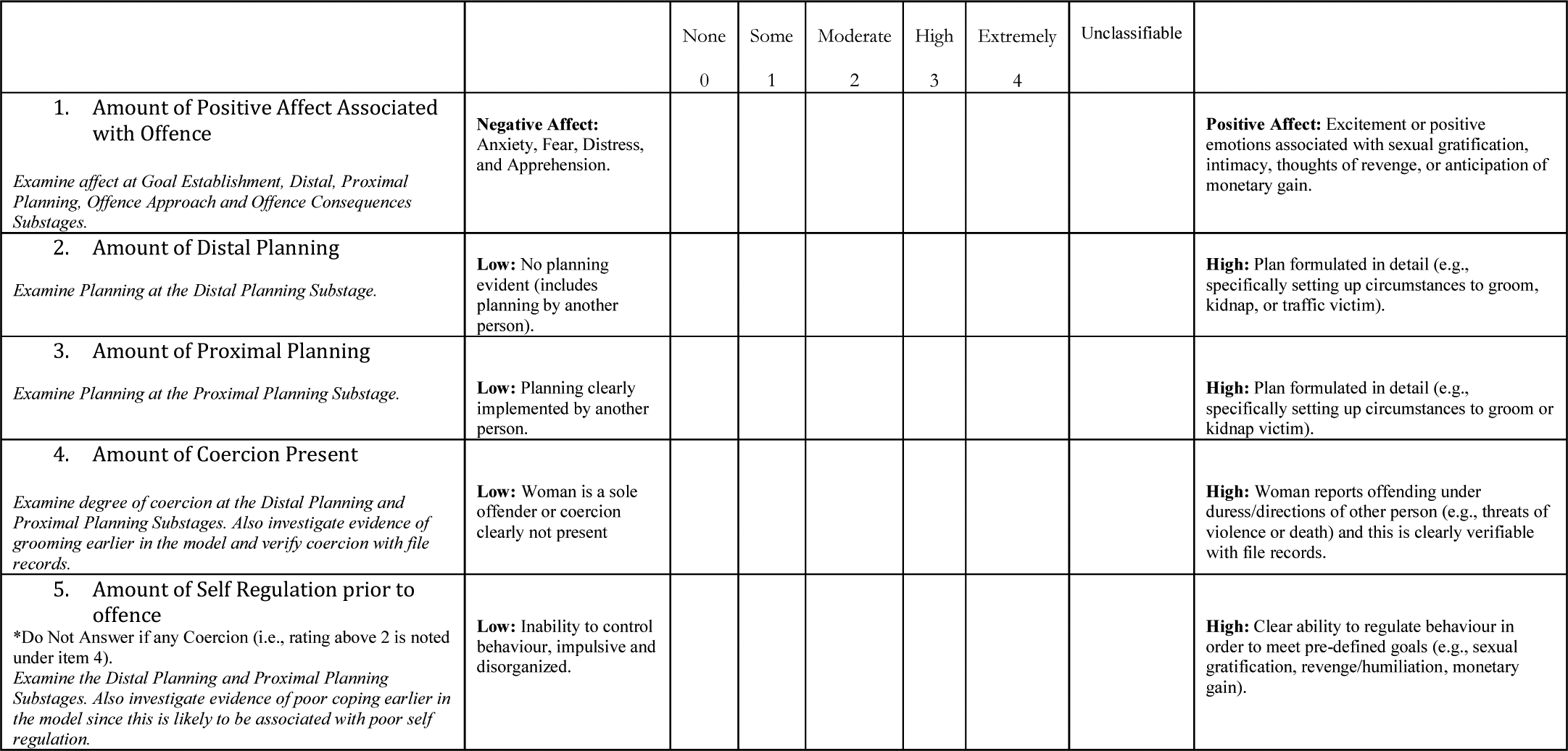
Two independent raters—who held postgraduate degrees in forensic psychology—were asked to assess each participant interview and assign it according to either (a) one of the three offense pathways outlined by Gannon et al. (2008, 2010, 2012) or (b) as unclassifiable due to lack of information or the possible presence of a previously unidentified pathway. In circumstances of dispute between raters, a third rater—the primary author of the DMFSO (TAG)—made the final overall assignment. To ensure intrareliability or stability of coding, raters received substantial training from the first author on the DMFSO and its constituent pathways and were required to correctly classify six interview scripts taken from Gannon et al. (2008) prior to rating the interviews outlined in this study. To encourage focused and reliable classification, raters were given the Offense Pathway Checklist described in Gannon et al. (2012; see Figure 1). This checklist—constructed to aid clinical judgment of basic offense styles and treatment needs—assesses five main areas associated with the preoffense and offense stages of the DMFSO: (a) amount of positive affect, (b) distal planning, (c) proximal planning, (d) coercion, and (e) self-regulation style. Raters rate each aspect on a scale from 0 to 5 to aid their classification of offense style.
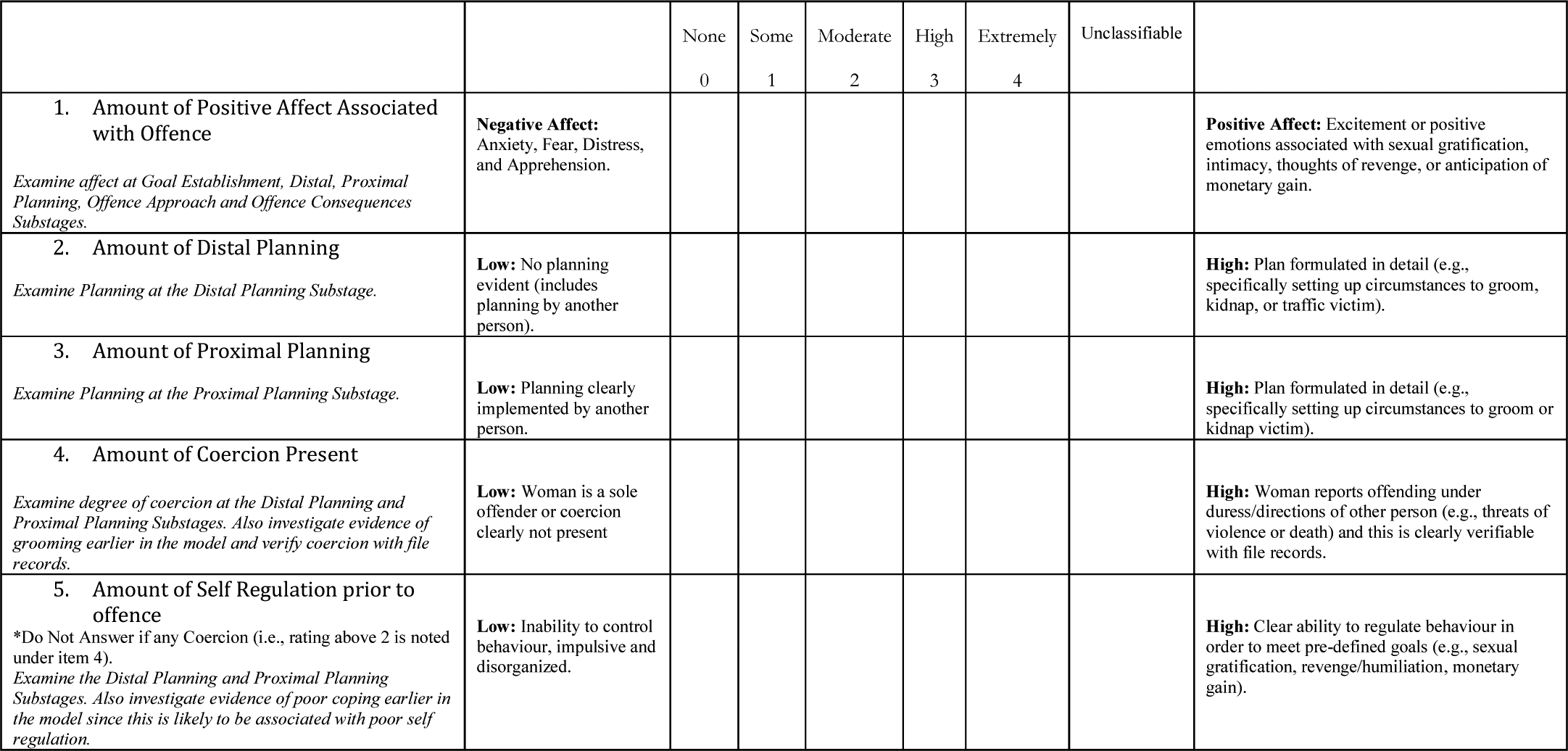
Preliminary offence pathway checklist for female sexual offenders.
Interrater reliability was calculated using Cohen’s kappa (κ). Using Landis and Koch’s (1977) guidelines for interpretation, we interpreted κs 0.41 to 0.61 as moderate, 0.61 to 0.80 as substantial, and 0.81 to 1.00 as almost perfect.
Procedure
The majority of data (>80%) were collected by the first author at Arizona State Prison Complex. The remainder were collected at Correctional Services Canada by a research assistant. Offense-relevant information and demographic details were attained via self-report and file records where possible. The interview procedure outlined in Gannon et al. (2008) was used by both interviewers to collect offense narratives. Interviews were recorded by audio recorder. In brief, the semistructured interview schedule contains questions about the participant’s childhood, early adulthood, factors leading up to and including the offense, and factors occurring immediately postoffense. The questions within the interview procedure were used as a guide and interviewers adapted questioning for each individual participant’s circumstances. Two participants did not consent to their interviews being recorded, and so handwritten notes were taken instead. A further Canadian French speaking participant was interviewed in French and the interview translated verbatim into English. Because each participant’s offense narrative was unique, recorded interviews (N = 34) varied in length from 27 min to 129 min (M = 55.16; SD = 19.00). Validity of interviews was examined, wherever possible, via consultation with psychology staff who held access to confidential file information. It should be noted that we did not attempt to examine any possible differences between the U.S. and Canada samples since the overall aim of this study was to examine whether the DMFSO could adequately categorize a range of offenders. Thus we do not assume that the U.S. and Canada samples are equivalent and neither do we assume that either sample are representative of U.S. or Canadian female sexual offenders. The study was reviewed and approved ethically by the University Research Ethics Committee.
Results
Evidence of Pathway Membership
Overall pathway classification agreement made by raters was 83.3% and overall interrater reliability of these judgments was κ = 0.77, 95% CI [0.60, 0.94]. This represents a substantial level of agreement according to Landis and Koch’s (1977) guidelines for interpretation. The most reliable pathway classifications were those made for Directed-Avoidant women. Here, there was 100% agreement between raters of pathway membership. This pathway was the largest in number (n = 12) representing approximately one third of the overall sample. The remaining pathway classifications for Explicit-Approach, Implicit-Disorganized, and Unclassified women each received a total agreement percentage of 60%. Following the final decisions made by the third rater, the classifications were 10 women as Explicit-Approach (27.8%), 8 as Implicit-Disorganized (22.2%), and 6 as Unclassified (16.7%). Of the six disagreements between raters, two thirds appeared to revolve around a general confusion between Explicit-Approach and Implicit-Disorganized women. Here, raters often appeared to categorize the implicit planning and positive affect associated with some Implicit-Disorganized women as the more extensive explicit planning profile characterizing Explicit-Approach women. Furthermore, a relatively large number of women were categorized as Unclassified. However, no rater highlighted the presence of any pathways over and above those specified by the DMFSO. Instead, the relatively large number of scripts categorized as Unclassified—similarly to Gannon et al. 2008—appeared to reflect either missing and/or unverifiable information (e.g., claims of coercion). As such, the large number of unclassified women appears to represent relative coding cautiousness. Notably, these unclassified women could not be differentiated from coded women on any key demographic variables. Figures 2 to 4 summarize the overall patterns of each pathway type (for each individual participant) across the five main areas associated with the preoffense and offense stages of the DMFSO as indicated via the Offense Pathway Checklist used by raters. 2 The perceived motivations of each participant are also presented. Figure 2 illustrates that Explicit-Approach women were generally characterized by moderate-high levels of positive affect, notable planning at the distal and proximal stages, low levels of coercion, and moderate to high levels of self-regulation. However, their motivations for offending were various and included intimacy, revenge/humiliation, sexual gratification, and financial gain. Figure 3 illustrates that Directed-Avoidant women showed a clear pattern of characteristics since they were all characterized by low levels of positive affect, and planning, but moderate to high levels of coercion. These women appeared to evidence only two main motivators to offend: fear of their male coperpetrator, or a desire to please their coperpetrator via offending so as to increase intimacy. Finally, as Figure 4 illustrates, the Implicit-Disorganized women were characterized by low levels of planning and impoverished self-regulation. These women displayed varying levels of affect and motivators (e.g., intimacy, revenge/humiliation, sexual gratification).
A schematic overview of offence pathway checklist allocations across two raters: Explicit-Approach.
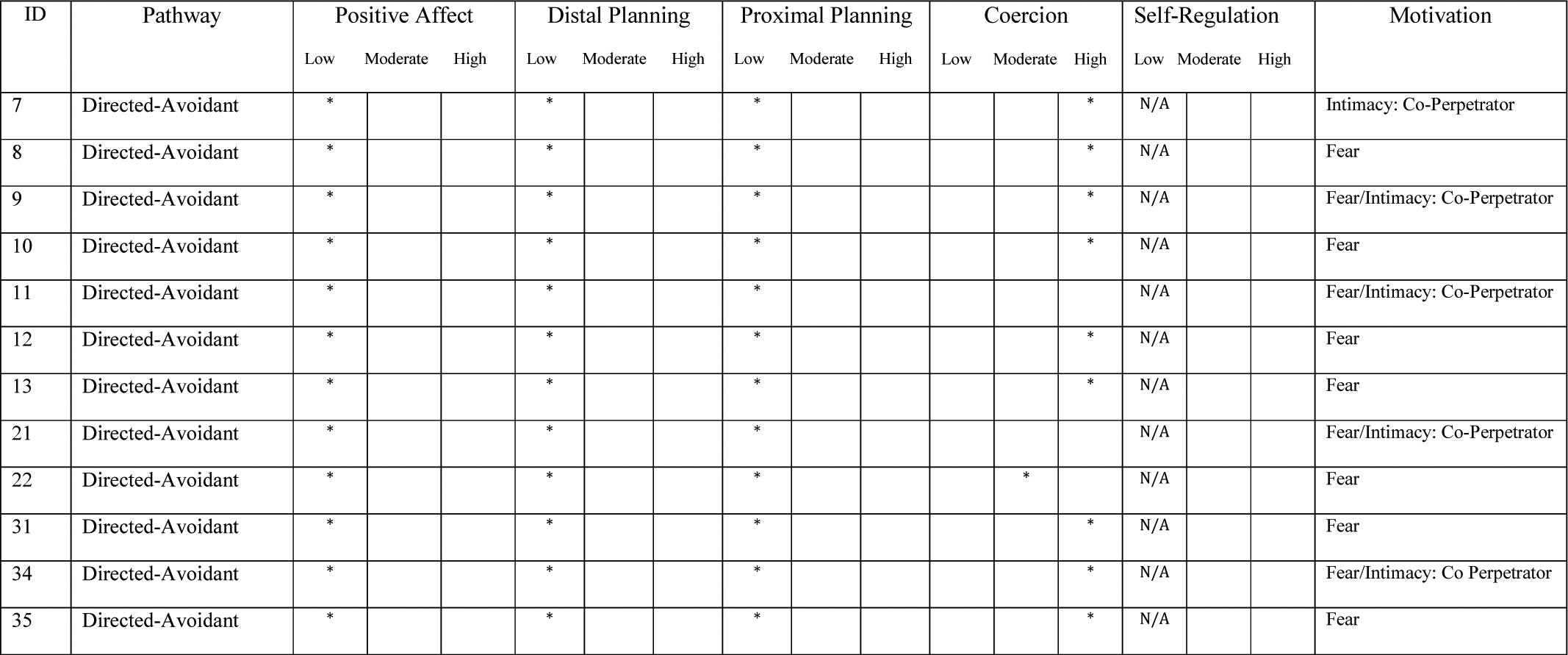
A schematic overview of offence pathway checklist allocations across two raters: Directed-Avoidant.
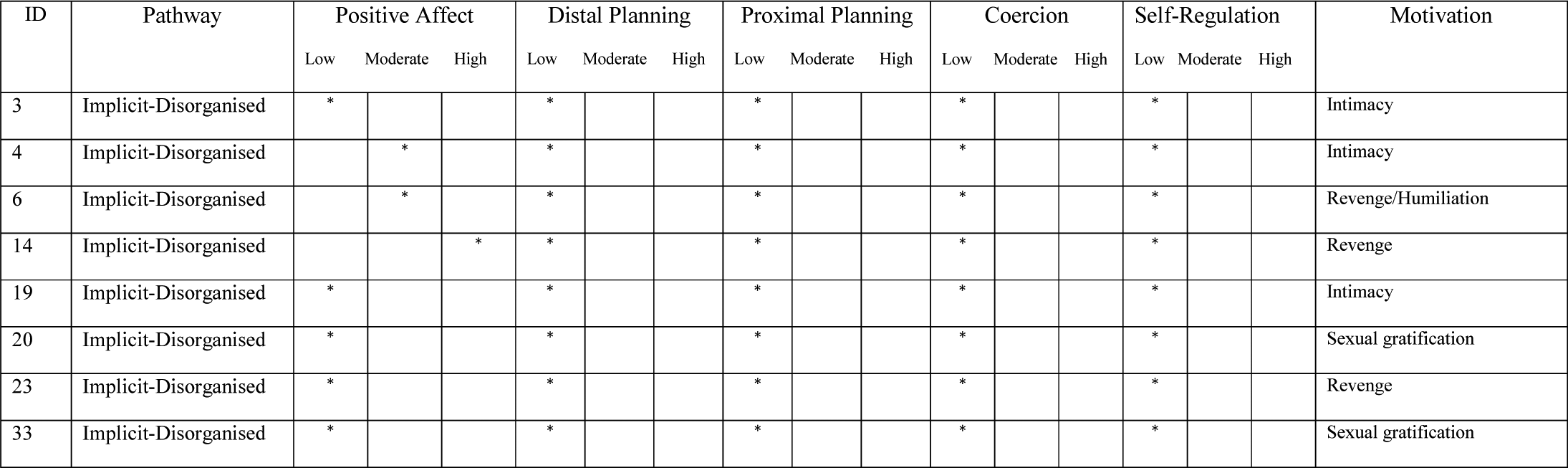
A schematic overview of offence pathway checklist allocations across two raters: Implicit-Disorganised.
Discrimination of Pathways on Key Demographic and Offense Factors
Table 1 outlines key demographic and offense data across each of the three pathways. As illustrated in Table 1, three main differentiations are evident. First, Explicit Approach pathway women held significantly longer records of formal education than the Directed Avoidant pathway. Second, Directed-Avoidant pathway women held significantly greater numbers of victims on their offense record than Explicit-Approach pathway women. Finally, the Implicit-Disorganized pathway and Explicit-Approach pathway women hold higher numbers of general crimes on their offense record compared to the Directed-Avoidance pathway. No other differences across the pathways were detected.
Demographic and Offense Information for each of the Identified Pathways.
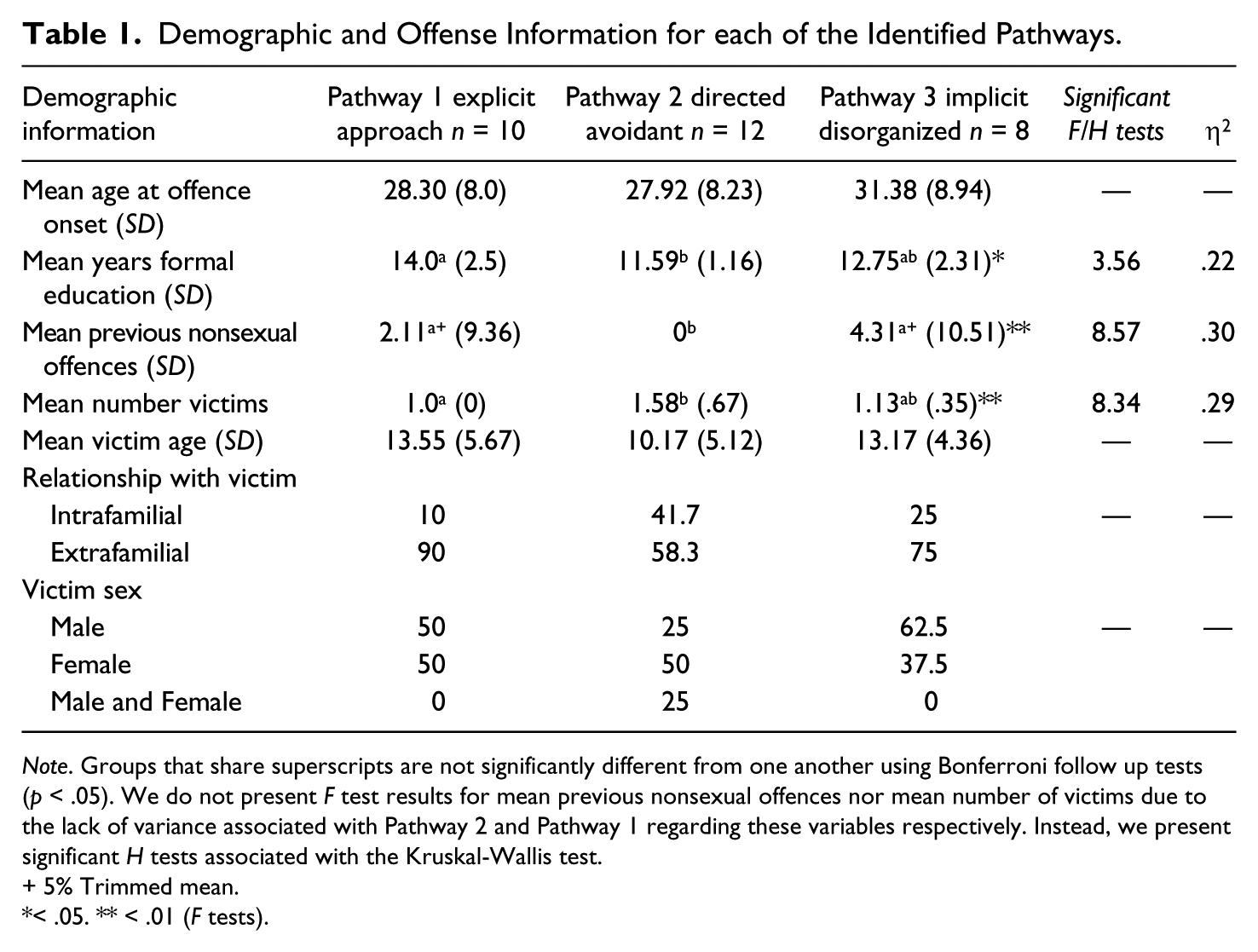
Note. Groups that share superscripts are not significantly different from one another using Bonferroni follow up tests (p < .05). We do not present F test results for mean previous nonsexual offences nor mean number of victims due to the lack of variance associated with Pathway 2 and Pathway 1 regarding these variables respectively. Instead, we present significant H tests associated with the Kruskal-Wallis test.
5% Trimmed mean.
< .05. ** < .01 (F tests).
Discussion
The present study found that the DMFSO had variable success as a descriptor of the offense styles of a sample of North American women who have sexually offended. In brief, when two independent raters used the DMFSO as a guide to pathway allocation—they were able to classify the majority (83.4%, n = 30) of a small sample of female sexual offenders at a rate of 77% (Kappa corrected). However, it should be noted that although agreement was 100% for the directed coerced pathway, it was less substantial for the remaining two pathways (i.e., only 60%). Thus it seemed that raters had some difficulty in identifying each of these pathways. Interestingly, at least for the current sample, we found that while the Explicit-Approach and Implicit-Disorganized pathways appeared to be characterized by various motivations, the Directed-Avoidant pathway women demonstrated only two motivators for offending: fear (of their coperpetrator male) or intimacy (i.e., offending to gain intimacy with their coperpetrator). This may explain, in part, why the raters agreed in total when making ratings for women in this pathway. Unlike previous typological explanations of female sexual offending (e.g., Faller, 1987), the DMFSO does not group participants together based on simple offense characteristics but rather on a cluster of factors associated with offense style or method (i.e., planning, affect, coercion, self-regulation). Consequently, numerous pathway indicators require consideration prior to pathway categorization and one pathway may contain various women characterized by differing offense characteristics and motivations (e.g., a male accompanied women might be allocated to Explicit-Approach as might a more “preferential” abuser of children). Such variation is likely to require some significant skill on the part of the raters. Notably, the raters that we employed were postgraduates who are not fully qualified forensic practitioners. Thus it would be interesting to see if ratings might differ substantially according to clinical experience.
In addition, when the resultant pathways were subjected to demographic/offense variable comparisons, there were three main discriminating variables: years of formal education (Explicit-Approach women held—on average—2.41 more years of education relative to the Directed-Avoidant pathway women), number of victims (Directed-Avoidant pathway women held—on average—.58 more victims on record than the Explicit-Approach pathway), and the number of previous general offenses appeared to differ across the groups (Implicit-Disorganized and Explicit-Approach women held significantly more previous offenses on file relative to the Directed-Avoidant pathway women who did not hold any previous offenses). However, the pathways were not generally discriminable on factors that might indicate some type of victim preference (i.e., victim age, relationship to victim, or victim sex), and neither were pathways differentiable according to age of offense onset.
The present findings show that the DMFSO represents a reasonable descriptor, overall, of the offense styles of this North American sample of incarcerated women who have committed sexual offenses. Of particular note is the fact that neither of the independent raters suggested the possible presence of any new offense styles or pathways despite the fact that this represented a viable classification option. This appears to suggest that the DMFSO—at least at the very broadest level—is tapping into key variables associated with three prominent offense styles. Our preliminary findings also suggest that the Offense Pathway Checklist represents a somewhat useful aid to judgments of basic offense styles (see Gannon et al., 2012). The validity and meaning of the demographic/offense variable comparisons is a little less clear. While it seems reasonable, for example, that Explicit-Approach pathway women would evidence higher levels of formal education—which would enable them to effectively plan their offence relative to the Directed-Avoidant pathway—it is unclear why other variables were not more discriminable across the pathways. Clearly, low participant numbers will have played a role here (our power calculations illustrate that more than 200 participants would be required to detect a small effect, with adequate power [i.e., .80], for example), and we invite future researchers to use larger numbers of participants (perhaps using offense narratives from treatment), which might ensure a larger sample could be tested.
Of particular importance to note, perhaps, is the fact that the women that we have used in an attempt to validate the DMFSO are those who have been caught for their offending and subsequently convicted. As many professionals have noted, female sexual offenders in particular are less likely than their male counterparts to be convicted for their offenses due to numerous biased assumptions about women as “nurturers” that operate at the broad societal level (Bunting, 2007; Saradjian, 1996). Consequently, we should not assume that the sample used in this study is entirely representative of female sexual offenders generally. In addition to this, as previously noted, the raters that we asked to conduct the pathway categorization task were postgraduates who had not yet completed forensic-clinical training. Consequently, it is possible that they may have been less critical relative to more experienced clinicians and may not have been so vigilant in the detection of other possible pathways. Given that the primary author of the DMFSO made the final categorizations when disagreements arose, skill of the initial raters in detecting other possible pathways appears imperative.
The data described in this study were derived from self-report interviews. Thus, although every effort was made to ensure the accuracy of information obtained within these interviews, it is possible that participants misrepresented their narratives in some way; particularly in an effort to minimize culpability. This represents a problem for all self-report data, which might only be minimized by elaborate tests of validity in the form of the polygraph or bogus pipeline type procedures (see Gannon, Keown, & Polaschek, 2007). Future studies might also want to examine whether the pathway checklist items can be more easily obtained using a quantitative approach, which may be less vulnerable to social desirability bias or at least incorporate some measurement of social desirability. A further limitation relates to the limited numbers of offense/demographic variables—due to restricted access—that we were able to compare across the various pathways. For example, it would have been informative to have compared the various pathways according to factors such as IQ, relationship status during offense, and level of force used in offense. It would also have been informative to have compared each of the pathways according to key psychological characteristics such as assertiveness, problem solving, coping style, impulsivity, and general personality traits using validated psychometric tests. We predict, for example, that Explicit-Approach offenders would show higher levels of assertiveness, problem-solving skills, and adaptive coping styles relative to the other two pathways. Furthermore, we predict that Implicit-Disorganized offenders would show relatively higher levels of impulsivity relative to the other two pathways. A final limitation relates to the fact that our sample, and the sample on which the DMFSO is derived, represents incarcerated prison populations. Consequently, it is unclear whether any new pathways and/or offense style characteristics would emerge were the DMFSO to be tested with other samples (e.g., community-sentenced females, those committed to mental health facilities, or those who have gone undetected).
Given these limitations, what, if any treatment implications do the DMFSO pathways hold? Given the current level of empirical support for the pathways (which is still being established), we suggest that researchers and clinicians use the offense pathway checklist with their clients transparently. For example, therapists can explain to clients that the pathways and associated checklist is still being tested and ask them to reflect on their offense style (or styles if multiple offenses are present) to see if they feel there are any similarities between their own offending and factors outlined within one or more of the pathways. This transparent presentation of the DMFSO can then service to promote collaborative analysis and exploration between therapist and client, promoting healthy exploration and a strong therapeutic alliance. Female sexual offenders are still an underresearched population, and few are likely to reside in the same correctional establishments. Consequently, such women may feel “unheard” or that their experiences are being likened to those of their male counterparts (see Ashfield, Brotherston, & Eldridge, 2010). Thus using a theory that has clearly been developed from other women’s experiences might be helpful in convincing clients that their practitioners are well informed and are attempting to work from a gender-sensitive perspective. Clearly, we do not hold all of the answers to understanding female-perpetrated sexual offending as yet. However, we can share currently developing knowledge with our clients.
Footnotes
Acknowledgements
We are grateful to the research assistants who helped to collect and transcribe interviews (Kim Allenby, Katie Grimwood, Azina Hoyle, Monika Khawaja, Amie Miles) and also our participants who were so forthcoming and helpful. The views expressed are those of the authors and do not necessarily reflect those of Arizona Corrections or Correctional Services Canada.
Declaration of Conflicting Interests
The author(s) declared no potential conflicts of interest with respect to the research, authorship, and/or publication of this article.
Funding
The author(s) received no financial support for the research, authorship, and/or publication of this article.