




Abstract
Although recent typologies of female sexual offenders have recognized the importance of having a co-offender, the clinical characteristics of solo and co-female sexual offenders remain poorly understood. The aim of this study was to compare solo (n = 20) and co- (n = 20) female sexual offenders on a variety of clinical characteristics. It was found that although solo and co-offenders reported similar developmental experiences and psychological dispositions, differences were found in environmental niche, offense preceding, and positive factors. Specifically, solo offenders demonstrated a greater presence of personal vulnerabilities including mental health and substance abuse difficulties. Co-offenders reported a greater presence of environmentally based factors, including a current partner who was a known sex offender and involvement with antisocial peers. It is suggested that these results have implications for understanding assessment and intervention needs for these groups of sexual offenders.
Introduction
Female sexual offending has typically generated considerably less interest when compared with that of male sexual offending. A seemingly relative lack of interest in female sexual offending may in part reflect an assumption among professionals and the general public that females rarely, if ever, commit sexual offenses (Wakefield & Underwager, 1991). Such a view is consistent with a tendency in Western society to view females as “protectors” or “nurturers” who aggress only when provoked by a male (Saradjian, 2010). However, it has been suggested that such attitudes may affect the reporting of female-perpetrated sexual offenses (Saradjian, 2010), and therefore distort prevalence estimates.
Based on data collected from sex offender registers in New York (Sandler & Freeman, 2009) and Texas (Vandiver & Kercher, 2004), less than 2% of all registered sexual offenders appear to be female. However, such estimates may vary depending on several factors, including the method of data collection (criminal justice records versus victim self-report) and the gender of the victim (Saradjian, 2010). Nonetheless, Cortoni and Hanson (2005), and Cortoni, Hanson, and Coache (2009), drawing on both victimization surveys and official records from Canada, the United Kingdom, the United States, Australia, and New Zealand, estimate that females account for roughly 5% of all sexual offenders.
Although prevalence rates for female-perpetrated sexual offenses would appear to be considerably lower than those for male sexual offenders, female-perpetrated sexual offenses nonetheless account for a sizable number of victims and offenders who are in need of clinical attention (Gannon & Cortoni, 2010). Despite the absence of known risk factors for female sexual offense recidivism, clinical research suggests that observable characteristics include female-specific offense-supportive cognitions; early victimization; and periods of severe sexual, violent, and emotional abuse (Gannon & Cortoni, 2010). Although many of these clinical characteristics overlap with observed risk factors for male sexual offending, Cortoni (2010) and Cortoni and Gannon (2013) argue that these characteristics may manifest themselves in different ways for females and males. Furthermore, these characteristics may not apply equally to different types of female perpetrators (Muskens, Bogaerts, van Casteren, & Labrijn, 2011).
Based on the offense characteristics of 16 female sexual offenders, Mathews, Matthews, and Speltz (1989) describe teacher/lover, predisposed, and male-coerced types of female perpetrators. The male-coerced category has been further developed by Nathan and Ward (2001) to include compliant victim, rejected/revengeful, and willing/ally subgroups. Here, Nathan and Ward distinguish between motivations that reflect either an exaggerated dependency on males, or feelings of rejection by a child itself or a male partner in favor of a child. Despite this focus on male-coerced subtypes, Harris (2010) notes that various typologies, including those developed by Sandler and Freeman (2007), Sarrel and Masters (1982), and Vandiver and Kercher (2004), fail to include the involvement of a male co-offender as a categorizing variable.
The importance of the presence or absence of a co-offender in developing typologies of female sexual offenders is acknowledged in a study of 232 adult females reported to the FBI from 21 states (Vandiver, 2006). Results showed that there were no significant differences in age, ethnicity, location, and type of offense for solo and co-offenders. However, co-offenders were significantly more likely to have multiple victims, familial victims, male and female victims, and previous convictions for non-sexual offenses (Vandiver, 2006). Differences between solo and co-offenders were also investigated by Muskens et al. (2011), who examined offense, victim, and offender characteristics of 60 adult female sexual offenders referred for psychiatric and/or psychological evaluation in the Netherlands. They found that both solo and co-offenders had a similar number of victims, were equally likely to have victims under the age of 13, and showed similar numbers of previous sexual, violent, and any convictions. Also, like Vandiver (2006), they found that solo offenders were more likely to have an unrelated or a male victim, whereas co-offenders were more likely to have a female victim.
In addition, Muskens et al. (2011) also found that the groups differed on mental health diagnoses, with a higher percentage of solo offenders presenting with a diagnosis of any Diagnostic and Statistical Manual of Mental Disorders, Fourth Edition (DSM-IV; American Psychological Association [APA], 1994) Axis I disorder, or a mood disorder in particular. Although non-significant, Muskens et al. also found that co-offenders in their sample had a higher mean number of DSM-IV personality disorders than solo offenders. This is in line with Vandiver’s (2006) data, which found that co-offenders were significantly more likely than solo offenders to have been arrested for a non-sexual offense. The two authors however suggest alternate interpretations for these findings. Vandiver appears to suggest that co-offenders may be more prone to general criminality. Muskens et al., on the other hand, suggest that co-offenders may be more prone to dependent personality disorders (e.g., Green & Kaplan, 1994), which make such individuals more vulnerable to manipulation and coercion into deviant sexual acts. Nathan and Ward (2001) also highlighted the fact that although female offenders are more likely to be given diagnoses of borderline personality disorder and men more likely to be diagnosed with antisocial personality disorder, female sexual offenders also possess antisocial characteristics. Wijkman, Bijleveld, and Hendriks (2011) found that females who co-offended with a male partner were more likely to be “specialists”—women who have committed multiple sexual offenses but only few other (typically minor) offenses—rather than generalists, the general prototype of the antisocial offender, or “once only” offenders. Specialists in their sample, as in previous studies, also victimized both males and females, and targeted children who were relatives or acquaintances.
Observed clinical characteristics for female sexual offenders during childhood include frequent and severe levels of childhood sexual victimization, neglect, bullying, and physical and emotional victimization (Christopher, Lutz-Zois, & Reinhardt, 2007; Gannon, Rose, & Ward, 2008; Kaplan & Green, 1995; Strickland, 2008; Turner, Miller, & Henderson, 2008; Wijkman, Bijleveld, & Hendriks, 2010). Clinical characteristics in adulthood include sexual and/or physical victimization (Gannon et al., 2008; Turner et al., 2008; Wijkman et al., 2010), personality disorder, mental illness, drug and alcohol use (Miller, Turner, & Henderson, 2009; Muskens et al., 2011; Strickland, 2008; Turner et al., 2008; Wijkman et al., 2010), relationship problems, intimacy deficits, and sexual abuse supportive cognitions (Gannon et al., 2008; Grayston & De Luca, 1999; Nathan & Ward, 2002).
Recent work has also attempted to identify the cognitive and motivational characteristics of female compared with male sexual offenders (e.g., Kaufman, Wallace, Johnson, & Reeder, 1995). Beech, Parrett, Ward, and Fisher (2009) drew on distorted schema patterns work with male sexual offenders and attempted to identify the presence or absence of offense-supportive thinking patterns among female sexual offenders. These thinking patterns, otherwise termed “offense-supportive cognitions” or “Implicit Theories” (ITs), are defined by Ward (2000) as complex and integrated sets of cognitions and desires that an individual uses, unconsciously, to explain and predict the nature of the world around him or her. Ward initially suggested there are five ITs: (a) children as sexual objects (the belief that children are capable of enjoying and desiring sex), (b) dangerous world (the idea that the world is inherently threatening and that people are malevolent, such beliefs can lead to either proactive attacks on others, or avoidance and submissive behavior), (c) uncontrollability (the belief that the world is uncontrollable and that events just happen to people), (d) nature of harm (the belief that there are degrees of harm and that some sexual acts are beneficial and do not cause harm), and (e) entitlement (the belief that some people are superior to others and therefore have the right to have their needs met).
Based on the transcripts of interviews with 15 female sexual offenders, Beech et al. (2009) found evidence for four of the five ITs identified in male sexual offenders (all but the entitlement IT). However, they suggested that the content of female sexual offenders’ offense-supportive cognitions appears to differ markedly from that of male sexual offenders. For example, Gannon, Hoare, Rose, and Parrett (2010) note that female sexual offenders’ offense-supportive cognitions included gender specific content such as female abuse not as harmful as male, partner’s needs greater than victims, males viewed as threatening, and men control the actions of women. In addition, the offense-supportive cognitions of female solo and co-offenders may differ, with females’ ITs of dangerous world, nature of harm, and uncontrollability often attributed to the presence of another person or co-perpetrator (Beech et al., 2009).
The findings outlined above suggest that the motivational characteristics of male and female sexual offenders can differ (Eldridge, Elliott, & Ashfield, 2009; Gannon et al., 2008) and are consistent with the need for a gender specific approach in working with sexual offenders (Ashfield, Brotherston, Eldridge, & Elliott, 2013; Eldridge & Saradjian, 2000). It is further emphasized by Cortoni (2010) and Cortoni and Gannon (2013) that there are a number of female-specific factors that must be considered when working with female sexual offenders, including childhood sexual, violent, and emotional abuse; adult mental health; intimacy deficits; and sexual abuse supportive cognitions. However, although others have outlined differences in the victim and offense characteristics of solo and co-offenders, potential differences in the clinical characteristics of these two groups remain relatively poorly understood. Therefore, the aim of this study was to compare the clinical characteristics of solo and co-female sexual offenders. Here we aimed to consider differences in developmental factors including early childhood abuse and parental relationships; psychological dispositions, including self-regulation and offense-supportive cognitions; and environmental niche factors. The environmental niche refers to the presence or absence of factors that can shape and be shaped by the environment (Ward & Beech, 2006) and includes factors such as sexual dissatisfaction, offense history, and living in a high risk area. We also investigated potential differences in offense preceding factors including negative mood and abusive fantasies, as well as positive factors that might protect against sexual offending and support treatment progress. We hypothesized as follows:
Method
Ethical Approval
Approval for the research was granted by the University of Birmingham Science, Technology, Engineering, and Mathematics (STEM) Ethical Review Committee. All procedures indicated by the British Psychological Society were adhered to in this study.
Design
A modified version (Version 2.0) of the Assessment Guidance Framework for use with Women Who Sexually Abuse Children (Elliott, Eldridge, Ashfield, & Beech, 2010), referred to from here on in as The Framework, was used in the research, to code for the presence or absence of the following clinical characteristics: (a) developmental factors, (b) psychological dispositions, (c) environmental niche factors, (d) offense preceding factors, and (e) positive factors which may support the offender in making positive changes. Furthermore, we coded each case for the presence or absence of offense-supportive cognitions and we compared the extent to which these were evident among solo and co-offenders.
Participants
The sample consisted of 40 female sexual offenders referred to the Lucy Faithfull Foundation (LFF), the United Kingdom, through the criminal justice or child protection systems in the United Kingdom. All of the participants were aged 18 years or older at the time of their offense, and had either been convicted of the offense in a criminal court, had a judge’s finding of fact against them in a family court, or had admitted to the offense. Case files that did not meet these criteria were not included in the study. Furthermore, there were no instances where a potential participant had acted as both a solo offender and a co-offender. These referrals were for assessment and/or intervention purposes. Table 1 provides information about the sample including age, and victim and offense characteristics.
Offender, Offense, and Victim Characteristics for Solo and Co-Offenders.

Ethnicity was known for 11 of the solo offenders, 9 of whom were White British, 1 was White Italian, and 1 was White American. Ethnicity was known for 9 of the co-offenders, all of whom were White British. Information from case files indicated that 45% of those who perpetrated with a co-offender were psychologically and/or physically coerced by their co-offender to engage in the sexual abuse of their victim. Contact offenses for the current sample included rape, indecent assault, gross indecency, and sexual assault. Non-contact offenses included facilitating a sexual offense, aiding and abetting sexual assault, and taking and distributing indecent images.
Measures
The assessment guidance framework for use with women who sexually abuse children: Version 2.0
The Framework was developed from an earlier version by Elliott et al. (2010). The original framework was developed to aid practitioners in assessing female sexual offenders in the relative absence of alternative guidance. Version 2.0 has been updated to include elements indicated by new developments in the field, including models of the offense process in female sexual offenders (Gannon et al., 2010; Gannon et al., 2008), and indirect measurements of offense-supportive cognitions (Gannon et al., 2010; Gannon & Rose, 2009). For each case, all items in The Framework that were found to be present were scored as 1, whereas all absent items were scored as 0. This allowed us to calculate the total number of items that were present for each scale/subscale. The current version of The Framework includes five primary scales as follows:
The Developmental Factors Scale contains six subscales assessing the presence of negative parental relationships; negative childhood environment; experiences of early emotional, violent, or sexual abuse; and other developmental factors.
The Psychological Dispositions Scale includes subscales assessing interpersonal factors, self-management/self-regulation, sexual self-regulation, and offense-supportive cognitions. The offense-supportive cognitions subscale also contains several distinct subscales that examine the presence or absence of cognitions relating to child as sexual being, nature of harm, entitlement, uncontrollability, dangerous world, and other directedness. Items relating to “other directedness” were included in Version 2.0 of The Framework and are consistent with the suggested application of four schema-theory concepts (abandonment, emotional deprivation, defectiveness/shame, and social isolation), derived by Young (1990), which Beech et al. (2009) argue may account for some of the additional features of female sexual offenders offense-supportive cognitions.
Various items included within these subscales were designed to assess the presence or absence of female-specific offense-supportive cognitions identified by Gannon et al. (2010), including female abuse not as harmful as male, partner’s needs greater than victims, males viewed as threatening, and men control the actions of women. The inclusion of these items in Version 2.0 of The Framework recognizes the importance of a gender specific approach to the assessment of female sexual offenders.
The Environmental Niche Factors Scale measures the presence of factors that can shape and reciprocally be shaped by the environment (Ward & Beech, 2006), with subscales measuring distal personal factors (e.g., sexual dissatisfaction, depression, and substance abuse), offense history, relationship problems, family problems, and proximal factors (e.g., living in high risk area, and antisocial peers).
The Offense Preceding Factors Scale contains a personal subscale to assess characteristics including negative mood states, abusive fantasies, and need for intimacy, whereas an environmental subscale examines factors including current partners who were known sex offenders, and other involvement with known offenders.
The Positive Factors Scale includes subscales assessing personal and contextual issues, factors indicative of treatment readiness, and factors that may support treatment progress.
Procedure
Data for use in this study were extracted from anonymized case files of female sexual offenders referred to the LFF between 1998 and 2009. Each anonymized file was coded for the presence or absence of each item in the five primary scales of The Framework. All case files were stored on-site at the LFF. Coding was carried out on-site by two of the authors; the second author examined each case file to identify the presence or absence of each item in The Framework, whereas the first author examined 20% of the files for the purposes of establishing inter-rater reliability.
The information contained within the files included a combination of the following: (a) a clinical report written by a LFF therapist—this report was constructed following a semi-structured clinical interview with the client; (b) a psychometric report (where available)—this would typically contain information about the client’s responses on self-report psychological measures of cognitive distortions, self-esteem, emotional loneliness, personality difficulties, victim empathy, and emotional regulation; and (c) other professionals’ reports (where available)—these were typically constructed by professionals within other organizations, for example, probation officers or social workers. The report written by the therapist was the consistent document available for all of the files. Other information was used where available to aid the researcher in identifying the presence or absence of each item. Where there was any doubt as to the presence or absence of an item, the item was coded as absent. Additional demographic, offense type, and victim information was also recorded. This additional information included offense type; sentence type; referral type; previous convictions; sex of victim; age of victim; relationship to victim; number of victims; and where relevant, sex of co-offender, and relationship to co-offender.
Intra-class correlation coefficients (ICC) were calculated to determine inter-rater reliability for the full scale, the individual scales, and the sexual abuse supportive cognitions subscale. ICCs indicated excellent inter-rater reliability and are reported in Table 2.
Intra-Class Correlation Coefficients and 95% Confidence Intervals for the Full Scale and the Individual Scales.
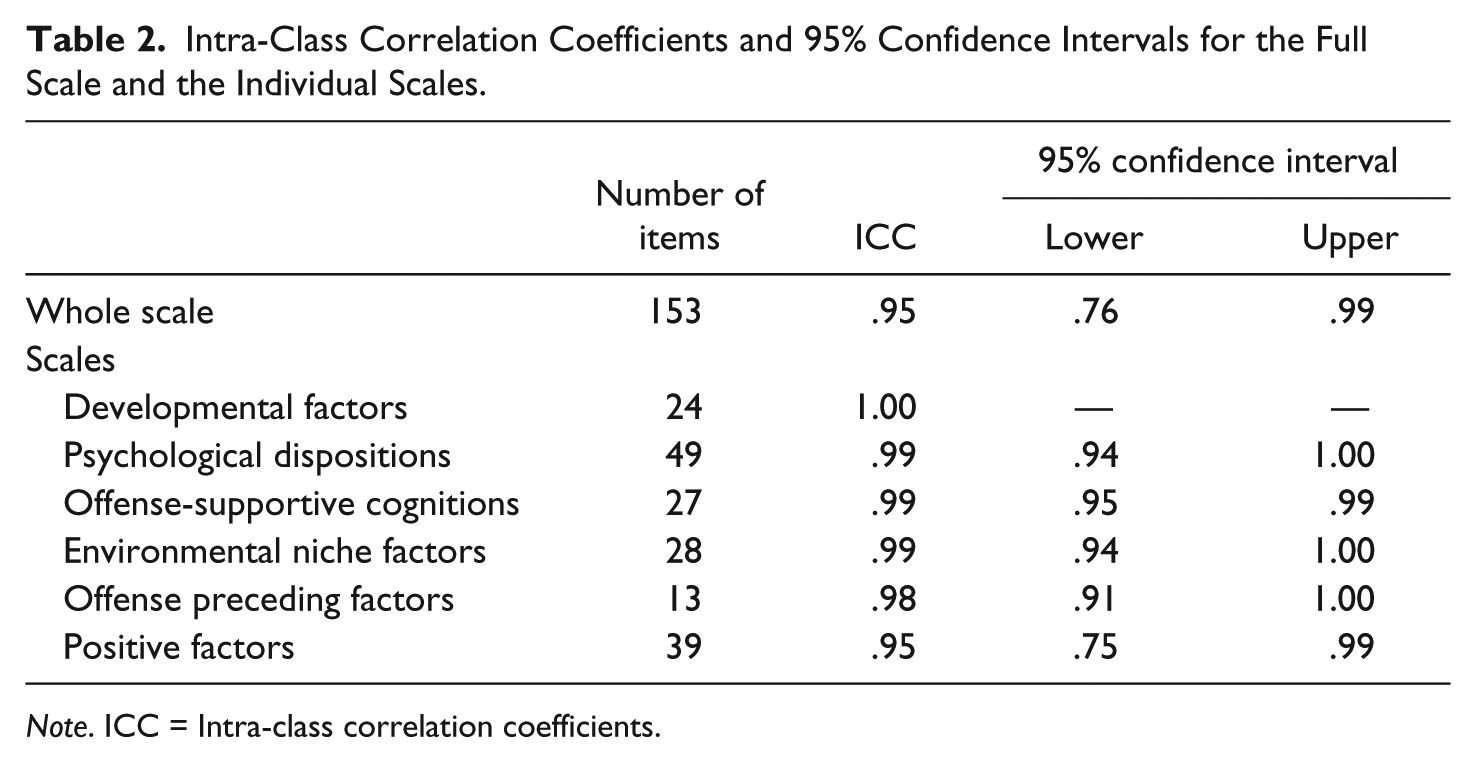
Note. ICC = Intra-class correlation coefficients.
Results
Scores were calculated for each participant by summing the number of items in each scale/subscale that were scored as present. To test the hypothesis that there would be significant differences in the clinical characteristics of solo and co-offenders, we conducted five multivariate analyses of variance (MANOVAs) to examine differences between solo and co-offenders on each of the five primary scales of The Framework and their associated subscales. A further MANOVA was used to examine the offense-supportive cognitions subscale (a subscale of the Psychological Dispositions Scale) in finer detail. This analysis allowed us to test the hypothesis that solo and co-offenders would show different patterns of offense-supportive cognitions. The statistical detail reported includes partial eta squared (
Tests of Hypothesis 1: Clinical Characteristics of Solo and Co-Offenders
Table 3 shows mean scores and standard deviations for solo and co-offenders on each of the five primary scales (Developmental Factors, Psychological Dispositions, Environmental Niche Factors, Offense Preceding Factors, and Positive Factors) and their individual subscales.
Mean Scores and Standard Deviations for Solo and Co-Offenders on Each Scale/Subscale.
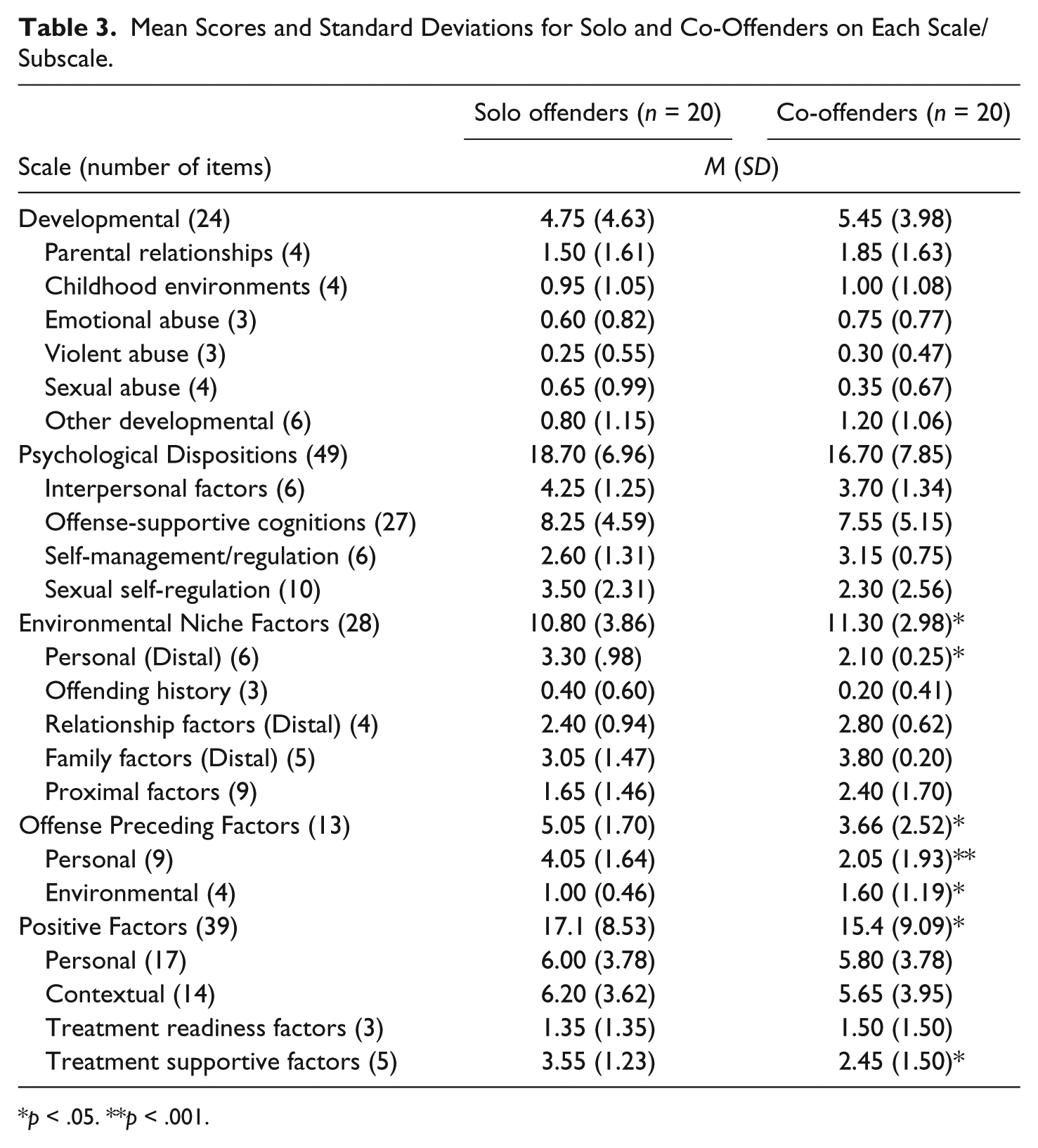
p < .05. **p < .001.
Developmental Factors
There was no difference between the two groups on the Developmental Factors Scale, Wilks’s lambda = .85, F(1, 38) = .94, p = ns,
Psychological Dispositions
The two groups did not differ on the Psychological Dispositions Scale, Wilks’s lambda = .79, F(1, 38) = 2.27, p = ns,
Environmental Niche Factors
A significant difference was found between solo and co-offenders on the Environmental Niche Factors Scale, Wilks’s lambda = .79, F(1, 38) = 3.41, p < .05,
Offense Preceding Factors
A significant difference was found between solo and co-offenders on the Offense Preceding Factors Scale, Wilks’s lambda = .65, F(1, 38) = 9.93, p < .05,
Positive Factors
A significant difference was found between solo and co-offenders on the Positive Factors Scale, Wilks’s lambda = .73, F(1, 38) = 3.16, p < .05,
Tests of Hypothesis 2: Offense-Supportive Cognitions of Solo and Co-Offenders
Table 4 shows means and standard deviations for solo and co-offenders on each of the offense-supportive cognitions subscales.
Means and Standard Deviations for Solo and Co-Offenders on the Child as Sexual Beings, Nature of Harm, Entitlement, Uncontrollable, Other Directedness, and Dangerous World Subscales of the Offense-Supportive Cognitions Subscale.
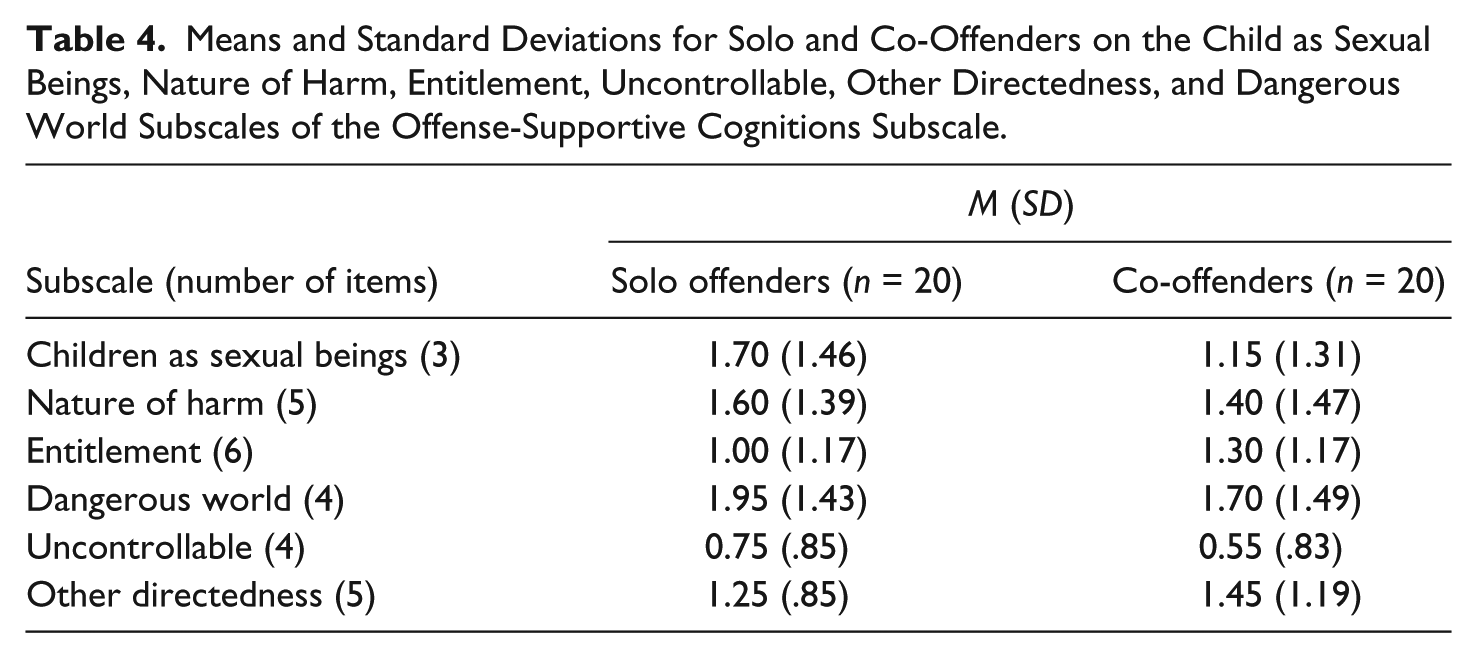
There were no differences in the extent to which solo and co-offenders showed evidence of offense-supportive cognitions, Wilks’s lambda = .89, F(1, 38) = .654, p = ns,
Percentage of Solo and Co-Offenders and the Total Sample Presenting With Offense-Supportive Cognitions.

Discussion
In the current study, we aimed to investigate potential differences in the clinical characteristics of female sexual offenders who offended with and without a co-offender. Although current typological frameworks recognize the importance of a co-offender in female sexual offending (Muskens et al., 2011; Vandiver, 2006), relatively little is known about the extent to which solo and co-offenders may differ in terms of their clinical characteristics. The results of the present study found significant differences between the groups in terms of environmental niche factors (e.g., substance abuse and depression), offense preceding factors including personal (e.g., negative mood states, and abusive fantasies) and environmental factors (e.g., current partner known sexual offender, and other involvement with known offenders), and positive factors (e.g., partner and family who are accepting of treatment, and a safe and supportive environment for change). However, no differences were found between solo and co-offenders in terms of developmental factors and psychological dispositions.
Although the majority of offenders showed some evidence of clinical characteristics relating to early development, including negative parental relationships, adverse childhood environment, and the experience of sexual, physical and/or emotional abuse, scores on these subscales did not differ between solo and co-offenders. Thus, although negative developmental factors have been consistently observed among female sexual offenders (Christopher et al., 2007; Gannon et al., 2008; Kaplan & Green, 1995; Strickland, 2008; Turner et al., 2008; Wijkman et al., 2010), we would suggest that the presence of such experiences may be equally common among solo and co-offenders.
We also failed to find any differences in psychological dispositions, including interpersonal factors, offense-supportive cognitions, self-management/self-regulation, and sexual self-regulation. However, despite this negative finding, it should be noted that these experiences may have a differential impact on the development of solo and co-offenders’ motivations for sexually abusing children (Cortoni, 2010; Cortoni & Gannon, 2013). There were also no differences between solo and co-offenders in the discrete categories of offense-supportive cognitions identified by Gannon et al. (2010). These findings are in contrast to the findings of Beech et al. (2009), who showed that solo and co-offenders differ with regard to cognitions relating to world as a dangerous place, nature of harm, and uncontrollability. The contrast between the results of this study and those of Beech and colleagues suggests that a more in-depth analysis of the offense-supportive cognitions of solo and co-offenders is needed.
Solo and co-offenders did however present with differences in environmental niche factors. Environmental niche factors included distal personal factors, offense history, relationship problems, family problems, and proximal personal factors. Results showed that solo and co-offenders differed in their experience of distal personal factors, with higher scores among solo offenders relative to co-offenders indicating higher rates of depression and other mental illness, as well as increased levels of sexual dissatisfaction, substance abuse, and denial. This finding is consistent with results showing that the mean number of DSM-IV Axis I disorders was more than 11 times greater for solo relative to co-offenders (Muskens et al., 2011). Also, it is noted by Muskens et al. (2011) that although there were no differences between solo and co-offenders on substance related disorder, post-traumatic stress disorder, or paraphilia, solo offenders were more likely to suffer from a disorder of mood. These findings add weight to earlier findings that showed elevated rates of depression or depressive symptomatology among female sexual offenders (Kaplan & Green, 1995; Lewis & Stanley, 2000), suggesting that this may be an area of particular concern when working with solo offenders. Solo and co-offenders however did not differ on offense history, relationship problems, family problems, or proximal personal factors.
Solo and co-offenders were also found to differ in the presence of personal and environmental offense preceding factors. Prior to their offense, solo offenders scored higher than co-offenders for personal factors, including negative mood states, abusive fantasies, need for intimacy, a need for power or dominance, and implicit and explicit planning. By contrast, co-offenders relative to solo offenders showed a greater number of environmental offense preceding factors, including the presence of current partners who were known sex offenders, other involvement with known offenders, and others simultaneously abusing the child. However, it should be noted that these findings would perhaps have been expected, with the majority of co-offenders in this sample offending with an intimate partner, and thereby automatically fulfilling the criteria for a number of these items.
Further evidence for a more negative environment among co-offenders relative to solo offenders was identified in an analysis of positive factors in these two groups. Here it was found that relative to co-offenders, solo offenders showed higher scores for items supportive of treatment progression, with items including a partner and family who were accepting and committed to resolution, a partner and family who were accepting of the treatment plan, and a safe and supportive environment for change. We identified no differences in solo and co-offenders for personal positive factors, contextual factors, or treatment readiness.
Although the findings reported here are in need of further replication, they may hold important implications for the assessment and treatment of female sexual offenders. For example, assessment of solo offenders may seek to understand the impact of personal and mental health issues, including depression, sexual dissatisfaction, substance abuse, and denial, as well as the role of personal offense preceding factors. Management strategies for solo offenders may therefore include the provision of mental health visits to monitor changes in drug use and negative mood states, as well as teaching fantasy management techniques. On the other hand, assessments of co-offenders may require a particular focus on environmental issues, including the presence of current partners who are known sex offenders, or other involvement with known offenders. The management of co-offenders may also benefit from a focus on addressing the possible absence of treatment supportive factors in this group. Based on the available clinical and research literature, Cortoni and Gannon (2013) emphasize the importance of treatment for all women, with treatment targets including offense-supportive cognitions, relationship problems and intimacy deficits—particularly among co-offenders—emotion regulation, and fantasy management. For women with a history of generally antisocial behavior, these authors also recommend a focus on antisocial attitudes, antisocial personality traits, and substance abuse problems.
Limitations
It should be noted that the findings observed in the present study may be limited by several factors. For example, although equal numbers of participants were recruited into solo and co-offender groups, results may be limited by a modest number of participants in each group (n = 20). Small sample sizes may have implications for statistical power with potential differences remaining undetected, particularly where effect sizes are indicative of meaningful differences between the two groups. Despite being statistically non-significant, effect size estimates indicated a large difference between the two groups on the sexual abuse and other developmental factors subscales of the Developmental Factors Scale, as well as the sexual abuse supportive cognitions subscales of the Psychological Dispositions Scale. However, it should be noted that with females accounting for a relatively low number of all sexual offenders (Cortoni et al., 2009), such criticisms are common for research of this type.
Limitations are also observed in the method for data collection, whereby the quality of data was dependent on the quality of the reports contained within the case files. These data may have been limited by participants’ abilities for introspection and to accurately report complex thoughts, feelings, motivations, and behaviors. Furthermore, participants may have demonstrated either positive impression management techniques or malingering during clinical interview. Although files were not subjected to multiple marking beyond the examination of 20% of all case files by a second marker, results from an ICC did indicate high inter-rater reliability, indicative of a good level of consistency between markers.
Conclusion
The results of the present study potentially shed new light on the clinical characteristics of solo and co-female sexual offenders. In particular, the findings reported here highlight the importance of personal factors including mental disorder and psychological vulnerabilities among solo offenders, while suggesting that co-offenders show a greater presence of environmental problems. Despite these findings, we would stress the shortcomings of seeking to categorize individual offenders into types in lieu of a comprehensive analysis of motivation in each individual. Furthermore, it should be noted that as yet, there is no evidence to support the concurrent validity of The Framework in terms of agreement with other, established measures of similar concepts. Also, the extent to which an individual’s score on The Framework relates to other outcome measures, including recidivism, remains uncertain. Indeed, such instruments do not equate to a method for assessing risk of reoffending, and although there is accumulating evidence for identifiable risk factors among female sexual offenders (Sandler & Freeman, 2009), relatively low rates of recidivism in this population lead to inherent difficulties in the accurate identification of risk factors for female sexual offenders.
Footnotes
Acknowledgements
The authors would like to thank Dr. Franca Cortoni and four anonymous reviewers for their helpful comments on an earlier draft of this article.
Declaration of Conflicting Interests
The author(s) declared no potential conflicts of interest with respect to the research, authorship, and/or publication of this article.
Funding
The author(s) received no financial support for the research, authorship, and/or publication of this article.