



Abstract
Athletes are cited as common perpetrators of sexual victimization and are at greater risk of becoming offenders compared with nonathletes. Demographic, lifestyle, and social characteristics of 624 nonathletes and 101 athletes from 21 U.S. Division I postsecondary educational institutions were assessed, with the updated Illinois Rape Myth Acceptance scale gauging endorsement of rape myths. Results indicate that athletes and nonathletes were similar in the degree of rape myth acceptance, with athletes reporting stronger agreement with rape myths than nonathletes did. Predictors of rape myth acceptance among nonathletes are multidimensional. In contrast, nondemographic characteristics like Greek membership, the number of alcoholic beverages consumed, and knowing a sexual assault victim predict rape myth acceptance for athletes, with gender not predicting rape myth acceptance nor different between genders of athletes. Policy implications and future research are discussed.
A number of athletes have been entangled in celebrated cases regarding rape and/or sexual assault on university campuses (Ziering & Dick, 2015). Approximately one in every seven claims of campus sexual assault between 2011 and 2013 identified the perpetrator as an athlete (United Educators, 2015). A disproportionately high number of sexual assault cases considering athletes accounted for 6% of the student body population at Division I universities (National Collegiate Athletic Association [NCAA], 2014).
White House involvement together with the establishment of a Task Force illuminated the issue of campus sexual assault and recognized the link to athletics. The Task Force is responsible for monitoring and promoting effective prevention strategies, the arbiter of universities appropriately exercising Title IX procedures (Krebs, Lindquist, Berzofsky, Shook-Sa, & Peterson, 2016), and a consultant with athletic associations (Obama, 2014). Discussion of campus sexual victimization that involved athletes was spurred by a 2015 documentary—The Hunting Grounds—that featured how universities downplayed athlete involvement in sexual assault allegations (Ziering & Dick, 2015). These academic institutions minimized the actions of athletes and ignored the welfare of the victims. Falsehoods like, “[a] rape probably didn’t happen if the girl has no bruises or marks” (McMahon & Farmer, 2011, p. 77) perpetuate rape myths, which are defined as “[p]rejudicial, stereotyped, or false beliefs about rape, rape victims, and rapists” (Burt, 1980, p. 217). Theoretically, a greater acceptance of such myths about rape leads to a greater inclination to the perpetration of sexually aggressive acts (Briere & Malamuth, 1983). Even so, predictors of rape myth acceptance (RMA) vary in their influence based on an individual’s background, personality, experience, and attitudes (Burt, 1980).
Individual attitudes, represented by a constellation of items, most notably, the acceptance of interpersonal violence, stood out as the strongest predictor of RMA (Burt, 1980). Subsequent research showed that the likelihood to perpetuate a rape or use sexual force/coercion is increased among students who exhibited a greater endorsement of rape-supportive attitudes and beliefs (Briere & Malamuth, 1983; Young, Desmarais, Baldwin, & Chandler, 2016). Compared with nonathletes, athletes are more likely to have reported using coercive sexual actions (Young et al., 2016).
Therefore, it is not surprising that athletes endorsed rape myths at greater levels than nonathletes did (Boeringer, 1999; Young et al., 2016). At the same time, athletic participation has also been identified as an uninfluential factor in RMA (Humphrey & Kahn, 2000; Murnen & Kohlman, 2007). Evidently, rape myths or rape-supportive attitudes operate differently among university athletes (Humphrey & Kahn, 2000; McMahon, 2007, 2010; Sawyer, Thompson, & Chicorelli, 2002). However, these conclusions are either based on a small set of students or schools or outdated RMA scales. Mixed results may have also resulted because of how studies liberally operationalized athlete and included club sport and recreational members to their sample of intercollegiate athletes. Furthermore, it is inconclusive whether nonathletes’ demographic, lifestyle, and social characteristics hold the same value to the athlete population when it comes to RMA. Given the wealth of empirical knowledge regarding university students’ RMA especially to that of athletes, coupled with the climate of campus sexual assault, it is crucial to identify as to why athletes are commonly cited as perpetrators of sexual assaults to clarify and advocate for empirically based preventive techniques of sexual victimization. Therefore, the present study will build upon the existing research by exploring how the characteristics of a multi-institutional set of Division I nonathletes and athletes are associated to the updated Illinois Rape Myth Acceptance (UIRMA).
University Students
Several demographic characteristics of university students showed relationships to RMA. There is an undisputed agreement that gender has been established as a predictor for rape myth beliefs. Males are more likely to endorse rape myths than females (Burt, 1980; McMahon, 2007, 2010; McMahon & Farmer, 2011; Morrow, 2010; Mulliken, 2005; Sawyer et al., 2002; Suarez & Gadalla, 2010; Swope, 2014).
Unlike gender, demographic characteristics such as age, education, race and/or ethnicity, and religiosity have shown mixed relationships with RMA. A meta-analysis indicated that age was not a significant predictor of RMA (Suarez & Gadalla, 2010). Other research has suggested that as a student continued through a postsecondary institution, the acceptance of rape myths decreased (Morrow, 2010; Swope, 2014). Similarly, university students with more education reported a lower adherence to rape myths (Suarez & Gadalla, 2010). Overall, the associations of age and education to RMA expressed either a rejection of rape myths or a lack of a relationship. Race has largely shown to be an uninfluential factor of RMA (Morrow, 2010; Sawyer et al., 2002; Suarez & Gadalla, 2010). However, Mulliken (2005) found that Asian/Pacific Islander students endorsed rape myths at greater rates when compared with Black and White students, and inferred that the relationship existed because of the culture’s endorsement of traditional patriarchal attitudes. Similarly, the link between religiosity and RMA has also shown mixed results (Freymeyer, 1997; Mulliken, 2005; Suarez & Gadalla, 2010). Mixed relationships between demographic characteristics and RMA may have resulted because these studies have based their findings on less than five postsecondary institutions and/or without the use of methodologically structured instruments.
For these reasons, it is uncertain the roles lifestyle (e.g., alcohol) and social characteristics (e.g., knowing a victim) will have when a larger body of students are assessed with an updated RMA scale that is ideal for capturing contemporary and subtle forms of rape myths. Consumption of alcohol resulted in an agreement with rape myths related to the assumptions held regarding women’s beliefs on sexually related issues (Morrow, 2010). In contrast, knowing a victim of rape and/or sexual assault was strongly related to a greater rejection of rape myths (McMahon, 2010; Swope, 2014). Additional empirical assessments across a larger number of universities are necessary to assess the relevance of these characteristics to students’ RMA and to identify what characteristics prevention programs should focus on to improve development and implementation procedures.
Perhaps the most frequently examined social characteristic of university students is Greek membership, which has been identified as a common predictor of RMA (Boeringer, 1999; Murnen & Kohlman, 2007; Swope, 2014). However, not all Greek organizations are the same. Fraternity membership has not always predicted RMA (Suarez & Gadalla, 2010). Service (as opposed to social) fraternity members endorsed rape myths at lower levels than nonservice fraternity members did (Swope, 2014). For this reason, respondents in the present study were questioned whether they are participants in a social Greek fraternity or sorority.
Athletes
Athletes are comparable with fraternities in that they are hypermasculine enclaves that promote rape-supportive attitudes (Boeringer, 1999). Athletes have been shown to exhibit a stronger link to hypermasculinity and a greater support of rape myths than fraternity members and nonathletes (Boeringer, 1999; Murnen & Kohlman, 2007; Young et al., 2016). Boeringer (1999) examined three groups (fraternity members, athletes, or nonmembers of both groups) of male students from a Division I postsecondary institution. Results revealed that fraternity members expressed greater support of rape myths than nonmembers did, with an even greater distinction of support between athletes and nonathletes. Since Boeringer (1999), it is unknown whether this distinction in RMA between intercollegiate athletes and nonathletes holds true nearly two decades later.
Demographic characteristics like age and ethnicity and its effect on university students and athletes’ RMA were similar. Sawyer et al. (2002) used a revised version of Burt’s RMA scale that included only 13 items, which was an RMA scale that McMahon and Farmer (2011) argued was no longer relevant to contemporary student populations due to its age, semantic usage, and the subtleties now present in RMA. Results showed that younger male (but not female) athletes (i.e., freshman and sophomores) supported rape myths at greater levels than older male athletes did. Compared with a majority of the student-based RMA literature, ethnicity was not a predictor of RMA for athletes. Outside of these demographics, Sawyer et al. (2002) had not explored the role of lifestyle and social characteristics on athletes’ RMA.
Alcohol has been, and continues to be, an enduring aspect of the athlete lifestyle and may contribute to the acceptance of rape myths. Athletes engage in frequent bouts of binge drinking (Brenner & Swanik, 2007; Yusko, Buckman, White, & Pandina, 2008). Male athletes consumed more and engaged in more frequent binge-drinking events than both their female counterparts (Brenner & Swanik, 2007; Yusko et al., 2008) and male nonathletes (Yusko et al., 2008). Furthermore, athletes from Division I (vs. Division II or III) postsecondary institutions reported the greatest rate of high-risk drinking (Brenner & Swanik, 2007) and supported the notion that Division I sports culture differed from Division II and III athletics.
Therefore, athletes must not be categorized as one group as there exist subcultures (e.g., Division I, individual/team-based sports, intramural athletes) with varying levels of support for rape myths or rape-supportive attitudes (Humphrey & Kahn, 2000; Sawyer et al., 2002). Like a subculture, Murnen and Kohlman (2007) argued that the small sizes of schools pressure students to conform to the beliefs held by those around them. Likewise, male athletes from team sports (e.g., football) endorsed rape myths at greater levels than those from individual sports (Sawyer et al., 2002). However, participation in team or individual sports was not an RMA predictor for female athletes as a whole.
But, Division I female athletes exhibited greater RMA endorsement than their Division II counterparts did, with division not a predictor of RMA among male athletes. Sawyer et al. (2002) argued that Division I female athletes likely adopted the traditional male rape myth attitudes because they have been introduced into a higher echelon of competitive sports. Athleticism, in conjunction with increased confidence, mental strength, and self-esteem contributed to the belief held by Division I female athletes that they are less likely to be victims of rape (McMahon, 2007). Female athletes engaged in victim blaming (more so than their male counterparts) and believed (nonathletic) women placed themselves in risky circumstances, and this justification places them at a potential risk or rape according to McMahon (2007). Therefore, rather than being the aggressor in a sexual encounter, Division I female athletes may be more susceptible to sexual victimization because they are less likely to recognize and/or report dangerous sexual encounters than their Division II counterparts (Sawyer et al., 2002). Thus, RMA operates differently between gender among athletes who engage in Division I athletics (McMahon, 2007; Sawyer et al., 2002).
Current Study
The purpose of the present study is to explore how RMA functions among university nonathletes and athletes from 21 Division I postsecondary institutions. This multi-institutional study performed a comparative analysis of RMA between nonathletes and athletes (and by athletes’ gender), with an exploration of the predictive values of demographic, lifestyle, and social characteristics. Therefore, in this study, it is hypothesized that Division I athletes exhibited a greater acceptance of rape myths than Division I nonathletes, RMA within athletes between gender are similar, and lifestyle and social characteristics are of greater importance to athletes’ RMA than nonathletes’ RMA.
Method
Procedure
A convenience sample of 725 university students from 21 Division I postsecondary institutions (20 public and one private) in 16 U.S. states were surveyed during the spring 2015 academic term. The number of postsecondary institutions represented nearly 6% of all Division I postsecondary institutions in the United States (NCAA, 2015a). Schools selected were based on the authors’ professional or personal relationships with criminal justice/criminology and sociology professors at those schools. It must be cautioned that bias in the direction of the rejection of rape myths may have occurred because a predominant number of respondents were social science majors (Swope, 2014). But, it is not known whether the students themselves were social science majors; therefore, the bias may not have occurred.
None of the university students received compensation for their participation, which was voluntary. An informed consent form and instructions accompanied the 61-item survey posted in an online survey program, SurveyMonkey. The authors’ colleagues presented our email invitation via a SurveyMonkey web link to students in their classes at their respective universities. Survey results were then exported from SurveyMonkey for analyses. Human subjects’ permission was obtained through the Institutional Review Board (IRB) at the authors’ university.
Measures
Dependent variable
Six dependent variables included McMahon and Farmer’s (2011) 22-item UIRMA scale and its five subscales (“She Asked For It,” “He Didn’t Mean To,” “He Didn’t Mean To—Intoxication Questions,” “It Wasn’t Really Rape,” and “She Lied”). Subscales depicted constructs of rape myths related toward females and rape victims. “She Asked For It” refers to the belief the victim’s behavior invited the sexual assault. “He Didn’t Mean To” refers to the belief that the perpetrator had not intended to rape, with the intoxication questions about the aggressor’s actions being influenced by alcohol. “It Wasn’t Really Rape” refers to victim blaming or the denial that the sexual assault occurred. “She Lied” refers to the belief that victims fabricated the rape.
All scales were based on a 5-point Likert-type scale (1 = strongly agree, 5 = strongly disagree). Students were queried about their feelings toward situations such as “[w]hen girls go to parties wearing slutty clothes, they are asking for trouble.” For the present study, the UIRMA and its subscales represented an additive scale. Thus, higher scores indicated a greater rejection of rape myths.
An exploratory factor analysis via a direct oblimin rotation of the current study’s UIRMA responses produced a 22-item (with five subscales) UIRMA model that mirrored McMahon and Farmer’s (2011) scale. Consequently, the construct validity of the sample enhanced the present study’s results and conclusions. Aggregated UIRMA scores from respondents ranged from 22 to 110. A Cronbach’s alpha of .93 was achieved in this study, and subscales ranged from .77 to .91 (“She Asked For It” [α = .84], “He Didn’t Mean To” [α = .82], “He Didn’t Mean To—Intoxication Questions” [α = .77], “It Wasn’t Really Rape” [α = .84], and “She Lied” [α = .91]).
Independent variables
Nine independent variables were selected for this investigation. Demographic characteristics included age, gender, race, grade point average (GPA), and religiosity. Social characteristics included Greek membership and known sexual assault. Lifestyle characteristics included the type of athletic participation and number of drinks.
Gender and race were dichotomous variables, with males and Whites coded as “1.” Independent t tests and a MANOVA were conducted between each racial/ethnic (e.g., Black, Hispanics/Latinos) group’s RMA levels and results showed that regardless of race and ethnicity, RMA was similar across all groups. Therefore, given the lack of statistical significance, race was used as a dichotomous variable (see Morrow, 2010). Respondents’ self-reported GPA was based on a 4-point scale and ranged from 0 to 4. The 10-item, Santa Clara Strength of Religious Faith Questionnaire score represented religiosity, which was a 4-point Likert-type, additive scale (1 = strongly disagree, 4 = strongly agree) (Plante & Boccaccini, 1997). Higher scores indicated higher levels of faith. Scores ranged from 10 to 40. A Cronbach’s alpha of .97 was attained.
GPA, religiosity, and knowing a sexual assault victim were chosen as the rape myth literature demonstrated that these variables are rarely examined, yet may be instrumental variables in an individual’s adherence to rape myths. Known sexual assault was represented as a dichotomous variable with a “yes” response coded as “1.” The other social characteristic included membership to a social Greek fraternity or sorority, with non-Greek members coded as “0” and members coded as “1.”
Due to the anonymity and confidentiality clauses of the authors’ university IRB, it was not possible to question the respondent’s specific sports participation (e.g., football). However, a viable compromise allowed for those surveyed to indicate their type of athletic participation (individual- or team-based). Athletic participation in a team-based sport was coded as “0” with individual-based sport athletes coded as “1.” A contingent question asked participants whether they consumed alcohol, in which a “yes” response directed them (consumers of alcohol) to a question that asked, “[w]hen you do drink, how many drinks do you typically have?”
Sample
As reported in Table 1, the sample was overrepresented in females (66.3%) and Whites (68.0%) compared with the population of students that attended public, postsecondary institutions in 2014 (U.S. Department of Education, 2015). Nonathletes who completed the survey were primarily females (69.1%) and White (65.5%). Approximately every sixth respondent indicated he or she was an athlete (16.2%). Athletes by gender (48.5% females and 51.5% males) were essentially equal to the Division I athlete gender population (46.1% females and 53.9% males; NCAA, 2015b); however, White athletes (83.2%) were overrepresented (NCAA, 2015b). On average, athletes reported a higher GPA (3.3 vs. 3.1), greater religiosity (26.0 vs. 25.3), and consumed, on average, roughly one more alcoholic beverage during a drinking session than nonathletes (4.1 vs. 3.2). In contrast, nonathletes (18.2%) were more likely to report membership to a social-based Greek organization than athletes (5.0%). Nonathletes (41.0%) reported greater awareness of a close friend/family member who had been a victim of sexual assault compared with athletes (35.7%).
Characteristics of Students.
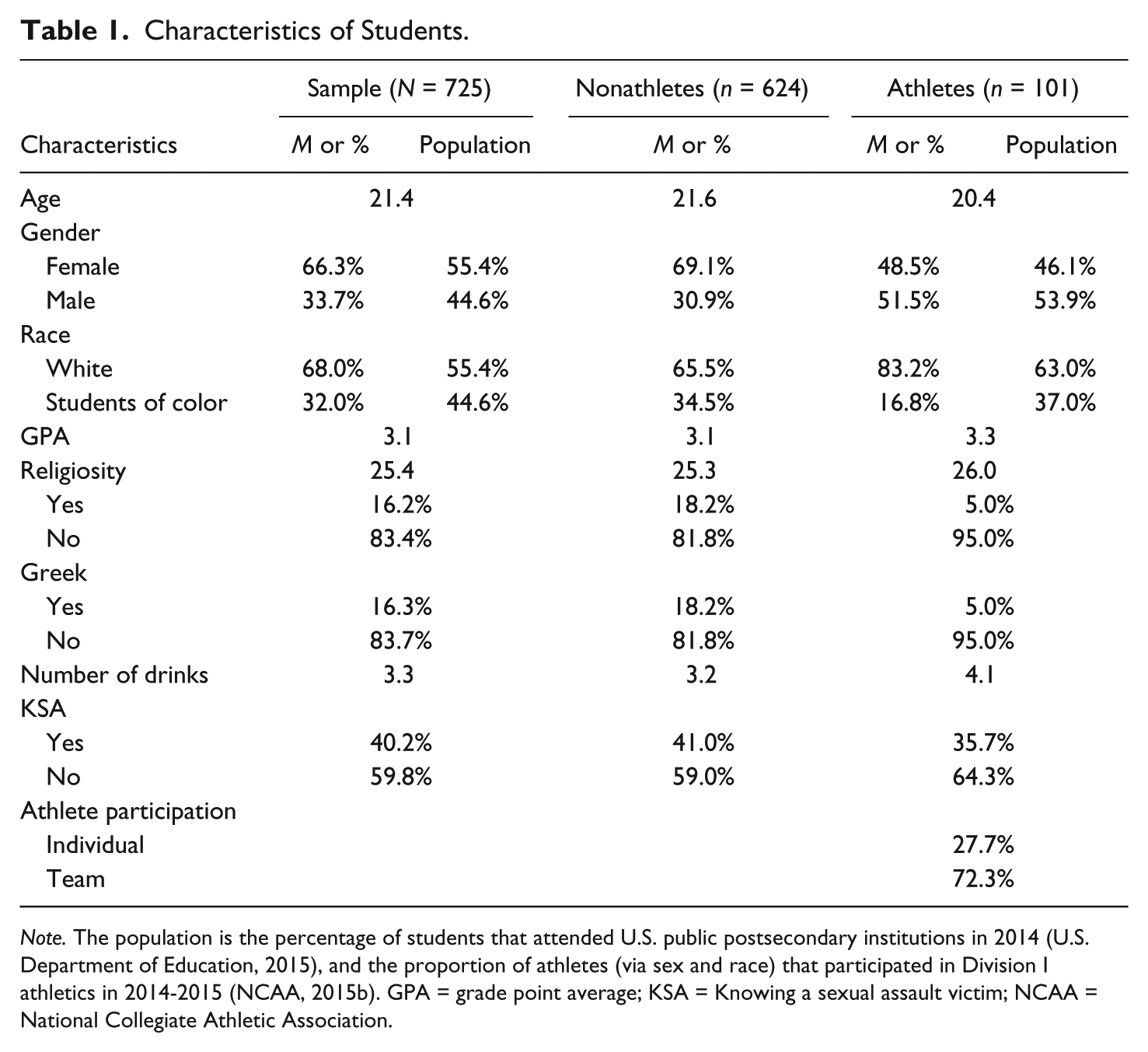
Note. The population is the percentage of students that attended U.S. public postsecondary institutions in 2014 (U.S. Department of Education, 2015), and the proportion of athletes (via sex and race) that participated in Division I athletics in 2014-2015 (NCAA, 2015b). GPA = grade point average; KSA = Knowing a sexual assault victim; NCAA = National Collegiate Athletic Association.
Analysis Plan
Descriptive statistics were run among the variables. Independent-samples t tests with a Bonferroni correction (p value of .008 or lower) was implemented to reduce the probability of a Type I error and explored whether differences existed in the UIRMA and its subscales between nonathletes and athletes. MANOVAs were also performed among the six dependent variables (i.e., the UIRMA and its subscales) between nonathletes and athletes. Results revealed different outcomes of statistical significance. Thus, the results here should be held with caution. Independent t tests were preferred because it could assess which rape myth construct was influential between the two groups. Regardless, the overall finding from either analytical approaches was the same, nonathletes and athletes held similar RMA. A series of ordinary least squares (OLS) regression analyses were performed to identify which independent variables predicted overall RMA and rape myth constructs for each group of students (i.e., nonathlete and athlete). No violations like multicollinearity were found in the regression analyses.
Results
Results of the UIRMA yielded a range of 22 to 110 and showed that the nonathletes obtained a higher UIRMA mean of 85.52 (SD = 14.82) compared with the lower UIRMA mean of 81.72 (SD = 14.07) for athletes. Nonathletes consistently scored higher means of disagreement in the UIRMA and its rape myth constructs than athletes (Table 2). The overall sample expressed a moderately high disagreement with rape myths as higher scores (held by nonathletes) indicated a greater rejection of rape myths.
Characteristics of Nonathletes and Athletes UIRMA Scores, and Independent-Samples t Tests of the UIRMA and Its Subscales.
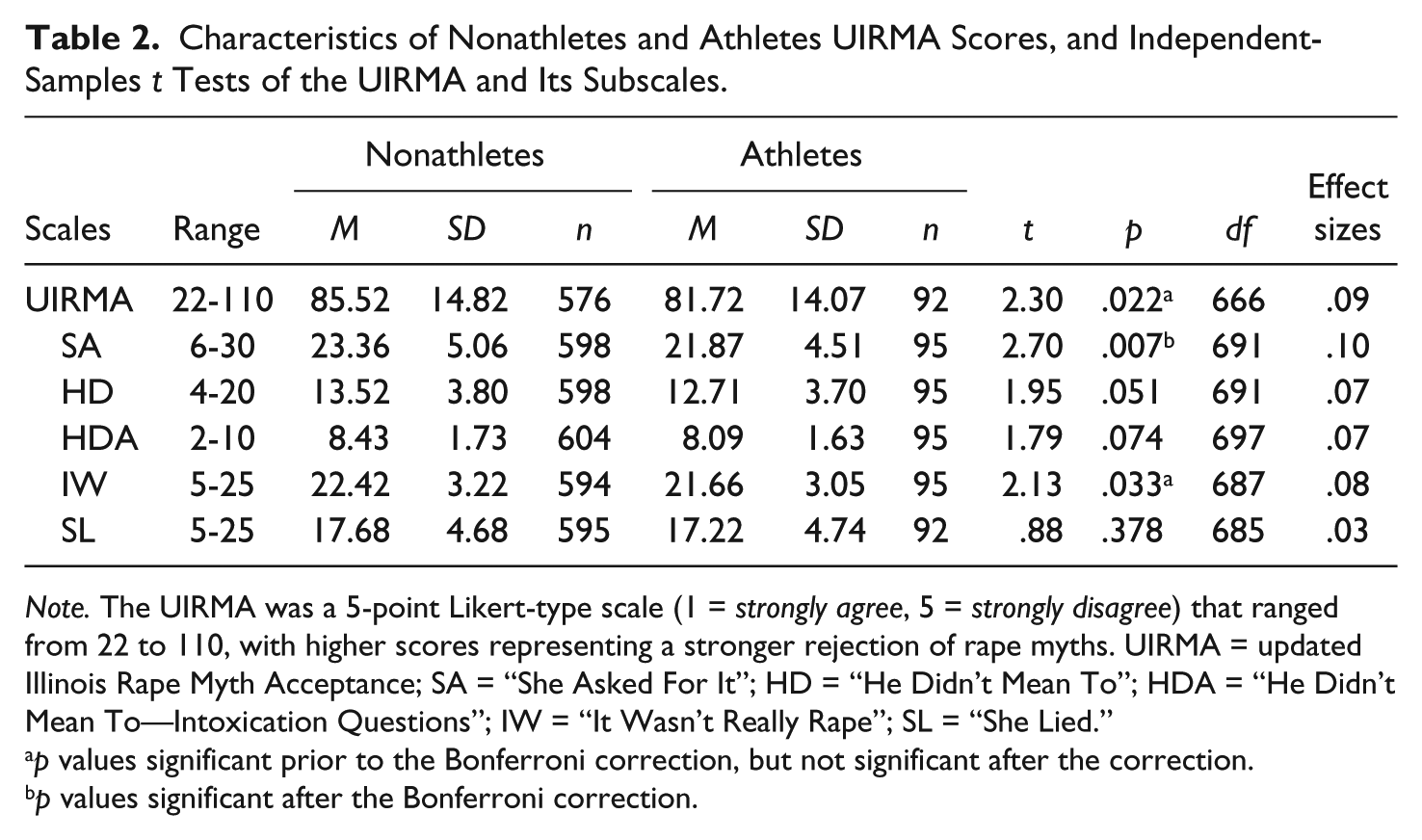
Note. The UIRMA was a 5-point Likert-type scale (1 = strongly agree, 5 = strongly disagree) that ranged from 22 to 110, with higher scores representing a stronger rejection of rape myths. UIRMA = updated Illinois Rape Myth Acceptance; SA = “She Asked For It”; HD = “He Didn’t Mean To”; HDA = “He Didn’t Mean To—Intoxication Questions”; IW = “It Wasn’t Really Rape”; SL = “She Lied.”
p values significant prior to the Bonferroni correction, but not significant after the correction.
p values significant after the Bonferroni correction.
A series of independent-samples t tests were conducted to determine whether mean differences between nonathletes and athletes were statistically significantly different. Results indicated that only the “She Asked For It” subscale was significantly different between athletes and nonathletes, t(691) = 2.70, p < .008 (Table 2). Therefore, nonathletes and athletes held similar attitudes toward RMA with exception to rape myths that fell under the construct of “She Asked For It.” Although not shown, an independent-samples t test (with a Bonferroni correction) indicated that individual- or team-based athletes were not statistically different in their responses to the UIRMA and its subscales, nor added substantial value as a predictor (i.e., athletic participation). Next, multivariate analyses were performed to explore which demographic, lifestyle, and social characteristics are predictors of RMA for both groups of students.
All multiple linear regression analyses included the predictors of age, gender, race, GPA, religiosity, (social) Greek, number of drinks, and knowing a sexual assault victim. Table 3 presents the results of each OLS regression model with the UIRMA and its subscales as the dependent variables for nonathletes. Overall, the nonathlete models significantly predicted the UIRMA and its subscales, with gender consistently being the strongest predictor of RMA and the only significant predictor that emerged across all five of the UIRMA subscales. The model explained 17% of the variance in the UIRMA, F(8, 490) = 12.03, p < .001. Looking at the OLS regression models for nonathletes with each UIRMA subscale as the dependent variable, “She Asked For It,” F(8, 507) = 9.22, p < .001, was the strongest model with 13% of the variance explained by the variables. Overall, race was not a statistically significant predictor in the UIRMA and its subscales for nonathletes, and the “He Didn’t Mean To—Intoxication Questions” subscale contained no statistically significant demographic, lifestyle, and social predictors.
OLS Regressions of the UIRMA and Its Subscales Among Nonathletes With Independent Variables.
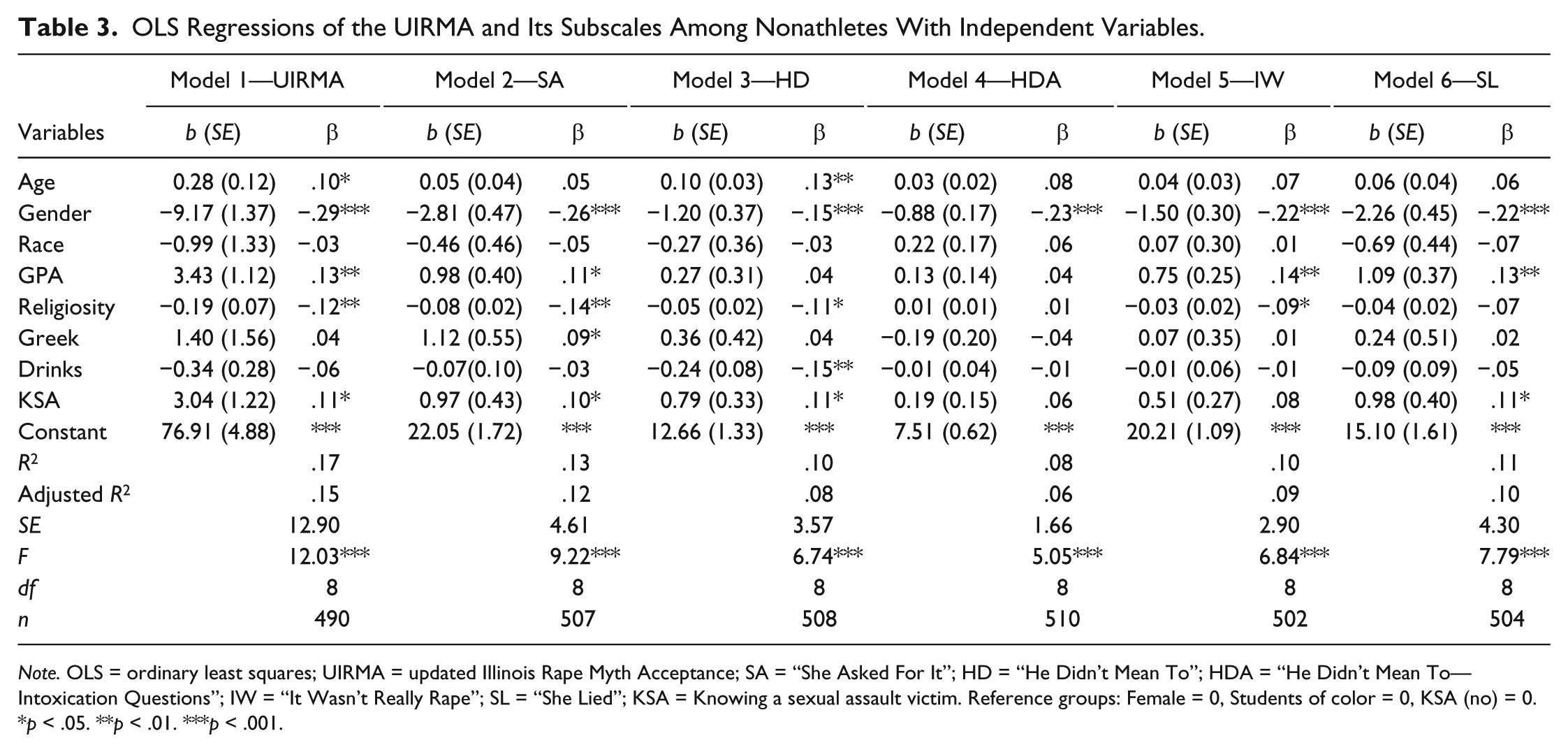
Note. OLS = ordinary least squares; UIRMA = updated Illinois Rape Myth Acceptance; SA = “She Asked For It”; HD = “He Didn’t Mean To”; HDA = “He Didn’t Mean To—Intoxication Questions”; IW = “It Wasn’t Really Rape”; SL = “She Lied”; KSA = Knowing a sexual assault victim. Reference groups: Female = 0, Students of color = 0, KSA (no) = 0.
p < .05. **p < .01. ***p < .001.
Regression models of nonathletes contrasted from the athlete models in three primary manners. First, gender was not a statistically significant predictor for athletes. Further analyses via a series of independent-samples t test (with a Bonferroni correction) indicated no significant differences to the UIRMA and its subscales between the genders of athletes. Second, social characteristics (i.e., Greek, knowing a sexual assault victim) predicted RMA among athletes, but not demographic characteristics, with lifestyle characteristics (i.e., athletic participation, number of drinks) seldom being predictors. Third, some RMA constructs were not explained by the present study’s variables for athletes.
The UIRMA model was statistically significant for athletes, and explained a higher variance for athletes than nonathletes, R2 = .23, F(8, 80) = 2.71, p < .001. Results show only two statistically significant predictors, Greek (b = .25, p < .05) and knowing a sexual assault victim (b = .29, p < .05) (Table 4). Both groups of students shared two similarities in the UIRMA models, in that race was not a predictor for RMA, and a known sexual assault was a predictor.
OLS Regressions of the UIRMA and Its Subscales Among Athletes With Independent Variables.

Note. OLS = ordinary least squares; UIRMA = updated Illinois Rape Myth Acceptance; SA = “She Asked For It”; HD = “He Didn’t Mean To”; HDA = “He Didn’t Mean To—Intoxication Questions”; IW = “It Wasn’t Really Rape”; SL = “She Lied”; KSA = Knowing a sexual assault victim. Reference groups: Female = 0, Students of color = 0, KSA (no) = 0.
p < .05. **p < .01. ***p < .001.
Unlike nonathletes, only two of the five UIRMA subscales (“He Didn’t Mean To” and “She Lied”) for athletes exhibited a statistical significance in the models (Table 4). Both models explained more variation than those for nonathletes and highlighted the relevance of lifestyle and social characteristics as RMA predictors for athletes. “She Lied,” F(8, 80) = 2.94, p < .01, was the strongest model with 25% of the variance explained by the characteristics. The “He Didn’t Mean To,” F(8, 83) = 2.27, p < .05, subscale explained 20% of the variance. The number of drinks was the only variable for athletes that exhibited a negative association with any of the UIRMA scales; athletes who consumed more alcohol were more likely to accept rape myths regarding victims fabricating rape incidences. Multivariate results indicated the importance of exploring the constructs of rape myths rather than overall RMA considering the divergent results between nonathletes and athletes.
Discussion
Intercollegiate athletes did endorse rape myths at greater levels than nonathletes (Boeringer, 1999; Young et al., 2016), but the magnitude of the differences in the acceptance of rape myths was marginal. RMA functions differently among university athletes (McMahon, 2007; Sawyer et al., 2002) based on a multi-institutional sample of universities with the employment of an updated RMA scale. Nonathletes’ RMA (both overall and its constructs) were predicted by a diverse set of features, whereas only lifestyle and social behaviors were influential predictors of the acceptance or rejection of certain rape myth constructs among athletes. Concerning athletes’ RMA, Greek membership and knowing a sexual assault victim (or social characteristics) decreased the acceptance of rape myths in general and rape myths related to the perpetrator’s intentions (“He Didn’t Mean To”). Both non-Greek membership and greater alcohol consumption promoted an athlete’s endorsement of rape myths related to a victim’s fabrication of rape (“She Lied”). These findings emphasize the importance of the disaggregation of rape myth into constructs, and how demographic, lifestyle, and social characteristics functioned differently by subcultures of students, with nondemographic characteristics being meaningful contributors to athletes’ RMA.
Burt’s (1980) findings that an individual’s background, personality, experience, and attitudes were all interconnected to explain a person’s adherence to rape myths may apply differently to athletes (compared with nonathletes), considering not one demographic characteristic was associated with rape myths. Although the gender of nonathletes was consistently a strong predictor for the rejection of rape myths, the same cannot be said for athletes. Differences in RMA were not apparent within athletes between gender or between individual- or team-based sports in the present study. In addition to the wealth of research that has indicated females are more likely to reject rape myths than males, the current study’s finding of female athletes’ RMA (which was comparable with the scores reported by male athletes) contradicted McMahon’s (2007, 2010) and Sawyer et al. (2002) research of female athletes’ RMA. As suggested by Sawyer et al. (2002), the current study’s sample of female athletes may have an elevated RMA that was comparable with that of male athletes due to the level of competition associated with Division I athletics. Female (and male) athletes from Division I universities subscribed to the belief that physically fit women (like themselves) were less likely to be victims of rape, in which other benefits derived from athletic participation like increased confidence and self-esteem promoted this logic (McMahon, 2007). This finding conveyed the strength of athlete culture in which gender has a reduced meaning. More research is needed to determine whether these gender-athlete findings hold true considering the uniqueness of the result, and explore how universities and athletics foster a culture that celebrates a competitive environment.
Unlike the athletes in the sample, demographic characteristics of nonathletes behaved in the same manner as reported in the literature. The rape myth literature has agreed that as students aged (McMahon, 2010; Morrow, 2010; Swope, 2014) and accumulated more education (Suarez & Gadalla, 2010), their acceptance of rape myths decreased. Comparatively, nonathletes in the current sample who were older and maintained higher GPAs rejected rape myths more strongly. The discussion of religiosity’s link to RMA was mixed, and possibly so because religiosity and RMA were not assessed by psychometric instruments (Freymeyer, 1997; Mulliken, 2005; Suarez & Gadalla, 2010). The present findings demonstrated that greater religiosity of nonathletes related to increased endorsement of rape myths (Freymeyer, 1997). Additional research should disentangle the effect of religiosity on athletes considering religiosity was a predictor of RMA among nonathletes but not for athletes, even though nonathletes and athletes reported similar levels of religiosity.
Differences aside, similarities in RMA existed between nonathletes and athletes. Previous research demonstrated mixed results with race and/or ethnicity’s relationship to RMA (Morrow, 2010; Sawyer et al., 2002; Suarez & Gadalla, 2010). No racial (e.g., Black) or ethnic (e.g., Latino/a) differences in RMA were evident in the current sample, although the sample was not representative of university racial or ethnic population. The present study supported the existing literature (McMahon, 2010; Swope, 2014) in that the social characteristic of knowing a sexual assault victim was relevant for both sets of students and showed the importance of this event in the reduction of RMA.
Additional similarities continued between nonathletes and athletes’ lifestyle and social characteristics. The present findings showed an unanticipated and inverse relationship between Greek organization membership and RMA; Greeks were not particularly adherent to rape myths. It could be that Greek organizations desire to combat their stereotype. Alternatively, these results of Greek life perhaps captured a transition from accepting rape myths to now rejecting them, a possible outcome from former program intervention, or the influence of gender likely prompted the rejection of rape myths as a large portion of Greek members comprised sorority members. Although athletes did consume more alcohol in one sitting on average compared with nonathletes, the data suggested that the level of consumption of alcohol was not a linear predictor of RMA, with exception to rape myths that were associated with victims who fabricated their rape (“She Lied”). At the same time, nonathletes who drank more alcohol were more likely to support rape myths related to the excusal of the perpetrator’s intention to rape (“He Didn’t Mean To”). Overall, alcohol consumption functioned differently among nonathletes and athletes, but alcohol was not a strong predictor of RMA for either group of students.
Limitations
This study was not without limitations. First, athletes and Greek members may have exhibited a social desirability bias in the direction of being more rejecting of rape myths when responding to the online survey. Second, the sample size of athletes was small and therefore limited additional analyses to be conducted between gender due to statistical power. Similarly, the sample of Greek university students was primarily sorority members, who as a group may have influenced the trajectory of RMA among students. Disaggregating Greek membership by gender was considered but doing so would have disallowed a comparative analysis between nonathletes and athletes due to low sample sizes of athletes involved in fraternities and sororities, and therefore, results within athletes between gender and Greek membership should be held with caution. It is important to recall this study’s purpose, which was to explore the predictive differences of RMA between these two groups of students. Third, the effect sizes between nonathletes and athletes were small. Fourth, the sample of students was contacted through professional relationships with criminal justice/criminology and sociology professors. On the one hand, respondents may have reflected biases of those academic disciplines. On the other hand, whether students subscribed to these social science majors is unknown. Future scholars should consider the relationship between university major and RMA. Fifth, due to anonymity, confidentiality, and despite the requests to professors, sports participation (e.g., football) or the demographic/count breakdown of students enrolled in the sampled courses were unobtainable.
Conclusion
The current study’s sample contained students from multiple Division I institutions and highlighted the predictive value of religiosity (among nonathletes) and knowing a sexual assault victim to RMA and at the same time the lack of predictive power of race. A distinction lies between nonathletes and athletes and what predicts the acceptance of rape myths. Athletes are influenced by events that define their social lifestyle but not demographic characteristics. Age, gender, race, GPA, and religiosity of athletes were not predictors of RMA but were predictors of RMA for nonathletes. These findings suggest that larger social forces are at play for athletes as the university athletic experience overrides the value of demographic characteristics to RMA. Sexual harassment or rape prevention programs should adapt to these findings (Swope, 2014) to be effective for athletes, particularly female athletes. Programs should regularly be conducted throughout an athlete’s collegiate career to become durable experiences that encourage preventive techniques of sexual victimization. The institution, if not also the coaching staff, should recognize the negative lifestyle and social behaviors of their athletes, and reward their positive lifestyle and social choices. Encouragement of community engagement like volunteering may alter the values of athletes and expose them to alternative experiences in contrast to the university student athlete lifestyle.
Footnotes
Acknowledgements
The authors take responsibility for the integrity of the data, the accuracy of the data analyses, and have made every effort to avoid inflating statistically significant results.
Authors’ Note
John C. Navarro is currently located at the University of South Carolina.
Declaration of Conflicting Interests
The author(s) declared no potential conflicts of interest with respect to the research, authorship, and/or publication of this article.
Funding
The author(s) received no financial support for the research, authorship, and/or publication of this article.