




Abstract
In the United States, certain laws restrict those convicted of sexually offending from accessing social spaces where youth congregate such as parks and playgrounds. However, empirical work to date has rarely described sexual assaults in these locations or tested the assumptions of these laws explicitly. To address these gaps in the literature, we drew on the National Incident-Based Reporting System (NIBRS) to analyze offender, victim, and crime characteristics of sexual assaults that occurred at parks and playgrounds over a 5-year period (2010-2015). Estimated via multivariate logistic regression, results showed support for these law’s assumptions when analyzing this particular location. However, stranger perpetrators were significantly more likely to sexually assault adult victims versus youth victims. Several other offense features distinguished youth versus adult victim sexual assault incidents at parks and playgrounds, such as the offender age, the use of force, and the injuries sustained by the victim. Collectively, these findings both support and challenge these types of social space restriction laws.
Introduction
Parks and playgrounds are shared places where community members of all ages have opportunities to engage in a variety of leisure activities, exercise, and social interactions (Frost & Wortham, 1988; Hayward & Weitzer, 1984). Demonstrating benefits for both health and well-being, they are also pervasive features of America (Crompton, 2001; Howell, 2008). Recently, the public has grown increasingly concerned about the safety of children at these places (Carver, Timperio, & Crawford, 2008; McCormack, Rock, Toohey, & Hignell, 2010; Miles, 2008). In one survey, more than three quarters of parents said they would not let their children go to the park alone without another adult because of concerns about safety (Loukaitou-Sideris & Sideris, 2010). While concerns about safety can range from traffic to lighting, studies show that parents cite violent crime as one of the important factors influencing their decisions on their children’s use of parks and playgrounds (Carver et al., 2008; McCormack et al., 2010).
Views about the level of violent crime and “undesirable users of parks” (e.g., drug users, loiterers) have resulted in reduced park use, especially for parents with daughters (Gomez, Johnson, Selva, & Sallis, 2004; McCormack et al., 2010). These open social spaces have also triggered the fear of stranger danger (Gomez et al., 2004; McCormack et al., 2010), which in turn is linked to concerns about sexual violence (Budd & Mancini, 2016; DeLuca et al., 2018). Few crime types have generated more fear than sexual assault perpetrated against youth by strangers, and this extends to perceptions that youth “. . . are at great risk from predators who lurk in schoolyards and playgrounds” (Levenson, Brannon, Fortney, & Baker, 2007, p. 143). These types of sex offenses are a potent combination that lead citizens and parents alike to call for social control through law and law enforcement (Harper, Hogue, & Bartels, 2017; Koon-Magnin, 2015; Levenson et al., 2007; Quinn, Forsyth, & Mullen-Quinn, 2004). Furthermore, the public typically perceives those with prior convictions for sex crimes as especially risky of future offending (King, 2016; Klein, 2018; Socia, Dum, & Rydberg, 2017). Because of these culminating factors, individuals who have been convicted of sex crimes have emerged as a focal point for law related to modern social control and fear of crime in American parks and playgrounds.
Over the past two decades, there has been a series of laws which constrain the movements of those convicted of sex crimes in relation to youth-centric locations. They receive widespread support from parents and are perceived to reduce sexual recidivism to keep youth safe (Budd & Mancini, 2016; Comartin, Kernsmith, & Kernsmith, 2009; Mancini, Shields, Mears, & Beaver, 2010; Socia et al., 2017). The core assumption underpinning these geographical approaches, which some scholars characterize as “internal exile”—banishment from a specific social space—is that exclusion will reduce sexual assault (Yung, 2007, p. 111). A fundamental premise, then, is that parks and playgrounds are an attractive environment for sexual predators to target potential vulnerable victims. The laws presume youth are at a heightened risk of sexual victimization and strangers are more prone to sexually victimize youth at these locations. In addition, the laws presume those with prior sexual assault convictions have a higher risk of sexual offending (Bierie, 2016). Because the laws are intended to serve a regulatory, nonpunitive function in ensuring public safety, most state and federal appellate courts have upheld them (for a review of case law, see Calkins, Jeglic, Beattey, Zeidman, & Perillo, 2014).
Despite public support for such laws, there is very little empirical work testing the presumptions of the laws. Moreover, because so little is known about sexual assaults at parks and playgrounds, there is a dearth of knowledge to guide law and policy responses and to assist law enforcement (e.g., prevention planning and/or investigatory work). This includes knowing what sexual assault offense characteristics are associated with youth versus adult victims given scholars have found it useful to study differences in sexual offending behavior as a function of victim age (e.g., Leroux, Pullman, Motayne, & Seto, 2016). Furthermore, knowing which characteristics distinguish offenses against youth versus adults may assist policy makers and law enforcement as they pursue tailored responses to sexual assault victimization that occurs at different locations.
Legislating Geographic Restrictions
Three legal methods currently limit how those convicted of sex crimes can interact with geographic and social spaces: residence restrictions, child safety zone laws, and laws or local ordinances prohibiting access/entrance to specific locations. First, residence restrictions are geographic buffer zones, anywhere from 500 to 2,500 feet, which prohibit those convicted of sex crimes from living near youth-centric locations such as parks, playgrounds, churches, and schools. Because residence restrictions only address where these individuals can live, some states have also implemented “child safety zones,” ranging anywhere from 300 to 500 feet, which prohibit loitering near where youth congregate (Broward County Sex Offender Task Force, 2009). These laws address social and community spaces and dictate where those convicted of sex crimes cannot be physically present.
The third type of legal method dictates where those convicted of sex crimes can enter and remain. These laws are akin to trespassing laws in that these individuals cannot enter certain locations, although some legislation delineates exceptions. This method of formal social control is sometimes built into residence restrictions or child safety zone laws, although stand-alone city ordinances do exist. For this research, we refer to these laws as “social exclusion zone” laws 1 to distinguish their purpose from residence and loitering buffer zones. For illustrative purposes, Table S1, which is available in the supplement, provides a nonexhaustive snapshot of some of these social exclusion zone laws that are currently active throughout the United States. Notably, the criteria for triggering the application of these laws vary by state: all registrants, only if the victim was under a certain age, sexually violent predator status, or as part of probation or parole. Although Table S1 focuses on state-level laws, there are also local ordinances. For example, in San Antonio, Texas, those convicted of sex crimes are not allowed to knowingly or intentionally enter a park under a city ordinance titled “Sex offender entry and loitering restrictions” (see San Antonio Code of Ordinances, Section 22-164). Although the focus here is not on an assessment of the laws, the key premise is that a myriad of state and local lawmakers have found that limiting the use of social space by those convicted of sex crimes is relevant and actionable.
Logical Underpinnings of Geographic Restrictions
Although strategically different, the laws share a similar underlying logic which embodies the elements of routine activity theory. First, the laws are a response to a presumed increased risk of stranger-involved sexual assaults (i.e., stranger danger; Hughes & Burchfield, 2008). That is, those who would offend against strangers would likely find parks and playgrounds appealing settings to identify targets due to visibility, the high volume of visitors, a cultural climate which often encourages or allows social interactions between strangers, and physical design features which may facilitate some forms of sexual assault. Whether a motivated offender is interested in youth or adults, the physical and social design of parks and playgrounds implies a risky environment for stranger-involved sexual offending. Thus, the laws are intended to reduce opportunity to act on deviant impulses (Troia, 2005).
Second, the laws assume youth are at especially heightened risk while at parks and playgrounds in part because they are particularly likely to use parks and playgrounds and also because of their age and naivety (for a review, see Pacheco & Barnes, 2013). Relatedly, parks and playgrounds are presumed to have less direct and/or diminished guardianship over young patrons. For example, parents and other adults who intend to provide direct supervision can become distracted (e.g., by using technology, socializing) or simply lack the direct knowledge needed to detect social interactions that are risky (e.g., an unknown adult walking away with an unknown toddler). In the case of older youth, parks are likely places of refuge away from parent or other adult supervision.
Third, the laws presume those who have been convicted of a sex crime are motivated offenders and have a high risk to sexually offend. The empirical data underpinning this assumption are complicated. Some scholars demonstrate most sexual assault is committed by those never previously convicted of a sexual offense (Levenson & Zgoba, 2016; Sandler, Freeman, & Socia, 2008). Data show only a minority of those released from prison for a sex offense conviction go on to sexually recidivate (e.g., 5.3% were rearrested for a new sex offense within 3 years of release; Langan, Schmitt, & Durose, 2003). In addition, there is evidence that risk of sexual reoffense declines the longer an individual with a sex offense history remains sex offense–free in the community (Hanson, Harris, Letourneau, Helmus, & Thorton, 2018). Yet, research has found registrants have a higher risk of being arrested for a sex offense compared with the general public (Bierie, 2016). Overall, the laws presume some individuals will be more likely to sexually (re)offend and therefore reduce temptation and opportunity in youth-centric locations, like parks and playgrounds, which are saturated with potential victims (Troia, 2005).
Finally, it is important to note that these laws are also expected to change sexual offending behavior. They operate by encouraging surveillance, or guardianship, of parks, playgrounds, and the users of these social spaces. This includes empowering police to stop and question individuals and to arrest or remove individuals found to be registrants. Parents and others are empowered to act as surveillance mechanisms through familiarity with their neighborhood registry. The laws, therefore, embody deterrence both by communicating potential sanctions and by increasing the perceived risk of being caught when attempting to engage in new sexual offending. In sum, exclusion zone laws encourage greater guardianship, attempt to limit access to vulnerable victims, and deter potential motivated offenders by denying those convicted of sex crimes access to these social spaces.
The Extent of Sex Crimes at Parks and Playgrounds
Why might parks and playgrounds be an attractive location for perpetrators of sexual assault? Beauregard, Rossmo, and Proulx’s (2007) investigation into the victim targeting process of a sample of serial sex offenders (N = 69) provides some insights. Choosing public locations, like parks and playgrounds (i.e., the victim targeting grounds), provides perpetrators an easy way to find and gain access to attractive targets (i.e., their potential victims). Within their data, almost a quarter of the victims were participating in some type of outdoor recreational activity (e.g., in a park; Beauregard et al., 2007). Victim vulnerability also plays a factor at locations like parks and playgrounds given there may be lack of supervision, or guardianship, at these locales in addition to isolated areas within parks and playgrounds to commit the sexual assault (e.g., a jogging path; Beauregard et al., 2007; Lang & Frenzel, 1988).
To put park and playground victimizations into context, it is essential to understand how frequently these locations are the venue for sexual assault. One approach to measuring the prevalence of sexual assaults at parks and playgrounds involves gauging where offenders come into contact with their victims. Collectively, these studies show parks are rarely contact points for victims and offenders (Calkins, Colombino, Matsuura, & Jeglic, 2015; Colombino, Mercado, & Jeglic, 2009; Colombino, Mercado, Levenson, & Jeglic, 2011; Mogavero & Kennedy, 2017; Smallbone & Wortley, 2000). To illustrate, using a sample of 270 higher risk convicted sex offenders in New Jersey, Mogavero and Kennedy (2017) found that a total of 222 of the offenders in the study (82.2%) came in contact with their victim at a residence. Of the remainder, only three offenders made contact with their victim at a park or playground. Colombino and her colleagues (2011) examined 1,557 sex offenders, finding 67% met or first encountered their victim in a residence. By comparison, only 15 of the adult male sex offenders in their study met their victim at a park. In an additional study by Colombino and colleagues (2009), 310 out of the 405 offenders sampled (76.5%) reported the offense occurred in a private setting (i.e., someone’s home). Only five of the “first contacts,” or 2%, were at a park.
A second approach is uncovering the location where the sexual assault took place. These studies show similar patterns to the victim–offender contact studies. Drawing on data from New Jersey, one study revealed that less than 1% of sex offenses were committed at a park/playground location during the reference period. In contrast, the overwhelming majority of sex crimes in the sample (84%) were committed in a residence (Mogavero & Kennedy, 2017). Colombino et al. (2009) found that 82.2% (n = 333) of sexual offenses occurred in private settings (i.e., either the victim or offender’s home). In contrast, only five sexual assaults (1.2%) were committed at a park/playground. Collectively, these two approaches addressing the extent of prevalence indicate that sexual assaults at parks are relatively rare. But, given these studies only focus on one state, it is difficult to estimate how many incidents of sexual assault take place annually throughout the country at this specific public locale.
Some of the studies referenced prior have demonstrated that when sexual offenses do occur at parks and playgrounds, youth are more likely to be victims than adults. For the 15 sexual assaults committed at a park that were investigated by Colombino et al. (2011), the majority were children (n = 12) versus adults (n = 3). For the 10 sexual assaults committed at a park that were investigated by Calkins et al. (2015), seven offenses were committed against a youth victim and three against an adult victim. For the four sexual assaults committed at a park that were investigated by Mogavero and Kennedy (2017), all four were committed against youth: one against a victim who was under 12 and the other three against victims aged 12 to 17 years. More generally, other research finds that in public locations (e.g., parks, streets, woods), youth were more likely to be victims in these locations (Colombino et al., 2009).
There is even less work to date assessing whether strangers are more apt to use parks and playgrounds than other locations as their crime site location. In the sole study specifically addressing parks and strangers, of the 10 sexual assaults identified by Calkins and her colleagues (2015), four were committed by an acquaintance and six by a stranger. One other study addresses victim–offender relationship but more generally in relation to social space. In public areas, Colombino and colleagues (2009) found two perpetrators were family members, 13 were acquaintances, and 13 were strangers. Parks were operationalized under “public.” Neither of these studies disaggregated the location by the age of victims (adults or youth). In short then, opportunities exist to extend pioneering scholarship investigating the nature of sexual offending and place, particularly given that evidence suggests up to 25% of sexual assaults are perpetrated by strangers, some of which occur at parks and playgrounds (CSOM, 2008; Truman, 2011; Williams & Bierie, 2015).
Current Research
Previous work suggests that sexual assaults at parks and playgrounds are relatively rare. However, only a very small number of studies have included an examination of sexual assaults at parks and playgrounds. Those that do exist have had exceptionally small sample sizes. Generalizability is also problematic as nearly all of the previously reviewed scholarship has focused on one state, New Jersey, and relied on prison samples. Because the majority of sexual assault cases do not lead to conviction or are subject to plea bargaining and thus reduced charges, these findings may not be representative of cases that occur at the front end of the criminal justice system (Bouffard, 2000; Crandall & Helitzer, 2003).
Continuing to improve our understanding of sexual assaults at parks and playgrounds is especially pertinent given the underlying logic of sex offender (social) exclusion zone laws: that strangers are involved in assaults at parks and playgrounds more so than in other locations and that youth appear to have a heightened risk to be victimized sexually in these locales. The current study seeks to build on prior work by using data that allow for an analysis of a large number of states in the United States and reports to police, rather than conviction data, to reduce the potential for the “criminal justice filtering effect” (e.g., Campbell, 1998). We explore the following research questions about sexual assaults that occur at parks and playgrounds:
Method
This research analyzed data from the National Incident-Based Reporting System (hereafter, the NIBRS). The NIBRS includes comprehensive incident-level data (e.g., offender, victim, and offense characteristics) on crimes committed throughout the United States that are reported to the police. Currently, 39 states in the United States submit data to the NIBRS. Because locations can be isolated in the NIBRS, we only analyzed incidents that were coded as taking place at a “park/playground” location (hereafter, parks/playgrounds). Next, because 2010 was the first year a sexual assault incident at a park/playground was recorded in the NIBRS, we limited the analysis to the beginning of 2010 through the end of 2015. 2 There were 2,336 incidents of sexual assault at parks/playgrounds to further investigate. Approximately 454,875 sex crime incidents were reported at other locations during this time frame.
Dependent Variable
Given the concern over youth victims of sexual assault at parks/playgrounds, we created a dependent variable that separated incidents by victim type: youth victims versus adult victims. Prior literature on the characteristics of park users informed the age cut points between youth and adult victims (for a review, see Evenson, Jones, Holliday, Cohen, & McKenzie, 2016). Incidents with youth victims were defined as those with victims under the age of 18. 3 Incidents with adult victims were defined as those with victims aged 18 or older. Youth victim incidents accounted for approximately 70% of the incidents (n = 1,521). Adult victim incidents accounted for approximately 30% of the incidents (n = 643).
Independent Variables
The independent variables are organized into three categories: offender characteristics, victim characteristics, and crime characteristics. Five variables were used to measure offender characteristics: offender sex, race, and age; the number of offenders within the incident; and substance use by the offender during the incident. Offender sex was coded (1) male and (0) female. Another measure captured whether both male and female offenders were present in the incident (0/1). Race was a series of mutually exclusive binary variables (0/1): White/Hispanic (omitted), Black, and Other. 4 Due to the recording practices of the NIBRS, the White and Hispanic variables cannot be dichotomized into separate measures. Offender age was coded as a series of mutually exclusive age categories which mimic the age categories used in the National Crime Victimization Survey: less than 16 (omitted), 16 to 19, 20 to 24, 35 to 49, and 50 and older. It was hypothesized that this coding would provide insights into victim type in relation to perpetrator age progression. The number of offenders involved in a sexual assault incident was treated as a continuous variable. Last, whether the offender was abusing substances during the incident was coded as mutually exclusive binary variables (0/1): under the influence of alcohol, under the influence of drugs, and not under the influence (omitted).
Four variables measured victim characteristics: victim sex and race, the number of sexual assault victims, and the victim–offender relationship. Victim sex was coded as female (1) and male (0). Another measure captured whether both female and male victims were present in the incident (0/1). Race was coded into four mutually exclusive binary variables (0/1): White (omitted), Black, Other, and Hispanic. Another measure was included to capture whether there were victims of different races in the same incident (0/1). The number of sexual assault victims was treated as a continuous variable. The NIBRS records over 20 victim–offender relationships. To provide the most robust view of these relationships, six mutually exclusive binary measures were created and included in the model (0/1): boyfriend/girlfriend, friend, acquaintance (omitted), intrafamilial (e.g., parent, sibling, grandparent, in-law), extrafamilial (e.g., neighbor, employer, employee), and stranger.
The last series of variables measured crime characteristics: sexual assault behavior, use of force, victim injury, time of the incident, whether the incident location moved, and whether there was an additional crime committed during the sexual assault incident. Four types of forcible sexual assault are recorded in the NIBRS and were included in the model: rape, sodomy, sexual assault with an object, and forcible fondling. These measures were allowed to be additive. Four mutually exclusive binary variables were created to capture use of force in the incident (0/1): gun, personal weapons (e.g., hand, feet, teeth), other types of weapon (e.g., knife, drugs, poison), and no weapon (omitted). Injury was measured as major (0/1), minor (0/1), or no injury (0/1; omitted). 5 The measure that gauged the time of the incident mirrored coding used on other juvenile victimization research (see, for example, Sickmund & Puzzanchera, 2014). These were a series of mutually exclusive variables: 1 a.m. to 4:59 a.m. (omitted), 5 a.m. to 7:59 a.m., 8 a.m. to 2:59 a.m., 3 p.m. to 6:59 p.m., and 7 p.m. to 12:59 a.m. A measure was also included to capture whether the incident moved to another location beyond the park/playground (0/1). Not least, drawing on public anxieties regarding child abductions and sexual assault, a measure was included to capture whether the incident involved kidnapping (0/1). In addition, given the attendant concerns regarding violent crime in parks/playgrounds, models included a variable measuring whether an assault occurred simultaneously during the incident (0/1).
Analysis
To address the underpinnings of the laws, two multivariate logistic regression models were estimated to test whether incidents at parks/playgrounds were more prone to stranger-involved sexual assaults and whether youth were more at risk at this location compared with other locations within the NIBRS. Next, we present a descriptive overview of sexual assault incidents occurring at parks/playgrounds. In doing so, we compare them with incidents of sexual assault occurring in the home given findings showing this is the most common location for sexual assault. We then conducted bivariate logit comparisons to assess the initial relationships between the variables when predicting incidents at parks/playgrounds with either a youth or adult victim (see Table 1). While informative, these bivariate results may be misleading due to the possibility of omitted variable bias. Therefore, the last step of the analysis was to run the full model, a multivariate binary logistic regression model, to assess (1) the odds of an incident involving a youth victim versus (0) the odds of an incident involving an adult victim. The results are presented in odds ratios (see Table 2). Odd ratios are not only more substantively meaningful and intuitive compared with log-odds but also assess effect size (Fleiss, 1994; Pampel, 2000). In both tables, results are presented for both incidents with youth and adult victims.
Descriptive Statistics and Bivariate Comparisons of Sexual Assault Incidents at Parks and Playgrounds by Victim Type (N = 2,336), the NIBRS 2010-2015.

Note. Not all categories may equal 100% due to rounding. Youth victims, <18 years old; adult victims, ⩾18 years old. The bivariate statistics indicate when an offender, victim, or crime characteristics are positively associated with predicting an incident of sexual assault at a park/playground that has either a youth or a adult victim. NIBRS = National Incident-Based Reporting System.
p ⩽ .01. **p ⩽ .01. ***p ⩽ .001.
Multivariate Logistic Regression Predicting Incidents of Sexual Assault Against Youth Versus Adult Victims at Parks and Playgrounds (n = 1,845), the NIBRS 2010-2015.
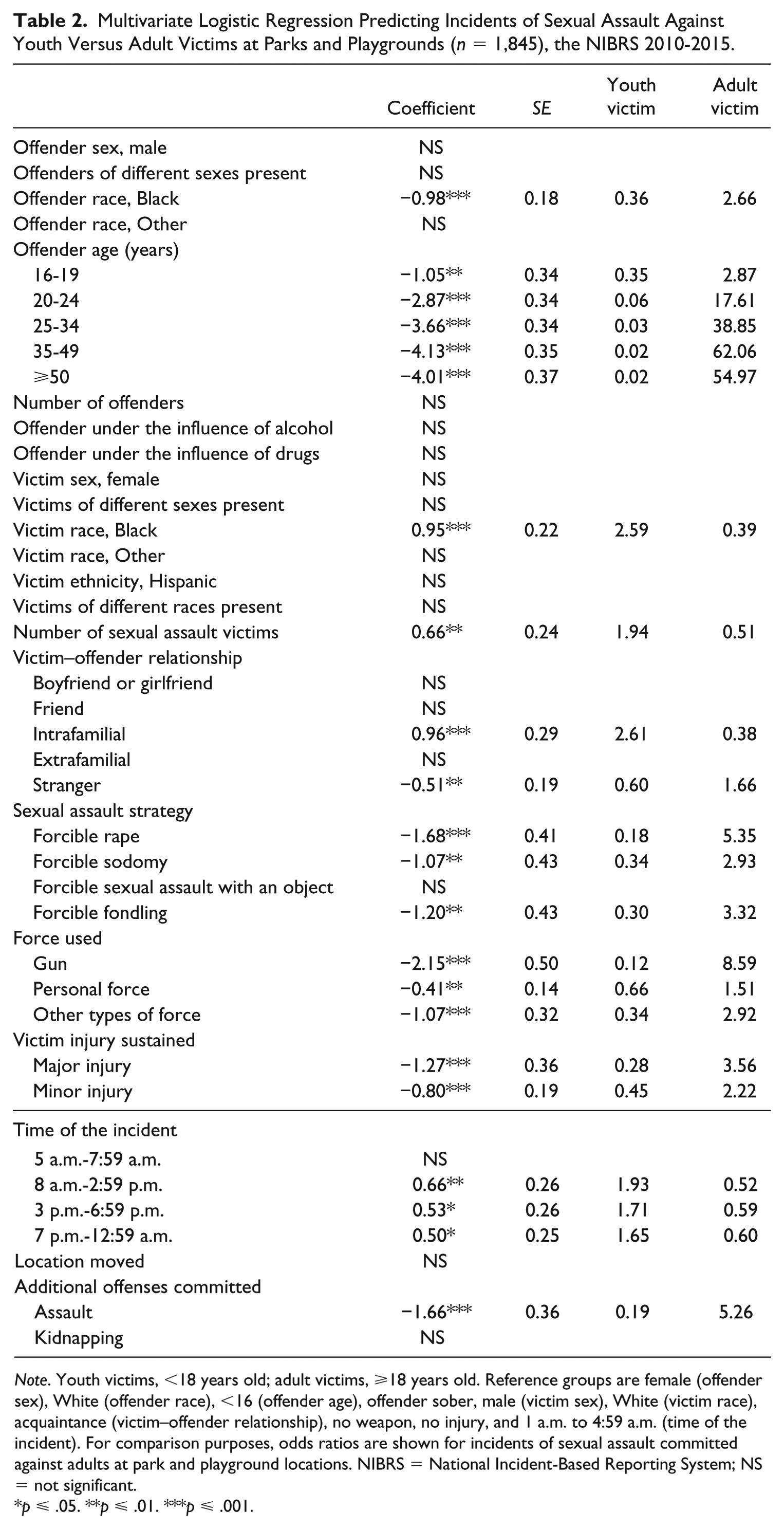
Note. Youth victims, <18 years old; adult victims, ⩾18 years old. Reference groups are female (offender sex), White (offender race), <16 (offender age), offender sober, male (victim sex), White (victim race), acquaintance (victim–offender relationship), no weapon, no injury, and 1 a.m. to 4:59 a.m. (time of the incident). For comparison purposes, odds ratios are shown for incidents of sexual assault committed against adults at park and playground locations. NIBRS = National Incident-Based Reporting System; NS = not significant.
p ⩽ .05. **p ⩽ .01. ***p ⩽ .001.
Results
To address the underpinnings of (social) exclusion laws, we turn to the first research question: Are parks/playgrounds a location of heightened risk with respect to sexual assaults perpetrated against youth and with respect to sexual assaults perpetrated by strangers? Using logistic regression, we assessed incidents of sexual assault at parks/playgrounds in relation to risk to youth versus adult victims. Sexual assault incidents at parks/playgrounds were significantly more likely to involve youth victims relative to adult victims, a 34% increase in the odds holding all other variables constant (p < .001). In a separate model, incidents of sexual assault at parks/playgrounds were regressed on stranger relationships versus nonstranger relationships. Sexual assault incidents at parks/playgrounds were significantly more likely to involve strangers versus nonstrangers, a 232% increase in the odds holding all other variables constant (p < .001). In both cases, results held regardless of controls for victim and offender demographics. These results are available in the supplement, Tables S2 and S3.
The second research question addresses descriptive characteristics of incidents of sexual assault that occur at parks/playgrounds that are then reported to police. In the years 2010 through 2015, there were 454,875 incidents of sexual assault reported to police. Of those incidents, 2,336 were committed at a park/playground. This equates to just less than 1% of the total number of sexual assault incidents, and approximately 5% of stranger-involved sexual assaults, for that 6-year time period. In comparison, over the same time period, 73% (i.e., 330,634) of incidents of sexual assault occurred at a residence or home.
Figure 1 shows the cumulative distribution by month of sexual assault incidents occurring at parks/playgrounds as recorded by law enforcement (2010-2015). Incidents of sexual assault committed at a home location were also added to Figure 1 so that their distribution could be compared with incidents of sexual assault committed at parks/playgrounds. In general, and as expected, incidents of sexual assault that occurred at parks/playgrounds increased during the spring and summer months and declined in the winter months. The peak month for sexual assault incidents against youth victims was June (12.6%), whereas the peak month for sexual assault incidents against adult victims was August (14.9%). Sexual assault incidents against youth and adult victims were at their lowest in February (4% youth, 2.1% adult) and both began to climb in March (7.6% youth, 5.5% adult). For incidents with youth victims, this steady climb continued until its peak in June (12.6%) and then declined through December (4.8%). In contrast, for incidents with adult victims, incidents continued to climb through August (14.9%), remained high in September (13.9%), and then began declining in October (8.7%) through December (4.3%). Figure 1 shows that sexual assault incidents occurring at the home stayed fairly consistent throughout the course of a calendar year (between 7% and 9% each month).
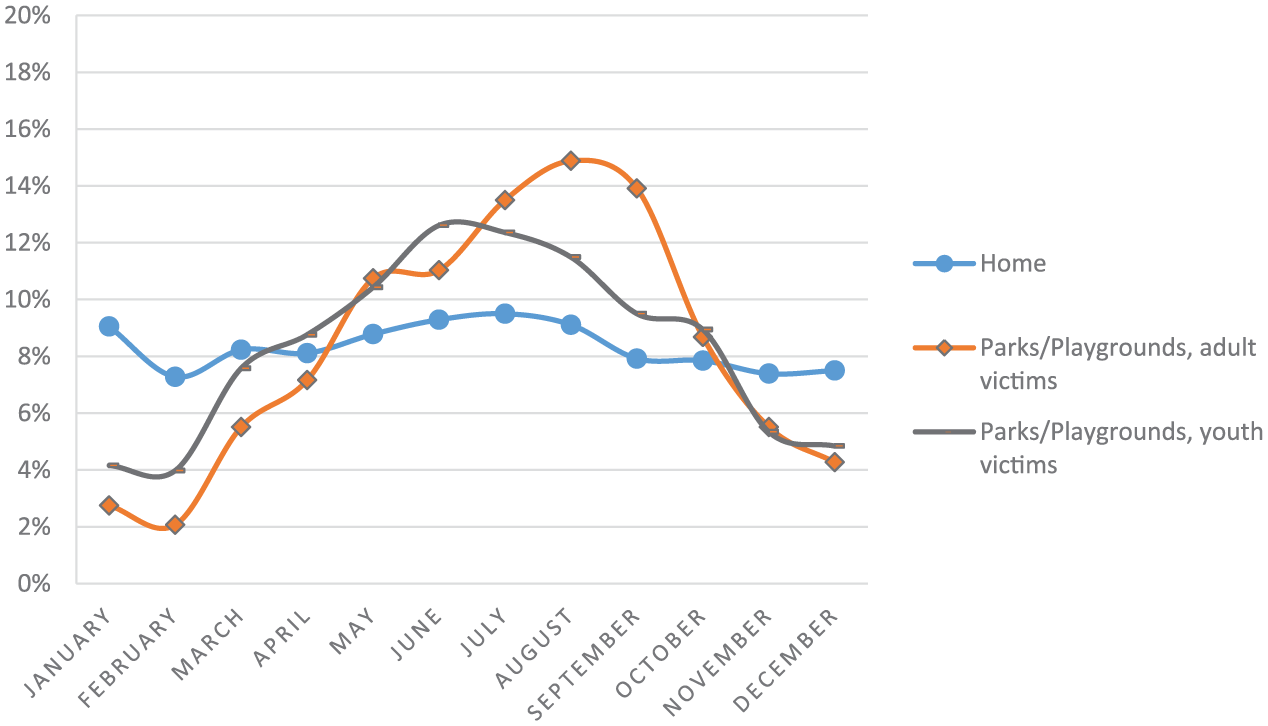
Percent of sexual assault incidents occurring at parks/playgrounds (adult victim incidents, n = 726; youth victim incidents, n = 1,610) or homes (n=330,634) by month as recorded by law enforcement agencies, the NIBRS 2010-2015.
Descriptive Overview of Sexual Assault Incidents at Parks/Playgrounds With Youth Victims
For sexual assault incidents involving youth victims, solo males (95%) were the majority of perpetrators, although a small percentage of incidents had both male and female perpetrators (2%). Perpetrators were on average 29 years old (SD: 10.64, range: 18-76; data not shown), with the largest percentage falling within the 16 to 19 age range (35%), and mostly White (74%). Youth victims within the incidents were on average 13 years old (SD: 3.49, range: infant-17; data not shown) and mostly White (70%). About 36% of the perpetrators in the incidents were acquaintances of the victim. A little over half of the incidents against youth victims involved a force (about 52%), but the most frequently used type of force was a personal weapon (48%; hands, feet, teeth). Rape (33%) and forcible fondling (39%) were the most prevalent sexual assault behaviors compared with sodomy (8%) and sexual assault with an object (3%). Twelve percent of the incidents resulted in victim injury, but the majority of the sustained injuries were classified as minor (10%). As for the time of the incidents, incidents with youth victims were most likely to be committed between the hours of 7 p.m. and 12:59 p.m. (35%) and also during the hours of 8 a.m. to 2:59 p.m. (29%) and 3 p.m. to 6:59 p.m. (29%). As for other crimes committed during these youth victim sexual assault incidents, 2% included assault and 7% included kidnapping.
Bivariate Logit Comparisons of Sexual Assault Incidents at Parks/Playgrounds With Adult Victims
Compared with incidents with adult victims, incidents with youth victims were more likely to have White offenders (74% vs. 60%, p ⩽ .001) and perpetrators who fell within the age categories of “less than 16 years old” (26% vs. 2%, p ⩽ .001) and “16 to 19 years old” (35% vs. 9%, p ⩽ .001). In contrast, incidents with adult victims were significantly more likely to have Black offenders (36% vs. 25%, p ⩽ .001) or offenders of another race (4% vs. 1%, p ⩽ .001). Incidents with adult victims were also more likely to have older offenders compared with incidents with youth victims, which was most pronounced when comparing “25 to 34 years old” (28% vs. 10%, p ⩽ .001), “35 to 49 years old” (30% vs. 7%, p ⩽ .001), and “age 50 or older” (12% vs. 4%, p ⩽ .001). The data showed sober perpetrators were more likely in incidents with youth victims compared with those with adult victims (94% vs. 86%, p ⩽ .001), although the majority of both youth victim and adult victim incidents did not have perpetrators who were under the influence of either alcohol or drugs. The one difference was that incidents with adult victims were more likely to involve perpetrator alcohol use (10% vs. 4%, p ⩽ .001).
Turning to victim characteristics, incidents with youth victims were more likely to involve male victims (12% vs. 9%, p ⩽ .05). Youth victim incidents were more likely to have Black victims versus adult victim incidents (19% vs. 15%, p ⩽ .05). Incidents with youth victims were also more likely to involve perpetrators who were known to the victim (here, a friend [12% vs. 5%; p ⩽ .001], an acquaintance [36% vs. 24%; p ⩽ .001], or other family member [6% vs. 4%; p ⩽ .05]), whereas incidents with adult victims were significantly more likely to involve persons known to the victim but outside of the family (extrafamilial, 28% vs. 24%, p ⩽ .05) and significantly more likely to involve stranger perpetrators (31% vs. 13%, p ⩽ .001).
Several findings are notable concerning additional aspects of the incident. Incidents with youth victims were significantly more likely to involve forcible fondling (39% vs. 29%, p ⩽ .001) compared with incidents with adult victims which were significantly more likely to involve rape (52% vs. 33%, p ⩽ .001). Incidents with youth victims were more likely to involve no force (48% vs. 26%, p ⩽ .001) and less likely to result in any type of injury (less the sexual assault itself; 88% vs. 66%, p ⩽ .001). Incidents with youth victims were more likely to occur between the hours of 8 a.m. and 2:59 a.m. (29% vs. 22%, p ⩽ .001) and between the hours of 3 p.m. and 6:59 p.m. (29% vs. 22%, p ⩽ .01), whereas incidents with adult victims were more likely to occur between the hours of 1 a.m. and 4:59 a.m. (13% vs. 5%, p ⩽ .001). Last, sexual assault incidents involving youth victims were less likely to involve an additional assault (2% vs. 9%, p ⩽ .001) or kidnapping (7% vs. 17%, p ⩽ .001) compared with those with adult victims.
Last, using a multivariate logistic regression model, the final research question probed how incident characteristics differed when a sexual assault occurs at a park/playground against a youth victim versus when it occurs against an adult victim at this locale.
Incidents With Youth Victims
Victim race, the number of sexual assault victims in the incident, and the victim–offender relationship were positively associated with predicting incidents of sexual assault involving youth victims that took place at parks/playgrounds. If the victim was Black compared with White, the odds the sexual assault incident involved a youth victim relative to an adult victim were 2.59 times greater, holding all other variables constant (p ⩽ .001). Second, for each additional sexual assault victim in the incident, the odds the incident involved a youth victim relative to an adult victim were 1.94 times greater, holding all other variables constant (p ⩽ .01). Finally, pertaining to the victim–offender relationship, intrafamilial relationship status increased the odds of a youth victim being victimized in the incident. If the sexual assault incident at parks/playgrounds involved an intrafamilial perpetrator, the odds the incident involved a youth victim relative to an adult victim were 2.61 times greater, holding all other variables constant (p ⩽ .001).
Numerous characteristics of the incident decreased the odds that the victim was a youth victim compared with an adult victim. If the incident involved a Black offender compared with a White offender, the odds decreased that the victim was a youth. All of the perpetrator age categories when compared with offenders who were less than 16 years old decreased the odds the victim was a youth victim. If the incident involved rape, sodomy, or forcible fondling, the odds decreased that the victim was a youth victim. If any type of force was used, if the victim sustained an injury (minor or major), or if the incident involved assault, the odds decreased that the victim was a youth victim compared to an adult victim. Last, if the perpetrator in the incident was a stranger, the odds of the victim being a youth victim relative to an adult victim decreased by a factor of 0.60, holding all other variables constant (p ⩽ .01).
Incidents With Adult Victims
The vast majority of incident characteristics, as coded here, were associated with an increase in the odds of an adult victim versus a youth victim at parks/playgrounds. For example, if the offender was Black compared with White, the odds the incident involved an adult victim relative to a youth victim were 2.66 times greater, holding all other variables constant (p ⩽ .001). In comparison with incidents with offenders under the age of 16, all of the offender age categories predicted an increase in the odds the victim was an adult compared with a youth. There were particularly substantial increases in the odds when the incident involved older offenders (aged 20 and older).
As for victim characteristics, if the perpetrator was a stranger, this increased the odds almost twofold that the victim in the sexual assault incident at parks/playgrounds would be an adult. If the perpetrator was a stranger, the odds the incident involved an adult relative to a youth victim were 1.66 times greater, holding all other variables constant (p ⩽ .01).
As for crime characteristics, incidents with adult victims were significantly more likely to involve rape, sodomy, and forcible fondling. When the incident involved force or a major or minor victim injury, the odds increased predicting an adult victim versus youth victim. For example, if the incident involved a gun compared with no force, the odds the incident involved an adult versus youth victim were 8.59 times greater, holding all other variables constant (p ⩽ .001). If the sexual assault incident resulted in a major victim injury, the odds the incident involved an adult relative to a youth victim were 3.56 times greater, holding all other variables constant (p ⩽ .001). The odds increased by 2.22 for minor injuries (p ⩽ .001). All else constant, sexual assault incidents at parks/playgrounds involving adults increased the odds fivefold that the sexual assault incident would also involve assault (p ⩽ .001).
Discussion
Parks and playgrounds have been viewed to serve the public good, ranging from leisurely activities like relaxing outdoors to improving physical health (Loukaitou-Sideris & Sideris, 2010), yet current laws enacted throughout the United States prohibit certain persons convicted of sex crimes from accessing these social spaces (e.g., residence restrictions, child safety zones, and social exclusion zones; e.g., Colombino et al., 2011; Levenson & Cotter, 2005; Levenson & Zgoba, 2014; Socia, Levenson, Ackerman, & Harris, 2014). The premise of the laws is often linked to youth safety, public safety, and reduced victimization (i.e., from strangers), but few studies have delved into the characteristics of sexual assaults that take place at these youth-centric locations. To help advance the literature, we drew on the NIBRS data (2010-2015) to examine 2,336 incidents of sexual assault at parks and playgrounds. Our results indicate that the type of victim, youth or adult, significantly shapes the characteristics of the sexual assault incident. In addition, while we found some similar patterns with previous work that included parks and playgrounds, our results also diverged from existent findings across some dimensions.
New Findings
One important observation from our study is the contextual risk for peer-to-peer sexual violence unique to adolescents and young adults. Put differently, within these incidents of sexual assault, teenagers and young people were most likely to be victims of sexual assault, and also commit such offenses, in parks and playgrounds. For example, our results showed that, at the bivariate level, incidents with youth victims were significantly more likely to be victimized by someone under the age of 20. Youth-on-youth victimization versus adult-on-youth victimization indicates then that the former group (i.e., younger victims) are more vulnerable to the presence of peer-aged perpetrators. This point is underscored because it appears to go against the stereotypically perceived image of the exact offender place restrictions seek to affect (e.g., an older recidivist offender loitering about waiting for the opportunity to sexually victimize a young park/playground-goer). Because the context in which crimes against youth are committed is missed in current social exclusion or “safeguarding” policies emphasizing the adult perpetrator (see Firmin, 2018), there is a failure to recognize the relationship that youth perpetrators have with this social space and the context in which these sexual assaults unfold. The intersection between the social contexts within the parks and playgrounds and peer group usage could make other youth vulnerable to opportunist and/or motivated peer offenders.
No work to date has assessed when sexual assaults at parks and playgrounds occur throughout the year. Temporal analysis showed that for both incidents with youth and adult victims sexual assaults tended to occur in the warmer months while decreasing in the colder months. This mirrors other research that has looked at the seasonality and/or warmer months versus colder months in relation to sexual violence (see, for example, Dodge, 1988; Keating, Higgs, Willott, & Stedman, 1990; Lauritsen & White, 2014; Michael & Zumpe, 1983). We did not anticipate that incidents with adult victims would remain persistently high throughout the summer months compared with incidents with youth victims. We hypothesized, based on the academic calendar, that incidents with youth victims would remain high throughout all the summer months. It is unclear why this might be the case, unless perhaps adults use parks and playgrounds at a greater frequency throughout the summer because of things such as exercising, not needing additional adult supervision (like youth), and being able to use these areas during times that youth, particularly children, would not (e.g., such as late night or very early morning hours). Generally, though, given this public social space, this trend is in line with other crime-related research that finds weather patterns influence certain crime types. This temporal pattern fits squarely within a larger literature documenting a routine activity effect in that during the more comfortable, warmer season a larger pool of suitable targets for crime exist (e.g., Anderson, 1987; Field, 1992; Hipp, Bauer, Curran, & Bollen, 2004).
In addition, indicators of additional violence and force (e.g., the offender used a weapon, inflicted additional physical injury) predicted reduced likelihood that the victim was a youth as opposed to an adult victim in the sexual assault incident. This set of findings may reflect the disproportionate use of “grooming” patterns adopted by perpetrators to entice youth victims to “go along” with sexual abuse (e.g., for a review, see Craven, Brown, & Gilchrist, 2006). In addition, force may not be needed to control smaller victims given their size. Beyond this trend, however, it is difficult to explain some findings and patterns regarding place and sexual victimization of youth given the absence of prior examination of the specific correlates of these offenses at parks and playgrounds. What can be gleaned is that a different context for sexual abuse against youths, as opposed to adults, exists.
Finally, this research had one unanticipated finding that is harder to explain—the relationship between perpetrator race and victim race. Notably, the majority of perpetrators and victims in the study were White, which is a pattern that corresponds to other research on sexual victimization and expectations regarding demographics of the U.S. population as a whole (Budd, Rocque, & Bierie, 2017; Finkelhor, Hammer, & Sedlack, 2008; Planty, Langton, Krebs, Berzofsky, & Smiley-McDonald, 2013; Williams & Bierie, 2015). However, when analyzing race effects further, a less consistent pattern emerged. The odds of being a youth victim were lower when the perpetrator in the incident was Black (compared with White), but the odds of being a youth victim were higher when the victim in the incident was Black (compared with White). Future research should explore mechanisms at play that may help explain these patterns further (e.g., levels of supervision of youth across race and ethnicity, differences in informal social control across communities, differences in design and use of parks and playgrounds across communities of various demographic distributions).
Supported Findings
Consistent with prior findings (see, for example, Calkins et al., 2015; Colombino et al., 2009; Colombino et al., 2011; Leclerc, Wortley, & Smallbone, 2010; Mogavero & Kennedy, 2017; Smallbone & Wortley, 2000), the majority of sexual assault incidents during this time frame occurred in a residence or home (~75%). Although some scholars are concerned with the utility of these social space restrictions as applied broadly (Levenson & Zgoba, 2014; Mogavero & Kennedy, 2017; Socia, 2014), if parks and playgrounds are part of the modus operandi and/or spatial behavior of certain individuals who sexually offend, customizing and targeting restrictions to this specific group of park and playground offenders may be justifiable (see, for example, Beauregard, Proulx, & Rossmo, 2005; Beauregard et al., 2007; Hewitt & Beauregard, 2014; Socia, 2014). This approach, particularly for those who evince a proclivity for finding victims at parks and playgrounds and/or committing sexual assaults at these places, may be a situational crime prevention strategy to remove those sexual offending triggers.
While prior investigations examined very small sample sizes for sexual assaults that occurred at parks and playgrounds (ranging from n = 4 to n = 15), there was a consistent pattern that youth compared with adults constituted the majority of victims (Calkins et al., 2015; Colombino et al., 2011; Mogavero & Kennedy, 2017). The more robust sample size here shows the same pattern. Incidents were more likely to involve youth victims (~70%) versus adult victims (~30%). Moreover, the multivariate analysis found that if a sexual assault incident occurred at a park or playground compared with the other NIBRS locations, there was a 34% increase in the odds the victim was a youth compared with an adult. This result presents for a mixed interpretation about potential social space exclusion reforms. On one hand, the finding that incidents were more likely to involve youth victims, and that this social space presents more risk for youth compared with other locations, supports the use of social space restrictions for these areas. On the other hand, as our divergent findings illuminate below, the victim–offender relationship does not support the inherent threat of stranger danger against youth victims at this locale, at least with this data set involving police-reported sexual assaults. That is, going against the “stranger danger” logic that influenced the passage of such laws, strangers were not the typical perpetrators in youth victim–involved incidents, but they did impose an inherent risk to adults.
Divergent Findings
Only one prior study has assessed the victim–offender relationship in relation to sexual assaults that took place at parks and playgrounds (Calkins et al., 2015). In that investigation, the majority of victimizations were committed by strangers and then acquaintances. However, drawing on a much larger data set, we found two additional patterns. First, our initial analyses revealed that parks and playgrounds, compared with other NIBRS locations, were significantly more likely to involve strangers. But youth compared with adults were more at risk to be victimized by known offenders within these incidents of sexual assault. Approximately 87% of the incidents that involved a youth victim at parks and playgrounds involved a perpetrator who was known to that youth. In addition, compared with incidents with adult victims, incidents with youth victims were also significantly more likely to involve an intrafamilial perpetrator, almost triple the odds. While the rationale for the laws has been to protect youth from stranger danger, here we found that adults were more at risk from stranger danger compared with youth. Whereas stranger perpetrators were involved in about 13% of youth victim incidents, stranger perpetrators were involved in 31% of the incidents with adult victims (i.e., almost three times as many incidents compared with youth victim incidents). This unexpected result indicates a need to more systematically evaluate whether current restriction laws are preventing sexual assault against adult victims at these locations. If this preliminary finding is confirmed by future analyses, a natural policy reform would be to explore how to improve the efficacy of such laws with an emphasis on protecting the adult population given their relatively greater risk of sexual victimization by strangers, as compared with youth, and in addition to protecting youth from sexual assault by people they know at these public places.
Limitations
As with all research on victimization patterns, a significant concern is that sexual assault is one of the least reported crimes to law enforcement (Langton, Berzofsky, Krebs, & Smiley-McDonald, 2012). Viewed from that prism, the use of NIBRS data to investigate our research questions can be seen as a limitation. It is important to note, though, that prior scholarship has relied on the NIBRS for analysis of other research voids that also required characteristics of the crime incident to investigate study hypotheses (see, for example, Chaffin, Levenson, Letourneau, & Stern, 2009; Krienert & Walsh, 2011; Prescott & Rockoff, 2008). As these studies mention, the NIBRS still represents one of the only large data sets that would provide for evaluation of the timing, location, and other features of reported crime incidents. In addition, although the NIBRS currently contains data for a majority of U.S. states, it is not necessarily a representative account of all crime that occurs across U.S. jurisdictions. Our results then do not include coverage of all sexual assault incidents at parks and playgrounds nationally.
A separate shortcoming may be that the NIBRS records parks and playgrounds as a singular location. It is reasonable to assume that all parks may not have playgrounds or that all playgrounds may not be located in a social space that is designated a park. Accordingly, the characteristics found to be associated with youth and adult victims here may vary if the location measures were further refined to isolate a park from a playground. But what may be inherently more important would be for future research to also include additional measures about place, such as the features of parks and playgrounds themselves, to assess their relation to the commission of sexual assault at these locations. These types of measures are not available in the NIBRS. Given that prior research has illustrated, for instance, individuals avoid parks and playgrounds that are perceived as unsafe (e.g., poor lighting, broken glass; Salem & Lewis, 2016), a logical next step would be to include environmental measures and characteristics of the location itself. Hence, these additional facets about parks and playgrounds have the potential to address our limitations and further illuminate pathways to committing sexual assault at specific locations against both youth and adult victims.
Finally, the NIBRS does not include criminal history (e.g., prior sexual assault convictions), whether the offender and victim made initial contact at a park or playground but the sexual assault occurred elsewhere, nor does it disentangle incidents that took place at parks and playgrounds with restriction laws or ordinances versus those that did not. These types of variables could potentially influence the characteristics of sexual assault victimizations that take place at parks and playgrounds. Researchers should consider parsing out parks and playgrounds by type of law (e.g., residence restriction, loitering, social exclusion zone laws) to evaluate their impacts while also including victim–offender contact information and offender criminal history.
Implications and Future Directions
Prior work, primarily drawing on small samples of incarcerated offenders convicted of sex crimes, has suggested that sexual assault committed in public spaces is an exception, not the norm (Calkins et al., 2015; Colombino et al., 2009; Colombino et al., 2011; Mogavero & Kennedy, 2017). Our data, which draw from reports to the police, provide another layer of support to these findings. In accordance with other research, analysis of official record data shows that the majority of sexual offenses were committed in a home versus only a small percentage that were committed in parks and playgrounds. Still, given the trauma inflicted on victims of these sexual assaults at parks and playgrounds and the focus of law on this location, progress must be made to better inform public safety measures at parks and playgrounds.
One avenue for future research would be to analyze whether the general criminality of the park and/or playground, perhaps operationalized by the number of calls for service, affects the extent of specific sex crimes in that area. Along this avenue, it is evident that other characteristics may be theoretically and empirically relevant in assessing the contextual nature of this location, such as the density of those registered for sex crimes living just outside the boundary restrictions, the number of unsupervised adolescents who frequent the park, or the number of infractions for loitering that occurs annually. Although county or municipal-level and/or observational data might be available to tap these variables, a complementary strategy would be to design surveys of residents that measured perceptions of the amount of loitering, vagrancy, and other social incivilities within the park or playground.
Another extension could explore the characteristics of sexual assaults that occur at other youth-centric locations targeted by social space restrictions, such as day cares, churches, and schools. This is an opportune area to study given that restrictions to place continue to broaden beyond parks and playgrounds (e.g., shopping malls; Levenson, Ackerman, Socia, & Harris, 2015). These are also locations that are contained within the NIBRS. It may be that a different set of factors predicts the likelihood of sexual abuse against youth across these distinct social places. Evaluating whether place restrictive reforms make for effective public policy requires, as a first step, analyses along these lines.
With the emphasis on best practices in criminal justice, particularly in addressing sexual victimization (Levenson & Cotter, 2005; Nobles, Leveson, & Youstin, 2012; Socia, 2014), developing a more complete picture of the reality of place-specific sex crimes might result in a better allocation of policing resources. For example, results showed sexual victimization incidents in parks and playgrounds peaked during certain times of the year and also during certain times of the day dependent on the type of victim. It follows, then, that synchronizing patrols during those “high-risk” periods may increase the efficiency and effectiveness of scarce police resources. Police officers may also benefit from some of the findings here. For example, these data show that youth victims are more at risk from victimization by someone they know in this public setting. It is plausible that police officers who are tasked with monitoring parks and playgrounds to prevent sexual assault may disproportionately focus on strangers engaging youth as an indicator of risk. This would likely be a common event to watch for then to intervene with questions or other investigative practices. While this research suggests this continues to be reasonable (i.e., 13% of the incidents did involve stranger sexual assault against youth), it also reminds police not to ignore situations which involve people who know each other. Somewhat related, these data may offer some guidance on officer safety. Use of force, particularly guns, was correlated with incidents with adult victimizations. Officers are likely always wary of risk when responding to a sexual assault, but they should be even more so when responding to incidents at parks with adult victims.
There is clearly more ground to cover in unpacking the place-specific context of incidents of sexual assault in various public locations. We cannot assume all public locations carry the same risk for youth or adult victims nor have the same sexual assault characteristics. In the absence of further research to build such knowledge, it would follow that law and policy recommendations adopt a cautious approach in implementing evermore place restrictions until preliminary evaluation of their characteristics and effects can be better ascertained through research. Once those characteristics and effects are understood, laws and policies that address the risks of sexual abuse in public spaces, like the ones outlined above, would be better designed and implemented when driven by sound evidence.
Supplemental Material
Table_S1_State_Laws_on_Sex_Offender_Use_of_ParksPlaygrounds_RandR – Supplemental material for Parks, Playgrounds, and Incidents of Sexual Assault
Supplemental material, Table_S1_State_Laws_on_Sex_Offender_Use_of_ParksPlaygrounds_RandR for Parks, Playgrounds, and Incidents of Sexual Assault by Kristen M. Budd, Christina Mancini and David M. Bierie in Sexual Abuse: A Journal of Research and Treatment
Supplemental Material
Table_S2_Binary_Logit_Parks_and_Stranger_Risk_RandR_FINAL – Supplemental material for Parks, Playgrounds, and Incidents of Sexual Assault
Supplemental material, Table_S2_Binary_Logit_Parks_and_Stranger_Risk_RandR_FINAL for Parks, Playgrounds, and Incidents of Sexual Assault by Kristen M. Budd, Christina Mancini and David M. Bierie in Sexual Abuse: A Journal of Research and Treatment
Supplemental Material
Table_S3_Binary_Logit_Parks_and_Youth_Risk_RandR_FINAL – Supplemental material for Parks, Playgrounds, and Incidents of Sexual Assault
Supplemental material, Table_S3_Binary_Logit_Parks_and_Youth_Risk_RandR_FINAL for Parks, Playgrounds, and Incidents of Sexual Assault by Kristen M. Budd, Christina Mancini and David M. Bierie in Sexual Abuse: A Journal of Research and Treatment
Footnotes
Acknowledgements
We would like to thank Paul J. Detar for his suggestions on an earlier draft of this manuscript. We would also like to thank Dr. Eric Beauregard, the action editor, and the anonymous reviewers for their invaluable feedback on the manuscript throughout the revision process.
Authors’ Note
The views and opinions of this research do not necessarily represent those of the U.S. Department of Justice or any component therein.
Declaration of Conflicting Interests
The author(s) declared no potential conflicts of interest with respect to the research, authorship, and/or publication of this article.
Funding
The author(s) received no financial support for the research, authorship, and/or publication of this article.
Notes
References
Supplementary Material
Please find the following supplemental material available below.
For Open Access articles published under a Creative Commons License, all supplemental material carries the same license as the article it is associated with.
For non-Open Access articles published, all supplemental material carries a non-exclusive license, and permission requests for re-use of supplemental material or any part of supplemental material shall be sent directly to the copyright owner as specified in the copyright notice associated with the article.
