



Abstract
The accuracy of risk assessment tools for Asian populations has received relatively little research attention. This study evaluated one of the most widely used static risk assessment tools - Static-99R - for assessing the likelihood of recidivism among men convicted of a sexual crime in South Korea. Overall, this South Korean sample (N = 8207) appeared to have a higher risk (more paraphilic interests, more sexual/general criminality) than the Static-99R normative samples (who were mostly White individuals from Western countries). Despite the differences, Static-99R was able to discriminate recidivists from nonrecidivists in South Korea, with AUC values similar to that observed in the normative samples (e.g., 0.72 for sexual recidivism). In terms of calibration, the observed sexual recidivism rates of the current sample were higher than the international routine/complete normative samples but lower than the high-risk/high-need normative samples (E/O = 0.75 and 1.26, respectively). Consequently, evaluators in South Korea can have reasonable confidence in the ability of Static-99R to rank individuals according to their relative likelihood of sexual recidivism.
Correctional interventions are most likely to be effective when the level of service is proportional to each person’s risk to reoffend (i.e., the most intensive services are provided to those at highest risk; risk principle; Bonta & Andrews, 2017). Consequently, accurate assessment of recidivism risk is critical for effective correctional rehabilitation and has broad implications for sentencing, parole, probation, and sex crime-specific treatment. This has led to the development of structured risk assessment tools for different types of offenses (e.g., violent, sexual, or general offenses), which are now widely used in the West (e.g., Canada, US, UK, Europe). In these contexts, recidivism prediction tools have demonstrated moderate to high levels of predictive accuracy (Campbell et al., 2009; Hanson & Morton-Bourgon, 2009; Tully et al., 2013; Yang et al., 2010).
Static-99R (Hanson & Thornton, 2000; Helmus, Thornton, et al., 2012) is the most commonly used structured risk assessment tool for adult men with a history of sexual offending, with routine use in forensic and correctional settings in Canada (Bourgon et al., 2018; Hill & Demetrioff, 2019), the US (Kelley et al., 2020; McGrath et al., 2010) and other countries (Neal & Grisso, 2014), including some countries in East Asia (e.g., Japan, Singapore, South Korea, Taiwan; Helmus et al., 2022). Static-99R provides relative risk and recidivism rate estimates based on commonly available demographic and criminal history information (Helmus et al., 2022). Consequently, the predictive accuracy of Static-99R should be evaluated in terms of discrimination (the capacity to distinguish between recidivists and nonrecidivists) and calibration (the consistency of recidivism rates across samples and settings; Hanson, 2022; Helmus & Babchishin, 2017).
To date, Static-99R has been validated across many different countries (e.g., US, Canada, Denmark, Singapore, Australia; Helmus et al., 2022) and those predictive validity studies have primarily focussed on discrimination. A recent meta-analysis with 15 field studies, for example, found that Static-99R showed moderate discrimination accuracy (i.e., AUC of 0.665 in the fixed-effect model, AUC of 0.688 in the random-effects model; n = 48,925; Helmus et al., 2021b). Of these 15 samples, five also examined calibration (n = 23,825). The general pattern was that the 2016 Static-99R normative data (Hanson et al., 2016) significantly overestimated sexual recidivism rates (E/O = 1.88, 95% CI of 1.76–2.01). The Static-99R recidivism rate norms for routine/complete samples have been subsequently updated (Lee & Hanson, 2021).
Cross-Cultural Validity of Static-99R
Static-99R was developed on largely White samples (i.e., there were relatively small numbers of ethnic minorities in the development samples), which raises the potential for cultural bias. For example, risk factors (items) might not be associated with recidivism risk for certain racialized/ethnic groups (i.e., groups to which individuals belong to based on shared culture). As well, different racialized/ethnic groups might have their own cultural-specific risk factors (Van de Vijver & Tanzer, 2004).
There is no single definition of fairness/bias for prediction tools, and not all definitions are mutually compatible (Chouldechova, 2017). Most Static-99R research, including the current study, followed the definition of bias proposed by Reynolds and Suzuki (2013); specifically, an unbiased measure is one that supports the same inferences regardless of race/ethnicity. For prediction tools, like Static-99R, this means that the estimated likelihoods are similar for different ethnic/racial groups. This definition can be formally stated as the equivalence of prediction equations (see Hanson, 2022, Chapter 14).
The cross-cultural validity of Static-99R has mostly been studied with racialized/ethnic minority groups who are disproportionately overrepresented (i.e., a higher proportion than expected) in the Canadian or US criminal justice system, such as African Americans (Lee et al., 2020b; Varela et al., 2013), Latinos (Lee & Hanson, 2017; Leguizamo et al., 2017) and Indigenous peoples (Lee et al., 2020a; Myer, 2019). Overall, Static-99R has generally worked as intended for these subgroups; however, there is a trend toward lower predictive accuracy among racialized minorities than among Whites.
Predictive Accuracy of Static-99/R for Asian Peoples
Predictive Validity of the Static-99/R for Sexual Recidivism with Asian Samples.
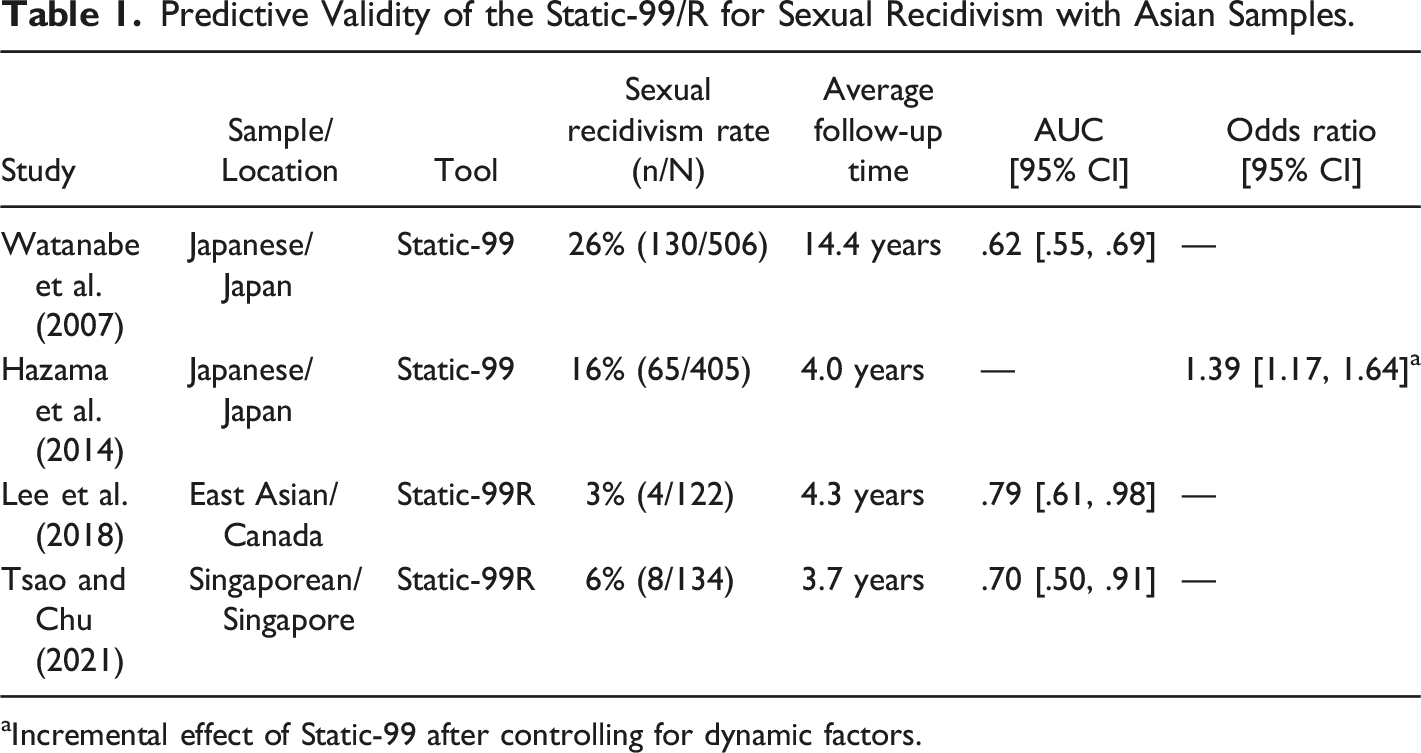
Incremental effect of Static-99 after controlling for dynamic factors.
In another study in Japan, Hazama and her colleagues (2014) examined the predictive accuracy of Static-99 with individuals who committed sexual crimes and were placed on probation or parole in 2008 and followed up until 2012. The total sample size was 405 (112 had been convicted of rape, 145 had been convicted of indecent assault, 28 had sexually offended against children, and 120 had committed other types of sexual crimes). Their sexual recidivism rate was 16.0% (65 recidivists) with about a 4-year follow-up time. They reported the incremental effect of Static-99 over a collection of dynamic risk factors and found good predictive accuracy for Static-99 (odds ratio = 1.39 [1.17, 1.64]) that was comparable to those observed in the Static-99R normative samples (e.g., odds ratio = 1.39, n = 6,967, k = 21; Hanson et al., 2016, Table 3).
In Canada, Lee and his colleagues (2018) examined the predictive accuracy of Static-99R with East Asian individuals (e.g., Chinese, Japanese, and South Korean) who were supervised by BC Corrections for a sexual offense (n = 122). With an average follow-up of 4.3 years, Static-99R significantly predicted sexual, violent, and any crime recidivism among those of East Asian heritage (AUC = .79 [.61, .98] with 4 recidivists, .68 [.54, .82] with 11 recidivists, .69 [.55, .82] with 14 recidivists, respectively). In comparison to the other studies that examined ethnic Asian samples in Asia cultures, this study examined an ethnic Asian minority in a non-Asian culture (BC, Canada).
In the most recent study, Tsao and Chu (2021) examined the predictive accuracy of Static-99R for 134 adult male probationers between 2004 and 2012 in Singapore. The average length of follow-up was 3.7 years. During the follow-up period, 6.0% (8/134) sexually reoffended, and 17.9% (24/134) reoffended with any offense. The AUC value of Static-99R for sexual recidivism (AUC = .70 [.50, .91]) was very similar to those found in the meta-analysis (Helmus et al., 2021a); however, it was not statistically significant, probably due to the small sample size (8 recidivists). Static-99R significantly predicted any recidivism with an AUC value of .64 (.52, .77).
Risk-Relevant Characteristics of Asians with a History of Sexual Crimes
Lee et al. (2018) found that East Asians in British Columbia (BC), Canada, were at lower risk than White and Indigenous individuals. The BC East Asian sample was relatively low on both general criminality (e.g., prior nonsexual violence) and sex crime-specific variables (e.g., prior sexual offenses). There were, however, more likely to have been convicted for noncontact sex offenses. With regard to victim characteristics (e.g., male, stranger, and unrelated victims), there were no significant differences between the two groups.
When compared to the Static-99R normative samples, the sample from Singapore tended to have lower risk levels on general crime histories (e.g., prior nonsexual violence, prior sentencing dates); however, they had comparable prior sexual offense histories (Tsao & Chu, 2021). The Singaporean samples had high rates of noncontact sex offenses, high rates of sexual crimes against unrelated/stranger victims, and low rates of sexual offenses against males (Tsao & Chu, 2021).
A recent study compared men with sexual offense convictions referred to a prison-based treatment program in Hong Kong (N = 249) to the Static-99R normative samples (Lam, 2021). She found that the Hong Kong sample had less general criminal history (e.g., index nonsexual violence, prior nonsexual violence, and prior sentencing dates) but were more likely charged with or convicted of sexual crimes than the Western normative samples. In addition, the sample from Hong Kong had high rates of convictions of noncontact sex offenses and unrelated/stranger victims, but low rates of sexual offenses against males.
South Korean Society
South Korea (also known as the Republic of Korea) is an independent country located in East Asia on the southern part of the Korean Peninsula (a land area of 100,210 km2 [38,623 mi2]). As of 2020, the population of South Korea was estimated to be 51.8 million (Statistics Korea, 2020), and it is considered one of the most ethnically homogenous societies in the world, with ethnic Koreans representing approximately 96% of the total population (Ministry of the Interior and Safety, 2019). Korean is the official language.
Almost all young adults between 25-and 34-year-old (98%) in South Korea have an upper secondary qualification, which is the highest compared to other partner countries for both men and women. About 88% of 25-and 64-year-olds in South Korea attained an upper secondary qualification, which is 10 percent higher than the OECD average (OECD, 2019). Since the end of the Korean War, South Korea has sought to improve its economy, and the industrialization and urbanization of South Korea have brought many changes. South Korea is currently about the 10th biggest economy globally in terms of nominal gross domestic product (GDP) in 2020 (OECD, 2021).
South Korea is a centralized nation-state with a tripartite system of government consisting of an executive, a legislature, and a judiciary. There are no localized criminal justice systems, and, thus, the entire criminal justice system, such as prosecution, courts, and prisons, is the responsibility of the central government. South Korea has adopted much of the Continental or Civil Legal System. Explicitly written legal codes, including constitutional law, have been widely implemented. Consequently, for all legal problems, written rules of law are the primary sources of reference. The basic structure of criminal procedure takes on the nature of both an inquisitorial and adversarial system. This is primarily due to the nature of the Korean criminal procedure, which is a merger of American and German criminal procedures. The legal culture in Korea often takes on a traditional nature. For example, people are not likely to resolve conflicts through the court; rather, an informal resolution, such as coordination or conciliation, more often provides justice.
South Koreans share many cultural characteristics with the Chinese and Japanese because of their geographic proximity, long history of contact, and the mutual influence of animism, shamanism, Buddhism, Confucianism, and Taoism. Although a variety of surface changes in the attitudes and behavior of Koreans in contemporary society, South Korean society is still under the influence of the traditional cultures (e.g., collectivistic and hierarchical in social structure; De Mente, 2012; Niaz & Hassan, 2006; Yeh & Huang, 1996).
Sexual Offending and Risk Assessment in South Korea
In South Korea, sexual crimes have been gradually increasing over the last few decades (Supreme Prosecutor’s Office, 2020), while the rate of total crimes has gradually decreased in the same period. Specifically, the number of convicted sexual offense cases was increased by about 55% from 2010 (20,584 cases) to 2019 (32,029 cases), which corresponds to an increase from 40.7 per 100,000 to 61.8 per 100,000. From 2009 to 2017, sexual crimes against children (under the age of 18) accounted for 8%–12% of the total sexual crimes, and among them, the rate of sexual crimes against children aged 12 or under ranges from 3.5% to 6.5% (Korean Institute of Criminology, 2020).
The reasons for the recent increase in officially reported sexual crimes are unknown and may be related to changing attitudes and criminal justice responses. Another possible contributor is an increased number of online sexual crimes, such as production, distribution, and possession of child pornography, distribution online of illegally taken photos/videos of someone’s body (e.g., “upskirt”), and online sexual harassment (e.g., non-consensual sharing of intimate images and videos). In 2019, online sexual crimes accounted for approximately 20% of total sexual crimes, which has been one of the most serious social concerns in a recent South Korean society (Supreme Prosecutor’s Office, 2020).
In South Korea, 27% of individuals who committed sexual crimes were sentenced to imprisonment, 41% received community-based sentences (e.g., probation), and 32% were sentenced to a fine in 2017 (National Court Administration, 2018). Individuals who are convicted of sexual crimes and are assessed as high risk of recidivism are registered into the sex offender registry for a minimum of 10 years to a maximum of 30 years when they are released into the community (Kim et al., 2020). In addition, if they are assessed to be at high risk in their probability of sexual recidivism (used the Korean-Sex Offender Risk Assessment Scale [K-SORAS], Lee et al., 2008), the court orders wearing electronic monitoring devices when released into the community for a maximum of 30 years (Ministry of Justice, 2021).
As of 2012, most individuals who are sentenced to imprisonment are ordered by the court to participate in a psychological treatment program in prison. The court imposes the required treatment completion hours (e.g., 100 hours) as a part of sentencing. The treatment classification decisions in correctional settings are primarily made based on their recidivism risk assessed by Static-99 as well as the Hallym Assessment Guide for Sex Offender Risk [HAGSOR]; Jo, 2010).
Purpose of the Current Study
The purpose of the current study was to examine the discrimination and calibration of Static-99R in South Korea and the extent to which South Koreans with a history of sexual offending resemble the normative samples of Static-99R (mostly White individuals from Western countries).
Based on the previous research findings (from Hong Kong and Singapore), we expected some differences in the risk-relevant characteristics between Korean and normative samples. Specifically, compared to the normative samples, the Korean sample was expected to have fewer general and sexual criminal history risk factors. However, the Korean sample will have more stranger and unrelated victims, mostly against female victims. In addition, the Korean sample will have more noncontact sexual crimes.
Given the comparable findings in other Asian studies (e.g., Japan, Singapore), we expected Static-99R total scores to show moderate discrimination for Korean individuals; however, we also expected some items that are less sensitive to Korean cultural norms (e.g., ever lived with a lover for 2 years) might not be associated with sexual recidivism. We made no hypotheses regarding calibration analyses because no previous studies examined the calibration of Static-99R for the Asian population. In the following section, we report how we determined our sample size, all data exclusions, all manipulations, and all measures in the study.
Method
Sample
This prospective field study included 8207 adult men (18 or older 1 ) who were convicted of a sexually motivated crime against an identifiable victim (Category “A” sexual offenses, i.e., contact and non-contact sexual offenses against a victim who did not consent or was unable to provide consent [e.g., a minor]; Phenix et al., 2016). They also served at least some time in custody in the criminal justice system of South Korea. About 15% of the convicted sexual crimes were against child victims (13 or under); more than 60% of victims were adults (18 or older). The average time spent in custody before being released was 3.1 years (SD = 2.4; ranging from 0.1 to 20.9). They were released into the community after serving their custodial sentences between 2015 and 2018 (Mdn = 2017), and recidivism information was collected until February 28, 2020.
Most of the men (n = 7867; 95.9%) were referred to specialized treatment programs for sex offenders administered in the correctional facilities. Of the 7867 individuals referred to treatment, the average number of intervention hours was 112.7 (Mdn = 100.0; SD = 63.4; ranging from 0 to 400). Of those referred to treatment, 53 individuals did not complete any treatment sessions. All the men were identified as ethnically Korean; however, 1% (n = 78) were foreigners (no specific information available). Approximately 60% of the sample had completed high school; 103 had no education (1.3%), and 910 had a post-secondary degree (11.9%).
Measures
Static-99R
Static-99R (Hanson & Thornton, 2000; Helmus, Thornton, et al., 2012) is a 10-item empirical actuarial risk tool designed to assess the risk of sexual recidivism among adult men charged or convicted of a sexually motivated offense. The items can be organized into three factors: (a) persistence/paraphilia (e.g., noncontact sex offenses, male victim, prior sex offenses), which is associated with deviant sexual interests, such as pedophilia, voyeurism, and exhibitionism; (b) youthful stranger aggression (e.g., age at release, nonsexual violence at index, unrelated victim, stranger victims, ever lived with a lover for at least 2 years), is related to the intent to sexually harm the victim, such as sexual sadism, hostility toward women; and (c) general criminality (e.g., prior sentencing dates, prior nonsexual violence), is related to antisocial traits, such as impulsivity, lack of remorse, rule violations; Brouillette-Alarie et al., 2016; Brouillette-Alarie et al., 2018).
Static-99R is identical to Static-99 except that it contains revised age weights, providing a more accurate risk assessment for older individuals. In the current study, all samples were scored on the original Static-99, which is still being used in South Korea; Static-99R scores were computed from Static-99 scores and age at release.
Total scores (ranging from −3 to 12) are calculated by summing all item points and can be used to place individuals in one of five risk categories: Level I - very low risk (scores of −3 to −2), Level II - below average risk (scores of −1 to 0), Level III- average risk (scores of 1–3), Level IVa - above average risk (scores of 4–5), and Level IVb - well above average risk (scores of 6 or higher; Hanson et al., 2017).
There are two sets of Static-99R sexual recidivism rate norms: routine/complete samples and preselected high risk/high need samples (Helmus et al., 2021b). The routine/complete norms consist of relatively random samples from a correctional system (e.g., prisoners, probationers, or parolees); thus, the routine/complete norms are used as the default. The high risk/high need norms were based on samples preselected as having unusually high levels of risk and/or need (e.g., individuals serving an indefinite sentence or under a high-intensity treatment program). Use of the high risk/high need norms requires a strong justification that the individual/group has an unusually high density of risk factors external to the Static-99R, which is typically measured by a structured method (Hanson et al., 2016). No such external risk measure was available for the present study.
Previous studies have found overall good interrater reliability of the Static-99R total scores (intraclass correlation coefficient [ICC] ranging from .78 to .96; Gonçalves et al., 2020; Hanson et al., 2014; McGrath et al., 2012; Raymond et al., 2021; Stephens et al., 2018). Rater reliability information was not available for the current study.
Recidivism
Recidivism was defined as any subsequent conviction after being released into the community. Pseudo-recidivism (i.e., any charges/convictions with historical offenses that were detected after the index offense) was not counted. Information concerning new convictions was obtained through the national criminal record systems managed by the Ministry of Justice, South Korea. First, we classified new convictions into the following categories: noncontact sexual offense, contact sexual offense, nonsexual violent offense, and nonsexual/non-violent offense. All classification decisions were based on the offense name in the conviction. We further categorized the classifications above into three different recidivism outcomes: 1)
Of the 8207 cases, 11 individuals committed new crimes during their custody period, and they had new convictions prior to release from their index sexual offense (six contact sexual offenses, four noncontact sexual offenses, and one nonsexual/non-violent offense). For the purpose of survival analyses, these cases were recoded as reoffending on the first day of their release into the community.
Procedure
Since first adopted by the Ministry of Justice, South Korea, in 2014, Static-99 total scores have been used for the treatment classification, assigning individuals into one of three treatment levels (i.e., basic [100 hours], medium [200 hours], or intensive [300 hours] treatment course) in the correctional facilities along with other assessment tool developed in South Korea (Hallym Assessment Guide for Sex Offender Risk; HAGSOR; Jo, 2010). The old version of the Static-99 coding manual (Harris et al., 2003) has been translated into Korean. Static-99 is coded by trained correctional officers with the 2003 version of the coding manual at the Classification and Examination Division of South Korea Correctional Service upon admission to corrections.
Overview of Analyses
For discrimination, we used three statistical methods: (a) the area under the curve (AUC) from receiver operating characteristic (ROC) analysis (Swets et al., 2000), (b) Harrell’s C (i.e., concordance; Harrell et al., 1996) and (c) odds ratios from logistic regression (Hosmer et al., 2013).
For calibration, we used (a) the E/O index (the ratio of the expected number of recidivists divided by the observed number of recidivists from Kaplan-Meier survival analysis; Hanson, 2022) as well as (b) a fixed-effect meta-analysis of logistic regression parameters (Borenstein et al., 2021).
Area Under the Curve
AUC values indicate the probability that a randomly selected recidivist would have a more deviant score than a randomly selected nonrecidivist. AUC can vary between 0 and 1, with .50 indicating the level of prediction that would be expected by chance. According to Rice and Harris (2005), AUCs of .56 would be considered small, .64 would be moderate, and .71 would be large. AUC values are expected to be smaller in prognostic studies than in diagnostic studies because the outcome of interest in prognostic studies does not exist at the time of assessment and may never happen (Helmus & Babchishin, 2017; Royston et al., 2009). It has the advantage of insensitivity to base rates and robustness to outliers (Ruscio, 2008). The AUC analysis was conducted using version 27 of SPSS.
Harrell’s C index
Harrell’s C (Harrell et al., 1996) index was used to compare the predictive accuracy (discrimination) across different fixed follow-up timeframes as it estimates the probability that, in a randomly selected pair of individuals, the individual with a higher risk score will reoffend before the other. Harrell’s C is calculated from survival data and does not require fixed follow-up times. Harrell’s C can vary between 0 and 1, with .50 indicating the level of prediction that would be expected by chance. Given its similarity to the AUC, similar interpretations of effect size magnitudes are applicable (i.e., the effect of .56 is small, .64 is moderate, and .71 is large; Helmus & Babchishin, 2017; Rice & Harris, 2005). The Harrell’s C index analysis was conducted using the R function survConcordance of the “survival” package (Version 3.2–7; Therneau, 2020) from the statistical software R (Version 4.0.3; R Core Team, 2013).
Logistic Regression Analysis
Logistic regression analysis was conducted to provide two coefficients (B0 – an intercept and B1 – a slope) with one independent variable (Static-99R total scores) and one binary dependent variable (sexual recidivism: yes or no). We used B0 coefficients centered on Static-99R scores of 2 (B02), which represents the median value in the population of adjudicated individuals with sexual crimes (Hanson et al., 2012). The intercept (B02), therefore, estimates the adjusted sexual recidivism rates (as a logit) for individuals with a Static-99R score of 2 (i.e., individuals in the middle of the risk distribution). For ease of interpretation, the B02 coefficients and their confidence intervals (CIs) were transformed from logits back into probabilities (p; see Appendix A in Hanson et al., 2016; Chapter 11 from Hanson, 2022).
Logistic regression was also used to calculate odds ratios (i.e., the extent to which the recidivism rates vary as a function of Static-99R total scores). Odds ratios (the exponent of a slope coefficient, [expB1]) indicate the change in relative risk associated with a one-unit change in Static-99R scores. For example, in routine/complete samples, Static-99R scores are associated with a consistent relative risk increase of approximately 1.4 (Hanson et al., 2016; Lee & Hanson, 2021), which means the odds of recidivism increase 1.4 times with a one-point increase in the Static-99R score. An odds ratio is statistically significant if the 95% confidence interval does not include 1. One advantage of odds ratios is that they are less affected than AUCs by a restriction of range (Hanson, 2008). The logistic regression analysis was conducted using version 27 of SPSS.
Comparing Logistic Regression Parameters (B02)
Sexual, Violent, and General Recidivism Rates and AUC Values.

The average follow-up time was 2.96 years (SD = 1.10; ranging from 1.16 to 5.16). Bolded values denote statistical significance at p < 0.05 level.
E/O index (with O estimated from Kaplan-Meier survival analysis)
The E/O index is a measure of calibration in which the expected number of recidivists is divided by an observed number of recidivists (Hanson et al., 2017; Viallon et al., 2009). The expected number of recidivists (E) was computed based on the logistic regression equations of 5-year sexual recidivism rate norms for routine/complete samples reported by Lee and Hanson (2021; Table 3) and for high-risk/high-need samples reported by Hanson et al. (2016; Table 7). Given that the follow-up period of current samples varied and most were less than 5 years (M = 3.0 years), the observed number of recidivists (O) was estimated through Kaplan-Meier survival analyses (see Chapter 13; Hanson, 2022).
Perfect calibration is indicated by an E/O index of 1.0. Following Viallon et al. (2009; Equation (14); Equations 13.3 and 13.4 from Hanson [2022]), the 95% CIs for the E/O indices when O is estimated from Kaplan-Meier survival analysis were computed as follows:

For the expected value for Static-99R scores of 11 (both routine/complete samples and high risk/high need samples), we used the expected value for scores of 10 because expected values for Static-99R scores of 11 are not provided by Lee and Hanson (2021) nor Helmus et al., 2021a. Similarly, for the expected values using the high risk/high need reference group, we used the value for −1 for scores of −3 and −2 because these were not provided in Helmus et al., 2021a. Expected values for routine/complete samples for scores of −3 and −2 are provided in Lee and Hanson (2021).
Results
Their average age at release was 42.1 years old (SD = 13.3; ranging from 18.1 to 88.7) and their average Static-99R total score was 3.6 (SD = 2.4; Mdn = 4.0; ranging from −3–11). The average length of follow-up time was 3.0 years (SD = 1.1; ranging from 1.2 to 5.2). During the follow-up period, 9.9% (n = 816) of the total sample (N = 8207) were reconvicted with any sexual offense; 14.5% (n = 1191) were reconvicted with a violent offense; 26.9% were reconvicted with an any offense (Table 2). Within a fixed 5-year follow-up period, the sexual recidivism rates were 15.6% (28/179), 19.0% (34/179) for violent recidivism, and 36.9% (66/179) for any recidivism (Table 2; See Table S1 for the recidivism rates across the Static-99R scores and risk levels).
Risk-Relevant Characteristics
Each Static-99R item scored in the current study was compared with the items scores from the routine/complete normative samples (N = 4644) from Hanson et al. (2016). Those normative samples were only from western counties (e.g., Canada, United States, United Kingdom, Austria, Sweden, and Germany). There were some differences in the items of Static-99R.
Comparison of Sample Characteristics on Static-99R Items.
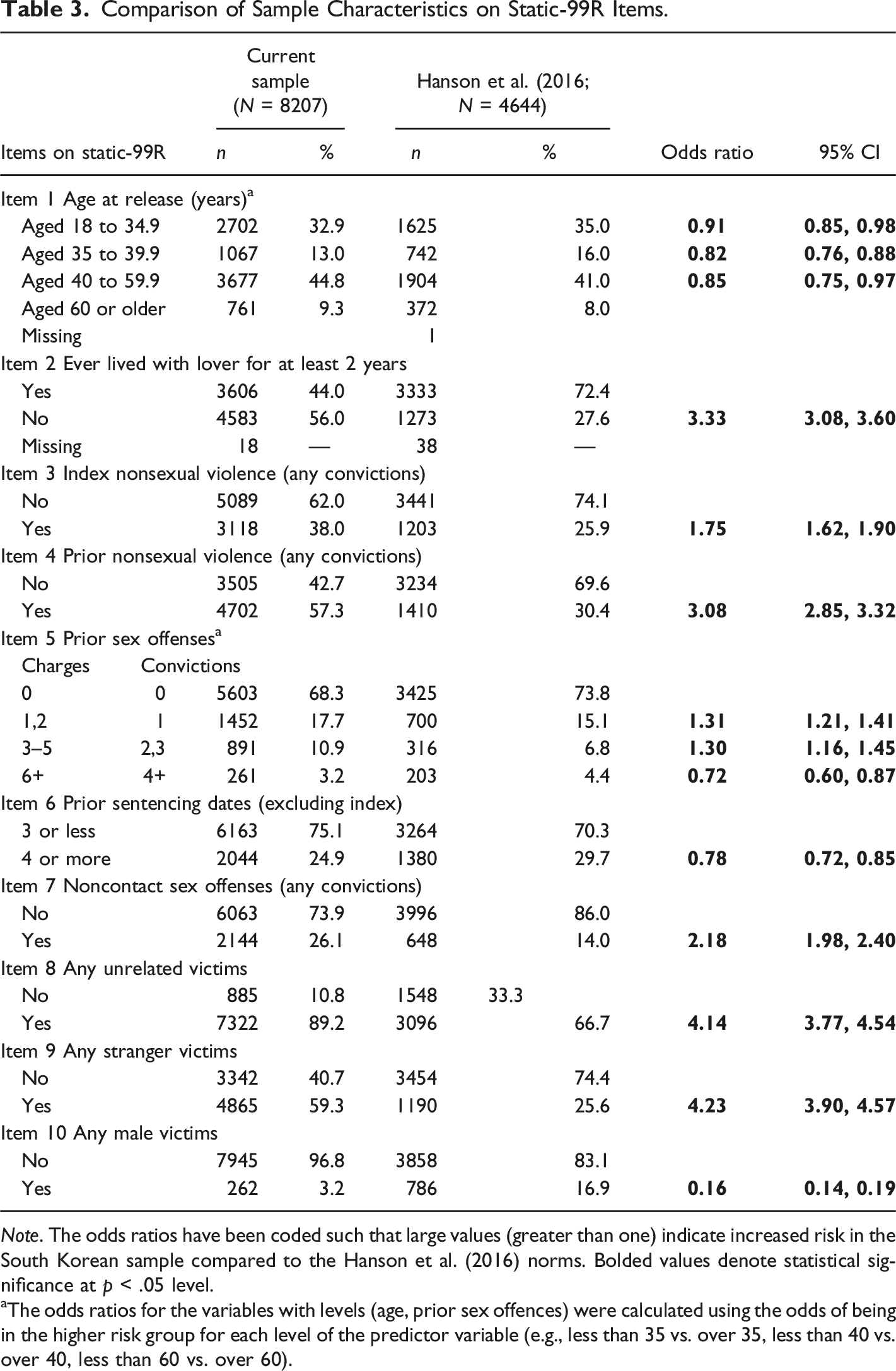
Note. The odds ratios have been coded such that large values (greater than one) indicate increased risk in the South Korean sample compared to the Hanson et al. (2016) norms. Bolded values denote statistical significance at p < .05 level.
The odds ratios for the variables with levels (age, prior sex offences) were calculated using the odds of being in the higher risk group for each level of the predictor variable (e.g., less than 35 vs. over 35, less than 40 vs. over 40, less than 60 vs. over 60).
Discrimination
Table 2 presents the discrimination analyses with AUC values for Static-99R total scores for the overall samples (N = 8207) and the samples with a fixed 5-year period (n = 179). For the sexual recidivism, Static-99R was able to discriminate recidivists from non-recidivists with the large effect sizes (AUCs of .72 [.70, .74] and .74 [.65, .83], respectively). With moderate effect sizes, Static-99R also showed good discrimination levels for violent and any recidivism (AUCs between .68 and .70; Table 2).
Comparison of Logistic Regression Parameters for Static-99R Predicting Sexual Recidivism with a Fixed 5-Year Follow-up Period.
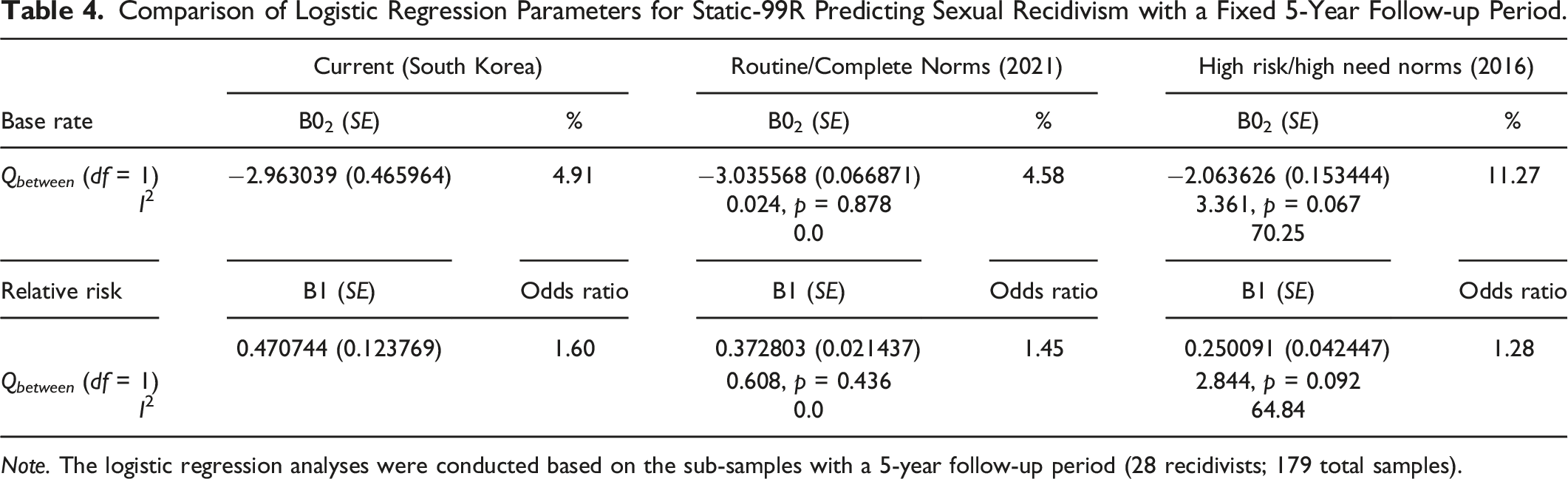
Note. The logistic regression analyses were conducted based on the sub-samples with a 5-year follow-up period (28 recidivists; 179 total samples).
Predictive Accuracy (i.e., Discrimination) for Static-99R Total Scores, Risk Levels, and Items.

The continuous age variable was reversely coded (i.e., 100 - age). Bolded values denote statistical significance at p < .05 level.
For predicting sexual recidivism, all Static-99R items were statistically significant, with the exceptions of the age item and index nonsexual violence (C = .50 and .49, respectively; Table 5). Among the items significantly associated with the sexual recidivism, the effect sizes ranged from very small (.51; male victim) to moderate (.71; prior sex offenses; Table 5).
Results were very similar for the prediction of violent recidivism and for the prediction of any recidivism. The strongest items were index nonsexual violence, prior nonsexual violence, and prior sex offenses (all C’s above .60); the male victim item was the weakest item despite its statistical significance (C = .51 for both types of recidivism). Unexpectedly, the age variables were significantly but reversely associated with violent and any recidivism (i.e., older individuals were more likely to commit new violent or any crimes; Table 5).
Calibration
The overall resulting logistic regression equation indicated an adjusted 5-year sexual recidivism rate of 4.9% for a Static-99R score of 2 (1/[1 + e−{−2.963}]) = 0.0491. The adjusted (score of 2) base rate of the current study was very similar with the rates of the routine/complete norms (4.6%; B02 = −3.04; Qbetween = 0.02, df = 1, p = 0.88; Lee & Hanson, 2021). When compared with high risk/high need norms (11.3%; Hanson et al., 2016), the base rate of the current study was about 6% lower, although the difference was not statistically significant (B02 = −2.06; Qbetween = 3.36, df = 1, p =.07, I2 = 70.3; Table 4; Figure 1). Logistic curves for south Korean samples with routine/complete norms (left) and high risk/high need norms (right).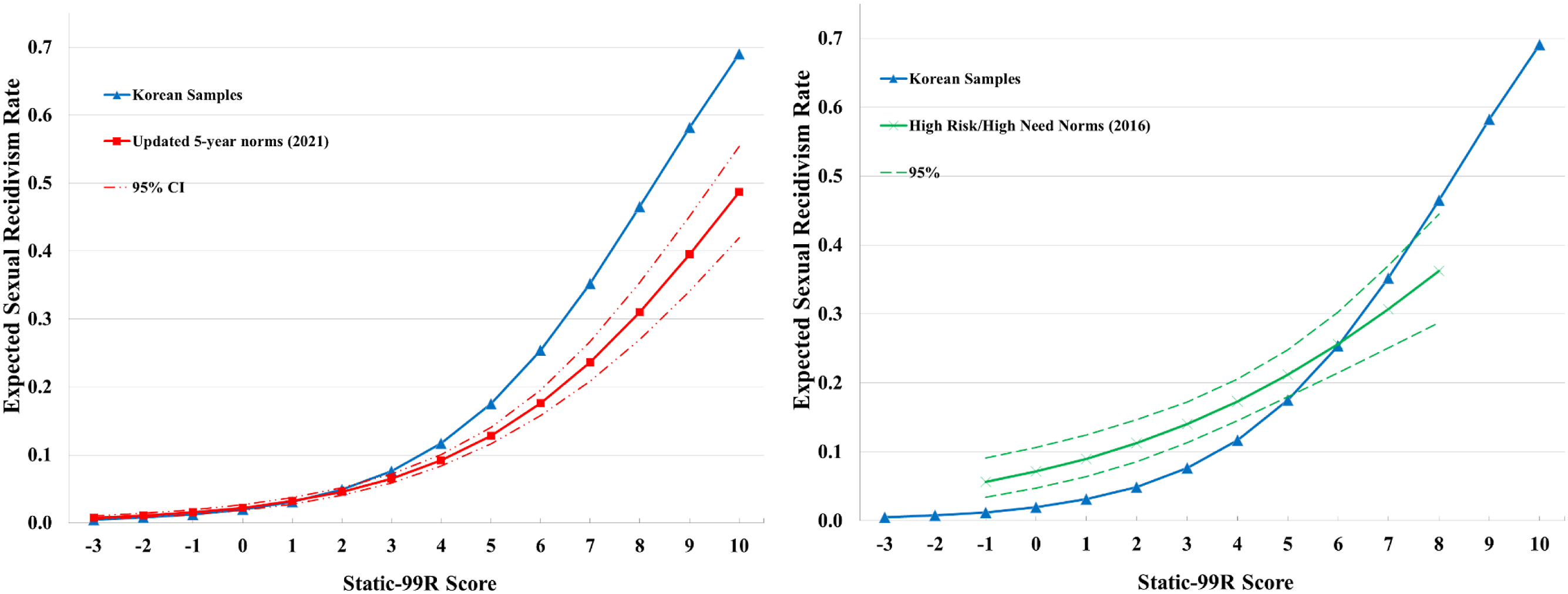
Calibration Analyses (E/O Index) with Routine/Complete 5-Year Norms and High Risk/High Need 5-Year Norms.
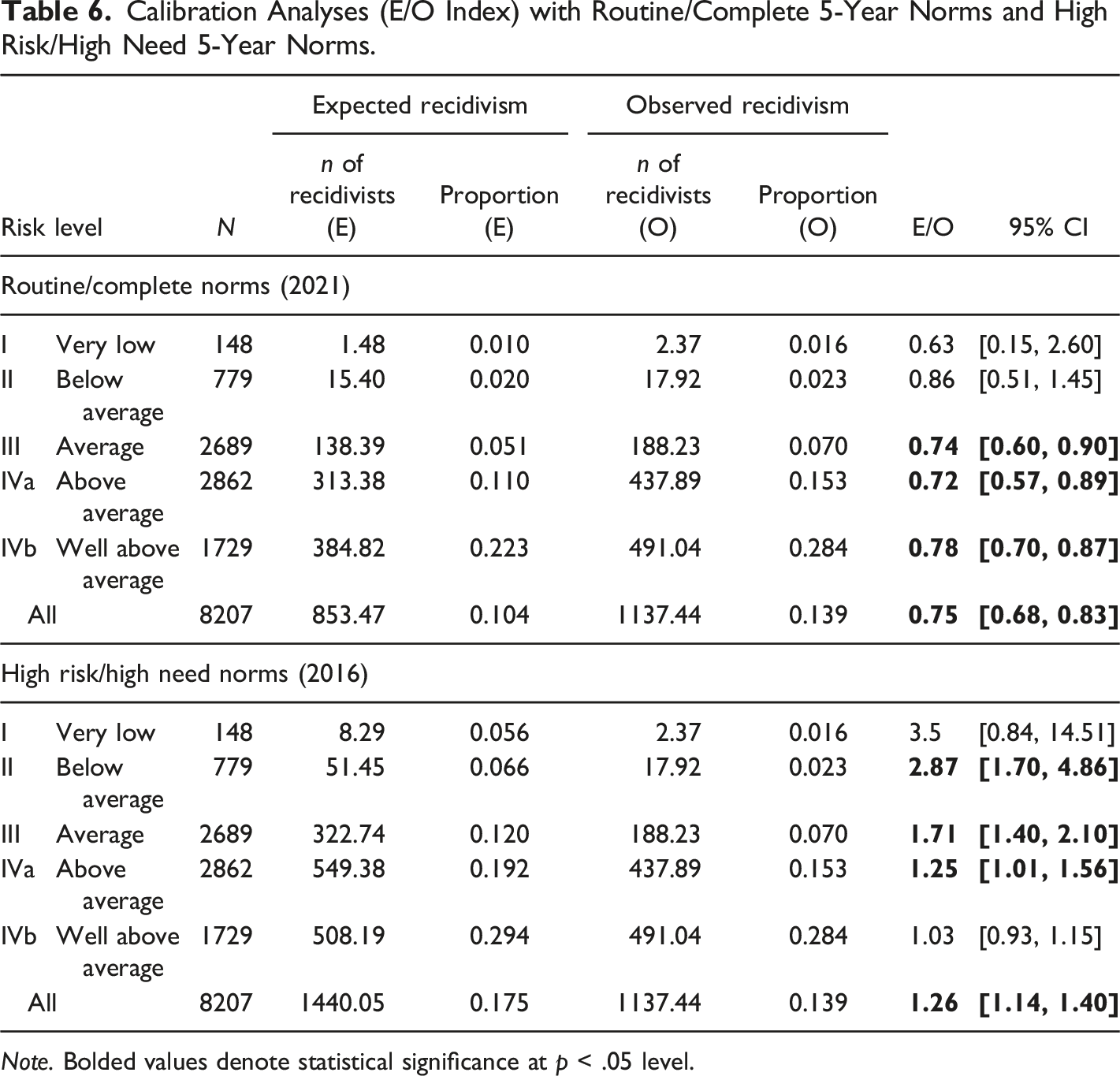
Note. Bolded values denote statistical significance at p < .05 level.
When compared to the high risk/high need norms, however, the observed 5-year overall recidivism rate from South Korean samples was lower than expected rates (17.5% vs. 13.9%; E/O index = 1.26 [1.14, 1.40]; Table 6 and Figure 1), except for Well Above Average risk level - Level IVb (E/O index = 1.03 [0.93, 1.15]; Table 6 and Figure 1).
Discussion
The generalizability of risk assessment tools across cultural groups is an important issue for criminal justice systems (i.e., cultural bias). Most research on cultural bias has been focused on the validation of the tools for the ethnic groups disproportionately overrepresented in the criminal justice systems of Western countries (Indigenous peoples, African Americans, Latinos). The main purpose of the current study was to fill research gaps by evaluating one of the most widely used static risk assessment tools for individuals who committed sexual crimes - Static-99R - with a criminal justice sample from South Korea.
Compared to the normative samples, the South Korea sample showed some differences in the frequencies of the three psychological constructs underlying the Static-99R. Specifically, this Korean sample showed more persistence in sexual crimes (i.e., more convictions of sexual offenses), and more paraphilic characteristics than the normative samples (e.g., more involved in noncontact sexual offenses). These findings are consistent with other East Asian samples (i.e., Lam, 2021; Singapore, Tsao & Chu, 2021) and a sample of East Asians residing in Canada (Lee et al., 2018). The higher number of noncontact sexual crimes among this South Korean sample might be associated with a high rate of digital sexual crimes accompanied by technological advances (e.g., about 97% of South Korean adults own smartphones or use the internet; Taylor & Silver, 2019). Although the use of smartphones is similarly high in other countries (e.g., UK, France, Australia, Sweden, US, Canada, Germany), the rate of noncontact sexual offending is much lower. One qualification to this comparison, however, is that the Western samples all involved individuals released before 2015 (the earliest release date for the South Korean sample) and many were released prior to 2000. Consequently, it would be interesting to compare the prevalence of noncontact sexual crimes in this South Korean sample to Western samples from the same time period (2015–2018).
Male victims, another indicator associated with sexual deviancy (Hanson & Bussière, 1998), were rare in this Korean sample and other samples of East Asians (Lam, 2021; Lee et al., 2018; Tsao & Chu, 2021). In Western samples, the vast majority of sexual offending against males involves boys (not adult men). The cultural features of emphasizing family and societal values might inhibit committing sexual crimes against children (e.g., high level of supervising and monitoring children; Finkelhor et al., 2013). However, it could also be related to the underreporting of certain sexual crimes, especially sexual abuse by family members or when the victim is a male. In Taiwan, for example, sexual assault on males has only recently been discussed in popular media (Taiwan News, 2020). Chiu Wei-chieh, a prominent figure in Taipai, said that he did not share his sexual abuse experience with anyone until years afterward because “Taiwanese traditionally do not think that men can be the victim of a sexual assault” (Taiwan News, 2020, p. 3).
Comparisons between the norms and this South Korean sample on general criminality (i.e., antisocial sociality) yield mixed results. Consistent with the previous Asian studies, the Korean sample had comparative few prior sentencing occasions. Their rates could be truly low, or their rates could only appear low, probably due to some cultural features of Koreans (e.g., Confucian, collectivism), leading to the coordination or conciliation to resolve the relatively minor conflicts before a trial. Contrary to the previous findings, however, this South Korean sample exhibits high rates of prior nonsexual violence. The increased rates are likely attributable to sample selection (treatment/preselected high-risk samples in the prison setting). A more representative sample would be needed to determine the extent to which this applies to the population as a whole.
Consistent with other studies (Lam, 2021; Lee et al., 2018; Tsao & Chu, 2021), this Korean sample had higher scores on the items comprising the youthful stranger aggression dimension. Specifically, compared to the normative samples on Static-99R, there were a significantly greater proportion of unrelated or stranger victims among the Korean sample; they were less likely to form intimate partnerships (i.e., a higher proportion of individuals who never lived with a lover for at least 2 years) and had higher index nonsexual violence. When compared to the normative samples (Lee & Hanson, 2021), the average age at release from the current samples was slightly older (40.3 vs. 42.1) but had a higher overall risk of reoffending assessed by Static-99R (total scores of Static-99R of 2.4 vs. 3.6) and the sexual recidivism rates (6.7% vs. 15.6% within a fixed 5-year period).
Discrimination
Another main purpose of this study was to examine whether Static-99R predicts recidivism risk (i.e., sexual, violent, and any recidivism). Static-99R was able to discriminate between recidivists and nonrecidivsts across sexual, violent, and any recidivism, even though the characteristics of this sample differed substantially on several variables when compared with the normative samples used in Static-99R (Hanson et al., 2016).
All items significantly predicted sexual recidivism as intended, with the exception of the age and index nonsexual violence. The item index nonsexual violence is one of the weakest Static-99R items in the meta-analytic studies (Helmus et al., 2021b; Helmus & Thornton, 2015). Although it has a significant association with sexual recidivism in the samples from North America, it has weak international generalizability (Helmus & Thornton, 2015).
The lack of a significant association between age and sexual recidivism was unexpected. Even more surprising was the small positive association between advanced age and increased violent/any recidivism. A decline in offending with advanced age has been characterized as ‘one of the brute facts of criminology’ (Hirschi & Gottfredson, 1983, p. 555), applicable to all types of crimes, including sexual crimes (Hanson & Bussière, 1998). The counter-intuitive age findings in the current study are difficult to explain other than by unknown, idiosyncratic features of the dataset. We examined post hoc certain non-linear relationships with age, and none were found.
Tsao and Chu (2021) discussed that some items included in the Static-99R might be less culturally relevant risk factors in the Singapore context than in the West. One of the suspected items was “ever lived with a lover for at least 2 years” because many young adults in Singapore live with their parents up to the time they get married, and living with a lover without marriage is rare. Consequently, most of their Singaporean sample received one point on that item, e.g., 90% of the age group between 18 to 34. Being culturally normative, it might not be a risk factor associated with sexual recidivism.
Koreans also have a very similar culture in that young adults stay with their parents until their marriage, along with a recent finding in Hong Kong (i.e., 49.4% of the samples never had a live-in relationship over 2 years; Lam, 2021). It might have caused the higher scores on the item - ever lived with a lover for at least 2 years (56.0% vs. 28% from the normative samples [Hanson et al., 2016]). This item, nevertheless, was significantly associated with sexual recidivism as well as violent and any recidivism among Korean samples. Like in the West, individuals in stable intimate relationships would be less likely to recommitt sexual crimes in South Korea.
Calibration
In terms of match between the expected and the observed recidivism rates (calibration), the base rate (at a Static-99R score of 2; i.e., individuals in the middle of the risk distribution) of this Korean sample (4.9% after 5 years) was very similar to the routine/complete sample norms (4.6% after 5 years; Lee & Hanson, 2021). The overall sexual recidivism rates were, however, significantly higher than the norms (14% vs. 10% after 5 years; E/O = 0.75). In particular, sexual recidivism rates for average and higher risk categories (Level III, IVa, and IVb) were substantially higher than the routine/complete norms (E/O = 0.72–0.78).
When compared to the high risk/high need norms, the sexual recidivism rates of the Korean sample were significantly lower (18% vs. 14%; E/O = 1.26), except for well above average risk (IVb; 6+). Overall, the sexual recidivism rates in the South Korean sample were intermediate between the two reference groups. There is probably some degree of preselection on risk-relevant characteristics, not measured by Static-99R (i.e., dynamic risk factors). Aforementioned, these Korean samples were derived from the individuals who committed sexual crimes and received imprisonment sentences, which is the most serious sentence under the Korean legal system. The median value of Static-99R scores in the current samples was relatively higher than the normative samples (median values of 4 vs. 2; Hanson et al., 2012).
Limitations
The average follow-up time in this study was relatively short (3 years); consequently, the models estimated by logistic regression were based on the small samples (n = 179; 28 sexual recidivists).
Our findings were based on individuals sentenced to prison for a sexual crime, accounting for about 30% of the total population convicted of sexual crimes. Thus, these findings might not be generalized to other sanctions administered by the correctional service (e.g., those sentenced to community-based sentences, fines). This study finding might not largely generalize to the Asians who were born and residing in White predominant countries (e.g., third generations). The current study included a more recent sample (i.e., released between 2015–2018) compared to the Static-99R normative samples (released between 1976 and 2009; Hanson et al., 2016). Thus, there might have other factors that could attribute to the characteristic differences in addition to the cultural differences (e.g., a high proportion of internet-based offending).
The old version of the Static-99 coding manual (Harris et al., 2003) has been translated into Korean and, thus, Static-99, rather than the Static-99R version, is still being used in the Korean criminal justice system. In addition, it was uncertain about the quality of the translation, such as whether the translation was verified by back-translation or review by a certified trainer fluent in both English and Korean. Official training in the use of Static-99R from a certified trainer is highly recommended before scoring Static-99R scores, given that the quality training of scoring is associated with increased predictive accuracy (Helmus et al., 2022). There is, however, insufficient information about the training programs in the Korean context, and no inter-rater reliability information was available.
Implications for Research
The large differences in the distribution of Static-99R items raise questions about the distinctiveness of East Asians who commit sexual offenses. Given that both Western and Asian samples are heterogeneous, can the differences be attributed to certain types of offenses/offenders being more prevalent in the East than in the West (e.g., young, educated males who commit upskirt photography)? Alternately, are there relatively unique types of sexual offending that are not well represented in Western samples? Identifying the factors that contribute to the differences in the Static-99R items and total scores could be informed by more detailed information about the offenses committed (e.g., location, self-reported motivation) and by more complete risk assessments, particularly assessments that address dynamic risk factors (e.g., STABLE-2007 [Brankley et al., 2017, 2021]; VRS-SO [Olver et al., 2007]). Assessing criminogenic needs would not only inform group differences, but it could also increase predictive accuracy, and increase the efficacy of rehabilitation programs adhering to the Risk/Need/Responsivity model (Bonta & Andrews, 2017).
Another important line of research would distinguish between race/ethnicity and minority status. The current study examined Koreans in South Korea, where they are the dominant majority. Would the same patterns be found for Koreans in Japan, where they are an underprivileged minority? In addition, further research should compare the predictive accuracy of the risk assessment tools in Asian men born in the Western countries compared to those who are immigrants, particularly recent immigrants. Such analyses could help distinguish between the distinct influences of ethnicity (and the historical-cultural influences experienced by minority groups) and the more contemporary cultural influences of their adoptive countries. Similarly, it would be worth comparing the characteristics of Latinos convicted of sexual crimes in the US with Latinos convicted of sexual crimes in Central or South America. It is quite likely that the characteristics of racialized subgroups are influenced not only by their cultural history and values but also by their social status and their historical relationship to the dominant ethnic group.
Implications for Practice
Based on the results of this study, evaluators can have confidence in the use of Static-99R in risk assessment procedure in the Korean context in order to rank-order individuals in their likelihood of sexual recidivism (i.e., relative predictive accuracy). Korean evaluators should be cautious, however, about estimating predicted recidivism rates until calibration (absolute predictive accuracy) is confirmed by further studies using representative samples in Korea. The current results also provide little motivation for the Korean Correctional System to update to Static-99R from Static-99, given that advanced age did not have the expected relationship to recidivism.
The current findings should provide encouragement to evaluators wishing to use Static-99R in countries and jurisdictions where it has yet to be formally evaluated. Although the necessary conditions for effective implementation are not fully known, it is reasonable to assume that Static-99R would work in countries that have relatively similar definitions of sexual crime, adequate criminal history records, the rule of law, and at least moderate economic prosperity.
Supplemental Material
Supplemental Material - Predictive Validity of Static-99R Among 8,207 Men Convicted of Sexual Crimes in South Korea: A Prospective Field Study
Supplemental Material for Predictive Validity of Static-99R Among 8,207 Men Convicted of Sexual Crimes in South Korea: A Prospective Field Study by Seung C. Lee, R. Karl Hanson, and Jeong Sook Yoon in Sexual Abuse
Footnotes
Acknowledgments
The authors would like to thank the Ministry of Justice, South Korea, for providing access to this dataset.
Declaration of Conflict of Interests
The author(s) declared the following potential conflicts of interest with respect to the research, authorship, and/or publication of this article: R. Karl Hanson is a co-author and certified Static-99R trainer.
Funding
The author(s) received no financial support for the research, authorship, and/or publication of this article.
Data availability
The authors take responsibility for the integrity of the data, the accuracy of the data analyses and have made every effort to avoid inflating statistically significant results.
Ethical Approval
Ethnics approval granted by Carleton University Research Ethics Board-B (Project 115402)

Supplemental Material
Supplemental material for this article is available online.
Note
References
Supplementary Material
Please find the following supplemental material available below.
For Open Access articles published under a Creative Commons License, all supplemental material carries the same license as the article it is associated with.
For non-Open Access articles published, all supplemental material carries a non-exclusive license, and permission requests for re-use of supplemental material or any part of supplemental material shall be sent directly to the copyright owner as specified in the copyright notice associated with the article.
