



Abstract
This article reports the results of a study examining the business communication offerings at the top 50 undergraduate business schools, as identified in the Bloomberg Businessweek rankings for 2011. The study focuses on communication course requirements, sequences, and programs, as well as what areas typically receive the most coverage within courses. The data are compared with information from similar studies dating back to 1999 in order to assess the current status of business communication courses and programs within business curricula and to make suggestions for future development.
Introduction
In 1999, a special issue of Business Communication Quarterly focused on the place of writing and communication in the business curriculum. In that issue, Melinda Knight published the results of a study examining the communication requirements at the 50 top-ranked undergraduate business schools. No comparable study of top business programs has been conducted since Knight’s article was published. Although a handful of additional studies have examined business communication curricula, they have reported on instructor and administrator perceptions of curricular offerings and course content rather than examining course requirements and descriptions; additionally, with the exception of Russ (2009), all of the studies were, like Knight’s, published several years ago.
The goal of the study we discuss here was to capture current curricular information that includes aspects of the earlier studies, Knight’s in particular, thereby providing an up-to-date and comprehensive picture of the role of communication courses within well-respected business curricula.
A Review of Previous Studies
Knight (1999) investigated business communication requirements at the top undergraduate business communication programs from 1996. She also noted the institutional home of business communication courses and the level of those courses. Knight found that virtually all the schools had lower-division communication requirements, typically first-year writing and, for about a third of the schools, oral communication. However, these were general requirements, not courses specifically tailored to business students. Additionally, more than two thirds of the schools had an upper division writing requirement, and most of the courses that met this requirement were offered through the business school itself. Typically, the courses offered through business schools had “communication” in the title and included both writing and presentation skills. Those business communication courses offered through a liberal arts college, however, usually had either “writing” or “speaking” in the title (Knight, 1999, p. 15).
Because hers was the first such study, Knight (1999) was not able to assess whether business communication requirements were increasing, decreasing, or holding steady. She did, however, observe that business schools that had recently revised their curricula, or were in the process of doing so, had generally instituted higher standards regarding communication: “If anything, the overriding message was that more rigorous requirements were being considered, even if none were yet in place” (p. 17). Knight concluded that business communication was “thriving” in undergraduate business curricula.
Since Knight’s study of exemplary programs, several studies have been conducted using a survey methodology to assess business communication curricula and instruction (Russ, 2009; Wardrope, 2002; Wardrope & Bayless, 1999). Although these studies were based on voluntary survey data and cannot be assumed to be representative of all undergraduate business programs, they do provide useful results that seem to be suggestive of patterns within business communication curricula. Wardrope and Bayless (1999) reported on a 1997 survey of business communication instructors who were members of the Association for Business Communication. The survey had approximately a 20% response rate with 229 responses and collected data regarding instructor coverage of the following areas: communication theory, written communication, oral communication, technology issues, employment communication, and current issues. Wardrope and Bayless (1999) found that the majority of business communication courses were taught within business colleges rather than by other departments such as English or Communication. They found, also, that written communication received the most attention from instructors, followed by oral communication. Current issues, including ethics and international communication, were rated as much less important, as was using email for correspondence.
In a second survey, Wardrope (2002) reported on business communication curricula from an administrative perspective, soliciting information from 1,850 department chairs in six business disciplines. Wardrope had a response rate of 16.4%; the largest groups of respondents were in accounting and management. The survey results revealed that most participating programs (76%) required a business communication course. In fact, Wardrope described the course as typically being a “core business requirement” that was, in keeping with the findings of earlier studies, taught mainly at the sophomore and junior levels and most commonly housed within the business college.
Wardrope also asked the department chairs to rate the importance of business communication skills in seven areas: writing, speaking, interpersonal, group/team communication, listening, technology-mediated communication, and cultural competency. The respondents rated written communication skills highest in importance, followed by skills in cultural literacy (primarily in avoiding sexist and culturally discriminatory language). The ability to give oral presentations was also very highly rated. Although Wardrope (2002) emphasized the importance of writing skills for business graduates, he also suggested “the need for breadth in communication training,” arguing that “the characteristics of the contemporary workplace suggest that topics other than writing may be equally important for the business communication course” (pp. 60-61).
The most recent published study of business communication curricula was conducted by Russ in 2008. Russ (2009) surveyed a national sample of 505 business communication instructors. He looked at the institutional home for the business communication course, the academic level of the course, the content covered, and the typical assignments. As reported in previous studies, the business college was most often the disciplinary home for the business communication course. Additionally, respondents indicated that almost half of the students in the course were juniors, with sophomores being the second largest group (approximately one third).
For the most part, Russ’s (2009) findings regarding course content were similar to those of Wardrope and Bayless (1999), although they did point to slightly broader coverage. The most covered topics focused on written communication and public speaking. Other topics that received substantial coverage included persuasive and ethical communication and electronically mediated communication (e.g., email). The least covered topics were related to theories of communication. Intercultural issues ranked in the middle. Russ concluded that the results of his survey were similar to previous “audits” in terms of the coverage of written communication but that they suggest greater coverage of other topics, including persuasion and ethics. He noted, as well, that the survey results pointed to an ongoing need to incorporate more coverage of computer-mediated communication beyond email. Again, we should note that, because the data from these studies were gathered through voluntary surveys, they may not be generalizable to programs not represented by the survey respondents.
Although these studies based on survey methodology are not directly comparable to Knight’s study of exemplary programs or to the study we report here, some similar findings are suggestive of patterns in business communication curricula. First, all of the studies indicate that business communication courses tend to be taught within the business college; this finding also aligns with a 1998 study conducted by Kleen and Gros (as cited in Ryan, 1999), who surveyed deans at 335 AACSB accredited schools. More than three quarters (77%) said there was a required course to address writing standards, and more than half (57%) of those courses were taught in the business college rather than in other departments. Additionally, these studies suggest that business communication courses are generally upper level and have typically been preceded by some sort of first-year writing experience. In terms of content, it appears that courses are heavily focused on traditional forms of written business communication.
The study we report here attempts to continue the work of these scholars, providing data about current business communication curricula that can be used by instructors and administrators to seek additional support or approval for program expansion, curricular changes, or additional resources for existing programs. Furthermore, we focus specifically on business communication courses and the requirements of business curricula. In reviewing previous studies, it was at times difficult to determine how much they distinguished between general (not business specific) writing and communication requirements and those that were actually business communication courses. For example, when the deans surveyed by Kleen and Gros (as cited by Ryan, 1999) indicated that there was a required course addressing writing standards, were they referring only to business communication courses or to general university writing courses that were required by the business school? By specifically focusing on business communication courses, we eliminate this confusion and provide a sense of how business communication curricula have (and have not) changed since the earlier studies were conducted, which can help us envision how we would like them to change in the future. Additionally, by examining courses and curricula directly rather than collecting information through a survey, we are able to provide a snapshot of curricula within exemplary undergraduate business programs, which can help us see how business communication curricula have changed, particularly since Knight’s (1999) study.
Data Collection
We began as Knight (1999) did: with a systematic examination of business communication offerings at the top 50 undergraduate business schools, as identified in the Bloomberg Businessweek rankings for 2011 (Bloomberg, 2011). With the support of a grant from the C.R. Anderson Research Foundation, we collected the data during the summer of 2011. All of the programs are AACSB accredited. It is interesting to note that almost three quarters (72%) of the schools listed in Knight’s study, which used 1996 rankings, are again on the top 50 list in 2011.
As Knight (1999) noted, looking only at these top schools may overlook other excellent programs. However, this limitation simultaneously provided a focus that is particularly useful, in that the top-rated business schools should have exemplary accredited curricula that can serve as models for other programs. That is, they can be used as benchmarks that, at the least, provide a foundation on which to build future curricular studies.
Because academic websites—particularly those for top-ranked schools—are now typically far more comprehensive and detailed than they were when Knight conducted her study, we were able to collect all of the curricular information online. Furthermore, our choice to rely solely on the institutions’ websites reflects our primary interest in the official, public face of these programs rather than the intentions or impressions of administrators, which can skew studies relying on a survey approach. For each of the business programs, we identified course requirements, course levels, and course sponsors. We also looked for evidence of business communication course sequences and programs within the top 50 schools and examined the curricula of those programs. Finally, we collected course descriptions for all of the courses offered.
We included in the study only courses that were primarily focused on business communication and that were explicitly listed as being part of the business school curricula, either as electives or as requirements. In some cases, this included Writing Across the Curriculum/Writing in the Disciplines (WAC/WID) courses with a specific business communication focus. We did not include a small number of writing-intensive courses that primarily focused on other topics, because the writing required by these courses seemed more academic than business-related, such as essays and research projects dedicated to the course’s main topic. Finally, because they did not mention writing or communication in either the course title or the course description, we eliminated a handful of courses that could conceivably be considered business communication. These courses did not have a primary focus on communication strategies; rather, they focused on other disciplinary perspectives or approaches to communication-related topics. For example, Notre Dame offers a course on conflict management, but the course description suggests a focus on the psychology of conflict rather than on communication strategies for resolving conflict.
Findings
Our examination of the top undergraduate business programs revealed 102 distinct business communication courses at 42 schools. Remarkably, 7 of the 50 top undergraduate business schools made no mention of business communication—either requirements or electives—in their curriculum. Two of those institutions, however, did discuss communication skills as important aspects of their programs: Boston University claimed their business programs were writing intensive, and Loyola University Maryland mentioned written and oral communication skills as an education aim of the business school. Neither institution offered a business communication course, however. One additional school, Villanova University, listed “Communication Portfolio I” and “Communication Portfolio II” as elective courses, but they were not credit-earning courses. These findings suggest that the schools may value communication skills, but the lack of dedicated courses leads us to wonder exactly how and where students are acquiring those skills. Certainly, a distinct course is not the only approach for teaching business communication, but we would argue that a writing intensive course or noncredit portfolio is unlikely to provide students with a comparable level of preparation.
Below, we describe the findings for the remaining 42 institutions; we have organized the data into five overarching categories: course sponsor, course level, requirements and electives, programs and course sequences, and course content.
Course Sponsor
In keeping with the findings of earlier studies, our data indicated that the institutional home for business communication courses was typically within the business school, although some institutions offered courses through other colleges as well. For 32 of the 42 institutions that offered a business communication course (76%), those courses were housed in a center within the business school, within a particular department in the school, or in the business school in general, without a center or departmental affiliation. Some of these institutions had business communication courses in more than one area of the business school, and five of the institutions had courses both in the business school and outside that school. All in all, 78 of the 102 courses we identified (76%) were housed in a business school (see Figure 1), showing a slight increase from Knight’s (1999) finding that 25 of the 36 schools (69%) that had upper division communication requirements housed those courses within the business school.

Departmental home of business communication
Two of the 42 institutions—University of Notre Dame and University of Southern California—had centers for business communication within the business school. Notre Dame offered two business communication courses through the center, and one additional course through the Management department. The center at University of Southern California, by contrast, offered five courses, with another two offered by the Business Administration department. A third institution—Southern Methodist University—had a center for leadership in the college, and that center housed the lone business communication course.
For 10 of the 42 institutions that offered business communication courses (24%), those courses were housed within the business college but were not affiliated with a center or with a particular department. These accounted for 18 of the 102 courses we identified. In some cases, the college had no individual departments, functioning as one entity.
More typically, business communication was housed within a particular department in the business school. Four institutions had dedicated business communication departments within the business school. As one might expect, these departments typically offered several courses that fit our criteria for inclusion in the study: Tulane University and University of Michigan each offered three courses, Bentley University offered four (with one additional course offered in another department within the business school and one more offered outside the school), and Indiana University offered six. However, the most common institutional home for business communication courses was within another department in the business college, typically either Management or Business Administration. These departments offered a total of 26 business communication courses at 15 different institutions. The University of Washington offered their five business communication courses through the Marketing department.
A few institutions had program-specific business communication courses that were offered by the home department of that program. At Carnegie Mellon, the Economics department offered its own course for majors in addition to the three business communication courses offered by the school of business. At Case Western and Texas A&M, the only business communication courses were department-specific: one economics communication course at the former and two accounting communication courses at the latter.
Although business communication was housed within the business school at the majority of the institutions we examined, for five of them it was housed both in the business school and in a communication department or writing program: Miami University, the University of Wisconsin, and Bentley University each offered a business communication course through their communication department in addition to those offered through their business school; University of Pennsylvania and University of Southern California each offered one course through their writing program in addition to their courses in the business school.
Finally, there were a handful of institutions at which business communication was housed solely in nonbusiness departments or programs. The University of Illinois offered two business communication courses, one housed in the Department of Speech Communication and one in the Department of Media Studies. Five institutions offered business communication through their English department or writing program: Pennsylvania State University, University of Tulsa, Binghamton, and Northeastern each offered one course, whereas Santa Clara University offered two. An additional two institutions offered courses in both communication and English/Writing departments: Syracuse University (three courses in the Writing Program and one in communication) and University of Maryland (one in the WAC/WID program and three in communication). And a final two institutions had combined departments of English and communication that housed the courses: Georgia Tech offered one business communication course through this department, whereas Rensselaer offered two. Overall, nearly one quarter (24%) of the 102 courses we identified were offered outside the business school.
As the discussion here suggests, sponsorship of business communication courses was less clear cut than one might expect, and there seemed at times to be a duplication of efforts. Course levels were more straightforward.
Course Level
Approximately one quarter (27%) of the business communication courses offered by the top institutions were lower-division—that is, freshman or sophomore level. Only nine courses were intended for first-year students, with an additional 19 at the sophomore level. Most of the lower-division courses were business core requirements: 15 were part of a general business core, and an additional two were requirements of an honors business core. Only two lower-division courses were a departmental requirement: the Economics Department at Carnegie Mellon University required students to take Writing for Economists; and the Information Design and Corporate Communication program at Bentley University required students to take Effective Speaking (although none of the other business majors did). The remainder of the lower-level courses were electives or options to fulfill a requirement.
More typically, business communication courses were upper division (junior or senior level). In fact, almost three quarters (73%) of the courses listed were upper division, and 30 of the 50 institutions offered at least one upper division business communication course, a number in keeping with Knight’s (1999) finding that 36 of the 52 schools in her sample offered upper division courses. By far the largest group—57 courses—were offered at the junior level. As one might expect, virtually all of the 25 advanced courses or courses with specialized topics, such as intercultural communication or managing diversity, were upper division. However, they were typically junior-level courses rather than senior-level. It is interesting to note that our findings align with those of Wardrope (2002) and Russ (2009), differences in methodology notwithstanding.
Requirements and Electives
Overall, there were 44 required business communication courses listed (see Table 1). Thirty of the 42 institutions that listed business communication courses on their websites had at least one required course, which is comparable to the findings of Knight (1999) and Wardrope (2002).
Required Business Communication Courses a

Note: a. Institutions listed in alphabetical order. COMM = Communication Department; BDEPT = Department within Business School; BSCHL = Business School, no departmental affiliation; E/W = English/Writing Program; CTR = Center within the Business School; BCOM = Business Communication Department; C/E = Joint Communication/English.
Of the 44 required courses, 29 were required as part of the business school’s requirements for all majors. These courses were located at 25 institutions, meaning that four institutions had two required business communication courses. These institutions were University of Michigan, Indiana University Bloomington, Carnegie Mellon University, and Miami University. At three of those institutions, the courses were a pair of complementary courses: one that focused on oral communication and presentational speaking and one that focused on writing or communication practices more generally. Only the University of Michigan required a sequence of courses, one of which builds on what students learn in the other. These courses are Introduction to Business Communication and Professional Communication Strategies. The latter builds on the basic communication skills learned in the former and seems to focus more on rhetorical strategies and persuasive communication. Four more courses were honors versions of one of these 29 required courses; for instance, Tulane University offered Management Communication, required for all majors, and Management Communication (Honors Option), required for honors students.
Additionally, 11 courses were required by specific majors rather than by the business school itself. More than half (55%) of those courses were required for accounting majors. Five different universities each required one of the remaining five courses for five different majors: management, economics, international business, information design and corporate communication, and an online business administration program at University of Florida. This supports Knight’s (1999) finding that accounting seemed to require more communication courses than other business disciplines.
In addition to the 44 required courses, there were 32 courses that served as options to fulfill a requirement; for example, the Writing Program at Syracuse University offered three business writing courses, any of which fulfilled a writing requirement within the business school’s core curriculum (see Table 2). Sixteen of the institutions offered at least one such course. Of those courses, nine could be used to fulfill a requirement for the business school at large, whereas six could be used to fulfill a requirement for a management or business administration major. The remaining 17 courses that could be used to fulfill requirements were part of a WAC/WID program. These courses were included in our study because they offered a specific business communication focus, and as options to fulfill university-level requirements were available to—and likely popular for—students of the business school. More than 70% of the WAC/WID courses were writing-focused courses. Only two were focused on oral communication, and another two had a combined focus on written and oral communication. One WAC/WID course had a unique focus on communication theories: Communication Theory for Business at Bentley University.
Courses That Can Be Used to Fulfill Business Curriculum Requirements
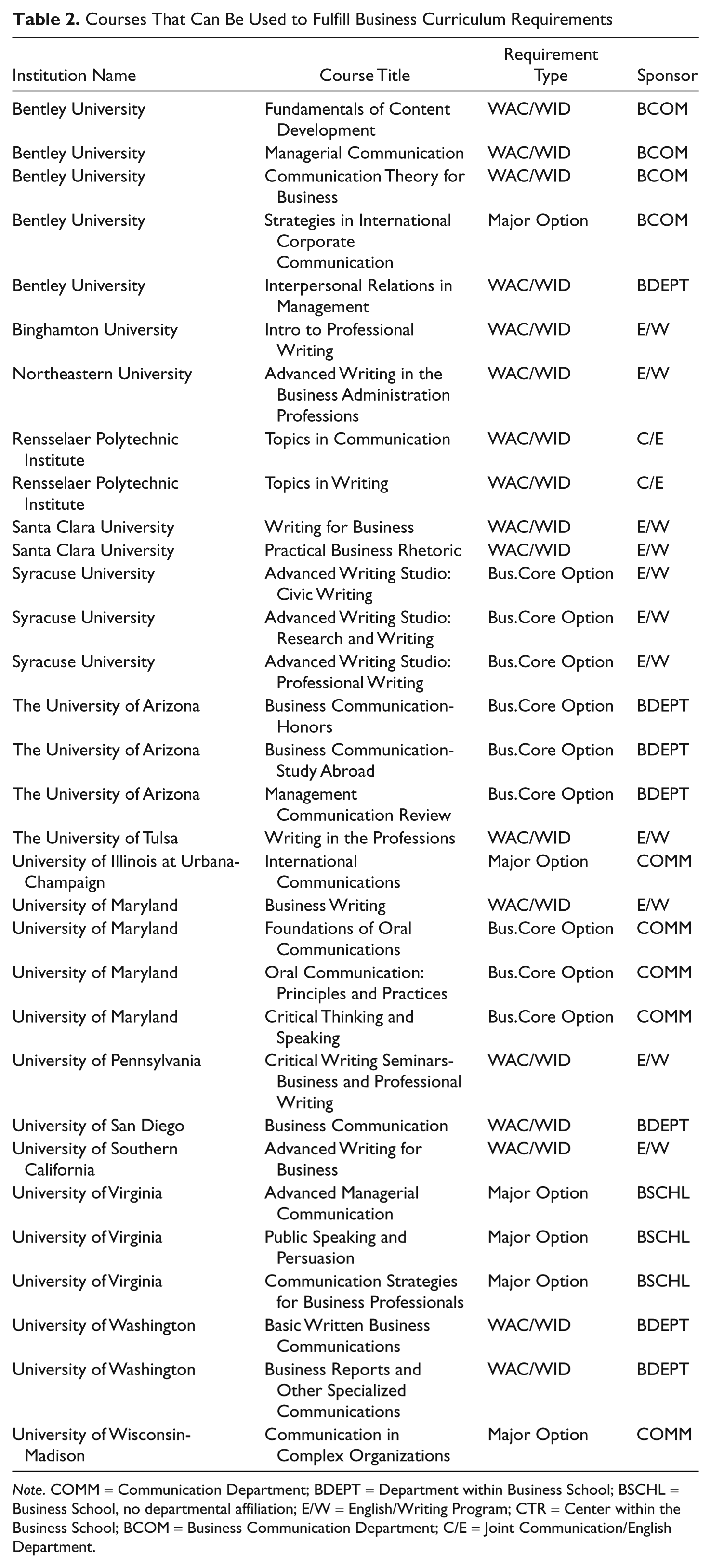
Note. COMM = Communication Department; BDEPT = Department within Business School; BSCHL = Business School, no departmental affiliation; E/W = English/Writing Program; CTR = Center within the Business School; BCOM = Business Communication Department; C/E = Joint Communication/English Department.
Of the courses that were neither requirements nor options to fulfill requirements, there were 26 electives at 15 institutions (see Table 3). More than 61% (16) of those electives were advanced courses or courses that focused on a particular aspect of business communication, such as the Global Management Communication course at Babson College that focused on intercultural communication. The other elective courses were general business communication courses focusing on written (two courses), oral (two courses), or combined written and oral business communication (six courses).
Elective Courses
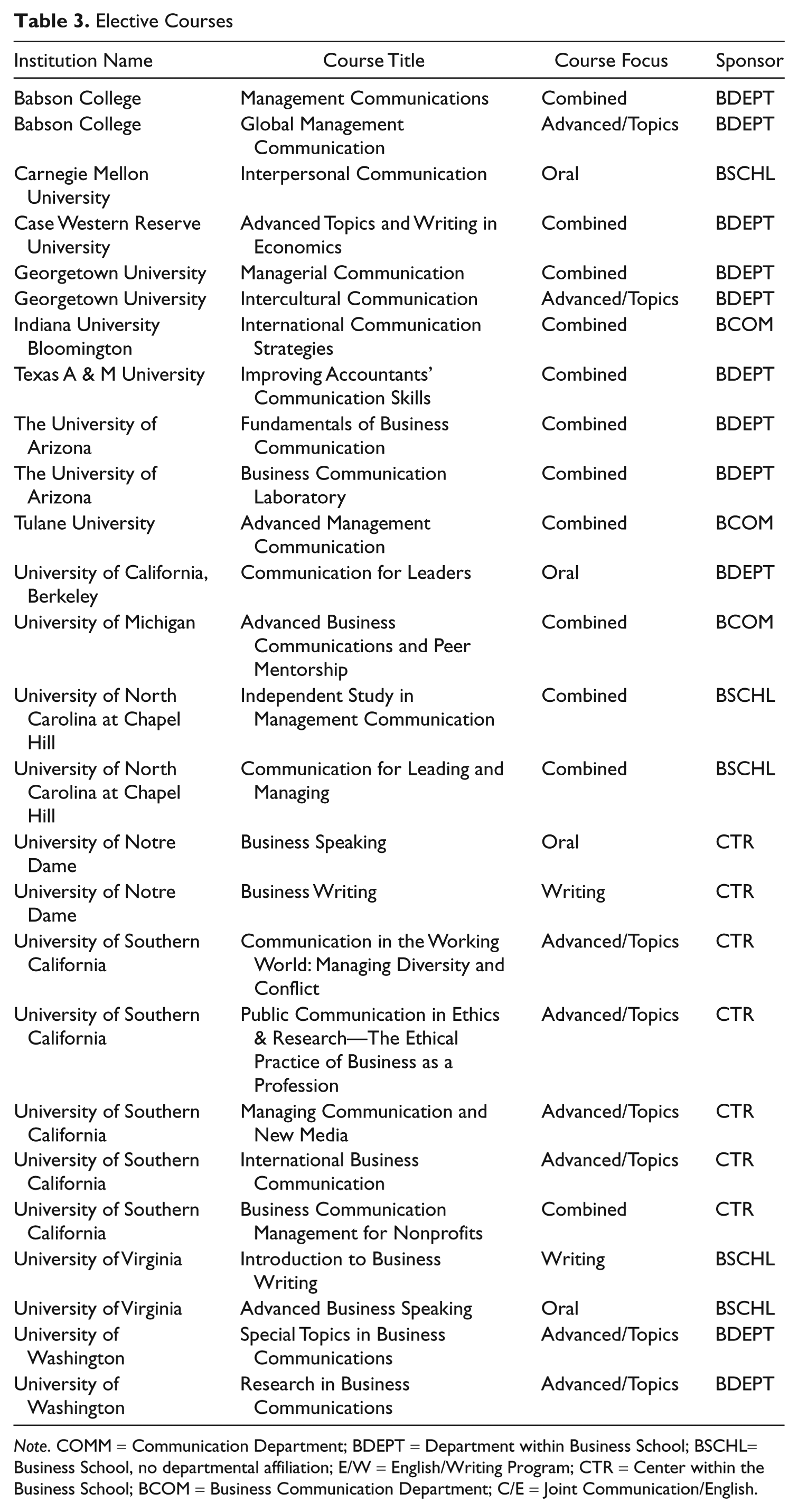
Note. COMM = Communication Department; BDEPT = Department within Business School; BSCHL= Business School, no departmental affiliation; E/W = English/Writing Program; CTR = Center within the Business School; BCOM = Business Communication Department; C/E = Joint Communication/English.
Programs and Course Sequences
Business communication courses continue to stand alone at the top 50 institutions. In fact, 17 (40%) of the 42 institutions that include business communication courses in their curricula only offer one course. Twelve of those institutions required the course for all business majors, as part of the business school’s core curriculum. For an additional four institutions, the course was part of the university’s WAC/WID program. Only one of those four was located within a business school; the remaining three were housed in English/Writing programs. For the final institution, Case Western Reserve University, the single business communication course was offered by the economics department as one of the senior capstone choices for majors.
While the remaining 25 institutions offer two or more courses each, only one actually had an official business communication degree program. Bentley University offered a major in Information Design and Corporate Communication that, according to their website, prepared students for careers in public relations, web design, and information design. However, the website only listed four courses from that program that met our criteria for inclusion in the study. Three of those courses fulfilled university-level WAC/WID requirements, and one was an option to fulfill a requirement for the Information Design and Corporate Communication major.
Like Bentley, the other three institutions with business communication departments offered multiple courses. However, they did not offer any sort of official program, such as a minor, concentration, or certificate. For example, University of Michigan offered three courses, but they were structured as a sequence, whereby the first two courses were required as part of the business core, and the third was an elective. Tulane University similarly offered three courses; all business students were required to take one of the first two courses (either a regular section or an honors section), and the third course was again an elective. Finally, Indiana University offered one course that was required only of accounting majors, two courses required of all business majors (either a regular section or an honors section of each), and an elective that could be taken by any business major.
Similar to the institutions with business communication departments, those with business communication centers (University of Notre Dame and University of Southern California) offered multiple courses ranging from introductory to advanced. However, none of the courses offered through the centers were required by any of the business majors. All the courses were listed as electives only. At Notre Dame, the only required business communication course was offered by the management department rather than through the business communication center, and it was required only for their own majors. At University of Southern California, there were two required courses, both offered by the business administration department; the first was required for all business majors, and the second for accounting students only.
Of the 25 institutions that offer more than one course, those that did not have a dedicated business communication department or center offered anywhere from two to five courses. These 19 institutions offer a total of 56 courses, with an average of three courses per institution. Of these, 19 courses were required, 22 courses were options that fulfilled a requirement (including WAC/WID courses), and 15 courses were electives. Two of the 19 institutions only offered business communication as an elective; each of the remaining 17 had at least one course that was required or was an option that fulfilled a requirement.
Overall, business communication remains, for the most part, an independent course in the broader business curriculum, though it is more often than not a required course. Even at institutions with multiple business communication courses, loosely structured sequences were the norm. In short, business communication programs do not appear any more common than they were when Knight (1999) conducted her study, although more institutions may offer multiple courses. Additionally, an examination of course titles and descriptions suggests that the number of advanced or topically specific courses may have increased, but the content of general business communication courses does not appear to have changed significantly.
Course Content
Once we generated a database of all of the business communication courses, we quickly discovered that course titles varied broadly. Some were fairly transparent (like the Business Presentations course at Carnegie Mellon), and others were much more opaque (like the Foundations in Business course at Texas Christian). To appropriately categorize courses according to their foci and to search for commonly covered topics in these business communication courses, we collected and analyzed course descriptions as well.
Based on both course titles and descriptions, oral and written communication are receiving comparable amounts of attention in business communication courses. More than one third of the courses we identified (38%) had a combined focus on written and oral communication skills. Ten additional courses focused specifically on oral communication, whereas another 20 focused solely on written communication. Interestingly, there were eight required communication courses that were not exclusively focused on business communication. Six of those courses were general, oral communication courses that were either specifically required by business programs or were options to fulfill requirements for business programs. The remaining two courses were Topics in Writing and Topics in Communication at Rensselaer Polytechnic Institute. These two courses fulfilled university-level WAC/WID requirements, and they were included in this study because they are rotating topics courses that often address business communication issues. For example, one iteration of the Topics in Communication course is titled “Professional Presentations,” and one iteration of the Topics in Writing course is titled “Writing in Organizations.”
Twenty-five of the courses we identified were titled in ways that suggested they were advanced courses or courses that focused on a particular aspect of business communication. Examples of these courses include courses that focused on communication research, such as Research in Business Communications at the University of Washington, and courses that focused on technology and new media, such as Managing Communication and New Media at the University of Southern California. Other topics included communication theory, nonprofit communication, and intercultural communication, as well as independent studies and courses with “advanced” in the title. Nearly one third (32%) of these advanced and special topics courses were focused on intercultural communication.
A closer examination of the descriptions of all courses included in the study indicated that several topics (in addition to written and oral communication) were common across many business communication courses. These topics include job-seeking skills, teamwork, technology, intercultural communication, ethics, visual communication, service learning, and interpersonal communication. Nearly 62% of the 102 courses we identified for the study mentioned at least one of these topics in their course description, and 44% of those (28 courses) mentioned more than one. Teamwork was by far the topic most mentioned in course descriptions (see Figure 2). Twenty-six courses included some reference to collaboration or teamwork as a learning goal. Intercultural or global communication was mentioned in 13 course descriptions, followed by technology (including presentation software) in 12 course descriptions and job-seeking skills, such as resume development and interviewing skills, in 11 course descriptions. Interpersonal communication was mentioned in 10 course descriptions, and visual rhetoric or design was mentioned in nine. Five courses descriptions indicated coverage of ethics, and four mentioned a service-learning component to the course. Finally, five courses had rotating topics; several of the examples given of possible topics aligned with the common topics discussed here.

Number of times topics were mentioned in course descriptions
When we cross-referenced the topics mentioned in course descriptions with the required and elective courses, some additional patterns emerged that are worth noting. More than 40% (18) of the courses that were required by the business core or by a specific major mentioned teamwork in their course descriptions, and 18% (8) mentioned interpersonal communication. Also interesting was that courses that covered intercultural communication were more than twice as likely to be an elective or an option to fulfill a requirement than they were to be required by the business core or a specific major, and of those courses, more than 61% (8) were a specific course about intercultural communication, meaning that only five courses mentioned intercultural communication as a topic within a broader business communication course. And, of these, only three were required courses.
Together, the course titles and descriptions demonstrate that oral and written communication are still receiving comparable treatment in business communication courses, but there are also many additional communication-related topics that these courses address. Of particular note is teamwork, which is more likely than any other topic to be included in course descriptions.
Discussion
Rather surprisingly, 8 of the top 50 undergraduate business institutions do not include business communication courses in their curricula. Granted, the institutions without business communication courses may have robust communication programs as part of their university’s core curriculum; however, such courses are not often focused primarily on business communication. Because Knight’s (1999) study included all communication requirements—including university core requirements—we cannot determine whether the absence of business communication courses at some institutions is a change for the worse or not. Regardless, this statistic concerns us. It may indicate the need to demonstrate further to business colleagues the value of business communication and the ways in which it differs from more general communication and writing courses, especially those at the freshman level.
A Decade of Little Change
Since the earlier studies, the status of the business communication course seems to have changed very little. In general, our study found that almost three quarters (71%) of those institutions that have business communication courses require at least one course, and business communication courses are much more likely to be required by business programs or the business school more broadly than they are to be options to fulfill requirements or electives. In comparison, Knight (1999) found that 69% of the 52 institutions she examined had formal upper division writing requirements, mostly through the business school. It is important to reiterate, however, that we have no way of knowing whether those upper division courses were business-focused or not. Not surprisingly, courses that cover both written and oral communication are still the most common type of course among the top 50 institutions. However, stand-alone courses with a written focus significantly outnumber those with an oral focus. This aligns with the survey finding by Wardrope and Bayless (1999) that written communication received more attention in business communication courses than oral communication.
Again in keeping with the data reported by Knight (1999), we found that accounting programs are more likely to require business communication than are other business majors. As Knight (1999) points out, this may be because of requirements related to Certified Public Accountant exams. If, however, we look also at courses that are options to fulfill requirements, programs in management seem to include a comparable amount of business communication in their curriculum. In fact, we found that management programs, though not necessarily requiring business communication, are more likely than other majors to list business communication courses as options that will fulfill major requirements. This supports Wardrope’s (2002) survey finding that department chairs in management, accounting, and marketing rated communication skills as more critical than did chairs of other departments.
Duplication of Efforts
The most common institutional home for business communication courses remains the business school. We found that 64% of the top 50 undergraduate business programs had business communication courses housed somewhere in the business school. We also found, however, that several institutions housed business communication in departments inside and outside of the business school. This could be potentially problematic, but it could also be beneficial for students. It may be problematic in the sense that students may be receiving inconsistent messages both about the value of business communication and its content. Additionally, it may signal a duplication of efforts across administrative units at the same university. However, offering courses both within and outside the business school may also mean that students are exposed to multidisciplinary perspectives on business communication topics, which could be very valuable.
Although some institutions offered courses outside the business school, dedicated business communication courses remain primarily within the business school. They also tend to be upper division courses, in keeping with the findings of previous studies. As Wardrope (2002) and Russ (2009) found, the greatest number of business communication courses are offered at the junior level. A substantial number, however, are also offered at the sophomore and senior levels. This may simply be because of differing institutional guidelines and standards regarding course levels.
Programs and Centers
Our study suggests that programs and structured course sequences dedicated to business communication remain scarce. Although 25 institutions offered two or more courses, these were not typically structured as a formal sequence. Only one of the top 50 institutions actually had an official business communication program; none of the other institutions had any sort of program—a major, minor, concentration, or even certificate—in business communication. This is particularly concerning given the fact that two institutions had their own centers for business communication, including the University of Southern California, which did have a business communication degree option in 1999 (Knight, 1999). Unfortunately, we found no current evidence of that program.
The centers for business communication at the University of Southern California and the University of Notre Dame housed courses in business communication and occasional professional development seminars and programs, but neither had an official degree or certificate-granting curriculum of any kind. While centers seem to be a trend, we wonder about their position and relative power within the university. If they are not housing degree or certificate programs and do not offer required courses, what resources do instructors have, particularly if they are not tenure track? Of course, “center” can have several different meanings, and some may have college- or department-level support, but without committed support for research, teaching, and tenure lines, neither students nor faculty will have the resources to fully reap the potential benefits of the center approach.
The continued lack of degree and certificate programs at the top business schools seems to suggest that business communication is still seen only as a complement to other business programs rather than a field in and of itself. This is troubling, particularly given the fact that business communication has respected journals and professional organizations. Furthermore, the information we were able to glean while collecting our data suggests that the majority of faculty teaching business communication courses remain non-tenure-track. We worry that the lack of degree-granting programs promotes a continued demarcation between business communication faculty and other business faculty; likewise, we worry about the impact of this demarcation on job security and the potential for promotion among business communication faculty.
Advanced or Special Topics Courses
Approximately one third of the top 50 institutions offer courses with more specialized or advanced topics, such as intercultural or interpersonal communication. This phenomenon was not mentioned by previous studies except in passing by Russ (2009). Therefore, it seems likely that these advanced and special topics courses are a somewhat new development, demonstrating a possible increase in the attention given to these more specialized aspects of business communication.
While international communication was a particularly popular topic for these specialized courses, it was, surprisingly, not mentioned very often in the course descriptions for more general business communication courses. Teamwork was by far the most popular topic in these course descriptions, particularly for required courses. This may reflect less of a content change in courses than it does a pedagogical change whereby instructors are attempting to more closely parallel workplace practice. Technology was mentioned in the descriptions for 12 of the 102 business communication courses we identified, which may suggest it is receiving a bit more attention than in the past. However, this coverage still seems inadequate, given the dependence on technology of most business enterprises. Even more significant, the technology focus was typically on presentation software or email, with little mention of social media and other current technologies that are becoming central to business practice.
Conclusions
This study contributes to the body of curricular “audits” (Russ, 1999) that can help us recognize trends, assess programmatic well-being, and identify opportunities for change. There are, however, limitations to our study that should be noted. First, it focuses only on the top 50 business schools; examination of a more extensive list of undergraduate business programs may reveal different patterns in terms of the role of business communication. Although we purposely focused on program websites to get a snapshot of the public faces of the top 50 business schools, we acknowledge that a second limitation of our study is that it depends on the accuracy and completeness of the those websites. This is a limitation that could be overcome through a follow-up study that relies on additional input from program faculty and administrators. Finally, and perhaps most significant, the study is limited in that it looks at course offerings, titles, and descriptions, but does not examine the content of the business courses listed by delving deeper into course syllabi and assignments. This, too, is a limitation we hope to address in a follow-up study. These limitations notwithstanding, the data reported here allow us to review curricular growth that has taken place over the past several years, evaluate how well current course offerings address workplace needs, and suggest avenues for continued development.
In terms of growth, we would not conclude that business communication is thriving, as Knight (1999) suggested. Rather, our data suggest that business communication has made moderate strides forward but not nearly as many as we might have hoped. The presence of a number of advanced and special topics courses is a positive indicator of an increasingly nuanced understanding of business communication theory and practice. Likewise, the emphasis given to teamwork reflects an awareness of the collaborative nature of many business communication practices.
At the same time, however, many things remain unchanged. Only two thirds of the top 50 institutions in 2011 actually required business communication. And, requiring business communication typically meant one stand-alone upper division course rather than a sequence of related courses. Course content in that general business communication course, for the most part, appeared remarkably similar to that reported in the survey conducted by Wardrope and Bayless (1999). As they noted, business communication instructors face something of a juggling act in deciding what to include and what to omit from an already overfull syllabus. Our examination of course titles and descriptions supports this survey finding and suggests that the problem is pervasive. However, if we are working to help students develop the knowledge and skills they will need in the 21st-century workplace, we must keep our courses up-to-date. More, our curricula must anticipate, where possible, future needs and try to provide students the foundation and flexibility they will need to meet those needs. What might those needs be?
Our data suggest a possible trend of increased attention to topics such as intercultural communication, technology, visual communication, and ethics in course descriptions. These are topics we believe are essential for business communication students, but the most frequently mentioned of these topics—intercultural communication—was addressed in only 13% of the course descriptions. Ethics was only mentioned in 5%. This coverage is insufficient to give students the foundation they need to succeed in the 21st-century workplace. Wardrope and Bayless (1999) stressed the need for a greater emphasis on technology in business communication courses we add to that our own call for greater attention, not only to technology but also to intercultural communication, visual communication, and ethics. Ethics, which was the least represented in the course descriptions, seems especially important given the numerous instances of corporate misconduct over the past several years.
Developing business communication certificate and degree programs would allow for greater coverage of these current topics as well as further legitimizing business communication as a valuable field of study within the academy. Business Communication departments are particularly well-positioned to begin development of these programs, as are those institutions that already offer advanced and special topics courses in business communication. Centers for business communication should also look into developing certificate or degree programs as a way to increase their visibility and relative power within their institutions; such programs could also serve to improve the material conditions of those who teach business communication. Of course, the impetus for creating programs will likely need to come from business communication faculty; that is, we will need to convince colleagues in other business fields, as well as upper administration, that such programs would serve students well and would enrich existing business degree programs.
The data presented here can serve as a resource in that effort—as a way to demonstrate that the field of business communication is moving forward and that the majority of well-respected programs continue to maintain some level of commitment to including business communication in the curriculum. However, our data suggest that there is much more work to be done if business programs want to graduate students whose communication skills are commensurate with their discipline-specific business knowledge. Not only do business communication faculty need to ensure that business communication is represented in the business curriculum at our institutions, but we also need to ensure that those courses include topics like ethics, technology, and international communication. It is our opinion that these should no longer be considered “special” topics. They are now central to business communication efforts, so why should their role in the curriculum be any different? Making these topics more central to our curricula and continuing to develop certificate and degree programs in business communication will provide our students with the knowledge and perspectives they need in a 21st-century workplace and will continue to increase the status of business communication as a field of study.
Footnotes
Author’s Note
This article is based on a paper presented at the 76th annual meeting of the Association for Business Communication, Montreal, Canada, 2011.
Declaration of Conflicting Interests
The author(s) declared no potential conflicts of interest with respect to the research, authorship, and/or publication of this article.
Funding
The author(s) disclosed receipt of the following financial support for the research, authorship, and/or publication of this article: The authors would like to thank the C. R. Anderson Research Foundation for funding this project.