




Abstract
Current literature suggests that students have equal or higher learning outcomes in a “flipped” classroom compared with a traditional lecture. However, there are few robust analyses of the flipped-class teaching method. This research uses a yearlong, quasiexperimental study across six sections of a business communication course to track student outcomes and perceptions of student engagement and learning. The results indicate that there were no significant differences between flipped and traditional classes across the learning and engagement variables in how students perceived these different conditions. However, the flipped condition produced better outcomes for oral and written assignments.
The goal of this research is to further our understanding of whether flipped classes are more effective for learning compared with traditional lecture courses. This article examines student perceptions of learning gains in a flipped class compared with a traditional lecture course across several measures, and it also compares rubric scores for an oral and written communication assignment across these experimental conditions.
Much of the literature suggests that students have equal or higher learning outcomes in a flipped classroom compared with a traditional lecture (Hake, 1998;Mason, Shuman, & Cook, 2013;Mazur, 2009;Nwosisi, Ferreira, Rosenberg, & Walsh, 2016;Wilson, 2013), and yet there seem to be few robust quantitative and rigorous analyses of this teaching method (Hall & DuFrene, 2016). Many of the early studies on flipped classes were in engineering, math, and science, but recently business instructors have also been considering these methods to teach concepts such as business writing, accounting, economics, finance, and more (Anders, 2016;Butt, 2014;Findlay-Thompson & Mombourquette, 2014;Knight, 2016;Roach, 2014;Sherrow, Lang, & Corbett, 2016). Currently, there is an unfortunate trend with many analyses of flipped classes in which researchers take an uncritical approach that does little to provide rigorous evidence concerning the efficacy of flipped methods. This current research aims to improve our understanding of the effects of flipped methods by comparing student perceptions of their learning outcomes and perceptions toward the course, as well as looking at grade changes between control groups for oral and written assignments. By doing so, we hope to begin a trend toward more robust and nuanced analyses of flipped methods in business courses to tease out what is or is not advantageous about this teaching modality.
Literature Review
There are many competing definitions of a flipped class, with no one unified definition (Educause, 2012). For many, a flipped-class methodology requires access to media for students to watch outside of class, which leads to activities, teamwork, and discussion during class (Berrett, 2012;Educause, 2012;Rosenberg, 2013;Sherrow et al., 2016). Students come to class already familiar with the material and use class time to ask the professor questions, solve problems, and engage in active learning. However, videos and media are not inherently a prerequisite to the definition of a flipped class. Many scholars and practitioners (Hall & DuFrene, 2016;Flipped Learning Network, 2014;Sherrow et al., 2016) define the key components of flipped classes as including the following:
Improved student engagement
Collaboration and team learning
A move from a group learning space to a more individualized one
Emphasis on instructor as a designer, facilitator, and coach rather than expert
Emphasis on students taking ownership of learning (self-motivated learning)
Use of active learning strategies (activities, discussion, feedback) rather than passive lectures
Student engagement through preclass study or quizzes
While there are other relevant concepts, these ideas represent the core of what distinguishes a flipped class from a traditional lecture.
As interest in the flipped model has increased, the amount of research on flipped pedagogies has increased as well. One of the early case studies on flipped classrooms took place at Clintondale High School near Detroit, Michigan (Rosenberg, 2013). In terms of performance, Clintondale High was in the worst 5% of Michigan schools, but converting to the flipped model dramatically increased the student graduation rate and reduced the failure rate (Rosenberg, 2013). Others corroborate that flipped classes improve student outcomes, such as increased engagement and interactivity, improved perceptions of the classroom environment, and better learning outcomes across a variety of measures (Nwosisi et al., 2016;Roach, 2014;Wilson, 2013). At the same time, quantitative studies appear to be nonexistent or show mixed learning results. In other words, studies have not shown universal improvement in all areas, and results in flipped classrooms have been sometimes only equivalent to traditional learning environments (Baepler, Walker, & Driessen, 2014;Mason et al., 2013).
The challenge is that many studies on flipped classes are anecdotal and focus solely on a professor’s personal reflection at the end of the term on how they flipped the class and what occurred (Arduser, 2016;Butt, 2014;Pragman, 2014;Sherrow et al., 2016). Often these include a basic survey of students’ perceptions, but there is little systematic use of measures. There are often no control groups for comparison or experiments. While these methods are still valuable for providing insights, they are less systematic in examining variables and limited in helping practitioners understand the key components of a flipped class. This observation is not new; others have also recognized the dearth of quantitative studies on flipped classes (Hall & DuFrene, 2016).
Some studies on flipped classes do have quantitative analyses, and these span the gamut of disciplines, from chemistry to nutrition to psychology. Many of these are based on test scores (Nwosisi et al., 2016;Wilson, 2013) or, in better instances, control groups’ posttest scores (Baepler et al., 2014) or surveys about interactivity (Roach, 2014). Controlled, experimental studies are more time-consuming and difficult, and therefore there are fewer pedagogical studies that use these controlled methods, especially in business communication courses. Because there are few experiments on flipped classes, it is difficult to make strong claims about what aspects of this model are beneficial.
At the state university where the research was conducted, the college of business requires all its majors to take a business communication course. Reports and news outlets routinely demonstrate both the importance of oral and written communication for new graduates entering the workforce but also graduates’ prevalent deficiencies with regard to communication competencies (Casner-Lotto & Barrington, 2006;Gorman, 2016;Ortiz, Region-Sebest, & MacDermott, 2016).
The main learning goal in the business communication course in this study is to improve students’ oral and written communication skills. Other skills emphasized in this course are typical for a business communication curriculum: interviewing, crafting a cover letter and résumé, and developing professionalism and soft skills. This study focuses on students’ perceptions of learning gains across many of these areas, and it also looks at the learning gains for oral and written communication.
Given the importance of communication across disciplines, it is critical to assess whether or not the core competencies are best served through a traditional delivery format or more interactive methods such as the flipped style. Based on these concerns and a desire to nudge future flipped-class studies toward more rigorous methodologies, we explored the following research question: How does a flipped-class teaching modality affect student learning outcomes in comparison to student learning outcomes from a traditional lecture-based course? To examine this question, the researchers generated the following hypotheses.
Method
Design and Teaching Approach
This research compares students’ perceptions about their learning and engagement in a flipped-style classroom to a traditional lecture classroom. This study targeted student engagement and perceptions of learning because student affect toward the course should affect their overall engagement with the course material. We also focused on these concepts because so much of the literature on flipped classes emphasizes student engagement as an important factor. At the same time, however, we also wanted to balance this self-reported data with student performance data across oral and written communication assignments.
The current study employed a quasiexperimental design to investigate differences in student (N= 168) engagement when content is presented via lecture (control) or in a flipped-classroom (experimental) setting. Three sections were surveyed in the control group and three in the experimental group. Course content and instructor were identical for all sections. The only exceptions to this were the addition of five video quizzes and a news article for reading in the flipped-class group.
While the graded content remained fundamentally the same, there were obvious course format differences that accompanied the flipped model. For instance, because of the need to incorporate video and extra content for course discussion in the flipped class, five additional quizzes were added to the flipped condition to keep students accountable for the material. Additionally, the due dates for the online quizzes were changed from after class lecture (control) to the night before class (flipped) to ensure that students had the requisite knowledge to benefit from the activities and discussion. In the flipped-class scenario, the students primarily engaged in learning activities in almost every class period to illustrate the principles in the textbook chapters and to help students practice those skills. For instance, one activity involved a mock interview in which students answered behavioral-based questions as anintervieweeand then rotated to ask questions as aninterviewer. Other activities involved individual and group editing of a professional document and a class debate.
Students in the three courses in the control group (n= 86) were surveyed in the spring of 2015, and students in the three courses in the experimental group (n= 82) were surveyed in the fall of 2015. Where feasible, every part of the course was kept the same across conditions to facilitate the quasiexperiment. Students in both the control group and the experimental group were surveyed at two points during the semester, at the beginning and at the end of the semester. The same instructor taught all classes. Students in all conditions completed 14 chapter quizzes, five graded writing assignments, and two graded oral presentations. To improve writing skills, these assignments included a self-analysis, written email, résumé, cover letter, and problem-solution analytical report. To assess oral communication, the assignments included a team presentation and an individual presentation. These assignments were assessed based on a combination of technical expertise (i.e.,grammarfor writing,deliveryfor presentations) and content (i.e.,comprehension of communication strategy). (SeeAppendix Afor rubric assessment criteria.) Extensive feedback was given to all students for each assignment to foster improvement. Both conditions also experienced two guest speakers, one relating to the job-search process and one focused on professionalism in the workplace.
As part of the experiment, there were some differences in the two conditions. In the traditional classes, the instructor lectured using PowerPoint presentations and engaged in typical lecturing mixed with discussion and intermittent in-class activities. By contrast, in the flipped-class group, the instructor assigned 14 chapter readings and four online videos as out-of-class work, assigned online quizzes to test students’ knowledge of this content and for accountability, and devoted the majority of the in-class time to discussions, activities, workshops, and presentations. For example, sample activities included an in-class debate, a revision exercise, an in-class mock interview role-play, a résumé workshop, and many more. Some days required two different activities per class period to fill the time. For instructors who are interested in using a flipped model, the time required to develop activities to fill a 50- or 70-minute class session should not be underestimated. The development of these activities took considerable time and preparation. Depending on the duration of each activity, a typical class period may require two or even three activities, plus a debriefing period. Other activities, such as impromptu speeches, take up more time and might last the entire class period. There were approximately 20 class periods in each course that were allotted for covering the content in the textbook. In the control condition, lecture was given, and intermittent discussion was facilitated. In the flipped condition, those 20 class periods typically contained one or two activities per day; thus, students in the flipped condition experienced approximately 25 to 40 additional in-class activities compared with the control group. In sum, every variable we could control was kept the same to promote a quasiexperimental setting.
Participants
In this yearlong study, participants (N= 182) were sampled from six business communication courses. Data from 14 participants were removed (lecture,n= 8; flipped,n= 6) due to course attrition. The final data set consisted of 168 participants. There were 86 participants (males,n= 53; females,n= 33) in the lecture group (mean age = 21.38 years, standard deviation [SD] = 2.21) and 82 participants (males,n= 44; females,n= 38) in the flipped group (mean age = 20.43 years,SD= 1.29). All students were offered the opportunity to participate in this research or conduct an alternative assignment to fulfill a research requirement of the course. The university’s institutional review board approved all methods and procedures.
Measures
A variety of measures was used to track students’ perceptions of their learning and engagement. For engagement, the Student Course Engagement Questionnaire (SCEQ;Handelsman, Briggs, Sullivan, & Towler, 2005) was used. Questions related to affect toward the course and course instructor were selected from the Instructional Affect Assessment Instrument (IAAI; McCroskey, 1994). Questions developed byFrisby and Martin (2010)were used to assess cognitive learning, including whether students perceived an increase in their learning. However, there was a lack of measures for students to self-assess their business communication skills. Because of this absence, the first author developed the Business Communication Competency Questionnaire (BCCQ) to evaluate student knowledge and confidence in business communication areas such as presenting, writing, awareness of soft skills, and so on (seeAppendix B). This measure was intended to provide a basic pre- and posttest analysis of students’ perceptions of their own skills.
Procedure
Students in both the control and experimental group completed a pretest at the beginning of their respective semesters. At the conclusion of each semester, students completed the posttest. The questions were identical at both testing periods, with the exception of the wording on one of the scales in the pretest, which was adapted because it did not fit the scenario and would confuse the students. It was changed to gauge students’typicalclassroom experience and then was compared at the posttest to the current classroom experience.
Results
All analyses were subjected to a 2 (course, traditional, flipped) 2 (time, pretest, posttest) mixed factorial analysis of variance. Significance was set atp< .05.
Engagement increased across all conditions from the beginning to the end of the semester. Analysis of the SCEQ revealed a main effect of time. Student engagement was significantly greater at the end of the semester (M= 86.28,SD= 13.09) than at the beginning of the semester (M= 83.47,SD= 11.91),F(1, 166) = 7.08,p= .009,
Descriptive Statistics for All Student Engagement Measures (Numbers in Parentheses Are Standard Deviations).

Note. SCEQ = Student Course Engagement Questionnaire; IAAI = Instructional Affect Assessment Instrument; BCCQ = Business Communication Competency Questionnaire.
Similarly, analysis of the IAAI revealed a main effect of time. Affect toward the course and instructor had significantly increased by the end of the semester (M= 46.83,SD= 9.75) compared with the beginning of the semester (M= 42.32,SD= 6.81),F(1, 166) = 27.25,p< .001,
Cognitive learning improved from the beginning to the end of the semester across all conditions, but both groups displayed indistinguishable increases in learning. Analyses of cognitive learning revealed a significant main effect of time,F(1, 166) = 64.74,p< .001,
The BCCQ helped measure students’ self-perceptions of their business communication competencies, and an analysis of student responses revealed an acceptable level of internal consistency, α = .78 at pretest and α = .84 at posttest. Further analysis of the BCCQ revealed a significant main effect of time. Students’ perceptions of their learning were higher at the end of the semester (M= 59.67,SD= 7.46) than at the beginning of the semester (M= 45.89,SD= 7.98),F(1, 166) = 386.51,p< .001,
Finally, students’ academic performance on written communication and oral communication competencies was analyzed (seeAppendix Afor the oral and written communication rubric criteria). The assignment used for the assessment was an end-of-term problem-solution assignment that involved writing a polished research report and then completing an oral presentation that summarized the findings. Because rubric scores were deidentified, we were unable to identify and remove participants who failed to complete the surveys. This resulted in different sample sizes when we analyzed the rubric scores. Although we faced this limitation, the scores are still valid for determining differences between the mean scores. Independent samplettests indicated a significant difference in written communication scores between students in the traditional classroom and flipped classroom:t(153) = 3.69,p< .001, Cohen’sd= 0.59 (seeFigure 1). The difference in oral communication scores between the traditional classroom and flipped classroom was also statistically significant:t(169) = 4.82,p< .001, Cohen’sd= 0.74 (seeFigure 2). In both measures, students in the flipped classroom outperformed students in the traditional classroom.

Oral communication scores between traditional and flipped classrooms (bars are ±1 standard error).
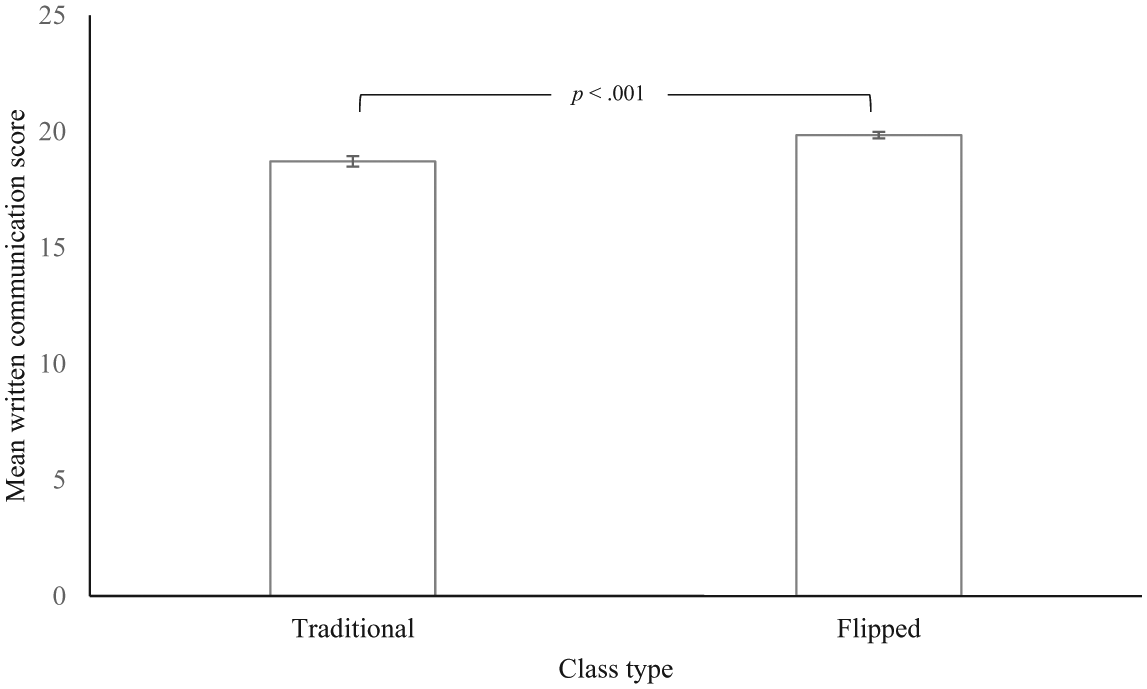
Written communication scores between traditional and flipped classrooms (bars are ±1 standard error).
Discussion
There are several important findings that move our understanding of flipped classrooms forward. Students who were in the flipped condition reported a favorable view of the flipped-class style. However, the results indicated that there was not a significant difference in terms of student perceptions between a traditional class and a flipped class. All the variables measured improved from Time 1 to Time 2. In other words, students’ perceptions of learning and engagement all increased by the end of the semester. However, there were significant differences in the written and oral communication scores, and the flipped class outperformed the traditional lecture course.
These results help fill a gap in the literature because typical flipped-class studies either do not have quantitative scores at all or they are primarily based on test score data or final student grades. By contrast, the present study focused on measurable student perceptions and evaluated the scores for an oral presentation and a writing assignment. These methods represent a step forward in terms of evaluating the efficacy of flipped pedagogies, because these assignments evaluated skill-based competencies that will actually be utilized in the workplace.
The oral and written communication portion of the research supports previous evidence on flipped classes, which found improvement or a positive difference in flipped pedagogies (Mason et al., 2013;Wilson, 2013). Put simply, the increased activities and active practice time given to students in the flipped condition appear to be superior to lecture (or lecture with discussion) in terms of developing the communication skills assessed at the end of the semester. While unsurprising, this finding is important. Instructors who are interested in improving students’ oral and written communication skills should consider increasing the practice time for building these competencies. At the same time, these findings should be considered thoughtfully. The student perception data did not result in significant differences and ended up producing a more mixed result, as other flipped-class studies have shown (Findlay-Thompson & Mombourquette, 2014). The student ratings of a flipped class were not significantly higher than a traditional course based on the scales that were used. Another important point that the data revealed was that student-reported engagement was not higher in a flipped condition; there was no difference in engagement between flipped and traditional courses. These results seem to indicate that other variables moderate engagement.
Therefore, the overall picture of the flipped model based on this study is that, although it does foster engagement and student learning, it is still unclear how significant the difference is. Factors such as class size and the level of instructor-to-student engagement are important variables to consider. The current study was conducted in classes with 32 students; classes were small enough that the instructor knew students’ names. This class size is different from a 100- or 300-seat lecture hall, where the instructor likely does not know students’ names or cannot interact with them individually as often. There also appears to be an improvement in the development of oral and written communication skills, and it may be that the students simply had more time in class to practice these skills.
Limitations and Future Research
These findings have several limitations and also provide ideas for future studies. As mentioned above, the smaller class size in this study undoubtedly affected students’ perceptions of engagement. Future research should investigate the effect of class size on the efficacy of flipped classes. Likewise, the evaluation of student perceptions was limited, even with the use of multiple scales. While these data are effective at charting students’ views on their learning gains, they are limited by students’ own self-awareness and objectivity.
One limitation is that the two groups were imperfectly controlled for because of the real-world classroom situation. The extra activities and the implementation of preclass quizzes with the flipped condition suggest that the advantage is due to the increased quantity of activities and engagement points. This would seem to confirm what other studies on flipped classrooms have found, which is that more engaging, active learning strategies create a pedagogical advantage. Students in the flipped condition spent more time on task actively practicing skills in class; however, we did not measure the time difference, and this is something future research could explore in a more controlled, lab-based experiment. Each class is dynamic, and an activity may take longer in one class than it does in another.
Finally, the finding that oral and written communication skills improved the most in the flipped condition should be compared with other skill-based competencies (Lucas & Rawlins, 2015) in future studies. Overall, this study has advanced the flipped-model pedagogical research forward in terms of providing a more systematic way of evaluating student perceptions and analyzing core competencies, rather than simply using multiple-choice test scores. Future studies could go a step further by looking at other types of assignments and measures of engagement.
Footnotes
Appendix A
Appendix B
Authors’ Note
This research was originally presented at the 81st annual conference of the Association for Business Communication, Albuquerque, NM, 2016. This study was approved by the Institutional Review Board of the University of North Georgia (Approval No. 2014127).
Declaration of Conflicting Interests
The author(s) declared no potential conflicts of interest with respect to the research, authorship, and/or publication of this article.
Funding
The author(s) received no financial support for the research, authorship, and/or publication of this article.
Author Biographies