



Abstract
Prior research in the United States has found that liberals are generally more environmentally concerned than conservatives. The present study explores whether conservatives’ opposition to environmental protection is solely a U.S. or a universal phenomenon and whether this association is contingent on country-level characteristics, such as development, environmental conditions, and communist history. Employing data for 19 countries from the International Social Survey Program module “Environment II,” this article explores inter-country variations in the relationship between individual conservatism and environmental concern using multilevel modeling with cross-level interactions. The models reveal a number of intriguing associations. Most important, conservatives’ support for environmental protection varies by country. This variation is a function of country-level characteristics. The strongest opposition of conservatives’ toward environmental protection was observed in developed, capitalist nations, with superior environmental conditions. On the other hand, in less developed countries, and countries characterized by poor environmental quality, conservatives are more environmentally concerned than liberals.
Keywords
Concern for the environment has emerged as one of the most salient political issues during the past few decades in major western nations. In the United States, for example, conservatives tend to favor business and economic growth over the environment, whereas liberals usually support environmental protection (McCright & Dunlap, 2010). However, it is not clear whether this ideological difference in environmental value orientation is mainly a U.S. or a universal phenomenon and whether this association is contingent on country-level characteristics. 1 For example, Freymeyer and Johnson (2010) suggest that country-level determinants may be more important predictors for environmental behavior than individual-level characteristics. In a multicountry study, they find significant influences of environmental conditions and country wealth on environmental actions such as signing a petition or giving money to an environmental organization. However, Freymeyer and Johnson do not explore whether the influence of individual-level variables is contingent on country-level characteristics. Only few studies have investigated these cross-level interactions (e.g., Franzen & Mayer, 2010) but none has focused on political ideology as a major predictor of environmental concern. Thus, this article tries to answer the following two research questions: Does the relationship between political ideology and pro-environmental attitude vary across countries? What are the main country-level predictors that affect the association between political ideology and pro-environmentalism?
Before embarking on the quest to answer these questions, it is important to conceptualize political ideology. Political ideology is a multidimensional concept that consists at least of three dimensions: economic, social, and political (Dunlap, Xiao, & McCright, 2001). However, because of data limitations, this study focuses primarily on the “political” aspect of political ideology, which is conventionally measured by a left–right or liberalism–conservatism dichotomy or continuum. However, these admittedly simplistic labels can have contrasting meanings in different countries. In capitalist countries such as the United States, left ideology tends to refer to the support for government regulations (e.g., gun control) and efforts to reduce social inequality while the right ideology represents the support for a small government and free market (Pilbeam, 2003). In contrast, in nations of the former Soviet Union (and other socialist countries, such as China), left ideology means support for democratic polity and free market while right-wing authoritarians prefer equality over individualism and fight to keep the socialist system (Sabbagh, 2005). These ideological differences are likely to affect the relationship between environmentalism and political orientation. With this in mind, the next section reviews the state of knowledge regarding the environmentalism–political ideology relationship.
Ideological Differences
Reviewing the relevant literature shows that empirical studies frequently find a strong correlation between environmental support and political ideology (Hamilton et al., 2010; Neumayer, 2004). Left-leaning individuals support environmental protection, whereas right-leaning persons often oppose such measures (Blankenau, Snowden, & Langan, 2008; Forgas & Jolliffe, 1994; Neumayer, 2004). These differences in attitude toward the environment might be rooted in the ideological meaning certain groups attach to environmentalism. Environmentalism is frequently associated with the rejection of discrimination against vulnerable groups (environmental justice) and a strong concern for nature and the welfare of future generations (Forgas & Jolliffe, 1994; Sabbagh, 2005). These values seem to overlap most strongly with leftist values and seem to be at odds with a rightist ideology that favors the industrial capitalist social order and resists changes that might impair the profit margin and economic growth (McCright & Dunlap, 2010). However, Bliese (1997, p. 135) calls the conservative resentment toward environmentalism a “historical accident” since there is no prima facie reason why environmental concern should necessarily be linked with any particular set of political attitudes (see also Dobuzinskis, 1992; Forgas & Jolliffe, 1994). In fact, the philosophical foundations of conservatism also support environmental protection and resource conservation.
The conservative movement consists primarily of two schools of thought: libertarian, free market advocates, and traditionalists. Both schools show components of environmental concern in different ways. Libertarians suggest the protection of the environment using free market mechanisms as more efficient alternatives to governmental regulation (Dobuzinskis, 1992; Pilbeam, 2003). Moreover, libertarians are convinced that governmental subsidies such as below-cost timber sales, subsidized irrigation, and the like are responsible for environmental destruction (Bliese, 1997; Dobuzinskis, 1992). Traditionalists focus more on the health of the human spirit and the state of culture. They consider tradition, in which religion plays a major role, as the golden way to ensure social stability. Traditionalists reject materialism and place morality above material values, and thus are willing to restrict economic growth to preserve environmental quality. Also, they support piety toward nature and see man not as the lord of creation but as a steward of it. Finally, traditionalists emphasize a social contract across generations and maintain that nature is a precious heritage, which they strive to hand on intact or even slightly improved to the next generation (Bliese, 1997). These principles and others (see Pilbeam, 2003) suggest a strong potential for the development of some form of “green conservatism.”
Indeed, findings from Nebraska, a traditionally conservative state, show that the attitudinal gulf between conservatives and liberals on environmental issues is not as pronounced as on other political issues (Blankenau et al., 2008). Even though leftists are more likely to choose environment over economy, a substantial number of rightists (55.7%) supported environmental protection over economic growth.
Why the Disparity?
In the United States, environmentalism started out as a consensual issue and much of the nation’s landmark environmental legislation was passed during the Republican Nixon and Ford administration with considerable bipartisan support (Dunlap et al., 2001). However, it did not take long until the unitary opinion of both liberals and conservatives regarding issues of environmental protection started to diverge. Already in the 1970s, numerous studies of legislative voting on environmental measures, both in the U.S. Congress and in a number of state administrations, found conservative legislators to have significantly lower pro-environmental voting records than their liberal colleagues (see Kamieniecki, 1995 and the references therein). This tendency has not changed since but rather, the cleavage between liberals and conservatives on environmental issues has grown substantially in the past decades (Dunlap et al., 2001). For example, a number of current studies, especially on the topic of climate change, find in general that liberals show higher levels of environmental concern than conservatives (McCright & Dunlap, 2010, 2011b; Wood & Vedlitz, 2007). Three reasons might help to explain why conservatives are less concerned about the environment than liberals and why a “green conservatism” has not emerged in the United States.
First of all, conservatives frequently associate environmentalism with socialism in disguise (Gray, 1993; Pilbeam, 2003). This perception was in part created by the environmental movement itself, since it has used, right from the beginning, an anti-capitalist tone that spurred a strong counter response of the conservative parties (McCright & Dunlap, 2010). Indeed, Forgas and Jolliffe (1994) suggest that environmentalism might have functioned as an anti-establishment ideology in an increasingly conservative political climate. Second, the perceived hegemony of a pro-business doctrine, the support for laissez-faire government, and the maintenance of the status quo have become core elements of mainstream conservative ideology (Dunlap et al., 2001). More specifically, the capitalistic expansionary imperative, supporting the ever greater exploitation of natural resources, is clearly hostile to any environmentally based restriction. Finally, an additional point of divergence is the strong nationalistic focus of U.S. conservative ideology, which is largely incompatible with the commitment to an environmentalist global perspective and the support of international regulatory bodies (Pilbeam, 2003).
Cross-Country Variation Argument
As the preceding discussion indicates, there is no necessity to associate pro-environmentalism with a liberal political ideology, and this relationship might hold true only in the United States. In fact, some authors have observed a tendency in countries such as Germany and Scotland for right-wing, nationalist groups to advocate pro-environmental views just as pro-environmental groups adopt right-wing ideological positions (Hamilton, 2002; Sabbagh, 2005). Thus, a number of reasons may be given for the place-based variation of environmental concern (Hamilton et al., 2010) in relation to political ideology.
First, environmental concern may be related to qualitatively different concepts. In Western countries, environmental concern is frequently associated with a progressive, future oriented ideology “based on anti-speciesism and respect for all organisms, for life, for ecosystems, and so forth” (de-Shalit, 1996, p. 51). In less developed countries, on the other hand, environmentalism might be associated with ruralism. Ruralism is the glorification of country life, a dissatisfaction with urbanism, and a pursuit to return to higher moral standards and religiosity of the past (de-Shalit, 1996). Political conservatives may connect environmental protection with preservation of agriculture and rural communities (Blankenau et al., 2008). This protection of local agricultural businesses might be especially important in developing countries with a large peasantry in which, due to globalization, large international corporations are threatening local businesses and the environment at the same time. In such countries, a pro-business (referring to family and local businesses) attitude might overlap with environmental protection goals. For example, in Costa Rica, popular activism combined nationalism, a typical conservative value, and pro-environmental concerns to oppose foreign investors’ construction of large industrial plants (Christen et al., 1998). Also, traditionalism, another conservative value, has been frequently combined in poor agrarian states with environmentalism. In Venezuela, leading environmentalists opposed impacts of modernization, such as the use of chemical fertilizers, pesticides, and crop hybrids “which have displaced older and more sustainable farming practices” (Christen et al., 1998, p. 71).
Second, grievances stemming from environmental ills play a big part in explaining environmental mobilization (Brulle, 2000; Martinez-Alier, 2002; Pellow, 2007). Thus, people’s environmental political attitude is likely affected by incidents in the physical realm. For example, disasters such as the explosion of the nuclear power plant in Chernobyl are likely to alter political ideologies toward environmental threats in a profound way (Van Hiel & Kossowska, 2007). Similarly, changes in rainfall and an increase in natural disasters caused by global warming and their adverse impacts on agricultural businesses might lead rightist, profit-oriented, groups to focus on environmental protection. Thus, especially in agriculture-dependent countries that experience an economic threat related to environmental degradation, a fusion between conservative interests and pro-environmental ideology may occur.
Third, the political–historical context is likely to affect region-specific political environmental relationships. For example, in the former Soviet Union, right-wing political groups preferred equality over individualism, whereas in the United States, the principle of laissez-faire individualism has been preferred by conservative groups (Sabbagh, 2005). This explains why rightist conservatives in former communist countries such as Poland and the Ukraine tend to adhere to communist economic principles, whereas leftist, progressive thinkers prefer the economic transition toward capitalist economic principles (Van Hiel & Kossowska, 2007). Since a pro-environmental attitude is opposed to capitalism, Van Hiel and Kossowska (2007) found a positive correlation between environmentalism and cultural conservatism for the Ukraine. However, this correlation was slightly negative for Poland and strongly negative for Belgium. The authors explain that in the Ukraine communist ideologies have been able to penetrate the social fabric more deeply than in Poland. In a similar vein, Blankenau et al. (2008) link the overall environmental support in Nebraska, despite its current conservative political orientation, to its more progressive past with its ideological support of the environment. In addition, the immature stage of democracy or party politics in former communist countries needs to be considered. Environmental-based party cleavage might not have fully crystallized at early stages of democracy (Lee & Norris, 2000). Thus, former communist countries may experience a weaker relationship between political attitude and environmentalism.
In summary, there are reasons to expect that the relationship of political ideology and environmental concern varies across countries. More specifically, it can be anticipated that a number of country-level characteristics such as communist history, developmental state or wealth, and physical environmental conditions weaken or reverse the generally negative relationship between conservatism and environmental concern.
Global Diffusion Argument
Contrary to arguments about country variation, however, there are theoretical reasons to believe that the relationship between environmental concern and political ideology is invariant across countries. Political as well as environmental ideologies are becoming increasingly dispersed through the process of globalization. It has been argued that the force driving globalization can be characterized as a world society or world polity—that is, by a cultural system of principles and norms enacted through and embodied in transational organizational structures and institutions (Meyer, Boli, Thomas, & Ramirez, 1997). Longhofer and Schofer (2010) provide empirical evidence that the world polity not only affects the state but penetrates down into civil society with transformative consequences (see also Bernstein, 2002). Thus, it is likely that major global players have the power to affect the ideology of countries around the world.
The diffusion-of-innovation literature might be helpful to explain this phenomenon. Diffusion has been defined as the influence of adoption of innovative ideas and behaviors by some individuals on the likelihood of adoption by others (Montgomery & Casterline, 1993). Often diffusion occurs first horizontally among higher socioeconomic groups but is later followed by vertical diffusion as lower ranking groups adopt the practices and ideas of more prestigious groups (Strang & Meyer, 1993; Strang & Soule, 1998). Applying this theory at the country level, it is possible that certain political ideologies such as conservative support for free market capitalism and opposition toward environmental protection, as supported by the most powerful governments (e.g., United States and Britain) and major international bodies (e.g., IMF and World Bank), will diffuse first among Western countries but be adopted by less developed countries within time. The diffusion is likely to be facilitated by globalized communication channels (e.g., Internet, TV) and through personal interaction between individuals of different countries as part of business and political relationships (Brechin & Kempton, 1994).
In summary, if a process of diffusion governs the relationship between political ideology and environmentalism, a high degree of similarity across all nations in the observed direction of the relationship can be expected. Of course, this assumes that the diffusion process has reached a certain degree of saturation and has spread to more and less developed countries alike. A cross-section of data collected at this point in time will not detect any between-country variation in the relationship under investigation. The global diffusion thesis might explain why Neumayer (2004) found no difference in the relationship between political ideology and pro-environmental attitude comparing developed and less developed countries. Other evidence for a process of diffusion comes from Australia, where a division on environmental issues between the conservatives (the coalition) and liberals (green and labor party) has emerged that shows a high degree of similarity to the situation in the United States (Tranter, 2011).
Individual-Level Influences of Environmental Concern
A number of other variables are likely to influence environmental concern. First, socioeconomic status and related factors, such as post-materialist value orientation, education, social class, and income have been found to affect persons’ attitudes toward environmental protection. People with postmaterialist values, emphasizing the importance of self-expression and quality of life, are more likely to support environmental protection than people with materialist values emphasizing physical and economic security (Inglehart, 1990, 1995). People with higher education have been found to be more environmentally concerned than people with lower education since education provides more information about geographically distant or seemingly abstract environmental threats (e.g., climate change) and evokes greater commitment to the common good (Gelissen, 2007; Hamilton et al., 2010).
A positive relationship between income and pro-environmental attitude was reported by Franzen and Meyer (2010), who suggest that environmental quality is an amenity good that can be more readily afforded by higher income versus low-income individuals. Most of the previously mentioned characteristics will define a person’s social class. Because of the observed relationships, it is assumed that a higher social class predicts higher environmental concern.
However, it is important to point out that some studies have also observed environmentalism among lower social classes (Adeola, 2004; Martinez-Alier, 2002). Guha and Martinez-Alier (1997) were the first to develop the notion of an “environmentalism of the poor.” They established that to be poor is very often a good reason to be green and that environmental movements in the developing world (“empty belly” environmentalism of the South in contrast to “full-stomach” environmentalism of the North) are fundamentally ecological in their ideology and motivation (Milton, 2000). More recently, Schelhas and Pfeffer (2007) investigated attitudes and perceptions of rural people in Central America toward forest protection. They observed that the rural poor generally agree that forest conservation is desirable for both practical (logging, protecting soil, protecting rainfall) and aesthetic reasons. However, because of livelihood considerations, most favor a combination of forest protection and cultivation (Anderson, 2009). In summary, the association between socioeconomic status and environmental concern is far from unidirectional, and research suggests that the poor are as environmentally concerned as the rich.
As for demographic characteristics, age has been shown to affect attitudes toward environmental issues (Kanagy, Humphrey, & Firebaugh, 1994), with younger people being more supportive of spending that supports the environment (Hamilton et al., 2010; Hunter, Hatch, & Johnson, 2004; Johnson, Brace, & Arceneaux, 2005). The literature also supports gender differences in environmentalism. Women have been found to be more environmentally concerned than men (Hamilton et al., 2010; Xiao & Dunlap, 2007), which might be explained by women’s higher assessment of personal and family dangers in relation to environmental threats (Davidson & Freudenberg, 1996; Hamilton et al., 2010).
Hypotheses
Inspired by the reviewed literature, the following hypotheses were used to guide the quantitative analysis. The null hypothesis or global diffusion hypothesis (H0) suggests that the relationship between political ideology and willingness to support environmental protection varies little across countries. The null hypothesis can be rejected in favor of the alternative hypothesis (H1) if substantial cross-country variation characterizes the conservatism–environmental concern relationship. Several hypotheses build then on H1 and suggest ways in which this relationship is affected by country-level characteristics. First, conservatives’ support of environmental protection is likely to be contingent on the political history of a country (H2). In capitalist nations, it can be expected that conservatives are less supportive of environmental protection while in former communist nations, liberal, free market supporters are less environmentally concerned. Second, conservatives’ supportiveness of environmental protection changes with a country’s developmental status (H3). While in more developed countries conservatives are expected to be less environmental concerned, this relationship might be inverse in less developed countries where conservatism is associated with ruralism. And third, conservatives’ support of environmental protection is contingent on the state of the environment in the particular country (H4). In countries where adverse environmental conditions result in economic losses, conservatives are likely to be more in favor of environmental protection. In contrast, an inverse relationship can be expected in countries with good environmental conditions, where perhaps strict environmental protection policies are responsible for better environmental quality and at the same time restricting dirty but profitable industrial production.
Data
Testing the hypotheses requires data on individual-level attitudes toward environmental protection as well as national-level information on wealth, communist history, and general environmental conditions. The International Social Survey Program (ISSP) data module “Environment II” for the year 2000 (ISSP, 2000) seems to be a good fit for this article’s proposed research goals. This survey includes questions on environmental issues and collects key sociodemographic information. The inclusion of numerous control variables reduced the number of countries with appropriate data from 26 to 19, resulting in 9,560 cases employed in the final analysis. Even though these countries are not necessarily representative of the world, they include nations from various stages of development, political history, and levels of environmental degradation.
Measures
Dependent Variable
Following the lead of Kemmelmeier, Krol, and Kim (2002) and Marquart-Payatt (2008), this study employed a willingness-to-pay scale as a measure for environmental concern. Three items are available in the ISSP 2000 data set, which ask survey participants about their willingness to pay higher prices, higher taxes, and their willingness to accept cuts in their standard of living to protect the environment with answer options ranging from 1 = very willing to 5 = very unwilling. The original response scales of these three items were reversed for convenience of interpretation. Thus, a higher score on the dependent variable indicates a stronger financial endorsement of environmental protection (see Kanagy et al., 1994). The three variables were combined to form an additive composite measure (Cronbach’s α = .819). Besides the empirical justification (high alpha reliability), there are good theoretical reasons to use willingness to pay to measure environmental concern. Willingness to pay taps deep-seated beliefs and values more than views approving of general environmental protection (Inglehart, 1995). Indeed, willingness to pay is able to discriminate between people who are truly committed to environmental protection and are willing to sacrifice money for its protection from those who merely pay lip service to the moral correctness of environmental protection and those who engage in pro-environmental behavior primarily based on self-interest (e.g., saving money by reducing energy consumption). However, it deserves mentioning that a willingness-to-pay measure is not without limitations. Such a measure might be biased in favor of wealthier people who can more easily afford to pay compared with poor people even if they have similar levels of environmental concern (e.g., Brechin & Kempton, 1994; Dunlap & York, 2008).
Independent Variables
Level 1 variables
The main predictor of interest in this study was a measure of self-rated political ideology. The survey question was phrased, “In politics there are often used terms the Left and the Right. Where do you place yourself on the scale?” Respondents indicated their political attitude on a five-category scale ranging from 1 = far left to 5 = far right. A long tradition of social research has employed such single item continuum measures to study the relationship between political ideology and environmental attitudes (e.g., Dillman & Christenson, 1972; Pierce & Lovrich, 1981).
Another important predictor frequently used in environmental concern studies is post-materialist value orientation. Based on Inglehart’s (1990) post-materialist item, people were asked, “Looking at the list below, please tick a box next to the one thing you think should be your country’s highest priority?” The answer options were as follows: (1) Maintain order in the nation. (2) Give people more say in government decisions. (3) Fight rising prices. (4) Protect freedom of speech. The subsequent survey question asked people to pick the next highest priority with the same four answer choices. Both Options 2 and 4 represent postmaterialist values. The postmaterialist variable was constructed to reflect whether respondents marked no, one, or two postmaterialist items on these two questions.
Three measures were included to account for variations in socioeconomic position, including social class, education, and income. Individuals provided a subjective rating of their social class on a six-item scale (1 = lower class to 6 = upper class). Respondents’ education was gauged by reporting the highest educational degree completed so far (1 = none or still studying to 7 = completed university degree). The variable for monthly family income was z-standardized (because income is reported in country-specific currencies) and adjusted for household size following Franzen and Meyer (2010).
Finally, age (in years) and gender (coded 1 = male and 0 = female) were used as demographic controls, which have been found to be significantly related to environmental concern (Davidson & Freudenberg, 1996; Hamilton et al., 2010; Johnson et al., 2005). Table 1 provides descriptive statistics for the dependent and explanatory variables used in the following analysis.
Summary Statistics of the Used Variables for the ISSP (International Social Survey Program) 2000 Sample
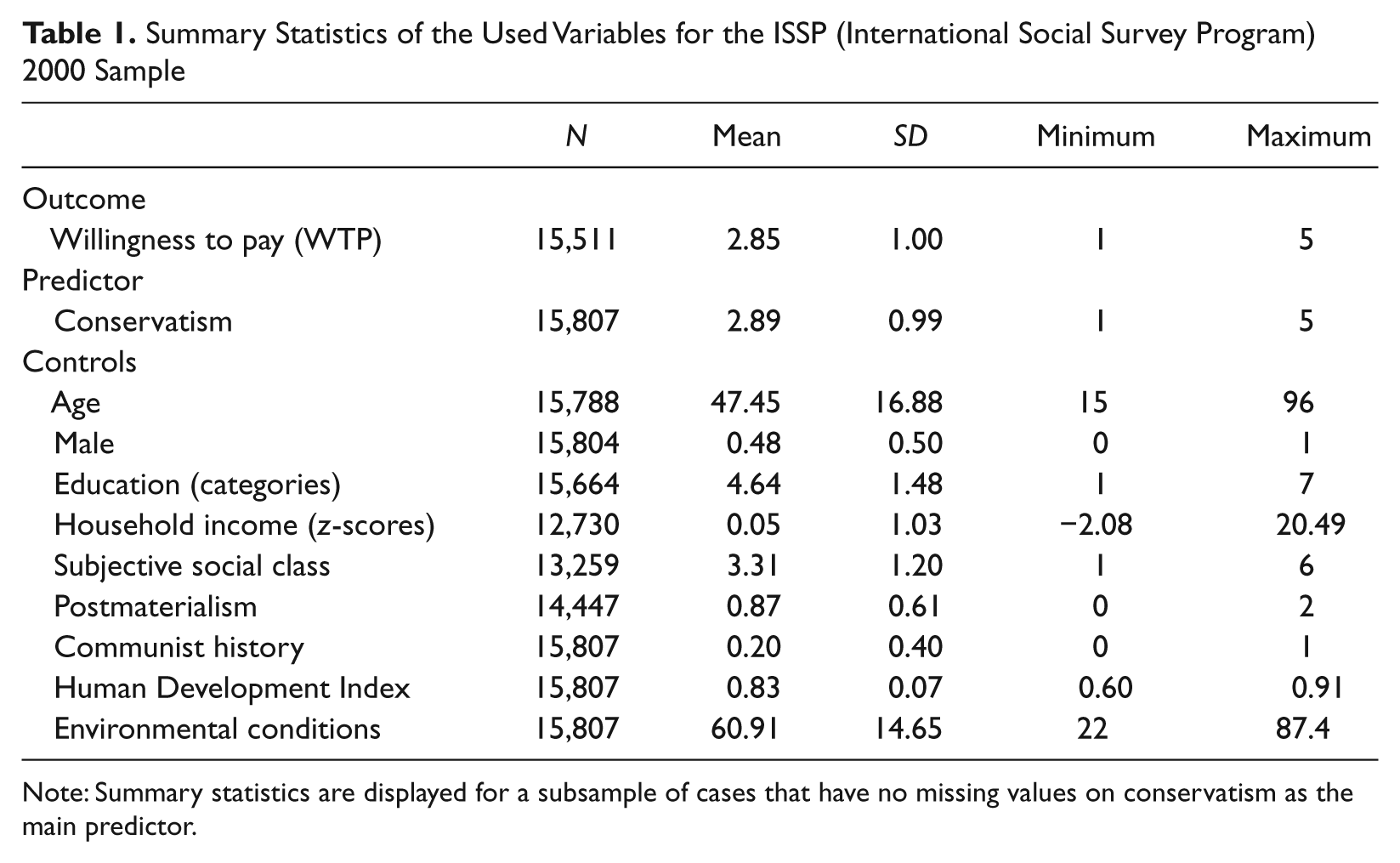
Note: Summary statistics are displayed for a subsample of cases that have no missing values on conservatism as the main predictor.
Level 2 variables
The research hypotheses warrant the inclusion of three country-level measures. First, a dichotomy, distinguishing former communist nations (coded 1) from other nations, reflects differences in the political history between these nations (Table 2). A similar differentiation has been used by Kemmelmeier et al. (2002). Second, to reflect the developmental stage of a country, the Human Development Index (HDI), published by the United Nations (2011), was used. HDI extends the focus on economic performance and includes measures of life expectancy and literacy. It gives less weight than GDP to oil rich countries with high inequality. Third, to measure environmental conditions the Environmental Sustainability Index (ESI) was used, which ranks countries on 22 indicators, covering natural resource endowments, past and present pollution levels, environmental management efforts, contributions to protection of the global commons, and a society’s capacity to improve its environmental performance overt time (World Economic Forum, Yale Center for Environmental Law and Policy, & Center for International Earth Science Information Network, 2001). However, the ESI has been criticized since it “lumps together social factors and environmental factors” (York, 2009, p. 206). Because of this problem, Gelissen (2007) used only those components of the ESI that reflect environmental quality. Following this approach, only the “Environmental Systems” component was employed, which combines measures of air and water quality, biodiversity, and conditions of the terrestrial system (e.g., soil degradation). A higher score on the Environmental Systems component indicates better environmental conditions.
Country Specific Means for the Three Used Level-2 Variables and the Willingness-to-Pay Scale

Note: Table includes only countries used in the final analysis sorted by the state of development. HDI = Human Development Index; EC = environmental conditions; CH = communist history (1 = yes; 0 = no); WTP = willingness to pay.
Estimation Strategy
The goal of this study was to explore whether the relationship between political ideology and environmental concern varies across countries and to investigate if this variation can be explained by country-level predictors. Since the predictor variables operate at two distinct aggregation levels (individual level and country level), the use of multi-level models is recommended. These models have the benefit of adjusting for clustering by nations, different sample sizes for Level 1 and Level 2 units, heteroscedastic error terms, and varying numbers of cases within Level 2 units (Luke, 2004). Besides these statistical benefits, multilevel models offer the functionality to test the outlined substantive hypotheses. Random affects permit the slope for a Level 1 predictor, such as political ideology (from here on “conservatism”), to vary across Level 2 units (countries), which is ideal to test Hypothesis H1 that the relationship between conservatism and environmental concern varies by nations. In addition, multilevel models are capable of including cross-level interactions, a necessity to test whether potential cross-country variation in the environmentalism–conservatism relationship can be explained by country-level characteristics. 2 The models were fitted using MLwiN 2.24 software (Rasbash, Charlton, Browne, Healy, & Cameron, 2009) run in STATA 11 (StataCorp LP, College Station, Texas) by using the macro runmlwin (Leckie & Charlton, 2011). To guard against problems arising from multicollinearity, all variables included in the interaction models were grand mean centered. 3
Results and Discussion
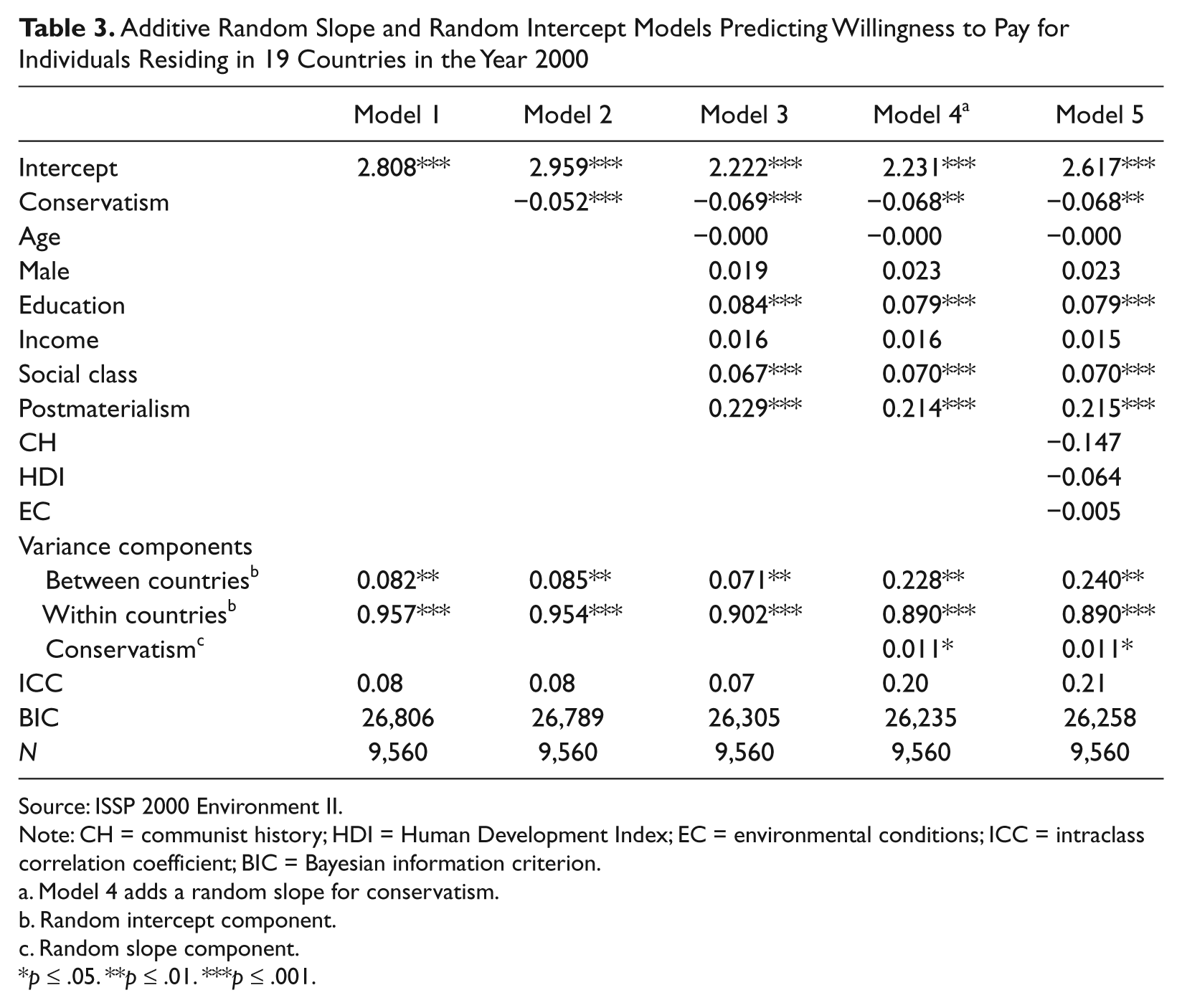
An intriguing, though not entirely unexpected first finding is that across all models the relationship between conservatism and willingness to pay is consistently significant and strongly negative (Hamilton et al., 2010). The inclusion of controls even increases the effect size slightly. Demographic differences such as age and gender seem to have no major impact on the willingness to pay (Table 3). However, education, social class, and postmaterialist value orientation show a strong positive associated with willingness to pay, confirming prior research on the determinants of environmental concern (Gelissen, 2007, Hamilton et al., 2010; Inglehart, 1990). In contrast to other studies (Franzen & Meyer, 2010), income showed no significant association with environmental concern, presumably because of measurement weaknesses.
Additive Random Slope and Random Intercept Models Predicting Willingness to Pay for Individuals Residing in 19 Countries in the Year 2000
Source: ISSP 2000 Environment II.
Note: CH = communist history; HDI = Human Development Index; EC = environmental conditions; ICC = intraclass correlation coefficient; BIC = Bayesian information criterion.
Model 4 adds a random slope for conservatism.
Random intercept component.
Random slope component.
p ≤ .05. **p ≤ .01. ***p ≤ .001.
To test the null hypothesis that the relationship between political ideology and willingness to support environment protection does not vary across countries, Model 4 allowed the slope for conservatism to vary across countries. A resulting decrease in the Bayesian information criterion (BIC) by 70 points suggests a superior model fit compared with the random-intercept-only model (Model 3). 4 The significant random effect suggests substantial country-specific variation in the coefficient for conservatism. The country-specific slopes are graphically depicted in Figure 1.
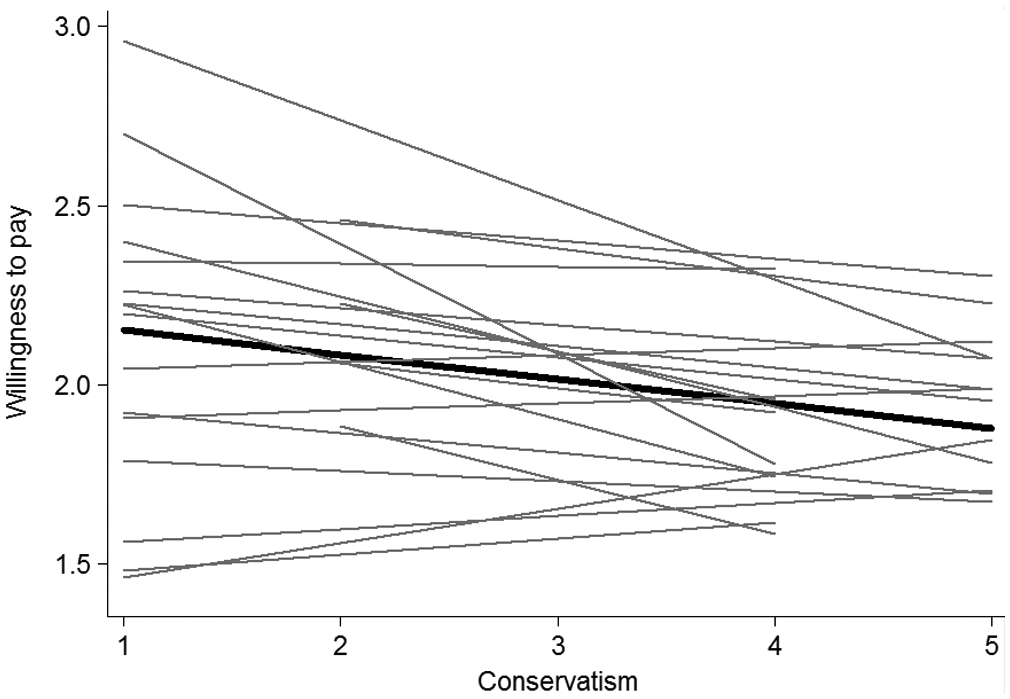
Individual slopes for all 19 countries as considered in the random slopes models
The bold black line in Figure 1 represents the global linear prediction for conservatism while gray lines represent the contributing slope for each individual country. The country-specific slope parameters range from slightly positive 0.037
The next analytical step aims at exploring whether differences in country-level characteristics contribute to the observed variation in the effect size and direction of the conservatism–willingness to pay relationship. To this end, three country-level predictors, communist history, HDI, and environmental conditions were added (Model 5). None of these country-level measures reaches significance in predicting individual-level environmental concern. However, to address Research Hypotheses 2, 3, and 4, these main effects are of limited utility; rather, cross-level interactions between conservatism and country-level predictors help to investigate whether the differential association between conservatism and environmental concern is a function of country-level characteristics.
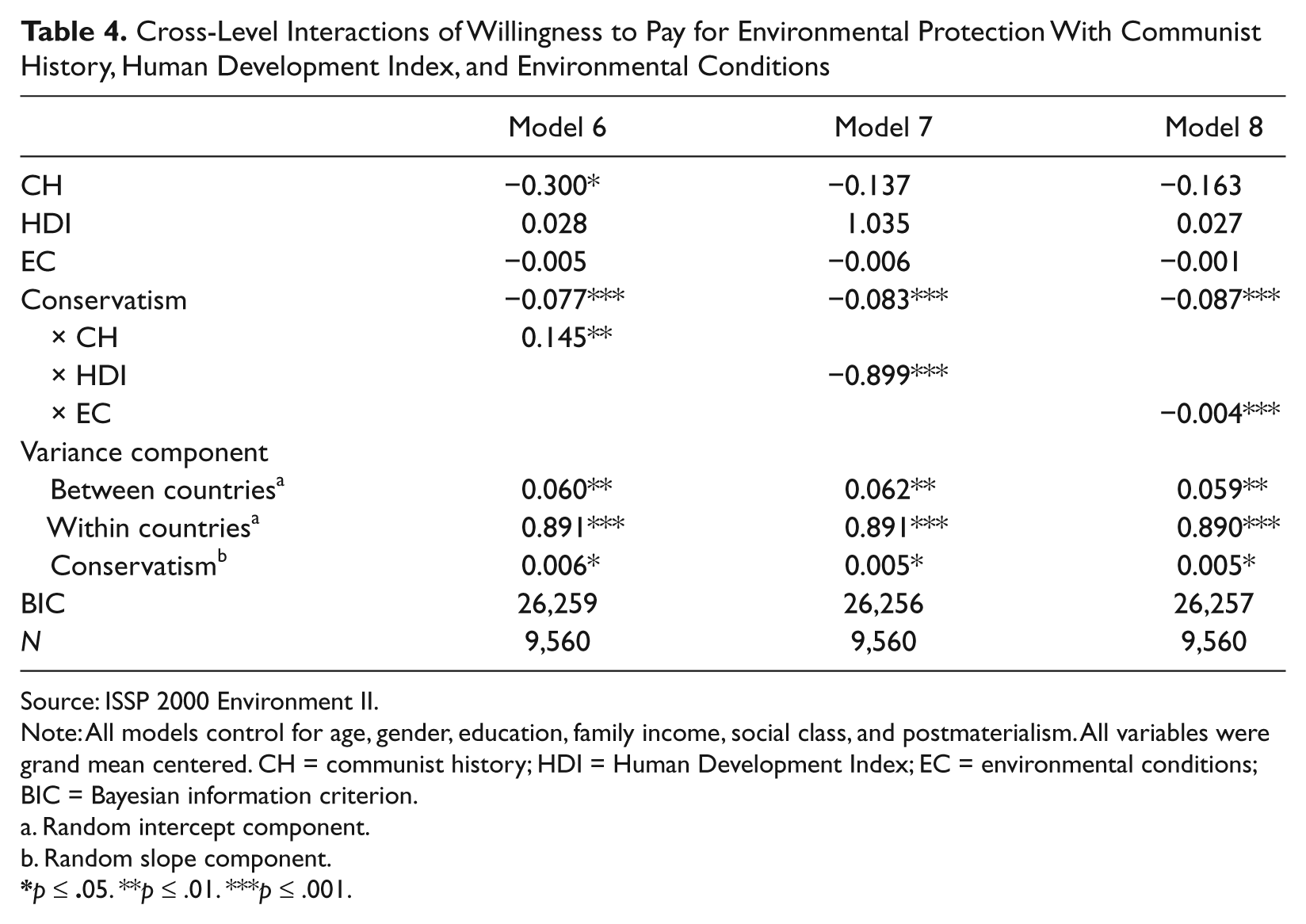
Table 4 shows that all cross-level interaction terms are significant, verifying each of the three associated research hypotheses. The models provide evidence that conservatives’ support of environmental protection is contingent on the political history of the country (H2), changes with a country’s developmental status (H3), and varies with country-specific environmental conditions (H4). Figure 2 depicts the observed relationships.
Cross-Level Interactions of Willingness to Pay for Environmental Protection With Communist History, Human Development Index, and Environmental Conditions
Source: ISSP 2000 Environment II.
Note: All models control for age, gender, education, family income, social class, and postmaterialism. All variables were grand mean centered. CH = communist history; HDI = Human Development Index; EC = environmental conditions; BIC = Bayesian information criterion.
Random intercept component.
Random slope component.
p ≤ .05. **p ≤ .01. ***p ≤ .001.
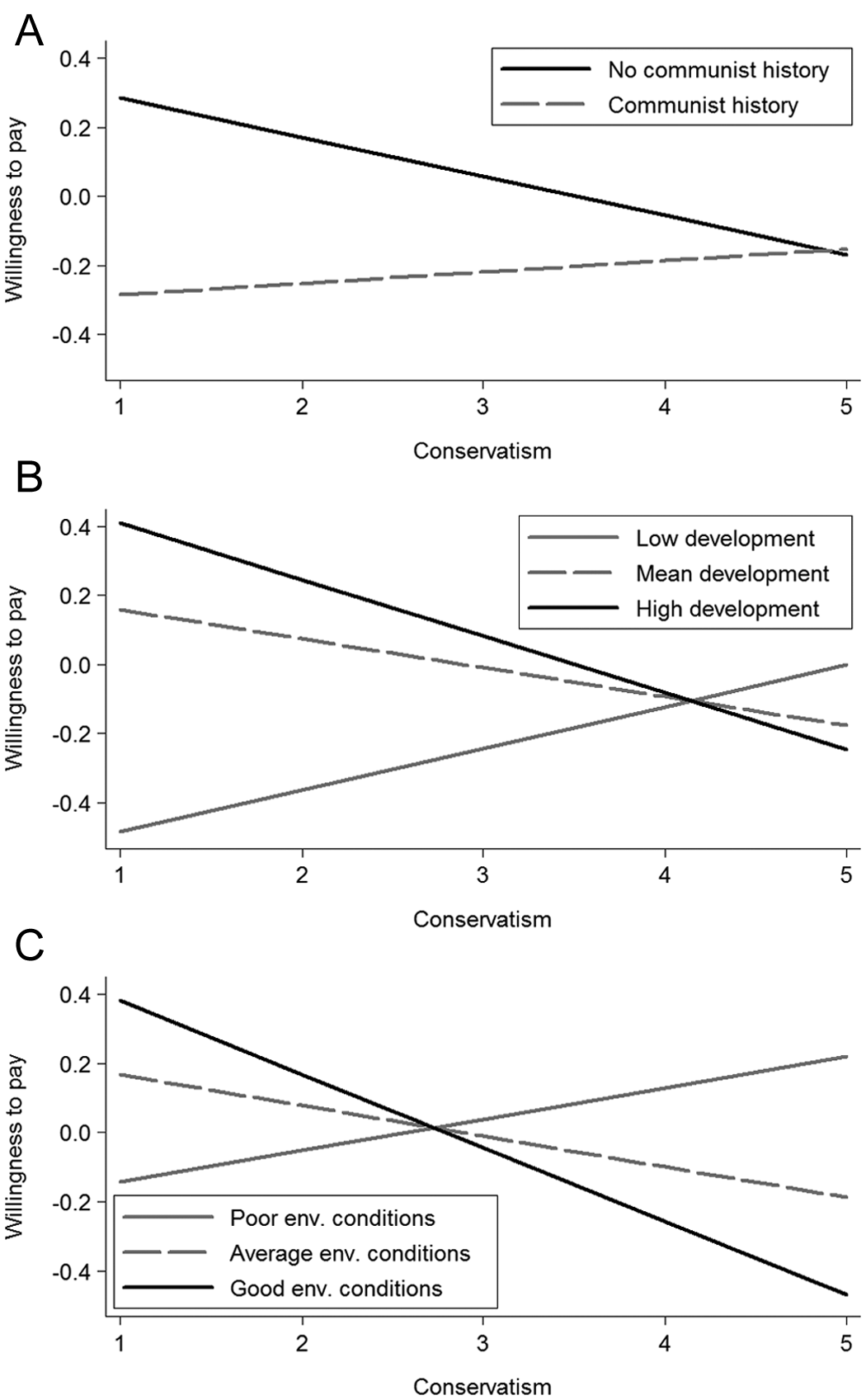
Cross-level interaction between Conservatism and Communist History (A), Human Development Index (B), and Environmental Conditions (C)
Model 6 and Figure 2A show that the negative association between conservatism and willingness to pay emerges only in capitalist countries that have never been under communist rule. In countries with a communist history, the relationship was not significant, indicating that conservatives and liberals are equally concerned about the environment. The slightly upward sloping line lends marginal support to Van Hiel and Kossowska’s (2007) assertion that in former communist nations, rightist conservatives tend to support environmental protection as the naturally opposite stand to capitalist principles. However, this trend is small, and the findings seem to indicate that a clear political position in regards to environmental concern had not sharply crystallized in former communist countries by the Year 2000 as has been argued by Lee and Norris (2000).
Model 7 and Figure 2B further indicate that conservatives’ support of environmental protection changes with a countries’ development status. The less developed a certain country is, the more political conservatism is connected with a pro-environmental attitude. One explanation for this finding might be that conservatives in less developed countries are concerned with preserving the quality of arable land, hunting grounds, and nature in general to ensure sustainable livelihood conditions for rural communities that are threatened by environmental destruction through industrial activities of multinational companies, which are idiomatic for a capitalistic free market economy (Blankenau et al., 2008). The findings provide empirical evidence to de-Shalit’s (1996) proposition that in less developed agrarian nations, environmentalism is likely to have the meaning of ruralism as a concept supported by conservative parties.
Finally, Model 8 and Figure 2C provide evidence that conservatives’ support of environmental protection is contingent on the state of the environment in a particular country. Whereas in countries of high environmental quality an increase in conservatism results in a decrease in environmental concern, this relationship is inversed for countries of low environmental quality. This finding can be best explained from an economic perspective. Since political conservatives are concerned with economic growth (McCright & Dunlap, 2010), they are likely to promote environmental protection as soon as the decreasing environmental quality affects the profit margin and becomes an “objective problem” (Brechin, 1999). The awareness of the importance of the state of the environment for economic growth will be especially heightened in the face of disasters. Under such conditions, environmental concern is likely to affect the political ideology in a profound way (Van Hiel & Kossowska, 2007).
Robustness Checks
Four robustness checks help establish confidence in the results. First, the HDI and the measure for environmental conditions are moderately correlated (r = .604, p < .01), which might bias the estimates because of the presence of multicollinearity. To increase confidence in the robustness of the cross-level interactions, Models 6 to 8 were rerun, including only the country-level variable involved in the interaction. This method effectively eliminates the possible influence of multicollinearity. The size of the regression coefficients changes only slightly whereas no change in the significance level was observed for all three interaction terms (not shown, available on request).
Second, because of listwise deletion in MLwiN’s estimation procedure, cases with missing values on any of the control variables are excluded from the model. This results in a reduction of cases and countries used in the final model. To test whether the cross-level interactions remain significant if more countries and cases are included, the interaction models were re-estimated with data sets in which the missing data were “filled in” through multiple imputation (Rubin, 1987). Multiple imputation is a Monte Carlo technique in which the missing values are replaced by simulated versions based on random parameter draws to reflect uncertainty levels (Allison, 2002; King, Honaker, Joseph, & Scheve, 2001). However, to preserve data validity and integrity, the imputation process was restricted to cases that have measured values on political ideology as the analytical focus of this article (n = 15,807). About 80% of the loss of data under listwise deletion can be attributed to three variables: social class, postmaterialism, and income. For these three variables, missing data were imputed. The imputation was repeated 5 times, creating 5 separate data sets. The multilevel models were then run within each data set, and the overall point estimates were calculated as the mean values across the 5 different data sets while the standard errors were the square root of the mean variances plus a correction factor. 5 The imputed data models are now using 15,033 cases and 22 countries compared with the much lower initial sample of 9,560 cases and 19 countries. However, the results are fairly similar. For the models using the imputed data, the interaction terms for “Conservatism × Communist History” (b = 0.152, z = 3.80, p < .001), “Conservatism × HDI” (b = −0.865, z = −4.04, p < .001), as well as “Conservatism × Environmental Conditions” (b = −0.004, z = −3.34, p = .001) change little in size and remain highly significant.
Third, to check for influential nations, the models were estimated by leaving out one country at a time from the sample set (Ruiter & De Graaf, 2006). Whatever country was excluded, all three interactions remained significant.
Finally, as noted earlier, some authors have been rightly critical of using a “willingness-to-pay” scale, since it is based on a Western concept biased toward an economic measure of worth (Brechin & Kempton, 1994; Dunlap & York, 2008). To investigate whether the reported results are limited to willingness to pay, different environmental concern scales were tested. The ISSP Environment II module asked individuals a number questions that tap into a wide range of opinions, attitudes, and behavior patterns that measure environmental concern. Based on face validity, seven of these items were chosen and included together with the three willingness-to-pay items in an exploratory factor analysis.
Using a rotated factor matrix with a threshold of 0.40, three major categories were identified (see Table 5). The items for each category were used to construct separate additive scales. The environmental worry scale shows an alpha reliability of .63 while the environmental action scale shows an alpha reliability of .55. Rerunning the cross-level interaction models using the new scales as outcomes shows that conservatism is a consistently strong negative predictor for each form of environmental concern (not shown, available on request). As for the interactions, the coefficient for “HDI × Conservatism” remains significant for both new outcome variables. The “Communist History × Conservatism” interaction remains significant for the environmental worry scale but drops below significance for the environmental action scale. However, the “Environmental Conditions × Conservatism” interaction does not reach significant levels for either of the new scales. Nevertheless, the directions (sign) of the interactions remain the same across all models and outcome variables. As such, the findings regarding the differential influence of country-specific development on the conservatism–environmental concern association can be safely generalized to the overarching concept of environmental concern whereas the influence of communist history and environmental conditions appear to be specific to willingness to pay.
Survey Items of the International Social Survey Program (ISSP) 2000 Used for the Exploratory Factor Analysis
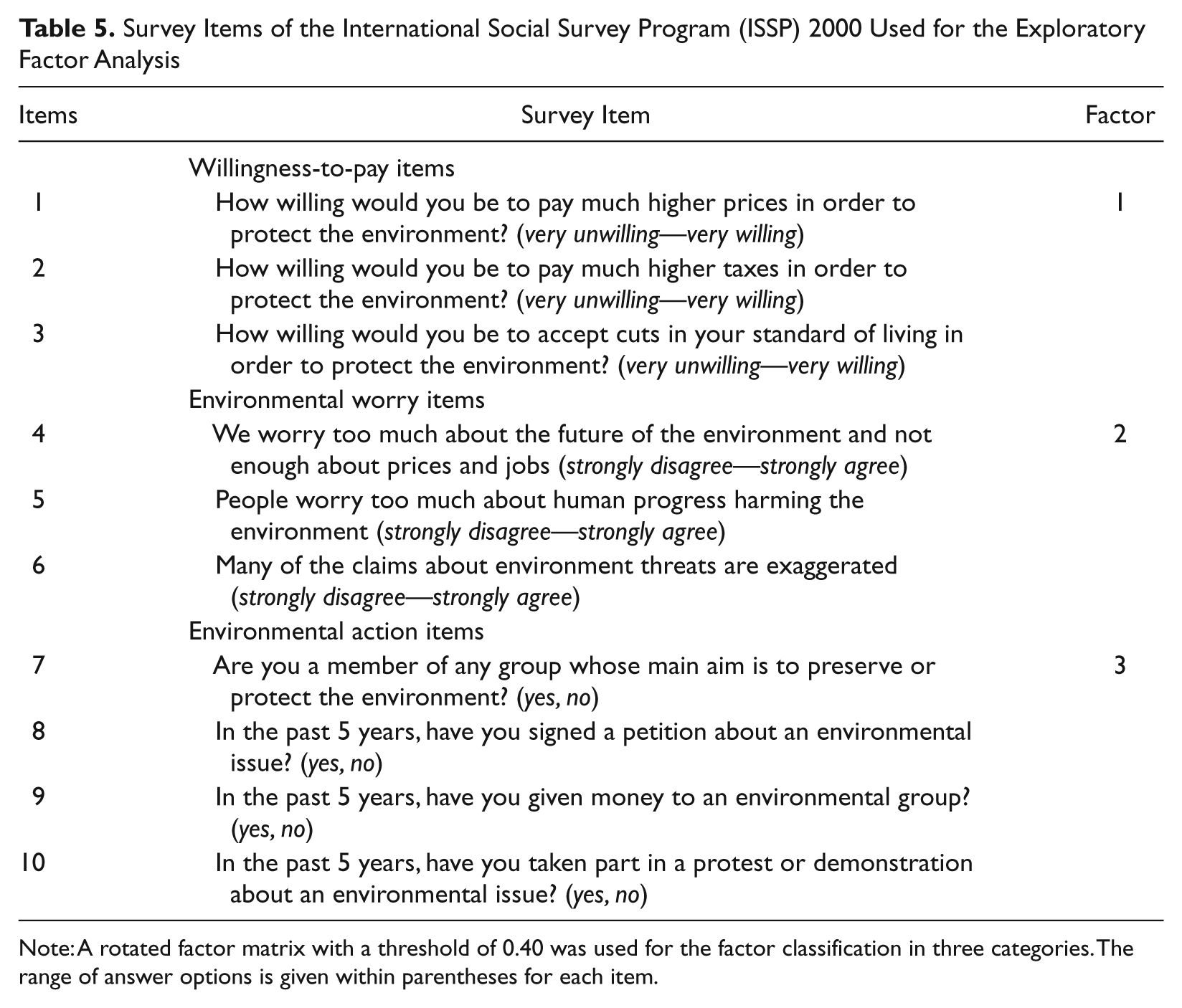
Note: A rotated factor matrix with a threshold of 0.40 was used for the factor classification in three categories. The range of answer options is given within parentheses for each item.
Conclusion
The present study has set out to explore the possible cross-national variation in the impact of conservatism on environmental concern. First, the analysis demonstrated that conservatives’ lack of support for environmental protection is not a global phenomenon but rather that this association varies by countries. Furthermore, this study provided evidence that variations in the country-specific relationship between political ideology and willingness to pay can be explained by three macro-level factors. Conservatives are least likely to support the environment in capitalist, highly developed countries, characterized by good environmental conditions. In contrast, conservatives are more willing to pay for environmental protection if they reside in former communist countries of low overall development status and poor environmental conditions.
This study adds to the current literature on environmental concern by providing strong evidence that the individual-level association between political ideology and environmental concern emerges in a distinct, nation-specific, context. Macro-level factors appear to influence whether conservative individuals are likely to become proponents or opponents of environmental protection. Thus, it is important to acknowledge the contextual embeddedness of micro-level associations in any research on the political determinants for environmental concern. Recognizing these interactions might be important for policy makers to understand and address contemporary issues, such as climate change denial (McCright & Dunlap, 2011a, Norgaard, 2006) and lack of support for renewable energies (Painuly, 2001; Wustenhagen, Wolsink, & Burer, 2007).
However, a number of limitations deserve mentioning. First of all, the countries in the ISSP data set are composed of few less affluent countries and no really poor countries (such as Nigeria, Nicaragua, or India). Even though this poses problems for the generalizability of the presented findings, the advantage is that the concept of willingness to pay is more applicable in these middle range countries than it would be for a sample that includes very poor nations.
Second, the present study is limited through its cross-sectional design. Even though the models indicate that the association between political ideology and environmental concern varies between countries, the test of the null hypothesis of global diffusion comes from data for a specific point in time (Year 2000). However, diffusion is a process (Strang & Meyer, 1993; Strang & Soule 1998) that might have been in progress, but was not completed in the Year 2000. Only a longitudinal study including information from the ISSP module “Environment I” (1993) and “Environment III” (2010, not yet released) would be able to provide meaningful evidence whether a global convergence toward a negative association between conservatism and environmental concern is on its way.
Third, the explanations for the observed cross-level interactions are in some instances speculative because of a lack of published research on this important issue. Thus, ground truthing, by using qualitative methods in a cross-national design would be helpful to verify the proposed explanations regarding the underlying meaning of the concept of “environmentalism” in different countries and for different political groups. However, qualitative research would also be beneficial to investigate what broad labels such as “left” and “right” mean in diverse settings. The observed cross-level interactions might be simply a function of country-specific differences in the conceptualization of political ideology.
Finally, it is important to recognize that communist history, a country’s developmental status, and the state of the environment are theoretically related concepts. Their influence is deeply intertwined, and they should be seen as a complex system of country-specific sociopolitical and eco-social factors rather than independent influences shaping environmental concern of people living in a certain location. The factors investigated in this study represent only a small selection of macro-level social forces that have been identified based on emerging themes in the literature reviewed. Future research should aim to explore possible cross-level interactions between a variety of other nation-level influences (e.g., social, cultural, economic, political, governmental, climatic, geographical, and historical) and conservatism in order to improve our understanding of value formation and change in times when the treatment of the environment has the power to profoundly shape the living conditions of future generations.
Footnotes
Acknowledgements
I thank Fred C. Pampel for his invaluable support and advice with the statistical modeling. I would also like to extend my profound gratitude to Lori M. Hunter, Fred C. Pampel, and two anonymous reviewers for their insightful and detailed comments on prior drafts of this article.
Declaration of Conflicting Interests
The author(s) declared no potential conflicts of interest with respect to the research, authorship, and/or publication of this article.
Funding
The author(s) received no financial support for the research, authorship, and/or publication of this article.