



Abstract
An effective climate change action involves the critical role that companies must play in assuring the long-term human and social well-being of future generations. In our study, we offer a more holistic, inclusive, both–and approach to the challenge of environmental innovation (EI) that uses a novel methodology to identify relevant configurations for firms engaging in a superior EI strategy. A conceptual framework is proposed that identifies six sets of driving characteristics of EI and two sets of beneficial outcomes, all inherently tensional. Our analysis utilizes a complementary rather than an oppositional point of view. A data set of 65 companies in the ICT value chain is analyzed via fuzzy-set comparative analysis (fsQCA) and a post-QCA procedure. The results reveal that achieving a superior EI strategy is possible in several scenarios. Specifically, after close examination, two main configuration groups emerge, referred to as technological environmental innovators and organizational environmental innovators.
Introduction
Climate change is caused by severe and irreversible impacts on the natural and social systems that underpin the sustainability of human well-being (Howard-Grenville et al., 2014).
Over the past decades, companies have started to address the urgency of environmental innovation (EI), consisting of the curtailment of the ecological footprint of humans and the easing of tensions between humankind and the environment (Liao, 2018). The scale and pace of environmental innovations have become increasingly crucial, and strong climate action more seriously takes the environmental role of companies (Geradts & Bocken, 2019).
Although there is a general agreement that EI can bring competitive and strategic benefits (Albertini, 2013; Marín-Vinuesa et al., 2018; Porter & Reinhardt, 2007) and many companies declare that they are already committed on this front, significant challenges remain in its concrete implementation (Hyatt & Berente, 2017). Some recent scandals (e.g., Dieselgate) highlight that the implementation of an effective environmental strategy for capitalizing on the growing demand for environmentally friendly products or practices (Siano et al., 2017; Testa et al., 2018) is very challenging and difficult to achieve in a real-world context and that the environmental strategies being implemented by organizations are far from what they should be.
The extant literature focuses on several characteristics of EI, explores the diversity of eco-innovation models deeply, and presents suggestions according to several classifications and beneficial effects (Horbach et al., 2012). In general, these studies reveal a predominance of specific characteristics that an environmental strategy should privilege; they do not truly question whether and how the different nature and characteristics of EI strategy can be combined or interact to support (or to weaken) each other.
EI strategy development involves multiple aspects and decisions, for example, what types of EI to address and which collaborations and types of resources to involve; all these aspects can create potential tensions (Doran & Ryan 2016). Seeking profit and market breakthroughs can be different from aiming to address environmental and social goals, and achieving all of them simultaneously could require different EI intents. In these cases, companies focus on apparent attention to environmental issues, which is not reflected in the concrete achievement of strategic benefits or vice versa and, therefore, is not in alignment with a superior EI strategy (Hyatt & Berente, 2017; Sugar & Descano, 1999), that is, a strategy combining environmental and business goals to achieve a competitive edge from a long-term perspective. Moreover, some studies demonstrate that apparent attention to environmental issues is not always reflected in concrete achievements such as risk reduction, market innovation, and an effective strategic advantage (Hyatt & Berente, 2017). For example, the cost of environmental policies is argued to be detrimental to the effective design and implementation of EI strategies (Ambec & Lanoie, 2008), and the interorganizational challenges posed by a collaboration aimed at implementing EI may undermine the final environmental efficacy (Shou et al., 2018).
Therefore, little consensus has emerged with respect to best EI practices in terms of modelling combinations and differences to address integrated EI objectives. To fill this gap, we deeply examine the diversity of EI characteristics and consider the opportunity to combine different aspects to frame short-term positional advantage, often less sustainable, versus a superior EI strategy (i.e., strategy integrating multiple goals in a long-term perspective)—as an important aspect of EI. Indeed, while the challenge to focus strategy development on the long term (as distinct from the short term), which is a classic management dilemma, is not formally part of our conceptual approach, it is addressed in the article.
Thus, the following research question emerges: How can different EI characteristics be combined or interact to support each other to address integrated EI goals? Specifically, we aim to identify the different configurations (both–and) that lead companies to a higher order EI outcome, which comes about when environmental, market, and economic benefits are combined and achieved simultaneously.
A data set including 65 companies in the ICT value chain was analyzed by using fuzzy-set comparative analysis (fsQCA) and a post-QCA procedure (Roig-Tierno et al., 2017). Due to the fsQCA, we were able to conceptualize cases as combinations of characteristics and to compare them to identify the relevant configurations.
The results revealed that achieving a superior EI strategy is possible in several scenarios. In this context, the contribution of this article is threefold: (a) to consolidate extant research on environmental innovation strategy through an interpretative framework of its critical characteristics based on published literature on the topic, (b) to map the configurational paths leading to strategic environmental innovation developed in this new logic of a combinative, both–and approach, and (c) to represent a first tentative approach to use a novel methodology to identify a superior EI strategy.
The rest of this article is organized as follows. First, based on a literature analysis, we present the conceptual framework and discuss the sets of complementary components of EI and the outcomes leading to a superior EI strategy. The methodological section clarifies the empirical research design, and the findings provide evidence of the relevant results. Finally, a discussion and implications are provided.
Conceptual Framework
The scientific debate on EI is increasingly lively and focuses on the innovations that firms implement and on the impacts that they are able to generate.
Several attempts have been proposed to help companies achieve a greater understanding of the dynamics of EI to structure and facilitate its integration within companies’ strategic approaches (Chang, 2011; Xavier et al., 2017; Xie et al., 2019; Yang et al., 2018). Some recent studies advance the argument that the achievement of the long-term EI strategy implies an urgent need for holistic changes around business processes (De Medeiros et al., 2014; Franceschini & Pansera, 2015). However, an integrated conceptualization to make sense of the different characteristics and outcomes of EI is not yet available.
The long-term effectiveness of EI strategies, as De Medeiros et al. (2014) argue, depends on the systemic view of EI, which has to match different requirements and characteristics. This perspective represents, in our view, an interesting avenue to be investigated, as it notes the need to approach tensions within their multiple aspects. EI cannot simply be considered an add-on aspect of innovation strategy to address the increasing environmental demand from the market (R.-J. Lin et al., 2013) or companies’ compliance responses to the binding government regulations and accountability forces (Ambec et al., 2013). EI’s different objectives need to be arranged and integrated in the innovation strategy to generate benefits for companies, markets, and society along with long-term objectives (Xavier et al., 2017; Yang et al., 2018). As EI research is key in developing an effective strategy, our research elaborates on what combined characteristics render EI superior over the long term.
In line with the both–and approach of O’Driscoll (2008), we assumed that multiple aspects of EI characteristics can exist simultaneously and go beyond the binary, either-or choice to sacrifice one to address EI. A both–and approach could support us in combining the differences as much as possible and capturing the forces between multiple driving characteristics. It suggests, in other words, that there may be a situation where the multiple ways of EI can coexist, and the seemingly tensional driving characteristics yield differing paths to EI, with possible superior solutions.
Our approach is not to deny that an either-or solution can be a possible avenue forward in certain circumstances. In this case, one characteristic can be clearly chosen over another related characteristic. However, our contention is that a significant amount of decision making in EI is complex, multifaceted, and interrelated. Thus, we propose our both–and approach that recognizes interconnection, complementarity, and tension. Consistent with these assumptions and after reviewing the literature that discusses the antecedents and consequences of environmental innovation, we have drawn our conceptual framework in Figure 1 by including two main components.
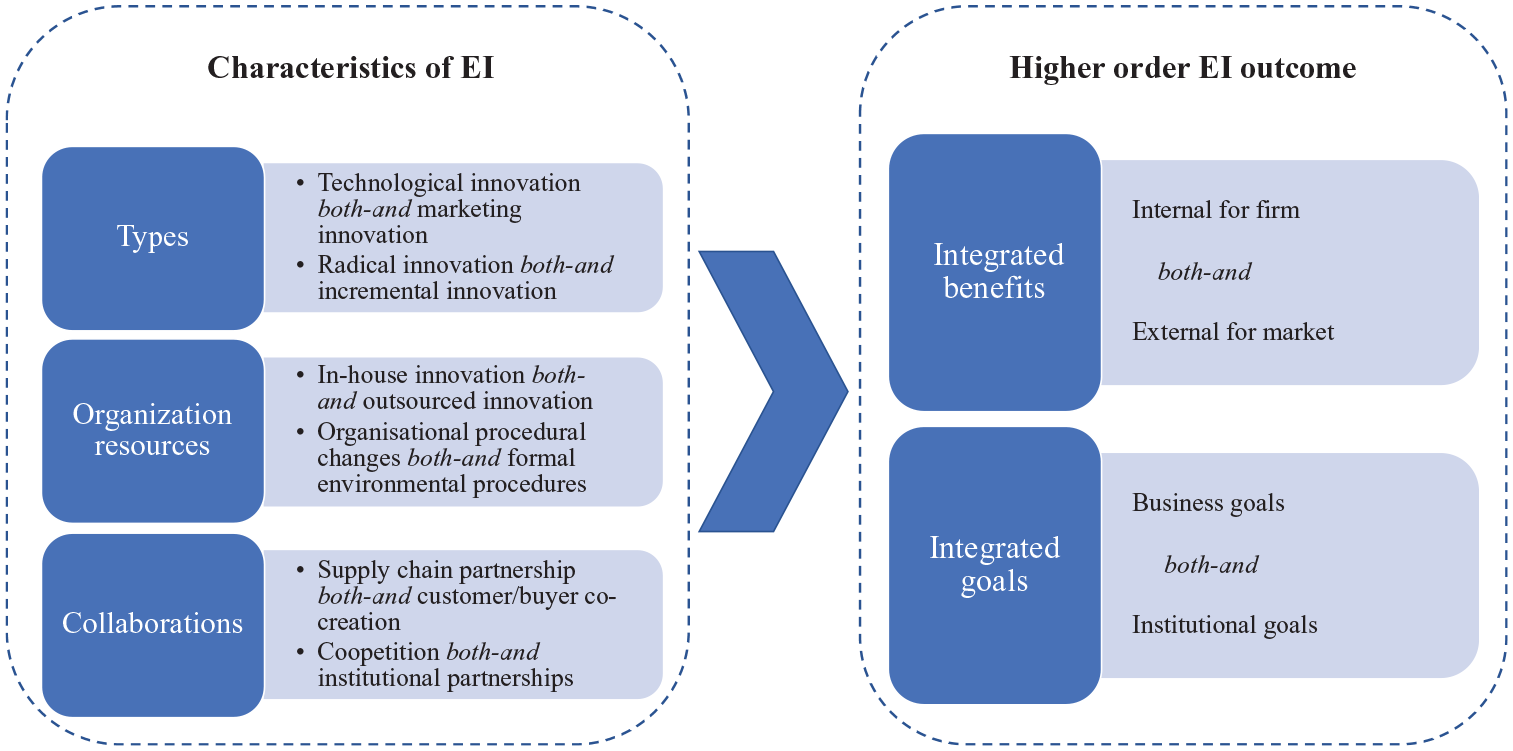
Conceptual framework.
The left side identifies EI characteristics. They include (a) the types of EI, (b) the organization resources, and (c) collaboration dimensions. The right side instead addresses the higher order EI outcome that points to a superior EI strategy and includes two sets of EI goals: (a) both internal and external companies’ EI benefits and (b) both business and institutional goals. Each of these comprises specific dimensions we discuss below.
Our conceptual framework reflects the idea that we put forward in this study: The basic elements of EI (types, collaborations, and resources), when combined to overcome their tensional or binary (either-or) nature, can produce higher order EI outcomes (i.e., an outcome where integrated environmental benefits and strategic goals are achieved simultaneously).
We now elaborate on this framework and note that further review of Tables 2 and 3 will also aid in the comprehension of our argument.
Types of EI
The characteristics of EI types have been widely discussed by scholars (Doran & Ryan, 2016; Kiefer et al., 2017). According to a systemic concept, environmental innovation includes any kind of innovation that helps prevent or reduce environmental harm (del Rio, 2005; Huber, 2008). It also entails the development of entirely new or renewed development processes (Qiu et al., 2020; Tseng et al., 2013).
Within the context of such varieties of forms and modes, the emphasis has been on some aspects rather than others, and few studies have analyzed the possibilities to take all the different EI types together to favor a more sustainable path. In this sense, for instance, scholars greatly emphasize technological innovation and radical development and their impact on companies’ environmental objectives (Kennedy et al., 2017). Other scholars also point to the ambition and pace of EI, which involves not only the tensions among frame-breaking or evolutionary technology but also reflects a more exploitative pursuit of market opportunities often based on redesigning business and market processes (Medrano et al., 2020).
In the following, we present the first two sets of complementary components of our framework, including (a) technological and marketing innovation and (b) radical and incremental innovation.
Technological Innovation Both–And Marketing Innovation
The EI debate strongly elaborates on technological product and process innovation. Consistent with the concept of green innovation (Dangelico & Pujari, 2010), environmental product innovation has been widely considered the logical complement of process innovation for EI (Cleff & Rennings, 1999; Xie et al., 2019). The meeting of demand environmental requirements is conducive to the development of new and improved products and services with effects on internal firm processes, with decreasing costs of production and reducing resource waste (De Medeiros et al., 2014; Hoppmann, 2018).
More recently, in line with the Oslo Manual, some authors have started to place marketing innovation at the same level as technological innovation (Kotler, 2011; Medrano et al., 2020). Defined as the implementation of a new marketing method involving significant changes in design and/or packaging, placement, promotion, or pricing (Medrano et al., 2020), marketing innovation has a role in the achievement of environmental objectives. Environmental marketing innovation can increase the adoption of new products, which may accelerate the elimination of old products, change consumer behavior, and reshape the market with better firm performance (Gonzalez-Padron & Nason, 2009; Leal-Rodríguez et al., 2018). However, it may be risky for the firm if the cost for reorganizing internal processes and the related product innovation exceed the expected market benefits (Kesidou & Demirel, 2012). Technologically driven environmental innovation alone could be insufficient if the market and consumer are not able to take advantage of it and recognize its benefit. On the other hand, market-driven innovation could mask green washing practices with no real benefit for society (Siano et al., 2017). In this sense, the impact of combining technological innovation and marketing innovation on long-term environmental strategies can be further analyzed.
Radical Both–And Incremental Innovation
The radical-incremental dichotomy is often associated with the idea that they are two different forms of innovations with different ambitions, pace, and effects for firms (Li, 2012). In line with mainstream innovation thinking (Hall & Clark, 2003), radical environmental innovation is often seen as a difficult and expensive process but is conducive to the most effective approach to EI innovation (Chen et al., 2012; Kennedy et al., 2017). It can generate new products, knowledge, technology, and designs that reduce the environmental costs of business activities and promote the firm’s sustainable development. Additionally, it requires high resource investment and a complete shift in the knowledge and R&D companies’ resources. Conversely, incremental environmental innovation is traditionally associated with small changes in the current business processes or dimension of service products and offerings to improve resource utilization and improve companies’ short-term sustainability (Cheng & Shiu, 2012). According to other scholars, incremental environmental innovation is also demonstrated to reduce the negative effect of a given product at all stages of its lifecycle by revising product design processes with potentially long-term sustainable effects (Qiu et al., 2020). As incremental innovation is recognized to positively affect internal knowledge creation and absorptive capacity (Zhang et al., 2020), some authors discuss that it can also have an impact on radical innovation performance with long-term effects on sustainable strategic companies’ objectives (Guisado-González et al., 2016). Thus, the combinative effects of radical and incremental innovation to address superior EI strategy efforts can be further explored.
Organization Resources
The EI literature has shown that increasing performance in EI is influenced by the capabilities of firms. In particular, firms that embrace R&D environmental strategies (Costa-Campi et al., 2017) or that invest in the development of organizational capabilities and practices are more likely to pursue an effective EI strategy (Ketata et al., 2015; Zhou et al., 2019).
The literature generally examines those aspects by using a dichotomous approach that reflects the firm’s decision to be eco-innovation friendly or not. We still know very little about the impact of different R&D knowledge strategies and organizational practices on a superior EI strategy. Thus, we introduce the second two sets of complementary characteristics of our framework, including (a) in-house and outsourced innovation and (b) organizational procedural changes and formal environment procedures.
In-House Innovation Both–And Outsourced Innovation
The relationship between R&D knowledge sourcing strategy and environmental innovation is debated because EI must often confront a technological frontier with which many firms are still inexperienced (De Marchi, 2012). Even if internal knowledge offers advantages in terms of R&D investment, an internal focus can also provide the risk of path dependence to narrow the focus on technologies that are similar to those previously developed (Rennings & Rammer, 2009). Conversely, recent studies suggest that a firm’s R&D strategy involving an in-house department and a critical mass of innovation-committed personnel firms develop much more effort towards environmental technologies (Costa-Campi et al., 2017). The nature of EI requires firms to face different technology challenges with heterogeneous sources and knowledge interactions (Belin et al., 2011; Ketata et al., 2015). Studies also claim that interfirm knowledge spillovers and outsourcing knowledge have higher impacts on environmental innovators (Grafström & Lindman, 2017; Hoppmann, 2018). They show that many firms decide to outsource technological R&D to experienced agencies or consultancy firms. However, the complementarity between in-house and outsourced knowledge for EI is increasingly being recognized. In this regard, some researchers also pay attention to the possibility that absorptive capacity can affect economic and environmental outsourcing performance (Ketata et al., 2015). Thus, we investigate whether complementarity or integration between in-house and outsourced innovation is also needed to develop a superior EI strategy.
Organizational Procedural Changes Both–And Formal Environmental Procedures
The renewal of organizational procedures at the management and procedural levels has been recently advanced by scholars as essential assets for developing environmental practices (Babiak & Trendafilova, 2011; Chassagnon & Haned, 2015).
In addition to the well-debated distinctions between reactive and proactive environmental strategies (Sharma & Vredenburg, 1998), many studies demonstrate that the building, integrating, and reconfiguring of organizational capabilities (including operational processes and managerial and human resource organizational systems) fundamentally reinforce the development of environmental innovation strategies (Chassagnon & Haned, 2015; Dangelico et al., 2017). New organizational systems contribute to enhancing firms’ flexibility and responsiveness, favoring the real implementation of environmental innovation practices in firms (Zhou et al., 2019).
However, the EI organizational debate has also grown on the role of the voluntary disclosure process and the formalization of internal environmental practices (Antonioli et al., 2013; Kiron et al., 2012). These are examples of formal environmental procedures within the organization. EI organizational renewal is demonstrated to be very useful in inducing innovation reporting. Firms investing in environmentally responsible processes increase their investment in environmental certification and internal procedural renewal (Chassagnon & Haned, 2015). At the same time, other studies demonstrated that this reporting investment can also hide a company’s opportunistic behavior to generate greenwashing effects with controversial results in terms of EI (Papagiannakis et al., 2019). In this line, it is also demonstrated that firms with poor EI performance and orientation tend to disclose less information on their environmental impacts.
Despite several research studies that analyze the benefits of new organizational procedures and practices on environmental innovation (Antonioli et al., 2013), our understanding of the impact of organizational and procedural changes and environmental disclosure innovation practices on EI remains limited and controversial. Thus, the coexistence of complementarity between them in promoting a superior EI strategy is of interest in this work.
Collaborations
Much recent consideration has risen on how companies develop EI. Collaborations are important, as EI is characterized by high levels of complexity and novelty, requiring several knowledge bases to be integrated. The literature proposes that collaborating with strategic partners will produce benefits in terms of knowledge and technology spillover, while scholars also point out that weak ties within broader networks may generate increasing opportunities for EI (Cainelli et al., 2012; Stadtler & Lin, 2019).
In addition to the potential of weak or strong ties, the focus is still narrowed to the technological aspects of collaborations, and the opportunities for collaboration with partners outside the business network remain less investigated. Based on these shortcomings, we present the last two sets of complementary characteristics of our framework: (a) supply chain partnerships and customer/buyer cocreation and (b) coopetition and institutional partnerships.
Supply Chain Partnership Both–And Customer/Buyer Cocreation
Generally, in EI, cooperation with suppliers is the most debated possibility, often referred to as upstream collaboration (Carrillo-Hermosilla et al., 2010; Z. Lin et al., 2020). Such a form of cooperation is stated to give firms access to resources outside their boundaries and augment the organizational resource base. Suppliers’ relationships driven by a need for innovation are more strongly geared to provide new technology and innovative material (Roscoe et al., 2016). Conversely, collaborating with customers is increasingly seen in open innovation (Ghisetti et al., 2015; Rauter et al., 2017) and cocreation approaches to improve idea generation and solution codesign, resulting in products or services that are more highly valued by customers, thus, bringing economic benefits to both firms and the market (Melander, 2018). With a few exceptions, there is still limited research that conjointly focuses on supplier and customer collaboration. Considering that their different settings can lead to inherently different objectives and logics, the coexistence of this complementarity offers an exemplary context for investigating superior EI strategies.
Coopetition Collaborations Both–And Institutional Partnerships
In addition to new product and process innovation, EI research has widened in scope to incorporate new business models (Bocken et al., 2014). Often, cooperation with competitors or other business partners, the so-called coopetition (Bacon et al., 2020; Bengtsson et al., 2016), is identified as appropriate in a number of specific circumstances, particularly, in developing “clusters” of innovating firms’ contributions to knowledge spillovers and renewal of business models.
Nevertheless, the experiences of cooperation with business partners are also demonstrated to be a cause of possible failure of environmental projects due to the inertia conditions of coopetitive collaboration (del Río et al., 2016). To achieve a break-out of the established trajectories and provide avenues to increase the diffusion of EI, major interorganizational efforts involving expertise and partners sourced through unfamiliar collaborations are needed (De Marchi & Grandinetti, 2013; Kiefer et al., 2017).
This implies the need to consider diverse partners beyond the business networks as educational and research institutes, universities, and other institutional partners. They become crucial in achieving EI and responding to a societal sustainability agenda (De Marchi & Grandinetti, 2013; Hansen & Spitzeck, 2011). In this sense, it is also interesting to investigate whether complementarity or integration between coopetition and institutional partnerships is also beneficial to a superior EI strategy.
Higher Order EI Outcome
As shown in Figure 1, we identify two interrelated overarching outcomes of the superior EI strategy. We defined them as EI-strategic objectives that include both the internal benefits for companies and external benefits for the market and the search for institutional and business goals.
Regarding the first outcome, EI helps companies become more proficient in internal processes (Ambec & Lanoie, 2008; Belin et al., 2011; Horbach et al., 2012) and, at the same time, identifies a new and competitive way to address customers’ environmental needs (Chen et al., 2012; Horbach et al., 2012). The general definition proposed to define EI as innovations contributing to a reduction in environmental burdens or to ecologically specified sustainability targets is neutral concerning the real impact and content of changes. By considering only a firm’s perspective and its internal aims, the positive effects of EI processes can be underestimated on a large scale. The role of integrated EI benefits has been recently debated (Russo Spena & Di Paola, 2020) to address how the environmental outcomes of firms (i.e., reduced material or water use, energy use, pollution, etc.) can be combined with the search for environmental outcomes for the market (reduced customer energy use, pollution or extended product life cycle). The role of customers’ environmental objectives in searching for integrated responsibility while maintaining internal firms’ benefits can be a starting point to analyze the matching of integrated benefits in the search for a superior EI strategy.
Concerning the second outcome, a superior EI strategy can be produced by a proactive strategic approach to address the increasing turbulence of environment-driven competition (Aragón-Correa & Rubio-Lopez, 2007; Chen et al., 2012; Hall et al., 2018). This approach is assumed when companies exhibit a consistent pattern of environmental practices across all ranges of their business and institutional activities, which overcomes the environmental regulations or business practice pressures. Some authors point to the importance of stakeholder engagement and the role of institutional communication (Aguilera-Caracuel & Ortiz-de-Mandojana, 2013; Buysse & Verbeke, 2003). They are not simply a mandatory approach towards legitimization, but a strategic objective required to promote the productive involvement of stakeholders in environmental strategy making and execution (Hyatt & Berente, 2017).
Researchers on strategy also identify EI orientation as a cornerstone of a superior strategic approach (Yang et al., 2018). Environmental objectives provide the framework for innovation and business expansion through new renewal and increasing of the overall capital stock (economic, market and technology and social) that push for innovation and new opportunities leading to business growth. In this sense, the pursuit of business goals can be seen as integral to institutional goals.
In our view, the search for a comprehensive approach to environmental strategic outcomes is not only those considered EI concrete benefits for companies and markets but also those whose outcomes may influence business environmental orientation in the long term and may be affected by the integration of both institutional and business goals (Yang et al., 2018).
This is why it seems appropriate here to investigate whether and in which cases companies are able to achieve both integrated institutional and business objectives and under which conditions they combine with other benefits (internal and market benefits) to lead companies to a superior EI strategy.
Materials and Method
To address our research aim, we employed fsQCA and then performed a post-QCA analysis. fsQCA is a set-theoretic method in which cases are conceptualized as a combination of the characteristics of interest (called conditions) and it adopts Boolean algebra and algorithms to compare them (Fiss, 2011). For each case, the value for a condition indicates its degree of set-membership in that condition (Kan et al., 2016). In set-theoretic terms, that value may indicate that the case is fully in or fully out with respect to the set membership in the condition. The fsQCA allows us to identify the commonalities between the cases by identifying the conditions that verify the phenomenon (called outcome). This “permits causal statements that draw relations between sets” (McKnight & Zietsma, 2018, p. 497). More specifically, the fsQCA allows us to identify both the necessary conditions (without which the outcome does not occur in any case) and the sufficient ones (on which the outcome also occurs). The statements of necessity and sufficiency are conjunctural because they may show that several conditions together lead to the outcome.
fsQCA is increasingly used by management scholars (Kraus et al., 2018) and in the field of innovation in particular (Roig-Tierno et al., 2017). Three particular characteristics are associated with this method (Fiss, 2011; Schneider & Wagemann, 2012): (a) it is sensitive to the combinatorial effects between conditions and therefore identifies the combinations of conditions that can generate the outcome (conjunctural causation); (b) it admits the possibility that the same outcome can be explained in different ways, that is, through different configurations of conditions (equifinality); and (c) it contemplates the possibility that a condition can intervene positively (when it is present) in one configuration and negatively (when it is absent) in another configuration (causal asymmetry).
Three reasons led us to use the fsQCA in this study: (a) fsQCA-related characteristics (linked to equifinality, conjunctural causation, and causal asymmetry) make it suitable for investigating complex phenomena such as EI, which admits multiple causations (Rabadán et al., 2019); (b) it allows us to compare cases and to capture their diversity, and therefore, in this study, it makes possible the comparison between different cases, in terms of superior EI strategy (Bacon et al., 2020; Bitencourt et al., 2020); (c) it allows us to specifically investigate the outliers (Douglas et al., 2020), which may prove to be of particular interest in deepening superior EI strategy, which are still quite rare.
fsQCA is performed for each of the two outcomes included in the conceptual framework. In the second part of the study, we adopt a heuristic approach (Furnari et al., in press; Meuer & Rupietta, 2017) to deepen the fsQCA results and then return to cases to discover qualitative relations among them.
Data Selection and Collection
In this study, we use the firm-level data contained in the Eurostat 2014 CIS Database. For each of the companies included in the database, the available data include the kind of innovation carried out by the firm, including the EI, the benefits obtained, and some general information about the company (employees, turnover, etc.). The CIS Database uses the Statistical Classification of Economic Activities in the European Community (nomenclature statistique des activités économiques dans la Communauté européenne, NACE) Rev. 2, Sections A to N. NACE codes considered in this study are the following: 26 (Manufacture of computer, electronic, and optical products), 27 (Manufacture of electrical equipment), 61 (Telecommunications), 62, and 63 (Information technology).
The choice of the sector was guided by some considerations concerning the implications of its remarkable innovativeness: (a) the sector has some peculiarities and critical aspects from the point of view of the use of natural and energy resources, of the rapid obsolescence of products, and delicacy in the disposal of e-waste (Heeks et al., 2015); (b) investments in innovation are often at the center of criticism from the point of view of the environmental impact. For instance, in the case of 5G, its implementation may be associated with a relevant growth (excessive, according to some) in data production, which requires extensive facilities for storage by the use of natural resources (Lucivero, 2020). These aspects cause a considerable increase in competition between companies in the sector from an environmental point of view.
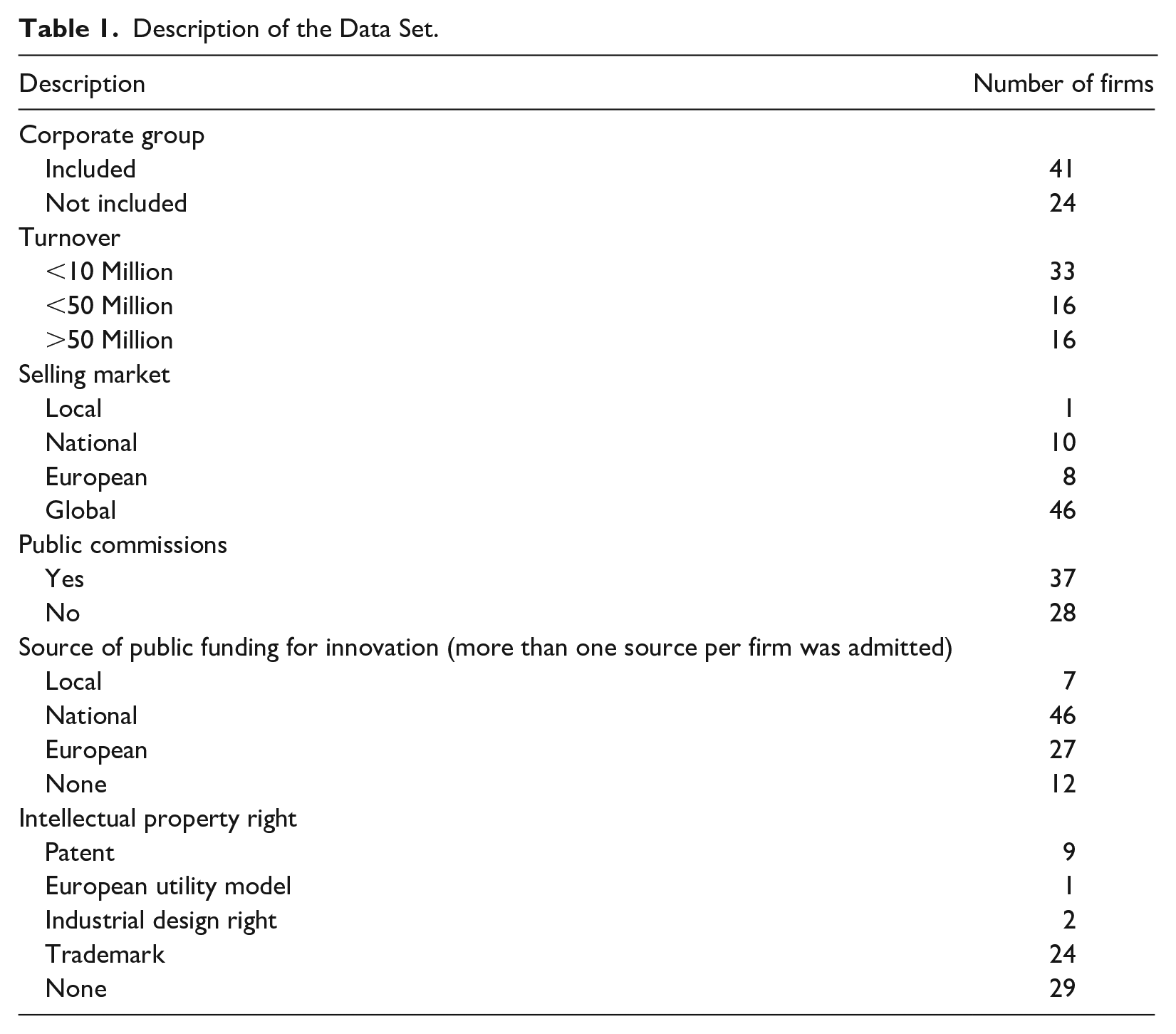
According to the selected NACE codes based on available data, a data set of 465 companies was identified from different EU countries: Bulgaria, Czech Republic, Germany, Estonia, Greece, Spain, Croatia, Cyprus, Latvia, Lithuania, Hungary, Portugal, Romania, Slovakia, and Norway. After a cleaning process, due to the presence of firms with one or more missing data, the final data set consists of 65 firms (see Table 1). More than 60% of the companies included in the data set belong to a corporate group, and approximately 75% of the companies are small and medium sized enterprises (according to the turnover threshold of 50 million established by the OECD). As many as 70% of the companies in the data set sell on a global scale, and 56% also have public subjects among their customers. Public funding for innovation is quite widespread in data set companies, and only 18% say they do not use it. There are numerous companies that use funds from different sources, and yet the most frequently used source is the national one, followed by the European one. The use of intellectual property protection is not widespread among the companies of the data set, which among the types of intellectual property rights seem to prefer trademarks. Based on the information available regarding the excluded firms, it is possible to conclude that the collected evidence would not have changed dramatically by also including those cases (more than 50% belong to a corporate group, approximately 65% are small and medium sized enterprises, and 75% of the companies sell on a global scale).
Description of the Data Set.
Measurements
The conceptual framework was used for the analysis. It identifies six sets of characteristics of EI (around types, organization resources, and collaboration) and two sets of outcomes, all inherently tensional. The six sets represent our conditions in the fsQCA. The idea that we put forward in the design of the conditions is that the choice between their two characteristics may of course be manifestly one, a clear-cut either-or; but it is also equally likely to be a more-nuanced, interconnected, both–and approach. For example, EI may be initiated by both in-house innovation and outsourced innovation (the two characteristics). It is this complementary, rather than oppositional, avenue that our study investigates. In line with fsQCA, each case can be coded as fully in or fully out with regard to the membership score in the condition or the outcome (or it can have a partial membership; Thiem, 2014).
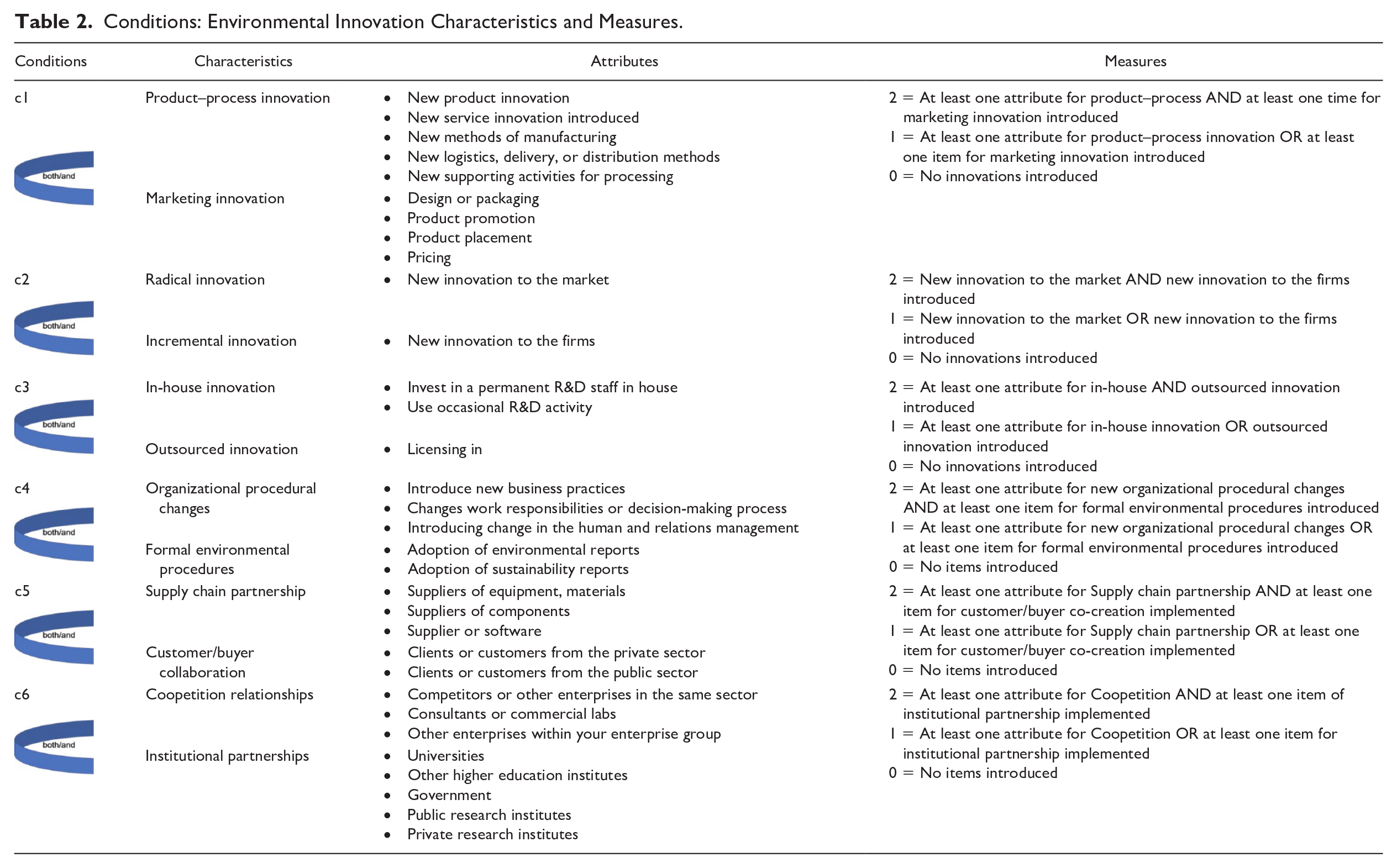
Each characteristic was investigated and measured through the identification of detailed attributes contained within the CIS database for each of the companies in the data set. The characteristics are selected on the basis of their substantive evidence in terms of data input and their measures. The characteristics included one or more attributes. Several eco-innovation studies have also used these characteristics (see for more details, Chen et al., 2012; Tseng et al., 2013, for types of innovation; Cheng & Shiu, 2012; K. Lewis & Cassels, 2010, for the organization resources). Both of the authors independently created a map of the characteristics and jointly discussed their different attributes for what should be considered fully in and fully out of set membership (Schneider & Wagemann, 2012). The presence of each characteristic derives from the presence of at least one of its attributes. A single measurement for each case in the condition is obtained on a scale from 0 to 2; the measure equals 2 when the two characteristics are present and 0 when neither characteristic is present. The characteristics and the detailed process of measurement for each condition are presented in Table 2.
Conditions: Environmental Innovation Characteristics and Measures.
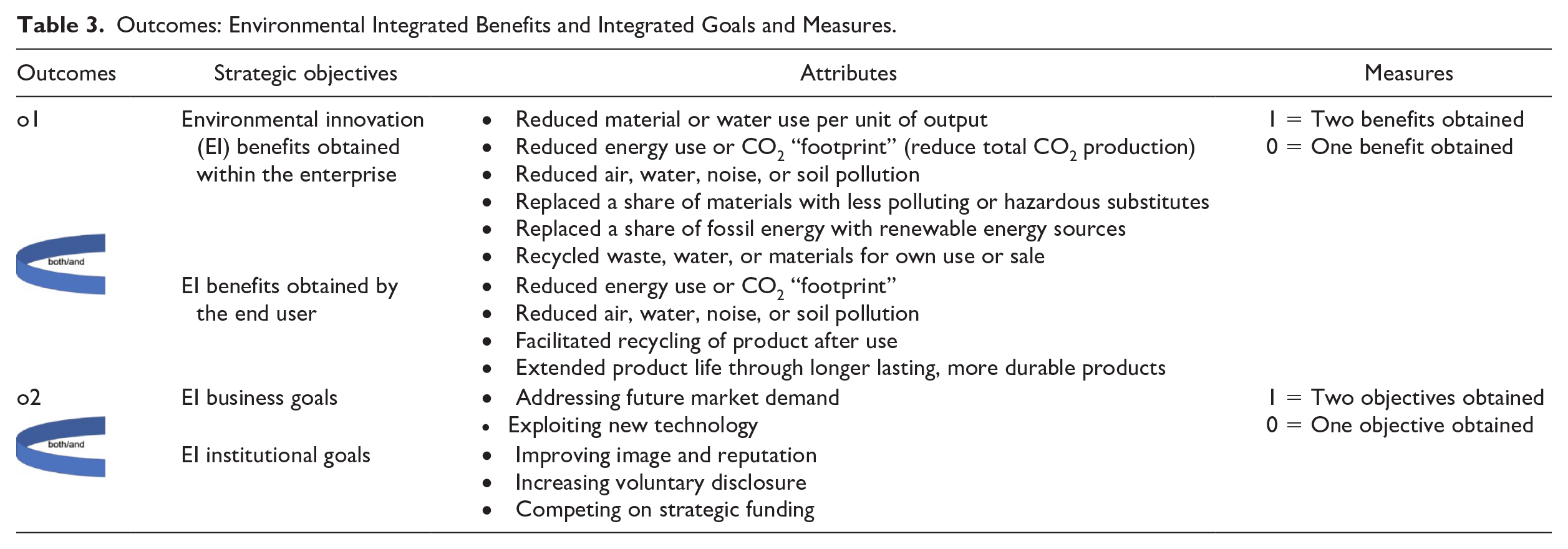
Similarly, according to our conceptual framework and based on the CIS database, we detected outcomes and their measures, specifically integrated EI benefits and integrated EI goals. The first is related to the specific internal and market benefits the companies pursued in their EI processes; the second is the long-term goals involving companies’ strategies at business and institutional levels. Table 3 contains the details on the attributes considered for each of the outcomes and on the ways in which a single measure was built for each of them.
Outcomes: Environmental Integrated Benefits and Integrated Goals and Measures.
Analytical Approach
The transformation of the original values into calibrated values occurred by identifying, for each condition and for the outcome, the calibration thresholds, corresponding to full membership (1), full nonmembership (0), and crossover point, that is, the point of maximum ambiguity (0.5), respectively (Schneider & Wagemann, 2012). Consistent with the literature on the topic, we identified qualitative anchors by analyzing the internal distribution of the cases and searching for discontinuities (Table 4).
Calibration Parameters.
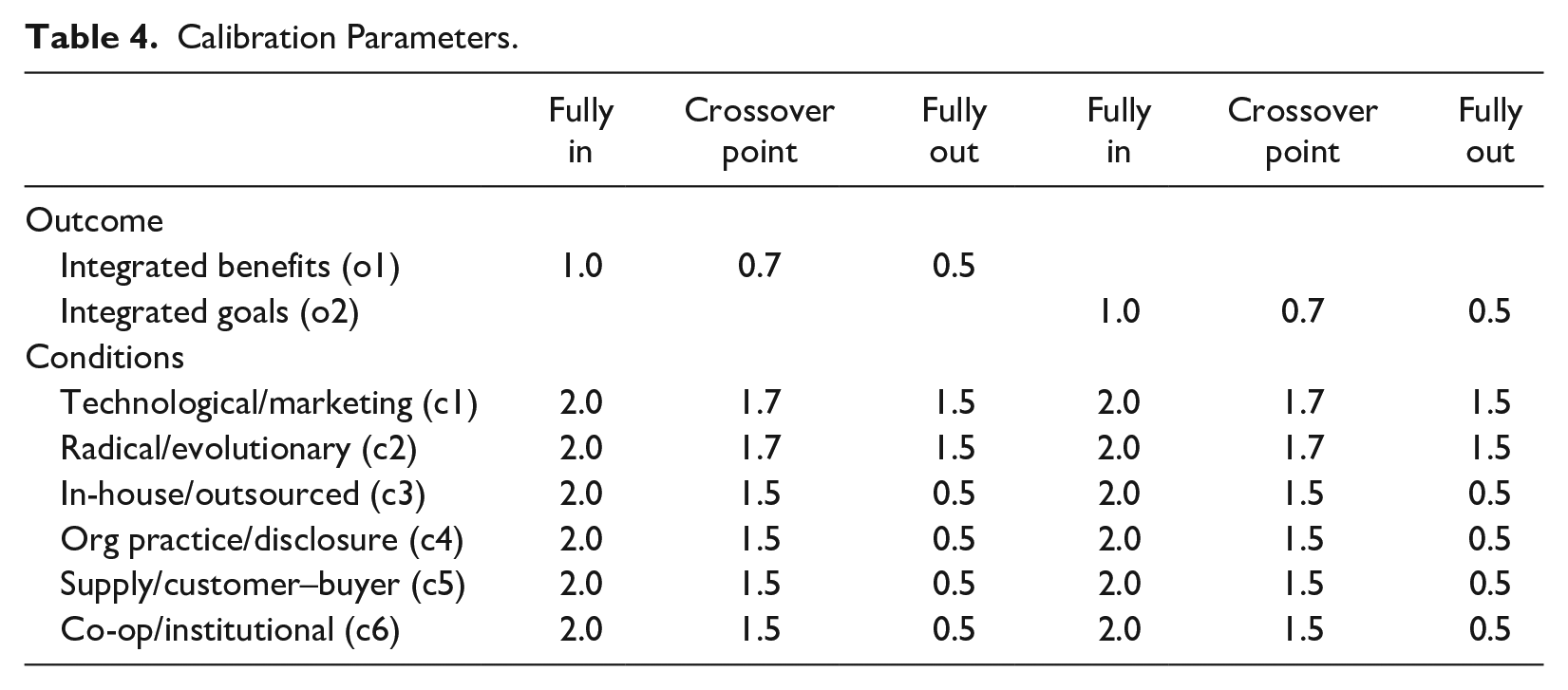
The calibration parameters for the two outcomes and the conditions are presented in Table 4. In Table 4, for instance, the anchor for the full membership of each case in the technological/marketing condition is equal to 2.0, the anchor for the full nonmembership is equal to 1.5, and 1.7 is the crossover point. In the same way, the other data contained in Table 4 can be read. Then, for each analysis, a truth table is compiled and simplified, that is, the combinations of conditions present within the data set are identified, checking whether they verify the outcome.
The algorithm used in this study is that of Quine-McCluskey (Dusa, 2019) and the frequency (i.e., the minimum number of cases in which the configuration is observed) and consistency (i.e., “how closely a perfect subset relation is approximate”; Ragin, 2008, p. 44) thresholds set to proceed are 1 and 0.90 for the necessity test and 1 and 0.80 for the sufficiency test, in line with what is suggested in the literature (Legewie, 2013). Sufficiency and necessity tests are carried out by using the QCA Version 3.7 package of the statistical software R (Dusa, 2019) and the fsQCA Version 3.0 software (Ragin & Davey, 2016), considering the parsimonious solution (Ragin, 2008).
Finally, a post-QCA analysis was carried out to return to the cases and search for the paths leading to higher order EI outcomes. More specifically, we adopt a heuristic approach (Furnari et al., in press; Meuer & Rupietta, 2017) to interpret the fsQCA results and discover qualitative relations among the relevant cases. In this regard, we analyze the patterns highlighted by the solutions associated with the outcomes of fsQCA and proceed to highlight commonalities and discrepancies among cases to unveil the paths leading firms to a superior EI strategy.
Findings
Following the analytical approach of the fsQCA for each of the two outcomes, namely, integrated benefits and integrated goals, necessity and sufficiency tests were conducted. The aim was to verify which conditions or combinations of conditions are sufficient and necessary for each of them to occur. The analysis was tested to verify the robustness of the results by modifying the consistency thresholds for sufficiency and the calibration thresholds (Skaaning, 2011).
Complexively, five “solution” paths emerge for integrated benefits and seven solution paths for integrated goals. For both the first and second outcomes, no necessary conditions occurred. The absence of necessary conditions (both for the first and for the second outcome) suggests that companies are not bound to necessarily follow one of the aspects connected to types, organization resources, and collaboration. In contrast, they are free to combine some of these aspects in different ways—as emerging from the sufficiency tests—so that the higher order outcome (in terms of benefits and goals) can materialize.
In line with the aim of this work, we further discuss the characteristics of firms engaging in a superior EI strategy, that is, those who pursue both EI-integrated benefits and EI-integrated goals. The first two paragraphs in the following present the results of the sufficiency tests related to each outcome; in the third paragraph, the solutions are then interpreted in an integrated fashion by going back to cases.
Configurations for Integrated EI Benefits
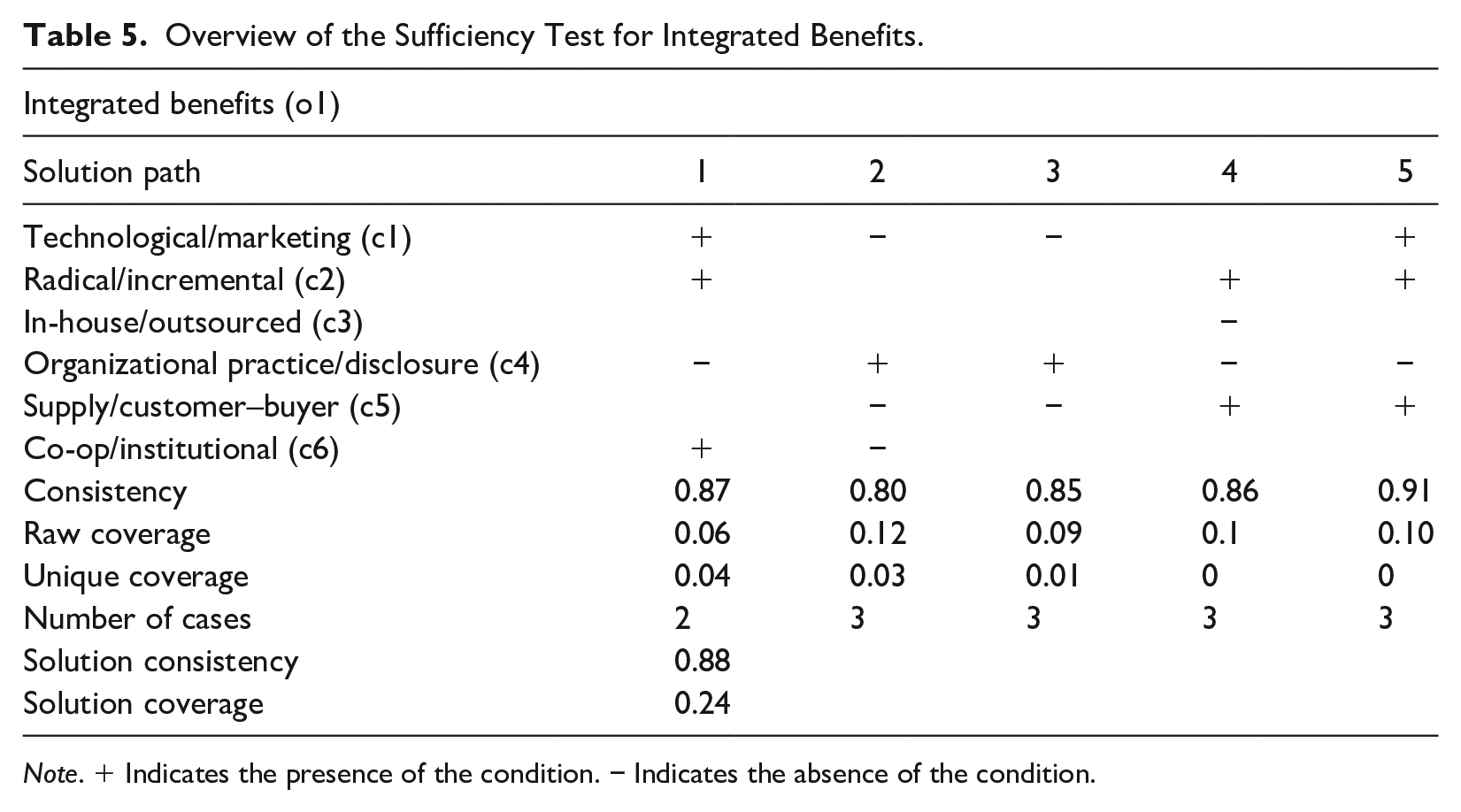
In the case of our first outcome, integrated benefits, the results of the sufficiency test are reported in Table 5.
Overview of the Sufficiency Test for Integrated Benefits.
Note. + Indicates the presence of the condition. − Indicates the absence of the condition.
The sufficiency test shows that integrated benefits are generated from five different combinations of conditions that satisfy the consistency threshold for sufficiency (Ragin, 2008).
More specifically, Solution Path 1 includes companies that obtain EI benefits through technological and marketing innovation; similarly, companies included in Solution Paths 4 and 5 develop both radical and incremental innovations. None of the companies included in the three solutions develop organizational innovation (in terms of practices or procedures). In addition, companies in Solutions 4 and 5 rely on intense relationships with the actors of their supply chain (both suppliers and customers). Conversely, companies in Solution 1 collaborate with competitors and institutions (e.g., research companies, both public and private). In contrast, Solution Paths 2 and 3 include companies that focus specifically on the innovation of organizational practices and procedures without concentrating on technological innovation. For companies of both solution paths, collaboration does not reveal any effect if the actors rely on their supply chain and in their wider strategic network.
The solution obtained was subjected to a robustness check (Skaaning, 2011). More specifically, an initial check provided for the modification of the consistency thresholds for sufficiency, set at 0.79 and 0.81; a second check provided for the modification of the calibration thresholds, of +0.05 and −0.05. All checks were successful, that is, the results of the original analysis were confirmed.
Configurations for Integrated EI Goals
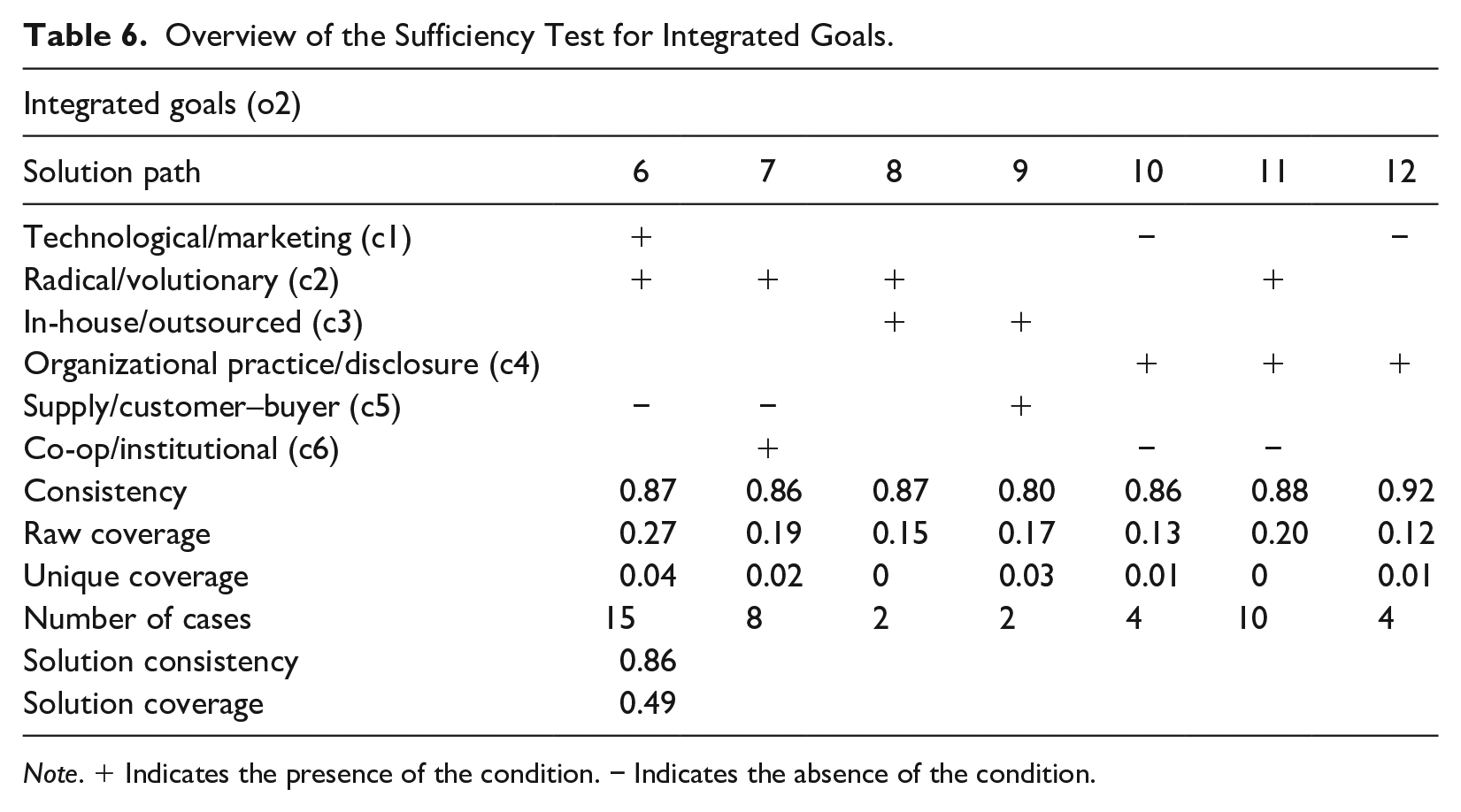
Regarding the integrated goals, our second outcome, the sufficiency test, highlights the results reported in Table 6.
Overview of the Sufficiency Test for Integrated Goals.
Note. + Indicates the presence of the condition. − Indicates the absence of the condition.
The results show that the integrated goals are generated from seven different combinations of conditions. More specifically, the integrated goals are achieved by those companies (Solution Paths 6 and 7) that develop technological and marketing innovation, both incremental and radical, which actively collaborate with their competitors and institutions to develop it but not with their customers and suppliers. Similarly, companies that develop organizational innovation (relating to procedures and practices) but do not do so through collaboration with competitors or institutional partners manage to obtain EI-strategic objectives (Solution Paths 10-12). Finally, regardless of the type of innovation developed, companies that focus on the integration between in-house and outsourced innovation (Solution Path 8) and that collaborate with suppliers and customers (Solution Path 9) manage to integrate EI-strategic objectives.
Again, the results were subjected to robustness checks (Skaaning, 2011) with the same changes as the consistency thresholds for sufficiency and calibration thresholds made in the case of the integrated benefits test. The robustness checks were successful, as they generated results equal to those of the original analysis.
It is interesting to note that the coverage of the solution for the integrated goals outcome is higher than that associated with the other outcome (integrated benefits). For both the first and second outcomes, the solutions are consistent. However, those solutions explain the two outcomes to a different extent, and, in particular, it seems there are fewer alternative ways for generating the integrated goals (Ragin, 2006). This is perhaps because the general statements of the integrated goals are easier to espouse than that of the integrated benefit involving greater improvement at the organizational and operative levels, which is perhaps more difficult to capture.
Configurations for Superior EI Strategy
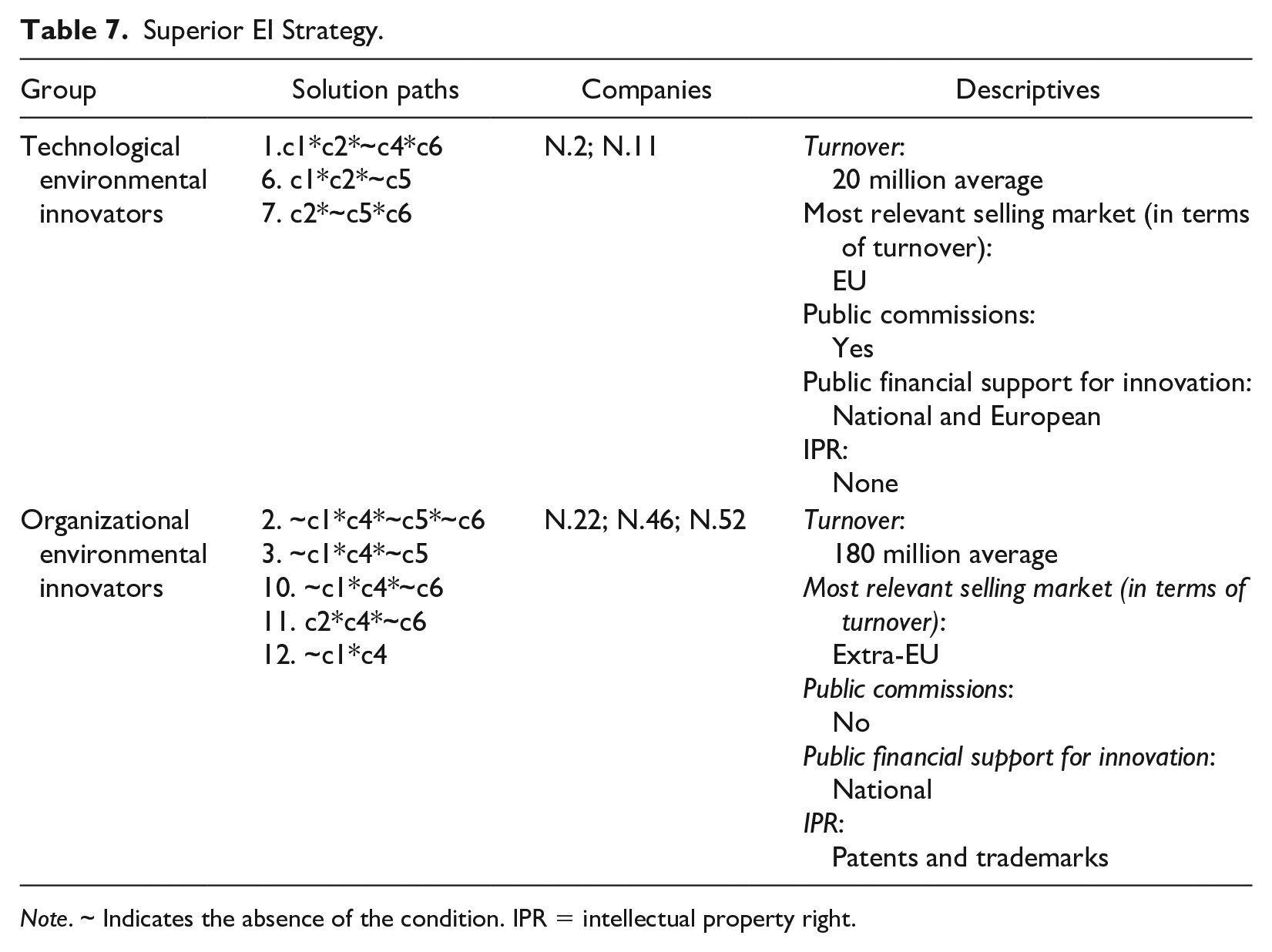
To explore the conditions for the superior EI strategy, we combined the solutions associated with integrated benefits and integrated goals and then analyzed their common characteristics. We adopted a heuristic approach (Furnari et al., in press; Meuer & Rupietta, 2017) to discover qualitative relations among results and identify patterns among them. Based on this post-QCA analysis, the solution paths indicating successful outcomes for both EI-integrated benefits and integrated goals were grouped into two main configurations, and the analysis of EI company strategies was further explored. Table 7 illustrates these results.
Superior EI Strategy.
Note. ~ Indicates the absence of the condition. IPR = intellectual property right.
Technological Environmental Innovators
The first configuration groups companies included in Solutions Paths 1, 6, and 7. Companies belonging to this configuration, which we call Group 1, are characterized by a significant projection towards innovation that is substantiated both on the technological (product and process) and on the marketing sides and privileges the pursuit of both incremental and radical innovations. In other words, our results show that companies that decide to balance their resources among those different types of EI, by adopting a both–and approach, are able to obtain higher order outcomes. Favoring this option over that of concentrating resources on a single type of EI is not a trivial choice, as firms could be induced to concentrate on one type in consideration of the relevant costs associated with the EI. Another peculiarity of companies belonging to this group is that they do not tend to adopt collaborative mechanisms within the supply chain, concerning neither suppliers nor the cocreation processes that involve buyers/customers. In contrast, some rely on partnerships with competitors and other external institutional partners, such as research institutes. These firms, in fact, decide to focus on wide-ranging innovation programs (we showed that they embrace both process/product and marketing innovations), and therefore, need to complement their internal resources with those of institutions and competitors.
A fine-grained look at the most frequent attributes in the data set for companies belonging to Group 1 allows us to better understand some particular features. Their product innovation focuses mainly on new products in a strict sense and only on a residual basis on new services. Process innovation mainly concerns production and logistics processes, while marketing innovation does not focus primarily on pricing attributes while favoring other dimensions (design, packaging, promotion, and distribution). The collaborations activated by Group 1 companies are mainly connected to interactions with public and private research centers and with universities. Group 1 includes medium-sized companies, which sell on the European market, as well as to public entities. These companies benefit from national and European innovation funds and do not highlight the use of any form of intellectual property rights protection.
For example, an Internet provider has launched its ultrafast connection service associated with the widespread supply of ecological modems. These modems enable reduced energy consumption and were made largely with recycled material; even their packaging is entirely recyclable. The provider was committed to promoting this environmental innovation through a massive advertising campaign and to guaranteeing the fast and widespread distribution of the product and reverse logistics throughout the national territory, putting in place the appropriate logistics activities. The creation of the high-performance modem was made possible through collaboration with a well-known research center.
An additional example involves a telephone producer who distributes its products by using truck-sharing services, which reduces the environmental impact. The company established a collaboration with the logistics provider and recently launched a joint advertising campaign to enhance the low environmental impact of its logistics.
Organizational Environmental Innovators
This configuration groups the companies included in Paths 2, 3, 10, 11, and 12. The companies of Group 2 focus on organizational aspects to compete (both with regard to “organizational procedural changes” (internal focus) and “formal environment disclosure” (external focus). These companies often manage to carry out innovative interventions, both incremental and radical, and do not tend to focus on external partnerships (neither with institutional subjects nor with competitors). The most frequent attributes among Group 2 companies reveal some of their features. These companies are focused on organizational innovation and, in particular, on new business practices and changes in human and external relations. These aspects relating to organizational practices are always paired with disclosure practices, such as environmental reports. This group includes companies of considerable size that market their products on a global scale and do not receive public contracts. The innovations of these companies often take the form of patents and trademarks and to innovate, these companies often benefit from national public funds. For example, an international leader in the provision of landline and mobile network services has committed itself to promoting internal practices that could reduce the environmental impact of its activities, such as teleworking and virtual conferences. These practices were included in a broader sustainability agreement that the company has signed with the public authority. The environmental benefits coming from sustainable practices were regularly quantified and valued in sustainability reports.
A similar situation occurs in a company that is a leader in providing services for cyber security and, in particular, in developing protocols for protecting data exchanged by the Internet. Additionally, in this case, the company is very much focused on internal practices for reducing the environmental impact, which in this case also includes procedures for rationalizing the computing power of its hardware equipment.
In summary, our results show that both technological- and organizational-oriented innovators facilitate the development of a superior EI strategy. Both of the configuration groups are contextualized with exemplar companies by demonstrating that some characteristics can be differently combined with other related characteristics. However, our results recognize that tensional, interconnection and complementarity aspects can coexist, and the seemingly tensional driving characteristic yields various paths to a superior EI strategy.
Discussion
This study uses a fuzzy-set qualitative analysis (fsQCA) and a post-QCA analysis to identify relevant configurations for firms engaging in superior EI strategy, that is, a strategy to achieve integrated EI benefits and goals. EI brought with it unprecedented complexity, diversity, and pace to innovation practices; the increasing pressures require a new configuration path to innovation that overcomes tensions. Building on the existing literature on multisided aspects of EI, we addressed the possible tensions between competing elements that are involved in EI processes (types, resources, collaborations). Thus, we propose our both–and approach to show, through our findings, how such competing elements can be combined (they appear simultaneously) to lead to integrated EI outcomes. Especially by contending that a significant amount of decision making in EI involves complex, multifaceted, and interrelated issues, our contribution to the literature in this article is threefold:
First, we consolidate existing research on EI through an interpretative framework of its critical characteristics, all inherently tensional. Current scholarly investigations into EI provide partial rather than a more complete systemic explanation of EI dimensions and outcomes. In line with recent studies, we advance the interconnection between the characteristics of EI (Geradts & Bocken, 2019; Kiefer et al., 2019) and the resultant multiple objectives of EI (Xie et al., 2019; Russo Spena & Di Paola, 2020; Yang et al., 2018). Thus, we propose that worthwhile integrated benefits and goals should not be viewed in an overly dichotomous manner or with exclusionary tensional resolution. In the necessarily complex EI journey, the connections and interrelationships between the characteristics and objectives of EI, rather than being oppositional, result in their complementarity. Even if we accept that such tension may sometimes appear limited and fragile, rather than self-evidently strong and robust, we claim that the decision making here still acknowledges an oppositional direction for each driving characteristic, beyond a general tension of limited overall resources.
Second, on the basis of this reasoning, we map the configurational paths leading to the superior EI strategy developed in this new logic of a combinative both–and approach. For sufficiency, 12 “solution” paths emerge from the data, indicating successful outcomes for EI-integrated benefits and EI-integrated goals. These paths reveal different, yet rich and complex, combinations, and interconnections between characteristics and EI. In doing so, our findings support other scholars interested in navigating the management quandary and complexity of the EI-strategic approach by configuring how these complexities take a form in practice (Bacon et al., 2020). As other research contends (Dangelico et al., 2017), specific complementarities among characteristics are needed for firms when they want to engage in a superior EI strategy. Our results show that two different main configurations support this strategy, namely, technological-oriented and organizational-oriented innovations. With regard to the first kind of configuration, previous studies discuss the complementarity between technology and marketing innovation and their positive effects on multiple benefits for companies and other actors (Moreno-Mondéjar et al., 2020). Our study addresses these combinations as useful to superior EI strategies, but it reveals a peculiar path in connections to collaborative decision processes (Z. Lin et al., 2020). Other studies emphasized that collaboration with external actors has positive effects on some categories of innovation and not others, as in the case of radical ones (Kennedy et al., 2017). Our results put forward the idea that these collaborations involve specific kinds of actors and more committed allies included in the wider companies’ networks. Collaboration with peers and other institutional partners, such as research centers and the government, is crucial when companies search for superior EI objectives.
Our results also offer contributions to the role of organizational innovation in the EI debate by providing a departure point for further research into the relationship between formal and organizational innovation. Building on evidence that new practices are contingent on not only the mandatory but also the strategic managerial approach (Chassagnon & Haned, 2015; Dangelico et al., 2017), we suggest that organizational innovation impacts the effectiveness of superior EI strategies rather than only the other way around, as is usually assumed. Improving environmental and organizational practices and routines across organizations, reflecting on what works concerning EI innovation and sharing and embedding that across organizations (De Medeiros et al., 2014), increase the opportunity for learning the long-lasting development of EI strategies. The emphasis is on the wider organizational culture of the EI, one that calls not only on the ambition and pace of innovation but also considers how much EI is organic with internal resources and organizational structures, for allowing both–and thinking in order to accommodate tensions.
Finally, we contend that a both–and approach has a helpful, guiding role in the domain of EI management. While the interdependencies of multiple opposing elements have been recognized in the EI literature, much of the nuance and complexity that characterize these interdependencies remains undertheorized and not empirically examined. By conceptualizing and empirically measuring these elements, we find unexpected connections between apparently contradictory elements to be revealed and for important parallels in the types, resources and collaborations of underlying different EI configurations to emerge. Such a variety offers great promise for advancing our understanding of tensions and dualities in EI in line with the recent call for paradoxes in the sustainability literature (Hahn et al., 2017; M. W. Lewis & Smith, 2014). Specifically, in line with Smith and Besharov’s (2019) suggestion to adopt an emic approach to the paradox, our findings address how companies themselves experience and interpret the multiplicity of core EI processes and the implications of different configurations for action as well as the conditions under which these paths provide higher benefits for organizations and society. A specific configuration may be the momentary instantiation of specific combinations, that is, assuming that EI is inherently tensional and acknowledging that an EI worthwhile outcome, in the face of apparent tension elements, follows a both–and approach.
Implications for Practitioners
Our results should be of interest to practitioners seeking to bridge the gap between theory and practice and to comprehend and manage dilemmic quandary and decision making.
In the first instance, managers must take into account a strong innovation orientation to achieve higher order EI outcomes. Managers need to devote particular attention to the type of innovation they implement and must keep a strong focus on the market when leading the innovative process, not only on product and process aspects. Managers who aim to achieve higher EI outcomes have to combine these aspects with marketing ones and therefore pay attention to the new product intrinsic features to launch, to the new process to implement for doing it, and on attributes such as new product design and packaging. In this case, the spillover of technology has positive effects only in some cases, thus, suggesting to managers a selective approach concerning the hypothesis of developing EI by resorting to partnerships mainly in their more extensive network, including the development of both competitor and institutional collaborations.
In addition, our results underline the complementarity between the innovative organizational aspects connected to formal procedures and those related to practices in the possibility of achieving superior EI objectives. Therefore, it is important that managers pay attention to reconfiguring their organizational resources to make them more suitable for understanding and generating environmental benefits. However, this must be associated with a disclosure effort, which allows formalizing internal environmental practices and obtaining environmental certifications.
Another consideration for managers is that pursuing an EI journey will take time. It is invariably a long-term undertaking. A temptation to go for short-term wins will often be counterproductive and unsustainable, sometimes occurring with accusations of greenwashing. Achieving optimal outcomes for both integrated benefits and goals, involving broader resources, networks, stakeholders, and institutions is, on a prima facie basis, a more long-term, difficult-to-capture achievement. However, the primacy to consider, and engage with, the long-term benefits remains.
On a more general level, we reflect that the process of managing and decision making is a complex and nuanced undertaking. It is a messy and “gray” progression. While one binary-type, either-or solution sometimes presents itself as the best way forward, this is rarely the case. More often than not, managers are faced with a both–and, inclusive, and likely combinative path forward. Furthermore, organizations themselves are often complex with fraught communication dynamics and dialectic tension. Scholars (e.g., Putnam et al., 2016) make the case for a constitutive approach to the study of organizational contradictions, dialectics, paradoxes, and tensions. Organizational development, an innovation culture, and strategic decision-making must acknowledge this phenomenon in identifying pathways that enable organizations, and hence environmental innovation, to develop and grow.
A superior EI strategy also has implications for policy makers. In fact, it appears to depend on a series of elements that go beyond the regulatory instruments that governments implement on the subject. Among other things, these instruments are a cost to the policy maker, who incurs administrative expenses to implement them and control compliance (Liao, 2018). Our study shows that strategic innovation and organizational orientation are critical in achieving higher order EI outcomes. Therefore, governments can effectively calibrate their EI promotion tools by establishing the right mix between the “command-and-control” and the supportive program to develop an EI culture (Zhang et al., 2020) and taking into account what emerged here concerning policies supporting collaboration among firms. These implications are particularly relevant in Europe (Orsini & Kavvatha, 2020), even in light of the new orientation towards the urgency of the realization of a new green deal.
Limitations and Further Research
This study sheds new light on the paths that companies can take towards superior EI strategy. Further research is needed in this field to delve into some of the results that emerged here and respond to the limitations of this study.
First, this study examines a specific sector, ICT and telecommunications, in coherence with other recent studies on the topic (Kiefer et al., 2019). It could be interesting to extend the testing of our conceptual framework to other sectors, both high-tech and more traditional sectors, to verify whether there are different paths towards a superior EI strategy.
Second, the characteristics of EI we assumed in our framework focus on some aspects of EI processes and their enablers. At the same time, it does not account for other aspects, such as the context, or some structural companies’ features, that is, size and belonging to the corporate network. As suggested by the coverage values associated with our results, other aspects including these can have some role as antecedents of EI characteristics (i.e., enhancing collaboration with other partners or in the availability of R&D resources) that could be of interest for further research.
Third, the results obtained in this study are strictly related to the cases and the measures used. In particular, the literature on EI still appears relatively young and lacks standardized measures on the salient aspects of the phenomenon. The gradual convergence towards shared measures could help make studies more comparable. Moreover, the inclusion of other cases into the data set could make the results more generalizable. In this sense, data coming from companies in other EU countries and an analysis taking into account the role of different legal or institutional frameworks could further support the understanding of EI.
Finally, research on EI topics in general uses a variety of methods, and therefore, the present study is complementary from this point of view (Bitencourt et al., 2020). However, fsQCA is characterized by a strong connection between the results obtained and the researcher’s choices in terms of the conditions considered and the data set used. Therefore, it produces results that are related to the research design. The use of alternative methodologies, including more quantitative methodologies and an expansion of the data set, could represent a way to validate the proposed conceptual model further.
Footnotes
Declaration of Conflicting Interests
The author(s) declared no potential conflicts of interest with respect to the research, authorship, and/or publication of this article.
Funding
The author(s) received no financial support for the research, authorship, and/or publication of this article.
