




Abstract
To understand the conditions that support employee green behavior across cultures, we develop and test a conceptual model that describes how normative cues from work team leaders and peers in combination with country cultural norms shape discretionary green workplace behavior. Data from 1,605 employees in five countries indicate that power distance moderates the positive relationships observed between the discretionary green workplace behavior of leaders and their subordinates. In addition, an observed positive relationship between team green advocacy and individual discretionary green workplace behavior held across both collectivistic and individualistic cultures, contrary to our predictions. By taking macro-level cultural context into account and examining its interplay with lower-level work team norms, the study makes a significant contribution to understanding and intervening employees’ discretionary green behavior at work.
Keywords
Scientists worldwide are voicing their alarm over the rapid changes in global environmental conditions (IPCC, 2018), and most of the world’s national leaders agree that large-scale change is needed to address the environmental challenges we face, as indicated by their signing of the 2015 Paris Climate Agreement. Citizens worldwide consider global warming to be a serious issue, with levels of concern nearly equal in countries categorized as developed (62% concerned), transitioning (60% concerned), and developing (61% concerned; Running, 2012). Yet businesses are responding at a dangerously slow pace (Slawinski et al., 2017). According to a 2017 worldwide survey of 2,422 businesses, environmental sustainability ranked among the most important concerns in fewer than half of the companies. Indeed, only 16% of companies indicated that a board-level committee was dedicated to dealing with any sustainability issue (McKinsey & Company, 2017). To date, few companies have promulgated strict rules and regulations to control employee green behavior (Lacy, 2019). Even companies with formal environmental policies rely heavily on employees’ suggestions and voluntary efforts as means for improving their environmental performance (Boiral et al., 2019). Therefore, it is paramount to count on employees’ voluntary, nonobligatory behavior to “green” the workplace if companies are to achieve environmental sustainability goals (Andersson et al., 2013; Ones & Dilchert, 2012).
This study examines organizational and societal conditions that elicit and support voluntary pro-environment behavior at work, which we refer to as discretionary green workplace behavior. In their review of the literature, Norton et al. (2015) categorized antecedents of employee green behavior into different levels, with institutional, organizational, leader, and team factors representing contextual conditions ranging from distal to proximal. Whereas most studies have examined antecedents at the employee level, less attention has been directed toward understanding higher-level contextual conditions associated with employee green behavior. Among those contextual conditions, perhaps the most influential one is an employee’s immediate work environment, that is, work team peers and the team’s direct supervisor. Permeating employees’ organizational life, work teams supply them salient cues and important information regarding organization issues. To date, research on work teams has accumulated a myriad of evidence as to the antecedents, processes, and outcomes of team effectiveness such as performance and turnover (Mathieu et al., 2008, 2019). In a similar vein, studies of employee voluntary green behavior also highlight the importance of team-level factors such as collective efficacy (Carrico & Riemer, 2011), green work climate (Norton et al., 2014), and green advocacy (Kim et al., 2017) as predictors of the behavior (also see Norton et al., 2015). In addition, supervisors are assumed to play an important role in eliciting employees’ green behaviors. Leaders’ own green behavior (Kim et al., 2017; Robertson & Barling, 2013) or their leadership styles such as transformational leadership (Peng et al., 2021; Robertson & Barling, 2013; Robertson & Carleton, 2018) and empowering leadership (Jiang et al., 2019) have been found to positively influence subordinates’ green behavior (also see Norton et al., 2015). Yet the combined influences of team and leader have seldom been examined (cf., Kim et al., 2017 for an exception), due perhaps to the different theoretical perspectives that dominate these two streams of research.
In contrast, much less is known about the effects of macro (institutional) level factors (e.g., regulations and societal culture) on employee green behavior. Norton and colleagues (2015), while attributing scant research attention at this level to the conceptual distance between it and employee behavior, contended that it is crucial to understand the trickle-down effects of higher-level institutional influences because such macro-level conditions can drive decisions and activities of senior executives in organizations, which ultimately translate to employee behavior. Based on their review, Norton and colleagues advocated for more research adopting a multilevel perspective to investigate cross-level means through which higher-level conditions influence employee-level green behavior. We respond to the call for research that fills this void by examining the cross-level effects. More specifically, extending previous focus on societal culture’s main effects on corporate sustainability and related concepts (see Miska et al., 2018 for a review), we explore the interplay between societal culture and lower-level work team dynamics in shaping employee discretionary green behavior.
A primary theoretical lens for understanding green behavior is the normative perspective. As discretionary green behavior is beyond employees’ required job scopes and responsibilities, it is to a large extent guided by social norms, that is, social pressures and (dis)approvals from the environment (Cialdini et al., 1990; Elster, 1989). Synthesizing findings from both psychology and economics on the impact of social norm interventions on personal (non-work) pro-environmental behavior, a recent review reported strong evidence of the importance of social norms as determinants of intentions and behavior (Farrow et al., 2017). However, the authors pointed to a lack of research (and thus a promising avenue for future research) concerning how different norms work together to shape behavior. Responding to calls by Farrow et al. and Norton et al. (2015), among others, we address the research question of whether and how different types of norms at different levels work together, jointly or interactively, in shaping employees’ discretionary green behavior. To do so we developed and tested a multilevel model of normative influences emanating from leaders, peers, and the country culture. Our focus on norms is also in line with Morris et al.’s (2015) perspective that norms offer great explanatory power for behaviors hinging on social perceptions of other people, of which discretionary green behavior is one kind. To test our conceptual model, we analyzed multilevel, multi-country survey data from 1,605 employees working in 299 teams in 19 firms in five countries (Austria, Brazil, China, Germany, and India).
Our study extends prior scholarship by contributing new theoretical insights and empirical evidence with practical implications for organizations. First and foremost, we theorize societal culture as context that interplays with lower-level work team factors in shaping employees’ discretionary green behavior at work. We answer an interesting question as to whether the influences of team leaders and peers vary across national culture. This multi-nation investigation contributes to the small body of research that examines cultural differences in team behavior generally (Maloney et al., 2016) as well as the emerging body of discretionary green workplace behavior specifically (e.g., see Paillé, 2020). The countries in our sample are underrepresented and thus complement the extant literature dominated by studies using data from the United States, Canada, and/or the United Kingdom (Yuriev et al., 2018). Furthermore, the normative perspective we adopt provides a parsimonious theoretical lens for understanding situational influences from social actors at multiple levels of analysis (work team peers, team leaders, and the broader society). A simultaneous examination of multiple normative cues offers a comprehensive understanding of how employees’ discretionary green workplace behavior is a product of their immediate and distal social environments. Finally, our results also have practical implications for both managers, for although they may generally presume that discretionary green workplace behavior is broadly beneficial, many barriers seem to inhibit its expression (Yuriev et al., 2018).
Discretionary Green Workplace Behavior and Multilevel Normative Influences
The past decade has witnessed a proliferation of research and theorizing about discretionary green workplace behavior, and this literature is growing to include a variety of related terms, definitions, measures, and relationships (Boiral et al., 2015; Francoeur et al., 2019; Norton et al., 2015; Yuriev et al., 2018). Common to most of this research is the idea that the behaviors of interest are voluntary, eco-friendly, and occur in a workplace. We adopt a straightforward and succinct definition of discretionary green workplace behavior, defining it as “discretionary acts by employees within the organization not rewarded or required that are directed toward the environment” (Daily et al., 2009, p. 246). Doing so avoids references to the possible antecedents or intended consequences of the behavior (cf. Boiral, 2007), is consistent with Ciocirlan’s (2017) definition of environmental workplace behavior, and recognizes that some behaviors that seem counterproductive or disruptive may be consistent with the general idea of what it means to be a good organizational citizen (Francoeur et al., 2019).
Reflecting the diverse theoretical perspectives of management scholars generally, the literature on discretionary green workplace behavior is theoretically fragmented, making integration across disciplines and sub-specialties difficult. Yet, fundamental to a variety of disciplines is the assumption that individual behavior is subject to normative influences. As implicit standards for evaluating behavior in social settings, norms can influence behavior by providing cues about what is required to fit in or stand out, and by creating expectations about how to gain the approval and avoid the disapproval of other people (Cialdini et al., 1990; Elster, 1989; Farrow et al., 2017; Morris et al., 2015). Paradoxically, the power of norms in influencing people’s behavior tends to be underestimated by individuals themselves (Cialdini, 2007).
In an attempt to better understand cultural dynamics and their impact on people’s judgments and behavior, Morris et al. (2015) developed an integrative framework capturing essential elements of norms, ranging from macro-level social institutions and regularities to micro-level personal preferences and expectations. Their framework demonstrates that norms influence behaviors through mechanisms manifest at multiple levels, which is also echoed in Farrow et al.’s (2017) review of evidence about the effectiveness of interventions for promoting pro-environmental behavior among private individuals (e.g., energy and pesticide use, recycling, littering, water conservation). Farrow et al. found that social norms evoked in small groups and large communities impact a range of targeted private environmental behaviors, such as recycling and consumer purchases. Normative influences are likely to be equally relevant to workplace green behavior, and an improved understanding of such influences is needed because many (perhaps most) organizations rely on employees’ voluntary greening efforts as their primary tool for building environmental sustainability (Egri & Herman, 2000).
To address how culture interplays with team dynamics in predicting employees’ discretionary green behavior, we develop a multilevel normative framework that includes both country-level and team-level norms. We also differentiate between descriptive (“actually do”) and injunctive (“should do”) norms (Cialdini et al., 1990; Morris et al., 2015). Descriptive norms refer to how people themselves behave—in this study, the descriptive norm of interest is the actual discretionary green workplace behavior of work team leaders. Injunctive norms refer to what others believe people should do. In addition to being value-laden, injunctive norms provide information about the likely payoffs associated with particular behaviors. In this study, work team green advocacy and country culture represent injunctive norms. Together, descriptive norms and injunctive norms shape a person’s expectations about how others are likely to respond to their own behavior. Next, we introduce theories on culture and then describe how it is likely to shape employees’ responses to normative cues from work team leaders and peers.
Culture as Context
The concept of culture has been used across many disciplines to understand phenomena at many levels of analysis, including organizations (e.g., House et al., 2004), nations (e.g., Hofstede, 2001, 2010), and larger geographic regions (e.g., Trompenaars & Woolliams, 2003). Across these domains, definitions of culture, though varying considerably, have been dominated by a view of culture as a relatively stable and almost uniformly shared aspect of social contexts. However, cultural models that emphasize the most widely shared and stable elements of culture struggle to provide inadequate explanations of organizational behavior that arises in complex organizations operating in a dynamic, globalized world. Hence, a desire to understand cultural influences has generated numerous country-level comparative studies showing associations between cultural indicators and various attitudes, behaviors, and policies (Gelfand et al., 2017; Kirkman et al., 2006). Published studies usually report significant differences between countries, but the pattern of findings is often mixed and even contradictory. For instance, a 24-country study of the relationship between Hofstede’s cultural dimensions and companies’ ethical policies found that ethical policies were negatively associated with collectivism (Scholtens & Dam, 2007). In contrast, a 44-country study found that ethical attitudes were positively associated with collectivism (Franke & Nadler, 2008). Mixed findings from studies taking a comparative approach are consistent with viewing country culture as an important but indeterminate contextual condition (Kirkman et al., 2006). Although we found no large-scale studies comparing discretionary green workplace behavior across multiple countries, the pattern of mixed results from comparative studies is common across many domains of management scholarship, suggesting the value of alternative approaches to taking culture into account when studying workplace behavior.
One alternative to the comparative approach to studying culture is the culture-as-context approach. Whereas the comparative approach to studying culture ignores the dynamic and embedded nature of behavior that occurs within multi-layered social systems, (e.g., Leung & Morris, 2015; Smith et al., 2008; Tung & Stahl, 2018), the culture-as-context approach recognizes that specific situations can alter the salience of cultural cues and thus magnify or lessen a broader culture’s influence on behavior in specific situations (Husted & Allen, 2008; Oyserman & Lee, 2008). To better account for the complex social context from which patterns of thought and behavior arise, Morris and colleagues (2015) advocated a norm-based model of culture, which views it as comprising patterns of behaviors and expectations that vary across multi-layered and complex social environments. We concur with Morris et al.’s perspective and use it to examine normative influences on discretionary green workplace behavior.
This study treats cultural norms as the contexts within which relationships between team-level norms and green behavior unfold. Specifically, we focus on the cultural dimensions of power distance and collectivism as country-level injunctive norms (Hofstede, 1980). Power distance refers to the extent to which the less powerful members of a society expect and accept an unequal distribution of power and its associated inequalities. Theoretically, this dimension is associated with the extent to which norms emanating from leaders are likely to be enacted. Collectivism refers to the extent to which members of society are integrated into groups, with stronger collectivism being associated with greater sensitivity to normative cues emanating from members of one’s group, such as work team peers. By examining the interactions between these two country-level cultural dimensions and the normative cues from team leaders and peers, respectively, we are able to capture the vertical as well as horizontal contextual forces influencing behavior in organizations. The hypotheses developed next are summarized in the figure below.
Leader Discretionary Green Behavior and Power Distance
At the corporate level, organizational leaders are expected to be “heroes” to lead sustainability initiatives (Walls et al., 2021); one of the reasons is that leaders are major role models for employees who often discern norms by observing how important people such as leaders behave and then making inferences concerning which behaviors are likely to elicit approval or disapproval (cf. Morris et al., 2015). Using observed behaviors as guides to one’s own behavior is a somewhat automatic and cognitively efficient way to estimate the likely material and emotional payoffs associated with one’s own behavior (Cialdini, 2007). Observing the leader, subordinates are likely to respond by modeling the leader’s discretionary green behavior even beyond what is required to perform their job duties, for leaders’ influence permeates the workplace (e.g., Gelfand et al., 2012). That people learn by observing the behavior of higher status others and subsequently engaging in similar behaviors is among the most robust findings in social psychology research (Bandura, 1977). Such behavioral modeling of people with higher status can occur even without sanctioning; the mere anticipation of possible approval or disapproval appears to activate neurological responses associated with perceived threat (Berns et al., 2005; Stallen & Sanfey, 2015). In organizational contexts, in addition to environmentally focused leadership styles that facilitate employees’ green behavior, that is, servant leadership (Afsar et al., 2018; Faraz et al., 2021) and transformational leadership (Robertson & Barling, 2013; Uddin et al., 2021), the behavioral modeling of high-status others is also evident in studies reporting a positive relationship between the green behavior of leaders and their subordinates (Kim et al., 2017; Robertson & Barling, 2013).
Furthermore, in societies characterized by strong power distance norms, people at all status levels endorse and respect status inequalities and value the legitimate use of power. Cultures characterized by power distance norms emphasize the importance of saving “face” to maintain one’s social and professional reputation and self-image (Hofstede, 2001), and there is social pressure to meet the expectation of leaders to maintain face (Hu & Fatima Wang, 2009). In organizational settings, subordinates expect to be told what to do, but the perceived and actual influence by those in authority is greater in large power distance cultures (Dorfman, 1996; House et al., 2004; Jiang et al., 2015). The higher status of work team leaders makes showing deference to them acceptable and desirable, even if it requires personal sacrifice or is counter to one’s own personal preferences. Conversely, behavior that implies rejection of normative signals from those in higher status positions is perceived as riskier in situations governed by strong power distance norms. Taken together, for workplace settings, we propose a main effect of work team leaders’ discretionary green behavior as well as an interaction effect whereby societal norms of power distance magnify or diminish the normative influence of team leaders on their subordinates.
Work Team Green Advocacy and Collectivism
In organizational settings, a work team is a type of “tiny public” (Fine, 2012) that engages in both writing normative scripts and serving as an audience for role performances. As far as pro-environmental behavior is concerned, work team green advocacy is a form of voice directed at members of a tiny public and represents nascent social activism (Briscoe & Gupta, 2016). As an emergent group-level phenomenon, work team green advocacy can involve discussing the importance of environmental sustainability, sharing relevant information, exchanging ideas and opinions, and proactively encouraging each other to engage in eco-friendly behavior. Through work team green advocacy, peers communicate the importance of environmental sensitivity and strive to change using direct influence. Like a strong wind, persistent advocacy is difficult to ignore and bending to its pressure is beneficial. Predicting which behaviors will bring (dis)approval in a work team where green advocacy is salient requires little guesswork because the team norm is explicit and clear. Conforming to the norm smoothes interaction by reducing ambiguity and uncertainty about how one’s behavior will be interpreted or evaluated by others.
Despite the likely power of work team norms governing discretionary green workplace behavior, they have seldom been studied (Francoeur et al., 2019). An exception to this generalization is a study conducted Kim and colleagues (2017), who found a positive correlation between work team green advocacy and the voluntary green workplace behavior of individual team members working in Korea—a country with a more collectivistic culture. Whether this dynamic also occurs in more individualistic cultures has not yet been examined. As for leaders’ influence, we argue that the extent to which individual team members comply with their peers’ normative cues can be amplified or diminished by country-level cultural norms. However, whereas power distance was proposed as the cultural dimension most relevant to hierarchical (leader-member) interactions, the cultural dimension of collectivism is proposed as most relevant to the influence of normative cues emanating from team peers. Across typologies for describing large social systems, cultural dimensions similar to collectivism are nearly universal (Ralston et al., 2014). In more collectivistic societies, members have strong ties to others and form cohesive in-groups, such as families and religious organizations. The normative expectation is that individuals strive to fit into the larger collective and behavior that deviates from the group’s norms draws disapproval. Likewise, ties among individuals in more collectivistic societies are tighter and people have less freedom to express their personal identities due to concerns about whether their own values and perspectives are shared by other members of their group. Such concerns have been suggested as one reason why environmental interest groups were initially more widespread and active in less collectivistic cultures (Katz et al., 2001) and why organizations in collectivistic countries engaged less in sustainability reporting during its early evolution (Yamen et al., 2018).
In societies emphasizing collectivistic norms, approval from in-group members and their well-being are particular concerns (Nelson & Shavitt, 2002). Understanding what others consider appropriate requires attending to a variety of social signals, making inferences, and controlling one’s own behavior to meet the expectations of others. Collectivism seems to be particularly relevant for understanding environmental behavior given its ethical implications (Husted & Allen, 2008), for collectivist cultural norms define morality as that which benefits one’s own group. Thus, in organizational settings, we posit that the effect of team green advocacy on team member green behavior will be amplified in more collectivistic societal cultures. Taken together, we propose a main effect of team green advocacy as well as an interaction effect whereby societal norms of collectivism magnify or diminish the normative influence of team members on the voluntary green behavior of individual team members.
Method
Procedures and Sample
Our multinational research team was formed based on a shared interest in green organizational behavior and human resource management, with the goal of assembling a research team of collaborators who could gain access to multiple companies in countries with differing societal cultures. In addition, we made an effort to include firms located in both economically “developed” and economically “developing” countries. Within countries, we sought access to multiple firms in a variety of industries. These efforts were aimed at ensuring an acceptable degree of external validity (generalizability) of our findings. Ultimately, data were collected in 19 companies located in five countries, namely, Austria, Brazil, China, Germany, and India. To enhance commonality in the businesses studied, we prioritized companies from the construction, IT, and/or financial sectors.
Within countries, researchers collaborated with company representatives to discuss and agree on the sampling method for each company. Some companies invited participation from all eligible work teams and other companies randomly selected teams for participation, with all companies restricting participation to employees working full-time in small- to moderately sized work teams with identifiable leaders. Participants in the sample worked in such functions as finance, human resources, research & development, marketing, etc. Team members were generally non-managerial employees; team leaders held supervisory positions, with some of them serving as functional heads.
Company representatives chose how to administer the surveys, including whether to use electronic or paper surveys, whether to allocate time for onsite survey completion, and who oversaw the process. With the exception of India, where surveys were conducted in English, researchers in each country used standard translation procedures (Brislin, 1990) to produce surveys in the local language.
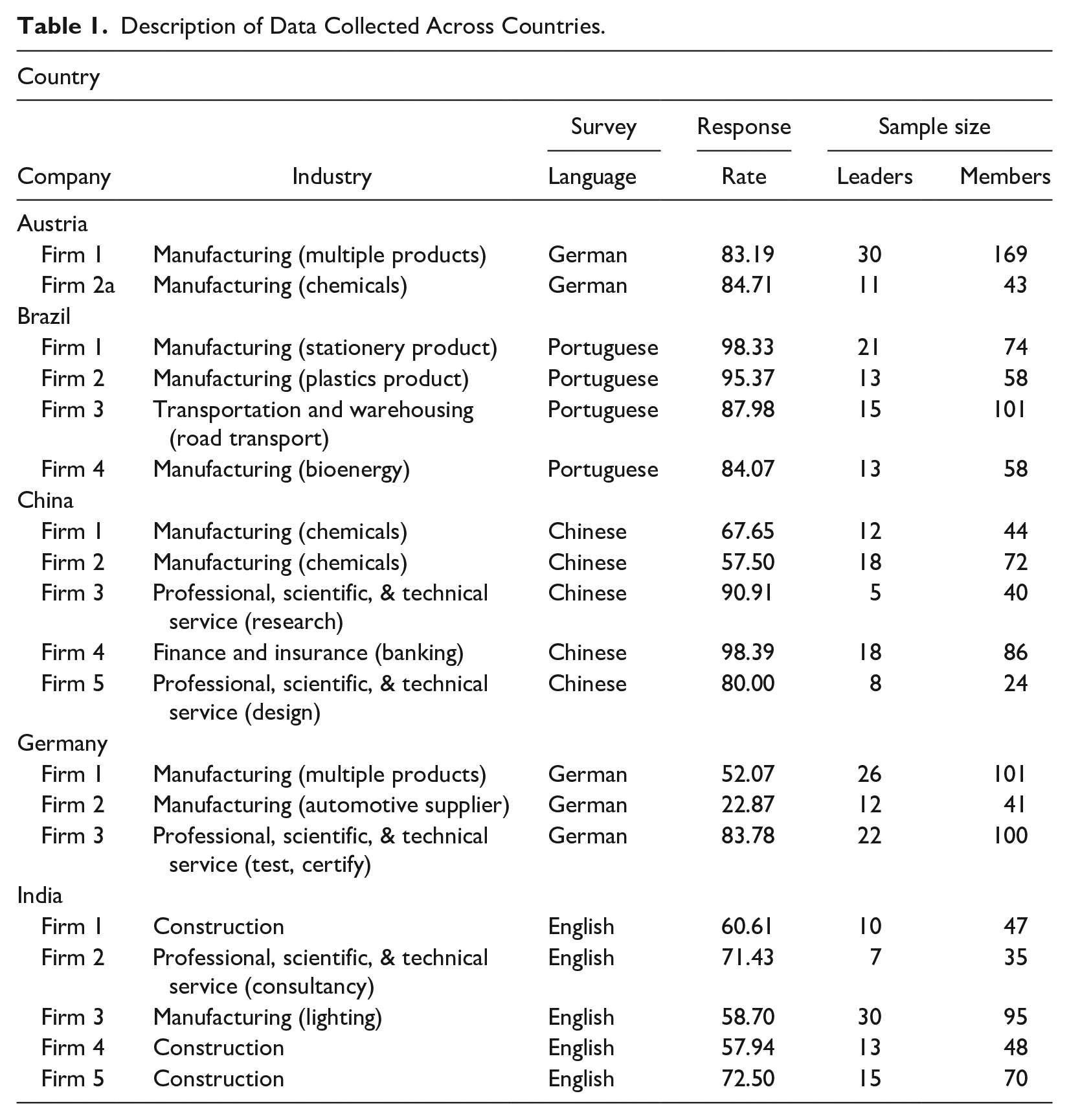
To ensure sufficient information was available for estimating team-level scores, we imposed several restrictions when deciding whether to use responses from a work team: usable data from the team leader, a minimum work team size of three people in addition to the leader, a minimum response rate of 50% for members of small work teams (size five or smaller), and responses from at least three members for larger work teams (size larger than five). The final usable five-country dataset included 1,605 individuals (299 work team leaders and their 1,306 subordinates) working in 19 firms located in five countries. Procedural details and response rate estimates are summarized in Table 1.
Description of Data Collected Across Countries.
Measures
Except when indicated otherwise, all responses were made using a 5-point Likert-type scale (1 = strongly disagree to 5 = strongly agree). We aggregated responses as needed to create and assess the reliability of measures.
Discretionary Green Workplace Behavior
All respondents (work team leaders and individual work team members) completed a 10-item index assessing discretionary green workplace behavior in the workplace developed by Boiral and Paillé (2012), who referred to their index as organization citizenship for the environment, Boiral and Paillé included items to assess eco-initiatives (e.g., “In my work, I weigh the consequences of my actions before doing something that could affect the environment”), eco-civic engagement (e.g., “I undertake environmental actions that contribute positively to the image of my organization”), and eco-civic helping (e.g., “I spontaneously give my time to help my colleagues take the environment into account in everything they do at work”). In our data, the three dimensions were highly correlated ranging from .75 to .79. Furthermore, a second-order confirmatory factor analysis (CFA) resulted in an acceptable fit of a one-dimensional measure (χ2 = 417.02, df = 32; root mean square error of appoximation (RMSEA) = 0.085; comparative fit index (CFI) = 0.97; standardized root mean square residual (SRMR) = 0.03), with the factor loadings of the ten items ranging from 0.56 to 0.86. Therefore, we report results using the total score. Reliability estimates for the total score and computed separately in each country ranged from .89 to .92 for team members and from .89 to .95 for leaders (α = .94 for the total sample; α = .94 and .94 for leaders and team members, respectively).
Work Team Green Advocacy
Team members described the green advocacy behaviors using items adapted from Kim and colleagues () and a 6-point response scale (1 = never to 6 = always). The three items we used are (a) “Members in my work group try to convince my group members to reduce, reuse, and recycle office supplies in the workplace,” (b) “Members in my work group work with each other to create a more environmentally-friendly workplace,” and (c) “Members in my work group share knowledge, information, and suggestions on workplace pollution prevention with other group members.” Reliability estimates computed separately for group members in each country ranged from .74 to .89 (for the total sample, α = .87). The ICC(1) value of .28, ICC(2) value of .63, the mean rwg(j) value of .74, and the median rwg(j) value of .85 all met acceptable levels to justify aggregation to create a team-level index.
Country Culture
The primary tests of our hypotheses were conducted using imputed power distance and collectivism scores retrieved from Hofstede’s website (Hofstede, 2010). For the countries in our dataset, power distance scores ranged from 11 to 80, with higher scores indicating greater power distance. Hofstede’s culture scores represent collectivism as the opposite of individualism. For ease of interpretation, we calculated collectivism scores by subtracting individualism scores from 100, which resulted in a range between 33 and 80, with higher scores indicating greater collectivism.
We adopted Hofstede’s scores for several reasons. First, in line with our theoretical development, Hofstede’s culture scores tap societal-level norms. Second, imputing culture scores helps alleviate common method bias because culture scores are not based on the responses of the employees who provide the responses used to compute team-level norms. Third, because Hofstede’s culture scores are the most prominent ones used in empirical cross-cultural management research (Kirkman et al., 2006), use of those culture scores can facilitate future cross-study comparisons and meta-analytic reviews.
Control Variables
Our analyses included several control variables, which were assessed at the level of individuals, teams, and firms. In the psychological literature, environmental attitudes have been viewed as being central to predicting environmental behavior, but evidence concerning the association between environmental attitudes and actual behavior is mixed (Norton et al., 2015; Raineri & Paillé, 2016). In order to take into account the uncertain role of environmental attitudes as predictors of environmental behavior, we asked participants to respond to items in the widely used New Ecological Paradigm environmental attitude index (Dunlap et al., 2000). Reliability estimates computed separately in each country ranged from .55 to .81 (α = .67 for the total sample) for team members. Because Dunlap et al.’s measure is well-established, we used the total score to ensure sufficient content and facilitate comparison to results found in other studies despite some low-reliability estimates.
Environmental attitudes have been shown to be associated with gender such that women tend to express more positive attitudes than men (e.g., World Bank, 2010), as well as with education such that highly educated people may show more concerns about environmental issues (Gifford & Nilsson, 2014). Thus, we controlled for respondents’ gender (0 = male, 1 = female) and education (1 = high school, 2 = college, 3 = bachelor, 4 = master, 5 = PhD). Because team size can affect interpersonal interactions and influence processes, we controlled for team size in two ways. First, as already noted, we included in our analyses only teams with an acceptable number of usable responses. Second, we asked leaders to indicate the number of members in their team and included actual team size as a control variable in our analyses.
To control for possible relevant differences in the broader business context (Etzion, 2007), we included an industry control variable (manufacturing = 1; nonmanufacturing = 0). Finally, due to our focus on discretionary green behavior, we controlled for company environmental policies. Team leaders answered several questions about their companies’ environmental policies, of which three were meaningful in all countries where we collected data and were used to create an index of company pro-environment policies. This company-level index captures the aggregated standardized responses of each company’s team leaders to three questions, “Is there a formal position or function for Environmental Sustainability in your organization?” (0 = no; 1 = yes), “Does your organization set specific goals or objectives for improving Environmental Performance?” (1 = definitely no; 5 = definitely yes), and “To what extent does your company practice formal Environmental Sustainability?” (1 = highly informal; 5 = highly formal). Aggregation of standardized responses to create this company-level variable was supported by acceptable intra-class correlations, ICC(1) = .65 and ICC(2) = .97, and acceptable inter-rater agreement, mean of rwg(j) = .85 and median rwg(j) = .92].
Data Analysis
Hypotheses Testing
Individual respondents were nested within teams, which were nested within companies, so we tested our hypotheses with random coefficient models using version 3.0 of the Nonlinear and Linear Mixed Effects program for S-PLUS and R (Pinheiro & Bates, 2000). Member discretionary green workplace behavior was regressed on predictors at the levels of individual (i.e., employee gender, education, and environmental attitude), team (i.e., team size, leader discretionary green workplace behavior, and work team green advocacy), and company (i.e., industry, company environmental policies, and two culture variables), respectively. To predict member discretionary green workplace behavior, we grand-mean centered leader discretionary green workplace behavior, team green advocacy, and the two culture variables of power distance and collectivism. The overall model fit was evaluated with the deviance index, calculated as −2 × log-likelihood of a maximum-likelihood estimate. The smaller the deviance score, the better the model fit. In addition, to better estimate effect sizes at different levels, we adopted Kreft and de Leeuw’s (1998) and Singer’s (1998) formulation of pseudo R2, which is based on the proportional reduction of variance at each level due to the inclusion of predictors, as well as the total proportional reduction of variance of all levels.
Results
Table 2 presents the descriptive statistics and correlations for the focal study variables. Where relevant, scale reliabilities are shown along the diagonal. All correlations were generated at the individual level, with higher level variables disaggregated to the individual level. Before testing specific hypotheses, we ran null models for the dependent variable to determine whether there was sufficient variance at each level. In particular, 38.74% (variance = 0.26, p < .01) and 10.06% (variance = 0.07, p < .001) of variance in member discretionary green workplace behavior resided at the company and team levels, respectively. The likelihood ratio test comparing a random-intercept model with an equal-intercept model revealed a better model fit for the random-intercept model for member discretionary green workplace behavior, likelihood ratio = 705.61, p < .001.
Descriptive Statistics, Reliabilities, and Correlations.

Note. N = 1,306 at the individual level (list-wise deletion). Values in parentheses represent scale reliabilities.
p < .05. **p < .01.
Table 3 presents results for the multilevel models predicting member discretionary green workplace behavior. Model 1 in Table 3 includes only control variables and reveals no significant relationships between the control variables and members’ discretionary green workplace behavior. Notably, neither company environmental policies nor members’ environmental attitudes were significantly related to member discretionary green workplace behavior.
Random Coefficient Modeling for Team Member Discretionary Green Workplace Behavior.

Note. N = 1,306 individual members in 299 work teams in 19 companies (except Model 1 that involves 1,320 individuals in 303 work teams in 19 companies). LDGB = Leader discretionary green behavior; TGA = Team green advocacy; PD = Power distance; COL = Collectivism; SE = Standard error.
Model 2 in Table 3 includes the control variables plus the hypothesized main effect associations of leader green behavior (H1a) and team green advocacy (H2a) with the discretionary green workplace behavior of individual team members. Compared to Model 1, Model 2 explained an additional 35.5% of variance in member discretionary green behavior. Furthermore, there was a positive and significant relationship between leader and member discretionary green behavior (γ = .094, p = .002). Likewise, the relationship between team green advocacy and member discretionary green behavior was also positive and significant (γ = .411, p < .001). Together, these results support both H1a and H2a.
Model 3 in Table 3 includes the predicted interaction effects of country culture. Specifically, H1b predicted that power distance would moderate the positive relationship between the discretionary green workplace behavior of leaders and their subordinates such that the relationship would strengthen as power distance increased; H2b proposed that collectivism would moderate the positive relationship between team green advocacy and member discretionary green workplace behavior such that the relationship would strengthen as collectivism increased. We tested the moderating effects of country culture by including two culture variables and the interaction terms into the model, respectively. First, as shown in Model 3 in Table 3, adding two culture variables and the interaction term between leader discretionary green behavior and power distance explained an additional 9.2% variance in the dependent variable. However, only the interaction with power distance was significant and positive (γ = .003, p = .006), indicating that the relationship strengthened as power distance value increased. Contrary to our prediction, collectivism did not moderate the relationship between team green advocacy and member discretionary green behavior: as shown in Model 4, the moderating effect of collectivism was non-significant (γ = .001, p = .539). Taken together, these results support H1b but not H2b.
Discussion
Responding to calls for more research taking a normative perspective to improve our understanding of organizational behavior in general (Morris et al., 2015) and pro-environmental behavior specifically (Farrow et al., 2017), we conceptualized culture as distal injunctive norms and examined its interactive influence on discretionary green workplace behavior with more proximal team norms associated with team leaders and members. Overall, comparing our results to the relationships shown in Figure 1, we found substantial support for most of our hypotheses. In particular, at the team level, both descriptive norms (i.e., team leaders’ discretionary green behavior) and injunctive norms (i.e., team green advocacy) jointly and independently predicted discretionary green behavior of team members. More interestingly, we found a cross-level interaction between leader discretionary green behavior and country-level power distance. These findings shed light on theoretical and practical issues regarding environmental behavior and management at work.

Contextualized Model of Employees’ Discretionary Green Workplace Behavior.
Theoretical Contributions
We believe the most significant contribution of this study lies in the examination of macro-level cultural norms and their interplay with lower-level work team norms. Our results reveal that while leader influence on employees’ discretionary green behavior varied depending on the level of power distance, peer influence was equally effective in molding such behavior across levels of collectivism. As such, examining the influence of green leadership and green advocacy in teams under certain socio-cultural conditions extends our understanding of these relationships accumulated in the extant literature. In addition, this study illustrates the value of the normative perspective as an integrative theoretical foundation for understanding discretionary green workplace behavior that occurs in the proximal social context of work teams and distal social context of culture. We elaborate on these contributions next.
Culture as Context
Extending the comparative approach to understand how cultural differences influence sustainability initiatives and outcomes (e.g., Miska et al., 2018; Ringov & Zollo, 2007), we consider how proximal work team norms combine with societal culture norms to mold employees’ behaviors targeted at the environment. Importantly, our results reveal some substantial similarities across cultures as well as some difference. Regardless of cultural contexts, we found that employees’ discretionary green workplace behavior was positively related to the normative cues emanating from their team leaders and team peers. That is, like previous investigations of leader green behavior (Kim et al., 2017; Robertson & Barling, 2013), we found a strong, positive relationship between team descriptive norms (leader discretionary green behavior) and members’ discretionary green behavior. In addition, our results replicate Kim et al.’s finding for employees in Korea of a positive relationship between leader discretionary green behavior and work team green advocacy.
Besides finding similarities across cultures, we also found evidence that the leader-member green behavior relationship was shaped by the cultural dimension of power distance. Specifically, employees in more hierarchical societies are more likely to be swayed by the behavior of their leader despite the discretionary nature of the behavior. Thus, leaders in more hierarchical societies may be relatively more effective in using their status to subtly influence their employees by simply modeling green behavior. By comparison, in egalitarian (lower power distance) cultures that de-emphasize hierarchy, leaders who hope to influence employee behavior by acting as role models may be less effective if they rely too heavily on role modeling as their primary means of influence. Instead, leaders might have more influence by showing support for employees’ self-directed green behaviors.
Contrary to our prediction that peer advocacy would be more strongly related to employees’ discretionary green workplace behavior in more collectivistic societies, our results suggest that, across cultures, peer green advocacy is equally relevant as a behavioral guide that signals which behaviors are likely to garner peer (dis)approval. This finding is consistent with a recent case study of corporate sustainability efforts (Soderstrom & Weber, 2020), in which the key to maintaining momentum of such efforts was the sustained motivation of advocates. Apparently, working with peers advocating green values and initiatives powerfully shapes one’s own discretionary green behavior and supports its contagious spread through networked employees; and such effects hold across cultures.
Interestingly, the invariant influence of peer green advocacy across cultures of collectivism implies that a global culture may be more well established for peer-to-peer relationships at work, whereas the evolution of a global culture for leader–member relationships and roles may be evolving more slowly (cf. Erez & Gati, 2004; Erez et al., 2013). Team-based structures have become more common across organizations, industries and nations. One possible result of the emergence of a global culture is increasing similarity among employees across a wide variety of organizations concerning the importance of gaining approval from workplace peers and avoiding their disapproval, regardless of the lingering norms (e.g., individualism) of one’s broader societal culture. In contrast, perceptions of and interactions with leaders seem to remain significantly different across cultures varying from high to low power distance. The complex pattern of these results regarding culture’s interactions with lower-level norms is consistent with calls for more research that examines how well theories promulgated in western cultures travel around the globe (Aguilera et al., 2021).
The Value of the Normative Perspective
The study of discretionary green workplace behavior is theoretically fractured, with different studies using different theories developed for understanding social units ranging from individuals to small or large groups to countries. The normative perspective adopted in this study, while consistent with several discrete theoretical perspectives found in “micro” scholarship focusing on green behavior within organizations (e.g., see Norton et al., 2015; Paillé, 2020), is nevertheless a departure that emphasizes the complex social embeddedness of workplace behavior and provides a common set of terms and principles for building multi-level and multi-disciplinary models that more fully reflect organizational life.
In the public sphere, efforts to change personal behavior often recognize and attempt to leverage the power of social influence and persuasion. For example, in some communities, residents receive information about how their household energy use compares to that of their neighbors. Such information has proved effective in decreasing the energy used by those who learn they use more power than their neighbors (Slemrod & Allcott, 2011). Similarly, effective corporate marketing campaigns often leverage normative information to encourage green purchases among consumers (White et al., 2019). Our results indicate that companies also are able to leverage various normative cues to promote discretionary green behavior among employees.
In addition to the main findings, we found formal environmental policies were of little direct consequence for predicting the discretionary green workplace behavior of participants in this study. These results should not be interpreted as an indication that the companies’ environmental policies were universally ineffective, for two reasons. First, due to our interest in discretionary behavior, we intentionally chose to study participants with job duties that were not closely tied to their company’s environmental objectives (e.g., environmental sustainability officer). Our data do not provide information about the direct relationship between formal environmental policies and required job duties. Second, in a supplemental analysis, we examined the indirect effect of company policies through the behavior of team leaders. The results of this analysis revealed a significant indirect effect of company policies such that leader behavior was a mediator of the relationship between formal environmental policies and the discretionary green behavior of lower-level employees.
Furthermore, we assessed the environmental attitudes of individuals and controlled for them in our analysis, but our results indicate that discretionary green behavior was not associated with environmental attitudes. Note that our results concerning environmental attitudes are consistent with the often-observed sustainability attitude-behavior gap (e.g., Park & Lin, 2020; Peattie, 2010). More research is needed to uncover the reasons for such inconsistencies.
Practical Implications
For global managers, our results suggest that human behavior is sometimes less complicated than might be expected across the diverse cultures they experience. As Tung and Stahl (2018) noted, most cross-cultural management scholars have focused on the question of how culture matters, making the assumption that it nearly always does matter. As to employee green behavior, our results are a reminder that some basic truths—like the importance of norms, leaders as role models, and employees’ desire for approval—are broadly applicable across cultures. Some relationships appear to be relatively more culturally conditioned (e.g., those between leaders and their subordinates) while others relatively less culturally conditioned (e.g., those among workplace peers).
When an organization’s goal is to encourage lower-level employees to reduce environmental harms or increase environmental benefits beyond the requirements of their job tasks—that is, when discretionary green workplace behavior is valued—formal policies and mission statements designed to tap into employees’ personal environmental attitudes may be ineffective. Yet due to the universal desire for approval from others, leaders who engage in discretionary green behavior can gently nudge lower-level employees to behave similarly (Eriksson et al., 2015) while forgoing authoritative demands, thereby reducing the potential resistance and backlash that can arise when employees feel resentment at efforts to control their discretionary behavior. Interventions such as training programs that inform employees about the importance of environmental sustainability or tell managers how (not) to behave (Kwan et al., 2015) may be less effective than interventions designed to help managers understand the value of subtle influence tactics such as role modeling. In countries with cultural norms characterized by large power distance, attentiveness to subtle normative cues may make it easier for managers to gently elicit desirable behaviors among employees and have them feel good about those behaviors; in low power distance cultures, however, employees may be somewhat less likely to mirror the behavior of leaders because doing so may threaten their personal autonomy (Deci & Ryan, 2015; Ryan & Deci, 2017). Nevertheless, in most cultures, serving as a positive role model is integral to effective leadership (House et al., 2004). Management development activities for building this skill might include a mix of education about the importance of role modeling of desirable behaviors not mandated by one’s job, mentoring by others who are recognized as strong role models, and experiential activities that provide opportunities to practice effective role modeling (e.g., see Haney et al., 2020).
Also likely to be effective are interventions that increase the salience of pro-environment sentiments. With increasing recognition of the planet’s declining environmental health, injunctive norms are evolving and tolerance of behaviors that do environmental damage is declining. Salient and pervasive norms are consequential for behavior so alerting employees that other external social referents approve of such behaviors may help initiate a virtuous cycle of social influence and change (Eriksson et al., 2015; Kwan et al., 2015). With public opinion becoming increasingly pro-environment, simply disseminating information about community greening activities is one way to increase the salience of eco-friendly norms and encourage discretionary green workplace behavior. In addition, job rotations and task force assignments that provide exposure to supply chain partners and customers can raise awareness of the environmental concerns among those constituencies while also helping employees gain new insights about how they might modify their own work methods to align more closely with the sustainability concerns of external stakeholders, regardless of formal job requirements.
Internally, companies can also take advantage of social influence dynamics among peers by supporting employee networks and interest groups focused on environmental issues. Participating in employee networks increases feelings of approval from like-minded peers and promotes information sharing about voluntary greening activities within the organization and beyond (Welbourne et al., 2017). When employees’ networking extends beyond the organization, it can change business practices across entire industries (e.g., see Oliveira, 2013) and accelerate changes in the status quo. Attacks on the status quo may be viewed positively when it is clear that the intent is to promote the organization’s goals, but if employees’ green advocacy is viewed as a threat to the organization’s reputation or smooth functioning, those engaged in green advocacy may be viewed as disruptive deviants. Thus, forward-looking companies might benefit by providing conflict management and negotiation training along with resources to support employee networking groups (e.g., see Gelfand et al., 2012).
Methodological Limitations
There are several methodological weaknesses in this study, which can be addressed in future studies. First, some common critiques against cross-sectional surveys can be legitimately leveled against this study, although we took steps to reduce the impact of such weaknesses. Our use of responses from multiple sources (focal employees, team leaders, peers, imputed culture scores) and inclusion of both multi-level associations and moderated effects mitigated the potential problem of common-method bias due to the use of single-respondent self-reports. These design features also reduced the likelihood that social desirability effects account for our results, for it is unlikely respondents could anticipate our hypotheses and give responses intended to (dis)confirm our predictions. Nevertheless, the assumed causal ordering within and across levels of analysis requires additional evidence to confirm. Further research can also counteract potential social desirability biases by complementing self-reports of discretionary green behavior with ratings by other observers.
Another methodological limitation involves our decision to adopt an etic (vs. emic) approach, making the assumption that the phenomena we investigated can be at least partially understood by looking at them through one conceptual lens and applying a common framework across different country settings. Future research conducted using an emic approach, including intensive case studies and developing measures that better capture cultural nuances, will likely yield additional insights about the unique contextual conditions that promote or inhibit discretionary green workplace behavior in particular countries, particular industries, or among members of particular occupational groups (e.g., see Xing & Starik, 2017). Related to our etic methodology, most measures we used were created for research conducted in “western” cultures and/or “developed” economies, and then were translated for local use in other “non-western” countries and/or “developing” economies. Conducting our research in a broad array of contexts gives us confidence in the robustness of our results; nevertheless, additional studies are needed to bolster the accumulation of much-needed evidence to establish the transportability of measures for use in future research.
Finally, following the most common approach to examining cultural differences, we assigned country-level culture scores to all individual respondents within a country; this method has been criticized as a form of cultural stereotyping that ignores within-country variation among demographic groups and cultural changes across time, as others have documented and explained in detail (e.g., Tung & Stahl, 2018). However, addressing the lack of psychometrically and practical alternative methods for conducting fine-grained assessments of local cultures was beyond the scope of our study, which may have diminished our ability to detect important nuances in country-level norms. Thus, the societal-level effects we found should be considered conservative estimates of possible true effects.
Despite these limitations and the need for additional research, the large-scale multi-country dataset and mitigation tactics we used to strengthen our methodology give us confidence in the robustness of our findings.
Future Research Directions
Scholars of organizational behavior have long been challenged to pay more attention to contextual influences that can alter how micro-phenomena of interest unfold—that is, to “look up” (Hitt et al., 2007). The main contribution of this study is looking up to consider how the behavior of individual employees appears to mirror and respond to the societal cultural context as well as the immediate social context of their work team peers and leaders. In looking up, we focused on downward influence of norms on individuals. Given the dearth of the research in this vein, more cross-cultural investigations of green behavior are needed to shed more light on the cultural contingencies for lower-level relationships. For example, some individual or team level relationships may hold in certain cultural conditions but not in others.
Building on our multilevel view of green behavior, another opportunity for research is to study upward influence and processes by asking questions about when and how the discretionary green workplace behavior of individuals and small work teams shape the environmental strategies of upper-level executives, for powerful upward influence processes can signal the need for an organization to adopt environmentally sustainable practices and encourage its leaders to show support for such changes (cf. Oreg & Berson, 2019; Solinger et al., 2020; Wagner & Llerena, 2011). In the end, an organization’s sustainability posture evolves through the interplay of intentional as well as unintentional top-down and bottom-up social processes in a continuous process of mutual influence (Soderstrom & Weber, 2020).
Furthermore, the normative lens employed by this study proves a useful tool to understand the evolution and dynamic changes of complex social systems and resulting decisions and behavior. Informal social influence has long been established as a subtle yet powerful force to guide human behavior. Based on our findings of interactive effects of normative forces from different sources at different levels, future research in environmental sustainability can continue to employ the normative approach to explore the complex and reciprocal social dynamics that involve the full range of relevant actors throughout organizations and beyond their boundaries (e.g., see Sandhu & Kulik, 2019; Starik & Rands, 1995). For instance, as social activists, employees’ insider knowledge may enable them to effectively frame environmental issues to fit the company’s values and organizational culture, leverage resources such as informal social structures like cliques and friendship networks, and lobby executives who are accountable and have authority over relevant resources (Briscoe & Gupta, 2016). Adding one more layer of complexity, a promising research avenue is to investigate how organizing for advocacy unfolds under different cultural and institutional norms.
Finally, our focus on discretionary green behavior should stimulate new research on the topic of green human resource management, a.k.a. green HRM (e.g., Paillé, 2020; Ren & Jackson, 2020; Renwick, 2018; Tang et al., 2018). Early efforts to establish the role of human resource management practices in organizations striving to achieve environmental sustainability married the scholarship perspectives of strategic human resource management and environmental sustainability (Jackson & Seo, 2010). Emphasis has been placed on adapting traditional practices for staffing, training, incentivizing and monitoring the in-role green (non-discretionary) behavior of individuals, with less attention paid to management practices that might be used to influence team norms and leverage naturally occurring social influence processes to promote extra-role (discretionary) green workplace behavior. Thus, this study points to new opportunities for expanding “micro” scholarship concerning discretionary green behavior with green HRM scholarship to produce new theoretical insights and develop novel and effective practical tools for promoting environmental sustainability.
Footnotes
Declaration of Conflicting Interests
The author(s) declared no potential conflicts of interest with respect to the research, authorship, and/or publication of this article.
Funding
The author(s) disclosed receipt of the following financial support for the research, authorship, and/or publication of this article: Financial support was provided by the Austrian Science Foundation (FWF I 3342-G16), the National Natural Science Foundation of China (number 71932004), and the German Science Foundation (DFG WA 2562/5-1), for which we are grateful. We also thank Dermot Breslin, Aleksios Gotsopoulos, Aida Hajro, and Martin Kilduff for providing helpful comments during the preparation of this article.
