




Abstract
Recent critical publications on neurofeedback raise a conundrum: Does electroencephalography-neurofeedback (EEG-nf) work, and if so, how? In a series of papers, we reported that EEG-nf seems to help the symptoms of ADHD, but for different reasons than most advocates would expect—that is, due to a placebo response (Thibault, Lifshitz, Birbaumer, & Raz, 2015; Thibault & Raz, 2017). In this Guest Editorial, we address ethical considerations concerning prescribing placebos and highlight how we can leverage prevailing brain-based beliefs about behavioral disorders to better treat patients. We conclude that clinicians can apply EEG-nf to ADHD as a form of clinical suggestion for patients with the time, finances, and inclination to pursue such a treatment.
In a therapeutic context, suggestion refers to communicable ideas, contextual cues, and cultural rituals that can help modulate both voluntary actions and autonomic functions that typically lie outside of our volitional control. Suggestions come in many flavors (e.g., hypnotic, parental, or commercial). In this paper, we focus on the kind of suggestion that uses ideas, cues, and rituals drawn from neurotechnology and our culturally widespread trust in brain-based explanatory models of human behavior—that is, neurosuggestion. To enhance the involvement of the patient and to make suggestion more effective, we can leverage culturally salient props, such as a brain scanner, in a process we broadly term accessory-assisted healing.
Why EEG-nf Is Neurosuggestion Therapy
EEG-nf for ADHD shows comparable benefits whether the feedback is genuine (from one’s own brain signal of interest) or a sham (from an unrelated signal). To date, every relevant double-blind sham-controlled study has reached this conclusion (Arnold et al., 2013; Lansbergen, van Dongen-Boomsma, Buitelaar, & Slaats-Willemse, 2011; Logemann, Lansbergen, Van Os, Bocker, & Kenemans, 2010; Perreau-Linck, Lessard, Lévesque, & Beauregard, 2010; Schönenberg et al., 2017; Thibault & Raz, 2017; van Dongen-Boomsma, Vollebregt, Slaats-Willemse, & Buitelaar, 2013; Vollebregt, van Dongen-Boomsma, Buitelaar, & Slaats-Willemse, 2014). In all but two of these studies, the treatment benefited both groups (Logemann et al., 2010; Vollebregt et al., 2014). A recent triple-blind registered randomized controlled trial (RCT) with 118 participants diagnosed with ADHD found large effect sizes for both true (d = 1.0) and sham (d = 1.5) neurofeedback groups (Schönenberg et al., 2017). Until research demonstrates additional benefits from true neurofeedback that go above and beyond placebo effects, the science suggests that EEG-nf, at least in its current incarnation, relies exclusively on treatment mechanisms unrelated to watching one’s own brain activity (Thibault & Raz, 2016). EEG-nf, in other words, is neurosuggestion.
We Already Prescribe Suggestion
Most clinicians have prescribed suggestion—but many don’t know it. The benefits of selective serotonin reuptake inhibitors (SSRIs) for depression, acupuncture for lower back pain, and knee surgery for osteoarthritis all stem largely from the suggestion that these treatments will improve your health (i.e., from placebo effects). In 2002, the psychologist Irving Kirsch obtained unpublished clinical trial data under the Freedom of Information Act and found that SSRIs barely outperformed placebos in RCTs (Kirsch, Moore, Scoboria, & Nicholls, 2002). In the case of lower back pain, two RCTs with a total of more than 1,700 participants demonstrated comparable benefits between veridical acupuncture and sham acupuncture, yet both outperformed a standard-of-care treatment (Cherkin et al., 2009; Haake et al., 2007; Harris, Lifshitz, & Raz, 2015). Likewise, a high-profile RCT showed that, even at a 2-year follow-up, sham knee surgery decreased pain and improved movement capacity on par with real surgery (Moseley et al., 2002). An expert panel now strongly recommends against knee surgery for osteoarthritis due to potential complications and the absence of benefits beyond placebo effects (Siemieniuk et al., 2017). In these situations, clinicians often unknowingly prescribe placebos. Following the results from recent double-blind studies, we can now add EEG-nf for ADHD to this list of placebo therapies that masquerade under other biomedical labels.
The Case for Suggestion in ADHD
In contrast to the above-mentioned placebo therapies, psychostimulants typically reduce ADHD symptoms more effectively than placebo, but come at a cost. Potential side effects include crying, staring, anxiety, sadness, nail biting, euphoria, and shyness (Konrad-Bindl, Gresser, & Richartz, 2016). Due to growing concerns about long-term adverse side effects, the European Commission recently called for a 2-year longitudinal study that is taking place at 27 sites (Inglis et al., 2016). Given the potential for harm, it is advantageous to consider drug-free treatments with minimal side effects to complement or replace psychostimulants. In this vein, a pair of studies found that when children with ADHD were prescribed an “open-label” placebo, they could cut their psychostimulant intake in half with negligible changes in behavior (Sandler & Bodfish, 2008; Sandler, Glesne, & Bodfish, 2010). In lieu of deception, the researchers briefed children with the following script: This little capsule is a placebo. Placebos have been used a lot in treating people. It is called “Dose Extender.” As you can see, it is different from Adderall. Dose Extender is something new. It has no drug in it. I can promise you that it won’t hurt you at all. It has no real side effects. But it may help you to help yourself. It may work well with your Adderall, kind of like a booster to the dose of Adderall. That’s why it’s called a Dose Extender. I won’t be surprised when I hear from you and your parents and your teachers that you’re able to control your ADHD better. (Sandler & Bodfish, 2008, p. 106)
Full disclosure made little impact on the effectiveness of the placebo condition—that is to say, administering placebos openly hardly detracted from the clinical benefit (Sandler & Bodfish, 2008). Researchers have reproduced this finding in several conditions, including irritable bowel syndrome, chronic pain, and depression (Kaptchuk et al., 2010; Kelley, Kaptchuk, Cusin, Lipkin, & Fava, 2012; Schafer, Colloca, & Wager, 2015).
Based on staunch faith in brain science, neurosuggestion may perhaps treat patients even better than placebo pills. In particular, with EEG-nf for ADHD, the suggestion that physical movement will contaminate the expensive brain recordings can lead participants to sit still and in turn, this procedure provides an ulterior form of behavioral therapy. The additional psychosocial cues surrounding EEG-nf, compared with those present when ingesting a pill, may help this technique compete with standard pharmacotherapy (e.g., Fuchs, Birbaumer, Lutzenberger, Gruzelier, & Kaiser, 2003). To further support this point scientifically and to the level of clinical recommendation, more studies would need to directly compare EEG-nf with standard of care treatment.
Testing Neurosuggestion in the Clinic
In our previous work, we explored how strong this type of suggestion could be. We found that many participants believed that a crudely built “brain scanner”—assembled from discarded hair drying and medical equipment and placed in a cognitive neuroscience laboratory—could read their minds (Ali, Lifshitz, & Raz, 2014). In subsequent iterations of this paradigm, we found that a more realistic looking scanner could similarly alter people’s sense of agency and moral attitudes (Olson, Landry, Appourchaux, & Raz, 2016; Olson, Strandberg, Hall, Johansson, & Raz, 2017). In light of these findings, we decided to test the clinical applications of this technique we term neurosuggestion.
To pilot the idea, we used a real but decommissioned—in other words, sham—magnetic resonance imaging (MRI) scanner at the Montreal Neurological Institute as part of an open-label procedure to treat nine children diagnosed with ADHD (Figure 1; Veissière, Olson, & Raz, 2017). We told the children that the “brain machine” was inactive, and that we would “use it as a suggestion” that would “help their brain heal itself.” While in the defunct scanner, we gave the children positive verbal suggestions to promote relaxation, focus, and confidence. At 1-, 3-, and 6-week follow-ups, parents reported improvements in eight out of the nine participating children. In qualitative interviews, two families reported near complete remission of symptoms, and six reported improvements in areas such as confidence, self-control, and social skills. None reported any side effects. In essence, this study provided neurofeedback-like treatment, but instead of focusing on a specific physiological mechanism, we emphasized suggestion-based healing.
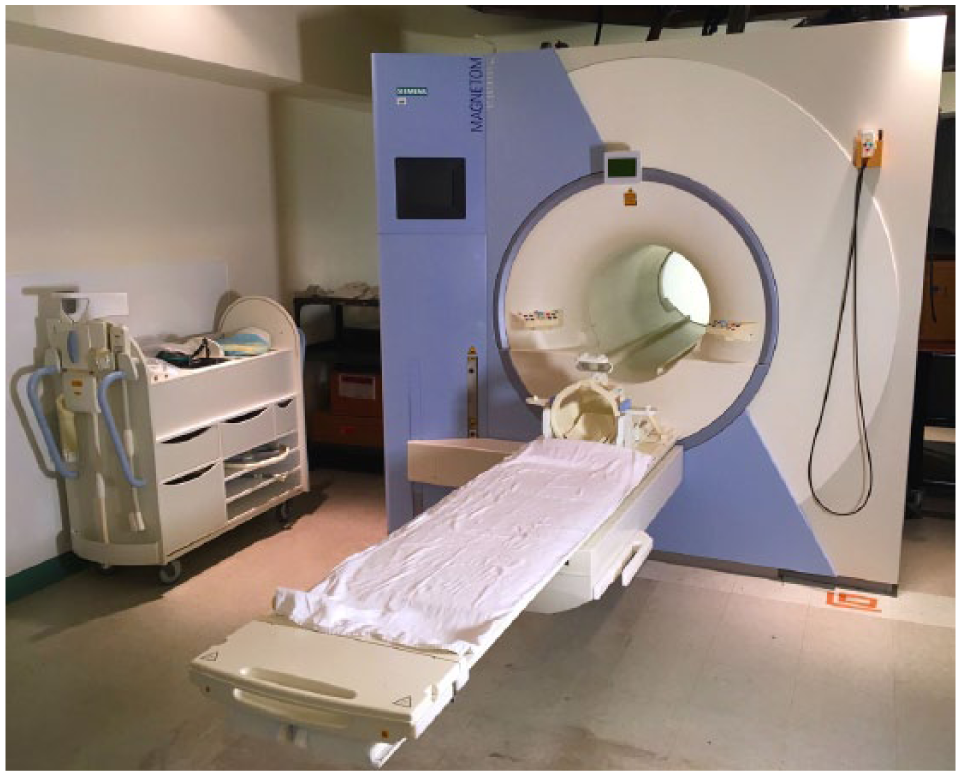
Decommissioned Siemens 1.5T MRI used for the neurosuggestion procedure.
Should We Prescribe EEG-nf for ADHD?
To answer this question, we need to consider a few issues. First, as a culture, we maintain deep-set beliefs that the origin of behavioral disorders resides in the brain (Moncrieff, 2016; Rose, 2003). Relying on this assumption, children and their families often actively seek a diagnostic label, for example, ADHD, to ascribe meaning to their behavior (Moncrieff, 2016; Moncrieff, Rapley, & Timimi, 2015). Second, even in our open-label neurosuggestion experiment (Veissière et al., 2017), parents continued to ask what was “wrong” with their child’s brain, despite having been extensively briefed regarding the inert nature of the MRI scanner. And yet, this very belief system—that a brain disorder is the core reason for the symptoms—may unintentionally act as a suggestion to further obfuscate the situation and exacerbate symptoms through nocebo effects (Loftus & Fries, 1979). This type of thinking has been described as a “looping effect,” where our beliefs and social norms affect the framing, course, and outcomes of a disorder (Hacking, 1995). In other words, context and culture strongly modulate how patients attend to and construe their behavior, which, in turn, alters their symptoms (Kirmayer, Gomez-Carrillo, & Veissière, 2017; Seth & Friston, 2016). Third, our experiments show that brain-based folk explanations can lead to both nocebo and placebo effects. It seems that neurofeedback likely summons its strength from this belief system, which offers a promising means to regulate “faulty” brain patterns (Thibault & Raz, 2017). Thus, neurosuggestion, rather than the act of regulating one’s own EEG waves, likely allows patients to break free from harmful looping effects.
In sum, under certain circumstances, clinicians could ethically and nondeceptively prescribe EEG-nf as a form of neurosuggestion therapy. It would not be the first placebo prescription—in the United States, one study reports that 45% of physicians use placebos in clinical practice and 96% of them believe placebos can have therapeutic effects (Sherman & Hickner, 2008); in Canada, an analysis of placebo use among physicians, and especially psychiatrists, echoes similar sentiments (Raz et al., 2011). Moreover, a recent study describes interviews with 1,000 parents and reports that most deem it acceptable for clinicians to recommend placebo treatment for ADHD (Faria et al., 2017). With these realities in mind, EEG-nf presents a reasonable alternative for patients experiencing adverse side effects or simply searching for a nonpharmacological treatment. Because EEG-nf requires time, money, and energy, if clinicians decide to promote this technique, they ought to present it as one of several options (e.g., exercise, cognitive training, behavioral therapy, and diet; Sonuga-Barke et al., 2013). Thus, clinicians can certainly prescribe EEG-nf. We recommend they do so transparently and with an eye for amplifying the psychosocial mechanisms of suggestion rather than grasping at the elusive neural signatures many practitioners speciously assign as the cause of ADHD.
Footnotes
Author Contribution
Robert T. Thibault and Samuel Veissière contributed equally to this work.
Declaration of Conflicting Interests
The author(s) declared no potential conflicts of interest with respect to the research, authorship, and/or publication of this article.
Funding
The author(s) disclosed receipt of the following financial support for the research, authorship, and/or publication of this article: RTT acknowledges an Alexander Graham Bell Canada Graduate Scholarship and Micheal Smith Foreign Study Supplement from the Natural Sciences and Engineering Research Council of Canada (NSERC). SV and JAO received funding and logistical support from the Mind Field segment of the Intellectual Property Corporation for the sham MRI experiment, which is approved under McGill University REB File: #32-0617. JAO acknowledges funding from the Joseph-Armand Bombardier Scholarship from the Social Sciences and Humanities Research Council of Canada. We further thank the BIAL Foundation for funding. The funding sources had no involvement in reviewing the literature, writing the manuscript, or deciding to submit the paper for publication.
