



Abstract
Background:
The present meta-analysis aimed to evaluate the efficacy of various non-pharmacological interventions on comorbid emotional symptoms such as depression, anxiety, and emotional dysregulation (ED) in children and adults with ADHD.
Method:
Forty-four randomized controlled trials (23 studies with ADHD children and 21 studies with ADHD adults) were included. Risk of bias, heterogeneity assessment, and subgroup analyses were conducted.
Results:
We found that therapies targeting the relationship between children and others (i.e., parent-training [on ED and depression] and social skills training [on ED]) were efficacious in the treatment of emotional symptoms in children with ADHD at post-intervention. As for adults with ADHD, cognitive behavioral therapy was found to be effective for the improvement of emotional symptoms at both post-intervention and follow-up.
Conclusion:
Our findings demonstrate that the efficacy of non-pharmacological interventions varies substantially across children and adults with ADHD. These results provide important implications for the selection of non-pharmacological interventions for children with ADHD.
Introduction
ADHD is a common childhood-onset neurodevelopmental disorder, with prevalence in children estimated at around 3% to 5% (National Institute for Health and Care Excellence, 2018; Sayal et al., 2018), which often persists into later life (Barkley, 2008), with a prevalence in adults between 2.1% and 2.5% (Simon et al., 2009; Vitola et al., 2017). ADHD is primarily characterized by the presence of inattention and/or hyperactivity/impulsivity as its main symptoms (Gillberg, 2014; Rief, 2015).
Nevertheless, recent studies have shown that emotional symptoms are also one of the most prevalent ADHD comorbid conditions in childhood. These include conditions such as depression, anxiety, and emotional dysregulation (ED), all of which have been also associated with ADHD in adulthood (Daviss, 2008; Oddo et al., 2018; Reimherr et al., 2017). Some researchers have even suggested that patients with ADHD presenting emotional comorbidity should be classified as a separate category of ADHD (Jensen et al., 2001). Unsurprisingly, in recent years a growing number of studies have focused on the ED in ADHD. Studies found that children and adolescents with ADHD are susceptible to depression and anxiety if they have problems with emotional regulation (Seymour et al., 2014). What is more, a recent study suggested that ED was a key risk factor for internalizing symptoms, such as depression and anxiety (Bertocci et al., 2016). In addition, ED was considered to play an important role in functional deficits in ADHD (Shaw et al., 2014) and even served as a core diagnostic feature within ADHD (Barkley & Murphy, 2010). Therefore, it is important to acknowledge and optimally address emotional symptoms such as depression, anxiety, especially ED, which can ultimately benefit the recovery of higher-order dysfunctions such as cognitive and social impairment in patients with ADHD (Bunford et al., 2018).
Traditionally, the emotional symptoms in patients with ADHD were treated with pharmacotherapy (National Institute for Health and Care Excellence, 2018). However, inconsistent results have been reported on the treatment of comorbid emotional symptoms (Adler et al., 2013; Epstein et al., 2014; Lenzi et al., 2018; Moukhtarian et al., 2017). Additionally, various side effects or adverse events during treatment with drugs for ADHD have been observed; these include loss of appetite, growth delay, cardiovascular risks, sleep disturbance, tics, substance misuse/abuse, seizures, suicidal thoughts/behaviors, and psychotic symptoms (Cortese et al., 2013).
For this reason, an extensive line of non-pharmacological treatments has been adopted in recent years to address ADHD core symptoms (i.e., inattention, hyperactivity, and impulsivity) and emotional symptoms (López-Pinar et al., 2020). For example, a systematic literature review (Den Heijer et al., 2017) showed that physical exercise represented an effective treatment in children and adults with ADHD with regard to several cognitive, behavioral, and socio-emotional functions. Similarly, a recent meta-analysis study (López-Pinar et al., 2020) demonstrated the efficacy of non-pharmacological treatments on emotional symptoms in adults with ADHD. For instance, cognitive-behavioral therapy (CBT) was shown to substantially improve emotional dysregulation, depression, and anxiety symptoms in adults with ADHD (López-Pinar et al., 2020).
Despite the recent emergence of critical systematic reviews and meta-analyses studies concerning non-pharmacological interventions on emotional symptoms in adults with ADHD, only a few systematic reviews or meta-analyses studies have tapped on the efficacy of certain specific non-pharmacological treatments on emotional symptoms in children with ADHD, such as physical exercise (Den Heijer et al., 2017), social skills (Storebø et al., 2019), and parent training (Rimestad et al., 2019). It is worth noting that, though a systematic review (Goode et al., 2018) has assessed the efficacy of various non-pharmacologic treatments in children with ADHD, it did not address emotional comorbidity outcomes. To our knowledge, no comprehensive meta-analysis study covering non-pharmacological treatments on emotional symptoms in children with ADHD has been conducted. The present study attempts to fill this gap.
Of note, as a neurodevelopmental disorder, ADHD affects both children and adults (Gillberg, 2014), and long-term follow-up studies of children with ADHD and retrospective studies of adults with ADHD have demonstrated that ADHD in children often persists into adulthood (Biederman et al., 2010). However, crucial differences exist between children and adults with ADHD concerning symptoms, comorbidities, diagnosis, and treatment (Leahy, 2018). For instance, a couple of studies suggested that impairments associated with ADHD may change across the lifespan (Kieling & Rohde, 2012; Leahy, 2018), as researchers found that ADHD symptoms in adults are more heterogeneous and subtle than in children (Kieling & Rohde, 2012). Moreover, a recent study challenged the assumption that ADHD in adulthood is always a continuation of ADHD in childhood (Caye et al., 2016). Instead, the authors suggested that ADHD in childhood and adulthood might be two different syndromes with distinct developmental trajectories and different pathophysiologic mechanisms (Caye et al., 2016). Therefore, in light of the current debate, the present meta-analysis will help understand the critical differences with which children and adults with ADHD respond to non-pharmacological treatments of emotional symptoms.
As in previous meta-analytic reviews (Goode et al., 2018; López-Pinar et al., 2020), we included the most-widely used non-pharmacological treatments in the current review, namely, cognitive behavioral therapy (CBT), parent training (PT), social skills training (SST), mindfulness-based therapies (MBT), behavioral therapy (BT), dialectical behavior therapy (DBT), cognitive therapy (CT), psychoeducation (PsyEd), neurofeedback (NFB), sleep intervention(SI), hypnotherapy (HT), and sports. It is important to note that different non-pharmacological treatments might have different efficacy on emotional symptoms. For example, in a systematic review (Den Heijer et al., 2017), cardio exercise was reported to be effective in improving children’s ADHD symptoms such as depression and anxiety; while a recent meta-analysis (Storebø et al., 2019) did not obtain evidence to support the efficacy of social skills training on emotional symptoms for children with ADHD. Thus, the current meta-analysis study aims to systematically compare the efficacy of different types of non-pharmacological interventions on emotional comorbidity in children with ADHD. To serve as a reference for comparison with children with ADHD, we also meta-analyzed the relevant studies which investigated adults with ADHD, in line with a systematic literature review by Den Heijer et al. (2017). According to the existing literature, we defined children with ADHD as those with age <18 years old (Storebø et al., 2019), and adults age ≥18 years (Simon et al., 2009).
Concerning the outcome evaluation of a given intervention, one cannot overlook the fact that the assessment from different evaluators may also lead to inconsistent results. For example, children with ADHD were shown to report a better performance when compared with reports from their parents and teachers; a type of bias referred to as “positive illusory bias” (Hoza et al., 2002; Owens et al., 2007). In the same vein, a recent meta-analysis study (Rimestad et al., 2019), showed that parent-rated outcomes of ADHD symptoms in preschool children with ADHD supported PT intervention, yet, no significant results were found when the outcomes were rated by independent observers. Given the variability in evaluations carried out by different categories of evaluators, the present meta-analysis will systematically compare these evaluations to determine whether the assessments are representative of true intervention efficacy or merely a reflection of bias.
In summary, the present meta-analytic review will (a) evaluate the efficacy of distinct non-pharmacological interventions on comorbid emotional symptoms (i.e., depression, anxiety, and ED) in children and adults with ADHD after treatment and at follow-up. Additionally, the present review will, (b) exam how different intervention types and settings moderated the effect size (ES) estimates for each outcome and (c) investigate how different types of evaluators influence the efficacy of treatment.
Method
This meta-analysis followed the guidelines of the Preferred Reporting Items for Systematic Reviews and Meta-analyses (PRISMA) guidelines (Liberati et al., 2009; see details in the Supplemental Material [Table S1]).
Systematic Review Protocol
For this systematic review, no previous protocol was carried out.
Search Strategy
A systematic literature search was carried out using the Pubmed, Web of Science, and PsycINFO electronic database without a date limit. Search criteria entered into the database scanned titles and abstracts for the following terms: (ADHD OR attention deficit hyperactivity disorder OR attention deficit disorder) AND (psychotherapy OR psychosocial therapy OR skills training OR CBT OR cognitive behavior therapy OR DBT OR dialectical behavior therapy OR neurofeedback OR MBCT OR mindfulness-based cognitive therapy OR mindfulness OR parent training OR cognitive training OR sport OR exercise OR physical activity) AND (randomized controlled trial OR randomly OR randomized). The final search date was June 8th, 2020.
Inclusion and Exclusion Criteria
Only published randomized controlled trial (RCT) studies in English including non-pharmacological interventions of ADHD were included. Trials were retained if participants had an ADHD diagnosis (any subtype) meeting the criteria of Diagnostic and Statistical Manual of Mental Disorders (DSM-IV-TR; American Psychiatric Association, 2000), DSM-5 (American Psychiatric Association, 2013), or International Classification of Diseases (10th rev.; ICD-10; World Health Organization, 1993). Trials involving ADHD patients with severe psychiatric disorders comorbidity (e.g., schizophrenia, bipolar, and personality disorders) but not emotional disorders (e.g., depression, anxiety) were excluded. Control conditions allowed were “waiting list,” “treatment as usual (TAU),” “active activity.” Finally, only studies reporting on emotional symptoms (i.e., depression, anxiety, or emotional dysregulation), that were evaluated by the participants themselves, or by participants’ parents, teachers, or independent observers (e.g., participants’ clinicians) were included. There was no age limit in our criteria. That is, the participants were classified either as children (age < 18) or adults (age ≥ 18).
Study Selection
First, duplicates from different databases were removed. Second, a screening search based on title and abstract was performed by the first author. The final inclusion was based on the full text according to the inclusion and exclusion criteria by the first author and third author independently, and inconsistencies were resolved through discussion until consensus was reached.
Data Analysis
Review Manager 5.3 software (https://training.cochrane.org/) was used for data analysis. The post-treatment and follow-up data were analyzed to measure improvement in depression, anxiety, and emotional dysregulation in ADHD patients. We divided the data into different groups according to the outcome raters (i.e., self-rater and observer-rater in adults with ADHD, and self-rater, parent-rater, teacher-rater, and observer-rater in children with ADHD). Standardized mean differences (SMD) of each study were calculated to indicate the efficacy of intervention of the non-pharmacological treatment group (compared with their respective control group). Effect sizes (ESs) of 0.2, 0.5, and 0.8 were considered small, moderate, and large, respectively (Cohen, 1988). Because of the heterogeneity of measurement of emotional symptoms of ADHD in children and adults in different studies, a random-effect model was selected. The I2 was used to estimate the consistency in different studies.
The risk of bias was assessed using the Cochrane Collaborations tool (Higgins & Green, 2011), which consists of selection bias, performance bias, detection bias, attrition bias, reporting bias, and other bias. The risk of bias was classified into three levels: low, high, and unclear risk of bias. Publication bias was assessed with Funnel plots and Egger’s Tests using Stata MP 14 software (Stata Corporation, College Station, TX), which was carried out only in outcomes included in more than 10 studies. Sensitivity analysis was conducted while excluding the extreme studies.
Results
Study Selection
From 3,221 records (2,232 remained after removing duplicates), 44 RCT studies were identified and included in the analyses. Selected studies were published in peer-review journals. A total of 2,125 studies were excluded after a screening based on the title and abstract. After reading the full texts of the remaining 107 articles, a total of 63 articles were excluded from further analysis, among which 18 studies included participants without ADHD diagnosis, 11 studies were not RCT, 17 studies had no outcome of emotional symptoms, 10 studies involved only medicine or supplementary treatment, and another seven studies consisted of incomplete data. Finally, a total of 44 studies passed the selection criteria for the meta-analysis and qualitative synthesis, which included 23 studies conducted with children with ADHD and 21 studies with adults with ADHD. Figure 1 reports the trial selection flowchart. Table 1 provides information about the retained trials.
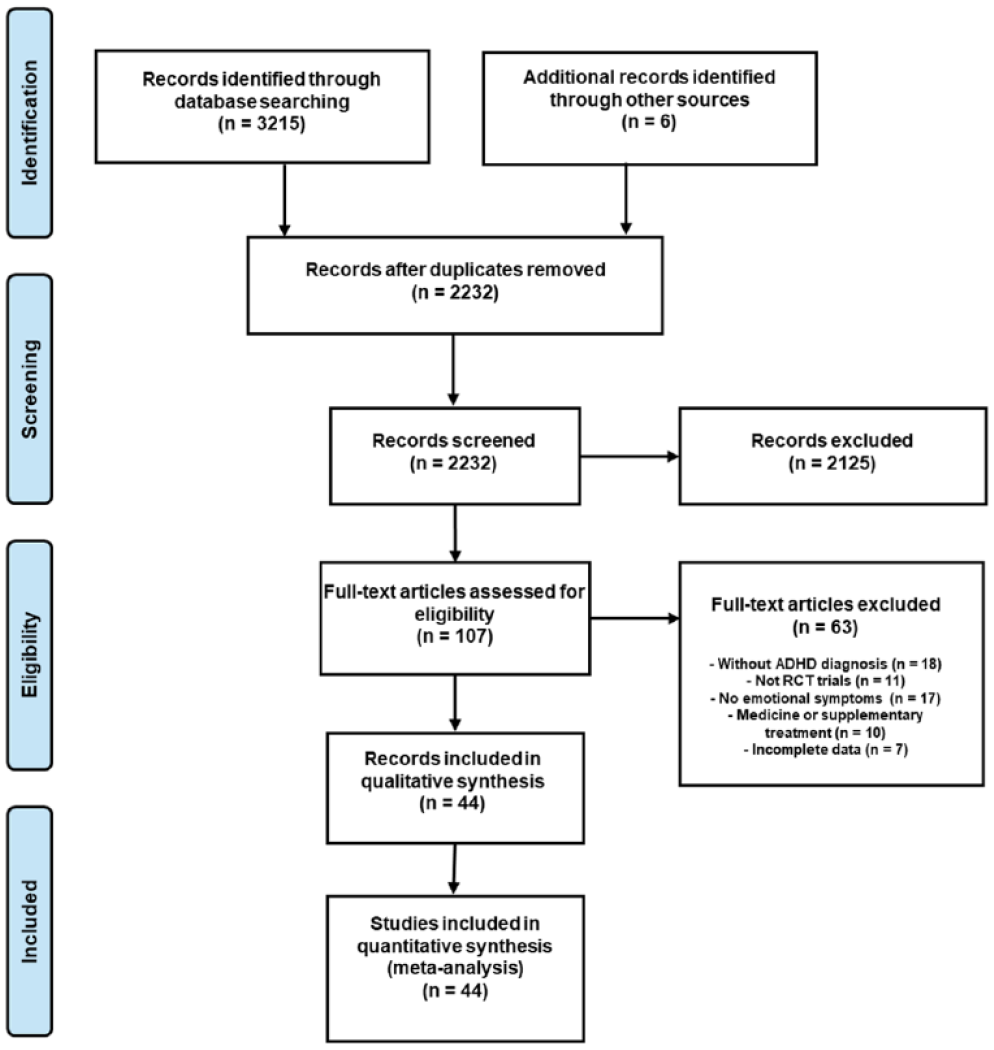
Flow diagram of selection of studies.
Characteristics of Studies Included in the Meta-Analysis.
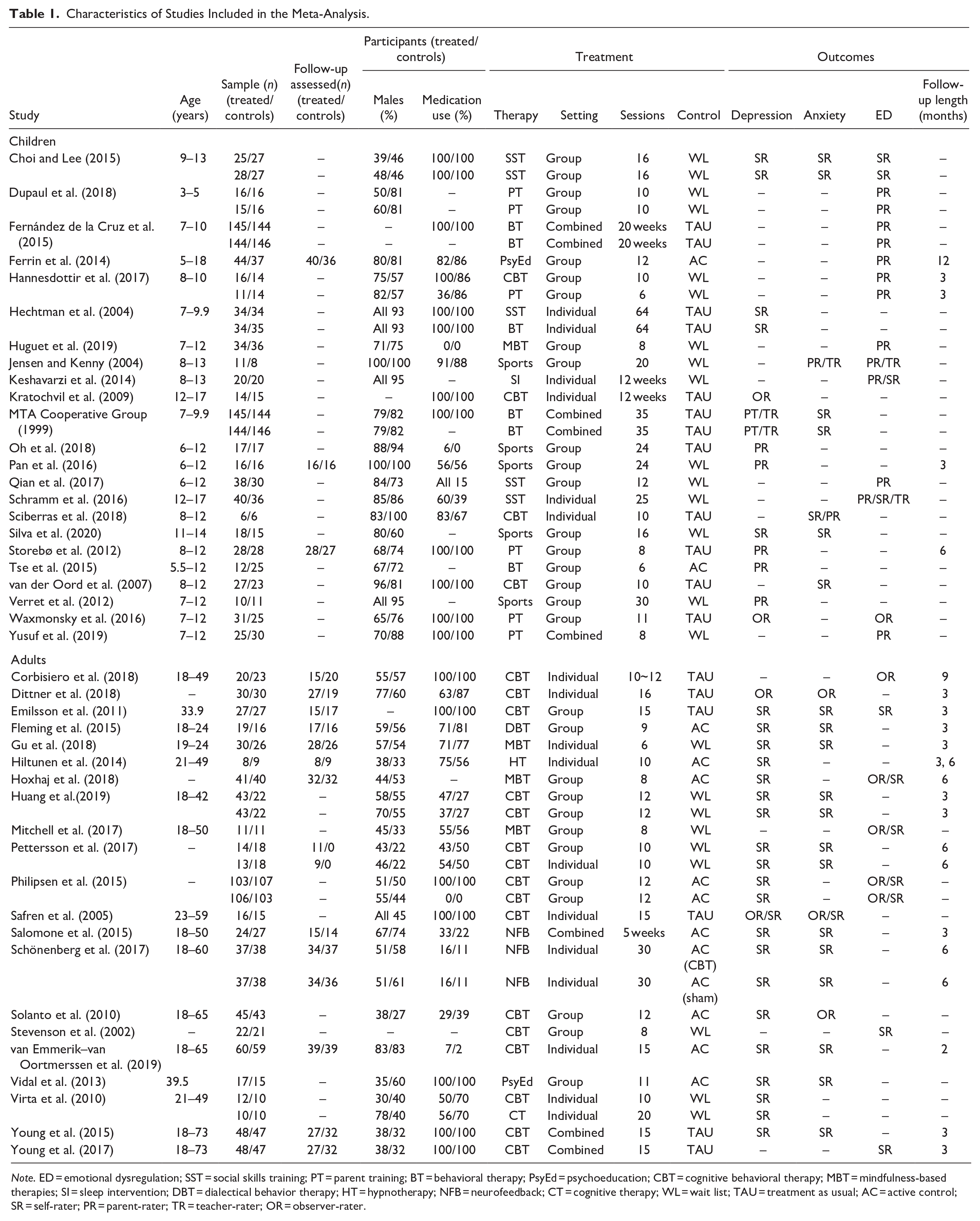
Note. ED = emotional dysregulation; SST = social skills training; PT = parent training; BT = behavioral therapy; PsyEd = psychoeducation; CBT = cognitive behavioral therapy; MBT = mindfulness-based therapies; SI = sleep intervention; DBT = dialectical behavior therapy; HT = hypnotherapy; NFB = neurofeedback; CT = cognitive therapy; WL = wait list; TAU = treatment as usual; AC = active control; SR = self-rater; PR = parent-rater; TR = teacher-rater; OR = observer-rater.
Interventions
Concerning the studies conducted with children with ADHD, a total of 21.7% (n = 5) of the treatment groups underwent PT, 21.7% (n = 5) practicing sports, a further 17.4% (n = 4) used BT, 17.4% (n = 4) CBT, and 17.4% (n = 4) SST. At the lower end, a total of 4.3% (n = 1) underwent MBT, 4.3% (n = 1) SI, and 4.3% (n = 1) psychoeducation. Regarding studies investigating adults with ADHD, a total of 61.9% (n = 13) of the treatment groups took part in CBT, 14.3% (n = 3) underwent MBT, a further 4.8% (n = 1) used DBT, 9.5% (n = 2) NFB, 4.8% (n = 1) CT, 4.8% (n = 1) hypnotherapy, and 4.8% (n = 1) psychoeducation. Three studies (children: Hannesdottir et al., 2017; Hechtman et al., 2004; adults: Virta et al., 2010) adopted two types of therapies. On average, the interventions comprised of 15.6 sessions (children: 18.0; adults: 13.0). Group and individual treatments were carried out in 56.8% (children: 65.2%; adults: 47.6%) and 29.5% (children: 21.7%; adults: 38.1%) of the studies respectively, whereas both group and individual settings were combined in 13.6% (children: 13.0%; adults: 14.3%). See Table 1 for details.
Comparison
A waiting list group was used in 40.9% (n = 18) of studies (children: n = 12; adults: n = 6) to compare with the intervention group, whereas a TAU group was adopted in 34.1% (n = 15) (children: n = 9; adults: n = 6) and an active control group 25.0% (n = 11) (children: n = 2; adults: n = 9) of studies. See Table 1 for details.
Participants
Twenty-eight studies reported depression symptoms in their patients with ADHD (children studies: 11; adult studies: 17). For the symptoms of anxiety and emotional dysregulation, there were 19 (children: 6; adults: 13) and 19 (children: 12; adults: 7) studies respectively. For depression outcomes, data from 1393 children with ADHD and 1,191 adults with ADHD at the post-treatment stage were obtained, whereas data from 87 children with ADHD and 561 adults with ADHD at the follow-up stage were obtained. For anxiety outcomes, data from 734 children with ADHD and 819 adults with ADHD at post-treatment were extracted, whereas data from 482 adults with ADHD and no children with ADHD at the follow-up stage were obtained. For ED outcomes, data from 1,450 children with ADHD and 853 adults with ADHD at post-treatment were obtained, while data from 95 children with ADHD and 251 adults with ADHD at the follow-up stage were extracted.
Among the 23 studies addressing children with ADHD, the symptoms of depression, anxiety, and ED were evaluated by either the children themselves (depression: two studies; anxiety: five studies; ED: three studies), their parents (6, 2, 10), their teachers (1, 1, 2) or the clinicians (2, 0, 1). Whereas in the 21 studies concerning adults with ADHD, the symptoms of depression, anxiety and ED were evaluated by themselves (depression: 16 studies; anxiety: 11 studies; ED: 6 studies) or the independent observers-their clinicians (2, 3, 4). See Table 1 for details.
Outcomes of Emotional Symptoms
Children with ADHD
Analysis of studies including children with ADHD revealed a small-to-moderate ES on ED (SMD = 0.34; 95% CI = [0.16, 0.51]; I2 = 57%) in the experimental group (compared with the control group) at the post-treatment stage (see Figure 2), while no effect on depression and anxiety was found at post-treatment (see Figures 3 and 4). Moreover, no effects were observed on ED and depression at follow-up (see Supplemental Figure S1 and S2).

Outcomes of emotional dysregulation (ED) for children (left) and adults (right) with ADHD at post-treatment.

Outcomes of depression for children (left) and adults (right) with ADHD at post-treatment.

Outcomes of anxiety for children (left) and adults (right) with ADHD at post-treatment.
Regarding the influence of different categories of outcome-evaluators on treatment efficacy, only a small-to-moderate ES on ED (SMD = 0.23; 95% CI = [0.08, 0.38]; I2 = 23%) was observed in data from parent-rater, while no significant effect was found from teacher-, observer-, and self-rater for post-treatment assessment (see Figures 2–4). Similarly, no significant effects on any emotional symptoms were found from the different categories of evaluators for follow-up assessment (see Supplemental Figure S1 and S2).
Adults with ADHD
Analysis of studies including adults with ADHD revealed a small-to-moderate ES on ED (SMD = 0.21; 95% CI = [0.02, 0.41]; I2 = 44%), and depression (SMD = 0.39; 95% CI = [0.22, 0.56]; I2 = 46%) (see Figures 2 and 3). No significant effect was found on anxiety at post-treatment (see Figure 4). At follow-up assessment, no significant effects on ED, depression, and anxiety were found (see Supplemental Figures S1–S3).
Regarding the data rated by the actual adults with ADHD, small-to-moderate ESs on ED (SMD = 0.22; 95% CI = [0.01, 0.44]; I2 = 21%) and depression (SMD = 0.34; 95% CI = [0.18, 0.50]; I2 = 39%) were found at post-treatment (see Figures 2 and 3), while no effect on anxiety was found (see Figure 4). From the data rated by the independent observers, a large ES on depression (SMD = 1.03; 95% CI = [0.54, 1.51]; I2 = 0%) and a moderate-to-large ES on anxiety (SMD = 0.54; 95% CI = [0.05, 1.03]; I2 = 53%) were revealed, while no effect on ED was found at post-treatment (see Figures 2–4). At follow-up assessment, no significant effects on ED, depression and anxiety were found from data by self-rater (see Supplemental Figures S1–S3). As for oberserver’s evaluation data, moderate-to-large ESs on depression (SMD = 0.74; 95% CI = [0.13, 1.35]) and anxiety (SMD = 0.76; 95% CI = [0.15, 1.37]) were observed. No effect on ED was found (see Supplemental Figures S1–S3).
Results for Each Therapy
Outcomes in Children with ADHD
Among the studies concerning children with ADHD in the present meta-analysis, the non-pharmacological treatment analyzed were: SST, PT, CBT, MBT, BT, SI, psychoeducation, and sports. The effect sizes of depression, anxiety, and ED relevant to different therapies and different raters are illustrated in the left panel of Figure 5 (for the post-treatment data) and Supplemental Figure S4 (for the follow-up data).
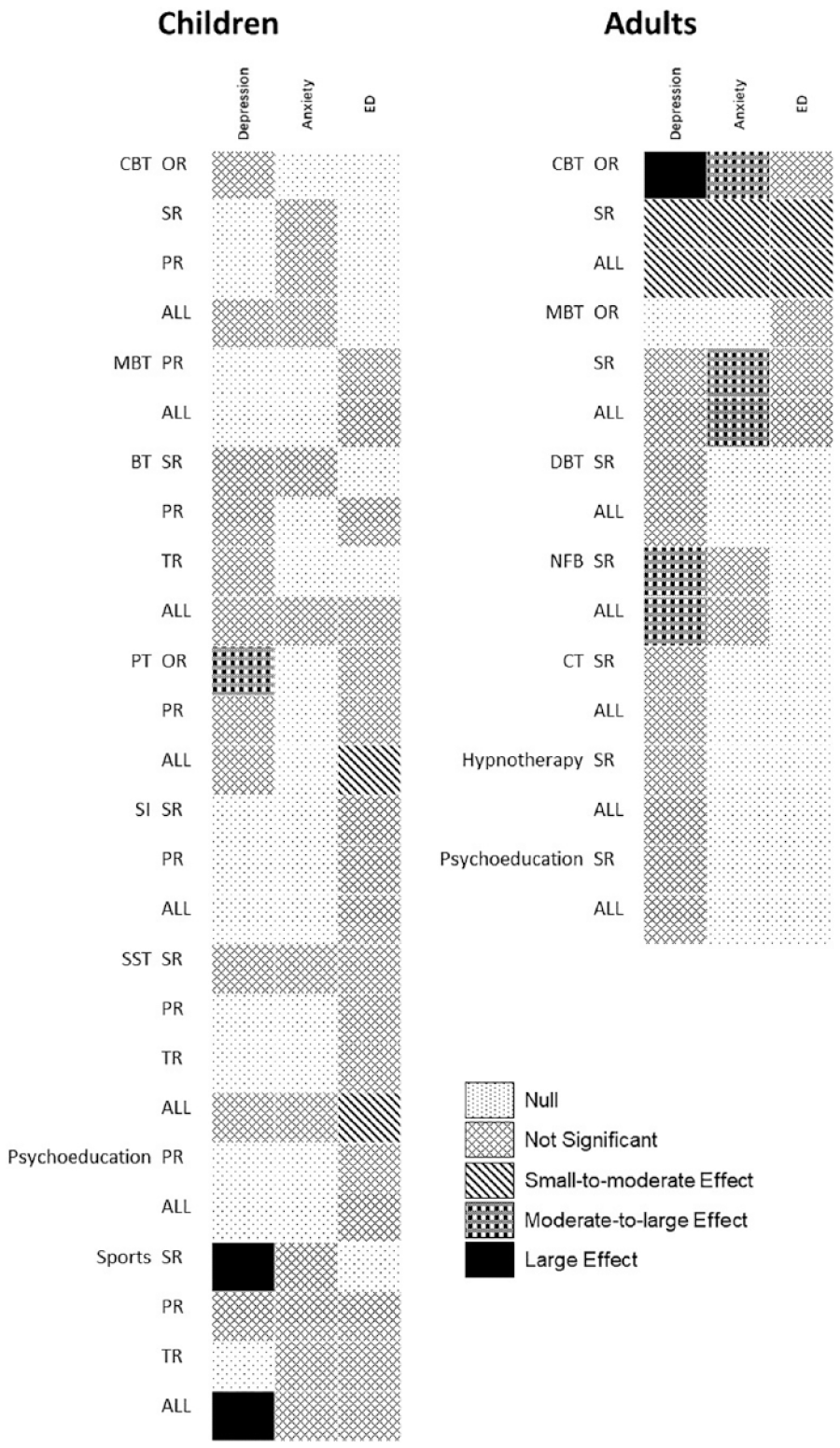
Outcomes of depression, anxiety and emotional dysregulation (ED) for children (left) and adults (right) with ADHD with different therapies at post-treatment.
PT
A small-to-moderate ES on ED (SMD = 0.49; 95% CI = [0.10, 0.88]; I2 = 39%) in the experimental group (compared with control group) was found at post-treatment assessment. No other significant effect was found in PT treatment during the post-test. As for categories of evaluators, a moderate-to-large ES on depression (SMD = 0.58; 95% CI = [0.03, 1.13]) from data rated by observers was found at post-treatment.
SST
A small-to-moderate ES on ED (SMD = 0.49; 95% CI = [0.07, 0.91]; I2 = 77%) was found at post-treatment. No other significant effect was found regarding data of specific types of evaluators.
Sports
A large ES on depression (SMD = 0.81; 95% CI = [0.08, 1.55]; I2 = 66%) was found at post-treatment. Regarding outcome assessment from different evaluators, a large ES on depression (SMD = 2.33; 95% CI = [1.14, 3.52]) from data of self-rater was found at post-treatment.
Others
No significant effects in other types of therapies at post-treatment were found. Importantly, for all therapy types, no significant effects were found at follow-up.
Outcomes in adults with ADHD
The non-pharmacological treatments for adults with ADHD in this review included CBT, MBT, DBT, NFB, CT, hypnotherapy, and psychoeducation. The effect sizes of depression, anxiety, and ED with different therapies and from different raters are shown in the right panel of Figure 5 (for the post-treatment) and Supplemental Figure S4 (for the follow-up).
CBT
Small-to-moderate ESs on ED (SMD = 0.26; 95% CI = [0.06, 0.45]; I2 = 34%), depression (SMD = 0.42; 95% CI = [0.19, 0.66]; I2 = 41%), and anxiety (SMD = 0.33; 95% CI = [0.15, 0.50]; I2 = 7%) were found at post-treatment. Regarding the outcomes from different evaluators, small-to-moderate ESs on ED (SMD = 0.30; 95% CI = [0.03, 0.57]; I2 = 39%), depression (SMD = 0.30; 95% CI = [0.09, 0.51]; I2 = 18%), and anxiety (SMD = 0.27; 95% CI = [0.08, 0.47]; I2 = 0%) were observed on data from self-rater at post-treatment; whereas a large ES was found on depression (SMD = 1.03; 95% CI = [0.54, 1.51]; I2 = 0%) and a moderate-to-large ES on anxiety (SMD = 0.54; 95% CI = [0.05, 1.03]; I2 = 53%) rated by observers at post-treatment.
As for follow-up assessment, a moderate-to-large ES on depression (SMD = 0.59; 95% CI = [0.04, 1.15]; I2 = 75%) and a small-to-moderate ES on anxiety (SMD = 0.47; 95% CI = [0.12, 0.82]; I2 = 47%) were found. Concerning the effect of categories of evaluators, moderate-to-large ESs were observed on depression (SMD = 0.74; 95% CI = [0.13, 1.35]) and anxiety (SMD = 0.76; 95% CI = [0.15, 1.37]) rated by independent observers, while a large ES was found in self-rated ED (SMD = 0.85; 95% CI = [0.41, 1.30]; I2 = 0%).
MBT
A moderate-to-large ES on anxiety (SMD = 0.75; 95% CI = [0.20, 1.31]) was found at post-treatment and from self-rater. No other significant effects were found at post-treatment or follow-up assessment.
NFB
A moderate-to-large ES on depression (SMD = 0.65; 95% CI = [0.04, 1.25]; I2 = 74%) was found at posttreatment assessment rated by the actual participants. No other significant effects were found at post-treatment or follow-up assessment.
Others
No significant effects were found in other therapies at both post-treatment and follow-up stages.
Risk of Bias Assessment
Most outcomes of “blinding of participants and personnel” (performance bias) and “blinding of outcome assessment” (detection bias) were rated with a high risk of bias. Several studies in each of the following outcomes were rated with a high risk of bias: random sequence generation (selection bias) (Hannesdottir et al., 2017; Jensen & Kenny, 2004; Silva et al., 2020; Tse et al., 2015; Verret et al., 2012), allocation concealment (selection bias) (Hannesdottir et al., 2017; Jensen & Kenny, 2004; Tse et al., 2015; Verret et al., 2012), incomplete outcome (attrition bias) (Dittner et al., 2018; Hechtman et al., 2004; Huang et al., 2019; Kratochvil et al., 2009; Solanto et al., 2010), selective reporting (reporting bias) (Dittner et al., 2018). Additional outcomes from 16 studies were rated with a high risk of other bias. The risk of bias assessment is shown in Supplemental Figures S5 and S6.
Publication Bias
Funnel plots and Egger’s Tests were used to assess the publication bias of emotional symptoms at post-treatment. While at follow-up, only the publication bias of depression and anxiety in adults with ADHD was calculated since less than 10 studies reported ED symptoms. A significant effect (p = .025) concerning publication bias on ED at post-treatment was found in adults with ADHD. As for depression and anxiety in adults with ADHD and all emotional symptoms in children with ADHD, no significant publication bias (see Supplement 1) was observed (all ps > .05).
Subgroup Analysis
The studies reviewed in the present meta-analyses contained evaluations of non-pharmacological interventions assessed by distinct evaluators, such as the participants themselves, their parents, teachers, and clinicians. As a result, different subgroups of evaluators might lead to outcome differences in emotional symptoms. Thus, we performed a subgroup analysis on depression, anxiety, and ED for children and adults with ADHD respectively. Consequently, subgroup differences were found on evaluation of depression (χ2 = 7.08 (df = 1), p < .01; I2 = 85.9%) in studies of adults with ADHD at post-treatment. No other significant subgroup differences were found in evaluation concerning children with ADHD and adults with ADHD at post-treatment and follow-up assessment.
Sensitivity Analysis
Given the high heterogeneity of the outcomes, we examined the stability of the results using sensitivity analysis. High heterogeneities (above 50%) were found on depression and ED in children and anxiety in adults with ADHD at post-treatment and depression and anxiety in adults with ADHD at follow-up. When excluding the study by Silva et al. (2020), the heterogeneity on depression in children with ADHD largely decreased (from I2 = 52% to I2 = 21%) at post-treatment. When excluding the data on emotional management in Choi and Lee (2015), the heterogeneity on ED in children with ADHD also dropped substantially (from I2 = 57% to I2 = 0%) at post-treatment. When excluding the data in Schönenberg et al. (2017), the heterogeneity on anxiety in adults with ADHD largely decreased (from I2 = 73% to I2 = 44%) at post-treatment. For adults with ADHD at follow-up, the heterogeneity on anxiety reduced greatly (from I2 = 93% to I2 = 44%) when excluding the data in Schönenberg et al. (2017), while no substantial decrease of heterogeneity appeared on depression regardless of the data excluded.
Discussion
The present meta-analysis is the first attempt to systematically review non-pharmacological interventions on emotional symptoms in children and adults with ADHD. We found that CBT demonstrated efficacy in the improvement of emotional symptoms in adults with ADHD, at both post-intervention and follow-up across self-reported and observer-reported conditions, which is consistent with previous review and meta-analyses studies (Jensen et al., 2016; Lopez et al., 2018; López-Pinar et al., 2020). As for children with ADHD, only certain therapies targeting the relationship between children and others such as PT (on ED and depression) and SST (on ED) were shown to be effective to relieve emotional symptoms. In addition, sports intervention also benefited the improvement of depression in children with ADHD at post-intervention. These findings suggest that the efficacy of non-pharmacological interventions can vary substantially between children and adults with ADHD. This information bears critical implications when choosing an appropriate intervention for children with ADHD.
Our results revealed that CBT improved comorbid depression, and/or anxiety, and/or ED in adults with ADHD when testing at post-treatment and follow-up, and when the outcomes were evaluated by the patients themselves or an independent observer. These findings are in line with previous meta-analyses studies of adults with ADHD (Jensen et al., 2016; Lopez et al., 2018; López-Pinar et al., 2020), which consistently supported the efficacy of CBT in improving comorbid emotional symptoms (i.e., depression, anxiety, and ED). However, we did not detect the efficacy of CBT in alleviating the emotional symptoms in children with ADHD. The reason, we speculate, might be due to the need for a more developed and mature brain to assimilate the therapy components included in CBT, such as cognitive therapy and problem-solving skills. As a result, CBT did not exert an obvious influence on children with ADHD. Of note, these findings need to be interpreted with caution, as only three CBT studies including children with ADHD were adopted in the present meta-analysis.
As for adults with ADHD, we found that NFB presented moderate-to-large ES on depression at post-treatment, in line with the fact that neurofeedback therapy tends to normalize brain activity through modulation by operant learning procedures, leading to improvements in cognitive and behavioral functioning (Mayer et al., 2016). Although many studies have explored the effectiveness of NFB in children with ADHD (Arns et al., 2014), dedicated studies are yet to investigate concomitant emotional symptoms. As for the MBT, we found only moderate-to-large ES on anxiety at the post-intervention outcome in adults with ADHD, which is consistent with a recent meta-analysis (López-Pinar et al., 2020). Meanwhile, no significant effect was found for MBT in children with ADHD in our meta-analysis, as only one study adopted this type of therapy with children (Huguet et al., 2019).
As for children with ADHD, PT and SST were found to be efficacious in the outcomes of ED. Specifically, both PT and SST led to a small-to-moderate ES on ED, however, only at post-intervention, and not at follow-up. Researchers claim that the type of parenting style and the state of parental mental health are risk factors for ADHD symptoms, and could worsen negative performance in children with ADHD (Bhide et al., 2017, 2019; Modesto-Lowe et al., 2008). A specific non-pharmacological intervention created to address the abovementioned parental risk factors, namely, parental training, was designed to relieve the symptoms of ADHD in children by training their parents (Pliszka & AACAP Work Group on Quality Issues, 2007; Zwi et al., 2011). Studies showed that after undertaking the PT program, the emotional symptoms (e.g., depression, anxiety) of parents of children with ADHD improved (Barlow et al., 2014; Reichow et al., 2013). Interestingly, we observed in the present meta-analysis a small-to-moderate effect on ED following PT intervention. These findings are in line with an early study that demonstrated that PT was effective for the improvement of ADHD symptoms and emotional symptoms in children with ADHD (Webster-Stratton et al., 2011). Similarly, parenting style was also found to be associated with emotion regulation ability in children (Azhar et al., 2019; Feng et al., 2009). Taken together, the improvement in emotion regulation in children with ADHD after PT intervention (Webster-Stratton et al., 2011), was likely due to parents’ newly learned strategies of emotional regulation which encouraged the children to practice the new skills outside the therapy room (Huang et al., 2015). As a result, as parenting style and emotional regulation ability of parents of children with ADHD improved, the children also benefited from their increase in the ability of emotional regulation (Doan et al., 2018).
Social skills training aims at improving the social skills needed to decrease disruptive or offensive behavior, and increase positive behavior to promote social interaction with peers (Pfiffner & McBurnett, 1997). In SST, emotional regulation is an important ability for social interaction, therefore most SST programs also contain training of emotion regulation (Willis et al., 2019). The results of the present meta-analysis study showed that SST improved ED in children with ADHD. This finding is in accordance with an earlier study demonstrating the effectiveness of SST combined with parent training on depression and anxiety symptoms in children with ADHD (Huang et al., 2015).
Besides PT, the present meta-analysis also demonstrated that sports can be an effective treatment for depression in children with ADHD. This finding is consistent with several studies that found an improvement in depression following sport intervention in children with ADHD (Den Heijer et al., 2017; Kvam et al., 2016; Silva et al., 2020). For example, a swimming-learning program was found to significantly improve depression and stress in children with ADHD (Silva et al., 2020). Moreover, the current result was also in line with a systematic review (Den Heijer et al., 2017), which showed that cardio exercise was effective in improving depression and anxiety in children with ADHD.
Taken together, PT (on depression and ED), SST (on ED), and sports (on depression) were found to be effective in alleviating the emotional symptoms in children with ADHD, while CBT (on depression, anxiety, and ED), MBT (on anxiety), and NFB (on depression) were shown to be effective in adults with ADHD. This difference might be caused by the more developed brain and mature cognitive function in adults compared with children, to the extent that cognition and brain-based therapies (e.g., CBT, NFB) take effect only in adults but not in children with ADHD, whereas relationship and social-based therapies (e.g., PT, SST) are more efficacious in the latter. The same reason may explain why certain improvement of emotional symptoms (e.g., depression, anxiety) could persist for some time (i.e., to the follow-up stage) in adults with ADHD, while no long-term effect was found in children with ADHD. It is worth noting that no studies adopting sports intervention in adults with ADHD were included in the present meta-analysis, thus sports efficacy on depression was revealed only in children with ADHD. On this note, we highlight that future investigations focusing on sports intervention on emotional outcomes in adults with ADHD are needed. Furthermore, the present meta-analysis revealed no significant efficacy of the remaining non-pharmacological therapies, such as DBT, CT, BT, SI, PsyEd, and hypnotherapy, neither for children nor for adults with ADHD, a result consistent with recent meta-analysis findings regarding adults with ADHD (López-Pinar et al., 2020). Importantly, given the limited availability of trials for these therapies, these results must be interpreted with caution.
Regarding the meta-analysis of outcome evaluation, we found that different categories of raters led to different assessment results. For example, data reported by the actual participants and independent observers (the clinicians) resulted in different efficacy evaluation of CBT on emotional symptoms in adults with ADHD. As for children with ADHD, a significant difference was also found between self-reported and independently-assessed measures. These differences may be due to “positive illusory bias” in studies with children with ADHD (Hoza et al., 2002; Owens et al., 2007) and expectations/beliefs for improvement in ADHD symptoms by the participants themselves and close others (e.g., the parents and teachers) (Sonuga-Barke et al., 2013). Finally, another important finding was that publication bias indicators were found only for ED in post-treatment of adults with ADHD. The rest of the outcomes were free from publication bias in studies including children and adults with ADHD, thus supporting the validity of the results, which is consistent with recent meta-analysis works (Lopez et al., 2018; López-Pinar et al., 2020).
Furthermore, we found a significant effect size of CBT on ED in adults with ADHD, and significant effect sizes of PT and SST on ED in children with ADHD. Of note, emotional regulation is crucial for social interaction (Bunford et al., 2018; Cleminshaw et al., 2020), and emotional dysregulation is also an important emotional symptom in patients with ADHD, suggested by some scholars as a potential core symptom of ADHD (Barkley & Murphy, 2010; Shaw et al., 2014). Restate, the present meta-analysis demonstrated the effect of PT and SST interventions on the improvement of ED for children with ADHD. This indicates that enhancing the ability of emotional regulation in ADHD children, and helping them efficiently manage their emotions might benefit their mental health and improve ADHD core symptoms (i.e., inattention, hyperactivity, impulsivity).
As a first attempt to meta-analyze the efficacy of various non-pharmacological interventions on emotional comorbidity in children with ADHD, we must acknowledge some limitations in this review. First, a crucial limitation concerns the relatively small number of studies addressing some types of interventions (e.g., SI, BT, MBT, NFB, PsyEd, CT, and hypnotherapy). Therefore, the interpretation and generalizability of the results concerning these therapies should be interpreted with caution. Consequently, the field calls out for more research on these interventions to explore their efficacy on emotional symptoms. Second, methodological differences in the designs of the included studies, such as outcome measure source, control group type, individual-group setting, evaluator source, and the length of post-intervention and follow-up might be partially responsible for the differential efficacy observed in different therapies. Third, the high risk of bias assessment on most outcomes might weaken the validity of results, as most outcomes were evaluated by the ADHD patients themselves or the parents of ADHD children. To address this issue, more independent and blinded observer-rated outcomes should be adopted in future research. Finally, we did not investigate the relationship between core ADHD symptoms and emotional comorbidity. Future meta-analysis studies should consider exploring this issue in children with ADHD using moderator analyses, adopting a similar approach used in a recent meta-analysis work on adults with ADHD (López-Pinar et al., 2020).
Conclusion
The present meta-analysis aimed to determine the efficacy of different types of non-pharmacological therapies on emotional symptoms in children as well as in adults with ADHD. Our findings suggest that effective non-pharmacological interventions for children and adults with ADHD are substantially different between the two groups. In children with ADHD, the PT and SST designed to improve the relationship and social interaction skills proved to be an effective intervention; while CBT, NFB, and MBT were shown to be effective in adults with ADHD. Our findings demonstrated that the non-pharmacological intervention on ED in children with ADHD should be different from that used in adults. That is, while adults might benefit from more complex forms such as CBT, children with ADHD will benefit from more intuitive non-pharmacological interventions involving social relationships and interaction skills.
Supplemental Material
sj-docx-1-jad-10.1177_10870547211001953 – Supplemental material for Efficacy of Non-pharmacological Treatments on Emotional Symptoms of Children and Adults with Attention-Deficit/Hyperactivity Disorder: A Meta-Analysis
Supplemental material, sj-docx-1-jad-10.1177_10870547211001953 for Efficacy of Non-pharmacological Treatments on Emotional Symptoms of Children and Adults with Attention-Deficit/Hyperactivity Disorder: A Meta-Analysis by Chao Guo, Leonardo Assumpcao and Zhiguo Hu in Journal of Attention Disorders
Footnotes
Declaration of Conflicting Interests
The author(s) declared no potential conflicts of interest with respect to the research, authorship, and/or publication of this article.
Funding
The author(s) disclosed receipt of the following financial support for the research, authorship, and/or publication of this article: This work was supported by the Natural Science Foundation of Zhejiang Province of China (Grant No. LY19C090001).

Supplemental Material
Supplemental material for this article is available online.
Author Biographies
References
Supplementary Material
Please find the following supplemental material available below.
For Open Access articles published under a Creative Commons License, all supplemental material carries the same license as the article it is associated with.
For non-Open Access articles published, all supplemental material carries a non-exclusive license, and permission requests for re-use of supplemental material or any part of supplemental material shall be sent directly to the copyright owner as specified in the copyright notice associated with the article.
