



Abstract
Almost 30% of ADHD adults do not respond to standard pharmaceuticals. Transcranial direct current stimulation (tDCS) is a method for modulation of cortical excitability. On the other hand, dialectical behavioral therapy (DBT) is a cognitive-behavioral approach that might be utilized for adults with ADHD. The effects of integration of these interventions are only beginning to be explored. In the present work, we used both subjective and objective measures to investigate the effects of tDCS, DBT, and the integration of the two in treating adult ADHD symptoms. A total of 80 adults with ADHD (63 females, 17 males) participated in the study and were grouped into control, DBT, tDCS, and combined groups. Based on the observed results, the combination of DBT and tDCS was significantly effective in improving the mentioned variables compared to administration of each method in isolation. The results are discussed in terms of neurophysiological and psychological aspects of treatment methods.
Introduction
Attention-deficit hyperactivity (ADHD) disorder is a prevalent problem that is considered for individuals with decreased age-adjusted attentional processing and/or hyperactivity-impulsivity (Danielson et al., 2018; Wolraich et al., 2019). The global prevalent of persistent adult ADHD is recently reported to be 2.58% and that of symptomatic adult ADHD is 6.76% (Song et al., 2021). Almost 30% of ADHD adults do not respond to standard pharmaceuticals (Torgersen et al., 2008). Although several medications (stimulant and non-stimulant) for ADHD have been shown to be effective in symptom reduction (Mészáros et al., 2009), these interventions might have significant adverse effects that, in some cases, lead to discontinuation of drug administration (Zetterqvist et al., 2013). Depending on the severity of the disorder, even the responders to medication may continue to experience significant symptoms. Moreover, administration of drugs without considering alternative methods of treatment may not be enough for amelioration of ADHD symptoms (Druedahl & Kälvemark Sporrong, 2018; Kinsbourne et al., 2001). Hence, investigating new non-medication interventions for ADHD is of interest for the field.
Transcranial direct current stimulation (tDCS) is a method for modulation of cortical excitability (Salehinejad et al., 2020). Despite vast amount of research on the effects of the tDCS on attention and working memory in healthy and clinical populations, the possible influence of this method on adult ADHD is still not clear (Jacoby & Lavidor, 2018; Westwood et al., 2021). On the other hand, dialectical behavioral therapy (DBT) is a cognitive-behavioral approach developed for the treatment of borderline disorder that can be modified for treatment of ADHD (Fullen et al., 2020). In addition, emerging data supports using both behavioral skills training and neurophysiological for maintaining the compensatory skills, in addition to targeting cortical structures for optimal treatment of ADHD in adults (Ditye et al., 2012). Even though, the effects of tDCS and cognitive training have been investigated separately, the effects of integration of these interventions are only beginning to be explored (Ditye et al., 2012; Kadosh et al., 2010). In the present work, we have used ADHD self-report scale, Stroop Test, Continuous Performance Test, and Emotion Regulation Difficulty Scale to investigate the effects of tDCS, DBT and the integration of the two in treating adult ADHD symptoms from subjective and objective measures. These measures were selected to explore the effects of treatments on self-reports, selective attention, and response inhibition, sustained attention and emotion regulation. Before reporting our results, we shall hereby present a summary of the research that motivated the current work.
The Effects of tDCS on Adult ADHD
tDCS is considered to be a non-invasive brain modulation method that is centered on cortical excitability by applying a weak current through the scalp. The modulation of cortical excitability depends on the polarity (anodal or cathodal stimulation) of electrodes. It is suggested that, in general, the anodal stimulation increases excitability of neural populations while the cathodal stimulation decreases it (Nitsche & Paulus, 2000). This intervention method has been successful in improving behavioral inhibition (Beeli et al., 2008; Mayer et al., 2020), and attentional processing (Westwood et al., 2021). Previous research (Jacobson et al., 2011) reported that unilateral anodal stimulation with tDCS over the right inferior gyrus enhanced inhibitory processes as assessed by a stop signal task (Verbruggen et al., 2008). Prehn-kristensen et al. (2014) demonstrated that tDCS improves declarative memory performance as well as enhanced reaction times in a go/no go task in individuals with ADHD (Prehn-Kristensen et al., 2014). The enhancement of inhibitory control and attention with tDCS has been investigated and the results indicated anodal stimulation improves these measures. Further work, indicated that resting state EEG showed decreased Theta (3–7 Hz) activity compared to sham stimulation, reflecting improved attention (Jacobson et al., 2012). Functional imaging and EEG studies report a network consisting of cortical areas and subcortical regions that are related to ADHD populations. As an example, Li et al. (2006), showed that efficient response inhibition was linked with increased cortical activity in frontal areas (Li et al., 2006). In short, in many studies it is reported that the dorso-lateral prefrontal cortex (DLPFC) is involved in behavioral control and attentional processes and dysregulation of these cortical areas contribute to ADHD symptoms observed in children and adults.
DBT and Adult ADHD
Given the fact that prior works support a neurophysiological bases for ADHD, several research point to the conceptual aspects of the disorder. In line with recent theories concerning ADHD, the neurophysiological impairments produce disruptions in higher order levels of cognitive processing including organization and planning strategies. The interaction of these two underlying problems led researchers to also focus on compensatory behavioral strategies in order to treat adult ADHD (Ramsay & Rostain, 2014). The preliminary psychotherapy reports in adults with ADHD were centered on insight-oriented psychotherapy (Ratey et al., 1992). However, these methods were unsuccessful and suggested the need for structured interventions. DBT was initially used for treatment of chronic suicidal behaviors and borderline personality disorder (BPD). It has been reported to be effected in a broader range of disorders that are associated with emotional and behavioral dysregulations (Koerner & Dimeff, 2007). Since BDP and ADHD share several behavioral aspects including impulsivity and emotion dysregulation, DBT, which is a cognitive-behavioral approach, was thus adapted for the treatment of adult ADHD (Hesslinger et al., 2002; Philipsen et al., 2007). Based on the analysis of pre and post-tests, participants in DBT group compared to the control demonstrated improvements on self-scale reports and a check-list of ADHD symptoms (Hesslinger et al., 2002). The following work that was conducted with a larger sample (N = 66), also indicated significant decrease in self-report scales of ADHD symptoms and other related measures (Philipsen et al., 2007). Since then several authors reported the effectiveness of DBT for adults with ADHD (Bayat et al., 2019; Hirvikoski et al., 2011; Morgensterns et al., 2016; Narimani et al., 2014; Philipsen et al., 2010). Overall, given the effectiveness of DBT, skill training might be an appropriate intervention for treatment of ADHD.
Current Work
A promising avenue for stepping up treatment is the combination of tDCS with psychotherapy methods. The combination of these methods is encouraging from both practical and mechanical perspectives. From a practical point of view, the combination of tDCS and cognitive-behavioral therapy methods such as DBT is feasible and safe. From a mechanistic point of view, we might obtain additive effects of both methods in terms of bottom-up and top down modulations. That is to say, when a specific neural network (bottom-up modulation) that is related to psychological aspects of interest (top down) is modulated, the combination of methods may lead to synergic effects (Spagnolo et al., 2020). As far as we know, only one research was focused on the efficacy of concurrently combining tDCS with a neurobehavioral method. The authors of this work report that application of left DLPFC tDCS in conjunction with cognitive training showed decreased impulsivity rates (Allenby et al., 2018). Due to a paucity of data in this line of research, we aimed to investigate the clinical outcomes of treating adult ADHD by combining two interventions of tDCS and DBT. We also explored whether the administration of combined methods might lead to optimized results when compared with conduction of each method separately. Therefore, the main research question was whether tDCS as an add-on therapy to DBT in adults with ADHD could produce greater significant improvements as measured by several scales, when compared to DBT and tDCS alone.
Methods and Materials
Participants
The study population included 580 patients who referred to the Psychotherapy and Counseling Center of Shiraz University in 2020. A total of 120 patients were given a written explanation of the study and were suggested to participate in the project. After conducting a structured clinical interview (based on DSM-V) under the supervision of a psychiatrist and psychologist and having inclusion criteria, a total of 80 adults with ADHD (63 females, 17 males) aged between 18 to 45 (mean age = 23.5; SD = 2.9) participated in the study. The inclusion criteria were receiving a diagnosis of ADHD and the ability to collaborate on the research project. Based on the structured clinical interview (DSM-V), potential participants meeting any of the following criteria were excluded from the study: any contraindication to receive tDCS, any comorbid neurologic or psychiatric disorder (such as comorbid depression, anxiety etc.) other than ADHD, history of substance abuse within the past 6-months and receiving other psychological and medication-based treatments at the same time. A simple randomization method based on a single sequence of random assignments was used. For this purpose, a computer-generated table containing random numbers was employed. The participants were then randomly assigned into four groups, each containing 20 participants (three experimental groups and one control group). The control group did not receive any treatments. The three experimental groups consisted of DBT, tDCS, and combined treatment groups. Because of the local ethical considerations, it was not possible for us to have a sham tDCS group. All participants provided informed consent. All of the procedures of the study were approved by the Local Committee and carried out in accordance with the Declaration of Helsinki.
Materials
The following psychometric scales were used to measure changes in terms of clinical improvement:
ADHD self-report scale (ASRS)
The ASRS was developed in conjunction with revision of the WHO Composite International Diagnostic Interview (CIDI) (Kessler et al., 2005). The ASRS consists of 18 questions about frequency of recent DSM-IV symptoms of adult ADHD. It is considered a validated tool for assessment of ADHD in individuals aged 18 or older. This scale has a sensitivity of 87% and the specificity of the questionnaire in identifying the symptoms of adult ADHD is reported to be 98.3% to 99.5% (Hines et al., 2012).
Stroop test (ST)
An experimental trial-by trial version of the ST (Erdodi et al., 2018; Jensen, 1965) was employed. Stimuli consisted of 48 congruent and incongruent colored (green, yellow, and blue) words. The participants were instructed to indicate the color of the words by pressing a key. Each stimuli were presented for 2 seconds with inter-stimuli intervals of 800 ms.
Continuous performance test (CPT)
The CPT is one of the most frequently used measure of attention and is of importance in identifying ADHD in adults (Beck et al., 1988; Lev et al., 2022). A computerized version of the CPT including 150 stimuli (containing 30% of targets) was presented to the participants. The participants had to press when seeing targets and inhibit their response when non-targets were presented to them.
Difficulties in Emotion Regulation Scale (DERS)
One of the commonly administered measure of emotional dysregulation is DERS. The DERS psychometric properties were initially evaluated with adult samples (Gratz & Roemer, 2004). The scale contains 36 questions that are answered with a Likert scale. The six subscales that are measured in this test include rejection of emotional responses, difficulty in performing purposeful behavior, difficulty in controlling impulse, lack of emotional awareness, limited access to emotional regulation strategies, and lack of emotional clarity (Evren et al., 2018).
Treatments
tDCS Administration
A battery driven stimulator (Mindalive, Canada) was used to deliver the direct current with intensity of 1.5 mA through two conductive electrodes (5 × 7 cm) that was covered with soaked sponges. The anodal and cathodal sites (F3/F4) were determined in accordance with 10 to 20 International EEG systems corresponding to left and right DLPFCs. The protocol included anodal and cathodal stimulation of F3 and F4, respectively. This configuration of anodal and cathodal stimulation placed at left and right DLPFC respectively (F3 and F4 electrodes) has been demonstrated to be ideal for cognitive and behavioral problems such as ADHD (Guimarães et al., 2021). In addition, the most studies on the tDCS effects on ADHD patients used this stimulation configuration (Finisguerra et al., 2019; Nejati et al., 2022; Sotnikova et al., 2014). Each session lasted 20 minutes and were carried out for 10 sessions. There was a 72 hour interval between sessions. The participants were unaware of the type of stimulation. All participants in the tDCS and combined groups received anodal and cathodal stimulation. The total period of tDCS treatment was 30 days.
DBT protocol
Individual DBT sessions (N = 10) were carried out at the start of tDCS administration and lasted 10 weeks. The sessions were conducted once a week, for 1 to 1.5 hours. Weekly psychotherapy sessions began with exploring an event or problematic behavior and reviewing the suggested solutions that have been used and the factors that the clients seek. The complete protocol of DBS sessions that were conducted for the DBS and combined groups are presented in Table 1.
The Protocol of DBT Carried Out for DBT and Combined Groups.

Procedure
An ethical code from the Local Authorities was obtained (registered at ethics.research.ac.ir with No. IR.SUMS.REC.1398.781). Then, structured interviews according to DSM-5 were used to screen a sample of the statistical population. The sample was then grouped into the aforementioned groups. After assignment in the groups, the stage of pre-tests was performed and all participants completed the measures introduced in the Materials section. Then, each experimental group (tDCS alone, DBT alone and combination of the two) received the related treatment protocol. After the intervention, post-tests were carried out for all four groups (Figure 1).
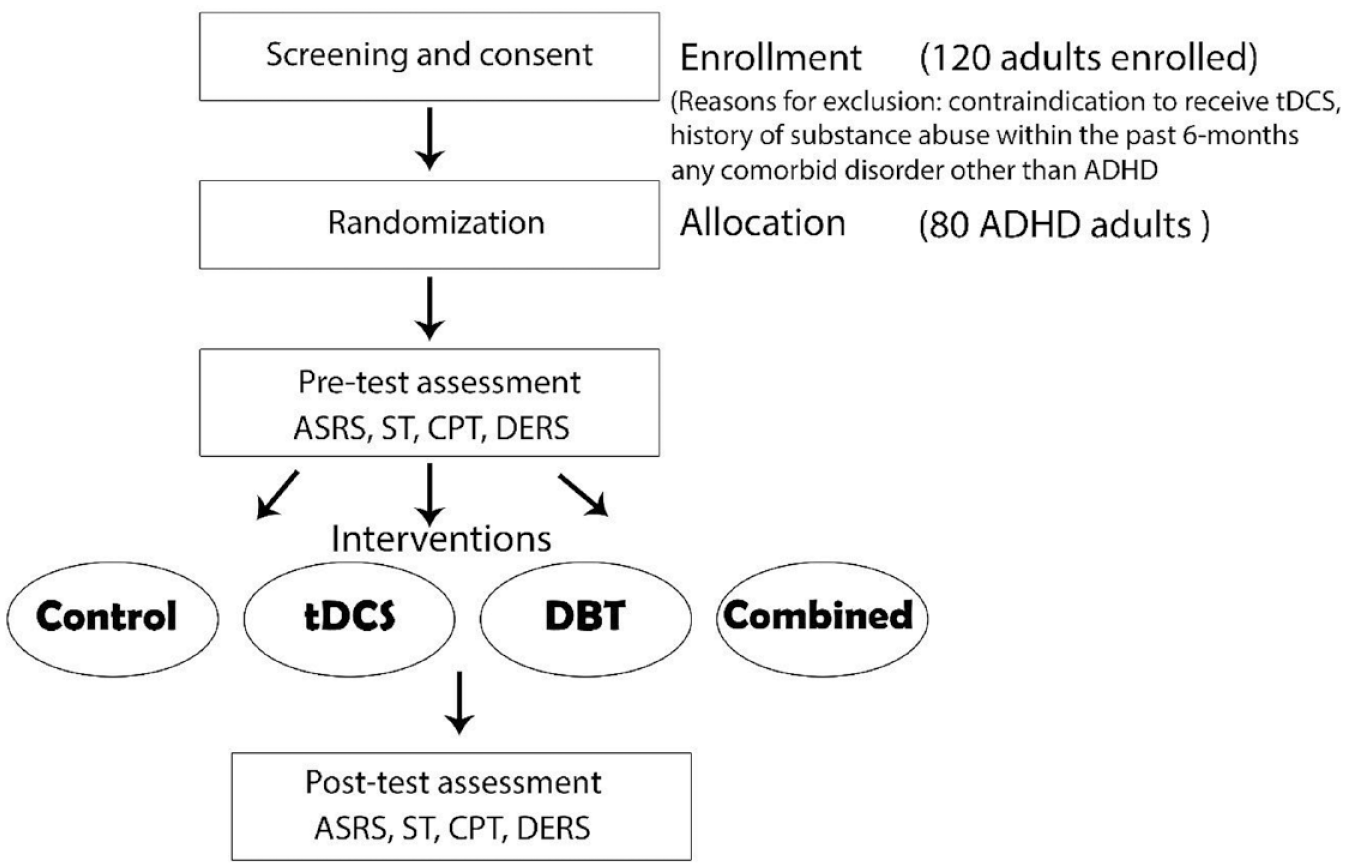
Overview of the study design.
Results
For the statistical analysis, the data were analyzed using SPSS ver. 21. The independent variables included DBT, tDCS, and combined treatments and self-report scale, selective attention and response inhibition, sustained attention and emotion regulation were considered as dependent variables as measured by the related scales (ASRS, ST, CPT, DERS). An analysis of MANCOVA was conducted considering groups (Control, DBT, tDCS, and combined) as between-subject factor and ASRS, ST, CPT, and DERS as within-subject factors.
The main effect of group was found to be significant in all dependent variables (F [18, 175] = 7.96, p = .001, η2 = .0507). It means that in the post-test phase, at least in one dependent variables there was a significant difference among the groups. Further analysis of ANCOVA revealed significant difference in ASRS hyperactivity in four groups (F [1, 3] = 9.75, p = .001). Post-hoc analysis of multiple comparisons indicated that the effect of DBT was significant compared to control in ASRS hyperactivity scale (SD = 0.945, p = .002, η2 = .462) as presented in Figure 2a. However, tDCS group did not reflect significant results in terms of hyperactivity scale in ASRS (SD = 0.886, p = .624). The effect of combined tDCS with DBT reflected significant results in ASRS hyperactivity scale (SD = 0.964, p = .001, η2 = .448).

Mean scores of dependent variables in four groups: (a) ASRS (inattention scores), (b) ASRS (hyperactivity scores), (c) ST scores, (d) CPT scores, and (e) DERS scores.
Analysis of ANCOVA also revealed significant difference in ASRS inattention in four groups (F [1, 3] = 28.24, p = .001). Post-hoc analysis of multiple comparisons indicated that tDCS group revealed significant results in terms of ASRS inattention scale (SD = 0.97, p = .001, η2 = .467) as reflected in Figure 2b. However, the effect of DBT was not significant compared to control in this scale (SD = 1.04, p = .861). The effect of combined tDCS with DBT reflected significant results in ASRS inattention scale (SD = 0.1.06, p = .001, η2 = .0621).
Similar analysis revealed significant difference in ST scale in four groups (F [1, 3] = 9.16, p = .001). Post-hoc analysis of multiple comparisons indicated that tDCS group revealed significant results in terms of ST scores (SD = 7.27, p = .001, η2 = .274) as reflected in Figure 2c. In addition, DBT group revealed significant results in terms of ST scores (SD = 7.76, p = .002, η2 = .297). The effect of combined tDCS with DBT reflected significant results in the mentioned scale (SD = 7.91, p = .001, η2 = .516).
In terms of CPT scores we found significant results in four groups (F [1, 3] = 15.32, p = .001). Post-hoc analysis of multiple comparisons showed significant results in tDCS (SD = 2.71, p = .001, η2 = .471), DBT (SD = 2.89, p = .001, η2 = .291) and combined (SD = 2.95, p = .001, η2 = .465) groups in terms of CPT scores as presented in Figure 2d.
Finally, four groups were significantly different regarding DERS scores (F [1, 3] = 10.74, p = .001). Post-hoc analysis of multiple comparisons showed significant results in tDCS (SD = 2.64, p = .003, η2 = .208), DBT (SD = 2.82, p = .001, η2 = .221) and combined (SD = 2.88, p = .001, η2 = .519) groups in terms of CPT scores as presented in Figure 2e.
Discussion
The present research was conducted to investigate the therapeutic effects of psychological and neurophysiological methods for the improvement and treatment of cognitive and emotional symptoms of adults with ADHD. ASRS, ST, CPT, and DERS were utilized to evaluate several symptoms of ADHD. Based on the observed results, the combination of DBT and tDCS is significantly effective in improving the mentioned variables compared to administration of each method in isolation. In the following sections, we shall separately provide the possible explanations regarding the methods and their effects on different variables.
DBT and Adult ADHD
The results showed that DBT is effective in improving most of the symptoms of adults with ADHD, as reflected in amelioration of problems in selective attention and response inhibition (ST), sustained attention (CPT) and emotion regulation (DERS). However, DBT group did not reflect improvement in ASRS in terms of subjective attention. Indeed, based on ASRS results, the participants experienced a significant improvement in hyperactivity due to DBT intervention, but no improvement was observed in the attention subscale. These findings might be explained by the fact that mindfulness training in DBT increases effective self-regulation and cognitive controls. In addition, as reported elsewhere (Bueno et al., 2015) mindfulness in DBT might establish a stable pattern of deactivation in brain regions that are related to motor activities. In terms of attentional processing, the lack of DBT effect in ASRS might be explained by the fact that the sample studied in this research included more female than male participants. In previous studies (Weiss et al., 2003), it has been shown that female patients are more likely to be hyperactive than male patients. To explain this finding, we must also consider that the ASRS is a self-reported inventory that assesses a person’s mental assessment of attention. Given that computer programs measure a person’s level of attention in the context of the procedure, but the ASRS is only a report of the patient’s assessment of performance, the differences might be explained by the fact that different scales might lead to different results in terms of subjective and objective factors (Söderström et al., 2014). Regarding emotion regulation (DERS), previous works have shown that mindfulness techniques in DBT enhances the abilities related to increased awareness of one owns feelings (Zalewski et al., 2018). Indeed, effective relationship skills can be considered as a mediating component to keep adults with ADHD away from emotional turmoil (Groß et al., 2019). In other words, one might conclude that due to the mechanisms underlying DBT such as acceptance, mindfulness, in combination with cognitive-behavioral therapy techniques, the treatment’s effectiveness in empowering patients to regulate their emotions.
tDCS and Adult ADHD
The results of the present study showed that tDCS had significant effects on most symptoms of ADHD in adults. Indeed, the tDCS group alone indicated enhanced selective attention and response inhibition (ST), sustained attention (CPT), and emotion regulation (DERS). Regarding attention, the present work was focused on two types of attentional processing: selective and sustained attention as measured by ST and CPT, respectively. According to the previous findings, DLPFC is involved in both types of attention. (Dubreuil-Vall et al., 2019; Salehinejad et al., 2020). tDCS has been utilized for a variety of cognitive functions (Ghanavati et al., 2019) and in line with our results its effects on attention has been approved (Oberman & Enticott, 2018). These results are consistent with reports that suggested the beneficial effects of tDCS for ADHD. Indeed, a recent meta-analysis of the research that used tDCS indicated that stimulation of the DLPFC is effective on different attentional tasks (Yadollahpour et al., 2017).
However, the participants in the tDCS only group did not reveal any significant improvement on hyperactivity scale as measured by subjective scale of ASRS. One explanation might point to the fact that hyperactivity scales are more related to the sensory-motor areas of the brain that were not modulated during our tDCS sessions. Another possible explanation for the lack of tDCS effects for hyperactivity scale and significant results for attentional processing might be related to learning effects in attention scores at pre-test phase. On the other hand, differences in stimulation and treatment paradigms such as stimulation amplitude and/or presentation of stimuli might explain the null results.
Furthermore, the results of post-test of the DERS indicated that our tDCS protocol led to improved emotion regulation in tDCS alone group. This result validate the previous findings, that is, the DLPFC is a core area of emotional regulation (Basiri et al., 2021; He et al., 2018). Brain imaging research also shows that participants had significant activation in DLPFC and dorsal anterior cingulate cortex (dACC) in the social context with emotional aspects (Eisenberger et al., 2003). It is speculated that left frontal anodal stimulation led to enhancement of regulation of the dACC in this brain regions, so that participants obtained improved scores in DERS. The contribution of our findings is that they might extend the proposed tDCS protocol to be used in adults with ADHD.
tDCS Combined With DBT for Adult ADHD
Research in the field of combining tDCS with psychological interventions is flourishing. Despite the fact that tDCS alone did not significantly improved hyperactivity scale and DBS alone did not influence inattention scale, the most promising results (as measured by both subjective and objective scales) were observed when tDCS was concurrently combined with DBT. Our findings revealed improvement after combined method in all subjective and objective measures (ASRS, ST, CPT and DERS). As discussed in the previous section regarding to the tDCS alone, this modulation improved inattention scale in ASRS. However, such result was not observed for DBT alone. The significant findings for the combined synergic effect for inattention scale, might be related to the additional effects of tDCS on DLPFC cognitive functions. The mentioned effects was thus augmented due to mindfulness training carried out in DBT sessions. Interestingly, the adults with ADHD that have problems in DLPFC functioning might not have benefited from DBT, therefore, tDCS administration increased the effectiveness of this psychological intervention. As discussed the hyperactivity scale in ASRS was not improved in tDCS group, but DBT group revealed improvements in this scale. The combined method, however, showed improvement in this scale indicating the efficacy of DBT.
Similar findings were reported previously regarding major depression and anxiety (Nasiri et al., 2020) and post-traumatic stress disorders (Philip et al., 2019). Such results are indeed interpretable both from a neuropsychological and neurophysiological perspectives. Of note, it is not clear whether significant results in all subjective and objective measures in combined group were due to the specific influence of tDCS on the neurophysiological mechanism of action that was involved in DBT.
Concluding Remarks
Optimization of the clinical effects of DBT combined with tDCS, represents a potential avenue to focus on brain plasticity and enhance the therapeutic effects. However, we believe that using psychotherapy methods in conjunction with neurotherapy requires understanding mechanistic and psychologic aspects that might influence the potential synergic effects for ADHD. Of importance, the available data, including ours, suggests that concurrent treatments can be preferred as opposed to separate or sequential administration of the methods. As an example, it is reported that applying one-session tDCS concurrently with a cognitive or behavioral task leads to greeter improvement as compared with sequential administration (Besson et al., 2019). Furthermore, in a meta-analysis performed on DLPFC single-sessions of tDCS combined with tasks indicated enhanced effects on cognition as compared with sequential method (Dedoncker et al., 2016). We shall hereby propose that synergic effects of psychotherapy methods such as DBT and tDCS is greater as the ADHD patients taught several new skills to regulate cognition, emotion, and behavior. We suggest combined methods may provide improved brain functioning in addition to opportunity to teach the ADHD adult how to use the neural enhancement to advantage more from the DBT (De Raedt et al., 2015). To summarize, our findings showed that merely applying tDCS or DBT alone might not improve cognitive and behavioral functioning. tDCS, thus, might act as a “restoration” tool to benefit from DBT intervention. Set against the strengths of our research we shall hereby point to several limitations. Major limitations of this research were lack of the sham tDCS group and the fact that assessments were not blinded. As mentioned before, we were not allowed to include such control group due to our Local Committee’s considerations. Clearly, further comparisons with sham-controlled groups and blinded assessment are required for the robust demonstration of the efficacy of any protocol with tDCS. Second, we did not conducted any follow-up for several months due to lack of access to all participants. Third, most of the participants in the study were females and due to the different aspects of cognition and symptoms of ADHD, the generalization of results might be limited. Fourth, optimal tDCS stimulation might be carried out considering the brain map of each individual and due to the related costs and unavailability of facilities, we have used the common protocol of stimulation. On the other hand, as various cognitive problems require different targets, other neural targets might have to be explored in future works. In the same vein, future works might determine the optimal duration of combined interventions. This issue is not an easy procedure because the parameters of stimulation and psychotherapy are different across different disorders.
Footnotes
Declaration of Conflicting Interests
The author(s) declared no potential conflicts of interest with respect to the research, authorship, and/or publication of this article.
Funding
The author(s) received no financial support for the research, authorship, and/or publication of this article.
