




Abstract
Tetrahydrobiopterin (BH4) is a critical cofactor in a variety of metabolic pathways that have been linked to ADHD. There have been no previous studies utilizing BH4 as a supplement for ADHD. BH4 has been approved as a treatment for phenylketonuria (PKU). Individuals with PKU and ADHD appear to have low DA levels in common, suggesting that the hypodopaminergic state seen in both illnesses could be a relationship between the two. Clinical research involving supplementation of BH4 has shown low occurrence of adverse. In experiments, BH4 has also been found to have good blood-brain barrier permeability. BH4 also has the ability in scavenging ROS activity, which is an implication of stress and is seen in ADHD. BH4’s significance in ADHD is reviewed in this paper because of its involvement in numerous neurodevelopmental metabolic pathways, and we anticipate that exogenous BH4 can be used to treat ADHD.
Introduction
ADHD
ADHD (attention deficit hyperactivity disorder) is a common and serious neurodevelopmental disorder marked by inattention and/or hyperactivity/impulsivity (Tsai, 2017).In addition to inattentive, hyperactive, and impulsive symptoms, ADHD is linked to emotion-related symptoms such as anger issues, psycho-social impairments, substance addiction, poor school performance and professional underachievement in the later stages of life (Mohammadpoorshoorcheh, 2019).
Pathophysiology
Although the pathophysiology of ADHD is unknown, physiological, neuroanatomical and neurochemical changes, mutation of certain genes, environmental, and psychosocial reasons are largely regarded as contributing to the illness. Several studies have suggested that deregulation of catecholaminergic neurotransmission is the cause (Blum et al., 2008; Vallone et al., 2000; Wilson & Thomas, 2022).There have also been linkages discovered between ADHD and dopamine levels in certain brain regions: people with ADHD have lower dopaminergic activity (Gehricke et al., 2017; Qiu et al., 2011; Wahlstrom et al., 2010). In addition, accumulating evidence suggests that oxidative stress also plays a role (Alvarez-Arellano et al., 2020; Joseph et al., 2015; Lopresti, 2015).The prevalence of ADHD has been reported to increase with a variety of chromosomal abnormalities, including abnormalities in the number of chromosomes (particularly sex chromosome aneuploidies) and chromosomal shape as well as several single gene disorders. The fact that genetic and environmental factors can interact to produce indirect risk effects adds another layer of complexity (Thapar et al., 2012). ADHD is treated with a multimodal approach that includes pharmacological and non-pharmacological therapies. Pharmacological therapies include treatment with medicines such as psycho stimulants (Geffen & Forster, 2018; Koda et al., 2010; Wolraich et al., 2019) and the non-pharmacological therapy involves psycho-social education, diet therapy, Physical activities and behavioral treatments (Catalá-López et al., 2017; De Crescenzo et al., 2017; Nimmo-Smith et al., 2020).
BH4
Tetrahydrobiopterin (BH4) is a member of the heterocyclic compound class that makes up the pteridine chemical family. BH4, is required for a variety of bodily functions. It aids in the health of the heart, brain, digestive, and reproductive systems, as well as a variety of physiological activities (Fanet et al., 2017). It plays a role in neurotransmitter production, cardiac and endothelial dysfunction, immunological response (Cai et al., 2005), and other neuropsychological disorders (Midhun et al., 2022). It was shown to be a crucial co-factor for the phenylalanine hydroxylase (PAH) enzyme, which converts phenylalanine to tyrosine. The enzymes tyrosine hydroxylase (TH), which changes tyrosine into L-DOPA, and tryptophan 5-hydroxylase (TPH), which transforms tryptophan into serotonin, both depend on the cofactor BH4. In addition to serving as a cofactor for PAH and TH, BH4 is required for the synthesis of dopamine-derived norepinephrine and adrenaline. It was established in the 1990s that BH4 serves as a cofactor for nitric oxide synthases (NOS), which produce nitric oxide (NO) (Burg & Brown, 1968; Ignarro, 2000; Prince, 2008; Shi et al., 2004; Thöny et al., 2000).
The function of BH4 was specifically investigated in relation to phenylketonuria, an uncommon condition brought on by functional deviations of PAH and resulting in an unhealthy buildup of phenylalanine in the body (hyperphenylalaninemia). The redox activity of biopterin is supplied by heteroatomic rings that can be oxidized (biopterin), partially reduced (dihydrobiopterin, BH2), or fully reduced (BH4). BH4 functions as an anti-oxidant molecule that may also scavenge ROS. A rise in reactive oxygen species (ROS) and reactive nitrogen species (RNS), such as peroxynitrite, leads to BH4 depletion because BH4 is quickly oxidized.This review aims at providing an update of the knowledge about the role of bh4 therapeutic target for ADHD in relevance to neurotransmitters and stress-driven symptoms (Kirsch et al., 2003; Kraft et al., 2020; Vásquez-Vivar, 2009).
Regulation of BH4
The intracellular availability of BH4 is influenced by its synthesis, enzymatic use, and regeneration and is regulated by the two most significant synthetic pathways which are “de novo” synthesis and “salvage” mechanisms (Figure 1). A process known as “recycling” can also be used to regenerate BH4, which is the oxidized and inactive version of BH4.
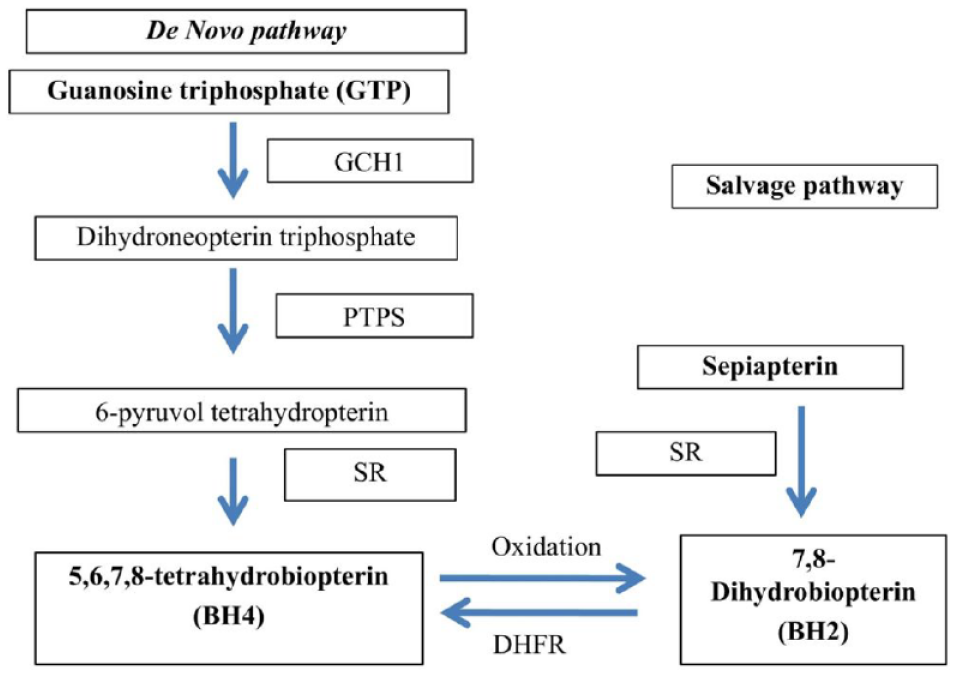
The synthesis of BH4 under de novo pathway starts from GTP getting converted to dihydroneopterin triphosphate in the presence of GCH1 (rate limiting enzyme). The salvage pathway is required to convert the exogenous sepiapterin to BH4 in the presence of DHFR.
In the de novo pathway, the three enzymes GTP cyclohydrolase 1(GCH1), 6-pyruvyl tetrahydrobiopterin synthase(PTPS), and sepiapterin reductase (SR) work together in a three-step process to produce BH4 from GTP. The salvage route is crucial for the conversion of sepiapterin to BH4 (Shi et al., 2004; Thöny et al., 2000; Werner-Felmayer et al., 2002). In the salvage process, sepiapterin is reduced by SR into BH2, which is then converted into BH4 by DHFR (dihydrofolate reductase) (Alkaitis & Crabtree, 2012; Crabtree & Channon, 2011; Thöny et al., 2000; Werner-Felmayer et al., 2002)
Degradation
Although the exact mechanism of BH4 degradation is unknown, increased levels of BH4 will lead to the binding of GCH1-feedback regulatory protein (GFRP) to GCH-1, inhibiting its function (Feng et al., 2021; Schmidt et al., 2014; Werner-Felmayer et al., 2002).
Evidence for Neurotransmitter Dysfunction in ADHD
Dopamine is a neurotransmitter linked to a variety of psychiatric disorders. According to recent research, the link between dopamine and ADHD is a little more convoluted (Duggal, 2021; Mehta, 2019). Individuals with ADHD appear to have a dopamine-removal system that is overly efficient. They contain a larger concentration of re-uptake inhibitors, which are dopamine transporters. Dopamine does not have enough time to have its effect when it is eliminated too rapidly (Mehta, 2019; Solanto, 2002; Wu et al., 2012).Studies on the effects of specific drugs on symptoms provide additional evidence linking dopamine and ADHD. Ritalin for example, is a regularly prescribed ADHD medication. It is a stimulant that works by inhibiting dopamine transporters. As a result, the clearance of dopamine after it has been released is slowed (Duggal, 2021; Hynd et al., 1991; Rubia et al., 2014).Reduced levels of two other neurotransmitters, norepinephrine and serotonin, may also contribute to ADHD symptoms (Killeen et al., 2013; Oades, 2007, 2008; Patrick et al., 2009; Quist et al., 2000; Sengupta et al., 2012).
Evidence for Stress (Oxidative and Nitrosative) in ADHD
Despite widespread acceptance of catecholaminergic ideas linked to ADHD, there has been an upsurge in study into different molecular processes. In psychiatry, for example, immune-inflammatory pathways and oxidative and nitrosative stress have piqued interest (Joseph et al., 2015; Lopresti, 2015).When the balance of the antioxidant system is disrupted, oxidative and nitrosative stress is developed. Low levels of antioxidants in the body or reduced antioxidant activity of the enzymes may further weaken the defense system (Bulut et al., 2007; Lopresti, 2015).
Although the results are mixed, a recent meta-analysis indicated that ADHD is linked to higher levels of oxidative stress. In general the levels of oxidative and lipid peroxidation biomarkers in blood, urine, and saliva of children and adults with ADHD have been found to be on the higher end. In children and adults with ADHD, for example, increased levels of malondialdehyde (MDA), a lipid peroxidation marker, have been discovered (Bulut et al., 2013).
It has been found that endothelial BH4 levels are primarily regulated by the salvage pathway, and that a decrease in SR has an impact on endothelial BH4. Similar to this, a rise in SR raises the levels of BH4 and NO production while also lowering the production of ROS.
Early research has shown that DHFR affects BH4 homeostasis, NO bioavailability and NOS coupling in endothelial cells. Reduced BH4 levels, increased NOS uncoupling and down-regulated DHFR expression are all effects of angiotensin II stimulation on endothelial cells that are all reversed by DHFR overexpression. Thus, DHFR is considered important to maintain endothelial BH4 levels and NO availability during oxidative stress (Aspide et al., 1998; Ceylan et al., 2010; Kitaoka et al., 2020; Varol Tas et al., 2006).
Low amounts of BH4 from BH2 oxidation can cause NOS uncoupling, increased oxidative stress, and the production of highly reactive superoxides. When BH4 is scarce, activated NOS can still absorb electrons from NADPH and transmit them to another substrate, O2, which results in the formation of O2− rather than NO (Aspide et al., 1998; Bulut et al., 2007; Solleiro-Villavicencio & Rivas-Arancibia, 2018).
Potential for BH4 as a Novel Therapy in ADHD
It is impossible to underestimate the role of BH4 in ADHD and other neurodevelopmental disorders (Fanet et al., 2017; Ignarro, 2000). Low levels of BH4 in the CNS can have serious neurodevelopmental implications. For starters, BH4 is required for the formation of nitric oxide, a soluble molecule that regulates cell proliferation, neuronal motility, and synaptic maturation during development, as well as communication between neurons and non-neuronal cells (Feng et al., 2021; Hevel & Marletta, 1992). Nitric oxide synthases (NOS) require tetrahydrobiopterin as a cofactor to catalyze the generation of nitric oxide (NO) from
Discussion
Stimulants like methyl phenidate, amphetamine and nonstimulants like atomoxetine help raise levels of neurotransmitters like dopamine and norepinephrine. Research indicates Dopamine’s production and transmission are not active in newborns, but they dramatically increase within the first several months after birth. The rate-limiting enzyme for the synthesis of dopamine is tyrosine hydroxylase (TH), and tetrahydrobiopterin (BH4) is a crucial cofactor for the TH. Therefore, if BH4 levels are low, dopamine synthesis will not occur as it should. As a result, using BH4 supplements may help with symptoms including adaptability, verbal expression, social responsiveness and interactions, communication, cognitive capacities, hyperactivity, and improper speech that may not fully be addressed by taking stimulant and non-stimulant drugs (Christ et al., 2013; Frye, 2010).There are very few studies that demonstrate that BH4 is lacking in ADHD. In order to determine whether or not BH4 can be supplemented in ADHD, we have attempted to assemble evidence from several sources in this paper. BH4 has demonstrated potential therapeutic effects for the treatment of autism and PKU, which share diagnostic issues with ADHD. With all of these proofs, it appears that BH4 and ADHD are related.
As explored above, BH4 is an important co-factor in the biosynthesis of neurotransmitters. ADHD is a disorder that primarily begins in childhood characterized by difficulty in maintaining attention and have episodes of hyperactivity. Research studies have observed that levels of dopamine seem to differ among ADHD and non-ADHD individuals giving a notion that dopamine could be the major neurotransmitter that is getting affected. According to the studies, this difference is due to increased concentrations of proteins called dopamine transporters in neurons in the brains of ADHD patients. Dopamine transporter density (DTD) refers to the amount of these proteins present. A greater DTD causes dopamine levels in the brain to drop, which could be a risk factor for ADHD (Caron, 1999; Biederman & Spencer, 1999; Cragg & Rice, 2004; DiMaio et al., 2003; Madras et al., 2005; Oades, 2008; Prince, 2008; Quist et al., 2003).BH4 is required by tyrosine hydroxylase for the production of dopamine which is considered to be a rate limiting enzyme in this reaction. Reduced or diminished BH4 may lead to loss of TH protein and in turn leads to less dopamine availability.
Similar to ROS and RNS, reactive sulfur species (RSS) can produce free radicals. Thiol molecules are transformed into reactive oxygen species and thiyl radicals (RS•) in the presence of trace amounts of transition metal ions. Thiyl radicals have been demonstrated to be capable of activating a number of potentially hazardous metabolic processes, including lipid peroxidation. The ROS-scavenger BH4 has the capacity to inhibit the production of thiyl radicals and render them harmless (Ceylan et al., 2010; Thabet et al., 2021).
Medication such as stimulants given in the treatment of ADHD can raise the extracellular dopamine (DA) levels in the brain by inhibiting DA transporters at synapses. However, there is a possibility of dopamine neurotransmitter (NT) depletion if there is a BH4 shortage in the brain. Only when dopamine is created can it be kept at a constant level, but if BH4 levels are low, dopamine production is also decreased. Adaptability, linguistic expressiveness, social responsiveness and interactions, communication, cognitive abilities, hyperactivity, and incorrect speech are just a few of the ADHD symptoms that BH4 may help with. Although taking a stimulant medication helps children with ADHD pay attention and concentrate, it may not necessarily help them in all areas of their language development.
BH4 can be considered a possible treatment target for decreasing ADHD symptoms based on the evidence supplied. Agents that can either aid to reduce BH4 breakdown in the body or promote BH4 biosynthesis can be researched. Phenylketonurias (PKU), sickle cell anemia, endothelial dysfunction, and schizoprenia have all been studied in clinical trials utilizing the synthetic version of BH4- Sapropterindihydrochloride (Nielsen, 2006; Prasad, 2015; Smith, 2021; Lindegren et al., 2012).Tetrahydrobiopterin supplementation has been tested in a clinical trial as a treatment for autism spectrum disorders. Individual dosages of BH4 were recommended as tablets to be taken once day at a dose of 20 mg/kg of body weight. BH4 is marketed under the trade name Kuvan and is permitted for use with PKU patients as young as 2 years old by the United States Food and Drug Administration (FDA). Due to the fact that PKU and ADHD do share some symptoms the same doses can be administered (Burton et al., 2015; Opladen et al., 2020; Shintaku, 2002). Therefore, depending on the degree and condition of ADHD, dosages of 2 to 20 mg/kg of body weight can be given once day. Tablets or oral powders for a solution are both acceptable dosage forms (Burton et al., 2015).
There is evidence that BH4 affects neurodevelopmental problems. Tetrahydrobiopterin-responsive PKU patients also shown a decrease in inattentive ADHD symptoms with sapropterin medication, according to a 2015 BioMarin-funded research of PKU patients (Burton et al., 2015).Tetrahydrobiopterin has taken part in clinical trials looking at alternative methods of treating disorders brought on by a tetrahydrobiopterin deficiency, including ADHD.
Conclusion
Given the roles of BH4 in neurotransmitter synthesis and scavenging free radicals in stressful situations, both of which are linked to ADHD, supplements or agents that can augment BH4’s effects in ADHD can be investigated further.
Footnotes
Acknowledgements
We acknowledge ICMR for providing funds for carrying out research works in ADHD. English language writing was done using QuillBot and grammarly trial version.
Author Contributions
SKW prepared the manuscript draft. JT edited, verified, and submitted.
Declaration of Conflicting Interests
The author(s) declared no potential conflicts of interest with respect to the research, authorship, and/or publication of this article.
Funding
The author(s) received no financial support for the research, authorship, and/or publication of this article.
