



Abstract
As the paradigm shift from command-and-control statutes to collaborative partnerships increases, public administrators, policy makers, and watershed stakeholders will become more dependent on collaborative partnerships to solve complex environmental problems. This article explores watershed management partnerships and suggests a new typology of collaboration built on the variable of governance. The typology categorizes three types of watershed partnerships as interagency governance, cross-sector governance, and grassroots governance. Understanding the strengths and weaknesses of watershed partnerships through the lens of governance structure will enhance public administrator and policy makers’ abilities to provide the best approach for addressing a particular watershed goal.
The emergence of watershed partnerships throughout the United States is indicative of changes within the political, social, and economic environments. Watershed partnerships develop as a response to state and federal command-and-control regulations that fail to address environmental and economic interests at the local and regional levels (Lubell, Schneider, Scholz, & Mete, 2002). In contrast to command-and-control statutes, watershed partnerships seek a collaborative approach to address complex environmental problems. Kenney, McAllister, Caile, and Peckham (2000) define a watershed partnership as a self-organized collection of networks, typically comprised of multiple sector stakeholders, coordinating collectively to address water quality issues within a shared watershed boundary. These collaborations fill a niche where command-and-control natural resource management policies have failed, and they address complex societal and environmental issues that can no longer be solved by any single institution (Agranoff, 2006; Duram & Brown, 1999; Kettl, 2002).
Fundamental to the research on collaborative partnerships is the understanding that there are many types of partnerships with varying characteristics (Bidwell & Ryan, 2006; Hardy, 2010; Heikkila & Gerlak, 2005; Margerum, 2008; Moore & Koontz, 2003). Recent scholars have created typologies to help define different collaborative partnerships. One example is Mandell and Steelman’s (2003) discussion of “interorganizational innovation” that refers to organizational arrangements that occur between public, private, and nonprofit organizations working on mutual problems. Mandell and Steelman present five types of interorganizational arrangements as follows: intermittent coordination where two organizations adjust policies and procedures to meet a common objective, temporary task forces where organizations share resources to meet a goal but disband once that goal is met, permanent or regular coordination between organizations in a formal arrangement to meet a common goal, coalitions where participants simultaneously work to reach a common goal, and network structures where organizations partner to accomplish broad goals over long periods of time. In another study, Agranoff (2007) develops a typology of collaborative networks that includes informal, developmental, outreach, and action networks. Agranoff’s typology provides descriptions of government agency partnerships whose “primary purposes range from mutual exchange to actually making policy and program adjustments” (p. 10). In another study, Provan and Kenis (2008) observe the effects of networks by categorizing forms of network governance as participant-governed where the network is governed by all participants within the network, lead-organization governed networks where one member of the network acts as the leader, and finally the network administrative organization model where the network is externally governed by an administrative entity.
Within the more issue-specific literature on collaboration is the seminal work by the Center for Watershed Protection (1998) that identifies a typology for watershed management based on member composition including government-directed, citizen-based, and hybrid partnerships. According to this model, government-directed partnerships are composed exclusively of government agencies, citizen-directed partnerships are driven by activists or grassroots organizations, and hybrid partnerships consist of both government agencies and grassroots organizations. Moore and Koontz (2003) expand on this classification of watershed partnerships by developing a more thorough description of the differences between the three groups based on member composition and types of accomplishments achieved by each group type. They reframe the Center for Watershed Protection’s (1998) typology to identify the three types of collaborative partnerships as agency-based, citizen-based, and mixed. As defined by Moore and Koontz (2003), agency-based watershed partnerships are primarily comprised of governmental actors and operate under the purview of state and federal agencies. Mixed partnerships are comprised of both governmental and nongovernmental actors such as state and local agencies, environmental interest groups, and private and nonprofit organizations. Citizen-based partnerships include nongovernmental actors such as nonprofit organizations, local environmental interest groups, civic leagues, and residents living in a local community. While the two typologies have added to our understanding of collaboration in watershed management, they have not emphasized the importance of governance structure within the three different group types. The issue of governance has been touched on by Moore and Koontz, but only in a limited capacity.
This article expands on the aforementioned typologies of the Center for Watershed Protection (1998) and Moore and Koontz (2003) by including governance structure as one variable of categorization. Thus, we argue the typology should include membership composition as suggested by the Center for Watershed Protection, types of achievements as added by Moore and Koontz, and finally our contribution of governance structure. Imperial (2005) maintains that governance is the mechanism that guides organizational direction, coordination, and control. Moreover, Imperial argues that governance is more than simply the configuration of governmental and nongovernmental entities; it encompasses formal and informal rules, administrative processes, statutory authority, resource capacity and allocation, programmatic structures, social norms, and the structures that govern individual and organizational relationships. In this regard, governance is the foundation that binds social institutions, and thus is an essential element in watershed collaboration.
This article argues that the key to successful watershed management is in understanding the governance structures of different types of watershed partnerships and how they influence environmental goals. Building off of the two aforementioned models, we advance typologies of collaboration by identifying three types of governance structures specific to watershed partnerships as interagency governance, cross-sector governance, and grassroots governance. We define watershed partnerships with interagency governance as having institutional policies and procedures shared among a network of multilevel governmental stakeholders that coordinate their activities and share their resources to address complex policy problems within a problem domain. Watershed partnerships with cross-sector governance depend on the integration of formal and informal policies and procedures formulated and implemented among a set of multisector institutional stakeholders (governmental, nonprofit organizations, or citizen based) to address complex policy problems within a policy domain. Finally, watershed partnerships with grassroots governance have formal and informal policies and procedures that are formulated and implemented by the coordinated efforts of citizens and nonprofit organizations seeking to address a local issue within their community.
The article begins with a discussion of a paradigm shift over the last century in approaches to managing natural resources, a context that must be understood to address watershed management. Next, we address former typologies of watershed management and present a new typology with governance structure as the defining variable. We then discuss the different elements of the typology and provide examples of each. The article concludes by emphasizing the importance of understanding the complexities of governance structures of watershed partnerships and how these complexities influence environmental goals, followed by a brief discussion of considerations and challenges for practitioners.
A Paradigm Shift in Approaches to Managing Natural Resources
The development of watershed boundaries emerged in the Progressive Era during the Roosevelt administration (Sabatier, Weible, & Ficker, 2005). The Reclamation Act of 1902 appropriated federal funds to build reservoirs and water distribution facilities throughout 16 Western states (Gerlak, 2005). The River and Harbors Act of 1925 authorized the U.S. Army Corps of Engineers to oversee all navigable waters and develop regional irrigation plans and flood control (Gerlak, 2005). Furthermore, the Progressive Era marked the advent of federal protection over common-pool natural resources by creating the U.S. National Forest Service (Sabatier et al., 2005). This agency was charged with managing and protecting over 185 million acres of public land (Sabatier et al., 2005).
The Great Depression ushered an era of social welfare policies aimed at reducing the plight of poor Americans (Gerlak, 2005; Sabatier et al., 2005). The Tennessee Valley Authority Act of 1933 authorized the construction of multipurpose dam projects to provide “flood control, water, and hydroelectric power” (Sabatier et al., 2005, p. 32). This federal legislation marked the beginning of governmental initiatives aimed at developing public policies that connected natural resource management to the provisions of public goods. Legislation enacted during the Progressive and New Deal Era primarily focused on efficient usage of natural resources for public goods and conservation for federal land (Sabatier et al., 2005). These federal initiatives did not address natural resource protection or conservation on privately held land. Consequently, the regulation of water quality was largely left in the hands of most localities, whose answer to waste disposal was dumping it into waterways (Sabatier et al., 2005).
The Environmental Federalism Era began in the 1970s and marked a change in public attitudes toward protecting the environment (Gerlak, 2005; Kraft & Scheberle, 1998). As a result, a number of major environmental policies were passed during this time frame, including the Water Pollution Control Act of 1972 (referred to hereafter by its more common name, the Clean Water Act), the Pesticide Act of 1974, and the National Forest Management Act of 1976 (Gerlak, 2005; Sabatier et al., 2005). These reforms imposed strict environmental mandates unilaterally over state and local agencies (Sabatier et al., 2005). The Clean Water Act mandated state agencies to adhere to strict water quality standards, which required new implementation of water pollution control measures (Gerlak, 2005; Kraft & Scheberle, 1998). The Environmental Protection Agency was responsible for overseeing that states complied with these new standards.
These federal mandates increased states’ expenditures on water quality programs, of which a small percentage was funded by federal grants (Kettl, 2002; Kraft & Scheberle, 1998). State and local governments shouldered the majority of the expense of these federal mandates. Sabatier et al. (2005) found that state water quality expenditures doubled from 1972 to 1994 resulting in an increase of $816 million. Sabatier et al. (2005) point out that some states faired better than others. For example, water quality expenditures per capita in Alaska were $338, whereas in California and Ohio per capita state expenditures were $20 and $18, respectively (Sabatier et al., 2005). Therefore, states that were more populated were better able to absorb the added expense through increases in tax revenues, while other states were left to redirect funding from other programs to achieve federal environmental mandates (Kraft & Scheberle, 1998). Consequently, water quality mandates created intergovernmental conflicts over environmental policy goals and their financial effect on state and local governments (Gerlak, 2005; Kraft & Scheberle, 1998).
What ensued was a climate of litigation between federal and state agencies seeking control over water quality management (Sabatier et al., 2005). This litigious environment created a zero-sum strategy to environmental protection, whereby intergovernmental agencies were more preoccupied with winning in court than finding solutions that mutually benefited all parties (Sabatier et al., 2005). Ultimately, the public and environmental interest groups grew more dissatisfied with top-down regulations that did little to address environmental issues derived from nonpoint source pollution (Gerlak, 2005; Kraft & Scheberle, 1998). As a result, Congress passed the 1987 Clean Water Act Amendment that established new policy initiatives that addressed nonpoint source pollution under Section 319 of the statute. Section 319 devolved federal control over watershed management to the states and created federal funding to help states address watershed issues (Gerlak, 2005). The amendment sought to build capacity through federal and state partnerships. Under this new approach, watershed management was primarily under the jurisdiction of states (Gerlak, 2005; Sirianni, 2009).
The Watershed Collaboration Era marked a critical shift in environmental policy (Gerlak, 2005; Sabatier et al., 2005). The reinventing government movement in the 1990’s and its focus on creating greater efficiencies in the federal government led to new federal initiatives sponsored by the Environmental Protection Agency (Gerlak, 2005; Kettl, 2002). These initiatives involved creating programs that promoted long-term sustainability at the community level, whereby federal agencies work with multiple stakeholders across different sectors to achieve local environmental goals (Kraft & Scheberle, 1998). Consequently, a new paradigm of federalism has emerged to replace the traditional command-and-control strategies.
This new paradigm seeks a pragmatic approach to federalism, whereby the focus is on finding innovative solutions to complex issues through vertical and horizontal collaboration and coordination (Gerlak, 2005; Kettl, 2006). The administrative state in the 21st century is undergoing an evolution with regard to American governance of environmental policy (Kettl, 2002). The reality is that the interconnectiveness of today’s world requires new strategies that build capacity and meet the challenges of the 21st century and beyond (Kettl, 2006). Globalization and devolution has further complicated the role of government with regard to environmental protection (Kettl, 2002).
There appears to be somewhat of a dilemma with devolution. On one hand, centralized decision making over natural resource management allows governments to ensure that national environmental goals are met and common-pool-resources are protected for future generations (Lubell et al., 2002; McKinney & Harmon, 2004). Conversely, devolving authority to states and local agencies allows decision makers to implement environmental policies that better address regional issues (Kettl, 2002; McKinney & Harmon, 2004). In this regard, McKinney and Harmon (2004) contend that sharing decision-making authority over managing environmental resources creates a holistic approach, whereby local and regional environmental and economic interests are balanced with achieving overall environmental goals.
Today’s complex policy problems are no longer confined within specific geographical areas. Rather, they span across multiple jurisdictions as well as international boundaries (Kettl, 2006). This is certainly true for managing natural resources, whereby the effects of water pollution generated in one geographic region can impact the ecosystems thousands of miles away (Kenney et al., 2000). McKinney and Harmon (2004) argue that the complexities of environmental protection require new institutional arrangements. The emergence of watershed partnerships indicates a shift toward developing new institutional arrangements that address complex issues and transcend political and geographic boundaries (Gerlak, 2005; Lubell et al., 2002). These arrangements use a collaborative approach to develop policy tools that address environmental problems within a watershed boundary (Lubell et al., 2002). The primary distinctions between these arrangements and the traditional institutional arrangement is that all stakeholders participate throughout the policy process (Koontz & Johnson, 2004). In this regard, citizens, government, and nongovernmental stakeholders identify policy issues, formulate strategies, and collectively bring resources together to implement watershed policies (Schuett, Selin, & Carr, 2001).
Typologies of Watershed Management
A review of the watershed management literature reveals several typologies that have been developed to explore the unique characteristics found in watershed partnerships. These typologies highlight the role of stakeholder composition (Moore & Koontz, 2003), organizational affiliation (Bidwell & Ryan, 2006), institutional activities (Hardy & Koontz, 2009), geographic scale and group dynamics (Cheng & Daniels, 2005), and operational activities (Margerum, 2008). Over time, the focus of the typologies has changed with earlier studies examining the characteristics of participants operating in watershed management settings and their influence on institutional structure to more recent studies analyzing the internal operations of the partnerships and their influence on institutional activities (see Bidwell & Ryan, 2006; Hardy & Koontz, 2009; Imperial, 2005; Margerum, 2008; Moore & Koontz, 2003). Findings from this stream of literature indicate that stakeholder composition and organizational affiliation influence institutional and operational activities in watershed partnerships (see Bidwell & Ryan, 2006; Heikkila & Gerlak, 2005; Margerum, 2011).
While the elements identified in the aforementioned typologies are helpful in describing watershed partnerships, we argue that the essential element of governance within the watershed collaboration literature has been remiss. The collaboration literature identifies “collaborative governance” as the new mode of governing in public administration (see Ansell & Gash, 2007; Emerson, Nabatchi, & Balogh, 2011; Purdy, 2012). The term collaborative governance captures a wide array of interorganizational governance activities such as informal and formal accountability mechanisms, deliberative decision making, integrative processes, and the coordination of multilevel actors across institutional boundaries (Agranoff, 2006; McGuire, 2006).
In the watershed collaboration realm, governance has been defined as the mechanism that underpins the coordination of institutional and operational activities pursued by watershed partnerships (Gerlak & Heikkila, 2006; Imperial, 2004; Marshall, 2008). While governance has been identified in the watershed literature as an important construct for viewing interorganizational activities, there is a dearth of research examining and identifying the types of governance structures that exist within the actual partnerships (see Cline & Collins, 2002; Gerlak & Heikkila, 2006; Imperial, 2004, 2005; Kenney, 1997).
A Typology of Watershed Partnerships From a Governance Perspective
Recent attention has been given to issues of governance within environmental management. Scholars of this area of research identify governance within the interaction of two spheres—spatial scales and levels of action of participants (Moss & Newig, 2010). Other research focuses more broadly on collaborative governance as “a governing arrangement where one or more public agencies directly engage non-state stakeholders in a collective decision-making process that is formal, consensus-oriented, and deliberative and that aims to make or implement public policy or manage public programs or assets” (Ansell & Gash, 2007, p. 544). More specifically, governance is related to the informal and formal processes of decision making by actors within the collaboration (Stoker, 2004). We apply these perspectives on collaborative governance to watershed partnerships by expanding on the typologies developed by the Center for Watershed Protection (1998) and Moore and Koontz (2003).
Drawing from the collaborative governance literature, five variables were identified to analyze and compare studies of watershed management including resource capacity, decision making, institutional activities, the role of government, and the complexity of the nature and scope of the issue. Collaboration scholars identify resource capacity as both the impetus and the glue of collective action in that resource dependency is a critical component of collaborative partnerships (Gray, 1985, 1989; Wood & Gray, 1991; Wondolleck & Yaffee, 2000). Gray (1989) argues that instability and uncertainty within the environment heighten resource dependency among stakeholders. A fundamental principle of collaboration is that the complexity within the problem domain exceeds the resource capabilities of traditional institutional structures (Gray, 1989). As a result, organizations seek new institutional arrangements that allow them to leverage their resources to gain control of their environment and reduce uncertainty (Wood & Gray, 1991). The type (human, knowledge, funding, technology) and level of resources (full-/part-time staff and experts) are likely to influence the institutional activities pursued by watershed partnerships. Moreover, the ability to mobilize resources is critical to the sustainability of watershed partnerships. The allocation and management of resources is a vital function in governance.
The literature also identifies the role of government and the complexity of the nature and scope of the issue as factors in governance of watershed partnerships. With regard to complexity of the nature and scope, the literature reveals that governance mechanisms created to manage natural resources are linked to the nature of the environmental problem (Margerum, 2011; Wondolleck & Yaffee, 2000). Watersheds cross-cut multiple jurisdictions, and are thus transboundary in nature (Kenney, 1997). Studies have found that the scale of the watershed issue (regional vs. local) and the complexity of the environmental issue being addressed influences the role of the government (Kenney, 1997; Margerum, 2011). Highly complex environmental issues require the mobilization of sophisticated assets (technology and experts), which often requires the involvement of governmental agencies. Kenney’s (1997) study of 12 watershed initiatives found that the role of government increases in watershed partnerships when government is the primary land owner and when legislative mandates require increased interagency partnerships and collaboration with public and private entities.
Fundamental to governance are the rules and procedures that guide the decision-making processes of organizations. Decision making in collaborative groups is predicated on the notion of participatory deliberation and consensus-building (Margerum, 2011). Margerum (2011) found that the decision-making processes differed across watershed partnerships in that the role of chairs, staff members, and facilitators varied depending on the stakeholder composition (agency, mixed, or citizen) and the institutional activities pursued by watershed partnerships. Large watershed partnerships addressing complex basin-wide issues likely require a more sophisticated governance structure to guide their decision-making process (Margerum, 2011). Conversely, decision-making processes in volunteer watershed groups comprised of citizens may or may not include formal procedures involving steering committees (Morris, Gibson, Leavitt, & Jones, 2013).
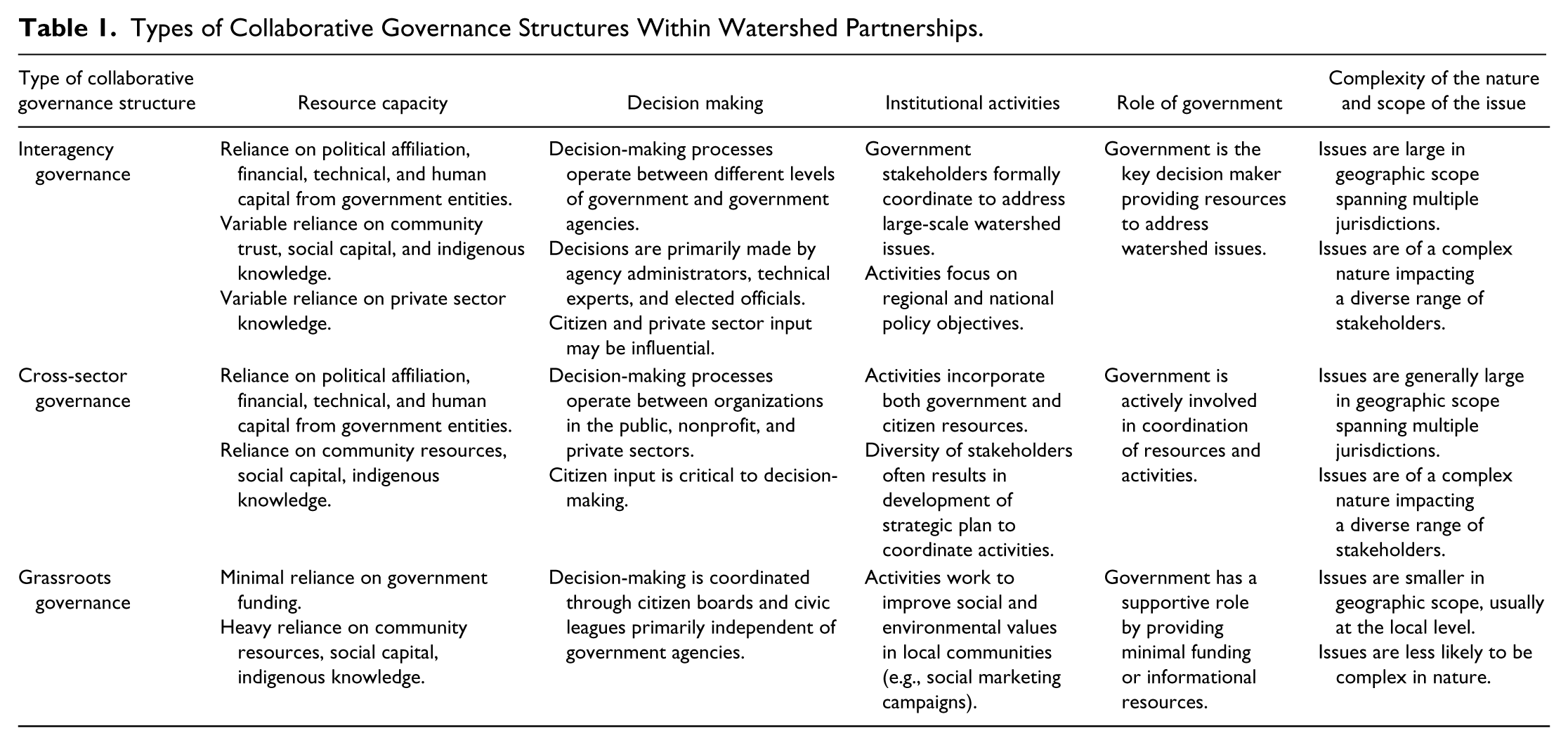
Based on these findings, three distinctive types of collaborative governance structures were revealed within the watershed partnerships that are identified as interagency governance, cross-sector governance, and grassroots governance. The three typologies and their characteristics are discussed below.
Interagency Governance
As Table 1 indicates, the interagency governance model focuses on collaborative partnerships of government agencies at all levels. Governance coordination activities within these collaboratives generally focus on regional and national policy objectives that affect multiple jurisdictions, numerous organizations, and large environmental interest groups (Koontz & Johnson, 2004). In this type of governance structure, the role of government is that of “problem-solving partner” (Margerum, 2011, p. 41). This is because basin-wide watershed issues cross-cut federal, state, and local governmental agencies that serve different constituents and operate under different authorities. Thus, agency objectives are highly influenced by the role of the federal government.
Types of Collaborative Governance Structures Within Watershed Partnerships.
Decision-making processes and rules are created primarily for addressing complex issues that span a wide geographic area. For example, the Chesapeake Bay Program is an agency-based watershed partnership that spans across Virginia, Maryland, Pennsylvania, and Washington, D.C. The Chesapeake Bay Program covers a total of 64,000 square miles, of which 11,684 miles is shoreline, and includes 150 major rivers and streams (Chesapeake Bay Program, 2012). Chesapeake Bay Program stakeholders include over 300 scientists, 22 different state and federal agencies, as well as representatives from the Environmental Protection Agency (Heikkila & Gerlak, 2005).
Governing bodies within agency partnerships are typically comprised of high-level institutional actors such as federal and state agency administrators as well as member governments and elected officials (see Chesapeake Bay Program, 2009; Gerlak & Heikkila, 2006; Margerum, 2011). Due to the scope and complex nature of the environmental issues being addressed, decision making within these governance settings operate at different levels (see Gerlak & Heikkila, 2006). In the case of the Chesapeake Bay Program, policy decisions regarding restoration and protection of the Chesapeake Bay are made by the members of the Executive Council (Chesapeake Bay Program, 2009). Members of the Executive Council are comprised of the “. . . governors of Virginia, Maryland, and Pennsylvania; the Mayor of Washington, DC; as well as a representative from the U.S. Environmental Protection Agency (EPA) and the Chair of the Chesapeake Bay Commission” (Gerlak & Heikkila, 2006, p. 6).
Policy decisions made by the Executive Council are formulated by the Chesapeake Bay Program’s Principals’ Staff Committee, which is comprised of environmental regulators and high-level government representatives and delegations of federal and state agencies (Chesapeake Bay Program, 2009). Members of the Principals’ Staff Committee act as policy advisors to the Executive Committee, setting the agenda for environmental policy priorities and program direction. Gerlak and Heikkila’s (2006) case study on four large-scale agency watershed partnerships found that partners within these settings are obligated to different jurisdictional authorities and are affected differently by watershed issues. Consequently, these partnerships use various levels of decision making to balance regional interests with broader environmental policy objectives. For example, the Chesapeake Bay Program incorporates four distinctive decision-making levels that guide governance activities: (a) consensus, (b) unilateral, (c) champion, and (d) voting (see Chesapeake Bay Program, 2009).
Interagency governance is prevalent where government is the predominate land owner within the watershed (Margerum, 2008). There are many elements that influence the governance processes of this type of collaborative. For example, Moss and Newig (2010) and other scholars find that spatial distances of stakeholders directly influence their level of involvement in collaboration. In the case of the Chesapeake Bay Program, this appears to be a relevant point. Arguably, water quality issues in Virginia would not lead to collective action from local stakeholders in Pennsylvania. However, the accumulation of nonpoint source pollution in the Chesapeake Bay may affect the ecosystems in both regions. This also suggests that issue salience is a factor in stakeholder participation in watershed management.
Another important element in interagency governance processes of watershed partnerships is the coordination activities of government stakeholders with environmental agendas that target large heterogeneous populations (Margerum, 2008). As in the case of the Chesapeake Bay Program, this watershed boundary is inhabited by 17 million people. Partners operating within collaboratives using interagency governance coordinate their activities and resources toward scientific research and development that address broad environmental issues, in addition to formulating recommendations for environmental rules and regulations (Hardy, 2010). Governance coordination activities among these partners focus on developing policy change within a broad environmental domain such as forestry, agriculture, water, and air quality (Bidwell & Ryan, 2006).
The complex nature and scope of interagency coordination and their impacts on the environment requires partners to invest significant time in building political relationships to influence watershed policy (Schuett et al., 2001). Due to the complexities of the environmental issues being addressed in this setting, stakeholders develop partnerships that require a high degree of political, financial, and human capital to achieve their operational and functional activities, and they often rely on funding from a variety of governmental agencies such as the Environment Protection Agency and the National Oceanic and Atmospheric Administration (Hardy, 2010).
Hardy (2010) found that agency-based partnerships are comprised of highly skilled technical experts, government officials, and representatives from regional and state agencies. Group composition in this model is homogeneous whereby the majority of stakeholders are linked to governmental agencies (Bidwell & Ryan, 2006). Partnerships with a high degree of agency affiliations tend to experience less conflict, thus facilitating consensus on goal setting and improving processes of governance (Hardy, 2010). This may indicate that the efficacy of watershed management in addressing complex technical environmental issues on a large scale requires a governance structure with a high degree of political affiliation, financial, technical, and human capital.
To determine the effectiveness of watershed partnerships with interagency governance, stakeholders measure the effects on social and environmental outputs through variables including increased community trust, social capital, and changes in water quality management practices within watershed communities. Some examples of environmental outputs measured by interagency collaboratives are the reduction in land development causing sedimentation issues and adaptations of new watershed management practices (Hardy, 2010).
Cross-Sector Governance
Watershed partnerships with cross-sector governance are one of the more prevalent types of natural resource collaborative (Koontz & Johnson, 2004). Bryson, Crosby, and Stone (2006) define cross-sector collaboration as “the linking and sharing of information, resources, activities, and capabilities by organizations in two or more sectors to achieve jointly an outcome that could not be achieved by organizations in one sector” (p. 44). In this type of governance structure government plays an active role in the coordination of resources and activities across sector boundaries and citizens’ inputs are integral to the decision-making process (Margerum, 2011; Morris et al., 2013).
Watershed partnerships with cross-sector governance tend to pursue complex environmental problems that affect a large population and span across multijurisdictions (Hardy, 2010). They address environmental issues that require a broader range of resources, and they rely on both governmental and nongovernmental actors to reach the collaborative’s goals (Koontz & Johnson, 2004). Because of their diverse stakeholder composition, they typically develop comprehensive strategic plans to coordinate their activities. Research has found that the higher the degree of diversity in a collaborative, the higher the degree of conflicting interests, thus the more time stakeholders spend on formalizing watershed agreements (Bryson et al., 2006). Watershed partnerships using a cross-sector governance approach to solving problems seek to garner community resources such as social capital and indigenous knowledge in addition to utilizing resources of government agencies.
Compatibility among stakeholders within the partnership is also an important element of cross-sector governance. The collaboration literature suggests that culture fit is an essential component for watershed effectiveness (Shaw, 2003). Shaw (2003) emphasizes cross-sector collaboratives are collections of various groups with distinct organizational affiliations. Therefore, stakeholders may not share the same values, norms, or culture. Consequently, the interdependence of these stakeholders requires a compatible fit (Shaw, 2003).
The cross-sector governance approach is the most appropriate for on-the-ground activities such as watershed restoration, and these collaboratives are more effective at mobilizing large numbers of volunteers in addition to their ability to circumvent red tape due to their nongovernmental stakeholders (Hardy, 2010). However, the involvement of agency actors in this setting and the governmental constraints that they operate under (e.g., regulations and legislative mandates) may result in watershed partnerships pursuing goals that do not align with local community environmental issues (Leach & Pelkey, 2001). This suggests that watershed partnerships with cross-sector governance may be less effective in addressing community-based watershed issues. Consequently, there has been a growing movement toward citizen-driven collaboratives, whereby community leaders, civic associations, and residents organize small watershed partnerships that focus on improving local environmental problems (Morton, 2008; Weber, 2000).
Grassroots Governance
Watershed partnerships with grassroots governance focus on local watershed issues that affect a smaller geographical area such as small town communities and rural areas (Flint, Luloff, & Finley, 2008; Weber, 2000). This governance structure is most identified with a bottom-up approach to natural resource management. This type of collaborative has grown in popularity as a response to citizens’ dissatisfaction with institutional regulations failing to address local issues (Lurie & Hibbard, 2008). The Environmental Protection Agency’s Adopt Your Watershed program estimates that there are over 3,000 citizen-based watershed partnerships in the United States (United States Environmental Protection Agency, 2001). Citizen-based watershed partnerships are defined as “self-organized groups of highly engaged local citizens planning and acting through deliberative processes to try to advance the public good” (Lurie & Hibbard, 2008, p. 432). Actors operating in these types of partnerships are primarily comprised of citizen volunteers, nonprofit organizations, and nongovernmental stakeholders. In this type of collaborative, government plays a supportive role through funding initiatives and providing informational resources (Margerum, 2011).
Typically, grassroots governance activities in this type of watershed partnership are directed through a watershed citizen’s board, whereby trustees are prominent local citizens in the community (Hardy, 2010; McNamara, Leavitt, & Morris, 2010). The Board of Directors operates independently from government agencies and has the freedom to pursue environmental issues that are salient to the local community (Flint et al., 2008; Lubell, 2004). Moreover, fundraising and organizational activities are created through the guidance of the Executive Director and approved by the trustees (Hardy, 2010). The Executive Director operates under the authority of the Board of Directors and is responsible for managing the daily operations of the organization. Moreover, the Executive Director acts as the organization’s head administrator (Morris et al., 2013).
Morris et al.’s (2013) case study of three grassroots watershed partnerships in the Hampton Roads area of Virginia found that the trustees are responsible for strategic planning and agenda-setting. In addition, they found that grassroots governance structures operate under committees generally headed by individuals serving on the Board. Margerum’s (2011) extensive research on watershed partnerships found that in grassroots governance structures the roles of trustees and staff are closely linked. Consequently, the functions of governance are carried out by trustees and individuals operating within the organization. In this regard, the majority of the functional duties in this type of governance structure are shouldered by a small number of actors.
Coordination activities primarily focus on shaping social and environmental values in local communities. A strategy used by these community groups is social marketing campaigns, whereby available resources go toward public awareness and education on environmental issues affecting the local watershed (McNamara et al., 2010). In the case study of the Lynnhaven River Now project, McNamara et al. (2010) identify several social marketing strategies used by watershed partnerships with grassroots governance to influence the environmental practices of citizens and businesses in local communities. First, Lynnhaven River Now works with local school districts and their science coordinator to develop teaching programs that address watershed issues in the area (McNamara et al., 2010). McNamara et al. suggest that providing watershed education to school children promotes ecosystem values that ultimately create better stewards of the environment. In addition, they contend that educating children may indirectly influence the behavior of their parents. Second, Lynnhaven River Now developed and conducted educational workshops for civic associations and gardening clubs. These workshops discussed the sources of nonpoint pollution and provided information on river-friendly landscaping practices. Finally, Lynnhaven River Now developed a certification program for landscaping businesses that taught courses in nutrient management, water garden construction, and creating buffer zones that decrease ground water runoff from residential properties into the river (McNamara et al., 2010).
As illustrated with the case of Lynnhaven River Now, watershed collaboratives with grassroots governance processes seek to change local beliefs and values within the community through social networks and information sharing (Parisi, Taquino, Grice, & Gill, 2004). Morton (2008) argues social networks are more effective at exerting pressure that leads to improving conservation ethics and practices. He found that in rural farming communities, local watershed forums bring citizens together to exchange information based on their indigenous knowledge and experience on environmental practices. These informal gatherings create a venue whereby stakeholders develop watershed management practices that best fit their operations as well as align with their beliefs and environmental values. Moreover, Morton found that local knowledge and beliefs are instrumental in shaping field practices and ultimately improving water quality outcomes in rural communities.
Moore and Koontz (2003) and others found that grassroots collaboratives are more effective at building trust and social capital because stakeholders are part of the community. In the watershed literature, social capital is identified as an input and outcome of collective action collaboration (Lurie & Hibbard, 2008; Morton, 2008; Parisi et al., 2004; Wagner & Fernandez-Gimenez, 2008). For example, Wagner and Fernandez-Gimenez (2008) found that in citizen-based watershed partnerships, the level of social capital directly affects the partnership’s ability to access other resources such as financial, human, and knowledge capital. In this regard, Wagner and Fernandez-Gimenez contend that social capital is necessary to facilitate collective action as well as increase the likelihood of the sustainability of the citizen-based collaborative.
Leach and Sabatier (2005) argue that in the absence of formalized agreements, building trust and social capital is essential to both the success and sustainability of informal collaborative arrangements. Weber (2000) contends that grassroots collaboratives promote participatory decision making through open forums that facilitate public deliberation on framing environmental issues that are important to the local community. Citizens engage in community activeness when they share a commitment to place (Parisi et al., 2004; Weber, 2000, 2009). In this regard, grassroots partnerships are effective at galvanizing communities to work toward a common goal in protecting natural resources.
Conclusion
The complex nature and scope of watershed partnerships presents challenges and constraints with respect to natural resource management. Typically, watershed partnerships cross multijurisdictional boundaries and involve multiple stakeholders across public, private, and nonprofit sectors (Bryson et al., 2006). The effectiveness of a partnership hinges on its ability to collaborate within a web of formal and informal networks (Emerson et al., 2011). Watershed partnerships fill a niche where traditional institutional approaches have failed (Gerlak & Heikkila, 2006). Collaborative partnerships provide a voluntary union of two or more stakeholders that share mutual interests in solving complex issues through the coordination of shared resources such as technical, financial, and human capital (Gray, 1985)
Previous research on watershed partnerships found that the efficacy of the partnerships depends in part on their governance structures, yet scholars in this field have not developed a typology of watershed partnerships based on this important variable. This study builds on this body of literature by exploring the variable of governance structures within the watershed partnerships. We identify three distinct governance structures as interagency governance, cross-sector governance, and grassroots governance. Each of these collaborative governance structures has its strengths and limitations in watershed management. Watershed partnerships operating under an interagency governance are effective at managing large-scale, complex, scientifically technical watershed issues (Margerum, 2008; Moore & Koontz, 2003). Moreover, the high level of agency affiliation among stakeholders within this model allows these types of collaboratives to influence water quality policy (Bidwell & Ryan, 2006). Watershed partnerships with cross-sector governance structures are more suitable for managing large-scale on-the-ground restoration projects because of the collaboratives’ abilities to mobilize large groups of volunteers. Furthermore, this model is better able to circumvent political red tape because of the breadth of the collaborative’s stakeholder composition. Finally, watershed partnerships with grassroots governance structures are more effective at addressing water quality issues at the local level (McNamara et al., 2010). This model may be more effective at changing watershed practices that ultimately lead to better stewardship of the environment.
The trans-boundary nature of watersheds presents unique governance challenges for practitioners and public administrators operating in these collaborative arrangements. While there are important distinctions across governance models in watershed management, actors operating in these collaborations face similar challenges. Marshall (2008) and other scholars emphasize that collaborative endeavors are inherently dynamic in nature, thus difficult to co-manage. Imperial (2005) found that participants in interagency and cross-sector collaboratives underestimate the challenges of working collectively in the absence of formal lines of authority. In contrast to centralized institutional approaches where authority is delineated and resources are controlled, collaboratives diffuse authority across a network of actors that mutually agree to share resources and coordinate their activities to achieve common goals (Bryson et al., 2006).
Lubell et al. (2002) assert the participants that join these endeavors are expected to adhere to shared policies and norms that may be a departure from their individual organizations. Institutionalizing or integrating processes, rules, and procedures across a network of autonomous actors is a formidable challenge for participants working within collaborative partnerships. Consequently, effective governance in these settings hinges on good leadership that builds and maintains trust among partners.
The formation of watershed partnerships, regardless of the type of arrangement, requires participants to spend considerable time and effort formulating and developing alliances (Lubell et al., 2002). Collaboration research suggests the design of the partnership and the governance mechanisms that it operates under can reduce transaction costs and thereby increase the sustainability of the collaborative (Imperial, 2005; Lubell et al., 2002; Wondolleck & Yaffee, 2000). Lubell et al.’s (2002) study of 958 watershed partnerships in the United States identified the following factors that affect transaction costs including the characteristics of actors (e.g., socioeconomic status), the diversity of the watershed population (heterogeneity vs. homogeneity), and institutional support (e.g., resources and government funding). This suggests that public administrators and policy makers need to consider contextual factors before implementation of watershed partnership initiatives.
Although watershed partnerships may vary in characteristics such as scale, governance approaches, and group composition, collectively they symbolize a new integrative approach to governance and problem solving (Kenney, 2000). Given the growing complexities of modern society, collaborative partnerships serve as innovative policy tools for governmental agencies and public administrators. It is important to note that while collaborative partnerships in natural resource management are essential for achieving environmental objectives, the literature suggests that traditional institutional arrangements still play an instrumental role in the watershed arena (Nelson & Weschler, 2001; Sirianni, 2009; Weber, 2000).
The collaborative management approach to natural resource management continues to capture the interests of researchers and scholars from multiple disciplines. This discussion of watershed partnerships reveals gaps in the research that require further study. For instance, the literature suggests that underserved communities in low-income areas are not represented in watershed partnerships with grassroots governance (Irvin & Stansbury, 2004; Lubell et al., 2002). Yet, these communities are often situated in higher-risk environmental locations. Arguably, a fundamental principle of watershed partnerships is the notion of democratic deliberation in the policy process, thus all stakeholders should be at the table. How can government and communities engage these stakeholders?
As the paradigm shift from command-and-control statutes to collaborative partnerships increases, public administrators, policy makers, and watershed stakeholders will become more dependent on multisector partnerships to solve complex environmental problems. Understanding the strengths and weaknesses of watershed partnerships through the lens of governance will help inform public administrators and policy makers of the best approach for addressing a particular watershed goal.
Footnotes
Declaration of Conflicting Interests
The author(s) declared no potential conflicts of interest with respect to the research, authorship, and/or publication of this article.
Funding
The author(s) received no financial support for the research, authorship, and/or publication of this article.