



Abstract
State governments play important parts in water governance, including risk reduction from floods and droughts. A framework for programs should include planning and policy, regulation, and support for local government and basin stakeholders. Analysis of activities in 10 states showed that programs evolved along different trajectories, but federal law and grant funding were determining factors in all. Core regulatory programs for water safety and pollution control are unlikely to change much, but regulation of water allocation will shift in some states. States also play essential roles in financial assistance, although other capacity building programs are unlikely to increase. Planning and policy development are the major areas of needed state activity to help forge holistic solutions to regional water problems. States may find their emerging roles to be unfamiliar territory, and they must study needed institutional change through water framework studies and active dialogues about problems and required responses.
Water Governance and Intergovernmental Relations
As issues like climate change, water scarcity, flooding, and public health intensify, the need for more effective water governance at all scales will be more urgent. In the U.S. federal system, collective action is required in water governance because water connects social sectors, geographic regions, and stakeholders (Ostrom, 1990; Grigg, 2010). Each level of government must fill essential roles in managing water uses for cities, farms, industries, and nature, as well as security by mitigating flood and drought risks
A rational alignment of the roles of the three levels of government will consider the nation’s large scale and geographic diversity and indicate that it is unwieldy for the federal government to act beyond policy goals and funding for broad issues like safe drinking water and clean streams. Local governments operate close to people in their daily lives and should deliver water services, whereas state governments work better to address regional issues and to interact with local governments of different kinds, including special districts. The result is that the federal government develops national policy for interstate issues such as water pollution control, and state governments have intermediate policy and regulatory roles (Nunn, et al., 2019).
This implicit assignment of roles among the three government levels provides a framework to address emerging problems that are in the spotlight currently. Three of these problems serve to illustrate the urgency: the 2022 record flood damages in Florida from Hurricane Ian, the deep and long-lasting drought in the Colorado River Basin, and the water hardships in Flint, Michigan and Jackson, Mississippi caused by failed drinking water systems. Collective action for these difficult problems requires state governments to assume key roles across the spectrum from policy to actions of different kinds. This article identifies the needed roles that have increased in urgency as the nation confronts the rising urgency of many water issues like those mentioned stemming from changes in climate and economic, social, and environmental trends.
The article explains how state governments have developed their current water program portfolios and how pressures on water indicate the need to reassess them. A framework for their water programs should align with federal policy and address planning and policy, regulation, and support for local government and basin stakeholders. The paper reviews water-related state government regulatory and planning programs, draws from a sample of state programs to assess their status, and discusses the programs in the light of emerging water issues and research in the water and public administration fields. The objective of these explanations is to alert readers to the need for a new paradigm of state government water actions to respond to increasingly urgent water issues.
The discussion begins with an explanation of water governance and its relationship to the functions and programs of water management. The functions and programs involved in planning and regulation were studied to assess the approaches of 10 individual states, which were selected due to their diverse attributes and approaches to water governance that are due to geographic, political, and cultural factors. The resulting patterns of state government activity were then compared against a list of emerging water issues to identify gaps and needs to reassess state government water programs.
Water Governance and Management
Water governance and management address a broad field of activity to manage water in all locations, phases, and uses. Whereas common perceptions may focus on specific uses of water, like low cost and reliable drinking water, the water management community understands the need to manage it holistically. Within this framework, water governance is a broad term used to refer to the socio-political, economic, and administrative systems of water management, which is a more specific term that means the actions required to provide and manage water across its many uses (Stockholm International Water Institute, 2022).
As the three levels of government implement water governance and management, their distinct roles in water policy, infrastructure, program delivery, and regulatory controls become clear. Some overlapping roles involve social contracts that were developed earlier, like federal construction of water reservoirs inside of state boundaries. The federal government draws from statutory authority to formulate some (but not all) regulatory policies for urban services and environmental water quality. State governments conduct planning and regulation under delegated authority from the federal government, as well as authorities from state statutes. Local governments deliver services and are subject to regulation, mainly by state governments but with some exposure to direct federal regulation, like environmental impact statements. In the case of flood risk management, the federal government manages federal infrastructure and flood insurance, state governments assist, coordinate, and respond to emergencies, and local governments regulate land uses in flood plains.
The respective roles in water management begin with shared planning and conflict management with stakeholders, depending on the scale and issue. Then, each level of government engages in its own planning, whether for infrastructure (like a local wastewater treatment plant), for environmental systems (like a state government assessing water quality in streams), or for management programs (like the federal government assessing adequacy of the national flood insurance program). Once facilities or programs are developed, they are operated and regulated. All require periodic review and renewal to sustain their life cycles.
The oversight provided through water governance of water management activities is manifest through policy and regulation in areas required to manage systems, deliver services, and comply with regulations. These areas can be classified as urban water services (water supply, wastewater, and stormwater), water pollution control, and flood risk management, as well as management of instream water for hydropower, navigation, fisheries, and recreation. Instream flows for fisheries are sometimes called E-flows to express their broad uses in nature. Irrigation is another important water management activity, but it involves distinct issues and will not be included in the analysis.
To facilitate the discussions that follow, a framework for water governance activities can be divided into three categories: core regulatory programs in place, emerging regulatory programs required to respond to issues needing attention, and planning and policy. Figure 1 shows core regulatory programs at the center, with an overlay of emerging regulatory programs in the next ring and the outer ring showing programs that focus on planning, rather than on any regulatory controls or even incentive-based control programs. Regulation of water allocation spreads across two rings because in some states it is a core activity and in others it is still emerging. Policy and planning are the most generalized activities and can serve as integrating mechanisms for the other programs. Framework of State Government Water Governance and Management Programs.
State Government Roles in Water Regulation
The most visible role of state governments is in regulatory control of water allocation, drinking water safety, water pollution control, public safety (mainly dam safety), and water for the environment through instream flow programs. Regulation of rates normally only applies to privately-owned local organizations, and service access and quality are normally not regulated directly by state governments (Grigg, 2016). After regulation, policy development and planning are also important roles in formulating state water plans and activities of basin planning and interstate coordination. Water infrastructure development is not usually a state level activity, and management programs depend on specific situations.
Regulation of surface and ground water allocation occurs through a hierarchy of law, customs, and agreements supported by administrative systems like assessments and permits (Wurbs, 2013). Within these, a state will usually have a unit devoted to water rights or water use permits. Most western states with long-standing systems of water rights will have well-established institutions to manage their programs, whereas states that are new to regulation of water allocation may lack programs and be considering how to proceed with their emerging programs. This results in a mixed system among the states for regulating water allocation, and no single association serves officials working in it, although some coordination among them occurs within the Interstate Council on Water Policy and the Association of Western State Engineers.
Regulation of drinking water safety is a long-standing core public health activity of state government, and some programs evolved before much federal involvement (Howells, 1990). These involved units within emerging health departments to inspect the sanitary condition of wells, pumps, treatment plants, and distribution systems. Federal interest began with interstate concerns about drinking water safety on railroads, and programs evolved into those of today’s Safe Drinking Water Act (US Centers for Disease Control, 2022). State governments have settled into a federal-directed approach of having a unit partially supported by a federal grant to run the program. All states except Wyoming have primacy and the District of Columbia also lacks primacy (US Environmental Protection Agency, USEPA, 2022d). This regulatory sector is well established, and state officials coordinate through the Association of State Drinking Water Administrators.
State water pollution control programs developed slower than drinking water programs. Most states lacked much activity until the Clean Water Act in 1972 (Howells, 1990; USEPA, 2022b), although California was an exception (California Water Boards, 2022). Now all states have units to manage assessment, permitting, and enforcement programs with partial support from USEPA (2022e) funding. Six interstate agencies also receive USEPA funds. The Association of Clean Water Administrators (formerly the Association of State and Interstate Water Pollution Control Administrators) provides a venue for coordination among state water pollution officials.
Most states lacked organized programs for dam safety until the National Dam Inspection Act of 1972 (Association of State Dam Safety Officials, 2014). Once again, California was an exception as it had developed a program after a disastrous 1928 flood event that failed the St. Francis Dam and killed more than 450 people (California Department of Water Resources, 2022a). State officials coordinate through the Association of Dam Safety Officials (Gardner, 2022). A state government might assist in flood plain management but not regulate flood plains directly. Per the US Federal Emergency Management Agency (FEMA, 2022), states have important roles in maintaining floodplain management standards. They can also help communities with their programs and encourage community planning to increase open space in floodplains. An Association of State Floodplain Managers (2022) provides a venue to coordinate state activities in this arena.
State instream flow programs have evolved slowly and in mixed fashion. Most lack teeth in their regulatory controls. Western states where water rights can deplete entire streams were first to develop programs, and eastern states with more humid conditions have been slower to develop programs. Annear (1998) explained how fisheries interests promoted them. One way to view them is that instead of direct programs, instream flow regulation results from other programs. The Instream Flow Council (2022) has assisted, and various studies have traced the development of different state programs.
State Water Policy and Planning
The extent of a state government’s planning activity can be an indicator of its overall effectiveness of water governance programs. A shared planning process can provide coordination among regions, sectors, stakeholders, interest groups, and governments at three levels to address common issues. The extent of planning programs varies. Some states have state water plans, while others may have a collection of studies and programs that can be combined to serve as a comprehensive approach to water planning.
Water resources planning extends to everything a state government does to study, assess, and strategize for its water programs. It should create framework and basin plans, and these should be complemented by targeted plans for program development in specific areas of management like drinking water safety and water pollution control.
Some states were slow in developing water planning programs, and national policy makers recognized the need to help them along with support authorized in the Water Resources Planning Act (WRPA) of 1965. The need was illustrated, for example, during the 1970s when Colorado created a water plan, only to withdraw it due to political opposition, and in North Carolina, where a group of university researchers took action to advocate more state involvement in comprehensive water planning. Programs of the WRPA have mostly expired, but the Act helped states to initiate their planning programs. While the programs established under the WRPA look much different now, they stimulated thinking among the states about their individual approaches. Now, many states have planning sections and state plans, but their approaches are mixed. Planning is an eclectic discipline, and states have developed varied approaches including activities like data collection, map preparation, assessment, and preparing plans for strategic state issues and water development in basins.
Interstate water negotiations and management comprise a state activity that is closely related to planning because it requires data, assessment, and analysis to solve problems and plan strategies to adjust water management outcomes. Many states have streams that either originate in or flow through their areas, and conflicts occur over problems like water allocation and pollution. Ideally, states with shared waters can engage in cooperative planning, but experience shows that more and more of the issues involve conflicts, which require states to be involved in negotiations and conflict management.
Water Resources Support Programs
Regulatory and other programs in areas like drinking water safety, water pollution control, and flood plain management require assistance to local governments that may lack technical, organizational, or financial capacity. State governments can help through training, grants, loans, certification programs, and other means. How states develop their approaches in these areas depends on the situations they face. All states have local governments with inadequate financial and other capacities, as well as others that are well-prepared to handle their responsibilities.
Examples of technical assistance might be development of an office to help local governments report their regulatory responsibilities, like water loss control. Organizational capacity-building could include training, visiting consultations, and program certification, for example. Financial assistance is universal among states, and it includes administering any state-initiated programs as well as those provided by the federal government.
Selection of State Cases
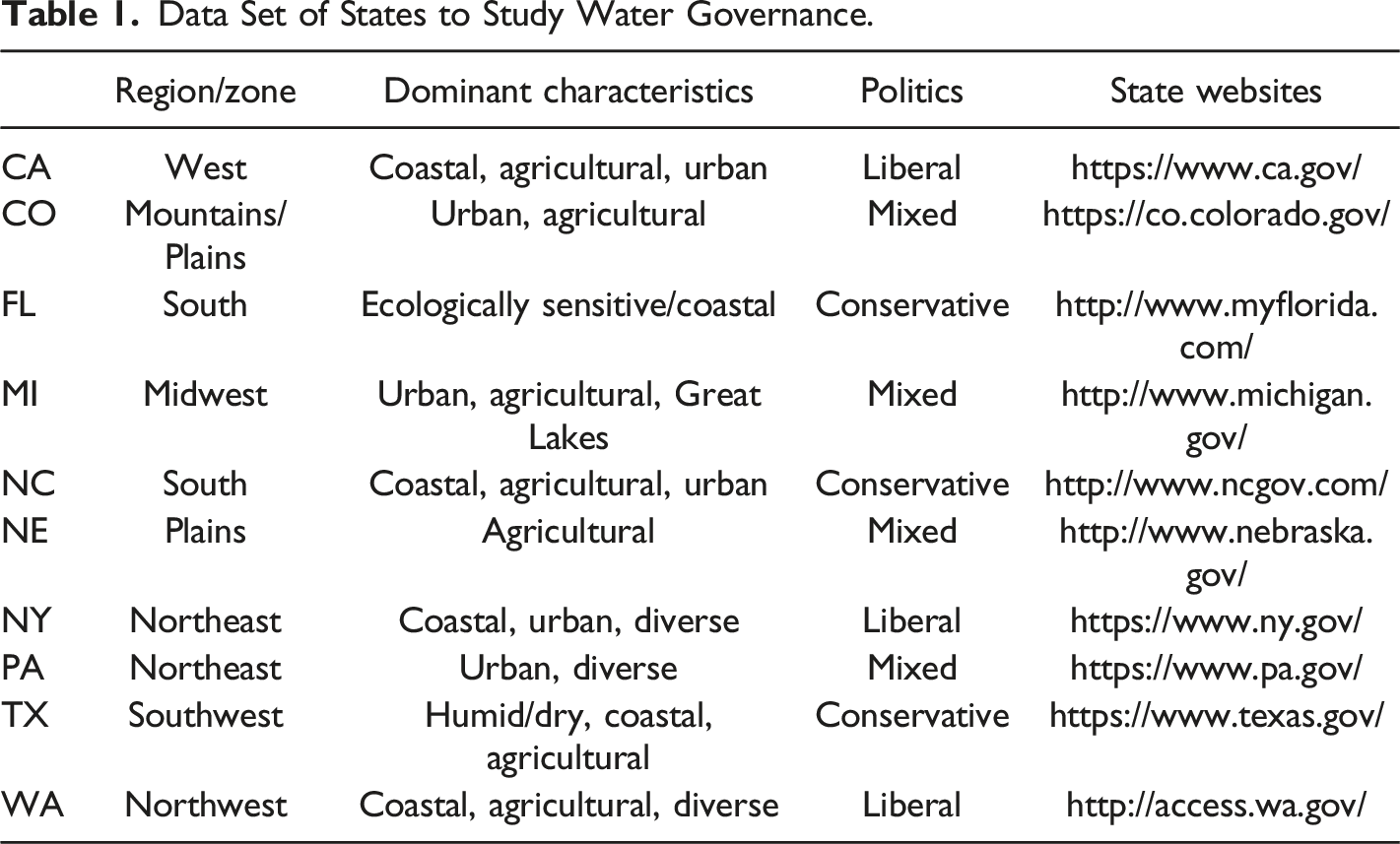
To examine how state government water management programs are evolving, 10 states from different regions and with distinct attributes were selected for analysis. The US can be divided into regions using different classifiers, and geographic regions are Northeast, Southwest, Middle West, and West, with granularity added through subregions like the Rocky Mountains or the Pacific Northwest. Considering the contextual situations of water management, climate is also important as are coastal features or unique zones like the Great Lakes, which enable consideration of ecologic zones like forest, plains, and coastal zones (USEPA, 2022a). Degree of urbanization is also important because states with large urban populations will face different issues than mostly rural states. Other variables that might influence how a state organizes for water governance include land area, population, and whether a state relies heavily on groundwater. Also, some states face more interstate water issues than others.
Political tradition was also considered to identify states more likely to be proactive in establishing government programs. In today’s political environment, there is much discussion of liberal and conservative leaning of states with the South and much of the West as more conservative and California and the Northeast as more liberal. The classifier used to assess the leaning of a state was from (Dizikes, 2015).
Data Set of States to Study Water Governance.
Analysis of State Government Programs
Data on the 10 selected states were collected to assess how state governments are developing their water programs for regulation, planning, and local government assistance. The information included the agency names and activities for regulation of water allocation, drinking water safety, and water quality, the status of any instream flow program, and their activities in water resources planning. Some data on the extent of financial and technical assistance to local governments were collected, but these activities are scattered and more difficult to characterize than the other attributes. The main source of the data was state websites, as augmented by studies identified in the references section and by the writer’s records. The data comprise both objective information, like the names of agencies, and anecdotal evidence, like case histories about a program’s activity level and/or successes. Study of the state programs from their websites requires visitation to numerous tabs and selections and listing all as separate references would add unneeded detail here, so the basic website addresses used are presented in Table 1. Selected additional references are added in the text as needed.
Regulatory Programs
Due to alignment of state government programs with federal requirements, all states have regulatory programs and staffs to administer drinking water and pollution control programs to comply with USEPA requirements. These requirements include aspects of planning, assessment, permitting, enforcement, and reporting. Among the states, few differences are observed other than those that stem from size and complexity of the states and choices among program organizational structures.
Most states initiated their regulatory programs in response to federal legislation, but California began earlier to organize and consolidate its programs with passage of a strong water pollution control law in 1949 and subsequent organization of the State Water Control Board. Regulatory controls for water allocation were already in place and drinking water was regulated in the state health department. Attention to water pollution stemmed from 1940s outbreaks of water-borne diseases and degradation of recreational waters that happened due to industrial development and population growth. Consensus about the needed changes was forged due to scatter among government agency jurisdictions, the needs of cities to build facilities for wastewater treatment, and the needs of industries to sort out laws and authorities among regulatory agencies. The programs have now been consolidated into a combined State Water Control Boards organization, with drinking water moving from the health department in 2014 (California State Water Resources Control Board, 2022). In a similar way, the Texas Commission on Environmental Quality (2022) was created in 1993 as a consolidated agency with the same programs, but they are housed with other environmental programs, like air quality.
Programs in the other eight states have similar stories. All but two have consolidated drinking water and water pollution control programs in single integrated agencies. In New York and Washington, the drinking water programs remain in the health departments. The dichotomy of having one aspect of water in a health department and another in an environmental control department exhibits the attribute of water as a connector to both health and environmental integrity, while these connect to many other aspects of society.
State implementation of federal legislation for drinking water and pollution control programs has been evolving for some 50 years and seems to be on a constant trajectory. There is little indication of any major policy changes at either level, despite new challenges that will occur in both program areas. In the case of drinking water, current threats are centered on emerging pollutants (USEPA, 2022c), and for pollution control, they center on inadequacy of current programs to deal with nonpoint source pollution (Andreen, 2013). The government and interest group communities that have formed around each program area seem poised to respond to these issues, but little strategic change in state government roles is indicated.Whereas the states show little difference in how they regulate drinking water and water quality, they exhibit wider differences in how they regulate water allocation. How they approach it depends on whether they have legally constituted water rights systems like in the appropriation doctrine states and/or whether they have experienced water quantity issues that are important enough to warrant regulation.
The sample of states includes three that are entirely in the West (Colorado, California, and Washington), four in the East (New York, Pennsylvania, North Carolina, and Florida), one in the Midwest (Michigan), one in the Plains region (Nebraska), and one that spans from Southeast to Southwest (Texas). The western states are classified as having either a prior appropriation system (Colorado) or a hybrid system (California and Washington). Nebraska and Texas are also considered hybrid water law states. A hybrid system is defined as one having some attributes of appropriation and some of riparian water law (Waters & Spitzig, 2018). The data show, however, that even if a state is classified as hybrid, it will still maintain the management system required to administer water rights like an appropriation state. Accordingly, Colorado has a state engineer’s office, like nearby western states like Wyoming. California has a water rights section in the California Water Boards organization, and Washington manages water rights in the water resources section of its Department of Ecology. The administrative systems of these three states seem to be well established.
As states with climatic and economic similarities to the western states, Texas and Nebraska also administer water rights, albeit with legal systems that evolved in mixed climatic zones. Both states have systems to administer water rights, Texas in the Commission on Environmental Quality and Nebraska through its Department of Natural Resources. Both states also work closely with regional organizations like basin authorities or natural resource districts.
The other five states have mixed systems of regulating water allocation. Their regulatory programs depend to some extent on rates of growth and pressure on water availability. For example, Florida has been growing rapidly for decades and a system of water management has evolved through its water management districts, which control permitting. North Carolina has also grown rapidly, but it has more diverse topography and climatic conditions and has evolved a different system for water use permitting through its Department of Environment and Natural Resources. Michigan has a complex system for water regulation that considers its shorelines along the Great Lakes, its other surface waters, and its groundwater. New York also manages surface water allocation through control of withdrawals, and in a similar way to other eastern states, permits are required for any withdrawal greater than 100,000 gallons per day.
Like the case for drinking water and pollution control, states exhibit stable programs to control water allocation, particularly in those with water rights systems. In diverse states like Michigan and New York, regulation of water withdrawals takes place within a comprehensive management framework that includes other environmental issues. It seems inevitable that all states will need to strengthen water allocation programs as climate change occurs and development pressures increase. In fast-growing states with tight supplies like Florida, permits for water withdrawal will come under increasing scrutiny more rapidly.
All 10 states had dam safety regulatory programs that seemed to be organized well. Mountainous states with higher dams must be especially diligent in dam oversight. In the West, states work closely with the US Bureau of Reclamation, which has a dam safety program. Eastern states like North Carolina and New York have some mountainous zones as well, but they do not have as many dams for irrigation water supply. Michigan had a recent dam failure and organized a special task force to examine its program and recommend strengthening. Florida splits regulatory roles between its Department of Environmental Protection, which handles landfills, wastewater treatment, mining, hazardous waste, water treatment facilities, and other types, and its water management districts, which handle commercial and office development, residential subdivisions and apartments, roadways, highways, and other developments.
State instream flow programs have not reached a level to be called regulatory because they are mixed in design when they exist at all. Colorado’s 1973 instream flow law was a pioneer and was negotiated between water users, environmentalists, and state government to authorize legal water rights for streams, but only under carefully controlled conditions. Nebraska also has an approach where an instream flow can have a water right. The Washington Department of Ecology (2022a) manages a program with rules to sustain adequate environmental flows in the state’s streams. The California Fish and Wildlife Department (2022) manages a program to identify priority streams for action as part of the state’s overall water management program. Florida has a minimum flow and levels program managed in cooperation with the water management districts. Pennsylvania and North Carolina have programs that are based on studies and advisory services but without firm statutory limits. Michigan, New York, and Texas do not indicate any instream flow programs on their websites.
Policy Development and Planning
State government involvement in water resources planning includes policy-setting, coordination of diverse demands on water, and facilitation of the efforts of local interests in solving their problems. Formal plans may be worked out for state framework assessments or river basin management. The work can also extend to cooperation with other states, the federal government, and other stakeholders. The extent to which a state takes leadership in water policy and planning is based on political interests and is difficult to assess. For this analysis, the starting point was to study whether the states have developed state water plans or similar policy-oriented studies. Additionally, the analysis considered the extent to which states indicated specific planning efforts to support their water regulatory or development programs.
There is no standard way to approach water planning because it depends so much on context. Hufschmidt (1980) offered a framework for it as he outlined the need in North Carolina to strengthen overall water resources planning, to include water pollution control, water allocation, water supply and conservation, interstate water issues, and flood management. These aspects can be expanded to include drought response, drinking water safety, groundwater regulation, and instream flow management.
California has an extensive legislatively mandated state water plan that is updated every five years. It is considered as a strategic plan to present the status and trends of water supplies and demands of agriculture, cities, and the environment for plausible future scenarios (California Department of Water resources, 2022b). Texas also has five-year water plans, with the first one displayed from 1961. The state plan is based on regional water plans and identifies streams of unique ecological value and potential reservoir sites (Texas Water Development Board, 2022). Florida has a similar state plan based on plans of its regional water districts.
Some of the states have plans designed as state water plans, but they are newer and still evolving in their impact. Colorado’s plan is a policy document that incorporates views of regional basin roundtables, which are coordination groups among stakeholders (Colorado Water Conservation Board, 2022). Prior to the first plan, which was issued in 2015, there had been resistance to the notion of state water planning as some stakeholders viewed it as a possible threat to water rights.
Nebraska has a planning process whereby the Department of Natural Resources works with the state’s natural resources districts to develop integrated management plans and basin-wide plans. An integrated management plan is between the state agency and a district and basin-wide plans involve the agency and multiple districts in a basin (Nebraska Department of Natural Resources, 2022).
Pennsylvania has a diverse plan that seems somewhat unique for an eastern state. It addresses policies related to unique issues such as river navigation and coal mining regions, as well as urban, environmental, and agricultural matters (Pennsylvania Department of Environmental Protection, 2022).
Several states do not show a state water plan as a comprehensive effort, but they may have focused approaches. For example, North Carolina shows a financing plan, Michigan and New York show clean water plans, and Washington lacks a legislatively mandated water plan, but its water resources program within the Washington Department of Ecology (2022) has a strategic plan.
Interstate cooperation is difficult to assess except when formal water compacts or agreements are made among states. Most interstate water compacts are in the West, but a few in the East focus on water quality or flood control goals. Data are available from the Interstate Council on Water Policy (ICWP, 2020), from Kenney (2002), and from the Council of State Governments (CSG, 2022), which has searchable data on some 1500 state-to-state compacts covering diverse topics.
Support Programs
The most visible support programs are those for financial assistance to local governments, especially through USEPA’s Drinking Water State Revolving Fund and Clean Water State Revolving Fund loan programs. Some states administer these funds through environmental departments and others have separate financing authorities. The Texas Water Development Board (2022b) exhibits an extensive and consolidated program with loans and grants that extend across several water management purposes. The California Water Boards organization has a Division of Financial Assistance and the state’s Department of Water Resources also administers some grants and loans. In Colorado, the Water Resources & Power Development Authority and the Colorado Water Conservation Board offer loans and grants. North Carolina has a State Water Infrastructure Authority.
The activities of state governments to provide technical assistance and support for capacity building are more difficult to assess than financial programs. Even in the case of financial programs, states may not find it necessary to intervene in local government affairs. Such interventions vary among states that have programs, and local officials may resent state involvement in their affairs (Pew Charitable Trusts, 2013).
State governments most likely do not have statutes mandating technical support and organizational capacity building. Support and programs that are initiated are likely to come and go, depending on emerging needs and changing priorities. Assistance may be provided to help local governments comply with regulatory requirements, such as the case of water loss reporting. States might also build on their coordination roles and provide some training, as for example in floodplain management programs to comply with FEMA rules.
Discussion and Conclusions
State governments have followed different trajectories to develop their current portfolios of water governance, but the influences of federal law and grant funding have been substantial in all of them. They developed their water governance portfolios in a piecemeal fashion, with some parts responding to federal legislation and other parts adapting to regional and local needs. These portfolios address water issues in programmatic categories, like regulation of drinking water safety, for example, and this leads to stovepipes between them and other programs, but policy development and planning programs provide tools to integrate them and to coordinate with other levels and jurisdictions of government.
Given the status of and constraints on state government water programs, how responsive will they be to emerging water issues like severe flooding, Colorado River drought, and drinking water failures? The issues they confront come from each category of water management: water services, water pollution, water allocation, instream flows, and flood control. Each of these faces the emerging and urgent issues mentioned: new health threats in drinking water, nonpoint source pollution, water scarcity, lack of adequate instream flows, and rising risks of flood disasters, among others.
Regulation of drinking water safety is a stable program area driven by the Safe Drinking Water Act and it seems unlikely to change very much at any of the three levels of government. Existing mechanisms seem capable to adjust to foreseeable health threats, although uncertainties and public trust will be continuing issues. Any major actions will be driven by federal actions and the main responses will be at the local level, with state governments mostly in a reactive model. Also, as most water supply enterprises are owned by local governments, state governments have little say about service access and quality, which are driven as much by politics as by regulations. Water supply crises like the Flint, Michigan problem and the more recent Jackson, Mississippi problems are mostly social justice issues that call for political responses, but they will differ from state to state, and they are more likely to involve short term reallocation of funds and priorities than any changes in state government programs. One area of increased oversight will be attention to security, particularly cybersecurity. Whether state governments have a significant role in it will be clarified in the years ahead. Infrastructure problems are addressed more by finances than by regulatory programs and may drive state activity in financial assistance programs.
Regulation of water pollution is based on a federally driven command and control system. The program gets credit for reducing pollution, but it does not address nonpoint problems well. Also, the Act does not address biological issues, which determine environmental integrity of streams (Andreen, 2013). Controls for nonpoint source pollution are largely in the hands of state governments and offer possibilities for new policies. States can begin to address these using regulatory and other available tools. In the companion issue area of instream flow regulation, as the climate changes and pressures on streams rise, states will need to develop ways to avoid over-depletion to sustain the integrity of their environmental systems. The reach of the federal government will be limited to existing legal tools, like pollution control permits, and which of the tools are dated.
The regulatory category of water allocation is the major tool that state governments have to respond to climate induced water scarcity. These tools be affected by growth, development, and climate change, and will need attention in all states, especially those with weak current programs based only on loose registration requirements. States with legally bestowed water rights are already active in this arena, as are a few that have effective permit programs. However, many states have been slow to initiate programs, and some have passive programs and little apparent enforcement.
Whether states can head off rising flood disasters as they confront climate change depends largely on land use controls, which comprise another arena where states can have significant influence on local programs, even while they cannot control land use directly. States can also make their dam safety programs more effective to prevent failures and states with weak programs will have to strengthen them.
While state governments must continue their essential roles in financial assistance programs, their activities in technical assistance and capacity building are unlikely to expand because they can be handled by third party providers like university extension, non-governmental organizations, and others for a fee. State governments can be providers of last choice when assistance is required, but for some reason is not available. They can also partner with other organizations in seeking federal grants to support assistance programs.
Planning, policy, and coordination activities to address emerging water issues are major tools available to state governments that should be expanded. As the water governance community continues to look for ways to integrate responses to shared issues, state governments occupy an important jurisdictional niche that equips them to engage in framework and basin planning and to take the lead in holistic approaches to problem solving. These efforts can also focus on environmental equity and justice as arenas where states can act. The three situations mentioned, flood disaster, Colorado River shortages, and drinking water problems, exhibit problem spaces where state government action can help greatly.
As state government programs move into the future, there will be continuing formal and informal negotiations about state-federal relationships, especially in the arenas of regulation. State governments will need to exercise diligence in protecting their water and aquatic environments and they will need to continue improvements in their planning programs and processes. While water governance should theoretically be based on collective action, it will occur in conflictual situations.
State governments must prepare for their emerging roles, which in some cases represent unfamiliar territory. Many are accustomed to waiting for federal action. This happened while the nation developed and the federal government took proactive actions at the national scale on issues such as control of water pollution control and flood risk, while many state governments took reactive positions and responded mainly to federal initiatives. Change began during the 1970s when the federal government, through its new water and environmental legislation, paved the way for new state government activity in water governance and management. Now, states must study needed actions with initiatives such as water framework studies and active dialogues about their problems and required responses.
State-federal relationships in water governance will continue to be worked out as the nation faces major emerging water issues like water scarcity, increased flood risk, regional groundwater competition, and environmental water sustainability. As states face these emerging issues, they can reassess their water governance portfolios to address issues in unique and appropriate ways.
Footnotes
Declaration of Conflicting Interests
The author(s) declared no potential conflicts of interest with respect to the research, authorship, and/or publication of this article.
Funding
The author(s) received no financial support for the research, authorship, and/or publication of this article.
