




Abstract
There are several ways of arranging rural water supply. One of these is through water cooperatives that have been established to provide water supply, irrigation, and/or sewerage services. Water cooperatives are found in developed countries such as Finland, Denmark, Austria, Canada, and United States, and in developing countries in South America, such as Bolivia and Chile. Water cooperatives or their equivalent organizations that exist in Kenya are called self-help water projects. Yet, surprisingly little attention has been paid to this option even in countries with rich tradition of cooperatives in other sectors. In this study, Finland and Kenya were selected for a comparative analysis of the identified features of water cooperatives. Best practices observed in the features with differences could be shared between the two countries.
Introduction
The tradition and history of the cooperative movement around the world is long. The scope of cooperatives includes supplying public services such as electricity, telephone communication, transportation, and water for drinking and irrigation. Community water supply cooperatives (co-ops) are predominant in rural areas of many developed countries such as Canada (200 co-ops; Bakker, 2007), Finland (1,300 co-ops), Denmark (2,500 co-ops), Austria (5,000 co-ops; Nikolaou, 2014), and the United States (3,300 co-ops; University of Wisconsin, 2016) where they are referred to as water user associations. In South America, there were 15 water cooperatives in Bolivia in 1993, while in Chile there were 137 (International Labour Office, 2001). Other examples are the water cooperatives in Southeast Asia, which are engaged in irrigation, often called water users associations. Furthermore, in developing economies such as Kenya, many self-organized water supply projects seem to operate largely according to the principles of water cooperatives.
Water cooperatives exhibit diverse features that explain their existence, successes, or failures and role in providing and producing water services (Katko & Hukka, 2015). Despite a variety of publications, web pages, and other sources that indicate the existence many water cooperatives in different parts of the world, only a few studies have been carried out focusing on their features, role, relevance, and development. There is need for to conduct additional research in this focus area to obtain better understanding of the features of water co-ops under various conditions. The lack of existing research has motivated this comparative article on the development of cooperatives in two countries: Finland in the North and Kenya in the South.
In this article, after defining the objectives and describing the research method, we will explore the development of water cooperatives in Finland and Kenya. The key features of water cooperatives in these two countries will be compared to identify their similarities and differences, followed by a discussion and conclusion.
Objectives
The objective of this article is to produce new knowledge and a better understanding of water cooperatives and their role in water services in two very different countries. The selection of the countries, Finland and Kenya, is based on the researchers’ knowledge of the water sector in their home countries.
The research questions are as follows:
In addition, we will identify learnings from these two case countries that can be used elsewhere.
Method
The approach used in this study was mainly qualitative, consisting of a literature review, interviews, and discussions. For Finland, the data collection was derived from the literature and tacit knowledge based on the actions and research of the first author and his active role with several water cooperatives including as chairman of the Association of Finnish Water Cooperatives (SVOSK) since 2012.
For Kenya, the data were collected from interviews with managers of Water Resources Management Authority (WRMA) regions and officers at Water Service Boards (WSBs). Focus group discussions were held with committee members of three water projects selected after examining the information emerging from the interviews. This approach was chosen as an initial assessment of existing water cooperatives in Kenya, such as the self-help water projects. Next, certain projects will be selected to be studied further in a future phase of this research by the second author.
With the comparative study, we will approach water cooperatives in these two case countries from different viewpoints such as
Role of cooperatives in the society,
Development of cooperatives or related consumer-managed organizations,
Water cooperatives versus other water service producers,
Institutional and legislative setting, and
Recent trends and future prospects for water cooperatives.
To discover out similarities and differences and lessons to be learned and shared, we will compare local practices in selected key topics based on previously mentioned viewpoints.
Finnish Water Cooperatives
According to the Finnish Patent and Registration Office (2016), there were 4,905 cooperatives in Finland at the end of 2015. These cooperatives operate in several fields: dairy, development, culture, energy farming, purchasing, marketing, social services and health, telecommunication, transportation, and water supply (Pellervo Society, 2016). The largest of these fields is water supply and sanitation. The register of the SVOSK includes 1,316 registered water cooperatives. This number is changing continuously since approximately 20 new water cooperatives are established every year while some water cooperatives cease operation. It is very difficult to assess the exact number of water cooperatives because the authorities do not maintain a comprehensive list. Furthermore, in the database of the Finnish Patent and Registration Office, water cooperatives are listed under many names, and it is not always clear from the registration name whether it is a water cooperative. Figure 1 includes 1,308 active water cooperatives according to the year of establishment in the Virre Information Service as of December 8, 2015. The Virre information Service is maintained by the Finnish Patent and Registration Office and it includes the official register information for Finnish companies.
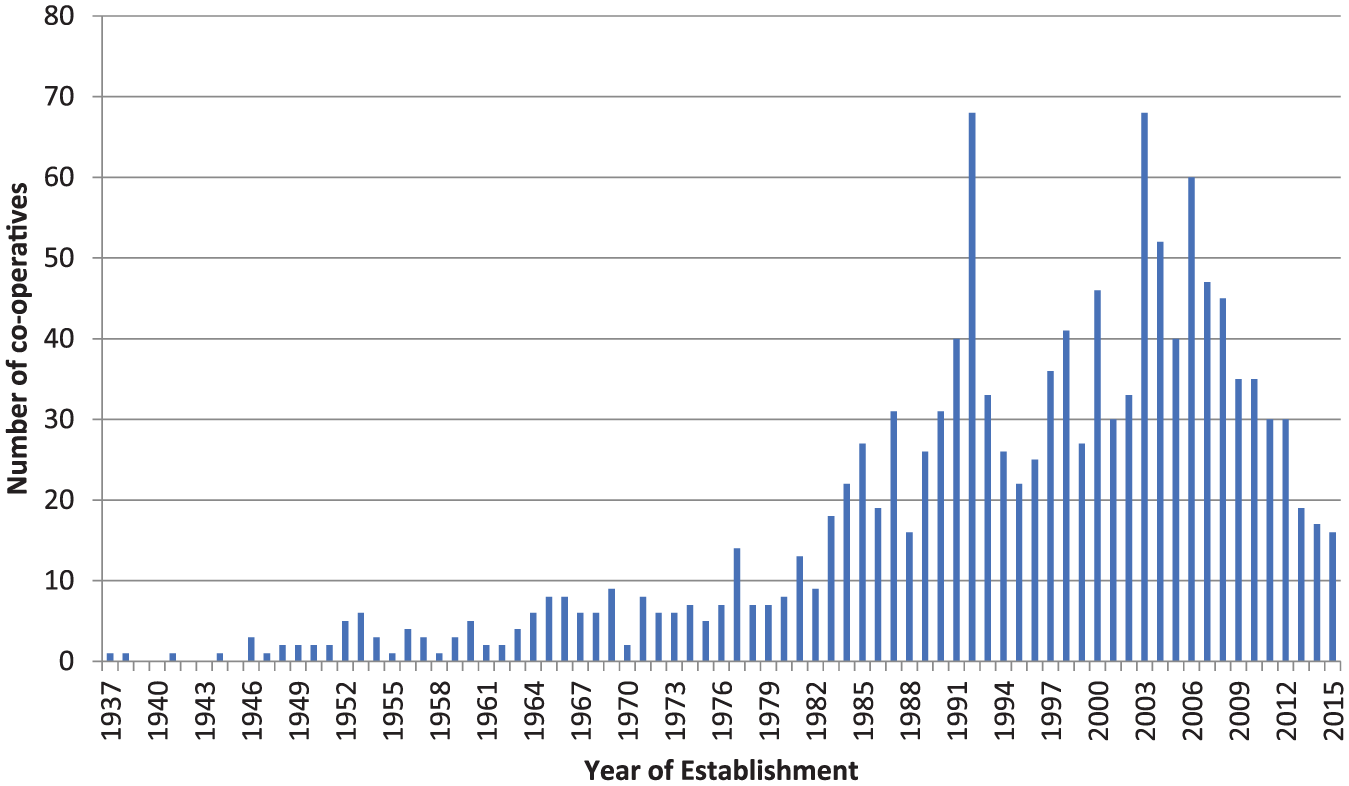
Active water cooperatives in 2015 according to the year of their establishment (Virre Information Service, December 8, 2015).
Water Supply Associations in Finland
In this context, association means a group of people organized for a joint purpose. This cooperation can be structured as a partnership, cooperative, or limited company. The common factor is the need to supply water, and the owners of the water sources and distribution networks are the people needing water. A partnership is suitable for small-scale water supply and distribution as it is simple and lacks bureaucracy. The partnership is a coalition based on a partnership agreement. It is often possible to agree on things freely even without written agreements and there might be room for interpretation in the agreements. The fundamental attribute of the partnership is the mutual trust of members because according to the Finnish legislation (Partnership Act 389/1988), all partners are responsible for the company’s obligations, such as their own debts.
The number of partnership-based water associations is unknown because there are no official registers of partnership-based water associations. According to the Virre Information Services as of March 27, 2016, there were 12 registered partnership-based water associations when the Finnish word for “water” was used as the search criteria. However, according to the SVOSK, there are more than 80 partnership-based water associations in Finland.
If there are more than a few members in an association, establishing an official cooperative or a limited company is recommended. The Act of Cooperatives and the Act of Companies contain regulations on agreements and other activities of the association. For example, the Act of Cooperatives includes the order of the contents of the rules of cooperatives. Previously agreed-upon rules for activities facilitate the association’s operations.
Tradition of Cooperation
Cooperation of various types has been one method of survival in the four-season climate of Finland. Coalitions have existed in several fields: boats, dragnets, fish weirs, mills, sawmills, and so forth. The largest coalitions had 40 to 50 members and all members participated through labor. These coalitions acted like cooperatives as early as in the 17th century (Alanen, 1964).
Finland is known as the land of a thousand lakes and there are approximately 57,000 lakes with a minimum area of one hectare (Statistic Finland, 2016). The water levels of at least 1,344 lakes were lowered in Finland in the 1700s and 1800s by lake drainage associations to provide more farmland (Anttila, 1967, cited by Katko, 1996). According to Katko (1996), early water cooperatives used the same fee-sharing principle as these lake drainage associations.
The first Cooperative Act in Finland was enacted in 1901, while the first registered water cooperative was established in Pispala, next to the city of Tampere, in 1907. This area is located along a ridge formed during the last ice age that ended some 10,000 years ago. The people of the area tired of retrieving water from a distant water source or lake and they searched for a solution for their water supply problem (Juuti & Katko, 1998). Although if this first formal water cooperative was established in a suburban area, early water cooperatives were typically solutions for domestic rural water supplies, especially for the needs of cowhouses (Katko, 1996).
Water Cooperatives in Different Phases of Water Supply in Finland
Finnish water cooperatives can be divided into five periodic categories according to their major features (Table 1).
Development Phases of Finnish Water Cooperatives (Takala, Arvonen, Katko, Pietila, & Akerman, 2011; modified).
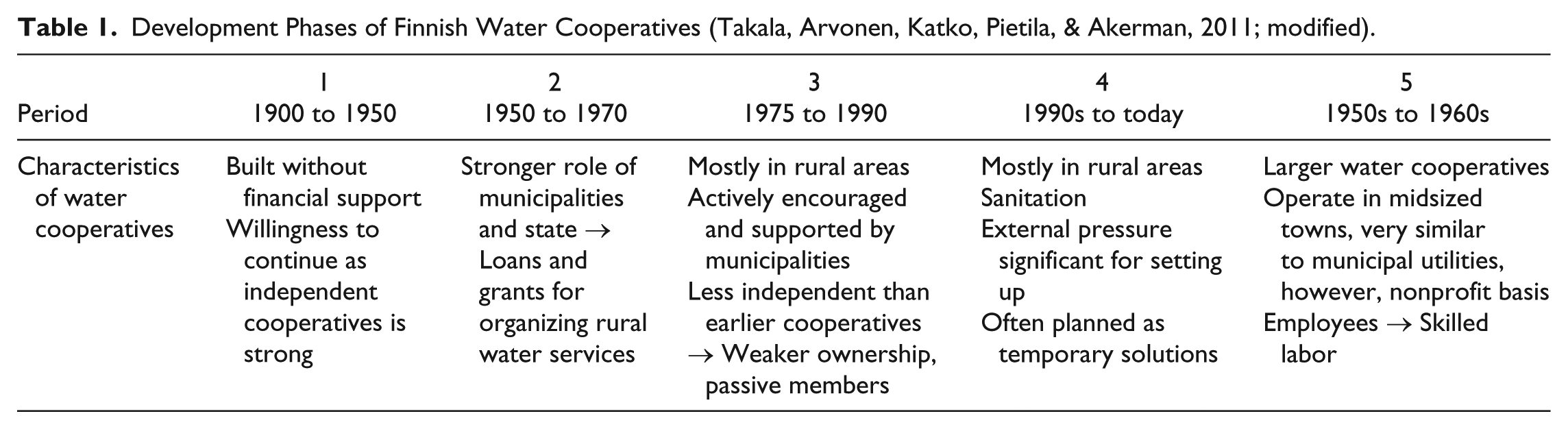
The first phase water cooperatives were established out of pure need; projects were organized by local people and were fully self-financed without financial support from the government, unlike the later phases. Typically, expenses were minimal and most of the work was done by voluntary contribution. Before 1950, there were 389 piped water supply systems in rural areas. Most of these were partnerships based on oral agreements. Many of these were not officially registered. Some 60% of these water supply systems were located in the Vaasa area where sufficient quality groundwater was not available. Typically, these water cooperatives used pipes made of wood and constructed by small local contractors (Wäre, 1951; cited by Katko, 1992).
During the second phase, municipalities and the state played a stronger role in financing water cooperatives. In 1950, the Committee for Rationalizing Households made a recommendation on the Act of Loans and Grants for Water Supply and Sewerage in Rural Municipalities. These grants and loans were available only to private associations, and plastic started to replace wood as the pipe material (Katko, 1992; Takala, Arvonen, Katko, Pietila, & Akerman, 2011).
During the third phase, from the 1970s to the 1990s, the focus was on sparsely populated areas. Municipalities encouraged people to organize and develop the services themselves. The focus was on drinking water, and in 1980, approximately 70% of the population in sparsely populated areas was connected to common water supply systems (Katko, 1992; Takala et al., 2011).
The fourth phase, from the 1990s to the present, also includes water cooperatives that address wastewaters. Especially in the early 2000s, the Government Decree on Treating Domestic Wastewater in Areas Outside Sewer Networks promoted establishing water cooperatives in many areas. This Government Decree might be one reason for the significant growth in the number of water cooperatives as shown in Figure 1 (Takala et al., 2011).
Fifth-phase water cooperatives differ from other groups by size and location. These water cooperatives are large (more than 2,000 customers and serving 2,000-15,000 people) and operate in small towns. These water cooperatives have permanent employees and are largely comparable to municipal water utilities (Takala et al., 2011).
It is not possible to describe a typical Finnish water cooperative because of its diversity. The common factors include the corporate form and operation with water or wastewater. Other factors vary: size, operating environment, level of services, level of knowledge, economic situation, state of the water supply or sewage networks, and maintenance level. The diversity of water cooperatives is driven by different types of people, needs, and circumstances (environment, economic, and population). Water cooperatives have been shaped according to the needs of the area and available resources.
Water Cooperatives in Kenya
Definitions and Context
The definition of water cooperatives varies widely between countries. In the Kenyan context, the meaning of cooperatives is not directly associated with water but with other economic activities. It was not until the mid-1940s that Kenyans were free to join the cooperative movement that became well established by the early 1960s. Today, there are cooperatives in production activities in agriculture, dairy farming, fisheries, handicraft, construction material processing, and irrigation farming. Other cooperatives operate in the services sector including housing, savings and credit, open-air informal businesses, and the insurance and transportation sector. According to the Ministry of Cooperative Development and Marketing, there were a total of 13,500 cooperatives registered in Kenya as of 2013 through the Cooperative Societies Act, Chapter 490 (GOK, 2012).
In addition to cooperatives, and operating on a similar set of basic principles, there are self-help groups involved in many socioeconomic activities, including water supply services to their members. Self-help groups are described by Ochanda (2013, p. 58) as “typically small community-based organizations or groups formed on a co-operative basis for the purpose of mutual assistance.” These groups are a dominant feature of the Kenyan way of life, improving livelihoods for their members. However, where water services are concerned, the groups are not permitted to share surpluses but require reinvestment in other water supply activities. Self-help groups are registered by the Ministry Responsible for Culture and Social Services because it is simpler and cheaper than other registration alternatives such as the Cooperatives, Companies, and Societies Acts. Previously, as Makhanu (2006) has observed, self-help groups were under the Ministry of Cooperatives and Social Services during the first Kenyan government after the attainment of independence. The existence of many agriculture and dairy cooperatives in rural areas influenced the establishment of self-help water projects and has also positively affected their management.
Water supply schemes implemented by self-help groups are known by several names: self-help water projects (or simply water projects), women-group water projects, water associations, and water user associations. Other names such as informal water service providers (WSPs) and small-scale water projects have also been used in reference to this group of water supply systems.
Water user associations and water resource user associations should be legally registered under the Societies Act Chapter 108. Although a majority of these groups use water for domestic and livestock needs, there are others engaged in commercial irrigation that have formed cooperatives to sell their agricultural produce. This group is required to be registered under the Cooperative Societies Act Chapter 490. In this article, these self-help water projects are considered equivalent to water cooperatives and the two names are used interchangeably.
Origins of Self-Help Water Projects
The origins of self-help groups in Kenya can be traced to the tradition of communal work and the cooperative effort practiced in activities such as tilling land, building houses, or assisting individuals solve social problems. This practice, described by Mbithi and Rasmusson (1977), as Harambee self-help, as a “fundamental trait of Kenyan rural societies,” enabled communities to initiate cooperative self-help development projects. Thereafter, communities used the call to vigorously engage in cooperative self-help development projects. Energetic and visionary individuals called champions were involved in mobilizing members of the community. In this way, many self-help water projects were initiated to improve water supplies from traditional sources to piped water near homesteads. During those early stages, community members pooled their own resources to implement and manage the self-help water projects supported by technical advice from government officers.
Self-help water projects are concentrated in the central and western regions where approximately 60% of the Kenyan population lives. Examination of records of 245 self-help water projects, chosen randomly from the water permit applications at WRMA offices in charge of four catchment regions, indicates that the largest number was registered from 2000 to 2010 as shown in Figure 2. This occurred at a time when government encouraged community members to participate in water supply development and increased funding. Thus, many self-help water projects were either newly established or those that had collapsed were revived. Another reason is that the projects were complying with application conditions from the Water Resources Management Authority (WRMA) that had taken over the mandate of approving water permits from the Ministry of Water and Irrigation (MoW&I) in 2005.
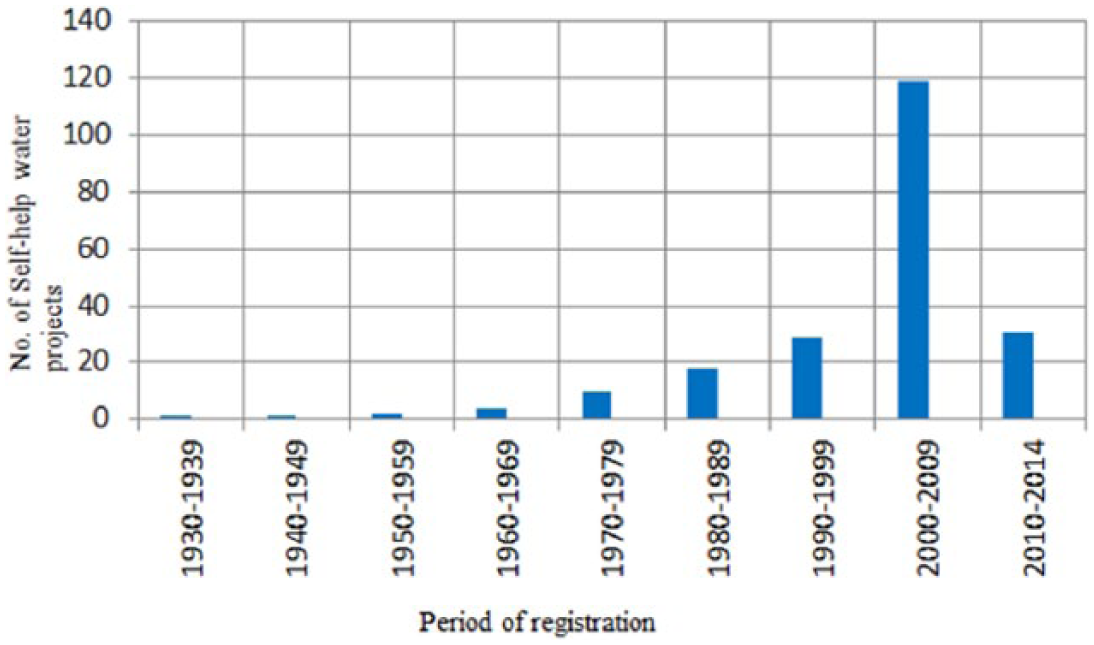
Periods of registration of self-help water projects.
Inclusion in Different Water Supply Policies
The water supply policy in Kenya has changed several times since the beginning of its independence in 1963. The period from 1963 to 1999 was marked by frequent institutional changes in the water supply sector (Nyangeri, 2007). Table 2 shows different ways that community self-help water projects were included in three phases of water policy.
Inclusion in Water Supply Policy (Mehta & Virjee, 2002; Oenga & Kuria, 2006; Ogendi & Ong’oa, 2009; compiled by Kibocha).
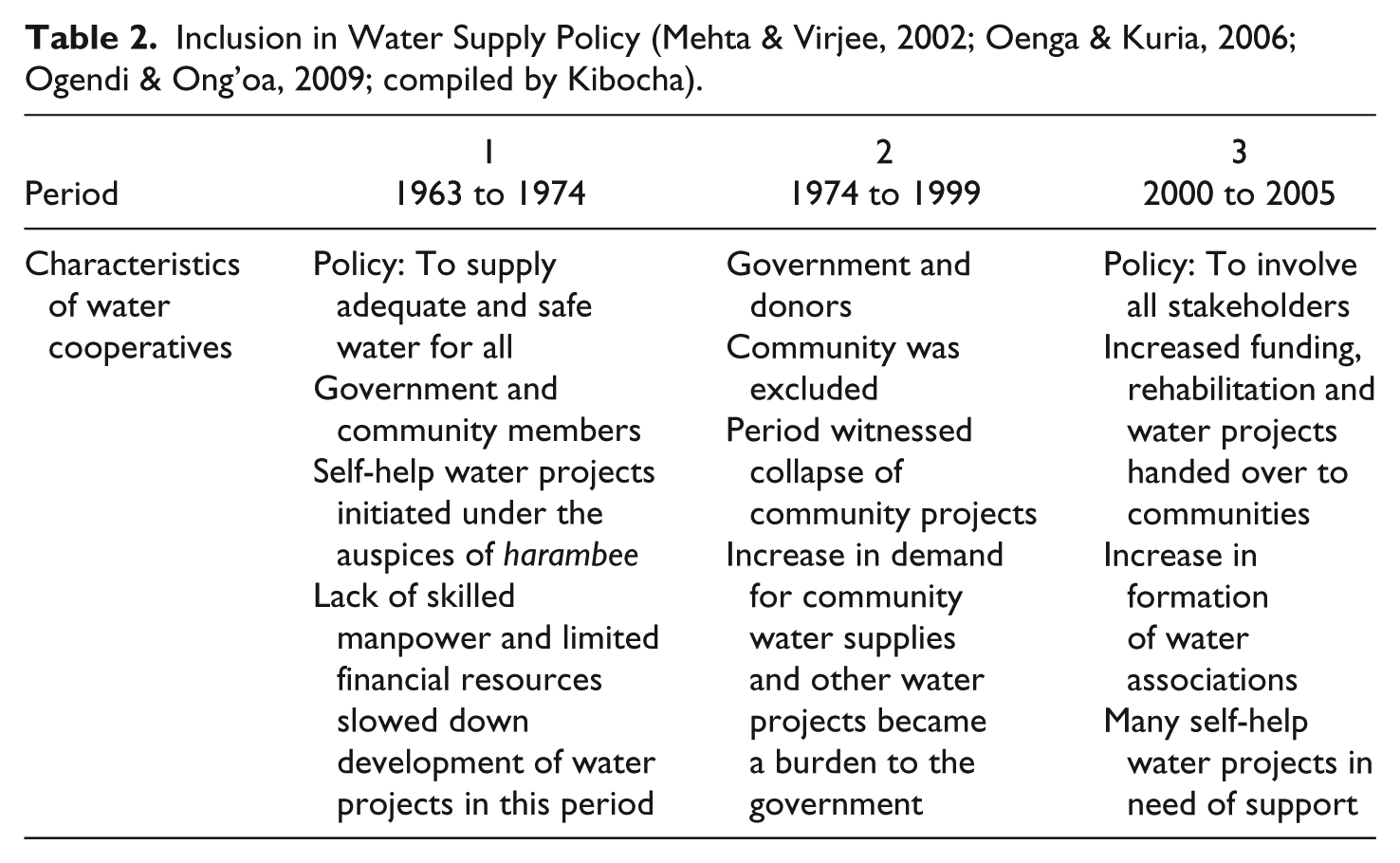
Despite the problems they have encountered, self-help water projects are considered an important aspect of the water supply sector in Kenya.
Comparison of Water Cooperatives in Finland and Kenya
According to the International Co-Operative Alliance (2016), the principles that govern cooperatives are voluntary and open membership, democratic member control, member economic participation, autonomy and independence, education, training and information, cooperation among cooperatives, and concern for community. These principles are the basis for all cooperative operations and some of these principles can be seen in water cooperatives in both countries.
This comparison is based on the following selected points, which describe the position of water cooperatives in the water sector and in the society.
The Contribution to the Provision of Water Service
In spite of the large number of water cooperatives in both countries, they apply to a relatively small share of the population. Water companies serve more than 90% of the Finnish population. Out of this, 10% is served by water cooperatives, privately owned limited companies, and partnership-based water systems (The Association of Finnish Local and Regional Authorities, 2007 and ROTI, 2009). In Kenya, WASREB (2014) estimates that the overall water supply coverage in rural areas is 51%. Of the areas covered, approximately 5,000 self-help water projects contribute approximately 15% of the water supply. The remaining 85% is provided by water companies licensed by WSBs.
The Size of Water Cooperatives
The size of Finnish water cooperatives varies. The smallest has two or three members and the largest has more than 4,000 members (Kuusamo Energy and Water Co-Operative, 2014). These large water cooperatives supply water to small towns of up to 15,000 people (Ylivieska Water Co-Operative, 2014). The supplied amount of water varies between a few cubic meters to more than 2,700 m3/d. This aligns with the design value for water consumption in Finland, which is 140 liters/capita/day (RIL, 2010). These large cooperatives also serve industry and the public sector such as schools. However, there are fewer than 20 water cooperatives serving more than 2,000 people in small municipalities (Vihanta, 2013).
In Kenya, records at the WRMA showed that self-help water projects with point sources applied for water permits ranging from 20 to 30 m3 per day for a population of approximately 1,400. Those with a piped water supply applied for permits with an average of approximately 600 m3/day for approximately 4,000 connections. The records also indicated that commercial irrigation self-help water projects applied for permits with an average of approximately 7,000 m3/day of water.
The Diversity of Services
Water cooperatives are diverse in terms of their size and their services. In Finland, the water delivered by water cooperatives can originate from an owned water source or drawn from a municipal water utility or from another water cooperative. The water drawn from cooperatives’ own sources is mainly groundwater. Some water cooperatives also manage the wastewaters in the area. They may have their own wastewater treatment plants or they transfer their wastewaters to the municipal wastewater treatment plant using contracts. Water cooperatives can also be combinations of the abovementioned types.
Some of the water cooperatives in Finland operate in the archipelago, some in Lapland’s ski resorts, some in small towns, and some in rural areas. These different environments require different technical solutions and different investment costs, and have different needs for water services. The operating environment depends on many factors and it has shaped water cooperatives in many ways. One example is the Kuusamo Energy and Water Co-Operative, which has combined energy production and distribution with water production and distribution. Water services represented 33% of the annual 7.8 M€ turnover of the Kuusamo Energy and Water Co-Operative (2014). Kuusamo is a typical example with varied water consumption because this area is a very popular tourist destination: During winter, 135,000 tourists visit the area over a very short period (Ruka, 2016). The cooperatives in the Finnish archipelago in particular have used special techniques to keep pipelines frost-free on rocky islands (T. Grönroos, personal communication, May 26, 2016). In rural areas there are long pressure sewer lines to collect wastewater for delivery to municipal wastewater treatment plants, and in densely built areas, wastewater flows in traditional gravity-fed sewers. More advanced technologies require more maintenance knowledge.
The use of the technologies varies between water cooperatives. Some cooperatives only draw untreated groundwater. Some water cooperatives, such as Elimäen Teuroisten Seudun Vesiosuuskunta in Elimäki, Kouvola region, conduct automatic water quality measurements to ensure the water quality in the pipes.
In Finland, cooperatives provide water and sewer services, while in Kenya, self-help water projects supply water primarily for domestic purposes, which may include livestock watering and subsistence irrigation. Commercial irrigation is practiced by some of the self-help water projects. Members of self-help water projects individually practice local disposal of wastewater and fecal matter. Water sources include point water sources such as wells and boreholes, and rivers and streams. Other sources include rainwater harvesting and sand dams and rock catchments. There are a few examples of self-help water projects that buy water from water utility companies. Water is collected at the source points or at the communal water points, such as water kiosks or yard taps for a piped water system.
External Support
In Finland, water cooperatives are supported financially mainly by government and local municipalities. According to the national drainage program, during 2007 to 2011, the Ministry of Agriculture and Forestry (2012) supported water supply and sanitation in rural areas with 40 million euro. The support is typically 20%, and according to legislation, the maximum support is 30% unless there are special reasons for support. In these cases, the maximum support is 50% (Ministry of Agriculture and Forestry, 2008). In addition, municipalities support local water cooperatives financially, and in some cases with technical support and loan guarantees. There are also other forms of support. For example, the municipality of Kontiolahti (2014) lends spare parts to the local water cooperative.
In Kenya, in the 1960s and 1970s, the communities that initiated self-help water projects did so to supplement development efforts by the first independent government and contributed their own resources to set up the projects. However, due to poverty levels, community members require continuous external support to sustain the projects. One source of support is WSTF, which was created by the 2002 Water Act to provide assistance to identified projects in need. Community members are required to contribute 15% of the cost of implementation of water facilities and 10% of the cost for sanitation facilities. Another source of financial support is the Constituency Development Fund (CDF) controlled by members of parliament. County governments also support water projects with funds drawn from the Equalization Fund, computed at the rate of 0.5% of national revenue.
Water Pricing
In Finland, the price of water varies between the water cooperatives. In some cases, the price is based solely on the immediate direct costs, such as pumping costs, and can be as low as 0,62 €/m3 (P. Alho, personal communication, June 26, 2016). The price of water is same or a bit higher than in municipal water works (on average 1,50…2,00 €/m3) for those water cooperatives that buy water from other water works, as they add a margin to cover operating costs. The decision regarding water price usually rests with the board of the water cooperative.
In Kenya, decisions concerning water pricing are included in the constitutions of individual water cooperatives. Normally, the project management committee determines the charges for water use and any other related fees, depending on whether the water supply system is metered or not. This decision is then presented at the annual general meeting for discussion and possible approval. The larger water cooperatives have block tariffs that are proposed by management committees. The consumers are then consulted for their agreement before presenting the tariff for approval by the regulatory body. The regulator harmonizes tariffs so they are uniform for different categories of consumers in either the urban or rural areas of the country.
Democratic Decision Making
Water cooperatives have internal democratic self-governance structures such as annual general meetings. They do not exist to make profit but for members’ needs. Prices are set for operation and maintenance only and any surpluses are reinvested back into the water system for expansion or distributed to the membership through lower water prices (Douvitsa & Kassavetis, 2014). Democratic decision making is ensured in both countries by regulation. In Finland, this democratic decision making is secured by the law through the Co-operatives Act Clause 421/2013 of 2013. In Kenya, the decision-making process is enshrined in the constitutions of the cooperatives, which are registered by the authorizing arm of government such as the Ministry in Charge of Social Services.
Gender Roles
According to an analysis of the list of contact persons for Finnish water cooperatives (which numbered 1,316), 7% (97) of the names were women and 64% (838) of the names were men. The remainder of the water cooperatives (381) had no contact person or the contact person was an accounting firm. These contact persons are typically chairmen of the boards or the secretaries of the water cooperatives. There are other people who take part in water cooperative management, but the gender distribution is very difficult to determine.
Although no particular role is reserved for either men or women in the management of water cooperatives, evidence abounds that women can play decisive and indispensable roles in ensuring the success of water improvement activities. In Kenya, the law requires that gender balance is observed when choosing leaders not only in water cooperatives but also in other organizations. However, in some rural areas, cultural beliefs work against women in leadership (Were, Roy, & Swallow, 2008). In Finland and Kenya, there are both genders on the management of water cooperatives. In Finland, there are no formal requirements to balance gender in the management of water cooperatives.
Political Interference
The authors have not observed direct political interference in water cooperatives, but in some cases, there has been indirect political interference in both countries. Whereas in some countries politicians are prevented from participating in water cooperatives, this is not the case in either Kenya or Finland. For example, in Santa Cruz, Bolivia the members of the cooperative cannot be elected to the Administration Board if they have participated in elections as candidates of a political party within the past 5 years or they have an active role in a political party (Ruiz-Mier & van Ginneken, 2006).
No evidence of direct political interference in water cooperatives has been observed in Finland by one of the authors in his 10 years of experience in working with Finnish water cooperatives or reported in the literature. However, local politicians are often actively involved in many activities, such as water cooperatives and hunting clubs, and the members of the board are not selected on political grounds. There are no political campaigns for the selection of the board members of water cooperatives unlike it was the case, for example, for Helsinki Cooperative Society Elanto (multisector and grocery group) in 2012, in which there were almost 1,000 candidates with only 14 of those lacking a political background (YLE, 2012).
However, local politicians may influence the operation of water cooperatives by making decisions about financial support for investments or when a municipal council confirms the operation area of the water cooperative. For example, in the City of Ylöjärvi, there were several years of political debates about the model of the sewer organization (municipal, cooperative, or none) in rural areas. During these debates, many aspects changed such as legislation, which caused problems for the project and the local water cooperative (LePeKa, 2014).
In Kenya, political interference in the running of self-help water projects can occur in the form of selective external support. According to the constitutions governing many self-help groups, politics is not permitted to influence their activities.
Presence of a Champion
The role of a champion at the initial stages of a community project is to mobilize members and the resources required to initiate the project. A champion is also essential not only where the community has obvious demand for water services but also in response to a “signal” such as proposed funding assistance (Andrews, 2013). This has an influence on the success or failure of water projects. A champion is also able to initiate top-down processes when chosen as the leader of a project.
The role of the initiators or the champions, called key persons by Katko (1992), has been very important for water cooperatives in Finland. These active persons have inspired the people to establish water cooperatives, perform voluntary work, such as building water pipes and serving in management roles (Katko, 1992). One driver for this type of activity has been the champions’ own demand for water services.
In Kenya, the champion is instrumental in mobilizing members during initiation of water projects and in fund-raising during implementation. Some champions donate personal resources to facilitate early realization of the water project.
Demand-Driven
Water cooperatives have been demand-driven in Finland. Until the 1990s, the reason has been the need for good quality drinking water for people and animals on farms. In the early 2000s, tighter legislation for on-site sanitation in rural areas was introduced (Takala et al., 2011). In recent years, companies have begun to help people establish water cooperatives to sell their products such as pumps (SKT, 2016).
In Kenya, self-help water projects in the 1960s and 1970s were initiated to supplement government development efforts and to step in where water services were unable to reach. After that time period, efforts became supply-driven, as the government implemented a policy to supply water to all citizens by the year 2000. When the 2002 Water Act was enacted, it provided for all stakeholders including the community to be involved in the development of its water supply systems. Due to the need for external support, self-help water projects have not been initiated completely on a demand-driven basis because members are aware they are targeted for funding of the water projects.
Cooperation of Water Cooperatives
In Finland, it is not typical for water cooperatives to cooperate with one another. The most comprehensive example of cooperation is on the Northwestern coast of Finland with an organization called OUKE (or Water Committee of Northern Finland). This organization has 43 water works as members and 11 of these are water cooperatives (OUKE, 2016). The people from the water works have annual meetings and training events. The SVOSK was established in 2009 and they have 130 members. Since 2010, SVOSK has arranged national water cooperative days with 100 to 120 participants every year. One of the main objectives of this association is to promote cooperation between water cooperatives, which makes it possible to exchange experiences and learn from each other.
A possible platform for the cooperation of Kenyan water cooperatives is the Water Service Providers Association (WASPA), which was established in 2002 and has a membership of 51 out of the current total of 103 licensed WSPs. However, many water cooperatives are not licensed as WSPs and hence are not members of WASPA. A new idea to form a federation of small water enterprises has been promoted by Stower (2008) who suggested that WSBs would facilitate the establishment of the federation. This idea has not to date been translated into action.
Challenges of Water Cooperatives
In Finland, human resource is one of the biggest challenges in water cooperatives. The age of the responsible persons is typically older than 60 years and it is difficult to get the next generation to accept responsibility for water cooperatives. Water cooperatives experience difficulties in finding candidates to take up positions on their boards. One reason is there is less willingness to engage in voluntary work. Another reason is that authorities prefer extending the operating areas of existing water cooperatives rather than establishing new water cooperatives, resulting in larger water cooperatives with more responsibilities. Larger units can hire professionals to manage water cooperatives. Tightening legislation also causes challenges to water cooperatives. According to legislation, the operation must be professional despite the lack of similar resources in small water cooperatives compared with municipal water utilities.
In Kenya, the biggest challenge facing self-help water projects is the lack of funds that limit the members’ capacity to undertake effective operation and maintenance of their water systems. Another challenge is related to the water supply boundaries, particularly in areas where self-help water projects are located within areas supplied by licensed WSPs. While this can be a source of conflict, it has also been regarded as competition for customers and thus a threat to the revenue base of the licensed WSPs. This also poses a threat to existence of poorly performing self-help water projects that are being taken over by licensed WSPs. However, some successful self-help water projects have entered into service provision agreements (SPA) with the relevant WSP in their areas. An additional challenge is illiteracy among elected members of water committees, which is blamed for poor management in several self-help water projects. In addition, there are cases of gender imbalance and noninclusion of youth in project management as well as discrimination against people with disabilities (WSTF, 2014). A particular challenge concerns the lands where sources and distribution systems of water are located as these lands are commonly not owned by self-help water projects. This becomes a problem only when the informal agreement allowing access is disowned by the affected land owners.
Discussion
Water cooperatives represent a significant portion of the provision of water services in many countries around the world, including Finland (a developed country), and Kenya (a developing economy). Water cooperatives are governed by different forms of legislation and are also referred to by different names in different countries.
Water cooperatives in both Finland and Kenya have features with similarities and others with differences as shown in Figure 3. The degree to which the features are different or similar depends on social, economic, legislative, environmental, and historical variations between the two countries.
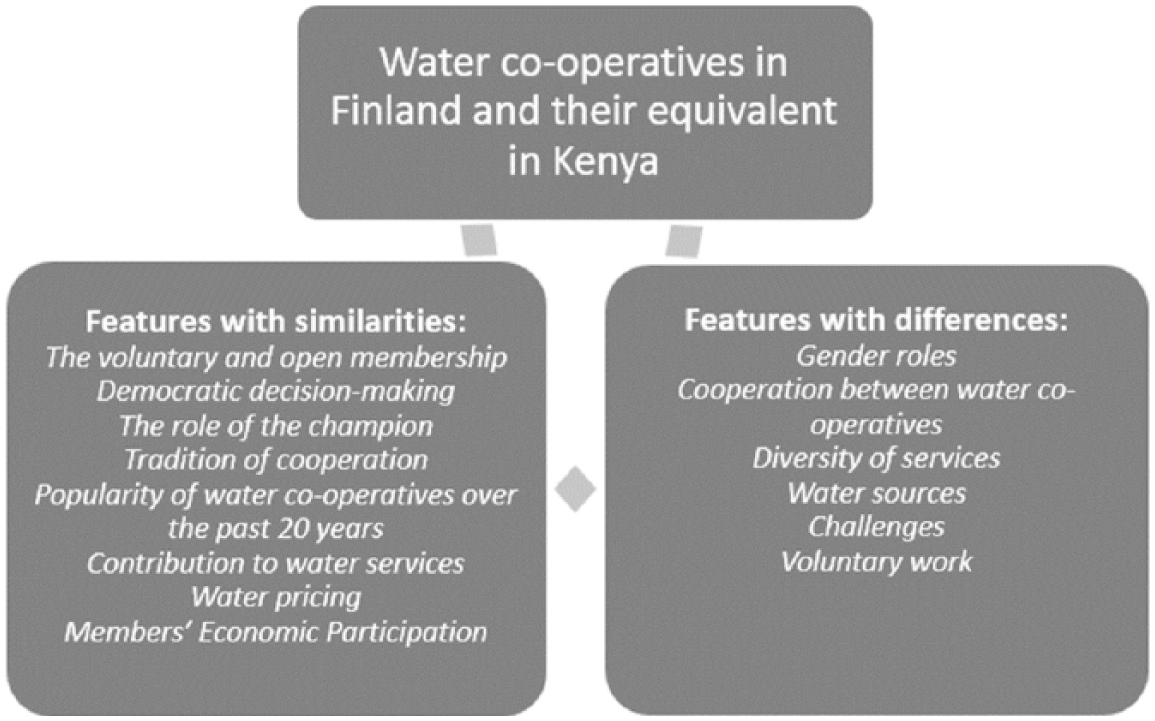
Features of water cooperatives in Finland and Kenya.
Features With Similarities
The voluntary and open membership
This similarity is based on the demand-driven needs for water services. There is no reason to force anyone to be a member of a water cooperative and use the water services for drinking water if there is a true need for the services. In Finland, this is not always clear because according to the law, your house must be connected to the pipes of the water utility if the house is in the official service area. In many cases, the local authorities oblige home owners to connect to the sewer instead of using poorly functioning on-site sanitation systems. Yet, exceptions to the compulsory connection requirement are granted if you have enough water of adequate quality available and a well-functioning on-site sanitation system.
Democratic decision making
Governance structures in water cooperatives make it possible that all decisions can be made democratically. This is ensured by having their own constitutions that contain rules or bylaws that cover the formation and composition of committees, membership, sources of funds, and other aspects.
The role of the champion
The presence of a champion is essential for water cooperatives to be successful in different life cycle phases. These key persons are typically voluntary workers who have their own reasons for involvement, such as their personal demand for water services.
Tradition of cooperation
There are marked similarities in the early traditional ways used to establish water cooperatives. In Finland, there were coalitions while in Kenya there was the harambee self-help movement that applied to all spheres of life, including construction of schools, water supply systems, cattle dips, and agriculture activities. The existence of other types of cooperatives also motivated the formation of water cooperatives.
Popularity of water cooperatives over the past 20 years
In the two countries, the period between 1990 and 2010 was associated with a large increase in the establishment of water cooperatives as shown in Figures 1 and 2. In Finland, the large number observed during the period between 1990 and 2012 was largely caused by the new legislation for wastewater treatment in households in rural areas. In Kenya, this period coincided with the decision of government to reencourage community members to take part in development of their water projects. There was increased donor activity to support new projects or revive collapsed ones. To qualify for funding, the water projects were required to be registered and many did so during this period despite the fact they may have been initiated earlier.
Contribution to water services
Significant numbers of water cooperatives are found in both Finland and Kenya providing water supply services, sewerage services, and irrigation. However, the fraction of water supply coverage is small compared with that represented by other WSPs. In Finland, water cooperatives serve approximately 10% of the population, while in Kenya, self-help water projects constitute approximately 15% of the water coverage in rural areas. These water cooperatives are relatively small, but necessary to serve people in rural areas.
Water pricing
The management and membership of water cooperatives are responsible for making decisions regarding water prices on the basis of expected costs of operation and maintenance and also considering members’ ability to pay.
Members’ economic participation
In Finland, the external financial support is usually less than 50%. Therefore, the members of the water cooperative must participate economically in the water service project. In Kenya, self-help water projects depend on external funding but their members are required to make contributions either in cash or type, which currently amounts to 15% of the cost of implementation.
Features With Differences
Gender roles
Although there are no roles reserved for either gender, in Kenya it is officially required that gender balance is observed at all leadership levels of all organizations including water cooperatives. As a reference point, a one-third gender rule is contained in the Constitution.
Cooperation between water cooperatives
In Finland, it is easy for different types of water cooperatives to join in formal or informal cooperation as no physical presence is needed and fees are low. The conditions for cooperation are also flexible. However, it has not been possible for Kenyan water cooperatives to join the existing association of WSPs.
Diversity of services
In Finland, the water cooperatives operate in supplying drinking water, sewer services, and wastewater treatment. In Kenya, the water cooperatives focus on drinking water supply and irrigation.
Water sources
In Finland, the water delivered by the water cooperatives can be from an owned water source or bought from a municipal water utility or another water cooperative. The water drawn from cooperatives’ own sources is primarily groundwater. Self-help water projects in the highland regions of Kenya obtain water mainly from surface sources such as rivers and streams while those in the lowlands have groundwater sources and harvest rainwater using dams. It is uncommon for self-help water projects to buy water from water utility companies, although there are a few examples some of which are reportedly facing difficulties paying water bills and experiences water supply problems.
Challenges
The challenges are different in both countries, but all of them relate to sustainability. Many water cooperatives are small to the extent that in Kenya they are perceived to be economically unviable or are at risk of collapse because they operate with tariffs that can hardly meet the operating and maintenance costs. It has been proposed by water sector players that the small water projects should merge or form clusters to form economically and technically feasible entities.
In Finland, the risk of collapse is less significant, but there are also recommendations from the authorities that water cooperatives merge and form larger entities. The argument for this lies in the possibility of hiring professionals to manage the water cooperatives.
Voluntary work
In Finland, voluntary work has been typical for small water cooperatives, but people are less willing to do voluntary work today.
Lessons Learned
As our findings from Finland and Kenya imply, there are several principles of water cooperatives that are similar or largely comparable. As for the more general principles that could apply to a wider context and in other countries, we suggest the following:
Collective initiatives and community cohesion, based on voluntary and open membership and need for water services, are important for the long-term operation of water projects operated by water cooperatives;
Paying workers rather than relying on volunteerism is more likely to ensure the sustainability of the projects managed by water cooperatives;
Good local financial management such as the ability of the water cooperatives to set tariffs is important;
Building capacity by the water committee or even the community members is essential;
The cooperation of water cooperatives in sharing knowledge and best practices is important;
External support: At first, financial, managerial, and technical support are needed for construction. During the operation and maintenance phase, depending on local resources, both managerial and technical support may be needed for continuity of the water cooperative;
The service delivery (buying and delivering water) approach applied by water cooperatives in developed countries can be proposed for the African equivalents. This will relieve the communities of the burden of implementation, leaving them only with the role of service delivery;
Water cooperatives are an attractive method in that the community is involved in development and management of the water resources and services in their areas.
Conclusion
Finnish and Kenyan water cooperatives exhibit common characteristics in the nature of their composition and practice, which are consistent with the international principles of voluntary membership, also common to other cooperative organizations.
The legislative and institutional aspects of the water cooperatives of the two countries differ. Whereas those in Finland are legally registered, many in Kenya are only administratively recognized because the legal avenues are considered cumbersome and costly. In terms of water sector institutional arrangement, many water cooperatives in Kenya are not yet licensed as WSPs.
In spite of their existence in large in numbers but small sizes, water cooperatives in both countries contribute only a small percentage of the water supply coverage. This, however, is considered a significant contribution and is expected to remain so in the future.
This study also finds that water cooperatives in the two countries have features with similarities and differences. Important lessons can be shared in best practices observed in the features with differences. For instance, Kenyan water cooperatives can learn important lessons from Finnish water cooperatives on how to cooperate formally and informally among water cooperatives. In addition, the use of bulk water purchases as an alternative water source can also provide lessons for Kenyan water cooperatives where the practice is not common.
Future research on water cooperatives could address an in-depth study of factors accounting for their successes and failures in different settings.
Footnotes
Declaration of Conflicting Interests
The author(s) declared no potential conflicts of interest with respect to the research, authorship, and/or publication of this article.
Funding
The author(s) disclosed receipt of the following financial support for the research, authorship, and/or publication of this article: Financial support from the Academy of Finland (No. 288153) is gratefully acknowledged.