



Abstract
Once regarded as core public sector business, Australia’s prisons were reformed during the 1990s and Australia now has the highest proportion of prisoners in privately managed prisons in the world. How could this have happened? This article presents a case study of the State of Victoria and explains how public–private partnerships (P3s) were used to create a mixed public–private prison system. Despite the difficulty of determining clear and rigorous evaluation results, we argue that lessons from the Victorian experience are possible. First, neither the extreme fears of policy critics nor the grandiose policy and technical promises of reformers were fully met. Second, short-term success was achieved in political and policy terms by the delivery of badly needed new prisons. Third, the exact degree to which the state has achieved cheaper, better, and more accountable prison services remains contested. As a consequence, there is a need to continue experimentation but with greater transparency.
Introduction
Private prisons in Australia have received bipartisan backing since the first such prison opened in the northern state of Queensland in 1990, and Australia now has the highest proportion of prisoners in privately managed prisons in the world (Jacovetti, 2016). A key feature of the Australian experience of private prisons has been the utilization of public–private partnerships (P3s) to facilitate the establishment and expansion of private prisons. The expectation underpinning this has been that markets (private firms), rather than bureaucracy (government agencies), will create social infrastructure that delivers more efficient, effective, and accountable services. However, support for this view is far from unanimous. In this article, we review evidence from Victoria, the second largest state in Australia, and the jurisdiction that has most enthusiastically embedded P3s within its correctional system. The article has four sections. The first section provides some background to the emergence of private prisons in Australia in the 1990s. The second section examines how Victoria pioneered radical public sector reform in Australia and was an early adopter of P3s for prisons. In the third section, we present the evidence in relation to the performance of prisons in Victoria to assess the contentions that private prisons will result in lower costs, better services, and greater accountability. In the final section, we discuss whether the data support the continuing expansion of P3s in the domain of social infrastructure.
Private Prisons: The Australian Experience
Australia operates under a federal system of government, with a written constitution allocating responsibilities between two levels of government. Until recently, prisons in Australia were owned and operated exclusively by the six state and two territory governments. A historically low incarceration rate has steadily increased over the past two decades, and the prison population rate in 2018 was 172 per 100,000 of the population (Walmsley, 2018).
There are currently nine privately operated prisons in Australia, housing 18.8% of the total prisoner population (Productivity Commission [PC], 2019). GEO Group Australia holds the greatest market share with four private prisons, followed by G4S and Serco with two each, while MTC-Broadspectrum operates one prison. Since the introduction of private prisons in 1990, one private prison has closed down (Andrew et al., 2016), another has been taken over and bought out by the State government concerned (Sands et al., 2019), and two more will return to government control when the contracts with the private service providers expire (“Queensland to End Public Jails After Scathing Report,” 2019).
A range of factors contributed to the establishment of private prisons in Australia. Increasing incarceration rates in the 1980s had led to prison overcrowding and demand for new infrastructure to increase capacity and replace aging infrastructure that was no longer fit for purpose (Sands et al., 2019). In some jurisdictions, there was also a strong desire to reduce the influence of powerful public sector unions (Alford & O’Neill, 1994). However, overwhelmingly, governments in Australia shared the conviction that private prisons would be cheaper to build and operate than those in the public sector. Nowhere was this more apparent than in Victoria, which from the 1990s onward enthusiastically embraced market-based solutions to address long-standing problems of public sector management. It was Victoria that made the most extensive use of privatization mechanisms to sell off government businesses and move large parts of the economy to the private sector. 1 In the decade prior to this, Victoria had also already been experimenting with long-term infrastructure contracts using private finance for delivering infrastructure projects. The United Kingdom’s popularization of this idea under the label “public–private partnership” (P3) became a policy preference, and this policy stance was likewise adopted in Victoria as well. Nearly 30 years later, harnessing private sector capacity to finance, build, and manage a broad range of infrastructure through P3s has become an accepted way to deliver economic and social infrastructure, although both the rationale and effectiveness of P3s remain contested.
Much has been written on the adoption of P3s for public infrastructure (Lawther & Martin, 2015; Little, 2011), the potential for adopting best practices, and the relative performance of P3s in general terms (Hodge & Greve, 2017; Petersen, 2019). Less focus has been devoted to the analysis of P3s in the context of prison reform and prison services, and it may be instructive to reflect upon the experience of Victoria, Australia. Prisons are clearly a special part of the social sector of any community and reform debates draw heavily on political culture, policy settings, and the historical path taken by a jurisdiction. Our attitudes to privatized prisons hide a multitude of sensitivities and assumptions. Nonetheless, it is worthwhile to discern lessons coming from adopting P3s in the social sector, as well as specific lessons from Victoria’s privatized prison experience.
P3s and Public Sector Reform in Victoria
The State of Victoria, like the rest of Australia, has a long history of wide-ranging government intervention in the economy. From the time of European settlement onward, a weak private sector, vast distances, and small populations combined to create the ideal conditions for market failure. As a consequence, for most of the 20th century, Victoria was characterized by an extensive public sector directly involved in nearly all areas of the economy. As one observer put it, Victoria may even have made “possibly the largest and most comprehensive use of State power outside Russia” (Eggleston, 1932, p. 1).
Bipartisan support for the role of government in Victoria’s economy prevailed until the early 1990s, when the State’s financial woes led to two credit downgrades (Hayward & Salvaris, 1994) and the election of a “radically conservative” government in 1992 (Freiberg et al., 1996, p. 1). The new Government, led by former advertising agency proprietor Jeff Kennett, lost no time in dismantling government monopolies and privatizing government services wherever possible. Assets sold included the state electricity and gas utilities, generating more than Aus$28 billion for the cash-strapped government. Other sales included the state-owned betting agency, the state insurance office, freight and passenger services on country rail lines, and ports. The stated economic purpose of these sales was to restore the State’s AAA credit rating (as defined by the two major credit rating agencies in Australia – Standard and Poor’s and Moody’s) and to reduce state debt (Woodward, 1999). However, the Government was also driven by a belief in the superiority of markets, and the conviction that governments should “steer” and not “row” (Savas, 1987), a view popularized by the international bestseller Reinventing Government (Osborne & Gaebler, 1992). Collectively, these understandings underpinned a raft of public sector reforms, including market testing for many public services, compulsory competitive tendering for most local government services, fixed-term contracts with performance-based pay for all senior public servants, and the introduction of new funding models for social and economic infrastructure.
The year 1995 saw a milestone in P3 policy when the Kennett Government selected the Transurban consortium to build City Link, a major roadwork infrastructure project in Melbourne to extend and link up several existing freeways. With a budget of Aus$1.7 billion, this project was constructed using the BOOT (Build, Own, Operate, Transfer) model and was an early political success story for P3s. With City Link, the Kennett Government had achieved what several previous governments could not—the delivery of a substantial infrastructure project. Since then, many formal and informal objectives have been articulated for P3s (Hodge & Greve, 2017). But there is little doubt that this P3 fitted the Government’s political ambitions like a glove. It avoided the need for up-front public borrowing, which had implications for the State’s credit rating, and made possible the construction of much-needed infrastructure at a time when government had severely limited resources (Andrew et al., 2016).
Upon its election, the Kennett Government immediately foreshadowed the outsourcing of correctional services and programs, including prisoner transport, court security, and hospital services, and also made a distinction between the ownership and management of prison facilities. In December 1993, expressions of interest were sought for three new prisons to be built as Design, Construct, Finance, and Manage (DCFM) projects to replace a number of prisons, including the aging Pentridge Prison (which was nearly 150 years old) and Fairlea Women’s Prison. Amendments to the Corrections Act in October 1994 enabled the responsible minister to enter into agreements for the construction of prisons by the private sector. Under the “full service” contracts for these new prisons, the private contractors were responsible for both correctional and accommodation services, with monitoring by the responsible government agency, Corrections Victoria. In other words, both infrastructure and prison services were to be provided by the private contractors. To support the impending introduction of privately operated prisons, prison management standards were developed and published in 1995 (women) and 1996 (men) (Corrections Victoria, 2014).
The first private prison in Victoria, Deer Park Metropolitan Women’s Correctional Centre, opened in August 1996, followed by Fulham Men’s Correctional Centre in March 1997 and Port Phillip Prison (also a men’s prison) in September 1997. The P3s entered into for these prisons were each for 20 years, with provisions for competitive retendering of service provision every 3 years after the first 5 years. Each P3 also specified that the contractor’s responsibilities were for the management of core and non-core prison management services. The new prisons were built on Crown land and the facility was to be owned by the contractor (English & Baxter, 2010). With the opening of the new prisons, the percentage of prisoners managed by the public sector in Victoria decreased from 100% to 55% within 3 years (PC, 1999).
The defeat of the Kennett Government in the 1999 state election marked a new stage in the privatization of prisons in Victoria with the incoming center–left government commissioning an audit review of all government contracts (Russell et al., 2000). At the same time the audit review was being conducted, two high-profile inquiries relating to private prisons were also taking place. A coronial inquiry was conducted into the deaths of five prisoners at the privately run Port Phillip prison and a review was undertaken of the management of the Deer Park Metropolitan Women’s Correctional Centre. The review of the women’s prison led directly to the Government taking control of the prison from Corrections Corporation Australia at a cost of Aus$20.2 million (Andrew, 2007), while the audit review of government contracts shaped the new government’s policy for infrastructure financing and development. The Partnerships Victoria policy initiative, announced in June 2000, emphasized the following: (a) value for money (VfM), (b) retaining government responsibility for delivery of core social functions, (c) acceptance of a range of partnership models, (d) rigorous procurement processes, and (e) protection of the public interest as assessed against a broad range of criteria. Under Partnerships Victoria, a further two new prisons, the medium-security Marngoneet Correctional Centre and the high-security Metropolitan Remand Centre, were built as P3s. The contracts for these prisons, which held approximately one third of the male prisoner population at the time (Department of Justice and Regulation – Corrections Victoria, 2018), provided for competitive retendering of service provision every 7 years, and included the design, construction, and financing of the facility, as well as limited services such as maintenance and security of facilities. Instructively, they did not provide for the private management of prisoners (English & Baxter, 2010).
The endorsement of the National Public Private Partnerships (PPP) Policy Framework and National PPP Guidelines in late 2008 marked another notable stage in Victoria’s prison privatization story. The overall objective of the Guidelines was to facilitate greater consistency in the consideration and application of P3s across Australian jurisdictions (Department of Finance and Deregulation, 2009). The new Guidelines were intended to maximize the efficiency of infrastructure procurement, reduce public and private sector procurement costs, and remove disincentives to participation in the infrastructure market (Department of Infrastructure and Urban Development, 2008). The privately operated Ravenhall Correctional Centre, which opened in 2017, was built under these guidelines. At the time of writing, nearly 40% of all Victorian prisoners are housed in privately managed prisons.
Reviewing the Performance of Victoria’s Part-Public Part-Private Prison System
While successive governments in Victoria have used P3s to build and operate prisons over more than two decades, claims that privately managed prisons are cheaper, better, and more accountable than publicly managed prisons continue to be questioned and challenged (Andrew et al., 2016; Sands et al., 2019). To review the performance of P3s in the provision of prisons in Victoria, we elected to use the best publicly available data. The Productivity Commission is the national Government’s independent research and advisory body on a range of economic, social, and environmental issues. Since 1995, the Commission has published an annual Report on Government Services (ROGS), which provides comprehensive information on the equity, effectiveness, and efficiency of government services across Australia’s state and territory governments. Our appraisal is constructed from ROGS performance data for the operating costs of the Victorian prison system as well as seven indicators which serve as proxies for service quality or performance—assaults in prison, hours out-of-cell per day, vocational education and training, employment, unnatural deaths in custody, escapes from prison, and offender rate of return to prison within 2 years (or recidivism). Where possible, the ROGS data are assessed against specific requirements in the original contracts for the private prisons and the minimum performance standards set out in the Victorian Government’s Correctional Management Standards for Men’s Prisons in Victoria (hereafter the “Correctional Management Standards”).
We accept that many alternative performance indicators can always be chosen for P3s (Lawther & Martin, 2014). In the case of services as complex as prisons, Solomon (2004) goes further and observes that it may not even be possible to agree on the most appropriate performance indicators because there may be little consensus on the most important goals, and there are always many ways of measuring performance against each of the relevant goals. Furthermore, although ROGS is the authoritative source of national performance data for prison services, there are limitations to its data. First, and most critically, the data collected are aggregated across the entire prison system in each state and territory in Australia. This meant that for all of the proxies we considered, with the exception of escapes from prison, it was not possible to distinguish between the data relating to privately and publicly managed prisons or between the data for high-, medium-, and low-security prisons. Second, there are gaps (some of them significant) in the data provided to the Commission which are identified in the figures below. And third, the data relating to re-offending may underestimate the proportion of offenders who have repeated contact with the criminal justice system as it only reflects those people whose re-offending has come to the attention of authorities and is defined by restricted time frames for measuring re-offending. The data relating to operational costs and the seven proxies for performance are now discussed.
Operating Costs
As Figure 1 illustrates, Victoria’s mix of public and private prisons had the highest daily operating costs per prisoner in Australia in 2017–2018 at Aus$329. The Australian Capital Territory (ACT) and Tasmania—both much smaller jurisdictions with no private prisons and reduced economies of scale—had slightly lower daily costs per prisoner of Aus$288 and Aus$310, respectively. The next highest daily operating cost was Western Australia, which spent Aus$245 per day on each prisoner—considerably less than Victoria. However, these figures do not by themselves necessarily prove the efficiency (or otherwise) of a prison system. Many factors can affect prisoner costs, including the composition of the prisoner population requiring different accommodation and/or management; the size and dispersion of the geographic area across which services are delivered; the potential (or lack of) for economies of scale; and, the impact of the wider criminal justice system policies and practices. (PC, 2018, p. 8.18)
It is not clear which, if any, of these factors account for the higher daily costs per prisoner in Victoria.

Real net operating expenditure per prisoner per day in Australian states and territories 2017–2018 (in 2018–2019 Aus$).
Turning to annual operational costs, Figure 2 shows that before private prisons opened in Victoria, the average cost (in 2018–2019 Aus$) of incarcerating one prisoner per year was Aus$98,955 in 1992–1993. This dipped to Aus$84,873 in 1993–1994, perhaps attributable to the impending introduction of private prisons producing an initial “efficiency dividend.” The annual operational costs then rose to Aus$$91,159 in 1996–1997 when the first private prison opened. By 1997–1998, when the second private prison commenced operations, annual operational costs per prisoner had settled back to Aus$90,480, and once all three private prisons had opened by 1998–1999, the average annual operating expenditure per prisoner was Aus$80,048. In the period 1996–1997 to 2000–2001, Victoria experienced several years of reduced costs in terms of the prison system’s operating expenditure. However, the average recurrent cost per prisoner per year has risen by about 49% in the last 15 years (2002–2003 to 2018–2019), increasing from Aus$78,636 to Aus$116,902. Overall, then, we can observe that any hint of a reliable cost-saving trend during the 1990s was not sustained.

Real recurrent annual operational cost per prisoner in Victorian prisons, 1992–2018.
Assaults in Prison
Figure 3 demonstrates that the opening of the first private prisons in Victoria coincided with a spike in the number of assaults, followed by a short period in which the number of such incidents declined. From 2002–2003, the number of assaults has generally trended upward, rising steeply from 2010–2011 onward with the assault rate more than doubling from 9.2 assaults per 100 prisoners in 2010–2011, to 19.58 assaults per 100 prisoners in 2017–2018. The 220% growth in Victoria’s prisoner population, which rose from 2,271 in 1992–1993 to 7,258 in 2017–2018 (PC, 1995, 2019), may help to account for the increasing incidence of assault. Other factors that may have contributed to the rising prevalence of assaults in Victoria’s prisons include the following: the overrepresentation of youth, disabilities, and Aboriginal and Torres Strait Islander background in the prisoner population; the mounting prevalence of mental health conditions, drug and alcohol issues, and chronic illnesses among prisoners (Victoria Auditor-General’s Office [VAGO], 2018); and limited hours out-of-cell per day (see Figure 4).

Assaults in Victorian prisons per 100 prisoners, 1996–2018.

Average hours per day out-of-cells in Victorian prisons, 1993–2018.
Time per Day Out-of-Cell
Time out-of-cells per day provides prisoners with the opportunity to participate in activities that may include work, education and training, well-being, recreation and treatment programs, the opportunity to receive visits, and interaction with other prisoners and staff (PC, 2019, p. 8.13). Time per day out-of-cell is also important because extended time in a cell, possibly an overcrowded one with two to three other inmates, contributes to frustration and aggression within the prison environment and reduces the likelihood of opportunities for rehabilitation. The original contract for the Men’s Metropolitan Prison stated that prisoners should have a minimum of 12 hr out-of-cells, 6 days a week (Blake Dawson Waldron, 1996). The Correctional Management Standards are less demanding, requiring that prisoners have at least 1 hr per day out-of-cells and generally have 12 hr out-of-cells unless circumstances render this impracticable (Corrections Victoria, 2014). In the first years of the private prisons, the target of 12 hr out-of-cells was mostly met, but between 2003–2004 and 2010–2011, data were not reported. Since Victoria began reporting this feature again in 2011–2012, out-of-cell time has consistently been under the 12 hr stipulated in the contracts for private prisons. Overall, then, Figure 4 suggests that private prisons have not led to a sustained increase in time spent out-of-cells in Victoria.
Education and Training
The original contracts for the private prisons stipulated that prisoners must be given opportunities to develop skills necessary for effective participation in the labor market after their release, including an average of four student contact hours of accredited education and training per week (Blake Dawson Waldron, 1996). However, the Correctional Management Standards do not specify how many hours of vocational education and training a prisoner should have, requiring only that prisoners “be constructively engaged for a total of 30 hours per week in a range of industries, prison services, community work, offending behaviour and drug and alcohol programs, reintegration programs, vocational education and training programs and/or structured orientation programs” (Corrections Victoria, 2014, p. 33). Figure 5 indicates that the percentage of eligible prisoners undertaking vocational education and training has fallen markedly since the introduction of privatized prisons. Between 1996–1997 and 1999–2000, the rate was between 45% and 62%, but since 2003–2004, the rate has remained at or below 40%. The reasons for this are not clear, but increasing prisoner numbers may be a factor.

Percentage of eligible prisoners undertaking vocational education and training in Victorian prisons, 1997–2018.
Employment
Prisoner employment is important because “addressing the limited vocational skills and poor employment history of some prisoners has been identified as a key contributor to decreasing the risk of re-offending” (PC, 2019, 8.13). The Correctional Management Standards state that prisoners should be engaged for a total of 30 hr per week in a range of activities that include industries and prison services (Corrections Victoria, 2014). Figure 6 indicates that the employment rate in Victorian prisons has been consistently above 70% since 1992–1993 and has been above 80% from 1999–2000 onward, suggesting that this is an area of performance that has improved since the introduction of privately managed prisons.
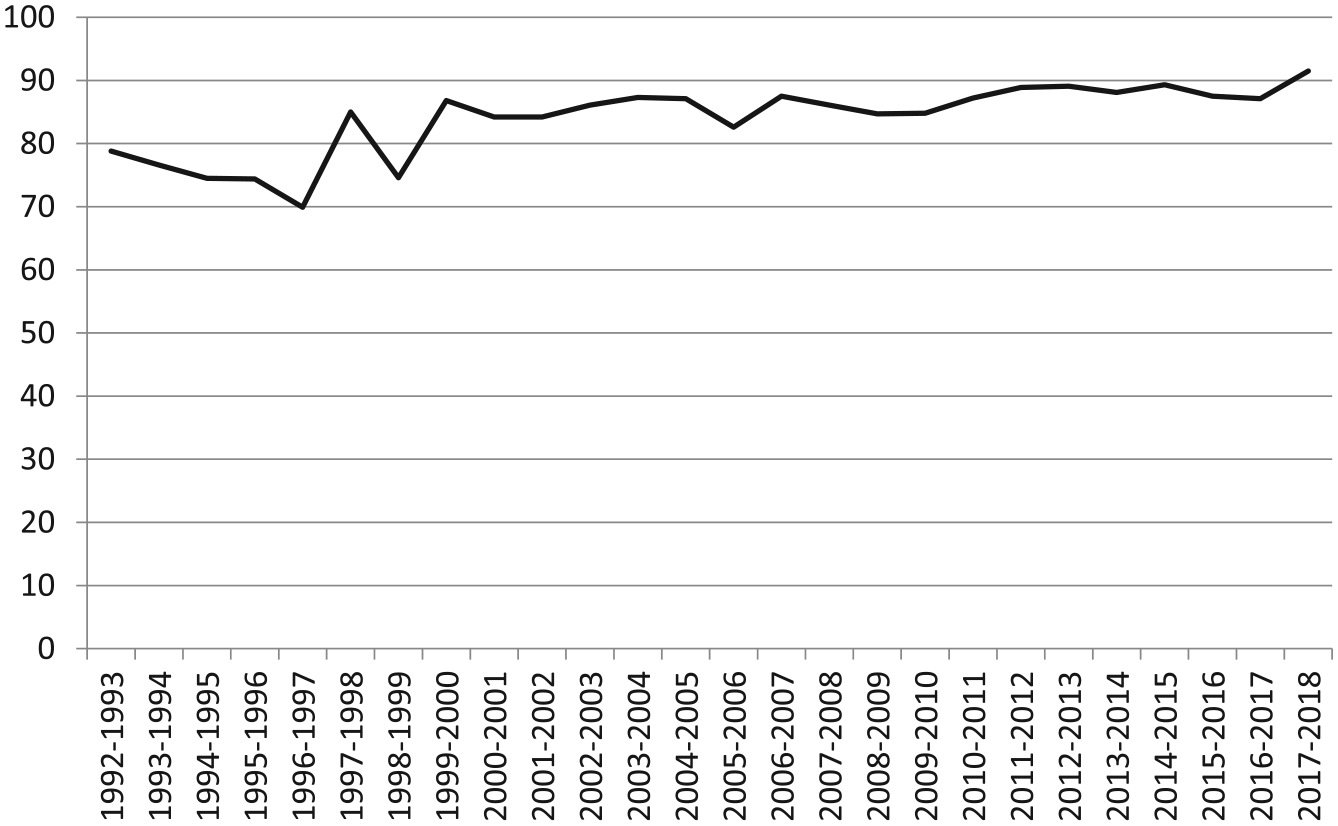
Percentage of prisoners employed in Victorian prisons, 1993–2018.
Apparent Unnatural Deaths
The Correctional Management Standards state that, as far as possible, the prison system should prevent prisoner deaths due to unnatural causes (Corrections Victoria, 2014). Figure 7, which refers to deaths attributed to violence, drugs, and suicide, but not deaths from natural causes, shows there was a spike in apparent unnatural deaths in 1997–1998 and again in 1998–1999. This may be attributed to the opening in 1997 of the privately managed Fulham and Port Phillip prisons, with five deaths at the latter alone. Since his time, the incidence of unnatural deaths in Victoria’s prisons has returned to pre-privatization levels, a significant achievement given overall prisoner numbers have nearly tripled.

Deaths from apparent unnatural causes in Victorian prisons, 1993–2018.
Escapes From Prison
The Correctional Management Standards emphasize that each prison security system should ensure the protection of the community by minimizing the risk of prisoner escape. In the periods recorded in Figure 8, there were 115 escapes from “open” (low-security) prisons and 14 escapes from “secure” (medium- and high-security) prisons. However, from the mid-1990s onward, the proportion of high- and medium-security prison beds and high- and medium-security prisons in the prison system has increased risen with the building of new prisons. Prisoners are now more likely to serve time in a large high- or medium-security prison, from which escape is far more difficult, rather than a smaller low-security prison. It is therefore not surprising that the incidence of escapes has declined dramatically, with 16 prisoners out of 2,271 prisoners escaping in 1992–1993 (an escape rate of 0.70%), and only nine prisoners out of 7,258 prisoners escaping in 2017–2018 (an escape rate of 0.12%).

Escapes from Victorian prisons, 1993–1996 and 2004–2018.
Rate of Prisoner Return to Prison Within 2 Years
Recidivism, or the rate of prisoners returning to prison, is an indicator of how the rehabilitative functions of a prison system are working. Although the Correctional Management Standards do not explicitly identify re-offending (or recidivism) as a performance measure, they do identify activities associated with reducing re-offending, such as opportunities to develop literacy, numeracy, vocational skills, and work skills, as performance indicators. Figure 9, which shows only data from 2000–2001 onward, indicates that a decline in re-offending in the first decade of this century has not been sustained. From a base of 42% in 2000–2001, the rate of re-offending dipped gradually to 35% in 2011–2012, before climbing back to 44% in 2014–2015 and remaining above 42% until 2017–2018.

Percentage of adults released from prison who returned to prison with a new sentence within 2 years, 2000-1–2017-18.
P3s and Social Infrastructure—Lessons From Victoria
What has been learned here, both for social infrastructure in general terms and in the specific case of prison reform in Victoria?
Previous reviews of global experience have suggested that P3s have been used productively for the provision of social infrastructure with much success. Despite controversial VfM findings, “P3s have usually been politically effective for reformist governments,” as Hodge et al. (2010) observed. And in jurisdictions such as the United Kingdom, Canada, and the Australian states, continued support from major political parties suggests that “there have been clear attractions in the use of P3s” in the past (Hodge & Greve, 2017, p. 66). P3s have enabled public infrastructure delivery to be put back on the political agenda and for specific projects to be successfully crashed through. Legitimacy concerns of critics have also been brushed aside as P3 commercial confidentiality has assisted governments to remain in control when setting the political agenda and timing their policy announcements. Whether delivering hospitals, schools, or other social facilities, P3s have become accepted. Victoria’s experience with its privatized (P3) prisons has been consistent with these broader conclusions. In other words, to Victoria’s voters, prisons have just been yet another public facility. It has not all been plain sailing, but controversy and bad news have been framed as policy learning, and P3 techniques have evolved over time.
Looking at the prison system’s performance data, we might comment on both the matter of unit costs and the several proxies for service quality. There is little doubt that operating costs per prisoner have increased in real terms by just under Aus$18,000 per prisoner in the period under review. Of even greater note is that operating costs per prisoner rose by nearly Aus$37,000 between 1998–1999 and 2017–2018. However, due to the limited nature of publicly available data, we are unable to attribute all or any of these additional costs to either the public or private prisons that comprise the Victorian prison system. Unlike the United States, where the respective annual per capita costs for Bureau of Prisons institutions and Federal contract prisons are on the public record (Office of the Inspector General, 2016), the absence of such information in Victoria “makes it difficult to make any evidence-based claims about the consequences of prison privatisation” (Andrew et al., 2016, p. 4). Of considerable importance here as well is that while it might be tempting to infer from the performance data that the use of P3s for social infrastructure should be accompanied by considerable caution, a more nuanced assessment of the Victorian experience is warranted.
From the time the first private prison opened, the State of Victoria’s population increased by 42%, growing from 4.56 million in 1996 to 6.52 million in 2018 (Australian Bureau of Statistics, 1998, 2018). During the same period, significant changes to bail, sentencing, and parole laws aimed at keeping offenders in prison longer were enacted (VAGO, 2018). With these developments, an increasingly complex prisoner population nearly tripled in the space of just over 20 years, while the system itself has gone from being 100% state-owned and operated to a hybrid of public and private ownership and management. Against this backdrop of profound change, it is perhaps not surprising that the confident expectations originally held that private prisons would deliver lower costs have not been entirely realized.
As well, gaps in publicly reported data affected our capacity to fully assess the seven proxies we used to measure performance. On the available data, four of the proxies (assaults in prisons, hours out-of-prison cells, vocational education and training, and recidivism) did not indicate that performance has improved since the advent of P3s, while data for the other three (unnatural deaths, employment in prison, and escapes from prison) suggested that real improvements had been achieved.
Deficiencies in the availability of data also had implications for our capacity to evaluate whether the accountability of the prison system had improved since P3s were introduced to build more prisons. Commercial-in-confidence provisions in the contracts for the new prisons between the Victorian Government and private consortia cast a shroud of secrecy over the operations of Victoria’s privately operated prisons, thwarting the public’s ability to identify contractual violations and any remedial actions taken. Arguably, a more significant constraint upon accountability is the absence of a transparent and independent body responsible for the oversight of the system to inform the public and Parliament in relation to the performance of the prison system. Unlike other jurisdictions, Victoria has persisted with an in-house monitoring and review process which lacks transparency and accountability to stakeholders outside the corrective services bureaucracy. While this model prevails, the notion that accountability has improved in Victoria’s privatized prison system will continue to be contested.
To summarise, we are left with research conclusions which are understandably modest as to costs, performance, and accountability. A more definitive evaluation of the efficacy of P3s as providers of social infrastructure will not be possible until all relevant data are publicly available, and the results of further ongoing experimentation in this field can be assessed transparently.
Footnotes
Declaration of Conflicting Interests
The author(s) declared no potential conflicts of interest with respect to the research, authorship, and/or publication of this article.
Funding
The author(s) received no financial support for the research, authorship, and/or publication of this article.
