



Abstract
Dual left turn lanes are typically operated with protected left turn signals, which means extra delay during non-peak hours compared to permissive operation. To reduce this delay, the authors designed, installed, and tested a “dynamic left turn intersection” (DLTi), which is a new way to operate dual left turn lanes. With DLTi, the both lanes are operated with protected phasing during the peak hours when higher capacity is needed, and only the leftmost left turn lane remains open for protected-permissive operation during off-peak hours. The test showed substantial delay savings, the crash experience has been minimal, and the public comments received have been predominantly negative but not overwhelming. Around 85 percent of left-turning motorists complied when the rightmost left turn lane was closed. The team believes that the DLTi test has been a success, and that agencies should begin searching for other suitable locations for DLTi installation.
Introduction
It has been common for agencies across urban and suburban America to construct dual left turn lanes to attempt to provide additional capacity for peak demands. In many of these cases, the dual left turn lanes have worked well, and the intersections operate efficiently during the peak periods.
Most agencies have chosen to operate dual left turn lanes only with protected left turn signals. This is due to safety concerns arising from operating dual left turn lanes with permissive or protected-permissive signals, including possible conflicts between adjacent turning vehicles and potential sight distance limitations. Compared to permissive or protected-permissive signal operation, protected signals likely add signal phases, increasing the lost time all motorists experience at the intersection. These days in North Carolina we believe lost time averages 5–6 seconds per phase, so protected phases on both streets can add 10–12 seconds of lost time per cycle compared to permissive phasing. Compared to permissive or protected-permissive signal operation, protected signals also add to the cycle length. The extra cycle length is because left-turning vehicles are not allowed to be jumpers at the beginning of a phase, are not allowed to be sneakers at the end of a phase and cannot filter through gaps in opposing traffic during a through phase. In other words, the signal must display a protected phase when even one left-turning vehicle is present during a cycle, and then all opposing and conflicting movements must wait while that phase is shown for that solitary vehicle. The duration of this extra cycle time may vary widely from one intersection to another but could end up being 20–40 seconds per cycle at a typical intersection. Since cycle length is a very important factor in any equation predicting vehicle delay at signalized intersection, it is easy to see that the longer cycle lengths due to protected left turn phases cause a lot of additional delay as well as increased fuel consumption, emissions, and red light running temptations.
The extra delay and associated issues caused by protected phases at dual left turn lanes are especially frustrating during non-peak hours. This is when dual left turn lanes are typically not needed due to significantly reduced demand. Figure 1 shows the familiar problem. Left-turning vehicles in a dual left turn lane wait on red at a protected left turn signal, while the opposing traffic provides plentiful large gaps in which to make a left turn if that was allowed. While North Carolina and some other states operate a few dual left turn intersections as protected-permissive during off-peak periods, the pool of potential locations for that operation is limited. Wouldn’t it be nice if there was a way to close one of the lanes during those times when the extra lane was not needed, and then convert the left turn signal operation for the remaining, single left turn lane to be permissive or protected-permissive? Left-turning vehicles in a dual left turn lane wait on red at a protected left turn signal, while the opposing traffic provides plentiful large gaps. Photo by corresponding author.
The objective of this paper is to describe the “dynamic left turn intersection” (DLTi), a potential solution to the dilemma posed above, that was pursued by the North Carolina Department of Transportation (NCDOT), the Town of Cary, NC, and the Regional Transportation Alliance. A dynamic left turn intersection seeks to enable a positive offset, protected-permitted single left turn lane during lower-demand times of the day, while still allowing protected-only, dual left turn operation during peak periods from that same approach. As far as we know this is the first time such a solution has been published or attempted. If successful, the solution could have a profound impact on intersections across the US, saving much delay and many crashes.
Literature and Current Practice
There are dual left turn lanes with permissive or protected-permissive signals in operation at a few intersections in several states, including North Carolina, Georgia, Texas, and elsewhere (NCDOT, 2015). While many of these locations function successfully, the opportunities to consider such phasing tend to be limited due to inadequate or suboptimal sight distance for one or both of the left turn lanes at many intersections. Guidance or recommendations for protecting all dual left turn locations, irrespective of other factors, is quite common (Bonneson & Fontaine, 2001; Qi et al., 2010). In addition, there are a number of outright prohibitions on protected-permitted or permitted operation of dual left turn lanes in state traffic signal design manuals or policies (WisDot, 2011). To that point, a literature review for the Virginia DOT identified a series of 19 factors considered in the left turn signal operation phasing mode selection process, and then assigned a score to each factor (VDOT, 2015). The highest scoring factor--even more than historical rate of left turn crashes or sight distance--was the number of left turn lanes. However, the Virginia DOT (2015) guidance document goes on to state that, “Considering permissive left-turns from dual left turn lanes is atypical but is not explicitly prohibited.”
An analysis of locations in Alberta, Canada by Guebert found that, “Protected-permissive dual left turn phasing can be almost as safe as (protected only) dual left turn phasing if it is implemented under the right conditions,” with characteristics such as “slotted dual left turn bays,” two or fewer opposing through lanes, sufficient gaps in opposing traffic, and lower truck volumes being important factors (Guebert, 2005). On the other hand, an analysis of protected-permitted dual left turn lane locations in metro Atlanta by Tarrall and Dixon (1998) found that the capacity gains may come at the expense of safety, given the reduction of traffic conflicts under protected-only phasing.
Dual left turn lanes can provide operational benefits during peak periods. The most common rule of thumb for consideration of a second left turn lane, a left turn volume exceeding 300 vehicles per hour (vph), has been around for decades. Prior studies have shown that at appropriate locations, dual lefts can reduce overall intersection delay during peak times by more than 20% compared to a single left turn lane (Shaik & Graham, 1996). An FHWA (2013) guide notes that multiple left turn lanes, “allow for the allocation of green time to other critical movements or utilize a shorter cycle length. Using multiple left-turn lanes helps reduce the queue waiting to turn left.” Again, this guidance refers to higher volume conditions.
While dual left turn lanes are certainly a common sight along arterials in North Carolina and elsewhere, NCDOT Congestion Management Capacity Analysis Guidelines (2022) nonetheless urge caution when considering the addition of a second left turn lane for several reasons. These include the possibility of inefficient split phasing due to conflicting turning paths depending on intersection configuration, the potential for erratic movements on the receiving lanes due to driveways in close proximity after the intersection, the possibility that capacity will be less than predicted due to merging on the receiving lanes, and, of course, the common condition of protected-only operation.
Potential Solution
The executive director of the Regional Transportation Alliance, which is a business leadership group in the Research Triangle region of North Carolina including the cities of Raleigh and Durham, came up with the idea for the DLTi and engaged FHWA and NCDOT on the concept. NCDOT in turn engaged the Town of Cary which installed the DLTi pilot at an intersection in Cary, activating the configuration on February 14, 2020. The paper describes our design and refinements, our analysis of the test site prior to installation, our analysis of how DLTi has worked since installation, and our suggestions for future installations.
The DLTi concept maintains operation of the dual left turn lanes with protected-only control during peak hours. During off-peak hours, when demand has dropped enough that the second lane is no longer needed or helpful, the DLTi closes the rightmost left turn lane. The single left turn lane remaining open then operates with protected-permissive control. The intersection will switch to a protected phase immediately after the permissive phase if vehicles are present in either lane to clear any remaining left-turning vehicles. The overall objective of the DLT treatment is to save delay and associated impacts during non-peak hours while retaining the capacity provided by dual left turn lanes during peak hours, with a simple and inexpensive set of devices that will not compromise safety.
Figure 2 shows the main traffic control devices we used for the DLTi. The Town installed changeable lane control signs over the rightmost left turn lane. The signs could change from showing a white arrow indicating that was a lane from which to make left turns to a red “X” indicating that the lane was closed. The Town used two changeable lane control signs, one on span wire near the entry to the left turn lanes (200 feet or so upstream from the stop bar at the pilot intersection) and one on the signal span on the far side of the intersection next to the traffic signal displays. To the left of each changeable lane use sign, over the leftmost left turn lane, the Town displayed a static sign showing that the lane was to be used for left turns. Next to each changeable lane use sign we installed a static black-on-white sign that said, “LANE CLOSED ON RED X”. The traffic signal controlling both left turn lanes was a single four-section display hung over the lane line between the two left turn lanes which did not show a flashing yellow arrow during peak periods (i.e., operated as protected only) but did have the capability of showing a flashing yellow arrow during non-peak periods (i.e., operated as protected-permissive). Main traffic control devices for the DLTi. Source: NCDOT Communications.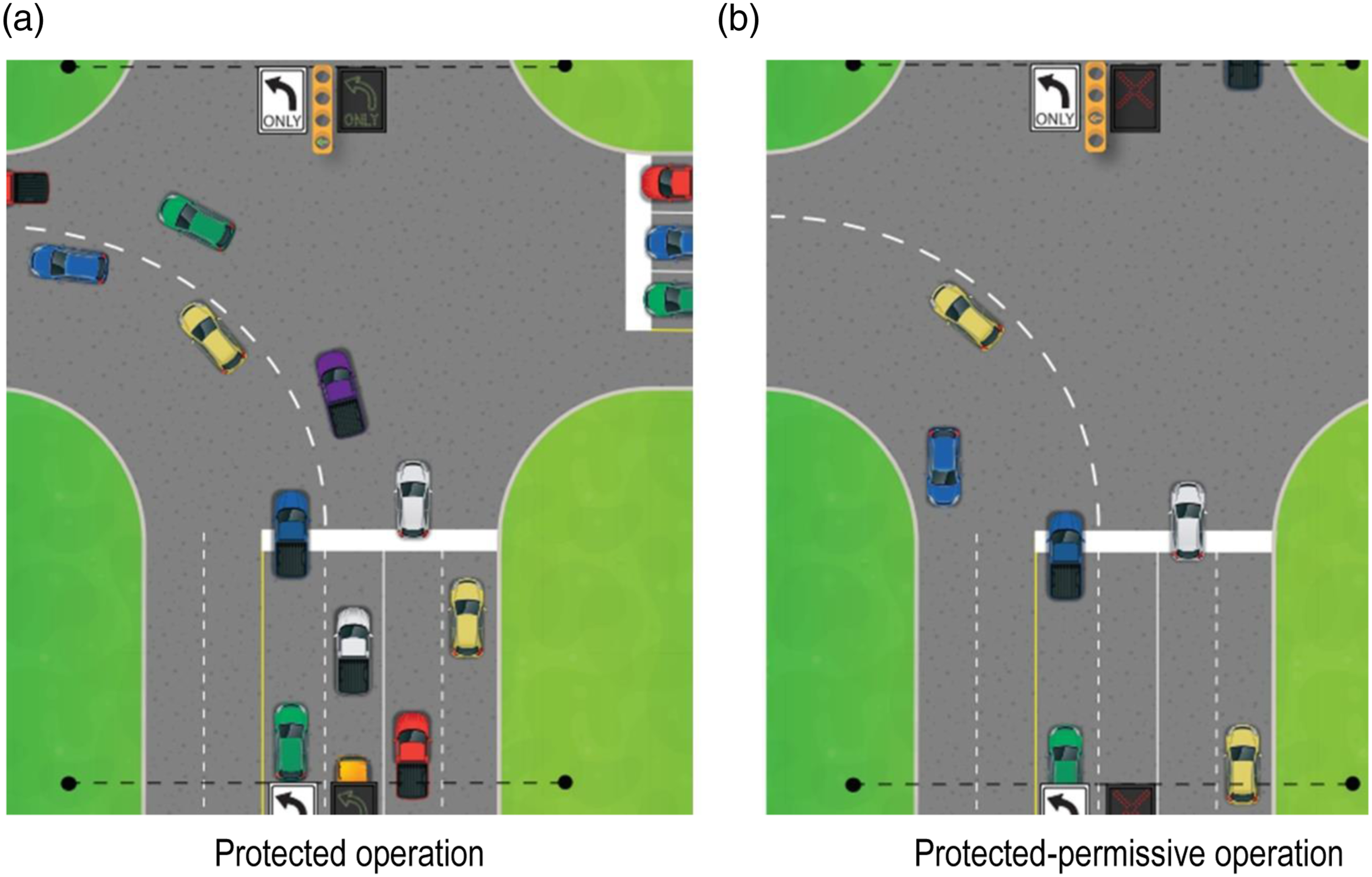
The Town also changed some of the pavement markings. Figure 3 shows the installation. In the foreground of Figure 3a and Figure 3b one can see revised pavement markings at the beginning of the dual left turn lanes in an attempt to guide drivers into the leftmost, primary left turn lane so they would have to intentionally change lanes into the closed lane during off-peak hours. In addition, as Figure 3a also shows some weeks after the DLTi signs and signals were installed, we revised the pavement markings within the intersection itself so that the skip line between the two streams of left turn vehicles as shown in Figure 2 became a solid line. The purpose behind this change was to help ensure that if there were any violators making a left turn from the closed rightmost lane during off-peak times they did not crash with the left-turning vehicles making the turn from the open lane. DLTi traffic control devices installed. (a) Single lane operation. Source: photo by co-author. (b) Dual lane operation. Source: photo by co-author.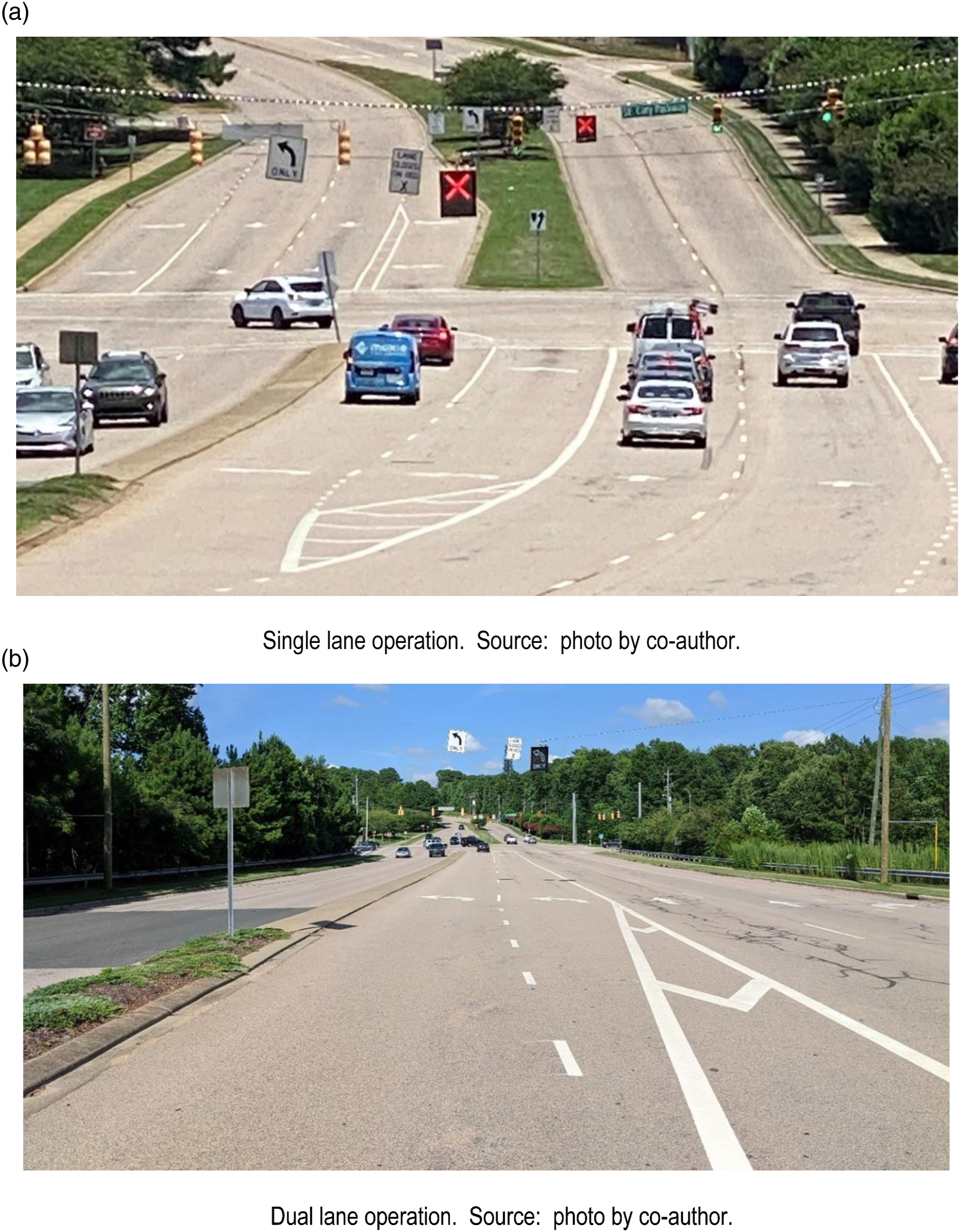
There are several reasons that the team chose to close the rightmost left turn lane instead of the leftmost left turn lane during off-peak hours. First, vehicles making a permissive left turn would have a shorter distance to traverse to clear the path of oncoming through vehicles. Second, vehicles in the leftmost left turn lane have a greater positive offset than vehicles in the rightmost left turn lane. That is, vehicles in the leftmost left turn lane are further to the left where drivers would have a better chance not to have their sight blocked by vehicles in the opposing left turn lanes. There are a couple counter-arguments in favor of closing the leftmost left turn lane, including that more drivers naturally tend to stay to the right when given a choice and that large trucks often need the longer radius of turn afforded by the rightmost left turn lane. The team considered these arguments and counter-arguments and found the case for closing the rightmost lane to be more compelling because of the more immediate safety benefits. Further, larger vehicles will still be able to drift right during their turn if additional space is needed, as no vehicles should be present in the rightmost left turn lane.
As traffic control devices in the U.S. are standardized in the Manual of Uniform Traffic Control Devices (MUTCD) (FHWA, 2009), we made sure that all of the signals, signs, and markings we used for the DLTi met the standards of the MUTCD. The red “X” to close the lane is a familiar symbol from Table 2B of the 2009 edition and the overhead mounting over the lane is appropriate. The signal meets the standards in Section 4D.20. The solid line between left turn lanes through the intersection is in keeping with Section 3B.08. The improved markings at the start of the dual left turn lanes are allowed in Section 3B.24. There was nothing novel or experimental in the individual traffic control devices that made up the DLTi installation, only the combination of the devices was unique.
Other agencies have attempted variable lane use configurations by time of day for various purposes through the years. Reversible lanes are common on freeway express lanes, arterials, and bridges where prevailing traffic experiences “tidal” flow variations, and North Carolina has several installations, including one on Edwards Mill Road, less than 10 miles from the pilot site, located in the same county. Many agencies have used turn prohibitions implemented with signs for decades. Utah is trying an installation where a lane operates as a shared left and through lane for part of the day and an exclusive through lane for part of the day (Luker, 2020). All of these other installations gave us ideas, informed our thinking, and built the confidence of the team that we could make something work well to solve our problem, but none of them exactly fit our situation so we had to develop a new and unique application.
Test Installation
When the basic concept of the DLTi was worked out, the team agreed that a test was worthwhile and began looking for a suitable site. Site selection criteria included: • Existing dual left turn lanes, • Sufficient left turn traffic demand such that both left turn lanes were needed during some peak periods of a typical day, • Left turn traffic demand that was not too high so that both left turn lanes were needed during most hours of a typical day, • Sufficient sight distance for left-turning drivers for permissive left turns from either lane, • Other conditions amenable to permissive left turns such as low pedestrian demands, • A site not to undergo any other major changes in the near future, • Presence of monitoring equipment such as a closed-circuit television camera, and • A city or town with engineers and political leaders receptive to the DLTi idea.
NCDOT engineers began reviewing potential sites in the Triangle region since the original DLTi idea came from the Regional Transportation Alliance in Raleigh.
One additional site selection criterion emerged later, after the team had chosen an initial potential site and begun engineering work. It emerged that certain signal software cannot handle the phase transitions DLTi needed to make. We therefore abandoned the first site we had chosen, because it had the less flexible software, and chose the site in the Town of Cary described below. Even though the selected site is on a state-maintained road, like many places in North Carolina the municipality operates the traffic signal. In this case, the software Cary uses could handle the DLTi logic, so we went forward with installation.
After sifting through several dozen potential sites, the team chose the eastbound left turn on Tryon Road at Cary Parkway in the Town of Cary. Figure 3 shows ground-level photos with the DLTi devices in operation and Figure 4 shows an aerial of the site after DLTi installation. The intersection of two four-lane divided arterials with 45 mph speed limits met all the criteria listed above. There is a shopping center entrance on the right side on the departure for EB left turn traffic about 350 feet from the intersection, and while this was a bit of a concern to the team many sites have such elements so the team decided to proceed with the test. NCDOT management and Town of Cary engineers and leaders concurred on the site selection, a funding source was determined, and device fabrication began. The DLTi traffic control devices cost about $35,000 to fabricate and install. Aerial view of site after installation. Source: Town of Cary.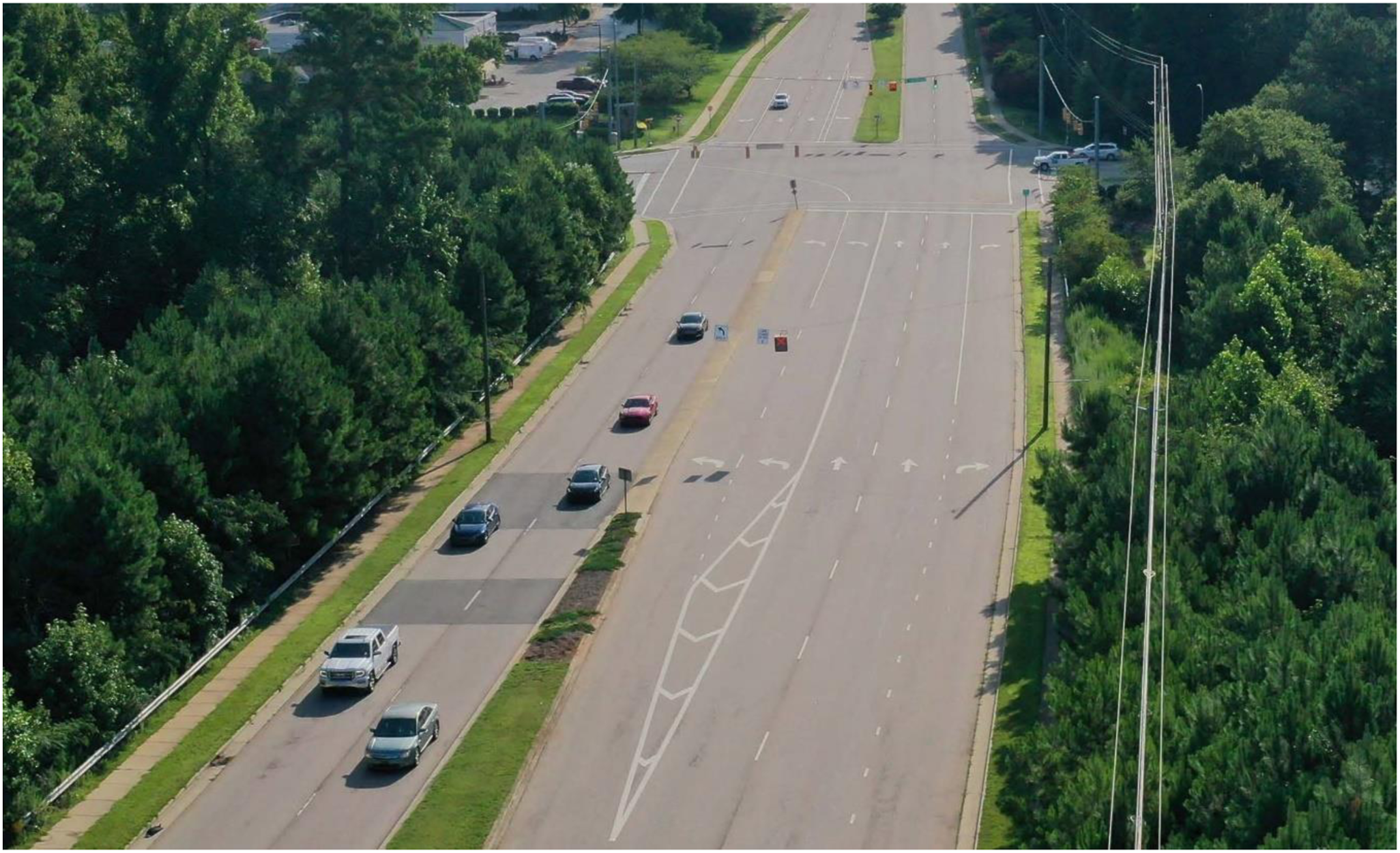
After tentatively choosing the site in Cary, the team investigated it to ensure that it had demands in the desired range and that DLTi would likely reduce delay. Recent annual average daily traffic estimates had three of the legs of the intersection, including the leg with the DLTi devices, at around 25,000 vehicles per day (vpd) and the fourth leg at 11,000 vpd, which generally for the intersection of two four-lane arterials means busy but not over capacity. The team obtained the most recent 16-hour turning movement count, from a weekday during March 2017, and saw that left turn demands on the DLTi leg were moderate, between 160 and 260 vph between 7 am and 7 pm. To estimate potential delay benefits from DLTi, the team inflated the 2017 count by two percent to fit 2019 levels (when we did the analysis) and used typical hourly factors from research in North Carolina (Findley, 2013) to estimate the eight overnight hours not counted. We then made 48 runs of the intersection in the Synchro program with optimum signal timing, one run for each hour with dual protected operation of the eastbound left turn and one run for each hour with EB left single-lane protected-permitted operation. While a macroscopic traffic analysis program like Synchro has accuracy limitations compared to microscopic programs, it is the NCDOT standard traffic analysis program for single intersections, and it should be accurate enough to provide an idea of the magnitude of the relative delay savings. We assumed that DLTi operation would provide the lower delay between the two runs for a given hour. The analysis results showed that the delay savings for DLTi over dual protected operation would be about seven seconds per EB left-turning vehicle, about 0.4 seconds per entering vehicle, and about six vehicle-hours per day. Using the standard NCDOT benefit rate of $12.75 per hour of delay saved, and assuming the savings accrued during weekends as well, the benefit would be around $27,000 per year and the payback comparing this benefit to the $35,000 installation cost would be just over one year. With these preliminary and positive results in hand, the team proceeded with device design and fabrication.
Estimated Delay Savings Based on 2019 Turning Movement Count.

Just prior to installation, the team began trying to communicate the DLTi concept to the public. We thought it important to educate as many drivers as possible on how to drive through the DLTi and why we were installing this treatment. One part of the communications plan included materials posted on the NCDOT Web site (Figure 2 was drawn from such materials) and on social media. Another part of the communication plan was a press release, which resulted in several stories in local media including local television news. The NCDOT communications staff monitored social media and the NCDOT “Contact Us” channel and responded to every request they found on this topic. Cary 311, 911, Fire, and Police were all coordinated with as they are generally public facing and handle questions regarding the project. Social media was monitored by Cary staff but responses to citizens were limited to direct requests. For the first few weeks of DLTi operation we also employed a changeable message sign on the approach to the site with the message “Red X Lane Closed” to increase awareness of the overhead lane control device and provide a reminder of its meaning.
After opening on February 14, 2020, Cary operated the DLTi as dual left turn protected for Monday through Friday 7:15 to 9:00 a.m. and 3:45 to 6:45 p.m. and as single lane protected-permissive for the rest of the week. During protected-permissive operation the protected phase was rarely called. After the Covid-19 pandemic changed traffic patterns dramatically in mid-March 2020, with the Town of Cary seeing up to 50 percent volume reductions from normal on average during some weeks in April according to unpublished NCDOT data, the Town revised the operation to be single lane protected-permitted at all times. When traffic volumes returned closer to Pre-Covid levels during the summer 2020, DLTi operation was restored.
Enforcement was light at the DLTi site during the first few months of operation. It is illegal to drive in any lane closed by a red “X” sign, so Cary Police had the authority to issue citations to violators that they observed. Initially, most drivers that were observed violating the red “X” sign were issued either verbal or formal warnings. As the months passed, Cary Police have conducted additional enforcement operations at this intersection and a few citations have been issued.
Data Collection and Results
Two live-stream cameras have been active at the intersection and have been monitored throughout the project by Cary Traffic Engineering staff. Videos and still images have been shared with the project team periodically during the project. Team members have visited the site frequently since installation and have often observed video and still photography of the operation as well. Anecdotally, team members generally feel like the operation has been going well. The devices have worked as intended. When the rightmost left turn lane has been closed most motorists have used the leftmost lane, and the team estimates the ratio of (compliant) leftmost lane use to (noncompliant) rightmost lane use at those times to be around 85:15. Violating drivers in the rightmost lane seem to execute their turns when gaps in opposing traffic present themselves as if the site had dual permissive left turn phasing. Violation rates seem to have leveled off after the first few weeks.
Between installation of the DLTi in mid-February and late-July, the team became aware of only one crash involving an EB left turn vehicle at the site. The crash was associated with the left turn movements within the DLTi; however, the functioning of the DLTi was not a contributing factor. Rather, the main contributing factor was the permissive left turn movement and poor gap selection on the part of the left turn driver.
The team has received many comments on the DLTi through social media and other channels. A majority of the initial comments have been negative, along the lines of, “We do not understand the benefit,” “There was nothing wrong with this location,” and “Why can’t I use both turning lanes?” Some commenters claim to have been driving correctly in the left lane and have had to deal with violators in the right lane. Other commenters claiming to represent truck drivers and pedestrians have also expressed negative feelings. However, a number commenters have had generally positive comments; even some negative comments have been coupled with suggestions on how to make the operation better. Of course, as with many traffic engineering initiatives, agencies rarely hear from the satisfied drivers, so team members are not overly concerned by either the amount or content of comments received in this case.
The main DLTi evaluation effort has been in a before-and-after comparison of the lane use in the EB left turn lanes. During the “before” count conducted in October 2019, used during the analysis reported in Table 1, the total EB left turn and u-turn demand was 3,179 vehicles during the 24-hour period. The lane utilization included approximately 37% of those vehicles using the leftmost left turn lane and 63% using the rightmost left turn lane. While a 24-hour vehicle count has not yet been conducted after DLTi installation (due to Covid-19), the team made a preliminary observation during midafternoon of a midweek in July 2020. During single lane operations we counted 33 non-compliant drivers using the rightmost lane out of 192 total vehicles counted using the two lanes, or 83% of vehicles using the leftmost left turn lane and 17% using the rightmost left turn lane, validating our anecdotal estimates of 85% compliance. In other words, based on these samples, almost 50% of the total volume of the two lanes has adjusted from using the rightmost lane to the leftmost lane with DLTi in place.
During that July 2020 data collection, we set up a series of video cameras to observe driver behavior from multiple perspectives under single lane protected-permissive conditions. Of the 33 non-compliant drivers using the rightmost lane, 10 made a downstream right-turn into the shopping center driveway past the intersection and likely used the rightmost lane to preposition in advance of the right turn, but the other 23 continued down the arterial past the shopping center. Twenty-eight of the 33 non-compliant drivers made the left turn at their first opportunity in conjunction with the left-turning vehicles in the leftmost lane, either taking an adequate gap during the permissive phase or waiting for the lagging protected phase. The other five vehicles hesitated from the rightmost lane, skipping an adequate gap during the permissive phase, eventually turning left during the succeeding protected phase. Vehicles in both lanes stayed in their respective lane during the left turn, not crossing the white solid line painted in the intersection. Slightly more than half of the 33 vehicles entered the rightmost lane when another vehicle was already present in that lane, resulting in numerous cycles with multiple non-compliant vehicles. Six of the 33 vehicles were late entries into the rightmost lane from the through lane and may have missed the pavement markings directing the vehicles into the left lane at the upstream taper.
Conclusions
The authors designed, installed, and tested DLTi, which is a new way to operate an intersection approach with dual left turn lanes. With DLTi, the both lanes are operated with protected-only phasing during the peak hours when higher capacity is needed, and only the leftmost left turn lane remains open for protected-permissive operation during the off-peak hours. The authors devised a set of traffic control devices that comply with the MUTCD, are relatively inexpensive to install, and can be operated with conventional signal control software. After devising site selection criteria and choosing a test site, the authors were able to test for the DLTi benefits and compliance levels at that site. The benefit looks to be substantial, in terms of delay savings, with a pay-off of five months as operated by the Town at pre-Covid demand levels. The crash experience has been minimal, and the public comments received have been predominantly negative but not overwhelming. Around 85 percent of left-turning motorists are complying when the rightmost left turn lane is closed—which means we have shifted the previous lane choice of almost 50 percent of drivers. This study was certainly limited, especially in that there was just one test installation and only one set of traffic control devices was tested. Nonetheless, the team believes that DLTi has been a success, that it should remain in place at the test site, and that the NCDOT and other agencies should begin searching for other suitable locations for DLTi installation.
There is uncertainty associated with trying anything new, and risk when operating a traffic signal under protected-permitted or permissive operation for left turns. However, there is also risk in not installing or attempting such operations, as literally thousands of travelers may be needlessly delayed, day after day. The DLTi and other time-of-day traffic operational treatments provide an opportunity to reduce risk, gain experience, and provide benefits to travelers and knowledge to engineers and researchers.
While the obvious applicability for a DLTi is to provide off-peak delay reduction for a dual left turn lane installation, a second case is where an agency is desirous of having dual lefts available during peak periods but is hesitant that they will be used effectively, or the benefits appear to be marginal. To that point, the FHWA Signalized Intersection Guide (FHWA, 2013) notes that, “rarely will there be an even distribution among the turn lanes, which can dramatically impact the signal timing,” and notes that double lefts are not appropriate when several conditions are present, including when, “left-turning vehicles are not expected to evenly distribute themselves among the lanes.” The DLTi provides a mechanism to install dual left turn lanes that would still be helpful for peak periods, even when there may be somewhat unbalanced lane utilization for many cycles, while enabling far more efficient, protected-permitted, single lane operation during the balance of the day. DLTi also provides agencies flexibility in operation for seasons or special events with lower or higher demands than usual.
Refinements of the current set of DLTi devices are possible. Closing the left lane instead of the right lane, especially where there is a driveway on the right side of the departure leg close to the intersection, might be worth considering if there are no sight distance problems. Additional lane use control signs over the other lanes on the intersection approach, even if those signs always show a downward green arrow, might help. Additional pavement markings could help, such as a double white line between the rightmost left turn lane and the adjacent through lane to try to discourage late entries into the closed lane. The project team has discussed delineators between the left turn lanes and the through lanes. Some form of rumble strip in the rightmost left turn lane has promise. All extra devices add cost and could reduce the benefit to cost ratio of the DLTi, but if an addition to the package is inexpensive and effective in conveying the correct messages to drivers we should use it in future installations and/or in a future modification for this pilot.
Future research on the DLTi should include more after studies on the test site in Cary (once Covid-19 has receded and traffic volumes are closer to normal), including analysis with a microscopic traffic simulation program, more lane use (compliance) data, delay data, and crash data. The NCDOT has at least one more site in mind for a DLTi installation, and likely will be looking for more once project funding is available, so more before-and-after studies of those sites would be promising. Installations in other states would be helpful. Testing of the effectiveness of various forms of public relations could also be productive. A driver simulation test of the refinements listed above could add value.
Besides more efficient operations in dual left turn lanes, lane use control can be applied to other similar problems around intersections. The Utah experiment mentioned above that changes a lane use between shared left and through and through only is interesting. In North Carolina there has been discussion of an application on the stem of a T intersection with two approach lanes, where the right lane can be converted from shared left and right to exclusive right at certain times of the day to allow a right turn overlap phase. In North Carolina we have also been discussing part-time reduced conflict intersection (RCI) operation. An RCI (a.k.a., superstreet, j-turn, or reduced conflict u-turn) redirects side street left turns and through movements to downstream u-turn crossovers. Our discussion has been on operating an intersection as an RCI during peak periods to take advantage of the superior capacity and progression it offers and operating the intersection conventionally (allowing direct side street left turns and through movements) during non-peak hours for the greater convenience of the stakeholders who use the side street. The contraflow left intersection (Su, 2016) which opens a gate to the left of a left turn lane allowing vehicles to queue in the opposing through lanes—creating a dual left turn capability where only a single left turn lane of asphalt exists—is another possibility along these lines. With the success of the DLTi trial agencies should have more confidence to employ lane use controls for some of these other applications.
The DLTi project team generally considers this trial as our first tentative step in North Carolina toward a future of engineering for a traffic stream consisting of mostly connected and automated vehicles (CAVs). In that future with mostly CAVs, traffic engineers will have to worry much less about how to communicate to drivers. Engineers will be able to customize intersections for the demand that will be arriving hour-to-hour or cycle-to-cycle. The results should be profound.
Footnotes
Acknowledgements
The authors alone are responsible for any errors or omissions in the paper; please bring those to our attention. The paper does not necessarily represent the views and opinions of the North Carolina DOT, the Town of Cary, or the Regional Transportation Alliance, a regional program of the Raleigh Chamber.
Declaration of Conflicting Interests
The author(s) declared no potential conflicts of interest with respect to the research, authorship, and/or publication of this article.
Funding
The author(s) received no financial support for the research, authorship, and/or publication of this article.
