



Abstract
In recent years, the concept of sustainable infrastructure has become a key concern for infrastructure development. However, there has been little comprehensive research on the enabling factors for sustainable infrastructure development. To address these knowledge gaps, this research conducted a systematic literature review of the enabling factors, with a specific focus on finance and governance, to provide new insights for development practitioners and academic scholars. The research first reviewed the characteristics of sustainable infrastructure, identifying several types of definitions. Subsequently, the research identified multiple finance arrangements and governance characteristics that have been applied to sustainable infrastructure. We confirmed that public-private partnerships (PPPs) and multilateral development banks (MDBs) play central and critical roles in leading and including other finance arrangements and governance characteristics of sustainable infrastructure development. In addition, the review suggests there are various governance modes combining horizontal process management with vertical project management for realizing sustainable infrastructure development.
Introduction
Sustainable infrastructure has recently become a key concern for infrastructure development. The Sustainable Development Goals (SDGs), adopted by the United Nations General Assembly in 2015, established the development of “quality, reliable, sustainable and resilient infrastructure” as one of the SDG targets (Target 9.1) (UN General Assembly, 2017). Following this, the concept of sustainable infrastructure has become widely utilized by international development organizations, such as the World Bank, Asian Development Bank (ADB), and the OECD, and is now one of the most commonly referred-to concepts by practitioners in infrastructure development-related fields (OECD, 2020b, 2020a; ADB, 2018; G20, 2019). With the notion of sustainable infrastructure becoming increasingly widespread, various views have been shared between development practitioners on how best to achieve sustainable infrastructure (e.g. UN General Assembly (2017) and G20 (2019)). However, overall, enabling factors introduced by institutions depend largely on development institutions’ preferences and the contexts of the discussions.
When it comes to academic scholarship, there is an increasing volume of research on sustainable infrastructure and on how to achieve it. The research on the enabling factors could be divided into research related to technical issues and non-technical issues. Research on technical issues, which accounts for the largest portion of these studies (Thomé et al., 2016; Ferrer et al., 2018), includes infrastructure design and construction methods using new technologies to reduce energy, emissions, and costs (e.g., Cheng et al., 2011; Saadatian et al., 2012; Cros et al., 2012; Liu et al., 2014). It also incorporates research on infrastructure materials designed to reduce the resources used in construction (e.g., Millogo et al., 2014; Bernardi et al., 2014; Madurwar et al., 2013; Iucolano et al., 2013). On the other hand, research on non-technical issues covers project planning and decision-making (e.g., Coutinho-Rodrigues et al., 2011; Horton et al., 2011) and project management and partnerships among stakeholders (e.g., Aylett, 2013; Mahalingam, 2010; Chen et al., 2010; Wang, 2004) for sustainable infrastructure development. However, despite the enormous volume of research on enabling factors for sustainable infrastructure development, few researchers have comprehensively examined enabling factors in the existing research or explored how such factors might be interrelated.
Considering this background, the main purpose of this research is to examine how to implement sustainable infrastructure development. In regard to the enabling factors for sustainable infrastructure, there is an underlying issue of disorganized knowledge: both practitioners and scholars utilize the concept holistically in line with all the ‘three pillars’ of sustainability—namely economic, environmental, and social sustainability (Brundtland, 1987; de Jong et al., 2015; Adshead et al., 2019) or have their own focus among the ‘three pillars’ when they talk about sustainable infrastructure. This varied definition of the concept, which depends on the context of the discussions, makes it more difficult to understand how we can achieve sustainable infrastructure. Therefore, this research first confirms some key characteristics of sustainable infrastructure by investigating which of the three pillars of sustainability are addressed in the existing research, and by reviewing the enabling factors.
As for the enabling factors for sustainable infrastructure development, this research focuses on financial and governance aspects. This is because while appropriate finance arrangements and governance characteristics are imperative for the implementation of infrastructure projects, there is little research into them as enabling factors. Moreover the focus is also important from a practitioner’s perspective because the need to address the lack of finance and managerial experience when implementing infrastructure development and sustainable development has always been at the center of discussions among the international development community (Spratt et al., 2021; UNCTAD, 2014).
Therefore, the interlinked research questions of this systematic literature review are as follows: 1) What are the characteristics of sustainable infrastructure? 2) What financial arrangements are available to support sustainable infrastructure? and 3) What governance characteristics are available in implementing sustainable infrastructure?
Research Methods
Systematic Literature Review through PRISMA protocol
To address the above research questions on sustainable infrastructure, this research conducts a systematic literature review. This research adopts the ‘Preferred Reporting Items for Systematic Reviews and Meta-Analyses’ (PRISMA) approach, which sets the following eligibility criteria for the review: topic, field of study, research method, language, publication status and database, and publication year (Moher et al., 2009).
The area of focus in this research is sustainable infrastructure. Therefore, only studies that mention “sustainable infrastructure” in their title, abstract, or keywords are included in the systematic literature review. While sustainable infrastructure is often mentioned together or associated with green infrastructure and green building in the literature, including organization reports and documents (e.g., Thomé et al., 2016; UN General Assembly, 2017; G20, 2019; OECD, 2020a), we utilize “sustainable infrastructure” as the search criterion. There are also independent concepts with their own specific definitions: green infrastructure is generally defined as “a hybrid network of natural, semi-natural, and engineered features within, around and beyond urban areas at all scales, which is planned and managed to provide multiple ecosystem services and benefits” (Choi et al., 2021, p. 2), and is sometimes regarded as low-carbon infrastructure such as public transportation systems and renewable energy infrastructure (Kaminker et al., 2013). Green buildings are defined as “healthy facilities designed and built in a resource-efficient manner, using ecologically based principles” (Kibert, 2016, p. 11). Therefore use of “sustainable infrastructure” as the sole search criterion makes it possible to clearly understand how sustainable infrastructure is being defined and delivered. It is true that the description of sustainable infrastructure could take other forms, such as sustainable transportation and sustainable water infrastructure, however this research focuses on the literature explicitly mentioning “sustainable infrastructure”, considering the situation that the terminology of “sustainable infrastructure” is now largely used as an unique noun in international societies and is consistent with the criteria applied in previous reviews on sustainable infrastructure. However, it should be noted that these terms are not excluded from this study as long as the title, abstract, or keywords of articles include “sustainable infrastructure.” Furthermore, sustainable infrastructure is a research area that encompasses various fields of study, such as public administration, engineering, and economics. This research reviews all the articles regardless of discipline, as long as the articles include a focus on finance and governance aspects. Therefore, articles that do not include the term “sustainable infrastructure” in the title, abstract, or keywords or discuss finance and/or governance were excluded from the study.
As long as the literature meets these criteria, we do not specify any limitations regarding the studies’ research methods. We review only English language articles to avoid undertaking translation; however, this does not appear to be a critical issue since only a small number of articles are written in other languages. The reviewed articles are peer-reviewed journal articles collected from Scopus and Web of Science, both considered to be comprehensive and authoritative search engines. According to research by Thomé et al. (2016), literature on sustainable infrastructure has been growing rapidly since 2005; hence, we set 2005 to 2021 as the criteria of the publication year for articles.
Screening and Review
We conducted an initial search based on the above protocol. Following the eligibility criteria, 425 articles were identified from Scopus and 302 articles from Web of Science. In total, 451 articles were eligible for screening after excluding duplicates. We then conducted a screening process to select the articles for review, as shown in Figure 1. First, we screened articles based on their title, abstract, and conclusion. There were a large number of articles not directly relevant to sustainable infrastructure, and of these, 135 articles were removed. Out of the remaining 316 articles, we excluded 231 that focused on specific technological aspects; hence, we finally identified 85 eligible articles that included a focus on finance or governance aspects. Process of screening of the articles for analysis.
Characteristics of the Reviewed Articles
The articles identified through the screening show diversity in terms of publication years, field of study, focus (finance/governance), and countries and sectors, as shown in Figure 2 and Table 1 (see Appendix A for the article list). As for the publication year, there is an increasing trend in the number of articles published each year. This indicates that more attention is being given to sustainability perspectives in infrastructure development and that the specific term ‘sustainable infrastructure’ is being used with increasing frequency. Publication year of the articles. Categorization of Articles.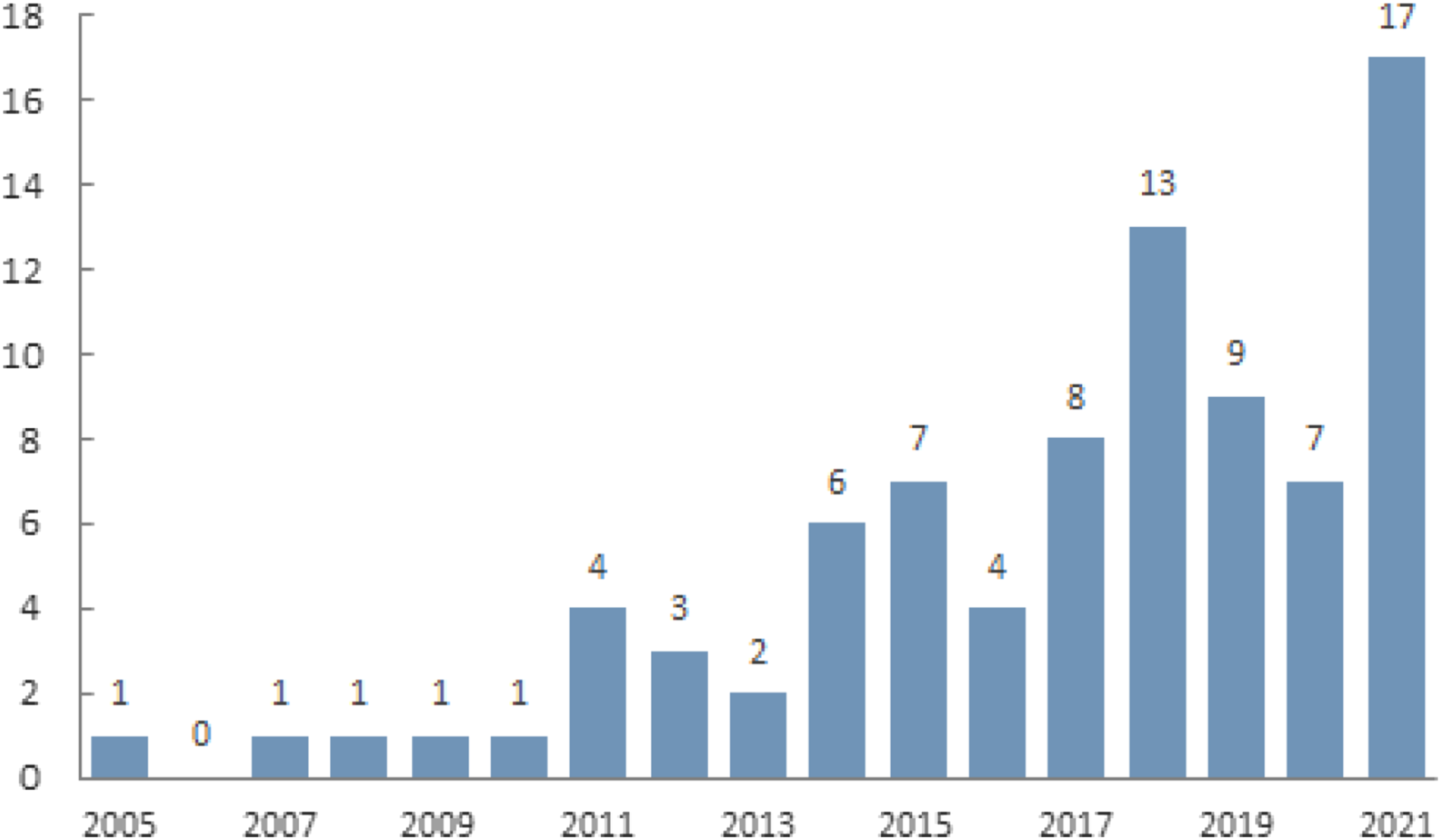
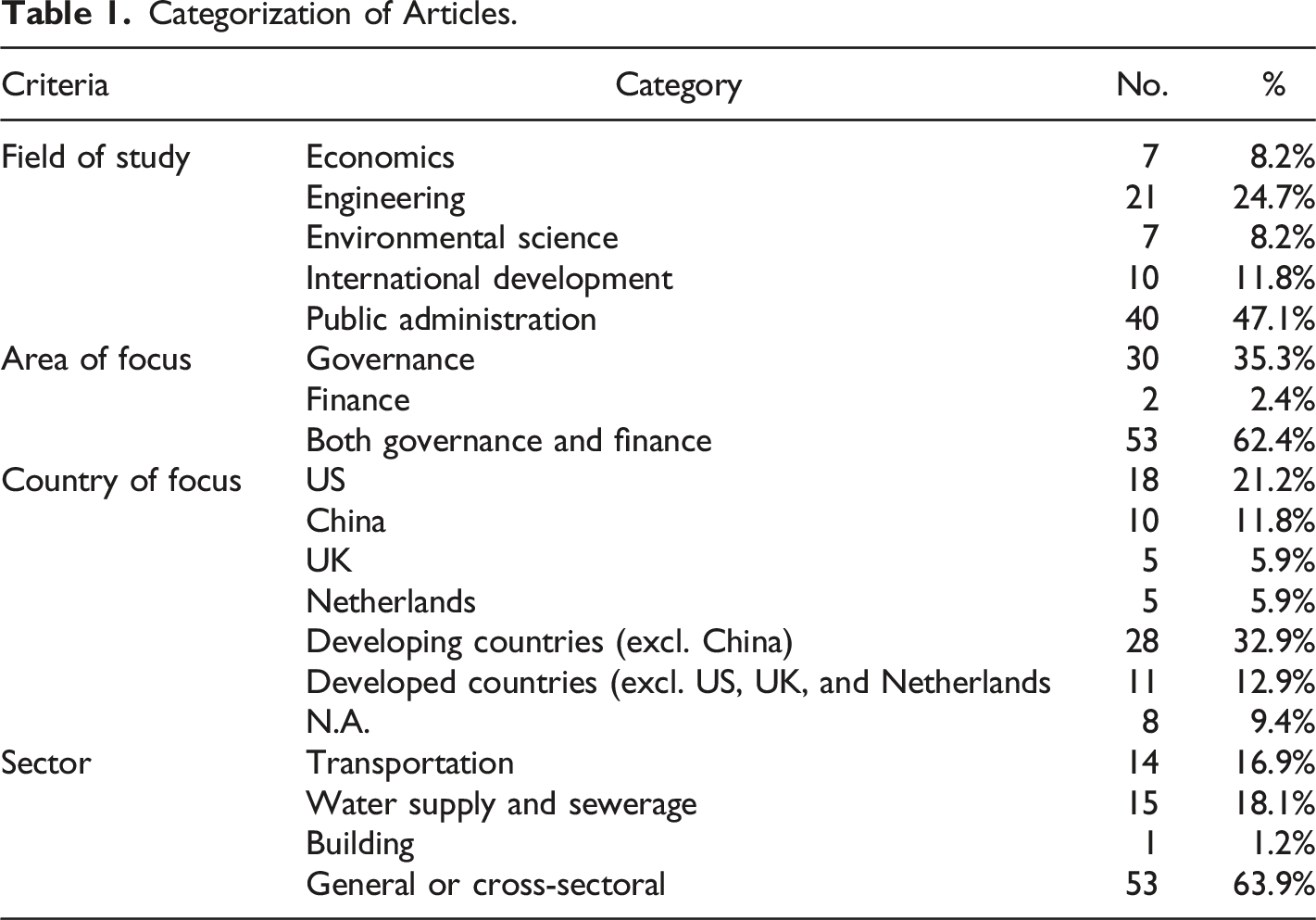
As for the field of study, public administration has around a half share of the selected articles (47.1%), followed by engineering (24.7%) and international development (11.8%). It is notable that research into administrative matters related to public works is conducted in the academic fields of public administration and engineering, as well as international development. Almost all of the identified articles mention governance aspects (97.6%) and 62.4% of the articles mention both governance and finance aspects. Regarding countries of focus, the US (21.2%), China (11.8%), the UK (5.9%), and the Netherlands (5.9%) are the top four countries in terms of the share of the articles. However, the articles also focus on numerous other developing and developed countries, suggesting that sustainable infrastructure is a global concern. The identified articles mainly discuss general or cross-sectoral infrastructure in their research (63.9%), although transportation and water supply and sewerage sectors are specifically examined by a proportion of articles (16.9% and 18.1%, respectively).
Full-Text Review And Co-Occurrence Analysis
By reviewing the full text of the selected 85 articles, we extracted and organized the information on the key characteristics of sustainable infrastructure. To analyze these characteristics, we focused on the three sustainability pillars and categorized the main area of focus and context of the research based on the three pillars—namely, economic, environmental, and social sustainability. In doing so, we aim to examine any changes in the focus of sustainable infrastructure and the overall trend in articles over the period. As for enabling factors for achieving sustainable infrastructure development, we conducted a full-text review, paying careful attention to the finance and governance aspects and analyzed which arrangements/characteristics had previously been identified and discussed. To ensure the reliability and validity of the coding, we conducted a full-text review twice with a time interval between them (the second full-text review was conducted two weeks after the first). We also sorted the identified information by the area of focus (economic, environmental, social, or others if any) to examine whether there were any trends in enabling factors. By closely reviewing the articles, it was expected that any details of financial arrangements and governance characteristics for sustainable infrastructure could be identified, along with their features.
Following the extraction of the enabling factors, in order to understand the relationship among each factor, we conducted a co-occurrence network analysis. The co-occurrence network analysis is a method to analyze interconnection of terms within the texts based on their paired presence and visualize potential relationships between the terms. To do so, we utilized KH Coder software, which is designed for quantitative content analysis, including co-occurrence network analysis (Higuchi, 2016b, 2017). We chose KH Coder because it is proven software and has been widely utilized, including previous use in sustainability studies (e.g., Sakuma et al., 2021). In addition, KH Coder automatically provides a visualized graph of co-occurrence networks with related information. Co-occurrence graphs consist of nodes that represent factors and edges that represent how the nodes relate at the two ends of the edge. Related information, centrality, and coefficient are automatically calculated. Centrality here is betweenness centrality, which shows the central role each factor plays in the network (Higuchi, 2016a). The greater the centrality, the more central the roles of each factor are in the network. The coefficient shows the Jaccard coefficient, which is an index for measuring the similarity of words, and a higher index (with a thicker edge in the graph) shows a stronger similarity between the words (Higuchi, 2016a). Additional details on centrality and the coefficients are shown in Annex B.
Results
Key Characteristics of Sustainable Infrastructure
To investigate the answer to the first research question, we analyzed the characteristics of sustainable infrastructure as presented in the articles. Through the review process, we confirmed that there are several approaches that the articles take in characterizing sustainable infrastructure, as shown in Table 2. The first type of article uses the terminology of sustainable infrastructure with no particular focus on the three pillars of sustainability (economic, environmental, or social pillars). This type accounts for 51.0% (52 articles) (e.g., Hellström et al., 2021; Zhou et al., 2017; Wei et al., 2016; Lenferink et al., 2013). In this type, many articles emphasize the importance of all the three pillars of sustainability within the context of infrastructure development by explicitly defining what sustainable infrastructure is. For instance, Gonzalez-Ruiz et al. (2019) use definition of sustainable infrastructure as “an infrastructure that integrates environmental, social and governance aspects into a project’s planning, building and operating stages” (p. 850). On the other hand, Hendricks et al. (2018) define the term as: “systems that have the capacity to endure over a long period of time; enabling the human-built environment to thrive and providing an opportunity for human society to improve its quality of life, without compromising the integrity and availability of natural, economic, and social assets for future generations” (p. 265). Area of Focus In Sustainability Pillars. Note: The number of articles (102 articles) differs from total the number of reviewed articles (85 articles) because some articles focus on more than one pillar (e.g., environmental and social).
These two articles are relatively new; however, this type of definition of sustainable infrastructure also appears in older articles. For instance, Kumaraswamy et al. (2007) describe concrete features of sustainable infrastructure from the three pillars perspective as follows: sustainable infrastructure must enhance the quality of life, provide client and user satisfaction, offer flexibility for user changes/ preferences, support desirable natural environments, enhance value for money, and maximize the efficient use of resources.
While the first group of articles focuses on sustainable infrastructure as related to all the three sustainability pillars, the second group contains articles on economic, environmental, or social pillars or combinations of two of them. In this group, there are almost the same number of articles on each pillar: 10 articles (9.8%) focus on the economic pillar, 22 articles (21.6%) on the environmental pillar, and 10 articles (9.8%) on the social pillar. For instance, Mostafavi et al. (2014) and Zhang et al. (2019) focus on the economic pillar, discussing how to mobilize innovative financing for infrastructure projects to fill the fiscal gap in public finance. Articles with a focus on the economic pillar include Wei et al. (2019), who define sustainable infrastructure from an economic perspective. Sustainable infrastructure is able to “keep the operation stage sustainable in terms of economy… (sustainable infrastructure) can obtain a positive risk-adjusted return...and promote high-quality economic development in the long run” (p. 1).
As for articles focusing on the environmental pillar, some scholars link infrastructure with climate change and regard sustainable infrastructure as infrastructure aimed at climate change adoption and/or mitigation, such as low carbon emission infrastructure. For instance, Ray and Kamal (2019) define sustainable infrastructure as “projects aimed at climate mitigation and/or adaptation” (p. 194), while Bak et al. (2017) define the goal of sustainable infrastructure as being “to deliver on a 2°C compatible pathway and the SDGs” (p. 5). Other scholars focus on the environmental pillar from the perspective of resource saving and resource efficiency in infrastructure design, construction, and operation. For example, Coenen et al. (2020) regard sustainable infrastructure in the context of a circular economy as the need “to consider and implement circular principles that are more suitable to their specific assets” and suggest important actions for the stakeholders to achieve that, such as the use of recycled materials and the articulation of material-reducing policies for infrastructure projects. Knoeri et al. (2016) also regard sustainable infrastructure as a “resource-efficient infrastructure operation” (p. 231).
As for articles focusing on the social pillar, scholars emphasize the importance of community-oriented infrastructure development. For instance, Egan and Agyemang (2019), who research water management in Ghana, regard sustainable infrastructure as infrastructure able to “provide safe and universal water supplies” and suggest “more communication with all stakeholders was (is) needed (to do so)” (p. 237, 250). Treviño-Lozano (2021) argues that “sustainable infrastructure can have a double impact on people by preventing negative and boosting social positive impacts. On one hand, it can serve to prevent human rights abuses against workers… On the other, sustainable infrastructure can boost its positive effects poverty-related through facilitating services such as energy, water or transport” (p. 2).
In addition to the three pillars of sustainability, through the review process, we found another non-negligible concept regarding sustainable infrastructure, namely project institutional/managerial sustainability (8 articles: 7.8%). Some articles clearly include institutional/managerial aspects in their definitions of sustainable infrastructure. For instance, Hoeft et al. (2021) show institutional/managerial aspects such as operation and maintenance capabilities, organization structure, and the competence and skill of the project team as indicators for assessing the sustainability of infrastructure, in addition to the three pillars’ conceptualization of sustainability. Malekpour et al. (2017) also suggest the importance of institutional stability or adequate institutional arrangements to enforce sustainable infrastructure operations. In addition, Xue et al. (2018) explicitly state that “Apart from economic, social, and environmental dimensions, this research also proposed organizational integration as a supplementary factor measuring IS (infrastructure sustainability). Organizations manage more than one project or project portfolio at the same time with limited resources, thus, integration of precise estimation, timely allocation, and reasonable use of resources are indispensable to attain IS” (p. 15, 16).
The time transition in these scholars’ areas of focus on sustainable infrastructure from 2005 to 2021 is summarized in Figure 3. It is understood that the scholars’ areas of focus have recently become more specific to each pillar of sustainability. However, at one time, scholars tended to treat sustainable infrastructure in a general way. This phenomenon could be related to the recent surge of attention toward sustainability issues across many fields due to the adoption of SDGs by the United Nations in 2015. Scholars within a particular academic field related to economic, environmental, social, or institutional/ management topics began to undertake research into sustainable infrastructure. Among these sustainability pillars, the environmental pillar has recently become a major area of focus (especially after 2019), comparable in size to the more general focus. This might be partly because of the recent boom in international attention to climate change, such as the annual Conference of the Parties (COP) of the United Nations Framework Convention on Climate Change (UNFCCC). However, it should be noted that the general focus on sustainable infrastructure has existed continuously throughout the period, while particular areas of focus have recently increased their presence. This fact suggests that sustainable infrastructure has a multifaceted nature, and the definition and use of the terminology related to sustainable infrastructure ultimately depends on the research contexts. Transition in areas of focus in sustainable infrastructure.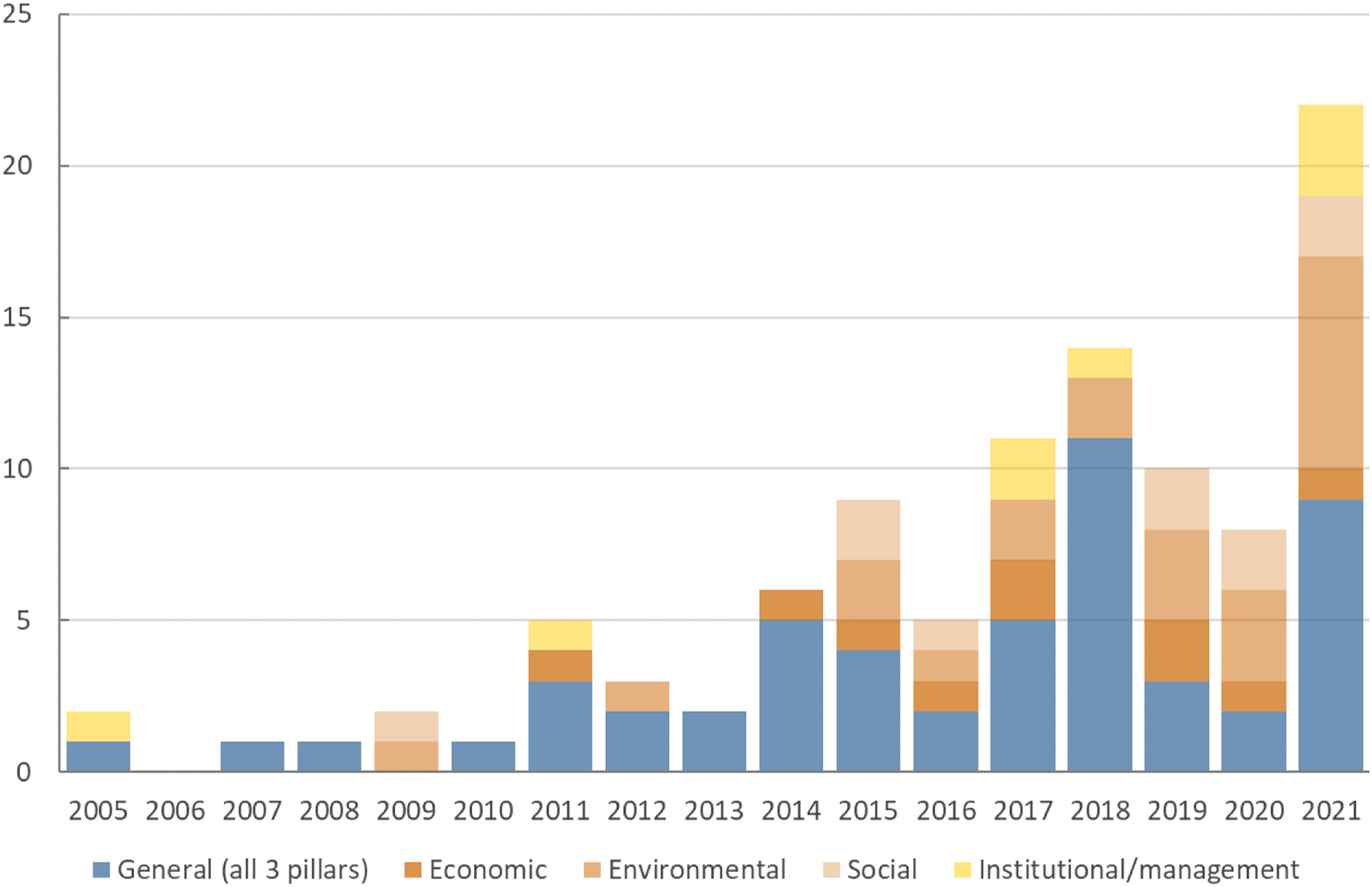
Finance Arrangements For Sustainable Infrastructure
Finance Arrangement For Sustainable Infrastructure (explanation).
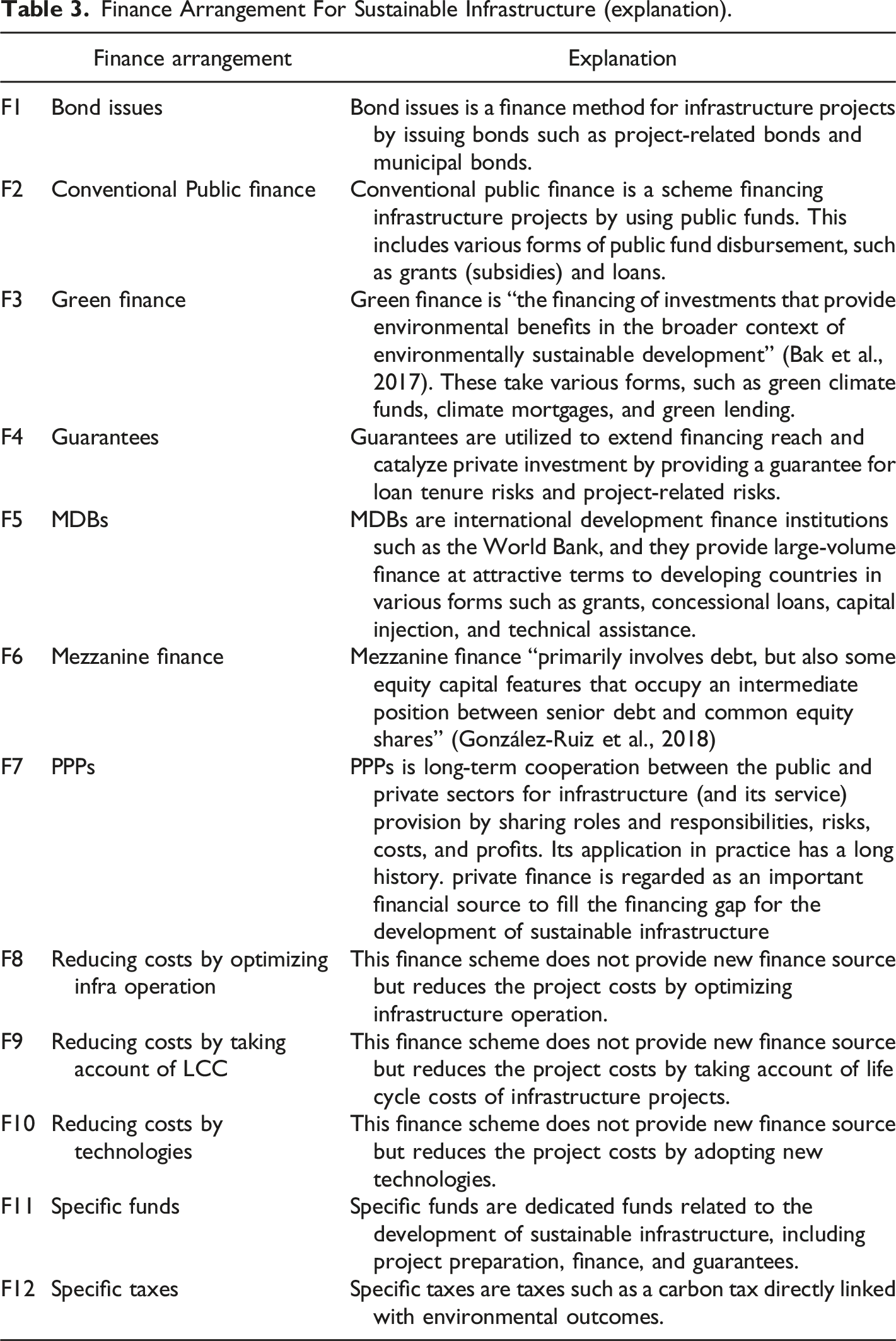
Other noticeable finance arrangements is multilateral development banks (MDBs) (F5). MDBs are international development finance institutions such as the World Bank, and they provide large-volume finance at attractive terms to developing countries in various forms such as grants, concessional loans, capital injection, and technical assistance (Bhattacharya et al., 2018; Ray & Kamal, 2019; Kharas, 2021). Developing countries generally do not have sufficient budgets to finance infrastructure development, even though the demand is huge. Therefore MDBs are major financial sources for infrastructure projects in developing countries (Egan & Agyemang, 2019). Turning to MDB finance, blended finance has recently come to be regarded as a key finance method. It is “the systematic and strategic use of development finance and philanthropic funds to mobilise and engage private capital at scale” (IDFC 2019). Blended finance is a widely acknowledged and promoted concept by international development communities, such as the OECD-DAC (Development Assistance Committee), which is composed of many of the largest providers of aid, and the International Development Finance Club (IDFC) (IDFC 2019).
Following the PPPs (F7), conventional public finance (F2), and MDBs (F5), there are several additional types of finance methods, including green finance (F3), which is directly related to eco-friendly infrastructure. Green finance is “the financing of investments that provide environmental benefits in the broader context of environmentally sustainable development” (Bak et al., 2017, p. 6). These take various forms, such as green climate funds, climate mortgages, and green lending (González-Ruiz et al., 2018). Green bonds are one method of green finance in the form of bonds, an approach that is referred to in five articles.
In addition, there are finance arrangements such as bond issues (F1), guarantees (F4), specific funds (F11), and specific taxes (F12). Bond issues is a finance method for infrastructure projects by issuing bonds such as project-related bonds and municipal bonds (Ahmad, 2021). Related to bond issues, a mezzanine debt mechanism (F6) based on sustainable convertible bonds has also been proposed (Gonzalez-Ruiz et al., 2019). A guarantee (F4) is a method for governments and/or MDBs to extend their financing reach and catalyze private investment by providing a guarantee for loan tenure risks and project-related risks (Ray & Kamal, 2019; Bak et al., 2017). Specific funds (F11) are dedicated funds related to the development of sustainable infrastructure, including project preparation, finance, and guarantees (Kumar & Arora, 2019; Lewis et al., 2021). Specific taxes (F12) are taxes such as a carbon tax directly linked with environmental outcomes (e.g., a higher marginal rate is imposed on provinces and metropolitan areas with higher pollution levels (Ahmad, 2021). Finally, tax-incremental financing allows local governments to invest in infrastructure projects by using anticipated future increases in tax revenues or spillover tax revenues generated by the project (Taghizadeh-Hesary et al., 2021; Neuman, 2020).
Moreover, there are other types of arrangements identified in the literature, namely reducing infrastructure project costs by optimizing infrastructure operations (F8), taking into account the life cycle costs (LCC) of infrastructure (F9), and adopting technologies (F10). These arrangements are different in nature from the above-mentioned arrangements in that they do not provide new finance source but provide ways of filling the finance gaps by reducing the project costs.
Finance Arrangements For Sustainable Infrastructure.
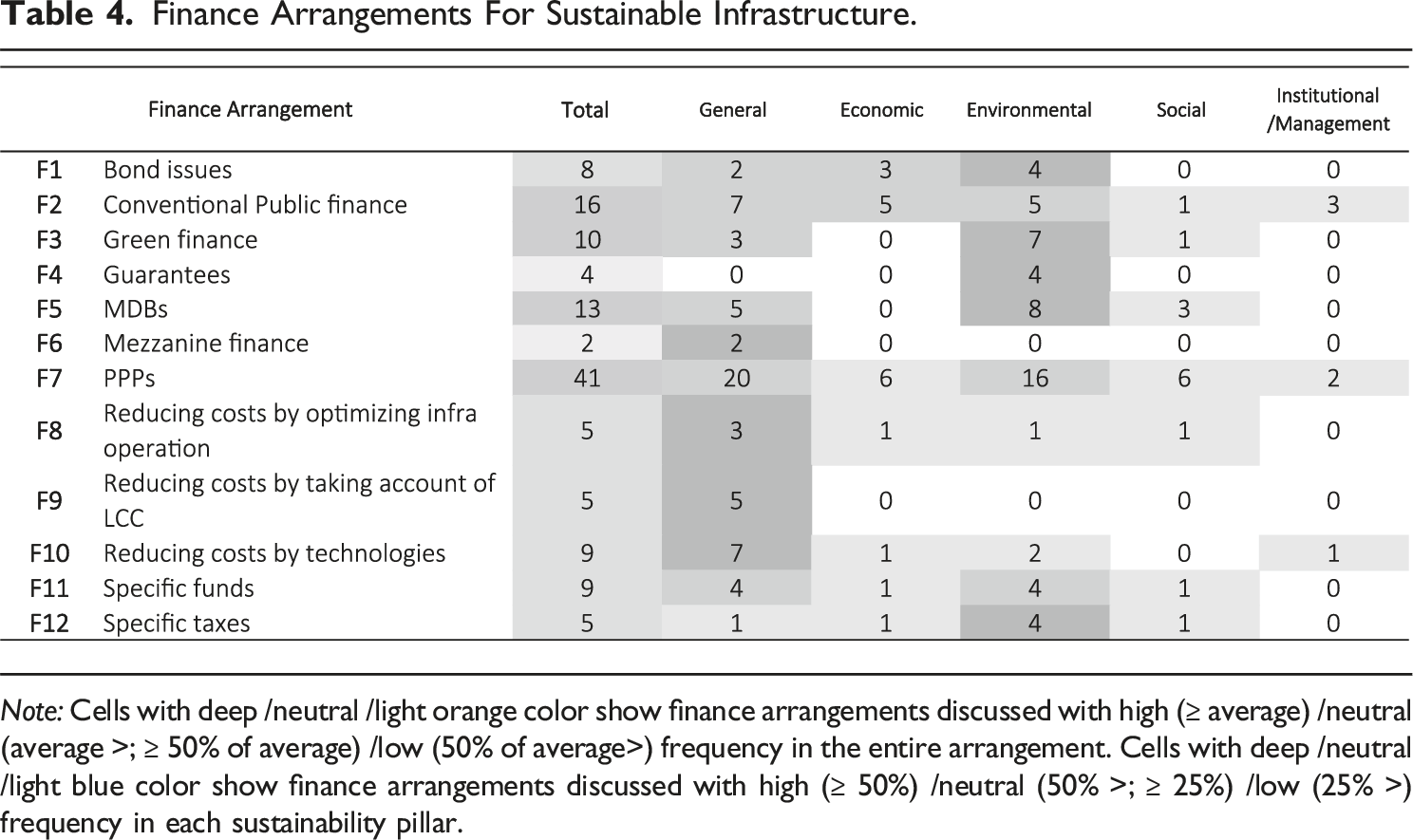
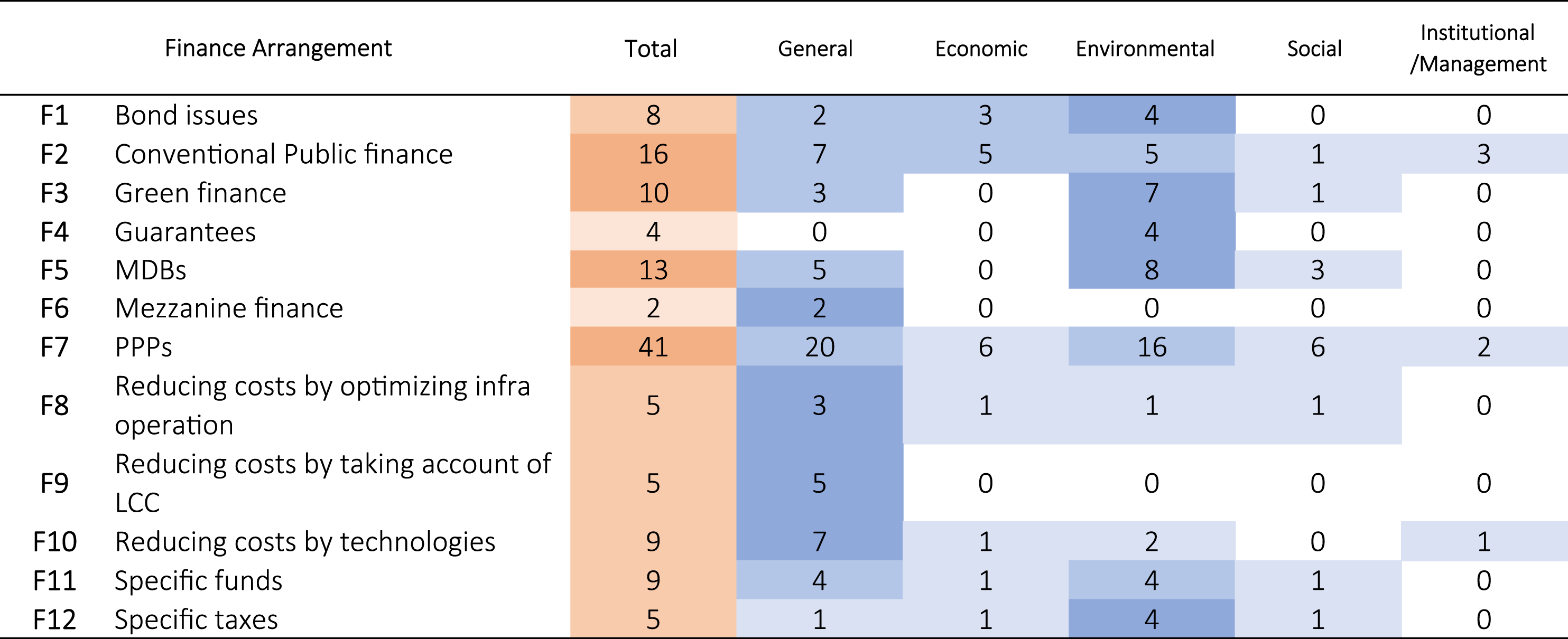
Note: Cells with deep /neutral /light orange color show finance arrangements discussed with high (≥ average) /neutral (average >; ≥ 50% of average) /low (50% of average>) frequency in the entire arrangement. Cells with deep /neutral /light blue color show finance arrangements discussed with high (≥ 50%) /neutral (50% >; ≥ 25%) /low (25% >) frequency in each sustainability pillar.
To understand the relationships between each of the financial arrangements, we analyzed the co-occurrence of finance arrangements mentioned in the articles. The results of this co-occurrence network analysis of financial arrangements are presented in Figure 4. As for centrality, it is understood that PPPs (F7) are, among the finance arrangements, at the most central position, followed by reducing cost by adopting technologies (F10), conventional public finance (F2), and MDBs (F5). This means these arrangements are frequently referred to together with various other arrangements, or in other words, these finance arrangements play key roles as a bridge to other finance arrangements. It is noteworthy that finance arrangements can be divided into two groups, which have low association between them; one is the group lead by PPPs (F7), conventional public finance (F2), and MDBs (F5) and another is the group lead by reducing cost by adopting technologies (F10). This is reasonable since the latter have a different nature from the former in terms of a way of finance, as mentioned above. Co-occurrence network of finance arrangements for sustainable infrastructure.
When it comes to PPPs (F7), the association with conventional public finance (F2) is relatively high (0.31). Indeed, PPP schemes are financially supported by subsidies from the public, such as viability gap funding (VGF) schemes and availability payment schemes—all frequently recommended by scholars (e.g., Agarchand & Laishram, 2017; Bak et al., 2017). Therefore, conventional public finance (F2) is an important finance arrangement to realize sustainable infrastructure not only by financing by itself but also by instigating PPP schemes. PPPs (F7) also have a relatively high association with MDBs (F5) (0.32), which implies that the utilization of MDB funds occupies an important position across all of the PPP schemes. This is reasonable since blended finance concept, which is the combination of PPPs and MDBs, is recently widely acknowledged and promoted.
For MDBs (F5), the number of associations between specific funds (F11) and green finance (F3) is also relatively high (0.29 and 0.28, respectively). This is because MDB finance is often recommended as a financial source for specific funds (e.g., Kumar & Arora, 2019; Ray & Kamal, 2019). Green finance is related to environmental goals, and thus, is a key item on the agenda for international communities, including MDBs. As for other non-central finance arrangements, associations among green finance (F3), bond issues (F1), and specific taxes (F12) and associations among guarantees (F4), green finances (F3), and specific funds (F11) also co-occurred relatively frequently in the literature. These arrangements are mainly aimed at the environmental pillar.
Governance Characteristics For Sustainable Infrastructure
We subsequently analyzed governance characteristics for realizing sustainable infrastructure. Governance can be described as a coordination process within networks of interdependent actors based on institutionalized rule systems (Treib et al., 2007; Kooiman, 2003; Jordan et al., 2006). There are various concepts of governance. However, we applied the concept of governance modes employed by Treib et al. (2007). This approach focuses on the relationships between state interventions and societal autonomy since both of them are involved in infrastructure development projects to a greater or lesser extent.
In concrete terms, we extracted governance characteristics related to two dimensions from the articles. The first comprises institutional properties (polity) (e.g., hierarchy/non-hierarchy institutional structure), while the other consists of policy instruments (policies/regulations) (e.g., material/procedural regulations). It should be noted that the actor constellations (politics) (e.g., public/private actors’ involvement), originally mentioned by Treib et al. (2007), have been excluded. This is because the participation of both public and private actors (not either only public/private actors’ participation) is assumed for infrastructure projects, as mentioned above. It should also be noted that we expansively use these two dimensions as criteria to extract governance characteristics regarding supranational governance (e.g., MDBs vs. state governments) and governance inside public/private actors related to sustainable infrastructure.
Governance Characteristics For Sustainable Infrastructure.


Note: Cells with deep /neutral /light orange color show governance characteristics discussed with high (≥ average) /neutral (average >; ≥ 50% of average) /low (25% of average >) frequency in the entire characteristics. Cells with deep /neutral /light blue color show governance characteristics discussed with high (≥ 50%) /neutral (50% >; ≥ 25%) /low (25% >) frequency in each sustainability pillar.
In addition to collaborations between public, private, and civic stakeholders, collaborations among private parties (e.g., contractors, operators, and engineers) (P2) and between governments (e.g., local and central governments) (P4), as well as collaborations between MDBs and countries (P3), were identified as governance characteristics leading to sustainable infrastructure development. For instance, Willar et al. (2021) suggest that knowledge transfer of sustainable principles from well-trained and competent contractors to project participants is important for the execution of sustainable infrastructure projects. Busscher et al. (2015) argue that a joint government arrangement involving project-related public actors, such as central and local governments and agencies related to transport administration, land use and environment systems, can lead to comprehensive and sustainable sector-integrated infrastructure planning.
As for collaborations between MDBs and countries (P3), Kharas (2021), for instance, emphasizes the importance of collaboration between MDBs and developing countries’ governments to use MDB finances specifically for sustainable infrastructure. On the other hand, Bhattacharya, Kharas et al. (2018) state that it is important for MDBs and governments of developing countries to develop their common standards for sustainable infrastructure to support its promotion. It should be noted that collaboration among MDBs and countries (P3) is supported more in the articles focusing on the environmental pillar, while the other types of collaborations (P1, P2, and P4) are discussed in a more general context. This might be because international communities, including MDBs, pay greater attention to environmental and social issues, as seen in the previous sub-section.
In connection with collaborations, the importance of trust in sustaining stakeholder relationships (P5) is emphasized in several articles. According to Lenferink et al. (2013) and Brown et al. (2012), relational contracts based on trust enable stakeholders to create unique and interdependent relationships between public and private actors, which support the implementation of complicated projects by reducing conflicts. Trapenberg Frick (2021) and Mostafavi et al. (2014) argue that building trust among citizens and communities through close and transparent communication also contributes to the realization of projects by gaining their support.
In terms of who takes on leadership roles in the collaborative networks of stakeholders, there are different governance types, comprising public leadership (P6), MDB leadership (P7), and project planners/managers’ leadership (P8). Public leadership (P6) is the most frequently mentioned type of leadership in the context of all the three sustainable pillars. Agarchand and Laishram (2017), for instance, suggest that promoting greater involvement in the political system, such as awareness-raising activities, is necessary to improve stakeholder participation in sustainable infrastructure development.
On the other hand, scholars with an international development focus and engineering focus tend to emphasize the importance of MDB leadership (P7) and project planners/managers’ leadership (P8), respectively. Articles focusing on environmental and social pillars argue more for MDB leadership (P7) due to mandate and attention of MDBs. It is also noteworthy that there are governance characteristics that are the inverse of collaboration, namely hierarchical governance (centralization) (P9) and distance from MDBs (P10), although only a few articles mention these characteristics. For instance, Ahmad (2021) argues that the Central Government of China should monitor and control the financial conditions of local governments to promote more sustainable infrastructure investment. Similarly, Egan and Agyemang (2019) state that the governments and the public of Ghana should work together to confront the supranational funding bodies such as the World Bank that prioritize financial efficiency and realize more community-oriented infrastructure development. In sum, diversity in the types of governance characteristics implies that suitable governance characteristics to realize sustainable infrastructure are highly dependent on the individual conditions of countries and sectors.
With regard to policies/regulations, platforms/regulations for close communication among stakeholders (R1) are one of the most noticeable characteristics, corresponding to “collaborations” in polity characteristics. Scholars emphasize the importance of providing a platform for stakeholders to collaborate and communicate with each other. Lenferink et al. (2013), for instance, recommends the inclusion of a socially relevant award criteria into procurement to improve the inclusiveness of stakeholders, including citizens, from the project design stage to the operation and maintenance phases. R1 is mentioned in the articles with both a general focus and those with particular foci on the sustainable pillars. Associated with collaboration, provision of related education and training to realize sustainable infrastructure (R2) is also identified as a policy with a high number of the referring articles. Scholars consider that knowledge sharing and transfer of sustainable infrastructure through the stakeholder collaboration processes contribute to the development of a common understanding on sustainable infrastructure, as well as better understanding of why and how countries/communities can realize that (e.g., McWhirter & Shealy, 2018, 2020; Willar et al., 2021).
In addition to the policies related to stakeholder collaboration, there are six specific regulations (R3 to R8) identified as governance characteristics for sustainable infrastructure. Among these, adding environmental/social conditions to the project bidding documents (R3) and regulations/policies on sustainable infrastructure (R5) are referred to with high frequency by the articles. The former (R3) is considered an effective way to enforce sustainable infrastructure development since only plans in line with sustainability requirements are likely to win the bidding (Munyasya & Chileshe, 2018; Kumaraswamy et al., 2007). It should be noted that R3 specifically discusses environmental and social topics; however, this is also mentioned by articles with a general sustainability focus. As for the latter (R5), scholars emphasize the importance of establishing policies/regulations related to sustainable infrastructure that the public, private, and citizens can follow. This should include more integral and clearer policy guidance on sustainable infrastructure for local governments (Liu et al., 2019) and an environmental and social safeguards policy for infrastructure projects (Ray & Kamal, 2019). R5 is mentioned more in the articles with a focus on environmental and social topics, areas that MDBs also focus on, though it is also mentioned by articles with a general sustainability focus. The other regulations are more specific and the numbers of referring articles are limited.
Lastly, assessment/planning tools for sustainable infrastructure (R9) are the most frequently mentioned by the articles in relation to policies/regulations. Scholars consider that the tools/methods to assess the sustainability of infrastructure for the planning and monitoring are necessary for appropriate decision-making in sustainable infrastructure delivery (Munyasya & Chileshe, 2018; Busscher et al., 2015). The suggested tools/methods comprise various types, including ones already used in construction fields, such as Leadership in Energy and Environmental Design (LEED) and the Building Research Establishment Environmental Assessment Method (BREEAM). However, they also proposed different ones, such as participatory assessment techniques (Hendricks et al., 2018) and the stakeholder-sensitive, social welfare-oriented sustainability benefit analysis model (Mostafa & El-Gohary, 2015). R9 is mentioned in the articles with both the general focus and particular focuses on the sustainable pillars.
As with the finance arrangement, we analyzed the co-occurrence of governance characteristics mentioned in the articles, shown in Figure 5. It is understood that collaboration among stakeholders (P1) is not only frequently referred but also have central characteristics that bridge governance characteristics. When focusing on P1, its associations with trust among stakeholders (P5) and public leadership (P6) are high (the coefficients are 0.22 and 0.30, respectively) in polity characteristics. This implies that the public sector takes leadership roles in the stakeholder collaboration process and develops mutual trust, which can lead to sustainable infrastructure development. As for policies/regulations, the associations between collaboration among stakeholders (P1) and the assessment/planning tool (R9), platform for stakeholders’ communication (R1), and education on sustainable infrastructure (R2) are high (the coefficients are 0.31, 0.25, and 0.31, respectively). This suggests that scholars often mention these policies/regulations (R1, R2, and R9) as tools to heighten the level of stakeholder communication, eventually leading to sustainable infrastructure development. Co-occurrence network of governance characteristics on sustainable infrastructure.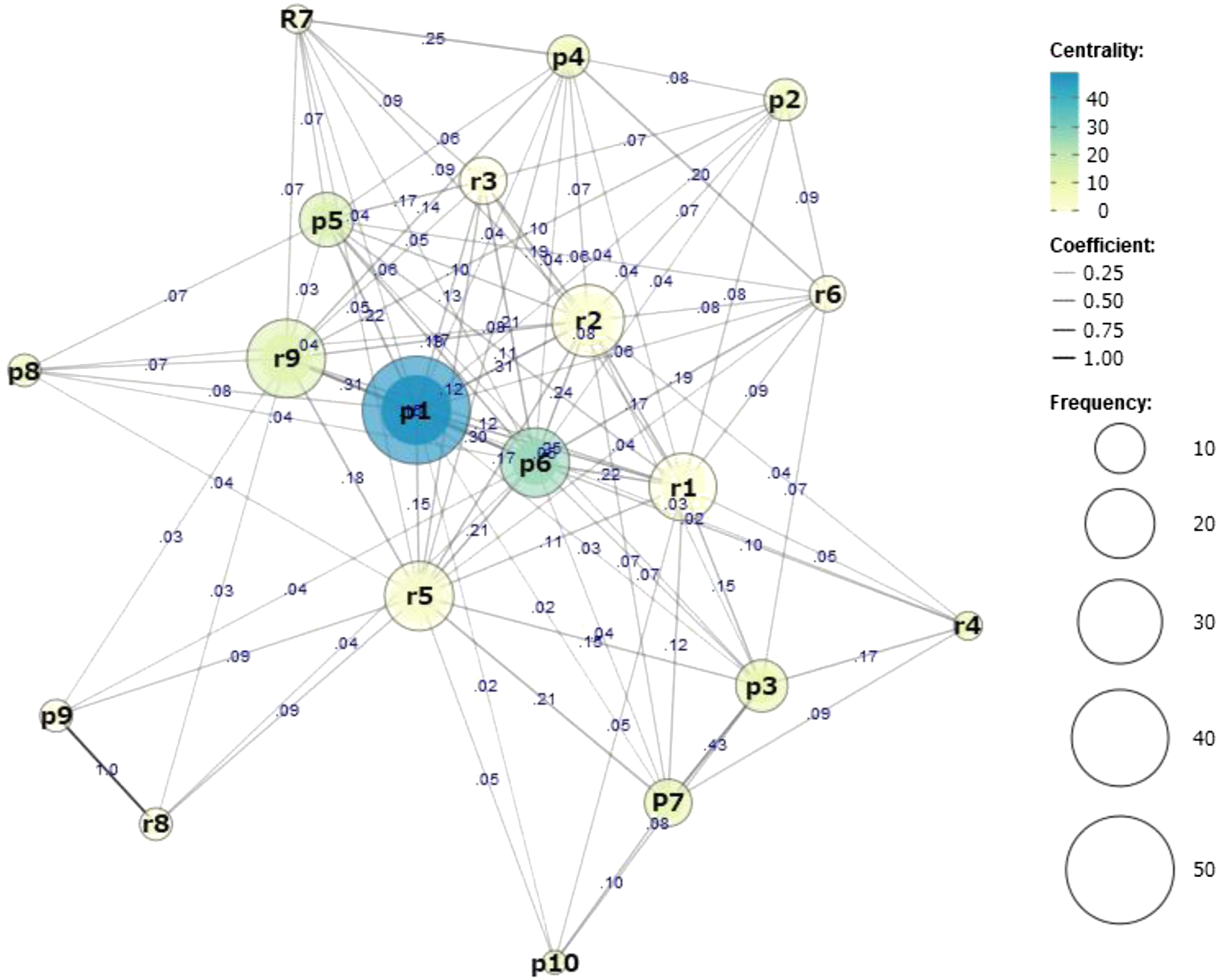
Another noticeable relationship takes the form of a triangle with a high coefficient, formed by collaboration among MDBs and countries (P3), MDB leadership (P7), and regulations/policies on sustainable infrastructure (R5). These are frequently mentioned in environmental and social sustainability contexts. This suggests that regulations/policy-settings led by MDBs are a key to sustainable infrastructure development in terms of environmental and social aspects. Hierarchical governance (P9) and regulations on enhancing centralization (R8) always co-occur; however, only a small number of articles raise this, and there is a weak co-occurrence link with other characteristics.
Discussion
The finance arrangements and governance characteristics for sustainable infrastructure that we identified in the previous section provide some important implications from both academic and practical viewpoints. In this section, we first discuss the results of the literature review by focusing on two major finance arrangements other than conventional public finance, namely PPPs and MDBs finance, with their relevant governance characteristics, and then move on to discuss the other finance arrangements and their relevant governance characteristics.
First, to realize infrastructure in ways that meet all of the sustainability pillars (economic, environmental, social, and institutional /management sustainability), PPPs sustained by collaboration among stakeholders are critical as finance and governance characteristics. From a straightforward financial perspective, PPP schemes are effective in broadening financial sources for infrastructure development by mobilizing private finance. From a governance perspective, it should be noted that the collaborative governance among stakeholders, which is one of the most prominent features of PPPs, contributes the most among other factors to realizing infrastructure development aimed at sustainability. For instance, Agarchand and Laishram (2017), who conducted their surveys in India, suggest that a private party’s involvement from preparation of the master plan for the project promotes innovative bids and minimizes the bidding cost. On the other hand, Hendricks et al. (2018) show that citizen participation in a case project on stormwater infrastructure in Houston, Texas, using a participatory assessment tool could lead to the equitable distribution of public resources and capital improvement. This result is consistent with the extant research discussion that PPP schemes are theoretically useful for sustainability-related objectives. PPPs could theoretically increase the effectiveness and efficiency of their public service delivery and ensure project stability, because the private sector often possesses unique know-how (e.g., management expertise) and the complementary resources necessary to achieve goals that the public sector does not have (Forrer et al., 2010; Brinkerhoff & Brinkerhoff, 2011; Pinz et al., 2018). However, the actual effectiveness of PPPs in achieving sustainability-related objectives in practice is still controversial; e.g. Pinz et al. (2018) indicate a lack of research on its effectiveness and emphasize that PPPs do not unconditionally deliver on their sustainability promises, while Cheng et al. (2021) suggest the use of PPPs in prioritizing construction perspectives (economic perspective) over operation perspectives could lead to the failure of sustainable infrastructure development.
In addition, regarding governance, the results indicate not only collaboration between stakeholders but also that other polity and policies/regulations are important in realizing sustainable infrastructure development, as seen in the previous section. We can confirm that the literature sometimes mentions stakeholder collaboration with some other polity (trust and public leadership) and policy/regulation (provision of platform and education for sustainable infrastructure, the inclusion of sustainable infrastructure requirements into procurement conditions, and the development of an assessment tool for sustainable infrastructure development). This finding indicates that, far from being a single governance characteristic various combinations of governance characteristics are available for sustainable infrastructure development.
It should be noted here that PPPs, or stakeholder collaborations, have horizontal modes or relationships among the stakeholders, but the polity and policies/regulations referred to together with them include horizontal governance modes (i.e., trust) and vertical governance modes (e.g., public leadership and the inclusion of sustainable infrastructure requirements or procurement conditions). There is also an in-between mode (i.e., provision of platforms for communication, provision of education for sustainable infrastructure, and the development of assessment tools for sustainable infrastructure). In other words, combinations of governance modes of both the horizontal collaborative governance mode and the vertical governance mode (top-down governance modes, led mainly by policies/regulations), are available for delivering sustainable infrastructure under PPPs. However, the combinations might vary depending on the conditions of the projects’ contexts, such as management culture of the countries, project sector, and institutional arrangements, as Klijn et al. (2016) argue. The ways that stakeholders—especially from the public sector—take leadership roles in horizontal and vertical management structures and combine them is a key factor in achieving sustainable infrastructure development under PPP financing.
This result is consistent with the findings of recent literature on the contributions of PPPs or collaboration among stakeholders toward the accomplishment of sustainability-related objectives. For instance, Pinz et al. (2018) maintain that PPPs or horizontal collaboration do not automatically realize sustainability-related objectives without vertical governance modes, such as a political and regulatory framework. Wang et al. (2022) and Warsen et al. (2019) researched the relationship between the management approaches in PPP networks, i.e., project (more or less vertical) management (e.g., focusing on results orientation and control) and process (more or less horizontal) management (e.g., focusing on communication and flexibility) and its outcomes. In particular, Wang et al. (2022) focus on sustainability as a PPP outcome, finding that communication or collaboration among stakeholders with a combination of hard approaches in project management can be critical to realizing sustainability-related objectives, although there are various combinations of management or governance modes depending on the projects. Therefore, these findings from extant research support our research findings and vice-versa. However, governance modes suitable for each project in terms of sustainable infrastructure delivery through PPPs should be further researched in the future since different countries and sectors have their own natures that might require particular governance modes.
When it comes to MDB finance, which is also a central finance arrangement, it is understood that MDBs and their roles are also critical as both finance and governance. From a financial perspective, MDBs provide finance sources for sustainable infrastructure projects, especially for developing countries with concessional conditions (e.g., low-interest loans, grants, guarantees, and technical assistance). Especially, MDBs play a catalytic role in realizing PPP finance arrangements by providing blended finance or subsidiary finance with public and private parties’ projects. From a governance perspective, MDBs are important for two reasons. One is that MDBs take leadership roles in the collaboration process among MDBs and countries (see the strong co-occurrence of P3 and P7 in Figure 5). This means that MDBs often initiate discussions and collaborations with the recipient countries’ governments and other related institutions to realize the sustainable infrastructure projects that MDBs finance, including blended finance projects. For instance, under the north-south commuter railway extension project in Manila, Philippines, which is financed by the ADB and the Japan International Cooperation Agency (JICA), sustainable infrastructure such as signaling systems that are safe and punctual and rolling stock that is lightweight and energy efficient, have been adopted through the leadership of the banks with their concessional loans and related technical cooperation systems. This is a reasonable finding considering the MDBs’ expected role of coordination among the stakeholders.
Another reason is that MDBs also take leadership roles in setting policies and regulations on sustainable infrastructure, especially regarding environmental and social considerations (see strong co-occurrence of R5 and P7 in Figure 5). MDBs tend to focus on environmental and social issues—especially climate change, as observed in Table 4—and develop stricter safeguard policies for infrastructure projects, encouraging the recipient countries to realize more sustainable infrastructure projects. It should be noted here that both horizontal governance mode (stakeholders’ coordination) and vertical governance mode (setting policies/regulations on sustainable infrastructure) are observed again, as in the case of PPPs, for sustainable infrastructure development under MDBs finance. This indicates that how stakeholders—especially MDBs—take leadership roles in horizontal and vertical governance modes and combine them is key to achieving sustainable infrastructure development under MDB financing.
In addition to PPPs and MDBs, other finance arrangements were also confirmed (e.g., finance through specific funds, guarantees, green finance, (green) bonds, and conventional public finance, including specific taxes). These finance arrangements do not occupy central positions in the finance arrangements networks except for reducing cost by adopting technologies; however, it should be noted that most are linked with either PPPs or MDBs (see Figure 4). The arrangements linked with PPPs include conventional public finance, specific taxes, and bond issues by states. These finance arrangements contribute to the realization of PPP projects by providing state finance as a subsidy for the projects.
On the other hand, finance arrangements linked with MDBs include specific funds, green finance, and green bonds. These finance arrangements are often mentioned together with MDBs in development contexts since these arrangements mostly aim at environmental sustainability, which has recently become part of the main agenda for MDBs. Therefore, considering the above situation, it can be understood that PPPs and MDBs are regarded as central and critical concepts and innovative new finance arrangements. They move beyond conventional public finance, bundling their relevant finance arrangements for sustainable infrastructure development. However, conventional public finance still plays an important role as a finance source for sustainable infrastructure by itself as well as by subsidizing PPP projects. We maintain that these concepts also play leading roles from the governance perspective, as most governance characteristics can be categorized into groups relevant to either PPPs or MDBs.
In sum, the results of our literature review indicate that PPPs and MDBs play crucial roles in sustainable infrastructure development, beyond conventional public finance arrangements, from both finance and governance perspectives. In addition, not only horizontal governance mode but also vertical governance mode or a combination of both types of modes are available for realizing sustainable infrastructure development under both PPPs and MDBs schemes, though the effective types of combinations might depend on the projects’ contexts. In such combinations, according to the co-occurrence network analysis, the leadership bodies of public and MDBs are deemed as key decision-makers in adjusting the mixture of horizontal and vertical modes under PPP and MDB schemes, respectively. Most particularly, public leadership is considered important when conventional public finance is utilized for subsidizing PPPs projects since the public sector has the right to make decisions on the use of their own budgets.
It is also noteworthy that PPP and MDB finance/governance have different levels of stakeholders in the networks of stakeholder collaborations. This includes public and private stakeholders at the project level, such as central/local governments and private parties (e.g., engineers, designers, citizens, and banks) who are generally involved in the PPPs. Stakeholders at a more macro level, such as multiple central governments of countries and multiple MDBs, are also involved in MDB finances, especially in cases where international norms or policies/regulations on environmental and social issues are decided. Therefore, it is determined that stakeholder collaborations at various levels (i.e., project, national, and supranational levels) are critical for realizing sustainable infrastructure projects, especially under blended finance schemes that generally involve more multi-layered stakeholders.
Conclusions
This research aimed to investigate financial arrangements and governance characteristics for sustainable infrastructure development through a systematic literature review. We confirmed that there are various finance arrangements and governance characteristics discussed in the existing research. However, it can be understood that PPPs and MDBs are central and critical concepts in leading and involving others from both finance and governance perspectives. These results suggest that the activation of PPPs, MDBs, and their relevant finance arrangements and governance characteristics, moving beyond conventional public finance, are important in realizing sustainable infrastructure development.
According to the co-occurrence network analysis on the finance arrangements and governance characteristics, it is found that PPPs or stakeholder collaborations, especially among public, private, and citizens, are the most often referred to as finance arrangements and governance characteristics regardless of the focus of the pillars of sustainability (economic, environmental, social, or institutional/ management pillars). PPP finance is often referred to along with other finance arrangements, such as conventional public finance, MDBs finance, specific taxes, and bond issues by states. This implies that these finance arrangements contribute to the realization of PPP projects by providing state finance and MDBs finance as a subsidy for the projects. On the other hand, MDBs finance is more often discussed in the context of environmental and social sustainability, together with specific funds and green finance. However, it is also mentioned in economic sustainability contexts. This makes sense considering that international development communities—including MDBs—have only recently begun to pay more attention to environmental and social issues, especially in regard to climate change.
As for the governance characteristics, our research also provides practically and theoretically significant insights. The finding is that not only horizontal governance mode or process management (i.e. collaborations and trust among stakeholders) but also vertical governance mode or project management (i.e. public and MDB leadership, adding environmental and social conditions to the project bidding documents, and regulations or policies on sustainable infrastructure) or a combination of both types of modes are available for realizing sustainable infrastructure development, though the effective types of combinations might depend on the projects’ contexts, such as the management culture of each country, sector, and institution. In sum, we maintain that not only sole finance arrangement and governance mode but also combinations of them are important to make sustainable infrastructure happened. In such combinations, the leadership bodies of public and MDBs are deemed as key coordinators in adjusting the mixture of finance arrangements and horizontal and vertical governance modes. In addition, such management approaches should take into account perspectives from multi-layered stakeholders at the project, national, and supranational levels.
Our systematic review provides practically and theoretically significant insights, however, there are some research limitations. First, we used the sole search criterion of “sustainable infrastructure,” prioritizing clarity of criterion and consistency with previous research on sustainable infrastructure and considering the situation that the terminology of “sustainable infrastructure” is now largely used as a unique noun in international societies. Therefore, other terminologies such as sustainable transportation and sustainable water infrastructure should be covered in future research, to deepen our understanding of the sustainability issues relating to infrastructure. Another limitation is that current research does not determine what kinds of combinations of management are practical since this research is a review only. Therefore, future studies should assess combinations of horizontal and vertical management (polity and policy/regulations) under PPP and/or MDB schemes that are effective for particular project contexts, such as countries, sectors, and institutions. In particular, practical and realistic types of management and the relevant polity and policy/regulations should be investigated by comparing different contexts (e.g., countries, sectors, and institutions) through, for instance, questionnaire surveys and interviews with government officials. Another future research avenue could be the investigation of measures to accommodate multi-layered stakeholder perspectives, among project, national, and supranational levels, on management processes by closely observing some successful cases.
Supplemental Material
Supplemental Material - Sustainable Infrastructure: A Systematic Literature Review on Finance Arrangements and Governance Modes
Supplemental Material for Sustainable Infrastructure: A Systematic Literature Review on Finance Arrangements and Governance Modes by Kei Endo, Jurian Edelenbos, and Alberto Gianoli in Public Works Management & Policy
Footnotes
Acknowledgements
The authors would like to thank anonymous reviewers for their insightful feedback and constructive suggestions on our research.
Declaration of Conflicting Interests
The author(s) declared no potential conflicts of interest with respect to the research, authorship, and/or publication of this article.
Funding
The author(s) received no financial support for the research, authorship, and/or publication of this article.

Supplemental Material
Supplemental material for this article is available online.
Author Biographies
References
Supplementary Material
Please find the following supplemental material available below.
For Open Access articles published under a Creative Commons License, all supplemental material carries the same license as the article it is associated with.
For non-Open Access articles published, all supplemental material carries a non-exclusive license, and permission requests for re-use of supplemental material or any part of supplemental material shall be sent directly to the copyright owner as specified in the copyright notice associated with the article.
