



Abstract
The authors’ purpose in this report is to examine the application of general-case programming to teach collateral academic skills to a student with pervasive developmental disorder–not otherwise specified (PDD-NOS) and with a mild intellectual disability who was attending college. The authors use data drawn from their work with Tom to explain and illustrate how a general-case approach may be developed and implemented effectively. The authors’ experience provides initial support for the utility of general-case programming for teaching acquisition and generalization of collateral academic skills. They make recommendations to guide researchers in future investigations of the application of the general-case programming to teach skills that enhance the successful integration of students with disabilities in postsecondary programs.
Keywords
An increasing number of students with intellectual disabilities are enrolling in postsecondary programs across the country (Stodden & Whelley, 2004). In 2009, 14.9% of individuals with intellectual disabilities ages 18 to 34 years attended postsecondary programs (HEATH Resource Center, 2009). Taking college courses with students without disabilities and adapting to new environments characterized by little structure, frequent schedule changes, different instructional approaches, and specific technology services are part of the college experience. Successfully navigating the academic college environment may be challenging for students with intellectual disabilities because (a) they may lack the skills necessary to access course information and requirements, (b) instructional approaches in college may be novel to them, and (c) they may have difficulty understanding the course content (Hamill, 2003; Roberts, 2010).
To be successful in university courses, students with intellectual disabilities must have a set of collateral academic skills. Collateral academic skills refer to effective strategies that enable students to access course information and to meet the class requirements outside of course content. Collateral skills specific to postsecondary programs have been discussed in the literature. Roberts (2010) suggested that assessing and teaching specific postsecondary technology skills, such as online course tools, might increase the probability of successful integration of students with autism spectrum disorders in postsecondary programs. Hamill (2003) recommended that teaching students with intellectual disabilities specific strategies aimed to help them manage the academic environment would increase the likelihood of their successful integration in academic postsecondary programs. Although the collateral academic skills required in postsecondary education should be the focus of transition planning from high school to college, many students with intellectual disabilities may lack these skills when they begin their college experience.
One of the characteristics of students with intellectual disabilities is their difficulty learning and generalizing new skills (Beirne-Smith, Patton, & Kim, 2006; Bryant, Smith, & Bryant, 2008). Thus, students with intellectual disabilities may require systematic instruction that addresses acquisition and generalization of not only academic content but also the collateral skills necessary for successful inclusion in postsecondary education. General-case programming is an effective and efficient instructional strategy that has the potential to produce acquisition and generalization of skills. Horner, Sprague, and Wilcox (1982) described general-case programming as an instructional process that consists of (a) defining the instructional universe, (b) defining the range of relevant stimulus-and-response variation within that universe, (c) selecting teaching and probe examples, (d) sequencing the teaching examples, (e) teaching the examples, and (f) testing for generalization. General-case programming focuses on generalization and response variation as an outcome by selecting and teaching instructional examples that represent the relevant stimulus characteristics necessary for producing an appropriate response across the full range of stimulus variation that the student will encounter in future environments.
Numerous researchers have demonstrated the effectiveness of general-case programming in teaching generalized skills to students with moderate and severe intellectual disabilities, including eating in a fast-food restaurant (Steere & Strauch, 1990), dressing (Day & Horner, 1986), street crossing (Horner, Jones, & Williams, 1985), telephone use (Horner, Williams, & Steverly, 1986), vending machine use (Sprague & Horner, 1984), vocational activities (Horner & McDonald, 1982), food and drink preparation (Tekin-Iftar & Birkan, 2010), table setting (Lehman, O’Neill, & Proctor, 2009), and requests for assistance (Chadsey-Rusch, Drasgow, Reinoehl, & Halle, 1993). We could not locate any studies that examined the effectiveness of general-case programming on the acquisition and generalization of collateral academic skills for individuals with intellectual disabilities in postsecondary settings.
In sum, postsecondary education has become an option for students with intellectual disabilities who intend to continue their education after graduation from high school. Successful participation of students with intellectual disabilities in academic college environments begins with collateral academic skills that allow them to access course information and requirements. In the remainder of this report, we examine the application of general-case programming to teach acquisition and produce generalization of collateral academic skills to an individual with pervasive development disorder–not otherwise specified (PDD-NOS) and a mild intellectual disability attending a postsecondary program. Our data are intended to be suggestive rather than conclusive; however, we follow the traditional format for presenting our Method and Results, and we end by making recommendations for future research.
Method
Participant
Tom was a 21-year-old man who had been diagnosed with PDD-NOS based on a psychological evaluation conducted by a licensed clinical psychologist when Tom was 5 years old. After Tom entered school, he was found to be eligible for special education services under the category of mental retardation. Tom’s parents reported that his IQ was in the high 60s; however, they could not provide the exact IQ score or any score of a formal evaluation. Tom attended a postsecondary program for students with intellectual disabilities at a southeastern university, where he audited regular undergraduate college courses; attended one-to-one instructional sessions for support with assignment completion; received instruction in vocational, social, and independent living areas; and completed several internships at fitness facilities located on- and off-campus. Tom lived with a roommate in an apartment located on the university campus. The University of South Carolina Institutional Review Board gave approval for the study to be conducted. Tom and his legal guardians signed informed consent letters.
We assessed Tom’s performance in reading and mathematics. On the Test of Adult Basic Education (TABE; CTB/McGraw-Hill, 1996) Forms 9/10, his reading was estimated at 2.7 grade level and his mathematics performance was estimated at 2.6 grade level. TABE is a multiple-choice test that aims to assess basic educational skills in reading, mathematics, and language. Tom had good conversation skills (e.g., could initiate and maintain a conversation and respond to open-ended questions) but rarely initiated conversations with peers or adults. His primary interests were listening to music and watching television. Tom was able to follow a schedule but needed constant reminders to perform activities and tasks across independent living, social, academic, and vocational domains (e.g., pay rent, call a classmate to get a ride to class, check and respond to emails, wear work uniform). He had a high level of independence in (a) accessing different locations and services on- and off-campus (e.g., purchasing items, working out at the fitness center) and (b) navigating the campus (e.g., walking to classes and internship site, locating course rooms and buildings).
Tom participated in the project because he (a) expressed a desire to become more independent and successful in meeting course requirements and (b) reported constant difficulties when using technology services. In particular, Tom reported that he faced challenges when using personal and student email, Blackboard, and Visual Information Processing (VIP). Student email is the university email system that provides students with blogging, photo sharing, and instant messaging tools in large free online storage. Blackboard is an online course management system used to supplement traditional classroom instruction that consists of tools for communication and grades, sharing course content, administering quizzes and tests, and delivering online courses. VIP is a technology service that provides the entire university community personal access to academic, financial, personal, technology, and employment information.
Setting
The project took place in the first author’s office located on the university campus where Tom attended classes. The office contained a large office desk, a small table and four chairs, a bookshelf, a wireless laptop computer with Internet access, and a Flip video camera on a tripod. Acquisition trials and generalization probes were conducted during one-to-one sessions in this office with the first author, who was the investigator. All sessions were videotaped.
Target Behavior and Recording System
Table 1 presents the operational definitions for each of the three independent generic response categories. We determined the duration for each generic response category based on our observation of the typical performance of (a) other students enrolled in the same postsecondary program and (b) peers without disabilities who attended university courses. The investigator recorded Tom’s responses as either “independent” or “nonindependent” in completing each of the generic responses.
Operational Definitions of Target Behaviors
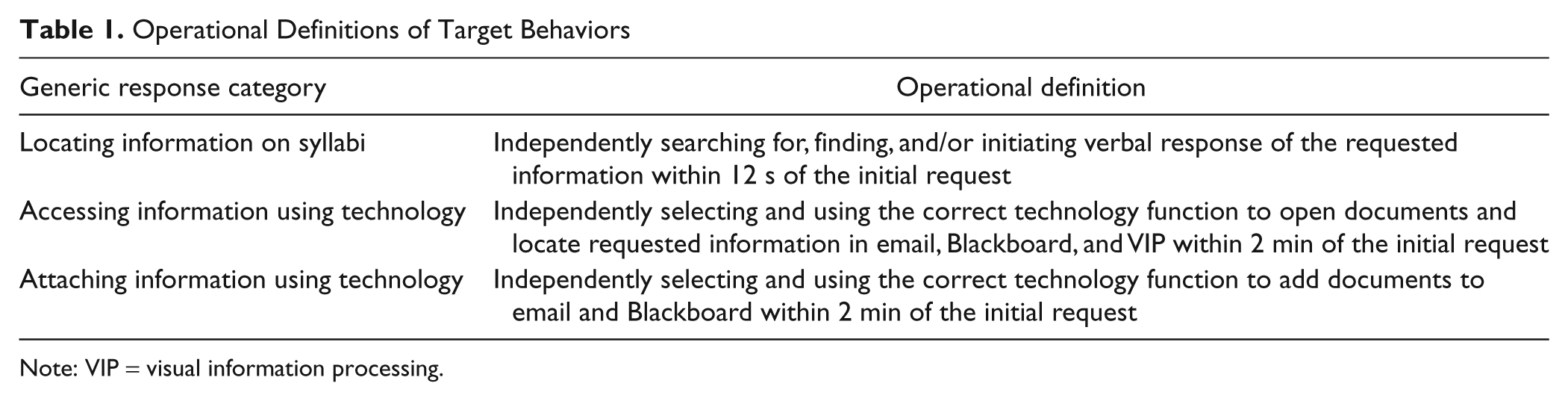
Note: VIP = visual information processing.
Design
We used a within-participant multiple-baseline design (Kazdin, 2011) with generalization probes across three generic response categories. Acquisition trials and generalization probes consisted of opportunities to respond to requests related to (a) locating information on syllabi, (b) accessing information using technology, and (c) attaching information using technology. Session performance was graphed and analyzed visually.
Procedure
Identification of general-case
We began by conducting 4 hr of direct observation of Tom across multiple activities and settings to collect information about (a) the type and frequency of difficulties he encountered when using technology services and (b) the type of strategies he implemented or attempted to implement to overcome these difficulties. We observed Tom during a variety of activities that consisted of group instruction (e.g., attending lectures and demonstrations) and independent work (e.g., developing a digital portfolio, creating a Power Point presentation, and sending an email). The observation settings included course classrooms, computer labs, the investigator’s office, the campus main library, and the career center. Direct observations served two purposes. First, it validated the information provided by Tom about his constant difficulties in accessing and operating technology services. Second, it provided information that Tom also was challenged when reading and interpreting handouts and syllabi for his university courses.
Next, we defined the instructional universe based on the information provided by Tom and from the results of direct observations. The instructional universe consisted of those situations in which Tom had to locate information on a syllabus to communicate with instructors or to prepare for class, or to respond to a challenge he encountered when using technology services. We then defined the range of the stimulus and response variation within the instructional universe. We identified the three categories of generic responses delineated in Table 1. Within this step, we determined the variations across generic stimuli and responses, as well as potential errors. Table 2 presents the general-case analysis form.
General-Case Analysis Form
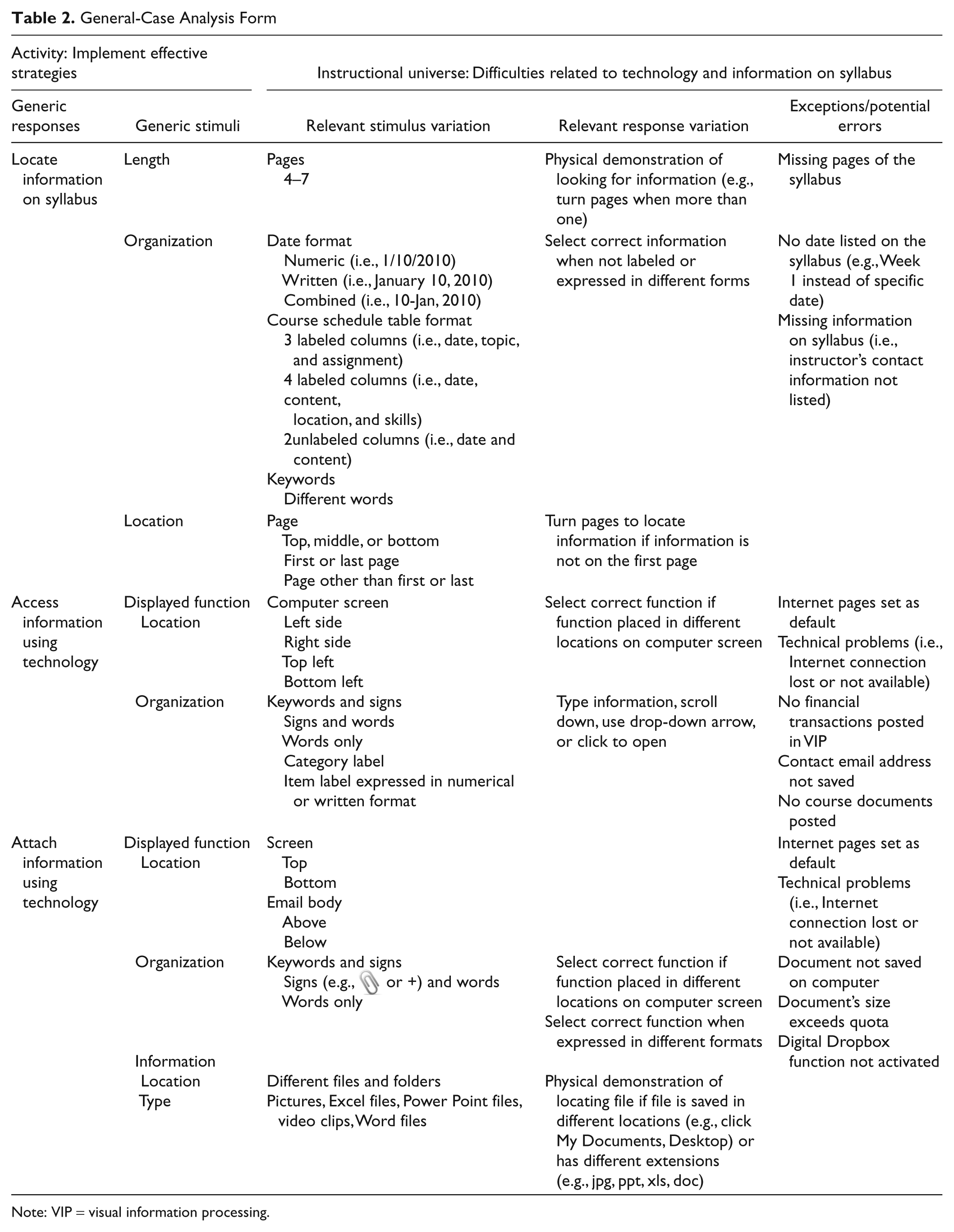
Note: VIP = visual information processing.
Next, for each generic response category, we selected three to four examples to serve as acquisition trials, and an additional two to three examples to serve as generalization probes. We selected the acquisition trials and generalization probes to sample the range of stimulus characteristics found in the instructional universe. For example, an acquisition trial in Category 1 consisted of asking Tom to find the grade requirements for a course. A related generalization probe would consist of asking Tom to locate the grading scale for the course. Table 3 contains a listing of the acquisition trials and generalization probes for each generic response category.
Acquisition Trials and Generalization Probes for Each Generic Response Category
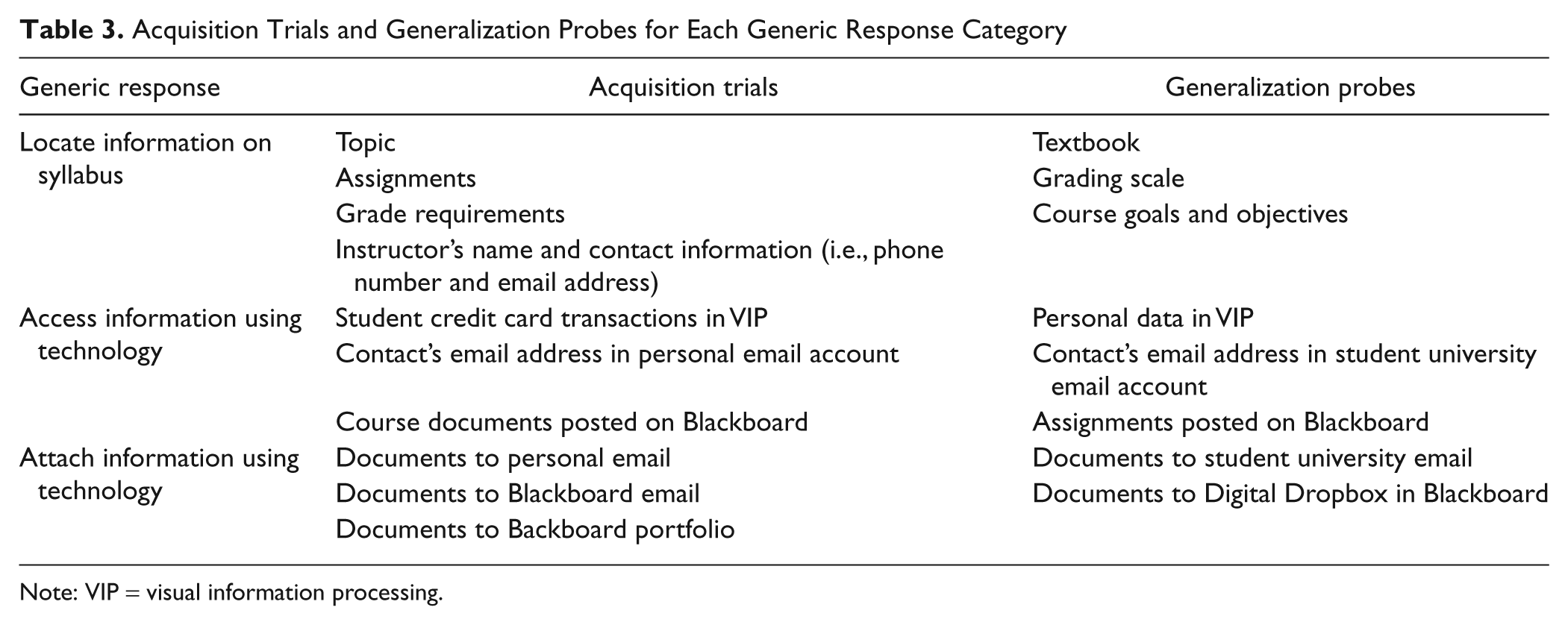
Note: VIP = visual information processing.
We then selected acquisition trials for each category to ensure that they sampled the relevant stimulus characteristics to occasion a correct response for the range of situations represented by each. For example, we taught Tom to locate information on a syllabus by pointing out relevant stimulus characteristics (i.e., different keywords) and by varying irrelevant stimulus characteristics (i.e., font color).
The next step consisted of sequencing the teaching examples. In this step, we addressed four critical aspects of general-case programming. First, we included multiple skills within each generic response. For example, Tom received instruction about using different keywords, scanning for information, and identifying the current date in different stimulus formats (i.e., numeric expression, written expression, or combined expression) for all four acquisition trials included in Category 1. Second, we presented multiple examples of each acquisition trial included in a category. For example, we provided Tom with five trials on each of the acquisition examples included in Category 1 by using a different syllabus for each trial that sampled the range of stimulus and response variation. Third, we reviewed the incorrect trials and the prerequisite skills necessary for successful completion of the training examples. For example, we reviewed and practiced identifying the correct date expressed in different formats at the beginning of each training session for locating information on syllabus category. Fourth, we taught the general-case examples before teaching nonexamples to maximize Tom’s performance on attending to the relevant stimulus characteristics. For example, we taught Tom to locate the instructor’s contact information listed on a syllabus before asking him to locate the same information on a syllabus that did not list the instructor’s contact information.
Baseline
For Category 1, locating information on syllabi, the protocol for conducting an acquisition trial and a generalization probe consisted of first presenting a trial. Next, Tom was given a latency of 12 s to locate the requested information on the syllabus. If Tom located the correct information within 12 s of the initial request, the investigator made no comment about the situation and presented the next trial. If Tom requested assistance, the investigator ended the trial, located the information for Tom, made no comment about the situation, and presented the next trial. If Tom made an incorrect or no response, the investigator ended the trial, made no comment about the situation, and presented the next trial.
We followed the Category 1 protocol to conduct acquisition trials and generalization probes for Categories 2 (accessing materials using technology) and 3 (attaching materials using technology). In these categories, Tom had 2 min after the investigator made the initial request, to select and use the correct technology function to access or attach information in Blackboard, email, or VIP. No instruction was provided during baseline assessment. Generalization probes were administered 1 time in baseline for each of the three generic response categories.
Intervention
Intervention for Category 1 began immediately following the generalization probe in baseline. Our instructional procedures consisted of constant time delay, differential reinforcement, and error correction. We used model prompts for training and verbal prompts for error correction. Each training session consisted of 20 trials, with 5 trials for each of the four acquisition examples included in Category 1. The training sessions were conducted 5 days a week for 30 min each day. In the investigator’s office, Tom sat at a desk and had access to different syllabi. Three of the 15 syllabi used were from Tom’s courses. A syllabus was selected at random for each trial. The investigator sat to Tom’s right with a datasheet to record data; she modeled the correct response and provided differential reinforcement and error correction.
Each training session began with a 3-s delay trial following the investigator’s delivery of the discriminative stimulus (e.g., “Tom find ___”). The investigator then waited 3 s for Tom to initiate a response. If he initiated a correct response within 3 s, the investigator allowed Tom to complete the answer and delivered verbal praise. If the response was initiated within 3 s, but it was incorrect, the investigator immediately interrupted Tom, labeled the error, and delivered verbal prompts to ensure correct response. If Tom did not initiate a response within 3 s of the initial request, the investigator delivered the discriminative stimulus again and waited an additional 3 s for Tom to initiate the response. If he did not initiate the response after the delivery of the second discriminative stimulus, the investigator modeled the correct response and had Tom imitate the model.
We implemented the intervention simultaneously for Categories 2 and 3 for three reasons. First, Tom was becoming anxious and frustrated with having to undergo the baseline procedures repeatedly as we continued to collect data across the two remaining baselines. Second, Tom’s performance in the third baseline was stable and consistent at a 0 level and adequate to predict Tom’s future performance without intervention. Third, we were concerned that the end of the academic school year was approaching, and we wanted to ensure that Tom acquired the skills necessary to function effectively when preparing for class or communicating with his instructors.
The instructional procedures for Categories 2 and 3 were the same as for Category 1, except (a) the total number of trials for Categories 2 and 3 differed from Category 1, (b) the time allowed to complete the behavior was longer for Categories 2 and 3, and (c) different materials were used during instructional sessions. Each training session consisted of 15 trials, with 5 trials for each of the three acquisition examples included in each of the two categories. Tom had access to a wireless laptop computer connected to Internet. Jing software was used to record the computer screen activity while Tom was accessing and attaching information using technology.
When Tom reached the acquisition training criterion for Category 2 (i.e., three of three acquisition trials completed independently for three consecutive training sessions), we administered the generalization probes to assess whether Tom generalized the newly acquired strategies to novel situations while continuing to provide instruction for Category 3. When Tom met the acquisition training criterion for Category 3, we administered the generalization probes for Category 3. The generalization probes occurred under the same conditions as baseline. All assistance, prompts, and praise were gradually faded out over training trials as Tom’s performance on acquisition trials improved.
Because the generalization probe in Category 2 represented an unacceptable level of proficiency, we implemented acquisition overtraining for this category. During overtraining, we provided Tom with three additional training sessions using the same instructional procedures. At the end of the overtraining, we administered a second generalization probe for Category 2.
Interobserver Agreement (IOA)
Tom’s performance during acquisition trials and generalization probes was videotaped during Category 1 sessions. Tom’s performance was recorded using Jing software for each acquisition trial and generalization probe in Categories 2 and 3. The reliability coder for this study was an associate professor in special education at the institution the investigator attended. The investigator and the reliability observer independently watched the recordings and coded the number of acquisition trials and generalization probes that Tom completed independently.
We calculated IOA across all baseline, intervention, and maintenance phases. An agreement was scored if the investigator and the observer coded an acquisition trial or a generalization probe as completed independently or as not completed independently within the predetermined amount of time for each category. We calculated the percentage agreement scores by dividing the total number of agreements by the total number of agreements plus disagreements and multiplying the quotient by 100%. IOA was calculated across all three categories for 27.7% of the baseline sessions, 38.3% of the training sessions, and 100% of the maintenance sessions. IOA was 100% in baseline, 91.4% in training (range 67%–100%), and 100% in maintenance.
Results
Figure 1 presents the percentage of acquisition trials and generalization probes that Tom completed independently for each generic response category during baseline and general-case intervention conditions. Tom had no target responses during baseline, but acquired all three target responses during intervention, had modest to good generalization, and had modest maintenance.

The percentage of acquisition trials and generalization probes completed independently by Tom across all phases
Discussion
Our purpose in this report was to examine the application of general-case programming to teach collateral academic skills to a student with PPD-NOS and with a mild intellectual disability in a postsecondary college environment. Our design did not provide sufficient evidence to demonstrate a functional relation between our intervention and the acquisition and generalization of the target behaviors; however, we believe that our data provide initial support for using a general-case approach to teaching skills necessary for successful inclusion of students with intellectual disabilities in postsecondary education. We end this report by making several recommendations that can guide other researchers to develop more rigorous investigations and applications of general-case technology to the growing population of postsecondary students with intellectual disabilities.
First, it is important for researchers to examine what constitutes a relevant and sufficient number of teaching examples that sample the range of stimulus-and-response variation when teaching collateral academic skills to students with intellectual disabilities who are planning to or who are already attending such programs. In our investigation, we selected three to four examples to serve as acquisition trials, and an additional two to three examples to serve as generalization probes. We selected a limited number of examples for the acquisition trials and generalization probes because of the specific and restricted nature of the instructional universe defined for the participant included in the investigation. In the future, researchers could examine this situation by determining how to select a sufficient number of examples for instruction that would produce discriminated responding under broader but relevant conditions.
Our second recommendation involves the selection of a design that allows a demonstration of a clear functional relation between the intervention and the target behavior. In our investigation, we used a within-participant multiple-baseline design with generalization probes across three generic response categories. However, we implemented the intervention simultaneously for Baselines 2 and 3 for the reasons described in the Method section. A more rigorous design would consist of the sequential and stepwise implementation of the intervention at three different points in time after the documentation of general-case acquisition in each category. In the future, researchers could evaluate the effectiveness and efficiency of general-case programming for teaching collateral academic skills to individuals with intellectual disabilities in postsecondary settings by selecting the most rigorous design that would allow the systematic replication of skill acquisition and generalization.
Our third recommendation involves the implementation of the intervention in natural environments. In our investigation, we implemented the intervention in a contrived environment because of (a) the participant’s reactivity to unfamiliar people and changes in his routines and (b) limited control over the situations in which the targeted skills naturally occurred. The implementation of intervention in natural environments has at least two advantages. First, it gives the participant the opportunity to acquire and apply the same skills performed by peers without disabilities in college environment, and thus increase the likelihood of skill generalization and maintenance. Second, natural environments may provide multiple opportunities for independent performance of targeted skill and access to reinforcers available in these environments, and consequently increase skills maintenance. In future studies, researchers should address not only the acquisition and generalization of collateral academic skills but also the maintenance of these skills in postsecondary settings. Procedural fidelity also needs to be assessed.
In summary, the acquisition and generalization of collateral academic skills is extremely important for students with intellectual disabilities in postsecondary settings. Without these skills, students will remain dependent on others and will have difficulties navigating the college academic environment. Our investigation provides initial support for the utility of general-case programming for teaching acquisition and generalization of collateral academic skills.
Footnotes
The author(s) declared no potential conflicts of interest with respect to the research, authorship, and/or publication of this article.
The author(s) received no financial support for the research, authorship, and/or publication of this article.