




Abstract
Previous studies suggest that individuals with an autism spectrum disorder (ASD) are more likely than other disability groups and the general population to gravitate toward science, technology, engineering, and mathematics (STEM) fields. However, the field knows little about which factors influence the STEM pipeline between high school and postsecondary STEM major. This study analyzed data from the National Longitudinal Transition Study–2, a nationally representative sample of students with an ASD in special education in the United States. Findings suggest that students with an ASD who took more classes in advanced math in a general education setting were more likely to declare a STEM major after controlling for background characteristics and previous achievement level. Educational policy implications are discussed.
Keywords
Introduction
Increasing evidence suggests a higher prevalence of participation in science, technology, engineering, and mathematics (STEM) among individuals with an autism spectrum disorder (ASD). Baron-Cohen, Wheelwright, Burtenshaw, and Hobson (2007) used a convenience sample of college students in the United Kingdom to show a higher prevalence of ASD among mathematics majors compared with students in medicine, law, or social science. Wei, Yu, Shattuck, McCracken, and Blackorby (2012) analyzed a national sample of students in special education in the United States and found that students with an ASD had the highest STEM participation rates (34%) among 11 disability categories and students in the general population. Such empirical evidence aligns well with the empathizing–systemizing (E-S) theory suggesting that individuals with an ASD may have an innate tendency to gravitate toward STEM fields (Baron-Cohen, 2009; Baron-Cohen et al., 2007). The E-S theory suggests that individuals with an ASD tend to have a disproportionately greater aptitude toward systemizing relative to empathizing. “Systemize” refers to analyzing or constructing rule-based systems to explain the world around them, whereas “empathize” refers to social and emotional reactions to other people’s thoughts and feelings (Baron-Cohen, 2009). The E-S theory suggests that individuals with an ASD are average or above on systemizing but below average on empathy (Baron-Cohen, 2009). Systemizing often requires the thinking or skills needed to analyze and construct systems, which also are necessary to perform successfully in many STEM-related fields (Baron-Cohen et al., 2007).
Recent studies also indicate that the prevalence of autism is increasing in the United States, with current estimates suggesting that 1 in 50 children are diagnosed with an ASD (Blumberg et al., 2013). Much of this increase is a result of a higher prevalence of ASD among those at the high-functioning end of the intellectual spectrum (Keyes et al., 2012), that is, among youth most capable of advancing their STEM interests through postsecondary education.
However, despite the high STEM participation rate and potential to succeed in STEM fields among students with an ASD, low college enrollment rates persist (Wei et al., 2012). Poor non-verbal communication, a limited ability to understand and use social rules, and difficulty maintaining the reciprocal interaction and joint attention essential to learning create significant barriers to college enrollment and persistence for students with an ASD (Hendricks & Wehman, 2009). Indeed, the study by Wei and colleagues (2012) revealed that only 32% of individuals with an ASD were enrolled in college, making it one of the lowest rates of postsecondary attendance among students with disabilities and the general population.
With the globalization of the economy and continued technological advances, the skills and knowledge needed for any particular job are constantly evolving (U.S. Department of Labor, 2007). The demand for STEM workforce increased by 175% between 1980 and 2008 as compared with 40% increase in the U.S. labor force (Carnevale, Smith, & Melton, 2011). There will be 2.4 million job vacancies for STEM workers between 2008 and 2018. However, the U.S. education system is not producing enough STEM-capable individuals to fill these positions (Carnevale et al., 2011). As the United States strives to promote a “world-class science and engineering workforce” to remain a leader in a technologically advancing global economy (Nagle, Marder, & Schiller, 2009), it appears that individuals with an ASD have the potential to play an important role in contributing to this important societal goal.
Considering the substantial contributions that individuals with an ASD could potentially make within the STEM fields, it becomes imperative to think critically about the factors that encourage students with an ASD to fulfill their potential and enable them to access and pursue STEM majors in postsecondary settings. However, very few empirical studies exist that consider the participation of individuals with an ASD in STEM careers, and the few articles that are available assume that STEM-related academic and occupational pursuits are primarily related to their innate interests in the STEM field (Baron-Cohen, 2009; Baron-Cohen et al., 2007; Wei, Christiano, et al., 2013; Wei et al., 2012). To date, no studies have considered mutable environmental factors that can alleviate the obstacles that gender, race, and socioeconomic status may pose in pursuing STEM careers among individuals with an ASD. The NLTS2 data provide a unique opportunity to investigate the influences of high school experiences on STEM academic and career choice for students with an ASD.
Theoretical Framework
Derived primarily from Bandura’s (1986) general social cognitive theory, social cognitive career theory (SCCT; Lent, Brown, & Hackett, 1994) uses a unified approach to understand the interrelationship among individual, environmental, and behavior variables on academic and career choice. Career development is achieved through a focus of three primary tenets: self-efficacy, outcome expectations, and goals (Lent et al., 1994). Key factors that influence individuals with disabilities selecting science and technology careers include individual motivation and personal determination, family support and advocacy, and positive STEM learning and training experiences (Alston & Hampton, 2000; Lindstrom & Benz, 2002; Mastropieri & Scruggs, 1992; Wang, 2013). SCCT highlights the role of environmental factors in strengthening or weakening one’s vocational behavior (Lent et al., 1994). Although researchers have applied SCCT to understand career choice and development for youth in the general population, very few studies use SCCT framework to understand career development for youth with an ASD. To account for the increasingly important role of vocational decision making in the transition from high school to early adulthood among adolescents with an ASD, this study applied the SCCT framework to explore how high school STEM learning experiences and individual background characteristics jointly contribute to postsecondary STEM majoring.
Linking High School Experiences and College STEM Major Among Students With an ASD
Studies that have explored postsecondary participation among students with an ASD have found that high school experiences play a significant role in a student’s successful enrollment and participation in postsecondary education. For instance, academic performance in high school coursework and participation in transition planning during high school were associated with participation in postsecondary education for students with an ASD (Chiang, Cheung, Hickson, Xiang, & Tsai, 2012; Roberts, 2010; Stodden & Mruzek, 2010; Wang, 2013). Among students with different types of disabilities, including ASD, attendance in regular high schools and inclusion in the general education classes appear to increase the likelihood of postsecondary participation (Baer et al., 2003; Test et al., 2009).
When considering factors that contribute specifically to the pursuit of STEM majors in college, studies involving the general population once again draw a link to high school academic factors. In fact, it appears that one of the strongest predictors of majoring in STEM during college is high school academic preparation in math and science courses (Tai, Liu, Maltese, & Fan, 2006; Wai, Lubinski, Benbow, & Steiger, 2010; Wang, 2013). A study by Tyson, Lee, Borman, and Hanson (2007) used descriptive statistics and logistic regression analyses to determine how science and mathematics course-taking in high school predicted STEM degree attainment among baccalaureate degree recipients. In this study, Tyson et al. (2007) found that students taking high-level science courses (such as Chemistry II and Physics II) obtained a STEM degree from a Florida university more often than students taking lower-level science courses. In addition, the researchers found that students who successfully completed calculus in high school were more likely to obtain a STEM degree from a Florida public university as opposed to students who did not complete a calculus course in high school.
Similarly, a study by Robinson (2003) examined the background of Advanced Placement (AP) science and mathematics classes and their impact on STEM career choices of college students. After looking at the results of surveys distributed to 315 students in AP science and math classes across eight different high schools, Robinson found that the likelihood of selecting a STEM career choice such as engineering, science, mathematics, and the medical field was significantly associated with students taking AP classes in calculus and the sciences. About 28% of STEM majors took AP calculus in high school as compared with 25% of non-STEM majors. The results also confirmed that both minority and non-minority students who were taking AP calculus and/or science courses in high school selected STEM careers at a higher rate than other careers, findings that have been confirmed by other studies of minority students (Crisp, Nora, & Taggart, 2009; Simpson, 2001).
Although advanced-level course-taking—particularly in science and mathematics—and academic success in high school play a major role in moving students in the general population through the STEM pipeline, strong performance on standardized tests are also associated with the persistence of undergraduate studies in STEM fields (Bonous-Hammarth, 2000; Sahin, Morgan, & Erdogan, 2012). In addition, high school grade point average (GPA) and class rank appear to have an impact on the pursuit of college STEM degrees among students in the general population. Two studies involving engineering students revealed that persistence within an engineering major was positively associated with prior academic attainments, including high school rank and high school GPA (French, Immekus, & Oakes, 2005; Zhang, Anderson, Ohland, & Thorndyke, 2004).
In summary, there are a variety of high school academic factors proven to be particularly effective in moving students through the STEM pipeline from high school to college STEM degree programs, ranging from science and math course-taking to high school academic achievement. However, to our knowledge, no studies to date have investigated the effectiveness of these factors in promoting STEM participation for students with an ASD in the United States. In addition, sociodemographic differences are of critical importance in STEM-related research (Crisp et al., 2009; Wang, 2013), and persistent underrepresentation in STEM participation by gender, race, and disability status remain (National Science Foundation [NSF], 2013; Wang, 2013; Zhang et al., 2004). This warrants the need for STEM-related research to take such background differences into consideration. This study includes a rich set of high school experiences variables, including general education inclusion, math and science coursework, standardized test scores in math and science, as well as individual background characteristics. This study is the first to consider the STEM pipeline for students with an ASD by examining the association between high school STEM preparation factors and majoring in STEM in college using a large, nationally representative U.S. sample of students with an ASD.
Method
Data
NLTS2 was conducted by SRI International for the U.S. Department of Education, and it is the largest and richest data set available to study transition experiences from high schools to postsecondary education and postsecondary outcomes of students with disabilities in the United States. Data were collected from parents and/or youth in five waves, 2 years apart, from 2001 to 2009. The initial sample included more than 11,000 high school students receiving special education, ages 13 through 16. About 1,100 of them received special education services in the ASD category by the Individuals With Disabilities Education Act (IDEA) of 2004. Each student’s eligibility for special education services was determined by the school district from which the student roster was sampled. Although the criteria for autism identification in schools may differ from the criteria found in the Diagnostic and Statistical Manual of Mental Disorders (4th ed.; DSM-IV; American Psychiatric Association, 1994), more than 95% of children with a school designation of autism also meet DSM-IV-based case criteria in public health surveillance studies—suggesting the school label of autism is very specific (Blumberg et al., 2013; Centers for Disease Control and Prevention, 2012).
The NLTS2 two-stage sampling plan first randomly sampled local educational agencies (LEAs) and state-supported special schools stratified by region, district enrollment, and wealth; then students receiving special education from rosters of LEAs or special schools were randomly selected to yield nationally representative estimates that would generalize to all students receiving special education services. Appropriate analysis weights for each instrument and each wave of data collection were used to produce estimates that can be generalized to the cohort of youth receiving special education services at the study’s start in a given age range and disability type.
Participants
NLTS2 includes data about students with an ASD as well as students in other special education disability categories from multiple sources on a wide range of topics using parent telephone interviews and mail surveys; school, teacher, and school program surveys; transcript data; and in-person student assessments and interviews. This article used the following data from multiple resources for students with an ASD: postsecondary data from Wave 5 parent and young adult telephone interviews and mail surveys collected in 2009, high school transcript data collected from high school from 2002 to 2009, Wave 1 parent survey, and Wave 1 or Wave 2 student direct assessments. The estimates in this report used appropriate weights from corresponding instrument when the data were collected (Wagner, Kutash, Duchnowski, & Epstein, 2005). Unweighted sample sizes were rounded to the nearest 10, as required by the U.S. Department of Education.
Measures
The primary measures used for this study are described below and also in Table 1.
Outcome Variables and Predicting Variables From NLTS2 Data Sources.
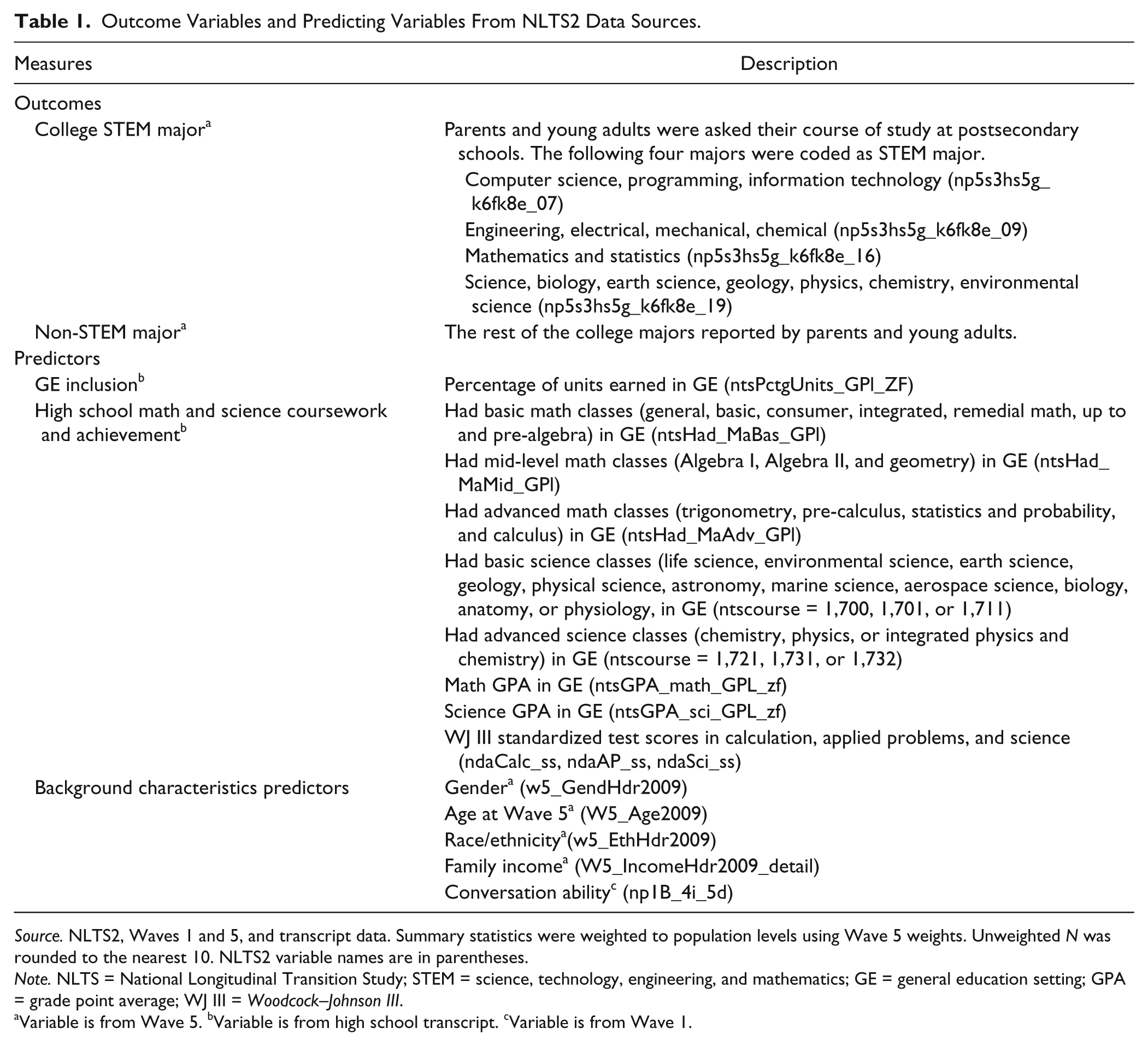
Source. NLTS2, Waves 1 and 5, and transcript data. Summary statistics were weighted to population levels using Wave 5 weights. Unweighted N was rounded to the nearest 10. NLTS2 variable names are in parentheses.
Note. NLTS = National Longitudinal Transition Study; STEM = science, technology, engineering, and mathematics; GE = general education setting; GPA = grade point average; WJ III = Woodcock–Johnson III.
Variable is from Wave 5. bVariable is from high school transcript. cVariable is from Wave 1.
College STEM major
Postsecondary enrollment in a 2-year or a 4-year college was measured at Wave 5 by survey items that asked whether the youth ever attended a postsecondary institution (e.g., 2-year community college, 4-year college) since leaving high school. Parents and young adults also answered questions about the course of study at a 2-year community college or a 4-year college. This study limited the sample of students with an ASD to those who reported a college major in a 2-year community college or a 4-year college. This study used the NSF definition of STEM: “all fields of fundamental science and engineering” (NSF, 2006, p. 1). An indicator for majoring in STEM fields was coded affirmatively if the youth or parent reported a college major that aligned with this definition, including majors such as computer science, programming, information technologies, engineering, mathematics and statistics, science, biology, earth science, geology, physics, chemistry, and environmental science. Social, behavioral and economic sciences were not included as STEM fields because the NLTS2 questionnaires combined psychology, economics, political science, sociology (NSF STEM majors), with non-STEM majors such as history, women’s studies, American studies, ethnic studies in one category. Majoring in STEM fields was coded affirmatively if the youth or parent reported a college major in the fields of computer science, programming, information technologies, engineering, mathematics and statistics, science, biology, earth science, geology, physics, chemistry, and environmental science. Students with an ASD reported that other majors were coded as non-STEM majors.
General education inclusion
Percentage of units earned in general education settings was extracted from the high school transcript data to measure the degree of inclusion of students with an ASD in general education classes.
High school math and science coursework
NLTS2 transcript data provide high school math and science course-taking patterns in the general setting. NLTS2 defines general, basic, consumer, integrated, remedial math, up to and pre-algebra as basic mathematics; Algebra I, Algebra II, and geometry as mid-level mathematics; and trigonometry, pre-calculus, statistics and probability, and calculus as advanced mathematics (Newman et al., 2011). Science course-taking was extracted from NLTS2 transcript data. Six science categories ranging from “life science or basic science classes” to “physics” were dichotomized into basic or advanced science courses. Basic science classes included life skills, environmental, earth, geology, physical, astronomy, marine, aerospace, biology, anatomy, and physiology. Advanced science classes included chemistry, physics, and integrated physics and chemistry. Average GPAs in general education math and science were also extracted from NLTS2 high school transcript data set.
High school math and science standardized test scores
Math and science achievement were assessed with research editions of the Woodcock–Johnson III (WJ III; Woodcock, McGrew, & Mather, 2001) at Wave 1 or Wave 2. The two math WJ III subtests used were (a) applied problems, which measures comprehension and ability to identify useful information, conduct simple calculations, and solve math problems, and (b) calculation, which measures computation skills ranging in difficulty from elementary computations to calculus. The WJ III science subtest measures academic knowledge in science by having factual science questions read to the students along with text and pictures. Test–retest reliabilities are reported to range from .76 to .93 across subtests of WJ III (Woodcock et al., 2001). The analysis of the WJ III subtests was based on standard scores, which measure the relative ranking of a student among his or her peers of the same age or grade level. The standard score for each subtest is centered on a mean of 100 with a standard deviation of 15 (Jaffe, 2009).
Background characteristics variables
Demographic variables included young adults’ gender, age, race/ethnicity, and family income, all of which were measured at Wave 5. Parents rated a child’s conversation ability at Wave 1 from “1 = converse just as well as others, 2 = has a little trouble carry conversation, 3 = has a lot of trouble carrying conversation or does not carry a conversation at all.”
Analysis
All analyses were performed on SAS 9.2 (SAS Institute, Cary, NC). SAS PROC SURVEY Taylor Series Linearization method was used to account for the complex sampling design and provide the exact estimate of the standard errors. In addition to descriptive analysis, weighted chi-square tests or t tests were used to test the difference between STEM major versus non-STEM majors in background characteristics and high school STEM preparation factors. Logistic regression models were used to explore the adjusted associations between high school STEM preparation and college STEM major after controlling for background characteristics. The rate of missing data was 16% for the postsecondary major variable, resulting in a sample size of 150. The missing data on demographic and high school factor correlates for the 150 college students ranged from 0% to 22%. Missing data (33% of n = 150) were list-wise deleted in the logistic regression models.
Results
The background characteristics and high school STEM preparation of students with an ASD who declared a college major are described below.
Descriptive Analyses
Table 2 provides the background characteristics of the young adults with an ASD in two groups (college STEM major vs. non-STEM major) weighted to represent the population nationwide at Wave 5. Compared with students with an ASD who were non-STEM majors, those who declared a STEM major had a higher proportion of male students (97.30% vs. 79.40%), were about half a year older (23.61 vs. 23.12 years old), and reported a lower proportion having lots of trouble or cannot carry a conversation at all (7.00% vs. 30.25%).
Weighted Percentage or Weighted Mean (SE) of Background Characteristics of Students With an ASD Who Declared a College STEM Major Versus Non-STEM Major.
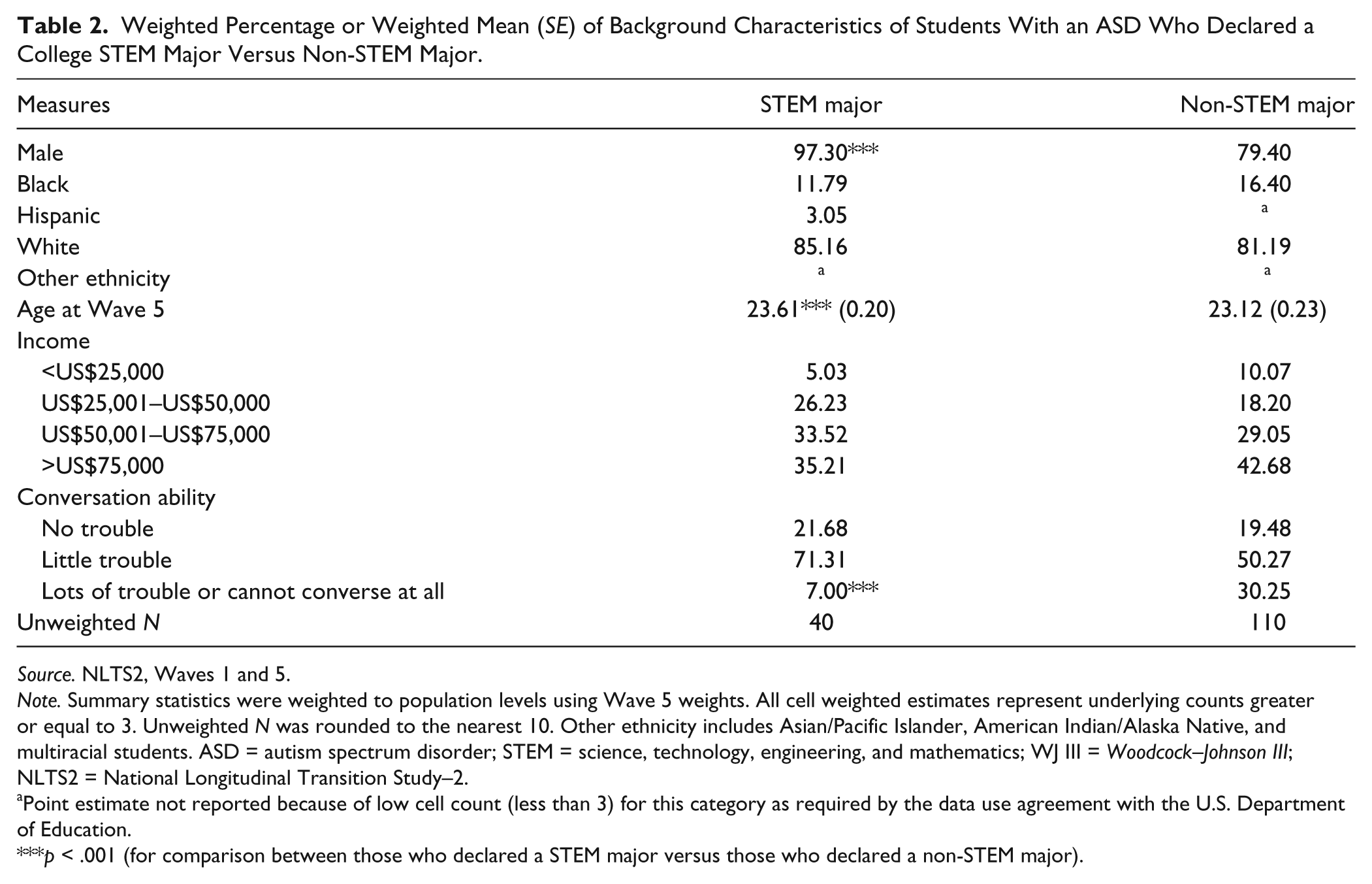
Source. NLTS2, Waves 1 and 5.
Note. Summary statistics were weighted to population levels using Wave 5 weights. All cell weighted estimates represent underlying counts greater or equal to 3. Unweighted N was rounded to the nearest 10. Other ethnicity includes Asian/Pacific Islander, American Indian/Alaska Native, and multiracial students. ASD = autism spectrum disorder; STEM = science, technology, engineering, and mathematics; WJ III = Woodcock–Johnson III; NLTS2 = National Longitudinal Transition Study–2.
Point estimate not reported because of low cell count (less than 3) for this category as required by the data use agreement with the U.S. Department of Education.
p < .001 (for comparison between those who declared a STEM major versus those who declared a non-STEM major).
When focusing on the difference between STEM and non-STEM majors in their high school STEM preparation (see Table 3), STEM majors had a lower percentage of units taken in general education settings (74.96% vs. 83.20%); however, a higher proportion of STEM majors took advanced math courses in a general education setting (41.62% vs. 22.32%) and scored higher on the WJ III science test (98.67 vs. 96.72; effect size = 0.13) than their peers who declared a non-STEM major.
Weighted Percentage or Weighted Mean (SE) of High School Academic Preparation for Students With an ASD Who Declared a College STEM Major Versus Non-STEM Major.

Source. NLTS2, Waves 1 or 2 direct assessment and high school transcript data.
Note. Summary statistics for variables from the transcript data were weighted to population levels using transcript weights. Summary statistics for WJ III variables were weighted to population levels using student direct assessment weights. Unweighted N was rounded to the nearest 10. ASD = autism spectrum disorder; STEM = science, technology, engineering, and mathematics; GE = general education setting; GPA = grade point average; WJ III = Woodcock–Johnson III.
p < .05. ***p < .001 (for comparison between those who declared a STEM major versus those who declared a non-STEM major).
Table 4 reveals findings from weighted logistic regression models predicting the odds of declaring a college STEM major (see Table 2). White students with an ASD had significantly higher odds of majoring in STEM fields than minority students with an ASD. Older students with an ASD had higher odds of majoring in STEM than their younger peers. Students with an ASD who had “no trouble” or “little trouble” conversing had higher odds of majoring in STEM than their peers who had “lots of trouble” or “cannot converse at all.” Students with an ASD who took advanced math classes in general education settings had significantly higher odds of majoring in STEM than those who did not take advanced math classes in general education settings.
Logistic Regression Using Background Characteristics and High School STEM Preparation to Predict the Odds Ratios and Confidence Intervals of College STEM Major.

Source. NLTS2, Waves 1 and 5 parent/youth interview, Waves 1 or 2 direct assessment, and high school transcript data.
Note. Unweighted N was rounded to the nearest 10. STEM = science, technology, engineering, and mathematics; GE = general education setting; GPA = grade point average; WJ III = Woodcock–Johnson III.
p < .05. **p < .01. ***p < .001.
Discussion
By taking advantage of a rich national longitudinal data set of students with an ASD, this study reveals the first national picture of how high school preparation factors and individual background characteristics are associated with entrance into STEM majors. Although the existing covariates in the NLTS2 data set preclude any in-depth investigation into STEM self-efficacy, outcome expectations, and goals that may influence STEM academics and career choice, these findings still align well with SCCT, which stipulates that an individual’s intention to engage in a certain activity (in this case choosing a major in STEM fields) is influenced by environmental (exposure to advanced math classes) and individual factors (conversation ability and race/ethnicity).
Math and science achievement scores in high school were deemed to be one of the strongest predictors of college STEM participation in research studies focused on students in the general population (Bonous-Hammarth, 2000; Crisp et al., 2009; Sahin et al., 2012). However, a recent study by Wang (2013) suggested that the effect of students’ exposure to math and science courses is stronger than that of math achievement on STEM entrance. Echoing Wang’s findings, this study emphasizes the critical role of taking advanced math classes within an inclusive high school setting in developing students’ predispositions toward choosing a STEM major in college. Furthermore, as compared with the smaller difference in proportion of STEM versus non-STEM majors who take advanced math classes in the general population (28% [Robinson, 2003] vs. 25% [Crisp et al., 2009]), this study shows that the difference between STEM and non-STEM majors among students with an ASD is more striking (42% vs. 22%). The very high rates of STEM majors with an ASD taking advanced math classes in high school emphasize the importance of exposure to high-level math classes on STEM enrollment for this population.
The number of STEM jobs is projected to grow by 17% between 2008 and 2018 as compared with 10% for non-STEM jobs (Carnevale et al., 2011). Broadening participation of underrepresented groups is an issue of concern to STEM educators and researchers and policy makers. The U.S. government has recognized that encouraging and supporting underrepresented groups such as women, minorities, and persons with disabilities to enter the fields of science and engineering is crucial to strengthening America’s science and engineering workforce (NSF, 2013). Students with an ASD represent one of the untapped STEM talent pools in the United States (Wei, Christiano, et al., 2013; Wei et al., 2012). Despite their potential to succeed in STEM fields, interest and ability alone may not be sufficient enough to enable a student with an ASD to pursue a STEM major in college. This finding implies that an earlier introduction and exposure to advanced math courses could be a particularly effective intervention to increase STEM enrollment rates among students with an ASD.
This finding is particularly relevant to practitioners dedicated to advancing the careers of individuals with an ASD. In the past, students with an ASD were typically segregated from their peers in the general education setting (McDonnell, 1998; McCurdy & Cole, 2013). However, recent research has shown that including students with disabilities in the general education setting is associated with high socio-behavioral and academic outcomes (Hunt & McDonnell, 2007; McCurdy & Cole, 2013). This study adds to the inclusion literature by suggesting that including students with ASD in advanced math classes in a general education setting is imperative to supporting their future STEM major declaration. These findings imply that high school counselors and teachers should encourage more students with an ASD to take challenging math courses. Such opportunities to enroll in advanced math classes will prepare students with an ASD to pursue STEM-related career tracks in college. However, more studies need to occur to advance the understanding of how to include students with an ASD in advanced math classes given the diversity of intellectual and behavior functioning of this group. Research that distinguishes strategies for facilitating inclusion of students with an ASD by functioning level would be welcomed by the educational community (Harrower & Dunlap, 2001).
Another factor that was significantly correlated with STEM majoring in college, conversation ability, also has the potential to be influenced through effective educational interventions and supports. The association between conversation ability and the odds of declaring a STEM major suggests that appropriate communication skills are important in STEM classes. Previous studies found that poor communication skills in young adults with an ASD may limit their ability to understand and use the rules of social behavior, resulting in more difficulties transitioning from high school to college (Hendricks, & Wehman, 2009; VanBergeijk, Klin, & Volkmar, 2008), and in maintaining the reciprocal interaction essential to college learning (Banda & Kubina, 2010; Donaldson & Zagler, 2010). Although speech/communication therapy is the most common special education service provided to secondary-school students with an ASD (Wei, Wagner, Christiano, Shattuck, & Yu, 2013), parents identified a lack of information about these supports and services and their unavailability as the most common barriers in meeting their children’s needs (NLTS2, 2007b). Furthermore, provision of speech/communication services after high school fell short of the identified need for them (Wei, Wagner, Hudson, Yu, & Shattuck, 2014). High school transition plans of 23.3% of students with ASDs identified a post-high school need for speech/communication services (Cameto, Levine, & Wagner, 2004), yet only 13.6% had received such services up to 6 years after leaving high school (NLTS2, 2007a). These findings add to the literature by emphasizing the importance of conversation skills for college students with an ASD majoring in STEM fields and suggest that high schools and colleges need to provide greater communication skills support for students with an ASD to enter and succeed in STEM fields.
This study also found a very large race/ethnicity gap in majoring in STEM-related fields among young adults with an ASD: White students were 6 times more likely to major in STEM than minority students. In contrast, a report from the NSF (2013) indicated no racial gap in intent to major in STEM among the general population, with 37% of White, 37% of Black, 41% of Hispanic, 49% of Asian, and 28% of American Indian college freshmen expressing their intent to major in STEM. This study suggests that increasing the STEM participation rate among minority students is an urgent issue for those with developmental disabilities compared with the general population. Recognizing the amplified disparities that exist among racial/ethnic minorities with an ASD is an important first step in providing appropriate services to cultivate and encourage STEM interest in this particular population. For instance, these findings may provide the impetus for Offices of Minority Affairs and Offices of Disability Services in colleges to initiate dialogue and develop action steps aimed at reducing barriers to STEM participation among students who come from more than one underrepresented population.
This study has several limitations. First, the NLTS2 study did not measure student interest and goals in math and science in high school nor in postsecondary education institutions. Consequently, this study does not provide insights into the interrelationship between STEM interest and goals and STEM career decision making. Second, the analyses were correlational and do not allow causal inferences. Future studies should replicate the findings of this study using experimental or quasi-experimental study design. Third, conversation ability was reported by parents, which may be subject to bias and cannot be equated with the results of formal evaluations conducted by trained professionals. Future studies should validate parent reporting of conversation ability by comparing it with other reporting methods, such as medical or school records. Fourth, the postsecondary enrollment and major data were collected by NLTS2 using parent or young adult survey instead of college registration records, which may have resulted in potential reporting biases. Future research should validate the results of this study through other data sources, for example, enrollment data from the university disability support office.
In sum, the findings from this study lay the groundwork to better understand the association between high school STEM preparation factors and college majoring in STEM among young adults with an ASD. Future research should aim to replicate these findings using original data that are not constrained by the limitations of secondary data analysis to strengthen the evidence base and help increase the likelihood of postsecondary STEM participation among the growing population of young adults with an ASD.
Footnotes
Authors’ Note
Any opinions expressed in this article are those of the authors and do not represent the positions or polices of the funding agency.
Declaration of Conflicting Interests
The author(s) declared no potential conflicts of interest with respect to the research, authorship, and/or publication of this article.
Funding
The author(s) disclosed receipt of the following financial support for the research, authorship, and/or publication of this article: This research was supported by Grant HRD–1130088 from the National Science Foundation, Grant R324A120012 from the U.S. Department of Education, Institute of Education Sciences, and Grant R01 MH086489 from the National Institute of Mental Health.