



Abstract
Individuals with high functioning autism spectrum disorder (ASD) frequently experience obsessions and/or compulsions that are similar to those specified in Diagnostic and Statistical Manual of Mental Disorders (5th ed.; DSM-5) criteria for obsessive-compulsive disorder (OCD). However, little research exists on effective interventions for OCD-like behaviors (referred to as OCBs) in ASD. In a preliminary randomized controlled trial (RCT; N = 14), a manualized function-based cognitive-behavior therapy (Fb-CBT) consisting of traditional CBT components (psychoeducation and mapping, cognitive-behavioral skills training, exposure, and response prevention) as well as function-based behavioral assessment and intervention significantly decreased OCBs in 8- to 12-year-old children with ASD at post-treatment and 5-month follow-up. This multi-component treatment shows considerable promise, and a larger RCT is needed to further validate and expand these findings.
Keywords
Many persons with autism spectrum disorder (ASD) have clinically significant anxiety, with 17.4% presenting with symptoms characteristic of obsessive-compulsive disorder (OCD; Van Steensel, Bögels, & Perrin, 2011). OCD is characterized by intrusive thoughts, urges or images (obsessions), and engagement in repetitive behaviors or mental acts (compulsions) assumed to reduce anxiety or distress (Diagnostic and Statistical Manual of Mental Disorders, 5th ed.; DSM-5; American Psychiatric Association [APA], 2013). A diagnostic requirement of ASD is restricted and/or repetitive behavior (RRB) that includes stereotyped movements, self-injury, need for sameness, compulsions, ritualized verbal and nonverbal behavior, and circumscribed or perseverative interests (APA, 2013). Increasingly, researchers differentiate RRBs as “higher level”—for example, washing, rigid routines, ordering, and arranging—that resemble OCD symptoms, and “lower level”—for example, restricted stereotypy and self-injury (Bishop et al., 2013; Bodfish, Symons, Parker, & Lewis, 2000; Hollander, Wang, Braun, & Marsh, 2009; Mirenda et al., 2010; Turner, 1999). Using the Repetitive Behavior Scale–Revised (RBS-R; Bodfish, Symons, & Lewis, 1999), several researchers provided preliminary support for a three-factor model composed of (a) self-injurious behavior, (b) restricted stereotypic behavior, and (c) compulsive, ritualistic, and sameness behavior (Bishop et al., 2013; Mirenda et al., 2010). This study focuses on the latter category. Although these behaviors may be maintained by escape from anxiety, when considering the social-communicative challenges and lack of introspection experienced by children with ASD, it is difficult to confirm this hypothesis (Zandt, Prior, & Kyrios, 2007).
Cognitive-Behavior Therapy
Cognitive-behavior therapy (CBT), composed of psychoeducation, cognitive training, mapping OCD, and exposure plus response (ritual) prevention (ERP), is efficacious and recommended as the first-line treatment for pediatric OCD (Abramowitz, Whiteside, & Deacon, 2005; Watson & Rees, 2008). Evidence for the efficacy of CBT for OCD symptoms in children and youth with ASD is promising, but limited. A meta-analysis (N = 469) of eight randomized controlled trials (RCTs) evaluating CBT for anxiety in an individual or group format for children with ASD yielded large effect sizes across clinician ratings (d = 1.19, 95% confidence interval [CI] = [0.23, 2.14]) and parent ratings (d = 1.21, 95% CI = [0.50, 1.97]; Sukhodolsky, Bloch, Panza, & Reichow, 2013) that are comparable with otherwise typically developing children (Silverman, Pina, & Viswesvaran, 2008). However, reviewed studies included only a handful of individuals with a primary or baseline diagnosis of OCD, and outcomes of specific disorder remittance were not typically disclosed.
Case studies (Boyd, Woodard, & Bodfish, 2011, 2013; Lehmkuhl, Storch, Bodfish, & Geffken, 2008; Reaven & Hepburn, 2003; Sze & Wood, 2007) using adapted CBT (e.g., increased use of visuals, repetitiveness, a protracted cognitive component, and parent participation) have shown decreases in OCD symptoms. One RCT (Sofronoff, Attwood, & Hinton, 2005) with 71 children (aged 10–12 years) used an ASD-adapted group CBT program for children with high functioning ASD with and without parent involvement. Results showed significant differences in anxiety symptoms (including obsessive-compulsive symptoms) on the Spence Children’s Anxiety Scale (SCAS-P; Nauta et al., 2004) for both active treatment groups, with the parent–child group showing the greatest reductions. An open trial (Farrell, Waters, Milliner, & Ollendick, 2012) used family-based group CBT to treat OCD symptoms in 43 youth (aged 7–17 years) with complex co-morbid conditions including 15 youth with ASD. Results indicated that approximately 40% of youth with ASD achieved remission (score < 14 and a 50% reduction on the Children’s Yale–Brown Obsessive-Compulsive Scale [CY-BOCS]; Goodman, Price, Rasmussen, Riddle, & Rapoport, 1986). Although CBT results are encouraging, research is needed to establish efficacy for treating OCD symptoms in children with ASD.
Applied Behavior Analysis (ABA)
A large body of research supports the use of behavioral interventions derived from a functional behavioral assessment, which attempts to identify potential functions such as social attention or escape from task for challenging behavior in persons with developmental disabilities (Feldman, Condillac, Tough, Hunt, & Griffiths, 2002; Hanley, Iwata, & McCord, 2003; Matson & Vollmer, 1995). Studies have used single-case experimental designs to evaluate ABA to treat topographically similar behavior (often referred to as “higher-level” RRB, ritualistic behavior, or OCD-like behavior) in children and youth with ASD and intellectual disabilities. Behaviors included discarding nontrash items (Kuhn, Hardesty, & Sweeney, 2009), and ordering and arranging (Leon, Lazarchick, Rooker, & DeLeon, 2013; Rodriguez, Thompson, Schlichenmeyer, & Stocco, 2012; Sigafoos, Green, Payne, O’Reilly, & Lancioni, 2009). For example, Rodriguez et al. (2012) used functional analysis to show that the function of arranging and ordering in three youth (aged 13–15) with ASD was automatic (sensory) reinforcement. Treatment included making alternative materials available, blocking, and product extinction (returning furniture to its original position). For all three participants, single-case experimental design data indicated that providing alternative items to arrange was insufficient to reduce arrangement and ordering; in all cases, response blocking, and in one case, product extinction (returning furniture to its original position) had to be added to reduce behavior to desirable levels. Using the Chambless and Hollon (1998) criteria for empirically supported therapies, Neil and Sturmey (2014) reported that behavior analysis and behavior modification, with four small N experiments with six participants conducted by four independent researchers met criteria for probably efficacious treatment for OCD-like behavior in children with ASD.
Present Study
As the research suggests that both adapted CBT and ABA can potentially reduce obsessive-compulsive symptoms in children and youth with ASD, we designed manualized “function-based CBT (Fb-CBT)” that combines aspects of both approaches (I Believe in Me, Not OCB!; Vause, Neil, Yates, & Feldman, 2013b). The present study is a preliminary randomized trial for school-aged children with high functioning ASD who were assigned to group Fb-CBT or treatment as usual (TAU). Given the overlap and difficulty in distinguishing between symptoms characteristic of OCD and higher level RRBs in ASD, the present study uses the term obsessive-compulsive behavior to represent and concurrently treat both phenomena.
Method
Participants
Fifteen children were recruited for this preliminary RCT, but one family dropped out due to work commitments precluding participation. The remaining 14 children were 9 boys and 5 girls, ranging in age between 8 and 12 years (M = 9.74, SD = 1.40) at time of assessment. They were recruited from nonprofit ASD organizations, government-funded agencies, and ASD professionals. Participants had a previous diagnosis of ASD from a pediatrician, psychiatrist, or psychologist who was confirmed by our MA psychometrist who received training to be designated research reliable on the Autism Diagnostic Interview–Revised (ADI-R; Lord, Rutter, & Couteur, 1994). Additional inclusion criteria included (a) presence of OCB as defined by Sameness, Ritualistic, and Compulsive subscales on the RBS-R (Bodfish et al., 1999) and CY-BOCS (Goodman et al., 1986), (b) an estimated Full Scale IQ (Wechsler Intelligence Scale for Children, 4th ed. [WISC-IV]; Wechsler, 2004) ≥ 70, and (c) the parent indicated no planned change in child medication during the study. Exclusion criteria included participating in treatment for anxiety, repetitive behavior, and/or Intensive Behavioral Intervention (IBI) during the study. Participants were able to take part in social skills and physical education/movement groups concurrently with treatment. Families could continue with any services if assigned to the TAU condition. Using a random number generator, participants were assigned to either group Fb-CBT or TAU (see Table 1 for summary of general demographics).
Demographics and Clinical Information for CBT and TAU groups.
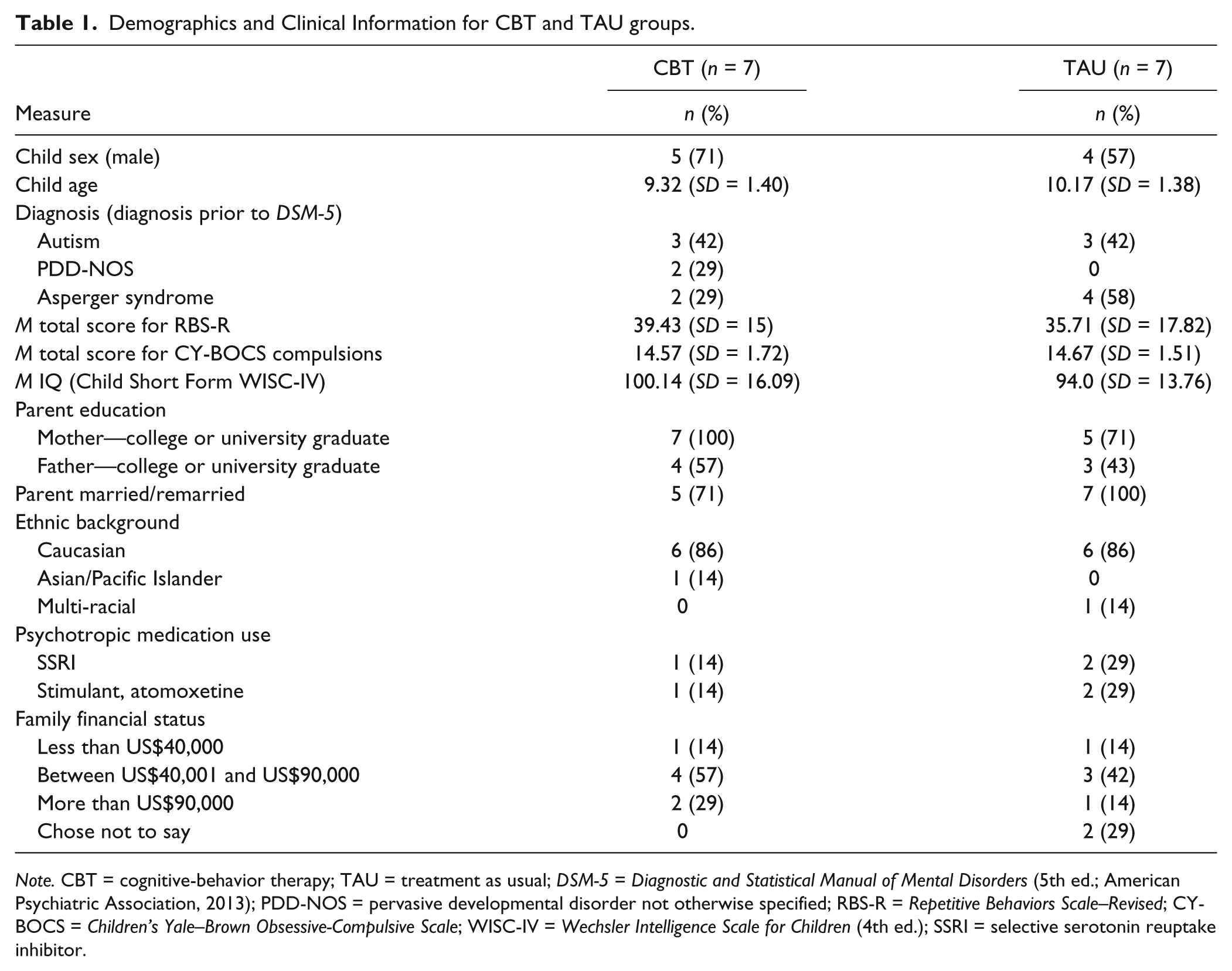
Note. CBT = cognitive-behavior therapy; TAU = treatment as usual; DSM-5 = Diagnostic and Statistical Manual of Mental Disorders (5th ed.; American Psychiatric Association, 2013); PDD-NOS = pervasive developmental disorder not otherwise specified; RBS-R = Repetitive Behaviors Scale–Revised; CY-BOCS = Children’s Yale–Brown Obsessive-Compulsive Scale; WISC-IV = Wechsler Intelligence Scale for Children (4th ed.); SSRI = selective serotonin reuptake inhibitor.
Of the 14 participants, mean pre-treatment total score for both groups on Sameness, Ritualistic, and Compulsive subscales of the RBS-R (Bodfish et al., 1999) indicated clinically significant levels of ≥ 20, and mean IQ across participants was 97.07 (SD = 14.73). Of the seven children randomly assigned to Fb-CBT, five children attended treatment with their mothers, and two children had consistent involvement of both parents. Children assigned to Fb-CBT did not receive any other psychosocial treatment for anxiety or RRBs; five were medication free, and two children were taking stable doses of psychotropic medication. Children in the TAU condition reported no access to other psychosocial treatment (although allowed), and four children received stable dosages of psychotropic medication. There were no significant group differences on any variable (p > .05).
Measures
The assessment battery was administered by independent MA graduate students in applied disability studies or education who were kept blind to group assignment. The first author, who has a PhD in clinical psychology and more than 18 years of experience in conducting cognitive and mental health assessments, provided more than 70 hr of assessment training for each student including familiarization with administration, co-rating videotaped and live interviews conducted by the first author, and, finally, conducting independent interviews/assessments and co-rating with 90% reliability.
Autism Diagnostic Interview Schedule–Revised (ADI-R)
This standardized, semi-structured clinical interview is administered to caregivers of individuals with possible ASDs. It is consistent with Diagnostic and Statistical Manual of Mental Disorders (4th ed.; DSM-IV; APA, 1994) criteria focusing on content areas including communication, social development and play, repetitive and/or restrictive behaviors, and general behavioral problems. The ADI-R has acceptable psychometric properties (Lord et al., 1994).
Wechsler Intelligence Scale for Children–IV short form (WISC-IV short form)
A four-subtest (Vocabulary, Similarities, Matrix reasoning, and Symbol Search) WISC-IV short form (Wechsler, 2004) gives a reliable estimate (.93) of Full Scale IQ (Sattler, 2008).
Repetitive Behavior Scale–Revised (RBS-R)
The RBS-R (Bodfish et al., 1999) is a rating scale for measuring the presence and severity of repetitive behaviors. It contains 43 items rated on a 4-point Likert-type scale ranging from (0) behavior does not occur to (3) behavior occurs and is a severe problem. A total raw score of ≥ 20 on the RBS-R indicates a clinically significant level of repetitive behavior (Bodfish et al., 1999). It has six conceptually derived behavior subscales (i.e., Stereotypy, Self-injury, Compulsions, Ritualistic, Sameness, and Restricted). Internal consistency for the subscales arranged into models with one to six factors was equal or greater than .72 with several models showing acceptable fit statistics (Mirenda et al., 2010), including the three-factor model composed of (a) self-injurious behavior, (b) restricted stereotypic behavior, and (c) compulsive, ritualistic, and sameness behavior. This finding is substantiated by Bishop et al. (2013) with correlations of r = .67 between Sameness, Ritualistic, and Compulsive subscales for participants between 4 and 18 years of age (M = 8.9); construct validity has also been demonstrated by correlations between the three subscales and relevant ADI-R scores (i.e., Insistence on Sameness). In this study, as we are focusing on higher level RRBs, we only used the Sameness, Ritualistic, and Compulsive subscales, pre-, post-, and 5 months following treatment.
CY-BOCS
The CY-BOCS (Goodman et al., 1986) is a 10-item, semi-structured interview used to assess symptom severity for children aged 6 through 17 years. Each item is rated on a 5-point ordinal scale from 0 (none) to 4 (extreme). This measure has acceptable psychometric properties including high internal consistency, convergent/divergent validity, and inter-rater and test–retest reliability (Scahill et al., 1997; Storch et al., 2004). The CY-BOCS was administered jointly to parent–child dyads. Given the RBS-R factor loading of compulsive, ritualistic, and sameness behaviors, general overlap of symptoms on RBS-R subscales with the CY-BOCS, and flexibility of the CY-BOCS in including items that fit broad categories (i.e., miscellaneous items), items comprising these RBS-R subscales (Items 15 through 39) that were endorsed by parents were probed for inclusion on the CY-BOCS. For the purpose of this study, only the 5-item Compulsion score was used pre- and post-treatment. Due to parental time constraints, it was not administered in follow-up.
Questions About Behavioral Function (QABF) and descriptive functional assessment
The QABF (Matson & Vollmer, 1995) shows good preliminary psychometric properties with individuals with developmental disabilities (Matson, Bamburg, Cherry, & Paclawskyj, 1999). It includes five items to examine each of four acknowledged functions of problem behavior including attention, nonsocial, escape, tangible, and questions to examine physical pain as a predisposing event for problem behavior. Each item is rated on a 4-point scale ranging from 0 (never) to 3 (often). To supplement parent ratings, therapists collected descriptive data on perceived antecedents and consequences of OCBs when they occurred in the natural environment (e.g., during a home visit or in session).
Parent OCB Rating Scale
A Likert-type scale ranging from 1 (desired post-treatment levels of OCBs) to 3 (partial improvement from pre-treatment levels) to 5 (pre-treatment levels of OCBs) was used by parents to rate OCBs during baseline (before treatment began), during treatment, and at 5- to 6-month follow-up.
Consumer satisfaction
At post-treatment, Fb-CBT parents rated the question “Overall, how satisfied were you with the effectiveness of therapy?” on a 7-point Likert-type scale (1 = not at all satisfied to 7 = very satisfied).
Research Design
This study received approval from a University Research Ethics Board, and written informed consent and assent were obtained from parents and children, respectively. A RCT design was used with pre- and post-testing. Follow-up RBS-R testing was conducted for the Fb-CBT group at 5 months post-treatment. For the Fb-CBT group, we conducted a treatment component analysis by examining mean parent ratings of OCBs across baseline, treatment, and follow-up.
Treatment Package
Based on level of interference for the child and family members, parents (and their children when possible) chose up to 10 OCBs to address in treatment and discussed post-treatment goals. Several behaviors were treated per participant (M = 6, range = 3– 9). During baseline and treatment, parents completed daily ratings for all OCBs using our OCB Rating Scale. Building on the work of March and Mulle (1998), we created a manualized treatment protocol titled “I Believe in Me Not OCB!” which includes a clinician’s manual (Vause, Neil, Yates, & Feldman, 2013a) and an accompanying children’s workbook (Vause et al., 2013b). Table 2 provides a detailed description of treatment enhancements (e.g., repetitiveness, predictability, use of visuals, immediate reinforcement, incorporating unique interests, and social skills exercises) to optimize treatment for individuals with ASD. Fb-CBT involved nine 2-hr weekly sessions with three to four children in each group and two therapists. Therapy consisted of group activities, individual work in parent–child dyads, group parent training, and social skills exercises. For all treatment components, at least one parent was present with the child to practice and acquire knowledge necessary to assist him or her in implementing the treatment components in the home setting. A lead female therapist (MA student in applied disability studies with a specialization in applied behavior analysis) with a minimum of 2 years’ experience working clinically with children with ASD and mental health issues, and a fourth year undergraduate female student led each group. Therapists administered the treatment jointly, with the exception of group parent training, which was led by the lead therapist, while the other therapist completed a social skills activity with the children. Therapist training consisted of reading and reviewing manual content, role-playing, and at least 2 hr of supervision each week by the first author to review weekly session content, and participants’ individual OCB program plans.
Treatment Modifications for Individuals With ASD.

Note. ASD = autism spectrum disorder.
Phase 1: Psychoeducation and mapping (PM)
Initial sessions focused on rapport building, introduced session rules, defined OCB and its relation to specific compulsions (and obsessions if present), and identified triggers. Homework assignments promoted awareness of OCBs (e.g., being a detective to describe where compulsions took place). Concrete exercises were used to teach concepts such as interference, and that OCB was not the child’s fault and could be externalized (whereby the child is the “boss” and has the ability to control OCB with a support team assisting him or her). A fear thermometer was used to rate the severity of each behavior (i.e., how distressed a child would feel if he or she could not engage in the compulsion). After rating these behaviors, children visually mapped their OCBs on a hierarchy that consisted of three sections: (a) complete control, (b) some control, and (c) having no control in performing compulsions. This map assisted the therapist in determining ordering of OCBs for treatment (e.g., starting with an OCB where the child had some control). Over the course of treatment, children referred back to this map and visually tracked their progress. Children, with the help of parents and therapists, also generated externalizing statements (e.g., “Buzz off, OCB!”).
Phase 2: Individualized treatment for OCBs using functional assessment and cognitive and behavioral treatment components
Function-based assessment and intervention
Prior to working on each individual OCB, the QABF was administered to a parent to determine perceived functions (beyond anxiety reduction). Based on resources available, a variety of methods were used to collect descriptive data. Researchers observed child behavior in contrived and naturally occurring situations at home and during therapy sessions. Parents also recorded video of child behavior at home that was later analyzed by researchers. Analysis of antecedents and consequences and possible functions was conducted by researchers trained in applied behavior analysis. Based on QABF and descriptive analyses of 38 behaviors, the top two functions were automatic reinforcement and attention, with percentage of behaviors maintained by these variables being 84% and 74%, respectively (note that many behaviors had multiple functions that were all treated).
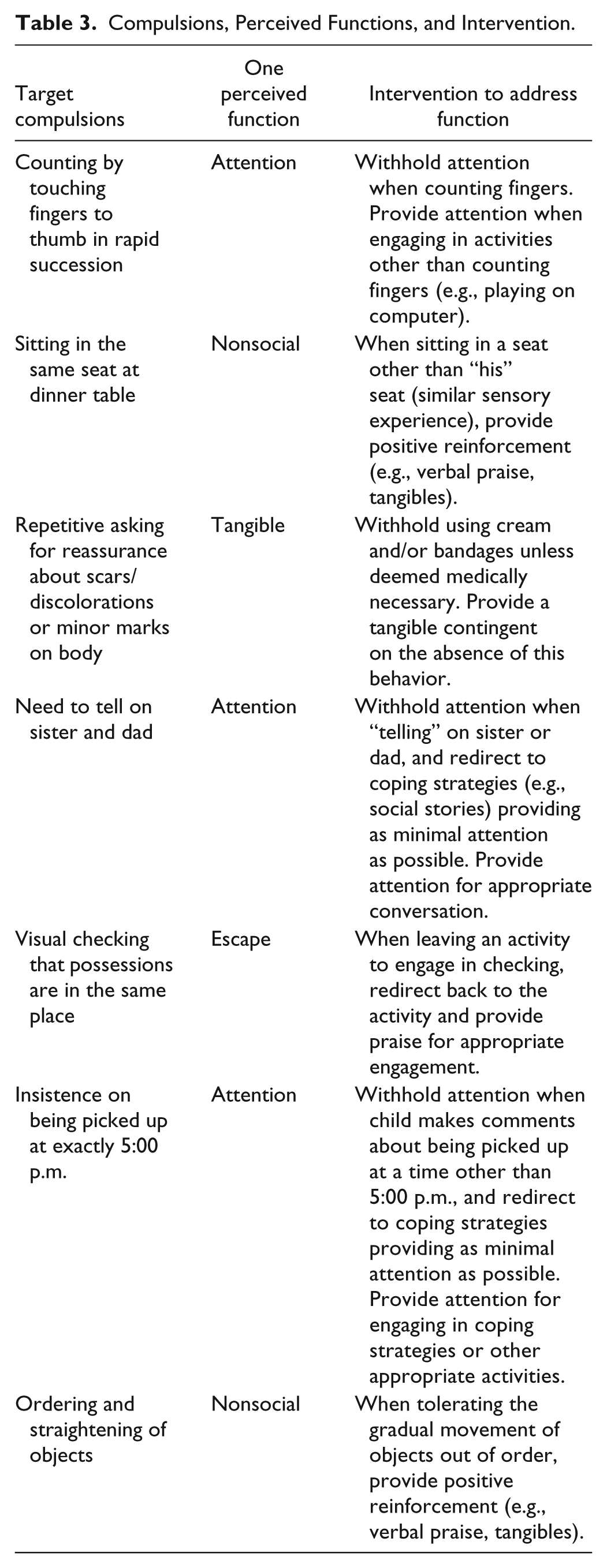
Perceived functions of individual OCBs were addressed in a written function-based assessment and intervention (FBAI) plan. Parents were trained to implement function-based interventions using verbal prompting, modeling, role-playing, and performance feedback. Functions were addressed using extinction and differential reinforcement of alternative or low rates of behaviors (Cooper, Heron, & Heward, 2007). For example, if perceived functions of frequent hand washing were parental attention and escaping a demand (e.g., meals), we addressed both functions in the FBAI. For parental attention, we advised the parent to minimize attention and prompt the child (in a neutral voice) back to the table and provide positive attention when eating. For escape, we gradually reduced the number of minutes the child engaged in hand washing and redirected him back to the meal (see Table 3 for an example of one representative behavior per participant, one perceived function, and how that function was addressed).
Compulsions, Perceived Functions, and Intervention.
Cognitive and behavioral strategies
OCBs were targeted one to two at a time throughout the remaining weeks. CBT skills training involved continued work on externalizing OCB. For each individual OCB, we reviewed the pros and cons of engaging in obsessions/compulsions, and taught children to generate coping statements, which often consisted of (a) externalizing statements (e.g., “I don’t have to listen to you OCB!”), (b) positive self-statements (e.g., “I can do it. I’m not going to let OCB beat me”), and/or (c) challenging faulty assumptions and deriving concrete coping statements—for example, “brushing my teeth for 3 minutes (rather than 20 minutes) is enough to get them clean.” Extent of cognitive restructuring was individualized to the participant. If there was not a distinguishable thought, we focused strictly on treatment of compulsions. Children were taught replacement behaviors (e.g., talking about and/or doing other things) to cope with the physical reactions of anxiety and/or urge to complete compulsions.
ERP and positive reinforcement
For ERP, therapists and parents assisted the child in creating a written plan for exposure to environmental stimuli associated with anxiety and refraining from performing the compulsion. For some OCBs, in attempt to ensure success, gradual exposure was used where specific criteria were set for reduced engagement in compulsions. If the child met his or her goal, child-initiated positive reinforcement (e.g., access to a preferred tangible item) was provided by the parent and faded accordingly. For example, a child may have developed a plan that limited the number of times he or she could erase and rewrite letters during homework each day, gradually decreasing the amount of times throughout the week. When possible, parents brought associated stimuli from home, and exposures were contrived in session (e.g., when objects were lined up, the child practiced moving one object out of place).
Parent training
Fb-CBT was family-based (Barrett, Farrell, Pina, Peris, & Piacentini, 2008) with parent training being an integral part of the treatment. Parent training occurred simultaneously with children working on specific treatment components. Parent training included discussions of OCB etiology, maintenance, impact of stressors, functions, various treatments of OCBs, positive reinforcement, and relapse prevention. Following discussion of treatment components, parents received hands-on training using modeling, role-playing, practice, and feedback in implementing individualized function-based and reinforcement interventions, cognitive strategies, and exposure plus response prevention. Parents received information on generalization of strategies to other child behavior problems and referral sources for other issues (e.g., fine motor problems).
Treatment Integrity
Trained observers followed a treatment checklist derived from the Vause et al. (2013a) manual to conduct treatment integrity (TI) checks on both therapist and parent behaviors on 97% of sessions across all components of the intervention. TI was calculated as percentage of checklist items completed correctly. Interobserver agreement on TI was calculated by dividing the number of agreements on delivery of treatment components by the number of agreements plus disagreements and converting to a percentage. Mean TI and TI interobserver agreement (25% of sessions) were both 100%.
Reliability on Parent Ratings of Target Behaviors
For three of the seven participants, observational probe data were collected by digital recordings of participants in their home environments. Interobserver agreement was calculated as the average percentage agreement between the lead therapist and the parent’s rated scores for each recording (Cooper et al., 2007). Agreement between the therapist and parents’ Likert-type scale ratings on six behaviors over 19% of randomly selected observations was 86% (range = 76%–91%).
Results
Group Comparisons on RBS-R and CY-BOCS
Figure 1 shows between-group pre–post differences on behaviors included in the Compulsive, Ritualistic, and Sameness RBS-R subscales. A mixed-design ANOVA shows a significant Time × Group interaction, F(1, 12) = 6.98, p = .02 (η2 = .58), indicating a significantly greater reduction between pre- and post-treatment RBS-R ratings of child OCBs in the Fb-CBT group. Figure 2 shows between-group pre–post differences on the CY-BOCS. A mixed-design ANOVA shows a significant Time × Group interaction, F(1, 11) = 27.77, p < .001 (η2 = .51), indicating a significantly greater reduction between pre- and post-treatment in the severity of compulsions for participants in Fb-CBT versus TAU.

Changes in mean severity ratings on the Compulsive, Ritualistic, and Sameness subscales of the RBS-R for Fb-CBT and TAU groups.
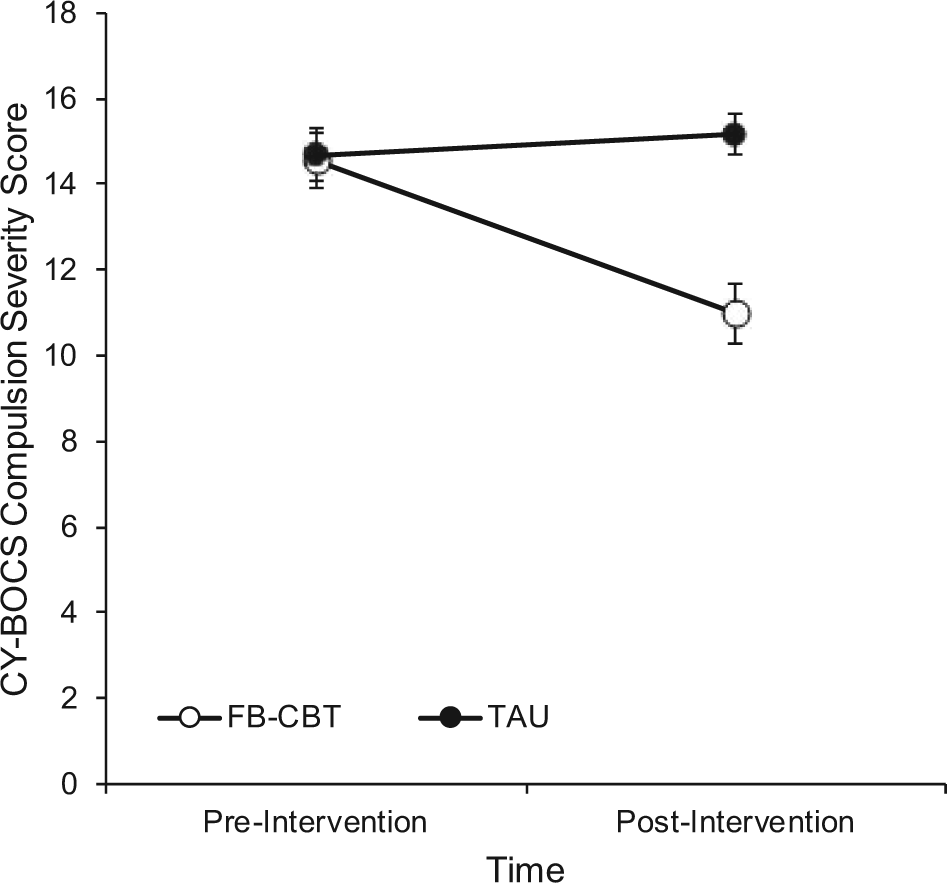
Changes in mean compulsion severity ratings for the CY-BOCS for FB-CBT and TAU groups.
RBS-R follow-up
For the Fb-CBT group, a one-way repeated-measures ANOVA was used to compare RBS-R ratings across pre-, post-, and 5 months following treatment. There was a significant effect of time for the Compulsive, Ritualistic, and Sameness subscale scores, F(2, 12) = 33.54, p < .05, (η2 = .85). Pairwise Bonferroni corrected comparisons indicated that pre-intervention RBS-R scores were significantly greater than post-intervention (p < .01) and follow-up (p < .01); there was no significant difference between post-intervention and follow-up (p > .05).
Treatment Component Analysis for Fb-CBT Group
Figure 3 shows grand means for daily parent ratings (using a Likert-type scale) of target behaviors across baseline (M = 24 days, SD = 7 days), PM, individualized OCB treatment, and follow-up (M = 5 months, 13 days; SD = 5 days). Across 7 participants in the Fb-CBT group, we treated 42 behaviors (M = 6, range = 3–9). Using the last three data points in each phase (for two behaviors, only one or two data points were available for use in the analysis), grand mean parent ratings were calculated for participants’ treated behaviors. Individual behaviors missing data in one or more phases were excluded from grand mean calculations; there were a total of 37 behaviors with data across all phases. Follow-up parent rating data were unavailable for two of the seven participants; therefore, we used the Last Observation Carry Forward (LOCF; Hamer & Simpson, 2009). A one-way repeated-measures ANOVA revealed a significant effect of phase on the grand means of parent ratings of OCB, F(3, 18) = 16.98, p < .01 (η2 = .74). Post hoc pairwise Bonferroni corrected comparisons indicated parent ratings did not show a significant difference from baseline to PM (p > .05) but significantly decreased from baseline to individualized OCB treatment (p = .02) and PM to individualized OCB treatment (p = .01). Baseline to follow-up approached significance (p = .09), and PM to follow-up showed a significant decrease (p = .001). A significant difference was not found between intervention and follow-up (p > .05).
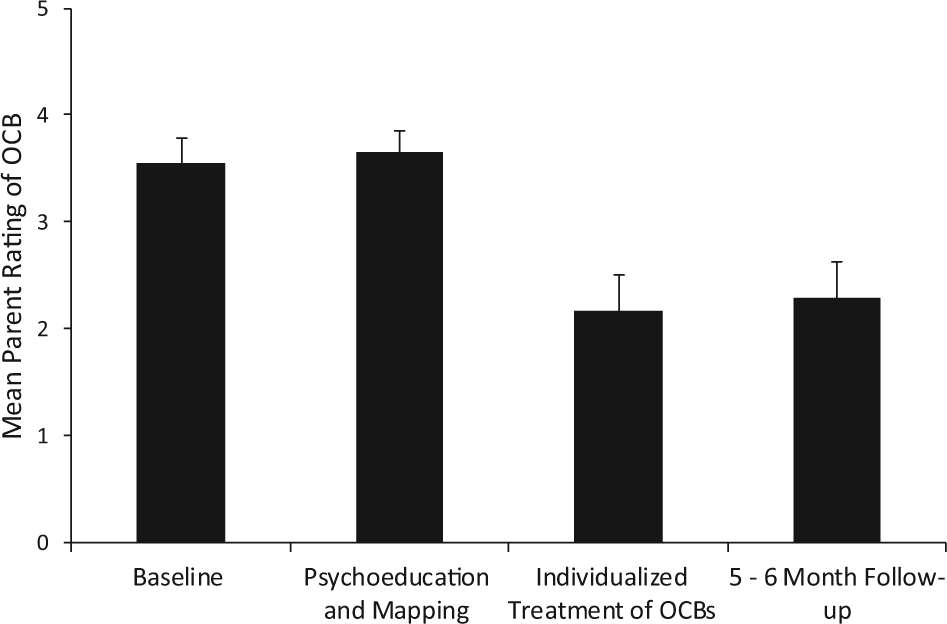
Mean parent ratings of OCB for all participants across all phases.
Across seven participants, 68% (25 of 37) behaviors responded to treatment, and of those 25, 14 behaviors were reduced to a parent rating of 1 (desired post-treatment levels). Following treatment, all participants showed decreases in OCBs, with the percentage of improved behaviors per participant ranging from 20 to 100 (M = 69%).
Consumer Satisfaction
Using a 7-point Likert-type scale, all seven parents participating in Fb-CBT were generally satisfied with the effectiveness of our therapy (M = 5.29, SD = 1.80). One parent said, “It worked!” and another said, “The study has helped us greatly at home with dealing with every aspect of [my daughter’s] anxiety.”
Discussion
Using multiple measures of OCBs, children with ASD who received our 9-week Fb-CBT package showed a significantly greater reduction in symptom severity following treatment in comparison with the TAU group, and these gains were maintained at 5-month follow-up. All between-group and within-group comparisons revealed medium to large effect sizes (η2 = .51 to .85), and parents were generally satisfied with the effectiveness of therapy. An analysis of individual treatment components revealed that, across participants, significant reductions in parent ratings of multiple target behaviors occurred only after individualized treatment began. A reduction in OCBs is consistent with adapted anxiety CBT programs for children with ASD (Sofronoff et al., 2005) that included a small number of individuals with OCB and small N behavior analytic experiments that were successful in decreasing OCBs in these children (Neil & Sturmey, 2014). This is the first known controlled trial of a manualized function-based CBT to focus exclusively on reducing OCBs in children with ASD.
Analyzing the parent rating time series data for our Fb-CBT group by treatment phase indicated that general psychoeducation and mapping alone did not show a treatment effect; a significant decrease in parent rating of OCB severity occurred when participants received individualized treatment for each OCB (including function-based intervention, CBT strategies, and ERP plus positive reinforcement). Component analysis studies are needed to systematically analyze the relative contributions of various components in our treatment package. ERP has been reported as the active ingredient in reducing OCBs (Lehmkuhl et al., 2008; March & Mulle, 1998), but emerging research also supports the use of function-based components (Kuhn et al., 2009; Rodriguez et al., 2012). Given the acknowledged difficulty in differentiating OCD from ASD symptoms (Boyd, McDonough, & Bodfish, 2012; Wood & Gadow, 2010), enhancing CBT with function-based behavioral methodology may allow for identification of other functions of OCBs beyond anxiety reduction. For example, our function-based assessment often identified that compulsions were maintained by social consequences such as parental attention and/or internal sensory stimulation (automatic reinforcement). If multiple functions are overlooked, this may lead to a slower treatment response or maintenance of the compulsion (Cooper et al., 2007).
Manualized Treatment Based on Evidence-Based Practice for ASD
In line with previous research (Reaven, 2009; Sukhodolsky et al., 2013), our treatment is tailored to the unique characteristics of individuals with high functioning ASD who present with varying cognitive-developmental levels. In the present study, children who received Fb-CBT had estimated Full Scale IQs (WISC-IV; Wechsler, 2004) ranging from 80 to 124. Our treatment is based on evidence-based educational interventions recommended for children with ASD above the age of 5 years, which includes individualized and systematic programming, structure, addressing goals related to ASD challenges, use of positive behavioral interventions, and family involvement (Iovannone, Dunlap, Huber, & Kincaid, 2003). Our multimodal treatment involves creating individualized goals and treatment plans for each OCB, structure and predictability, as well as behavioral support strategies.
Participating in a treatment group may have helped the children’s social-communicative skills, although these behaviors were not directly measured. Therapists did report that children formed friendships, and one child initiated the exchange of contact information with another child to get together after treatment.
Limitations
Although this RCT should be considered preliminary because of the small sample size, significant between- and within-group differences in OCB symptom severity emerged. It should be noted that due to resource limitations, we were unable to administer the Autism Diagnostic Observation Scale (Lord, Rutter, DiLavore, & Risi, 1999) to complete our own diagnostic assessment of ASD. Although RBS-R follow-up data were available for all seven treatment participants, due to parental time constraints in the follow-up period, the CY-BOCS was not administered and OCB parent ratings were available for five of seven participants. Future studies using Fb-CBT should collect interobserver agreement data on the descriptive analyses.
Conclusion
This controlled trial provides preliminary evidence toward validating a FB-CBT package to treat OCBs in children with high functioning ASD. A larger RCT and component analysis studies are warranted to further evaluate and establish efficacy for this manualized treatment. In addition, future studies should further examine social validity by evaluating changes to key variables such as quality of life for children and their family members.
Footnotes
Acknowledgements
We sincerely thank the participants, their families, and agencies for their incredible support of this project. This research was supported by the Ontario Mental Health Foundation and the Ministry of Health and Long-Term Care. Funding sources did not have a specific role in the study itself or in decision to submit this article for publication.
Declaration of Conflicting Interests
The author(s) declared no potential conflicts of interest with respect to the research, authorship, and/or publication of this article.
Funding
The author(s) disclosed receipt of the following financial support for the research, authorship, and/or publication of this article: This research was supported by the Ontario Mental Health Foundation and the Ministry of Health and Long-Term Care.