



Abstract
This study contributes to the body of research examining why city-level violence rates peaked in 1993. Taking homicide data from that year, we introduce an indicator for active street gangs along with indicators derived from common structural explanations of homicide rates. We assess whether gang presence is empirically associated with homicide variation across 154 U.S. central cities. Consistent with conceptual claims, correlational evidence demonstrates that active gangs were a significant source of homicides across this sample of cities. As a secondary concern, we assess structural conditions that were likely to predict gang formation within cities during the crime peak.
Introduction
Throughout the mid 1980s and into the early 1990s the United States experienced a dramatic escalation in the level of violent crime (MacDonald & Gover, 2005). By 1993, violent crime victimization and offending rates had reached an all-time peak for young men (Cook & Laub, 1998). In response to the alarming spike in violence, criminologists sought to develop insights regarding the social psychological and structural factors contributing to the phenomenon (see, for example, Jackson, 1991). For sociological and historical reasons, a substantial body of research has remained focused on this peak period of violence, with particular emphasis on patterns of homicide (Cerdá et al., 2010; MacDonald & Gover, 2005; Maxson, Curry, & Howell, 2002; Ousey & Lee, 2002; Pridemore & Trent, 2010; Strom & MacDonald, 2007). The analysis below is a continuation of this line of research. Drawing from the many insights of contemporary researchers, we focus explicitly on the plausible empirical link between street gangs and homicide offending in central cities throughout the United States.
Early explanations for the sharp increase in homicide came to focus on the confluence of drug markets, guns, and gang presence (Decker, 1996; Decker & VanWinkle, 1994; Esbensen & Huisinga, 1996; Maxson & Klein, 1996). Recent literature suggests complex developmental issues, extending well beyond a singular financial gravitation toward these lucrative but violent markets, shape patterns of gang membership (Bjerregard, 2010; Thornberry & Krohn, 2003). The rapid accumulation of gang-oriented studies continues to document strong links between gang affiliations and street-level violence (Esbensen, Peterson, Taylor, & Freng, 2010; Klein & Maxson, 1995; Thornberry & Krohn, 2003). Street gangs today are in the crosshairs of law enforcement since they are widely viewed as a key source of heightened interpersonal violence (Liberman, 2010) and have been strongly linked to drug and vice economies operating in economically marginalized communities (Block, Antigon, Ayad, & Przybylski, 1996; Coughlin & Venkatesh, 2003; Hagedorn, 1988, 1998; Hagan, 1994; Thornberry & Krohn, 2003; Padilla, 1992). Despite many previous micro level studies documenting the plausible linkage between gangs and lethal violence, aggregate level literature to date has not documented this plausible empirical association. Most likely this is because such opportunities were not available to researchers since the first study to document systematically the number of gangs and gang members across aggregate units was published in 1992 (Maxson, 1992).
The gangs-violence thesis is not new. For many years researchers who study gangs have emphasized their adherence to oppositional values, including the use of lethal violence. For over 150 years the mythos surrounding street gangs and violence has dominated popular and academic discourse (Gilfoyle, 2004; Thrasher, 1927). The media is also replete with anecdotal evidence that street gangs are capable of and often willing to victimize outsiders (Liberman, 2010; Welch, Price, & Yankey, 2004). Surprisingly, while many reports allude to the influence of street gangs on patterns of interpersonal violence, very few criminologists have sought to systematically observe the balance of perceptions and realities (Miethe & McCorkle, 1998), particularly using aggregate data. This article examines cross-sectional data taken from 154 inner-city areas during 1993 (when violence rates were at their historical peak) and seeks to confirm or deny the hypothesis that the presence of gangs is empirically associated with patterns of lethal violence. 1 Taking as a point of departure historical and contemporary sociological insights and extensive media accounts, we investigate the commonsense expectation that the presence of active street gangs would be correlated with city homicide rates.
Gang researchers, using primarily case studies and interviews, have focused intensively on interpersonal or group-level processes that define the structure of street gangs (Hagedorn & Rausch, 2007; Sykes, 1997). Several reports document that street gangs have been responsible for a significant proportion of homicides in many U.S. cities (Hagedorn, 1998; Howell, 1999; Short, 1997). 2 With a few notable exceptions (Kyriacou, Hutson, Anglin, Peek-Asa, & Kraus, 1999; Meehan & O’Carroll, 1992), aggregate research has rarely examined gang influences on rates of violence. This is disheartening but understandable, as the most commonly used data sources (Uniform Crime Reports and the U.S. Census) do not provide estimates of gang activity within areas. In most aggregate public policy research, the contribution of gangs to violence is a taken-for-granted piece of wisdom and is reflected in antigang statutes that have proliferated in cities across the country (Barrows & Huff, 2009; Parenti, 2008; Strosnider, 2002). This article attempts to bridge a gap in the homicide research by empirically assessing the influence of gangs on homicide rates while statistically holding constant diverse structural indicators used previously in aggregate violence research.
A number of reviews (Coughlin & Venkatesh, 2003; Howell, 1999; Hagedorn, 1998; Robinson et al., 2009; Wood & Alleyne, 2010; Spergel, 1990) report evidence linking active gangs to increased interpersonal violence (also see Anderson, 1990; Hagedorn, 1988; Moore, 1991). 3 Hagedorn (1998) provides systematic evidence that gangs became increasingly entrepreneurial and violent during the 1980s. Cork (1999) suggests that external factors facilitated innovation and diffusion processes among inner-city gangs. In summary, we highlight that activities associated with expanding markets in drugs and guns, at least some of which are facilitated through the activities of local gangs, very likely contribute to aggregate patterns of lethal violence across urban landscapes (Johnson, Williams, Dei, & Sanabria, 1990).
Relevant Research
Literature that relates gang effects to urban homicide rates is of importance. Such literature suggests that displays of violence may be an important determinant of the social hierarchy in gangs and likely plays a key role in the maintenance of informal street codes in some marginalized neighborhoods (Anderson, 1994, 1999; Fagan & Wilkinson, 1998). Jackson’s (1991), study of street gang proliferation suggests that economic decline within American cities combined to augment both crime and the presence of youth gangs. Other literature focuses on aggregate level characteristics, including racial composition and concentrated disadvantage, and attempts to document how these explain urban homicide rates. Homicide researchers have assessed diverse hypotheses linking social disorganization and strain/deprivation indicators with aggregate patterns of homicide (Cerdá et al., 2010; Mares, 2010; McCall, Land, & Parker, 2010; Papachristos & Kirk, 2006).
Evidence of Gang Effects
While the actual number of annual gang homicides is disputed, Block et al. (1996) reports that gang-related homicides in 1994 made up a substantial percentage of total homicides in cities such as Chicago (32%) and Los Angeles (44%; also see Klein, 1995). Additionally, Johnson et al. (1990), and other researchers (Blumstein, 1995; Cork, 1999; Johnson, Natarajan, Dunlap, & Elsayed, 1994) have underscored the relationships that emerge between gangs and drug distribution operations in cities where drug market exchange activities are ostensibly backed by swift and certain violence.
The literature on gangs emphasizes a likely link to violence but there is little direct empirical evidence about their aggregate influence on homicide rates. Most studies instead address individual level explanations for gang violence and use self-report data (Deschenes & Esbensen, 1999) or attempt to understand group-level processes (Curry & Spergel, 1988; Fagan & Wexler, 1987; Hagedorn, 1998; Rosenfeld et al., 1999). Research since the early 1970s emphasizes gangs “as a social threat that requires intervention from enforcement and judicial institutions” (Coughlin & Venkatesh, 2003, p. 53) but the accumulation of studies has been theoretically eclectic rather than cumulative.
Despite the lack of a fully developed theoretical framework and supporting aggregate evidence many accounts suggest that gangs or gang-like subcultures are an important source of urban violence (Anderson, 1990; Barnett & Schwartz, 1989; Barrows & Huff, 2009; Bernard, 1990; Fagan & Wilkinson, 1998; Hagedorn & Rauch, 2007; Rosenfeld et al., 1999, 1994, 1998; Wood & Allyene, 2010; Zatz & Portillos, 2000). The well-established link between community factors and delinquency also suggests that these juvenile and young adult affiliations likely contribute to overall patterns of violence. Finally, research has focused on entrepreneurial gang participation in the expanding informal economies in America’s marginalized central cities (Hagan, 1994) and particularly involvement in violent drug markets. Hagedorn (1998) and Curtis (1998) imply that gangs are a significant source of overall violence rates (also see: Blumstein & Rosenfeld, 1998). Each of the foregoing claims points to an association between gangs and violence, but the mechanics underlying this link are undertheorized and support for a systematic relationship has not been demonstrated empirically.
Other Structural Explanations
With the exception of race effects, empirical homicide research is characterized by mixed or contradictory findings (McCall, Land, & Parker, 2010; Pridemore & Trent, 2010). The literature on race effects is consistent as most studies report a positive association between the percentage Black or minority population and heightened levels of violence. Liska, Logan, and Bellair cite Downs (1973, p. 72) arguing that “There is overwhelming statistical evidence that high crime, vandalism, and delinquency rates are indeed found in areas that are predominantly low-income—or predominantly black—and especially both.” (Liska et al., 1998, p. 27). Subsequent research reinforces that assertion (Kovandzic, Vieraitis, & Yeisley, 1998; Liska et al., 1998; Messner, 1983; Parker & Pruitt, 2000). 4
One of the difficulties in studying lethal violence is that there is little consensus regarding connections among various competing controls (Kovandzic et al., 1998; Land et al., 1990; McCall, Land, & Parker, 2010). Some research supports claims that economic inequality influences homicide rates (Blau & Blau, 1982; Jacobs & Richardson, 2008) but other studies report nonsignificant coefficients (Messner, 1982, 1983; Messner & Tardiff, 1985; Williams, 1984). Similar problems are evident concerning poverty effects. Several studies report significant effects (Bailey, 1984; Messner, 1983; Messner, Raffalovich, & Sutton, 2010; Williams, 1984) while others fail to support the poverty-homicide thesis (Blau & Blau, 1982). Despite contradictory research findings, both economic inequality and poverty are widely believed to influence homicide offending.
Unemployment has been theorized as a key source of “economic-induced strain” (Parker & McCall, 1999, p. 464), and may contribute to higher levels of violence. But again the research findings are mixed. Kapuscinski et al.’s (1998) time series study reports that unemployment is not associated with homicide rates. Cantor and Land (1985) report mixed results using data on the unemployment-crime relationship. Parker and McCall (1999) and Kovandzic et al. (1998) report significant unemployment effects on homicide rates.
City size has been statistically held constant in most homicide research (Parker & McCall, 1999; Shihadeh & Ousey, 1998; Williams, 1984) with similarly mixed results. Finally, aggregate studies offer mixed evidence about the effects of household disruption (percent divorced) on homicide rates. Williams (1984) and Blau and Blau (1982) report a positive association between the influence of divorces on homicide rates. But two later studies (Kovandzic et al., 1998; Parker & McCall, 1999) report that divorces are not a significant predictor. Similar contradictory results persist with other structural indicators (see Land et al., 1990 for a thorough literature review).
In sum, previous homicide research has focused extensively on structural explanations. While the presence of Blacks is a consistent indicator of city murder rates, other structural factors have been inconsistent predictors of homicides. Gangs have been conceptualized as a key factor affecting urban violence but concrete evidence of gang effects is limited. The following emphasizes multiple hypotheses.
Theory and Hypotheses
Active Local Gangs and Lethal Violence
Much gang research highlights the oppositional street cultures that reinforce learned patterns of violence. Early criminological accounts of juvenile deviance linked adolescent gangs to delinquent behaviors (Lanier & Henry, 1998; Spergel, 1990). Battin, Hill, Abbot, Catalano, and Hawkins (1998) produced empirical evidence linking gang membership to delinquency while Deschenes and Esbensen (1999, p. 63) cite many other studies in which gang activity has been “heralded as a cause of the increased violence.” Anderson’s ethnographic research (1990, 1994) illustrates the emergence of a subculture that cultivates a self-image based on violence. Anderson’s work underscores the consequences for young Black males immersed in these oppositional subcultures (also see Markowitz, 2003). These studies highlight individual and group-level processes but suggest a systematic effect since likely contribute to reduced informal controls.
Rosenfeld et al.’s (1999) study of gang homicides suggests that gangs facilitate violence directly through their activities (attacking rival gangs, protecting turf) as well as indirectly by increasing community contact with violent and risky situations. Studies accentuate that gang attributes are perceived as threats to civility (Coughlin & Venkatesh, 2003; Hagedorn, 1988; Spergel, 1990; Howell, 1999). Several studies highlight gang participation in drug markets, asserting that entrepreneurial gangs have been responsible for much of the expansion in drug-related violence (Curtis, 1998; Hagedorn, 1998; Johnson et al., 1990). 5 These studies document individual and group-level processes and provide imagery of a violent and opportunistic orientation.
Cork (1999) provides a model of innovation and diffusion that draws on Johnson et al.’s (1990) descriptive analysis, showing how the expansion of drug markets (chiefly crack cocaine during the 1980s) was followed by a proliferation of interpersonal violence. He offers the idea that gang activities provide employment and income opportunities for inner-city youths. During the 1980s, law enforcement agencies
forced crack dealers to take their “self-defense” into their own hands. In the world of crack sales, “the use of violence and, even more important, threats of physical violence become essential elements,” and [as Cork notes] the possession and use of firearms is a formidable threat. (Cork, 1999, p. 383)
Juveniles are ideal job candidates both for legal and economic reasons because they can avoid felony prosecution and are more prone to take extraordinary risks for relatively trivial short-term gains. Because they are less likely to be habitual users they are more reliable than older recruits although they are also more impulsive and less likely to think clearly about the consequences of their actions. A notable feature in drug and vice economies is the role of employee discipline. Employees must know “that if they run off with drugs or money, or fail to repay debts, or act as informers to police, they are likely to be physically assaulted or killed.” (Cork, 1999, p. 383). Cork emphasizes that the rapid expansion of crack sales and disputes over territories necessitated the threat or actual use of force. He notes that groups selling crack “frequently challenge and try to establish their sellers in particularly good locations; [and] such challenges can lead to executions or gunfire with guards and employees of another crack-selling group.” (Cork, 1999, p. 383)
As drug markets expand across cities, so does the amount of armed competition between rival groups. As entrepreneurial gangs arm themselves to protect their markets, everybody, not just members of the respective gangs, faces a heightened risk of victimization. Cork’s work provides a critical conceptual link, showing how the expansion of gangs into drug markets logically results in heightened rates of homicide. 6 In short, there is a logical basis for an expected empirical association between the presence of gangs and elevated homicides. Homicides should be positively associated with greater numbers of gangs but cities with fewer gangs should experience smaller increases in homicide rates.
The Effects of Concentrated Disadvantage
The homicide literature highlights several conceptually distinct, but empirically overlapping, structural factors that should be statistically held constant in order to increase the precision of estimated gang effects. Land et al. (1990) expand on Wilson’s (1987) conception of concentration effects emphasizing overlapping social structural characteristics that are linked to community disorganization and crime. Recent meta-analytic findings by McCall et al. (2010) show a link between resource deprivation and crime rates. Measures including the size of the Black population, income inequality, poverty, and family disorganization have been used together to form an index of concentrated disadvantage. The logic for these statistical controls follows.
The effects of Black population size on homicide are generally conceptualized as a function of structured disadvantages Blacks face as a group (Hagan, 1994; Ousey & Lee, 2002; Wilson, 1987) and related economic and social discriminatory practices (Liska et al., 1998; Messner & Rosenfeld, 2001; Ross & Levine, 2000). Hagan (1994) emphasizes that the size of Black population is likely to be associated with reduced economic and social opportunities, therefore making criminal behaviors more likely. 7 These same structural conditions are likely to result in diffuse anger, frustration, and expressive violence (Bernard, 1990).
Economic inequality has been theorized as a source of homicide variation and should be statistically controlled as well (Jacobs & Richardson, 2008). The absence of adequate economic resources makes crime an alternative for economic survival and exposes people to situations that may require or result in violence (Kovandzic et al., 1998). Messner (1989)’s research emphasizes that relative income inequality places the interests of those benefiting from inequality against society’s dispossessed groups. But this alone does not necessarily result in overt conflict. He argues that consolidated inequalities
. . . facilitate the recognition of competing self-interests in the redistribution of a status resource and in this way transforms the potential for conflict associated with inequality into overt forms of conflict . . . the presence of inequality thus tends to produce pent-up aggression which manifests itself in diffuse hostility and violence. (Messner, 1989, p. 598)
Poverty may also contribute to heightened stress and may result in diffuse anger and aggressive outbursts. Researchers have argued that poverty contributes to residential instability and ultimately leads to reduced social control (Osgood & Chambers, 2000). Thus economic marginalization may contribute to reduced control contributing to lethal violence.
Finally, many disorganized communities are characterized by a disproportionate number of households without positive male role models (Anderson, 1990; Wilson, 1987). Two parent households may minimize the likelihood of unreasonable outbursts while sheltering family members from violence. From a social control perspective (Hirschi, 1969; Lieber, Mack, & Featherstone, 2009), juveniles with both parents in residence may form stronger bonds to mainstream society. But where families are disorganized, informal controls may lose their force.
Additional Structural Indicators
Several additional structural features have received analytical attention in previous homicide research and should be statistically held constant. The absence of labor market opportunities and resulting stress may be a factor contributing to irritability in social exchanges and also to outbursts of violence, some of which may spill over into lethal violence. Therefore, a statistical control for the effects of unemployment is included in the analysis. Economic differences between Blacks and Whites may be a source of heightened social strain and so we also include a ratio indicator of Black to White mean family income.
Divorce also has been conceptualized as a factor that increases violence risks (Beaulieu & Messener, 2010). Divorce is a disruption in family stability and viewed as a source of weakened social ties. It may produce interpersonal conflict and low self-control (Gottfredson & Hirschi, 1990; Nofizger, 2010). Reduced control and lack of adequate disciplinary resources may contribute to irritation and confrontational behavior, spilling over into lethal violence, and so we introduce a statistical control for the rate of divorces. 8 Finally, highly populated cities allow individuals to remain anonymous and may be related to lower societal control on criminal activities and situations that may result in violence (Felson, 1994). With this in mind, we also include a statistical control for population size.
Method
The Dependent Variable and Sample
Data on city homicide offenses come from the Federal Bureau of Investigation’s Uniform Crime Reports from 1993. The homicide indicator is computed as the per capita rate for central cities with populations greater than 100,000. A natural log transformation was applied to the indicator to correct for positive skew. One city reported no homicides during that year so a constant of 1 is added to the city homicide rate prior to logging. The dependent variable in this study is the natural log of city homicide rates (+ 1). The sample consists of 154 cities whose population exceeded 100,000 in 1990. 9 Homicide data are merged with census data and other secondary sources from which we develop measures of the included economic and social indicators. 10
Measurement of Key Explanatory Variables
Measurement of explanatory variables used in this study is as follows. The logged per capita rate of active gangs is used to assess gang effects. This indicator is developed using police estimates of the number of active gangs taken from Maxson’s (1992) survey of law enforcement agencies. We emphasize the language used in the survey instrument to collect estimates of the number of gangs since this information is central to the analysis presented here. The preface to the questions regarding gangs is as follows:
Next, we’d like to ask you a few questions about your current local (non-migrant) street gang situation. For these purposes we’re defining a street gang (sometimes called “crews” or “posses”) as a group of adolescents and/or young adults who see themselves as a group (as do others) and have been involved in enough crime to be of considerable concern to law enforcement and the community. Drug gangs may be separate subgroups of street gangs, or may develop independently, but we would like you to include them in your answers. We realize the range of information about street gangs that is maintained by law enforcement varies. Please answer these questions using the best information available to you. Where adequate records are not available, we’d appreciate your estimate. Currently, how many street gangs are active in your jurisdiction?
Law enforcement responses to this survey question were used to develop the gang rate indicator in the present research. To correct for positive skew the indicator is logged. Since some cities report no gangs a constant of 1 is added to the rate prior to logging. 11
Following Land et al. (1990) an indicator of concentrated disadvantage was constructed using measures of Black population, economic inequality, poverty, and female single parent households. Economic inequality is measured using the Gini index computed on household incomes. Poverty is measured as the percent of the population living in poverty. Female single parent households are those households currently headed by a female with children under the age of 18. Unemployment is the city level annual unemployment rate. Divorces are measured as the percentage of all households reporting that they are currently experiencing separation of a married spouse or recently experienced a divorce. The Black/White income ratio is the ratio of Black to White mean family incomes. Population is measured as total population and is logged.
Estimation Method
OLS and an errors-in-variables regression model are used to estimate the homicide models. Descriptive statistics reveal adequate variance on all of the respective indicators and observation of bivariate scatterplots and partial plots from the regression models provide reinforcing evidence that a linear model provides a reasonable approximation of the structural relationships. Most aggregate homicide research has relied on similar methods and so there is ample precedent for the choice of methods.
Analyses
Homicide Offending in the United States
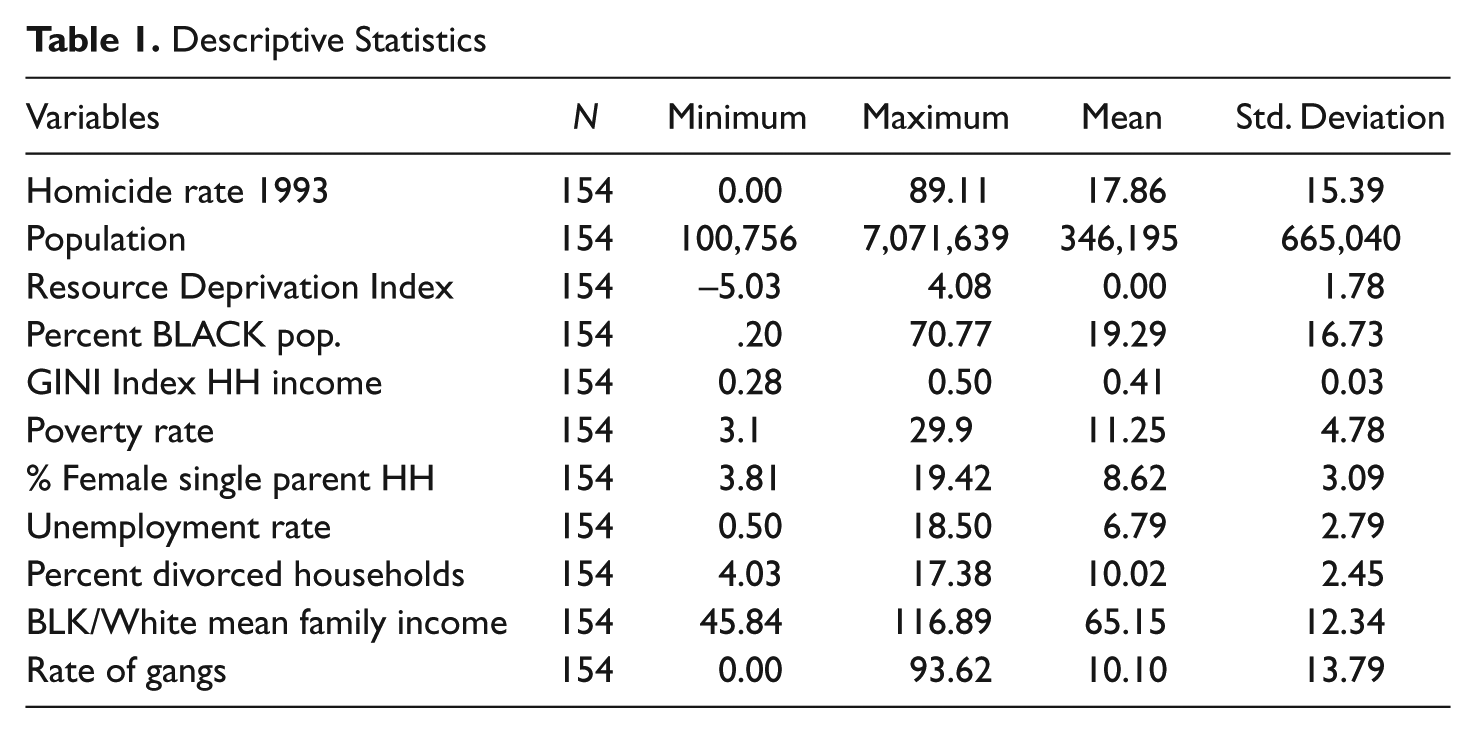
According to the FBI there were 24,530 homicides during 1993 in the United States and the national per capita rate for that year was 9.5 per 100,000 population. We note that the cross-sectional analysis that is highlighted for that year reflects a larger pattern of city violence rates that spiked during the 1990s. Kovandzic et al. (1998) notes that homicides in the United States are disproportionately located in large central cities. The sample data for this study confirm this observation since the mean homicide rate in this study sample is 17.86 per 100,000. The range in the data is substantial (range = 0 to 89.11), indicating that the national average, and even the average for large cities, masks substantial variation in homicide offense rates.
Table 1 shows the number of valid cases, minimum and maximum values, means, and standard deviations for the indicators used in this analysis.
Descriptive Statistics
Zero-order correlations are located in Table 2. The large intercorrelations between percent Black, the gini index, percent of households in poverty, and female single parent households suggest that collinearity may be present. Land et al. (1990) summarize inference problems that arise in the presence of high collinearity among structural predictors. In this analysis their approach is adopted to assess the dimensional space of the structural covariates using a principle components analysis.
Zero-Order Correlations
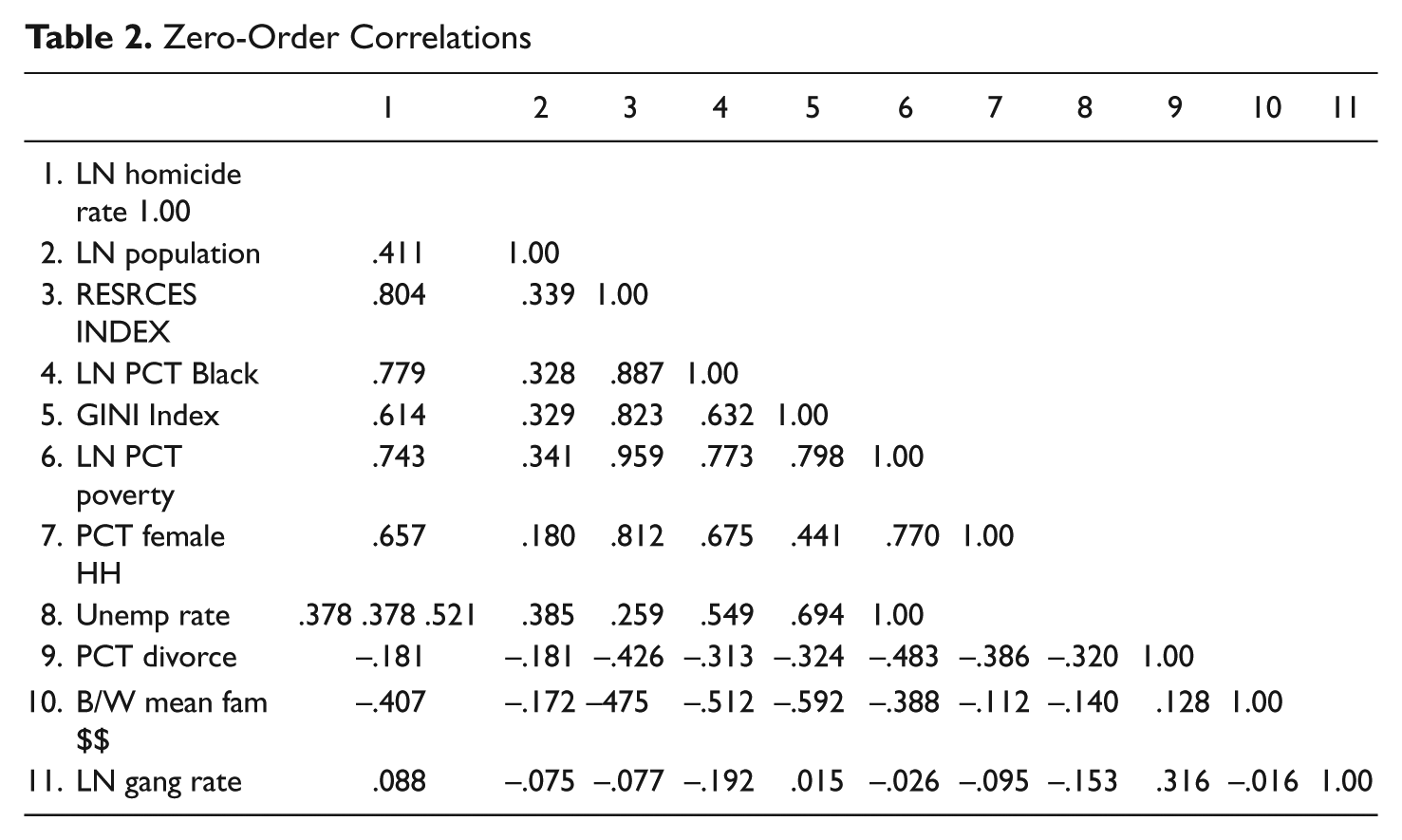
That analysis revealed substantial overlap in the dimensional space for poverty, income inequality (gini), female single-parent households, and percent Black population indicators. A single index of concentrated disadvantage was developed from these empirically overlapping measures. One limitation of this approach is that it is unable to assess unique effects associated with the indicator’s underlying components; however the approach addresses the interest of strengthening inferences about gang effects on aggregate homicide rates.
Histograms and corresponding univariate statistics showed positive skews for the population size and gang rate indicators and so a natural log transformation was applied (a constant of 1 was added to the gang indicator since several cities reported no active gangs). Examination of bivariate scatters, regression residuals, and regression partial plots provided reinforcing evidence that the data are multivariate normal. Also, tests for heteroskedasticity and omitted variables, available in STATA 10.0, never approach significance in the reported models.
Analysis of the Regression Results
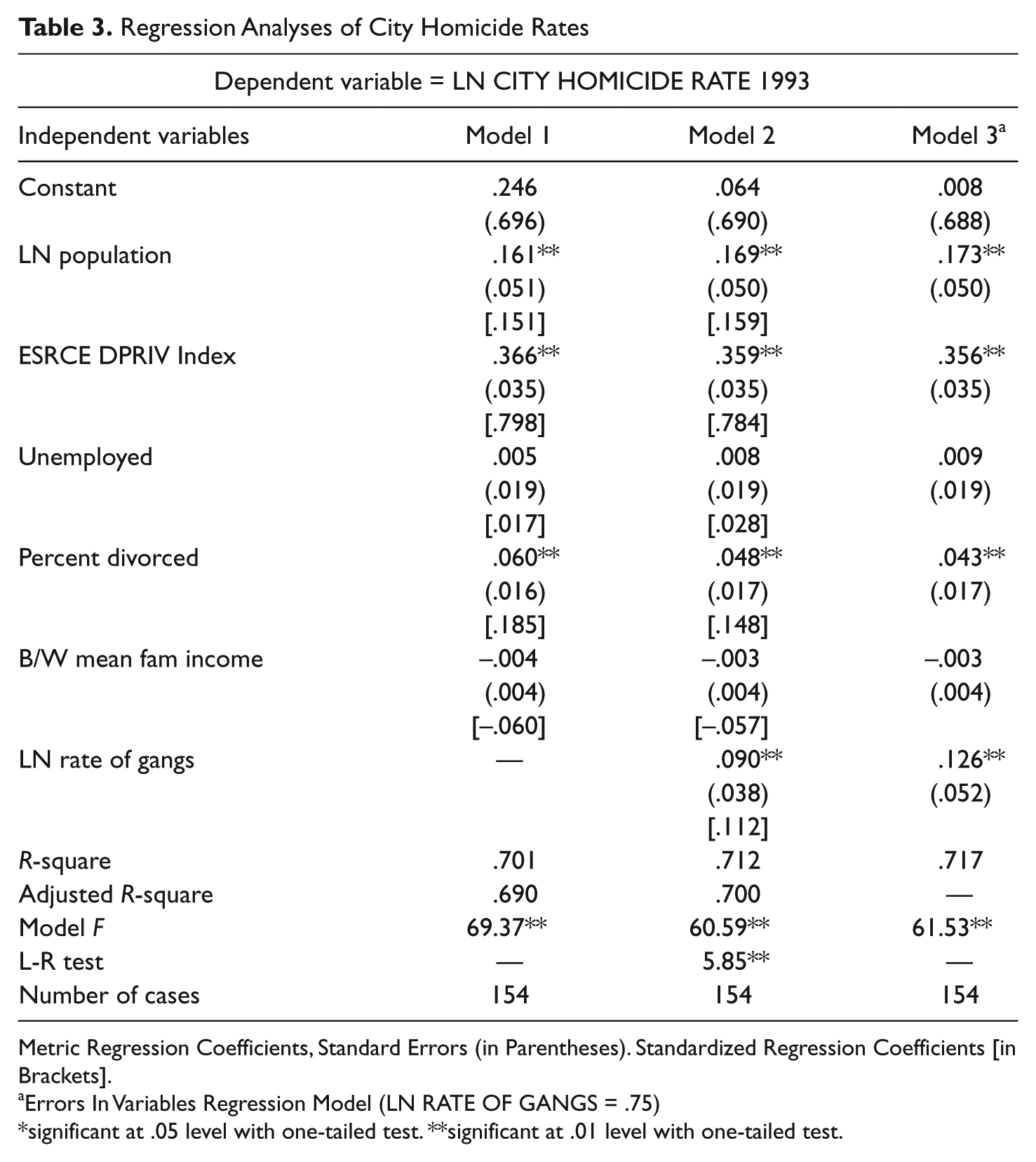
Table 3 includes three homicide model specifications. The statistical analysis begins with a model that includes structural covariates widely adopted in previous homicide research. The second model includes an indicator for the rate of active gangs to assess its unique effects on the dependent variable. Gang estimates may be plagued by measurement error and so the third equation shows estimates from an errors-in-variables regression model. This methodological approach is useful for assessing whether coefficient estimates are sensitive to specified levels of error in the measurement of the gang indicator (StataCorp, 2009). Finally, to supplement this analysis of the gangs-homicides thesis, in Table 4 we introduce the gang indicator as the dependent variable to assess whether structural sources of homicide also predict gang rate variation.
Regression Analyses of City Homicide Rates
Metric Regression Coefficients, Standard Errors (in Parentheses). Standardized Regression Coefficients [in Brackets].
Errors In Variables Regression Model (LN RATE OF GANGS = .75)
significant at .05 level with one-tailed test. **significant at .01 level with one-tailed test.
Regression Analysis of City Gang Rates

Note: Metric Regression Coefficients, Standard Errors (in Parentheses). Standardized Regression Coefficients [in Brackets].
significant at .05 level, with one-tailed test. **significant at .01 level, with one-tailed test.
Model 1 (Table 3) introduces the primary structural covariates studied in previous homicide research. The observed F-value for the first specification (69.37) indicates that the model taken as a whole accounts for significant variation in city homicide rates. The adjusted R2 (.690) provides further evidence of the model’s overall good fit. Model variance inflation (VIF) scores are all quite low (average VIF = 1.91) suggesting collinearity is not adversely affecting the regression estimates.
In the first model, several structural indicators used in previous research are significant predictors of homicide variation. Population size 12 and the divorce indicators are associated with heightened homicide rates, but the concentrated disadvantage index exhibits the strongest association within the model. As indicated in the literature review section, previous research emphasizes the importance of the underlying components in this index as key sources of homicide variation. Several studies (Land et al., 1990; Parker et al. 1999) summarize problems arising from the presence of collinearity and suggest a solution involving the construction of a combined index to address the problem. Principle components analysis was used to construct such an index and the regression results indicate that these factors together are closely associated with enhanced homicide rates. Note, however, that the Black/White mean income ratio and the unemployment rate are not significant predictors of homicide variation in this or any of the subsequent models.
Model 2 (Table 3) retains all of the previous structural indicators but also includes the gang indicator. The expanded model exhibits a slight overall improvement (adjusted R2 value of .690 in Model 1 increases to .700 in Model 2), and the gangs coefficient is positive and statistically significant. The Likelihood Ratio test statistic comparing Model 2 with Model 1 is significant (5.85) indicating that including the active gangs indicator results in a significant improvement in the overall fit of the model. 13
Gang researchers routinely note the key role violence plays in gang processes. This study draws conceptual insights from Cork (1999) concerning innovation and diffusion of drugs and guns and links the presence of active gangs to heightened rates of lethal exchanges. The quantitative evidence in Model 2 is consistent with these conceptual claims since after controlling for structural conditions that have been linked to homicide variation, an indicator for the presence of active gangs is significantly associated with increased city homicides. All of the structural covariates introduced in Model 1 are retained in Model 2 and those coefficients that were significant in the first model remain significant in the second model. VIF scores are minimal (average VIF = 1.81) in this model as well.
Comparing standardized coefficients [in parentheses], the strongest predictor in Model 2 is the concentrated disadvantage index. A one standard deviation change in this indicator, across cities, is associated with a .78 standard deviation change in the homicide rate. This substantial correlation underscores the devastating consequences associated with conditions of concentrated disadvantage in America’s central cities. By comparison, a standard deviation change in the gang rate indicator is associated with approximately a .11 standard deviation change in the homicide rate. In addition to these results, indicators on population size (.16) and divorce rates (.15) exhibit comparable though slightly stronger associations with the homicide rate.
The comparatively small substantive gang effect is noteworthy since many research reports emphasize that gangs are a key source of increased violence. Cork (1999)’s arguments imply that the presence of violent gangs most likely results in the proliferation of drugs, handguns, and homicides throughout city neighborhoods. This possibility is countered somewhat by qualitative research (Curtis, 1998; Venkatesh, 1997) linking gangs with more subtle and varied social processes. Their research provides evidence that at least some gangs adopt sophisticated institutional roles, resulting in the facilitation of violence, but also neighborhood stabilization. Both studies suggest that citizens living in violent neighborhoods expressed ambivalent attitudes concerning active gangs, while documenting that by the early 1990s some gangs may have already been developing new strategies to protect gang turf, maintain market shares, and reduce gang members’ exposure to street violence.
Additional Evidence: Using a 3-Year Average for Homicide Rates
We note at this point the possibility that the outcome of this study, the single year homicide rates for respective central cities, may exhibit instability since homicide is a relatively infrequent event, even in some major cities. To assess the stability of the homicide estimates, we constructed an alternative indicator that is a 3-year average (1991-1993) of each city’s homicide rate. After substituting this alternative dependent variable into the regression equations, we found that with the exception of the Black/White income ratio there were no substantive differences from previous models that incorporated a single year indicator for the homicide rates (see appendix). In this final specification the ratio indicator exhibits an inverse association with the homicide rate indicator, consistent with claims that as incomes approach parity homicides are decreased, holding constant the other indicators in the model. Not surprisingly, the overall model values are slightly improved as well (Adjusted R2 = .732).
Additional Evidence: Errors in Variable Regression 14
Law enforcement estimates of the number of active gangs may be characterized by an unknown amount of measurement error. 15 Model 3 (Table 3) explicitly models measurement error on the coefficient estimates with an errors-in-variables regression (available in STATA). The results show that the substantive results do not change when this alternative estimation method is used. Despite substantial changes in modeled measurement error (in unreported specifications) the patterns initially observed in the regression models are substantively unchanged.
Additional Evidence: Predicting Gang Rates
As Jackson’s 1991 research suggests, structural conditions may increase both the likelihood of gangs and homicides. Thus, extreme economic and social marginalization or concentration effects (Land et al., 1990; Wilson, 1987) may well predict homicide while also contributing to the proliferation of gangs. We assessed this possibility with a model that treats gangs as the dependent variable.
Model 1 (Table 4) shows that with the exception of divorces and violent crime the remaining structural covariates are not significant predictors of active gangs. These results show that gangs are not simply an outgrowth of these other structural factors but apparently emerge through the operation of other social mechanisms.
The divorce indicator however, is a significant predictor of gang variation. For any household, divorce typically results in the adult male leaving the home. For adolescents, the experience of divorce in the household may produce individual level anger and alienation while undermining respect for conventional adult role models, particularly adult male role models. One implication is that divorce and the sudden absence of adult male figures may contribute to a growing gang presence as young adolescents seek gang affiliations in order to foster male bonds and substitute role models while also addressing anger and alienation associated with family disruption (Anderson, 1994).
A high rate of local street violence also appears to correlate closely with the gang indicator and is suggestive that such violence may facilitate gang formation as a form of self-protection for members. Faced with threats of personal victimization, individuals may organize into informal gangs and thereby gain security that is unavailable through other conventional mechanisms such as intact families or police. In unreported analyses, the homicide rate indicator was substituted for the violence rate, producing similar results but the size and significance of the estimated coefficient was reduced. Other than the divorce and violent crimes, none of the additional structural predictors exhibit any statistical association with the gang indicator.
In sum, the model predicting the rate of active gangs exhibits quite low explanatory power. Structural covariates widely adopted in the study of homicide apparently are not strong predictors of rates of gangs across large U.S. cities. Yet once gangs form, their presence is linked to heightened rates of community violence. A substantial accumulation of literature backs this basic research finding, with claims made by many researchers that gang presence may be an important source of shifting patterns of violence.
Limitations of the Analysis
Given the weight often attributed to street gangs during the violence peak, we should identify potential factors that serve to temper the conclusions drawn from this research. The data used to construct the gang indicator were originally collected as part of a government study used to produce gang estimates for 154 central cities in 1992. Our effort to uncover other comparable gang indicators for years prior to this proved unsuccessful. Estimates published in later years by other researchers use different methodologies to generate counts. There are several reasons why it would not be viable to combine these distinct data sources into a single indicator. First, the methodology and data sources are not the same, and so we cannot be confident that they are measuring the same social phenomena. Also, attempts to use estimates from later years are problematic since later efforts of gang data collection occurred well after peak homicide years.
Finally, we note that the UCR Supplementary Homicide Reports (UCR-SHR) provide more detailed information than the UCR rates used in this research. Loftin, McDowall, and Xie (2008) suggest there are some geographic problems encountered pooling UCR-SHR data with city level census data; we suggest that if these problems could be overcome, the use of the UCR-SHR in future studies of this time period might be helpful.
Discussion and Conclusions
The data used in the foregoing analysis point to a period of peak violence in American central cities but we should not be too quick to draw a border between that period and the present. The diverse structural conditions that historically separated the dispossessed from middle class society have not abated and gangs today persist as a presumed source of violence in struggling cities across the country. The foregoing analyses have relevance to today’s society. Inequality continues to grow and joblessness is high. Gangs have not receded in terms of their relevance to street violence today. As it was during the peak of violent crime era during the 1990s, it is usually the disadvantaged and poor who are victims of gang violence. For the least well off, conditions since the early 1990s have not improved and indeed may have worsened in the years since this period of proliferating guns, drugs, gangs, and violence.
Insights taken from the extensive gang literature reinforce expectations that an empirical association exists between gangs and violence (Cork, 1999; Hagedorn, 1998; Johnson et al., 1990; Spergel, 1990). Previous aggregate research may have disregarded the importance of gangs as a contributing feature in city-level homicides. 16 The foregoing analysis indicates that the presence of gangs has a modest significant effect on patterns of urban homicide. These empirical results highlight an additional research consideration for aggregate crime researchers.
The research literature implicates gangs as an important feature of the overall urban landscape and as a factor influencing the quality of life for America’s most distressed urban populations. The analysis offered here provides empirical evidence consistent with the conceptual link. Optimistically, this investigation encourages the inclusion of gang indicators in future research to promote an improved understanding of gangs and their effects on patterns of violence. Future research could benefit as well from analysis of a racially disaggregated homicide indicator.
The discovery that gangs were a modest correlate of murder during the homicide peak may have implications for current social policies, as antigang ordinances have proliferated since the Reagan-Bush era. Law enforcement agencies operate on the assumption that the presence of gangs is an important predictor of city violence (Barrows & Huff, 2009). Many urban police agencies appear to gravitate toward militarization of tactics in matters of gang control (Kraska, 2001). Despite a downward trend throughout the last decade, American cities have continued to experience high rates of violence. Many criminal justice agencies have attempted to respond through enforcement of ordinances that are swift and severe in their targeting and efforts at gang suppression. Furthermore, many states have upped the ante, employing antiterrorist measures to target gangs. California was among the first, adopting a street terrorism policy during the late 1980s (Sigal, 2007).
The observed findings in this study provide empirical documentation consistent with a widely operating thesis in the gang literature, and with conventional wisdom as well. Public officials throughout the country appear to have disproportionately responded to this conventional wisdom with repressive policies and associated police enforcement tactics. This study calls that choice into question. It is all too easy to respond to violence in kind without consideration to alternatives. We note that the development by many jurisdictions of antigang ordinances represents a distinctly repressive orientation in urban public policy.
Barrows and Huff (2009) suggest antigang ordinances have introduced threats to civil liberties that involve misclassification of certain gang members as terrorists. Also, research by Parenti (2008) is relevant here because it highlights how the confluence of police practices, city ordinances and political rhetoric bring about a blurring of the distinction between gangs, crime and terrorism. He drew particular attention to the justification of militarized police presence and activation in Fresno, California in response to perceived gang activity. Parenti (2008, p. 122) reports that law enforcement agencies throughout the state use a set of criteria to identify alleged “street terrorists.” Such determinations include: associating with gang members; having gang-style tattoos; making gang hand signs; and wearing gang clothing (such as red and blue jackets or baggy pants). Parenti (2008, p. 122) explains that “If a person meets 3 of these criteria, he or she is entered into the CAL Gang Database as a known gang member. To be deemed an associate, one need only meet two of the criteria.”
Parenti highlights the increased militarism that police agencies have adapted and its effects on social justice. Other researchers (Costanza, Helms, Ratansi, Kilburn, & Harmon, 2010; Kraska, 2007) suggest that heightened militarization of police activity may have adverse effects on social justice for communities. By virtue of residing in a certain community with a high level of gang membership, civilian (nongang affiliated) residents are at risk of being targeted by police agencies or otherwise becoming collateral victims of proactive policies that seek to aggressively target gangs. Meanwhile, those who can afford to escape the most impoverished inner city areas are able to minimize their exposure to gang activity and enhanced enforcement activities.
This study shows quantitative evidence consistent with the theorized gangs-homicides association but the size of the effect relative to other indicators in the model invites speculation. Despite this study’s emphasis on innovation and diffusion (Cork, 1999), it is possible that gangs vary substantially in their embrace, and actual use, of instrumental violence. One alternative piece of research emphasizes the effects of gangs on the sustained decline in city level violence. Curtis (1998) asserts that the decline in New York City violence during the middle 1990s was in part attributable to evolving activities of certain gangs in stabilizing public spaces and protecting their members from street-level violence.
Venkatesh’s field research (1997) evokes a similarly complex social role associated with the presence of gangs. In central cities, particularly in the early 1990s, the vacuum left by other diminished social institutions (families, local schools, the economy, the political system, local police) opened up new opportunities for those who were willing to innovate and use violence to achieve their objectives. In pursuing the interests of their own members, gangs seem to have contributed to an increased level of overall violence while at the same time narrowing the institutional divide by linking socially and economically isolated neighborhoods to prevailing economic and social processes (Hagan, 1994). Through their instrumental and sometimes violent actions, gangs also may unwittingly have aided social regulation and order when other social institutions failed to address elementary community needs. Gang-centered social processes, from this view, appear to have contributed to heightened violence while also facilitating neighborhood economic survival. These opposing contributions would seem to appear simultaneously in economically devastated neighborhoods.
These divergent insights from the gang research illuminate important though contradictory dimensions of urban social life. Moreover, they provide justification for additional research directed to advancing our understanding of the sociological significance of gangs. Evidence presented here, along with evidence from studies that use other methodological approaches, underscore the important benefits of employing complementary methodologies to assess and document the complex social reality of America’s cities. Future research should benefit from further development of sociological themes highlighted here and may be expected to advance current understanding of how active gangs influence urban homicide rates.
Footnotes
Appendix
Declaration of Conflicting Interests
The author(s) declared no potential conflicts of interest with respect to the research, authorship, and/or publication of this article.
Funding
The author(s) received no financial support for the research, authorship, and/or publication of this article.
Notes
Bios
References
Supplementary Material
Please find the following supplemental material available below.
For Open Access articles published under a Creative Commons License, all supplemental material carries the same license as the article it is associated with.
For non-Open Access articles published, all supplemental material carries a non-exclusive license, and permission requests for re-use of supplemental material or any part of supplemental material shall be sent directly to the copyright owner as specified in the copyright notice associated with the article.
