




Abstract
This research is concerned with developing and testing models of political legitimacy as a predictor of homicide on the cross-national level. Specifically, we used Bruce Gilley’s (2006) theoretically driven indicator of political legitimacy to examine its direct and moderating effects on homicide. This measure is available for 65 nations, and is composed of indicators representing a state’s capacity to obey its own laws (legality), the degree to which civil and political values coincide (justification), and the level of behavioral consent of the people (consent). After controlling for a number of widely acknowledged predictors, legitimacy was found to be significantly negatively related to homicide.
Keywords
Introduction
More than a decade ago, Gary LaFree (1998) proposed that the dramatic rise in street crime in postwar United States was due to the declining legitimacy of political, economic, and family institutions. He argued that as perceived illegitimacy grew, social controls failed and crime increased. This problem of “losing legitimacy” is familiar to researchers of civil conflict, war, and political violence. Scholars in Latin America (Huggins, 1991; Kruijt & Koonings, 1999; Palacios, 2006; Pèrez, 2003/2004), Africa (Englebert, 2002; Fanon, 1965) and Eastern Europe (Karstedt, 2003; Sergeyev, 1998) have been investigating the problem of legitimacy and violence for years. Historical research on Europe (Eisner, 2001; Spierenburg, 2008) and the United States (Roth, 2009) suggests that lethal violence declines as states consolidate power and become more legitimate. Yet political legitimacy is virtually ignored in cross-national criminological research (cf. Chamlin & Cochran, 2006).
Political legitimacy, simply put, is the right to rule. Bruce Gilley (2009, p. 499) argued that “[t]he concept of political legitimacy is central to virtually all of political science because it pertains to how power may be used in ways that citizens consciously accept.” In other words, perceptions of political legitimacy may hold the link between state and institutional characteristics and individual behaviors. This article aims to fill this gap by examining concepts of political legitimacy and offering the first cross-national analysis of the relationship between political legitimacy and homicide using a large 65-nation sample. We seek to explore how differences in perceived state legitimacy may contribute to levels of homicide.
What is Political Legitimacy?
Many social scientists draw from an attitudinal conception of legitimacy, where the definition and measurement of what is legitimate depends on consensus or belief as to what is legitimate (e.g., Chamlin & Cochran, 2005, 2006; Kane, 2005; Tyler, 1990). In contrast, political scientists (Beetham, 1991; Coicaud, 2007; Gilley, 2009), as well as penologists (e.g., Liebling, 2004; Sparks, Bottoms, & Hay 1996) argue that legitimacy is a multidimensional concept concerning not only citizens’ attitudes, but also the behaviors and norms of the regime as well. Beetham (1991) specifically rejects the singular attitudinal view of legitimacy, arguing that public opinion alone does not drive legitimacy. Instead it is determined by the degree to which actions taken by the state comply with underlying norms and values. Gilley (2009, p. 11), following Beetham, defines legitimacy on a continuum, where “a state, meaning the institutions and ideologies of a political system, is more legitimate the more that it holds and exercises political power with legality, justification, and consent from the standpoint of all its citizens.”
This tripartite definition requires further explanation. Legality concerns the state’s accordance with its own laws and constitution (Beetham, 1991; Gilley, 2009). Here, power wielded is legitimate if it is done within the confines of law, legislative convention, or judicial judgements. Justification is essentially related to legality, where the laws governing authority must reflect generally shared norms and beliefs within the society. Of course there is room for contention within the realm of beliefs, as few societies can achieve complete homogeneity. Consent is the action taken by citizens that conveys agreement with the ruling power. This component is behavioral and, Beetham (1991) stresses, essential to understanding true levels of state legitimacy as perceived by its citizens.
O’Kane (1993) offers a prominent criticism of Beetham, arguing that the components justification and consent are superfluous to a regime’s legitimacy, as they are difficult to measure and can be dangerously misleading due to the possibility of manipulation and coercion. She gives the example of the Soviet Union, where norms were made congruent through violent repression, and consent was ensured on penalty of imprisonment. (Il)legitimacy, according to O’Kane, is more accurately determined by a government’s actions, or merely the “legality” aspect of Beetham’s definition:
If a government uses violence, force, terror or coercion against people, there is no need to introduce an analysis of beliefs and their congruence or otherwise, in order to understand why people at the receiving end of that violence might think ill of the perpetrators. . . . (1993, p. 477)
O’Kane’s criticism falls short in one important way: Laws are not inherently legitimate. For example, many laws in postcolonial countries are simply left over from former colonial regimes. These laws typically do not reflect the norms and values of the indigenous people, but yet were created and implemented by “legitimate” means (Beetham, 1991). Discussing the case of postcolonial police in Ghana, Tankebe (2008) writes that: [t]he centrality of shared norms in the popular legitimation of power means that colonial policing necessarily lacked legitimacy because although the powers and actions of the colonial police might have been legal, in the sense that they operated according to British colonial law, they did not simultaneously express the accepted norms, values, and customs of the indigenous people of colonial Ghana. (p. 73)
Both Beetham and O’Kane seem to agree, however, that legitimacy cannot be defined solely in the beliefs-based manner.
However, one cannot dismiss beliefs (“justification”) as a component of legitimacy as there is still a need to bridge macrolevel characteristics with microlevel phenomena (Chamlin & Cochran, 2005; Liska, 1990; Short, 1998). Thus, although O’Kane’s reservations about the validity of citizens’ beliefs and actions are important, at least some measure of discontent is required to gauge the likelihood of norm-breaking behavior. In addition, every component of legitimacy, including legality, may be subject to manipulation: Illegitimate laws can be passed and followed by the state, beliefs can be forced or obscured, and consent can be coerced under severe penalty. In this sense, these issues of measurement are not much different from most concerns about measurement validity in the social sciences, of which triangulation is a key solution.
The Cross-National Theoretical Framework
In cross-national criminology, the theoretical focus tends to be on structural risk factors such as poverty, inequality, or demographic structure (e.g., Pridemore, 2008, 2011; see also Nivette, 2011). However, the study of political factors in comparative criminology is not novel (see Armatrudo, 2009). For example, some criminologists have examined the effects of democratic values and institutions on criminal justice and crime rates (see volume by Karstedt & LaFree, 2006; Lin, 2007; Sung, 2006). Researchers are particularly interested in investigating the affect of democratization on crime rates in Eastern Europe (e.g., Stamatel, 2009a) and Latin America (e.g., Imbusch, Misse & Carrión, 2011). Despite these important contributions, researchers are seemingly slow to incorporate political factors into cross-national theoretical and empirical models. In her survey of cross-national research, Stamatel (2009b, p. 17) emphasized that comparative criminologists must move beyond the limited explanatory power of traditional grand theories (e.g., modernization and conflict) to theorize about “regime types, efficacy and legitimacy of governments” and incorporate “political factors, especially the role of the state in maintaining law and order.”
Questions about the impact of modes of government, political regimes, and effectiveness are necessarily tied to the relationship between the state and order in civil society. For instance, Karstedt’s (2006) exploration of the nonviolent characteristics of democracies found that the values that promote social control and restraint of deviant behaviors (i.e., egalitarianism, individualism) are only advantages when states and their institutions are also fair and meritocratic. Although she does not focus on legitimacy, much of her argument alludes to Habermas’ (1976) “legitimation crisis” in that modern nation-states—in particular democracies—continuously struggle to meet the value-laden expectations of society.
The following section explores how legitimacy might fit into the broader theoretical framework of cross-national criminology. It is necessary to ground the following analyses in theory to develop plausible causal mechanisms that link legitimacy to homicide. Much of what follows draws from a “new institutional” approach in that it emphasizes the interdependencies and shared function of social control between political, social, and economic institutions (Karstedt, 2010). Karstedt (2010, p. 354) argued that institutional perspectives are beneficial because they “reject the ‘market determinism’ of neoliberal approaches and the account of linear progress and convergent modernization where all institutional regimes will be ultimately assimilated.”
Political Legitimacy and Homicide
There are several ways in which political legitimacy may be theoretically linked to levels of interpersonal violence, and in particular homicide.
Lack of Legitimacy and Social Control
One theory is that illegitimate states cannot maintain functioning social, economic, and family institutions, consequently eroding the mechanisms of social control. LaFree (1998; see also Hearn, 1997; Roth, 2009) argued that as humans are embedded in obligations and relationships within institutions, when these institutions begin to lose their “moral validity,” people feel less obligated to abide by their responsibility to social control and conforming behavior. He describes this breakdown occurring for both informal and formal social control (LaFree, 1998):
When members of a society begin to doubt the fairness of their political institutions, even if they themselves do not violate the laws, they become less enthusiastic agents for the social control of others. Parents, families, and neighborhoods do less to defend rules and respond less harshly to rule violations. Formal punishment by the legal system is less threatening and carries less of a stigma when applied. (p. 80)
Essentially, LaFree, drawing from Durkheim, proposes that social and political institutions are crucial to shaping wanted human behaviors and controlling unwanted behaviors. This perspective essentially follows the logic of social disorganization and breakdown theories, whereby humans are embedded in networks of obligations that maintain the need to peacefully cooperate, and disruptions to this established way of being releases individuals from these ties (Granovetter, 1985).
The primary mechanism here is the breakdown of informal social control. Legitimacy maintains order by instilling an obligation among individuals to conform to and police the rules without the need of coercion (Bottoms & Tankebe, 2012; Tyler et al., 2007). When governments fail to provide expected service (e.g., moral education) to the population, or act outside established norms and values, this obligation either disappears or becomes weak. Without an obligation to maintain self and informal social control, individuals are more likely to commit opportunistic and violent street crime.
This process of losing legitimacy has been observed in transitioning countries. For instance, Karstedt (2003) discerned that the increases in both street and “suite” crime in postcommunist countries was a function of the loss of trust in political and civil society. Similar to the consequences of political change in 1950s and 1960s United States outlined by LaFree, postcommunist societies went from a relatively solid integration of civil and cultural norms (if forced) to less secure and more uncertain situations, resulting in loosened social bonds and controls within society (see also Kim & Pridemore, 2005; Sergeyev, 1998).
Lack of Legitimacy and Self-Help
A second possibility is that a lack of legitimacy discourages citizens from using the criminal justice system to solve interpersonal conflicts. This argument is based on the ability of the state to solve conflicts and to provide justice, whereby a state’s illegal or corrupt actions may lead members of a society to increase levels of “self-help,” harkening back to violent prestate methods of “private justice” (Black, 1983; Eisner, 2009; Hobbes, 1996/1651). Here legitimacy is not about political and governmental functions on a societal level per se, but is nested rather in the most visible extension of the state: the police (Tankebe, 2008; Tyler & Fagan, 2008). Where the police are perceived as illegitimate agents of social control and order maintenance, citizens may fill this gap—or this “unavailability of law” (Cooney, 1997)—with their own tools of conflict resolution, including violence. This draws from Black’s (1983) idea of “crime as social control,” wherein a criminal act is imbued with moral meaning. Homicide in this sense is the product of “disorganized vigilantism” (Eriksson, 2009, p. 49), or an act of private capital punishment enacted in response to some perceived wrong, affront, or injustice (see also Cohen & Nisbett, 1994; Eisner, 2009).
This perspective is largely based on Weber’s (1978) idea (drawing from Hobbes’ Leviathan, 1996/1651) of the legitimate state as the only arbiter over the use of violence (see also Elias, 2000/1939). Hence in legitimate states, the political “struggle” over the “rule of man over man” is relegated to courts of law, contractual agreements, and nonviolent conflict resolution. Civil society, for the most part, accepts the appropriation of violence by the state. 1 And when the state is considered illegitimate, civil society may reappropriate this tool to use in the course of continuous political “struggle.”
For instance, Pèrez (2004) found that victimization and insecurity are significant factors related to perceptions of illegitimacy in democratic institutions in Guatemala and El Salvador. Holston (quoted in Pèrez, 2004) argues that the process is circular:
In such uncivil democracies, violence, injustice, and impunity are norms. As a result, uncivil electoral democracies share certain significant features of citizenship. Their institutions of law and justice undergo deligitimization; violent crime and police abuse escalate; the poor and the ethnically other are criminalized, dehumanized and attacked; civility and civil protection in public space decline; people abandon the public to retreat behind private security; and illegal measures of control receive massive popular support. (p. 628)
Thus rising violence leads to increased perceptions that the state is ineffective (i.e., not doing its job), which results in citizens relying on extralegal methods of crime control. Importantly, Pèrez points out that these actions and reactions usually occur among the poor and marginalized, where the effects of regulatory failures, civil rights abuse, and political insufficiencies are often experienced first.
Lack of Legitimacy, Inequality, and Homicide
The third possibility is that an illegitimate state does not allocate resources fairly, leading to frustration, distrust, and ultimately violence. This is essentially a social contract perspective, in which one of the primary foundations of the modern state is an agreement of compliance from citizens in exchange for a fair distribution of services for citizens, including justice (Habermas, 1976; Rawls, 1999). If rules of reciprocity between the state and its citizens are violated, the chances increase that conflicts will occur in everyday life.
One of the best established findings of cross-national research is that homicide rates are strongly correlated with levels of inequality (see Nivette, 2011). Given the robust and consistent association, the question arises whether and how political legitimacy interacts with social inequality in generating homicide. Some authors have argued that high levels of social inequality are associated with homicide because high inequality represents a violation of rules of distributional fairness (Blau & Blau, 1982; Chamlin & Cochran, 2005, 2006; Durkheim, 1947). However, Gilley strived to include some of the However, distributive injustice may only be corrosive to civility in states where democratic ideals are championed and inequalities are based on ability and achievement rather than inheritance (Chamlin & Cochran, 2005; Weber, 1978). Thus the affect of political illegitimacy on homicide may be limited to conditions of high distributional fairness (i.e., low inequality).
Hypothesis
Despite the potential explanatory power of state legitimacy, criminologists have given sparse theoretical attention to the affect states may have on social order and citizens’ behaviors. A recent meta-analysis suggested that most predictors used in cross-national research relate to domains such as social disorganization, economic deprivation, and demographic characteristics (Nivette, 2011). Generally, very few studies have examined predictors that measure aspects of the political system, and none have explicitly modeled the effects of political legitimacy. It is also clear that legitimacy is a complex and multidimensional concept that may affect social order through a variety of mechanisms. Although this study cannot disentangle these potential mechanisms, it can offer the first cross-national empirical look at the relationship between a state’s political legitimacy and homicide. Specifically, we examine the hypothesis that politically legitimate states have lower levels of homicide than illegitimate states.
Method
Sample
Many cross-national studies are limited by a lack of available and reliable data (Neapolitan, 1997). Indeed, there are no cross-national surveys that are specifically designed to measure political legitimacy. Even Bruce Gilley’s (2006, 2009) indicator used here covers only 72 nations, a large portion of which are Western, industrialized democracies. However, Gilley strived to include some of the most populous non-Western states (e.g., China, India, and Bangladesh) to be more representative of the world’s overall population. Because of missing data for economic inequality and female labor force participation, the sample was reduced to 65 countries (see Appendix A for full list). The current sample, covering nearly 79% of the world’s population (United Nations Statistics Division, 2011), is nevertheless a marked improvement over most cross-national studies, where the average sample size is 44 countries (Nivette, 2011).
Dependent Variable
The dependent variable for these analyses is the natural log of homicides per 100,000 people drawn primarily from the World Health Organization (WHO; 2009), and supplemented by data from the Pan American Health Organization (PAHO). The PAHO act as a regional office for the WHO and therefore use the same homicide definitions based on the International Classification of Disease codes (PAHO, 2007). The WHO data are often considered the most reliable among cross-national criminologists as they use a standardized definition, which includes intentional homicide that does not occur in the context of war or legal intervention (WHO, 2007).
Independent Variables
Political Legitimacy
To represent a state’s level of political legitimacy, we used Gilley’s (2009) cross-national indicators, which he theoretically derived from David Beetham’s (1991) definition. Beetham’s (1991) model, used by political scientists and penologists, argues for three components of legitimacy—legality, justification, and consent—representing government conduct, citizens’ perceptions, and citizens’ actions, respectively. The subcomponents justification, legality, and consent were constructed using international surveys and datasets, such as the World Values Survey, the EuroBarometer, the World Handbook of Political and Social Indicators, and the International Institute for Democracy and Electoral Assistance (see Appendix B for more details).
Gilley then combined the components and weighted scores in favor of the subcomponent justification to create an aggregate score ranging from 0 to 10. By weighting in favor of justification, he aimed to emphasize the importance of “moral justification . . . because that power underwrites the laws and rules that govern so much of the rest of social and economic life” (Gilley, 2006, p. 510). Gilley’s dataset covers 72 nations, 65 of which are included in this study. 2
Economic inequality
Economic inequality has been shown to be a strong and robust correlate of homicide at a cross-national level (LaFree, 1999; Messner, Raffalovich, & Shrock, 2002; Nivette, 2011; Pridemore & Trent, 2010). Measures of income in equal are represented by the ratio of the top 20th percentile’s share of wealth to the bottom 20th percentile’s gathered from the World Income Inequality Database compiled by the United Nations University World Institute for Development Economics Research [UN-WIDER] (2008). This operationalization was preferred over the more common Gini Index because of concerns about its cross-cultural and methodological validity depending on the type of data the used to calculate the coefficient (Blanco, 2010; Kovandzic, Vieraitis, & Yeisley, 1998; see also Pratt & Godsey, 2002, 2003). More specifically, Kovandzic et al. (1998) point out that Gini coefficients based on grouped data tend to underestimate the share of income held by the highest percentage. Income distribution data are from the year 2004. As income inequality is generally considered a slowly changing concept (Messner et al., 2002), missing data points were filled by data from the nearest year, but not exceeding more than 10 years.
Poverty
Infant mortality, measured as the number of deaths per 1,000 births, was used here as a proxy to control for levels of poverty. Pridemore (2008, 2011) has stressed the importance of controlling for poverty in cross-national models because of the strength and robustness of the poverty-crime association in subnational research (see also Messner, Raffalovich, & Sutton, 2010; Pratt & Cullen, 2005; Pridemore & Trent, 2010). Researchers observe that infant mortality is a more valid measure for poverty because it is not reliant on income-based representations of general material well-being (i.e., Gross Domestic Product per capita), and captures broader notions of social inclusion (Messner et al., 2010). In this sense, infant mortality is an important component to consider alongside political legitimacy; high levels of deprivation and social exclusion may multiply frustrations with a perceived illegitimate government, causing increased levels of violent reaction, or “self-help.” Data refer to the year 2000, and were drawn from the WHO. The natural log was taken in to adjust for skewed data (Neapolitan, 1997).
Female labor force participation
A measure of women’s participation in the workforce is used in cross-national criminology to represent both the disorganizing forces of modernization (Neumayer, 2003) as well as a lack of parental guardianship in the home (Gartner, 1991; see also Nivette, 2011). The implied consequence of these two perspectives is similar; the family is disrupted, affecting the efficiency of informal social controls that prevent deviant behavior (Shaw & McKay, 1942). The data were drawn from the United Nations Statistics Division (2008), and refer to the year 2004.
Demographic controls
To account for population composition, the total population growth rate from 2000 to 2005 and the proportion of the male population aged 15 to 24 for the year 2004 were taken from the United Nations Department of Economic and Social Affairs (2009) World Population Prospects. The former reflects a potential disruption to social order caused by rapid increases in population, or alternatively, a simple linear relationship where faster growth leads to more homicide. The percentage of young males is a common demographic control used in cross-national models to represent the theoretically most criminogenic cross-section of the total population (Hirschi & Gottfredson, 1983; Karstedt, 2001; Nivette, 2011).
Model Specification
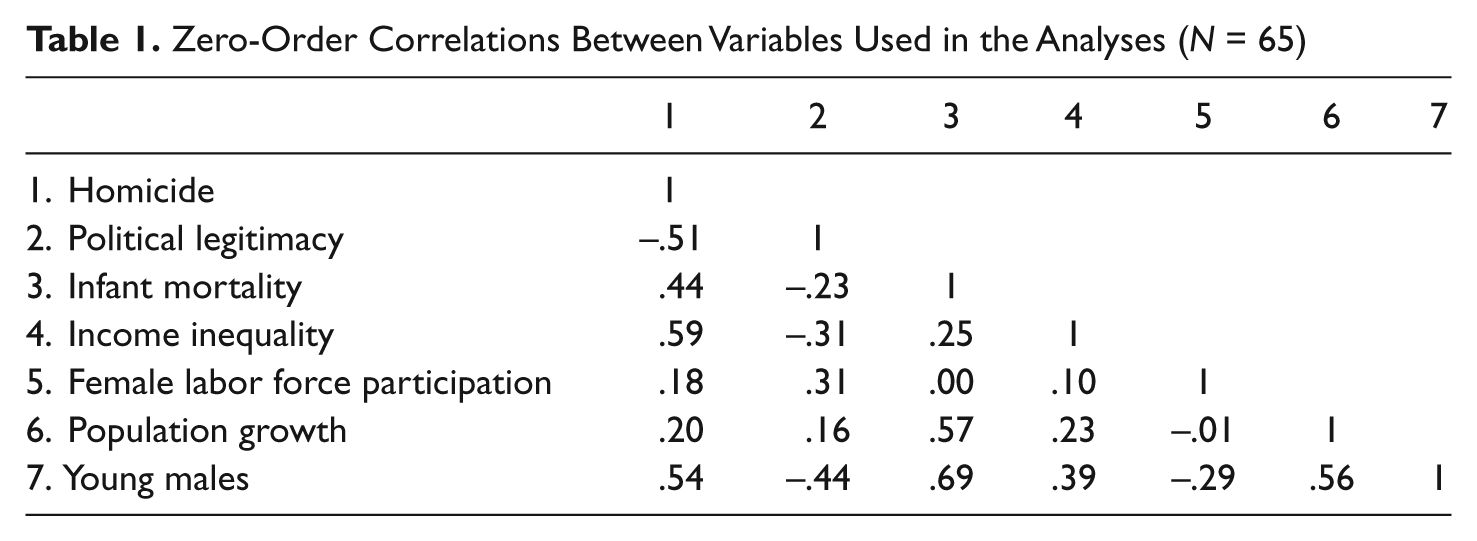
The models for this analysis are estimated using Ordinary Least Squares [OLS] regression techniques. Several steps were taken to ensure OLS assumptions were met. First, independent variables are sometimes highly correlated with one another, obscuring the affect of any one variable. The zero-order correlations indeed revealed issues of multicollinearity, particularly between infant mortality and the percentage of young males. High correlations are not in themselves indicative of multicollinearity, so the Variance Inflation Factor [VIF], or the extent to which the variance is affected by collinearity, was examined for each model. In instances where the VIF exceeded the threshold of 5 (Champion & Hartley, 2010), models were estimated with and without the young male indicator to detect any significant changes or “partialling fallacy” (Cambell, Edwards, Booth, & Hudis, 1981; Gordon, 1967). A partialling fallacy occurs when two or more independent variables are interrelated, masking their true effects on the outcome.
Second, residual plots were examined to detect unequal variance in the residual terms, or heteroskedasticity. An examination of residual plots and a test for heteroskedasticity in Stata (Statacorp, 2009) revealed that this was indeed a problem. However, traditional methods used to adjust for heteroskedasticity (namely, Weighted Least Squares [WLS] regression) were not able to correct for this violation. On inspection of the residuals, two cases were pinpointed as outliers (Peru, residual = −1.82 and South Africa, residual = 1.75). 3 When these cases were excluded, it was possible to correct for subsequent heteroskedasticity using WLS methods. WLS accounts for unequal variations by weighting the variables by their appropriate influence, which in most cases is population size (Pridemore, 2008). Thus each heteroskedastic model included the inverse of each nation’s population as a weighting variable. 4
Moderator effects were tested with the interaction term Political Legitimacy × Income Inequality. Before doing so, the target independent variables were centered by their means to assure minimal multicollinearity in the interaction model (Aiken & West, 1991).
In addition, as we are examining legitimacy as a predictor for the first time, a series of sensitivity tests were conducted to ensure the results were not because of model specification. Various indicators were substituted or added to the model: the Gini Index (UN-WIDER, 2008) in place of income inequality measured by ratios, gross domestic product per capita for the year 2004 (United Nations Statistics Division, 2011) for infant mortality, and a dummy variable for Latin American nations added for regional effects (Neapolitan, 1994; Nivette, 2011).
Results
Bivariate Results
The zero-order correlations (see Table 1) show that the strongest correlates with homicide are income inequality (r = .59), the percentage of young males in the population (r = .54), and Gilley’s political legitimacy indicator (r = −.51). There are other high correlations between the control variables, namely between infant mortality and youth male population (r = .69). However, in most cases the Variance Inflation Factors were not high enough to warrant concern (Fisher & Mason, 1981).
Zero-Order Correlations Between Variables Used in the Analyses (N = 65)
Multivariate Results
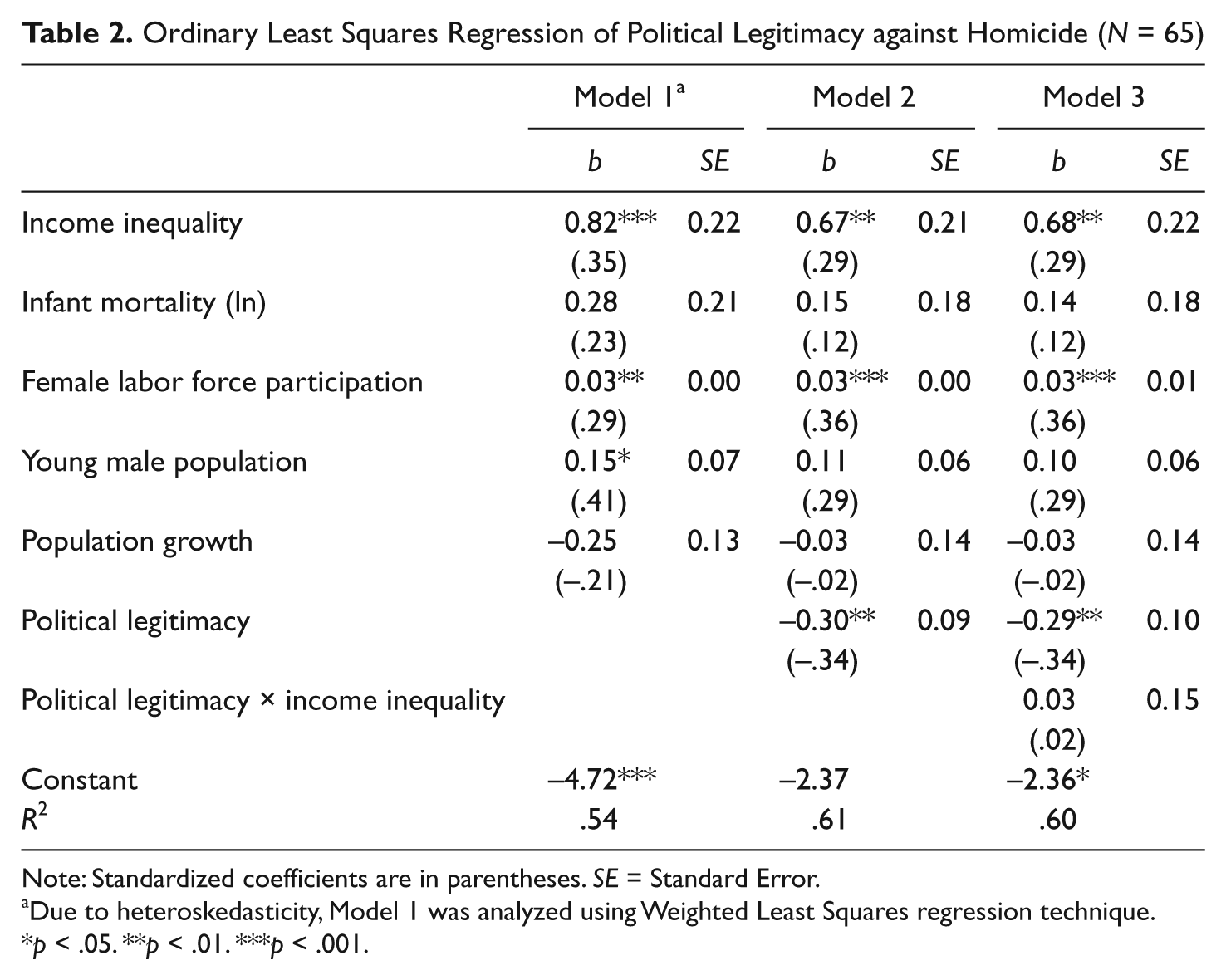
Table 2 shows the results for the 65-nation sample. Model 1 displays the unstandardized and standardized regression coefficients for homicide regressed on the baseline model, whereas Models 2 and 3 show the results when political legitimacy and the interaction term were included.
Ordinary Least Squares Regression of Political Legitimacy against Homicide (N = 65)
Note: Standardized coefficients are in parentheses. SE = Standard Error.
Due to heteroskedasticity, Model 1 was analyzed using Weighted Least Squares regression technique.
p < .05. **p < .01. ***p < .001.
Income inequality, as expected from previous research, remains a robust correlate of cross-national homicide with standardized coefficients ranging from .29 to .35. Interestingly, infant mortality, Pridemore’s (2008) indicator for poverty, was insignificant across models. However, as noted above, this may be the result of a “partialling fallacy,” whereby multicollinearity with the indicator for young males obscures the relationship. In consequence, the significance is attributed to the indicator with the highest bivariate correlation with homicide; young males (Gordon, 1967). Thus the nonsignificance of infant mortality should be interpreted with caution. In Models 2 and 3, political legitimacy shows a strong, negative correlation with homicide (β = −.34, p < .001). However, the interaction term was nonsignificant. 5
Sensitivity Analyses
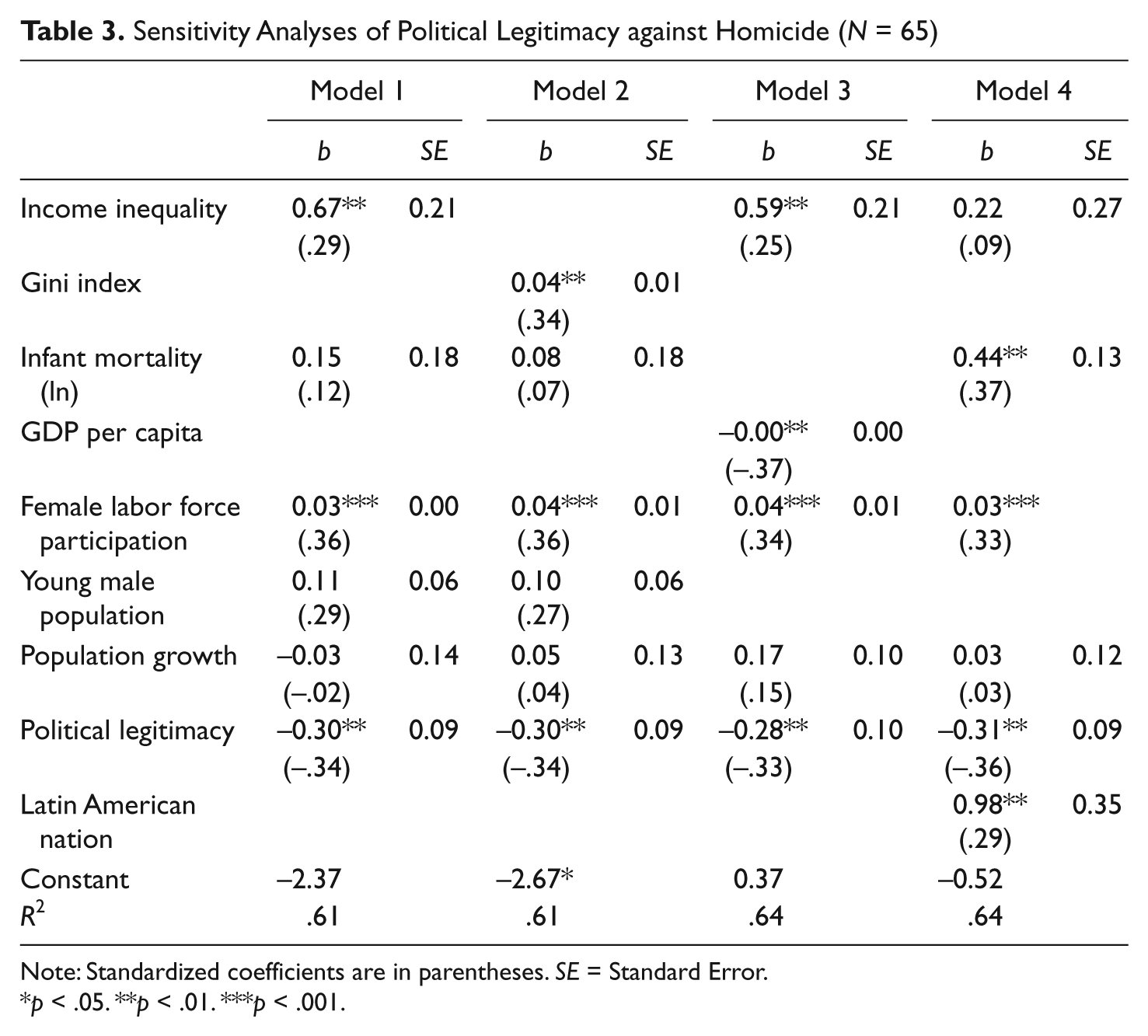
A series of sensitivity analyses were carried out to ensure the results truly reflect the proposed relationship between legitimacy and homicide, and are not an artifact of model specification. Additional WLS and OLS regressions were run substituting alternative measures of control variables. The results are shown in Table 3.
Sensitivity Analyses of Political Legitimacy against Homicide (N = 65)
Note: Standardized coefficients are in parentheses. SE = Standard Error.
p < .05. **p < .01. ***p < .001.
Model 1 recounts the results for political legitimacy regressed on homicide as specified in Table 2. Models 2 and 3 examine alternative measures of income inequality (Gini Index) and poverty (Gross Domestic Product per capita) respectively. Model 4 displays results including the strong regional predictor for Latin America. In Models 3 and 4, we removed the young male predictor because of multicollinearity.
The most important finding to notice is that political legitimacy remained significant across specifications. Indeed, the substitution of well-known risk factors as controls minimally altered the coefficient for legitimacy. 6
Discussion
David Beetham (1991, p. 3), begins his pivotal analysis of legitimacy with the statement “[t]he exercise of power by one person over others, or by one group over another, is a basic recurrent feature of all societies.” It is surprising then that legitimacy is rarely, if ever, evaluated in cross-national research on crime. When attempting to understand crime at the state level, it would seem only logical to include some measure of state functioning. The findings of this study suggest that the state indeed matters to social order. The independent effects of legitimacy on levels of homicide are approximately as strong as some of the well-established predictors such as income inequality and development. If calculated as a standardized effect size, the effect of legitimacy would be about d = .70. Furthermore, we tested whether legitimacy mattered only in equal societies, that is, whether effects are limited to countries with particularly democratic and socially equitable characteristics. The answer is no; legitimacy seems to matter both at low and high levels of inequality.
Bruce Gilley’s (2009) indicator of political legitimacy used here is beneficial over previous studies’ use of singular attitudinal measures (e.g., Chamlin & Cochran, 2006; see also Weatherford, 1992) or secondary data with questionable content validity (e.g., Crespo, 2006). The legitimate state, as measured in this article, is one that evokes confidence in its ability to provide fair and equal rights and protection, conducts its government according to citizens’ values, and does not prey on its citizens (i.e., through political violence; Gilley, 2006). Tested against a number of controls, the robust results show that where polities are considered legitimate, homicide is low.
This means that the state, its actions, and the quality of its services to civil society are important to establishing and/or disrupting social order. Criminologists and political scientists who have studied Latin America, post-Communist nations, and neighborhood-level policing surveys have long understood the affect of political institutions on the effectiveness of social and criminal justice agents in preventing disorder (Englebert, 2002; Huggins, 1991; Karstedt, 2003; Kruijt & Koonings, 1999; LaFree, 1998; Palacios, 2006; Sergeyev, 1998; Tyler et al., 2007). The purpose of a cross-national design is to examine how crime varies across countries, yet many criminologists neglect the theoretical and empirical meaning of their unit of analysis. Gilley (2009) explains why the state is so important to order, and ultimately violence:
States represent institutional and ideological organizations that provide outputs—both expressive and substantive, moral and material—evaluated by citizens in terms of some conception of the common good. Those evaluations in turn shape how citizens interact with the state, critically determining its strength and efficacy. (p. 210)
In other words, the state is irrevocably intertwined with citizens through the concept of legitimacy (see also Karstedt, 2010). The cross-national study of crime and violence would be remiss to omit this central “organizing principle” (Helman, 2001) when constructing theoretical and analytical explanations of social order.
Importantly, Gilley (2009) emphasizes the independent affect of political legitimacy on political and social order. Although our research shows that political legitimacy, poverty, and development share some variance, legitimacy consistently proved to be a strong and independent predictor of homicide. In this case, it is not sufficient to attribute the affect of legitimacy to structural factors and vice versa. Improvements in one area may increase the other, that is, legitimacy may improve the conditions for economic growth (Barro, 1996, 2000; Bates, 2008), but legitimacy remains a predictor of social order. Thus to reduce violence, efforts to advance development, democratize and increase economic growth should ideally be accompanied by the cultivation of legitimacy through mutual trust, transparency, and fairness (Gilley, 2009).
Further Research
The next step is to incorporate concepts of the state and political order into cross-national and subnational criminological theory and analytical models. Researchers should look further at mediators to test possible pathways through which legitimacy affects homicide. We proposed that the modern state holds three important roles in relation to order: To develop and maintain social institutions that embed morality and social control into everyday life (e.g., LaFree, 1998), to maintain a monopoly over the use of violence by providing protection and justice to its citizens (e.g., Black, 1983), and fairly distributing social and material resources (e.g., Chamlin & Cochran, 2005).
The first pathway situates legitimacy in the context of institutions. This mechanism hinges on the assumptions that citizens are first committed to the institution and second that citizens will withdraw commitment once they perceive or experience illegitimacy. An important confounding factor to consider in this context is “dull compulsion,” or pragmatic compliance that stems not from moral commitment but from the belief that the environment is beyond control (Bottoms & Tankebe, 2012; Carrabine, 2004; Mann, 1970). Theoretically, if citizens merely comply without committing to institutional rules, they are unlikely to actively police the monopoly of force (i.e., participate in informal social control). Illegitimate polities and institutions induce the withdrawal of moral commitment to the nonviolent rules of social interaction, but they may also lead to routine obedience. Researchers should investigate under what circumstances individuals are led to dull compulsion, and subsequently how various motivations for compliance affect participation in institutions, informal social control, and ultimately violence.
The second pathway proposed that illegitimate states do not provide (or that they discourage) legitimate outlets of conflict resolution (Cooney, 1997). This leads citizens to reject the state’s right to hold the monopoly of force and reappropriate violence for self-help (Black, 1983). To test this relationship, we must consider several questions about the nature of self-help. Violent self-help may manifest as a range of individual, group, and collective behaviors, from everyday criminal activities (e.g., homicide, assault, robbery, vandalism, or theft) to organized vigilantism (e.g., lynching) to violent revolution, and even terrorism (see, for example, Black, 2004; Rosenfeld, 2004; Tankebe, 2009). The question is: Under what circumstances are certain types of self-help used? When, for instance, does capital punishment (homicide) occur as opposed to physical punishment (assault)?
The third pathway proposed that unfair resource distributions delegitimize the state in egalitarian contexts, leading to institutional breakdown and conflict (Chamlin & Cochran, 2005). Although we found that the effect of legitimacy was not confined to conditions of high distributional fairness, inequality, and illegitimacy may still be intertwined. Chamlin and Cochran (2005) emphasized the distinction between earned (legitimate) and ascribed (illegitimate) inequalities. They argued that ascribed inequalities lead citizens to withdraw commitment from social institutions, damaging informal social control. This mechanism is similar to the one proposed by LaFree (1998), suggesting that there may be potential for theoretical integration. Future research should investigate where and how inequalities emerge, how citizens interpret and tolerate these hierarchies, and how disparities in different institutions relate to other social forces (e.g., development, democracy).
Furthermore, the process of building and losing legitimacy is essentially a longitudinal phenomenon, and cross-sectional analyses capture only a snapshot of how the government is perceived and functioning at that particular time. As the recent uprisings in the Middle East have shown, years of simmering frustrations and growing opinions of ineffectiveness can suddenly boil over, resulting in a rapid shift in power and legitimacy (see Albrecht & Schlumberger, 2004; Weinberg, Pedahzur, & Perlinger, 2009). However, empirical longitudinal analyses on this topic (including this one) are hindered by a lack of data representing legitimacy (and indeed, crime). As large-scale surveys such as the International Crime Victimization Survey, the World Values Survey and the Latinobarometer continue to collect attitudinal data, criminologists must shift analyses toward longitudinal designs.
It is important to note that the particular conceptual model examined here may limit these results. Although Beetham’s model contains separate components—legality, justification, and consent—Gilley’s aggregate indicator did not allow the examination of different aspects of legitimacy in relation to homicide. Not all of these components may be relevant. It could be that beliefs regarding justification and the extent to which the state complies with its own laws are far removed from everyday interactions where crime takes place. In relation to violence, political legitimacy may be more appropriately embodied in perceptions of figures and behaviors that directly relate to bodies of criminal justice and social control. In particular where there is extreme poverty, many people may not think about the functioning of something as abstract and distant as the “state,” and instead develop perceptions based on more local representatives of state authority, namely the police. Alternative models of legitimacy, such as Tyler and Fagan’s (2008; see also Hough, Jackson, Bradford, Myhill, & Quinton, 2010), which focuses on law enforcement as the most important source of legitimacy that encourages cooperation in formal and informal social control, may be more appropriate for influencing levels of interpersonal violence. Conversely, subnational studies that focus on police legitimacy may benefit from integrating political measures of legitimacy into their models.
Conclusions
Political legitimacy is not a new concept, but cross-national criminologists have yet to fully embrace its explanatory potential. A number of scholars, including Sparks et al. (1996; see also Bottoms & Tankebe, 2012), LaFree (1998), Liebling (2004) and Tyler (1990) have persuasively argued that the topic of legitimacy should be central to understanding social order. This study has theoretically and empirically made the case to extend the idea of legitimacy into cross-national criminology. Not only do perceptions of legitimacy affect citizens’ interactions with state rules and officials, but also they color the effectiveness and development of other institutions that can strengthen or weaken mechanisms of social control. In a field that is considered “theoretically lean” (Evans, LaGrange, & Willis, 1996, p. 25), a more holistic conceptual framework can bring together disparate variable-driven research and increase the value of cross-national criminology. In the words of David Held (1991, p. 4), “we seem to know more about the parts and less about the whole; and we risk knowing very little even about the parts because their context and conditions of existence in the whole are eclipsed from view.”
Footnotes
Appendix B: Gilley’s (2006) Political Legitimacy Scores
Gilley (2006) produced three legitimacy scores for 72 countries; unweighted, weighted, and attitudinal. The unweighted scores consider each subcomponent—legality, justification, and consent—equally influential in constructing a state’s level of political legitimacy. Gilley (2006, p. 509) argued that unweighted scores assume “that citizens adopt an all-things-considered view of legitimacy.” Gilley explained that the implication is that countries may lack justification or consent, but still rank moderately high because of strong legality. However, he rejected this construction because it lacks substantive theoretical basis. He proposed that justification should be given more weight because moral justification provides the foundations for laws, legislation, and other social and economic behaviors. Gilley therefore gave 50% weighting to justification and 25% to legality and consent. The items used for each component are reported in the Table below. The reliability (alpha) for weighted scores is 0.76 (Gilley, 2006, p. 511). Although the weighted scores are reliable, Gilley reported low interitem correlations between attitudinal and behavioral components. Therefore he excluded measures of voter turnout, political violence, and paid taxes to create an attitudinal score. These scores are slightly more reliable (alpha = 0.89), however they were not used in this article because they did not include measures of consent.
Furthermore, Gilley (2006) performed a number of validity tests on his legitimacy scores by running correlations with expected causal and outcome indicators. The causal indicators—good governance, provision of human rights, and reduction of poverty—were all highly correlated with legitimacy scores. Effects of legitimacy, including political stability and reduced spending on military (i.e., security), were also correlated with legitimacy, although the latter correlation was small. In addition, he found that citizens’ personal financial satisfaction was moderately correlated with legitimacy, meaning the score reflects individual self-interests, and thus may not be a pure representation of normative compliance.
Appendix A
List of Countries Used in the Analyses
| Albania (3.27) | Croatia (4.62) | Italy (5.90) | Russia (2.27) |
| Algeria (4.48) | Czech Republic (5.28) | Jordan (4.99) | Slovakia (4.62) |
| Argentina (4.03) | Denmark (7.62) | Latvia (4.16) | Slovenia (4.93) |
| Armenia (2.83) | Dominican Republic (2.86) | Lithuania (3.22) | South Korea (5.45) |
| Australia (6.38) | Egypt (5.01) | Macedonia (2.97) | Spain (6.28) |
| Austria (7.00) | El Salvador (4.27) | Mexico (3.55) | Sweden (6.93) |
| Azerbaijan (6.78) | Estonia (4.88) | Moldova (4.33) | Tanzania (5.67) |
| Bangladesh (5.58) | Finland (6.98) | Morocco (5.25) | Turkey (3.39) |
| Belarus (4.41) | France (5.24) | Netherlands (7.13) | Uganda (5.05) |
| Belgium (6.64) | Georgia (2.90) | New Zealand (5.69) | Ukraine (4.02) |
| Bosnia and Herzegovina (3.54) | Germany (6.68) | Nigeria (5.56) | United Kingdom (6.28) |
| Brazil (5.19) | Greece (5.22) | Norway (7.61) | United States (6.82) |
| Bulgaria (4.07) | Hungary (5.21) | Pakistan (2.41) | Uruguay (5.94) |
| Canada (7.03) | India (4.46) | Philippines (5.66) | Venezuela (4.66) |
| Chile (5.81) | Indonesia (5.05) | Poland (5.23) | |
| China (6.58) | Iran (4.72) | Portugal (6.39) | |
| Colombia (2.95) | Ireland (6.48) | Romania (3.92) |
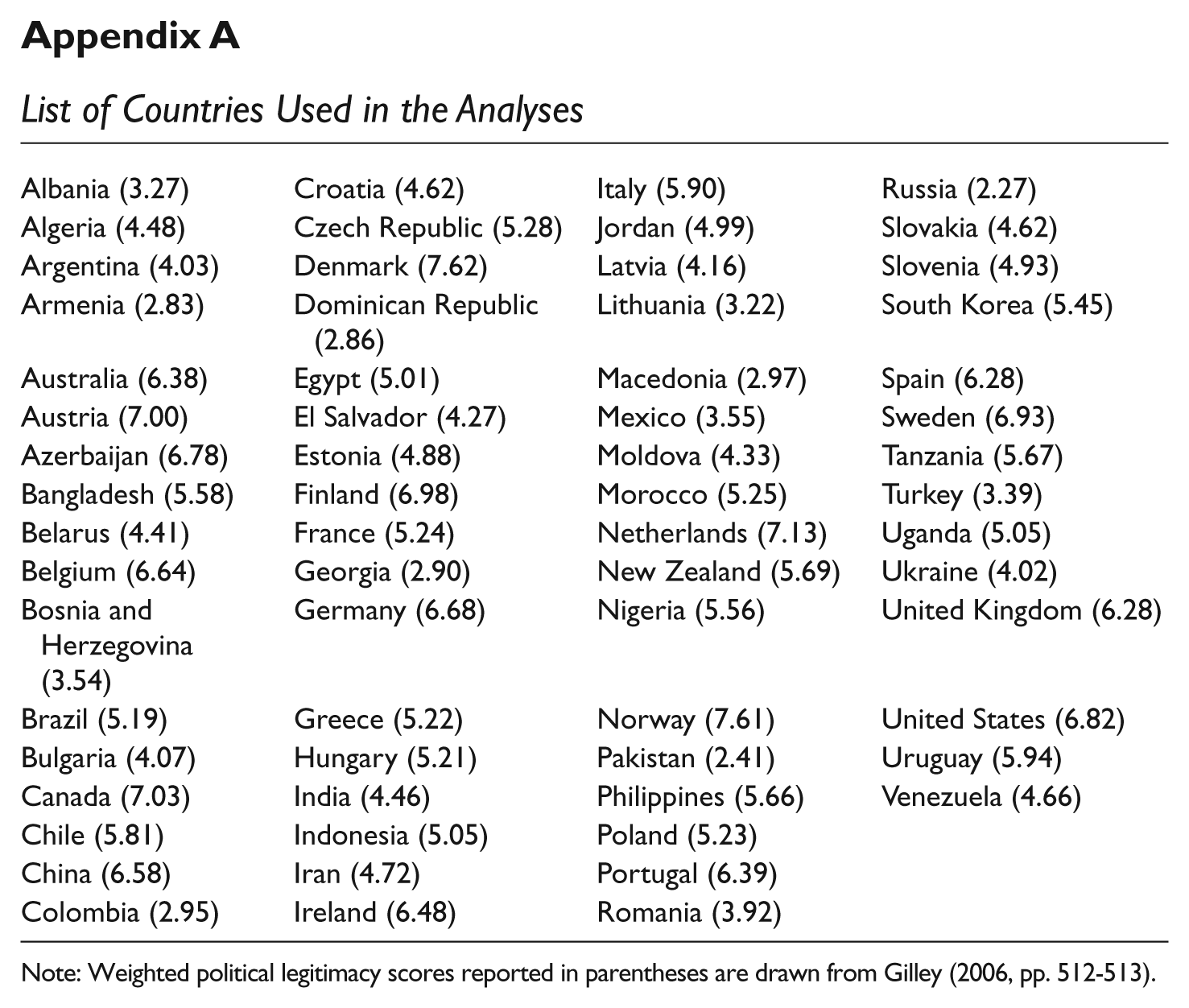
Note: Weighted political legitimacy scores reported in parentheses are drawn from Gilley (2006, pp. 512-513).
Acknowledgements
The authors would like to thank Bruce Gilley for allowing them to use his data, as well as the anonymous reviewers for their helpful comments on earlier drafts of this article.
Declaration of Conflicting Interests
The authors declared no potential conflicts of interest with respect to the research, authorship, and/or publication of this article.
Funding
The authors received no financial support for the research, authorship, and/or publication of this article.