



Abstract
Using data obtained from 165 mass murders in China, this research examines the crime of mass murder through a routine activities perspective as it relates to the location of where they occur (rural areas), while taking into consideration the motivation (revenge and profit), and most common weapon (knife) used. This adds to the literature on mass murders and routine activities theory from an area (China) where little academic research has been published regarding this crime.
Homicides are commonplace around the world and while some media attention may be given to single, double, and even triple homicides, it pales in comparison with the attention given to cases of mass murder (Duwe, 2007; Stote & Standing, 1995). In 2012, there were several high profile mass murders in the United States, including the second deadliest shooting attack in U.S. history, where a gunman killed 20 children and 6 adults before turning the gun on himself at Sandy Hook Elementary School in Newtown, Connecticut; a shooting at a midnight premiere of The Dark Knight Rises in Aurora, Colorado, which killed 12; and a massacre at a Sikh temple in Oak Creek, Wisconsin, which killed 7. Tragedies such as these are typically interpreted through the lens of the Second Amendment to the United States Constitution that protects the right of the people to keep and bear arms, but this article argues that a global perspective on mass murder is imperative since outside of the United States, gun control is not the main talking point.
While various definitions of mass murder exist (Dietz, 1986, 1996; Fox & Levin, 2012; Gresswell & Hollin, 1994; Hempel, Meloy, & Richards, 1999; Holmes & Holmes, 1994, 2002; Rappaport, 1988), for the purposes of this article, mass murder pertains to an incident in which one or more assailants kill four or more victims within 24 hr (Duwe, 2007). Attempted murders and injuries are not included. Mass murder is not a new phenomenon (Duwe, 2007), but it is difficult to know exactly how many mass murders occur worldwide since crime data are not always displayed in a comparable format in a country’s crime profile and in some countries, like the People’s Republic of China, there is no public dissemination of aggregate crime statistics. Indeed, following a spate of attacks in 2010, whereby a succession of knife-wielding angry middle-aged men murdered schoolchildren en masse in China, the Chinese government, under the auspicious of preventing copycat attacks, imposed a news blackout (Richburg, 2010). Nevertheless, a crime like a mass murder rarely goes unnoticed. In this digital age of smart phones and social media, perfect remembering and rapid dissemination of breaking news, such data exist, thereby presenting opportunities for analysis.
While a mass murder can occur anywhere, studying patterns in location of where they are more likely to occur is an important area of research. Knowing what part of a city, province, state, or country a mass murder is more likely to occur, as well as where specifically they cluster (e.g., a home, school, business, or entertainment establishment) can yield some fruitful information. There is a growing body of research conducted in the area of criminology of place/environmental criminology to better understand the convergence of factors that help contribute to a criminal event in a location (see Weisburd, Groff, & Yang, 2012). This research contributes to this literature by looking at the crime of mass murder and providing a sociological examination of mass murders through the use of routine activities theory. This research also fills a gap in the literature on mass murders from an area where little academic research on crime per se has been published—the People’s Republic of China.
Literature Review
Mass Murder
Mass murder is statistically rare and most of what we know about it comes from the United States. The most comprehensive survey details 909 mass murders that took place in the United States between 1900 and 1999 (Duwe, 2007). Between 1976 and 1999, the average annual number of mass murders in the United States was 27, or approximately 2 per month, and the average number of victims per incident was 5.2, or approximately 140 per year (Duwe, 2007, pp. 16-17). Compared with ordinary homicide offenders, mass murderers in the United States are “on average, slightly older and more likely to be white and male” (Duwe, 2007, p. 22).
Like other forms of interpersonal violence, mass murder is largely an interracial offense and mass murderers often know and intentionally select their victims—particularly when those victims are family, friends, or colleagues (Duwe, 2007; Fox & Levin, 2012). Other persons who happen to be in the wrong place at the wrong time simply become “collateral prey” (Hickey, 2012, p. 17). Familicide, such as when a male head of household kills his wife and children, is the most common form of mass murder (Fox & Levin, 2012). As a result, mass murder victims are typically younger and more likely to be female than victims of ordinary homicide (Duwe, 2007).
Mass murderers in the United States typically use guns to kill suddenly and swiftly (Fox & Levin, 2012; Hempel et al., 1999; Palermo, 1997) but no more so than ordinary homicide offenders (Duwe, 2007). Despite claims that guns in general and “military-style” assault weapons with high-capacity ammunition clips in particular have increased the efficiency of mass murder in recent years (Fox & Levin, 2012), Duwe (2007) observes guns killed an average of 4.92 victims per mass murder in the United States during the 20th century, marginally more than knives, blunt objects, and bare hands at 4.52 people per incident, but significantly less than explosives at 20.32 people. While assault weapons are used in only 4% of gun-related mass murder cases, they do result in more wounded victims (Duwe, 2007).
Most mass murders occur in residential settings, but approximately 28% transpire in public locations, such as workplaces, schools, and restaurants (Duwe, 2007). In some cases, offenders move from private to public spaces (e.g., Charles Whitman, who in 1966 first killed his wife and mother before killing 16 others from a sniper’s position on top of the bell tower at the University of Texas, Austin) or from public to public events (e.g., Anders Breivik, who in 2011 bombed government buildings in Oslo, Norway, killing 7, then later killed 69 on Utoya Island); known as mass murder “bifurcation” (Hickey, 2012, p. 23). Excluding shootings in connection with crimes such as robbery, drugs, or gangs, there were 116 mass public shootings in America during the 20th century, more than half of which took place after 1976 (Duwe, 2007). It is important to note these are raw figures; the United States had far fewer people 50 or 100 years ago. Duwe’s data highlight 42 additional mass public shootings since 2000 (as cited in Kessler, 2013). The worst year for public shootings was 1991, when eight incidents took place. In 1999 and 2012 there were seven, ranking joint second.
In contrast to homicides in general, mass murders do not tend to cluster in large cities, but rather in small towns and rural settings to the extent that mass murder essentially reflects the geographic distribution of the general population. For instance, only 26% of all familicides, 29% of all workplace massacres, and 26% of mass public shootings in the 20th century occurred in cities with a population more than 250,000; compared with 50% of “felony-related” and 58% of “drug-related” mass murders (Duwe, 2007).
Existing research on mass murder is concerned primarily with motivational typologies, albeit based upon a limited number of case studies (Busch & Cavanaugh, 1986; Dietz, 1986; Fox & Levin, 2012; Gresswell & Hollin, 1994; Holmes & Holmes, 1994, 2002; Kelleher, 1997; Rappaport, 1988; Rowlands, 1990). Given mass murderers are some “5 times more likely to commit suicide than ordinary homicide offenders” and approximately 25% of them die at the crime scene (Duwe, 2007, p. 30), motives often remain hidden. Some motivations for mass murder are intrinsic, occurring within the offender, while others are extrinsic, involving factors outside the offender. Likewise, some murders are instrumental, while others are expressive (Holmes & Holmes, 2001). Fox and Levin (2012) propose a “motivational typology” of mass murder that encompasses the incentives of power, revenge, loyalty, profit, and terror. For comparison purposes, these same categories are adopted in the current analysis.
Power (or control) is a dominant theme in mass murder, notably between the so-called “pseudo-commando” (Knoll, 2010a, 2010b) and “mission-oriented” killers (Holmes & DeBurger, 1988). But “revenge” against specific individuals, particular categories or groups of individuals, typically defined by gender or ethnicity, or society at large, is the most common motive in mass murder (Fox & Levin, 2012). In some cases, mass murderers choose victims because they are identified with or representative of a primary target against whom revenge is sought—a phenomenon Frazier (1975) describes as “murder by proxy.” Examples include a “disgruntled employee” who kills his boss and all of his employees (see Romano, Levi-Minzi, Rugala, & Van Hasselt, 2010) or a bullied youth who indiscriminately murders his classmates and teachers to target a school institution (Holmes & Holmes, 2001). Disgruntled citizens who kill in acts of domestic terrorism, such as Oklahoma City bomber Timothy McVeigh, are different, however, because “politics and hate” are precipitating factors, thus demonstrating the at times “impersonal” nature of homicide (Riedel & Welsh, 2011, p. 54).
Some mass murderers, say Fox and Levin (2012), are encouraged by a “warped sense of love and loyalty,” such as a desire to “save” their loved ones—an extension of self—from perceived inevitable suffering (p. 25). Kelleher (1997) refers to this as “perverted love,” (p. 41) which encompasses “suicide by proxy” (Frazier, 1975), but also murders perpetrated by the obedient disciples of cults and charismatic leaders. Such should not be confused with “sexual” or sadistic homicides, perpetrated by a desire to achieve sexual gratification through inflicting and/or receiving pain, or “executions” for profit or to eliminate crime victims and witnesses (Kelleher, 1997).
Typologies of mass murder are useful, but fail to predict under what circumstances “motivated offenders” will or will not commit mass murder (Turvey, 2011). This is where routine activities theory can shed some light (L. Cohen & Felson, 1979; Felson & Cohen, 1980). Routine activities theory controversially assumes a motivated offender without further explanation (Lanza-Kaduce, Akers, Dunham, & Cromwell, 1998; Sasse, 2005; Stahura & Sloan, 1988). We argue that this theory, together with Fox and Levin’s (2012) motivational typology of mass murderers, provides a broader framework for understanding mass murder.
Routine Activities Theory
For crime to occur, L. Cohen and Felson (1979) argue three essential ingredients must converge in time and space—motivated offenders, suitable targets (people or items), and an absence of capable guardians. Guardianship, from the routine activities perspective, is either a formal or informal social control mechanism that restricts the availability and accessibility of an attractive target and is often conceptualized in terms of handlers or supervisors (e.g., parents, teachers, employers), managers (e.g., owners of potential crime scenes), and guardians that essentially observe the potential target (Felson, 1997). Felson and Clarke (2010) add an important distinction with their discussion on the difference between routine activities as compared with routine precautions. Precautions are a conscious activity or effort to prevent crime, whereas routine activities are often inadvertent. Like routine activities, precautions are influenced by both formal and informal controls.
Routine activities theory has been applied at both a macro and micro level to explain a variety of predatory crimes, including violent and property offenses (e.g., Arnold, Keane, & Baron, 2005; Belknap, 1987; Bernburg & Thorlindsson, 2001; Boudreaux, Lord, & Jarvis, 2001; Cass, 2007; De Coste, Estes, & Mueller, 1999; Deslauriers-Varin & Beauregard, 2010; Felson, 1986, 1997; Fox & Sobol, 2000; Holt & Bossler, 2009; Kennedy & Silverman, 1990; Messner & Tardiff, 1985; Robinson, 1999; Sampson & Wooldredge, 1987; Schwartz, DeKeseredya, Taitb, & Alvic, 2001; Smith, Frazee, & Davison, 2000; Spano & Freilich, 2009; Tewksbury & Mustaine, 2000; Tewksbury, Mustaine, & Stengel, 2008), but rarely in the context of mass murder, in part because routine activities theory has traditionally been viewed as a theory about victimization and not necessarily offending (Sampson & Lauritsen, 1990). Chan, Heide, and Beauregard (2011) apply routine activities theory in the context of sexual homicide offending, but combine it with social learning theory. Levin and Madfis’s (2009) five-stage sequential model likewise incorporates routine activities theory to explain the genesis of mass murder in school settings. Levin and Madfi observe how students dedicated to kill rivals and despised authority figures (a motivated offender), the absence of armed resource officers (or capable guardians), and the tight congregation of suitable targets in classrooms or public places, converge into cases of mass murder.
Identifying where crime transpires and is most likely to occur can help aid in the prevention of criminal activity. Examining the impact of location alone is not enough, but in combination with situational prevention and routine prevention, it has the potential of reducing criminal activity (Felson & Clarke, 2010). Location has been researched at the macro level extensively, and in recent decades, the ability to pinpoint exact locations using mapping software and other technological advances has facilitated a more micro level focus. Sherman, Gartin, and Buerger (1989), for example, shed light on “hot spots” of crime, that is, areas where a majority of calls for service and crime originate in a city. Their study found approximately 3% of crime “hot spots” in Minneapolis produced 50% of the calls for service to the police. Similar studies have replicated such findings (Weisburd, Bushway, Lum, & Yang, 2004). Weisburd et al.’s (2004) longitudinal research, for instance, showed hot spots remained in the same area over time, thus concluding that crime was concentrated in very small areas within Seattle and remained stable. We are not suggesting there is a “hot spot” of mass murders in China, but rather, a look into the crime distribution of mass murder by location could add to a more complete understanding of the crime of mass murder in China.
The Present Study
Method
The data are derived from a content analysis of published newspaper and criminal justice agency accounts of mass murders that occurred in China from 2000 to 2011. For the purposes of this research, only incidents in which one or more assailants kill four or more victims within 24 hours are included (N = 165). As the classification of mass murders includes only fatalities and not attempted murders, the total number of victims could have been higher, as another 212 victims were injured in addition to the 696 killed at the hands of the mass murderers.
Descriptive data in the form of frequency counts are presented on the following variables: number of victims, location (geographical), location (type), type of weapon, and motivation of murder. Data were coded, recorded, and analyzed using the NVivo qualitative statistical software package. To increase accuracy of the findings, the data were coded 3 times by a team of six researchers, who refined and revised the coding scheme throughout the coding process, and when necessary, discussed the cases until consensus was reached, resulting in high intercoder agreement. Because the case reports analyzed in the study were qualitative by nature, the coding process is essentially interpretative. The focus was to achieve agreement among different coders through group discussion and iterative coding. The coding process produced no data that can be used to construct a quantitative measure of reliability.
Content analysis of published newspaper and criminal justice agency accounts is really the only known way to capture data on mass murders in China because official national-level data on mass murders do not exist, nor are there any aggregate accounts of what the crime picture looks like in the country. The main websites that were examined included the Ministry of Public Security, China News, Yunan Daily, Economy and Trade Newspaper of East Asia, and the Morning Newspapers of Beijing and Lanzhou. When a mass murder was reported by one newspaper, if other news outlets reported it, the original article was either referenced or copied directly. Therefore, there was little variability in how a murder was reported if more than one newspaper wrote about the same crime. This study is not the first to use media reports to study mass murder. Duwe’s (2007) history of mass murder in the United States, for example, supplemented Federal Bureau of Investigation (FBI; 2012) Supplementary Homicide Reports, which date from 1976, with The New York Times dating from 1900. Alas, this is a truly unique data set and while the representativeness and reliability of the data cannot be formally validated, it is probably the best that can be achieved at this time.
Despite its strengths, certain data limitations warrant discussion. First, the data used for this project originate from accounts of mass murders published on official websites of multiple media and criminal justice agencies, all in Chinese. In China, the press is still the megaphone of the party and the State. Indeed, China ranks 174 out of 179 countries in terms of press freedom, according to Reporters Without Borders (2013), only slightly ahead of Iran, Syria, and North Korea (the United States ranks 47). Media reports are considered “official,” thus the information published is the de facto account/record of the crime as communicated by the police and other criminal justice agencies, which is a potential source of bias. The nature and extent of the information published is also inconsistent across cases (i.e., some reports provide more detail than others). Mass murders could only be coded to the extent data were provided to the public via the “official” channels.
Another limitation of this research is that there is no way to confirm the ratio of murder to mass murder in China as official homicide statistics are not published. The Chinese Ministry of Public Security offers no equivalent to the FBI Supplementary Homicide Reports. According to the 2010 “Blue Book on Rule of Law” published by the Chinese Social Sciences Academic Press, a think-tank, violent crime in general and intentional murder cases in particular, increased 10% in 2009 after a decade of declines, but specific detail is lacking. The UNDOC (2011), by contrast, reports China had a murder rate in 2002 at two per 100,000 and this rate decreased to one per 100,000 in 2010. If said data are accurate, China has one of the lowest murder rates in the world. The same report lists the United States at 5.6 per 100,000 in 2002 and 4.8 per 100,000 in 2010. No discussion of mass murder is provided on this data set for any of the more than 200 countries that are examined in the annual homicide survey. Estimates from elsewhere indicate approximately 0.1% of all homicide incidents fall into the category of mass murder (Duwe, 2007), so it is possible to assume the same is true in China.
Operationalization of Motivation
For obvious reasons, the true “state of mind” of the offenders is unknown. The murderers themselves were not asked directly why they committed murder, thus knowledge is contingent upon information provided in official reports. The determination of motivation, in turn, is only as good as how the official channels describe each case. Based on the information available and only upon reading the entire context of the cases, the research team identified the primary factor(s) that precipitated mass murder. Individual level factors, such as love, revenge, greed and so on, better corresponded with existing mass murderer typologies than situational factors (e.g., a fight that gets out of hand) because in the former there is clear intent to kill. Nevertheless, to encourage future comparative research, motivations are classified to align with Fox and Levin’s (2012) 5-point mass murder typology: (a) power; (b) revenge (which includes three subtypes: individual-specific, where the offender targets particular people; category-specific, where particular groups of people are targeted; and nonspecific, where the murders are precipitated by the offender’s paranoia, and where the offender does not have specific targets); (c) loyalty (e.g., a warped sense of love); (d) profit orientation (e.g., felony murder); (e) terrorism. Given this categorization is not exhaustive, we add a sixth “other” category. The “other” category contains cases without specific information on motivation. In cases where more than one crime occurred, motivation was examined using the totality of both crimes. For example, in a case where there was a robbery and a murder and reports indicated that the victims were killed to cover up the robbery, this is classified as a profit murder. In the case where there was a rape and a murder, this fell under power.
Operationalization of “Location”
Two different categories of location were coded: geography and type. With regard to geographical location, four different categories were used: rural, small city, medium city, and large city. A rural area is defined as belonging to a village level of administrative distribution in China. A small-sized city refers to a place that belongs to a town level of administrative distribution, which consists of many villages and has a nonagricultural population of less than 20 million people. A medium-sized city is a city that is not a capital of a province and has a nonagricultural population of between 20 and 50 million people. A large-sized city is the capital of a province, and special economic zones, such as Shenzhen, Zhuhai, Shantou, and Xiamen, as well as the municipalities directly under the central government, such as Tianjin and Shanghai, with a nonagricultural population of more than 50 million. There are 23 provinces in China. The provinces in south coastal area of China—such as Zhejiang, Jiangsu, Fujian and Guangdong—tend to be more industrialized, with regions in the hinterland less developed.
The second category of location refers to location type, as follows: home, outside, street, factory, shops, entertainment establishment, school, and other. “Home” was coded to be a place of residence. “Outside” meant the murders happened in nature away from public buildings, private residences, and other structures—most likely on farmland or in a field. “Street” refers to a road near a building or dwelling. A “factory” includes any manufacturing type of establishment. “Shops” include any place of shopping commerce, like a supermarket. “Entertainment establishment” includes restaurants, hotels, saunas, and similar areas. “School” includes any type of education institution, including a college or university.
Findings
The 165 mass murders (consisting of 211 offenders) examined in this study were responsible for killing a total of 696 people. Frequency counts on selected characteristics associated with these mass murders are provided in Table 1. While age can be an important demographic characteristic to examine, only half (n = 81) of the newspaper accounts provided any information about the offender’s age. Of these cases, 70% were 40 years of age or below, which is comparable with the United States where the average age of mass murderers is 30 (Duwe, 2007).
Patterns of Mass Murders (N = 165).
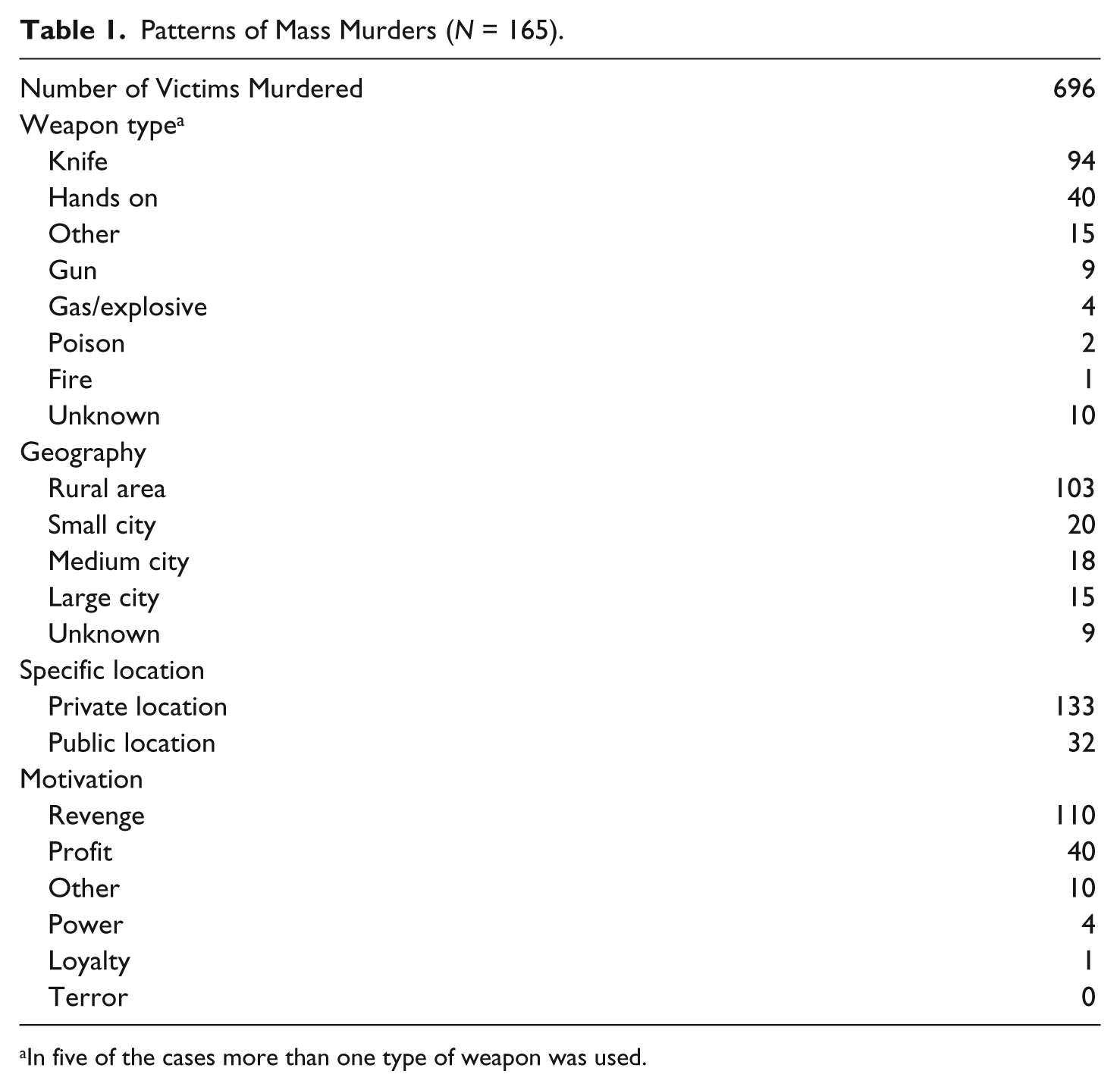
In five of the cases more than one type of weapon was used.
A majority (n = 144) of mass murders had between four and seven victims, which is consistent with trends in the United States (Duwe, 2007). Only 11 mass murders had more than 10 victims. The mass murder case with the most victims, 17, occurred in Zhejiang Province in a rural area on June 27, 2003. The offender, Chenfu Zhao, was a member of the Falun Gong. His victims were all beggars. Zhao poisoned beverages, placed them on the corner of the street, and invited thirsty beggars to drink. Zhao was apparently executing the orders of his master and killed panhandlers in an effort to elevate his status in Falun Gong. He was found guilty by the court and later executed.
As is generally the case with homicide in general and mass murder in particular, men make up a vast majority of all offenders. While any summary statements of female mass murderers should be taken with care because there are so few of them, analysis shows that of the seven cases with female offenders, three had four victims, two cases had five victims, and two cases had six victims, for an average of 5.29, fractionally higher than the U.S. average of 4.94 (Duwe, 2007). Females more often killed with knifes in residential settings. Only one female mass murder was public, which is comparable with the 14% of public mass murders perpetrated by women in the United States (Duwe, 2007). In terms of motivation, four of the seven (67%) mass murders by women were perpetrated during the commission of another crime (burglary or robbery), which is noteworthy given only 7% of female mass murders in the United States are felony related (Duwe, 2007). The revenge case that occurred on September 5, 2001, in Henan Province in a midsized city is also notable. The offender, Dushi Xian, owned a kindergarten. A dispute about payment of the tuition arose. Xian went to the home of the victim, Zhang Suling, and a fight occurred. Xian ended up killing Suling’s three children (two girls and one boy), ages 11, 10, and 8, respectively, with a knife and rolling pin taken from the victim’s kitchen. Xian then killed Suling. Xian was found guilty of intentional homicide and sentenced to death, but was not executed.
The majority (66.7%) of mass murderers operated alone to commit the crime of mass murder, which is consistent with trends in the United States—team killers, such as Eric Harris and Dylan Klebold at Columbine High School are the exception, not the rule (Fox & Levin, 2012). In looking at the number of offenders in proportion to the number of victims, the data show that multiple offenders were not responsible for a higher number of victims. Indeed, 24 of the 29 known cases involving two or more offenders (83%) had six or fewer victims. The remaining five cases included 7, 8, 12, 13, and 15 victims, respectively. This represents only 16% (5 of 32) of all the mass murders that had 7 or more victims. Forty-one percent of multiple offender mass murders occurred in rural areas and 76% occurred in residential settings. Only 24% have a known motivation. One example of a case involving five offenders and four victims occurred on July 21, 2001, in Guang Dong Province in the capital of Guangzhou. The offenders were members of a gang who robbed and stabbed to death a group of motorcyclists.
Motivation
The two most common motivations for mass murder in China are revenge and profit. This is similar to U.S. data in that revenge is listed as the most common reason, with mass murderers characterized as externalizing blame to perpetrate well-planned executions (Fox & Levin, 2012). But numbers alone do not capture the human element associated with this crime. Each mass murder has a story behind it. For example, on February 8, 2001, in a rural area of Hunan Province, Changhong Pan was gambling with his neighbor when an argument broke out. The neighbor, Xianzheng Peng, subsequently assaulted Pan’s nephew. In response to this, Changhong entered Xianzheng’s home later that day and killed Xianzheng with a knife. On route home, Changhong met Xianzheng’s wife, who happened to be walking with another neighbor, and killed them both. Changhong then proceeded to enter another neighbor’s home, Derong Deng, with whom he was also in conflict, and killed Deng’s family of five and injured another six people. This was a crime motivated by revenge.
An example of a “typical” mass murder involving the motive of revenge is the case of Hongtai Li. On September 24, 2011, he and his girlfriend, Jiuju Wang, went back to their hometown of Fan Jia Ping Village to discuss marriage with Wang’s mother, Yuanmei Gao, and aunt, Cunying Wang. However, they did not come to an agreement. Li was not pleased, so the following morning, bringing daggers to the Wang’s house, he poked his girlfriend 11 times, killing her instantly. He then killed her aunt and mother and, to prevent witness identification, killed his girlfriend’s 5-year-old niece, Xiuying Wang, and 7-year-old nephew, Lingxiong Wang. The People’s Court found Hongtai guilty of intentional homicide and sentenced him to death. Another example of a revenge-motivated murder occurred on April 17, 2000, in Hubei Province in a rural area. The offender, Minghong Liu, killed his older brother, his brother’s wife, their two daughters and his aunt and uncle with a knife in his brother’s home. Liu was having an affair with his brother’s wife.
Location
Mass murders primarily occurred in rural areas. Somewhat counterintuitively, not 1 of the mass murders that included 10 or more victims occurred in densely populated medium- or large-sized cities (see Table 2). As in the United States, therefore, mass murder reflects the geographic distribution of the general population, albeit the definition of what constitutes urban or rural in terms of population size may be different. Eighty-one percent of all mass murders occurred in a private setting (n = 133), which is consistent with trends in the United States (Duwe, 2007). Of public mass murders (n = 32) in China, 13 occurred “outside”; 8 were on the “street”; 3 respectively occurred in a factory, “entertainment” venue, “school,” and place of shopping commerce; and 8 were classified as “other.” Eight of the 14 cases that had 10 or more victims occurred in a private setting. In the 3 cases, where there were 15 or more victims, 1 was in a house, 1 in the street, and 1 in some other place. It should be noted that in the present study, place of work was not classified as a separate category. Only 3 of the mass murders occurred between colleagues, and of these, 2 of them occurred in a home and 1 happened in a factory. The number of victims was 5, 7, and 8, respectively. In terms of geographical location, 1 was in a big city, 1 midsized, and 1 was in a small city.
Number of Mass Murders by Known Geographical Location and Number of Victims From 2000 to 2011 in China (n = 156).
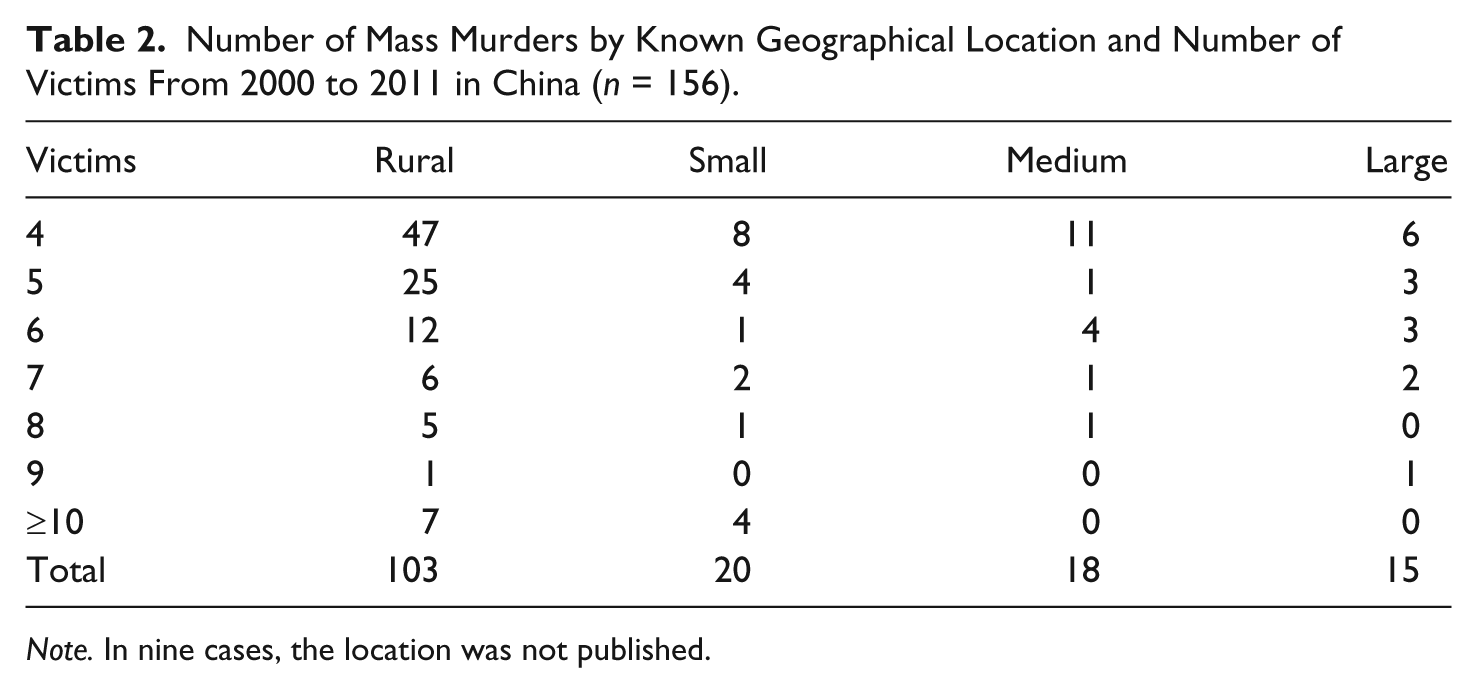
Note. In nine cases, the location was not published.
Weapons
As demonstrated in Table 3 and in the case studies above, the knife is the weapon of choice for the majority of mass murders in China, which stands in stark contrast to the United States where firearms are used in 67% of cases (Duwe, 2007). This makes sense given the Criminal Code of China heavily regulates firearm ownership and production. According to Article 128 of the Criminal Code, illegal possession may result in a punishment range from 3 to 7 years in prison, and illegal production and transportation of a firearm could have a maximum penalty of death based on Article 125. In China, knives with blood grooves, lock blades, blades measuring more than 22 cm in length, and blades more than 15 cm in length with a point angle of less than 60 degrees are also regulated to the extent that people must register with the government when purchasing them. However, Chinese people still carry pocket knives as a matter of “routine” and the blades used in the commission of mass murder are likewise typically convenient tools, such as kitchen knives or machetes used in agriculture. A “typical” case involving a knife in a rural area with the motivation of revenge is the case of 60-year-old Chen Guoxu. He lived in An Hui Province. His neighbor, Yang Yi, is someone whom he held a grudge against for years over trivial matters related to livestock and the homestead. Guoxu would repeatedly sneak into Yi’s home looking for an opportunity to retaliate. In the early morning of May 25, 2004, while carrying a knife, he snuck into his neighbor’s home and was successful. He stabbed Yi, Yi’s mother-in-law, granddaughter, and grandson to death.
Known Weapon Mass Murderer Used by Number of Victims (N = 165).
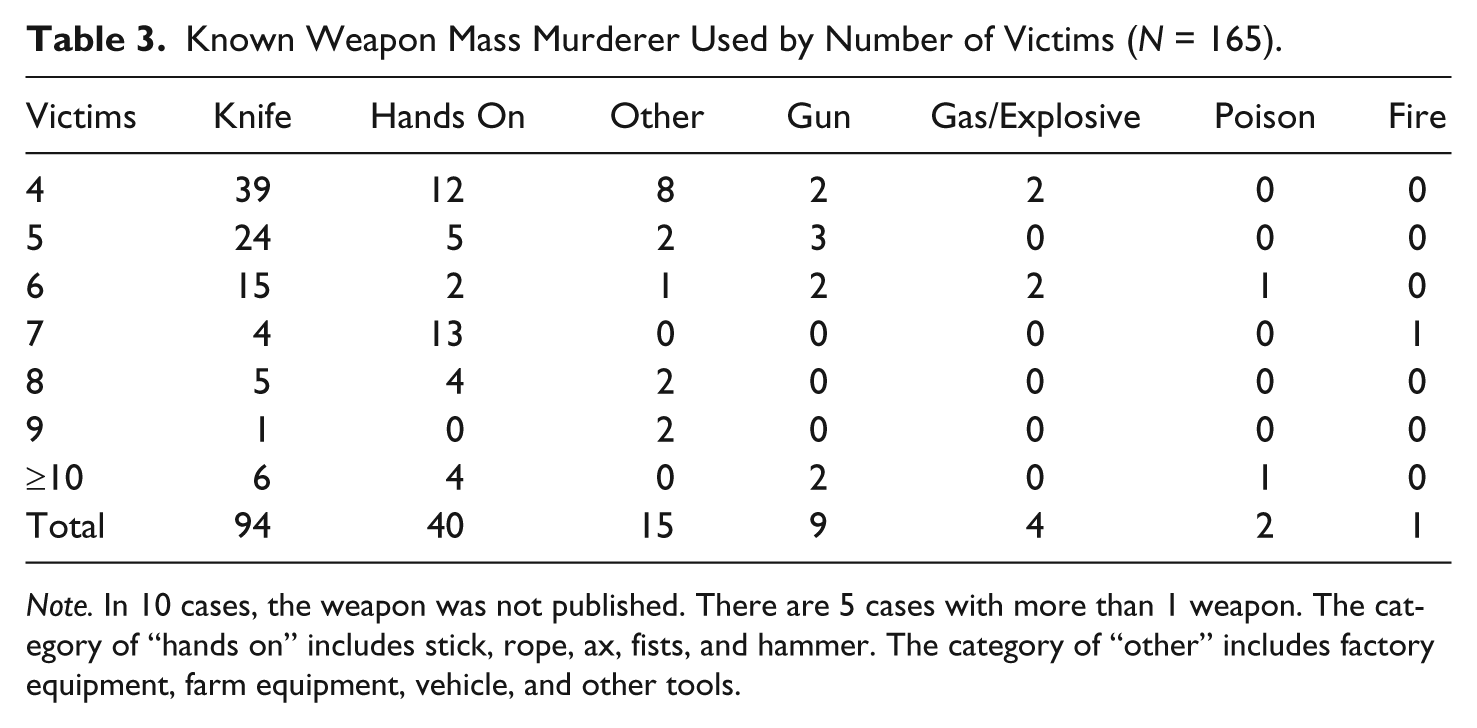
Note. In 10 cases, the weapon was not published. There are 5 cases with more than 1 weapon. The category of “hands on” includes stick, rope, ax, fists, and hammer. The category of “other” includes factory equipment, farm equipment, vehicle, and other tools.
Access to firearms is very difficult, hence why mass murderers in China are likely to use a knife. However, further illustrating the importance of location in routine activities, the weapon of choice is that which is available. In all 14 cases that used an ax as a weapon, the location was in a rural area. An ax can be considered a common tool in rural areas. A particularly gruesome mass murder that occurred using an ax took place on November 14, 2001, in Yang Ling Village in Guang Xi Province. In this case, Liang XX axed 12 people, causing 7 deaths and 5 serious injuries. According to information from villagers, in the middle of the night, Liang XX was drinking with Li XX in his own home. They got into an argument and Liang XX picked up an ax and chopped the neck of Li XX. Li XX was wounded and fled. After that, Liang XX proceeded into the room of his sister-in-law, hacking her to death. He then proceeded to ax 10 more people, of which 6 died.
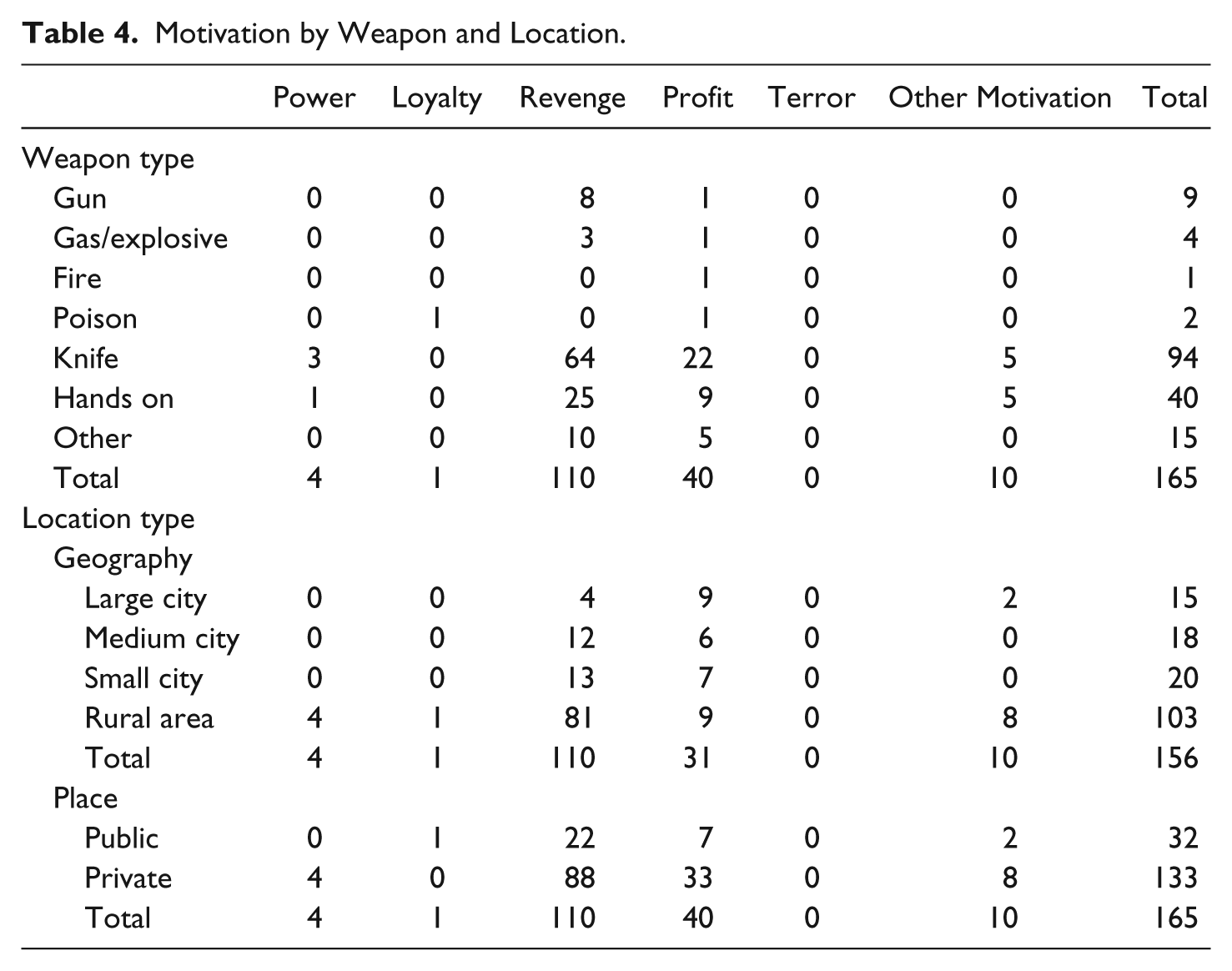
The relationships between motivation and (a) weapon type and (b) location were also analyzed as shown in Table 4. In looking at motivation, the top two motivations were revenge and profit. In both of these cases, a little more than half used a knife, followed by the second most popular weapon of “hands on” for both motivations. In the case of loyalty (n = 1), the weapon of choice was poison and for “other” motivation it was a 50/50 split between knife and “hands on.” As it relates to location, for all motivation categories, except loyalty, a significantly higher percentage (at least 80% of all cases) occurred in a private setting as opposed to public space. In looking at geography, for the cases of revenge, loyalty, and other, at least three out of every four cases occurred in a rural area. The same is not true of profit whereby between 20% and 30% of the cases occurred in each of the geographic regions.
Motivation by Weapon and Location.
Discussion and Conclusion
The application of routine activities theory to mass murders in China shows that there is a motivated murderer, suitable targets, and a lack of guardianship. While the crime of mass murder is never routine, there are some routine activities that exist. Conceptually, routine activities theory can thus be useful in investigating mass murder, but one of the challenges is using it in respect to individual profiles of an offender. From a routine activities perspective, moreover, changing the nature and extent of capable guardians and reducing the availability and accessibility of suitable targets through “hardening” tactics and routine precautions does nothing to diminish the third and most vital factor: the motivated offender.
Motivation is often assumed rather than clearly articulated both in theoretical and empirical applications of routine activities theory (for a discussion, see Sasse, 2005), but here we see the main reasons offenders are motivated to kill in mass are because of revenge or profit. Suffice it to say, despite the “senseless” or “random” label often bestowed upon mass murders by media commentators and the public who now watch these cases unfold in real time, mass murder is typically nonrandom and actually makes perfect “sense” to the perpetrators. Suitable targets are easy to identify when revenge is the motivation because there is often a known relationship between the victim and the offender. As it relates to guardianship, since a majority of mass murders occur in a rural home, most families do not have security precautions in place to prevent someone who is motivated to kill. Although most rural families have walls surrounding their residences, they usually keep the gate open during daytime when they are home. In short, few precautions exist to prevent the motivated offender because such living arrangements provide ample opportunities for someone with malicious intent to kill, even if their only weapon is what is available at the location (e.g., an ax, hammer, farm equipment, or even one’s bare hands).
Despite the fact that knives are the weapon of choice for mass murders in China, stab wounds are less likely to kill the victim than gunshot wounds, in part because of reduced hydrostatic shock to internal organs (Adelson, 1974). Case in point: the same week as 20 children and 6 adults were shot at Sandy Hook Elementary School in Newtown, Connecticut, 22 children and 1 adult were knifed at Chenpeng Village Primary School in Henan Province in China (Cable News Network, 2012). The difference is all 26 victims in Connecticut died, while all 23 in Henan Province survived. There is no way to know, but had Min Yingjun wielded a gun and not a knife, the attack outside Chenpeng Village Primary School might have been much worse, perhaps even the deadliest mass murder in China in a decade.
If firearms were the common choice of weapon in China, moreover, then perhaps some of the 26 cases in which three people were killed and at least one other person was injured would have tipped over into the sample of mass murders. The implication is that deeply troubled and alienated young men who violently lash out at the world exist both in China and the United States. But in China, unlike the United States, such people do not have easy access to guns and the gun culture that glorifies them (Zimring & Hawkins, 1997). Even if we could exclude all gun-related mass murder in the United States (a 67% reduction), the United States would still have a higher mass murder rate than China (UNDOC, 2011), which suggests the wide availability of guns in America is not the only proximate cause of high rates of lethal violence in this society. But when next debating violence prevention, the United States is still encouraged to look at the routine of mass murder in other countries, not least China.
The above also has implications for understanding the profile of mass murderers in China. As previously stated, the vast majority of mass murders in the United States involve the use of a gun (Duwe, 2007; Fox & Levin, 2012). A gun is a ranged weapon that can be used to project violence even when unused—in robberies, for example, brandishing the weapon typically suffices because people do not wait for proof that the gun works. The physical distance gained by using a gun also implies a certain amount of mental distancing. But a knife is an intensely personal weapon and means of dispatch. And knife crime is a high culpability crime. Like a gang member explains in Densley’s (2013) ethnography of youth violence in London,
Knifes don’t jam or run out of bullets. You actually feel the knife go in. You’re there. You have to look into man’s eyes. Feel him as he falls to the floor. Blood pouring everywhere. People screaming. It’s real. No doubt about it.
Perhaps this is significant. When revenge is the motivation, as it often is in China, mass murder requires a personal touch.
The question that looms heavy immediately after the tragedy of mass murder is “what could have been done to prevent it?” Identifying which routine precaution to take in a home to prevent murder is problematic. While research on a national level has shown that having “no home security measures” is the strongest predictor of residential burglaries (at a rate of 10 times compared with those with some security measure), it is not really possible to replicate these national-level studies on protecting oneself from being a mass murder victim since most of the data come from victim surveys (Nicholas, Kershaw, & Walker, 2007). Furthermore, even if routine precautions exist, there are still no guarantees they would stop someone who is willing to kill people en masse. In looking at the murders at Sandy Hook Elementary School in Connecticut, for example, routine precautions like controlling access to the building during school hours did exist, but were not enough to stop the shooter.
The motivations of revenge and profit explain 91% of all mass murders in the sample. It is important to understand that by and large, Chinese culture is a secular culture. Confucianism is a secular morality and the Chinese Communist Party is officially atheist, in accordance with its Marxist roots. Correspondingly, forgiveness is an abstract concept in China and research has shown that lasting resentment and sensitivity to the circumstances of an offense is higher among the Chinese than among Western Europeans (Paz, Neto, & Mullet, 2008). The Chinese also hold family bonds as sacred and honor them accordingly. Losing face is not only a personal shame but also a disgrace to the family honor. For the rural classes in Chinese society, who neither display the trappings of wealth and success nor are granted the deference they feel they deserve, personal and family honor are especially paramount—it is literally all they have. Much like in violent urban settings (see Anderson, 1999), with such an overdeveloped sense of personal and family pride, people become hypersensitive to single, often minor, acts of perceived disrespect. In some cases, an insult can serve as a sufficient justification for drastic action to revenge. In other cases, an insult is just a triggering event that leads to a series of escalating violent confrontations that end with a mass murder. Either way, violence is used to project feelings of shame or humiliation onto others and “replace it with its opposite, the feeling of pride” (Gilligan, 1997, p. 111). Alas, some people will do anything to save face, even if it means mass murder.
As in other cultures of honor (see D. Cohen, Nisbett, Bowdle, & Schwarz, 1996; D. Cohen, Vandello, & Rantilla, 1998; Nisbett, 1993; Nisbett & Cohen, 1996), “eye for an eye” is deeply rooted in the Chinese principles of justice and retribution. People may believe that if someone wronged them, they have the right to retaliate. Actually, not doing so would be seen as a sign of cowardice and dishonor. In the family context, failure to defend family honor through revenge is seen as betrayal. Revenge need not repay the damage in kind in an “eye for an eye” just-desert fashion. Throughout Chinese history, the revenger almost always worried about being a victim of retaliation carried out by those who were on the receiving end of their revengeful action. Therefore, the ultimate form of revenge is not only to kill the person who caused the wrong but also his or her entire family, including all of the women and children, so that no one in that family will be left to retaliate at some future time. For example, in the case of Liu Xinyou, he was in a dispute with Liu XX about housing repairs. Xinyou subsequently held a grudge against XX. During harvesting season, Xinyou waited in the corn stocks armed with a stick, ready to attack XX. When the opportunity came, he killed XX, XX’s wife, daughter, and mother all within 20 min. This is another illustration of how revenge is closely tied to mass killings in China.
This research is not suggesting a change in deep-rooted cultural ideas and beliefs as a way to reduce the motivation for mass murder. Rather, where attention can be given is on long-term prevention techniques to ensure that individuals do not develop the sociological and psychological profile to engage in mass murder in the first place. This is much easier said than done. Changing the routine activities of places can be easier to change than the routine activities of persons (Sherman et al., 1989). Therefore, what can be more easily addressed is how the police and the criminal justice system should best respond to these types of situations when they occur—essentially they need to train how best to become a capable guardian when this crime of mass murder is in progress. In the United States, active shooter training is something that police conduct, along with exploring best practices in response to these situations. In China, since most mass murders do not involve an active shooter, other police training and responses need to be explored and best practices developed to help minimize the number of victims.
In the United States, problem-oriented policing is preferred in rural areas (Jiao, 2001), and the perception of safety is more heavily influenced by the quality of police contact in rural areas (Nofziger & Williams, 2005). But in China, especially in the rural areas, police officers often display a very high tolerance of interpersonal violence (Chu & Sun, 2010). Fighting between individuals and families often go unnoticed by the authorities unless they result in serious injuries. People who feel victimized by interpersonal violence often have nowhere to turn but to take the matter into their own hands, which can only serve as an impetus for more violent confrontations. Local authorities can do a better job to mediate the relationship and reduce the conflict before it escalates to murder. Doing so will take away two routine activities that contribute to murder: motivated offenders and lack of guardianship.
The causal processes of crime and delinquency are of course more complicated than the explanations offered by a single criminological theory such as routine activities (Elliott, 1985; Tittle, 1985). Sociological explanations certainly fall short of fully describing why mass murder occurs and we cannot ignore the offenders’ psychology when examining what to do in response to this crime.
Mental illness among the offender population has been a neglected issue in China. Mental health care is generally lacking in China. The problem is especially severe in the criminal justice system. Courts and correctional agencies rarely have professionally trained psychologists or psychiatrists on their staff. As a result, mental health is not routinely assessed in the intake, detention, prosecution, or corrections processes. For these reasons, it is nearly impossible to find reliable psychological data from official sources, let alone scientific data for the assessment of psychological causes of the violent behavior. The official reports analyzed in this study at times contained details of the offenders’ psychological profile. Such descriptions, however, often reflected the personal opinions of the police officers and prosecutors involved in processing a specific case rather than the results of psychological testing conducted by trained professionals. Alas, the subjective nature of the data prevents any psychological analysis of mass murder.
Rarely are mass murderers truly psychotic (Kelleher, 1997; Turvey, 2011), but rather the profile of mass murderers is punctuated with a history of mental disorder and deep frustration because of a major personal loss, rejection, or failed intimate relationship (Hempel et al., 1999; Meloy et al., 2004; Meloy, Hempel, Mohandie, Shiva, & Gray, 2001; Palermo, 1997). Some speculate mass murderers seek infamy, known as “herostratos syndrome” (Borowitz, 2005), but empirical evidence is lacking. Media coverage potentially can help perpetrators regain the appearance of power, possibly encouraging others to engage in copycat murders (Lee, Lee, & Ng, 2007), hence why some media outlets after such an event try not to speak much about the offender and focus more on the victims.
The findings of this study provide a framework in which further research can be done to understand the crime of mass murder in a global context. While the odds of a mass murder event occurring remain small, this neither diminishes the impact of such crimes nor the importance of understanding the routine of mass murder with a view to future crime prevention and intervention.
Footnotes
Declaration of Conflicting Interests
The author(s) declared no potential conflicts of interest with respect to the research, authorship, and/or publication of this article.
Funding
The author(s) received following financial support for the research, authorship, and/or publication of this article: One of the authors, Spencer Li, received an internal faculty grant (from the University of Macau where he is the employed) to work on this research.