




Abstract
This study examines the covariates of weapon choice in homicide incidents. Two research questions are examined. The first research question is: what variables influence the use of a particular type of weapon in a homicide? The second research question asks: how does the method of weapon retrieval, or lack thereof, affect the choice of weapon? The findings suggest that firearms are more likely to be on the offender’s person and carried to the incident scene relative to other weapon types. In addition, the use of specific types of weapons is conditioned by the demographic and lifestyle characteristics of victims and offenders.
Introduction
Approximately 70% of all homicide incidents are committed with a firearm (Planty & Truman, 2013). Although there is a plethora of research documenting the relationship between firearms and lethal violence, there is little research on which factors affect the choice of weapon in a homicide, and how access to specific types of weapons has an effect in the transactions that culminate in this crime. To date, little is known about whether an offender brings the weapon with them to the homicide event with the intent to use it, or if the choice of weapon is opportunistic and the offender simply comes across it in the homicide scene. Given this, there is room for a greater understanding of the relationship between weapon choice and the offender. More knowledge of the covariates of weapon choice and the dynamics related to it can further shed light into the situational transactions that lead to homicide and inform policy. Indeed, policy discussions among practitioners and lawmakers related to firearms, the most commonly used weapon to commit this crime, have been on the forefront of national debates (Kleck, 2017).
This study contributes to the homicide literature by examining the covariates of weapon choice and the situational dynamics related to the type of weapon utilized by offenders to carry out the lethal event. A further aim of this study is to determine the most common situational factors that lead to the initial decision to use specific weapon types. Data from the Newark, New Jersey, and Rochester, New York, homicide units are explored to examine two research questions: what variables influence the use of a particular type of weapon in a homicide, and how does the method of weapon retrieval, or lack thereof, affect the choice of weapon? The findings fill the aforementioned voids in the literature by shedding light on the variables that lead to the use of a specific weapon, and how the presence of specific weapon types impacts the manner in which a homicide takes place.
The Homicide Event
The homicide event consists of collective transactions between the victim, offender, and a possibly audience, where each individual contributes to the development and shaping of each other’s behaviors (Luckenbill, 1977). Luckenbill (1977) characterized the transactions as a character contest that escalates due to the actor’s attempts to save face. These transactions are often coercive in nature, with one party attempting to achieve the compliance of another by threatening and/or inflicting pain as a form of punishment (Tedeschi & Felson, 1994). Tedeschi and Felson (1994) posit that offenders make the decision to use coercive actions by making “rational choices” after balancing the odds of achieving a desired outcome with the possible cost of engaging in such actions. However, these “rational” decisions are often made under duress, in a short period of time, and under the influence of alcohol or some emotion; thus, resulting in the failure to fully evaluate the potential consequences or any alternative options.
During the homicide transactions, weapons are often used to facilitate compliance, inflict pain, or mete out punishment (Decker, 1996; Tedeschi & Felson, 1994). Despite the abundance of weapon types that can be used in the commission of this crime, research has consistently found that the most frequently used weapon in homicides is a firearm (Catanesi et al., 2011; Cook, 1983; Cooper & Smith, 2012; Pizarro, 2008). The use of firearms appears to vary by homicide motive type, however. Decker (1996) was one of the first scholars to explore the relationship between motivation and weapon choice in homicide. He found that when the motive was instrumental, a firearm was used in incidents involving family members, close friends, and other intimates. He also found that the motive was more likely to be expressive in acquaintance-involved homicides that involved physical force, and in stranger homicides that involved a firearm. Decker (1996) suggests that “motive has clear implications for the choice of means by which death is inflicted” (p. 437). His findings coincide with Cook (1983), which suggest that weapon choice in a crime is an indicator of offender intent.
Recent studies using more precise measures of motive at both the national and city levels have confirmed Decker’s (1996) and Cook’s (1983) findings. Research has demonstrated that domestic homicides are the least likely to involve firearms (Pizarro, 2008). National-level research has found that husbands who kill their younger wives have an increased likelihood of using hands-on methods, such as strangulation, knives, or drowning, as compared to those that involve older wives (Mize, Shackelford, & Weekes-Shackelford, 2011). Furthermore, at the national level, husbands who are a part of a younger couple are more likely to use strangulation when they kill their wives, while husbands who are a part of an older couple are more likely to use long-barreled firearms, blunt objects, and other types of weapons (Fox & Allen, 2014).
Distinct patterns emerge in the examination of other homicide motives. For example, both national- and city-level studies suggest that drug-motivated homicides are more likely to be carried out with a firearm (Pizarro, 2008; Tardiff, Marzuk, Lowell, Portera, & Leon, 2002). This finding is not surprising because prior research has shown that drug dealers usually carry guns to protect themselves from robberies and intrusions into their business territory (Blumstein, 1995). Similarly, national- and city-level studies indicate gang-motivated, dispute, and robbery homicides show similar patterns in firearm use (Pizarro & McGloin, 2006; Tardiff et al., 2002). More nuanced operationalization of motive has also yielded important differences in weapon use. Corsaro, Pizarro, and Shafer’s (2017) recent examination of planned aggression found that relative to other weapon types, firearms are more prevalent in homicides where the offender and/or victim traveled to the incident location with the intent of engaging in a criminal act or to confront the other party.
Studies that have examined other typologies also suggest the prevalence of firearms in distinct types of homicides. Catanesi and colleagues (2011) found that gender plays a role in the choice of weapon. Males are more likely to use firearms or knives, and females are more likely to use weapons that are easily accessible in the moment when the homicide occurs, as women are more likely to kill someone they are romantically involved with. Research also suggests that firearms are more often used in homicides involving strangers and acquaintances when compared with homicides that involve family members or friends (Fox & Allen, 2014). Cooper and Smith’s (2012) study also found that homicides committed by a friend/acquaintance and homicides committed by a stranger were more likely to involve a firearm than those committed by an intimate or family member.
Chan and Beauregard’s (2016) recent study explored a distinct dimension related to weapon choice in homicides. Their analyses of male sexual homicide offenders using Supplementary Homicide Reports from 1976 to 2011 showed that the characteristics of victims impact the choice of weapon. Specifically, males are more likely to kill adults with knives and other cutting objects, and younger victims with their bare hands. Similarly, offenders who target females are more likely to use their hands, while those who target males are more likely to use a weapon. Although they only examined one very specific type of homicide, these findings give further support to research focusing on motive and weapon type, because they show that intent and victim characteristics are related to weapon choice.
Explaining Weapon Choice
Rational choice theory provides some insight into an offender’s use and choice of weapon. This theory suggests that an offender will opt to commit a crime when the characteristics of the situation have increased benefits that outweigh the costs (Cornish & Clarke, 1986). According to this theory, offenders engage in a cost–benefit analysis before committing a crime and proceed with the action if the situational conditions favor them and allow them to meet their needs. The likelihood that an individual will participate in criminal activities increases when situations require minimal effort; offer a reduced risk of being caught, apprehended, and punished; and present favorable rewards and/or excuses. However, the decision-making process is bounded. It is influenced by numerous factors such as the offender’s level of self-control, moral code, prior learning, prior experiences, and sociodemographic characteristics. The situational characteristics present during the criminal event itself also inform the decision-making process. Hence, the process is individual and event centered so the actions that might appear rational to the particular offender in a specific situation do not necessarily have to appear rational to another, or even the same offender under distinct circumstances.
Cornish and Clarke (1986) differentiated between two types of decision points in their explanation of rational choice—involvement and event decisions. Involvement decisions encompass the initial choice to engage in a crime, while event decisions focus on the decision to commit a specific type of crime. As it relates to homicide, involvement would encompass the decision to engage in a violent act against the potential victim, while the event would consist of the decision to end the victim’s life. Both decision points do not have to occur in distinct time periods, nor is it necessary for time to elapse between the involvement and event decisions. Clarke and Cornish (1985) indicate that in “real life the two decision points may occur almost simultaneously” (pp. 169). The decision process also does not necessarily have to involve careful planning and premeditation prior to the criminal event. They posit that immediate situational factors inform the decision-making process and can alter the sequence of events, resulting in decisions being made last-minute with only rudimentary or no planning, and offenders basing their decision on an assessment of incentives within the immediate situation.
Weapon Choice, Rational Choice, and the Homicide Event
Homicide transactions do not need to involve a weapon because it is possible to end a person’s life with one’s hands and feet. However, the presence of a weapon has been shown by researchers to influence the transactions that culminate in a murder (Cook, 1983; Luckenbill, 1977; Tedeschi & Felson, 1994). Knives, blunt objects, firearms, and other weapons can facilitate the commission of a violent act, but of these, a firearm can guarantee victory during coercive transactions given its lethality (Cook, 1983). Indeed, Libby and Corzine (2007) found that all firearms have a statistically significant impact on lethality: Handguns and shotguns were 25 times more lethal when compared with being unarmed, other types of firearms were 20 times more lethal, and rifles were 17 times more lethal. Relative to other weapons, firearms also facilitate detection avoidance (Zimring, 2004). Unlike knives and blunt objects that require that the offender comes within physical contact distance of the victim to commit the homicide (Wright & Decker, 1997), and heighten the chance that the offender leaves some form of identifying evidence behind at the scene, firearms requires no physical contact between offender and victim (Cook, 1983).
Individuals carrying a firearm, or who have access to one, may also feel emboldened during a perceived slight to confront the victim and/or offender (Kleck & DeLone, 1993; Phillips & Maume, 2007; Watkins, Huebner, & Decker, 2008). Kleck and DeLone (1993) posited that firearms embolden offenders and the victims who utilize these weapons to protect themselves. That is, victims are more likely to confront offenders during victimization due to the perceived protection the firearm offers (Watkins et al., 2008). This “weapon effect” results in more violence and firearm-related injuries because offenders and victims are more likely to engage in actions they normally would not, due to the security the firearm provides them. Indeed, conflicts are more likely to turn violent when a firearm is on the person, even in instances where the offender had no premeditated intent of using it (Phillips & Maume, 2007).
Studies that have examined offender decision making in the commission of robberies and assaults that culminate in a homicide have found support for the notion that offender’s choice of weapon is governed by cost–benefit analyses similar to those proposed by rational choice theory. Cook (1983) and Wright and Decker (1997) found that robbers select their weapons based on its capacity to help them get the job done, the vulnerability of the potential victim, the lethality of the weapon in the event the crime does not go as planned, and if the weapon is available to them. In relation to assaults, Cook (1983) posited that offenders are more likely to use a weapon, specifically a firearm, if the victim is considered invulnerable. Similarly, Felson and Steadman (1983) found that the behavior of victims during assaults influenced that of offenders, and that in events where the victim resisted the assault and/or displayed a weapon first, the offenders were more likely to use a weapon themselves.
The use of a firearm versus that of other weapons fits nicely within the rational choice framework in the explanation of homicide, particularly events in which the offender premediated the crime and where time elapsed between the involvement, event, and the commission of the crime. Indeed, if the offender has the intent to kill another person, tools that decrease their effort in the commission of a homicide by making it easier for the offender to end the life of another, or gain compliance from the victim, would be favored by the offender according to this theory. Similarly, methods that would allow offenders to flee the scene quickly without leaving evidence behind would also be favored in the commission of a homicide.
Homicide research has demonstrated that not all homicides are premediated and planned out: A significant percentage of incidents are acts that are unplanned and are a product of impulsive aggression (Piquero, MacDonald, Dobrin, Daigle, & Cullen, 2005). The lack of planning does not necessarily signify that involvement and event decisions did not influence the commission of a homicide or the weapon choice used during the crime however. As indicated by Clarke and Cornish (1985), these decisions do not necessarily have to take a prolonged time and can occur immediately during the incident transactions. In the specific context of violence, Tedeschi and Felson (1994) also explain that the “rational” decisions of offenders to engage in coercive actions are often made under duress and in short periods of time. Offenders tend to make these decisions in the heat of the moment, based on the immediate situational attributes of the event, their prelearned scripts, and self-control (Felson & Steadman, 1983; Piquero et al., 2005; Tedeschi & Felson, 1994). For example, an offender may be in the incident location for leisurely purposes and during the course of his activities engage in an altercation that escalates to lethal violence due to his attempt to save face with the victim (Luckenbill, 1977). The presence of a weapon in the scene, or on their person, that is easily accessible can serve as an impetus during the event decision process.
Method
The current study uses homicide investigation files collected from the Newark, New Jersey and Rochester, New York police departments to further examine this issue. As indicated in the outset, two research questions are explored:
Newark is one of the most violent cities in the state of New Jersey with an average of 102 homicides per year during the study period (approximately 36.8 per 100,000 population). Recent research suggests that homicides occur throughout the city (Zeoli, Pizarro, Grady, & Melde, 2014). However, the homicides are often concentrated in neighborhoods characterized by racial isolation and economic deprivation. The homicide problem in Newark may be caused by the subculture of violence that has been present in the city along with the availability of firearms (Yu, Lee, & Pizarro, 2017; Zeoli et al., 2014). In addition to the violence-related problems, the city of Newark also suffers from various social structural problems. For instance, based on estimates from the 2010 U.S. Census, nearly 25% of Newark’s residents lived below the poverty line and 47% of all residents aged 16 years and older were not in the labor force.
The average homicide rate in Rochester, New York is lower than Newark’s, with an average rate of 24.2 per one hundred thousand citizens from 2000 to 2014 (52 homicides per year). Despite having fewer homicide incidents, this city is often referred to as “murder capital of New York” as it continuously has the highest homicide rate per capita every year in the state (Comen, 2017). Like Newark, Rochester also suffers from social structural ills such as poverty and disadvantage. According to the U.S. Census, approximately 33% of Rochester residents live below the poverty level and approximately 47% of all residents aged 16 years and older were not in the labor force.
Data and Measures
This inquiry centered on 821 homicide incidents investigated by either Newark or the Rochester homicide unit, which were cleared with an arrest and the charging of an offender. 1 This study examined homicides that occurred in Newark, New Jersey, from January 1999 to December 2007, and in Rochester, New York, from January 2000 to December 2014. Four hundred thirty-six occurred in Newark, and 385 in Rochester, which total to 821 homicide incidents. Investigation files were used to extract information for each incident pertaining to the race and gender of the victim and offender, the motive and mode of the homicide, the type of weapon used in the homicide, and deviant lifestyles for both the offender and the victim. Researchers also collected narrative data from incident reports, witness testimonies, and offender statements, which they used to code variables related to the transactions and situational attributes that lead to the homicide to occur. The coding and data collection methodology has been extensively documented in previous works (see Pizarro, 2008).
Tables 1 and 2 present the operationalization of the variables included in this study and their corresponding descriptive statistics. Given the research questions examined, two dependent variables are used. The first captures the weapon used to carry out the homicide. This variable is coded into three categories: other, cutting or blunt object, and firearm. The other category is comprised of hand/feet, motor vehicles, fire, ropes, pillows, and deprivation of food. The bulk of “other” weapons (80%) is comprised of hands and/or feet. The majority of homicides examined (68.2%) were carried out with a firearm, followed by cutting/blunt objects (21.7%) and other weapons (10.1%).
Variable Coding Schema.
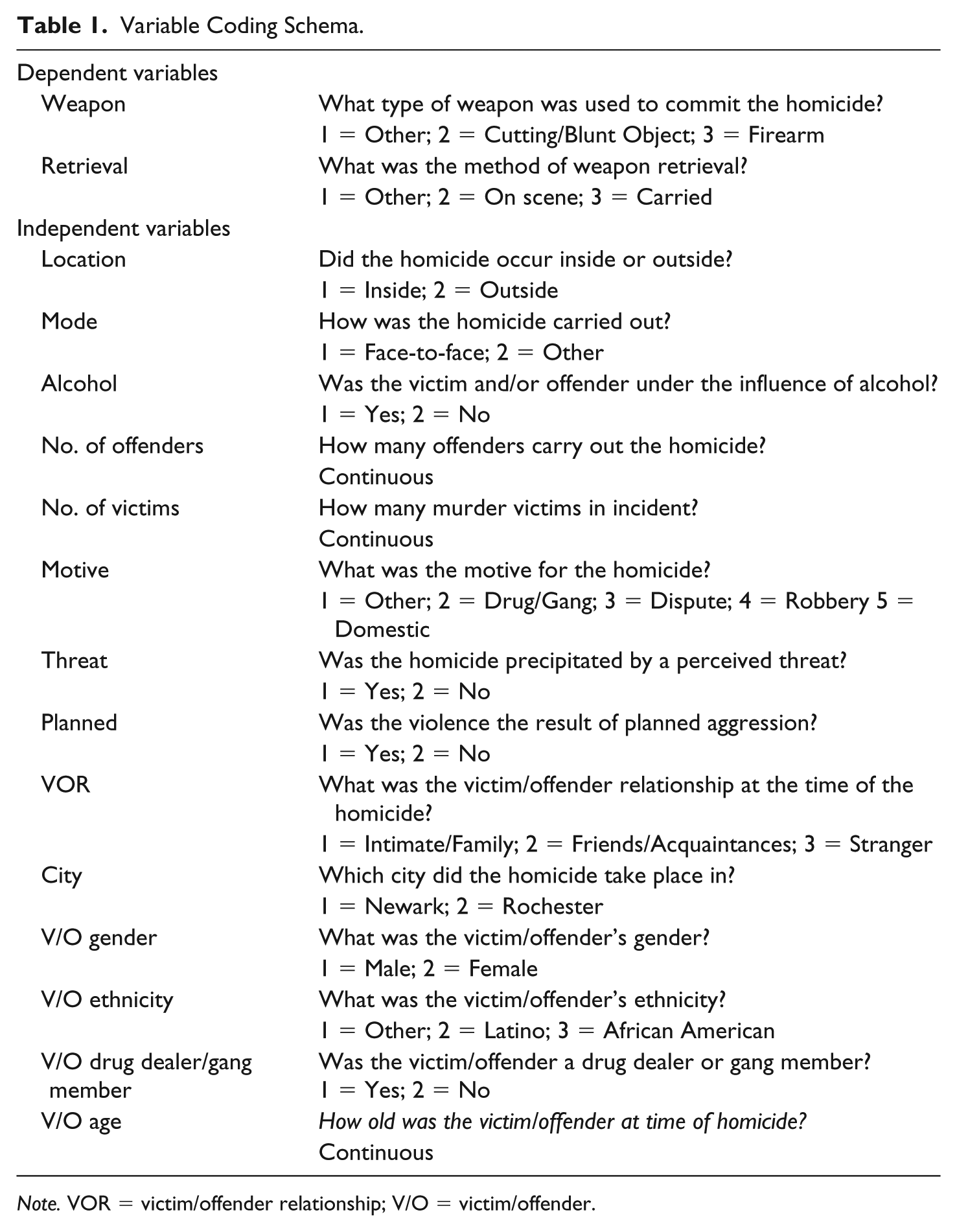
Note. VOR = victim/offender relationship; V/O = victim/offender.
Descriptive Statistics by City.
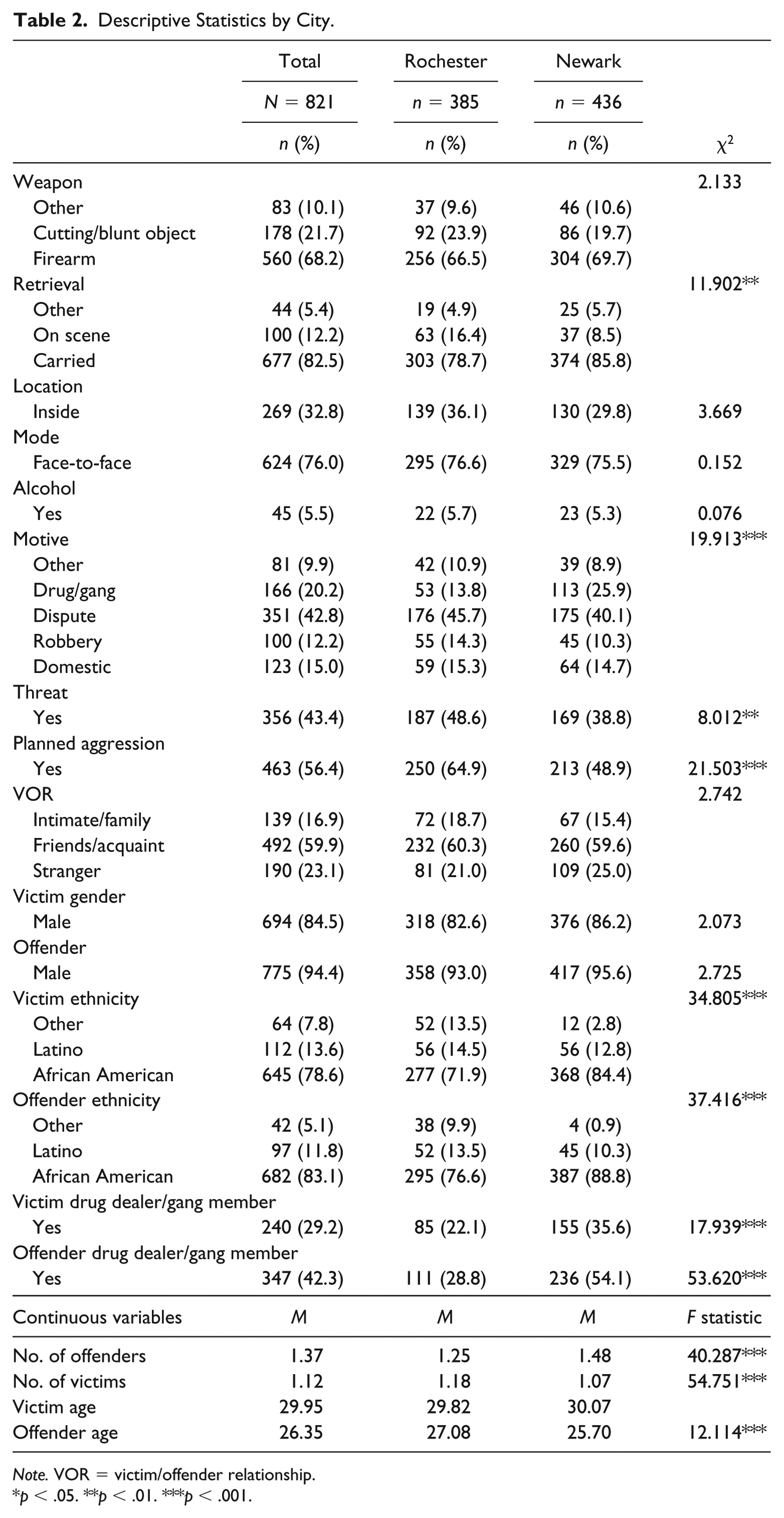
Note. VOR = victim/offender relationship.
p < .05. **p < .01. ***p < .001.
The second dependent variable centers on the method of weapon retrieval; that is, at the time of the incident, how did the offender get a hold of the weapon used to carry out the homicide? Like the weapon variable, retrieval is comprised of three categories: other, on scene, and carried. Incidents coded as carried refer to cases where the offender brought the weapon with them and had it on their person at the time of the homicide incident. On scene refer to incidents where the offender did not have the weapon on their person at the time immediately preceding the incident, but rather picked it up in the incident location. For example, the offender was arguing with the victim in the kitchen of an apartment and picked up a knife that was laying on the counter. Finally, other method of retrieval include incidents where the offender had the assistance of a third party in retrieving the weapon (e.g., offender called a friend and asked them to bring a weapon), or the offender left the scene themselves to retrieve the weapon (i.e., going to their car in the parking lot to get their firearm or going to their house and bringing the weapon back to the altercation site). Offenders carried the weapon in the majority of incidents (82.5%), followed by retrieving it from the scene (12.2%), and other method (5.4%). While carrying the weapon is the most prevalent mode of weapon retrieval in Newark and Rochester, offenders in Rochester are more likely to retrieve the weapon on the scene than having carried them to scene.
Weapon and retrieval also serve as independent variables in the models. Specifically, in the models testing for weapon type, weapon retrieval serves as an independent variable. Conversely, the models testing for weapon retrieval include weapon type as an independent variable. This allows to test whether weapon retrieval predict weapon type, and whether weapon type predicts retrieval simultaneously. Examining these relationships is important because prior research suggests that the homicide offender’s intent is related to the weapon used to carry out the lethal act (Cook, 1983). As such, one can surmise that the causal sequence of events that explain the type of weapon used in homicide would vary. As independent variables, the firearm category serves as the reference category in the weapon variable, while weapon carried serves as the reference category in the weapon retrieval variable.
Research examining the transactions that give rise to homicide have found that it has general situational- and individual-level trends. The majority of homicide incidents are often the product of trivial interpersonal disputes (Pizarro, 2008). The average homicide incident is also more likely to involve racial minority males in their 20s who know each other, occur in a public location, and be carried out with a firearm (Cooper & Smith, 2012; Pizarro, 2008). Related research has also suggested that specific lifestyles increase risk of homicide offending and victimization. Specifically, gang membership and drug dealing are related to carrying weapons, particularly firearms, and also increases the risk of homicide victimization and/or offending (Tigri, Reid, Turner, & Devinney, 2016).
Due to the relationship of these variables documented by prior research, two sets of independent variables are examined in this study. The first set captures incident characteristics and the second the characteristics of victims and offenders. Incident variables capture location, mode, alcohol, number of offenders, number of victims, motive, perceived threat, planned aggression, and victim/offender relationship (VOR). The second set of variables capture victim and offender demographics and lifestyle characteristics such as gender, ethnicity, age, and gang and drug activity.
Incident characteristics
Location refers to the place where the incident occurred. The majority of incidents occurred outside in a public location such as a city street (67.2%). Mode refers to how the incident was carried out by the offender and captures whether the homicide was committed in a face-to-face manner where the victim was aware of the offender’s presence and were communicating at the time of homicide, or other method such as a drive-by or shoot out. Approximately, 76.0% of all incidents were carried out in a face-to-face manner. Alcohol captures whether the victim and/or offender were under the influence of alcohol at the time of the homicide. Only a small percentage of incidents (5.5%) involved a victim and/or offender who were under the influence at the time of the homicide. Number of offenders and victims capture how many offenders carried out the homicide and how many individuals were killed in the incident. 2 The bulk of incidents involved one victim and one offender. Interestingly, relative to Rochester, Newark homicides involved more offenders and fewer victims.
Four additional variables that capture the dynamics of the homicide incident were also coded. First, motive refers to the immediate reason the offender acted against the victim. This variable is comprised of five categories: domestic, robbery, dispute, drug/gang, and other. Domestic homicides are defined as incidents that resulted from any type of abuse involving a family member, disputes between intimate partners, revenge for infidelities, and disputes between family members. Domestic homicides serve as the reference category for this variable. Robbery homicides are defined as incidents that resulted from an offender taking or attempting to take by force money or other material goods from the victim. Dispute homicides are defined as incidents that resulted from an argument or physical altercation that escalates to lethal violence, or the victim/offender wanting to get even for a past altercation that is not related to domestic, drug, or gang reasons. Drug/gang are defined as incidents that occurred because of sales or distribution of narcotics or homicides that occurred to further the interests of a gang (e.g., dispute over turf, colors, a gang initiation, internal conflict within a gang for power, or rivalry between two or more different gangs). The other category consists of incidents caused by other factors (e.g., murder for hire, mental illnesses, wanting thrill). Dispute homicides make up the bulk of observations (42.8%), followed by drug/gang (20.2%), domestic (15.0%), robbery (12.2%), and other (9.9%). There are significant differences between the motive distributions in Rochester and Newark. Although dispute homicides are the most prevalent in both cities, Rochester experiences more domestic and robbery incidents than Newark per capita, while Newark experiences more drug/gang incidents.
Threat captures whether the homicide incident was sparked by a threat on the part of the victim and/or offender (Pizarro & McGloin, 2006). More specifically, this variable captures whether the victim and/or offender acted against each other due to what they perceived to be a threat against their group or their status within their group. Approximately 43% of incidents were sparked by a perceived threat. Incidents sparked by a real and/or perceived threat of the offender’s group or status within their group appear to be more prevalent in Rochester.
Planned aggression captures whether the primary reason for the victim and/or offender to be in the incident location at the time of homicide was to (a) confront the other party, (b) seek retaliation over a prior dispute, (c) commit a robbery specifically against the other party, (d) meet with the other party, (d) stall the other party, (e) burglarize the other party’s home, or (f) confront, rob, and/or kill the other party (Corsaro et al., 2017). A little over half of the incidents (56.4%) examined in this study were the product of planned aggression. Planned aggression is more prevalent in Rochester homicides than in those that occurred in Newark.
Finally, VORs are captured as intimate/family if the victim and offender had an intimate relationship or were family members; friends/acquaintance if the victim and offender knew each other at the time of the incident; or stranger if the victim and offender did not know each other at the time of the incident. Stranger serves as the reference category. The majority of incidents involved victims and offenders who were either friends or acquaintances at the time of the homicide (59.9%), followed by stranger (23.1%) and family/intimate (16.9%) relationships.
Victim and offender characteristics
Gender captures whether the victim and offender were male or female. The bulk of incidents in both Newark and Rochester involved male victims and offenders. Ethnicity captures whether the victim and offender were African American, Latino, or Other. 3 African Americans were overrepresented as victims and offenders and serve as the reference category for this variable. Approximately 79% of the victims and 83.1% of offenders are African American. Rochester, however, has a higher percentage of Latino and other ethnicities in terms of victims and offenders. Age is a continuous variable that ranges from 1 to 84 for victims 4 and 8 to 71 for offenders. On average, victims were approximately 30 years of age at the time of their murder, and offenders were slightly younger with an average age of approximately 27. Rochester offenders were slightly older than those from Newark at the time of the homicide. A final variable taps into the victim and offender lifestyle by capturing if they were either a drug dealer and/or gang member at the time of the homicide incident. Approximately 30% of victims were either a gang member or drug dealer at the time of the homicide, while approximately 42% of offenders were involved in these lifestyles. Gang and drug dealing victims and offenders are more prevalent in Newark than in Rochester.
Analysis
Because the two dependent variables comprised three mutually exclusive nominal categories that are not independent from one another, multinomial logistic regressions which estimate the probability of one outcome occurring relative to a reference category are used. This method is best used in analyses of variables that have more than two values that cannot be naturally ordered (Long, 1997). Two multinomial models are estimated. The first model examines the use of firearms relative to knives/blunt objects, and other weapons. The second model examines the covariates of carrying the weapon at the time of the homicide relative to finding the weapon on the scene or retrieving the weapon in another manner. Due to the differences in some of the variables related to city in which the homicide incident occurred, a dichotomous variable that captures the city in which the incident occurred was included in the models as a control.
Findings
Table 3 presents the results for the multinomial logistic regression model predicting the weapon type used in the homicide event. Because the reference category was “Firearm,” the β coefficients reported are the log odds of the offender using a knife/blunt object or other weapon relative to a firearm. The first model estimates the probability of the offender using a knife or blunt object versus a firearm. When compared with firearms, knives and blunt objects were more likely to be recovered from the scene rather than the offender carrying them (β = 2.448, p < .001). Knives and blunt objects were 89% more likely to be found at the scene than firearms. Incidents that were carried out inside (β = 0.567, p < .05) and carried out in a face-to-face manner (β = 1.870, p < .001) were more likely to be committed with a knife or blunt object than firearms, which is not surprising given that knives and blunt objects are often not readily available in public places and direct contact is necessary when stabbing or bludgeoning someone. Planned aggression or motive does not differentiate the weapon used, but perceived threat does. Specifically, incidents rooted in the offender acting against the victim due to a real or perceived threat to their group or status within that group were less likely to be carried out with a knife or blunt object (β = −0.682, p < .05). Relative to incidents involving strangers, family/intimate partner (β = 1.290, p < .05) and friend/acquaintance (β = 1.268, p < .001) homicides were more likely to be committed with a knife or blunt object as opposed to a firearm.
Multinomial Models—Weapon Type: Firearms Relative to Knives/Blunt Objects and Other Weapons (N = 821).

Note. VOR = victim/offender relationship.
Significant findings are bolded.
p < .05.**p < .01. ***p < .001.
Several victim and offender demographic and lifestyle variables also emerged significant in this model. Males, drug dealers, and gang members were less likely to use a knife/blunt object when carrying out murders. Specifically, males were 80% less likely than females to use a knife/blunt object (β = −3.100, p < .001). Similarly, victims and offenders who were either drug dealers and/or gang members at the time of homicide were approximately 97% less likely to have a knife/blunt object used against them in a homicide, or to use these weapons when they engaged in one (Victims: β = −1.103, p < .05; Offenders: β = −1.072, p < .01). The models also suggest that non-African American victims were more likely to be killed with a knife/blunt object (β = 1.120, p < .05). This might be more due to the types of homicides in which these non-African Americans are victimized. Specifically, a closer examination of the data shows that non-African Americans are more likely to be killed in inside locations where knives and blunt objects are more prevalently used in homicide incidents. Finally, the age of victims and offenders were positively related with the use of knife/blunt objects, with older victims and offenders more likely to be killed or kill with a knife or blunt object rather than a firearm (Victims: β = 0.320, p < .001; Offenders β = 0.041, p < .01).
Model 2 in Table 3 presents the findings of the covariates of other weapons relative to firearms. Similar to Model 1, method of weapon retrieval, threat, VOR, victim ethnicity, offender drug dealer/gang member, and offender age emerged as significant in this model. Alcohol and planned aggression, which were not significant in Model 1, emerged as significant in this model. Specifically, other weapons were more likely to be retrieved from the homicide scene relative to firearms (β = 1.330, p < .05). Other weapons were also more likely to be used when either the victim and/or offender were under the influence of alcohol (β = −1.706, p < .001) and were less likely to be the product of a threat (β = −1.706, p < .001) or planned aggression (β = −0.697, p < .05). Relative to homicides involving strangers, other weapons were also more likely to be used with family members and intimate partners (β = 2.456, p < .001). Other weapons were also more likely to be used on non-African American and Latino victims (β = 2.354, p < .001). Relative to firearms, older offenders appear to prefer the use of other weapons, while drug dealers and gang members do not (Offender Age: β = 0.035, p < .05; Offender Drug dealer/gang member: β = −1.499, p < .01).
Table 4 presents the results for the multinomial logistic regression model testing for the covariates of mode of weapon retrieval. Because the reference category was “Weapon Carried,” the β coefficients reported are the log odds of the offender retrieving the weapon from the scene or in another manner relative to carrying it and bringing it to the homicide scene. Confirming Models 1 and 2 in Table 3, other weapons and knife/blunt objects were more likely to be retrieved from the scene when compared with firearms (Other: β = 1.276, p < .01; Knife/Blunt Object β = 2.549, p < .01). Homicides that were carried out face-to-face were less likely to be carried out with a weapon that the offender found on scene (β = −1.170, p < .01). While this finding may appear as contrary, additional analyses suggest that it is due to the majority of face-to-face incidents being carried out with a firearm. These findings, however, need to be interpreted with caution, as it may simply be a product of the high number of firearms.
Multinomial Models—Method of Weapon Retrieval: Weapon Carried Versus On Scene and Other (N = 821).
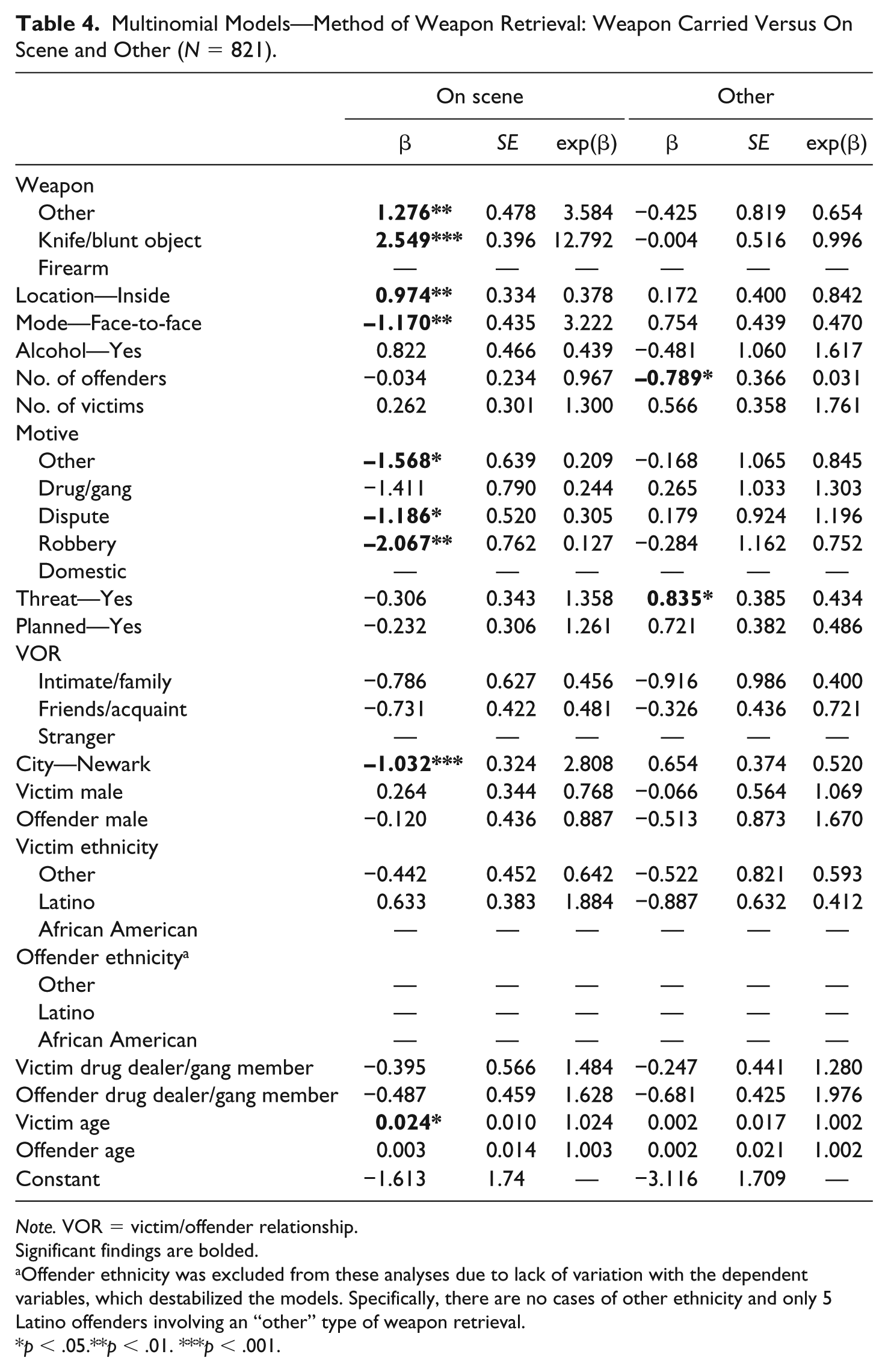
Note. VOR = victim/offender relationship.
Significant findings are bolded.
Offender ethnicity was excluded from these analyses due to lack of variation with the dependent variables, which destabilized the models. Specifically, there are no cases of other ethnicity and only 5 Latino offenders involving an “other” type of weapon retrieval.
p < .05.**p < .01. ***p < .001.
Motive also emerged significant in this model. Relative to domestic, disputes (β = −1.568, p < .05), robberies (β = −2.067, p < .01), and other motives (β = −1.568, p < .05) were less likely to involve a weapon that was on scene rather than one the offender carried. Furthermore, homicides that occurred inside were more likely to be carried out with a weapon that the offender found on scene as opposed to a weapon the offender carried at the time of the homicide (β = 0.974, p < .01). The city in which the incident occurred was also significant in this model. Specifically, Newark homicide incidents were less likely to be carried out with a weapon that was on scene relative to one that was carried (β = −1.032, p < .001). Finally, only one demographic variable emerged as significant in this model. Specifically, victim age has a positive relationship, suggesting that older offenders were more likely to be killed with a weapon retrieved from the scene relative to one brought to the scene by the offender (β = 0.024, p < .05).
Only two variables are significant in Model 2 of Table 4. Threat and number of offenders are the only two significant variables in this model. Specifically, incidents in which the offender acted against the victim due to a threat were more likely to involve other types of retrieval relative to the offender bringing the weapon to the scene (β = 0.853, p < .05). Incidents in which the offender retrieved the weapon in another manner were also less likely to be carried out by more than one offender (β = −0.789, p < .05). 5
Discussion
This study focused on answering two research questions: What factors influence the use of a particular type of weapon in a homicide, and how does the method of weapon retrieval, or lack thereof, affect the choice of weapon? These questions were examined via the lens of rational choice theory. In answering the first research question, the multinomial regression results revealed that specific dynamic factors related to the homicide situation and the characteristics of victims and offenders had an impact on what type of weapon an offender uses in the commission of a homicide. Younger African American males who were either drug dealers and/or gang members were more likely to be victimized or offend with a firearm that was on their person, while older non-African Americans who were not gang members or drug dealers were less likely to be killed with a firearm and the offender was more likely to retrieve the weapon from the scene. These findings are not surprising given that prior research has demonstrated that gang members and drug dealers, who usually tend to be younger males, are more likely to engage in gun carrying behavior (Tigri et al., 2016).
The second question focused on weapon retrieval and its covariates. The results show that firearms are more likely to be on the offender’s person and carried to the incident location, while knives, blunt objects, and other weapon types were more likely to be found on scene by the offender at the time of the incident. Furthermore, relative to domestic incidents, homicides that were motivated by interpersonal disputes and robberies were less likely to involve a weapon that was on scene rather than one carried by the offender at the time of the incident. In homicides where there was a perceived threat, the offender was more likely to call a friend and/or family member and ask for them to bring the weapon to the scene, or left the scene and returned with the weapon. In these instances, the weapon most often retrieved was a firearm. Taken as a whole these findings suggest that, when intent was present, the offender was more likely to opt for the most lethal weapon that would guarantee success (i.e., firearm). This coincides with earlier research (Cook, 1983), which suggests that weapon choice in a violent offense is an indicator of offender intent.
The aforementioned findings must be viewed within the context of the study’s limitations. It must be acknowledged that some of the data utilized in the present analysis were subject to reporting bias, which may have affected the study results and subsequent conclusions. As the data were collected from investigation files from the Newark Police Department (NPD) and Rochester Police Department (RPD), officer’s perceptions of the event may have clouded the categorizations of motive and the lifestyles of victims and offenders. In addition, the use of law enforcement intelligence as the sole source of data also poses a limitation given the threat of suspects being wrongfully identified and charged with a homicide, and that investigation officers might have based the information on the inaccurate information. Related, approximately 35% of all the incidents that occurred in the cities during the study period remain open with no identified offender and hence were not included in this study. Consequently, the method of weapon retrieval could not be ascertained, so one can reasonably assume that there is an undercount in some of the categories. While these are important limitations, it is important to note that unlike other crimes, homicides are the best investigated and procedurally followed through by police (Corsaro et al., 2017). Therefore, while there are possibilities of errors, relative to other crime types, homicide files present the most valid and accurate information.
The present study only analyzed incidents with a lethal outcome. Data for assaults that did not end up in a homicide were not available. Previous research has shown that homicides are the result of an attack that, in most instances, ends in a nonfatal injury (Cook, 1983; Felson & Steadman, 1983). This limitation plagues homicide research due to the fact that data on nonfatal events are difficult to obtain. Future research should attempt to alleviate this limitation by examining both nonfatal and fatal incidents. In addition, although both weapon type and method of retrieval were examined outcome variables, it was not possible to disentangle what comes first—Does the weapon type influence the method of retrieval, or does method of retrieval influence the weapon type? Although the evidence presented here suggests that it can be both, future studies should examine the sequence of events qualitatively and whether there are differences based on homicide type and offender intent.
It is also important to acknowledge that the study sites are not generalizable to the average American city. Newark’s population is primarily comprised of ethnic minorities, the city suffers from acute economic deprivation and isolation, and it is one of the most violent cities in the country (Zeoli et al., 2014). Furthermore, Rochester is also among the top 25 most violent cities in the country (Comen, 2017). Due to these characteristics, it is noted that the findings presented here are not generalizable to the majority of cities throughout the United States and abroad. They may be generalizable, however, to cities with similar structural characteristics and homicide trends (e.g., Detroit, MI, Flint, MI, Baltimore, MD, Memphis TN, etc.).
Despite the aforementioned limitations, the findings of this study contribute to the theoretical understanding of the transactions that culminate in lethal violence and lend support to the propositions of rational choice, and prior research examining the transactions that escalate into lethal violence. Firearms were found to be the weapon that the offender was more likely to use in the commission of homicide. In this study, this was the case in 560 out of 821 (68.2%) observations. Firearms were also the most common weapon that offenders had on their person and brought to the homicide scene (526 out of 821 cases; 64%). Rational choice theory suggests that the offender will opt to commit the crime when the characteristics of the situation favor the odds that they will successfully complete the offense, and facilitate the commission of the crime (Clarke & Cornish, 1985).
The fact that the majority of incidents were committed with a firearm, the most lethal of weapons, supports the idea that offenders choose the weapon that has the greatest brute force capabilities to efficiently kill the victim, has the least amount of personal risk, and has the least likely chance of being involved in close contact with their victims. In addition, gun-carrying behaviors appear to facilitate their use in a homicide. As indicated by the findings, the majority of offenders carried the firearm at the time of the incident. This further validates the assumption of rational choice that when the specific crime requires less effort, and an opportunity presents itself that makes its commission easier, a person who has made a decision to commit a crime is more likely to engage in it. Moreover, the act of carrying a weapon in and of itself, even without the intent of engaging in a homicide, also demonstrates some degree of cost–benefit analyses as per rational choice theory. Indeed, individuals who carry weapons, specifically firearms, often report doing so for protection (Blumstein, 1995; Martin, Sadowski, Cotten, & McCarraher, 1996) or due to prior victimization (Spano, Pridemore, & Bolland, 2012). Hence, one can argue that they engage in a cost–benefit analyses where the risk of carrying a firearm is outweighed by the benefit of avoiding victimization, and/or successfully prevailing any victimization attempt against their person.
Homicides sparked by a perceived threat and those that involved some type of planning by the victim and/or offender were also more likely to be carried out with firearm relative to a knife, blunt object, or other weapon. In addition, events involving a perceived threat were also more likely to involve the offender leaving the scene to retrieve their desired weapon or calling someone to retrieve the weapon and bring it to carry out the homicide. Again, this lends support to the tenets of rational choice because when the expectation is a confrontation and an actor feels threatened, they are more likely to obtain a weapon that would guarantee their advantage in a confrontation as per the cost–benefit analyses.
Homicide incidents involving actors who did not know each other and had a stranger relationship were also more likely to be carried out with a firearm relative to those involving individuals who knew each other. There are a couple of possible explanations for this finding. While not presented here, a closer examination of the data suggests that incidents involving strangers are more likely to be instrumental in nature and are robbery or drug motivated. These types of incidents are more likely to be committed with a firearm (Pizarro, 2008). It might also be the case that in these types of instrumental incidents, offenders choose to use a firearm relative to other weapons because they are more likely to guarantee success. Rational choice would also suggest that due to the unfamiliarity with the target, offenders might choose the most lethal weapon in an effort to maximize the odds of success when dealing with an unknown target.
The significance of victim and offender demographic and lifestyle variables also offer support to the assumptions of rational choice. Findings demonstrated that males, drug dealers, and gang members are more likely to be victims in gun homicides than incidents involving other weapons. This confirms findings from prior research that suggests the characteristics of victims influence the decision-making process offenders, and that offenders are more likely to use weapons that are more lethal, such as a firearm, when they perceive that the victim cannot be easily over powered (Chan & Beauregard, 2016; Cook, 1983). More specifically, the more lethal the weapon, the easier it is to prevail against a victim who is considered strong and threatening, such as younger males, gang members, and/or drug dealers. Indeed, Cook (1983) found that firearms are more likely to be used against victims who are perceived as invulnerable. Hence, as per the assumption of rational choice, an offender may opt to act against these targets with a weapon that guarantees success.
The findings related to the use of knives, blunt objects, and other weapons also lend credence to the assumptions of rational choice. The availability of these weapons on the scene served to facilitate the homicide occurrence. During the homicide transactions, the availability of these weapons might have provided the impetus for the offender to believe that they could prevail in the confrontation, thus providing favor in the cost–benefit analyses to escalating in the transactions that resulted in a homicide. Other weapons are significantly more likely to be used relative to firearms when the victim and/or offender are under the influence of alcohol or drugs. While that does not negate the decision-making process of offenders as per rational choice theory, the impairment may have hampered the decision, making the actors act against each other when they normally would had not done so.
Conclusion
In conclusion, when compared with other crimes, homicide is a rare event. However, the effect it has on the public health and psyche, at the societal level and individual levels, is often lasting. As a result, this line of inquiry merits further exploration. Future research should further explore the dynamics of weapon choice and how they increase the odds a homicide event will occur. For example, future research should explore how gun carrying behavior affects the likelihood for lethal violence. Group dynamics and co-offending should also be explored in the context of weapon choice and retrieval. Qualitative research examining the context to the variable research, like the one presented here, to further illustrate the transactions that lead to the use of specific weapons, particularly knives and blunt objects, and the progression of the event that ends in lethal violence should also be undertaken. The source of weapons carried by homicide offenders, as well as whether they were purchased via legal or illegal venues, should also be explored. Finally, future studies should replicate the methods and approach used here in other cities with distinct structural characteristics to assess the generalizability of these findings.
Footnotes
Declaration of Conflicting Interests
The author(s) declared no potential conflicts of interest with respect to the research, authorship, and/or publication of this article.
Funding
The author(s) received no financial support for the research, authorship, and/or publication of this article.