



Abstract
Previous scholars have shown that a considerable proportion of child deaths in mortality statistics that have been coded as deaths from Lack of Care (LC) or from Injuries of Undetermined Intent (IUI) were probable homicides. Historical research, however, shows (a) that nosologists used the LC and IUI classifications with a changing frequency over time in Ohio and in the national at large in relation to the number of child deaths that they classified as homicides, and (b) that the proportion of LC and IUI deaths in Ohio that were probable homicides changed over time. These changes should be taken into account by historical criminologists whenever they study long-term trends in child homicides, particularly the homicides of children under age 10.
Keywords
Many scholars have used official statistics to study the ecological factors that place children at risk of homicide across counties in the U.S. (Baron, 1993; Farrell et al., 2017; Finkelhor, 2008; Hunnicutt, 2007; Vanderminden et al., 2019). However, none of these studies address a potential problem: the undercounting of homicides of young children. Given the limitations of the FBI’s Supplementary Homicide Reports because of reporting failures by local agencies (Fox & Swatt, 2009; Loftin et al., 2008), scholars have focused almost exclusively on child deaths that have been coded in the databases of state health departments or the National Center for Health Statistics (NCHS) as homicides, according to the International Classification of Diseases (ICD). The ICD coding scheme was created after World War II by the U.S. Committee on Joint Causes of Death and adopted by the World Health Organization in 1948 (Alharbi et al., 2021, pp. 6–8).
Local studies by pathologists, forensic scientists, and pediatricians have shown, however, that death certificates often underreport child homicides, sometimes because warning signs are missed, but at other times because coroners, medical examiners, and death registrars have placed probable homicides in categories that have allowed them to express uncertainty (Christoffel et al., 1989; Ewigman et al., 1993). From 1959 through 1967, when computerized mortality statistics were first available in the U.S., the Seventh Revision of the ICD included a classification for deaths of infants from lack of care (LC) during unattended births or from malnutrition, dehydration, or chronic neglect (U.S. Department of Health, Education, and Welfare, 1959, pp. 47–48). That classification was superseded in the Eighth (1968–1978), Ninth (1979–1998), and Tenth (1999–2021) revisions by a classification for deaths of persons of all ages from injuries of undetermined intent (IUI), with subcategories for the means by which the injuries occurred (U.S. Department of Health, Education, and Welfare, 1968, p. 73). Coroners elected not to make a final determination on the circumstances of such deaths, even in cases in which the preponderance of evidence, particularly evidence of serious, multiple, or repeated injuries to the head or internal organs, pointed to homicide.
Deaths from LC or IUI pose challenges, especially for historical criminologists who study change over time. Today the guidance that coroners and medical examiners receive on describing the nature and circumstances of injuries on death certificates is extensive, as is the guidance that nosologists receive on the use of particular death codes, including online training with educational credits and detailed guides for writing cause-of-death statements (National Vital Statistics System, n.d.). The early guides were rudimentary, however, with only a page and a half for physicians on how to describe deaths from external causes on death certificates, and only a page or two for nosologists on when to code deaths from external causes as LC or IUI, which by their very nature are complex categories that include deaths that physicians or coroners may suspect have been homicides (U.S. Department of Health, Education, and Welfare, 1958, pp. 10–11, 1959, pp. 47–48, 1968, p. 73).
Further problematic for historical criminologists, nosologists used these codes at different frequencies over time in proportion to homicides. The frequency with which infant deaths were coded as LCs in NCHS mortality data fell rapidly from 1959 to 1967 under ICD-7 from 2.5 for every 10 homicides to 1 (Figure 1). The frequency with which child deaths were coded in the U.S. as IUIs under ICD-8, 1968 to 1978, was higher: roughly 4 IUIs for every 10 homicides for children ages 10 through 15, and 6 IUIs for every 10 homicides for children under age 10. The frequency fell for all children ages 15 and under to a low from 1968 through 1998 under ICD-8 and ICD-9 of around 1 IUI for every 10 homicides but rebounded from 1999 through 2015 under ICD-10 to 2 IUIs for every 10 homicides. 1 How and why persons responsible for coding deaths changed the frequencies with which they used these categories is thus a matter of concern.
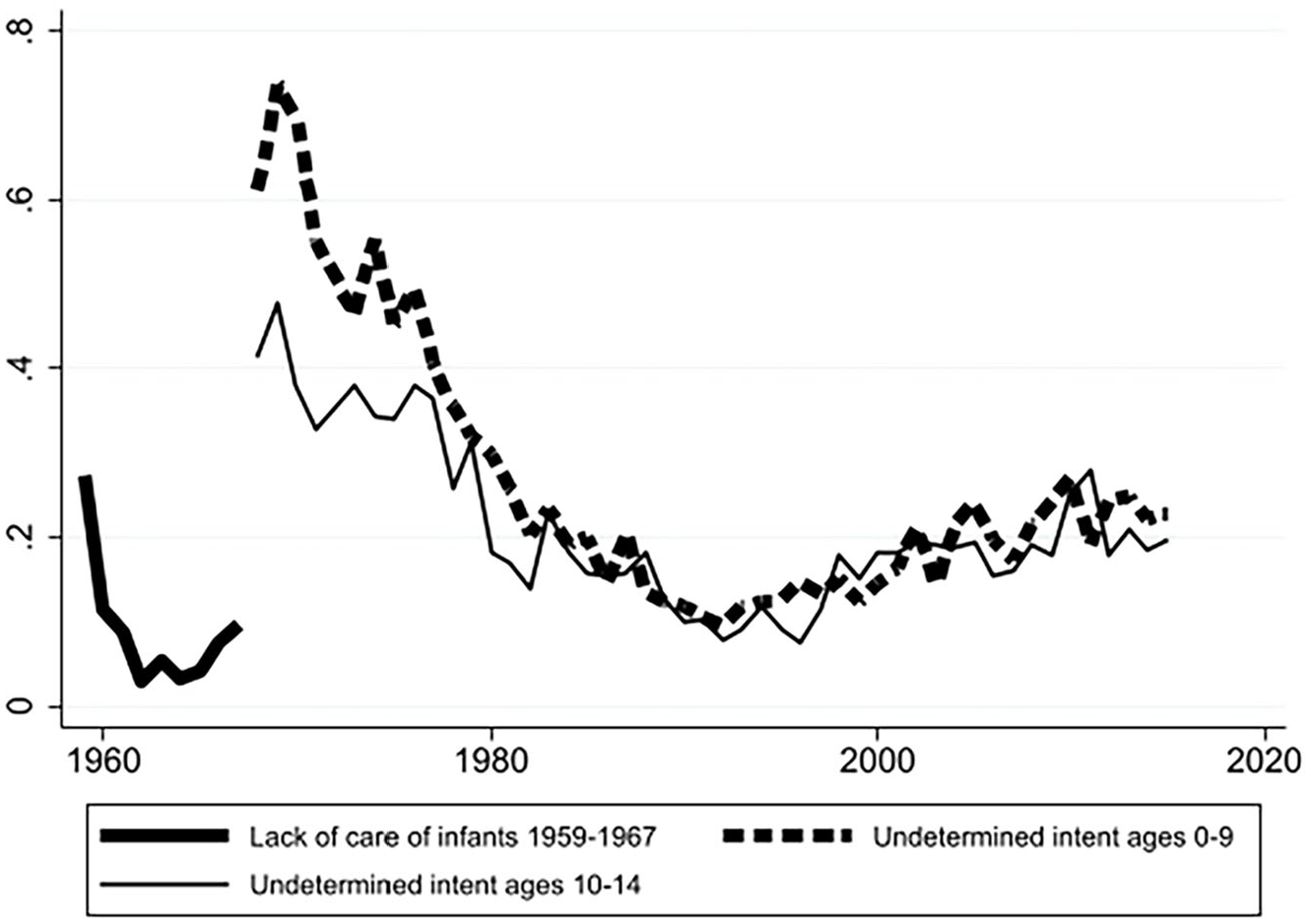
Ratio in the United States of homicides to child deaths from lack of care, 1959 to 1967, or from injuries of undetermined intent, 1968 to 2015.
Data from Ohio show that the proportion of deaths classified as LCs and IUIs in the mortality files of the Ohio Department of Health (ODH) that were probable homicides also changed over time from 1959 through 2015. As will be shown from a close examination of every LC and IUI death certificate, supplemented by coroner’s reports, law enforcement case files, and newspaper reports, the proportion of cases in which the preponderance of evidence pointed toward homicide in Ohio from 1968 through 2015 was low for children ages 10 to 15 from IUI (8 of 142, or 6%), but considerable for infants from LC, 1959 to 1967 (15 of 51, or 29%) and for children under age 10 from IUI, 1968 to 2015 (166 of 428, or 39%). Ignoring these fatalities may therefore compromise our understanding of the causes and incidence of child homicides.
The goal of this research note is to examine the ways in which coroners and medical examiners described deaths from external causes that they were reluctant to classify as accidents, suicides, or homicides, and the ways in which nosologists in Ohio used the LC and IUI classifications. Ohio was chosen because it is the focus of a collaborative effort among scholars at the state’s public universities to create a comprehensive, multiple source database on homicides and probable homicides since 1959. The research, supported by the National Science Foundation (SES 1228406), was possible because death records were open under Ohio law until this year, when the Ohio Supreme Court ruled that they are no longer subject to public disclosure (Bischoff, 2024)—a considerable loss to scholars, because Ohio was one of the few remaining open record states.
Understanding the frequency with which nosologists assigned child deaths to these categories, the proportion of those deaths that were probable homicides, and the ways in which the frequency and proportion changed over time, is crucial to building accurate time series of child homicides and to determining the degree of confidence we should have in official homicide counts. The goal of this research note is to show that it is possible through systematic historical research to determine in most instances whether deaths of children classified as LC or IUI were probable homicides, accidents, suicides, or deaths from natural causes or unattended births, given the detail with which pathologists, coroners, and medical examiners described the nature and circumstances of injuries from lack of care or undetermined intent.
Literature Review
Researchers who have studied suspicious deaths of children have found that many probable homicides have been classified as LC or IUI. Christoffel et al. (1989) undertook a pioneering study of violent deaths of children ages 15 and under in Cook County, Illinois, 1977 to 1982. Examination of coroner’s reports revealed that the possibility of intentional violence could not be ruled out in 89% (206 of the 231) of the IUIs. “The inclusion of undetermined cases in this study resulted in violent death rates that were nearly double the official rates in the younger age groups” (Christoffel et al., 1989, p. 1407). The authors acknowledged that not all of the IUIs that were possible homicides were homicides, but they believed that “overestimation of homicide incidence” could be “minimized by exclusion of cases that are unlikely to be violent based on available information” (Christoffel et al., 1989, p. 1407).
Ewigman et al. (1993) followed with a study of 384 children under age 5 in Missouri, 1983 to 1986, who died from external injuries, abuse, or neglect, according to the Missouri Division of Family Services. The authors consulted law enforcement investigations and autopsy reports to classify deaths from maltreatment as definite, probable, possible, not from maltreatment, or undetermined for lack of information. Only 48% of the 121 definite maltreatment deaths were coded as maltreatment deaths on death certificates. Instead, they were coded as accidental, natural, or IUIs. The underreporting was caused, in the authors’ opinion, by inadequate investigations, by failures of agencies to share data, and by failures to use the multiple cause of death code (995.5 in ICD-9) to indicate that child maltreatment syndrome was a contributing cause, if not the principal one.
Crume et al. (2002) found a similar degree of underreporting for children ages 16 and under in Colorado, 1990 to 1998. The state’s multidisciplinary Child Death Review team discovered through an examination of vital records that only half of the children who died of maltreatment were classified properly. The deaths of children who lived in rural areas and were maltreated by a parent rather than a non-parent were especially likely to be misclassified. Child deaths were also more likely to be misclassified if the victims were white or male. Overpeck et al. (1999) found in a national study of linked birth and death records, 1983 to 1991, that homicide rates for infants would rise by 20% if probable homicides classified as IUIs were included. The authors concluded that “excluding deaths of undetermined intent may lead to an underestimation of the magnitude of the public health problem of intentional injuries among infants” (Overpeck et al., 1999, p. 272).
Breiding and Wiersema (2006) believe that the standard for classifying child deaths as homicides is “artificially high for public health purposes” and should include probable homicides to help researchers, practitioners, and public officials gauge the magnitude of the child homicide problem (p. 49). The National Association of Medical Examiners echoes their concern, stating that categories that allow coroners and medical examiners to express their uncertainty should be used only “when information pointing to one manner of death is no more compelling than one or more competing manners of death in through consideration of all available information” (Hanzlick et al., 2002, p. 6). As yet, however, there is no protocol for noting on death certificates or in medical examiner reports the specific reasons why a coroner or medical examiner finds it impossible to classify a particular child death as homicide, suicide, accidental, or natural, nor a protocol for stating whether the weight of the evidence in such cases did or did not point to homicide.
This research note seeks to build upon these studies by examining every death in Ohio of an infant from lack of care, 1959 to 1967, and of every child aged 15 and under from an injury of undetermined intent, 1968 to 2015, to determine (a) the proportion of cases in which the preponderance of evidence pointed to homicide and (b) how that proportion changed over time. The frequency with which these classifications were used in Ohio tracked closely with the frequency of their use in the rest of the country. That suggests Ohio’s data may be helpful, in the absence of other long-term, state-level studies, for estimating the proportions of these infant and child deaths that were probable homicides in the nation at large.
Data and Methodology
The national data are from the detailed mortality files of the NCHS, 1959 to 2015. The data on the causes of child deaths in Ohio are from the mortality files of the ODH, 1959 to 2015, which are more complete than the data Ohio submitted to the NCHS. These mortality data were used to study the frequency with which coroners assigned child deaths to particular categories, not only from LC or IUI, but from SIDs, homicide, and accidents caused by suffocation, drugs, and toxins. Ohio death certificates were available through the Ohio History Connection, 1959 to 1971, and the Ohio Bureau of Vital Statistics, 1972 to 2015. Worksheets were created for every death of an Ohio resident from birth through age 15 from LC or IUI, which included all of the information available on the death certificates: the age, race, gender, and ethnicity of the victims, their parentage and place of birth, their education, the coroner and the person reporting the death, the time and place of the injuries and death, and verbatim descriptions of the victims’ injuries and the circumstances of those injuries. If the certificates were pending or if the descriptions of injuries were left blank, autopsies and coroner’s reports, where they survived, were studied through county offices; and county newspapers were searched through the Ohio History Connection or newspapers.com for obituaries or additional information on each death. Information on the cause of death was available upon completion of the research for all 51 deaths from LC and for all but 11 of the 596 deaths from IUI.
The death certificates and coroner’s reports in these cases did not state, by definition, whether the injuries that the children suffered were caused by accident, suicide, or homicide. The evidence in these certificates and in other reports on the children’s injuries and the circumstances in which they occurred is sufficient, however, to indicate that a minority of these deaths were most probably caused by homicide rather than suicide or accident. Deaths from LC and IUI were classified in this research note as probable homicides in cases in which the births of newborns were deliberately concealed, and death resulted from exposure, drowning, or injuries inflicted after birth; and in cases in which infants died of malnutrition and/or dehydration attributed to neglect. Additional deaths from IUI were classified as probable homicides when children died of massive head trauma or internal lacerations, fractures, or hemorrhages inconsistent with deaths from natural, accidental, or self-inflicted causes, or when infants or toddlers died from cerebral hemorrhages so severe that they had only a slight chance of being due to natural causes. With the exception of two cases in which the circumstances were suspicious because of chronic abuse, IUI deaths of infants from suffocation were not classified as probable homicides, even if the circumstances raised the possibility of intentional injury, because such deaths were indistinguishable from natural or accidental deaths. The other IUIs that were probable homicides because of circumstances were caused by burns, drowning, firearms, knives, neglect, scalds, or strangulation. Again, LCs and IUIs were classified as probable homicides only in the minority of cases in which the preponderance of evidence pointed to homicide.
Results
Deaths of Infants from Lack of Care (LC) in Ohio, 1959 to 1967
Nosologists in Ohio used the “lack of care” code primarily for deaths of newborns during unattended births. Thirty-six of the 51 deaths were caused by the absence of a doctor, nurse, or midwife at the time of birth. Relatives tried to save the children but failed to clear airways, and the children suffocated. The other 15 LC deaths, however, included six probable neonaticides, where there was a death from an apparently unnatural cause and an intent to conceal the birth and death of a child; eight infant deaths due to malnutrition or dehydration from neglect; and one due to multiple severe injuries from abuse.
The possible neonaticides included one child who drowned in a bucket and another who drowned in a toilet, where their mothers left them after giving birth without any effort to rescue or revive them. Other full-term infants apparently died of exposure or aspiration after being dumped in fields or vacant lots, or of severe wounds. 2 It is understandable why coroners failed to classify these deaths as neonaticides, given that it is difficult to determine, for instance, the cause of death of an abandoned full-term newborn found in a state of partial or advanced decomposition, but the evidence leaned toward neonaticide.
Eight infant deaths from LC were from malnutrition, exacerbated in some instances by dehydration and failure to seek medical care. The parents were deemed responsible and in two cases were charged with manslaughter. One death occurred in a modest suburban home, but the others occurred in impoverished neighborhoods, three in rural Appalachian communities and four in urban working-class neighborhoods. Why the coroners failed to classify these deaths as homicides is hard to say. Compassion may have been the reason, given the poverty of these families. One couple, far from concealing their child’s emaciated state, brought the child to the hospital (too late to save it); another couple with five children sought help from relatives, but were overwhelmed when their youngest arrived. 3 When classified as probable homicides, these deaths raise the number of deaths caused by neglect from 10 to 18, neonaticide from 70 to 76, and abuse from 33 to 34, for a 13% increase in homicides of infants in Ohio from 1959 to 1967.
Deaths of Children Under Age 10 from Injuries of Undetermined Intent (IUI) in Ohio, 1968 to 2015
The potential for undercounts of homicides became far greater after 1967, when the ICD dropped “lack of care” for infants in favor of “injury undetermined whether accidentally or purposefully inflicted” for persons of all ages. Most alarming is that 66% of IUIs of children under age 10 in Ohio, 1968 to 1978, were probable homicides, given the severity and multiplicity of their injuries. Twenty-four percent of IUIs were probable accidents, suicides, natural deaths, or unattended births, and the remaining 11% were truly undetermined (Table 1).
Percentages of Probable Causes of Death for Children Who Died from Injuries of Undetermined Intent in Ohio, 1968 to 2015.
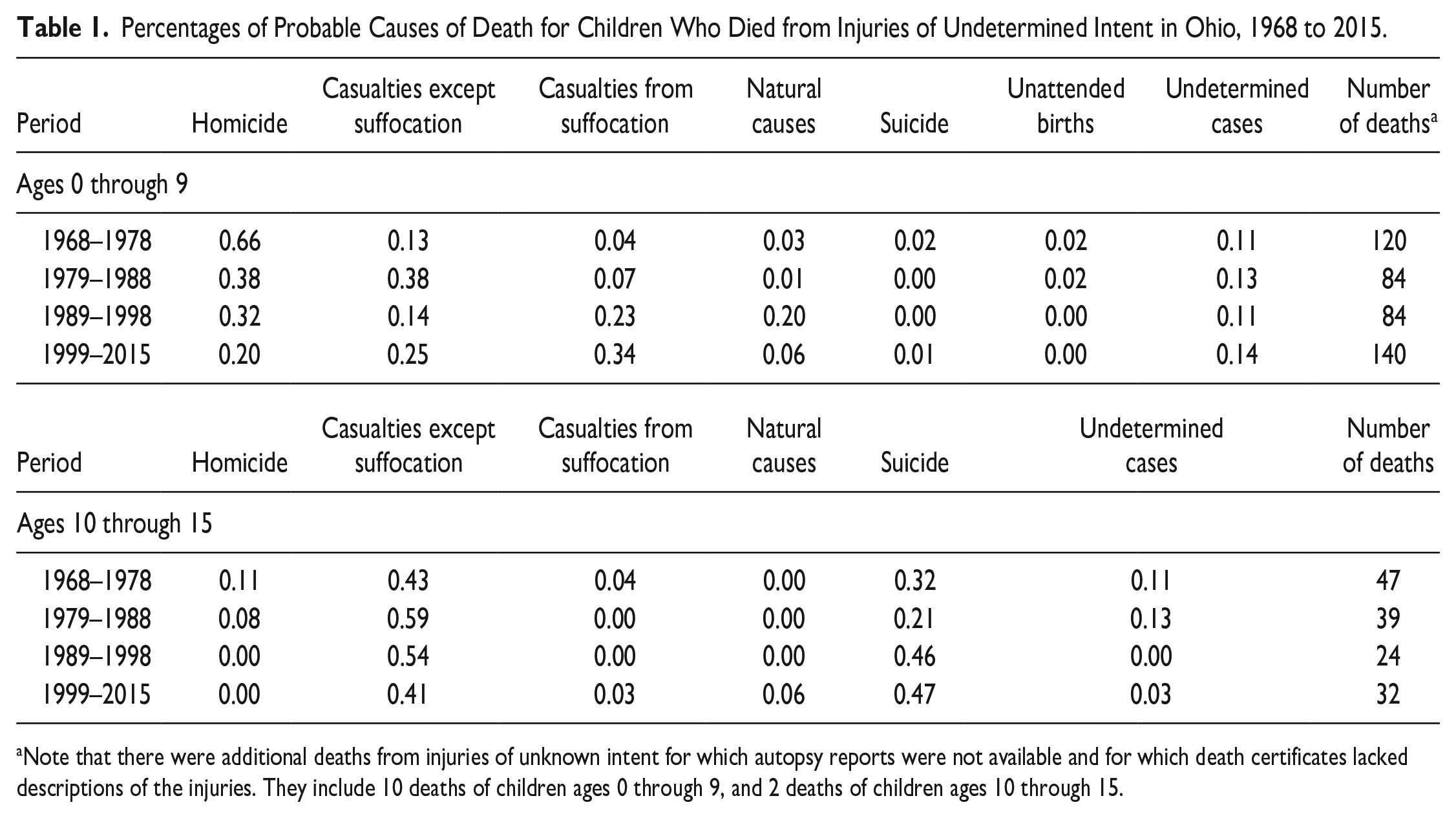
Note that there were additional deaths from injuries of unknown intent for which autopsy reports were not available and for which death certificates lacked descriptions of the injuries. They include 10 deaths of children ages 0 through 9, and 2 deaths of children ages 10 through 15.
Of the 79 children under age 10 whose deaths were probable homicides, three were victims of neonaticide, two of neglect, and three died in fires of suspicious origin. In addition, a 4-year-old girl, missing from her home for 4 hr, died of hypothermia in a snowbank after she suffered multiple injuries from a blunt instrument. Another 4-year-old girl was shot multiple times by her mother, who was despondent over the collapse of her marriage; and a days-old infant died of a cerebral hemorrhage when a sibling hurled her to the floor. 4
The other 68 probable homicide victims died from abuse. The injuries were horrific. A 2-year-old boy suffered a severed intestine, lacerated liver, bowel bruises, and blood clots on his abdominal wall; and his buttocks and the soles of his feet were black from bruises, all at the hands of his stepfather. A 2-year-old girl, who had suffered numerous cuts and bruises that were in various stages of healing, died of a traumatic subarachnoid hemorrhage, allegedly at the hands of her babysitter; and an 8-month-old boy, who had a number of broken ribs, died of a massive cerebral hemorrhage and fractured skull inflicted by his mother and stepfather. 5
The proportion of IUIs of children under age 10 that were probable homicides fell from 66%, 1968 to 1978, to 38%, 1979 to 1988, and 32%, 1989 to 1998, although the proportion of cases in which it was impossible to determine intent held steady at around 12% (Table 1). Deaths of infants and toddlers continued to be classified as IUIs despite massive subdural hematomas, deep scalp lacerations, depressed skull fractures, traumatic spinal injuries, perforated organs, and signs of strangulation. 6 The classification was used primarily, however, for nonhomicides caused by negligence, such as medication overdoses, the poisoning of a Down syndrome child who drank bleach while her parents were away, or accidental suffocation. 7 The proportion of IUIs that were probable homicides fell further from 1999 to 2015. Still, 20% of IUIs of children under age 10 were probable homicides, with an additional 14% in which homicide was a possibility (Table 1). When classified as probable homicides, these deaths raise the number of homicides for children as we move farther back in time: from 581 to 609 during 1999 to 2015 (an increase of 5%), 391 to 417 during 1989 to 1998 (an increase of 7%), 359 to 391 during 1979 to 1988 (an increase of 9%), and 375 to 454 during 1968 to 1978 (an increase of 21%).
Deaths of Children Ages 10 Through 15 from Injuries of Undetermined Intent (IUI) in Ohio, 1968 to 2015
The potential for undercounts was less dire for children ages 10 through 15. From 1968 through 1978, only 11% were probable victims of homicide. Three died in a suspicious fire allegedly set by their father; a 12-year-old boy suffered severe head and abdominal trauma from abuse; and a 14-year-old boy suffered multiple skull fractures during a sexual assault. 8 Coroners used the category 79% of the time for deaths that were probable accidents or suicides; and in 11% of cases, the intent was truly undetermined (Table 1). For children ages 10 through 15, the decline in IUIs that were probable homicides was steep, from 11%, 1968 to 1978, to 8%, 1979 to 1988, to none, 1989 to 2015, as was the decline in the proportion of deaths in which it was impossible to determine intent, from around 12% to none (Table 1). When classified as probable homicides, these deaths have only a small impact on the homicide counts in Ohio’s mortality statistics for children ages 10 to 15. They raise the number of homicide deaths from 150 to 155 during 1968 to 1978 (an increase of 5%), from 131 to 134 during 1979 to 1988 (an increase of 3%), and not at all during 1989 to 2015.
Deaths from Injuries of Undetermined Intent (IUI) That Were Truly Undetermined in Ohio, 1968 to 2015
If we look closely at IUIs of children under age 10 in Ohio in which the cause was truly undetermined, 1968 to 2015, the most frequent reason for doubt was that 26 of those 53 deaths were from fires of suspicious origin. An additional 11 deaths were from suffocation. For children ages 10 to 15 it was different. They died in 6 of 11 instances from gunshots. It is possible that as many as half of these child deaths were homicides.
Discussion
This research note confirms the findings of previous scholars who discovered that a considerable proportion of LC and IUI deaths were probable homicides. It also shows, however, by taking a historical approach, (a) that nosologists used the LC and IUI classifications with a changing frequency over time in Ohio and in the national at large in relation to the number of child deaths that they classified as homicides, and (b) that the proportion of LC and IUI deaths in Ohio that were probable homicides changed over time. These changes should be taken into account by historical criminologists whenever they study long-term trends in child homicides, particularly the homicides of children under age 10.
Because nearly all of pathologists, coroners, medical examiners, and nosologists who practiced in the late 1950s through the 1980s have retired or passed away, historians may never know for certain why the number of child deaths classified as IUIs and the proportions that were probable homicides declined after the 1970s. Those declines coincided, however, with improvements in pathology, forensics, and death investigation, which led to the implementation of Child Death Reviews and of Fetal and Infant Mortality Reviews. Child Death Reviews, first performed in Los Angeles in 1978, study suspicious deaths of children through age 17 (American Academy of Pediatrics, 1999, 2010; Durfee et al., 1992; Quinton, 2017); and Fetal and Infant Mortality Reviews, which began in 1988 with eight federally funded projects, look at all fetal and infant deaths (Baltay et al., 1999; Buckley & Chapin, 1999). By 2001, every state and the District of Columbia had some form of death review, and by 2015, 1,350 state and local review panels were in operation (Mayhew, 2007; National Center for Fatality Review and Prevention, 2017).
Childcare and supervision also improved, as did childproofing of homes, so fewer children died of accidental falls, drownings, and gunshots (Burnham, 1995, 2009, pp. 166–192; Green, 1997; Rivara & Grossman, 1996; Schnitzer et al., 2015). These were deaths that might have landed earlier in the “undetermined intent” category. There were also improvements in pathology and forensic science. Pathologists could determine with greater accuracy if a head injury was the result of violence. Cerebral edema (a buildup of pressure from fluid in the skull) and retinal hemorrhages were no longer considered indicative of blunt force trauma (Boos et al., 2022; Piteau et al., 2012; Shuman & Hutchins, 2017). Pathologists were also able to determine with greater accuracy whether an injury came from a fall or a blow because of growing knowledge about the force required to inflict particular injuries (Bulloch et al., 2000; Guyomarc’h et al., 2010; Kremer & Sauvageau, 2009; Pierce et al., 2005).
One advance since 2000, however, has increased the number of infant deaths recorded as accidental suffocation. The NCHS mortality data show that deaths from sudden infant death syndrome declined dramatically in the 1990s, as parents and caregivers became aware of the dangers of natural interruptions of breathing and of the circumstances in which children could be suffocated by sleeping prone or in unsafe bedding (Figure 2). The “Back to Sleep” campaign (Carlins & Collins, 2007) contributed to a remarkable decline in SIDS deaths, from nearly 150 per 100,000 infants per year to 60 per 100,000. Advances in pathology, however, revealed that many deaths once classified as SIDS were in fact deaths from suffocation (Kim et al., 2012; Pasquale-Styles et al., 2007; Shapiro-Mendoza et al., 2006). The death rate from accidental suffocation rose from 5 per 100,000 infants per year in the 1980s to 25 per 100,000 by the 2010s. That in turn raised the rate at which young children died from suffocation of undetermined intent. Together with the rise in the rate of negligent deaths of infants from opioids and other drugs and toxins, suffocation deaths led to a rebound in the rate of IUIs (Figure 3).
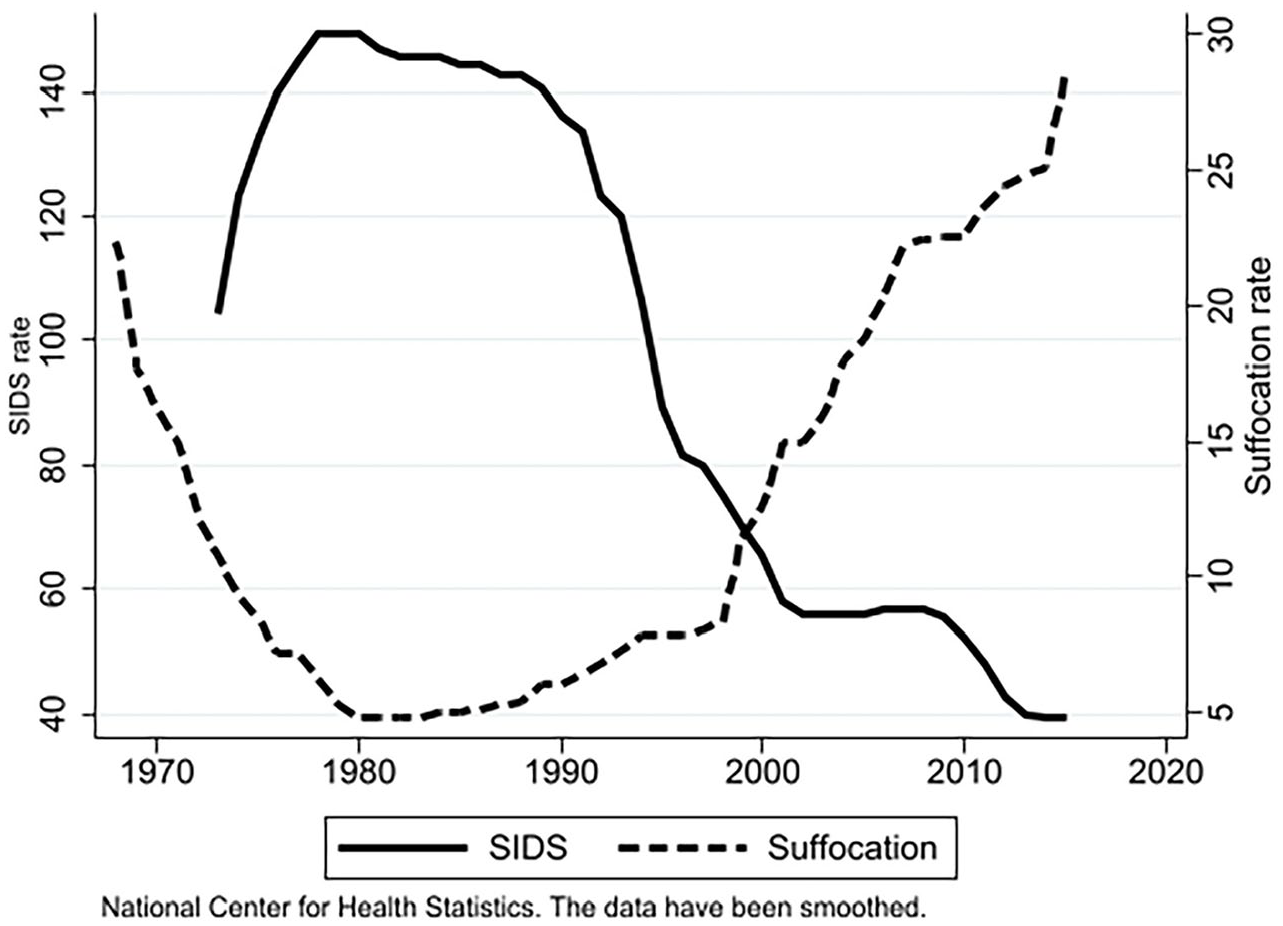
Death rates in the United States from suffocation or SIDS, 1968 to 2015, per 100,000 infants per year.
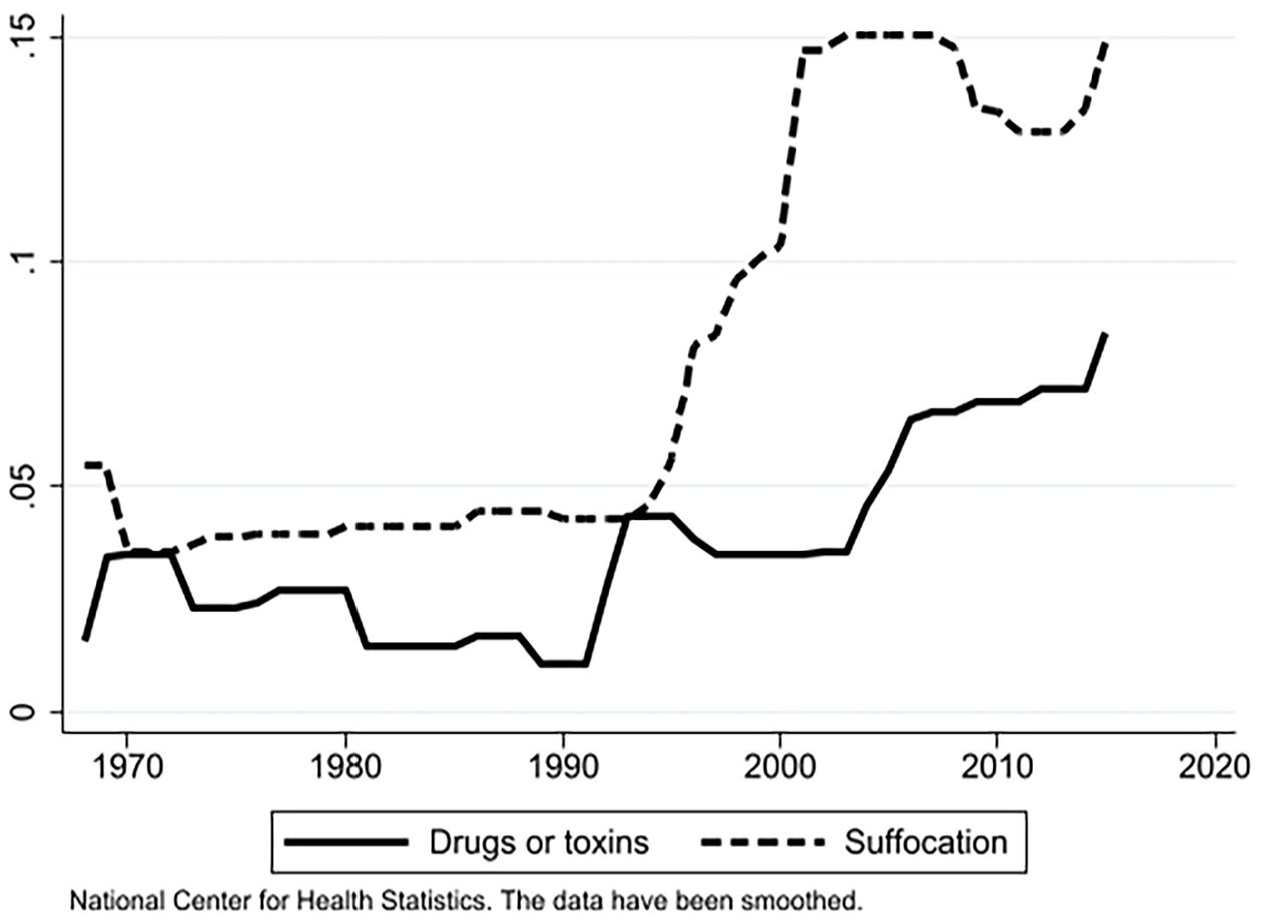
Death rates in the United States from injuries of undetermined intent from drugs, toxins, or suffocation, 1968 to 2015, per 100,000 children ages 0 to 9.
Over time, coroners and medical examiners in Ohio have used the IUI category with greater care and precision. Today it contains a far smaller proportion of probable homicides than in the past. It would be helpful, however, if coroners and medical examiners were required to indicate in their case notes whether they believe the evidence leans toward a particular finding (homicide, suicide, accident, natural), even though the evidence is not definitive—a practice recommended by the National Association of Medical Examiners (Hanzlick et al., 2002). Nonetheless, it is vitally important for scholars who study homicides of children, especially historical criminologists, to consider the large number of probable homicides that have been coded as LCs or IUIs down to the present. The only way to determine the size of that number, however, is to engage in historical research in death certificates, coroner’s reports, and autopsies—preferably through a collaborative study of LC and IUI deaths in a representative sample of counties across the United States.
Limitations
Determining the full number of LC and IUI deaths that were probable homicides will always be difficult. There is no way to determine, for instance, the number of young children who were deliberately suffocated. Without clear indications of strangulation, especially by ligature, such deaths are indistinguishable from deaths from SIDs, accidents, or unknown causes. Scholars have no alternative but to accept the decisions of local authorities. Furthermore, subjectivity will always be involved when historical criminologists examine LC and IUI deaths through death certificates, coroner’s reports, and autopsies. Local authorities in Ohio were suspicious, for instance, when a newborn infant died in a rural county of a lacerated lung, kidney, and liver. 9 The mother may have dropped the child or struck it repeatedly in a panic as she gave birth—but the injuries were severe. Historians and criminologists may legitimately disagree as to whether such deaths were probable homicides.
Conclusion
If Ohio is representative, child homicides have been classified with increasing accuracy since the 1970s as forensic science, pathology, and training for coders improved and death review boards were implemented. However, scholars of violence against children who rely on mortality statistics should consider not only homicides, but deaths coded as LCs or IUIs, especially for children under age 10, because a substantial number of those deaths have been probable homicides, even in recent years. The only way to gauge that number, however, is to study the death certificates, coroner’s reports, and autopsies on which those codes were based.
Footnotes
Acknowledgements
The author would also like to thank his co-investigators, Wendy Regoeczi and Rania Issa, for their research in the homicide case files of the Cleveland Police Department, and the members of the Society for the Scientific Detection of Crime for their help in understanding contemporary forensics, pathology, toxicology, and homicide investigation.
Declaration of Conflicting Interests
The author declared no potential conflicts of interest with respect to the research, authorship, and/or publication of this article.
Funding
The author disclosed receipt of the following financial support for the research, authorship, and/or publication of this article: The author would like to thank the National Science Foundation (SES-1228406) and the Harry Frank Guggenheim Foundation for their support for the creation of a comprehensive database of homicides in Ohio from 1959 to the present.
