



Abstract
Sexual child homicides are rare, even among sexual homicides, and no previous study has compared sexual child homicide with nonsexual child homicides. To address this gap in research, this study aims to compare sexual child homicide offenders (n = 8) with two comparison groups: sexual adult homicide offenders (n = 89) and nonsexual child homicide offenders (n = 176) regarding victim, offender, and modus operandi factors. Using bivariate analysis, the results show that although sexual child homicide offenders appear more similar to other sexual homicide offenders than to homicide offenders, sexual offenders targeting children differ from both groups on certain variables. Sexual child homicide offenders more often used strangulation as a method of killing, had intoxicated victims, used multiple locations, and destroyed evidence after the murder. The study concludes that sexual homicide offenders targeting children should be considered distinct from other offenders and that the salient characteristics linked to sadism and instrumentality should be further examined.
Introduction
A homicide is considered to be sexual in nature when there is sexual arousal, behaviour, or assault by the offender just before, during, or after killing a victim. Although research on sexual homicide has increased (see Chan & Heide, 2016, for a review), studies examining sexual homicide targeting children are still scarce. One reason for this lack of research might be the relative rarity of this crime; while sexual homicide in general constitutes between 1% and 4% of all homicides (Chan & Heide, 2016; Roberts & Grossman, 1993), sexual child homicide is even rarer, constituting between 6% and 8% of all sexually motivated homicides (Firestone, Bradford, Greenberg, Larose, & Curry, 1998; Somander & Rammer, 1991). Despite the rarity of this crime, the impact of sexual child homicide, like any child homicide, is immense, resulting in both intense media attention and the overwhelming and exhaustion of investigative resources (Boudreaux, Lord, & Jarvis, 2001; Federal Bureau of Investigation [FBI], 2004; Neuilly & Zgoba, 2006). The few studies that have examined sexual child homicide have furthermore focused on comparing offenders of sexual child homicide with nonlethal sexual molesters or sexual homicides of adults. No study to date have compared sexual child homicide offenders with offenders of nonsexual child homicide. This constitutes a gap in the literature regarding both sexual homicide and child homicide that needs to be addressed if the characteristics of sexual child homicide are to be understood. This, since previous research, has argued that sexual child homicide should be considered distinct from other sexual violence (Beauregard, Stone, Proulx, & Michaud, 2008). Whether or not sexual child homicide offenders are similar to or different from nonsexual child homicide offenders has important implications for both research and theory as well as for policy and prevention. If sexual child homicide offenders differ significantly from other homicide offenders, or from other sexual homicide offenders, this might imply different offending pathways or different pathologies among this particular group of offenders, which needs to be properly understood if future violence is to be prevented, appropriately treated, rehabilitated, and managed. Such differences could potentially mean that changes to rehabilitation programs or custodial strategies might be needed to ensure future prevention of this crime. This study therefore aims to address this lack in knowledge by exploring the characteristics of sexual child homicide offenders in relation to nonsexual child homicide offenders as well as sexual homicide offenders targeting adults.
Homicide of Children
Homicide where the victim is a child has been described as one of the least understood categories of homicide (Azores-Gococo, Brook, Teralandur, & Hanlon, 2017). Although rare, comprising around 5% of all homicides worldwide (United Nations Office on Drugs and Crime, 2011), meaningful heterogeneity has been found among offenders of child homicide (Azores-Gococo et al., 2017; Liem & Koenraadt, 2008; Putkonen et al., 2016). In general, psychiatric disorders are overrepresented among perpetrators of homicide against children (Stroud & Pritchard, 2001). The offender is also most commonly female, and the homicides are also often intrafamilial in nature (Pritchard, Davey, & Williams, 2013; Stroud & Pritchard, 2001). Many homicides of children are committed in a domestic context, as part of a familicide, where one parent, often a father, kills the spouse and the child or children (Azores-Gococo et al., 2017; Liem & Reichelmann, 2014). When the victim is the own child of the perpetrator (filicide), the reported motive may be altruism (relieve the child of real or imagined suffering), acute psychosis, that the child was unwanted, unintentional murder due to abuse, or spousal revenge (Azores-Gococo et al., 2017; Bourget & Gagné, 2002). Research has also shown that there are significant differences between intrafamilial and extrafamilial homicides, where extrafamilial murders tended to involve male offenders, slightly older victims, strangulation, and sexual motivation (Alder & Polk, 2001; Cavanagh, Dobash, & Dobash, 2005).
Sexual Homicide of Children
In sexual homicide of children, the offender is often extrafamilial (Stroud & Pritchard, 2001). In their study, Stroud and Pritchard found that all of the extrafamilial child homicides were sexually motivated. Although the knowledge of sexual homicide of children has been evident since the 15th century (Hickey, 2002), research about this crime has been scarce. Unlike what the literature shows on child homicide in general (Stroud & Pritchard, 2001), sexually motivated homicides of children often involve a male offender (Boudreaux, Lord, & Dutra, 1999). Research also show that the offender most commonly is a stranger to the victim (Boudreaux et al., 1999; Spehr, Hill, Habermann, Briken, & Berner, 2010; Stroud & Pritchard, 2001), that the victim most commonly is female, and that the most common cause of death is strangulation or suffocation (Beauregard et al., 2008; Boudreaux et al., 1999). Sexual homicide offenders targeting children often plan their offence and a weapon is commonly used (Beauregard et al., 2008). When examining the abduction of children in the United States, Boudreaux et al. (1999) found that the most common age for sexual child homicide was 6 to 17 years old for female children and 6 to 14 years old for male children.
Two main explanations have been put forward in explaining the choice of children as victims in sexual attacks: (a) children represent easier, more available targets compared with adults, and (b) the offender has a sexual interest in children. It has been hypothesised that children are targeted for sexual homicide due to their comparative vulnerability, weakness, and availability compared with other victims (Beauregard et al., 2008; Heide, Beauregard, & Myers, 2014). The offender might experience difficulties interacting and connecting well with other adults, finding more emotional congruence with children (Beauregard et al., 2008).
Sexual deviant preferences for children and the harming of children have also been found present in child sexual homicide offenders (Heide et al., 2014; Spehr et al., 2010). In the group of sexual homicide offenders targeting children as a result of a deviant sexual preference, the murder of the child has been known to occur to avoid apprehension (Heide et al., 2014). There is also a subset of offenders in this group with sadistic inclinations, where arousal and gratification result from the suffering and killing of their victims (Heide et al., 2014; Schmidt & Madea, 1999).
Beauregard et al. (2008) also found that sexual child homicide more often involved modus operandi characteristics congruent with Dietz, Hazelwood, and Warren’s (1990) result outlining the crime scene characteristics of sadistic offenders, further highlighting the link between sadism and sexual homicide of children. The study by Dietz et al. (1990), which has been described as one of the most complete studies of the modus operandi of sadistic offenders, demonstrated that the majority of the sadistic offenders planned their crimes, that their victims were often tortured, tied up, and gagged. The sadistic offender moreover demonstrated a diverse range of sexual acts and had an accomplice in about a third of the cases. When the victim was killed, strangulation was the most common cause of death, both with and without the use of a ligature, and the victim’s body was often concealed (Dietz et al., 1990). While sadism has been described as a salient feature of child sexual homicide (Beauregard et al., 2008; Heide et al., 2014; Schmidt & Madea, 1999), these characteristics (such as concealing the body and planning the crime) are also related to instrumentality and organisation of the offender (Salfati & Canter, 1999; Salfati & Haratsis, 2001).
Comparative Studies
Only a handful of studies have compared the characteristics of sexual child homicide with other offences, most commonly with nonhomicidal sexual child molesters (Firestone, Bradford, Greenberg, & Larose, 1998; Firestone, Bradford, Greenberg, Larose, & Curry, 1998; Firestone, Bradford, Greenberg, & Nunes, 2000). Such studies have found that homicidal offenders had a higher prevalence of mental illness, paraphilias, and personality disorders, including sexual sadism, psychosis, and psychopathy. Firestone, Bradford, Greenberg, Larose, and Curry (1998) also found that homicidal offenders more often targeted strangers and were more likely to have past convictions of violent and sexual offences compared with nonhomicidal offenders. Research has also found that sexual child homicide offenders had a significantly higher prevalence of sadistic paedophilic preferences compared with the nonhomicidal offenders, indicating a preference for assaultive rather than consensual interaction with children in this group (Firestone et al., 2000).
When comparing sexual homicides of children with sexual homicides of adult women in Canada, Beauregard et al. (2008) found that sexual homicide offenders targeting children had more commonly suffered sexual abuse in their own childhoods. Sexual child homicide offenders more commonly had deviant sexual fantasies compared with sexual adult homicide offenders, and the study demonstrated differences between the groups on precrime, crime, and postcrime variables. Sexual homicide offenders targeting children were significantly more likely to premeditate their offence, strangle their victim, and to hide and dismember the body after the murder compared with sexual homicide offenders of adults. Offenders targeting children were furthermore more likely to be unemployed and to have had prior contact with the victim.
When sexual homicides of children were compared with sexual homicides of adult victims in Germany, Spehr et al. (2010) found that although most of the victims of sexual child homicides were female, significantly more male victims were killed in this group. No difference between the groups was found in regarding to age, where both the homicide offenders with adult and child victims had a mean age in their mid-20s; however, the sexual child homicides included a higher percentage of juvenile offenders compared with the sexual adult homicides (Spehr et al., 2010). Spehr et al. also found that sexual homicide offenders targeting children more often were diagnosed with paedophilia. Sexual homicide offenders targeting children were however less likely to have alcohol or drug dependency, sexual dysfunctions, and narcissistic personality disorder compared with sexual homicide offenders targeting adult victims. No difference between the groups was found regarding psychopathy scores or overall risk; however, the sexual homicide offenders targeting children were more likely to have a previous history of committing sexual abuse against children. Overall, Spehr et al. concluded that the two groups were more diagnostically similar than different, differing most significantly in their diagnosis of paedophilia.
Objective of Study
Previous studies have shown that there are similarities as well as differences between homicidal and nonhomicidal sexual violence of children (Firestone, Bradford, Greenberg, & Larose, 1998; Firestone, Bradford, Greenberg, Larose, & Curry, 1998; Firestone et al., 2000) and between sexual child homicides and sexual homicide targeting adults (Beauregard et al., 2008; Spehr et al., 2010). However, no study to date have compared sexual homicides of children with nonsexual homicides of children, despite the fact that research has shown that certain characteristics of sexual child homicide offenders are more similar to homicide offenders in general than to samples of nonhomicidal sexual child abusers (Spehr et al., 2010). This raises questions of possible offending pathways of the offenders of this crime. Are sexual child homicide offenders more similar to sexual adult homicide offenders than they are to nonsexual child homicide offenders? Due to this gap in the current knowledge of sexual homicide against children, the aim of the current exploratory study is to compare child sexual homicide offenders with two different groups: (a) sexual homicide offenders targeting adults, and (b) nonsexual homicide offenders targeting children. This comparison will be exploring characteristics of the offenders, the victims, and the modus operandi, examining whether sexual homicide offenders targeting children primarily are to be considered sex offenders, homicide offenders, or a different group all together.
Method
Sample and Procedure
The sample consists of child sexual homicide offenders, gathered from the Scottish Homicide Database (SHD) held and coded by Police Scotland. The SHD contains all homicide cases that come to the attention of the police, including cases that have yet to be tried in court, making it a population dataset of homicide in Scotland. A homicide in the current study is defined as an incident where at least one dead body (or parts of a dead body) was found within the context of the same crime scene. The homicide case may involve multiple offenders and/or multiple victims but if another victim was found outside the borders of the first crime scene, this would be regarded as different homicide case. Cases were identified as sexual if the motive was coded as sexual by Police Scotland, or if the case met the definition of sexual homicide provided by the FBI: that is, the case had to include at least one of the following: (a) victim’s attire or lack of attire, (b) exposure of the sexual parts of the victim’s body, (c) sexual positioning of the victim’s body, (d) insertion of foreign objects into the victim’s body cavities, (e) evidence of sexual intercourse, or (f) evidence of substitute sexual activity, interest, or sadistic fantasy (Ressler, Burgess, & Douglas, 1988). Due to practical difficulties in the coding of the database leading to significant levels of missing data, the sample only includes cases from 1990 to 2015. Culpable homicides were excluded from the sample as some of these cases were nonviolent acts (such as the self-administration of drugs). Culpable homicides in Scotland are defined as homicides where the offender has caused the loss of life through wrongful conduct without the intention to kill or “wicked recklessness” (Scottish Government, 2004), and/or where provocation or diminished responsibility can be found. All cases of homicide involved in this study were cases that Police Scotland had coded as “murders.”
Overall, there were a total of eight sexual child homicide offenders involved in the deaths of eight child victims. The two comparison groups were (a) all sexual homicide offenders with adult victims during the relevant time period (n = 89), and (b) all nonsexual homicide offenders targeting children during the relevant time period (n = 176).
Measures
Dependent variables
The dependent variables differed depending on comparison group. When the child sexual homicide offenders were compared with adult sexual homicide offenders, the dependent variable was victim’s age. As the legal age for consent is 16 years old in Scotland (Scottish Government, 2010), any victim younger than the age of 16 years was considered a child. When the child sexual homicide offenders were compared with the nonsexual child homicide offenders, the dependent variable was whether or not the case was considered sexual.
Independent variables
The same independent variables were used in both comparison groups. There were three groups of independent variables relating to the offender, the victim, and the modus operandi of homicide. All independent variables except for offender and victim age were dichotomous, coded 1 = yes and 0 = no or unknown. These variables were chosen based on availability and what previous research has shown to be important when examining sexual homicide (Carter & Hollin, 2009; Chan & Heide, 2016; Dietz et al., 1990; Skott, Beauregard, & Darjee, 2018).
There were seven offender variables: (a) gender, (b) White ethnicity, (c) unemployed, (d) if the offender was homeless, (e) suicide of the offender, (f) if the offender had an accomplice, and (g) mean offender age.
The five victim variables were (a) gender, (b) White ethnicity, (c) if the victim was homeless, (d) if the victim was intoxicated by alcohol or drugs, and (e) mean victim age (for comparing the sexual and nonsexual child homicides).
There were 18 modus operandi variables: (a) whether cause of death was stabbing; (b) whether cause of death was bludgeoning; (c) whether cause of death was shooting; (d) whether the victim was by physical assault or without the use of any weapons; (e) whether the victim was strangled or asphyxiated to death with or without the use of a ligature; (f) whether the victim was killed by other methods (which included drowning, poisoning, drugs and cause of death cannot be established, or cases where the it was uncertain what weapon was used); (g) whether the victim and offender were acquaintances or known to each other; (h) whether the victim and offender were nonintimate family members; (i) whether the victim and offender were strangers; (j) whether the relationship was unknown; (k) whether the homicide took place in a private location; (l) whether the homicide took place in an indoors location; (m) whether any evidence had been attempted to be destroyed (which included any of the following: the body had been moved more than walking distance from the place of the murder; the body was covered but not buried; the body had been buried; the body had been burned; and/or whether the body had been dismembered); (n) whether the choice of weapon was improvised; (o) whether the weapon was brought to the scene; (p) whether the homicide involved multiple locations; (q) whether the homicide involved an additional adult victim; and (r) whether the homicide was unresolved. An unresolved homicide is by Police Scotland defined as cases that are any of the following: the case remains undetected (as in no suspect is discovered); the case is considered detected but no further proceedings have been made; the case is awaiting trial; the case has proceeded to trial where the offender was found not guilty; the offender committed suicide or died before trial with not enough evidence that the offender killed the victim; or the case was found not proven.
Statistical Analysis
Due to the small sample size of female sexual homicide offenders, independent variables were compared between dependent variable groups using Fisher’s exact test for bivariate analysis without conducting multivariate analyses. Effect sizes, using Cohen’s d, were also determined, with .20 = small effect, .50 = medium effect, and .80 = large effect (Cohen, 1992). The mean age of the offenders was compared using Mann–Whitney U tests. The child sexual homicide offenders were compared with adult sexual homicide offenders and with nonsexual child homicide offenders. All statistical analyses were conducted using SPSS version 19.
Results
Detailed Description of Sexual Child Homicide Cases
One of the eight sexual child homicide offenders in the current study was a serial homicide offender; however, only one of the victims was younger than 16 years old. Another case involved two simultaneous victims, a mother and daughter, both of whom had been sexually assaulted before death. Half (n = 4) of the sexual child homicide offenders had previous convictions for sexual violence. The sexual violence in these homicides included a diverse range of sexual acts, with three (37.5%) of the cases involving at least two different sexual acts during the murder. Three of the cases also involved the use of a ligature.
Of the eight cases of sexual child homicide in the current study, only one case involved a female offender. In this case, both the offender and victim were in their teens (16 and 14 years, respectively) and the victim was also female. This was also the case where the victim and offender were family members and where the offender had an accomplice. This case was one of the two cases that remained unresolved due to dropped charges. Another case remained unresolved due to the suicide of the offender before trial.
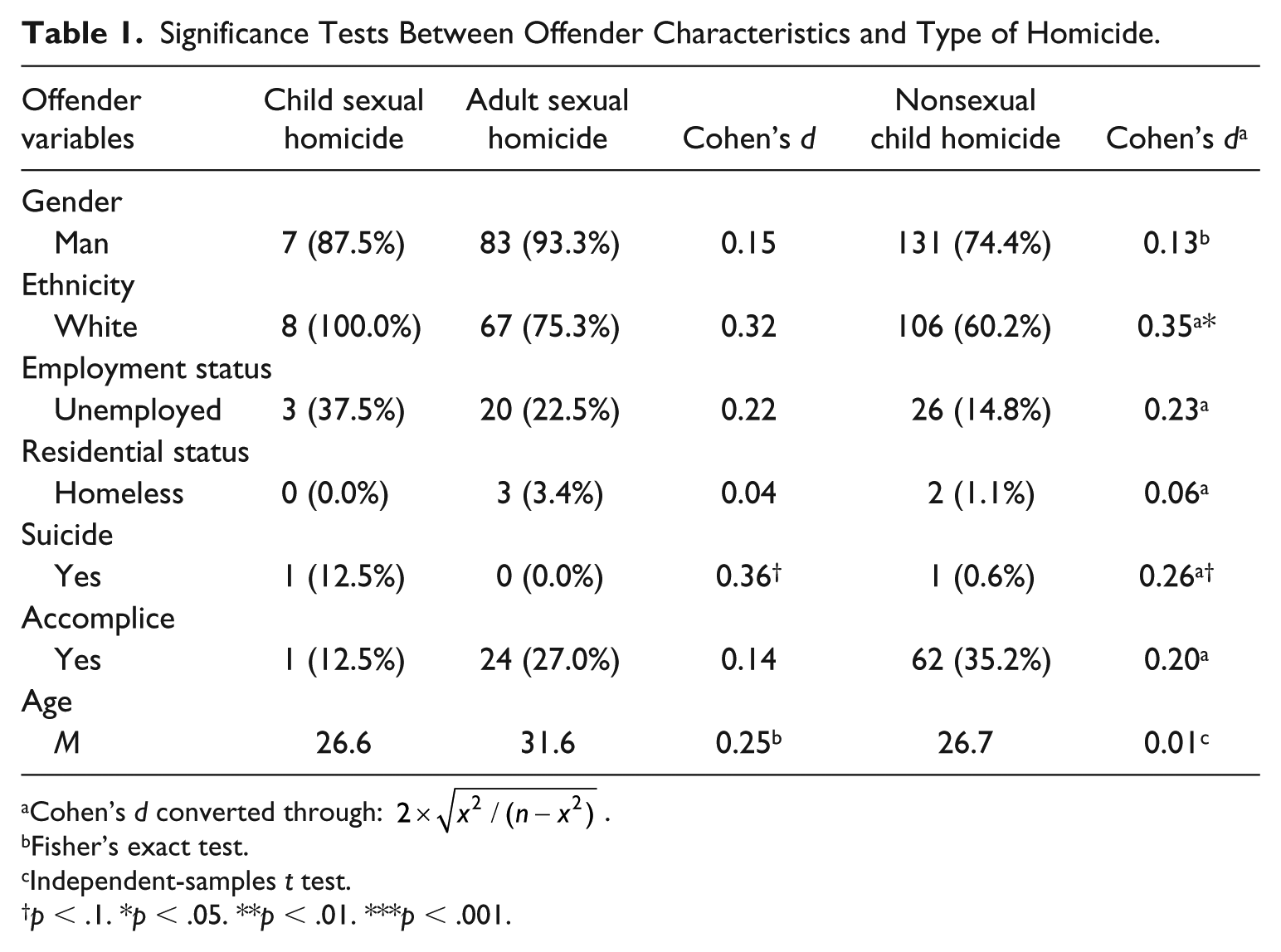
As can be seen from Table 1, the mean age of the offenders among the sexual child homicide offenders was 26.6 years old; however, in two cases, the offenders were aged 16 years old. In both these cases, the victims were also teenagers, and in one of these cases, the offender and victim had previously been romantically involved.
Significance Tests Between Offender Characteristics and Type of Homicide.
Cohen’s d converted through:
Fisher’s exact test.
Independent-samples t test.
p < .1. *p < .05. **p < .01. ***p < .001.
In half of the cases (n = 4), evidence had been destroyed after the murder. This included cases where effort to conceal evidence had been made, or where the body had been hidden, dismembered, or buried. In most of the cases where evidence had been destroyed (n = 3, 75.0%), the victim had also been drugged or intoxicated prior to the offence. The majority of the cases involving evidence destruction also involved more than one location, meaning that the body had been moved before or after the death of the victim. All cases which involved stranger victims (n = 2) also belonged to the group of cases involving evidence destruction, and most (n = 3, 75.0%) of the offenders in this group had committed previous sexual offences.
Offender Characteristics
The majority of sexual child homicide offenders were male (n = 7, 87.5%), and all of them (n = 8, 100%) were White. Approximately two fifths (n = 3, 37.5%) of the offenders were unemployed at the time of murder and no offenders were homeless. Only one (12.5%) of the sexual child homicide offenders had an accomplice, and one (12.5%) of the offenders committed suicide after the homicide. The mean age of the sexual child homicide offenders was 26.6 years old at the time of murder (see Table 1).
Overall, the sexual child homicide offenders appeared very similar to the sexual adult homicide offenders. While sexual adult homicide offenders were less likely to commit suicide compared with the sexual child homicide offenders (n = 0, 0.0%), this difference only approached significance (see Table 1).
There were more differences between the sexual child homicide offenders and the nonsexual child homicide offender, however. Although the majority of the nonsexual child homicide offenders were White (n = 106, 60.2%), they were more likely to belong to an ethnicity other than White compared with the sexual child homicide offenders (p = .02, small effect size). Although only approaching significance, nonsexual child homicide offenders were slightly less likely to commit suicide after the murder (n = 1, 0.6%) compared with sexual child homicide offenders.
Victim Characteristics
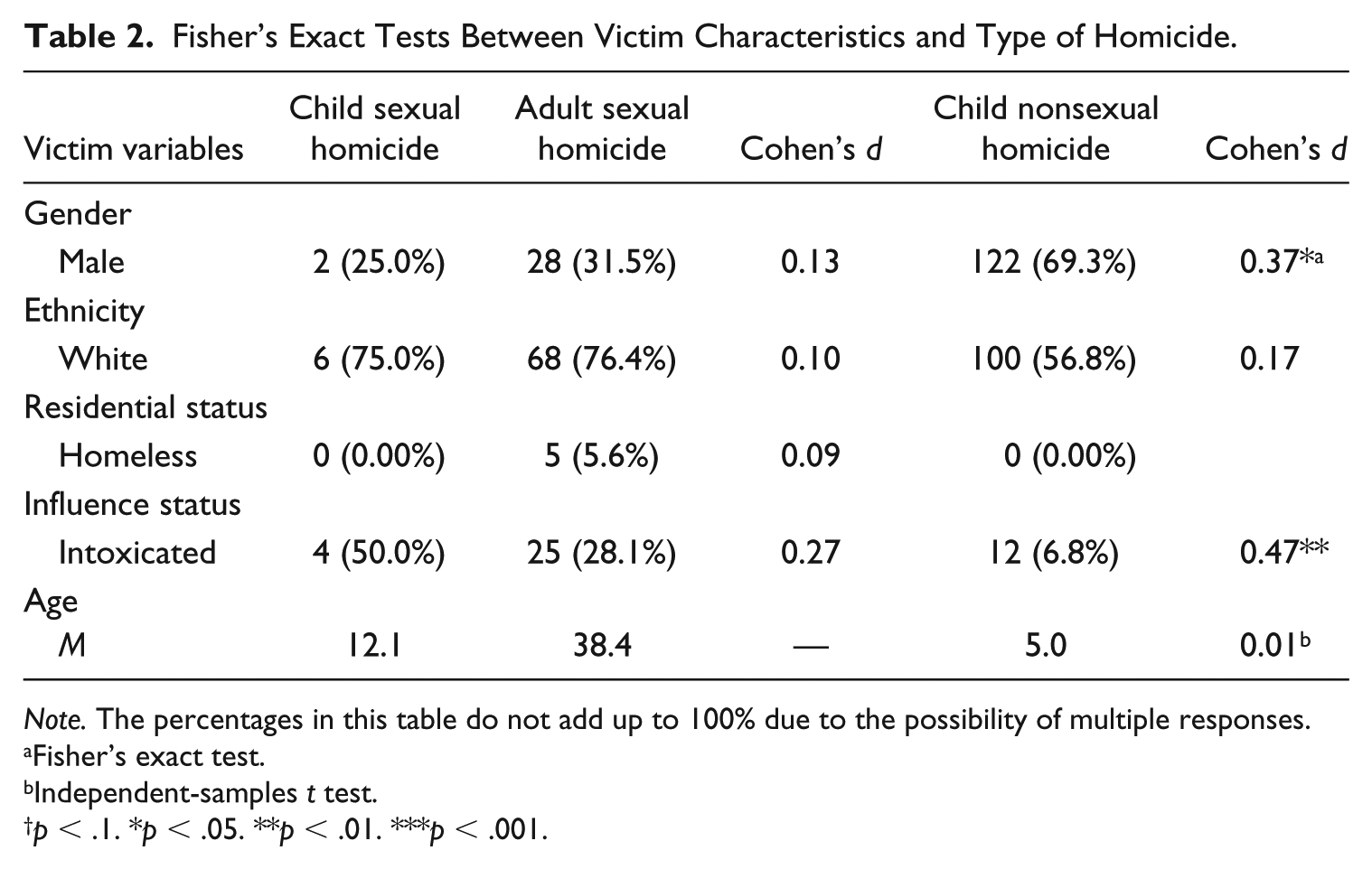
The victims of sexual child homicide were most commonly female (n = 6, 75.0%) and of White ethnicity (n = 6, 75.0%). None of the victims were homeless (see table 2). Half (50.0%) of the victims were intoxicated by either drugs or alcohol at the time of death and the mean age of the sexual child homicide victims was 12.1 years old (SD = 3.0).
Fisher’s Exact Tests Between Victim Characteristics and Type of Homicide.
Note. The percentages in this table do not add up to 100% due to the possibility of multiple responses.
Fisher’s exact test.
Independent-samples t test.
p < .1. *p < .05. **p < .01. ***p < .001.
There were no significant differences between the victims of sexual child homicide and sexual adult homicide. The nonsexual child homicide victims were more commonly male compared with the sexual child homicides (n = 122, 69.3%, p = .015, small effect size). The sexual child homicide victims were significantly more likely to be drugged or under the influence of alcohol during the homicide compared with nonsexual child homicide victims (p = .002, small effect size). The mean age of the sexual child homicide victims was significantly higher than the age of the nonsexual child homicides, where the mean age of the victim was 5.0 years old (SD = 5.8; p < .001).
Modus Operandi
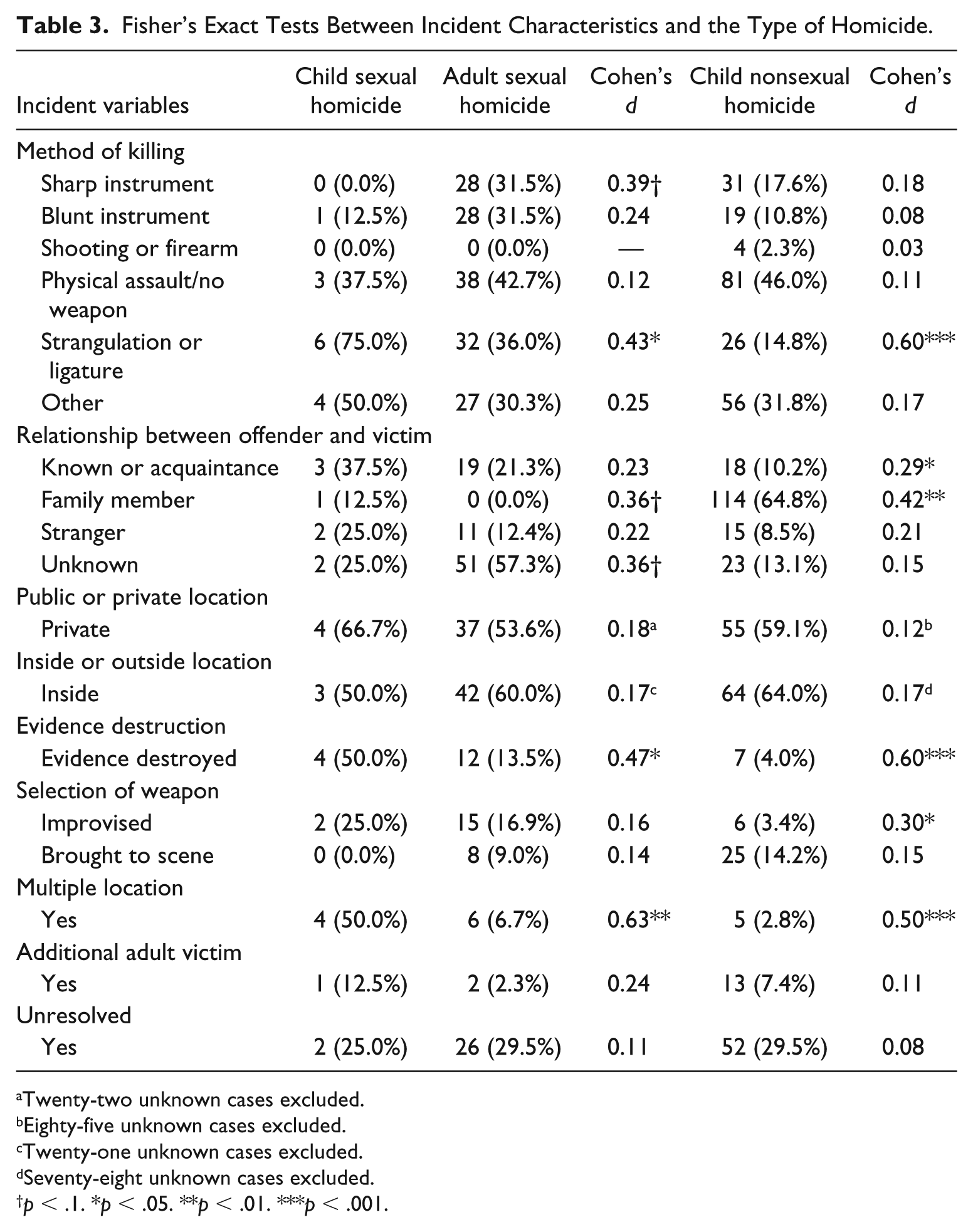
The majority of sexual child homicide victims were killed using strangulation either with or without the use of a ligature (n = 6, 75.0%). Half of the cases (n = 4) also involved other methods of killing, including drowning, poisoning, or if the cause of death could not be established due to decomposition of the body. Three cases (37.5%) of the sexual child homicides involved physical assault without the use of any weapon. When a weapon was used, it was more common that the weapon was improvised (n = 2, 25.5%) rather than brought to the scene by the offender (n = 0, 0.0%).
The most common relationship between offender and victim was someone known, like a neighbour (n = 3, 37.5%). In two of the cases (25.5%), the victim was a stranger to the offender, and in one case (12.5%), the offender was a family member. In two cases (25.0%), the relationship was unknown, either because this information was missing (n = 1, 12.5%) or because the case was unresolved (n = 1, 12.5%). It was more common that the sexual child homicides occurred in a private location (n = 4, 66.7%), and it was as common to occur inside as outside (n = 3, 50.0%; see Table 3). Evidence was destroyed in half of the cases (n = 4, 50.0%), and in half of the cases (50.0%), did the homicide involve more than one location. One case (12.5%) involved the death of another adult victim.
Fisher’s Exact Tests Between Incident Characteristics and the Type of Homicide.
Twenty-two unknown cases excluded.
Eighty-five unknown cases excluded.
Twenty-one unknown cases excluded.
Seventy-eight unknown cases excluded.
p < .1. *p < .05. **p < .01. ***p < .001.
Strangulation as method of killing, with or without the use of a ligature, was significantly more common among the sexual child homicide offenders compared with both adult sexual homicide offenders (p = .038, small effect size) and nonsexual child homicide offenders (p < .001, medium effect size). Although only approaching significance, sharp instruments were more commonly used among sexual adult homicide offenders (n = 28, 31.5%) compared with child sexual homicide offenders. When a weapon was used, it was significantly more common that the weapon was improvised for the sexual child homicide offenders compared with the nonsexual child homicide offenders (n = 6, 3.4%, p = .041, small effect size).
There were no significant differences between sexual child homicide offenders and sexual adult homicide offenders in regard to their relationship to the victim. It seemed slightly more common for sexual child homicides to involve a family member compared with sexual adult homicides; however, this relationship only approached significance.
Sexual child homicide offenders were significantly more likely to target a known victim compared with nonsexual child homicide offenders (p = .05, small effect size). The offenders of nonsexual child homicides, where family members or relatives were the most common relationship between offender and victim (n = 114, 64.8%), were significantly more likely to murder a family member compared with sexual child homicide offenders (p = .005, small effect size).
There was no difference between sexual child homicides, sexual adult homicides, and nonsexual child homicides regarding the location of the homicide. Sexual child homicide offenders were however significantly more likely to destroy evidence after the homicide compared with both sexual adult homicide offenders (p = .024, small effect size) and nonsexual child homicide offenders (p< .001, medium effect size). Sexual child homicides were also significantly more likely to involve more than one location when the homicide was committed compared with both sexual adult homicides (p = .003, medium effect size) and nonsexual child homicides (p < .001, medium effect size).
Discussion
The current study has been the first of its kind to compare sexual child homicide with both sexual adult homicide and nonsexual child homicide. This is furthermore the first time sexual homicide involving children has been examined in the United Kingdom, let alone Scotland, and the results from this study will therefore help to expand the limited knowledge of sexual homicides targeting children.
The results support previous studies stating that sexual homicides targeting children are very rare. This crime constituted about 0.3% of all homicides and 8% of all sexual homicides in Scotland. Both these figures are consistent with previous research (Chan & Heide, 2016; Firestone, Bradford, Greenberg, Larose, & Curry, 1998; Roberts & Grossman, 1993; Somander & Rammer, 1991). This study also found that sexual child homicide constitutes 4% of all child homicides. This figure is not commonly reported, as sexual child homicides most commonly are compared with nonhomicidal sexual violence on children or sexual adult homicide. As this is a Scottish estimate, it would be interesting to see whether other countries have similar ratios, as indeed the ratio of sexual child homicide to all sexual homicide has been shown consistent with previous research.
The sexual child homicide offenders of the current study were most commonly male, of White ethnicity, and had a mean age of 26.6 years old. These offenders most commonly committed their murder alone, without the help of an accomplice, and they rarely took their own lives after the murder. The victims of these crimes were most commonly female and were often intoxicated by drugs or alcohol before the murder was committed. The victim and offender were most commonly known to each other in an extrafamilial manner, and the majority of the victims were killed using strangulation or asphyxiation, with or without the use of a ligature. Most of the sexual child homicides were committed in private locations, often indoors. Half of the cases involved evidence destruction and half of the homicides also involved more than one location.
These findings are congruent with previous research, stating that sexual child homicide offenders are most commonly male, that the victim most commonly is female, and that strangulation or suffocation is the most common cause of death (Beauregard et al., 2008; Boudreaux et al., 1999). Some differences between the current sample and previous research were found as well. For instance, the current study did not find that the offenders most commonly were strangers to the victim (Boudreaux et al., 1999; Spehr et al., 2010; Stroud & Pritchard, 2001), or that the offender most commonly used a weapon (Beauregard et al., 2008). In fact, only one case in the current study involved the use of either a sharp or blunt weapon or a firearm. While these differences might be due to the different methodologies utilised in the different studies, there might also be underlying jurisdictional differences between sexual child homicide offenders in Scotland compared with other countries. Future cross-national studies comparing the characteristics of sexual child homicide offenders is therefore necessary to determine whether samples of this rare offence differ between jurisdictions or if underlying pathways of these offences can be identified.
This study has also compared sexual child homicide offenders with both sexual adult homicide offenders and nonsexual child homicide offenders, demonstrating similarities and differences to both groups. Overall, the results indicate that sexual homicide offenders targeting children are more similar to sexual homicide offenders targeting adults compared with nonsexual homicide offenders targeting children. This result mirrors the findings from a larger number of studies comparing adult sexual homicide cases with nonhomicidal sexual aggressors (see, for instance, Beauregard, DeLisi, & Hewitt, 2017; Beauregard & Martineau, 2016; Choon & Heide, 2016; Proulx, Blais, & Beauregard, 2007).
While there were no significant differences regarding either the offender or the victim characteristics between the sexual child homicides and the sexual adult homicides, nonsexual child homicides were significantly more likely to include non-White offenders and male victims compared with sexual child homicides. Nonsexual child homicides were furthermore significantly less likely to include victims who were intoxicated compared with sexual child homicides. Another key finding of the current study was that sexual child homicide victims were significantly older (average age of 12 years) compared with nonsexual child homicide victims (average age of 5 years). This difference, suggesting sexual homicide offender more commonly target prepubescent children or teenagers rather than small children, might also explain the difference in intoxication between sexual and nonsexual child homicides and should be examined further in future research.
Sexual child homicide offenders furthermore appeared more similar to sexual adult offenders regarding modus operandi. It was significantly more likely for the sexual child homicide offenders to have an extrafamilial known relationship to the victim compared with the nonsexual child homicide offenders. When a weapon was used, it was also significantly more common that this weapon was improvised in the sexual child homicides compared with the nonsexual child homicides. The nonsexual child homicide offenders were more likely to target family members compared with the sexual child homicide offenders, suggesting an intrafamilial preference among the nonsexual child homicide offenders congruent with previous research (Azores-Gococo et al., 2017; Bourget & Gagné, 2002).
Although sexual child homicide offenders seem to share more similarities with sexual adult homicide offenders, this group differed from both comparison groups on certain variables. Strangulation as a method of killing, both with and without the use of a ligature, was significantly more common among the sexual child homicide offenders compared with both sexual adult homicide offenders and nonsexual child homicide offenders. It was also significantly more common for the sexual child homicide offenders to destroy evidence in relation to the homicide and to use multiple locations during the murder.
The fact that sexual child homicides demonstrate differences to other forms of sexual homicide is also consistent with previous research, which has identified sexual child homicide as a distinct group within sexual homicide (Beauregard et al., 2008; Spehr et al., 2010). Research have previously found that sexual homicides targeting children are more likely to involve strangulation and the dismemberment of the victim’s body compared with sexual adult homicide (Beauregard et al., 2008). Previous studies have also shown that the victims of sexual child homicide were most commonly female (Spehr et al., 2010), which was consistent with the findings of the current study. Spehr et al. (2010) also found that the sexual child homicides included a higher percentage of juvenile offenders compared with the sexual adult homicides. Although this was not statistically tested, two of the sexual child homicide offenders in the current study were younger than 18 years old.
This highlights the need for future research on sexual child homicide, particularly regarding the specific offending pathways demonstrated by these offenders. Many of the characteristics seemingly unique for sexual homicides of children are congruent with the modus operandi outlined by Dietz et al. (1990), describing sadistic offenders. Dietz et al. identified that sadistic offenders often planned their crimes, that the most common cause of death was strangulation, that a range of sexual acts had been performed, and that the victim’s body often was concealed. While the current study did not include a specific variable indicating premeditation, the fact that the sexual child homicide offenders more commonly used multiple locations, destroyed evidence, and that their victim was more commonly intoxicated could indicate a higher level of premeditation compared with the other homicides examined. The fact that sexual child homicide offenders more commonly knew the victim in extrafamilial terms compared with nonsexual homicide offenders might also suggest levels of planning. Previous research on sexual aggressors targeting children has demonstrated that the offenders might stalk or groom the victim for some time before molesting them (Carter, Barnett, Stefanska-Hodge, & Higgs, 2014). Previous research has furthermore linked sexual child homicide to sadism, even describing it as salient to this particular crime (Beauregard et al., 2008; Heide et al., 2014; Schmidt & Madea, 1999). While these features might also be related to instrumentality and organisation rather than sadism, research has demonstrated that investigative awareness can be considered a distinct feature of sexual sadism (Reale, Beauregard, & Martineau, 2017). Taken together, these characteristics would indicate that sexual child homicide offenders are demonstrating higher levels of sadism and instrumentality compared with both sexual adult homicide offenders and nonsexual child homicide offenders.
Conclusion
Overall, this study has shown that while sexual child homicides display similarities to both comparison groups, the results would suggest that sexual homicide offenders targeting children are more similar to sexual homicide offenders targeting adults compared with nonsexual homicide offenders targeting children. This means that this particular group of offenders should be considered sexual offenders first, and homicidal offenders second. This distinction might prove important in regard to correctional management and rehabilitation of offenders, which sometimes have different routes for “sex offenders” on one hand, and “murderers” on the other hand. This might lead to diminished availability of certain treatment programmes for sexual offenders who are treated as homicide offenders, and as argued by Skott et al. (2018) in regard to sexual and nonsexual homicide offenders, sexual child homicide offenders should be considered escalating sex offenders rather than homicide offenders. This would enable such offenders to gain access to treatment and rehabilitation strategies specifically designed for this type of violent behaviour and help prevent reoffending of such violence in the future.
The prominent sadistic feature of sexual child homicide suggested in the current findings has important theoretical and practical implications. Sadistic offenders often withdraw into an inner world of elaborate and coercive fantasies, fleeing failed relationships, where acting out on these fantasies become a coping mechanism due to intense emotional stress, and an outlet for their inner distress, rage, and humiliation (Proulx, McKibben, & Lusignan, 1996; Proulx et al., 2007). In the case of sexual homicide offenders targeting children, these failed relationships might be with other adults, and the stressful events could be low self-esteem or a feeling of rejection (Beauregard et al., 2008). Sadistic sexual murderers often display high levels of organisation and ritualization, which might also be indicative or serial offending (Dietz et al., 1990; Proulx, Blais, & Beauregard, 2007). These offenders might therefore prove challenging for preventive and rehabilitate purposes and will require specifically designed treatment programmes that take their offending pathways into account to prevent reoffending.
Previous research has already demonstrated that there are distinct offending pathways of nonhomicidal sexual child molesters, differing on a range on different factors, including characteristics of the offender and modus operandi (Beauregard, Proulx, & Leclerc, 2014; Carter et al., 2014). While the current sample size of sexual child homicide offenders was too small to statistically examine different offending pathways, future studies should look at combining international samples to examine whether differing offending pathways exists within this group as well. Such research should also examine whether sexual child homicide offenders fall into types more similar to nonhomicidal child molesters, such as the noncoercive deviant, coercive deviant and coercive nondeviant types (Beauregard, Proulx, & Leclerc, 2014), or to sexual homicide offenders, such as the Angry and Sadistic subtypes (Beauregard & Proulx, 2002). The importance of sadism and instrumentality in sexual child homicide offenders, and its relationship to rehabilitation and management strategies, needs to be examined further in future research. These features should also be examined in relation to differences in the underlying motivations for sexual homicide (i.e., targeting children as they are easier targets; killing to silence a victim or killing because of a sexual interest in children).
While this study was the first to compare sexual child homicide offenders with nonsexual child homicide offenders, it is not without limitations. The most obvious limitation to the current study is the small sample size of sexual child homicide offenders (n = 8), which should be taken into account when interpreting the results. The limited power of small n analyses might lead to failure to detect significant differences between groups. This number is however similar to previous research examining sexual child homicide (Beauregard et al., 2008; Firestone, Bradford, Greenberg, Larose, & Curry, 1998). Although it is always difficult to draw definitive conclusions based on small samples, the fact that this was a population-based study does increase the generalisability of the results. As mentioned, future studies should examine the possibility of combining international samples of sexual child homicides to increase the low number of this rare crime and enable more sophisticated analysis. Such studies should also include information about the psychiatric history or mental illness of the offenders in line with the studies by Firestone and colleagues (Firestone, Bradford, Greenberg, & Larose, 1998; Firestone, Bradford, Greenberg, Larose, & Curry, 1998; Firestone et al., 2000), which the current study did not include.
Footnotes
Declaration of Conflicting Interests
The author(s) declared no potential conflicts of interest with respect to the research, authorship, and/or publication of this article.
Funding
The author(s) received no financial support for the research, authorship, and/or publication of this article.
