




Abstract
Recently, interest in aggregate and population-level implicit and explicit attitudes has opened inquiry into how attitudes relate to sociopolitical phenomenon. This creates an opportunity to examine social movements as dynamic forces with the potential to generate widespread, lasting attitude change. Although collective action remains underexplored as a means of reducing bias, we advance historical and theoretical justifications for doing so. We review recent studies of aggregate attitudes through the lens of social movement theory, proposing movements as a parsimonious explanation for observed patterns. We outline a model for conceptualizing causal pathways between social movements and implicit and explicit attitudes among participants, supporters, bystanders, and opponents. We identify six categories of mechanisms through which movements may transform attitudes: changing society; media representations; intergroup contact and affiliation; empathy, perspective-taking, and reduced intergroup anxiety; social recategorization; and social identification and self-efficacy processes. Generative questions, testable hypotheses, and promising methods for future work are discussed.
Inequality among social groups persists, with both explicit and implicit biases thought to contribute to the problem. Solving social issues requires durable attitude changes, yet nearly all research on implicit attitude interventions has been short-term (Forscher et al., 2019). Despite temporary malleability, there is little evidence for interventions that create changes lasting more than a few days (Devine et al., 2012; but see prejudice habit-breaking intervention, Forscher et al., 2017). This underscores a need to investigate the possibility of enduring, societal-scale changes in attitudes. Recently, there has been a surge of interest in aggregate and population-level attitudes and how they change (or not) over several-year periods (Charlesworth & Banaji, 2019; Ofosu et al., 2019; Sawyer & Gampa, 2018; Schmidt & Axt, 2016; Westgate et al., 2015). This opens new questions about how implicit and explicit attitudes relate to sociopolitical features of society, and when and how attitudes shift on a mass scale. We review this literature through the lens of social movement theory, arguing for the examination of movements as dynamic social forces with the potential to generate widespread and lasting attitude change.
Implicit measures are less susceptible to social desirability pressures than explicit measures. Consequently, the frequent discord of implicitly measured attitudes with explicitly expressed egalitarian attitudes has helped to undermine the myth of a postracial U.S. society (Lane & Jost, 2011). The Implicit Association Test (IAT; Greenwald et al., 1998), while far from the only implicit measure (e.g., affect misattribution procedure; Payne et al., 2005), is the most widely used and well-validated implicit measure, and a relatively strong cognitive-behavioral measure (Bar-Anan & Nosek, 2014; Hedge et al., 2018). The Project Implicit (PI) website has collected IAT and explicit measures from millions of respondents around the world since 2002 on a variety of attitudes. This has facilitated aggregate analysis, revealing that while explicit attitudes have trended in egalitarian directions in recent decades, U.S. implicit and explicit attitudes remain anti-Black, anti-gay, anti-disabled, anti-old, and anti-fat (Charlesworth & Banaji, 2019). There is a great interest in social psychology and beyond in understanding how these attitudes can be improved, and we aim to further this effort by examining social movements as potential drivers of change.
For much of its history, psychology largely ignored social movements or characterized them as pathological (Flacks, 2004). Recently, however, there has been increasing interest in collective action (Wright, 2009), primarily in processes that encourage or undercut participation in such action. Nevertheless, social movements remain understudied as contexts for social and psychological change. Far more work has focused on prejudice reduction, which has developed quite separately from collective action research (Wright & Lubensky, 2009). This article takes steps toward uniting these areas of work by exploring collective social movements as generators of psychological change, and one of the most promising avenues for long-term, aggregate prejudice reduction. To do so, we distill interdisciplinary theory on social movements for use in psychological investigation. Although psychological research has been dominated by questions of what propels or impedes collective action, we explore the psychological consequences of collective political struggle. In particular, we examine the impact of movements on implicit and explicit attitude change and mechanisms through which these changes may occur. Sociology and political science suggest the success or failure of movements depends in large part upon their influence on societal attitudes (Thomas & Louis, 2013). Thus, this work has implications for understanding what elements of social movements make them effective in both social and psychological terms.
In the pages to come, we advance historical and theoretical justifications for studying the link between social movements and attitudes. We offer social movements as a parsimonious theoretical explanation for observed shifts in aggregate U.S. bias. We also propose a model for conceptualizing causal pathways between key social movement elements and attitudes among movement participants, supporters, bystanders, and opponents. This includes six categories of mechanisms through which movements can alter attitudes as they transform society. We discuss how effects on implicit and explicit attitudes may overlap and differ, and we delineate key questions, testable hypotheses, and promising methods for future work in this area. In an era of social crises, social movements, and contentious politics, Sherif’s (1970) vision of a politically germane psychology seems more apt than ever: “A relevant social psychology should be concerned with the study of social movements produced by social problems, for it is these movements that are groping toward the shape of the future” (p. 156).
The Dynamic Unity of Psychology and Society
The connection between individuals and their social world is often split into psychological study of minds and sociological study of societal structures, each discipline addressing one side of this dynamic interplay. Given this dilemma, Solomon Asch (1952/1987) identified attitudes as a vital nexus: “The study of attitudes may open a way to clarification. . . Here is a critical point at which social and personal processes join each other. . . at which social events become personally significant and personal events become of social moment” (p. 593). From an even broader perspective, attitudes can be viewed as one of many intertwining threads between psychological and sociological processes.
In cultural-historical activity theory (CHAT), for example, the unity of consciousness and activity is a fundamental principle, with all psychological activity regarded as inherently social. CHAT originated in the Soviet Union in the late 1920s, with Lev Vygotsky, Alexei Leontiev, and Alexander Luria among its founders, and sought to analyze the mind as it develops in reciprocal connection with societal processes (Chaiklin, 2019). Activity theory centers “the activity of man [sic] who, as a species and as individual, acts to change reality and in doing so is himself changed” (McLeish, 1975, pp. 264–265). For our purposes, this notion provides broad philosophical grounding for investigating the psychological ramifications of collectively acting to change society. This type of reciprocal feedback from activity to cognition is almost never studied in intergroup psychology (Louis, 2009), indicating a need for theoretical development and empirical investigation. The link between political movements and attitude change may serve as a vivid illustration of the interweaving of psychological transformation and collective activity.
More typical than investigations of change in society and attitudes have been models emphasizing social and attitudinal stability. System justification theory, for example, foregrounds the idea that people tend to defend and justify existing social, economic, and political systems, thereby satisfying psychological needs to reduce uncertainty and conflict (Jost, 2019). Other work suggests that institutional structures and sociopolitical configurations are largely stable and thus so are aggregate attitudes (Payne et al., 2017). Although there is an acknowledgment that widespread changes in bias “will require culture-wide changes in social organization and practice” (Hardin & Banaji, 2013, p. 21), little has been explored in terms of concrete social or political forces that could catalyze such a transformation, or mechanisms through which this process might occur.
From Individual Differences to Aggregate Analysis
Until recently, the individual-differences framework adopted in most implicit attitude research has been a barrier to studying societal attitude change. This perspective construes bias as a personal characteristic—like a personality trait—that is largely stable in an individual’s mind. Of late, however, the view that biases are primarily a feature of social contexts has gained ascendance. The “bias of crowds” model (BoC; Payne et al., 2017), for instance, highlights that while individual-level bias is transitory and unstable, aggregate levels of implicit bias tend to be highly consistent over time. Highlighting the short-term volatility of individual bias, a recent meta-analysis found a test–retest reliability of only r = .42 over a few weeks (Gawronski et al., 2017). BoC argues that the seeming contradiction of individual fluctuation with aggregate stability is resolved by conceiving of implicit bias as the result of an environment with a relatively stable level of systemic inequalities that maintains ready accessibility of biased associations and stereotypes. This concept accessibility fluctuates as individuals experience diverse interactions and situations in their daily lives, making implicit attitudes fleeting and idiosyncratic at the individual level, but reflective of a stable overall social environment in aggregate form. In a nutshell, implicit racial bias is taken to be “a cognitive reflection of racialized associations in the culture” (Payne et al., 2019, p. 11694).
These systemic inequalities offer an explanation for robust correlations between aggregate implicit and explicit bias and sociological disparities. For example, aggregate county-level racial bias correlates with racial disparities in birth weight (Orchard & Price, 2017), and poorer health care and health outcomes for Blacks (Leitner et al., 2016). Regional racial bias is associated with lethal force by police against Blacks (Hehman et al., 2018), and the prevalence of national-level gender stereotypes predict gender disparities in Science, Technology, Engineering, and Math (STEM) fields (Nosek et al., 2009). These aggregate-level correlations with structural inequalities are typically larger than individual-level correlations with discriminatory behavior (Greenwald et al., 2009; Oswald et al., 2013; Payne et al., 2017). This suggests that conceptualizing aggregate-level bias as a reflection of structural inequality better illuminates relations between sociological and psychological phenomenon than an individual-differences approach.
Notwithstanding recent criticisms of BoC that argue implicit bias is more likely a noisily measured individual-level construct (Connor & Evers, 2020), aggregate analysis provides a reliable base from which to investigate attitude change in relation to large-scale sociopolitical factors. For example, aggregated implicit and explicit measures show much stronger predictive validity for meaningful real-world outcomes related to racial disparities than individual measures (Hehman et al., 2019). Thus, aggregation, whether by minimizing individual-level measurement error or more effectively capturing the social environment, appears especially promising for investigating the impact of political struggle on structural inequalities and widespread biases.
Continuity and Change in Aggregate Attitudes
If aggregate implicit biases are indeed relatively stable over time, the persistence, transmission, and reproduction of historical inequalities are likely causes. Payne et al. (2019) found that White residents of counties more dependent on slavery in 1860 showed higher levels of pro-White implicit bias 156 years later, arguing that contemporary racial inequalities in these counties resulted from the transmission of pre-Civil War inequalities. Against this backdrop of historical continuity of racial bias and inequality, however, there is also evidence for substantial shifts in racial attitudes within the past few generations (Newport, 2013). Massive shifts in political norms and explicit attitudes are not uncommon in U.S. history, as Charlesworth and Banaji (2019, p. 1) showed, From Puritan America through the 19th century, same-sex relations were punishable by death; today, same-sex marriage is legal across the United States. In 1958, only 4% of White Americans approved of Black–White marriages; today, 87% of White Americans approve. (Newport, 2013)
We suggest there is much to be gained by investigating such implicit and explicit attitude changes in concert with the political forces that can generate them.
A handful of recent studies have investigated aggregate biases over multiyear periods, and their mixed findings are worth reviewing and reconsidering in the context of social movements. Two of these studies investigated a hypothesized “Obama effect” (Schmidt & Axt, 2016; Schmidt & Nosek, 2010), proposing that former U.S. President Barack Obama, as a high-status Black exemplar with unprecedented visibility, may have caused a societal shift in implicit racial attitudes. The hypothesis cited experimental evidence that exposure to Obama as a counter-stereotypical exemplar reduced anti-Black implicit bias (Columb & Plant, 2011, 2016; Plant et al., 2009). However, after examining national IAT-Race data and accounting for demographic shifts, the studies concluded that implicit and explicit attitudes did not change meaningfully during Obama’s campaign or presidency. In conclusion, the authors suggested that racial attitudes may be less malleable than previously thought. As we will argue later, emphasis on the political figure of Obama, rather than on an anti-racist social movement that arose late in his presidency—Black Lives Matter—appears to have obscured a genuine reduction in racial bias.
In another relevant study, Westgate et al. (2015) found an aggregate reduction in U.S. implicit and explicit anti-gay bias between 2006 and 2013. Speculating about potential causes, the authors suggested legal changes (e.g., legalization of same-sex marriage) and more favorable media representations of gay and lesbian people as likely contributors. Examining a slightly longer span (2005–2016), Ofosu et al. (2019) found associations between state-level legalization of same-sex marriage and aggregate reductions in U.S. anti-gay implicit bias. Although bias had been decreasing prior to this legislation, it declined even more sharply afterward. The proposed mechanisms were new social norms signaled by the legislation, to which people were motivated to conform by changing their attitudes and behaviors. The study suggested that attitudes and legislation may be mutually reinforcing, such that changing attitudes may have spurred the legislation, which in turn further reduced bias. However, the notion that public attitudes are sufficient or even a key spur for new laws is complicated by the myriad of political issues around which attitudes have shifted even more dramatically (e.g., support for Medicare for All or raising the federal minimum wage), but which have decidedly not resulted in new legislation. The study attempted little explanation for why anti-gay bias was declining prior to the passage of same-sex marriage, but we suggest that the large and vibrant marriage equality movement during this period is a strong possibility.
Finally, in the most comprehensive study to date of aggregate attitude change, Charlesworth and Banaji (2019) examined IAT data for several different social categories from 2007 to 2016 in the United States. Although explicit attitudes became uniformly more egalitarian, implicit attitudes showed a mixed pattern. Implicit attitudes toward sexual orientation, race, and skin-tone became less biased, attitudes toward age and disability did not change, and attitudes toward body weight became more biased. The study examined hypotheses derived from theories of attitude strength and change (Petty & Krosnick, 1995), finding attitudes that changed had lower levels of initial bias, stronger implicit–explicit (IE) correlations, and higher perceived societal priority than more stable attitudes.
To summarize, the causal explanations offered for attitude changes in these studies are: (a) the proposed mechanism failed (Obama effect); (b) changing media portrayals and norms signaled by local legislation (anti-gay bias reduction); or (c) the attitude’s strength and social priority (sexual orientation, race, skin-tone, age, disability, body weight). Despite reference to historical and contemporary examples of large, progressive attitude shifts, none of these studies mention or empirically incorporate social movements—a conspicuous potential driver of such changes. Contesting structural inequalities and transforming attitudes has long been a central goal of social movements. As a legal scholar put it, The structural diagnosis of inequality, exclusion, and subordination—and the concurrent need to radically reshape those structures—is not a new realization among either scholars or social change activists. Indeed, this structural lens is at the heart of some of the most ambitious, transformative, and egalitarian movements in American politics. (Rahman, 2018, pp. 123–124)
Because concrete political movements remain largely in the background within psychology, we believe that theoretically elaborating their central characteristics will facilitate psychological investigation.
Defining Social Movements and Their Key Characteristics
The interdisciplinary study of social movements offers valuable tools for framing psychological enquiry into attitude change. Distilling this work, the foundation of social movements can be conceptualized as contentious collective action (Tarrow, 2011). Such action is contentious in that it tends to be wielded by people who lack institutional power, makes new or unaccepted claims on authority, and fundamentally challenges others. This activity rises to the level of a movement when ordinary people coordinate their actions around shared demands in sustained confrontation with political opponents. Thus, social movements can be defined more precisely as “collective challenges, based on common purposes and social solidarities, in sustained interaction with elites, opponents, and authorities” (Tarrow, 2011, p. 9; cf. Tilly & Wood, 2009). Although not all movements succeed in winning their intended changes, those that do characteristically create social, political, and economic disruptions that are powerful enough to compel elites to grant reforms (Piven & Cloward, 1979). Contentious, disruptive activity can engulf an entire society, creating a cycle of contention (Tarrow, 2011, p. 16) that when organized and channeled toward overturning power can lead to revolution.
This theory of social movements features four empirical pillars: collective political challenge, common purpose, social solidarity, and sustained political action. We offer this as a working definition that is open to modification through developments in social movement theory or empirical evidence accumulated within this framework. For psychologists adopting this working definition, social movements should meet all four of these criteria. Figure 1 depicts the overall process through which these four pillars of social movements influence attitudes among direct participants, movement supporters, neutral bystanders, and movement opponents. The model provisionally specifies the empirical pillars of movements thought to relate to each mechanism of psychological change; these mechanisms and their supporting evidence will be elaborated later in the paper. In general, a movement should have a greater effect the stronger its contentious challenge, the more cohesive its purpose, the greater its social solidarity, and the longer it sustains itself.
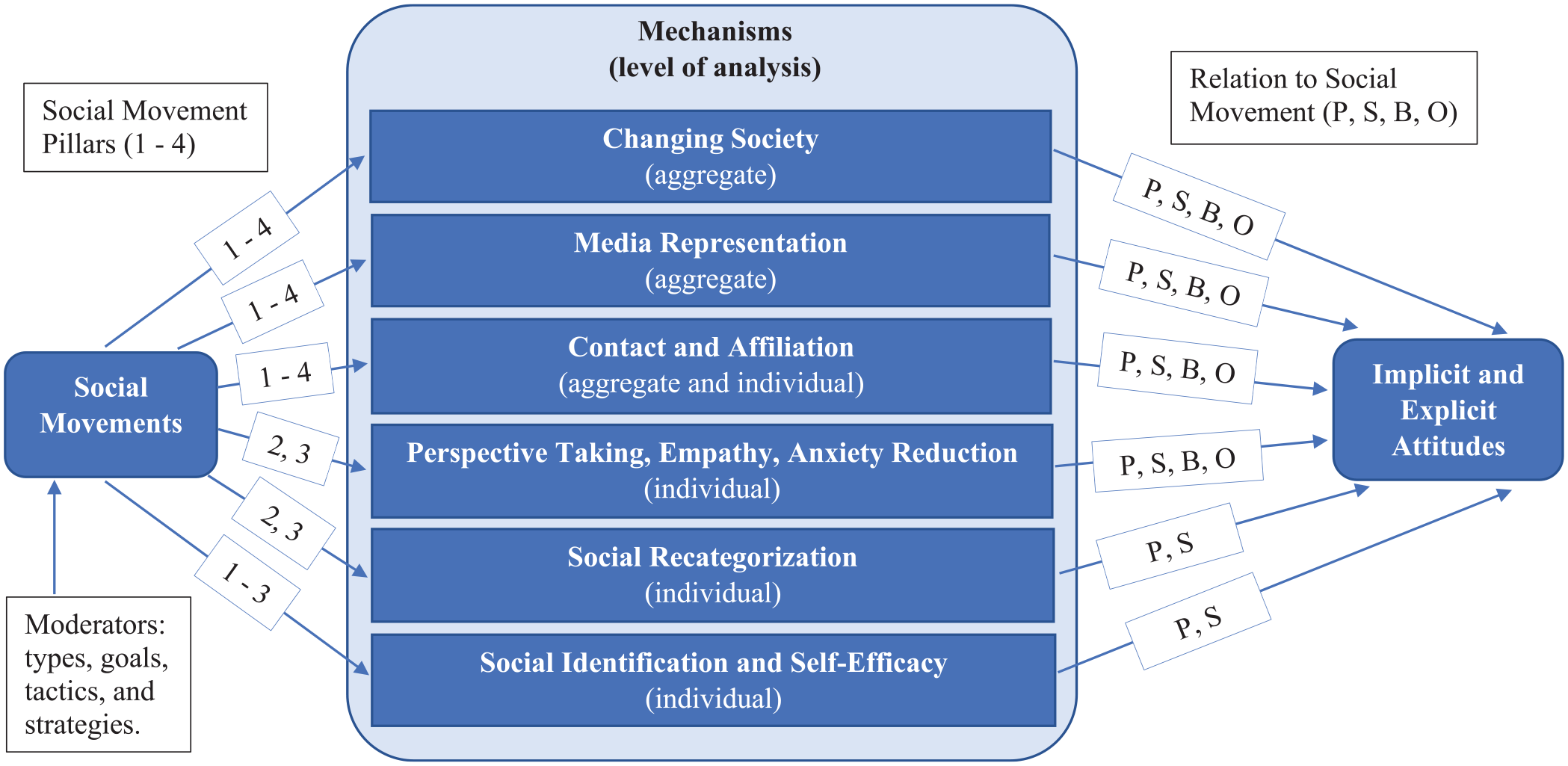
Process by which social movements influence attitudes of participants, supporters, bystanders, and opponents.
Regarding the first pillar, movements propel contentious challenges, usually through disruptive direct actions against authorities, elites, other social groups, or sociocultural norms. This may involve protests, sit-ins, boycotts, demonstrations, speak-outs, interrupting public events, blocking traffic, street theater, strikes and other job actions, or even running movement-connected candidates in elections. These actions may be designed to win new supporters, shift public opinion on key issues, increase awareness and attention to movement claims and messaging, demonstrate the movement’s strength and commitment, or pressure decision-makers to act on behalf of the movement’s interests. As Tarrow (2011) wrote, Despite their growing expertise in lobbying, legal challenges, and public relations, the most characteristic actions of social movements continue to be contentious challenges. . . because [movement leaders] lack the stable resources—money, organization, access to the state—that interest groups and parties control. (p. 10)
Second, regarding common purpose, movements arise out of shared or overlapping interests and values among participants. This shared purpose emboldens people to act collectively, even when it entails personal risk or other costs. Third, movements involve social actors consciously recognizing their common interests, and acting in solidarity to protect, defend, and further each other’s empowerment and well-being. Finally, movements must sustain their engagement in political confrontation over time. To summarize, a social movement should entail collective political challenges against authorities, elites, or norms, from people with common goals, expressing social solidarity in ongoing action against political opponents.
Historically, riots, rebellions, and general social turmoil preceded organized movements, and these forms of contentious politics continue today. Riots are not typically considered movements because they often involve only fleeting solidarity and are very short-lived. However, the urban riots of the 1960s or Los Angeles in 1992 arose from a shared sense of injustice and the need to act against racism and police violence, causing an enduring liberal shift in policy support by mobilizing Black and White voters (Enos et al., 2019). Spontaneous actions such as riots or other uprisings may be discrete moments within a larger movement, or indications that a movement is forming (Sherif, 1970; Tarrow, 2011). This seems to have been the case with the early riots in response to the 2020 police murder of George Floyd, which later broadened into a new phase of the Black Lives Matter (BLM) movement.
In U.S. history, the movements that created the deepest sociopolitical transformations succeeded in sustaining struggles against opponents with more resources and connections to power (Tarrow, 2011). Movements have been a potent and recurring force, from abolitionism to the Civil War and Reconstruction, to the labor movement, Civil Rights and Black Power movements, Latinx and Chicano movements, American Indian movements, anti-war movements, women’s suffrage and liberation movements, LGBTQ (lesbian, gay, bisexual, transgender, and questioning) liberation and marriage equality movements, Occupy Wall Street, and BLM. Not only have movements created a more just society, but they have had well-documented impacts on Americans’ explicit attitudes (Zinn, 2015). For example, White Americans’ attitudes toward racial desegregation, interracial marriage, and Blacks in general changed in a progressive direction during and after the Civil Rights and Black Power movements of the 1960s to 1970s (Greeley & Sheatsley, 1971; Taylor et al., 1978). Importantly, the Civil Rights movement created this widespread attitude change despite violent backlash from the state and racist counter-movements (Condran, 1979; Taylor et al., 1978). A recent political science study found progressive effects of nonviolent civil rights activism on public opinion and vote share from 1960 to 1972, especially when activism was met with repression by government or vigilantes, which drove a positive media framing of the movement (Wasow, 2020).
Electoral Campaigns Versus Social Movements
The attitude changes spurred by the Civil Rights and Black Power movements stand in contrast to the finding that a high-status exemplar like Obama seemingly failed to shift attitudes. Granted, Obama is merely one individual (though a powerful one) in contrast to the millions of people involved in anti-racist movements, which could limit his scope of influence. Perhaps more importantly, Obama represented an electoral phenomenon rather than a social movement. Because some have claimed that Obama’s campaign represented a new type of grassroots electoral movement (Ganz, 2009), it provides a useful boundary case for clarifying what constitutes a movement. In social movement theory, because movement actors typically lack wealth and connections to corporate or government elites, electoral campaigns are not usually considered movements. U.S. electoral campaigns—especially at the national level—are typically run by career politicians or wealthy individuals with no intention of sustaining campaign infrastructure beyond the election cycle, and who evince little solidarity with constituents and supporters (unless wealthy) postelection. Obama’s campaign echoed this pattern by accepting enormous donations from Wall Street banks (who later received a large bailout) and quickly demobilizing its grassroots and online networks after the election.
Moreover, Obama’s election had a demobilizing effect on a key social movement that helped elect him—the anti-war movement. Heaney and Rojas (2011) surveyed and interviewed over 5,000 demonstrators from anti-war protests, concluding that the anti-war movement demobilized from 2007 to 2009 when Obama ran and was elected, despite Obama sending more U.S. troops into Afghanistan. This withdrawal of Democratic activists destabilized large anti-war coalitions, weakening the movement. Ironically, while “heralded as a victory for the antiwar movement, Obama’s election, in fact, thwarted the ability of the movement to achieve critical mass” (Heaney & Rojas, 2011, abstract). The stakes are high in identifying social movements, as inaccurate assessment of Obama’s campaign is argued to have duped anti-racist movements into uncritically supporting rather than pressuring Obama, thus ceding momentum to the right wing (Fletcher, 2012), including the nascent Tea Party movement, until the later rise of the BLM movement. We will discuss the issue of disentangling the effects of competing movements and counter-movements in a later section.
Asking whether an anti-racist movement could succeed where an individual exemplar and electoral campaign failed, Sawyer and Gampa (2018) investigated BLM in relation to implicit and explicit bias. Examining 1.3 million IAT sessions, racial attitudes before BLM (2009–2013) were compared with attitudes during the movement (2013–2016). White Americans’ implicit and explicit attitudes were found to be less anti-Black during BLM, and rising bias prior to BLM reversed to a declining trend during BLM. Anti-Black bias was also lower during most of the highest points of movement struggle (identified by movement chronology and media citations). Importantly, participants of all political orientations displayed reduced bias, with liberals showing larger reductions than conservatives. The study provided the first empirical evidence linking a social movement to population-level changes in implicit attitudes. In sum, while Obama’s campaign and early presidency saw rising anti-Black bias, BLM appeared to reverse this trend.
Social Movements Parsimoniously Explain Changes in Aggregate Attitudes
Political movements are one of the few social forces with a historically demonstrated capacity to change public attitudes on a mass scale. Thus, as psychologists increasingly analyze attitudes in aggregate national and regional forms, the potential influence of social movements looms large. Thus far, studies on large-scale implicit and explicit attitude change have posited media representations, social norms, legal and policy changes, and social priority of attitudes as causal factors. We believe that social movements offer a more parsimonious explanation for such attitude changes, and that they can be conceptualized as underlying and propelling many of the intermediate causal factors proposed above.
When discussing evidence for policy changes driving attitude change, Ofosu et al. (2019) cited the finding that after Donald Trump was elected U.S. President in 2016, participants supporting both Clinton and Trump reported increased acceptability of prejudice against stigmatized groups (Crandall et al., 2018). We suggest this finding speaks more to the potency of movements than policy changes. Applying a social movement lens, it is apparent that Trump’s campaign, election, and inflammatory rhetoric—while not a social movement in itself—energized and breathed life into a variety of white supremacist, “alt-right,” and neo-fascist social movements (Blout & Burkart, 2020; Eddington, 2018). Moreover, this effect occurred well before Trump took office and had a chance to enact policy changes (Hawley, 2019). Thus, while Obama’s election had the effect of demobilizing movements of the political left, Trump’s election encouraged movements of the political right. As the bitter fruit of these movements, the Southern Poverty Law Center reported more than 400 bias-related incidents in the week after Trump’s election and more than 1,000 incidents in the following month, a significant spike (Hatewatch Staff, 2016a, 2016b). Further work on right-wing movements could help to substantiate how not just progressive social movements but reactionary movements may fuel attitude change, though in the direction of increased bias and bigotry.
Ofosu et al. (2019) also highlighted legislation and legal rulings as key causal factors in shifting sexual orientation attitudes. They stated that evidence for the impact of legislation on attitudes is somewhat scant and mixed, but they emphasize that the Supreme Court’s 1978 upholding of legalized interracial marriage was followed by increasing support for interracial marriages, suggesting a causal link. However, inspection of the relevant Gallup Poll (Newport, 2013) shows this long linear increase in support actually began years earlier, during the Civil Rights movement of the early 1960s, suggesting a more seminal role than the court decision in propelling attitudes. This suggests that legal and legislative changes may often be better conceptualized as intermediate achievements of successful movements—or as one causal pathway through which movements can operate—than as key causal drivers in and of themselves.
Taken together, Ofosu et al. (2019) and Westgate et al. (2015) discussed cultural/media and legal/legislative changes to account for societal reductions in anti-gay implicit and explicit bias. However, this historical timeframe also included the mass movement for lesbian, gay, bisexual, and transgender (LGBT) rights. Beginning in 2008, days after Proposition 8 in California outlawed previously legal same-sex marriages, tens of thousands of demonstrators across the U.S. voiced support for same-sex marriage (McKinley, 2008). A year later, hundreds of thousands participated in the 2009 National Equality March on Washington, D.C., transforming the national conversation and political tide. Although indeed many legal rulings and legislative victories followed the rise of the LGBT movement, and media portrayals continued to improve, the marriage equality movement has been argued to be the driving force behind these changes (Kowal, 2015). We suggest that psychology can gain by directly exploring the tectonic sociopolitical shifts associated with social movements that often undergird changes in laws, legislation, media representations, social norms, and patterns of societal activities.
Charlesworth and Banaji (2019) provided the strongest evidence of ongoing progressive (and sometimes regressive) shifts in aggregate attitudes. From 2007 to 2016, attitudes regarding sexual orientation, race, and skin-tone became less biased. In contrast, attitudes concerning age and disability remained stable, and body-weight attitudes became even more anti-fat. To account for autocorrelations and seasonality in implicit attitude data over time, the study effectively utilized auto-regressive integrated moving average (ARIMA) models. These forecasting models still leave the problem of explaining changes in trends, however (Jebb et al., 2015). The study found that, consistent with theories of attitude strength, attitudes that became less biased had higher social priority. However, the finding that changing attitudes had stronger I-E correlations contradicted this theory, because strong I-E correlations indicate robust intra-attitudinal structures thought to be more stable. To account for this discrepancy, the study offered an alternative explanation that strong I-E associations may represent attitudes that are frequently discussed and thus better elaborated (Nosek, 2007).
We suggest that a social movement framework also provides a parsimonious explanation for these seemingly contradictory findings. First, social movements tend to raise the social priority of related issues and attitudes. They spur increased discussion—in official political and media outlets and everyday life—that encourages attitude elaboration on a mass scale. For instance, when BLM arose it exploded the notion of “post-racial” America and refocused national political and media discourse on police brutality and racism (Petersen-Smith, 2015). This generated conversations, arguments, and political statements regarding the value of Black lives, the reality of racial oppression, and the virtues of fighting for racial justice. Charlesworth and Banaji (2019) briefly mentioned historical examples of social issues becoming “priorities” in U.S. society, including slavery during the Civil War, women’s right to vote during the suffrage movement, and racial justice during BLM. This reinforces the idea that all of these aspects of attitudes related to change—social priority, elaboration, and IE correspondence—are catalyzed by the mutual influence of social movements on all of them.
A social movement hypothesis also accounts for the finding that attitudes that became less biased over time had lower levels of initial bias (Charlesworth & Banaji, 2019). This is because attitudes related to social issues targeted by recent movements would have a less biased “starting point.” To illustrate, U.S. history has witnessed multiple movements against racism and homophobia, with BLM and the struggle for marriage equality the latest incarnations. From this perspective, the finding that attitudes around race, skin-tone, and sexuality have a less biased starting point is not surprising. A social movement explanation is further supported—in the negative—by evidence that biases around age, disability, and body weight remained stable or became more biased. None of these issues had been addressed by mass social movements in the decades prior to the study. The absence of relevant social movements may also relate to “hollow” attitude changes—identified as reductions in explicit bias but stagnation or increases in implicit bias observed among socially neglected issues (Charlesworth & Banaji, 2019). In sum, social movements are a highly plausible generator of historical and contemporary attitude change, and they also offer an efficient theoretical explanation for the intermediate cultural and attitudinal features identified in these studies.
As a final point of comparison to a social movement explanation, we consider some additional speculations on attitude change and stability offered in Charlesworth and Banaji (2019): Rapid change in sexuality attitudes may arise from the unique concealability of sexual orientation (Pachankis et al., 2018), enabling positive contact before the stigma is revealed. . . Furthermore, we note that age, disability, and body-weight attitudes involve a perceived but measurable decline of the body and may therefore be seen to have an objective basis. In contrast, race, skin-tone, and sexuality attitudes are not rooted in objective evidence but have emerged for arbitrary and historic reasons (e.g., Sidanius & Pratto, 1999). Such differences in perceived objectivity may contribute to the relative stability of age, disability, and bodyweight attitudes. (p. 17)
We find these suggested sources of attitude change unconvincing. First, the ostensible concealability of sexual orientation cannot plausibly explain rapid change in sexuality attitudes. Not only is it questionable how concealable sexual orientation truly is (Sylva et al., 2010), but its level of concealability has not changed in recent years. What has changed are the social and political circumstances around “coming out,” along with the rights and public respect won by the marriage equality movement. Second, it is true that age, disability, and body-weight attitudes may be perceived as having an objective bodily basis, though conceptualizations and attitudes around these categories are widely culturally and historically variable. In fact, a critical insight spawned by the U.S. disability rights movement of the 1970s is that disability is not fundamentally determined by a person’s body (and many disabilities are not physical), but by whether society is arranged to include or marginalize that person. Another problem is that perceived objectivity of the attitude object also applies to race, skin-tone, and sexuality. Most people mistakenly view race as a biologically real category, visibly evident in skin-tone and other physical characteristics. Sexual orientation is also commonly assumed to be biologically determined. In other words, each of these categories, while socially constructed, are popularly perceived as objectively instantiated in the body. This renders perceived objectivity an inadequate explanation for differences in the attitude trajectories. A social movement hypothesis appears to offer firmer ground for explaining attitude changes, and even for explaining common notions of what is biologically objective versus socially constructed in the first place.
How Might Social Movements Change Attitudes?
A key reason for the potential of social movements to create far-reaching and lasting change appears to be their capacity to create multiple pathways for changing attitudes. As displayed in Figure 1, our survey of the psychological literature identifies six categories of mechanisms through which movements may affect attitudes: remaking societal structures and activities; influencing media representations; creating favorable intergroup contact conditions and affiliation dynamics; encouraging empathy, perspective-taking, and reduced intergroup anxiety; spurring social recategorization; and fostering social identification and self-efficacy processes. These mechanisms are postulated to operate on both aggregate and/or individual levels.
In Table 1, we elaborate the evidence for each mechanism in relation to implicit and/or explicit attitude change. In cases where empirical evidence for a theoretical mechanism is lacking, we write “hypothesized to apply to. . .” the specified attitude (implicit, explicit, or both). We describe how the mechanism is expected to function within movements and whether it applies to participants, supporters, bystanders, and/or opponents. Finally, we identify the relevant literature, along with key concepts, variables, and measures used in the studies. Table 1 and Figure 1 propose levels of analysis (aggregate and/or individual) for each mechanism, based on the supporting literature. These hierarchical levels are both conceptual in terms of plane of casual operation, and empirical with regard to the type of data best suited for analysis of each mechanism. We explicate the mechanism categories in descending order from aggregate to individual levels.
Potential Mechanisms Through Which Social Movements Can Change Attitudes.

Note. BoC = bias of crowds; APE = associative–propositional evaluation; NY = New York.
Changing Society
Perhaps the most systematic and durable way that social movements can change aggregate implicit and explicit attitudes is by transforming the sociopolitical structures that underpin them. These may include winning legal, legislative, and institutional changes, altering material intergroup disparities and power relations, and transforming broad patterns of societal norms and activities. Because sociopolitical change is a large-scale process, the aggregate, societal-level perspective on implicit attitudes foregrounded by the “bias of crowds” model (BoC; Payne et al., 2017) appears particularly germane to this mechanism. BoC takes aggregate implicit racial bias to reflect systemic racism—structures and procedures that create systematic racial inequality—and to be a better indicator of it than individual prejudice (Payne & Hannay, 2021). The corollary, though not strongly emphasized, is that thoroughgoing structural transformation of society should result in comprehensive changes to aggregate implicit attitudes. In fact, this hypothesis could be seen as one of the strongest tests of the BoC model.
Although the evidence for the BoC model reviewed earlier indirectly supports this mechanism for implicit attitudes, there is a need to further elaborate psychological mechanisms through which explicit attitudes could be similarly altered. There is certainly a historical link between societal changes and changing attitudes. Studies of the U.S. Civil Rights movement winning tangible societal reforms (e.g., ending segregation, interracial marriage, voting rights) are historically associated with shifts in explicit attitudes. In addition, as we have argued, Ofosu et al. (2019) can be interpreted as supporting the notion that the LGBT movement generated attitude changes—partly by changing societal structures through winning legalization of same-sex marriage. Finally, strong correlations between regional sociological disparities and aggregate implicit and explicit attitudes (summarized in Hehman et al., 2019) suggest that movements that succeed in reducing sociological disparities (e.g., in wealth, policing, or residential segregation) should also reduce aggregate implicit and explicit bias.
BoC implicates structural inequality and the “background radiation” of systemic implicit bias it creates, raising the question of what forces might transform this social order. According to Vuletich and Payne (2019), BoC-based interventions may include: (a) momentary interventions (e.g., Lai et al., 2016) to reduce bias during decisions like hiring or admissions; or (b) changing social environments in more durable ways. On the first point, BoC recommends that if high levels of implicit bias are found in firms or other organizations, measures to soften the impact of bias should be implemented, such as blind review, rubrics, lessening rushing and fatigue among decision-makers, and more (Payne et al., 2017). Regarding the latter, of particular interest here, removing Confederate statues is offered as an example of removing environmental cues of inequality to reduce aggregate bias, and increasing diversity among organizational leadership is proposed to reduce institutional bias. Although not unworthy goals, these types of interventions appear inadequate for generating the large-scale social and psychological transformations envisioned by most social movements.
To consider a theoretical framework for changing society advanced by a movement, BLM has centered the frame of racial capitalism to analyze and combat anti-Black oppression (Issar, 2021). Based on examination of the integral role that racism has played within U.S. capitalism (Robinson, 2000), racial capitalism indicates that overturning structural racism will require political struggles that directly challenge racialized capitalism itself. Under particular historical circumstances, the growth and interconnection of social movements have produced such social and political revolutions. These can be conceived of as “rapid, basic transformations of a society’s state and class structures. . . in part carried through by class-based revolts from below” (Skocpol & Theda, 1979), or as efforts that “transform the political institutions and the justifications for political authority in a society, accompanied by formal or informal mass mobilization” (Goldstone, 2001, p. 142). We suggest that when social movements remake societal relations so comprehensively, dramatic reconfiguration of aggregate attitudes should be an ongoing product and an intensifier of this process.
CHAT can also help to frame the persistence of attitudinal biases and possibilities for eradicating them. By this view, the mind develops in dynamic interconnection with society, and “the mental nature of man represents the totality of social relations internalized and made into functions of the individual and forms of his structure” (Vygotsky, 1997, p. 106). This approach illuminates the internalization of prejudices from an unequal society, and points to collective political solutions through its central axiom that people transform themselves as they transform the world (Stetsenko, 2017). If individuals internalize the meanings of new sociopolitical relations as they collectively act to change society, this suggests a positive dialectic of social and psychological change. This view implies that changing society should alter both implicit and explicit attitudes, though this framework has not elaborated or tested these connections.
The notion of reciprocal feedback from collective political action to cognition has been little studied (Louis, 2009) but holds important practical implications for those interested in a different sociopolitical and psychological landscape. Given their reliability, validity, and societal scope, aggregate implicit and explicit attitudes can be vital tools for exploring the social and psychological success of movements. For example, aggregate attitudes could be conceptualized as psychological barometers of municipal, regional, or national sociopolitical environments. Strong correlations between aggregate implicit and explicit bias and sociological disparities (Hehman et al., 2019) support this notion. From this vantage, we can gauge the success and societal impact of social movements by measuring progress (or regression) in relevant attitudes. When social movements lessen structural inequalities or fundamentally transform daily life in progressive ways, there should be corresponding reductions in local, regional, or population-level implicit and explicit bias. Conversely, if right-wing movements increase systemic inequality, increases in aggregate bias would be expected.
Media Representation
Another important aggregate pathway through which social movements can influence implicit and explicit attitudes is via their representation in mass media. Media often amplifies movement actions and messages, increasing awareness of movements and their goals. As Gamson and Wolfsfeld (1993) write, “social movements often make good copy for the media. They provide drama, conflict, . . . and photo opportunities” (pp. 116–117). Conversely, media outlets may ignore social movements, distort their messages, or criticize their strategies, tactics, and goals. Media can also raise a movement’s visibility while simultaneously misrepresenting or criticizing it.
Recent empirical work in political science supports this media pathway by exploring “agenda seeding”—the process by which activist movements attempt to shift aggregate public opinion and politics by generating favorable media coverage (Wasow, 2020). While acknowledging that politically subordinate groups cannot fully control their representation in the media, which often exhibit systematic bias against them (Davenport, 2007), agenda seeding holds that protest strategies are critical in influencing how their interests are framed: Through tactics like disruption, subordinate groups are predicted to upend the normal dominant group focus of the media to achieve a form of punctuated pluralism in which their concerns temporarily come to the fore of the press and, by extension, public opinion and policy making. (Wasow, 2020, p. 7)
The agenda seeding model predicted 1960s voting behavior and public opinion in relation to the Civil Rights movement using aggregate methods of analysis including examining causal relations between time-series measures of movement activity and explicit public attitudes (Wasow, 2020). However, the general approach used in the study appears a promising avenue for empirically examining media-mediated effects of movements on implicit and explicit attitudes. It shares some affinity with Sawyer and Gampa (2018), who used BLM chronology and associated media coverage to predict changes in implicit and explicit bias, also supporting this mechanism.
Contact and Affiliation
A large body of work on intergroup contact theory—both on aggregate and individual levels—is also relevant to the attitudinal impact of social movements. This research is rooted in Allport’s (1954) seminal work, The Nature of Prejudice, which planted the idea of intergroup contact as a way to decrease prejudice. Five conditions that foster successful intergroup harmony and improved implicit and explicit attitudes toward out-groups have now been well validated: (a) cooperation; (b) equal status between groups during the interaction; (c) common goals; (d) support of authorities, law, or custom; and (e) the opportunity to form intergroup friendships (Dovidio et al., 2017; Pettigrew & Tropp, 2008). The four pillars of social movements—collective contentious action, common purpose, social solidarity, and sustained struggle—appear to entail the first, second, third, and fifth conditions of successful contact. This is because when movement participants successfully collaborate to mount and sustain their campaigns, they develop common goals, bonds of solidarity, and an egalitarian spirit, not to mention occasions to socialize and form intergroup friendships.
Only the fourth condition of favorable contact is often missing from social movements—at least initially. This is the blessing of authorities, law, or custom, although some movements actually aim to uphold or enforce extant laws and customs. Nevertheless, movements can gain support from authorities (or at least sections of them) and win changes in laws and customs and as they develop in size and strength, as discussed in the changing society mechanism. This dynamic was evident in the latest wave of BLM protests, which resulted in defunding police departments in certain cities and school systems, firing and prosecution of some police officers who committed brutality or murder, government-backed painting of “Black Lives Matter” on city streets, and widespread adoption of the slogan by politicians and even corporations across the United States. Similarly, the legislative gains and shifts in social norms associated with attitude change in Ofosu et al. (2019) can be understood as intermediate products of a successful movement.
In addition to in-person interaction among movement participants, the attitudes of movement supporters, bystanders, and even opponents could be changed through extended, vicarious, and virtual contact (for a review, see Dovidio et al., 2017). Work on extended contact (Wright et al., 1997) has shown that simply knowing an ingroup member has formed a relationship with an out-group member can decrease intergroup bias. Thus, even movement opponents may be affected by friends or acquaintances who form relationships with out-group members as participants or supporters of the movement. Vicarious contact involves observing other ingroup members’ positive impressions of other groups, often through television, radio, or the internet. Similarly, virtual contact via computer allows intergroup interactions, often across great distances, which can have some benefits in reducing bias, even if less than face-to-face or extended contact (Lemmer & Wagner, 2015). With the advent of live internet streaming of protests, and associated chat and discussion boards, ever greater numbers of people are interacting with movement activists and supporters through online channels, potentially increasing bias-reducing intergroup contact.
Movements also engender possibilities for other forms of contact and affiliation. Interestingly, the simple physical experience of “synchronous walking” beside an out-group member reduced implicit and explicit bias against the oppressed Roma group in Hungary (Atherton et al., 2019). Protest marches and demonstrations involve synchronous walking, coordinated chanting, music-making, and other matched movements. Such coordinated movements increase trust and explicit liking (Hove & Risen, 2009; Wiltermuth & Heath, 2009), as well as prosocial behaviors and recategorization of out-group members to ingroup members, which can reduce prejudice (Cirelli, 2018; Cross et al., 2019; Good et al., 2017).
In sum, contrary to critics who argue that conditions for intergroup contact are unrealistic or impossible in everyday life (Dixon et al., 2005), social movements appear to facilitate such conditions. By creating more propitious society-wide conditions and increased structural possibilities for contact (e.g., by ending legal or de facto societal segregation), movements can create aggregate- and individual-level effects on attitudes through altering both regional and interpersonal patterns of contact. Such dual effects may be captured through analytical tools like multilevel modeling. Christ et al. (2014), for example, aggregated intergroup contact at the regional level and explored this alongside individually reported levels of intergroup contact. As expected, individuals who had greater personal contact with minority group members showed less prejudice, but over and above this effect people who lived in regions with more frequent aggregate intergroup contact also displayed less prejudice. Thus, the effect of social movements at both aggregate and individual levels may be explored simultaneously in future work. In the next two sections, we will examine individual-level cognitive and affective mechanisms shown to be associated with enhanced conditions and opportunities for contact.
Perspective-Taking, Empathy, and Anxiety Reduction
In their protests, meetings, and public messaging, social movements often directly encourage taking the political and social perspectives of marginalized groups. This promotes empathy for their plight, another potential mechanism for shifting attitudes. This mechanism is supported by the finding that news stories detailing obstacles like poverty and discrimination faced by Black and Native American people decreased implicit bias against them, likely by increasing empathy (Sternadori, 2017). Similarly, a study found that hearing stories from the experiential perspective of Latinx immigrants increased empathy and improved explicit attitudes toward them (Lepe, 2019). These empathic, perspective-taking mechanisms are likely operating within social movements that highlight the discrimination and inequality faced by particular social groups. Such mechanisms may occur partly through intergroup contact, as a meta-analysis of more than 500 studies found that contact reduces prejudice primarily through affective processes of reducing anxiety about intergroup interaction, and enhancing empathy and perspective-taking, though cognitive factors outlined by Allport also contributed (Pettigrew & Tropp, 2008).
In a highly de facto segregated society like the United States, many people have limited interaction with out-group members, which can cause interracial anxiety. However, multiracial movements like BLM create opportunities for interracial interactions, which can alleviate anxiety about future interactions and reduce bias (Blascovich et al., 2001). One model proposes that intergroup contact increases understanding of out-group perspectives, which lessens intergroup anxiety and improves attitudes (Aberson & Haag, 2007). This perspective-taking pathway was found to account for explicit attitude change, while decreased implicit bias was predicted by mere intergroup contact. This suggests a dual-process model, where implicit and explicit attitudes might be changed in different but complementary ways, both of which would be fostered by social movements.
Movements may even shift attitudes among opponents through perspective-taking and affective mechanisms by literally giving voice to participants’ arguments. Hearing someone voice an opinion has been found to humanize a person in the minds of those hearing it—even if they currently disagree with the opinion (Schroeder et al., 2017). Although political opponents are often dehumanized and viewed as having diminished capacity for thinking and emotional experience (Haslam & Loughnan, 2014; Ross & Ward, 1996), this humanizing effect of hearing a vocalized opinion was particularly pronounced among those who disagreed with the person voicing it. Relatedly, individuals across the political spectrum—including those self-identifying as “strongly conservative” who presumably opposed BLM—demonstrated reduced implicit and explicit racial bias during BLM and its high points of struggle (Sawyer & Gampa, 2018). This study demonstrates the value of subgroup analyses based on political orientation, which can reveal differential effects among liberals and conservatives of varying degrees.
BLM’s larger effect among liberals, who are more likely to support or participate in the movement, and smaller effects among conservatives, more likely movement bystanders or opponents, is consistent with the model depicted in Figure 1 and the mechanisms outlined here. This model suggests that, in general, more attitude changes should accrue to movement participants and supporters than bystanders and opponents. This is because processes of social recategorization, social identification and self-efficacy, and certain forms of intergroup contact generated by movements appear unlikely to be experienced by bystanders and opponents. This pattern should apply to movements on each side of the political spectrum, in that left-leaning movements should have larger effects on liberals, and right-leaning movements should produce greater effects on conservatives.
Social Recategorization
Many accounts of racism consider the social, political, and psychological construction of racial in-groups and out-groups essential to its functioning (Omi & Winant, 2014; Tate & Audette, 2001). Nevertheless, a powerful route for changing implicit and explicit attitudes appears to be humans’ ability to flexibly categorize and recategorize their in-groups. Rather than trying to short-circuit all tendencies toward group categorization, the common ingroup identity model argues we can utilize the positive consequences of ingroup membership to combat prejudice (Gaertner & Dovidio, 2005). This shifts emphasis from “decategorization” (e.g., achieving “color blindness”) to “recategorization” of social identities by reclassifying formerly out-group members under a superordinate category that creates a new common ingroup.
Social movements appear to be an important force for creating new ingroup identities (e.g., anti-racists, egalitarians) around mutually held values of participants and supporters. Extensive empirical validation of the common ingroup identity model suggests these new ingroup identities can reduce bias and may be especially effective when subgroup identities are retained within them (Gaertner & Dovidio, 2005). These salient dual identities maintain an associative link between superordinate and original group identities, which allows positive feelings toward individuals formerly considered part of an out-group to generalize to the out-group as a whole (Gaertner et al., 2016). Let us consider BLM, which includes members of oppressed and nonoppressed racialized groups. The movement appears to retain subgroup memberships in these socially meaningful original identity categories, while also creating solidarity and a new superordinate group identity as anti-racists among participants and supporters. This shared superordinate identity—based on mutual goals, solidarity, and a new sociopolitical understanding—combats prejudice because now “‘Us’ and ‘Them’ are regarded as ‘We’” (Gaertner & Dovidio, 2005, p. 615). There is reason to expect larger attitude changes among the relatively advantaged subgroup in this situation but not always, as such interaction may reduce stereotype threat anxiety for the disadvantaged subgroup (Dovidio et al., 2017).
Examples from U.S. labor movement history also illustrate the creation of new ingroup identities through collective contentious action and the intergroup contact that accompanies it. White, Black, native-born, and immigrant workers have often overcome racism and xenophobia to unite under the superordinate identity of exploited workers. Although not equally oppressed, these workers demonstrated solidarity during collective actions, likely because subgroup identities were recognized and respected. Supporting this notion, Waterfront Workers of New Orleans: Race, Class, and Politics, 1863–1923 details how European immigrant workers supported the abolition of slavery, and fought against anti-Black racism, forming alliances and integrated labor unions with Black workers (Arnesen, 1994). These efforts culminated in an 1892 general strike that shut down New Orleans, in which interracial solidarity and a common identity as workers were essential.
A recent study found that the formation of multiracial unions decreases Whites’ racial resentment, while increasing their support for affirmative action to benefit Black workers, both historically and during the past decade (Frymer & Grumbach, 2021). This suggests that White workers recategorized their fellow Black workers—even beyond the union—as ingroup members whom it was in their interest to support. Thus, it appears class-based movements can influence racial attitudes, which do not appear directly related, but in fact can be integral to labor struggles. The labor slogan “an injury to one is an injury to all” highlights that workers’ fates are linked and implies a superordinate identity among workers of various genders, races, national origins, sexual orientations, and more. Where such intersectional solidarity is practiced within labor struggles, we might expect an impact on multiple intergroup attitudes, an area ripe for research.
Social Identification and Self-Efficacy
Both social movement scholars and psychologists have suggested that concepts of self and identity are essential to a psychology of social movements (Stryker et al., 2000). As a movement theorist conveyed their profound psychological impact on participants, Participation in social movements frequently offers an enlargement of personal identity for participants and offers fulfillment and realization of self. Participation in the civil rights movement, women’s movement, and New Left, for example, was frequently a transformative experience, central to the self-definition of many participants in their later lives. (Gamson, 1992, p. 56)
Although social problems like oppression and bias can appear intractable, social movements raise people’s sense of efficacy to solve these problems, promoting increased activism and further growth of movements (Edwards & Oskamp, 1992; Klandermans, 1989; Van Zomeren et al., 2004), which we hypothesize can change explicit attitudes. In particular, Whites who experience greater self-efficacy in reducing racial inequality engage in more anti-racist work and demonstrate more positive explicit attitudes toward Blacks (Stewart et al., 2010). This dovetails with the concept of empowerment, a feeling of being capable of reshaping society posited to develop among members of subordinated groups who collectively challenge inequitable conditions (Drury & Reicher, 2009).
Although often transformative for direct participants, we propose that social movements can also have a powerful impact on supporters. A large literature on social identity, self-concept, and stereotypes finds that people generally have positive attitudes toward themselves, and this positive evaluation is transferred to groups with whom they identify (for a review, see Greenwald et al., 2002). Therefore, the more strongly people identify with social groups, the more positive their implicit and explicit attitudes toward that group (Walther & Trasselli, 2003). The politicization of group identification—a key feature of most social movements—may contribute even further to this process (Simon & Klandermans, 2001). To illustrate, the marriage equality and BLM movements have attracted tens of millions of people in the United States into direct participation through protests, meetings, online activism, and more (Buchanan et al., 2020). Beyond participants, far more people support and identify politically, socially, or ideologically with these movements (Parker et al., 2020). This presents opportunities for individuals of any race or sexual orientation to forge new or deeper links with Black and LGBT people, the primary leaders of these movements. Thus, a former out-group may become incorporated into the self-concept, improving attitudes toward the out-group (Eller & Abrams, 2004).
In addition, by identifying with a movement, supporters and participants will find they share opinions with others in the movement. Holding opinions in common with others increases mutual attraction and positive evaluation; this seems to operate largely implicitly but has shown effects on explicit attitudes (Greenwald & Banaji, 1995). This implies a mechanism by which movements can reduce bias among participants and supporters toward groups who are targets of relevant oppressions (e.g., immigrants, Black people, indigenous people). This effect should be amplified as movements gain strength, increase visibility, and convert initially neutral bystanders or even opponents into supporters. Although the mechanisms in this section have begun to be investigated on the individual level, we suggest that aggregate analysis of regional support and identification with various movements could reveal multilevel contributions to attitude changes.
A Differential Impact on Implicit and Explicit Attitudes?
Nearly all research linking attitudes with social movements has measured explicit attitudes, often through public opinion polls. Although self-reported attitudes are subject to social desirability pressures, implicit attitudes—typically considered less controllable—may offer unique insight into the psychological impact of movements. This distinction between implicit and explicit attitudes appears to be reflected in the striking fact that every explicit attitude studied by Charlesworth and Banaji (2019) has trended toward neutral over past years in the United States, while this is decidedly untrue of implicit attitudes. This divergence seems to conflict with the high correlation between implicit and explicit racial attitudes when aggregated over long time periods (13 years) at the state level, and an interpretation of implicit and explicit attitudes as two measures of a broader latent construct: regional racial bias (Hehman et al., 2019). This seeming contradiction should be further explored, as such “snapshots” of regional IE correlations when aggregated across several years may not capture diverging and dynamic trends over time. Alternately, regional trends in implicit and explicit attitudes may differ from national trends. We suggest that the effects of social movements on implicit and explicit attitudes should initially be examined separately to explore differential effects, and potentially as a composite or latent outcome if this appears warranted.
There is reason to think that social movements may affect implicit and explicit attitudes through different underlying processes. The associative–propositional evaluation (APE) model, for example, theorizes that implicit attitude change can result from overall changes to associative evaluations or temporary shifts in activation of preexisting associations (Gawronski & Bodenhausen, 2006, 2014). The APE suggests that exposure to familiar exemplars like Obama may activate preexisting associations (e.g., powerful, accomplished) that temporarily influence associative evaluations of Blacks in general. However, because Obama is a specific individual, activation of these associations may not generalize in a durable way to one’s overall associative structure for Black people. In contrast, a social movement that repeatedly pairs Black people as a social group with positive language (“Black Lives Matter”), positive imagery, and positive traits (courageous, agentic, fighting for justice) appears more likely to systematically change one’s overall associations with Black people, potentially generating more fundamental and lasting change. Regarding explicit attitudes, an anti-racist movement—with its message amplified by media—may catalyze widespread and extensive political discussion, thus generating persuasive arguments about the value of Black lives or the virtue of struggling against racism. APE specifies that such arguments and propositions can change explicit attitudes, and that explicit propositional processes can alter implicit attitudes via top-down construction of new associative evaluations. Equally, changes in implicit associations can have bottom-up influence on explicit attitudes. In an ongoing social movement, it is probable that both processes operate reciprocally, amplifying the potential effect on both types of attitudes. Therefore, implicit and explicit attitudes could be examined in dynamic relation to each other as they change during a movement, to see if implicit attitudes may mediate later changes in explicit attitudes or vice versa.
In terms of available evidence, implicit and explicit attitudes changed during BLM (2013–2016) in the same direction (less anti-Black bias) and to a similar degree. However, there were differences in these attitudes’ trajectory among White and Black subgroups. Although Whites’ implicit attitudes became less pro-White, Blacks’ implicit attitudes did not change. Because Blacks demonstrated little implicit bias prior to BLM (being close to “no preference”) and Whites exhibited greater bias, the larger change among Whites may reflect their greater room for bias reduction. In terms of explicit attitudes, Whites and Blacks showed opposite directions of change, with Whites becoming less explicitly pro-White, and Blacks becoming less pro-Black. Rather than opposing trends, this can alternately be conceptualized as a mutual shift toward a no preference position.
A possible explanation for these patterns is that anti-racist social movements may move all racial groups toward egalitarian attitudes, if they are not already egalitarian. Oppressed groups often express strong explicit ingroup preferences to counteract hostile out-group attitudes, and these ingroup preferences are likely to weaken if societal attitudes become less hostile (Gawronski & Bodenhausen, 2006; Westgate et al., 2015). Thus, decreasing bias among Whites during BLM may have alleviated the need for Blacks to maintain explicit pro-Black attitudes. Future research can explore the possibility that anti-racist social movements, rather than polarizing Whites and Blacks, may be capable of moving both groups toward more egalitarian implicit and explicit racial attitudes. Changes could be examined nationally, and/or using data aggregated regional data, which demonstrates high reliability and validity in relating to regional measures of inequality (Hehman et al., 2019).
Hypotheses, Questions, and Methods for Future Research
The current era of politically volatility appears favorable for an “activist turn” in the study of implicit and explicit attitudes. Social movements offer hope for transforming the sociopolitical terrain, along with the attitudes we form to navigate this terrain, for better or worse. We suggest psychology can further this process by theorizing social movements as parsimonious causal agents and empirically examining their impact on social relations and attitudes. In this section, we lay out some key questions, testable hypotheses, and methodological approaches that may be useful in this work.
Hypotheses
Movement mechanisms
A central avenue of investigation is to examine and test the mechanisms outlined here to discern their relative importance in facilitating the effects of movements. Based on the model presented here, social movements should have larger attitudinal effects to the extent that:
They enhance social identification with the movement and self-efficacy to solve social problems among participants and supporters.
They create opportunities and favorable conditions for intergroup contact and affiliation among participants, supporters, bystanders, and possibly opponents.
They encourage perspective-taking, empathy, and reduced anxiety about intergroup interactions among participants, supporters, bystanders, and opponents. Perspective-taking may relate more strongly to explicit attitude change, while other affective factors relate more strongly with implicit attitude change.
They spur social recategorization among participants and supporters, especially under a new superordinate identity with important subgroup identities retained. Attitude changes are likely to be larger in relatively advantaged subgroups than in disadvantaged subgroups.
Media gives the movement greater coverage and more favorable representation.
They transform society, especially in terms of structural, sociopolitical inequalities, material intergroup disparities, and broad patterns of societal activity.
Movement pillars
The model in Figure 1 shows that these mechanisms flow from the empirical pillars of social movements: collective contentious action, common purpose, social solidarity, and sustained struggle. We should expect these mechanisms to be enacted to a greater degree the stronger the contentious challenge posed by the movement, the more cohesive the movement’s common purpose, the stronger the social solidarity displayed by the movement, and the longer the movement sustains its activities. Although Figure 1 tentatively suggests the pillars that appear most related to each mechanism, establishing these connections calls for the development of appropriate tools to measure movement pillars and exploratory investigation of these links.
Questions to Explore
Trajectories of attitude change
A key question is the chronological relation of attitude changes to social movements. There are at least three possible trajectories to be further examined: (a) ongoing, cumulative influence of movements that create incremental long-term attitude change; (b) the influence of dramatic, concentrated bursts of movement activism that may result in swift, short-term attitude change; and (c) time lags or “incubation periods” between movement activity and attitude changes. Although there is some initial evidence for the first two trajectories (Sawyer & Gampa, 2018), the third possibility has yet to be explored. Time lags in movement impact might be generated by changes in social structures, conditions of intergroup contact, or media representation whose effects are delayed until further into the future. Finally, movement effects may long outlast the movement itself. For example, recent work in political science shows the U.S. Civil Rights movement created long-run change in explicit attitudes, with Whites from counties with protests providing greater support for affirmative action, less anti-Black resentment, and more votes for the Democratic party to the present day (Mazumder, 2018).
Spillover effects
The question of whether attitude changes “spillover” across social categories is also worth exploring. The finding that multiracial unions increase Whites’ support for affirmative action and reduce racial bias (Frymer & Grumbach, 2021) suggests this possibility, in that labor struggles spillover into racial attitudes. Recent teacher strikes that have taken up demands around racism might similarly show spillover effects. Intersectional solidarity practiced within labor struggles or movements like BLM (e.g., trans solidarity) also seem like good candidates for producing spillover effects. Could effects transfer to attitudes seemingly unrelated to a social movement? This area appears ripe for research.
Movement type
The present approach also unlocks unexplored questions about what types, goals, tactics, and strategies of movements are most effective in transforming implicit and explicit attitudes. As indicated by the moderators depicted in Figure 1, one of these exploratory questions is the relative merits of normative collective action (e.g., peaceful protests) and nonnormative collective action (e.g., sabotage, violence) in producing attitude change. Outcomes likely vary based on social conditions and appraisals of them, in that nonnormative action is most likely to gain support when a group’s perceived efficacy in creating change is low (Becker & Tausch, 2015). This question can be made even more concrete by comparing attitudinal impacts of a range of tactical choices, including strikes, vigils, protests, sit-ins, boycotts, demonstrations, speak-outs, marches, interrupting public events, blocking traffic, street theater, and other more or less disruptive actions. Similarly, the efficacy of different movement strategies can be assessed, for instance movements based on identity politics versus multiracial class struggle, or other strategies. Finally, two major classes of movement aims—conversionary and competitive (Wright, 2009)—can be compared. Socially competitive movements try to improve their group status relative to advantaged out-groups (Tajfel & Turner, 1979), and as examples have been taken to describe civil rights and women’s movements in the United States, and First Nations movements in Canada. In contrast, conversionary movements focus on converting bystanders or opponents to join the ingroup and/or support the movement’s goals, for example, an environmental movement that tries to win more people to becoming environmentalists (Wright, 2009). In sum, the exploration of these movement characteristics may serve as important moderators of their effects on attitudes, offering new research possibilities.
Tangible victories
A question that bears special attention is the extent to which a movement’s attitudinal impact depends on winning tangible structural changes or reforms. For example, the Civil Rights movement won legal desegregation and voting rights. Desegregation in particular seemed to change the course of daily social activity, creating cascading effects that included increased interracial interactions, relationships, and opportunities for cooperation in schools and workplaces, providing ongoing impetus for attitude change. By contrast, the BLM movement of 2013 to 2016 did not win such sweeping structural reforms. Aside from increased police use of body cameras, it has been difficult to discern tangible changes to racial disparities in housing, education, employment, or criminal justice resulting from BLM. This could factor into the relatively small size of implicit and explicit bias reductions observed during BLM. In response to the more recent racial justice movement ignited by the murder of George Floyd, there have been somewhat more tangible reforms in terms of banning tear gas and chokeholds, prosecuting police for violent acts, increased oversight and transparency, removing police from certain universities and schools, and pledges to shift funding from police to housing and mental health services in certain cities (Eder et al., 2021; Ray, 2021; Subramanian & Arzy, 2021). Studies examining attitudinal effects of this new movement would be enlightening, as would assessing whether attitude changes are larger in regions where such reforms have been achieved.
Methods
Here, we discuss the merits of quasi-experimental and experimental approaches to the questions and hypotheses above. We address the use of traditional and social media data, and how both progressive and right-wing movements might be explored. We also address aggregate- and individual-level analyses of attitude change. In addition, it should be noted that most of the relevant studies reviewed in this paper rely on data from Project Implicit (PI) due to its vast quantity, long time span, and high psychometric quality. Yet this is not without limitations; the PI sample is self-selected, and has been found to be younger, more female, and more educated than the U.S. population. Nevertheless, implicit and explicit measures from the PI sample correspond to racial attitudes in a nationally representative dataset, suggesting that these data may perform like a representative sample (Hehman et al., 2019). Future work should aim to diversify its sources of implicit and explicit attitude data and check them against relevant external sources and nationally representative datasets of explicit attitudes.
Aggregate- and individual-level change
A fruitful avenue for future research is the conceptual and empirical incorporation of mechanisms at both individual and structural levels. This can be done in separate studies addressing one level or the other, or via multilevel analysis within the same investigation. The mechanisms depicted in Figure 1 and summarized in Table 1 have been posited as operating on aggregate and/or individual levels and can be conceptualized in roughly hierarchical relations. By changing society, social movements transform aggregate structural conditions, which correspond analytically to aggregate attitudes (e.g., municipal, regional, national, etc.). As they engage in contentious collective activity, movements are refracted through aggregate media representations, which can be favorably influenced by movements, thus altering aggregate attitudes. An ongoing movement, especially if it alters societal structures and media representations, can create advantageous conditions for intergroup contact, thereby shifting attitudes on aggregate and individual levels. A movement can directly foster—and indirectly encourage by altering conditions of contact—individual-level cognitive and affective mechanisms like perspective-taking, empathy, anxiety reduction, social recategorization, social identification, and self-efficacy processes, all of which influence attitudes. Of these individual-level mechanisms, regional support and social identification with movements appear the most promising conceptually and empirically for incorporating an aggregate-level analysis in multilevel fashion.
Quasi-experimental approaches
Treating social movements as natural experiments is a promising approach that can speak to multiple trajectories of attitude change, as in Sawyer and Gampa (2018). To examine long-term attitude change, this study used regression discontinuities and ANCOVA-style pre–post analyses that controlled for changes in participant demographics to assess the influence of the movement’s onset and its cumulative effect over its entire duration compared with previous periods. To examine the effects over months or years, aggregate attitudes can be treated as a time series, for instance using ARIMA models (Charlesworth & Banaji, 2019). ARIMA models are widely used for forecasting future trends (often in finance, economics, and atmospheric sciences), and they produce more accurate predictions than multiple regression by accounting for autocorrelations and seasonal effects across various time points. In addition, such models are well equipped to assess potential time lags or “incubation periods” between movement activity and attitude changes. Most importantly, exogenous variables representing cumulative movement activity or high points can be added to these models (i.e., ARIMAX models). Examining the size and direction of these exogenous movement variables could provide strong evidence for the impact of movements.
For shorter-term attitude change because movements feature periodic spikes in movement activism, it is worth examining high points of movement activity and visibility. Sawyer and Gampa (2018) identified movement high points using traditional media content (via Factiva and LexisNexis) and social media data (“Beyond the Hashtags”; Freelon et al., 2018). Performing regression discontinuity or ANCOVA-style pre–post analyses on high points versus immediately preceding periods (controlling for demographic differences) can yield insight into rapid attitude changes. In addition, short-term analyses provide converging evidence for a movement’s effect when combined with longer-term, cumulative analyses. For examination of movement spillover effects, the same analyses described here could be employed with the addition of multiple attitude categories as dependent variables.
Although not addressing social movements, a study treating high-profile celebrity “fat-shaming” events as natural experiments found associated spikes in implicit and explicit anti-fat bias (Ravary et al., 2019). This study identified 20 fat-shaming events covered in the media, finding larger bias increases around events of greater notoriety. Similar to the “high points” approach, the study shows that events amplified by media can affect attitudes, suggesting parallels to social movements. Relatedly, Wasow’s (2020) agenda seeding model treats the valence of media coverage as the key mediator between activist tactics, public opinion, and political outcomes. The study used Granger causality tests to assess potential causal relations between different time series (including movement and public opinion variables). In general, this study’s fine-grained attention to media representation in response to movement tactics (e.g., violent/nonviolent interactions with police) offers rich resources for the psychological study of social movements.
Media data and right-wing movements
Although traditional media have thus far been incorporated into relevant studies (via Factiva and LexisNexis, Sawyer & Gampa, 2018; or NY Times Index; Wasow, 2020), future work could utilize social media data to a greater extent to account for movement activism and related public discourse. One excellent resource is the “Twitter Corpus of the #BlackLivesMatter Movement and Counter Protests: 2013 to 2020” (Giorgi et al., 2020), which contains 41.8 million tweets from 10 million Twitter users containing BlackLivesMatter, AllLivesMatter, and BlueLivesMatter. Because this corpus also contains anti-BLM tweets, it allows for the investigation of the relative power of BLM vs. counter-BLM movements in predicting attitude changes. Variables related to social movements and counter-movements could be entered into the models described above to investigate their relative weight and predictive capacity. This approach could help to disentangle the effects of competing movements on opposite sides of the political spectrum. In general, it would widen our understanding of the ramifications of social movements to investigate not only pro-egalitarian movements but also movements meant to uphold the status quo or to impose anti-egalitarian hierarchies (e.g., far-right movements).
Another approach to studying interactions between social movements and counter-movements on opposite sides of the political spectrum would be to look for “turning points” when the momentum shifted from one side to another. For instance, the campaign and early U.S. presidency of Trump spurred right-wing forces (“alt-right” and associated white supremacists and neo-Nazis) to organize public rallies and demonstrations, which had not been seen for decades in the U.S. The political momentum of this right-wing social movement generally grew, though dwarfed in some cities by counter-protests, until the Unite the Right Rally in Charlottesville, VA in which a white supremacist murdered activist Heather Heyer. This was widely regarded as a turning point in public opinion about the “alt-right,” an end to right-wing ascendance (Strickland, 2017; “What Charlottesville Changed,” 2018), and a moment in which anti-fascist and anti-racist activism gained an advantage. Such moments could be examined as a potential movement turning points in which attitudes might be anticipated to reverse trends.
It should also be noted that the six categories of mechanisms outline above should apply equally to right-wing movements as to progressive movements. To take an example of far-right white supremacist movements, the mechanisms would generally be mirror images of how they may function in a movement like BLM. This might entail (a) making society more systemically racist, segregated, and hierarchical, thus increasing bias; (b) media representations that amplify these processes and temporarily foreground concerns of the right-wing movement; (c) decreasing structural opportunities and worsening conditions for harmonious interracial contact, with segregation breeding increased prejudice; (d) facilitating perspective-taking and empathy processes for White people, while diminishing these processes toward other groups by vilifying them and raising intergroup anxiety about Blacks and other minorities; (e) promoting social recategorization of the world into racial groups at war with one another, increasing out-group prejudice; and (f) encouraging social identification, especially among the White population, with the overwhelmingly White racial group leading the movement.
Experimental approaches
True experimental manipulations will also be of value. This could include assessing the attitudinal effects of randomized exposure to various types of social movements and control groups. Experimental conditions might include learning about social movements or participating in some form of activism, even if on a small scale. Although not replicating the full scope of living social movements, finding effects in these reduced-scale contexts would add experimental weight to the social movement hypothesis. Experimental methods can help to disentangle differential impacts of movements on participants, supporters, bystanders, and opponents. Participatory action research and ethnographic methods can also be valuable in exploring these differential effects.
Conclusion
Amid public health crises, economic shocks, impending climate catastrophe, and ongoing oppression, social movements raise new possibilities and have a demonstrated record of changing history (Solnit, 2016). Although changes in attitudes should be expected to occur during and after social movements—especially those winning tangible structural changes—Zerhouni et al. (2016) found that cities with lower preexisting aggregate anti-Arab bias had higher rates of participation in rallies to honor Charlie Hebdo victims and support free speech. This suggests that social movements and changes in aggregate attitudes can be reciprocally reinforcing. In one hypothetical causal chain, social movements reduce aggregate bias, which encourages further mass mobilization, which in turn further decreases bias. We recommend future research explore different starting points in various reciprocal causal paths to assess prospects for dynamic interplay between attitudes and social movements. These links may vividly illustrate how psychological transformation is deeply interwoven with collective political activity.
Footnotes
Declaration of Conflicting Interests
The author(s) declared no potential conflicts of interest with respect to the research, authorship, and/or publication of this article.
Funding
The author(s) received no financial support for the research, authorship, and/or publication of this article.