



Abstract
Why is humanity destroying its wellbeing and its habitat, Earth? The suggestion here is that the dominant culture has unnested itself from humanity’s millions-year-old adaptive heritages, impairing evolved capacities and human potential in a feedback loop of greater disconnection and destruction. Humanity’s heritage is to be nested horizontally, respectful of deep history and future generations, nested developmentally with evolved ways of raising children to foster thriving, and nested vertically, consciously participating in Earth-cosmos dynamism. Nestedness fosters capacities that are often missing in westernized peoples: ecological relational consciousness and knowhow, which were central to human adaptation. The dominant culture undermines their development. Mainstream western scholarship has accepted the slippage in baselines, collaborated with industrialized-capitalism culture and its intentional divorce from Nature’s ways, and is now caught and caged in the limitations of its models and metaphors. Enmeshed in the dominant culture, modernist psychology largely ignores species-normal child raising, human nature and capacities found all over the world among nomadic foraging societies and other traditional societies. In order to reverse the dominant culture’s destruction of planetary integrity, biological and cultural diversity, psychology must transform itself to help reestablish evolved practices and support deep nestedness, thereby helping restore human and Earth wellbeing.
Keywords
The dominant (industrialized, capitalist-globalist, modernist) culture has unnested itself from humanity’s adaptive heritages, impairing evolved capacities and human potential in a feedback loop of greater disconnection and destruction. Dissociated from species-normal wellbeing, mainstream modernist psychology has been an advocate of a mechanistic techno-science that has colonized the world and destroyed biological and cultural diversity, bringing humanity to the brink of self and planetary destruction. Can psychology move away from supporting a neurosisphere (Roszak, 1992) and instead facilitate human and planetary wellbeing through an ecologically nested psychology? This is a discussion of that possibility, specifying some of what must be restored to move forward.
The Setting: The Collapse of Wellbeing
Why do so many modernist humans think they are living in a time of human progress? Several reasons are discussed throughout this paper. One reason is because Whig histories are purveyed to the public, contending, for example, that humanity has never been so peaceful (e.g., Pinker, 2011), contrary to responsible scholarship (Malesevic, 2016; Ferguson, 2023). Another reason is that the dominant culture emphasizes economic growth over any other value. Most mainstream news sources and global agencies tell us that poverty is decreasing around the world while they cloak what this actually means—the eradication of Indigenous cultures who live outside of the monetary system, the privatization of public lands, and the extermination of biodiversity through deforestation and waterway damming—that is, decreased social and ecological wealth of the many (human and non-human) for the monetary wealth of a few (Korten, 2015; Norberg-Hodge, 2016; Perkins, 2017). Dominant news sources also fail to describe the poverty, especially among children, pervasive in the monetarily richest nation on Earth, the USA (Desmond, 2023). In the background thumps a drumbeat of “there is no alternative” (TINA).
What does “progress” look like for the average person in the monetarily richest nation? Most members of the USA spend their days working in one or more low wage jobs requiring narrow skills, allowing little self-direction or creativity. They must squeeze in personal and family life needs and activities around the demands of work or else their income may be lost. Time is spent worrying about juggling family demands, bill payment, and self-regulation to keep the job(s). Like Roman citizens and conquistadors of the past (Graeber, 2013), their lives are haunted by indebtedness. Pharmaceutical drugs are taken for the physical and mental disorders that ensue. Leisure is minimal, typically characterized by soothing use of shopping, alcohol, drugs, food, or spectatorship. The goods of life seem scarce and life itself precarious. They spend energy each day just trying to make ends meet, unaware or dismissive of the ongoing destructiveness of their lifestyles on planetary life and on their own wellbeing. Individuals are often alienated from themselves, their neighbors, and the rest of the natural world. The general feeling a visitor absorbs is one of ongoing stress, resentment, smothered despair, and low self-regard.
Why do USians put up with these lifeways? One reason is that USians, beyond the daily struggles mentioned, dwell in an ethnosphere that keeps their attention on the latest technology, entertainment, or treat, in effect, “amusing themselves to death” (Mander, 1978, 1991; Postman, 1993). With each new development, technology promises a wonderworld just ahead, remedies for all challenges, thereby distracting modernist humans from the burgeoning wasteworld that technology creates under their feet, over their heads, and in their bodies and psyches (Berry, 1988). Technology and capital might be progressing, but human wellbeing is not.
It has become increasingly clear that USians are a highly traumatized people (e.g., Felitti & Anda, 2005; Winfrey & Perry, 2021), not only from the “taboo on tenderness” towards children (and the less fortunate) that pervades the culture (Suttie, 1935), but from generations of historical trauma USians carry in their bodies, still unresolved (e.g., Menakem, 2017). The result is a culture that promotes robopathic (emotionally detached or dissociated) and sociopathic tendencies (Derber, 2013; Yablonsky, 1972) and a susceptibility to white ethnonationalism built on the country’s roots in violent racism (Lundskow, 2022). Moreover, across the colonized-globalized world, human wellbeing is on the decline. Mental health is worsening worldwide in younger people (World Health Organization, 2022) and mental illness is increasingly prevalent in the USA (Murthy, 2023), where life expectancy continues to decline (Bezruchka, 2022), and everyone under age 60 in 2023 is at a health disadvantage in comparison to members of other high-income nations (National Research Council, 2013; see also Bor et al., 2023, for the long term trend).
Despite the dominant culture’s story that humans are progressing towards a better future, across the world human-caused ecological destruction accelerates. The “four horsemen of the environmental apocalypse” are advancing (Wilson, 1991): toxification of soil, water, air, food (Bormann & Kellert, 1991); global warming and climate disruption (Steffen et al., 2018); atmospheric degradation (NOAA, 2001); and mass species extinction—the death of birth (Kolbert, 2014). Most planetary boundaries have been breached (Richardson et al., 2023). The widespread destructiveness and despair wreaked by the dominant culture are hardly signs of progress, by any theory or measure.
How do we know that humans have not always been this miserable? One only needs to take into account the characteristics and experiences of peoples who live in a manner representative of 95–99% of humanity’s species’ history, nomadic foragers, documented around the world (e.g., Everett, 2009; Finnegan, 2017; Gowdy, 1998; Ingold, 2005, 2011; Katz et al., 1997; Lee, 1979, 1990, 2018; Lee & Daly, 2005; Liedloff, 1977; Thomas, 1989; Turnbull, 1984; Woodburn, 1982; Young, 2019). The focus here is primarily on Central African foragers whose cultures have been in existence for at least 150,000 years (Suzman, 2017). Nomadic foragers embrace and revel in their natural landscape, resist modernization, and maintain cooperative partnerships even with predators. Traditionally, they spend a few hours a day obtaining enough food with a host of built-up skills, and then spend much of the rest of the time in social, enjoyable leisure, with extensive tactile connection and communication, meeting the basic needs of babies, singing-dancing, laughing, telling jokes and stories, with the group teasing down inflated egos. Not all foragers work to obtain food for the group, and no one is coerced to perform any activity, but the food is largely shared, especially the treasured animal protein (arguments may sprout over the fairness of distribution). Playful social relations pervade all tasks. Largely peaceful, each member of the small band (whose members may shift day to day) feels nested in layers of human and non-human communal relationships, with a sense of belonging on an abundant Earth. The community operates in cyclical time, migrating with food sources, which are used in ways that ensure their continued existence on the next visit. When shortness of temper starts to spread, a community healing ceremony may be scheduled. Deep disagreements lead to fission of the group. But by and large, the feeling a visitor picks up is a communal sense of wellbeing.
Why isn’t psychology focused on supporting the wellbeing, represented by nomadic foragers, that is humanity’s heritage? Of course, we know the answers. First, most people do not believe the depiction of foragers as thriving. The dominant culture’s story of “progress” suppresses accurate knowledge about the deep past and hides the truth about alternatives. Second, “we can’t go back” is the common refrain about a supposed “romantic” past. Ah, but we are still social mammals, members of a living Earth community with particular basic needs that must be met for health and wellbeing (Narvaez, 2018); and there still are foragers that have not succumbed to the consumerist-corporatist-militarist megamachine that controls so many people’s lives (Scheidler, 2020). Third, psychology tends to operate in silos within its discipline but also in isolation from other human sciences, and thus is inattentive to data like those summarized in the foraging scenario. Narrowed attention can blind one to the big picture. Fourth, psychology is highly integrated into the cultural imperialism of the dominant culture, rooted in a mechanistic rather than a living-world view, that aims to inculcate globally the “habits of mind” conducive to modern economic progress—a “hegemonic psychology” that ignores the intercultural violence it advances (Adams et al., 2018).
Dominated by USA leadership, psychology exports to the world its notions of what is normal human functioning, often forgetting or ignoring its WEIRD status (western, educated, industrialized, rich, democratic—around 12% of the world’s population; Henrich et al., 2010). Like most western scholarship, psychologists implicitly assume that the way things present themselves in their lives is the way they evolved to be and should be (a naturalistic fallacy), believing that the western world holds the true measure and assessment of reality, including what should be expected of human beings generally. Thus, USian psychology imposes its ways around the world, including the treatment of trauma which undermines longstanding local traditional healing practices (Watters, 2010). The USA is also the most culturally violent society, seeding worldwide trauma through its exports of violent media (https://mediasmarts.ca/digital-media-literacy/media-issues/violence/why-violent-media-so-pervasive), weaponry (Wezeman et al., 2023), and military action (Vine, 2020). U.K. psychologist David Kidner warned that we should “be justifiably sceptical about the understandings of ‘normality’ assumed by the most ecologically destructive society the world has known” (Kidner, 2007, p. 133).
Psychology by and large is not addressing the complexities of this moment full of ecological and human crises. Sub-branches of psychology such as ecopsychology (e.g., Roszak, 1992; Roszak et al., 1995) have pointed to the need for a rethink, but these have not affected the attitudes of the field as a whole and they do not address the institutions and structures that cause the demise of life and its diversity, nor challenge the altered baselines of what is considered normal. Too many psychologists are resigned to the system as it is, with its inevitable forthcoming collapse.
The multiple crises the planetary community faces, brought about by human recklessness in the last millennia, and increasingly so in the last decades, are an opportunity to awaken to new (or ancient) ways of being and perceiving. If mainstream psychology is going to help pull humanity out of its nosedive as a species, then psychology’s assumptions and scope need adjustment. If psychology can take up the challenge to alter its frameworks and reset its baselines, it may be able to help humanity restore its potential and redraw the future. This paper is intended to suggest ways forward.
Critical Missing Pieces of Humanity
There is something more than WEIRDness that separates the west from the rest of the world: a mismatch of its culture with human species normality. Species normality involves nestedness, a factor that affects child raising and child development, human nature, and adult capacities. Earthcentric societies (nomadic foragers and traditional First Nations) exist(ed) in nested cooperative companionship (Hrdy, 2009; Narvaez, 2014). In fact, humans evolved to be nested at multiple levels. Traditional societies around the world have maintained many of these practices. See Figure 1. The Types of Nestedness that Comprise Deep Nestedness, Horizontal, Developmental and Vertical.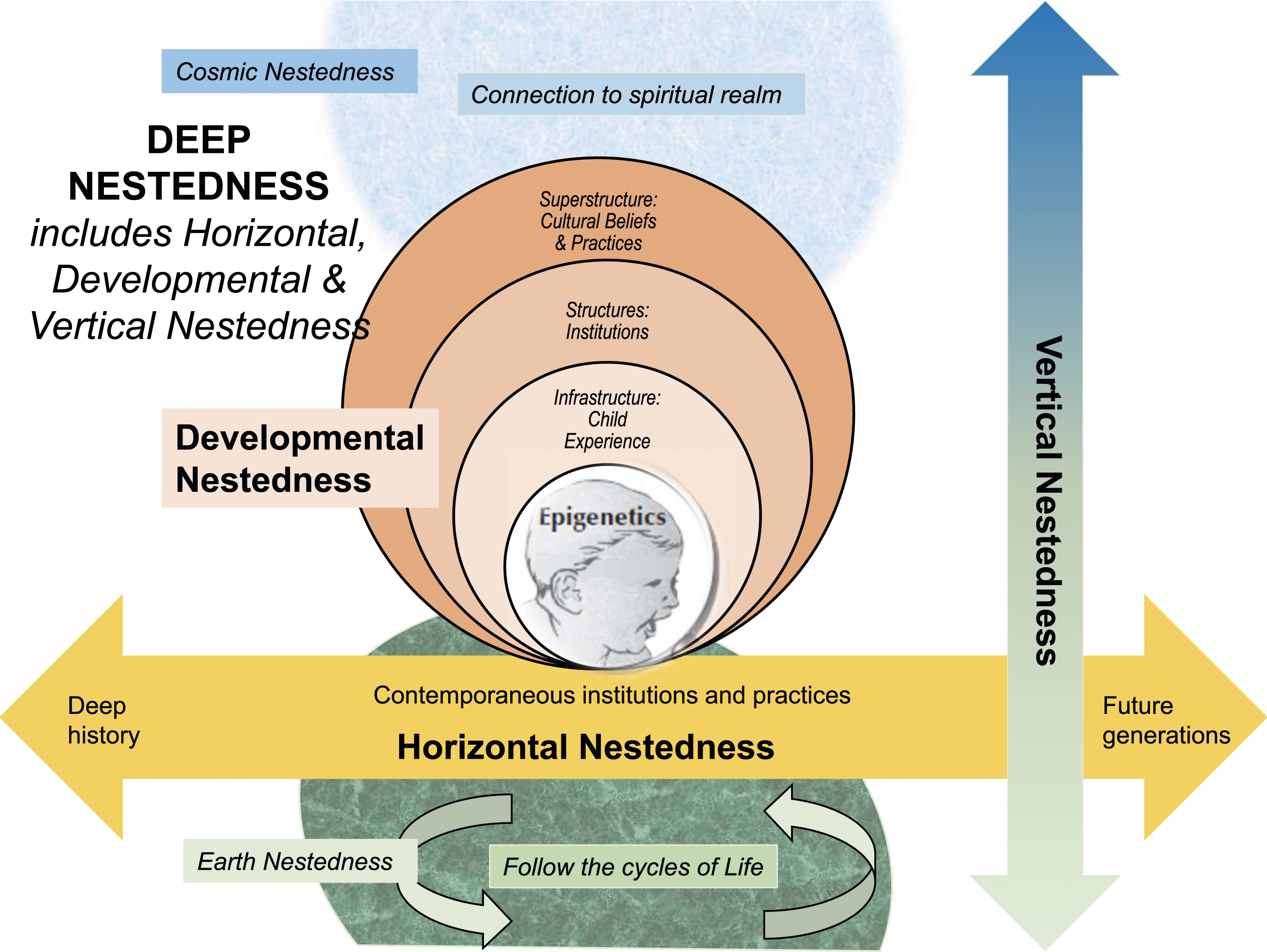
Deep nestedness, rediscovered by post-Newtonian science, reflects a transpersonal, ecological relationality: Earth is alive, and every entity is interacting with many others in a creative, dynamic flow (Fox, 1990; Naess & Rothenberg, 1989; Weber, 2019). Instead of a metaphysic that subscribes to rigid platonic ideal forms and linear causality, the world is field of “contending forces in dynamic process in which the well-being of each is bound up with the other” within a “matrix that the organism requires to survive, [an] open, pluralistic ecological system” (Rolston, 1991, p. 90). The community of subjects (e.g., quarks, cells, microorganisms, organisms) give and take from one another to meet needs as part of self-productive autopoiesis, mutual co-creation, and co-evolution. Entangled with others, being is inseparable from interactions in the world where becoming, advancing into novelty together, is ongoing (Whitehead, 1929/1978). To live well is to be perceptively and receptively entangled, or nested.
Three aspects that comprise deep nestedness are discussed here: horizontal, developmental, and vertical. Horizontal nestedness refers to embeddedness in the human evolutionary story, in hominin patterns of existence and multiple inheritances (Narvaez, 2019). It means being attentive to traditions developed across generations, honoring ancestors, and living responsibility with future generations in mind (Deloria, 2006). Developmental nestedness shapes desires and capacities for the other forms of nestedness. It includes community provision of humanity’s evolved developmental niche, shaping and maintaining species-normal functioning through dynamic biosocial plasticity (Narvaez, 2014). Vertical nestedness refers to the present moment of conscientious entanglement with Nature and all relations (Ingold, 2011). The web of interbeing involves respectful relations with the landscape and Earth entities through courteous manner and protocol, marinating in a sense of cosmic oneness.
What does nestedness at all these levels do? It cultivates and supports two critical adaptive features of humanity discussed here: ecological relational consciousness and knowhow. Ecological relational consciousness is all inclusive. It refers to the sense of existing in a web of living, dynamic relations with multiple entities, from humans to trees, from rivers to bees—the list is endless—and in multiple realms, not only the visible manifested realm, but the unmanifested—the spiritual, the ancestral, and the future (e.g., Deloria, 1999; Ingold, 2011; Martin, 1999). Community ceremonies remind members about how reliant they are on the gifting of all relations, and how dependent those relations are on reciprocal gifting. Like a spider on its web, each person’s actions (including thoughts and feelings) reverberate across the web’s strands, affecting the wellbeing of all relations. To be enwebbed with countless relationships brings a sense of ongoing moral responsibility to live rightly and respectfully. Maintaining respectful connections becomes a deep desire, a deep value, resulting in a communal ethical orientation (Narvaez, 2014). But to act on these values requires more than consciousness and desire. It requires knowhow.
Ecological relational knowhow is the second cultivated result of deep nestedness, involving mostly bottom-up, intuitive, skilled ways of being with others, human and non-human. Behavior in real time constitutes holistic cognition, know-how instead of a know-what (Varela, 1999), a contextually situated, embodied enactment of practical knowledge (Engel et al., 2013). Children co-construct knowhow from engaging the world via movement and exploration, picking up ways to behave from the invariants in the world like gravity, sun, and moon cycles (Gibson, 1979) and from the ever-changing relational interactions with others through shared play. Children build receptive intelligence from immersion in natural wild spaces. They learn how to co-participate in the world as it presents itself. Even full-term newborns demonstrate a readiness-for-action with others (Trevarthen, 2005). Developmental nestedness fosters full capacities for relational attunement; layer upon layer of micro-skills form across development, fostering a bottom-up “neuroeducation” for compassionate moral functioning (Narvaez, 2012). A nested individual is ready to cope with what is at hand, often without deliberation. Ecological relational knowhow, based in deep and diverse experience, is integrated then with ethics and wisdom: “a wise (or virtuous) person is one who knows what is good and spontaneously does it” (Varela, 1999, p. 4). Ethical sensitivity, judgement, motivation, and action capacities grow together through lived experience in a beloved community that includes affection and respect for the rest of Nature (Narvaez, 2010).
The means by which ecological relational consciousness and knowhow are fostered and maintained were abandoned by the western world with its theological break from Nature beginning in the first millennium BCE, negating the sacredness of humanity and Nature, relegating sacredness only to a male sky god (Schneidau, 1976). Over centuries, seeking an escape from a fallen human nature, the focus of meaning-making shifted from personal and communal experience to individual learning of a set of correct disembodied beliefs. Secularism completed the desacralization, leading to “the steadily building illusion of independence from nature, so that in time that greatest of illusions is erected: the omnipotence of man” (Turner, 1994, p. 25). Separation from and sense of superiority to Nature led to the species-atypical outcomes that are presumed normal today by the dominant culture, whose myths rationalize the dysregulated results (self-centeredness, aggression, impulsiveness), naming them original sin or innate depravity, and excuse rampant ecological destruction. It is time to abandon these destructive beliefs.
Establishing Species-Normal Baselines Through Nestedness
It is thought to be important within psychology to establish appropriate baselines for the phenomenon under study. Yet to date, psychology as a field has not systematically developed general baselines for humanity—for human nature, human development, or human wellbeing (Narvaez et al., 2022; Narvaez & Witherington, 2018). Perhaps the lack of baselines should not be a surprise since scientists across fields have only recently recognized how baselines for what is assumed to be normal degrade across generations of scientists. That is, scientists tend to take as normal/good/appropriate what they themselves experienced growing up, thereby missing the changes over decades or centuries (“shifting baselines syndrome”; Pauly, 1995). The need to establish holistic, cross-generational baselines is often overlooked.
Baselines proposed here are rooted in humanity’s evolved nestedness—horizontal, developmental, and vertical—and its outcomes, evident in extant foraging communities and other traditional communities. Around the world, nesting practices are still apparent in traditional communities not wrecked by colonization or capitalist globalization (e.g., see aforementioned list of anthropological references). Understanding humanity’s evolved nestedness can guide the establishment of baselines for species-normal child raising, human nature, and human potential.
Horizontal Nestedness: Human Roots and Branches
Horizontal nestedness comprises our rootedness in the past, embeddedness in the present, and extension into the future. Understanding the continuum of humanity’s existence, integrating paleo and ethnographic sciences, helps scholars understand the unique evolutionary pathway that brings humanity to the present moment and guides them in selecting appropriate baselines for species-normal human nature (Henley et al., 2019).
Humanity split off from our common ancestor with bonobos and chimpanzees about seven million years ago. The Australopithecine line emerged about three million years ago. About 2 million years ago hominins emerged with homo erectus, who fostered increased skull size (twice the size of chimpanzee skulls) with cooperative child raising (“cooperative breeding”; Hrdy, 2009), contrary to other apes whose mothers raise offspring alone and thereby hit a “gray ceiling” for brain development (Isler & van Schaik, 2012). Cooperative child raising or allomothering played a significant role in humanity’s development of traits not apparent in chimpanzees, such as egalitarianism, intersubjectivity, grandmothering, cooperative eyes, concealed ovulation, and counterdominance psychology (Boehm, 1999; Burkart et al., 2009; Power, 2022). About a half million years ago, with homo heidelbergensis and Neanderthals, the hominid skull expanded to three times the size of chimpanzees. Homo sapiens sapiens emerged around 300,000 years ago.
Until about 10,000 years ago, homo sapiens sapiens universally lived in nomadic foraging groups (and at least one third of humanity lived in such groups until colonization and globalization of industrialized-capitalism). There are still hundreds of nomadic foraging groups in existence around the world. For several centuries, they were remarked upon by first contact explorers and settlers, and for the last 200 years have been studied by ethnographers. Made up of 5–50 people that often shift into larger groups for part of the year, nomadic foragers practice immediate-return economies (Woodburn, 1982). That is, they use up food resources rather immediately and carry few possessions. They manifest the Indigenous or kinship worldview identified first by Robert Redfield (1956), described more thoroughly further below and by Four Arrows (2016; this issue; Topa & Narvaez, 2022). Most foraging groups consist of kin and non-kin, with membership changing by the day, displaying interdependence with the rest of Nature and across human groups (Hill et al., 2012; Shepard, 1982). Foragers are fiercely egalitarian, not putting up with inflated egos (e.g., Lee, 1979), thus avoiding the damaging effects of intractable inequality (Wilkinson & Pickett, 2011).
The Neolithic revolution began about 10,000 years ago in different parts of the world, gradually over centuries. Some groups of humans moved away from nomadic foraging and lunar-centered, female coalitionary social structures to settled agriculture, male dominance, and a focus on the solar calendar (Knight, 1991; Power, 2022). The reasons for the shifts are debated but crowding around scant resources in combination with food storage from agricultural surplus led to corporate organizations and delineated territories, increasing population and greater need for food security, bringing about static social hierarchies and armed conflict (Bellwood, 2004; Kelly, 2000; Shepard, 1998b). Mono-agriculture of grains was associated with surplus accumulation of property, forced labor, slaves, taxation, and militarism (Scheidler, 2020; Scott, 2017).
Nestedness deteriorated. Respect for animals and plants diminished as domesticated animals and plants were depersonified and commodified (for a modern example, see Naveh & Bird-David, 2014). Infrastructure for raising the young degenerated and institutional structures that supported universal wellbeing became exclusionary. The shift from nomadic lifestyles to sedentary lifestyles brought about a decrease in physical health and height while disease and epidemics became routine (Wells, 2010). Among settled humans since the neolithic, brain cases shrank (Hennenberg, 1988; Liu et al., 2014; Ruff et al., 1997) and jaws and palates have shrunk since industrialization from decreased breastfeeding, causing sleep and orthodontic problems (Boyd et al., 2021).
In social hierarchical systems, coercion must be used to force obedience, unlike in matrifocal societies where domination is/was forbidden (Goettner-Abendroth, 2013). To maintain itself, the system requires breaking the will of all those within it. Over time coercive institutions and practices broke nestedness at all levels (horizontal, developmental, and vertical), interfering with the natural, uncoerced development of the individual, curtailing freedom of movement and relations, increasing ignorance and distrust of Nature (Shepard, 1982). Belief systems (superstructures) were invented to support the coercive, under-nurturing caregiving infrastructures (e.g., “babies are born in sin”) and non-nurturing institutional structures (e.g., “the poor will always be with us”).
Europe has a long history of breaking humanity down. The shattering of human spirit through removal of traditional ways of living in concert with the rest of the natural world was perfected by the Romans who deforested the lands they conquered (Harrison, 1993); furthered by institutional Roman Christianity, burning libraries of non-Christian writings and music and the heretics themselves, establishing churches on sacred land (Lash, 2006); and boosted by elite takeover of the common lands across Europe over centuries forcing wage labor (K. Polanyi, 2001), which still continues today around the world (Bollier & Helfrich, 2012). Nestedness collapsed further with the Protestant reformation and its denigration of the feminine, the invention of western techno-science, and European colonialism and its rationalizations. This perfect storm facilitated the rise of European (and USian) power, which relies on robbing the wealth and lives of peoples around the world (e.g., Maldonado-Torres, 2007). The wétiko fever, cannibalizing life for control and accumulation, continues unabated (Forbes, 2008).
Divorcing economics from Nature, human wellbeing, and ethics, coercion has been part of western techno-science from its beginning, with a founder, Francis Bacon, linking science to power (Bajaj, 1990). Western enlightenment’s patriarchal civilization formulated an accelerating creative destruction to alchemize an alternative to natural systems (Von Werlhof, 2011, 2013). “Instead of caring for and respecting the Other by cultivating the creative and bonding principles of need-oriented giving and receiving, of mothering, caring, and nurturing, the Other is declared raw material and a resource to be split up into any number of individual parts and recombined in order to get an allegedly better, controllable, and exchangeable ‘higher’—male-created—life” (von Werlhof cited by Worer, 2019). Nihilistic alchemy has only grown stronger and is boosted by heedless scholarship.
Most western scholars take up notions of human nature based on recent religious and philosophical views from the past 6000 years or so, primarily in preserved documentation (pictograms, art, writing) from the west’s “Old World.” Setting one’s baselines in recorded western civilization means 95%–99% of human history and experience across time and space are ignored. Unfounded assumptions about the past color assumptions while theories about the present impair imagination about the future. For example, settler-colonialism (Veracini, 2011) and its globalization lack concern for the present and future wellbeing of non-humans and humans outside of heteronormative white male interests and profiteering.
In contrast, the primary goal of traditional communities is cultural perpetuity which requires horizontal nestedness. Horizontal nestedness is contemporaneous, meeting the basic needs of community members, honoring ancestors and future descendants, and sustaining a network of cooperation with others, human, and non-human. Balance in the ecosphere relies on implementing traditional longstanding observational knowledge and maintaining respectful kinship with ecosphere partners through, for example, practicing the honorable harvest of plant and animal beings (Kimmerer, 2013). Respect for Nature is fundamental. Wovoka, a Paiute elder (b. 1856), conveys the deep attachment to the wellbeing of Mother Earth: You ask me to plow the ground. Shall I take a knife and tear my mother’s bosom? Then when I die she will not take me to her bosom to rest. You ask me to dig for stones! Shall I dig under her skin for her bones? Then when I die I cannot enter her body to be born again. You ask me to cut grass and make hay and sell it, and be rich like white men, but how dare I cut my mother’s hair? (quoted in Nerburn, 1999, p. 6)
Horizontal nestedness, then, is about interdependence. Interdependent selfways (Markus et al., 1997), common around the world across time and space, are described as prevention oriented (Adams et al., 2018; Higgins, 2011) because the individual adapts to normative expectations, striving for self-improvement, fitting in and adjusting to context. Perception is holistic, reasoning dialectic, and logical contradiction is tolerated. The individual self is diffused among relationships, and the sense of wellbeing relies on relational harmoniousness, which depends on respect and generosity. Each self is a co-constructed self, “I am because we are” (ubuntu). Each person feels and interprets experience, and receptively negotiates existence within the community and across realms, manifest and unmanifest.
Sharing with others is like sharing with the self, an extended self (Belk, 2010), a non-egocentric action that Bird-David (2005, p. 207) links to “entangled identities” or “joined lives.” For example, across foraging communities and other traditional societies, sharing with no immediate expectable return is the norm, even with distant non-relatives (Hill et al., 2012), so much so that there is no word for sharing. “Sharing is understood here as the social practice of enabling access to what is valued on the basis of shared demands…Sharing is allowing others to take what is valued,” understanding the precarity of life (Widlok, 2017, p. xvii). The gift economy of sharing reflects Nature’s gift economy of nourishment through an endless cycle of taking and giving where one animal’s waste is food for another ecosphere community member (Worster, 1994).
In contrast to interdependent selfways, the modernization tradition has assumed a linear progress of human consciousness toward individual autonomy or independent selfways (Markus et al., 1997), so much so that interdependent selfways are considered underdeveloped and inferior (Harrison, 1985). According to independent selfways, human agents are inherently free and independent of context. Events in the world are explained by personal dispositions and according to abstract rules (rather than by situational press). Promotion-oriented (Higgins, 2011), the individual focuses on self-expression, personal growth, and control of surroundings, while seeking highly aroused positive affect. Independent selfways are lodged in the dualisms of ego consciousness (e.g., body/mind, human/nature, civilized/savage) and are not conducive to cultivating relational consciousness and knowhow. Moderns have “maximized procedures that keep [them] from always owing, always depending, always giving back” because they “have discovered a source of absolute certainty, [economic principles], indifferent to values” (Latour, 2013, p. 449). “To live in accordance with [individualistic selfways] is to rehearse, reproduce, and extend intercultural relations of coloniality” (Maldonado-Torres, 2007, p. 20).
The shift away from interdependent connectedness, especially one that is inclusive of the rest of Nature, is an example of the dismissal and denigration of tradition by modernist culture, which considers “the loss of intergenerational knowledge and networks of mutual aid as a necessary part of becoming modern” (Bowers, 2002, p. 26). Being modern means newness, change, and a belief in human capacities to control Nature and the future. In other words, human technology will solve any problem that arises because modern humans are ingenious. Intergenerational wisdom and longstanding networks of mutual respect and entwined lives, with non-humans and those in other places, including those in the future, are repudiated.
What happened in western world history that impaired its horizontal nestedness? The proposal here is that it began with the corruption of developmental nestedness.
Developmental Nestedness: Seeding Species Normality
Each species has a typical nature or disposition apparent at maturity. When we start with a picture of a species’ maturity or wholeness, we can map the type of experiences that foster it, documenting its basic needs. To understand how to treat an acorn, we must understand the nature of the end goal, a mature oak tree, and map the developmental infrastructure that brought it about. We learn from observing species in their evolved habitats. Healthy dolphins are playful and social, living freely together in waterways. We know that something has gone wrong with an individual’s experiences when a species-normal nature is missing. Harlow (1958) discovered, accidently at first, that a key component of the species-normal early environment was missing for his isolated, cage-raised Rhesus monkeys who were aggressive and asocial: maternal presence and affection.
What about humans? Do humans have a typical disposition? What experiences bring it about? For centuries, a negative view of human nature has populated scholarship with the assumption that humans are naturally selfish and aggressive. Scientists have taken up this originally theological position (e.g., from Augustine). The contemporary scientific notion of human aggression (e.g., “demonic males”; Wrangham & Peterson, 1996) relies on documented chimpanzee violence assumed to be showing an innate propensity among all apes, including humans (importantly, ignoring the female-dominated, erotic sociality of our other equally close cousins, the bonobos). However, as noted earlier, humans are distinctive from chimpanzees in many characteristics (Burkart et al., 2009). Nor are chimpanzees naturally violent. Ferguson (2023) painstakingly shows how multiple forms of human intrusion (e.g., food provision, habitat loss, killings, and displacement) were causative in observed chimpanzee violence. Similar disruptions have led to violence among young male elephants due to complex post-traumatic stress disorder and lack of species-normal adult male presence (C-PTSD; Bradshaw & Schore, 2007).
The position that humans are naturally violent is also propped up by a misunderstanding of humanity’s past, conflating hierarchical social structures (e.g., tribes) with (egalitarian) nomadic foragers, and by cherry-picking societal examples (e.g., Pinker, 2011; see critiques by Ferguson, 2023; Malesevic, 2016). Nomadic foragers are primarily peaceful. Like bonobos, they tend to be sociable and welcoming on first contact (as demonstrated across European diaries and reports of genuine first contact with Native Peoples around the world). Single males may become violent from jealousy or mental impairment but there is next to no coalitionary violence (Fry, 2006, 2013). Coalitionary violence emerges with social inequality, when there is something to be gained in wealth or status, as in more complex societies like complex hunter-gatherers (who cultivate plants and/or domesticate animals). One study of the Yanomami, Chagnon (1988), is often cited as representative of humanity’s past and proof of the selectionist advantage of male violence, demonstrating that successful warriors had more offspring. But this conclusion is refuted by an examination of the actual data (Ferguson, 2023). Similar conclusions about human male violence drawn from other data have been thoroughly refuted as well (Ferguson, 2023). The real cause of human male violence today may have more to do with the species-atypical care they receive in early childhood and their gender fragility. Because males mature more slowly and have less built-in resilience than females (Schore, 2017), they need more developmental nurturance for longer (greater nestedness) in order to develop a well-functioning psychosocial neurobiology. But they typically receive less nurturing care in industrialized patriarchal societies where toxic masculinity norms are applied to male child raising.
Hierarchical civilizations have been around only for about 1% of human genus existence and until recently involved only a small portion of humanity. Industrial civilization fosters a very different human nature than that found among nomadic foraging societies (e.g., Ingold, 2005; Sorenson, 1998). That is, characteristics assumed to need civilization’s sociopolitical control—such as dysregulation, selfishness, and aggression—are not typically observed among nomadic foragers. The contrast between the received view of innate depravity with humanity’s nested nature is striking. Nomadic foragers display a very different character.
Nomadic Forager Character
Anthropological and other reports of those living in the ancestral context of nestedness provide contrary evidence to the received ‘innate naughtiness’ viewpoint (e.g., Fry, 2013). E. Richard Sorenson (1998) lived all over the world with hunter-gatherers (some were complex hunter-gatherers who had gardens or raised animals). He admits it took him decades to realize what he experienced—he had to watch and re-watch the films he collected to help him discern what was different: their consciousness. He called it “preconquest consciousness,” to contrast with the “postconquest consciousness” of the dominant culture. According to his experience, preconquest peoples have no guile and no deception toward one another, but are fully present to one another, living with a “heart-felt rapprochement based on integrated trust” (Sorenson, 1998, p. 80). They display a coordinated sociosensuality characterized by both high communalism and high individual autonomy. Each person acts autonomously, without coercion, in the flow of interdependence. Sorenson struggled for a term and settled on “individualistic unified at-oneness” (p. 89). They display flexible attunement to others, holistic practical, social, and ecological intelligences, and knowhow for living cooperatively in a complex dynamic world. We might call this “robust intelligence” (as opposed to what we might call the “skinny intelligence” of IQ scores and artificial intelligence). The enactivist, nonverbal “animal mind” is fully developed with a host of intuitions from lived experience, ready to cope in a dynamic world (Song, 2016; Young et al., 2010).
Personality Characteristics of Adult Members of Foraging Communities.

aArcheologists note that inegalitarian settlements did occur among foragers for part of the year, for the benefit of food sourcing or worship (Graeber & Wengrow, 2021), but groups shifted back to egalitarianism for the rest of the year.
When Maslow lived with the Blackfoot of North American, inspiring him to shift his research to self-actualization, he found these same kinds of characteristics, and was astonished to find no neuroticism (Maslow & Honigmann, 1938, cited in Brown, 2014). But Maslow missed some critical features of Blackfoot society. Like nomadic foragers, they considered individual self-actualization to be fundamental and primary, not an endpoint. Self-actualization supports the true overall aims: community wellbeing and cultural perpetuity (Ravilochan, 2021). These aims are facilitated by living in a band of multiple genders and multiple generations, each age/gender having its wholeness, its gifts of insight, its different skills to contribute to community success. Generational diversity allows for natural pedagogy where the younger observe and imitate the older and the elders enjoy the energy and new ideas of the younger. Elders are repositories of vital understandings and knowledge for the community’s survival and wellbeing.
What brings about the thriving character described above? It turns out that human babies need all of Maslow’s list of needs fulfilled simultaneously to promote healthy development as they self-organize basic physiology and psyche, self-actualizing around experience (Narvaez, 2018; Tarsha & Narvaez, 2022a). Like all animals, nomadic foraging communities provide for the basic needs of children (rather than dismissing or denying them as modern cultures sometimes do). Humanity’s evolved developmental niche appears to provide just what is needed.
Humanity’s Evolved Developmental Niche (EDN)
Although the typical focus of human inheritances is genes (defined simply as a blueprint of nucleotides passed on from parents, which are relatively easy to measure), humanity inherits much more. Extra-genetic (outside of genes) inheritances include cell and body plans (Margulis, 1998), culture, ecological conditions (Jablonka & Lamb, 2005), and niche construction, the means by which each species interacts with Nature to create a supportive environment for its umwelt—its perceptual, physical and psychological capacities (Odling-Smee, 1988). Further, every animal has a developmental system or niche that matches up with the maturational schedule of the young (Gottlieb, 1998). Niche provision shapes species-normal nature (Narvaez, 2014; Stotz & Narvaez, 2018).
The human niche emerged from the tens-of-millions-of-years-old social mammalian niche becoming the “hunter-gatherer childhood model” (Konner, 2005) which was central to human adaptation (Hrdy, 2009). The human evolved developmental niche (Narvaez et al., 2013a; Narvaez et al., 2013c) for young children is the species-typical developmental system (Ford & Lerner, 1992) that includes soothing perinatal experiences; years-long on-demand breastfeeding; responsiveness to needs (e.g., keeping baby calm during rapid growth) from mothers and allomothers, including extensive affectionate touch; positive climate of support for mother and child; and self-directed play immersed in Nature with multi-aged playmates throughout childhood (Hewlett & Lamb, 2005; Konner, 2005; Narvaez, 2014). Converging transdisciplinary evidence shows that EDN provision supports healthy postnatal growth (e.g., Narvaez, 2014; Narvaez et al., 2014; Narvaez et al., 2016; Narvaez et al., 2013b). In effect, the EDN supports the social proximal processes in Bronfenbrenner’s ecological model (Merçon-Vargas et al., 2020) that foster humanity’s species-typical nature described earlier. A species’ developmental system provides the supportive care that co-constructs, for example, a healthy body (that resists infection), cooperative intelligence (critical for learning to find local food sources), a prosocial physiology (Carter & Porges, 2013; Tarsha & Narvaez, 2023), ecological relational consciousness (Shepard, 1998a), and psychosocial wellbeing (a critical feature of human adaptation) (e.g., Narvaez, 2014; Narvaez et al., 2013b; Shonkoff et al., 2021).
Early experience is especially important for shaping human lifelong functioning given that human infants are particularly immature at full-term birth (40–42 weeks), resembling fetuses of other animals until about 18 months of age (Trevathan, 2011), with more postnatal epigenetic “wiring” taking place than in other apes (Gómez-Robles et al., 2015). It should be noted that human brain volume is expected to increase most significantly in the first 18 months of life, as skull plates do not solidify until around that time (Trevathan, 2011). Neglected children (at three years) have smaller brains than adequately raised children (Perry et al., 1995).
Self-organization is another extra-genetic inheritance (Kauffman, 1993). The individual self-organizes their development around experience (Oyama et al., 2001; Witherington et al., 2018). Parents and alloparents are engineers of the thresholds and parameters of multiple neurobiological systems undergoing sensitive periods in the young child (e.g., stress response systems; Lupien et al., 2009). Sensitive periods, during which only certain kinds of stimuli affect a particular circuit or system, come and go. When expected experience is missing, a foundational system for later-developing systems may not develop properly, undermining later functioning (Knudsen, 2004). Adults model and physiologically resonate with dispositional energies that form the child (Lewis et al., 2000), enveloping the child in multiple fields of supportive energy, from the caregivers’ kind attention to the collective’s efforts on their behalf. The child learns to resonate with these efforts, creating dispositional habits (Schore, 2019) and building relational knowhow. During various sensitive periods, including psychobiosocial relational expectations and capacities (e.g., attachment; Bowlby, 1969/1982), EDN caregiving calibrates the young child’s thresholds for being, molding the neurobiology of the child. For example, child attachment is not just a cognitive matter (“internal working models”) but a co-construction of neurobiological structures (Schore, 2019); insecure attachment signals that the structures are misdeveloped, impairing relational knowhow, potentially leading to lifelong difficulties with intimate relationships (Bowlby, 1979). Critical but often overlooked by developmental psychologists, is the need for attachment to non-human Nature (animals, plants, and landscape), seeding the ecological relational consciousness that is critical for species-normal human nature (Narvaez & Bradshaw, 2023; Shepard, 1982).
The most critical time period for the development of species-normal human nature may be the first six years, with multiple sensitive periods and decreasing neurobiological plasticity during that time period (Hambrick et al., 2019). However, psychotherapist Dan Stern (1977) contends that, for sociality, the first six months of life are one of the most critical periods because multiple aspects of relational knowhow must develop before language, such as playful teasing, turn taking, recognizing and expressing social cues, temporal patterning, tempo and rhythm of human interaction, and learning conventions for initiating, maintaining, terminating, and avoiding interactions. Ideally, the young infant experiences frequent moments of pure social experience: encounters with primary caregivers that rise and fall in call and response rhythms, a symphony of co-attunement that awakens, stimulates, and structures the social brain, building foundations for social intelligence. However, species-normality also includes infant immersion in Nature to learn its embrace through wind and gravity, beauty and song, building ecological attachment and receptive intelligence (Narvaez & Bradshaw, 2023).
The EDN appears to provide a “cultural commons” across nested groups, molding human nature toward social cooperation and openness, shaping perception, attention, desires, capacities, and values oriented towards interbeing and interdependence (Narvaez, 2014). The EDN immerses the child in a “biology of love,” fashioning a loving human nature (homo sapiens amans, Maturana & Verden-Zoller, 2008). “The infant’s life is so thoroughly social that most of the things the infant does, feels, and perceives occur in different kinds of relationships… The notion of self-with-other as a subjective reality is thus almost pervasive” (Stern, 1985, p. 118). Through their behavior, mothers and allomothers co-construct the biopsychosociality of the child.
The EDN fosters right hemisphere (RH) development, which initially governs various forms of self-regulation, including vagus nerve function, and gathers a lifelong repository of knowhow from immersion in whole-body experiences (McGilchrist, 2021; Schore, 2019). Capacities governed by the RH identified by neuroscience include being open and receptive, attuned to the energies of the moment with feelings of connection and multiperspectivalism, with interest in mysteries beyond apparent perception or comprehension (McGilchrist, 2021). Socioemotional intelligence, empathy, and relational attunement are all governed by the RH which is oriented to dynamic interrelations—fundamental for ecological relational consciousness and knowhow. Overall, it appears that lack of the EDN in early life impairs development in multiple systems with a large causal factor being the underdevelopment of the right hemisphere (RH) which is scheduled to grow more rapidly than the left hemisphere in the first years of life (Schore, 2019).
The Collapse of Developmental Nestedness: Authoritarian Childhoods
The shift to patriarchy (male domination) from matrifocality decentered nurturing, mothers, and children, undermining human wellbeing (Hrdy, 2009). Today the patriarchal settler-colonial-industrialized-capitalist culture has spread around the world, along with its harmful child raising practices. Male-dominated medicalized birth is traumatic (Verny & Weintraub, 2002). Infants are put on schedules to ingest artificial food and sleep alone. They are caged in carriers, cribs, and walls, forced to focus their motivation extrinsically (to avoid punishment and receive praise), interfering with psyche and virtue formation (Fromm, 1964). They are isolated in nuclear families, sometimes with only one parent, and sometimes spend their days with distracted strangers or screens. Children and adults who do not conform to the controlling regimen are labeled and treated as deficient or delinquent.
Deprivation of EDN components is physically and psychologically debilitating. In animal studies, where experiments are done, and in human longitudinal correlational studies, there are significant effects for privation of touch (Harlow, 1958; Hofer, 1994), play (Panksepp, 2007), maternal presence (Kuhn & Schanberg, 1998; Moriceau & Sullivan, 2006), and delivery of corporal punishment (Gershoff & Grogan-Kaylor, 2016). Young babies show dysregulation and pain states when separated from mother/caregiver, when put on their backs, or are denied suckling and nearly constant touch. Routine isolation and distress force the young child into dissociation for survival (Lanius et al., 2010).
A toxically stressful early life undermines longterm health (Callaghan & Richardson, 2012; Shonkoff et al., 2009). Strong, routine, or prolonged activation of the stress response without caregiver support (e.g., hours of physical isolation, cry-it-out sleep training), immerses the child in an interpersonal biology of fear (Maturana & Verden-Zoller, 2008). Because of brain malleability, immersion in a biology of fear instead of a biology of love interferes with biopsychosocial development, dysregulating various systems, fostering alternative natures from that of a homo sapiens amans. Innate survival systems are enhanced instead, and sociality systems are undercultivated, resulting in natures such as homo sapiens aggressans or homo sapiens arrogans (Maturana & Verden-Zoller, 2008). Critically, the undercared for child (missing the EDN) becomes an easily triggered adult whose free will vanishes when triggers flare, impairing thinking and perception (Arnsten, 2009), shifting affordances to social self-protection (Narvaez, 2008, 2014).
Some might contend that each community prepares children for its own needs and culture. Certainly, the dominant culture prepares children for social and emotional distancing, for a life spent in artificial environments, and for anxious achievement, so there may be some truth to this view. But one must look at the bigger picture. The industrialized capitalist megamachine and its colonized people are destroying biological and cultural diversity across the planet, not by happenstance or rooted in some evolutionary process, but by general unnestedness and myth-driven child raising that enhances innate pre-human survival systems oriented to dominance-submission, shaping preference for authoritarianism, which is increasingly apparent in the dominant country of the world, the USA (Milburn & Conrad, 2016; Narvaez, 2014; Rhodes, 2022).
Our species-typical evolved nest was experienced by the entire community throughout life, supporting a well-functioning neurobiology, prosociality, ecological relational consciousness and knowhow. This developmental nestedness facilitates vertical nestedness, felt connectedness to and respect for Nature, Earth, and cosmos.
Vertical Nestedness: Ecstatic Holistic Being
Vertical nestedness refers to relationality in the moment, one’s interbeing with Earth and Cosmos. How it is displayed varies by group, in consciousness and knowhow, but it has its deepest foundations in firsthand Nature immersion. Spending hours each day immersed in Nature leads to a particular sensibility, a feeling of unbounded kinship with a living world. The contrast with moderns is striking. “Moderns imagine the world as an inanimate surface to be occupied; for many relational cultures, to the contrary, humans and other beings inhabit a world that is alive” (Escobar, 2018, p. 87). Standing Rock Sioux scholar, Vine Deloria (2006), described Native American traditions: “By observing the behavior and growth of other organic forms of life, they could see that a benign personal energy flowed through everything and undergirded the physical world. They understood that their task was to fit into the physical world in the most constructive manner and to establish relationships with the higher power, or powers, that created and sustained the universe. They sought to learn a way of living that would most efficiently accomplish these tasks. This posture was not unique to any tribe; it was generally the way Indians of all tribes described the mysterious reality that affected their lives.” (p. xxv)
In the animist traditions around the world, the individual learns to live within a sentient world through personal experience and through cultural stories describing non-human and human similarities. Though bodies are different and require perspective taking to understand, all share subjectivity; whether animals, plants, rocks, or spirits, all are the same inside, making relationships always subject-to-subject and not subject-to-object (Descola, 2013). Various forms of relationships may be established including contracts for mutual help and reciprocity.
The presumably oldest culture on Earth, the San Bushmen (over 150,000 years in existence, carriers of humanity’s genetic inheritance; Suzman, 2017), center healing and spirituality on experiencing n/om, the mysterious life force that fuels the web of life (Keeney & Keeney, 2015). In contrast, verbal language, part of the mind that likes to categorize and explain, is regarded as the invention of the trickster (a counterpart to God). “Trickster mind is utilized in certain practical matters, but it is not allowed to interfere with the serious matters of n/om” (Keeney & Keeney, 2015, p. xxix). “The Bushmen teach us that understanding the mystery of life is less important than participating in it. They invite us to dance more and talk less. They want us to feel our hearts rather than fill our minds. The Bushman way is more polyphonic, improvisational, playful, and biological than any flat-planed, textually structured world. Their truths mirror the truths of the sky, earth, plants, and animals that surround them” (Keeney & Keeney, 2015, p. xxi).
The young are not systematically taught but learn through observation and imitation. What is important is experiencing full-bodied dancing with all of creation through the “mysterious presence that moves their bodies to perform ecstatic choreographies of healing movement inseparable from heartfelt touch” (Keeney & Keeney, 2015, p. xx). Children develop muscle memory of dance movements and holistic memory of orally transmitted songs.
Foragers generally foster and display an ethics of being that is primarily communal. In babyhood, the collective moves with baby’s needs, as if upheld by an ocean of care, flowing back and forth in a relational dance (Finnegan, 2017). The child’s physiological needs draw the child into themselves, but the satiation of needs by the collective brings them back out to community connection. The flow of imbalance, from a need arising, to balance from a need fulfilled, provides a practice ground for living confidently in a flow of autonomy and communalism. The child learns to follow and meet their own needs over time within a collective that assists when needed. Kinship is expressed in an embodied flow of sociosensuality through frequent communal synchronized movement that promotes communitas, joyful togetherness (Turner, 1974). Movement with others through song-dancing fosters a sense of connection, of unity with the group, with the natural world, and with the cosmos. There is less a sense of individual self than a sense of Common Self (Martin, 1999). For example, on a wander through the Malaysian forest, Malaysian-raised, Dutch healthworker, Robert Wolff observed that after chewing on a root for a while, a Sng’oi companion would store it, likely in a tree, “so that someone else can find it when he is hungry,” human or animal (Wolff, 2001, p. 84).
Cultivated from a young age, intuitions are honed to tune into alternative aspects of reality, sharpening receptivity to signals from the implicate order, the nonvisible order from which our visible (explicate) order emerges (Bohm, 1980, 1994). Each culture varies in its metaphysics, metaphors, and relational maps of the cosmic and Earth realms (Guenther, 2015). In Andean culture, human “bodies and spirits are intertwined with mountains and stars in webs of reciprocal duties” and each person has multiple spirits to keep happy (Greenway, 1998, p. 993). Embeddedness in an Earth- and Cosmos-centered consciousness means responsively attending to one’s own nature as a co-constructor of the immediate future. For Australian Aboriginals, one is responsible to sing the land and life into being. “Songspirals bring Country into existence. To sing or keen the spirals now means the ongoing creation of place and people—an emergent, more-than-human creativity that literally creates and re-creates existence. Songspirals are more-than-human processes that need active engagement to nourish positive relationships and to heal damaged ones. Songspirals are a keening/singing, of, with, by, for, and as Country.” (Country et al., 2022, p. 435)
Those with preconquest consciousness are polycentric (Bram, 2002, 2018) in a pluripotential world (Martin, 1999). For example, instead of feeling attached to one form of identity, descriptions of self, others, and places shift based on context (Ingold, 2011; Sorenson, 1998). A person can have names that come and go, whose use shifts with the desire of mates or activity. Entities are perceived from multiple changing perspectives, depending on context and mood. With the lack of fixed or rigid identities, the overall sense of the world is not static but dynamic; actions are dependent on foregrounding, activity, and season, rather than on fixed cognitive thought. Each situation calls forth a different response, one could say a different microidentity (Varela, 1999). Polysemic or polyperceptive consciousness swims in a shape-shifting world, one of dedifferentiation, where the individual seeks to become one with the other through dance, trance, or story. A Kalahari Jul’Hoansi tribal elder reported on his trance experiences as a healer: “In a kabi [a visitation or communication from God or ancestors], you enter first creation where everything can change. I can love an animal inside first creation and even kiss it. It would be impossible to believe what happens to us if we hadn’t experienced it for ourselves…We can dance with our ancestors, drink God’s water, ride the animals, and become a lion, among many other wonderful experiences. (Keeney & Keeney, 2015, p. 152)
Living is a dynamic space of participatory consciousness with all (Magliocco, 2012). The present moment is heavy with connection to others, including ancestors, the other-than-human, and other spiritual aspects of a dynamic, fluctuating universe (Descola, 2017). One is never alone. For example, after the full-moon community dancing had finished and the Mbuti were settling into sleep, anthropologist Colin Turnbull (1968) writes about hearing a noise in the forest: “This surprised me, because at nighttime the Pygmies generally never set foot outside the main camp. I wandered over to see what it was. There, in the tiny clearing, splashed with silver, was the sophisticated Kenge, clad in bark cloth, adorned with leaves, with a flower stuck in his hair. He was all alone, dancing around and singing softly to himself as he gazed up at the treetops. Now Kenge was the biggest flirt for miles, so, after watching a while, I came into the clearing and asked, jokingly, why he was dancing alone. He stopped, turned slowly around and looked at me as though I was the biggest fool he had ever seen; and he was plainly surprised by my stupidity. “But I’m not dancing alone,” he said. “I am dancing with the forest, dancing with the moon.” Then with the utmost unconcern, he ignored me and continued his dance of love and life.” (p. 272)
Participatory consciousness is “a syncretic system that accepts multiple truths and meaning and attempts to reconcile them. This state of consciousness is not due to a rational process” (Shepard, 1998a, p. 8). It does not recognize a “separateness of subject and object” but instead understands “a flow of subjective and objective contributions…bound together” without “clear consciousness of subject as subject or of object as object” (Cobb, 1967, p. 82). This intersubjective consciousness offers a sense of embeddedness in a thickly composed living world. It allows one to accept a world where many worlds fit, a pluriverse (Escobar, 2018).
The Collapse of Vertical Nestedness and Trust
Of course, the aforementioned capacities and orientations exasperate those immersed in postconquest consciousness. Earth-centeredness, cosmic-relatedness, and partnerships with non-humans are ridiculed as primitive, romantic, delusional, or even in some circles, demonic. Industrialized colonizing capitalism denigrates sacred landscapes and traditions and has destroyed such cultural wisdom and knowhow all over the world. Yet, “humankind cannot live wisely, sanely, or gently without the cosmos. Without the cosmos humanity becomes arrogant and manipulative in its idolatry of itself and its ways” (Fox, 2000, p. 73).
Mander (1978) identified two conditions of modern life. First, “human beings have lost insight into natural processes—how the world works, the human role as one of many interlocking parts of the worldwide ecosystem—because natural processes are now exceedingly difficult to observe” (Mander, 1978, p. 54). They have little understanding of how things grow and how long it takes, the complex interrelations between animals and plants, and what is required for ecological flourishing. Instead, postconquest cultures live against nature, attempting to control it in a myriad of ways. They have few direct relationships with Nature and these are often to dominate (e.g., planting non-native species) or exterminate (e.g., spraying pesticides and herbicides) or consume (e.g., bucket list of tourist sites). The human-made environment in which they spend most of their time is artificial, typically divorced from the flow of larger natural processes. They watch Nature from a distance on screens or through windows and tend to fear it in themselves and in their children.
Second, “human beings no longer trust personal observation, even of the self-evident, until it is confirmed by scientific or technological institutions” (Mander, 1978, p. 54). Swimming in a sea of information outside of lived experience, postconquest minds live primarily in a world of phantoms (Ellison, 1995), “inside projections of [their] own minds” (Mander, 1978, p. 67), a sea of illusions invented by onlooker consciousness, vastly different from relational consciousness. As an onlooker to life, postconquest consciousness separates itself from body, Nature, and relational awareness. Imagination is rooted in emotionally detached ideas applied to a world of objects rather than grown from personal experience and relational presence. What has happened to “modern” minds is “a colonization of emotions that are denounced as backward, superstitious, unenlightened, or unscientific. The emotional work of caring for a commons, however, is both an ecological necessity and a material reality, as well as a psychological need. Therefore, the collapse of affect (belonging, meaning, identity) has material consequences. As human relationships to an ecosystem erode, so does respect for the ecosystem, as well as the ecosystem’s stability” (Weber, 2019, p. 168).
Modern culture has moved away from Nature’s nest into a techno-landscape. Television, as a representation of visual media, provides an illustration of mind shaping. Mander (1978) pointed out how, like a magician, television places images in our heads that are hard to displace. They stay with us even against our desires. For over seventy years, it has been documented that greater television exposure increases “mean world syndrome” where viewers feel more fearful and less safe in the world, more distrustful of others, with less empathy for victims, and greater support for police and the military (Gerbner et al., 1986). Indeed, sociologist Robert Putnam (1995; 2000), who documented the decline in trust among USians across the 20th century, could only find television to be the cause. The studies of mean world syndrome were initially based on early television, which was vastly less violent than media today. Violent media shift our baselines for what we think is normal human nature and acceptable behavior (Dowd et al., 2006).
Along with more technologically advanced tools and a nearly 24/7 exposure to images created by others, immersion in screens today fosters a techno-human nature, teaching us how to exist like machines. Most of us live in a manufactured environment, from pavements to malls to social media, moving at technological, rather than Earth lifeway, speeds. Immersed in artificial environments, our minds ‘co-evolve’ with machines. TV and its offspring pacify the brain while speeding up the nervous system (Mander, 1991). We become “dumb and speedy” (ibid, p. 66). Instead of expecting and learning to interact with living beings around us, we learn to expect machine-enhanced experiences. Stuck in a relationally alienated calculative ego consciousness (typically governed by the left hemisphere), modernist culture orients to categorizing, manipulating and controlling the (only partially perceived) world, which is depersonified and objectified. Unmentored in perceiving and living with a world full of sentient beings or a cosmos full of spiritual energies, Nature becomes ever more distant and irrelevant. We’ve become “species isolated” and, inconceivable for our ancestors, assault Earth with gusto (Berry, 1988).
Western techno-science applies its linear, two-fold logic, a detached analysis, to manipulate and improve reality (Nandy, 1990), imposing abstracted, idealistic models on the world, regardless of their veridicality (McGilchrist, 2009, 2021). Consequently, techno-science tends to blunder immeasurably, supplanting complex dynamic systems with separable artificial components, such as replacing a forest’s vast diversity with monoculture plantings thereby undermining biodiversity, weather patterns, and local food sources (Scott, 2009; Shiva, 1993). The dismantling if local knowledge systems and longstanding sustainable practices are legitimized as progress and “development.” As exhibited in western systems of knowledge and modern scientific thinking, postconquest consciousness, distrustful of Nature, is demonstrably more close-minded to alternative practices than are traditional cultures (Shiva, 1993).
Postconquest humanity has become increasingly dissociated and deskilled for living well on Earth. Instead of living in a fullness of being-in-relation, the dominant culture cocoons in the death grip of grabbing and having. Can psychology help with the great turning back to a fuller human nature with a more responsible presence on Earth (Macy & Brown, 2014)?
Transforming Social Science
The need for a revitalized psychology has never been greater. Like most institutions that grew out of the western worldview of disconnection, superiority, and duty to colonize, psychology floats on the flotsam of destroyed wellness across humans, non-humans, and now the planet, having adjusted over generations to abnormalities taken for granted. The widespread ecological destruction and increased mental illness that accompanies settler-colonial-industrialized-capitalist culture, the kind of culture in which most psychologists live, should raise red flags rather than accommodation. Psychology’s role, as David Kidner (2001; 2004) and others have criticized, has been to try to name, normalize and treat the symptoms of those who are having trouble conforming to the dominant culture’s demands, despite its destructive practices, institutions, and outcomes. The dominant culture’s rhetoric assures us that this is necessary collateral damage on the progress pathway to a human-made paradise. “There is no alternative” (TINA). On the contrary, there is a world of alternatives (TIWA). One must learn to step outside the dominant culture’s frames to perceive them. Here are a few suggestions for places to start.
Decolonize Memes, Metaphors and Frames
Every western-educated scholar should be aware that they have been colonized by species-atypical ideas that straitjacket thought and being (Bowers, 2002). This is especially true for psychology with its emphasis on the detached individual. “The Trojan horse of the individual has been carried by the economic and political aims of colonialism, modernization, globalization and development, destroying communalism and place-based ways of relating” (Escobar, 2018, p. 83). To decolonize minds, it is necessary to let go of the memes and metaphors these forces have wrought. Outdated notions to abandon include: (1) Patriarchy’s alchemical destruction of Nature to create an alternative reality to replace mothers, mothering, and natural cycles (von Werlhof, 2013); (2) Enlightenment views of human separation from and superiority to nature, its metaphors of humans as machines, mind over body, and its denigration of personal knowledge and feeling; (3) Victorian ideals of linear progress, white heterosexual male normativity, and western culture; (4) Mechanistic understandings of evolution and Earth’s ecology that ignore how living organisms autopoietically organize themselves, together creating and regulating the environment (Clarke, 2020); (5) Industrialized capitalism’s view of economics as a magical, separate sphere necessarily divorced from ethics and wellbeing (Oreskes & Conway, 2023), exhibited in its encouragement of vice—for example, greed and predation. Western notions continue to feed a cycle of increasing disconnection, derealization, and desacralization, bringing us to the brink of self and other destruction. It is well past time to abandon these mostly WEIRD orientations.
Colonization of a people, which has happened to all of us, destroys relationships with “ancestors, human and otherwise, their old people, their children, their land, their animal and sacred kin, their rituals and ways of being. In the end, you have to remove them completely from the places that hold them as kin…What it means to be colonized is to be dislocated from living in a traditional Earth-oriented way” (Sepie, 2021, p. 25). The opposite of colonization is kinning, becoming kin through recognizing, respecting and listening to the uniqueness of others, humans and non-humans, including waterways, forests, and mountains (Van Horn, 2021). Anthropologist Marshall Sahlins describes kinship as an ongoing “mutuality of being” characterized by persons “who belong to one another, who are members of one another, who are co-present in each other, whose lives are joined and interdependent” (Sahlins, 2011). Decolonization means restoring ecological relational consciousness and knowhow inclusive of all our kin, fostering a communal imagination (Narvaez, 2014). Scholars can step outside their silos and learn to perceive, sense and study the connections, the entanglement, the inseparability of every entity with every other one (Bateson, 1972). Each scholar can routinely shift attention to a broader scope, to a cognitive archeological view of our deep past and learn ancestral regenerative lifeways (Henley et al., 2019). They can adopt the Indigenous, or kinship, worldview, and learn to live it as individuals and scholars, integrated “placefully” wherever they are on Earth (Topa & Narvaez, 2022).
Understand and Support Nestedness
Nestedness is central to the development of species-normal, embodied human nature. Psychologists of all stripes need to understand that babies (0–3 years or so) are unable to self-regulate but require co-regulation from caregivers, forming the foundations of a healthy dynamic system whose initial conditions shape longterm trajectory, allowing them over time to self-organize body-mind-psyche in a species-typical manner. Nestedness is an ongoing moment-by-moment experience whose nature varies by the basic needs of a developmental age (e.g., nearly 24/7 touch in babyhood). Nestedness is not a checklist for a set of singular actions (e.g., “I hugged my child today so that takes care of affectionate touch”). Every effort should be made to keep young children in a positive growth state (Schore, 2019), feeling relationally connected and secure, which ongoing EDN provision evolved to do. There is likely a plethora of sensitive periods for the development of socioemotional intelligence, ecological relational consciousness and knowhow, which nestedness supports. But nestedness is a lifelong need. Caregivers themselves require nestedness in order to provide the EDN
The understanding of basic needs must be expanded beyond Maslow’s hierarchy, which reads more like a list of psychological outcomes, and be focused instead on the provisions of support that leads to those outcomes—the EDN—but also the species-normal outcomes listed in Table 1. In childhood and adult studies, psychologists can establish basic need fulfillment indicators of past or present experience and use them as covariates to predict mental and physical health (Narvaez, 2018). Embracing the deep social needs and sociality of the human species, psychology can be more focused on relationships rather than individuals. Understanding that humans become themselves through intersubjectivity and relationships, psychology can advocate provision of the layers of support needed at each phase of life. Although Bronfenbrenner (1979) offered a multi-layered social ecology of human development, the deep evolutionary and ethnographic scope described here suggests additions to Bronfenbrenner’s model such as the specifics of EDN support and the inclusion of horizontal and vertical nestedness.
Expand Understanding of Human Intelligence, Learning and Knowledge
The centrality of detached, onlooker consciousness, detached “objectivity,” should be challenged with efforts to restore respect for participatory consciousness, the ability to commune with Nature phenomenologically. Although Piaget labeled aspects of participatory consciousness as “magical thinking,” in foraging societies it is cultivated to expertise, supporting ecological relational consciousness. In postconquest societies, participatory consciousness mostly disappears when literacy and schooling replace it with verbalized logical thinking. But verbal explanation and thinking in a detached manner about the world, as an onlooker, is distrusted by Bushmen and by wisdom traditions generally (Bourgeault, 2003). Abstractions and conceptual models narrow attention, shrink awareness, and can easily mislead. They can be forms of ideology or escape that do not necessarily conform with the way the world works (Sampson, 1981).
During the 20th century, it was noted that IQs in the USA rose decade after decade (“Flynn effect”). But the only aspect of the IQ tests that improved was hypothetical reasoning (Flynn, 2007), the kind of reasoning nomadic foragers and peasants refuse to do (Luria, 1976). As a component of onlooker consciousness, hypothetical reasoning detaches from reality, from context, and from emotional and relational connection. Schooling has become very good at promoting this kind of cleverness deluding students into believing they can know better than Nature: “Without significant precautions, education can equip people merely to be more effective vandals of the earth. If one listens carefully, it may even be possible to hear the Creation groan every year in late May when another batch of smart, degree-holding, but ecologically illiterate, Homo sapiens who are eager to succeed are launched into the biosphere.” (Orr, 1994, p. 5)
We can see how selecting literate, westernized, schooled people as a baseline for normality has misdirected psychology. Information processing, a central component of cognition, relies on a collection of structured facts that are transmitted primarily by language—for example, through books and lectures (though see Hogarth, 2001). “Knowledge is seen as something that can be acquired and accumulated, rather like stocks and bonds” (Peat, 2001, pp. 5–6). In contrast, according to Indigenous/First Nation cultures, coming to know something is a matter of personal transformation. “The knower and the known are indissolubly linked and changed in a fundamental way” (Peat, 2001, p. 6) To know is to be transformed not only in intellect but heart, spirit, and knowhow (robust intelligence). “Knowledge in the traditional world is not a dead collection of facts. It is alive, has spirit, and dwells in specific places. Traditional knowledge comes about through watching and listening, not in the passive way that schools demand, but through direct experience of songs and ceremonies, through the activities of hunting and daily life, from trees and animals, and in dreams and visions.” (Peat, 2001, p. 65)
Extensive personal experience with full sensory involvement builds the tacit relational knowledge that guides a life. Personal transformation is ongoing through receptivity to the other. The social environment in which a person is immersed builds intuitions and knowhow for action, grounded in personal experience (Hogarth, 2001; Narvaez, 2010; Polanyi, 1958). But one must have immersed experiences of the appropriate kind, not those that mislead and misguide development. A child immersed in a multi-aged, sensory-rich, playful, nested world learns a different way of being from a child immersed in a world of isolation, punishment, and screens. Species-normal child raising practices support various forms of intelligence, including ecological relational consciousness and knowhow. Every effort should be made to immerse children in environments that cultivate participatory consciousness, a sense of a sentient Earth community, receptivity to a dynamic cosmos, where they practice respectful and responsible actions towards all others, human and non-human (e.g., Medin & Bang, 2014).
When psychology moves away from narrow views of intelligence, learning and knowledge that have contributed to our ecological and moral crises, it can instead embrace a relational, nature-centered 4E—embodied, embedded, extended, and enactive—orientation as described in this paper (Narvaez et al., 2022).
Establish Appropriate Baselines
Baselines for species-normal child raising, human nature, and human potential should be based in humanity’s evolved nestedness across millions of years, founded on humanity’s 95%–99% across space and time rather than on the 12% of WEIRDness from the last century or so of human existence. This means decentering WEIRD assumptions about child raising that take for granted nuclear families, singular mother-child attachment, same-age child immersion, prioritization of talking and reading and deciding in early life (largely left-hemisphere-directed skills). Instead, species-normal EDN practices should be expected (and their absence documented), such as affectionate touch, self-directed free play, and immersion in multi-aged extended families/communities and Nature to promote wide attachment (growing right-hemisphere-directed capacities).
It should be acknowledged by researchers and publications that the human nature examined in most psychological studies is species atypical, that is, participants and their parents/grandparents did not experience the EDN during sensitive and critical periods of brain and sociality formation in early life. Thus, western psychology is largely unnested psychology, drawn from a populace of undercared for subjects, clients, and participants. As a result, unnested abnormalities have been normalized, contributing to slipped baselines. Understanding that the dominant culture of WEIRD societies represents unnested humanity should give us pause in generalizing anything found there to species-typical human nature. It is like taking the capacities, interests, orientations of caged animals to be representative of their species’ character.
Recognition of WEIRDness needs to be accompanied by recognition of various degrees of unnestedness which affects human potential. To take seriously our evolved species-typical baselines, study methods, participants and interpretations must be set up appropriately and control variables applied. For example, researchers can assess how nested the individuals were in early childhood (e.g., Narvaez et al., 2016). Notably in one study, the negative effects of reported childhood adversity on adult vagal tone were mitigated by reported childhood EDN experience; developmental nestedness provided a buffer for adversity (Tarsha & Narvaez, 2022b). Generalizations then are made cautiously, with caveats about applicability. Although most studies have not been reporting on nestedness, does this mean we throw out existing publications? No, we classify them not only as rooted in WEIRDness, if that applies, but also (likely) unnestedness.
Bring Ecological Relational Ethics Back to Science
Because most of us have been colonized by postconquest consciousness, we have underdeveloped ecological relational consciousness and knowhow affecting our ethical behavior. Techno-science alienates us from ourselves, our relations, our natural embeddedness and an evolved ethics of mutual concern and mutual aid (Kropotkin, 1914/2006). For example, ethical sensibilities towards babies and their needs have been impaired, away from attending to babies’ birthright to receive species-normal care, which when missing can undermine wellbeing (Narvaez, 2013b; Narvaez & Duckett, 2020). Education should be provided to all about the importance of the EDN for species-normal development and for optimizing human potential.
To restore our sense of relational responsibility to the rest of the natural world, we can re-personify animals and plants, rivers and mountains as sentient agents, as biologist Barbara McClintock demonstrated in her genetics work with corn (Keller, 1984). Scientists can avoid doing harm to our kin, animals, and plants, who should be supported in their own evolved patterns (Kimmerer, 2013; Narvaez & Bradshaw, 2023). As traditional Native Peoples understand, there are limits to knowledge acquisition—not everything should be studied (Deloria, 1999). Psychological science can learn the broader openness to learning shown by Native science which is built on multi-generation observation, transdisciplinarity, and relational responsibility; no experiences are discarded, no data are treated as error, and no living beings are tortured (Cajete, 2000; Deloria, 1999).
We are the animal that dreams or imagines our future and then creates it. No longer must we suffocate in the misperception of a mechanized universe limited by robopathic tendencies that destroy the integrity of the ecosphere. Instead, embracing panbiotic relations we can conscientiously co-create the future alongside all other biotic and abiotic entities as part of a dynamic Gaian system (Clarke, 2020). Like Native scientists, we behave as if we understand that our wellbeing is intertwined with the flourishing of the land and its non-human entities. We then act as equal, not superior, partners, using techno-science tools minimally, carefully, judiciously within a collective living world.
To restore deep nestedness ethically, there are several things to keep in mind. Modernist cultures will need to learn from local experts, Indigenous/First Nation members who have been able to maintain their species-normal practices and capacities and are willing to share their wisdom. Communities around the world have practices of wellness-promotion that can be shared and adapted in different locales (e.g., Legrand, 2021). We need to be aware that ecological systems are still under duress from the extensive disruption and damage from the environmental apocalypse imposed by colonialism and globalized-industrial capitalism, making natural patterns less predictable and animals more dysregulated than in the past. This makes the re-establishment of partnership relations with animals and plants more challenging. Nevertheless, in these transformative times, we can “stay with the trouble,” grieving with our non-human partners for the losses around us (Haraway, 2016).
With deep nestedness, we can return to our ancestral manner of growing into the world rather than growing away from it, of perceiving aliveness in everything, and learning from Nature to locate our lives within the relational dynamism of natural processes and structures (Kidner, 2007; Narvaez et al., 2019; Weber, 2019).
Conclusion
The situation is dire. Earth’s ecosphere has long supported life as we know it, but human interference is pushing the planet toward “hothouse earth,” a different equilibrium that will be less habitable (Richardson et al., 2023; Steffen et al., 2018). Industrialized capitalist-globalist colonization, through its conquest of human psyches and establishment of a megamachine hard to dismantle, is clearly largely responsible for the situation. It has colonized human psyches into emotional and relational disconnection from self, others and Nature, and modernist psychology has gone along. But psychology can transform itself.
Ecologically nested psychology recognizes that WEIRDness is founded on unnestedness, impairing the development of species-normal capacities. Instead, deep nestedness supports the development and maintenance of ecological relational consciousness and knowhow, central features of mature human nature. Once awareness is awakened and orientation shifted, ecologically nested psychology has an opportunity to step in with senses wide open to centralize human wellbeing, transforming society’s institutions, practices, and stories. It can set up ways to liberate psyches to get back in tune with the ecosphere, reestablishing wellness-informed pathways to thriving centered on all our inheritances, especially deep nestedness. There are practices individuals can take up as remedies (e.g., Narvaez, 2014; Topa et al., 2022). Personal changes must be accompanied by systemic changes (Chater & Loewenstein, 2022). Although it may take several generations to restore preconquest capacities, it will require bottom-up change—provision of the EDN across generations for healthy neurobiological development, but also top-down change—the replacement of current superstructures (cultural narratives, memes, and metaphors), structures (social institutions), and infrastructures (community, family, and individual life experiences) with those that centralize holistic, Nature-based wellbeing. Of course, there are many aspects of society that need to be addressed by others, along with dismantling the hegemonic megamachine. But with the appropriate baselines and frames based in deep nestedness, psychology can be instrumental in collaborating with other disciplines, policymakers, and community members to focus society’s energies on promoting human and planetary wellbeing. Will psychologists courageously step forward?
Footnotes
Author Note
Darcia Narvaez, Department of Psychology and the Kroc Institute for International Peace Studies, University of Notre Dame.
Declaration of Conflicting Interests
The author(s) declared no potential conflicts of interest with respect to the research, authorship, and/or publication of this article.
Funding
The author(s) received no financial support for the research, authorship, and/or publication of this article.
