



Abstract
Competitive foods in schools have historically been scrutinized for their ubiquity and poor nutritional quality, leading many states to enact legislation limiting the availability and accessibility of these items. Evaluations of these policy approaches show their promise in improving the healthfulness of school food environments, considered an important strategy for reducing childhood obesity. Yet little is known about the decision-making processes by which such legislation is formed and adopted. Using a comparative case study design, this study describes and analyzes the policy formation processes surrounding five state-level competitive food bills introduced in 2009-2010. Data for each case were drawn from multiple key informant interviews and document reviews. Case studies were conducted, analyzed, and written independently using a standard protocol and were subsequently compared for recurring and unique themes. Abbreviated case studies and summary tables are provided. Results indicate that bill cost is a major barrier to achieving strong, health-promoting policy change. Additionally, findings reveal that supporters of stronger competitive food policies often concede to changes that weaken a bill in order to neutralize opposition and achieve stakeholder buy-in. These challenges suggest that continued research on the development, implementation, and evaluation of public health policies can contribute to the advancement of new strategies for effective health promotion.
Keywords
Childhood obesity is a leading public health concern. While public health experts do not deny the roles of biology and behavior in childhood obesity, there is growing evidence of the “toxic environment,” one that fosters inactivity and overconsumption (Brownell & Horgen, 2004). Health-directed structural approaches—those that modify environmental factors targeting a specific health issue—are useful but infrequently used to improve population health (Lieberman, Golden, & Earp, 2013). Ensuring the healthfulness of school food environments is one strategy that can have a population impact.
In addition to meals, schools may sell foods and beverages known as competitive foods, so named because they are sold in competition with the reimbursable meal programs. Often found in vending machines and cafeteria à la carte lines, competitive foods have been scrutinized for their ubiquity and poor nutritional quality (although healthy items—e.g., fruits, vegetables, and water—can still compete with school meals and therefore competitive foods may be healthy or unhealthy). Research indicates that the availability and consumption of competitive foods are associated with increased calorie, fat, and sugar consumption and decreased fruit, vegetable, and milk intake (Fried & Simon, 2007; Story, Nanney, & Schwartz, 2009), as well as higher body mass index in adolescents (Fox, Dodd, Wilson, & Gleason, 2009; Story et al., 2009). Yet it appears these outcomes are reversible when tighter controls are imposed (Chriqui, 2012). Such results have, in part, led to calls for increased federal regulation (Fried & Simon, 2007; Story et al., 2009), recently answered through the Healthy, Hunger-Free Kids Act of 2010 (HHFKA; 2011). HHFKA (2011) requires the U.S. Department of Agriculture to establish nutrition standards for all foods sold outside the school meal programs on school campuses during the school day. These nutrition standards, known as the Smart Snacks in School regulation, went into effect on July 1, 2014 (Nutrition Standards for All Foods Sold in School, 2013).
Although childhood obesity has been a long-standing national issue, the slow federal response has left states to take their own actions. In fact, by the time President Barack Obama signed the HHFKA, at least 28 states had adopted nutritional requirements for competitive foods, and 29 states limited their access (Levi, Vinter, St. Laurent, & Segal, 2010). Evaluations of these policies show promise in improving the healthfulness of school food environments (Boles et al., 2011; Kubik et al., 2010; Long, Henderson, & Schwartz, 2010; Phillips et al., 2010; Taber, Chriqui, Powell, & Chaloupka, 2012; Woodward-Lopez et al., 2010), students’ intake (Taber et al., 2011; Taber, Chriqui, & Chaloupka, 2012; Woodward-Lopez et al., 2010), and weight status (Taber, Chriqui, Perna, Powell, & Chaloupka, 2012). These findings are significant, given that states with standards stricter than the U.S. Department of Agriculture’s will be permitted to continue enforcing them.
Though studies point to the effectiveness of a policy approach to reducing childhood obesity, there are substantial gaps in knowledge about the decision-making processes surrounding policy formation and adoption. To simplify the complexity of public policy making, Sabatier and Jenkins-Smith introduced the Advocacy Coalition Framework (Sabatier, 1988; Weible, Sabatier, & McQueen, 2009). This framework (Figure 1) identifies policy subsystems as the primary unit of analysis because “political systems involve many topics over broad geographical areas that compel actors to specialize in a topic and locale to understand its complexity and to be effective in producing change” (Weible et al., 2009, p. 123). Policy subsystems operate within a larger political and social context, which can constrain or facilitate legislative decision making. In addition, policy subsystems consist of “advocacy coalitions” consisting of various groups (e.g., elected and agency officials, interest group leaders, researchers, journalists, etc.) who share a particular belief system and show coordinated activity over time. Multiple advocacy coalitions may exist within a policy subsystem, potentially creating a polarized and adversarial decision-making environment (Sabatier, 1988). Using the Advocacy Coalition Framework subsystem framework as a guide, this study focuses on the decision-making process of governmental authorities to better understand how and why changes are made to state legislative bill language and content prior to adoption.
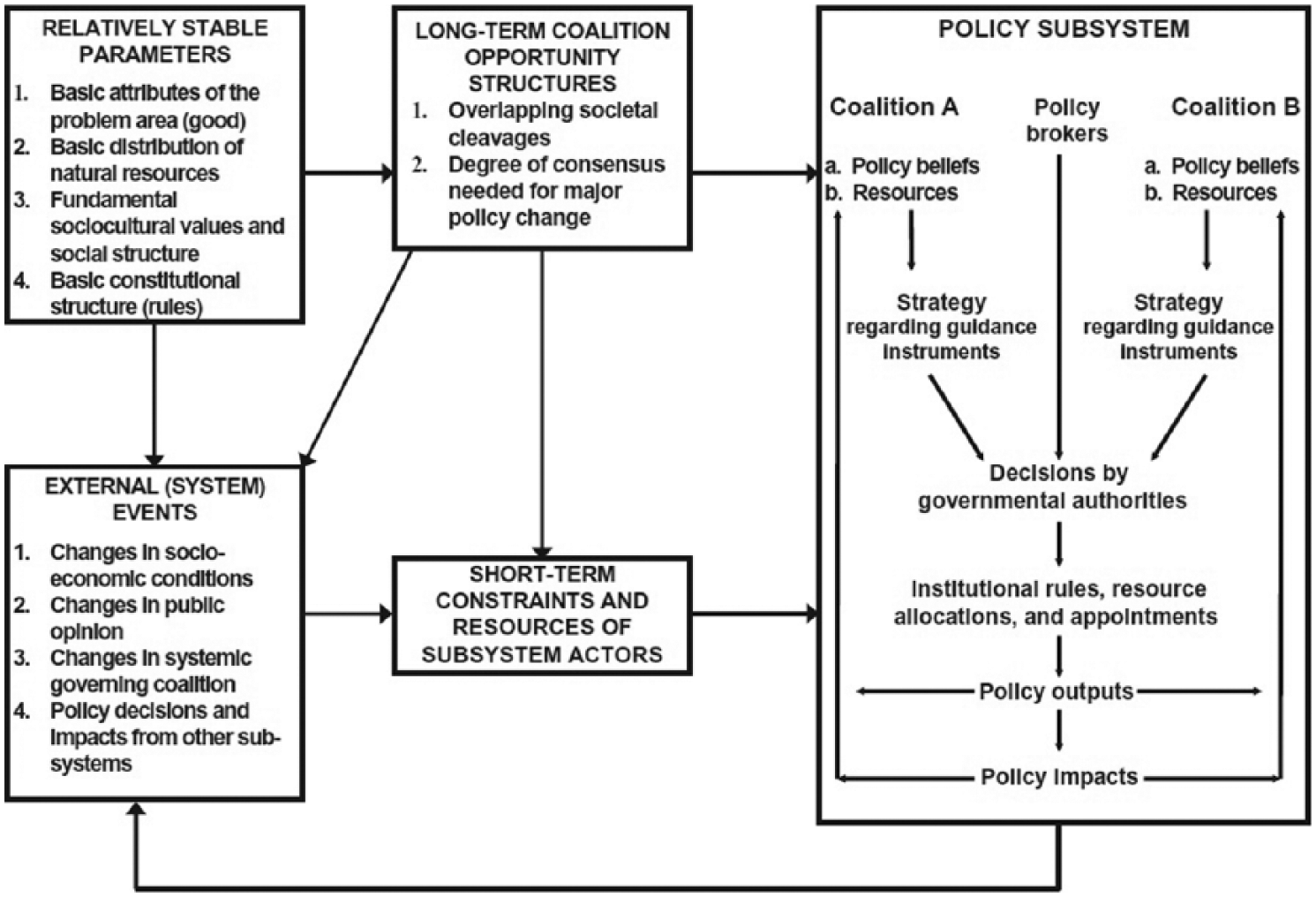
Advocacy Coalition Framework diagram (2007).
Method
This study employed a retrospective comparative case study design, whereby a case is defined as the policy formation process surrounding a state-level competitive food bill introduced in 2009-2010. To determine cases, a catalog of all state-level competitive food bills introduced between January 2009 and August 2010 was developed using three legislative databases (National Association of State Boards of Education, 2010; National Conference of State Legislatures, 2010; Yale Rudd Center for Food Policy and Obesity, 2010) searched on August 11, 2010. A total of 29 bills from 18 states were identified, and the status and text of each were obtained from state legislative websites. To be included for study, bills must have resulted in adopted legislation addressing competitive food, and changes must have been made to bill language before adoption. Of the 29 bills identified, only 5 met both inclusion criteria (Figure 2).
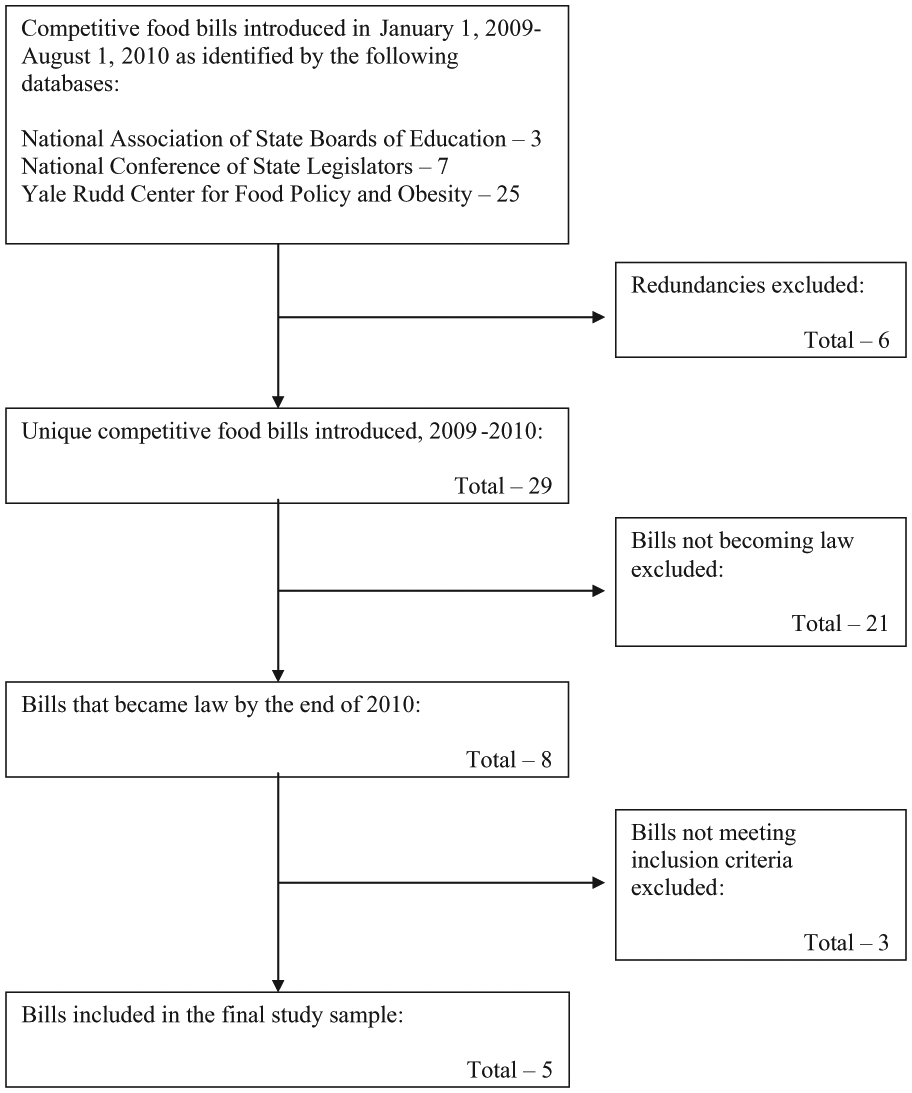
Flow diagram of case sample selection.
In all five cases, bills went through at least two revisions during the legislative session. Each version was compared line-by-line with the previous version to identify changes made over time. Additionally, each change was qualitatively assessed for its potential, as written, to make the school environment more healthful relative to the previous version. Factors such as implementation, enforcement, and compliance were not considered, unless the subject of the change itself. Rather, each change was labeled as strengthening, weakening, or having a negligible or indiscernible impact on the bill based on its intent to make healthy food more available, unhealthy food less available, or improve student health.
To understand how and why changes were made to bills, data were collected from several sources, and case data files were created to organize the evidence. Sources of evidence were obtained from governmental, organizational, news, and scholarly publications. Table 1 details the types and distribution of documentation sources obtained for each case. Additional contextual information was obtained from legislator profiles and committee assignment records, legislative session summaries, chamber rules, and state lobbying and political finance databases. Documents and archival materials were obtained through either the Internet or from direct contact with interview respondents, legislative offices, or state agencies. Documents were collected until saturation was reached.
Distribution of Documentation Types and Interview Respondents, by Case.

Additionally, at least three semistructured telephone interviews were conducted per case with key informants representing legislative sponsors, legislative staff, and nongovernmental advocates and researchers (Table 1). Key informants were identified through documentation review or via a snowball approach. For each case, attempts were made to interview state agency representatives and nongovernmental opponents; however all potential respondents either refused to be interviewed or did not respond despite multiple invitations. Thus, all interviewees were bill supporters. This study was approved by the Institutional Review Board of the Graduate Center, City University of New York.
Once completed, all interview transcripts and documents were uploaded to ATLAS.ti, version 6.2 (ATLAS.ti GmbH, Berlin, Germany) and were analyzed by two researchers in a process adapted from Zimmerman, Israel, Freudenberg, Becker, and Janz (1995). A case study was then written for each case using a standard outline. At least one interview respondent from each case was asked to review the respective case study for accuracy. Once all five case studies were written, comprehensive summary tables were compiled and analyzed for recurring and unique themes and common patterns, enabling conclusions to be drawn across cases in a final comparative case report.
Results
Table 2 provides brief descriptions of the adopted bills included in this study. Although all bills focused on competitive food-related legislation, each differed in its content, comprehensiveness, and strength. Bills ranged from a single focus on water provision (California SB1413, 2009-2010) or nutrition standards for competitive foods (Colorado HB1335, 2010; Virginia SB414, 2010) to more comprehensive bills that included competitive food provisions along with sections on farm-to-school programs, physical education, and/or student health and wellness (Massachusetts HB2092, 2009-2010; Ohio SB210, 2009-2010). In addition, the strength of bill language varied. As one example, Massachusetts HB2092 required that nutrition standards apply to all foods and beverages sold or provided to students in public schools (excluding those sold as part of the federal meals programs), whereas Virginia SB414 excluded beverages, and Ohio SB210 exempted those foods and beverages provided to students at no cost from meeting nutrition standards.
Summary of Bills Included in the Study Sample.
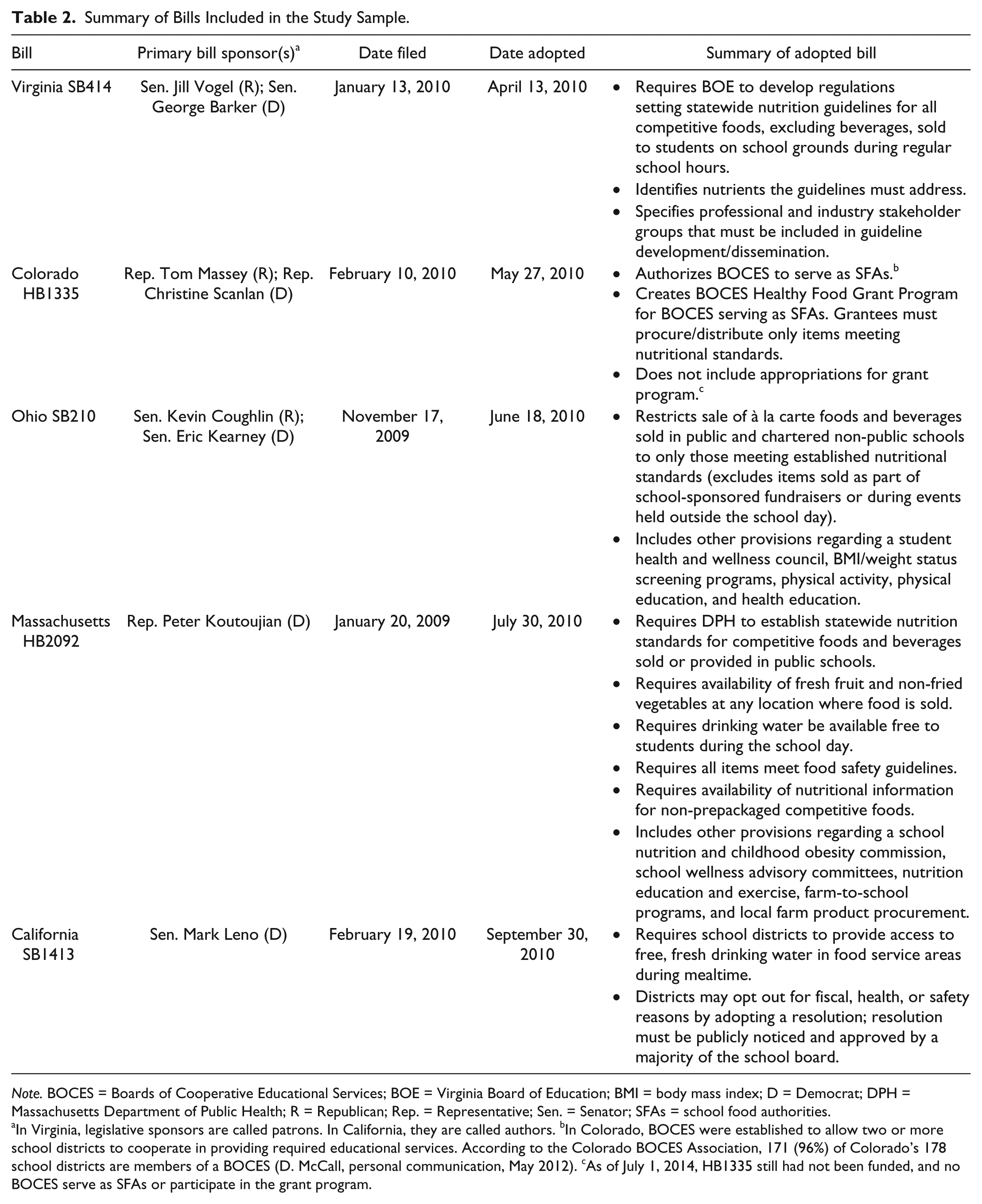
Note. BOCES = Boards of Cooperative Educational Services; BOE = Virginia Board of Education; BMI = body mass index; D = Democrat; DPH = Massachusetts Department of Public Health; R = Republican; Rep. = Representative; Sen. = Senator; SFAs = school food authorities.
In Virginia, legislative sponsors are called patrons. In California, they are called authors. bIn Colorado, BOCES were established to allow two or more school districts to cooperate in providing required educational services. According to the Colorado BOCES Association, 171 (96%) of Colorado’s 178 school districts are members of a BOCES (D. McCall, personal communication, May 2012). cAs of July 1, 2014, HB1335 still had not been funded, and no BOCES serve as SFAs or participate in the grant program.
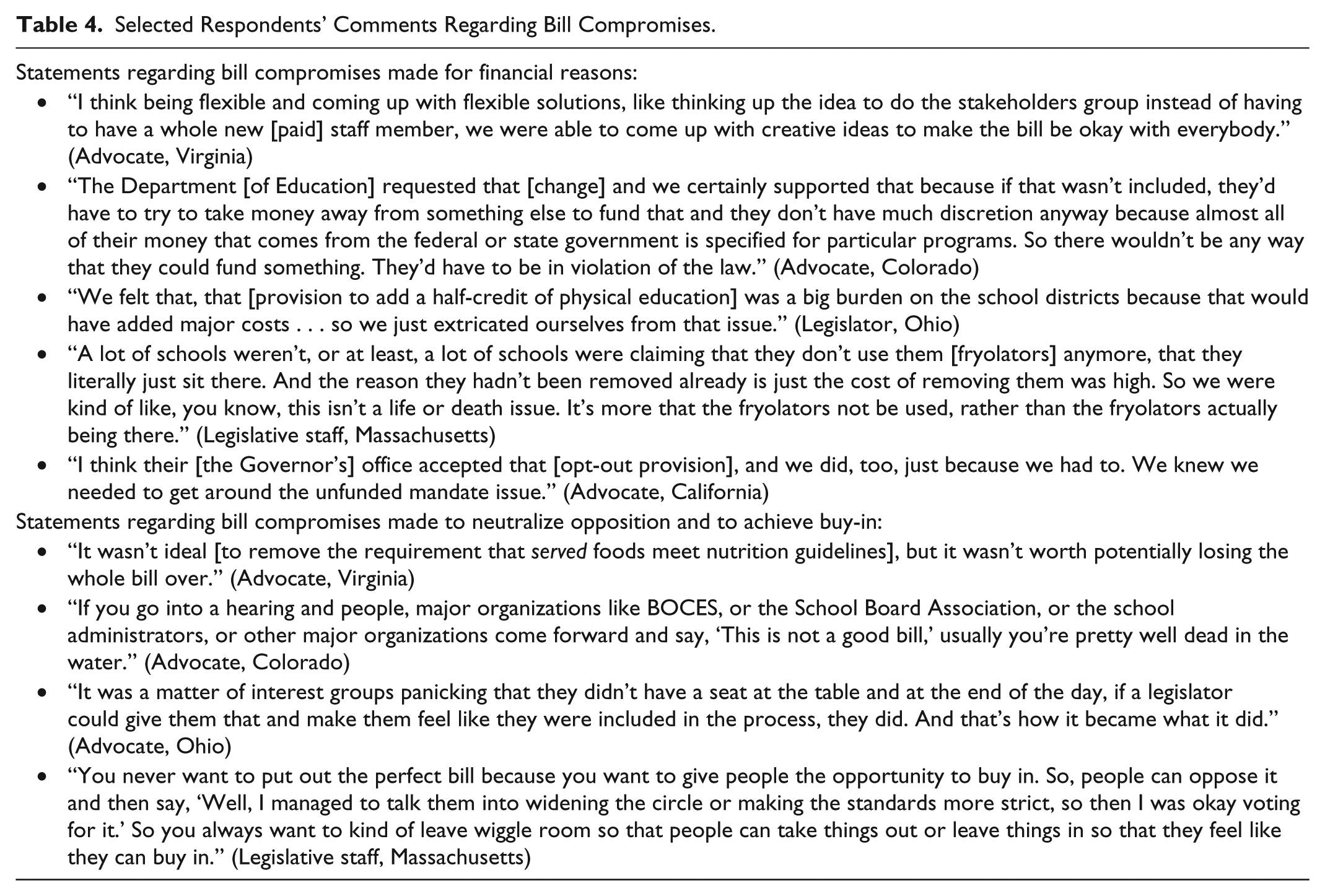
Abbreviated case summaries are provided below. Table 3 identifies the major changes to bill language and content across cases, the effect of each change on bill strength, and the reason(s) for each change. Table 4 highlights selected comments from interview respondents regarding bill compromises.
Summary of Major Changes to Bill Language and Content Across Cases.
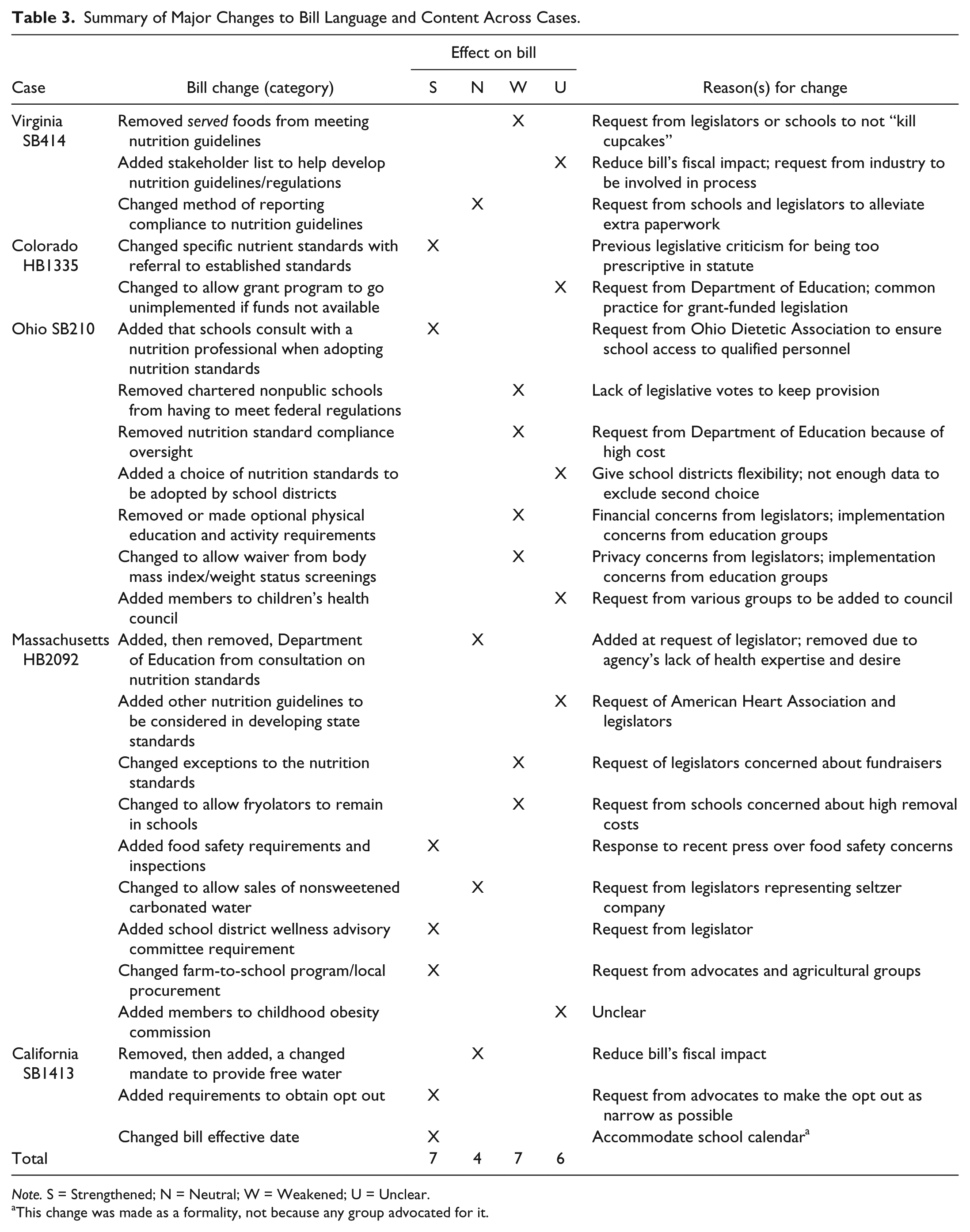
Note. S = Strengthened; N = Neutral; W = Weakened; U = Unclear.
This change was made as a formality, not because any group advocated for it.
Selected Respondents’ Comments Regarding Bill Compromises.
Virginia Senate Bill 414
Despite unanimous legislative support in 2010, Virginia Senate Bill 414 (SB414) took two attempts to pass. In 2008, Senator George Barker introduced a similar version, which died in the House for political reasons related to what one advocate described as an “inner brawl” between chambers. Two advocates explained that, in 2009, the American Heart Association partnered with state chapters of the American Academy of Pediatrics, American Cancer Society, and School Nutrition Association to reintroduce the bill with new bill patrons.
Comparison of the various bill versions identified three major modifications made to SB414 after it was introduced (Table 3). One notable change, which weakened the bill, limited application of the nutrition guidelines to only those competitive foods sold to students (originally, sold or served). Because students were accustomed to celebrating birthdays at school, one Senator reported that legislators removed the words or served to “avoid having to be seen as killing cupcakes.” Though the final bill is weaker than its original form, bill supporters were willing to compromise on all concerns in order to increase the chances of adoption.
Colorado House Bill 1335
Colorado House Bill 1335 (HB1335) followed a multiyear effort to improve competitive foods in Colorado schools. Supported by advocacy groups such as the Committee for Progress in School Nutrition and the Colorado Children’s Campaign, a series of legislative attempts were made between 2004 and 2009 to require that schools offer more healthy choices. Advocates revealed that most attempts failed due to opposition from school districts, high estimated costs, or for unrelated political reasons.
According to respondents, under the leadership of the Colorado Health Foundation and with input from the Colorado Children’s Campaign, the Department of Education, and the Colorado Boards of Cooperative Educational Services Association, HB1335 was drafted in 2009 and introduced in February 2010. Despite minimal opposition, two major changes were made prior to adoption (Table 3). Neither change was met with resistance, and the bill was adopted in a slightly stronger form than when it was introduced. As one advocate stated, “The reason [that there was no opposition] was that the process was good and the issues were worked out before it [the bill] went forward.”
Ohio Senate Bill 210
According to respondents, the idea for Ohio Senate Bill 210 (SB210) began in 2006, when the Ohio Business Roundtable expressed concern over rising costs of health care for employers and identified childhood obesity as a priority area for intervention. In response, the Ohio Business Roundtable, together with the Ohio Children’s Hospital Association, convened a coalition of over 80 members representing children’s health experts, health insurers, nutrition and physical activity professionals, food and beverage associations, businesses, and education representatives. With input from coalition members, the Ohio Business Roundtable and Ohio Children’s Hospital Association drafted recommendations for SB210 and an identical companion bill, HB373.
Despite bipartisan and bicameral support, several barriers, including a high estimated cost, led to HB373 dying in committee. SB210 was able to pass both chambers, though not without a number of major changes, the majority of which had a weakening effect (Table 3). Respondents and media reports indicated that opposition often stemmed from education groups—such as the Department of Education and teachers’ unions—who expressed concerns over high costs, time constraints, and lack of choice. Ultimately, bill sponsors and lead advocates compromised on significant changes to appease oppositional groups, thus allowing the bill—albeit a weakened version—to become adopted. One bill sponsor explained,
You know, I think obviously I would have preferred to keep those two provisions mandatory but I’m very proud of the process overall. I’m very proud that we’re able to put together a bipartisan piece of legislation in an impossible session to get things passed. And this is, other than the budget, really the only bill like that, that got passed that had controversy.
Massachusetts House Bill 2092
According to respondents and media sources, Massachusetts House Bill 2092 (HB2092) took nearly a decade to pass. Championing the bill from its beginnings were the Massachusetts Public Health Association and American Heart Association. Respondents attribute the 10-year struggle to several factors, including influential opposition from the Massachusetts Beverage Association, schools’ concerns over declining competitive food sales and lost revenue, ideological differences over the role of government, and organizational and legislative turnover. By 2009, these inhibiting factors were addressed or no longer relevant. Additionally, a broad coalition of over 100 groups and individual supporters, coupled with increased public attention around childhood obesity and school food, helped build momentum for the bill.
In this newly conducive environment, HB2092 was filed with 56 cosponsors and passed through the legislature almost unanimously, though several major and minor amendments were made (Table 3). Weakening changes often resulted from financial concerns of legislators and schools, while strengthening changes occurred in response to popular press and requests from advocacy groups. The bill’s broadened scope and loosened language allowed for buy-in from legislators and ultimately led to a stronger bill.
California Senate Bill 1413
According to advocates, California Senate Bill 1413 (SB1413) was motivated by results of a 2006 community-based participatory research project on school-based obesity prevention. Unexpectedly, researchers found water availability to be an issue in several Los Angeles schools (Goh et al., 2009; Patel et al., 2009; Patel, Bogart, Uyeda, Rabin, & Schuster, 2010). Hearing this, California Food Policy Advocates spoke with other California districts and found the issue to be more widespread. California Food Policy Advocates decided to pursue water in schools as a legislative initiative in 2008, but the bill approved by both chambers authorized (not required) schools to provide free drinking water and was later vetoed by Governor Arnold Schwarzenegger for being unnecessary (Schwarzenegger, 2008). The following year, California Food Policy Advocates gathered more evidence of the problem and presented findings to the Governor, who subsequently championed SB1413 in 2010. Nearly 20 organizations publicly supported SB1413, including a variety of education, environmental, and health groups, with no organizations on record as opposing the bill.
SB1413 originally required all schools to provide access to free water. However, because the costs of this mandate would be reimbursable by the state, legislative analysis estimated the bill would cost $4 million, an amount that respondents explained would “kill the bill” if not drastically reduced. Legislators therefore added an amendment allowing districts to opt out if unable to comply, effectively removing the “unfunded mandate.” California Food Policy Advocates pushed for limitations around why districts could opt out, as well as requiring districts to provide public notice specifying the reasons for noncompliance. Although the bill was weakened because of the opt-out provision, advocates were successful in minimizing the opt-out’s effects.
Discussion
Creating public policies that address food and physical activity environments is considered a key strategy for reducing obesity, highlighting the need for public health advocates to understand and actively engage in this health-directed structural approach. Yet health professionals may lack the confidence or preparation to participate in the political arena, and public health researchers have called for “a stronger evidence base about the feasibility and effectiveness of structural interventions” (Lieberman et al., 2013, p. 523). This study attempts to answer this call by describing the challenges faced by those supporting stronger state-level legislation of competitive foods in schools.
Although all bills described in this study were adopted into law, it is clear that achieving strong policy change is difficult. From an Advocacy Coalition Framework perspective, bill supporters faced several external constraints and policy subsystem challenges in their quest to improve school food environments. Externally, a prominent constraint across all cases was the broader economic context. In 2009-2010, states were slowly emerging from a national economic recession and money was not allotted for new programs. Changes that could reduce or eliminate a bill’s cost—even if changes weakened a bill—were perceived as necessary for bill survival (Table 4, top). In fact, nearly half of all bill changes were made in response to a direct financial concern, be it perceived or actual costs related to implementation, lack of appropriations for bill provisions, or fear of lost revenue (Table 3).
From within the policy subsystem, a major challenge was the need to increase cohesion among advocacy coalitions. With few exceptions, advocates—most often from child advocacy groups, food/school food groups, and health/medical groups—reported conceding to bill changes in order to achieve stakeholder buy-in and neutralize opposition, commonly stemming from education groups and education departments (Table 4, bottom). Indeed, compromise and incremental change are common features of the U.S. legislative system, and only a small percentage of bills become law, averaging about 20% across states (Hamm & Moncrief, 2008). Despite compromises made to bill strength, all stakeholders were proud of their efforts and felt that these bills were successful at moving public health policy in the right direction, acknowledging that small steps forward are better than none at all. One California advocate explained, “If you can pick up 5 or 10 or 15% of what you are trying to do, I would get it. And then come right back with the rest.” A Virginia advocate shared a similar sentiment, stating,
If we’ll just get food sold at school to be more nutritious for kids, then that’s a pretty big win. And we knew some day if everything works out fine, that we can always come back and add “served” in later, a couple years down the road.
Thus, a change that weakens a bill from a health perspective is not necessarily perceived as a policy failure, especially if improvements are made to the status quo.
Three study limitations deserve to be mentioned. First, in all five state cases, oppositional groups either did not respond to invitation requests or refused to be interviewed. These omissions have likely led to missing data, such as a more complete understanding of the extent, intensity, and effectiveness of tactics used by opponents and state agencies to influence bill language and content. In response to this limitation, attempts were made to understand multiple perspectives by asking interviewees about opponents, triangulating data, and filling informational gaps using secondary data from opponents’ websites and news reports.
Another limitation is that cases focused only on adopted competitive food bills that changed during the legislative process. This narrow focus may have led to undiscovered findings that could have arisen by examining unsuccessful bills, or bills adopted as introduced. However, it should be noted that bill adoption is context dependent. Adoption of the five bills analyzed in this study may not have occurred if the bills were introduced in a different temporal, geographic, and/or political context. In fact, Virginia SB414, Massachusetts HB2092, and California SB1413 each took at least two legislative sessions to pass, allowing for the identification of several challenges faced by those advocating for bill adoption. Additionally, the goal of the study was to characterize successful cases, not to identify factors necessary for bill adoption. This latter line of research has been studied in the context of childhood obesity prevention legislation (Boehmer, Luke, Haire-Joshu, Bates, & Brownson, 2008; Cawley & Liu, 2008; Dodson et al., 2009).
Additionally, this study is based on legislation passed during the 20-month window between January 2009 and August 2010. This relatively short time frame was chosen to maximize key informant recall and documentation availability. However, the Advocacy Coalition Framework is based on the premise that understanding policy change requires a time perspective of a decade or more to obtain an accurate representation of program success and failure (Sabatier, 1988). To acknowledge this time perspective, the impetus for and history of each of the five bills was investigated. Moreover, in Massachusetts and Colorado, an 8- to 10-year-long history was critical to understanding how and why their respective bills were written and changed during the legislative process. Still, more can be learned by studying the implementation and evaluation of the five bills during the decade following enactment.
Despite these limitations, this study is the first of its kind to examine the policy formation process of competitive food legislation. As such, the results contribute to the childhood obesity literature by going beyond a description of the problem to better understand how legislative action is currently being taken. Although this study focused on bills introduced and adopted in 2009-2010, the findings are currently relevant given recent legislative attempts to weaken federal school nutrition standards. For example, on June 4, 2014, the House Committee on Appropriations introduced HR4800, the Agriculture Appropriations Act for fiscal year 2015 (Aderholt, 2014). Imbedded in this bill is a requirement that the Secretary of Agriculture allow schools to apply for a waiver from the Smart Snacks standards for 1 year if schools can verify a net financial loss from operating a food service program over 6 months. Additional bills limiting the authority of the Secretary of Agriculture have been introduced in both chambers, such as the “Reducing Federal Mandates on School Lunch Act (HR 3663)” (Noem, 2013) and the “Sensible School Lunch Act (S 427)” (Hoeven, 2013).
Likewise, a congressional turnover following the November 2014 elections may have significant implications for the future of the HHFKA, set to expire on September 30, 2015. The potential for a weakening of federal school food policy leaves state rules both necessary and vulnerable to critique and change. In states with established competitive food policies, advocates must be prepared, at a minimum, to support the status quo. Where nutritional standards for competitive foods do not exist, advocates should begin to consider state-level legislation similar to those reviewed in this study. Such attempts to improve the school food environment are crucial in the broader fight to reduce childhood obesity, a major threat to the nation’s health.
Implications for Practice and Policy
The challenges highlighted by this study suggest areas for further reflection. For one, solutions to a policy issue must be able to address the problem while remaining politically acceptable and administratively feasible (Howlett, Ramesh, & Perl, 2009). Although external constraints are often not within the control of stakeholders or amenable to change, advocates can be proactive and strategic in their approach to the legislative process. It is necessary, then, that advocates have a clear understanding of the broader political and social context to make tactical suggestions around bill language and content. For instance, results from this study suggest that advocates view fiscally constrained subsystems as ones not allowing for high-priced bills. In similar contexts, ensuring bills are less costly to states may increase the likelihood of adoption, or at least reduce the chance that bills will stall for financial reasons.
Still, it should be noted that the perception of fiscal prudence and demand for austerity measures are socially constructed, politically decided, and context-dependent. Governments determine who and when to tax, what fees to impose, and how budgets are balanced. Advocates can either accept these decisions, as in the cases described here, or challenge them, as seen most recently by occupy movements and anti-austerity protests (¡Democracia Real Ya!, 2012; March for the Alternative, 2012; Occupy Wall Street, 2012). Although improving competitive food is arguably not enough of a reason to initiate similar events, obesity is a serious public health issue that deserves comprehensive actions by all levels of government. Ensuring adequate funding for strong legislative initiatives will require creative, persuasive strategies.
Advocates seeking to improve the healthfulness of food environments can also consider the stakeholders who supported these bills to elicit involvement from their counterparts in other states. Groups representing business, education, and medicine are quite influential across the states (Nownes, Thomas, & Hrebenar, 2008), and having their active support can be especially helpful. Conversely, understanding where opposition may come from—education and industry groups, conservative legislators, and education departments—can help advocates prepare persuasive messaging, gather research to counter oppositional concerns, and compromise accordingly to increase subsystem cohesion.
To be sure, winning over opponents is often necessary for bill adoption because “forces that oppose a bill only need to be successful at any one stage to block the proposed legislation, whereas the bill’s proponents must win at each step” (Hamm & Moncrief, 2008, p. 185). This phenomenon highlights the role of interest group power in state legislation, though not all stakeholders wield equal power or have uniform access to legislatures. In the face of powerful opposition, advocates of strong public health policies may increase their influence by reframing issues to promote potential losses and opportunity costs of not taking action, rather than solely focusing on the possible gains. This is because losses and costs arouse strong emotions, such as anger, resentment, and injustice, whereas the promise of something new—especially after adaptation to the status quo—is likely to stimulate weaker emotions of hopes and desires (Stone, 2002).
These challenges and potential solutions suggest that continued research on the development, implementation, and evaluation of public health policies can contribute to the advancement of new strategies for effective health promotion.
Footnotes
Author’s Note
The author is currently at Montclair State University. At the time of the study, she was a graduate student in the Doctor of Public Health program, The Graduate Center, City University of New York.
Declaration of Conflicting Interests
The author declared no potential conflicts of interest with respect to the research, authorship, and/or publication of this article.
Funding
The author disclosed receipt of the following financial support for the research, authorship, and/or publication of this article: The Graduate Center Doctoral Student Research Grant Program provided the author with funds to support data collection and analysis for this research. The author received no other financial support for the research, authorship, and/or publication of this article.
Supplement Issue Note
This article is part of a Health Education & Behavior supplement, “The Evidence for Policy and Environmental Approaches to Promoting Health,” which was supported by a grant to the Society for Public Health Education (SOPHE) from the Robert Wood Johnson Foundation. The entire supplemental issue is open access at  .
.