




Abstract
The use of websites and GPS-based mobile applications (“apps”) designed for social and sexual networking has been associated with increased HIV risk; however, little is known about Latino sexual minorities’ and transgender persons’ use of these websites and apps and the risk profiles of those who use them compared with those who do not. Data from 167 participants who completed the baseline survey of a community-level HIV prevention intervention, which harnesses the social networks of Latino sexual minorities and transgender persons, were analyzed. One quarter of participants (28.74%, n = 48) reported using websites or apps designed for social and sexual networking, and 119 (71.26%) reported not using websites or apps designed for social and sexual networking. Those who used websites or apps were younger and reported more male sex partners, a sexually transmitted disease diagnosis, and illicit drug use other than marijuana. HIV prevention interventions for those who use websites or apps should consider addressing these risks for HIV.
Keywords
There are profound HIV disparities experienced by ethnic minorities, sexual minorities, and transgender persons. Over two thirds (68.83%) of new HIV infections in the United States in 2010 occurred among ethnic and sexual minority subpopulations (i.e., gay, bisexual, and other men who have sex with men [MSM], Blacks, and Latinos; Centers for Disease Control and Prevention [CDC], 2012). The majority of new infections among Latinos in 2010 occurred among men (87%), and the most common mode of transmission for Latino men occurred via same-sex sexual behaviors (79%; CDC, 2012). The highest percentage of newly identified HIV infections among transgender persons in 2010 were among Blacks and Latinos (CDC, 2011). The South is now the U.S. epicenter for HIV, where approximately 50% of HIV diagnoses in 2011 occurred (CDC, 2013; Reif et al., 2014).
One emerging concern is the influence of the Internet on HIV risk. Websites designed for social and sexual networking may facilitate the development of risk environments and risky sexual behaviors (Bull & McFarlane, 2000; Chiasson et al., 2007; Klausner, Wolf, Fischer-Ponce, Zolt, & Katz, 2000; Rhodes, DiClemente, Cecil, Hergenrather, & Yee, 2002; Rietmeijer & McFarlane, 2009; Rosser et al., 2011). However, there is also other research that suggests the opposite, that website use is not associated with risky sexual behaviors (Grov, Hirshfield, Remien, Humberstone, & Chiasson, 2013; Jenness et al., 2010; Léobon & Frigault, 2008; Zhang, Bi, Lv, Zhang, & Hiller, 2008).
In addition to websites, there are now GPS-based mobile applications (“apps”), which allow users to locate other MSM and facilitate social and sexual networking. These apps display profile photos of other users arranged by geographic distance to the user; the other users who are nearest are displayed first. Users can then read profiles, chat with other users, and arrange to meet in person. These apps are used by a large number of MSM. For example, Grindr, the first app designed for social and sexual networking among MSM, claims to reach more than 5 million men in 192 countries (Grindr, 2014).
Samples recruited from websites designed for social and sexual networking were more likely to report engaging in unprotected anal intercourse (UAI) and a sexually transmitted disease (STD) diagnosis (Rhodes et al., 2002). MSM who use websites or apps designed for social and sexual networking reported more risk factors for HIV, including greater number of male partners (Benotsch, Kalichman, & Cage, 2002; Horvath, Rosser, & Remafedi, 2008), UAI (Benotsch et al., 2002; Liau, Millett, & Marks, 2006), using alcohol or drugs during sex (Beymer et al., 2014), and having had an STD (Beymer et al., 2014; Elford, Bolding, & Sherr, 2001), compared with those who did not meet sex partners via websites or apps. Comparing risk behaviors engaged in with partners met online or offline, there was greater UAI (Rosser et al., 2009; Winetrobe, Rice, Bauermeister, Petering, & Holloway, 2014) and alcohol or drug use during sex (Winetrobe et al., 2014) with partners met online.
In addition to this focus about app use being associated with HIV risk, other research has identified the multiple uses of these apps by MSM. While sexual partner seeking was a primary motivation for MSM who use apps, it is not the only motivation (Rice et al., 2012). Other reasons included friendship seeking and social support seeking (Rice et al., 2012).
There is a growing literature on the use of social media and technology by Latino MSM (Martinez et al., 2014; Meadowbrooke, Veinot, Loveluck, Hickok, & Bauermeister, 2014; Young et al., 2014) and most of these studies generally focus on communities in large inner cities. Little is known about Latino sexual minorities and transgender persons living in the U.S. South who use websites and apps designed for social and sexual networking. The purpose of our analysis was to (1) describe the use of websites or apps designed for social and sexual networking among Latino sexual minorities and transgender persons and (2) identify differences between those who use websites or apps designed for social and sexual networking and those who do not within a sample of Latino sexual minorities and transgender persons.
Method
Baseline survey data of the HOLA intervention (Rhodes, Daniel, Alonzo, et al., 2013), collected from November 2011 to July 2012, were used. An authentic, colearning community-based participatory research partnership, composed of lay community members, organization representatives, and university health professionals and researchers, that has existed for more than 10 years identified priorities, developed the intervention and evaluation plan, and are now analyzing, interpreting, and disseminating findings (Rhodes et al., 2014).
The HOLA intervention is a lay health advisor and social network–based intervention that applies Social Cognitive Theory (Bandura, 1986) and Empowerment Education (Freire, 1973) to increase HIV testing and condom use among Spanish-speaking Latino sexual minorities and transgender persons. Twenty-one adult Latino gay, bisexual, and other MSM and transgender persons were recruited from across North Carolina through word of mouth and fliers distributed to nonprofit agencies focused on health, Latino, and/or LGBT communities to serve as lay health advisors (navegantes); and each of them then recruited eight adult Latino sexual minority or transgender social network members into the study. The 21 navegantes completed a four-session, 16-hour training and served as lay health advisors for 1 year to the eight social network members they recruited into the study (Sun, Garcia, et al., 2015).
Participants completed the Spanish-language paper-based baseline survey, which on average took 1.5 to 2 hours to complete. Most surveys were self-administered, although for participants with low literacy skills, the project coordinator administered the survey by reading it out loud in person. Participants received $30 for completing the survey.
Measures
Use of Website or Apps Designed for Social and Sexual Networking
The outcome of interest was measured with two items: (1) “During the past 3 months, how often did you access or view online sex hook-up sites?” and (2) “During the past 3 months, how often did you use apps on a cell phone or mobile device to find people for sex?” Participants rated their use for each item on a 5-point scale (i.e., “never,” “very rarely,” “monthly,” “weekly,” and “daily”). A dichotomous variable was created that combined both items; participants who reported using websites or apps monthly, weekly, or daily were classified as using websites or apps at least monthly. Participants who had missing data (i.e., did not know or refused to answer) for both questions were excluded from the analyses.
Demographics
Participants reported their age, number of years and months they had resided in the United States, their birth country (dichotomized as Mexico or other), highest level of education (dichotomized as less than high school or high school education or higher), monthly income (dichotomized as <$2,000 or ≥$2,000), and gender identity (dichotomized as transgender identity or not).
Sexual History
Participants reported the number of male and female sex partners they had in the past 6 months and how frequently they used condoms (i.e., “never,” “once in a while,” “about half the time,” “most of the time,” and “always”) during insertive and receptive anal intercourse with men and vaginal and anal intercourse with women. Consistent condom use was defined as always using condoms in the past 30 days.
Communication With Sex Partners
Based on a previously validated scale (Van der Straten, Catania, & Pollack, 1998), participants indicated whether or not they had discussed five different topics (i.e., condom use, HIV testing, STD testing, other partners, and monogamy) with a sex partner in the past 6 months. For each topic they had discussed, one point was added to the score.
HIV Testing
Participants reported whether they had been tested for HIV in the past 12 months.
Substance Use
Participants reported what substances (i.e., marijuana, cocaine, crack, alkyl nitrates [commonly known as “poppers”], and other, using an open-ended free response item) they had used in the past 6 months. Two dichotomous variables were created to designate marijuana use and illicit drug use other than marijuana. Participants reported the number of days in a typical week they were drunk (typical week drunkenness) and number of days in the past month they had five or more drinks during one occasion (heavy episodic drinking). Participants also reported how many times in the past 30 days they had been drunk immediately before or during sex and how many times in the past 30 days they had been high immediately before or during sex. A variable was constructed to designate how many times in the past 30 days they had been drunk or high immediately before or during sex.
Condom Use Intention
Participants reported how likely they were to (1) persuade their partner(s) to use condoms every time they had sex and (2) use condoms every time they had sex during the next month on a 5-point scale from “not at all likely” to “extremely likely.” Participants who selected “very likely” or “extremely likely” were classified as having high intention.
HIV Knowledge
Based on a previous set of true–false items used to measure knowledge about HIV transmission and prevention items (Knipper et al., 2007), participants reported which of the 12 statements they thought were true or false. For each correct answer, one point was added to the score.
STD Knowledge
Based on a previous set of true–false items used to measure STD knowledge (Knipper et al., 2007), participants reported which of the 12 statements about STD transmission and prevention and STD epidemiology among sexual minorities and transgender persons were true or false. For each correct answer, one point was added to the score.
Condom Use Skills
Based on a previously validated scale that measured how well participants knew how to use a condom correctly (Stanton et al., 2009), participants indicated whether they thought each of 18 statements was correct or incorrect. For correctly identifying the answer, one point was added to the score.
Condom Use Efficacy
Using a modified version of a previously validated scale (Marín, Tschann, Gómez, & Gregorich, 1998), participants rated how sure they were that they could use a condom in 15 situations on a 5-point scale from “definitely no” (1) to “definitely yes” (4).
Condom Use Expectancies
Based on a previously validated scale of 28 items (DiIorio, Maibach, O’Leary, Sanderson, & Celentano, 1997), participants rated their agreement with 19 statements about the outcomes of using condoms on a 4-point scale from “strongly disagree” (1) to “strongly agree” (4).
Acculturation
To measure acculturation, the Short Acculturation Scale for Hispanics (Marin, Sabogal, Marin, Otero-Sabogal, & Perez-Stable, 1987) was used. Participants reported their language use in seven situations on a 5-point scale (“only English” [1], “more Spanish than English” [2], “about half and half” [3], “more English than Spanish” [4], and “only English” [5]) and the ethnic composition of people with whom they socialized in three situations on a 5-point scale (“all Latinos/Hispanics” [1], “more Latinos than Americans” [2], “about half and half” [3], “more Americans than Latinos” [4], “all Americans” [5]).
Internalized Homonegativity
The revised and shortened version of the Reactions to Homosexuality Scale (Smolenski, Diamond, Ross, & Rosser, 2010) was used to measure internalized homonegativity. This scale demonstrated measurement invariance across racial/ethnic groups. Participants rated their agreement with seven statements on a 7-point scale (“strongly disagree” [1] to “strongly agree” [7]).
Community Attachment
Based on measures previously used with young Latino MSM (O’Donnell et al., 2002), participants rated their attachment to the gay community, Latino community, and Latino gay community on a 6-point scale from “not at all” (0) to “a great extent” (5).
Social Support
The Index of Sojourner’s Social Support (Ong & Ward, 2005) was used to measure how many people (on a 5-point scale from “no one” [0] to “many” [4]) would provide socioemotional support and instrumental support. A study about the validity of this measure for Spanish-speaking Latino men suggests it is useful for measuring social support (Rhodes, Daniel, Song, et al., 2013).
HIV and STD Diagnosis
Participants reported if they had ever been told by a doctor or nurse they had gonorrhea, syphilis, Chlamydia, herpes, hepatitis A/B/C, human papillomavirus/genital warts, another STD, or HIV. Two variables were constructed, one to designate HIV diagnosis and one for any other STD diagnosis.
Analysis
Descriptive data analysis was conducted to describe the sample and participants’ use of websites or apps designed for social and sexual networking. Bivariable and multivariable random effects logistic regression models were used to model the relationship between explanatory variables and the binary outcome while accounting for possible within social network nonindependence. Variables found to be significant in bivariable analysis (p < .25; Hosmer & Lemeshow, 1989) were entered into the initial multivariable model; other threshold levels, such as .05, can fail in identifying variables known to be important (Mickey & Greenland, 1989). Backwards elimination variable selection procedures were used to determine the more parsimonious model. All analyses were conducted in Stata 12.1. For participants with missing data, we replaced missing responses with that individual’s mean response (i.e., person mean substitution).
The Wake Forest School of Medicine Institutional Review Board oversaw the study.
Results
Participant Characteristics
A total of 167 Latino sexual minorities and transgender persons completed the website and app use questions and were included in the analyses (19 participants were excluded for not answering the outcome measure questions). On average, they were 30.29 years old and had lived in the United States for 10.17 years (see Table 1). Three quarters (76.05%) of the participants were born in Mexico, and one fifth (20.36%) had a monthly income of at least $2,000.
Baseline Characteristics of Study Participants Who Do and Do Not Use Websites or Apps Designed for Social and Sexual Networking Among MSM Monthly a .
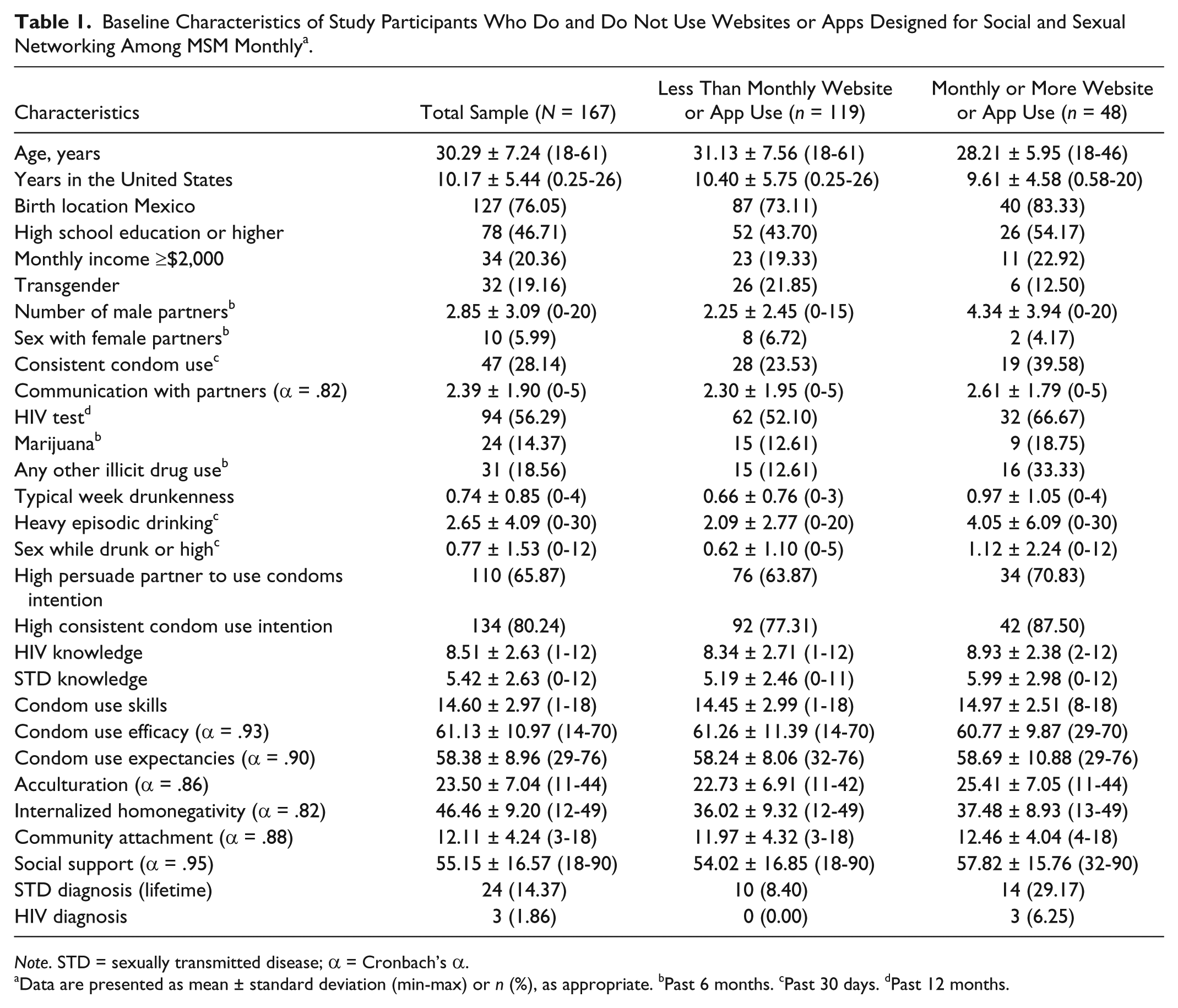
Note. STD = sexually transmitted disease; α = Cronbach’s α.
Data are presented as mean ± standard deviation (min-max) or n (%), as appropriate. bPast 6 months. cPast 30 days. dPast 12 months.
Slightly more than one quarter (28.74%, n = 48) of participants reported using websites or apps designed for social and sexual networking at least monthly. Twenty-four participants reported using both websites and apps at least monthly, 4 used apps only, and 20 used websites only (see Table 2).
Frequency of Website and App Use in the Past 3 Months.

Bivariable Analysis
Demographic characteristics, sexual history, consistent condom use, condom use intentions, past 12-month HIV testing, history of STD diagnosis, HIV knowledge, STD knowledge, acculturation, social support, and substance use (i.e., illicit drug use other than marijuana, typical week drunkenness, heavy episodic drinking, and sex while drunk or high) were associated with using websites or apps at least monthly (see Table 3). Older participants and transgender participants were less likely to use websites or apps at least monthly, while participants with at least a high school education, who were born in Mexico, and who reported high condom use intention, consistent condom use in the past 30 days, having been tested for HIV test in the past 12 months, history of STD diagnosis, and illicit drug use other than marijuana in the past 6 months were more likely to use websites or apps at least monthly. There was a positive association between acculturation, HIV knowledge, STD knowledge, social support, and the reported number of male partners in the past 6 months, typical week drunkenness, number of days of heavy episodic drinking in the past month, and number of times had sex while drunk or high in the past 30 days and at least monthly website or app use.
Bivariable and Multivariable Associations Between Participant Characteristics and at Least Monthly Use of Websites or Apps Designed for Social and Sexual Networking.
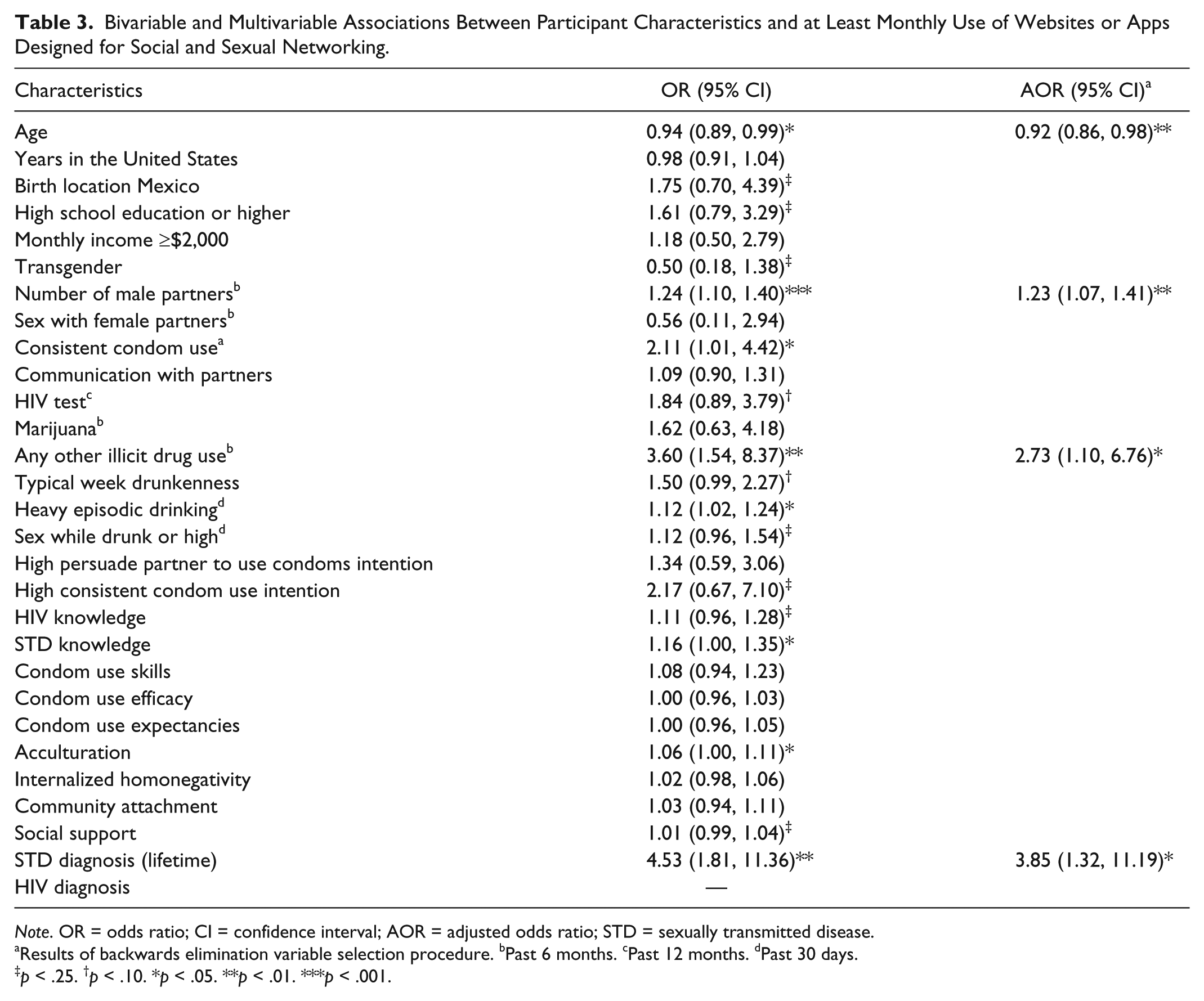
Note. OR = odds ratio; CI = confidence interval; AOR = adjusted odds ratio; STD = sexually transmitted disease.
Results of backwards elimination variable selection procedure. bPast 6 months. cPast 12 months. dPast 30 days.
p < .25. †p < .10. *p < .05. **p < .01. ***p < .001.
Multivariable Analysis
In the multivariable model (see Table 3), age, number of male sex partners in the past 6 months, history of STD diagnosis, and illicit drug use other than marijuana in the past 6 months were associated with using websites or apps at least monthly. Participants who reported using websites or apps at least monthly were more likely to be younger (for every 1-year increase in age, the odds decrease by 8%) and reported more male sex partners in the past 6 months (for each additional male sex partner reported, the odds increase by 23%). Those who reported a history of STD diagnosis and illicit drug use other than marijuana in the past 6 months were almost four times and three times more likely to report using websites or apps, respectively.
Discussion
Among this sample of Latino sexual minorities and transgender persons in North Carolina, one quarter reported using either websites or apps designed for social and sexual networking at least monthly. Websites were used more frequently than apps. There are multiple potential, and yet to be tested, explanations for this difference. Future research is needed to further explore these preferences and usage patterns, including the intensity of use (e.g., number of times logged on during a specific time frame, length of average usage sessions, number of profiles viewed, and number of people chatted with). Although the cost of the Internet and computers has decreased greatly since they were first introduced (70.1% of the sample uses the Internet daily), the cost of smartphones and mobile devices that run apps and the data plans to access the Internet on these devices has remained fairly high. Additionally, websites for social and sexual networking like Adam4Adam have a similar layout to apps where users can be displayed from closest to farthest to facilitate in-person networking, so there may be less incentive to use apps. Another consideration for participants who share computers and/or smartphones and mobile devices (although 85.5% of this sample had their own cell phone that they do not share with anyone else) and who may not be “out” is it may be easier to discreetly use websites compared to apps. Website histories can be fairly easily deleted but apps need to be deleted each time after they are downloaded.
In the multivariable model, participants who reported using websites or apps at least monthly were younger and reported more male sex partners, a STD diagnosis, and illicit drug use other than marijuana. The age, number of sex partners, and STD diagnosis history findings are similar to other published research about MSM who use websites or apps designed for social and sexual networking (Benotsch et al., 2002; Beymer et al., 2014; Elford et al., 2001; Horvath et al., 2008; Rhodes et al., 2002). One potential reason illicit drug use is associated with social and sexual networking website or app use is MSM use these apps for multiple purposes, including substance use partner seeking (Rice et al., 2012).
Several limitations should be taken into account. The results of this analysis are based on cross-sectional data, and it is not possible to infer causality. Although it may be tempting to assume that the increase in number of male sex partners and rates of STD diagnosis are due to using websites and apps designed for social and sexual networking, such conclusions are not possible with these data. Another limitation of this study was it was a small, nonprobability sample, which may have increased the likelihood of Type II error and limits the generalizability of the findings. Participants of this study were participants of the HOLA intervention and may be different than other Latino MSM and transgender persons.
Despite limitations, the findings of this study have important implications for HIV prevention programs. As some research has suggested the use of websites and apps designed for social and sexual networking may be associated with increased HIV risk, understanding the differences between those who do and do not use websites or apps designed for social and sexual networking allows us to develop focused HIV prevention interventions. Younger participants were more likely to use websites or apps designed for social and sexual networking. Given the increasing rates of HIV among young MSM, interventions are needed for younger Latino sexual minority and transgender website or app users. Several important risk factors for HIV (number of sex partners, history of STD diagnosis, and illicit drug use other than marijuana) differentiated participants who reported using websites or apps designed for social and sexual networking compared to those who do not. Interventions on popular websites and apps may be particularly useful to address these risk factors. Website-based interventions have been successful at providing sexual health information, increasing HIV testing, and reducing HIV risk behaviors (Bowen, Williams, Daniel, & Clayton, 2008; Rhodes et al., 2011; Swendeman & Rotheram-Borus, 2010) and app-based HIV prevention interventions are acceptable (Holloway et al., 2014; Sun, Stowers, Miller, Bachmann, & Rhodes, 2015) and have been demonstrated as feasible (Sun, Stowers, et al., 2015), although further evaluation, particularly with Latino sexual minority and transgender communities, is needed. Apps have also been developed to promote HIV prevention, although there are few that discuss the association between drug use and HIV risk (Muessig, Pike, Legrand, & Hightow-Weidman, 2013). Addressing these risk factors identified in this analysis is important to reduce HIV disparities, and websites and apps designed for social and sexual networking may be the most appropriate venue for this population as interventions could “meet them where they are.”
Conclusion
The results of this study demonstrate that there are differences between Latino sexual minorities and transgender persons who do or do not use websites or apps designed for social and sexual networking. These results suggest HIV risk factors to address through interventions for Latino sexual minorities and transgender persons who use websites or apps designed for social and sexual networking. There is a need for interventions that use these types of social media. Future research should design, implement, and evaluate interventions that are based in social and sexual networking platforms. Additionally, beyond efficacy and effectiveness, this research should also focus on the transferability to future and more advanced networking capabilities given the rapid changes in technology.
Footnotes
Acknowledgements
We would like to sincerely thank the study participants for their time and openness.
Declaration of Conflicting Interests
The authors declared no potential conflicts of interest with respect to the research, authorship, and/or publication of this article.
Funding
The authors disclosed receipt of the following financial support for the research, authorship, and/or publication of this article: This article is based on support from the National Institutes of Health (R01MH087339; PI: Scott D. Rhodes).