



Abstract
Introduction. Social support is important for behavior change, and it may be particularly important for the complexities of changing multiple risk behaviors (MRB). Research is needed to determine if participants in an MRB intervention can be encouraged to activate their social network to aid their change efforts. Methods. Healthy Directions 2, a cluster-randomized controlled trial of an intervention conducted in two urban health centers, targeted five behaviors (physical activity, fruit and vegetable intake, red meat consumption, multivitamin use, and smoking). The self-guided intervention emphasized changing MRB simultaneously, focused on self-monitoring and action planning, and encouraged participants to seek support from social network members. An MRB score was calculated for each participant, with one point being assigned for each behavioral recommendation that was not met. Analyses were conducted to identify demographic and social contextual factors (e.g., interpersonal, neighborhood, and organizational resources) associated with seeking support and to determine if type and frequency of offered support were associated with changes in MRB score. Results. Half (49.6%) of participants identified a support person. Interpersonal resources were the only contextual factor that predicted engagement of a support person. Compared to individuals who did not seek support, those who identified one support person had 61% greater reduction in MRB score, and participants identifying multiple support persons had 100% greater reduction. Conclusion. Engagement of one’s social network leads to significantly greater change across multiple risk behaviors. Future research should explore strategies to address support need for individuals with limited interpersonal resources.
One in four U.S. adults have multiple morbidities, and this is likely due, at least in part, to health behaviors (Anderson, 2010). Currently, 49% of the U.S. population are not meeting physical activity recommendations (Centers for Disease Control and Prevention, 2012), 77% are not meeting guidelines for fruit and vegetable intake (Centers for Disease Control and Prevention, 2010), and 17% are smokers (Centers for Disease Control and Prevention, 2015). To promote behavior change, social contextual models emphasize addressing behaviors at multiple levels while also taking into consideration one’s individual circumstances and social context, including social support (McLeroy, Bibeau, Steckler, & Glanz, 1988; Sorensen et al., 2003). Broadly defined, social support refers to supportive actions from members of an individual’s social network (e.g., family, friends, or coworkers) and can include emotional, instrumental, and informational support (Berkman, Glass, Brissette, & Seeman, 2000). Emotional support encompasses the actions people take that make a person feel cared for and valued (e.g., empathy, encouragement). Instrumental support is tangible support (e.g., assistance with cooking and childcare), and informational support is the provision of information to help someone (e.g., advice about behavior change).
Research indicates that social support can lead to increased rates of smoking cessation (Hennrikus et al., 2010; Solomon et al., 2005), improved dietary intake (Anderson-Bill, Winett, & Wojcik, 2011; Campbell et al., 1998; Hagler et al., 2007; Thomson, Zoellner, & Tussing-Humphreys, 2014), and increased physical activity (Anderson-Bill et al., 2011; Greaves et al., 2011; Kahn et al., 2002). Previous interventions that have tried to create new social support networks to support behavior change have had limited success in increasing social support (May & West, 2000; Park, Tudiver, Schultz, & Campbell, 2004) and affecting behavior change. Thus, a key need for behavior change research is to determine how to most effectively motivate individuals to activate already established social support networks to assist in their behavior change efforts. A few intervention trials for smoking cessation have successfully mobilized naturally occurring social support networks and increased use of social support to promote smoking cessation and use of stop-smoking resources (Carlson, Goodey, Bennett, Taenzer, & Koopmans, 2002; Gruder et al., 1993; Patten et al., 2012). However, no research to our knowledge has examined whether people can activate their social networks to change multiple risk behaviors. The aims of this study are to (1) identify factors associated with whether participants of a multiple risk behavior intervention activate existing social networks and (2) whether the offered support affects behavior change. These findings will help determine the impact of social support within multiple risk factor interventions and identify subgroups that may benefit from targeted approaches to activate existing social networks.
Method
Healthy Directions 2 (HD2) study was a cluster-randomized controlled trial of a self-guided, multiple risk behavior (MRB) intervention conducted in two urban health centers (conducted from 3/2009–11/2011) in the Boston, Massachusetts, area that has been described elsewhere (Emmons et al., 2014; Greaney et al., 2014). Briefly, English-speaking patients 18+ years of age with scheduled well visits or chronic disease management appointments at the participating health centers were sent a study introduction letter prior to their scheduled appointments. Study staff recruited participants on site before their appointments. Randomization occurred at the primary care provider level, with participants being randomized to (a) usual care, (b) HD2 intervention materials, or (c) HD2 intervention materials plus coaching calls. Each of the two intervention conditions led to greater improvements in MRB score than usual care, although there was no significant difference between the two intervention conditions. At 6 months, 28% of participants randomized to usual care had improvements in their MRB scores versus 39% of those randomized to the HD2 intervention materials and 43% of those randomized in the HD2 intervention materials plus coaching calls (Emmons et al., 2014).
The HD2 intervention was a multicomponent intervention designed to simultaneously target physical activity, fruit and vegetable intake, red meat consumption, multivitamin use, and smoking. The intervention was guided by the social contextual framework (Sorensen et al., 2003) and focused on individual, interpersonal, and community levels of influence (McLeroy et al., 1988). Intervention components were created to be sustainable while having a large reach and included the following: (a) brief provider endorsement of behavior change, (b) intervention materials delivered via web or print (participant choice), (c) two tailored feedback reports about the participant’s behaviors, and (d) links to key community-based resources. Intervention materials encouraged participants to identify one or more individuals in their social network who would support their behavior change efforts and provided information about as to how support persons could aid change efforts. In addition, participants received a booklet and a website URL to share with their identified support person(s). Both the booklet and website provided the support person with information about the targeted behaviors, as well as illustrative examples of how to provide emotional, informational, and instrumental support for behavior change. The HD2 study protocol was approved by a review committee on the protection of human participants at the Harvard T.H. Chan School of Public Health.
Measures and Procedures
Participants completed surveys at baseline and at 6 months post baseline (the end of the intervention period). The baseline survey was self-administered at the participating health centers, while the 6-month survey was interviewer administered and completed via telephone.
HD2 Participants’ Behaviors
For each participant, we calculated baseline and 6-month MRB scores by dichotomizing whether the person met the recommendation for each assessed behavior (75+ minutes of vigorous or 150+ minutes of moderate physical activity/week; 3 or fewer servings of red meat/week; 5+ servings of fruits and vegetables/day; a multivitamin 6-7 times/week; and not smoking). One point was given for each behavioral recommendation that was not met; participants with incomplete data for a behavior were classified as not meeting the recommendation for that particular behavior (n = 19), as this was the most stringent approach to determine if the intervention had an effect on MRB score. The scores for each behavior (0 or 1) were summed to create an MRB score (range: 0-5), with a higher score being indicative of less healthful behaviors.
Physical activity was assessed using four questions adapted from the Centers for Disease Control and Prevention’s Behavioral Risk Factor Surveillance Survey, which included descriptions of moderate (e.g., brisk walking, biking, or anything that causes small increases in breathing or heart rate) and vigorous (e.g., running, aerobics, or anything else that causes large increases in breathing or heart rate) activities (Estabrooks, Bradshaw, Dzewaltowski, & Smith-Ray, 2008). We summed participants’ reported minutes of moderate and vigorous physical activity into a total number of weekly minutes.
Fruit and vegetable intake was assessed using the National Cancer Institute’s “5 A Day for Better Health” tool, a 7-item validated instrument (Serdula et al., 1993). We calculated the total number of daily servings of fruits and vegetables for each participant (excluding French fried potatoes). Red meat intake was assessed with an abbreviated form of the Willet semiquantitative Food Frequency Questionnaire (Willett et al., 1985). Responses were recoded to equivalent servings per week.
Multivitamin intake was assessed by asking respondents how many days per week, on average, they took a multivitamin (Emmons, McBride, et al., 2005). Responses were coded as daily if subjects reported taking a multivitamin 6 or 7 days per week. Current smoking status was assessed using the 2004 Behavioral Risk Factor Surveillance System Tobacco Use module (Centers for Disease Control and Prevention, 2004).
Health Status of HD2 Participants
Participants reported their perceived health status on the baseline survey using the one-item assessment from the Medical Outcomes Study Short-Form (Ware & Sherbourne, 1992). Height and weight, obtained from electronic medical records, were used to calculate body mass index and weight status.
Contextual Factors of HD2 Participants
We assessed participants’ resources for chronic illness self-management and healthful behaviors using three subscales from the Chronic Illness Resources Survey that measure (a) interpersonal resources (resource support from friends and family, e.g., family members or friends exercised with you), (b) neighborhood resources (e.g., restaurants that offer tasty, low fat food choices), and (c) organizational resources (e.g., free/low-cost meetings to support health behaviors). Each subscale was measured by three items that participants answered using a 5-point scale (not at all, a little, a moderate amount, quite a bit, very often), that were summed, with higher scores indicating greater support (range 0-4; Glasgow, Strycker, Toobert, & Eakin, 2000; Glasgow, Toobert, Barrera, & Strycker, 2005).
Sociodemographic Characteristics of HD2 Participants
Age, sex, and primary care provider were obtained from participants’ electronic medical records. Participants reported their race/ethnicity, education, and marital/partner status on the baseline survey (using standard questions) as well as their perception of their household’s financial situation (comfortable with some extras, enough but no extras, have to cut back, or cannot make ends meet).
Identification of a Support Person and Assessment of Offered Support
On the postintervention survey, participants reported whether they had identified a support person(s) to assist in their change efforts. Individuals who reported seeking support were asked how many support persons they identified. They also reported the frequency (daily, a few times a week, once a week, two to three times a month, less than once a month, never) with which the identified person provided encouragement (emotional support), information to assist with change efforts (informational support), or tangible support of their behavior change efforts (instrumental support). Participants who identified multiple support persons reported on the individual whom they viewed as their primary supporter. Participants also reported their level of satisfaction with offered support (very satisfied, somewhat satisfied, not at all satisfied).
Reasons for Not Seeking Support
Individuals who did not identify a support person were read a list of possible reasons for not enlisting assistance and asked to select all relevant responses. They also were given the opportunity to provide additional reasons.
Analysis
The analytic sample for the present study is limited to individuals who received the HD2 intervention. Due to the cluster-sampling design, data were weighted proportional to the physician panel size (weighted n = 17,589). We first calculated descriptive statistics for the key variables and then conducted bivariate analyses using an intention to treat approach to examine the associations between enlisting a support person (yes, no) and health status (baseline MRB score, perceived health, weight status), contextual factors (interpersonal, neighborhood, and organizational resources for healthful behaviors), and sociodemographic characteristics (age, sex, race/ethnicity, marital/partner status, and perceived financial situation). We included all variables significant at p < .10 in the bivariate analyses in a series of cluster randomized, multivariable logistic regression models. We then removed variables with the highest Wald p value one at a time until we reached the final parsimonious model. Age, sex, and race/ethnicity were included in all models a priori. In addition, we developed a model that included all of the contextual factors (interpersonal resources, neighborhood resources, and organizational resources) and the variables that were bivariately significant to examine the relationship between the contextual factors. Next, we used general linear modeling to obtain geometric means of the change in MRB, as a continuous value, adjusting for intervention arm, age, sex, and race/ethnicity to determine if the number of social support persons identified (0, 1, 2+) was associated with change in MRB score. Last, similar analyses were conducted to determine if frequency of different types of support and satisfaction with offered support were associated with change in MRB score. We conducted all analyses using SAS 9.4 (SAS Institute Inc., Cary, North Carolina) statistical software. P values <.05 were considered statistically significant, unless noted.
Results
As seen in Table 1, participants were racially/ethnically diverse (25.8% Black, 7.9% Hispanic/Latino, 8.4% Other, including multiracial). About two thirds of the sample (58.9%) were women, and the majority were married or living with a partner (67.0%). Participants had high levels of educational attainment with 64.4% being college graduates. Half (50.1%) of the participants reported that their household financial situation was comfortable and allowed for some extras, while 22.7% reported having to cut back or that they could not make ends meet. Less than a fourth of the participants (23.9%) met four or five of the behavioral recommendations at baseline. The baseline-adjusted MRB score was 2.31 (SE = 0.04): participants who did not select a support person had a mean-adjusted MRB score of 2.39 (SE = 0.06), while individuals who selected one person had a mean-adjusted MRB score of 2.42 (SE = 0.06), and those who selected two or more persons had a mean MRB score of 2.61 (SE = 0.07).
The Association Between Sociodemographics of Healthy Directions 2 Participants and Identifying a Support Person (n = 1,082, weighted sample = 17,589).

Note. Bold text indicates p < .05. OR = odds ratio; CI = confidence interval.
Assessed postintervention at 6 months. bModel adjusted for intervention arm. cModel adjusted for age, sex, race/ethnicity, marital status, interpersonal supports, and intervention arm. dScores for each scale can range from 0 to 4.
Selection of a Support Person
Half of the participants (49.7%) identified a support person to help with their change efforts; 28.5% enlisted one person and 21.2% sought support from two or more individuals. As shown in Table 1, age, marital status, and baseline levels of interpersonal resources were significant in the final logistic regression model predicting whether a support person was identified. As expected, individuals who reported higher levels of interpersonal resources were more likely to enlist a support person than those with lower levels. When the model included baseline interpersonal, neighborhood, and organizational resources, only interpersonal resources were associated with seeking support. In the final model, individuals who were married/partnered were 76% more likely to seek support than participants who were single or widowed. Of persons who were married/partnered, 54.5% chose a support person. Of these individuals, 74.1% selected their partner as a support person. Participants were less likely to ask for support with increasing age, with a 3% decline with each additional year.
Support Received and Impact on HD2 Participant’s Behavior Change
Results of the generalized linear models determined that individuals who enlisted a support person had a greater reduction in MRB score. At 6 months, the adjusted mean MRB score for participants who did not identify a support person decreased by 0.43, while the mean MRB score for individuals who selected one person decreased by 0.58 and by 0.87 for participants who selected two support persons (see Figure 1). Participants who selected a support person had a 61% greater reduction in MRB score than those who did not identify a support person. Participants who identified more than one support person had a 100% greater reduction in MRB score than individuals who did not select a support person and a 30% greater reduction in MRB score than those identifying a single support person.
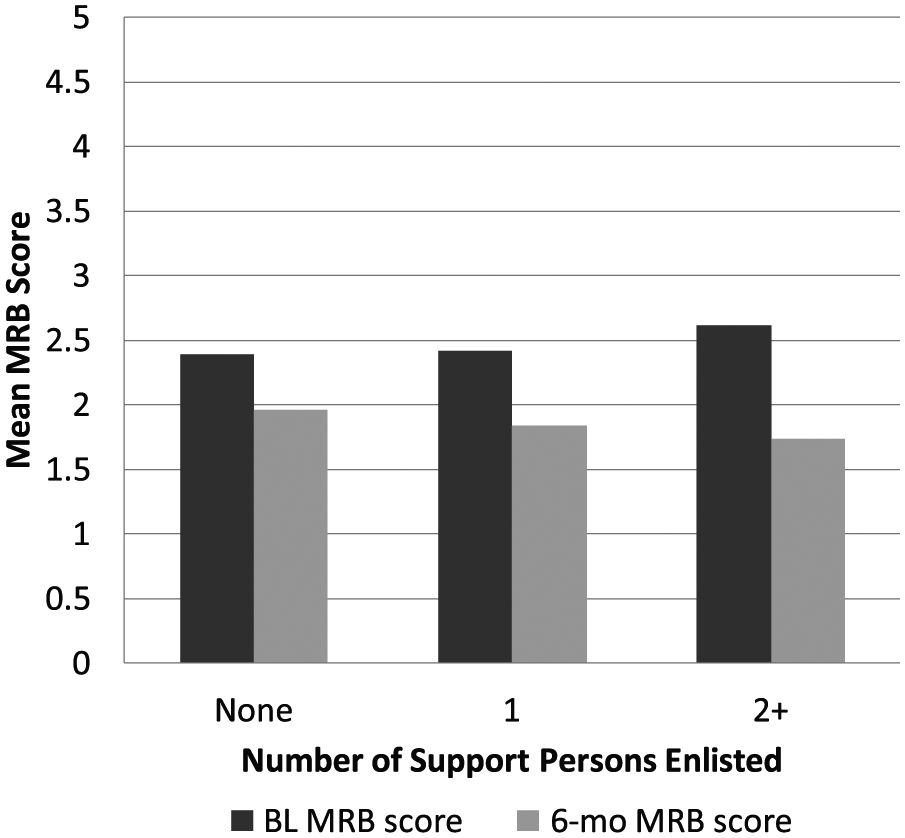
Adjusted mean multiple risk behavior (MRB) score at baseline (BL) and 6 months by number of social support persons identified (weighted n = 17,589).
As seen in Table 2, a notable percentage of participants reported that their support persons offered support daily; 31.2% received emotional support, 18.5% informational support, and 24.3% instrumental support daily. Most participants (78.6%) were very satisfied with the support offered. Results of the generalized linear models determined that frequency of emotional support was associated with a greater reduction in MRB score. There was a trend for frequency of informational support to be associated with a greater reduction in MRB score (p = .10). Neither tangible support nor satisfaction with offered support were associated with a change in MRB score (Table 2).
Type and Frequency of Support Offered by Primary Support Person and HD2 Participant Satisfaction With Offered Support (Weighted n = 8,906). a

Note. HD2 = Healthy Directions 2; CI = confidence interval.
Analyses is limited to individuals who identified support person(s). Analyses adjusted for intervention arm, age, sex, and race.
Reasons for Not Selecting a Support Person
The primary reasons participants gave for not selecting a support person were that they preferred to work on changing their behaviors alone (91.3%) or that the best person to ask was too busy (45%). Additionally, 16% reported that they could not think of anyone to ask; 50.8% of these participants were married/partnered.
Discussion
The HD2 intervention was a self-guided intervention designed to help individuals reduce multiple behavioral risk factors. A novel aspect of the intervention was to mobilize existing social support networks to promote change in multiple behaviors. With encouragement, one out of every two people receiving the HD2 intervention enlisted members of their social networks to aid their change efforts. The rate of participation by social network members in our study exceeds that found by Carlson et al. (2002), who reported that 26% of smokers who attended a community-based smoking cessation program and were encouraged to bring a support person to subsequent sessions did so. The greater rate of participation in our study is likely due to the intervention being self-guided, and that support persons did not need to attend scheduled events. Materials were available for them in a booklet and via a website, which suggests that interventions that do not require social support persons to actively participate in planned events may be a viable method to engage network members.
Enlisting support had a significant impact on behavior change. People who identified a support person had a 61% greater reduction in MRB than individuals who did not identify a support person, and those who selected multiple support persons had double the reduction in MRB score than individuals who did not select a support person. Identifying multiple support persons may promote greater behavior change, in part, because one support person can assist when the other(s) are not available. In the case of efforts to change multiple health behaviors, it may be important that participants receive support for various behaviors from different supporters as support persons may provide different types of support depending on their availability, behavior, knowledge, and skill sets.
A reduced MRB score indicates an improved behavioral profile: A score of four indicates that one behavioral recommendation is being met while a score of three indicates that two of the five behavioral recommendations are being met. Given that health risks cluster (Emmons, Stoddard, et al., 2005; Liu et al., 2016; Loprinzi, Branscum, Hanks, & Smit, 2016) and contribute to increased risk mortality (Abegunde, Mathers, Adam, Ortegon, & Strong, 2007; Ford, Zhao, Tsai, & Li, 2011), reduced MRB scores can delay morbidity and mortality. Reducing risk behaviors also has been shown to be associated with reduced health care costs (Edington, 2001; Edington, Yen, & Witting, 1997); estimates from Edington (2001) suggest changing two health behaviors can reduce an individual’s medical costs by approximately $2,000 per year.
Our study builds on the existing body of research that has been conducted to determine if changes at the interpersonal level, that is, changes to the social environment through increased social support, will promote behavior change. Interventions that include a peer-leader component, such as training individuals with a similar background and/or from the intervention community to serve as peer leaders, lay health educators, and community health workers, have been found to promote behavior change among intervention participants (Lorig, Ritter, Villa, & Armas, 2009; Tessaro et al., 2000), although results are not always consistent (Campbell et al., 2004). de Souza et al. (2014) conducted in-depth interviews with 20 peer health leaders participating in a multicomponent worksite wellness obesity prevention program conducted in a hospital setting and found that peer leaders filled many roles throughout the intervention period, including changing the social environment by acting as role models by changing their own behavior. Support persons in our study may have acted in a similar capacity demonstrating that social support may be offered effectively via trained leaders and from members of existing social networks.
In addition, our findings add to the very limited extant research examining the activation of social networks to promote smoking cessation (Carlson et al., 2002; Gruder et al., 1993; Patten et al., 2012). Our findings were similar to that of Carlson and colleagues who found that enlisting support leads to higher levels of behavior change among people trying to quit smoking. In their study, smokers that had a support person who attended at least one cessation session (vs. those that never had a support person present) had a 20-percentage point higher quit rate 3 months post quit date (56% vs. 36%). Although cessation rates declined over time, they remained 10 percentage points higher at 6 months and 12 months among participants who had engaged a supporter. Our study has added to this area of research by providing additional evidence of the added benefit of enlisting support.
We found that individuals who were single and, not surprisingly, those with fewer interpersonal resources at baseline were less likely to enlist support. Prior research shows that family and peer support is associated with healthful behaviors (Walker, Pullen, Hertzog, Boeckner, & Hageman, 2006), and it is likely that participants with greater interpersonal resources, such as those who were married/partnered, had existing support systems that they could easily access to aid their behavior change efforts. Although older age in our study was associated with a decreased likelihood of seeking support, older participants did not have lower levels of interpersonal resources. It is unclear why older adults were less likely to activate their support systems. It is possible that their support systems are structured differently (e.g., more remote support from adult children living at a distance) than social systems among younger adults. This is worthy of exploration, given the aging U.S. population (Colby & Ortman, 2014). In addition, it is currently estimated that two out of every three older adults have multiple chronic conditions that are affected by health behaviors (Centers for Disease Control and Prevention, 2013). Another important area for further exploration is to determine, regardless of gender and age, how to help those who do not have strong interpersonal networks to enlist support, and whether support resources developed in the context of interventions can be effective in helping these individuals change their behaviors. As noted, prior interventions that have tried to create new social support networks for participants to assist in their change efforts have had limited success (May & West, 2000; Park et al., 2004), perhaps because they included individuals who did not need additional support resources in their daily lives or that establishing networks for participants without their involvement may not be helpful.
In this study, we were specifically interested in the types of support that would be associated with behavior change. Participants reported that their support persons offered emotional support with greater frequency than informational or tangible support, which is consistent with previous research (Sharma, Sargent, & Stacy, 2005). Daily emotional support prior to and around an intended quit day has been found to be associated with reduced smoking (Scholz et al., 2015). Our results also showed that the frequency of emotional support was associated with change in MRB score. It is possible that because we provided information through our materials that there was a reduced need for informational support. Additionally, our sample had high levels of educational attainment, and informational support may not have been as needed.
Most participants who did not identify a support person stated that they prefer to work on changing behaviors alone. While some people may be able to achieve success using this strategy, our finding showed that this group’s level of behavior change was lower than those who secured support, indicating that this may not be the best choice for most people. Efforts are needed to further understand this resistance, and whether it reflects the need for support or a change in other motivational factors. For those who do not have or do not want to use their own interpersonal support networks, the role of neighborhood and organizational resources may be important to emphasize and develop.
Study Limitations
Study limitations include the use of self-reported measures and having participants only report on the primary support person’s offered support. Study strengths include a large and diverse sample as well as the assessment of frequency and satisfaction with offered support.
Conclusions and Implications for Health Promotion Practice
In sum, we found that about half of the individuals enrolled in a multiple risk behavior intervention can be encouraged to enlist social support from existing members of their social networks, and that engaging support has a strong and positive impact on behavior change. As the Affordable Care Act puts a key emphasis on the role of self-management and patient activation, interventions and health promotion efforts should encourage individuals to enlist several support persons when working to change multiple risk behaviors. Future research should be conducted to understand how to increase use of social support among those least likely to enlist social (e.g., older adults, single adults) and/or create other means of supporting their behavior change efforts.
Footnotes
Acknowledgements
We would like thank all study participants as well as all individuals who provided them support. We appreciate Harvard Vanguard Medical Associates for the opportunity to conduct research in their clinical sites, and all of the health care providers who participated in this study. We also would like to thank the Healthy Directions 2 staff and acknowledge all Healthy Directions 2 investigators: Gary G. Bennett, PhD, Moira Cunningham, MD, Matthew Gillman, MD, SM, and Vish Viswanath, PhD. Study-related materials were developed in partnership with the DFCI/HCC Health Communication Core.
Declaration of Conflicting Interests
The authors declared no potential conflicts of interest with respect to the research, authorship, and/or publication of this article.
Funding
The authors disclosed receipt of the following financial support for the research, authorship, and/or publication of this article: This work was supported by the National Institutes of Health (Grant Numbers R01 CA123228 and 1K05 CA124415).