



Abstract
Background. Lower-income families in the United States are at increased risk for food insecurity and have higher rates of tobacco use. Many retailers accepting government food assistance benefits also sell tobacco products, whose marketing promotes smoking initiation and undermines quit attempts. We examined the presence of tobacco marketing in authorized retailers in the Supplemental Nutrition Assistance Program (SNAP) and/or Special Supplemental Nutrition Program for Women, Infants, and Children (WIC), compared with nonauthorized retailers. Method. A nationally representative sample of tobacco retailers in the contiguous United States (N = 2,054) were audited for tobacco marketing in 2015. Using generalized estimating equations, we examined the association between WIC and SNAP authorization and presence of tobacco marketing, adjusted for store type and neighborhood demographics. Results. Both WIC-authorized (odds ratio [OR] 1.7, 95% confidence interval [CI] [1.1, 2.4]) and SNAP-authorized retailers (OR 2.3, 95% CI [1.7, 3.1]) had greater odds of displaying interior tobacco price promotions, compared with stores that were not WIC/SNAP authorized. SNAP-authorized stores (compared with nonauthorized) had almost 3 times greater odds of displaying interior tobacco advertisements (OR 2.9, 95% CI [1.9, 4.5]), while WIC-authorized retailers had 80% lower odds of displaying exterior tobacco advertisements (OR 0.2, 95% CI [0.1, 0.3]). Conclusion. Millions of lower-income American families may be disproportionately exposed to tobacco marketing at food retailers. Federal, state, and local policies could create healthier retail environments by restricting the marketing and availability of tobacco products and increasing promotions and access to healthy food options.
Tobacco use remains the leading cause of death in the United States, and disproportionately affects low-income populations (U.S. Department of Health and Human Services, 2014). More than 50 million low-income Americans receive food assistance through the Supplemental Nutrition Assistance Program (SNAP) and the Special Supplemental Nutrition Program for Women, Infants, and Children (WIC) programs (U.S. Department of Agriculture, 2015c, 2016). The types of stores that accept SNAP and/or WIC benefits (convenience stores, corner stores, grocery stores and supermarkets, dollar stores, mass merchandisers, and pharmacies and drug stores) (U.S. Department of Agriculture, 2015b) are often the same stores that sell and promote tobacco products (Ribisl et al., 2017). Given that tobacco retailers may also accept SNAP and/or WIC benefits, participants of food assistance programs may be disproportionately exposed to tobacco marketing and promotions at the point-of-sale.
Currently, tobacco companies spend more than $19 million each day on marketing, promotions, and advertising at the point-of-sale, more than in any other venue (Federal Trade Commission, 2018; Feighery, Ribisl, Clark, & Haladjian, 2003). Retail tobacco marketing has been associated with youth smoking uptake (Henriksen, Schleicher, Feighery, & Fortmann, 2010; Robertson, McGee, Marsh, & Hoek, 2015) and with undermining quit attempts among adults (Germain, McCarthy, & Wakefield, 2010; Hoek, Gifford, Pirikahu, Thomson, & Edwards, 2010). Tobacco retailers in low-income, minority neighborhoods have more point-of-sale tobacco marketing (e.g., advertisements and price promotions) compared with stores in higher-income, predominantly White communities (Lee, Henriksen, Rose, Moreland-Russell, & Ribisl, 2015; Ribisl et al., 2017). Furthermore, tobacco industry documents have revealed that tobacco companies segment and target price-sensitive consumers, including low-income women and youth, with coupons and price promotions at the point-of-sale (Chaloupka, Cummings, Morley, & Horan, 2002). In the 1970s, one tobacco company even tested out mailing cigarette coupons with Food Stamps (currently called SNAP benefits) to program participants (Brown-Johnson, England, Glantz, & Ling, 2014). Given the influence of the retail environment on smoking and tobacco use, and the tobacco industry’s history of targeting low-income consumers and youth, it is important to consider the presence of tobacco marketing in stores where millions of low-income American families purchase food.
To our knowledge, only two previous studies have analyzed the relationship between the presence of tobacco marketing and SNAP and WIC authorization of retail stores. These studies produced conflicting findings and were limited to one city each (Hillier et al., 2015; Hosler & Kammer, 2012). Given this discrepancy and limited geographic scope, there is a need to consider the link between tobacco marketing and SNAP and WIC acceptance on a national scale. This study examines whether there are associations between retailer WIC and/or SNAP authorization and the presence of tobacco marketing (interior and exterior advertisements, interior price promotions, and tobacco placement near children’s products) in a nationally representative sample of tobacco retail outlets.
Method
Data Set and Sampling
Tobacco retail store assessment data for this study were collected in 2015 as part of the Advancing Science and Policy in the Retail Environment (ASPiRE) project. Sampling and data collection methods have been described elsewhere (Ribisl et al., 2017). Briefly, a two-stage probability sample proportionate to population size design was used to obtain a nationally representative sample of tobacco retailers in the contiguous United States. In Stage 1, 97 counties were randomly selected proportionate to county population size with replacement, using 2010 Census data and the probability sample proportionate to population size method (Chromy, 1979). In Stage 2, tobacco retailers were randomly selected within each county from two commercial retailer lists (ReferenceUSA and Dun & Bradstreet) (D’Angelo, Fleischhacker, Rose, & Ribisl, 2014), after retailers known not to sell tobacco products were excluded (e.g., Target and CVS). Figure 1 outlines the inclusion and exclusion of tobacco retailers into the final study sample. Notably, stores that are WIC or SNAP authorized, but do not sell tobacco products, were excluded from the sample.
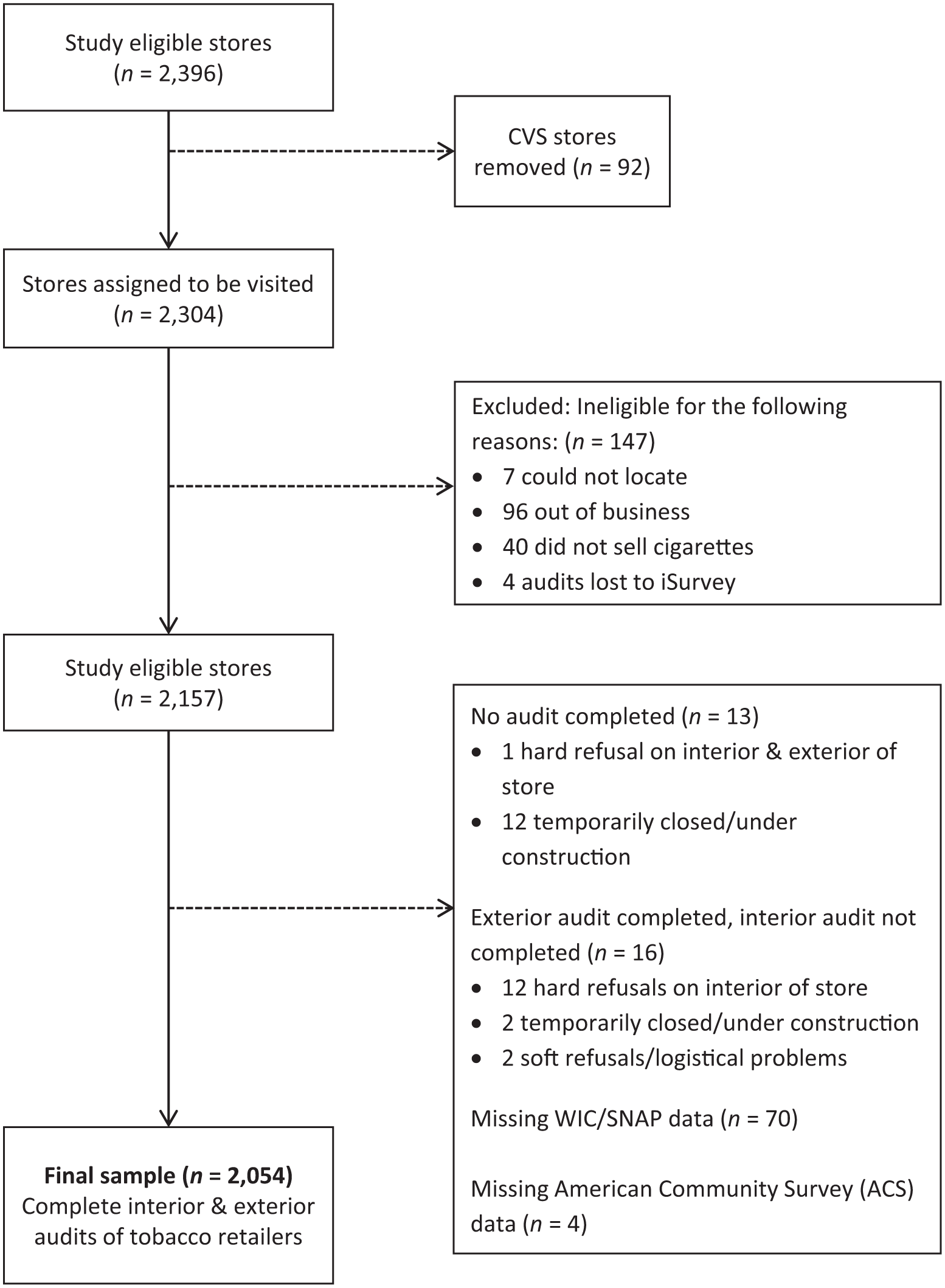
ASPiRE Tobacco Retailer Sampling Diagram, 97 counties in the Continental United States (data collected May 2015 to August 2015).
Data Collection
Data collection occurred between May and August 2015. Following store audit best practices (Lee, Henriksen, Myers, Dauphinee, & Ribisl, 2014), data collectors conducted in-person audits of the interior and exterior of each retailer for tobacco marketing, price promotions, product availability, and store characteristics. Auditors evaluated the interior and exterior of the store for the presence of tobacco marketing by type (e.g., advertisement, price promotion) and by product (e.g., nonmenthol cigarettes, menthol cigarettes, cigars/cigarillos, e-cigarettes). Store auditors did not introduce themselves unless asked by a store employee. Data were collected electronically via the iSurvey application using Apple iPads. Prior to data collection, auditors were trained in-person through instruction and a field test (Feld, Johnson, Byerly, & Ribisl, 2016). The University of North Carolina Office of Human Research Ethics determined that the study did not constitute human subjects research (12-0765).
Interior and exterior audits were completed for 2,128 retailers out of 2,157 stores eligible for the study (98.7% completion rate). Thirteen store audits could not be completed due to clerk refusals, 14 stores were temporarily closed or under construction, and there were logistical problems with reaching the 2 remaining stores. Additionally, 70 stores were missing data on WIC/SNAP acceptance and 4 were missing American Community Survey census tract data, leading to a final sample of 2,054 retailers (Figure 1).
Measures
Store Type
Each tobacco retailer was coded as one of the following store types: convenience store (without a gas station); gas station convenience store; drug store/pharmacy; beer, wine, or liquor store; grocery store or supermarket; mass merchandiser (e.g., Walmart); discount/dollar store (e.g., Family Dollar); tobacco shop; or other store type (e.g., newsstand, kiosk).
Tobacco Marketing Materials
Data collectors coded branded tobacco advertisements on both the exterior (e.g., windows, doors, sidewalk, building, parking lot) and interiors of stores. On the interior of the store, data collectors indicated the presence of branded tobacco advertisements, signs, displays, and functional items. For both the interior and the exterior of the store, data collectors indicated the product type (nonmenthol cigarettes, menthol cigarettes, cigarillos/little cigars, large cigars, chew/snuff/dip/snus, and e-cigarettes) associated with each marketing material. We recoded across products to examine the presence of any (1) interior and (2) exterior tobacco marketing (0 = no marketing, 1 = marketing).
Tobacco Price Promotions
Data collectors coded price promotions on the interior of the store. Types of price promotions included special price (e.g., $1.00 discount per pack) or multi-buy special (e.g., buy 1 pack, get 1 pack free). Price promotion data were collected for cigarettes, e-cigarettes, and noncigarette tobacco products. We created a variable across products to indicate the presence of any tobacco price promotions inside the store (0 = no promotions, 1 = promotion(s)).
Tobacco Placement Near Children’s Products
Data collectors examined interior tobacco marketing for evidence of youth appeal, indicated by tobacco product placement near children’s products. Data collectors coded for the presence of tobacco products within 12 inches of toys, candy or gum, slushy/soda machines, or ice cream (0 = no placement near children’s items, 1 = placement near children’s items).
SNAP and WIC Acceptance
Data collectors assessed whether each retailer accepted WIC or SNAP benefits by the presence of in-store signage (0 = does not accept benefit, 1 = accepts benefit). If no signage was present, data collectors were instructed to ask the clerk. In 3.2% of stores (n = 69), there was no signage and the clerk either refused to answer whether WIC was accepted or did not know. In 3.3% of stores (n = 71), there was no signage and the clerk either refused to answer whether SNAP was accepted or did not know.
Retailer Neighborhood Demographics
Retailer neighborhood was defined by the census tract location of each retailer. Data from the American Community Survey 5-year estimates, 2011-2015, were used to assess the racial/ethnic composition, socioeconomic characteristics, and age levels of each census tract. Four variables provided demographic information for each retailer neighborhood: percent non-Hispanic Black residents, percent Hispanic residents, median household income, and percent under 18 years old. Quartiles were created for each variable (1 = lowest quartile, 4 = highest quartile).
Analysis
We examined associations between retailer SNAP and WIC authorization and four dichotomous dependent variables: (1) any exterior tobacco marketing materials, (2) any interior tobacco marketing materials, (3) any tobacco price promotions, and (4) any tobacco marketing with youth appeal. We used generalized estimating equations for binary distributions to account for retailer clustering within county and the dichotomous outcomes. Two sets of models were estimated: the first set used WIC authorization as the primary predictor and the second set used SNAP authorization. We controlled for store type and neighborhood demographics in each model.
For the models on WIC authorization, we excluded beer, wine, or liquor stores and other establishment types (e.g., newsstands, kiosks), as no stores in those categories accepted WIC. Tobacco stores were also removed from the analytic sample as no retailers of that type accepted WIC or SNAP benefits. The final retailer sample size for the WIC models was 1,750. For the SNAP models, the final sample size was 1,977 complete store audits.
Results
SNAP benefits were accepted at 65.7% of study retailers (n = 1,320) while WIC was accepted at 18.5% of retailers (n = 335) (Table 1). In our sample, most WIC-authorized retailers (97.0%, n = 320) were also authorized to accept SNAP, but only 24.4% of SNAP retailers also accepted WIC (n = 320), most likely because WIC has stricter food stocking requirements than SNAP. The majority of mass merchandisers (79.0%, n = 39) and supermarkets/grocery stores (61.0%, n = 230) accepted WIC, while most drugstores/pharmacies (99.1%, n = 125), discount/dollar stores (97.7%, n = 141), supermarkets/grocery stores (85.7%, n = 316), and mass merchandisers (100%, n = 50) accepted SNAP benefits (Table 1).
Weighted SNAP and WIC Authorization by Tobacco Retailer Store Type, Continental United States, 2015 (n = 1,983).
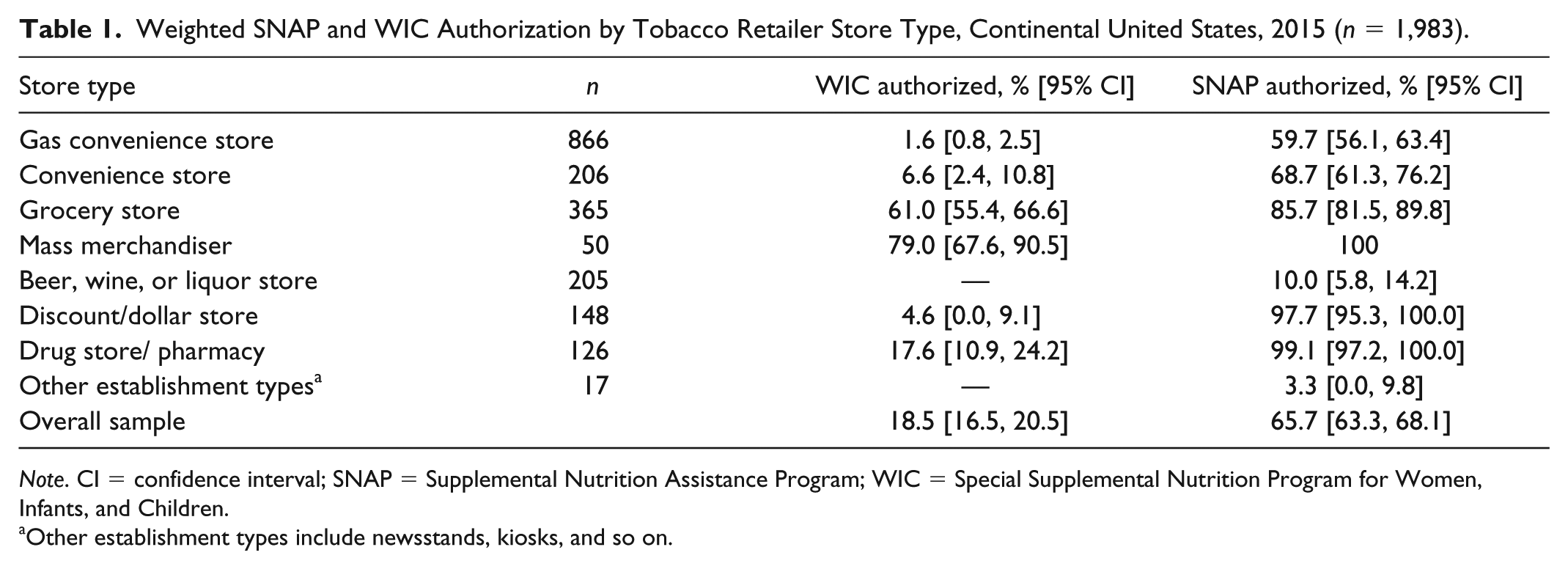
Note. CI = confidence interval; SNAP = Supplemental Nutrition Assistance Program; WIC = Special Supplemental Nutrition Program for Women, Infants, and Children.
Other establishment types include newsstands, kiosks, and so on.
Across all stores sampled, more than half had at least one exterior tobacco advertisement (56.2%, n = 1,167) and most retailers had at least one interior tobacco advertisement (86.9%, n = 1,766) or an interior tobacco price promotion (74.7%, n = 1,538; Table 2). Fewer stores had tobacco products placed within 12 inches of products with youth appeal (e.g., candy, soda/slushy machines, toys; 26.3%, n = 516).
Presence of Tobacco Marketing by WIC and SNAP Authorization, Continental United States, 2015, Weighted Data.

Note: CI = confidence interval; SNAP = Supplemental Nutrition Assistance; WIC = Special Supplemental Nutrition Program for Women, Infants, and Children.
Overall store frequencies include liquor stores and other store types.
SNAP Participation and Presence of Tobacco Marketing
Estimates obtained from the generalized estimating equations logistic regression models are reported in Table 3. After controlling for store type and neighborhood demographics, SNAP-authorized stores had nearly 3 times higher odds of displaying interior tobacco advertisements compared with non-SNAP-authorized retailers (odds ratio [OR] = 2.9, 95% confidence interval [CI] [1.9, 4.5]). Similarly, SNAP-authorized stores had more than 2 times higher odds of having interior tobacco price promotions (OR = 2.3, 95% CI [1.7, 3.1]) than non-SNAP-accepting retailers. There were no significant differences in exterior advertisements or tobacco products placed near children’s items between SNAP-authorized vs non-SNAP-authorized retailers.
Adjusted Odds of the Presence of Tobacco Marketing and Promotions by WIC/SNAP Authorization, Continental United States, 2015.
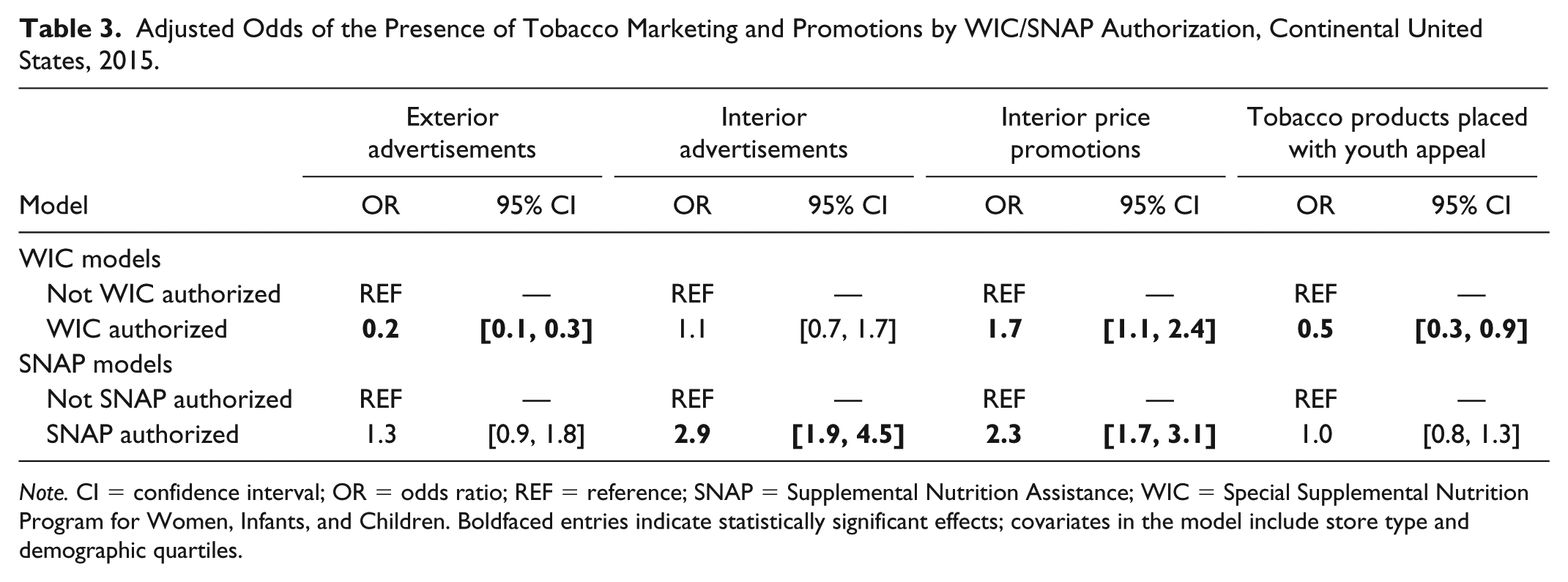
Note. CI = confidence interval; OR = odds ratio; REF = reference; SNAP = Supplemental Nutrition Assistance; WIC = Special Supplemental Nutrition Program for Women, Infants, and Children. Boldfaced entries indicate statistically significant effects; covariates in the model include store type and demographic quartiles.
WIC Participation and Presence of Tobacco Marketing
After controlling for store type and neighborhood demographics, WIC-authorized stores (compared with those not authorized to accept WIC benefits) had 80% lower odds of displaying exterior tobacco advertisements (OR = 0.2, 95% CI [0.1, 0.3]) and 50% lower odds of tobacco products placed to appeal to youth (OR = 0.5, 95% CI [0.3, 0.9]). Conversely, WIC-authorized stores had 1.7 times higher odds of having interior tobacco price promotions compared with non-WIC-authorized stores (95% CI [1.1, 2.4]). There was no statistically significant difference in interior advertisements between WIC-authorized and non-WIC-authorized retailers.
Discussion
In this nationally representative study of tobacco retailers in the contiguous United States, we found significant associations between WIC and SNAP authorization and the presence of point-of-sale tobacco marketing. In models adjusting for both store type and neighborhood demographics, WIC- and SNAP-authorized retailers had higher odds of displaying interior tobacco price promotions, and SNAP-authorized retailers had higher odds of displaying interior advertisements. Conversely, WIC-authorized stores were less likely to display exterior tobacco ads or have tobacco products placed with youth appeal.
There are approximately 260,000 authorized SNAP retailers (U.S. Department of Agriculture, 2015b) and about 47,000 authorized WIC retailers in the United States (U.S. Department of Agriculture, 2015a). Our finding that both WIC- and SNAP-authorized retailers had greater odds of displaying interior price promotions for tobacco products may indicate a targeting of lower-income, price-sensitive consumers at these stores by the tobacco industry. Price promotions lower the price of tobacco products and are particularly effective at appealing to price-sensitive consumers, including low-income and youth populations (Paynter & Edwards, 2009; Robertson, Cameron, McGee, Marsh, & Hoek, 2016; Siahpush et al., 2017). It may also be that stores accepting WIC or SNAP benefits are also engaged in contracts with the tobacco industry that require greater participation in displaying price promotions and interior signage (Feighery et al., 2003; Feighery, Ribisl, Schleicher, & Clark, 2004). Regardless of whether the greater amount of tobacco price promotions in WIC- and SNAP-authorized stores is intentional, these retailers are preferred food shopping destinations for millions of low-income Americans, many of whom are limited by lack of transportation or geography when selecting a food source (Ver Ploeg, Mancino, Todd, Clay, & Scharadin, 2015).
Comparison With Previous Studies
Our findings are mostly consistent with a study by Hillier et al. (2015), which examined the relationship between tobacco advertising and SNAP/WIC authorization at tobacco retailers in Philadelphia, Pennsylvania. Hillier et al. found that WIC- and SNAP-authorized retailers were significantly more likely to display interior advertisements compared with nonauthorized retailers, while our study found that SNAP-authorized (but not WIC-authorized) retailers were more likely to display interior ads, and both SNAP- and WIC-authorized retailers were significantly more likely to display interior price promotions. Given that our study measured advertisements (branded signs) and price promotions as separate marketing materials, our findings may be similar if these materials were all included as interior advertising. Furthermore, our study used a nationally representative sample of all types of tobacco retailers, including wholesale stores/mass merchandisers, which were not found in the urban Philadelphia setting.
In contrast to both our study and the Hillier et al. study, a study in Albany, New York (Hosler & Kammer, 2012), found that SNAP-authorized stores were less likely to display interior tobacco ads, while there was no significant association between WIC authorization and the presence of interior tobacco marketing. However, all WIC stores in the New York sample did sell tobacco products. The conflicting findings may be explained by the sampling methodology: The study in Albany sampled food retailers, whereas in Philadelphia, tobacco retailers were sampled from a tobacco retailer licensing list that included laundromats, bars, and restaurants/take-outs. Retailer type likely plays an important role in product advertising in and around the store. Our study sampled store types representing the most common tobacco retailer outlets but limited the analytic sample for this study to only those retailers that sold food.
Policy Implications
At the state or local level, there are several policy and programmatic approaches available to create healthier retail environments. Limiting tobacco availability and marketing through retailer licensing, including at food retailers participating in WIC or SNAP, is one approach. Tobacco retailer licensing is not currently required in all U.S. states. Licensing can be used to cap the number of tobacco retailers in an area, restrict tobacco sales near schools and youth-oriented locations, restrict the types of outlets that can sell tobacco, or restrict price promotions (Ackerman, Etow, Bartel, & Ribisl, 2017; Myers, Hall, Isgett, & Ribisl, 2015). Tobacco retailer licensing would also allow the implementation of and enhance the enforcement of state or local minimum pricing laws (McLaughlin, Pearson, Laird-Metke, & Ribisl, 2014) and bans on the redemption of cigarette coupons, such as the policies that exist in New York City (Huang et al., 2016).
While more than 261,000 retailers in the United States accept SNAP benefits (U.S. Department of Agriculture, 2015b), many stores lack a variety of fruits, vegetables, and other healthy products (Laska, Caspi, Pelletier, Friebur, & Harnack, 2015). Healthy retailer licensing is a policy option that aims to increase healthy food availability in stores, as well as limit the marketing and availability of tobacco and alcohol products (Ribisl et al., 2016). The federal SNAP program or state WIC programs could create “healthy retailer” designations to better promote stores offering healthy options and empower consumers to choose outlets that are health promoting, with enhanced nutrition options and reduced marketing/availability of unhealthy products, such as tobacco.
Cities can also enact a licensing ordinance for food retailers (excluding restaurants) to carry a minimum selection of healthy food products. In addition, retailers could receive incentives for exceeding food-stocking requirements, limiting the sale of sugar-sweetened beverages, and limiting or eliminating the sale of alcohol and tobacco products. Minneapolis was the first city in the United States to regulate nutritional requirements in food stores (ChangeLab Solutions, 2013), and also implemented the Minneapolis Healthy Corner Store program to provide technical assistance to retailers, improve compliance with the Staple Foods Ordinance, and increase the availability of fresh produce in stores (Gittelsohn, Laska, Karpyn, Klingler, & Ayala, 2014). Some localities, like California, have created voluntary healthy retail environment programs, focusing on marketing and availability of food, tobacco, and alcohol in community stores (Healthy Stores for a Healthy Community, 2014).
At the local level, in addition to improving healthy food access through healthy store programs, there is also an opportunity to reach WIC and SNAP recipients at the point-of-sale with promotions and marketing for healthy alternatives. Instead of dedicating space to tobacco products and marketing, that space could be used for creating displays for healthy snacks and beverages near the checkout counter, and displaying signs promoting those healthy alternatives (Ribisl et al., 2016). For example, in a systematic review of small-store interventions to create healthier retail environments, Gittelsohn, Rowan, and Gadhoke (2012) found that “healthy corner store” programs improved healthy product availability (e.g., produce), increased sales of healthier foods, and also increased customer awareness of healthy eating.
These state or local policies could be a key way to target SNAP- and WIC-authorized food retailers across the United States and increase the availability of healthy options for SNAP and WIC consumers. Additionally, the SNAP or WIC programs could pursue the creation of their own “healthy retailer” program, with criteria specific to the interests of the program and with consideration for the needs of low-income shoppers. Healthy retailer licensing and healthy retail campaigns have the potential to address the top preventable causes of death in our nation—tobacco use and obesity—while also ameliorating food deserts. However, when working to reduce tobacco product availability in stores, policymakers and public health officials should ensure that unhealthy products, such as sugary snacks and candy, do not take their place (Ribisl et al., 2016).
At the federal level, any reauthorization of the Farm Bill, which funds SNAP and other food assistance programs, could include legislative provisions to protect low-income Americans from harmful tobacco marketing in stores where they shop for subsidized food, and pilot healthy retailer programs. These policy options would serve to mitigate exposure to tobacco marketing at a variety of stores, including SNAP- and WIC-authorized retailers, as well as promote healthier food options to program participants.
Limitations
The lack of a nationwide tobacco retailer licensing system is a limitation for the methods of this study, which uses store lists purchased from two commercial sources to identify tobacco retailers. Since there is no universal system for identifying tobacco retailers, some stores may have been overlooked in the sampling process. Furthermore, while this study is representative of tobacco retailers at the national level, it is not a nationally representative sample of WIC- or SNAP-authorized stores. While we adjusted for both store type and neighborhood demographics in our statistical model, it is possible that there is some residual confounding due to store type. WIC-authorized retailers may rely less on tobacco sales, and therefore display less tobacco marketing than some SNAP-authorized retailers given the differences in these programs’ requirements.
This study also did not take into account the number and density of tobacco retailers in the store neighborhood; however, future studies could examine whether local tobacco retailer density is associated with greater tobacco marketing at WIC-/SNAP-authorized stores. Furthermore, this study measured tobacco marketing at retail outlets, rather than the totality of retail food, beverage, or other product marketing present. Future work could examine the prevalence and characteristics of tobacco marketing, in comparison with other goods, in the retail environment. Last, this study examined retailer and neighborhood characteristics and was not linked to individual behavioral data, so an association between WIC and/or SNAP utilization and tobacco use cannot be established.
Conclusion
Overall, WIC-authorized stores were significantly more likely to display interior tobacco price promotions and SNAP-authorized stores were more likely to display both interior ads and promotions, compared with stores that do not accept WIC or SNAP benefits. Policy options for creating healthier retail environments include tobacco retailer licensing, healthy retailer licensing, and healthy retailer campaigns at WIC/SNAP-authorized stores. At the local level, interventions are needed to increase healthy food availability, access, and education at the point-of-sale, and programs could incorporate restrictions on tobacco marketing. Further research is needed to assess the effects of tobacco marketing exposure on SNAP and WIC participants, as well as the best policy options for reducing tobacco product availability in stores frequented by millions of families for SNAP and WIC food purchases.
Footnotes
Acknowledgements
We would like to thank Dr. Karl Umble, staff, and peers in the Department of Health Policy and Management at the UNC Gillings School of Global Public Health for their support and assistance in completing this study, especially through reviewing early drafts of this manuscript. We would also like to thank Ashley Feld and members of the ASPiRE team for their efforts with data collection and overall project management.
Declaration of Conflicting Interests
The authors declared the following potential conflicts of interest with respect to the research, authorship, and/or publication of this article: Allison Myers and Kurt Ribisl receive royalties from UNC-Chapel Hill because of their roles as co-inventors of two store assessment and mapping software tools, the Store Mapper and Store Audit Center. Neither tool was used in this study.
Funding
The authors disclosed receipt of the following financial support for the research, authorship, and/or publication of this article: Funding for this study was provided by grant number U01 CA154281 from the National Cancer Institute’s State and Community Tobacco Control Initiative. The funders had no involvement in the study design, collection, analysis, writing, or interpretation. This study was part of Advancing Science and Policy in the Retail Environment (ASPiRE), a consortium of researchers from Stanford University, the University of North Carolina at Chapel Hill, and Washington University in St. Louis.
