



Abstract
This article assesses the utility of video diaries as a method for organization studies. While it is frequently suggested that video-based research methodologies have the capacity to capture new data about the minutiae of complex organizational affairs, as well as offering new forms of dissemination to both academic and professional audiences, little is known about the specific benefits and drawbacks of video diaries. We compare video diaries with two established and “adjacent” methods: traditional diary studies (written or audio) and other video methods. We evaluate each in relation to three key research areas: bodily expressions, identity, and practice studies. Our assessment of video diaries suggests that the approach is best used as a complement to other forms of research and is particularly suited to capturing plurivocal, asynchronous accounts of organizational phenomena. We use illustrations from an empirical research project to exemplify our claims before concluding with five points of advice for researchers wishing to employ this method.
Introduction
Video cameras are now routinely embedded in smartphones and computers, creating new possibilities for researchers to gather data recorded on devices used by participants in the conduct of their organizational lives. In this article, we evaluate one variant of such technology-based research: self-directed video diaries. It is frequently suggested that video-based methodologies have the capacity to capture the minutiae of complex organizational affairs by accessing new types of data as well as offering new forms of dissemination to both academic and professional audiences (e.g., Iedema, Forsyth, Georgiou, Braithwatie, & Westbrook, 2006; Knoblauch & Schnettler, 2012). Yet little is known about the additional organizational data video diaries may capture, the specific benefits and drawbacks of video methods, their suitability for specific organizational phenomena and research approaches, and what practical aspects require consideration.
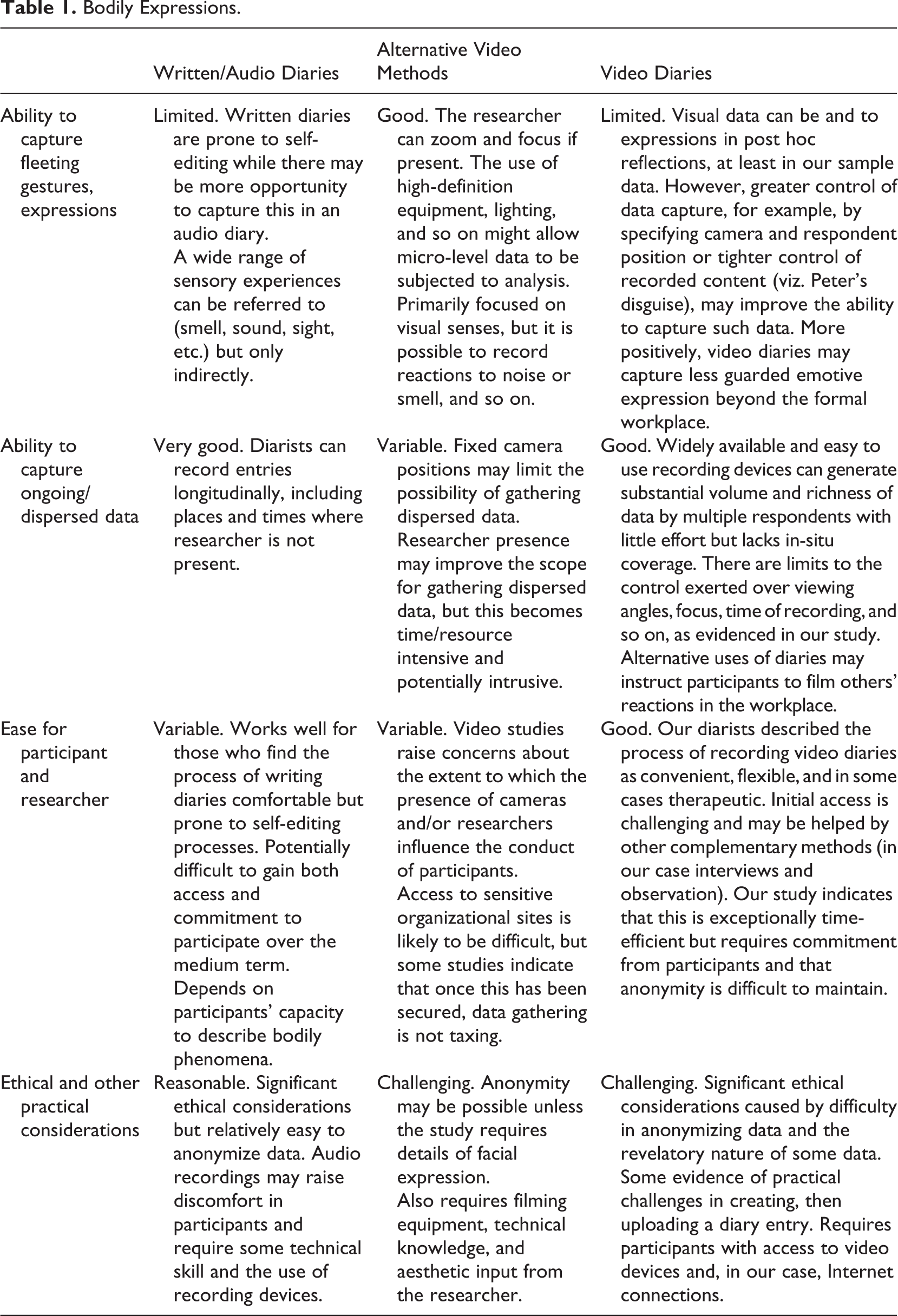
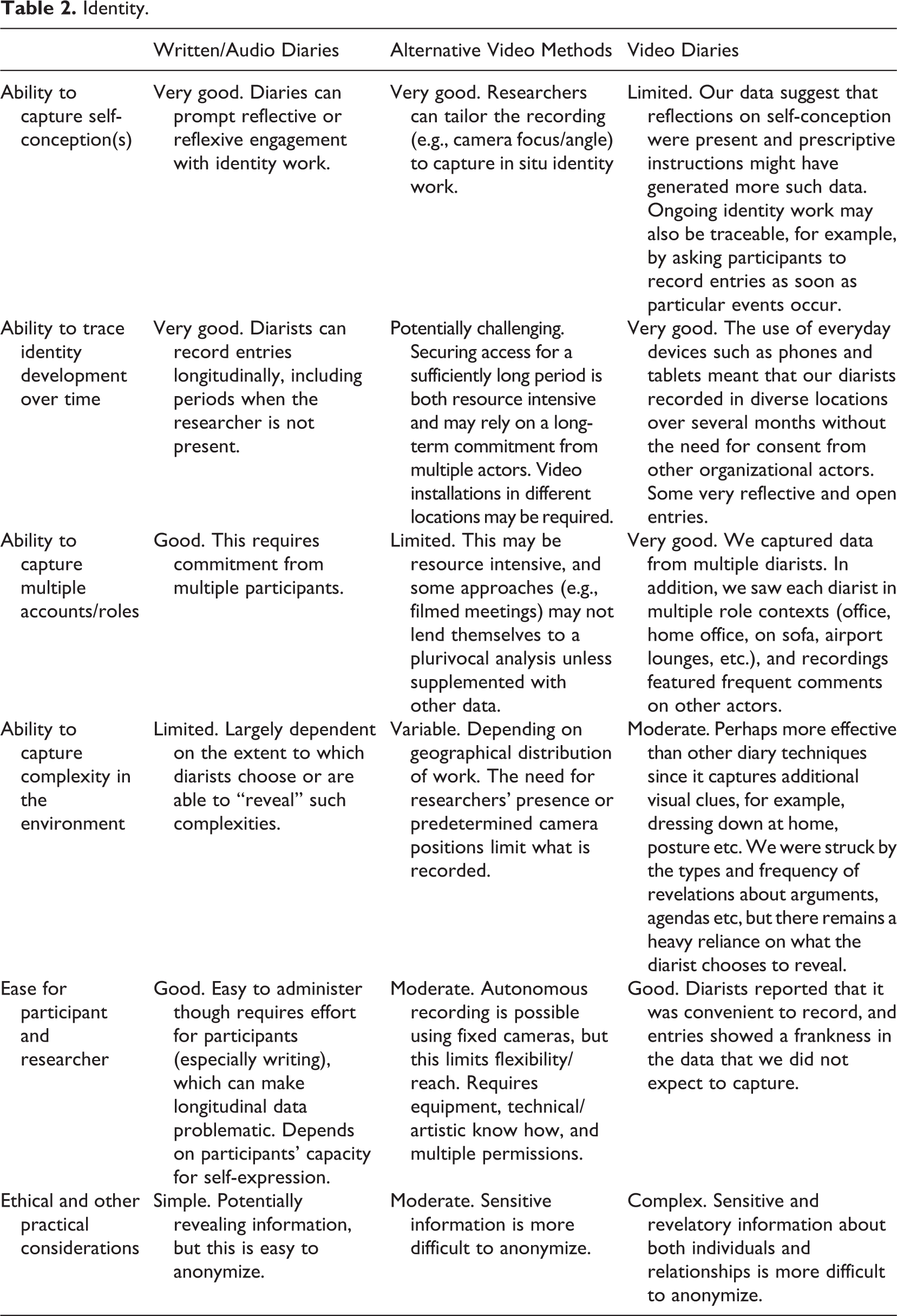
We evaluate the additive contribution of video diaries by contrasting them with “adjacent” methods: other forms of diary studies (written or audio) and other, non-diary, video methods. We assess each method in relation to three themes: bodily expressions such as the gestures employed to enjoin others in one’s sensemaking processes (Clarke, 2011); identity, self-perception and the processes of identity formation, change, fragmentation, or framing (Brown, 2014); and finally organizational practice, either in the form of individual actions exhibited as part of organizational work or in terms of the orchestration of work patterns between individuals in everyday organizational life (Smets, Burke, Jarzabkowski, & Spee, 2014).
These three themes place differing demands on research methods by specifying, inter alia, the purposive frame of analysis, relevant units of analysis and levels of abstraction, as well as the acknowledged role and influence of the researcher. We draw on published research using diary and other video approaches and contribute excerpts from an empirical study in which we employed video diaries. We suggest that video diaries provide an efficient and effective means of gathering large amounts of dispersed and asynchronous data from difficult to access organizational areas. Video diaries can provide both more and richer data. When studying bodily expressions, video diaries can produce close-up recordings of sometimes intense moments of joy or despair, confessions and worries, as well as conflicts and alliances. For identity researchers, video diaries allow access to multiple actors as they reflect on the roles they inhabit, providing details of identity developments and struggles over time. For researchers of practice, video diaries can add participants’ intense reflections on organizational affairs, access to dispersed communities of practice, and as “unselective” recording devices, they offer audio-visual glimpses into the wider work-world of the participants.
These benefits are offset by a lack of in situ work recordings, the relative lack of control of the researcher when it comes to content and recording settings, and potentially challenging ethical issues. We reflect on our own experiences with video diaries in terms of the ease with which they allow the creation of seemingly coherent flows of audio-visual materials, veiling the geographical and temporal distances in actual organizational settings in which they were recorded, and the influence of processes of manipulation of video diary clips and how these translate rather than transmit organizational phenomena. As such, they sometimes make uneasy viewing for researchers. We conclude by suggesting that video diaries may be at their most effective when combined with more traditional research methods and by elaborating practical considerations for researchers wishing to use video diaries.
Case Study Background
The video diary extracts presented in this article formed part of a wider study of distributed sensemaking processes in relation to strategic decisions within an entrepreneurial engineering service firm. We gathered data in a series of traditional interviews as well as facilitating strategy workshops within the firm. The strategy workshops and interviews established working relationships with the management team and facilitated the negotiation of “access” for the video diary study. Managers from the firm were invited to upload a video diary at least weekly using a private YouTube channel where the researchers could see entries from all of the diarists but each participant could only access their own recordings. We received 258 minutes of video recordings in 28 separate uploads from four diarists between July and September 2013. This period coincided with substantial change within the firm.
We offered instructions to the diarists in two ways. First, in form of instructions to “comment on any developments arising in the life of the organization since your last recording that you feel to be significant” (excerpt from invitation email to participants). Second, in approximately monthly cycles, we transcribed the content of the diary entries and conducted a thematic analysis that acted as a guide to the next round of data collection. Each subsequent email instruction combined both the general prompt (“comment on any developments”) and a more specific prompt from previous analysis, (for instance, “comment on what you’d see as the next stage of the software development project”). We became aware that other disciplines have longstanding coding regimes for nonverbal behavior (Ekman & Friesen, 1969), including software tools such as the ELAN system (Lausberg & Sloejes, 2009) in much the same way that organizational researchers use NVivo or similar tools to manage complex textual, audio, and visual data. We did not employ these approaches in our treatment of the data for this article but did make note of audio and visual cues such as body language, facial expression, and so on. Our analysis initially consisted of extended thematic coding of the transcribed text. We also repeatedly watched all recordings and then produced figures combining shorter clips of scenes we found relevant. These are partly reproduced in the following.
Video + Diaries
Video diaries are a recent addition to the organizational researcher’s toolkit even though their constituent parts—both videos and diaries—have relatively long traditions in social science research, dating back, at least, to the countless photographs and reels of film the anthropologists Margaret Mead and Gregory Bateson exposed in Bali in the 1930s (see Erickson, 2011; Harries-Jones, 1995). In organizational research, video recordings have been used in various ways: as an enabling step, for example, Lehtinen and Palli’s (2011) videotaping of a series of organizational meetings for further, largely textual analyses; or to study the nonverbal performances such as gestures and facial expression (Manusov & Trees, 2002). Such studies highlight the importance of bodily expressions as both culturally ritualistic as well as situation-specific enactments of social relations, employed to structure and order interactive human affairs (LeBaron & Jones, 2002) and enact particular identities (Clarke, 2011). Video data have also been used to study work processes, such as the sequential organizational workflows that constitute call center activity systems (Blackler & Regan, 2009) or the ambivalences, struggles, and surprises invoked by continuous changes to hospital work settings (Engestrom, 1999). In a similar setting, Hindmarsh and Pilnick (2007) employed video to analyze teamwork when investigating how verbal and nonverbal elements of collaborative work are interwoven and how embodied practices are sensed and disrupted in the flow of work.
Video studies raise questions about the recording and viewing apparatus involved but also about the role and influence of the researcher (Mumford, 2016). When intervening in the ongoing filming process or in choosing static positions for cameras, researchers not just record but actively produce accounts of organizations just as they more obviously do in selecting, deleting, editing, and reproducing video figures. These recorded accounts carry their own possibilities, heightened by digital processing methods that allow effortless rewinding and fast forwarding, pausing or zooming, cutting or joining. This double temporality and double spatiality can make certain things visible or meaningful primarily by virtue of being recorded and reproduced and not necessarily as part of the original (analogue/organizational) world from which they are filmed (Pinchevski, 2012).
Epistemologically, video research not only documents but intervenes. Indicative of this is the study by Iedema et al. (2006) who actively involve participants in video studies to enact problems not just for observing researchers but as part of an inquisitive and reflexive journey in which they can act out and subsequently review existing problems, moving beyond limiting decontextualized descriptors. Others invite participants to direct the focus of the inquiry not just by performing in front of a camera but also by directing, narrating, and broadcasting their own videos in a fashion close to the work of visual anthropologists (Gubrium, Hill, & Flicker, 2014; Muir & Mason, 2012), giving voice (and image) to otherwise muted or othered concerns.
In this sense, video studies echo concerns raised by researchers concerned with reflexivity and emancipatory impact employing diary-based methods. Uses of diaries range from information gathering in the form of semi-structured questionnaires and telephone-prompted responses (Uy, Foo, & Aguinis, 2010) to reflexive writing tasks in classroom settings (Cunliffe, 2002). Written diaries are time-consuming, and there is the suspicion that the editing of entries leads to sanitized and shortened accounts while it has been suggested that audio-recorded diaries “encourage more openness, directness and self-expression, and perhaps allow for more emotive observations than written words” (Balogun, Huff, & Johnson, 2003, p. 209).
New approaches to user-generated research combining diaries and videos emerge through the wide availability of smartphones and other camera-equipped devices. However, as yet, few studies using video diaries in organization and management research exist. One example is provided by Mason (2010) who, while not explicitly analyzing visual aspects, suggests video diaries create the capacity for continued communication over physical distance through the dialogical development of meaning between diarist and researcher. In the following, we expand Mason’s nascent line of inquiry and assess the utility of video diaries in the study of organizations.
Three Illustrative Research Foci: Bodily Expressions, Identity, Practice
We assess the utility of video diaries for organizational research in three broad research areas: bodily expressions, identity, and practice. As a precursor, we offer a brief review of each area to elicit key demands placed on research methods in these specific domains. This review is intended to be indicative rather than exhaustive, and in choosing three different research areas, we hope to broaden the scope of our evaluation of the relative utility of diaries, videos, and video diaries.
Bodily Expressions
While effable data readily lend themselves to codification and analysis, they are often restricted to verbal systems and discourses (Bell & Davison, 2013). Whether gathered in interview settings or via diary studies, textual data represent only a partial subset of embodied organizational life. One trope of literature has therefore emphasized that we, the individuals populating organizations, are first and foremost “bodies,” imbued with emotions and passions and thus enacting our world through all of our senses in ways that exceed that which can be linguistically recorded (Knorr-Cetina, 1991; Strati, 2007).
A focus on bodily expressions is found in a variety of traditions, including studies of gender and sexuality in organizations (see Hassard, Holliday, & Willmott, 2000), linking “felt meanings” (Warren, 2008) to sensory experiences especially in form of images and signs (Bell & Davison, 2013; Meyer, Hollerer, Jancsary, & van Leeuwen, 2013). Gestures and facial cues have been recognized as important aspects of communication (LeBaron & Jones, 2002; Manusov & Trees, 2002), and the proliferation of audio-visual communication and the widespread availability of imaging, video, and networking capabilities (Pauwels, 2010) reinforces this view. Moreover, some philosophical approaches see perception as not merely tied to some abstract (textual, verbal, or ideal) realm but as a bodily phenomenon, where all the senses reach out into the world and are touched by it (Hancock, 2008). Studying bodily expressions begs the question of how transitory phenomena that are “often fleeting, existing tantalizingly beyond our grasp” may be “pinned down” and evaluated (Warren, 2008, p. 561).
Identity
The second research area we consider, identities in organizations, is both vast and diverse. For our purposes here, we focus on aspects of individual (as opposed to group/shared or organizational) identity. Brown (2014) summarizes the key research questions in terms of: the meanings that individuals attach reflexively to their selves as they seek to answer questions such as: “How shall I relate to others?” “What shall I strive to become?” and “How will I make the basic decisions required to guide my life?” (p. 21)
Methodologically, studying organizational members’ identities demands insights into the complex tapestry of often contradictory sociocultural accounts in organizations (Creed, Scully, & Austin, 2002) as well as into the unfolding dynamics of identity formation, which come to bear when individuals conduct identity work (Alvesson & Willmott, 2002).
Practice
The third area of research that we consider investigates organizational practice. This includes a concern for what organizational agents do in their everyday work and how organizational phenomena “emerge, develop, grow,” or fade away, over time (Langley, Smallman, Tsoukas, & Van de Ven, 2013). Data relating to practice transcend fixed systems of meanings to include processes of semiotic mediation that are not determined by any syntactic system but by the social and situated context in which signs are read and used (Lorino, Tricard, & Clot, 2011). Studying the individual elements of such a distributed view of organization means tapping into specific episodes unfolding in local “epistemic cultures,” where knowledge is embedded in specific, local ways and where any sense of meaning is subject to the contingencies and accountabilities of the prevailing situation—which may or may not be how other groups partaking in the wider network operate (see also J. S. Brown & Duguid, 2001; Spender, 1989).
Practice studies typically demand research methods that help document the fine details of naturally occurring interactions (Mondada, 2006) in order to understand, inter alia, the value and character of contemporary work practices (Hindmarsh & Heath, 2007), the interrelations of mutually constitutive details through which actions and objects gain their significance in particular working contexts, and the relations of these with representations and the politics of organizing (Suchman, 1995, 2000). Practice approaches also attend to more specific organizational activities, for instance in relation to formation and implementation processes (MacIntosh & MacLean, 2015).
Our brief account of these three research areas illustrates differences in the specific demands placed on research methods. Studies taking seriously bodily expressions require a range of data on bodily performances accompanying sense perceptions, On the exhibition of emotions, and on various communication signals, which may only appear fleetingly. Studies of identity require data tracking individuals’ shifting self-perceptions and expressions as well as the various and complex socio-cultural demands placed on organizational agents and how these are negotiated, successfully or not, over time. Practice studies require data on ongoing work processes, often detailing tasks, actions, and accompanying sensemaking processes that lend meaning to those tasks.
Evaluating Video Diaries
Having surfaced some of the differing demands that particular research themes invoke, we now turn to a comparison of methods: written and audio diaries, other video studies, and video diaries. We consider the methodological demands made by studies focusing on bodily expressions, identity, and practice in turn, explicating and evaluating the three methods in relation to each. The source material for our comparison comes from existing research for diaries and video studies. Additionally, we draw excerpts of data from our own video diary–based study and provide a table for each theme, summarizing key comparative points.
Bodily Expressions: Diaries
In terms of bodily expressions, diaries have long been used to track behaviors. In medical studies, diaries help record changes in bodily behavior in response to medication, diet, or exercise. Self-reporting techniques are also frequently used in organizational research, linking objective working conditions to psychosomatic or psychological strain (Daniels, 2006). For instance, Conway and Briner (2002) asked managers to record their affective responses to breaches in psychological contracts using daily diary entries that reflected feelings using a range of descriptors ranging from anxiety to comfort and from depression to enthusiasm before subjecting these data to statistical analysis. Alternatively, Riach and Warren (2015) included “smell diaries” in their study of organizational sensory experiences, asking participants to record audio descriptions of “smell episodes” at work. This provided some rich insights, for instance, into the associations made between smells of food, perfume, or various odors as sensual signifiers for recurring events, times of day, or even expected stress, for instance, the smell of coffee signifying that “we are in for a long night” (Riach & Warren, 2015, p. 802). These data include participants’ voices and not just researchers’ interpretations of bodily expressions.
However, there are also a number of acknowledged shortcomings of such self-reporting methods, including mood and bias effects, temperament, as well as the prevailing opinion of others (Daniels, 2006). Sensory experiences are not read from the body directly but mediated through participants’ own narrations and therefore subject to their capacity and willingness for self-expression.
Bodily Expressions: Videos
Bodily expressions have also been explored through video studies. Llewellyn (2011), for example, dissects the gestures, movements, gazes, and utterances of specific interactions constituting gift exchanges, taken from video recordings of ticket sales exchanges in a gallery. The camera was in a fixed position, allowing for a detailed view of the counter showing the movements of gallery staff, filmed largely from behind, and the movements and faces of customers, allowing for fine-grained analysis of hand and head movements, as well as the use of objects, in conjunction with spoken words. Jarzabkowski, Burke, and Spee (2015) trace bodily movements and expressions in their video-ethnography of traders, again with a fixed position camera on the trader’s desk, affording close-up analysis of facial expressions, hand movements, and the use of objects. Others have used videos to study gestures and visual symbols employed as sources of legitimation for entrepreneurs (Gylfe, Frank, LeBaron, & Mantere, 2016) or as indicators of the emotive involvement and contagion of organizational agents involved in strategic work (e.g. Clarke, 2011). Similarly, Cornelissen, Clarke, and Cienki (2012) recorded interactions between two entrepreneurs as part of a broader shadowing study, capturing detailed gestures and facial expressions from a variety of camera angles and positions.
The level of flexibility in the recording process varies between these studies. While Llewellyn (2011) and Jarzabkowski et al. (2015) use fixed camera positions, which allow for careful and deliberate selection of the recording space as well as (near) autonomous recording, Cornelissen et al.’s (2012) method follows organizational agents in different work settings. This required the continued presence of the researcher and multiple but perhaps less mannered camera positions (e.g., on one screenshot, on p. 225, one person is partially hidden behind a monitor while in another, on p. 233, a participant is partly obscured by a filing tray).
Bodily Expressions: Video Diaries
Our own data contained a large number of emotive expressions, most explicitly from Max, the managing director. The following pictorial figure is an excerpt from a diary entry recorded in Max’s home office. It shows gesturing, strong facial expressions, and obvious elements of body language.
Max, June 20, 2014 (8:31). … you know, I think for me this is the key thing … is well, how do we manage that? How did we manage the fact that [competitors] are ahead of us and how do we improve? Right, well if that’s how it is, well we have just got to suck it up and continue to do what we do as best as we can ‘til the message gets out there … and the clients are the people that count and it’s kinda getting over ourselves and kinda getting in front of the clients to be able to drive that [pauses, holds head in hands then leans back] does this make any sense? (Hmmm)
Max, Entry 2, June 10, 2013 (13.11). … anyway, that’s me, it looks like I’m in a much better frame of mind than I was the last time…. I still think we are a little bit in the fucking shit but well, what’s the worst that can happen…. I don’t know if I’ve told you this but my plan B, if it all falls on its arse, we’ll take some equity out of the house that we have and we are going to fuck off traveling for a year. So it doesn’t sound like a horrendous thing.
Max, June 25, 2013 (4.48). The technology ticks a lot of boxes and actually, it’s funny [starts rocking slightly forth and back in his chair], we got quite excited about it and we’ve been effectively trying to punt it to potential clients…. They got quite excited about it so I don’t really understand how these guys [the sales representatives] have got this fantastic product that they can’t actually sell to anyone or that they are just losing money hand over fist.
Charlie, July 23, 2013 (22.44). … I can’t help but think in the long term [a licenced product] would be a nice business model. However, are we trying to do too much in the short term? Should we look to get [the software product] out there first and then back it up with all the services behind? That is kind of my thoughts for the last month or so [pause—rests mouth on hands]. That’s my conflict. It’s glaringly obvious [big hand gesture] that that is my conflict [looks away].
In reviewing the diary entries of both Max and Charlie, we found multiple instances of emotive bodily expressions, sometimes in close proximity within the same diary entry. In contrast, we found much less data relating to bodily expression from our third diarist, Alan, who trained the camera more closely on his face. In the following (Figure 5), even though he makes a pointed remark, he expresses only minimal facial changes while speaking in a quiet, measured tone.
Alan, Entry 1, August 1, 2013 (2.06). In general, you know, we seem to be moving forward. I have made the point to all of the guys that if they thought they had been working hard for the last 18 months, well they ain’t seen nothing yet because when the investor money comes in they are going to have to work even harder.
Peter, Entry 1, June 20, 2013 (0.10). … the most important thing is, for me at the moment, not for the next few years but for the next few months is surviving this massive gap that we have between projects (ehm) obviously we have projects down the line but it surviving and having enough money so that all of us can pay our mortgage.
Bodily Expressions.
Identity: Diaries
Written and audio diaries present an obvious methodological choice for those studying individual, organizational, and professional identity through “deep analysis of individuals’ internal processes and practices” (Radcliffe, in press), but gaining and keeping access is challenging, and there are issues around reliability. Existing research ranges from tightly structured to loose configurations. For instance, Dornan, Pearson, Carson, Helmich, and Bundy (2015) used audio diaries in a study of trainee clinicians to explore the role of emotions in the identity work involved in becoming a doctor. Diary entries were recorded daily over 10 working days against a set of standard prompts generating accounts of emotional attachment and detachment in relation to patients. These data were then subjected to critical discourse analysis. Similarly, in a study of “illegitimate tasks,” Eatough et al. (2016) asked respondents to use established rating scales twice or three times per day to generate numeric data. In contrast, Beech (2011) uses autobiographical diaries, written independent of the research process, in a study of liminalities in identity work. Diaries have also been used to explore a range of topics from identity in safety-related settings (Pilbeam, Davidson, Doherty, & Denyer, 2016) to multitasking (Mattarelli, Bertolotti, & Incerti, 2015).
Identity: Videos
Studies of identity in organizations have increasingly drawn on video technologies, following the longstanding practice of video-based research in sociology and anthropology (e.g., MacDougall, 1997; Prins, 2002). Samra-Fredericks (2010) produced a set of videos of everyday interactions in an organization, generating detailed and granular accounts of “face” and “face-work” exchanges. Clarke (2011) used extensive video observations to identify the visual symbols employed by entrepreneurs when presenting themselves and their businesses to various stakeholders. Carefully deliberating the optimal viewing distance and camera angles, Clarke (2011) attempts to capture “participants acting naturally.” LeBaron, Glenn, and Thompson (2009) analyze episodes of (positive) identity work from video-taped interviews. Here, “fly-on-the-wall” cameras were placed unobtrusively to provide insights into postures, gestures, stances, expressions, and eye gazes between interviewer and interviewee in the continuous negotiation of their identities. Contrasting with these in situ studies, Marsh and Musson (2008) video record interviews conducted with teleworkers to analyze gender identities, arguing that voice recordings alone lacked the “intimacy and immediacy” required to examine the performative nature of identity.
Identity: Video Diaries
Unlike some of the previous examples, our video diary study does not contain footage of identity work between actors in the workplace. However, our recordings detail ongoing negotiation of “selves” within the firm. The diarists in our study, especially Charlie and Max, repeatedly engaged in intense reflections on their roles and the difficulties in sustaining these (Figure 7).
Charlie, Entry 1, August 14, 2013 (14.44). What we are finding is that obviously we all had this, when we first started the company, we had this image of what we wanted to do within it, and what we were and what we weren’t going to do. But as we naturally grow, we are finding ourselves dropping into…. Finding our personalities are changing or our experiences are changing, meaning we are walking down paths that we never expected to be taking or to be taken within the company.
Max, Entry 2, June 10, 2013 (14:14). … (urgh) reflecting on it [smiles] maybe it’s just the general overall worry that I have as the MD that, that, just the worry of the company—whether we are going to make it or not? (ehm) [looks away from the camera then looks down] that’s my concern and the people around me that say that it’s going to be successful, it’s going to continue, you know there are some dark moments where it’s pretty tough.
Max, Entry 1, August 16, 2013 (0.00). Morning [addresses one of the researchers]! It’s a lovely day in [location]—Hope you are well. This is me talking to the computer which is almost like talking to you. I have my papers here and also have [reads out academic paper title and holds it to camera] which is just a fucking awesome title! (uhm) I’m actually quite curious as to the titles you have given your papers to find out if they are as equally pompous and smart arse as these … I see here Messieurs Eisenhardt, Quinn, Weick and … Mintzberg—are all in here—oh there is even Schumpeter as well. I’ve just printed this out and I am going to read this over the weekend. It will be nice to read a paper again, I actually think I might have missed it (ehm) which is odd (ehm).
We gathered a number of reflective statements about the participants’ identities, their ongoing struggles, and the wider contexts in which these unfold. Here we found a surprising degree of openness and deep reflection prompted in the video diary process. In Figure 10, early on in the study, Max records the following:
Max, Entry 2, June 10, 2013 (16:18). I’m getting up earlier and earlier to do more work and now I’m sitting here talking to you for 20 minutes when I should be doing a load of other shit…. It’s quite a nice catharsis I guess (ehm) to be able to do this (ehm) so thank you for listening to my winghy bollocks.
Identity.
Practice: Diaries
Studies of organizational practices typically concern the embedded and situated nature of activities, but diary studies are not frequently used in this field. Green and Cluley (2014) studied innovation using practice theory and gathered diaries as one part of a wider data set comprising field notes, observations, and other sources of data collected as part of a longitudinal study. Radcliffe (2013) employed diaries to investigate the complexities of negotiating the boundaries of work in terms of the negotiation of work-life decisions, while Plowman (2010) asked participants to record individual self-reflections on daily events to look below the official organizational sphere. Diedrich and Guzman (2015) use diary data to study organizational practices relating to knowledge management, though more of their analysis draws on standard interview techniques and other methods rather than on diary entries per se. Finally, in the context of marketing practices, McColl-Kennedy, Cheung, and Ferrier (2015) use diary data to explore the co-creation of service experiences. Diaries then can be particularly helpful since they can accommodate respondents from different communities of practice.
Practice: Videos
In contrast to the paucity of diary studies of organizational practice, visual technologies are increasingly recognized as affording a better appreciation of the “situatedness” of organizational activities (Chia & Rasche, 2009). One trope of work uses videos to bring together micro or agentic elements with more macro or structural aspects. Examples include Gylfe et al.’s (2016) use of videos to illustrate how participants bridge individual concerns into wider strategic directives, while Engestrom (1999) uses videos to visualize phenomena that link individual actions with wider, group, or communal activities. Videos may invite discussion between practitioners and researchers about “troublesome work situations.” For example, Iedema et al. (2006) employ videos to involve participants in the resolution of organizational problems by highlighting what may otherwise remain obscure, taken for granted, or veiled behind definitional language. Once recorded, ordinary elements of work practices can be revisited such that “different aspects” (Iedema et al., 2006, p. 24) dawn on those involved, allowing the situation to move on.
Video studies that focus on interaction and work coordination can place the body center stage (see Hindmarsh & Pilnick, 2007). Hindmarsh and Pilnick’s (2007) study affords an intriguing insight into the orchestration of human bodies and objects in an operating theatre, disrupting any ideas about the stability of “teams” and instead showing how work is practically accomplished through embodied practices.
Video data are also being used in the spirit of ethnographic work where researchers are “there” or even participating in the actions for those studied (Smets et al., 2014). Liu and Maitlis (2014), for example, video record a series of top management meetings to identify and analyze their constitutive micro-behaviors and interactions. Proponents of video data suggest that video offers a “faithful record of the data long after the fieldwork is finished, allowing repeated scrutiny of important episodes during the data analysis stage” (Liu & Maitlis, 2014, p. 206).
Practice: Video Diaries
Our video diaries detailed problems in work patterns only in a limited way compared to the studies of Engestrom (1999) or Iedema et al. (2006). Neither could our data speak to bodies at work in the way in which Hindmarsh and Pilnick’s (2007) study did since we did not capture images of in situ work activities. Instead, video diaries allowed us to glimpse these managers’ nonpublic work spaces, enriching our sense of the places, spaces, and times in which their work occurred, at work, in their home offices, or in hotels.
Moreover, the video diaries efficiently traced otherwise hidden organizational events and the associated sensemaking processes. One example is a serious row between Max and Charlie, which happened at a private meeting and which Alan, Max, and Charlie discussed, at different times, in their recordings. Following what Gylfe et al. (2016) call “patterning,” we present a combination of excerpts relating to that specific organizational episode. Max states that (see Figure 8 for images): (ehm) I had a massive row with Charlie, (ehm) basically I’ve been on his case for two weeks—I don’t think he’s been performing particularly well, I think he has been tossing it off (ehm) this has been frustrating me (ehm) [30 seconds omitted for ethical reasons]…. Charlie and I, we had this massive row, but the problem is he’s just had a baby (ehm) Peter’s got a baby and they are my two business partners (eh) well Peter’s son is five (ehm) so they’ve got these kind of divergent priorities. I don’t have kids (ehm) and I’m willing to basically probably make myself sick to make this work (ehm) but I don’t think they are (ehm) and how do I manage my own expectations (ehm) in this regard?
Alan, June 13, 2013 (2.58). [shifts in seat] Max and Charlie have had a couple of (ehm) “Set To’s” on different things, mainly because Max is very focused and seems to be working 24/7 on the business. Charlie married in the course of the last couple of years, with a three-month old baby, priorities have changed a bit and (eh) (ehm) that seems to be causing some challenges. I knew it was tense but wasn’t aware how much until something blew up out of nothing the other day, so I’ve been speaking to Max about that, trying to give a bit of guidance on what we should do with that and how we can move that forward because it’s, it’s vital that we get that sorted out.
Peter, Entry 1, August 2, 2013 (2.33). I’m going to get more involved because I always seem to be out on a limb at the moment on my own. But now I will be more involved with Charlie—give him a hand as well because I’ve felt he’s been feeling quite left, well not left to do it all on his own but last week we had quite a lot of work on and I wasn’t able to help him because I was in [location] with prior arrangements i.e. my son’s birthday, which he understood, which is good, but now I can come up here and relieve the load and bounce ideas off each other, because we all seem a bit distant. It has been very difficult working remotely as a team on different projects … [looks down] we have just had a little boy, and that has been difficult, predominantly working from home. Max is up in [a northern UK city], Peter is down in [a southern UK region], Alan is in [northern UK city], projects are spread around the UK. It has been very difficult to get in the office to bounce ideas around, everything is done by email, everything is done by phone, it is just dragging things out. It’s kind of misinterpreted by the way people type—misinterpretation of emails or text messages, working remotely, can’t see people’s faces, can’t read their emotions (ehm) [pause, has pained expression] it kind of creates a very fractious, stressful environment in which to work. Especially with the uncertainty and that kind of … striving to be successful with the company.
The obvious drawback of video diaries, at least in the way in which we configured our research, is that it does not provide the kind of rich data on micro-behaviors and interactions Liu and Maitlis (2014) captured, yet the example of the aforementioned disagreement shows that we did elicit aspects of group interaction, sanctions, incentives, and control and provided voice to a dispersed grouping of participants with different views on the issues at hand. Our comparative findings are summarized in Table 3.
Practice.

Discussion
In this article, we assess the utility of video diaries as a method for organizational research. We ask which, if any, additional organizational phenomena video diaries might elicit and how the approach compares with other, adjacent research methods. Thus far, we have illustrated specific differences between video diaries, written/audio diaries, and other, non-diary video techniques as used in the study of bodily expressions, identity, and practice. Next we broaden our discussion to reflect wider concerns about video diaries in recording selective or unselective materials, to be compellingly arranged into flows of events, and to be manipulated to elicit additional insights.
(Un)selective Recordings
Video diaries seem particularly suited to recording reactions and sensemaking processes in parallel, over time, in various geographical locations, and in a manner that is highly resource efficient. Like most technological recording methods, video diaries are “unselective inscription devices” (Pinchevski, 2012), recording intentional elements alongside unintentional ones. Unlike video recordings operating with deliberately chosen and fixed camera positions that record more or less randomly occurring behaviors, our video diaries resulted in a range of more or less random camera positions, angles, and foci, recording more intentionally guided content following our (minimal) instructions. Unlike written or audio diaries, these additional, unselective elements allowed glimpses into wider working contexts, such as home offices and living rooms, and we saw how they dressed and carried themselves. These unselectively recorded, additional cues gave us a greater sense of various and sometimes conflicting roles being enacted. Unintentionally recorded data allowed us to reuse these recordings to investigate elements we did not build into our initial research design. In framing the study, we did not have bodily expressions, identities, or visual elements of organizational practices as our primary focus, but these additional and unselectively recorded data allowed for relevant analyses.
Unselectively recorded data also offer the possibility of research following a psychoanalytical line of enquiry. The capacity to replay voices lends audio recordings access to subconscious processes by recording, processing, and transmitting back what may at first seem like nonsense or that one swept past unnoticed (Benjamin, 2008; Kittler 1986). Relatedly, Figure 10 shows Max calling his recording process “cathartic.” Holliday (2000) describes therapeutic functions in her study of video diaries when individuals question, elaborate, or secure their discursive and social positions via an invisible other as a facilitator of emotion. Invoking this register, Pinchevski (2012) investigates video testimonies by holocaust survivors and suggests this medium is capable of capturing and reproducing the fleetingly unconscious and unarticulated traumatic past of the holocaust, precisely by recording silences in addition to what is said.
But also we, as researchers and viewers, found video diaries to be a powerfully effective medium. We experienced video diaries as a medium through which we could record data for research as well as a medium as such; as spaces of “visible and audible dynamic activity” (Lemke, 2007, p. 40) to which we, as viewers, respond when making meanings or experiencing feelings. In following our diarists for a few weeks, we felt that the recordings transmitted ambient elements that we struggled to capture in our analysis.
(In)consistencies
Video diaries allowed us to record a variety of comments from different participants over time and from geographically dispersed locations. The ease of video editing software allowed us to then set these into specific arrangements, such as our unfolding commentary on the conflict between Max and Charlie (Figures 8, 11, and 12) or Max’s changing emotional state (Figures 1, 2, and 3). Not only were we able to link different diarists together at home, in the office, in different parts of the country, and over lengthy periods, we were also able to create, as we felt, compelling audio-visual figures that offered visual illustrations of the connections we detected.
Initially, we were almost seduced by a sense that through these diaries we were given an insight into the organization as a whole; that we would be looking at consistent episodes that hung together naturally and that we merely revealed through the video diaries. However, the longer we worked with the data, the more we came to realize that the clips did not necessarily “stand for” the months of organizational time or the various places or people involved. Gibson (2005) argues that while video diaries suggest far greater autonomy for research respondents, researchers remain co-producers of any generated data, and we had to remind ourselves that there were long pauses between entries, that the clips veiled the geographic distances, and that we created many omissions when we reduced 258 minutes of recordings to the few examples presented here. In this regard, video diary data are no different to other methods, including written and audio diaries and other forms of video recordings. However, video diary clips are particularly easy to transform otherwise discrete figures into “flows” (Williams, 2004, p. 87). Setting Max and Charlie’s argument into a flow allowed us to direct attention and convey a mood, in the same way in which in the flow of Figures 1, 2, and 3 we deliberately arrange discrete events to highlight changes in the emotional tone. Through this, we as researchers were as much creating insight as we were being given it by both our data and our handling of those data. As such, there is a particular danger that these flows create their own internal consistencies that are not necessarily the same as the naturally occurring structure of the unfolding events (Williams, 2004).
Manipulation
This leads us to consider more widely how the influences of the media-technological apparatus, camera set-up and digital files, the computer keyboard and trackpad, screen and speakers, and the software for fast forwarding or pausing are actively involved in translating “recordings” into new forms of inscription. Through this process, video-editing processes can bring out “aspects of the original that can only be accessed by the lens” (Benjamin, 2008, p. 6). We can join together events, manipulate flows of time and place, reverse, hold still, or zoom into a Figure in ways that allow us to find ever new details. This kind of “reviewing” makes it possible to revisit a record with a different “set” of purposes that draw out many more noteworthy details than we could have spotted by physically being there in the recording process (Lemke, 2007). The changes in expression in Figures 1, 2, and 3 only became clear to us when we watched the different clips; Max’s gestures look quite dramatic in the still shown in Figure 8 and created a more powerful reaction in us than occurred when watching the running video.
Pinchevski (2012) suggests that nothing just sits there waiting to be recorded or stored but that the technology, the entire apparatus of recording, editing, storing, and displaying, conditions the very structure of the “audiovisual mark” of bodily expressions, identity, or practice. We suggest that video recording and editing produces as much as it records events. In manipulating such data, even though they are audio-visually moving and compellingly “real,” we increasingly abstract them from the lived world from which they were recorded. The process of producing stills, rearranging, or zooming in makes it increasingly difficult to retranslate these entries back into the context from which they were extracted. We felt this when at first we found ourselves affectively arrested by the diary entries presented here, but by watching them over and over again, fast-forwarding, or pausing, making stills for the purposes of this article inured us to the point where we treated them just as “data” (Lemke, 2007), and we ended up talking about them primarily in terms of Figure numbers, dates, and time stamps (Ernst, 2013) and less clearly in relation to how these moments mattered to those in the organization.
Conclusions and Recommendations
In this article, we have investigated the utility of video diaries. We found the technology both enabling as well as restrictive in each research context: bodily expressions, identity, and practices, respectively. The benefit of video diaries over written and audio diaries is that they “unselectively” record additional visual data. Compared to alternative video methods, video diaries offer an efficient means of gathering data from multiple respondents over time. We were able to capture data that would enable studies of bodily expression, identity, and practice associated with their various roles in places that are ordinarily difficult for a researcher to access. The examples shown earlier indicate the rich and unexpected reflections our diarists shared (e.g., Max on the requirements of being a managing director, Charlie and Peter on how to combine family and work life). Further, we have shown how video diaries can trace complex issues over time and across various sites from formal work spaces to private homes.
In our particular study, these insights were offset by the lack of in situ footage of organizational practice, enacted identities, bodily arrangements, and expression in everyday organizational practice. We did not pre-specify camera positions or intervene when entries went off track. A more rigid set of instructions and control mechanisms may avoid recordings such as those of Alan or Peter, both offering little scope for visual analysis, but this may come at the price of losing the free, open, and revelatory insights that emerged when Max and Charlie in particular went off script. Moreover, we note that even though the data we collected were particularly compelling, consideration has to be given to how the technological apparatus involved mediates these data. Even though they are animated and engaging, these data are still re-presentations of organizational life and are both enabled and constrained by the capacities of specific recording and display devices. As the first structured evaluation of video diaries, we conclude with five recommendations for those considering the use of video diaries in their own research.
First, we found video diaries insufficient as a standalone methodology for studying organizational practices, at least in the open and unstructured way in which we configured our research. While one participant (Alan) was very structured in his comments, our other diarists frequently veered off topic, making it difficult for us to integrate or align insights with the unfolding everyday events in the organization that we were studying, such as won or lost contracts, the acquisition of additional funding, or ongoing product development. We realized how critical to our interpretations of the diary entries the additional interviews, observations, and various collected artifacts were as they allowed us to relate relatively unstructured data to key reference points, jargon, events, and event structures. The key benefit of video diaries for the study of organizational practices lay in their capacity to collect reflections from a number of participants in close temporal proximity to unfolding organizational events over time in an efficient way. We therefore suggest that while video diaries can be immensely helpful and effective means of gathering spatially and temporally distributed data, they are perhaps best used in combination with other research methods that better capture the sequential structure of events and that offer the researcher opportunities to clarify issues or redirect attention in the data gathering process.
Second, it may be possible to expand the utility of video diaries for practice research by providing more focused instructions, for example by asking participants to document their work surroundings or organizational processes. Examples include projects of digital storytelling in the area of public health (Gubrium et al., 2014) or participant-produced digital footage of family Christmases (Muir & Mason, 2012), whereby research subjects are given the space both in front of and behind the camera, directing, narrating, and broadcasting their videos. Such approaches follow, more generally, the work of visual anthropologists such as Ginsburg (1991) whose “indigenous media” include examples of indigenous people being asked to film themselves in order to self-present their culture or the provision of video technology to an indigenous community with the largely political aim of providing and broadcasting voice to these groups (Turner, 1992). While such initiatives have not been without criticism (e.g., Boyer, 2006), they nevertheless point toward the potential for video diaries to transcend the strictures of objective, explanatory theory as well as the hegemonic influence of the researcher.
Third, our study emphasizes the need to establish trust in the researcher-researched relationship. We had the most established relationship with Max, and while our other diarists agreed to participate, their level of openness varied significantly, as indicated even in the confines of the few excerpts of data presented in this article. We therefore suggest spending time and effort in developing a shared set of expectations and boundaries with each participant and to review these regularly so as to ensure that sufficient privacy is granted while still providing the required level of detail for the research process. We also chose to feed forward in our study, identifying emerging themes that we wanted to hear more about. Clarifying those dimensions of your study that will be fixed and those that will be fluid is particularly important in relation to video diary research.
Fourth, we were surprised by the level of disclosure provided by some of our diarists. We accumulated data that included private information and details, if not confessions about their work, family, and personal lives, most of which we chose not to put into this article. One point to consider here is the degree to which any such information is shared between participants or fed back to the organization and individuals. Our research design was clear on the ethical issues around nondisclosure of diary entries between the participants. What surprised us was the extent to which deeply personal information influenced organizational decisions in ways that we could not disclose to others within the organization or commit to a paper output. In some forms of action research, this would present the researcher with a dilemma as they struggle to balance the rights of the individual diarist with the desire to make improvements in the organizational context. Another point concerns the question of how we as researchers deal with sometimes deeply engaging diary entries, especially as we became emotionally attached to the diarists over time. This sense in which attachment and objectivity come into tension is true in other forms of research, and there are some discussions on the impact of friendship on research relationships (see Beech, Hibbert, MacIntosh, & McInnes, 2009), but video diaries place the researcher in a particularly passive spectator role. Thus, of substantial concern are questions of whether, how, and when we as researchers might intervene if we review recordings that indicate tensions, illegal practices, or concerns about the well-being of the participants.
Finally, we suggest paying particular attention to the practicalities of the recording process. We asked participants to use their own recording devices and provided access to a private YouTube channel. We encountered a number of problems in the recording process, including failed entries (see Figure 13 in the following). This raises the very real possibility of losing content or eroding the commitment of participants, as is indicated by the visible and audible frustration of Max.
Max, Entry 2, August 16, 2013 (0:00). [rubs face] Oh [name of researcher]. Right this is the third time I’ve uploaded this hopefully. The first time, it crashed but I hadn’t got that far. The second time I [pause] I was about 12 minutes into it, so that is really, really fucking annoying.
Footnotes
Declaration of Conflicting Interests
The author(s) declared no potential conflicts of interest with respect to the research, authorship, and/or publication of this article.
Funding
The author(s) received no financial support for the research, authorship, and/or publication of this article.