



Abstract
Despite growing interest in video-based methods in organizational research, the use of collaborative ethnographic documentaries is rare. Organizational research could benefit from the inclusion of collaborative ethnographic documentaries to (a) enable the participation of “difficult to research” groups, (b) better access the material, embodied, or sensitive dimensions of work and organizing, and (c) enhance the dissemination and practical benefits of findings. To increase understanding of this under-explored method, the authors first review the available literature and consider strengths, limitations, and ethical concerns in comparison with traditional ethnography and other video-based methods. Using recent data collected on working class men doing “dirty work,” the authors then illustrate the use of collaborative ethnographic documentary as an investigative tool—capturing often concealed, embodied, and material dimensions of work—and a reflective tool—elaborating and particularizing participants’ narrative accounts. It is concluded that collaborative ethnographic documentary facilitates greater trust and communication between researchers and participants, triggering richer exploration of participants’ experiences, in turn strengthening theoretical insights and practical impact of the research.
There is a long tradition of making documentary films to depict the lives of working people, labor history, and related economic, political, and sociological concerns (Zaniello, 2003). In addition, a wealth of literature addresses the contribution of film to our understanding of labor, labor history, and working lives (Brigden, 2005). For example, Zaniello’s (2003) expanded guide to films offers readers a comprehensive overview of more than 350 documentary films devoted to working people and labor issues in general that have been a part of Hollywood and independent filmmaking since the 1930s.
In the social sciences, however, and in management studies in particular there has been less interest in, or use of, documentaries. When filming is incorporated in management and organizational research, it is often in the service of documenting common organizational routines and practices (Heath, Hindmarsh, & Luff, 2010). Film is less frequently applied as a means of inviting subjects to produce and/or to react to images in relation to relevant social concerns or life experiences, or as a way of offering voice to groups that might lack “status-generated” confidence (Bourdieu, 1984) and feel reluctant to share their experiences. There is also very limited literature exploring the potential use of documentaries as a way of establishing a more democratic, collaborative, and mutually beneficial research relationship, and increasing the social impact of research projects.
The limited utilization of documentaries in organizational studies is potentially a missed opportunity to benefit from a powerful and versatile visual method. Documentaries may be especially valuable as a means of extending traditional ethnographic approaches. In this article, we propose that incorporating a collaborative form of documentary into organizational ethnographies (i.e., “collaborative ethnographic documentary”) can strengthen research in several important ways. First, the collaboration process avoids privileging researchers as “experts” (Pink, 2007), helping to build stronger participant trust. A more trusting researcher–participant relationship facilitates access to typically “difficult to research” groups and exploration of sensitive topics (Parr, 2007). Second, collaborative ethnographic documentary used together with more standard ethnographic methods can enhance data quality. In particular, better access is facilitated to the material (e.g., physical and embodied) dimensions of work without downplaying the role of the discursive (e.g., socially constructed) perspectives on experience. This may help address calls to depart from the counterproductivity of the so-called “isolationist” agenda, in which scholars advocate the superiority of either the material or the discursive perspective—to the detriment of a more holistic understanding of organizational phenomena (e.g., Hardy & Thomas, 2015; Philips & Oswick, 2012). Third, collaborative ethnographic documentary can address growing demands for ethnographers to increase the benefits and reach of their research (Smets, Burke, Jarzabkowski, & Spee, 2014) because it is grounded in the principle of reciprocity. Reciprocity seeks to achieve beneficial outcomes of the research for participants and other stakeholders—not only the academic community.
As a step toward developing and encouraging the use of documentaries in management and organizational research, this article explores how collaborative ethnographic documentary can facilitate the production of data in the context of researched groups whose members might lack confidence, or be less willing to recount their experiences, as a result of anticipated negative evaluation. Specifically, in this context we seek to demonstrate the utility of collaborative ethnographic documentary as an “investigative tool” and as a “reflective tool.” As an investigative tool, we examine how collaborative ethnographic documentary may help researchers to capture often concealed, embodied, and material dimensions of work to provide a more exhaustive and nuanced understanding of phenomena in context, and challenge conventional views or previously accepted (discursive) categories (Heath et al., 2010; Parker, 2009). As a reflective tool, we investigate the ways in which collaborative ethnographic documentary serves to elaborate and particularize participants’ narrative accounts by aiding the development of trust and creating a reference point for participants’ self-reflections (Haw & Hadfield, 2011).
The first section of this article reviews existing literature to examine the potentialities and challenges of collaborative ethnographic documentaries in relation to other video methods and traditional ethnography. Drawing on a recent research project in London, we then discuss how collaborative ethnographic documentary emerged as a solution to problems we encountered when using a more traditional ethnographic research design. We illustrate how collaborative ethnographic documentary can be employed to develop trust and participation; enhance data quality, including capturing material and embodied (in addition to discursive) dimensions of workers’ experiences; and increase the social impact of research.
The Use of Video in Organizational and Management Research
The development of affordable, portable digital film technology and editing software has led to increasing use of video-based studies of work practice in sociology, humanities, education, health studies, consumer research, and, to a lesser extent, organization and management studies (Clarke, 2011; Hindmarsh & Tutt, 2012; Spencer, 2011). Video-based methods commonly form part of a wider ethnographic research design involving extended immersion in a social context, observation, interviews, and examination of documents (Bryman & Bell, 2011). Such approaches in the field of organization studies entail unpacking “the artful interactional practices that underpin the accomplishment of work” (Hindmarsh & Tutt, 2012, p. 59). Typically, research designs have focused on the study of situated work practices using naturalistic video recordings of organizational environments (Hindmarsh & Heath, 2007), as in Clarke’s (2011) video ethnography of entrepreneurs’ strategic impression management, Whalen, Whalen, and Henderson’s (2002) study of call center sales representatives’ routines, and Llewellyn and Burrows’s (2008) research documenting the sales techniques of Big Issue street vendors. 1
Video has also been used as a tool of capturing speech and gestures in the micro-ethnographic study of entrepreneurial sense making (Cornelissen, Clarke, & Cienki, 2010). In addition, scholars have turned to video-based methods to show the relevance of the material and the embodied in daily exchanges (Hindmarsh & Pilnick, 2007; LeBaron & Jones, 2002). In particular, video-based methods help to capture the material dimensions of social actions (e.g., the importance of artifacts, exchanges with objects, and the mapping of space and time) and to reexamine the role of the body, highlighting the embodied dimensions of organizational experiences (e.g., rich yet tacit ways in which the human body is an integral component of different working contexts; see Dale, 2000; Hindmarsh & Pilnick, 2007). Finally, video has been used in research to investigate the production of different spaces, in particular aesthetic spaces and sensory structures (MacDougall, 2006).
Less attention, particularly in organization and management studies, has been paid to the potential of ethnographic documentaries—i.e., ethnographic video data that is edited to produce a short film—both as a research tool and as a way of disseminating findings. While ethnographic documentary was once the sole preserve of anthropologists (e.g., Mead, 2003), recent advances in technology and new theoretical developments (e.g., interest in the material—sensory, affective, and embodied aspects of work) have widened the range of themes and contexts deemed suitable for being documented in films. In this article, we focus specifically on collaborative ethnographic documentaries. We define collaborative ethnographic documentaries as edited films, representing and communicating participants’ social worlds, that are collaboratively planned and coproduced by researchers, participants, and filmmakers. Below we compare collaborative ethnographic documentaries with other ethnographic video methods, and more traditional ethnographies. The relative strengths and limitations of each approach are assessed to highlight the unique characteristics of collaborative ethnographic documentaries, focusing particularly on the benefits for researcher–participant trust, reciprocity, and data elicitation. Following this, the ways in which collaborative ethnographic documentary can enhance more traditional ethnography are discussed.
Video Ethnographic Methods
Different approaches to video data collection reflect the role of the researcher and the nature of their relationship to participants (Heath et al., 2010), as well as the significance of the data to the analysis. Hence, video data can be collected in many different ways, distinguished by the degree to which the material is selected and filmed by researchers, participants, professional/amateur filmmakers, or some combination of these. In this section, and summarized in Table 1, we outline and compare three key ethnographic approaches to developing new video images with the involvement of researchers and/or participants and filmmakers: researcher-led video ethnography, participatory video ethnography, and collaborative ethnographic documentary.
Comparison of Video Ethnographic Approaches.
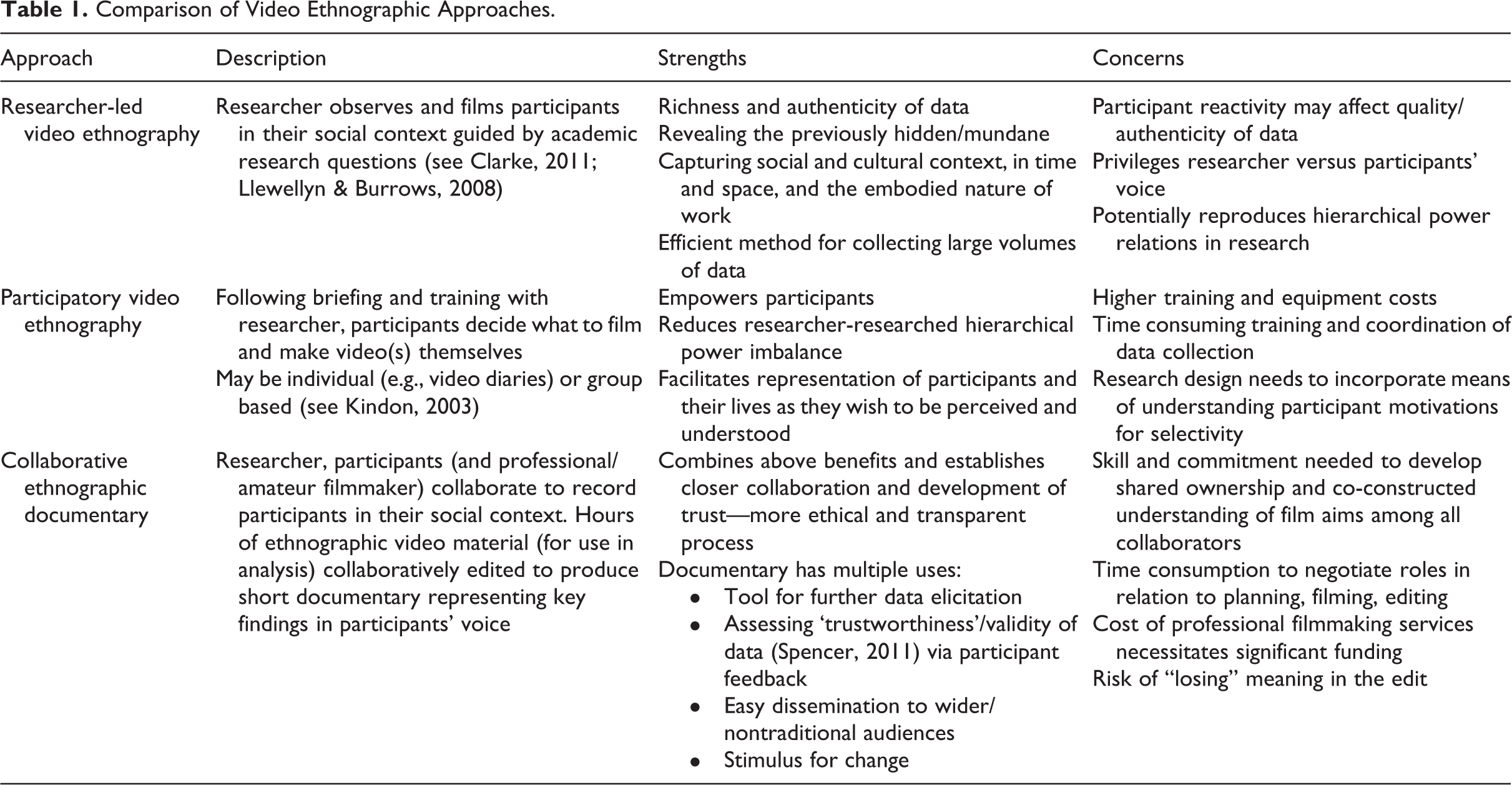
In researcher-led video ethnography, data are generated by researchers observing participants in their social context, guided by initial research questions and objectives. Researchers carefully preselect organizational settings to generate the data they are seeking to capture (see Clarke, 2011). While this approach potentially offers data that form a rich, authentic representation of the social, cultural, and embodied context of work practice and experience (Spencer, 2011), of particular concern is the extent to which the presence of a researcher might affect interactions and behavior (i.e., participant “reactivity”), and how researchers’ preexisting understandings might influence the framing and selection of visual data (Banks, 2012). To circumvent these difficulties, participatory video ethnographic designs can be adopted. Here researchers explicitly involve participants in the research process, inviting them to generate video data by filming events or organizational phenomena that are salient to them (see Kindon, 2003). This “participant-led” approach has great potential to represent participants’ stories in a way that more closely reflects their lived experience (Spencer, 2011). It is an effective way of accessing and articulating the views of traditionally less advantaged or relatively powerless groups (Parr, 2007). It also reduces the power imbalance between the researcher and researched, enabling a way of looking “which does not perpetuate hierarchical power relations and create voyeuristic, distanced and disembodied claims to knowledge” (Kindon, 2003, p. 142). However, shortcomings of this approach include participants perhaps lacking necessary technical skills, and being selective in what they film. It is therefore important that in planning participatory video research, time and budget are allowed to adequately train and resource participants. It is also important to develop trusting relationships with participants to understand the motivations behind their choices and framing of video material.
In light of the limitations of the above methods, Banks (2012) asserts that the dominant trend is toward using the camera to create ethnographic films coproduced with participants. Researchers and participants may also collaborate with professional (or experienced amateur) filmmakers to record participants in their social context (e.g., Parr, 2007). We label this approach collaborative ethnographic documentary to emphasize the role of multiple parties in jointly planning, filming, and editing a condensed representation of particular social and organizational phenomena. This approach retains the benefits of both researcher-led and participatory methods but also offers distinct strengths of its own (see Table 1). Foremost among them is that the higher degree of collaboration required serves to establish much closer relationships between researchers, filmmakers, and participants (Kindon, 2003). This enables a more trusting, transparent, and ultimately more ethical process that, in turn, enhances confidence in the authenticity of the data (Parr, 2007).
The collaborative ethnographic documentary is made by editing video material (with input from participants and technical assistance from the filmmaker) to produce a film with a coherent visual narrative, encapsulating the essence of participants’ lived experiences (Parr, 2007). While the “uncut” video material can be retained for conventional ethnographic analysis alongside other data sources (Spencer, 2011), the first edit (“rough cut”) and/or the final edit of the documentary film have multiple additional uses. Foremost among these, the documentary can function as a data elicitation tool based on researchers’ and participants’ responses to viewing the film. The documentary can elicit new, and more nuanced, data in two ways. First, as an investigative tool, the documentary can draw researchers’ attention to previously taken-for-granted or unseen aspects of experience, prompting new research questions and further conversations with participants (Heath et al., 2010; Parker, 2009). Second, the film can serve as a reflective tool—a stimulus and frame of reference for participants’ self-reflections—leading to elaboration of the film contents and/or prior interview data (Haw & Hadfield, 2011). The documentary also offers a means of assessing “trustworthiness” or validity (Spencer, 2011) of the findings in the eyes of participants; a stimulus for change, via dissemination to organizational or institutional leaders (Kindon, 2003; Parr, 2007); and a means of more easily disseminating the research findings to wider/nontraditional audiences (Kindon, 2003) to increase the social impact of the research.
However, relative to researcher-led and participant-led video methods, there are several potential challenges to realizing the advantages of collaborative ethnographic documentary. In practical terms, the services of professional film producer (e.g., a freelance individual) may be prohibitively expensive. A great deal of time and interpersonal skill are needed to develop trust and a sense of shared ownership with participants, to negotiate roles, and to co-construct a shared understanding among all parties of the aims of filming (Parr, 2007). Without careful attention to these issues to arrive at a “transparent and negotiated approach” (Spencer, 2011, p. 59), there is a risk of “losing” meaning or misrepresenting/overriding participants’ realities through insensitive filming or editing. Finally, if the documentary is intended to have practical impact, researchers need to plan for, and commit to, the “long haul” of collaboration (Kindon, 2003). For example, it is important (and ethical) to sustain processes that involve participants beyond the fieldwork/filming stage to share and discuss a rough cut or rough cuts and final edit of the video material, and to negotiate how and to whom the film should be disseminated.
Extending “Traditional” Ethnography
Collaborative ethnographic documentary extends “traditional” ethnographic practice in important ways (see Table 2 for a summary). Traditional ethnography is concerned with the “study and representation of culture” (Van Maanen, 2011, p. 221). In the “standard model” of ethnographic research a single researcher immerses himself or herself in the context of study for an extended period of time, observing and taking field notes (Van Maanen, 2011). Studying people in their natural environment facilitates rich description of people’s constructions of their everyday activities, norms, and values to reveal meaning in the mundane and “how things work” (Watson, 2011). Immersive fieldwork also conveys the prevalence of particular themes, reducing the likelihood of “overinterpreting” data. However, as contemporary work and organizations become more flexible, dynamic, and geographically dispersed, the extent to which participants’ social realities can be observed and recalled by a single-site researcher is constrained (Smets et al., 2014). In collaborative ethnographic documentary, the focus on capturing and understanding participants’ constructions of the everyday remains core, but filming offers greater efficiency and flexibility. Participants can identify the most important times, places, and things that should be filmed (Parr, 2007). Researchers are then able to capture a faithful visual record of the many seemingly unremarkable, transient details of everyday life (including the social and material) that really matter in the participants’ world but might be missed by an overloaded traditional ethnographer (Smets et al., 2014; Spencer, 2011).
Comparison of Traditional Ethnography and Collaborative Ethnographic Documentary.
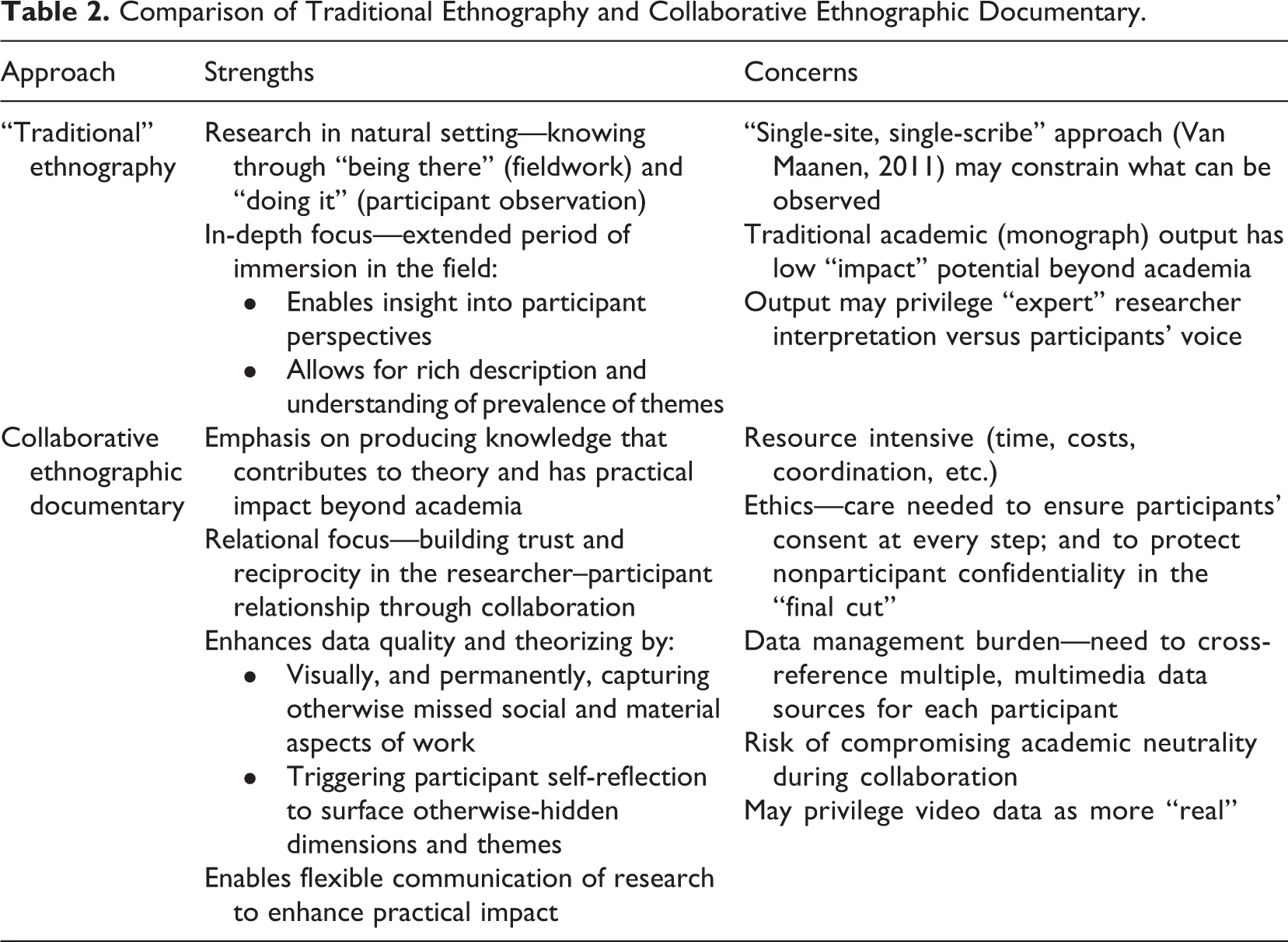
According to Smets et al. (2014), a further concern with traditional ethnography is that it is increasingly challenging to produce research outputs with tangible benefits or “impact,” for example, practical recommendations applicable to audiences beyond academia including participants, organizations and/ or wider society. More accessible communication of ethnographic findings, to suit these diverse audiences, is also needed (Smets et al., 2014). Related to this, traditional ethnography is sometimes criticized for reproducing dominant power relations and privileging “expert” researcher perspectives over those of informants (Pink, 2007). In contrast, a key strength of collaborative ethnographic documentary is the focus on building greater trust and reciprocity—i.e., mutual benefit—into the research process (Parr, 2007). This approach empowers participants and creates a safe space for self-reflection and expression of views, which in turn may strengthen data quality and permit new insights that better reflect participants’ perspectives (Kindon, 2003). Wider organizational or societal impact is also made possible because the documentary film itself offers flexible communication options for reaching key stakeholders (Parr, 2007) via research websites, social media, or screenings for organizations and the public, for example.
Relative to traditional ethnography, collaborative ethnographic documentary brings challenges that must be anticipated and addressed. As shown in Table 2, compared with traditional ethnography, collaborative ethnographic documentary may be a more resource intensive approach because managing the process of collaboration (e.g., including multiple coordination, planning, and follow-up meetings)—in addition to actually making the film—can be time-consuming and expensive. It is therefore important to factor in time and costs of all aspects of collaborative film production in the earliest design stage, to ensure adequate resourcing. Collaborative ethnographic documentary generates large volumes of visual data (compared with researcher memory and field notes in the traditional approach). A clear plan for managing multimedia data sources and systematic data management using CAQDAS (Computer Aided Qualitative Data Analysis Software) can help to ensure nothing is “lost” or forgotten. Collaborative ethnographic documentary, as with visual research more broadly, risks privileging the visual as more “real” than other data sources (Bell & Davison, 2013). It is also possible that the process of collaboration, and emphasis on achieving practical outcomes, could somehow compromise “academic neutrality.” Strong reflexivity, including keeping a research journal of decisions made (e.g., what should be filmed or omitted, and why) and a commitment to an open and transparent researcher–participant relationship (Spencer, 2011), can help to alleviate these concerns. Finally, collaborative ethnographic documentary poses greater ethical challenges compared to standard ethnography, particularly if the film is to be disseminated as part of the research output. We discuss ethical considerations and how to address them in more detail below.
Ethical Considerations
The core ethical issues associated with video-based research—as with all visual research—concern consent, confidentiality, and anonymity (Wiles et al., 2008) driven by the need to protect the dignity, privacy, and well-being of research participants (Wiles, Coffey, Robinson, & Prosser, 2010). In video-based research, these considerations are particularly salient given that video images can more easily jeopardize participants’ and organizations’ anonymity (Harper, 2005; Warren, 2009) and lead to exposure of sensitive areas of individual lives and business organizations (Ray & Smith, 2011). Indeed, employees in organizations might worry about their views being exposed to management (Ray & Smith, 2011). Participants can also become very distressed by how their voice/image is edited and presented (Parr, 2007). There is also the possibility that researchers/filmmakers might intrude on, and interrupt, the daily activities of participants, and impose on the film (via framing and editing) their preconceived views about those who are the subject of the film (Spencer, 2011).
In light of these issues, obtaining informed consent from participants is of paramount importance. Express agreement is needed on the making and use of images—the latter covering both the use of video material for the research, and how the images will be utilized for publication and dissemination (Ray & Smith, 2011; Wiles et al., 2008). In collaborative ethnographic documentary it is important to ensure that both types of consent are obtained at two points in the process: before filming, and before showing/disseminating the material. The discussion should include which audiences the participants are happy for the material to be shown to. Providing detailed explanations of the research process, the goals of academic publications, and the nature of dissemination outlets can also help to establish credibility and trust with participants (Ray & Smith, 2011). Overall, in collaborative ethnographic filmmaking, ethical problems should be reduced because the relationship between researcher and participants is inherently closer, and the researcher/filmmaker is not the sole editor of the final film (Parr, 2007). Indeed, collaborative ethnographic documentary enables the kind of trusting, collaborative relationships and empowerment of participants to represent themselves that are increasingly advocated in all ethical visual research (Pink, 2007; Spencer, 2011; Wiles et al., 2008). As Spencer (2011) notes, “A collaborative and transparent approach should be encouraged in the mutual interest of integrity and honesty and in presenting a valid representation of social reality” (p. 65).
To summarize, the potential of collaborative ethnographic documentaries in organizational research has been largely overlooked. Based on our review, we suggest that the collaborative ethnographic documentary offers a way of conducting and disseminating research that is potentially more empowering, ethical, and representative of participants’ voice and lived experiences than other video-based methods, and traditional ethnography alone. To further illustrate the potential benefits for researchers and participants, we include in the next section an example of using collaborative ethnographic documentary in our own research.
Lessons from a Collaborative Ethnographic Documentary
In our research, collaborative ethnographic documentary emerged as a solution to difficulties we encountered in engaging participants with our initial, more traditional ethnographic research design. Incorporating collaborative ethnographic documentary enabled the development of greater trust and reciprocity between researchers and participants. This, in turn, enhanced the quality of data collected and enabled new theoretical insights, as well as providing the foundations for practical impacts of the research. In this section, we introduce the aims of the study and describe the problems that arose with more standard ethnography. Next we detail the rationale for and processes by which we revised and implemented our research design to incorporate collaborative ethnographic documentary. We then outline our approach to data analysis for combining visual and verbal data sets. Finally, we present examples of how collaborative ethnographic documentary enabled richer data and supported practical outcomes for participants and their organizations.
Research context
The research investigated working-class men doing “dirty work” (tasks and roles seen as disgusting, “distasteful,” degrading, or otherwise tainted in key respects; Ashforth & Kreiner, 1999). The project took place in London; it was an exploratory qualitative study funded by a U.K. funding body, the British Academy. The study sought to bring together two aspects of workers’ experience—the material and the discursive. Interest in the material and embodied aspects of workers’ experience was motivated by two considerations: First, echoing concerns about the “isolationist agenda” in organization studies more broadly (see Hardy & Thomas, 2015; Philips & Oswick, 2012), materiality in recent studies of dirty work has been either neglected or discussed too narrowly so that the ways in which everyday practice is bound with materiality are overlooked (Orlikowski, 2007). Second, little is known about the potential for the material to interfere with the coherence and soundness of normative narratives and discursive representations—that is, how the dimensions of materiality (objects, practices, bodies, and space) can support or undermine the production of cohesive narrative accounts (Putman, 2014).
The aims of the study were twofold. First, we sought to build theory in the area of dirty work by addressing the previously neglected sociomaterial aspects of workers’ experience, and by refining existing categories and relationships in the literature (Locke, 2001, p. 103). The research was guided by the following broad questions: How are the physical and material dimensions of dirt experienced by participants in the study? In what ways, if at all, do the material and the symbolic intertwine in understanding of experiences of dirty work? In what ways, if any, do such categories of difference as class or gender influence the experiences of dirty work? Second, we sought to develop the potential impact of the research. In the U.K. research context, funding bodies increasingly value research that is cognizant of broader societal concerns. Accordingly, we sought to make a rigorous theoretical contribution with practical relevance for participants and their organizations. We further discuss impact later on.
To extend theory, we selected a research context that could serve as an extreme case (Eisenhardt, 1989). Extreme cases facilitate theory building because the dynamics being examined tend to be more visible than they might be in other contexts (Pratt, Rockmann, & Kaufmann, 2006). Applying this criterion, street cleaning, refuse collection, and graffiti removal were a suitable context since they intensify differences along two dimensions particularly pertinent to dirty work: (a) physical rather than symbolic proximity to dirt and (b) direct contact with the public, which should intensify participants’ sensitivity to stigma and the need to reconstruct valued identities. Choosing an extreme case, however, presented challenges; in particular, how best to research participants who may be unaccustomed to self-disclosure, whose willingness to participate might be inhibited by expectations of negative evaluation, and who might lack trust in researchers’ intentions as a result of perceived social differences. The expectation of negative judgment, and the vulnerability of a low status position, may lead to an unwillingness to express negative feelings, or to stronger adherence to identity-affirming norms to resist potential devaluation.
To try to overcome these challenges, the researchers at first adopted a research design that combined traditional ethnographic participant observation with photographic representation (researcher-only photographs), followed by photo-elicitation interviews (see Figure 1, Phase 1). Ethnographic participant observation was warranted to enable direct experience of daily routines involved in the type of work studied, opening up a fuller articulation of the habitual and mundane practices that might otherwise have gone unexplored. At the preliminary design stage, both researcher-led photographic and (nondocumentary) video-based methods were considered as options for visually enriching the data set. We opted, at this point, to use researcher-produced photographs rather than video. This initial choice was driven by theoretical as well as practical concerns. Both methods offered the potential to enhance theory development (Pink, 2001) by capturing the materiality and the physical aspects of work. However, in practical terms, relative to the time and costs associated with video-based methods, photography was likely to be less resource intensive.
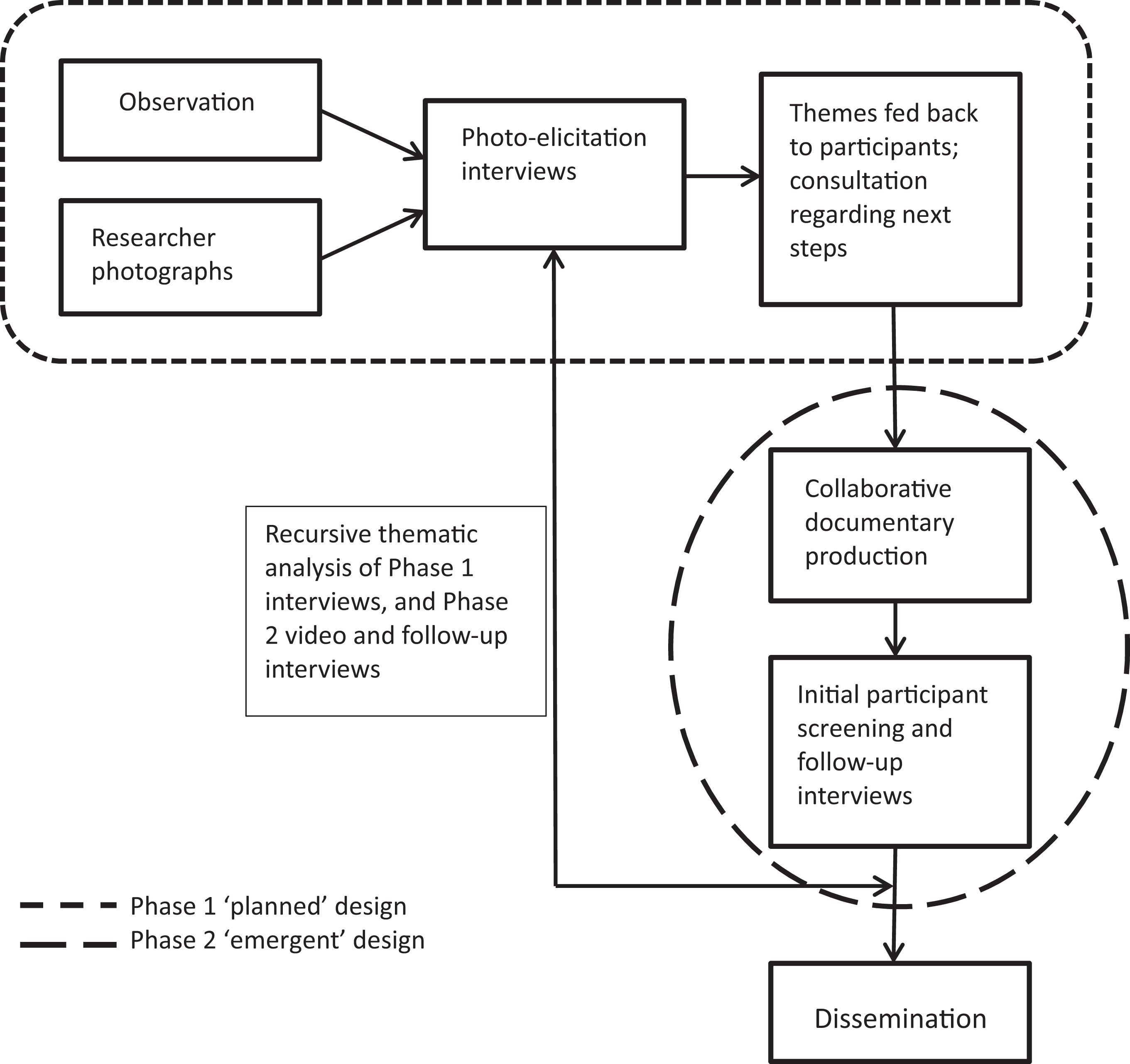
Evolution of a Collaborative Ethnographic Documentary Research Design
A further practical consideration was that filming might be more likely than photography (a less intrusive method) to be read by participants as an additional form of workplace monitoring or surveillance. Workers in the study were already required by their employers to wear pagers that tracked their progress on the streets as they worked. Therefore, it was possible that despite ethical assurances, participants might view researchers with video equipment with heightened suspicion. In turn, this perception could arguably result in reduced trust, increased nonparticipation, and increased evasive responses. Trust was central to this study given that male participants are often reluctant to discuss experiences that might disclose their vulnerabilities as this contradicts cultural ideologies that position men as powerful and resilient (Oliffe & Bottorff, 2007). Moreover, disclosure has the potential to further marginalize participants already adversely affected by physical proximity to dirt and low occupational status. In sum, based on these considerations, the planned approach was to analyze photographs, transcripts of photo-elicitation interviews, and observational field notes together to identify common themes that could contribute to our understanding of how the material and the symbolic intertwine in experiences of dirty work.
Navigating Trust and Reciprocity
In practice, the research evolved differently from the original design. After 28 interviews (from 57 in total) it was apparent that fear of negative evaluation and respondents’ distrust of researchers’ motives (“we have to be careful what we say” was a refrain of many interviews) restricted verbal exchanges—leaving more contentious issues undiscussed. No doubt, some of these difficulties in data collection were inadvertently produced as a result of the perceived social differences between researchers and participants. There was a presentiment among participants that their voices were not going to be heard even if they shared their views.
In Phase 1 of the research, participants unanimously insisted that they liked their job, in particular, the fact they could work outside and were not stuck in the office. They were also willing to engage with discussions that opened up possibilities for construction of valued identities, for example, conversations that encouraged a display of masculinity through the demonstration of strength and endurance. Overall, however, the information collected at this stage offered only limited insight into the experiences the project sought to explore. The interviews were stopped at this point because the researchers were worried by participants’ reluctance to share their insights.
Confrontation with participants’ reluctance to engage raised two issues: first, concerns regarding the quality and richness of the data and, second, the question of (lack of) reciprocity—or mutual benefit—from the research. Amis and Silk (2008) stress that the ways in which we study workplaces might advantage some members of society and disadvantage others. In particular, researchers can act as “plunderers” of the stories of “others”—often those with little power—for personal as well as academic advancement and without any accompanying sense of reciprocity (Sandercock & Attili, 2010). Similarly, Geertz (1988) criticizes the unhealthy self-absorption of some academic writing and research activities, and the lack of interest in more practical implications of research findings. Attentiveness to reciprocity is viewed as a way of reversing hierarchical dynamics (researcher/participant) that might hinder rapport building and trust development (Dundon & Ryan, 2010).
The above concerns motivated researchers to go “back to the drawing board” to consider how best to deprivilege their own (academic) agenda and establish a more mutually beneficial and trusting research relationship. Specifically, the researchers sought ways of “democratizing” the research project, using a more “proactive forum for dialogue” (Oliffe & Bottorff, 2007) to offer participants a more independent voice. This led to the proposed evolution of the research design using collaborative ethnographic documentary (see Figure 1, Phase 2). Drawing on an analysis of the challenges outlined above, and a review of the available video ethnographic methods discussed earlier, collaborative ethnographic documentary was viewed as the method that (from the researchers’ perspective) could best achieve a more democratic, trusting process with mutually beneficial outcomes (e.g., enhanced data quality for the researchers and giving voice to participants’ concerns). Fundamentally, however, it was also important that participants embraced the proposed new approach. In the next section, we outline the further steps and considerations that ultimately led to the production of a collaborative ethnographic documentary.
An Evolving Research Design: Collaborative ethnographic documentary
Denzin (2003), discussing the multimedia ethnographic approach, highlights the importance of establishing a colearning environment whereby researchers and participants jointly explore emerging research paths that might inform further research (Sandercock & Attili, 2010). Based on this, before approaching the participants, all Phase 1 interviews were first transcribed and coded for emergent themes. Qualitative analysis software (NVivo) was used to assist in coding, storing, and managing the data efficiently. Field notes, field observations, and photographic images taken by the researchers were carefully catalogued and coded to make sure that they comprehensively covered the range of daily working routines and practices, and could be linked to related themes identified in the interviews. Themes included encounters with dirt/waste/stains, work routines and practices, participant histories, relations with the public, recognition, and change.
Next, the researchers presented key findings from the analysis to the Phase 1 participants. Participants were consulted over whether they would be interested in making a collaborative documentary, and whether they could assist in choosing the main focus of the film from several broad “themes” identified in the preliminary analysis. Participants consented to be involved. Participant responses to the invitation suggested collaborative ethnographic documentary offered a method of engaging participants in a research medium that they could more easily relate to compared with the standard ethnographic methods used earlier in the project. The prospect of filming generated excitement and enthusiasm among participants. They appeared very interested in media/film production in general—an interest that might reflect the increasing prevalence of reality-based TV shows and contemporary fascination with celebrity culture in the United Kingdom. In addition, participants were confident that a documentary film of their experiences could more effectively summon attention to their concerns by visually “bringing them to life.” These positive reactions confirmed the decision to pursue a collaborative ethnographic documentary.
Before finally embarking on the collaborative ethnographic documentary process, a technical decision was needed on whether to employ a professional filmmaker or pursue a more “amateur” approach. To inform this choice, the researchers assessed the practical costs and benefits of alternative modes of filming (see Table 3). Filmmaking can be achieved through various means ranging from amateur filmmakers and equipment such as cell phones and hand-held video-cameras, to professional film production equipment operated by trained filmmakers. While amateur “home movie-making” technology is affordable, portable, and easy to use, the trade-off is a potentially lower audio and visual quality due to lack of technical knowledge of lighting, sound, composition, and editing (Spencer, 2011). This could limit the academic value of the material and its suitability for later communication of the research. In addition, the deceptive ease of basic filming may encourage a lack of reflexivity and selectivity about what is filmed and how it is framed, generating too much—potentially random/tangential—data (Spencer, 2011). Employing professional filmmaker(s) and equipment is more expensive, and may lack flexibility due to the more cumbersome nature of professional equipment and possible limits on filmmaker availability. In addition, working with professionals requires time for careful coordination and planning between all parties, as noted in the previous discussion. However, the higher quality audiovisual output may be a more focused and accurate record of experiences in the field, and may be particularly appropriate when wider dissemination (e.g., uploading to a research website, public screening) is intended.
Comparison of Video-Based Technical Alternatives.

In light of these practical considerations, the preferred method for the next phase of the research was a collaborative ethnographic documentary employing the technical assistance of a freelance filmmaker. Overall, this was considered the most effective means of establishing the desired collaborative relationship between researchers and participants while, at the same time, producing high-quality output that could contribute to the wider practical aims of the research. Increasing participants’ engagement in the research through a film production project, and the importance of achieving reciprocity and practical impact, justified the additional costs involved.
Participants were included in the whole process of filmmaking—in planning, programming, in the filming itself and in editing the film. 2 The film’s themes were discussed in detail with participants before filming began, and decisions on what to include were made collaboratively. The purpose of the discussion was to cocreate both a process and an outcome that delivered shared benefits and enhanced reciprocity in the research relationship (Sandercock & Attili, 2010). Priority areas identified by participants were work routines and challenges associated with changes in regulations, at work, and in communities, and recognition and encounters with the public. Overall, the collaborative processes involved in the film project aimed to develop trust by establishing that the researchers were seeking to represent participants’ views, and willing to publicize them.
The main uncertainty related to producing the collaborative ethnographic documentary was how to make the film as authentic as possible, minimizing participant reactivity and avoiding privileging the researchers’ voice. To address this, we decided that the filmmaker and researchers would adopt a “stand by” position, or a way of looking “alongside” rather than “at” the participants (Kindon, 2003). Specifically, voice-over narration was omitted in favor of participants telling their own stories in their own words. Five days of filming took place; participants were filmed and interviewed at work. The filmmaker prompted conversation with participants using the questions prioritized in advance by participants. Context was provided by filming participants’ working environment, and a wide range of tasks performed during the day.
Analysis: A recursive cyclical process
Once filming was completed, the researchers started work on analysis: examining the video material to expand the findings of the Phase 1 interviews and develop a protocol for further interviews. There is no single established methodology for analyzing video data (Smets et al., 2014). A major concern in this analysis process was how to make two data sets (i.e., visual/nonverbal and verbal) work better together. This was central to gaining insight into the interplay of material and discursive elements of dirty work. Focusing predominantly on discursive or material aspects of work and organizations would limit the potential to uncover material aspects of dirty work, or the role of materiality in the discourse of dirty work, for example (Hardy & Thomas, 2015; Philips & Oswick, 2012). The challenge was to represent the material without neglecting the discursive and vice versa. In data analytical terms, this tension implies researchers must consider how to avoid reducing images to a subordinate role (e.g., using them solely as an illustration of verbal interactions) yet, at the same time, not privilege images as more “real” than verbal data, or vice versa (Bell & Davison, 2013).
To this end, following Hindmarsh and Pilnick (2007), the researchers drew iteratively on the two data sets to reflexively view and re-view episodes of lived experiences in fine-grained detail. Comparing observations from the video coding with insights from the Phase 1 data was thus a “recursive cyclical process” (Engle, Conan, & Green, 2007). Merging the insights from the film and existing data provided an opportunity to “sharpen the focus” of the research (Spencer, 2011), raising new questions, and registering previously unnoticed aspects of work routines and engagement with the public, as well as suggesting a new emphasis or significance for things previously observed but not fully appreciated.
Analysis of each visual instance (i.e., a selected video segment) began with the production of a transcript of the parallel conversation/audio in the segment, and a detailed description of the visual episode. The instance captured in Figure 2 was described as follows:
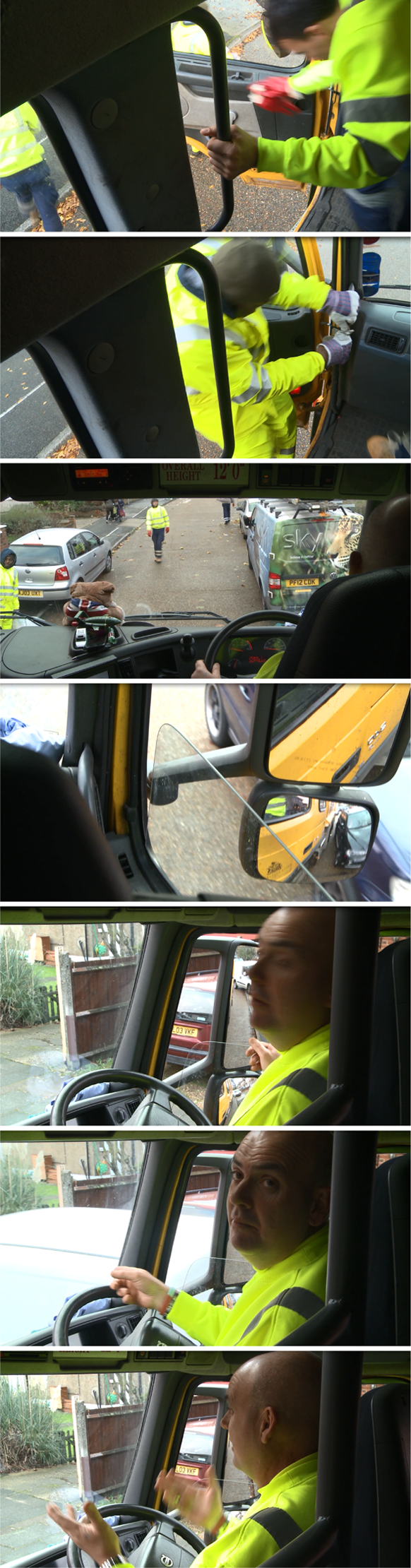
Image Sequence From Collaborative Ethnographic Documentary.
It is early in the morning. The roads are busy with traffic getting heavier as more people are rushing to work. The episode in the film shows the dust cart (a vehicle of a significant size) stopping in the residential road. Three men jumping out of the cart to bring wheelie bins to the vehicle, the driver of the dust cart stays inside continuing his conversation with the filmmaker. The traffic is building up behind the vehicle. The drivers in the vehicles behind the dust cart are getting impatient. A white car passes the dust cart by driving on the sidewalk. The driver of the dust cart points to the car on the sidewalk. He shakes his head in a disapproving mode and waves his arms in frustration and resignation.
3
To test the researchers’ understanding arising from the analysis, explore new issues, and engage participants further in collaborative practice, a first rough cut of the documentary film was shown to participants (approximately 3 hours of digital video footage). The researchers asked participants what should remain in the final edit, what could be removed, and which segment(s) of the documentary they found most representative of their working lives. Further “analytic conversations” (Smets et al., 2014), akin to informal follow-up interviews, with individual participants based on extracts from the first cut of the documentary were also conducted at this time. Topics covered were participants’ responses to the film and newly emerged issues and questions from the analysis so far.
Enhancing the Quality of Data
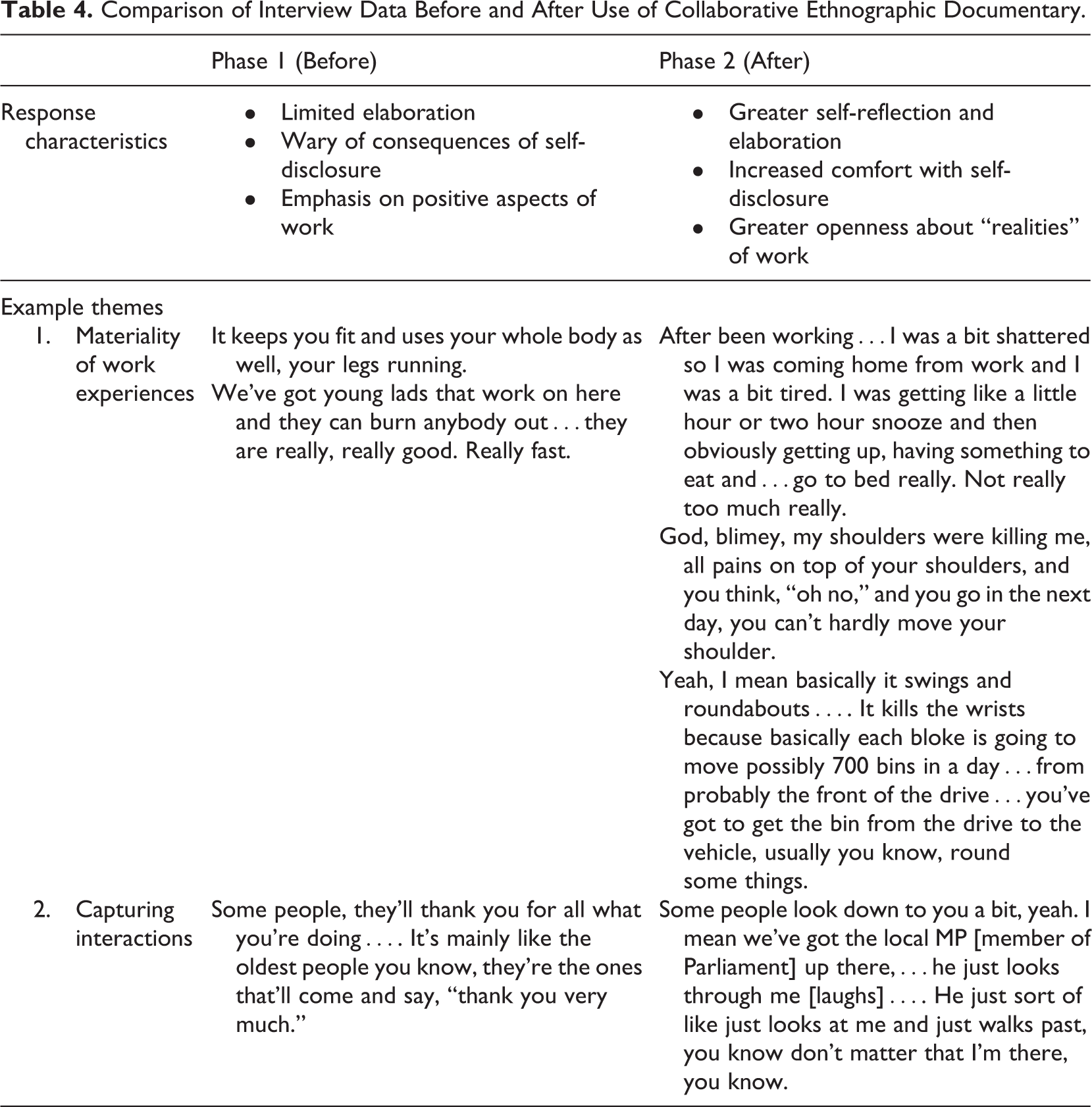
By building greater trust and reciprocity into the research process, collaborative ethnographic documentary enhanced the quality of subsequent interview data. After showing the first rough cut of the film to participants, the researchers were able to broach more sensitive, previously undiscussed topics. Moreover, as we outline below, the documentary enabled observation and discussion of embodied, material aspects of work and complex interaction dynamics which were absent from earlier verbal responses and static photographic images (see Table 4 for examples).
Comparison of Interview Data Before and After Use of Collaborative Ethnographic Documentary.
Materiality of Work Experiences
Scenes in the documentary detailed the physical and material dimensions of the participants’ work experiences the size of the vehicles, the awkwardness of moving the bins (bumping them down), the unevenness of road surfaces, and the variety of cleaning equipment. The long shots at the beginning of the documentary, and the camera tracking the movement of the vehicles and the workers, generated a fuller picture of the working conditions, including revealing spatial and temporal aspects of practices involved. The film offered a different angle on the demands of the job. When the camera focused on the subject itself it made certain aspects of participants’ physique suddenly more visible—hands with blisters and injuries, faces beaten by the weather conditions, hunched backs, and arthritic joints.
The documentary images of the materiality of participants’ work experiences functioned as an investigative tool (Heath et al., 2010; Parker, 2009) that directed further lines of inquiry. Specifically, the images prompted a rereading of the Phase 1 interview data and drew researchers’ attention to participants’ replies that were previously unnoticed. For example, to the question on what participants would do after work the response was consistently a brief statement such as “sit down.” In the postviewing follow-up conversations, the researchers were able to elicit more extended discussions related to physical tiredness. The documentary also provoked exploration of how the physical practices of dirt’s removal could place a considerable stress on the laboring body and result in daily physical discomfort. These issues had previously been “under the radar” of the researchers because they were given little emphasis by participants in Phase 1.
Capturing Interactions
The film also documented the embodied encounters with things and persons, attending to complex dynamics of interactions between material objects and people—for example details such as the refusal of eye contact in interactions with the public—which were omitted or missed in the original (Phase 1) conversations and photographs. When participants’ viewed these images, the documentary served as a reflective tool (Haw & Hadfield, 2011) stimulating greater participant self-awareness and expression. The scenes from the film offered a form of endorsement of participants’ experiences authorizing them to reflect on their feelings and verbalize their concerns. This opened up new discussions associated with the frustrations of the big city—dealing with narrow roads, heavy traffic, disrespectful drivers, unlawful parking, and impatient pedestrians. It also started a more detailed conversation regarding public attitudes. Participants’ readiness to reflect on these troubling feelings with the researchers was arguably a result of the greater trust that had developed throughout the collaborative filming process.
Developing Research Impact
A key aim of the research was to build in greater reciprocity by enhancing the practical benefits of the research for the participants and other stakeholders. As Pain and Francis (2003) note, there is often a divide between researchers’ intentions to consider practical implications of research and actual practice and outcomes. However, using collaborative ethnographic documentary may strengthen practical impact because the resulting film offers an effective communication tool to stimulate dialogue, and set in motion change that is mutually beneficial to employees and organizations. 4 In the present study, after consultation with participants, the film was shown to the management team. Managers reacted positively and constructively. After viewing the film, managers, although apprehensive at the start (anticipating condemnation), felt reassured by participants’ willingness to reflect on their concerns and by their balanced comments; they were also surprised and moved by the intensity of participants’ emotions, such as those evoked by perceived disrespect from the public.
The documentary empowered participants by providing an opportunity to tell their stories in their own words (Ray & Smith, 2011; Spencer, 2011). Previously, in a precarious labor market, fears over job security silenced participants’ concerns. However, the documentary presented powerful visual evidence that exposed and validated participants’ concerns, and authorized them to speak. In turn, the film facilitated a more open and fruitful dialogue with management about the issues of most concern to participants—in particular negative public attitudes and their impact on perceived working conditions. The screening of the documentary film prompted self-reflexivity from the management team. After viewing and discussing the film, managers acknowledged the validity of workers concerns and recognized more could be done to change public perceptions. Consequently, managers developed plans to educate the public regarding the demands of the job to challenge negative attitudes and to better manage expectations. More broadly, the management team realized that policies aimed at improving quality of service and customer satisfaction were often perceived by participants as management’s indifference toward, or reluctance to support, workers’ interests. Viewing the film encouraged managers to begin to rethink their approach.
Discussion
The aim of this article was to introduce collaborative ethnographic documentary as a method to assist future organizational researchers in achieving more insightful and impactful research, founded on principles of researcher–participant trust and mutual benefit. We have argued that the significant academic value of the collaborative ethnographic documentary, as demonstrated in this article, is as an important tool in the ethnographer’s tool-kit that can contextualize and enrich other data collected through more conventional ethnographic means. Adopting collaborative ethnographic documentary in our own research highlighted its power to extend the reach of traditional ethnography, eliciting a fuller, yet more focused exploration of participants’ experiences.
Using a combination of collaborative verbal and nonverbal (visual) elements of the process facilitated communication between two groups that do not share taken-for-granted cultural backgrounds (Harper, 2002), helping to foreground participants’ accounts and capture less recognized aspects of their work. Harper (2002) highlights the difficulties of “jolting” participants and researchers into an awareness of taken-for-granted aspects of their own experiences. What can be immediately recognizable and accessible to researchers might be less obvious to participants and vice versa, since what is observable is often preconditioned by one’s framing of “normal” and “ordinary.” Making joint decisions about what was important to keep in the final edit simultaneously exposed, and helped to bridge, differences between researchers’ and participants’ perspectives. The rough cut of the film depicted interactions and experiences of work that, when viewed by researchers and participants together, served to anchor (verbal) analytical conversations in their visual (nonverbal) context, facilitating further exploration of issues and experiences in a manner that was accessible to both parties.
Collaborative ethnographic documentary also enabled us to address an important conceptual gap by elaborating how the material and the symbolic intertwine in experiences of dirty work. Using collaborative ethnographic documentary generated data that offered new insights into both the material (from visual/film data) and discursive or symbolic (from verbal/interview data) dimensions of dirty work, and the interplay between them. Specifically, the collaborative ethnographic documentary facilitated new understandings in two key ways. First, serving as an investigative tool the documentary film exerted its own power and agency (Pink, 2003) independent of narrative accounts. Collaborative ethnographic documentary facilitates the production of what LeBaron (2008) labels “premium data” by capturing small moments and subtle details, and providing verifiable and defendable grounding for interpretive claims. In our study, the collaborative ethnographic documentary enriched participants’ narratives (drawn from previous interviews) with visual insights into, previously unaccounted for, material and embodied aspects of their experiences. In turn, this enabled the researchers to query participants’ tendency to adhere to the limited discursive resources that are traditionally available to low status groups and typically deployed to defend against anticipated negative evaluations. Thus, a more nuanced, contextualized understanding of dirty work and the sensitivities that might lie beneath dirty workers’ commitment to particular normative standards was achieved.
Second, the collaborative ethnographic documentary served as a reflective tool helping participants develop self-reflexivity and elaborate their (previously limited) narrative accounts. In the present study, the film images, sequences of events, and interactions created a clear focus and point of reference for participants’ self-reflections (Haw & Hadfield, 2011). In addition, participation in production of the film shifts the dynamic of the hierarchical power relations that often characterize academic research (Punch, 2000). Providing participants with opportunities to effectively take charge as experts enhances their willingness to share and reflect on their experiences (Oliffe & Bottorff, 2007). Hence, the development of stronger researcher–participant trust through the collaboration process, and the capacity of the camera to capture overlooked (material and/or discursive) elements of experience, respectively functioned as an emotionally safe space and a trigger for participants to engage with, and verbalize, previously unexpressed negative sentiments and troubling experiences.
Managing Tensions in Collaborative Ethnographic Documentary
The process of conducting research using collaborative ethnographic documentary brought to the fore two recurring themes or tensions which required careful consideration and management—(a) how best to enact reciprocity in the research relationship in a manner that balances academic and participant goals and (b) how best to generate and combine verbal and visual data in a way that supports a balance between material and discursive perspectives on social phenomena.
Academic and Participant
Throughout this article we have emphasized that collaborative ethnographic documentary is intended as a reciprocal process—with the dual goals of achieving academic insight and practical benefit for stakeholders. On the surface these goals might seem incompatible. However, this concern may stem, in part, from adherence to more traditional hierarchical views of the researcher–participant relationship (Pink, 2001). Underpinning collaborative ethnographic documentary is an alternative, feminist-inspired approach which seeks to create a closer, more trusting and democratic research relationship (Pink, 2001). Traditional academic research often involves articulating the views of others from a position of knowledge and expertise (Bodwitch, 2014), which increases social distance and the power imbalance between researchers and the researched. In contrast, the feminist-inspired approach aims to reduce such a “masculinist” gaze (Kindon, 2003); this is seen as particularly appropriate when academics conduct research with less socially empowered groups (De Lange, Olivier, & Wood, 2008). The aim is to balance academic objectives of advancing the field of knowledge with simultaneously empowering participants and accounting for marginalized perspectives. To achieve this balance, the notion of researchers “giving back”—through encouraging participant engagement and collaboration—is central to a feminist methodology (Bodwitch, 2014).
It is through bridging the traditional divide between researchers and participants, and actively engaging with participants to coproduce a documentary about their working lives, that researchers can gain deeper academic insights into phenomena of interest, from the perspectives of the individuals themselves (Kindon, 2003). Equally, individuals who participate in the collaboration are motivated to do so (at least in our study) because the documentary is a powerful means to show others (e.g., managers, the public) what their working lives “are really like.” This in turn may provide a catalyst or foundation for change that brings desired benefits to participants, as we noted in our study. Hence, if the collaboration is carefully coordinated from the outset, reciprocity of outcomes form a natural part of the research process and academic and practical goals need not conflict. Accordingly, in collaborative ethnographic documentary research, it is essential to devote time to meetings with potential participants to build trust and arrive at a shared understanding of what is, and is not, desirable and achievable (Spencer, 2011) by making a documentary. Researcher sensitivity and listening skills are important in this process.
Material and Discursive
There have been repeated calls to unify a current divide between adopting either material or discursive approaches to qualitative management and organizational research (Hardy & Thomas, 2015; Philips & Oswick, 2012). This divide is both conceptual and methodological in that, by favoring verbal forms of data production over the visual, researchers may automatically afford discursive interpretations of phenomena with greater weight than alternative understandings that reveal the materiality of the same phenomena. Focusing predominantly on discursive or material aspects of work and organizations also hinders the possibility of uncovering the role of materiality in discourse and vice versa (Mauthner, 2015). The challenge is therefore to “bring the material back in” without downplaying the discursive. Fundamentally, this implies that researchers need to find ways to acquire and use verbal and nonverbal/visual data together more effectively.
Haw and Hadfield (2011) highlight that more complex theoretical constructs may be attended to through the use of composite (i.e., verbal and nonverbal) data sets because they can help to fuse the micro and the macro, and observed behavior with the context in which it takes place. Our own research suggests that when collaborative ethnographic documentary is used as an investigative and a reflective tool—as part of a wider ethnographic research design—it allows researchers to combine and interrogate multiple phases of verbal (interview) data in the context of the material and embodied dimensions of experience, as represented in the visual (film) data. As noted previously, this can lead to new avenues of enquiry and theorizing, revealing both material and discursive aspects of experience that may previously have been hidden or deflected by participants’ earlier discursive choices.
In addition, drawing from our first unsuccessful attempts with photo elicitation through to the evolution of the documentary project, the challenges in attempting to obtain and use verbal and nonverbal/visual data together may, in part, be managed by developing a more trusting and collaborative research process. Establishing trust and transparency affords access to better quality data, both verbal and nonverbal (Spencer, 2011). While, arguably, other video methods (e.g., the researcher-led or participatory video reviewed earlier) might also elicit verbal and nonverbal data to help bridge the material-discursive divide, our findings attest to the role of collaborative documentary making in building stronger researcher–participant trust that, in turn, may stimulate greater participant engagement and disclosure.
Practical Considerations
Using an ethnographic documentary approach raises additional practical considerations. First, it is acknowledged that would-be ethnographic documentarists may lack the resources for a full-scale collaborative project involving a professional filmmaker. An alternative might be “collaborative video ethnography.” This method would retain the collaborative emphasis of the documentary approach, but without the end goal of producing a documentary film. To reduce time and costs, amateur filming techniques (see Table 3) could be used by the researchers and/or participants, as appropriate. We anticipate that this approach would still support enhancing data quality through the mutual trust that develops in collaboration. However, the trade-offs may be that, without a collaboratively edited film output, the options for further exploring and refining the data, communicating and disseminating findings, and achieving wider practical impacts may be reduced.
Second, because our own use of the collaborative ethnographic documentary method was emergent rather than planned, it suffered some limitations which future researchers might take steps to avoid. In particular, the filming process can adversely affect the interview process by inhibiting participants, so it is crucial to involve the filmmaker in the research process as early as possible to help establish rapport and build trust with participants. Ultimately, very shy/awkward participants might have to be edited from the final cut on grounds of quality, and it is important participants are aware of this possibility. In addition, the format of the resulting film affects how it can be disseminated. Decisions about how the research is to be disseminated should be made at the outset so that appropriate methods and resources can be built into the research design and film production.
Third, collaborative ethnographic documentary can help us to reconsider how we communicate and present the findings of management research, not only to academics but to practitioners and policy makers. The role of the visual in disseminating findings is recognized in organizational and management research, though currently little attention has been paid to it (Meyer, Höllerer, Jancsary, & van Leeuwen, 2013). Conventional academic publishing currently limits the scope to include video/film in communicating research findings. In the future, publishers might increasingly host websites to hold visual materials. Meanwhile, authors could include web links in journal articles to a research website, or YouTube and Vimeo, so that readers can access the visual material. Authors can also include film “instants,” or photographic stills (Spencer, 2011) within the journal article (see, e.g., Pink, 2007), or short sequences of frames that form a “photo narrative” (see, for example, this article and Llewellyn & Burrows, 2008).
In addition, for wider, nontraditional dissemination purposes, there are several ethnographic film festivals which future researchers might consider. The present documentary is to be screened at a forthcoming Economic and Social Research Council (ESRC) Festival of Social Science. Accompanying the screening, a panel discussion has been organized with academics and nonacademics (the filmmaker, two researchers, council representatives, and some of the workers who collaborated in the film production). Finally, publicly accessible websites, for example, https://www.shortoftheweek.com and the community TV channel http://www.communitychannel.org, also offer a means of broadcasting short documentaries to nontraditional audiences. The opening/closing titles of the documentary can be adapted (e.g., by stating that the film is part of a research project, and including a web link) to direct interested viewers to an associated research website. As well as links to traditional academic outputs (e.g., journal articles), the website could include a short video interview with the researchers to help contextualize the documentary and connect it with the aims and findings of the academic research.
Decisions about the most appropriate dissemination outlet(s) should be guided by a consideration of how best to reach the intended audience(s). Choice of outlet may, in turn, have implications for the length/duration of the final edit of the documentary film. For example, in the project reported in this article the final documentary length was short, with a run time of just 15 minutes. The goal was to produce a concise representation of participants’ experiences and concerns that was digitally compact enough to be easily uploaded to a range of digital platforms, and short enough to be accessible to a range of interested but busy individuals (e.g., managers, employees, students, public).
Finally, in terms of practical applications for educators, managers and organizations, collaborative ethnographic documentaries have the potential to enhance the “real world” relevance of classroom teaching and organizational training. For example, the present film has been used successfully for teaching research methods to undergraduates and postgraduates. In organizations, with appropriate consent from participants, collaborative films could be used to develop training that assists managers and employees in understanding and devising strategies to cope with otherwise “hidden” or “unspoken” negative aspects of work.
Future Directions
In the future, a collaborative approach to documentary-making can facilitate richer accounts in the context, not only of “difficult to reach” groups, but also a range of organizational phenomena that are less amenable to capture through traditional methods. For example, the approach would be useful for any research that requires additional trust and rapport to reveal sociomaterial aspects of work, sensitive topics, or dimensions of work that are poorly understood because employees feel normatively bound not to speak out (e.g., organizational politics, or difficult customer interactions). In other cases, employees may lack conscious awareness of underlying social dynamics or intrapersonal, sociocognitive processes (e.g., team and leader–follower dynamics, or learning and using tacit knowledge in professional occupations). Such phenomena involve processes that may be difficult to capture and represent fully through traditional verbal methods alone. In contrast, collaborative ethnographic documentary could help researchers and participants to select and film meaningful actions, interactions, and contexts as the basis of follow-up conversations/interviews to identify and interpret underlying dynamics. Thus, collaborative ethnographic documentary offers a valuable addition to the ethnographic toolkit that may help shed new light on many social, intrapersonal, and material aspects of work and organizations.
Conclusion
Collaborative ethnographic documentary is little used in management and organizational studies. In this article we sought to demonstrate its potential for extending the aims of more standard approaches to ethnography. The method is not without its challenges, including resourcing, organizing, and coordinating film production, building trusting and reciprocal collaborative relationships, and managing and analyzing large volumes of verbal and visual data. However, if these challenges can be successfully negotiated the researcher may be rewarded with data that are extremely rich and nuanced, enabling new understandings and highlighting previously unaccounted for aspects of work and organizational experience. Furthermore, the resulting documentary film opens up opportunities to give voice to and affect change for stakeholders, and to communicate findings innovatively and accessibly to new audiences. It is hoped that this article serves as a stimulus to future researchers to adopt collaborative ethnographic documentary.
Footnotes
Acknowledgments
The authors would like to thank participants of the video methods workshop in Utah 2015, and Michael Pratt and the anonymous reviewers for their valuable comments on earlier drafts.
Declaration of Conflicting Interests
The author(s) declared no potential conflicts of interest with respect to the research, authorship, and/or publication of this article.
Funding
The author(s) disclosed receipt of the following financial support for the research, authorship, and/or publication of this article: This project was funded by the British Academy (R31014).