



Abstract
Frontline employees in traditional customer service units are under increasing pressure to pursue the twin goals of providing quality service while achieving productivity gains by meeting increased sales targets—that is, being service-sales ambidextrous. Drawing from literature on organizational ambidexterity, this study explores forces that facilitate the conversion from a service-only environment to one that emphasizes both sales and service behavior. With a sample of more than 2,306 frontline employees in 267 bank branches, this study examines the impact of contextual variables on service-sales ambidexterity from a multilevel perspective. It then explores the consequences by analyzing objective financial data at the retail branch level, which reveal a significant relationship between ambidexterity and financial performance. Empowerment and transformational leadership are positively associated with service-sales ambidexterity at individual and branch levels; team support is associated with ambidexterity only at the individual employee level. Managers thus should let service workers exercise their own judgment when deciding when or what to up- or cross-sell. The delegation of authority works best for branch office veterans whose service excellence and selling both are recognized and rewarded.
Keywords
As markets mature and competition increases in most service industries, stakeholders evaluate the efficiency with which inputs transform into outputs (services; Anderson, Fornell, and Rust 1997). Firms thus increasingly substitute capital for labor, such as through automated processes or reliance on information technology (e.g., online banking, self-check-in kiosks, integrated voice response systems). Recently, the spotlight also has turned to how service firms can extract more productivity from frontline service employees, with the recognition that traditional customer service units might double as revenue-generating units by becoming ambidextrous and achieving both customer service and sales targets.
Ambidexterity refers to the simultaneous pursuit of dual, sometimes seemingly conflicting strategic goals (Simsek 2009). To illustrate, organizations frequently face decisions about whether to invest in existing versus new products and services, or adopt differentiation versus low cost production, when they might prefer to excel at both simultaneously. Ambidexterity is akin to Rust, Moorman, and Dickson’s (2002) and Mittal et al.’s (2005) dual emphasis strategy, in which a few capable firms adopt both a cost emphasis and a revenue emphasis to manage their profitability through both efficiencies and customer satisfaction. They caution though that a dual emphasis is difficult to achieve and causes tension because the two emphases reflect different organizational philosophies and compete for resources. Similarly, adding a sales focus to traditional service centers has promising potential for increasing revenues and productivity (Murcott 2007; Reider 2008) but also presents notable challenges.
A McKinsey & Co. report indicates that firms can add 10% to their existing revenues by integrating cross- and up-selling functions into traditional service centers (Eichfeld, Morse, and Scott 2006); other observers suggest this figure is closer to 50% of total revenue (Murcott 2007). Inspired by this potential to increase revenues while keeping operating costs constant, major financial players such as Wells Fargo, Bank of America, and Westpac Bank (Australia), as well as firms in various industries (e.g., Starbucks, Ford Motor Company, British Airways) have implemented ambidextrous strategies in their branch networks. We set out to examine the drivers and consequences of emphasizing dual goals of service excellence and sales simultaneously.
As Rust, Moorman, and Dickson (2002) and Mittal et al. (2005) imply, transforming traditional service units into service- and revenue-generating units can result in unexpected, disappointing consequences, such as deterioration in both service and sales levels (Aksin and Harker 1999) or employee dissatisfaction (Dart 2009). Starbucks’ falling share price and lack of U.S. growth has been attributed in part to the demoralization of frontline baristas when management, in pursuit of productivity gains, suddenly imposed sales performance targets in a setting distinguished mainly by excellent service provision and personal interactions with customers (Berfield 2009). Inconsistent findings about whether ambidextrous strategies have positive or negative impacts on organizational performance suggest the need to examine the consequences (i.e., financial outcomes), as well as potential drivers of a successful implementation of ambidexterity (O’Reilly and Tushman 2008).
In particular, ambidexterity scholars often assert it is crucial to build an organizational context that facilitates successful implementations. Ghoshal and Bartlett (1994) argue that organizational variables influence the attitude and behavior of frontline employees and thus determine the firm’s ability to pursue dual, conflicting strategies. Gibson and Birkinshaw (2004) indicate that social contextual variables (i.e., systems and processes that encourage support) have significant impacts on a branch’s ability to be ambidextrous. People act in accordance with the social systems to which they belong; for example, frontline employees’ perceptions of their organizational context (e.g., perceived empowerment) likely shape their understanding of what is expected of them and guide their work behavior (Biddle 1986). A collective perception of the work environment shared by staff members in a particular branch also might create an office atmosphere that dictates whether staff should continue or modify their current behavior (Liao and Chuang 2007).
However, no studies have explored the organizational forces that facilitate service-sales ambidexterity. This gap offers little guidance for managing the impact of the organizational context at the local level or facilitating the alignment of service and sales strategic foci. With this study, we aim to contribute to literature and managerial practice in several important ways. In particular, our main purpose is to identify success factors for blending service delivery with sales. Rather than relying on employee self-regulation, we show which facets of the work environment contribute to successful implementation. Moreover, we demonstrate that companies should consider branch tenure and reward system designs when embarking on a dual sales-service emphasis strategy.
Conceptual Framework
The concept of ambidexterity has emerged in multiple theoretical domains, including organizational learning and design and innovation. At the firm level, ambidexterity refers to a firm’s capability to strive for the seemingly conflicting goals of exploiting existing competencies and exploring new opportunities (Raisch and Birkinshaw 2008). Exploitation refers to activities designed to refine, implement, and execute current tasks better, to increase efficiency and reliability. Exploration refers to activities such as search, discovery, and risk taking, with a focus on flexibility and variability (Levinthal and March 1993; March 1991). These two sets of activities are disparate and nonsubstitutable, so companies may attempt to realize complementarity by executing both (Gibson and Birkinshaw 2004; Levinthal and March 1993). Growing empirical support suggests a positive impact of such ambidexterity on firm performance.
Yet, firms often have insufficient resources to pursue multiple strategic foci simultaneously, which causes tension within the organization (March 1991). Should the firm invest in an exploitation strategy (emphasis on existing products; pursue growth in current markets) or an exploration strategy (new product development; expand internationally)—or both? Rust, Moorman, and Dickson (2002) rephrase this decision: Pursue increased customer satisfaction or efficiency gains, or both? We extend the discussion by focusing on a particular work unit’s capacity to achieve excellence by exploiting its existing service delivery capabilities while also exploring up- and cross-selling. According to management literature, organizations seeking to perform such seemingly conflicting tasks have two options: structural ambidexterity or contextual ambidexterity (Gibson and Birkinshaw 2004; Gupta, Smith, and Shalley 2006). If it chooses structural ambidexterity, the organization seeks a structural solution (subunit or temporal) to obviate the internal tensions and conflict that stem from its disparate goals. Thus, one organization might have one business unit focusing on sales and another focusing on service. Contextual ambidexterity instead signifies striving for a balance between opposing, interdependent, and complementary attributes within one organizational unit (Ghoshal and Bartlett 1994). We consider a form of contextual ambidexterity, namely, service-sales ambidexterity, which we define as the simultaneous pursuit of service and sales goals by a single branch office. People working in this unit must use their judgment about to how to divide their time, attention, and efforts between demands for service excellence and sales targets (Gibson and Birkinshaw 2004), both of which are essential for an organization’s survival but also compete for the same employee resources (Aksin and Harker 1999).
Although customer service and sales goals are nonsubstitutable and interdependent, at an aggregate (unit) level, they may be complementary, because they mutually reinforce each other (e.g., superior customer service should increase sales, and selling appropriate products that meet customer needs increases perceptions of service excellence; Zeithaml 2000). Conflict thus arises primarily at the individual and operational levels, such as in terms of employees’ time and effort. The apparent conflict between customer service and sales thus may entail required behaviors, rather than underlying abilities. That is, we posit that a common set of abilities underlies both activities, including diagnostic behavior, empathy, and interpersonal adaptation (e.g., Evans, Arnold, and Grant 1999; Gwinner et al. 2005; Saxe and Weitz 1982). We predict, in line with cognitive psychology research, that people can perform routine tasks using automatic processes and rely on controlled processes only for nonroutine tasks (Wegner and Bargh 1998). Because service and selling activities share a common task basis, firms should emphasize their commonality at the business unit level. Organizational processes and systems thus should enable and encourage frontline employees to customize their behavior according to this common set of abilities to deal with different service and sales situations (Coelho, Augusto, and Lages 2011; Gwinner et al. 2005).
Furthermore, we identify several antecedents that should enable employees to be ambidextrous, on the basis of two conceptual foundations. First, Hackman’s (1987) nominal model of team effectiveness states that a supportive context is a key determinant of various tasks and duties. Second, the involvement model of service operations (Bowen and Lawler 1992) indicates that boundary-spanning employees should have the freedom and authority to deal with multifaceted service delivery processes. Research also has shown consistently that perceived autonomy is critical to positive attitudes and behaviors by customer contact teams (de Jong, de Ruyter, and Lemmink 2004). With these theoretical bases, we derive three predictor variables that should be pertinent to frontline service teams that also engage in cross- and up-selling: empowerment, team support, and transformational leadership. In brief, employees need higher levels of autonomy to deal with the complexity and variety of service delivery. As the spectrum of tasks widens to include selling, employees depend more on one another, so a supportive team context can enable them to handle the increasing job demands involved in service-sales delivery. They also need guidance and even inspiration from superiors to handle these seemingly conflicting job demands. Thus, transformational leadership can facilitate and encourage their efforts to serve and sell simultaneously during customer encounters.
Hypotheses
We present our theoretical framework, which details the consequences and antecedents of service-sales ambidexterity, in Figure 1.
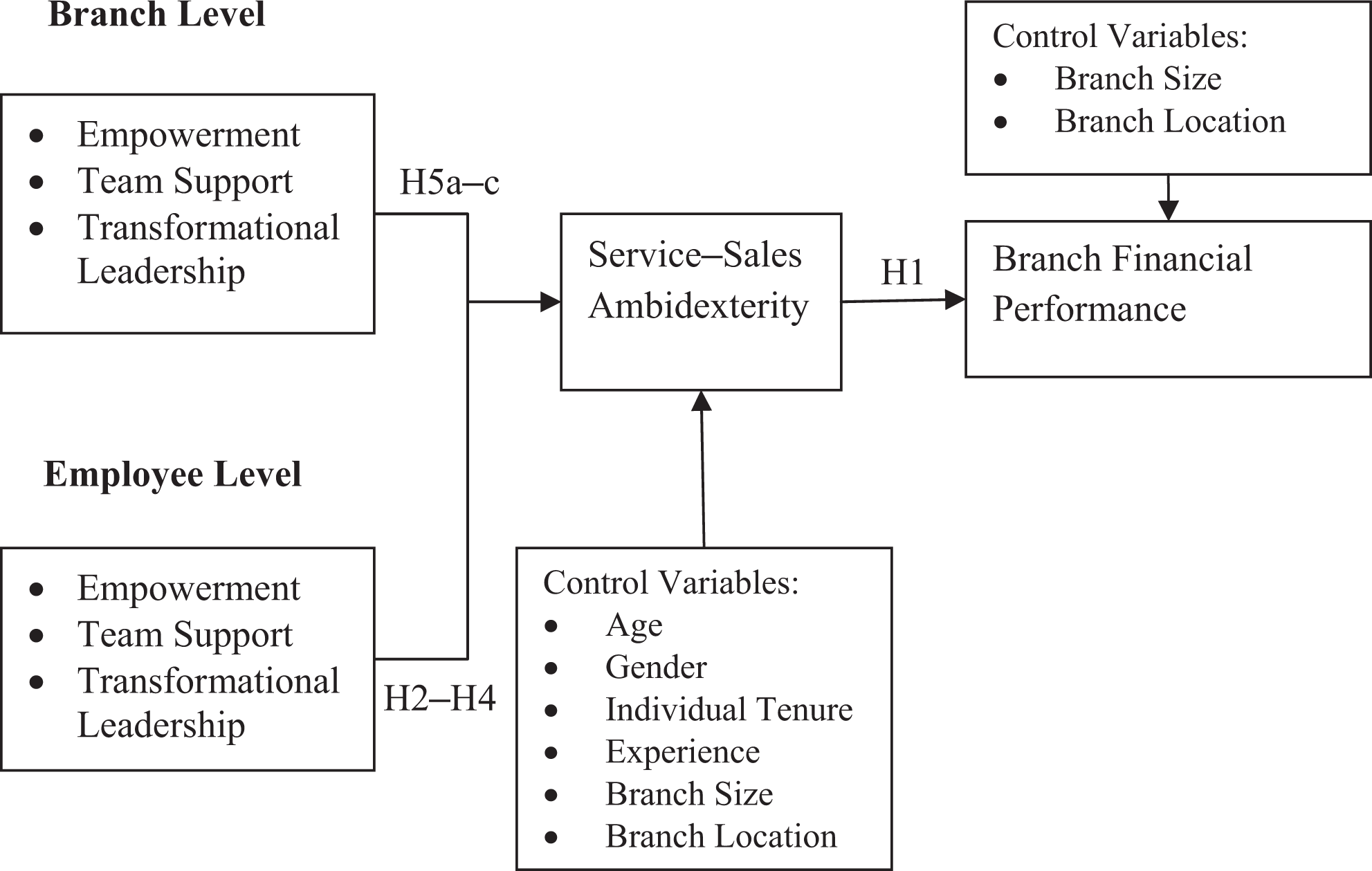
Multilevel model of the antecedents and consequences of service
Service-Sales Ambidexterity and Branch Financial Performance
Several studies (e.g., Ebben and Johnson 2005; Rust, Moorman, and Dickson 2002) indicate that a single strategic focus may have a more positive impact than dual strategies on organizational performance. However, Gibson and Birkinshaw (2004) claim that business unit ambidexterity is positively associated with business performance, which they measure according to whether the business unit achieves employee satisfaction, customer satisfaction, and full potential. Lubatkin et al. (2006) similarly contend that the pursuit of ambidexterity relates positively to subsequent firm performance. However, both these studies use subjective performance measures (i.e., perceptions of participants), which may suffer rating and self-serving biases (Ahearne, Mathieu, and Rapp 2005). To the best of our knowledge, this study is the first to conceptualize service-sales ambidexterity at the branch level and investigate its impact on objective financial performance. We hypothesize:
Hypothesis 1: Service-sales ambidexterity relates positively to branch financial performance.
Individual-Level Antecedents of Service-Sales Ambidexterity
Empowerment
Following Mathieu, Gilson, and Ruddy (2006), we define empowerment as the collectively held belief among employees that they have the authority and responsibility to decide how to manage their service delivery and selling activities. Empowerment is critical if frontline staff are to be flexible and adaptable when serving customers (Ahearne, Jelinek, and Jones 2007; Chebat and Kollias 2000; Hartline and Ferrell 1996). In addition, Oliver and Anderson (1994) argue that selling is a relatively unstructured function, which makes it crucial that members of frontline units have sufficient freedom to perform their roles. Frontline staff who are allowed to make discretionary decisions are more likely to personalize their service or sales efforts to meet the needs of different customers, which should improve the likelihood that they achieve branch-level service and sales goals (Mittal and Lassar 1996).
Yagil (2006) also posits that empowerment supplies frontline personnel with an opportunity to establish operational guidelines, which is beneficial for coping with service pressures. For example, if frontline employees collectively decide that they have the power to refund overdrafts or other fees on the spot, customers may be more satisfied with the outcome and therefore more prone to consider additional financial products suggested by these staff members. As another example, during peak periods with long customer queues, employees in the branch should be allowed to minimize their up- and cross-selling efforts to focus primarily on service performance. Such forms of empowerment refer to employees’ judgment of whether it is better not to sell (i.e., not be ambidextrous) in some situations. Branches can enhance service-sales ambidexterity if employees are empowered to prioritize service-sales objectives according to the circumstances at hand. We thus hypothesize:
Hypothesis 2: Empowerment relates positively to service-sales ambidexterity.
Team support
Defined as “the degree to which employees believe that the team values their contribution and cares for their well-being” (Bishop, Scott, and Burroughs 2000, p. 1114), team support is strongly associated with team effectiveness (Drach-Zahavy and Somech 2002). Encouraging cooperation is important for a branch’s achievement of service-sales ambidexterity, because members depend on one another while performing individual tasks. In a retail bank for example, branch employees might work together to achieve group outcomes. As de Jong, de Ruyter, and Wetzels (2005) argue, frontline staff members often require information and resources from other employees, and the support of team members is therefore crucial to perform tasks. In the context of a retail bank, for which complex financial products and terminology often appear in cross- and up-selling processes, the quickest way to clarify confusing terminology or product knowledge is to seek support from other employees. Bishop, Scott, and Burroughs (2000) also suggest that when staff members believe their contribution to the team has been recognized and that other team members care about their well-being, those members are more likely to return the favor by investing more effort in their work. In addition, perceptions of strong branch support from other branch members should increase employees’ assessments of branch value, which they then can internalize. Mutual support among branch members is a crucial organizational process that facilitates a branch’s service-sales ambidexterity. Thus, we hypothesize:
Hypothesis 3: Team support relates positively to service-sales ambidexterity.
Transformational leadership
Among the plethora of transformational leadership conceptualizations, we adopt Bass’s (1985) definition, which emphasizes the degree to which leaders increase followers’ awareness of task importance and value, foster collective goals over and above self-interest, and activate higher order needs. The leadership style of a branch manager then might represent contextual support provided by local management. Berson et al. (2006) suggest that leaders also play facilitator roles, in that they provide contextual support to members across the organization or business unit as they pursue multiple goals. Exercising appropriate leadership, such as by providing guidance, helping, and involving others in the decision-making process, rather than exercising authority, should have a significant impact on a business unit’s ambidexterity (Gibson and Birkinshaw 2004).
Coelho, Augusto, and Lages (2011) also argue that local managers’ behaviors largely define the work context. By actively demonstrating how a service issue could be resolved by providing an up-sell and then explaining key issues involved in recognizing this situation, leaders could motivate followers to practice similar approaches. Adler, Goldoftas, and Levine (1999) identify supportive and flexible managers as prerequisites for ambidexterity; it is therefore not surprising that empirical evidence supports a positive relationship between transformational leadership and individual employees’ task performance, organizational citizenship behavior (Piccolo and Colquitt 2006), and commitment to specific changes (Herold et al. 2008). Therefore, we predict:
Hypothesis 4: Transformational leadership relates positively to service-sales ambidexterity.
Group-Level (Branch-Level) Effects
Employees in a branch develop shared beliefs about that branch, because staff members are exposed to similar contextual features (e.g., branch culture, branch goals, strategies) and socialize with other branch employees. The relative homogeneity of their experiences creates a set of shared beliefs that is unique to each branch, which may be captured with an aggregate-level branch construct (de Jong, de Ruyter, and Lemmink 2004; Seibert, Silver, and Randolph 2004). The set of shared beliefs among staff members assigned to different work units can vary significantly due to their different locations and different customers. We therefore analyze the influence of antecedents at two levels to provide a better understanding of what contributes to or inhibits a branch’s service-sales ambidexterity.
Chan (1998, p. 237) describes direct consensus models that use “within-group consensus of the lower level units as the functional relationship to specify how the construct conceptualized and operationalized at the lower level is functionally isomorphic to another form of the construct at the higher level.” In turn, de Jong, de Ruyter, and Wetzels (2005) use group averages of individual measures to aggregate constructs measured at the employee level up to the team level. They argue that aggregation (i.e., group averages of individual measures) effectively represents shared, collective beliefs and can be used to test group-level predictors. Similarly, the relationships between predictors (i.e., empowerment, team support, and transformational leadership) and service-sales ambidexterity in this study are primarily hypothesized at the individual level, but to capture the influence of context on service-sales ambidexterity, we also follow a direct consensus model. Thus, we conceptualize empowerment, team support, and transformational leadership at both individual and group (branch) levels. According to Lindell and Brandt (2000), a direct consensus model typically becomes manifest through the use of ambient stimuli, such as rewards that are available to all members of a work unit (e.g., information resources, workplace characteristics). In contrast, discretionary stimuli are awarded to individual members of a work group, though they also might create synergy within a work unit through perceptual agreements (Liao and Chuang 2007; Lindell and Brandt 2000). Accordingly, we hypothesize
Hypothesis 5: At the group (branch) level of analysis, the positive effects of (a) empowerment, (b) team support, and (c) transformational leadership explain a significant amount of variance in service-sales ambidexterity.
Empirical Studies
A large nationwide retail bank cooperated with us for this study, which facilitated the data collection among staff members in the branch network and provided financial performance data at the branch level. The bank offers a broad range of retail and business services, such as lending, deposit receipts, credit cards, home mortgages, international trade financing, lease financing, asset and funds management, investment banking, factoring, finance leases, operating leases, and purchasing services. For this study, we focused exclusively on retail banking operations, which comprise mainly lending (in a broad sense, such as personal and home loans), deposit receipts, credit cards, and savings accounts. All retail branches that had been established longer than 6 months were invited to participate. Our multimethod study also combined quantitative and qualitative research methods.
Quantitative Data Collection, Measures, and Analysis Strategy
Following a rigorous pretesting procedure, we distributed questionnaires to all staff members in each of the 350 participating branches of a large retail bank. From 302 branches, we received 2,618 usable questionnaires. To ensure sufficient sample sizes for each branch (Lüdtake et al. 2008), we compared the size of the staff and the response rate from each branch. If less than 50% of the staff within a branch responded, we excluded it from further analysis. Thus, we obtained a final sample size of 2,306 employees representing 267 branches. Senior bank management confirmed that the geographical and size spreads of the branches were representative of the bank’s national network. In terms of branch and staff characteristics, we do not find any significant differences between responsive and nonresponsive branches.
Ambidexterity is often operationalized as an orientation or self-reported behaviors. Yet, no prior work has provided a reliable, valid scale to measure service-sales ambidexterity. Among existing ambidexterity measures, we considered the items developed by Lubatkin et al. (2006) the best suited for our study context. We modified their items to capture service-sales ambidexterity and precluded any face validity issues. All items loaded significantly on their respective factors (i.e., service orientation and sales orientation), with loadings greater than .50. The items also achieved good reliability (service orientation α = .89; sales orientation α = .91). To reflect the nonsubstitutable, interdependent nature of service and sales orientations, we computed a multiplicative interaction between the service and sales components to determine the service-sales ambidexterity level of each branch, a method commonly used in previous studies (e.g., Atuahene-Gima 2005; He and Wong 2004).
There are many measures of organizational performance. Harter, Schmidt, and Hayes (2002) use customer satisfaction/loyalty, profitability, productivity, and sales to measure business performance; other studies focus exclusively on sales (e.g., Rapp et al. 2006). For the banking industry, another key metric is the ratio of each branch’s annual performance to financial targets. Therefore, we took a composite measure of branch-level financial (sales) performance, including volume of deposits, credit card activity, housing mortgage activity, and personal loan activity. By measuring branch financial performance as a percentage of the target level, we effectively standardized for differences in branch size, location, and market potential. Our approach is similar to that adopted by Gelade and Young (2005), who argue that this kind of performance measure is what a branch tries to maximize, which grants it operational validity. Branch financial performance data came from the bank for the most recent financial year. With our objective rather than subjective measure, we also overcame the problem of self-reported performance biases.
The measurement scales for empowerment, team support, and transformational leadership came from existing literature, which indicated their content validity. All constructs were measured on 7-point Likert-type scales. Five items capturing empowerment were drawn from Mathieu, Gilson, and Ruddy (2006), in a scale that captured both responsibility and perceived authority elements. Team support was measured with 5 items from de Jong, de Ruyter, and Lemmink (2004), though our confirmatory factor analysis (CFA) suggested dropping 1 item from the original scale. We assessed transformational leadership using an instrument developed by Podsakoff et al. (1990), restricted to 11 items that specifically captured this construct. A complete list of the items, their factor loadings, reliability, and average variances extracted (AVE) appears in the Appendix A.
Kenny and La Voie (1985) argue that when it applies simultaneously to two levels, a measure can refer to two constructs—one for the group, and another for individuals. For example, a measure of attitudes might indicate attitudes at the individual level but group norms at the group level. Therefore, the group analysis can be based on the mean of the individual scores within each group, whereas individual analyses ignore the group aspect. We used this approach to explore the group effects of empowerment, team support, and transformational leadership.
Finally, we identified several other factors that might influence both service-sales ambidexterity and the volume of financial activity by a branch. Specifically, we controlled for employees’ age, gender, individual tenure, and experience, as well as branch size and location (city, suburban, regional; see Figure 1). Including the control variables provided a more robust test of our hypotheses.
To test Hypothesis 1, we aggregated service-sales ambidexterity to the branch level and performed a multiple regression analysis of the relationship between the branch’s service-sales ambidexterity and its financial performance. To study group and individual processes simultaneously, hierarchical linear modeling (HLM) is appropriate for multilevel research (Hofmann 1997; Liao and Chuang 2004; Seibert, Silver, and Randolph 2004). We therefore applied it to test Hypotheses 2–5. We also used group mean centering (Hofmann and Gavin 1998), such that we group mean-centered the individual-level variables and grand mean-centered the group-level variables to (1) distinguish within-from between-group variance, (2) reduce multicollinearity, and (3) facilitate model estimation (see Bryk and Raudenbush 1992). To reduce the risk of demand artifacts (Argyris 1968), we did not explicitly refer to the study purpose in the questionnaire, and we randomized the order of items within each construct. We also guaranteed anonymity and asked respondents to send their questionnaires directly to the research team (instead of handing them in to supervisors).
Reliability and Validity Checks
We established convergent and discriminant validity using exploratory factor analysis (EFA) and CFA; we examined the factor structure using principal component analysis. The EFA (principal component) provided the initial result for the factor structure. We then performed CFA using structural equation modeling software (AMOS) and assessed the measurement properties of the items (see Diessner et al. 2008). The indices of the proposed factor model yielded a sound fit. Because χ2 values can be inflated by a large sample size, we examined the values for the Goodness-of-Fit Index (GFI = .88), Adjusted Goodness-of-Fit Index (AGFI = .85), root mean square error of approximation (RMSEA = .06), standardized root mean square residual (SRMR = .04), Normed Fit Index (NFI = .94), and comparative fit index (CFI = .94; see Byrne 2001).
To examine within-method convergent validity, we checked the significance and magnitude of item loadings. The results of the CFA and reliability tests (see Appendix A) revealed coefficient α values greater than .65 (service-sales ambidexterity .89 for service and .91 for sales component; empowerment .92; team support .88; transformational leadership .97). Therefore, construct reliability was acceptable (Nunnally and Bernstein 1994). Regarding within-method convergent validity, all items loaded significantly on their respective constructs (minimum t value = 21.03) and had standardized loadings of at least .50 (service-sales ambidexterity from .76 to .87 for service and from .67 to .86 for sales; empowerment .74 to .90; team support .67 to .87; transformational leadership .80 to .91). To establish discriminant validity, we followed Fornell and Larcker’s (1981) recommended procedure. The AVE for each construct was greater than .50 (service-sales ambidexterity .70 for service and .62 for sales; empowerment .68; team support .65; transformational leadership .77). We also compared the AVE of every pair of constructs with the square of the correlation between the two constructs; in all cases, the AVE for any two constructs exceeded the square of the correlations. All χ2 difference tests (significant with 1 degree of freedom; p < .05) suggested that the pairs of constructs correlated at less than 1. Table 1 contains the descriptive statistics and bivariate correlations for all variables at both the employee and the aggregated levels.
Means, Standard Deviations, and Correlations.
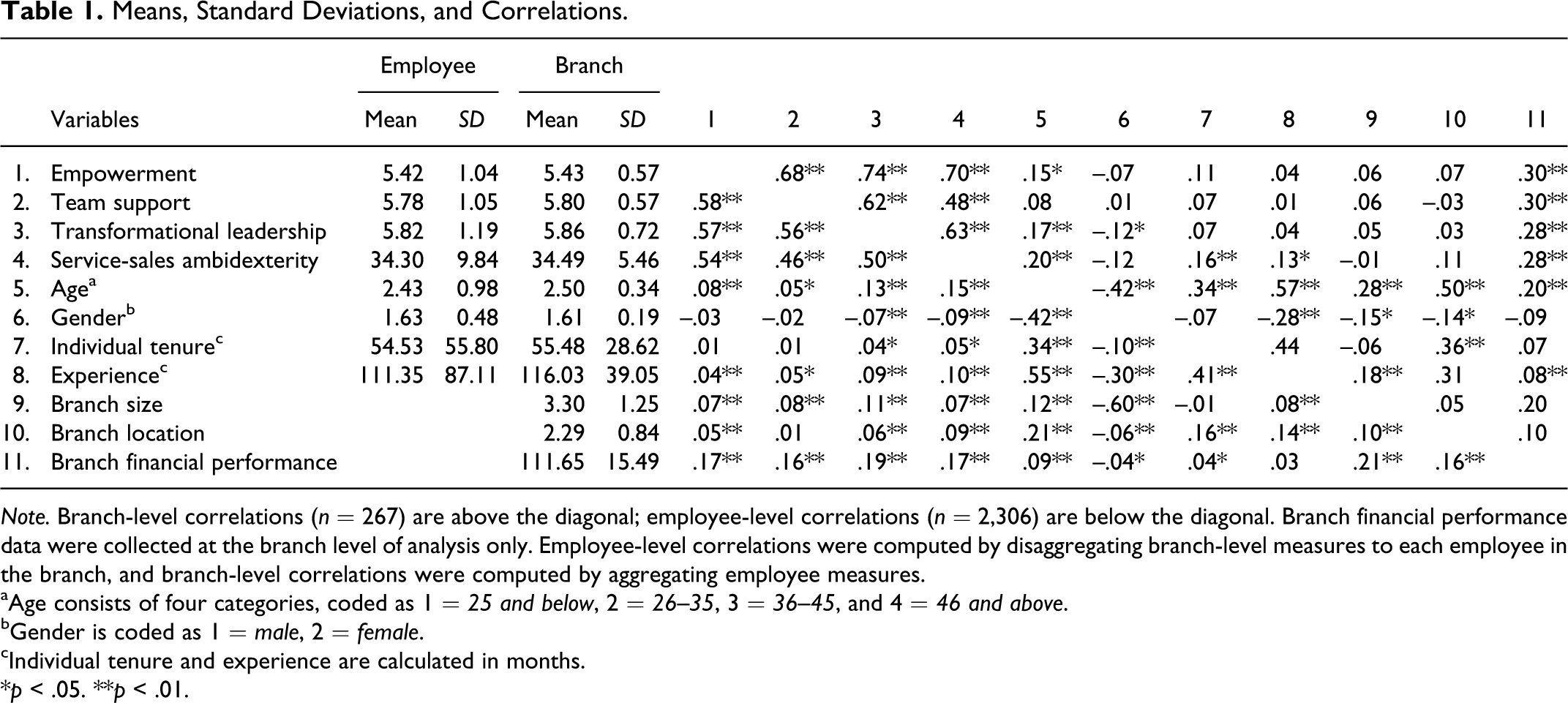
Note. Branch-level correlations (n = 267) are above the diagonal; employee-level correlations (n = 2,306) are below the diagonal. Branch financial performance data were collected at the branch level of analysis only. Employee-level correlations were computed by disaggregating branch-level measures to each employee in the branch, and branch-level correlations were computed by aggregating employee measures.
aAge consists of four categories, coded as 1 = 25 and below, 2 = 26–35, 3 = 36–45, and 4 = 46 and above.
bGender is coded as 1 = male, 2 = female.
cIndividual tenure and experience are calculated in months.
*p < .05. **p < .01.
Aggregation Statistics
The variables in our model represent branch contexts, measured using individual employees as raters to assess the branch to which they belong, or “shared unit-level constructs” (Klein and Kozlowski 2000). We assume that employee perceptions of empowerment, team support, and transformational leadership are shared beliefs within a branch but vary among both individuals and branches. To demonstrate that both assumptions are valid, we performed several tests.
First, to test the assumption of shared beliefs within a branch, we explored the within-group agreement using an interrater reliability coefficient (Rwg) test (Dixon and Cunningham 2006; James, Demaree, and Wolf 1993; Schneider et al. 2003). The cutoff for acceptable interrater agreement values is .6 (see Glick 1985). As we show in Table 2, the Rwg range spans from .93 to .97 (empowerment .93; team support .92; transformational leadership .97), which suggests a high degree of interrater reliability and thus adequate agreement for aggregation. That is, perceptions were shared within branches.
Aggregation Statistics and Internal Consistency Reliability.
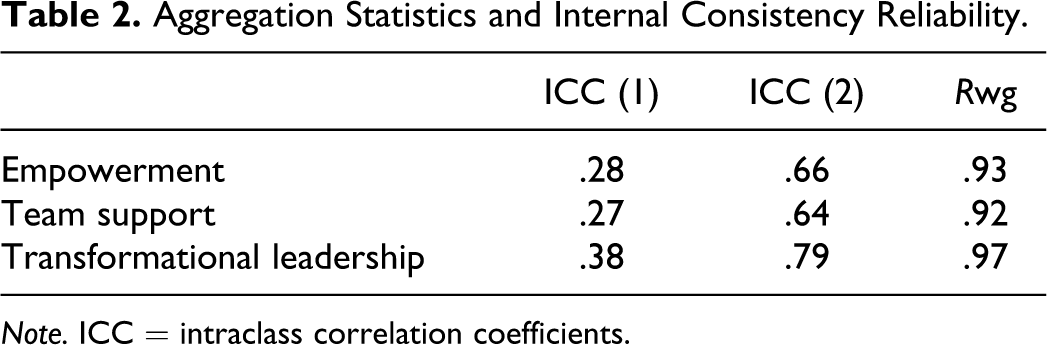
Note. ICC = intraclass correlation coefficients.
Second, we calculated intraclass correlation coefficients, ICC(1) and ICC(2), using a one-way analysis of variance (ANOVA) for the employee-level data. The ICC(1) indicates convergence within a branch, whereas ICC(2) refers to the reliability of the mean and takes group size into consideration (Liao and Chuang 2004). As we show in Table 2, the ICC(1) coefficients (empowerment .28; team support .27; transformational leadership .38) were all greater than .12, with significant ANOVA test statistics (F; Kenny and La Voie 1985). All ICC(2) values (empowerment .66; team support .64; transformational leadership .79) also were well above the .5 cutoff level (de Jong, de Ruyter, and Wetzels 2005). The ICC(1), ICC(2), and Rwg results suggested that it was appropriate to aggregate empowerment, team support, and transformational leadership to the branch level.
Hypotheses Tests
In Hypothesis 1, we posited a positive relationship between service-sales ambidexterity and branch financial performance. We tested this prediction by aggregating employee-level perceptions of service-sales ambidexterity to the branch level and performing a multiple regression analysis, with branch size and branch location as control variables. The results indicated a significant positive relationship between branch service-sales ambidexterity and branch financial performance, F = 17.93, R 2 = .123, p < .05. In other words, 12.3% of the variance in branch financial performance can be explained by the branch’s service-sales ambidexterity, in support of Hypothesis 1.
For the tests of Hypotheses 2–5, we used HLM software (Raudenbush et al. 2004); we summarize the results in Table 3. The null model included only the dependent variable. To test Hypotheses 2–4, we introduced individual-level predictors; then for the test of Hypothesis 5, we included branch-level predictors.
Hierarchical Linear Modeling Results.
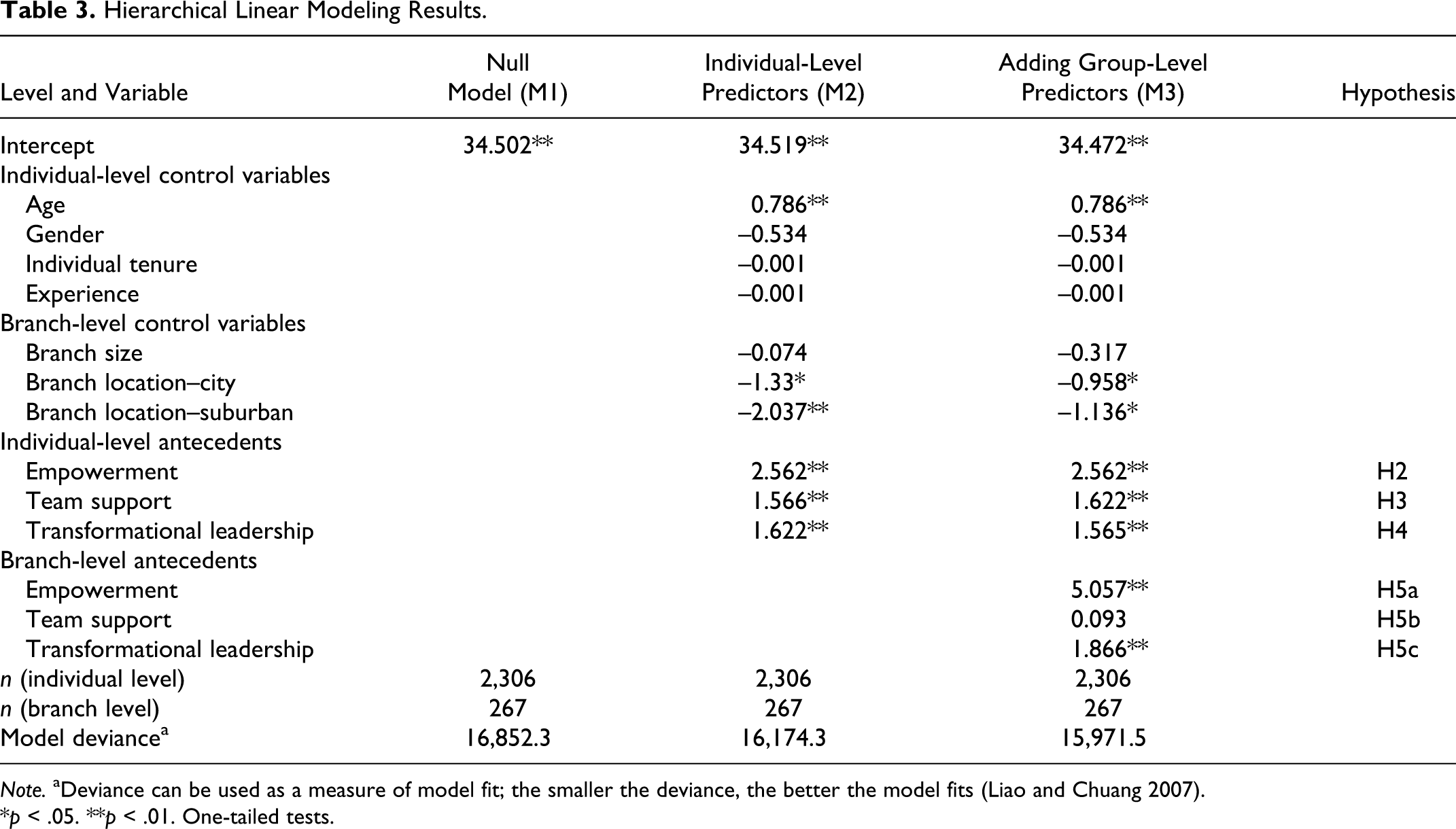
Note. aDeviance can be used as a measure of model fit; the smaller the deviance, the better the model fits (Liao and Chuang 2007).
*p < .05. **p < .01. One-tailed tests.
Null model
We hypothesized a significant impact of individual- and branch-level variables on a branch’s service-sales ambidexterity. Our results indicated significant between-branch variance in this service-sales ambidexterity, with ICC(1) equal to .30, such that 30% of the variance in employees’ perceptions of service-sales ambidexterity resided between branches, and 70% resided within branches. The use of HLM analysis was appropriate in this case (Marrone, Tesluk, and Carson 2007).
Individual-level predictors
In Table 3, Model 2 (M2) summarizes the result of the HLM analysis tests for Hypotheses 2–4 that added employees’ perceptions as individual-level variables. Employees’ perceptions of empowerment (γ = 2.562, p < .01), team support (γ = 1.566, p < .01), and transformational leadership (γ = 1.622, p < .01) at the individual level all were positively associated with service-sales ambidexterity, in support of the hypotheses.
Branch-level predictors
At the group level of analysis, empowerment, team support, and transformational leadership should have positive effects on service-sales ambidexterity. To test Hypothesis 5, we added aggregated branch-level variables into Model 3 (M3, Table 3). Empowerment (γ = 5.057, p < .01) and transformational leadership (γ = 1.866, p < .01) at the branch level were positively associated with service-sales ambidexterity, in support of Hypotheses 5a and 5c, respectively. However, team support was not significantly related to service-sales ambidexterity, so we must reject Hypothesis 5b.
Qualitative Data Collection and Findings
The primary aim of the qualitative phase of the study was to enrich the interpretation of the quantitative results, as well as to explore whether post hoc analyses might reveal more fine-grained, possibly more managerially interesting results. We selected six representative bank branches, according to branch size (one small, one large, and four medium/large), varying customer demographics, branch location, branch capacity, and performance. We conducted 14 in-depth interviews (two per branch, plus two with regional executives) and thereby obtained a reasonably broad, comprehensive picture of employee contributions to branch ambidexterity (Fournier 1998). We ceased our qualitative data collection when we reached data saturation (Strauss and Corbin 1998). To confirm the trustworthiness of the qualitative findings, we used several methods suggested by Creswell (2003). Specifically, we spent prolonged time in the field (3 months) to improve understanding of the industry. During branch visits, the researcher triangulated information from different stories told by the same person and confirmed key points/issues raised by others in the branch. Member-checking ensured that the participants thought the information was accurate. In addition, measures were taken to guarantee participant confidentiality.
The dual emphasis on service and sales at the retail branch level was introduced as a companywide initiative 4 years prior to the study, though the actual implementation of the service-sales conversion program was left to the individual branches. Initially, it prompted some frustration at the branch level; the program was one of many central initiatives by the head office aimed at improving the bank’s competitive positioning. As one interview respondent indicated:
at the time we had the feeling that central was just dumping all these things on our shoulders, and left us to figure out what to do. It felt just like we had to learn on the run. Some of us, even talked to colleagues at other banks, just to find out what needed to be done. (manager, inner-city branch).
During the interviews, it became clear that employees wondered how other branches were doing, considered the blending of service and sales daunting, and remained insecure about their branch’s ability to be ambidextrous. A key concern was how to add sales without compromising service performance levels. Fairly early in the process, employees explicitly wondered about how they could meet service objectives if they were attempting to sell. It became clear quickly that handling time parameters would need to be relaxed and left to the discretion of the employees, because otherwise selling would ruin service performance:
She [branch manager] gives us a lot of responsibilities to make decisions ourselves and that really helps because we can override fees, we can apply for better rates and, you know, just do those little things for customers that would make them happy. It’s not like we always have to keep running to her to get decisions. She gives us that authority to make those decisions ourselves. So she has enough faith in us, which is great.…The flexibility we have when servicing the customers helps us to maintain a good relationship with the customers and it made it easier when we are trying to introduce new products to the customers and still be able to meet my quota of customer inquiries. (client advisor, inner-city branch)
Apparently, when empowered, employees felt not only that the company was making it easier for them to do their job but also that they were trusted. They appreciated being empowered and were thus motivated to take pride in assuming responsibilities. In attempting to come to appropriate divide their time and efforts, employees looked to colleagues to determine “how things are done around here”:
I don’t know about other branches, but we don’t always have to keep going to the manager for decisions on small things. This is what everyone does in this branch, so I am comfortable doing that myself too. (client advisor, suburban branch)
Several interviewees also noted the importance of backing up this freedom to decide with reward systems aligned with the new demands:
We really felt strongly about being recognized and rewarded for both our serving and selling in trying to decide how to balance our time. Otherwise, it would be a no-brainer to just do what we were always doing, helping customers. (client advisor, regional branch)
Performing service- and sales-related tasks often requires support from peers. Moreover, the service staff filters customers for the sales staff and shared responsibilities with them at times. With peer support, they could help one another become ambidextrous, such that colleagues could restore the balance when service and sales appeared to be conflicting:
It’s good when people are helping each other. If there’s a problem and you need to ask a question, instead of going straight to management, there’s always someone around who is willing to help. It can save a lot of time, and it can make up sometimes for the extra time that is often needed in trying to upgrade customer to more profitable financial products (client advisor, suburban branch).
The interviewees suggested that they preferred branch managers to provide feedback and instructions for improving their performance, which inspired them but also gave them the assurance to undertake new and unfamiliar tactics (i.e., sales techniques) in their encounters with customers. Feedback and direction provided by the branch manager have direct impacts and shape employees’ work behaviors to enable them to perform service and sales tasks:
Selling new products messes up my handling time, but treating customers right requires this time. It’s really hard to balance, and I often look to [the branch manager] to help me make sense of this, and show me how I can do well on both activities (client advisor, suburban branch).
However, an issue on which interviewees’ opinion did not seem to converge related to length of service in the branch. Some respondents were convinced that for the successful execution of a service-sales conversion program, they needed new recruits (fresh blood), because “you cannot teach an old dog new tricks.” Others contended instead that people who had been with the branch for a long time knew the local customers best and thus understood just how to act. These differences of opinion pertained particularly to the effective exercise of authority: Those who had been at the branch for a long time seemingly tended to rely on old routines, without sufficiently open minds to consider alternative options:
Some of the old crowd around here don’t even think. They come, do what they have always been doing, they go home. Can’t really blame them, they have seen many programs come and go. (client advisor, inner city branch)
However, these more experienced staff members also were more confident about exercising decision-making autonomy, compared with newer recruits who require managerial guidance:
Stephen downstairs has been with us longer than I can or even care to remember, and still outperforms the young crowd. He has developed this radar for customer needs and knows exactly when the time is right to sell a product as a service solution. It is amazing how quickly he has picked this thing up. He just does it, no questions asked. (client advisor, regional branch)
Likewise, employees with extended branch tenure can undermine mutual support among branch employees, because they act more independently and have less patience and tolerance for people who are having problems aligning service delivery efforts with sales:
Whenever I asked a question about this new mutual fund that we are supposed to promote this quarter to Ian, he always seems very impatient and bored. This really makes me feel stupid and think twice before asking again. (client advisor, inner city branch)
In conclusion, we find corroborative evidence of the significant relationships identified in our quantitative analysis. Beyond these main effects, our qualitative results also indicate that the aforementioned effects vary as a result of the presence of a dual emphasis on service and sales in the branch reward structure, but there is considerable difference of opinion with regard to the impact of branch tenure.
Potential Moderator Effects Post Hoc Analysis
A series of post hoc analyses explored the circumstances in which key antecedents had stronger or weaker effects. We computed an average branch-level measure for respondents’ perceptions of the extent to which service excellence and meeting sales targets were rewarded jointly (7-point scale), and computed an average branch-level measure for respondents’ branch tenure (in months). Branch tenure reflects the number of months that employees have spent at the branch where they currently work, which differs from individual (bank) tenure, which refers to the length of time an employee has been employed by the bank. During a person’s bank tenure, he or she may have been assigned to different branches at various points in time. Branch tenure (γ = .018, p < .01) and service and sales rewards (γ = .065, p < .01) influenced the relationship between predictor and criterion variables. Both perception of joint rewards and branch tenure strengthened the impact of empowerment on service-sales ambidexterity. Neither team support nor transformational leadership moderated the relationship between empowerment and service-sales ambidexterity.
Discussion and Implications
By generating sales opportunities during service delivery, a firm can turn traditional cost (service) centers into revenue-generating centers with minimum incremental costs. This potential alone provides a compelling rationale for pursuing a successful service-sales ambidextrous strategy. However, as noted by March (1991) and Rust, Moorman, and Dickson (2002), the pursuit of an ambidextrous strategy can create conflicts and require trade-offs; noting this challenge, we focus for the first time on working conditions that are conducive to employees’ successful service-sales alignment and empirically assess the financial payoff of branch ambidexterity. Thus, we extend current literature by identifying specific contextual predictors of service-sales ambidexterity and demonstrate its positive relationship with financial performance. Whereas previous research incorporated subjectively perceived measures of performance (e.g., Gibson and Birkinshaw 2004; Lubatkin et al. 2006), our study is one of the first to demonstrate that the simultaneous pursuit of service and sales affects the bottom line.
Ambidexterity has been studied mainly at (aggregate) organizational levels. By exploring this concept at the level of the work unit or branch office, we focus on the creation of work conditions that encourage alignment between service delivery and sales during encounters with customers. Complementarities between service delivery and sales can be achieved at the branch level, because frontline workers balance their time and effort to meet service and sales objectives collectively. Our interviews reveal that the implementation and maintenance of these dual foci constitutes a challenge, which underlines the importance of creating an environment that fosters ambidexterity. To the best of our knowledge, our study is first to study service-sales ambidexterity at the branch level.
Our results, both quantitative and qualitative, offer strong evidence that individual employee perceptions of empowerment, team support, and leadership relate positively to service-sales ambidexterity, which reinforces the importance of organizational context for managing an ambidextrous strategy. The interviews further reveal that employees recognize the importance of using their own judgment to balance the seemingly conflicting demands of service and sales objectives and interpret empowerment as a signal of trust. Such trust motivates them to engage in service-sales alignment. In addition, drawing on the wisdom and social support of colleagues and having a branch manager who can act as a role model helps create an ambidextrous unit.
Most studies of empowerment, team support, and leadership have focused on a single level of analysis, but Rousseau and House (1994) argue that such single-level research may suffer from fundamental biases, such as overgeneralization of the impact of antecedents found at one level or underestimation of their cross-level effects (Hitt et al. 2007; Watson, Chemers, and Preiser 2001). The addition of branch-level antecedents, incorporated in our study, provides a better understanding of the impact of contextual variables on service-sales ambidexterity, supporting Rousseau and House’s view. Our study is the first to show that the impact of contextual variables is more complicated than originally proposed in literature on ambidexterity (e.g., Gibson and Birkinshaw 2004).
We also find that group-level effects of empowerment and transformational leadership on service-sales ambidexterity are significant, whereas team support is not. Although every staff member in a branch may require team support, the relationships of individual staff members each may be unique. Employees within a branch possess different characteristics; they exhibit different levels of performance, have reached different stages of their careers, and have different personalities (Wright, Dunford, and Snell 2001). These factors can provoke varied behavioral responses to any given type of team support. Thus, team support may provide individual-level motivation and guidance, as supported by the qualitative data. This finding may help explain the lack of group-level effects of team support; alternatively, the impact of team support at the branch level may be indirect. Bishop, Scott, and Burroughs (2000) originally hypothesized a direct, significant impact of team support on job performance, but they find only an indirect effect through team commitment. Rather than global, single-level predictors of contextual ambidexterity (as used by Gibson and Birkinshaw 2004), our study identifies, for the first time, specific contextual factors at two levels of analysis. In addition to enriching understanding of the key antecedents of ambidexterity, our interviews hinted at the presence of factors that might moderate these effects. Branch tenure strengthens the impact of empowerment on ambidexterity, likely because experience in the branch instills confidence and comfort about exercising authority to balance service delivery and sales. Zhang and Bartol (2010) argue that employees with more experience with certain job circumstances display a greater cognitive capacity that allows them to rely on their own judgment and more effectively use delegated authority to handle competing demands. Furthermore, a dual emphasis in reward systems promotes the impact of empowerment on ambidexterity; that is, employees believe that they can make decisions on their own only if the reward system is aligned with the demands of service-sales ambidexterity. Thus, our study presents new and fine-grained insights into the intricate relationship among the contextual factors that shape ambidexterity at the branch level.
Managerial Implications
Although the conversion of traditional service units into blended sales–service environments is challenging, it can also be financially rewarding. The significant positive relationship between service-sales ambidexterity and financial performance should provide encouragement for firms considering such a strategy. Our results further indicate that traditional service units can generate additional sales opportunities, improve financial performance, and even shift from a cost center to a profit center. Our findings may help management make a business case for the introduction of a service-sales alignment strategy.
To maintain this strategy, an active approach to creating a branch environment (context) that fosters ambidexterity is crucial. This environment must support the delegation of authority to employees, particularly branch office veterans. Managers should recognize deployment of empowerment as a management tool with varying effects. It seems especially important to acknowledge and learn from office veterans and involve them in the education and socialization of newcomers and less experienced branch members. The delegation of authority may work best if both service and sales behaviors receive recognition and rewards. Furthermore, management must evaluate rewards systems and align them with both components of service-sales ambidexterity. Service unit managers can play a crucial role in influencing customer service representatives’ motivation (Wieseke et al. 2011). Branch management should relinquish its role as controller and instead be a motivator or role model to develop the team’s ability to serve and sell. It is also important to create awareness of this responsibility.
The alignment of serving and selling is a complex activity; peer support contributes to facilitate ambidexterity though. Processes and systems should be designed to encourage team interactions on the job, foster relationships among team members, and enhance team spirit. As Peters (2011) notes, frontline managers are the most important predictors of employee satisfaction, retention, and productivity. It is the managers who implement systems and cultures to create supportive contexts that in turn shape individual employee behavior.
Empowerment and transformational leadership have positive impacts at the group level. In addition to individual perceptions of branch contextual factors, we find group effects of empowerment and transformational leadership. Therefore, perceptions of these contextual factors seemingly should be shared to catalyze service-sales ambidexterity. To promote convergence, firms should initiate formal and informal discussions about the motivational impact of empowerment and leadership, perhaps through role-playing and team-building exercises with branch personnel.
Limitations and Research Implications
Our study suffers several limitations that may point to directions for further research. Our sample is cross-sectional, though shared perceptions in work units are dynamic and ideally should be studied from a longitudinal perspective (de Jong, de Ruyter, and Wetzels 2006). In particular, a longitudinal study of ambidexterity might involve multiple measurements and reciprocal relationships, such as between performance and service-sales ambidexterity (Lubatkin et al. 2006). Although we are confident that our results are representative of a wide range of multiunit, service delivery operations (e.g., travel agencies, restaurants chains, telecommunication retailers), additional research is needed to confirm this assumption. Moreover, such research could consider ambidexterity that involves cross- or up-selling of the service products provided by other companies. A recent market survey (Forrester Consulting Report 2011) indicates that these services (i.e., third-party ancillary services) form an underexplored revenue-generating opportunity for the travel industry.
We have focused on both service and sales strategies at the branch level, which prevents us from exploring possible cross-level interaction effects at different organizational levels. For example, how might pursuing a sales strategic focus at the firm level interact with the pursuit of a service strategic focus at the branch or individual level? By focusing on only one organization, we also cannot expand the model to a three-level HLM, which would include individual, branch, and organizational levels. Additional studies should expand the service-sales ambidexterity scope by involving more organizations in different industries and searching for cross-organizational or cross-industry effects.
Our qualitative interviews identified transformational leadership as most relevant to service-sales ambidexterity, but other types of leadership, such as transactional, servant, service, spiritual, or distributive leadership, could better manage different types of organizations or achieve different sorts of goals (e.g., Brown and Gioia 2002). In-depth studies might explore the possibility that different types of leadership have different impacts on service-sales ambidexterity. For example, Kennedy, Goolsby, and Arnould (2003) emphasize the importance of shared leadership between the leader and employees, with the argument that employees need the leader as much as the leader needs the employees. Studies might also examine the dynamics of shared leadership within a branch and explore how it influences the achievement of service-sales ambidexterity.
Finally, we investigate branch-contextual variables within a retail branch, but other contextual variables fall outside the branch or organization, such as the pace, ambiguity, and complexity of the business environment. Brown and Gioia (2002) indicate that such variables shape leadership requirements and managerial processes such as communication, decision making, and vision. It would be useful to examine the extent to which external environmental dynamism and competitiveness also are associated with a business unit’s service-sales ambidexterity.
Conclusion
Across many service industries, frontline employees are expected to explore opportunities to sell during service encounters with customers. Instead of imposing this complex, dual responsibility on individual employees, firms should design the work environment to be conducive to the simultaneous achievement of quality service and sales targets. In particular, our results show that frontline managers must let service workers exercise their own judgment when deciding when or what to up- or cross-sell. Such delegated authority works best for branch office veterans; it also requires the recognition and rewards for both service excellence and selling. Taking such work environment characteristics into account can induce service-sales ambidexterity, with its positive impacts on bottom-line results.
Footnotes
Appendix A
Acknowledgment
Portions of this article were written while the first author was a postdoctoral research fellow at the University of Technology, Sydney.
Declaration of Conflicting Interests
The authors declared no potential conflicts of interest with respect to the research, authorship, and/or publication of this article.
Funding
The authors gratefully acknowledge financial support from the Australian Research Council (DP110103527).
References
Supplementary Material
Please find the following supplemental material available below.
For Open Access articles published under a Creative Commons License, all supplemental material carries the same license as the article it is associated with.
For non-Open Access articles published, all supplemental material carries a non-exclusive license, and permission requests for re-use of supplemental material or any part of supplemental material shall be sent directly to the copyright owner as specified in the copyright notice associated with the article.
