



Abstract
Blurring roles in the front line are changing how many organizations interact with their customers. Whereas frontline employees were tasked with functional roles of service or selling, an increased competitive environment and growing customer expectations have caused a shift requiring many employees to be effective at both selling and service. The growth of sales/service ambidexterity in both practice and research has prompted more meaningful investigation of the topic. The purpose of this article is to provide a brief background of ambidexterity and positioning of the topic. We provide a discussion of the articles compiled in this special issue and the synergy across papers. We conclude with the implications of this research and avenues for future research.
Organizational theorists have long acknowledged the need for firms to simultaneously manage processes that are often in opposition to one another. In a seminal paper, March (1991) perhaps best summarized this view by suggesting firms fundamentally engage in activities designed to explore (seek out new opportunities, engage in innovation) or exploit (reduce variance in outputs, operate more efficiently) resources. This led to a stream of research designed to investigate what has come to be known as organizational ambidexterity. These studies have explored issues such as the extent to which organizational ambidexterity is related to performance and the appropriate organizational architecture required to maximize the impact of ambidexterity.
Marketing researchers have also studied ambidexterity in a variety of different contexts, but recently this has occurred mostly as it relates to gaining a better understanding how to best manage the potentially conflicting requirements of achieving sales success, while at the same time providing high levels of customer service. While the integration of sales and service has been studied within marketing at an organizational level (e.g., Rapp et al. 2017), most of the work in marketing has focused more on what might be labeled individual-level ambidexterity (e.g., Jasmand, Blazevic, and de Ruyter 2012). Specifically, this research has endeavored to better understand factors associated with incorporating sales activities among service employees (Jasmand, Blazevic, and de Ruyter 2012), organizational factors that facilitate individual-level sales/service ambidexterity (Yu, Patterson, and de Ruyter 2013), and the potential “dark side” of developing ambidextrous sales/service employees (Gabler et al. 2017). Given the recent interest in this topic, the time is ripe for a special issue devoted to better understanding the sales/service interface. This is also true given the recent identification of Organizational Frontline Research as an important topic of study (Singh et al. 2019), something that explicitly recognizes the similarities between sales and service personnel.
The purpose of this special issue on the “Interface of Service and Sales” is to further advance the emerging body of frontline research that seeks to provide insights regarding the integration of service and sales responsibilities. The papers in this special issue make important contributions by introducing rich perspectives on sales/service ambidexterity which have the potential to aid organizations in better understanding how to manage the relationship between sales and service activities. A brief overview of each article is summarized next. We then offer a discussion of the extant literature and identify what we perceive to be important future research opportunities.
Overview of the Special Issue Articles
de Ruyter, Keeling, and Yu begin their paper by enumerating three shortcomings of research to date which have explored the interface between sales and service. Specifically, they note that prior research has not yet fully addressed the tension between exploitation and exploration, provided an answer to how ambidexterity might be best achieved, nor how technology might impact the success of sales/service integration. In response to these concerns, de Ruyter et al. theorize about the common grounds of sales and service, ultimately proposing a potential for service and sales to be associated with shared capabilities (e.g., diagnostic behavior, interpersonal attention, customer attentiveness) and, based on extant literature, identify organizational processes and systems, along with individual employee characteristics, as factors offering great potential to facilitate the combination and interplay of service and sales activities at the front line. The authors also argue for the importance of identifying and tracking the impact of learning on the development of distribution channel partners’ service-sales ambidexterity. In conjunction with this, the authors identify the growing importance of solution selling, primarily performed through reseller channels, as driving the need to identify and track the impact of such learning on service-sales ambidexterity.
de Ruyter and colleagues suggest one approach that may aid in overcoming the concerns they identify is the use of human and machine learning. Working with a global firm that was working to move resellers from a product focus to a solution selling focus, de Ruyter et al. conduct an analysis of 4,933 resellers to determine the appropriate “pathway” for the achievement of solution selling targets. Results of their analyses suggested those who follow a pathway that includes both sales and service elements outperform those who use a pathway based on a single approach (e.g., selling). They conclude by summarizing their research, proposing recommendations for managers, and sketching out a research agenda that would appear to be of great benefit to other researchers in this area.
Hughes and Ogilvie begin by providing a very useful and comprehensive review of the evolving nature of the professional sales role. They argue that a number of changes in markets (e.g., increasing service expectations, customer demands, buyer access to information and offerings) have resulted in a broadening of salesperson roles. This, combined with the increasing dynamism in the environment faced by firms, has led to an increase in the extent to which frontline employees are nimble in responding to the markets they serve. The authors propose that this can be achieved by focusing more on what they label organic frontline ambidexterity. This is contrasted with inorganic ambidexterity, something that is driven from within the firm. Organic frontline ambidexterity, on the other hand, derives from the frontline employee’s interactions with the environment and their engaging in behaviors that are necessary at a particular point in time. Accordingly, if more sales behaviors are required, that will be the frontline employee’s focus, but if more service activities are required, that will be their focus.
One specific contribution of the work by Hughes et al. is that by setting their work within the context of a service ecosystem (Hartmann, Wieland, and Vargo 2018), they significantly broaden the perspective that has to date been taken with regard to managing the interface between service and sales. A service ecosystem approach explicitly acknowledges the multidirectional nature of information flows faced by frontline employees, thus necessitating a need to be ambidextrous. Furthermore, the fact this emanates from an increasingly complex and changing environment leads directly to the need for ambidexterity to be more organic than inorganic. The authors go on to identify a number of activities important to each form of ambidexterity and point to the importance of alignment of frontline employees and customers, managers, and the firm regarding actions, resources, preferences, needs, and expectations. The authors also expound on why and how ambidexterity can serve as a dynamic capability. The article concludes with a discussion of several interesting areas and nine research questions. Research responding to any of these questions offers great potential to move the service-sales literature forward.
As the literature pertaining to the sales/service interface has evolved, one question has been whether it is more advantageous to have service employees engage in sales activities (e.g., Jasmand, Blazevic, and de Ruyter 2012) or to add service activities to salespeople’s responsibilities. The paper by Mullins, Agnihotri, and Hall contributes to the emerging research on this critical question by exploring the impact of adding service responsibilities to salespeople. Their primary contribution, however, may be the inclusion of the potentially important construct of polychronicity, which refers to the preference one has for moving between tasks within the same time block. This would seem to be a very nice addition to the literature on sales/service ambidexterity as it explicitly acknowledges the fact that if firms approach the integration of sales and service at the individual level it will require that employee engage in multiple tasks. Using a sample consisting of 161 business-to-business salesperson-customer dyads across six industries, Mullins et al. formally explore the impact of salesperson polychronicity on salesperson ambidextrous behaviors, which is further expected to be positively related to the willingness of the customer to pay a price premium. Finding support for these main effects, the authors also explore the moderating role of three “trait activation cues”—customer demandingness, manager feedback, and innovation climate. Results suggest that all three strengthen the relationship between trait polychronicity and salesperson ambidextrous behavior.
This research offers important theoretical and managerial implications. Regarding theory, it extends the limited examination of antecedents of salesperson sales-service ambidextrous behaviors to include salesperson characteristics and, in particular, salesperson traits (i.e., polychronicity). Furthermore, it points to the importance of considering broad environmental factors with regard to the positive association between salesperson polychronicity and service-sales ambidextrous behaviors, identifying and showing that customer (i.e., customer demandingness), manager (i.e., manager feedback), and organizational (i.e., innovation climate) factors each offer the potential to alter this relationship. From a managerial perspective, it provides further evidence supporting the contention that service-sales ambidextrous behaviors can improve firm outcomes, which suggests that firms can benefit by factoring the polychronicity trait into their salesperson hiring decisions, and indicates that salesperson polychronicity becomes more advantageous when customer demandingness, manager support, and organizational innovation climate increase.
Becker, Spann, and Barrot investigate how cross-selling activities affect the impact of proactive post-sales-service on customer churn and number of service calls. In doing so, they approach the sales/service interface in a more implicit manner than other papers in the special issue. However, by providing evidence of the negative impact of cross-selling on the relationship between proactive post-sales-services, the authors provide a very important boundary condition to the use of proactive post-sales-service. In addition, the authors show that the main effects are carried through the customer’s motive uncertainty. In other words, when proactive post-sales-service is combined with cross-selling, customers question the firm’s motives, something that leads to an increase in customer churn. The authors also investigate how utilizing different media to contact customers plays a role in the relationships they investigate. Here, results suggest that the relationship between the types of channel being used to contact the customer impacts postsales customer service which is then mediated by customer’s perceptions of privacy.
In the next article, Tremblay does not look at the sales/service interface, per se, but rather investigates how manager/employee (dis)agreement on service culture impacts sales performance and employee turnover, which in the past been strongly and negatively related to sales performance. In other words, the author explores the impact of a climate for service that impacts sales performance directly and indirectly via employee turnover. The author also considers unit-customer fit, described as how close store frontline employees perceive their fit to be with customers, as a moderator of such relationships. To test the hypotheses, Tremblay performs polynomial regression and response surface analysis on a data set consisting of store provided turnover and performance data paired with matched survey data collected from 753 frontline employees and 125 managers representing 125 stores. The author reports that as service climate agreement between employees and managers moves from low to medium, employee turnover decreases but, quite interestingly, increases at higher level of agreement. As the author notes, this is counter to current thinking informed by the attraction-similarity-attrition model which suggests firms’ divergence in employee and firm (manager) think will lead to greater turnover and a corresponding decrease in performance.
As it relates to sales performance specifically, one very interesting finding is that divergences between employee and sales manager perceptions of service climate can be associated with higher levels of sales performance. Specifically, when the manager overestimates the service climate relative to the employees, sales performance is higher. This does not occur when the employee overestimates the climate relative to the manager. Furthermore, this effect is lower when the fit between the employee and the customer is high. This article contributes to the literature by filling important gaps regarding whether (dis)agreement regarding store manager and frontline employees perceptions of service climate impact store-level outcomes (i.e., performance, turnover) and identifying contingent conditions (i.e., unit-customer fit). Promising extensions of this research would be to evaluate the proposed relationships using (dis)agreement in perceptions of service and service climate from multiple other stakeholder perspectives (e.g., differences between store employees and customers, managers and customers, managers and firm executives).
The next article, by Panagopoulos, Rapp, and Pimentel, uses a human resources lens to develop and test a comprehensive model illustrating relationships among three firm-level ambidextrous practices, sales force performance, and firm financial performance. To test this model, Panagopoulos et al. match survey data collected from senior sales executives with time-lagged financial data (i.e., sales revenue, operating profits), collected from secondary sources, for 116 business-to-business firms in various industries. The results substantiate the proposed model. Specifically, the results show that sales force performance is positively related to firm financial performance and that ambidexterity in sales-service skill-enhancing (i.e., selection, training) practices is positively associated with sales force performance. In addition, ambidexterity in firm-level motivation-enhancing (i.e., metrics and incentives) and opportunity-enhancing (i.e., data and tools use) practices strengthen the relationship between firm-level ambidexterity in skill enhancing practices and sales force performance. Interestingly, the results also show contingencies of these two-way interaction terms. Competitive intensity amplifies the positive interaction between ambidexterity in skill-enhancing practices and ambidexterity in motivation-enhancing practices and amplifies the positive interaction between ambidexterity in skill-enhancing practices and ambidexterity in opportunity-enhancing practices.
This research makes strong contributions and offers significant implications. Panagopoulos et al., for example, develop and validate two measures: ambidexterity in skill-enhancing practices related to the selection and training of service and sales knowledge, skills, and abilities of frontline personnel; ambidexterity in motivation-enhancing practices related to the performance metrics and incentives of service and sales knowledge, skills, and abilities of frontline personnel. Panagopoulos et al. also extend the literature by using contextual ambidexterity theory to illustrate that firms can implement systems and processes which balance service and sales aspects to create an organizational context that improves sales force performance. Altogether, the findings provide compelling evidence that firms can experience greater sales force success which translates into improved firm performance by implementing frontline employee selection and training practices that balance sales and service, aligning incentives and performance evaluation with a balance of service and sales and service, and providing supporting systems (i.e., data and tools) designed to facilitate both service and sales. We point to the observed interactions as emphasizing the importance of considering the interplay between organizational systems and processes as well as the ecosystem within which the firm is embedded.
Discussion and Implications for Future Research
The papers in this special issue significantly add to our understanding of the sales/service interface and perhaps more importantly do so from a number of different perspectives. These articles present many avenues that could be explored by future research. Below, we highlight some potential research questions and offer a brief table with other fruitful areas of investigation.
One question that is alluded to within this issue but not fully explored is the efficacy of trying to optimize the service-sales interface at the individual versus the organizational level. Most of the research that has explored the service-sales interface in marketing has taken the perspective of how to best instill ambidextrous behaviors into either salespeople or service employees. But many questions exist about team-, manager-, and organizational-level solutions. The organizational ambidexterity literature naturally leads one to ask what organizational forms aid “seamless service-sales integration?” Addressing this question, ideally from multiple levels, from a perspective that considers the entire customer journey offers great promise to both practice and research (Table 1).
Future Research Questions.
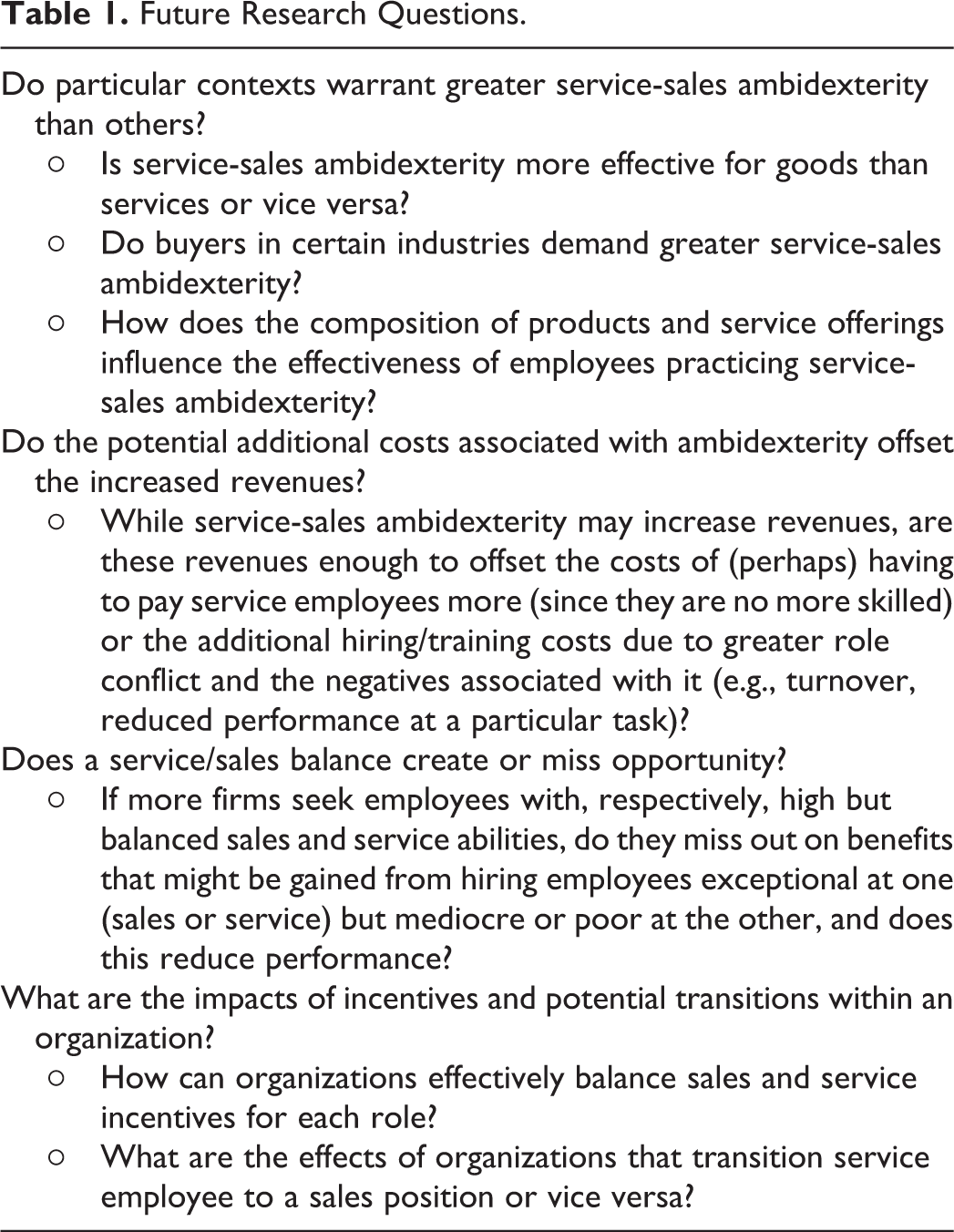
In addition, there may be contextual issues that need to be addressed. For example, are there particularly industries for which service-sales ambidexterity is more important than for others? Or might this differ based the buying situation? Furthermore, what about the costs to the firm, and/or the individual, for implementing service-sales ambidexterity. At the firm level, these costs would likely include increased costs to hire, train, and retain frontline employees. At the individual level, increased costs would include the increased emotional and mental fatigue associated with needing to engage in ambidextrous behaviors. Should firms focus more on those who are higher regarding polychronicity, as suggested by Mullins et al., and if so how can the firm best identify and train these employees?
To sum, we thank all of the authors and reviewers for their efforts on this special issue.
Footnotes
Declaration of Conflicting Interests
The author(s) declared no potential conflicts of interest with respect to the research, authorship, and/or publication of this article.
Funding
The author(s) received no financial support for the research, authorship, and/or publication of this article.
