



Abstract
In this article, we introduce the concept of the service delivery network (SDN) defined as two or more organizations that, in the eyes of the customer, are responsible for the provision of a connected overall service experience. This responds to calls for frameworks recognizing that dyadic service encounters are embedded in the series of experiences customers have with complementary providers as part of the journey to achieve their desired goals. Adopting an SDN perspective presents a dramatically different set of challenges for managers and provides research opportunities challenging the current view of established service concepts. Managers must recognize that to better serve the customer they need to understand the role that they play in the customer-defined service journey and be prepared to coordinate their activities with complementary providers. Participating in helping build and manage the SDN for the customer, or understanding how they fit into customer’s self-designed SDN, becomes a central challenge, often requiring firms to develop a new set of capabilities. The SDN also challenges the way we view many of the core concepts in service research, which are anchored in the dyadic view. This provides considerable opportunity for future inquiry. We present a series of research questions, inspired by the SDN, organized into categories including building cooperative and collaborative networks, customer cocreation, systems thinking, customer relationship management, managing service failure and recovery, building capabilities, and customer-to-customer interactions.
Introduction
The term service encounter has long been used to denote the interplay between the customer and the service provider (Bitner, Booms, and Tetreault 1990). It is a central concept within service research, as it provides the basic situation whereby the customer coproduces value through interaction with the organization’s service delivery systems. In the often-cited definition, Surprenant and Solomon (1987) described the service encounter as “the dyadic interaction between the customer and the service provider firm.” The related concept of the customer experience has also been frequently defined to only include direct and indirect contact between the customer and the service provider (e.g., Meyer and Schwager 2007). The central assumption underlying these conceptualizations is that the service encounter is dyadic in nature and that the customer assesses the firm in isolation. This assumption is at the core of many service models and our definitions of key concepts such as service quality and customer satisfaction (Rust and Chung 2006).
More recently, the view of the service encounter has expanded to encompass a perspective of providers engaged in delivering a “customer journey” (Patrício et al. 2011; Zomerdijk and Voss 2010). This perspective views service encounters as interactions embedded in a series of exchanges that may extend over a considerable period of time and with a variety of providers contributing to the experience. In such circumstances, the customer’s interactions with other providers are likely to have significant impacts on the service encounters with any particular firm that contributes to the overall service. A service provider may play a leading or a subordinate role in organizing the customer’s activities or in directing the delivery of service components by others. Alternatively, the customer may act as a “resource integrator,” assembling and coordinating interrelated services to achieve a given objective (Lusch and Vargo 2006).
Consider the example of a chiropractor who regularly sees a patient for spinal adjustments. The provider may view the relationship as a dyadic exchange where their responsibility is to repair the patient's alignment. The patient, however, is focused on their back health (i.e., their “customer journey”) and also visits a dietician, a trainer, a gymnasium, and a massage therapist. Assessing the chiropractor-patient interactions independently does not account for the possible impacts from the patient’s exchanges with the other contributing providers, which lead to the following questions:
Research Question 1: How is the patient affected by the need to assemble his own network of providers versus being assisted with referrals and advice from the chiropractor?
Research Question 2: How does the encounter differ for the chiropractor if she takes a lead role in coordinating services versus being one of several providers in a subordinate role for this particular patient?
Research Question 3: How does the patient react when given an unsatisfactory referral by the chiropractor versus making an independent choice for the same provider?
Research Question 4: What is the impact on the patient of being given contradictory advice or treatment by different service contributors?
Research Question 5: How is the patient’s satisfaction with the chiropractor affected by an unsatisfactory encounter with an independent but related service?
From the patient’s perspective, the journey spans multiple providers who form a network centered on him. Even though each of the providers interacts with him separately, they are bound together to some extent in the patient’s mind through the previously listed issues. By examining the set of dyadic encounters from the perspective of the patient’s network, substantially different insights emerge than when just focusing on each encounter as an isolated dyadic interaction.
Viewing the service encounter from the perspective of the network seen by the customer is consistent with the approach of Anderson, Håkansson, and Johanson (1994) who demonstrated that business networks are formed through dyadic buyer-seller relations being interconnected to other buyer-seller relations. The increasing interest in the network outlook is also observed in calls for research to introduce network perspectives in the study of services (Gummesson 2007; Ostrom et al. 2010; Scott and Laws 2010; Vargo and Lusch 2004). The central goal of this article is to provide the logic for complementing the dyadic service encounter perspective with a broader network view that emerges when the customer’s providers of related services are taken into account. This serves to support recent process-oriented frameworks (e.g., Patrício et al. 2011; Sampson 2012) of the customer experience by accounting for the nature of the relationships among members. As a means to shape the discussion, we introduce the customer-designated service delivery network (SDN) defined as two or more organizations that, in the eyes of the customer, are responsible for the provision of a connected, overall service. We reveal why this is valuable and demonstrate the advantages of the customer-centric network view for the advancement of service management and research. Consistent with the categorization scheme of MacInnis (2011), our goal is one of envisioning, providing an expanded conceptualization of the traditional service encounter by understanding the role of network impacts.
The remainder of the article is organized as follows. First, we present our motivation for introducing the SDN as a context to view dyadic exchanges. Second, we review the relevant network literature and establish the foundational principles of the SDN. Third, we contrast the current dyadic perspective with the SDN view and provide a discussion of the importance, implications, and associated challenges for researchers and managers. We conclude with a robust future research agenda.
Why Introduce an SDN Perspective?
This research responds to the many calls in the literature to more closely consider the role of networks in service (e.g., Baron and Harris 2009; Gittell 2002; Gummesson 2008; Lusch and Vargo 2006; Ostrom et al. 2010; Scott and Laws 2010). In describing our motivation, we consider two related themes: the increasing reliance on networks resulting from service fragmentation and the impact of the Internet, and the development of the customer experience literature that recognizes the impact of forces outside the firm on service encounters.
Increasing Reliance on Service Networks
A central reason cited for the importance of adopting a network perspective is that customers increasingly encounter multiple providers in pursuit of achieving their service goals. One factor in this trend is the growing fragmentation of service delivery. Firms are more reliant on outsourcing, contracting out service elements that these firms once provided internally (Ostrom et al. 2010). In some cases, the reliance on others stems from the firm’s choice to limit the range of its own activities, outsourcing noncore portions of its processes to other firms, stemming in part from the notion of concentrating on the firm’s core competencies (Prahalad and Hamel 1990). In conjunction with this movement to focus on specific processes, there has been the growth of industries specializing in providing support functions such as transportation and logistics, customer support, and after-sales services. The scale and scope economies and expertise afforded by the support specialists have further increased the appeal for firms to outsource parts of their service delivery (e.g., Cho, Ozment, and Sink 2008; Kemppainen and Vepsäläinen 2003).
In addition to the fragmentation of service delivery due to outsourcing, increasing technological complexity in many offerings has led to specialization among service providers and their increased reliance on complementary providers. For example, the mobile telephone industry is characterized by specialized providers of handsets, operating systems, applications, network services, and maintenance services. Some of the providers work with others to bundle service elements together, while others leave it to individual customers to create the combined service offerings.
The Internet has also had profound effects on service provision by facilitating customers’ abilities to become “resource integrators” and create their own networks (Lusch and Vargo 2006). First, it has increased the ease with which customers can search for and compare service offerings, allowing them to select various service providers on their own where they may have previously relied on a familiar provider to meet all of their needs. Second, the Internet has given rise to aggregators and intermediaries that act as agents who take on the resource integrator role. Although such services potentially add to the service encounter’s complexity by introducing another provider, they allow customers to pick “dynamic packages” (Piccoli et al. 2009) that meet individual preferences instead of those created through a firm’s more rigid alliances with selected complementary service providers.
Using the Customer Experience Approach to Alter Our Perspective
The dyadic view of the service encounter has been challenged for not recognizing the importance of factors outside the organization that contribute to the customer experience (Gummesson 2008; Verhoef et al. 2009) and not accounting for the importance of the coordination of service providers both within and across organizations to support customer satisfaction (Gittell 2002). Sampson (2012) points out that service processes frequently cross entities to address the customer’s needs. Patrício et al. (2011) refer to these external entities as comprising the “customer value constellation,” and they are an important part of the multilevel service design process. These frameworks are consistent with articles on service innovation, growth, and experience management that contend that firms need to understand service from the perspective of the customer’s overall requirements or goals. This includes identifying from the customers’ perspective all of the touch points that comprise the journey required to help them achieve their goals (Zomerdijk and Voss 2010). One clear result of advanced blueprinting and design approaches that map out the service from the customer's perspective is the recognition that the journey frequently involves touch points at multiple parts of an organization and often with external partners as well (Patrício et al. 2011; Sampson 2012).
U-Haul, a US-based provider of self-move and storage resources, provides an excellent example of how a customer-centric perspective benefits from a network approach (Bettencourt and Ulwick 2008). In addition to its core moving services, U-Haul helps customers locate other services needed to complete the job of moving their physical goods. The firm offers prepackaged moving kits that reduce the time customers take to gather the different boxes and moving supplies. Further, an online partnership with eMove, an electronic marketplace of self-moving- and self-storage-related consumers, business owners, storage affiliates, and moving helpers, assists customers quickly locate a variety of ancillary services offered by human helpers—packers, babysitters, cleaners, and painters—that recognizes the interconnected set of services that customers require to accomplish their goals.
A second example from leading design firm Innovation, Design Engineering Organization (IDEO) demonstrates the value of considering all of the touch points in a customer journey and adopting a network perspective (Jones 2007). The firm was working with Blue Cross/Blue Shield (BC/BS), a large U.S.-based health care insurance company, to understand the customer’s health journey in order to help the client position and design the role the client would play. Through its field interviews with customers, IDEO discovered and clearly defined the seven roles that someone needed to play for the journey to be favorable: guide, teacher, coach, personal assistant, expert, financial advisor, and consumer advocate. Based on further analysis, IDEO recommended that BC/BS takes on the roles of guide and financial advisor, relying on other parties to assume responsibility for the other roles in the customers’ journey.
A number of implications emerge from this case when using the customer journey perspective. First, the journey is based solely on the customers’ experiences. Second, the network of providers beyond BC/BS delivering each role is potentially unique to each customer. The insurance company’s success in its part of the service encounter depends on the other service providers that each customer selects to play the complementary roles. Third, the customer plays a central role in cocreating the network of providers delivering the services. Fourth, each series of dyadic interactions with a network member is embedded among the many other encounters with the other members of the customer’s network supporting his health journey. Finally, the complexity of the journey, driven by the number of organizations and people involved, leads to challenges in coordinating the activities of the network members.
The above illustration suggests that placing the service encounter in a network context provides a broader, more realistic view of service experiences and also allows us to tap into the rich literature about networks to label and better understand the conditions that occur within them. This adds an important dimension to the more process-oriented approaches introduced to better understand the service encounter and associated experience (e.g., Patrício et al. 2011; Sampson 2012). In the next section, we develop the concept of viewing the service encounter in this network context and we explain how the SDN fits within the extant terminology and discussion about networks.
SDN
A network consists of a set of actors or nodes along with a set of ties that connect them (Borgatti and Halgin 2011). The pattern of ties yields a particular structure and the nodes occupy positions within this structure.
Networks are challenging to define as they do not have natural boundaries; however, as Borgatti and Halgin (2011) point out, the relevant network is defined by the investigator who, based on the purpose of the research, selects the set of nodes and the types of ties to include or exclude. In describing the service encounter, there is a critical need to consider networked service delivery in the way that the customer sees the service, in other words, to adopt a customer-centric approach (Shah et al. 2006). Through this perspective, we recognize what a customer sees as the relevant set of actors and ties and, from there, we can gauge how that customer is impacted by the particular network’s effects on each service encounter with the relevant firms. A larger network of interconnected customer-provider product and service relations also exists beyond a specific customer’s SDN, one that includes the service providers’ suppliers, competitors, customers, and complementors (Wilkinson 2008). However, consideration of this larger set of relations is beyond the scope of our focus on the customer-provider interactions with a service encounter.
In network terms, we adopt a focal net or ego network approach where we examine the situation from the perspective of a single actor—the customer (Borgatti and Foster 2003; Burt 1992). The customer acts as the “hub” or focal node and the network includes as nodes the set of actors (service providers) who directly touch the customer in his particular service journey, with the customer’s encounters represented by ties between the customer and the providers.
Specifically, we define the resulting SDN as two or more entities that, in the eyes of the customer, are responsible for the provision of a connected, overall service. The SDN also includes any ties that may exist among the providers that the particular customer encounters, where the ties represent interprovider interactions that affect the customer. Note that many SDNs may have no such interprovider ties, particularly where customers have numerous alternative providers from which to choose.
The Embedded Service Encounter
Consider the case of wealth management services where a client may have a certified public accountant, a lawyer, a financial planner, a chartered life underwriter, and an estate planner involved in the process. The dyadic perspective of the service encounter views interactions with each provider as independent of the exchanges with the other professionals.
The SDN approach considers the encounters with each provider to be embedded within a network defined by the exchanges with the other professionals. In Figure 1, we first show the dyadic view where the client interactions with the lawyer are independent of interactions with any of the other professionals. The same conditions would apply for the other providers. Figure 2 illustrates the SDN perspective where the client interaction with each professional is potentially influenced by the customer’s experience with the other providers.
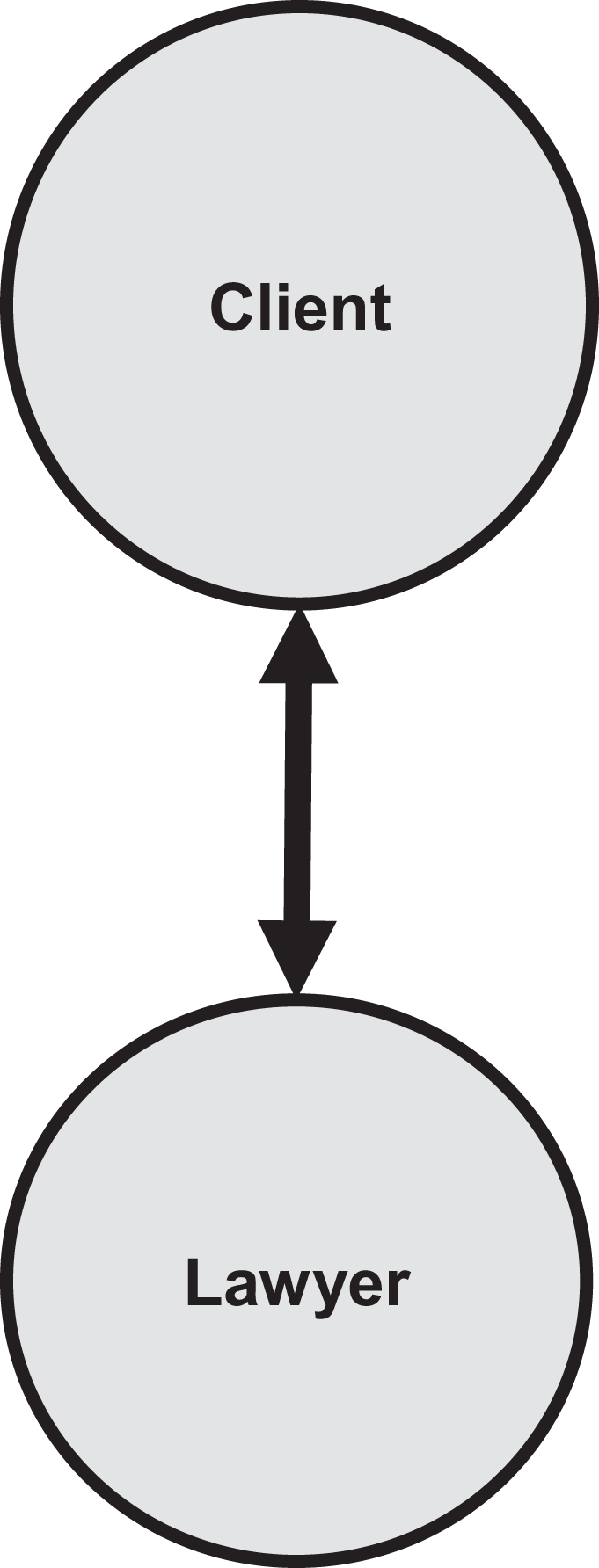
The dyadic service encounter. In the dyadic view, a service provider (in this case, a lawyer) interacts with the client in isolation, even though the lawyer’s interaction may form only part of the customer’s overall service experience.

The service delivery network encounter. Each service provider interacts with the client who relies on other providers who contribute complementary portions of the overall service. In this case, the client requires expertise from several professions for wealth management services. The encounter with each provider may be impacted by the client’s experience with the other professionals. In addition, the providers here must interact to coordinate the overall service.
In network terms, the customer in a service encounter is the center of an individual ego network, while the relevant service providers who contribute to the customer’s wealth management journey are the “alters” (i.e., other network nodes or members) for that customer (Borgatti and Foster 2003). The lawyer in our example is only one of the customer’s “alters” and the encounter may be affected by the particular ego network’s configuration. In this particular example, the nature of the service requires that the providers interact to ensure that the overall service is properly coordinated; in other circumstances, there may be few ties and limited interaction among the firms, with the coordination duties falling to the customer.
In the figures, we highlight the customer’s tie with the lawyer by bolding it to emphasize that the SDN conceptualization is, like the dyadic service encounter model, a means of portraying the interaction between a particular service provider and its customer. While the SDN is derived from the customer’s perspective, it is designed to frame conditions facing each of the service firm’s managers. One firm is likely to be the focus of the customer at a specific point in time but that shifts when the customer is in contact with a different provider. Figure 2, by using a customer-centric perspective, helps the lawyer recognize that, during any encounter with a client, he must consider not just the customer but also the role played by other service providers contributing to the overall service.
The SDN approach is designed to model the encounter with an individual customer to inform the firm about the conditions that are relevant for that encounter. However, it is also instructive to consider what different scenarios may occur when numerous customers’ SDNs are aggregated, that is, what the firm faces with the pattern of SDNs arising from its customer base. In some cases, a firm’s customers may have very similar SDNs; in other cases, the SDNs may be very diverse and the differences affect the firm’s ability to manage service encounters.
Constrained Versus Unconstrained Customer Choice
One decision a service provider must make is whether or not to restrict its customer’s selection of complementary providers. In Figure 3, we depict the example of an appliance retailer that has chosen to designate a sole provider of warranty repair services. Under these circumstances, the networks of the retailer’s customers will have some similarities and there is likely to be a more formal arrangement between the retailer and the warranty service provider. Note that customers may choose other network members, such as a financing company, contributing to differences in their SDN.
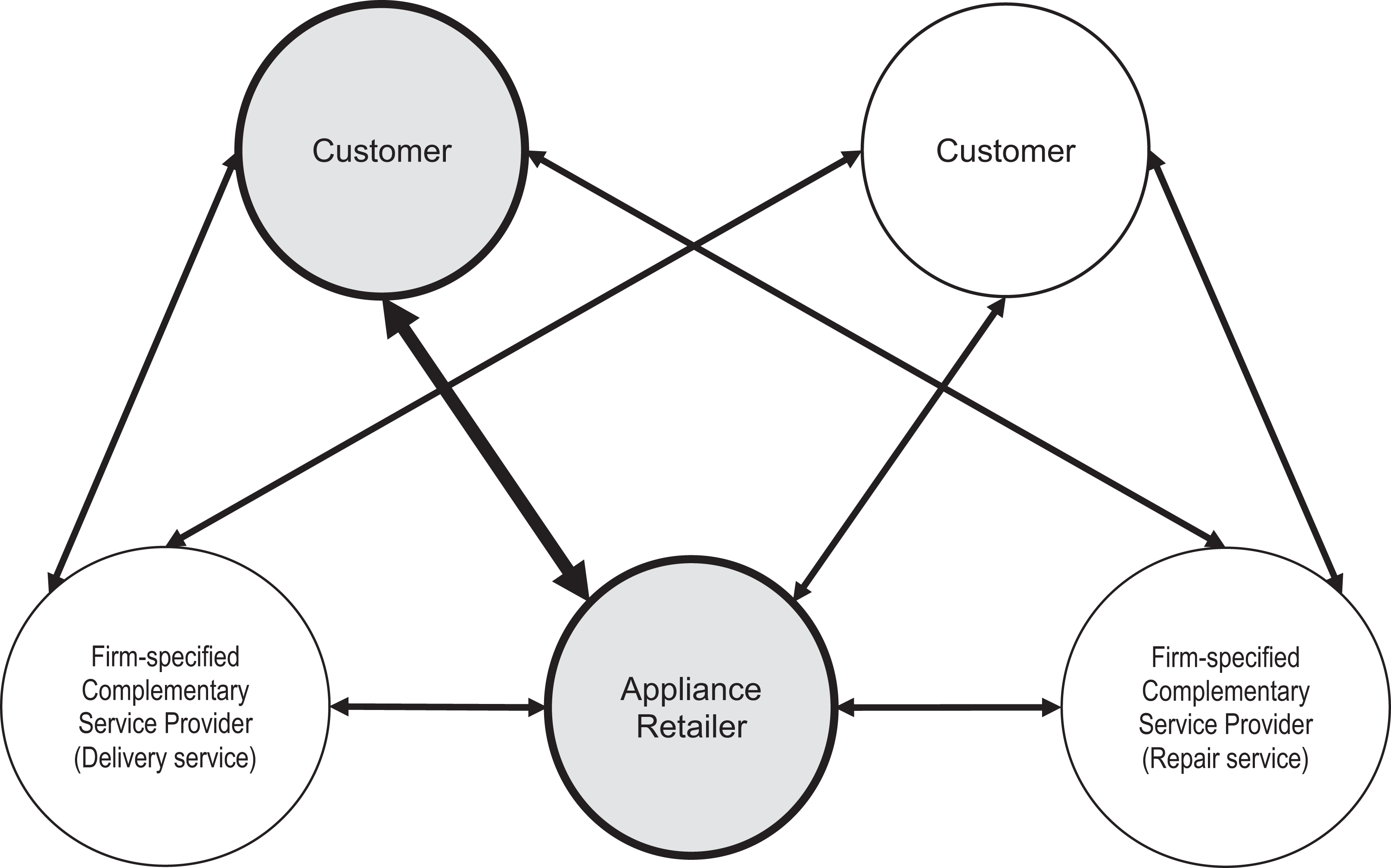
The service delivery network environment with constrained customer choices. Given sufficient power, the firm may be able to dictate to customers which specific complementary service providers may be used in conjunction with the firm’s services. A high degree of commonality among customers’ SDNs promotes interaction among service providers.
We expect a very different situation where a firm has little power to direct customers to specific coproviders. For example, customers of a hotel in an urban center have many options for dining and entertainment that make up other components of their experiences. Figure 4 shows this contrasting situation where customers are free to choose complementary service providers; here, each ego network of these two customers has multiple “alters” in the form of customer-selected complementary service providers that have no connection to the core service provider, or to one another. The contrasting situations illustrate the potential differences in the extent of commonality among the SDNs that customers might bring into the firm’s service encounters.

The service delivery network environment without customer choice constraints. Potentially, the firm may have customers who bring unique sets of complementary service providers.
Collectively, this comparative similarity or diversity across all of the firm’s customers’ SDNs creates what we call the degree of SDN commonality of the firm’s collective interactions with customers. The firm’s degree of SDN commonality may be as important for service firm managers as the formal networks they establish since high diversity among customers’ SDNs can greatly affect the design of the firm’s own processes. Piccoli et al. (2009), for example, differentiate between an alliance strategy whereby partnering organizations build interconnecting systems and an agility strategy whereby the firm’s systems must be able to allow customers to choose their own service coproviders. The need to accommodate different configurations of customers’ SDNs places greater burdens on the design of the firm’s service processes.
In cases such as the one depicted in Figure 3, the SDNs of customers will be quite similar if the firm has the power to direct them to use specific coproviders. In network terms, such power may be derived through the firm’s network centrality, its size, or its ability to bridge structural holes among the customers’ networks (Burt 1992; Wilhelm 2011). An example of power derived from bridging structural holes is U-Haul’s service of recommending related moving services to its customers; there are many structural holes in the customers’ combined networks (in that there are few connections among the customers other than their common use of U-Haul) that might otherwise help these customers locate alternative coproviders. In this case, U-Haul has more power in being able to provide expertise not available to its otherwise unconnected customers. However, in many cases, firms may not even be aware of other contributors to various customers’ overall services since each SDN is not necessarily created and managed by the service coproviders.
Coordinating Service Networks
The need for many networked services to be coordinated leads to additional tasks that otherwise may not be considered as an essential part of the service encounter. While the service encounter has considered the customer’s role as interacting with the firm in isolation, in network-based encounters, the customer’s role may expand to include activities such as service coordination. As well, customers may have expectations that one or more of the service providers within their SDNs undertake coordinating roles, influencing their satisfaction with particular providers. By recognizing these aspects of the customer’s requirements, the firm may be able to expand its services without impinging on the roles already played by complementary service providers in the customer’s SDN.
Clearly, the customer’s SDN may be quite different from what firms see as their networks from the traditional viewpoint. There may be no formal agreements or connections among firms that the customer views as service coproviders. For example, a theater company in a large city might see its network as largely its subscribers and its supplier base. However, for the customer who buys a theater ticket, the overall service experience might involve transportation, parking options, babysitting services, a wide range of alternative dining spots, and any other contributors to the customer’s evening out. While the traditional perspective of the service encounter views the interactions with each provider separately, the customer may perceive them collectively; a good experience with one component of the overall experience can positively influence the customer’s view of the others. As shown in Figure 5, the customer may act as a “resource integrator,” selecting the play, restaurant, and transportation service independently. Alternatively, as shown in Figure 6, the customer may rely on an agent such as an events company that integrates the service components by packaging the theater with a restaurant and transportation service. This arrangement allows the agent to develop a relationship with the customer without any of the other service contributors being strongly connected to the customer or their coproviders. As the theater company begins to see the encounter from the customer’s perspective, it can develop relationships that address the overall service experience, not just its own component. As shown in Figure 7, it might take a leadership role in organizing the customer’s evening entertainment by coordinating the delivery of complementary service components by other selected providers. By organizing the restaurant and transportation providers, the theater may be able to manage the customer’s experience more effectively as well as establish a closer relationship.
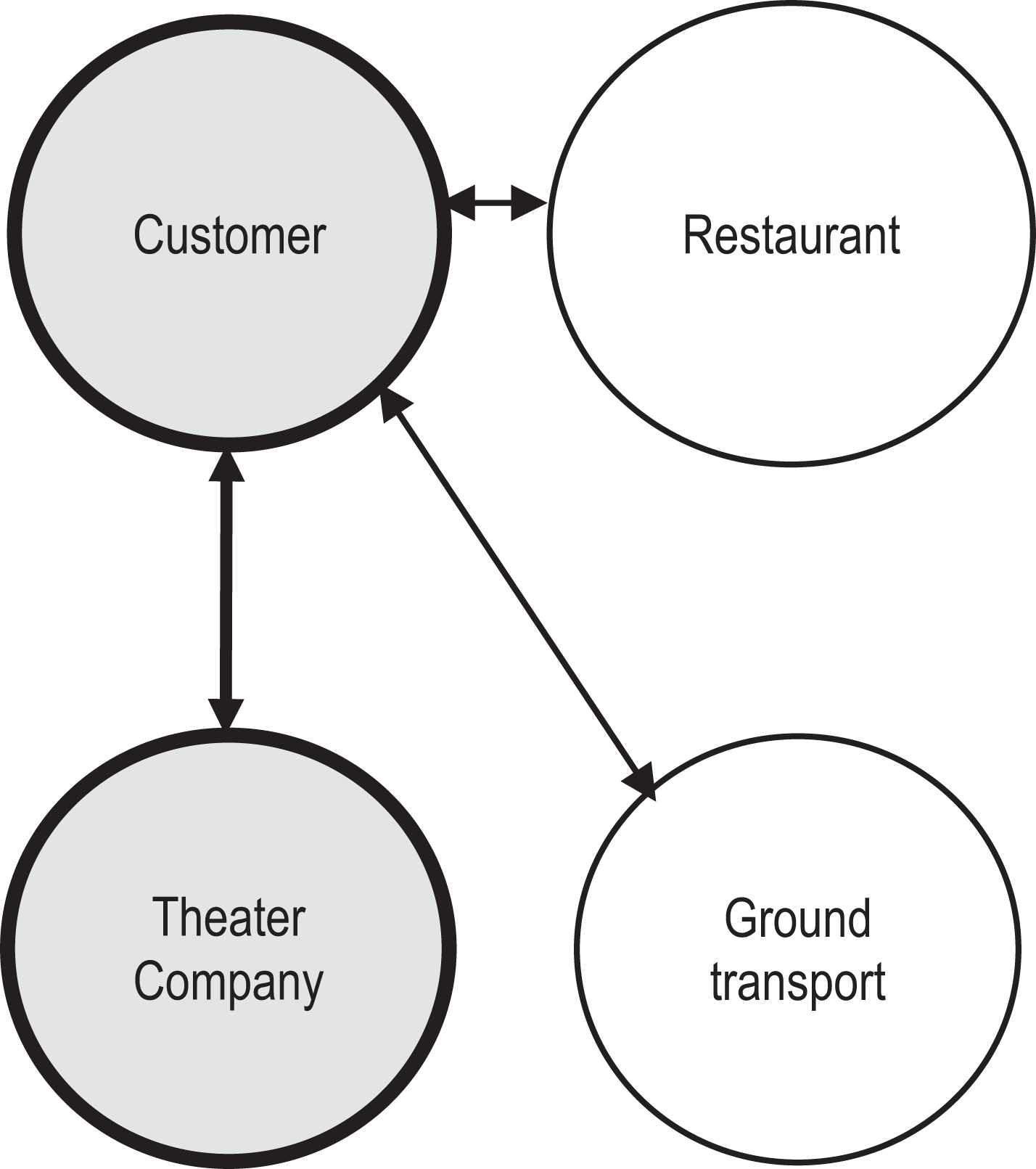
Service delivery network where the customer coordinates. The customer organizes an evening’s entertainment. There may be no ties among any of the service providers. Each service provider may be unpredictably impacted by the customer’s service encounters with the other providers.

Service delivery network where customer uses a service coordinator. Each service provider is contracted by an event planner. The event package company plays a central role as a coordinator, with ties to each other service providers but there may otherwise be no ties among service providers.
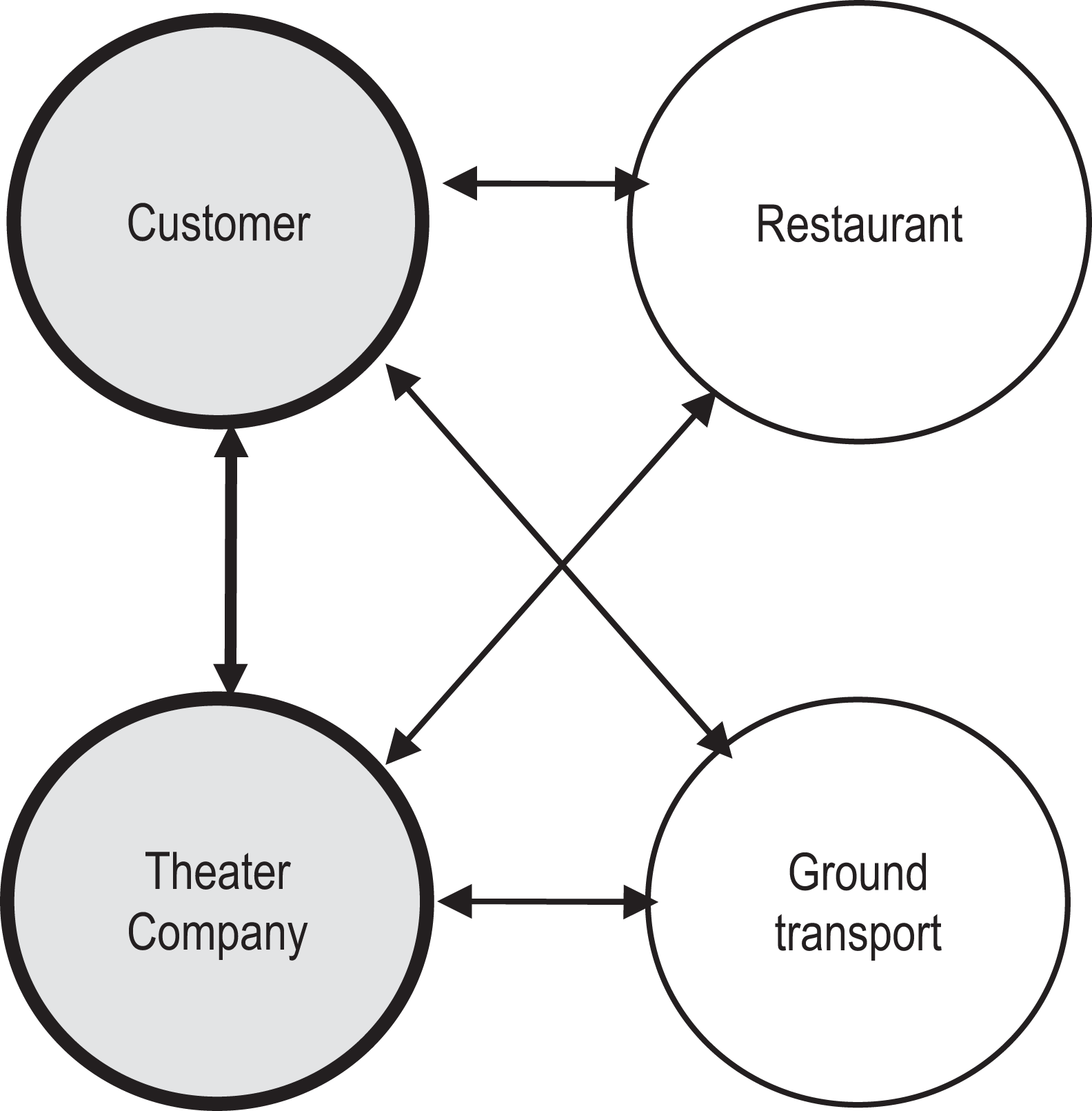
Service delivery network where the service provider takes a leadership role. The theater company selects a nearby restaurant as a partner and promotes it with restaurant discounts offered to theater ticket holders in return for the restaurant’s special timely service for theater patrons. The theater company also promotes a particular taxi firm in return for having sufficient transport capacity available after performances. By taking a leadership role and developing ties with other providers, the theater company is likely to improve the overall experience for participating customers.
It should also be noted that SDNs are dynamic. The experience and outcomes of the various service encounters can strengthen or weaken existing relations; customers’ SDNs change and evolve over time as new providers and aggregators enter the scene and disrupt existing networks and as customers’ needs change and they learn about different alternatives (Wilkinson 2008). Such changes offer strategic opportunities and pose threats for those involved (Ritter, Wilkinson, and Johnston 2004).
SDN Membership
We include within SDNs just those agencies with which the customer interacts directly for a particular overall service. Like others have, we recognize that firms are not isolated: Their behavior and performance depend not only on their own efforts, skills, and resources but also on those of others to whom they are directly and indirectly connected (Gummesson 2008; Wilkinson 2008). Virtually all firms will have supply bases but, in most cases, customers are likely unaware of the contributions made to the final service by this network of suppliers; we do not consider such suppliers as part of the SDN. We do include in the SDN those contract suppliers that deal directly with customers on the firm’s behalf. Examples are contracted tailoring services working within a department store or contracted telephone-based customer support services. A firm may not portray such service providers as separate entities; however, their independent roles may become apparent to the customer in the event of a service failure when the problem resolution might bring their roles to light.
Although the SDN does not include the indirect contributor service providers such as suppliers, the network may include fellow customers if they contribute to service delivery. Education programs often rely on classroom participation or group projects, making classmates’ part of each other’s SDN. Audience participation entertainment and adventure tour companies are other examples of services that depend on customers as major inputs in the experience (Arnould and Price 1993; Baron and Harris 2009).
The customer-centric definition of the SDN provides a parsimonious frame in delineating just the providers that the customer directly encounters. This delineation makes the SDN distinct from a value net perspective (Gummesson 2007) that includes the supply chain, complementors, and competitors. While the value net may be very useful in addressing future questions associated with service networks, our focus is on the part of that network that the customers sees and interacts with directly, since these actors directly affect the service encounter and customers’ perceptions.
Dimensions of Aggregated SDNs
Given that the firm encounters many individual customers who are the central nodes of their own SDNs, the service firm has to manage the individual encounter but plan its service processes according to the aggregated SDNs of its anticipated clientele. We have referred to one aspect of this aggregation of the individual SDNs as the degree of SDN commonality—what the service firm faces as the result of the aggregated network configurations of its customer base. The SDN commonality among customers is potentially affected by the providers’ networks as well, particularly if the customers’ network configurations are driven by arrangements among the providers. For example, if a service firm requires that customers use a particular set of coproviders exclusively, there will be far more congruity among the SDNs of the firm’s customers. Both customers and service providers are likely to be impacted by differences in some important dimensions of the firm’s degree of SDN commonality. Some dimensions of this characteristic include but are not limited to: Formality of the service provider network: Commonality or diversity among the SDNs of a firm’s customers may be driven in part by the conditions established by the firm’s network of coproviders. Networks among service providers may vary from formal relationships governed by multilateral contracts to situations where there is no formal arrangement, with interconnections driven only by factors such as geographical proximity. For example, a playhouse and nearby restaurants or a medical center and neighboring pharmacies—or other conditions that lead customers to use the same combinations of service providers. Clearly, greater use of formal relationships among coproviders may improve their service coordination, even if only some of the customers are shared among them, which may enhance satisfaction of the affected customers (Gittell 2002). Transactional versus relational goals: A customer may prefer to establish long-term relationships with some network members but only deal on a transactional basis with others within the same SDN. For example, a customer may be a loyal patron of a particular hotel chain but uses various online reservation websites to book rooms. While the hotel chain would prefer that the customer booked directly through its own reservation service, each travel booking service also has an interest in developing a relationship with the same patron. In such cases, the customer faces issues in maintaining loyalties toward multiple service providers who vie to establish the central customer relationship within their patrons’ SDNs. A customer’s SDN may include several complementary service providers that aim to develop customer relationships, potentially causing conflict that affects the customer’s overall encounter. For example, the customer may be negatively affected by a lack of cooperation between the hotel and the booking service, each of which could withhold information from the other firm to gain advantage in managing the customer relationship. Degree of customer freedom in selecting providers: As previously observed, firms may have the option of constraining their customers to use only specified coproviders. Examples include health maintenance organizations that specify authorized primary-care and secondary-care providers, or monopoly government services such as vehicle licensing offices. Figure 3 depicts this situation where the focal firm dictates that its customers must use one or more particular coproviders. The resulting higher degree of SDN commonality affords the firms more predictability in its service encounters. The common interests among the linked providers are likely to lead to stronger ties among them. In contrast are situations where customers are unconstrained in selecting service coproviders, such as that depicted in Figure 4 where a firm’s customers have only the focal firm in common within their SDNs. Greater freedom in selecting service coproviders is likely more attractive for customers but introduces complexity for the service providers. Such firms will have fewer opportunities to develop strong ties with particular coproviders and customers, with their divergent SDNs, will likely bring different expectations and requirements into their encounters. Complexity of the overall service offering: Networked service encounters range from the uncomplicated purchase of a coffee in a Starbuck’s outlet in a hotel lobby to the complex situation of long-term medical treatment. Complexity increases with the number of elements in a system and with the dimensionality, that is, the relative unpredictability of interactions among customers, service providers, and other system elements (Choi, Dooley, and Rungtusanatham 2001). In regularly contributing to more multifaceted service offerings where the customers and their SDNs inject more dimensionality, firms may face more complex service requirements that demand greater flexibility within each process stage, compatibility with a broader range of providers, involve more consequential decisions for the customer, require more information exchange and coordination, and have less predictable outcomes.
The conditions created by the collective nature of the firm’s customers’ SDNs vary with these and other dimensions. In the next section, we indicate how viewing service encounters as dyadic customer-firm interactions does not account for important details when in fact the customer instead encounters an SDN.
Contrasting the Dyadic and SDN Perspectives of the Service Encounter
In this section, we compare the SDN and dyadic approaches in terms of how important service management concepts vary across the two perspectives. Table 1 shows several of the contrasts that arise when comparing the traditional dyadic customer-firm model of service with the situation where the customer interacts with a firm that forms part of the customer’s SDN.
Contrasting the Dyadic and SDN-Based Service Encounters.

Note. SDN = service delivery network.
We expand on some of the key differences below.
The Customer’s Role in the Service Encounter
In service, the customer is presumed to be a coproducer (Bendapudi and Leone 2003; Vargo and Lusch 2004). Customers’ effectiveness in coproduction depends on factors such as their familiarity with comparable service processes. However, coproduction is usually viewed as a process isolated from outside influences. The typical service blueprint, for example, portrays the service delivery in terms of what the organization sees within its own systems, mapping out the organization’s internal processes and customer interactions alone (Bitner, Ostrom, and Morgan 2008).
In SDN situations, the customer interacts with multiple providers; the overall process may be intertwined over time, with interagency dependencies at various stages throughout the process (Patrício et al. 2011). Interactions include those involved in designing and planning the service network itself, that is, services through which customers come to know about alternatives and their potential contributions. The temporal interconnections are evident in the customer-activity chain perspective and recent versions of blueprinting frameworks that consider all aspects of service that a customer performs in conjunction with the appropriate set of providers (Patrício et al. 2011; Sampson 2012; Sawhney, Balasubramanian, and Krishnan 2003).
As discussed, an important consideration in the SDN is the coordination of the various providers’ activities in serving the customer. When the customer has few constraints in choosing service coproviders, the interprovider coordination is likely to be less developed and the coordination role falls to the customer. This is the case in Figure 5, where the customer chooses to organize the theater experience. How the customer behaves in this resource integrator role—and how that impacts the customer’s experience—is an important aspect of the SDN functioning absent in the dyadic view.
Managing Service Quality
Established service quality models hold that the firm plays a central role in setting expectations against which perceptions of service will be compared. While it is acknowledged that other forces, such as experience with competitors and word of mouth, contribute to expectations (Parasuraman, Zeithaml, and Berry 1988), these models do not account for network partners being a primary source of the promises that customers expect to be fulfilled (such as a hotel having to meet promises made by an online travel booking site).
As well, the customer’s perception of one firm’s service quality is probably influenced by the performance of other providers within the SDN. The network literature supports that the effectiveness of a group of providers influences the perceptions of the individual member’s performance, given the interdependence of their efforts (Ancona 1987; Burt 1997). Referrals within a network of providers put a premium on social capital—capital based on the relationship ties of SDN members—to coordinate effectively to ensure the expected service quality (Burt 1992; Nahapiet and Ghoshal 1998).
Further, customers who are particularly pleased with an overall experience may overlook the shortcomings of some network service providers. Services delivered in close succession by multiple providers may blend together in the customer’s perception, resulting in a gestalt that affects the customer’s assessment of individual providers. As Chase and Dasu (2001) point out, customer perceptions may be inordinately affected by what happens in the overall experience's later stages.
Finally, a low degree of SDN commonality among customers makes it more difficult to identify the best return on quality (ROQ) initiatives (Rust, Zahorik, and Keiningham 1995). The ROQ model is designed for targeting service improvement but requires that customers assess satisfaction with all components of the experience to identify key drivers of repurchase intention. As more SDN actors contribute to customers’ experiences, identifying the most valuable areas for improvement becomes more complex.
Service Failure and Recovery Issues
In the dyadic view, the provider is generally expected to take responsibility and recover from a service failure (Tax, Brown, and Chandrashekaran 1998). Where service is delivered through a network, responsibility for service failures may not be readily apparent to the customer and difficult for service providers within the network to agree on attributions of blame. Even when the problem source has been identified, customers may expect other SDN members to respond and take care of their partners’ error. This is challenging as they might have little power to correct them. Conversely, service providers within a network may benefit from solving problems created by others. Effecting recovery by correcting coproviders’ service failures could lead to higher customer satisfaction for a firm compared to the firm simply doing its own portion in an exemplary manner.
These possibilities point to the importance of cooperation and coordination in an SDN service recovery process. The ability of service providers in the customer’s network to discipline and cooperate with each other will depend on their relationship. Failure and recovery incidents are also apt to bring out the competitive nature of SDN member firms and to be a source of conflict (Luo, Slotegraaf and Pan 2006; Wilhelm 2011; Wilkinson 2008). In the case of a service failure, the firm hearing the complaint can attribute blame to other parties who may or may not be responsible, with the intention of reducing expectations about its own responsibility for the recovery and also to protect its service quality image.
In cases where the provider recommends or restricts customers to only using a specific partner, customers may have higher expectations for that provider to assume accountability for the partner’s failure. Consumer research indicates that when a customer refers a friend to a service provider and the friend is dissatisfied with the performance, the relationship between the firm and the recommender suffers (Ryu and Feick 2007). This same risk is likely to occur when firms recommend or restrict the choice of their customers to select partners. The partner’s performance will impact the relationship of the recommender and its customers.
Customer Relationship Management
To effectively manage customer relationships, firms need to consider the impact of other stakeholders in the process, including additional firms delivering parts of the customer solution (Baron and Harris 2009; Wilkinson and Young 2002). The relationship management perspective in service literature has been criticized for being too focused on the customer and the individual firm at the expense of understanding the network influences (Grönroos 2004).
When service delivery involves multiple service providers, viewing the long-term customer-firm relationship in isolation from the SDN overlooks at least two important complications. First, the customer may want to establish a primary resource within his SDN that remains stable over time—a “network captain” for a particular type of services. The network captain might be designated by convention or by regulation, as with the primary care physician within a customer’s network of health care providers. In other cases, no central coordinator of the network may exist, with each provider and the customer forming a looser system of relations. This challenges traditional notions of management and control (Ritter, Wilkinson, and Johnston 2004). It may not be obvious who can or should assume the role of network captain; it may be open to competition among service providers who each see advantages in “owning the customer relationship.” In such situations, the customer may face ambiguity in determining the best choice of primary service provider within the network and may have to deal with some friction among the competing service providers. Being the customer’s primary point of contact might provide advantages that lie in steering the customer’s choices, being able to “cross-sell” the customer with its own services, and being able to manage attributions in service failure incidents. Since networks are a source of information as well as service provision (Podolny 2001; Wilkinson 2008), having multiple providers in a network offers the customer opportunities to gain different points of view about the services. Those assuming the “captain” role also face risks; they may be held responsible for the performance of others they recommend and they also could spend uncompensated time to manage relationships between the customer and other providers.
Second, loyalty to a particular service provider may be affected by that firm’s ability to control who else is allowed to participate in its customers’ SDNs. If a customer is constrained to using a particular service contributor that the customer does not like, that factor could overwhelm any loyalty that the customer has to the firm. A vivid example was the initial exclusive use of AT&T, a global provider of cell phone network services, as the carrier for Apple’s iPhone in the United States. Regardless of the allure of the signature Apple offering, if customers were frustrated enough with AT&T’s service, they would seek alternative smartphone options. In some circumstances, for example, where technology or fashion tastes change rapidly, maintaining customer loyalty may rest in part on managing access to an ever-changing set of complementary service providers.
Service Orientation
The issue of fit and relations with network partners extends beyond considerations of processes and information flows to encompass concerns with how partners deliver service. This aspect is captured in their service orientation and climate (Lytle, Hom, and Mokwa 1998). Evidence supports a strong relationship between firm service orientation and such outcomes as profit, growth, customer satisfaction, and loyalty (Schneider, White, and Paul 1998). Positive service climates reflect a set of distinctive practices supporting employee behaviors that sustain superior service. These practices include issues related to the core focus on the customer experience, hiring, training and rewarding of employees, and the servant leadership view of management (Lytle, Hom, and Mokwa 1998).
In the dyadic view, firms that emphasize a service orientation in their competitive positioning can largely assure that their own service encounters deliver on their values. In the SDN situation, significant service delivery and customer contact may be provided by others, leading to concern about how well their service orientations match and how well they can effectively communicate and cooperate (Gittell 2002). Consistency in service orientation thus becomes an important decision when selecting and being selected by partners (Wilkinson, Young, and Freytag 2005). For example, WestJet, Canada’s second-largest airline and a top-20 member of the 2010 Businessweek Customer Service Champs ranking, has faced challenges in entering partnerships with other airlines. They had built a strong, loyal customer base through delivering a combination of economic value and a memorable experience through highly engaged employees. Besides the technical challenges of linking processes and information systems with partner airlines, a significant concern was the differences in the service orientations of potential partners, something that would be very obvious to its loyal customers.
Process Design Considerations
Methods to analyze and design service processes, such as service blueprinting, usually focus on the steps that customers go through in their transactions with the firm in isolation (e.g., Bitner, Ostrom, and Morgan 2008). Where firms are routinely involved in only part of the overall service delivery, they also need to account for how their service designs fit with those of complementary service providers (Patrício et al. 2011; Sampson 2012). They have to adapt their service designs to reflect the range of complementary service providers that customers bring into their encounters with the firm. If the firm allows customers to use many different complementary service providers, the firm’s internal processes will have to be more flexible to allow for the variability inherent in having a wider variety of other providers’ processes and outputs. Adding variety (i.e., different fixed service options) and customization (ability to alter the process or outcomes to suit customer requirements) to the firm’s processes reduces process efficiency (Anderson, Fornell, and Rust 1997). The need to mesh with a wider variety of other service providers is likely to drive up the requisite variety (Ashby 1958; Wilkinson 2008) within the firm’s own systems, leading to challenges for controlling the firm’s processes and maintaining their efficiency.
As identified in Figure 3, a firm may try to gain efficiencies by limiting the range of allowable complementary service providers. However, there are trade-offs in constraining customers’ choice, and there are limits on the power of firms to control behavior of other providers in a customer’s SDN. On one hand, restricting which other firms customers may use can have positive impacts by improving efficiency and information sharing among the providers. On the other hand, customers may view service offerings to be more attractive if they offer greater flexibility, with more customized treatment (Chase and Dasu 2001). Constraining customers’ choices about other allowable providers can have negative consequences, since perceived constraints tend to reduce motivation and intentions to use services (Alexandris, Funk, and Pritchard 2011). Each provider firm in an SDN may be seeking to control the network in its own best interests, which may conflict with others’ and with the customer’s best interests. Viewing the service encounter as a phenomenon that, for customers, extends beyond the firm’s own boundaries reveals the potential dilemma facing managers in choosing between restricting customer choice of complementary service providers versus facing the consequences of greater complexity in giving customers more coprovider options.
The Value of the SDN Perspective
The SDN perspective’s core contribution is that it provides firms with a way to recognize the potential opportunities in helping customers coordinate service provider actions to make the experience more efficient and effective. In addition, it can help managers to put their firms in a superior strategic position in a network context by developing relational coordination capabilities and learning how to deliver a superior experience by effectively managing and participating in their customers’ SDNs. The SDN approach also makes firms aware of the benefits and risks of building stronger relationships with a select set of complementary providers by restricting customer choice. Finally, the SDN perspective alerts firms to the competitive threat posed by other network members.
To deliver great customer experiences, firms need to understand the entire constellation of service providers and their activities that help customers achieve their goals (Patrício et al. 2011). While recent frameworks have pointed to the importance of such an understanding (Sampson 2012), experience research more generally has been criticized for only addressing the customer experience at the firm level (Patrício et al. 2011; Verhoef et al. 2009). The SDN perspective reveals the opportunities that firms have for creating networks of complementary service providers that can simplify the customer’s task of identifying and coordinating all of the parties needed to satisfy their requirements. Unlike other “journey-based” approaches, the SDN perspective, by incorporating network theory, identifies both critical conceptual issues and many of the challenges to successfully implementing the strategy.
An example case from Strauss (2010) vividly illustrates some essential conceptual elements and managerial requirements for successfully adopting an SDN view and the benefits from doing so. He compares the traditional service view of accounting firms dealing with clients in a dyadic fashion to that of effectively managing in a network-based wealth management relationship. “Effective wealth managers, then, become highly proficient at relationship management, first building relationships with their clients in order to fully understand their unique needs and challenges, and then coordinating the efforts of their expert teams in order to meet those needs and challenges. The accounting firm of the future will align itself with trusted partners in all areas of wealth management to protect clients from financial risk. A successful transition for accounting firms to a wealth management paradigm hinges on paying strict attention to critical success factors, including having one partner in charge, creating the right infrastructure, building alliances with advisors in investment management, law and advanced planning, and ensuring that firm members can readily access that knowledge.”
This case illuminates that when there are multiple agencies involved in the process, as we show in Figure 2, interorganizational coordination and cooperation are needed in managing encounters (Alter 1990; Gummesson 2008; Luo, Slotegraaf, and Pan 2006; Wilhelm 2011). Relational coordination helps support task integration, since the relationships among networked service providers are important contributors to customer outcomes (Gittell 2002). Coordination becomes increasingly important when service processes are highly interdependent, uncertain, and time constrained. Firms that can take a lead role (through assets such as infrastructure, alliance-building skills, or information integration processes) may have a competitive advantage in securing a customer’s trust and confidence. More generally, a particular customer’s coordination requirements will vary with the service’s overall complexity, the coordination provided by the selected set of providers as part of their regular service, and whether the customer chooses to use an agent or himself to manage the coordination (see Figures 5 –7).
The SDN approach also surfaces the strategic potential of forming alliances or networks among complementary service providers. This approach can result in stronger ties with regularly interacting network members, making coordination more effective and routinized. Jones et al. (1998) refer to the development of “polygamous constellations” among service firms that choose to share customers and “pursue collective advantage” through the development of a stable, constrained network. In other markets, particularly where there is little differentiation among competing complementary service providers, there may be less advantage for the firm in restricting customers’ choices in the makeup of their SDNs. However, the growth in importance of relational coordination in managing the supplier base (e.g., Dyer 1996) suggests that similar advantages might be gained with lateral connections by restricting customers’ SDN choices in order to develop closer relationships with a constrained set of coproviders.
While recent frameworks for the customer experience recognize the importance of multiple firms contributing to the journey, they do not account for competition among those parties. The SDN, building from underlying network theory, recognizes that interfirm relations involve a mix of cooperative and competitive elements or co-opetition (Wilhelm 2011). Firms both cooperate to expand the total amount of rewards and resources available to them, and compete over the means to do this and over the division of rewards and resources (Wilkinson 2008). They often compete to form relationships with counterparts such as customers and suppliers that build competitive advantages in creating value for final customers. This is a critical element in both the service experience and the customer relationship management (CRM) that the SDN approach brings to theory development and practice.
Future Research
The SDN viewpoint challenges conventional approaches to service thought; it should stimulate a broad array of research to develop theory advancing our understanding of this phenomenon. Next, we highlight important issues requiring attention. The section is organized around core themes with a summary of specific research questions for each topic provided in Table 2.
Summary of Important Future Research Questions.
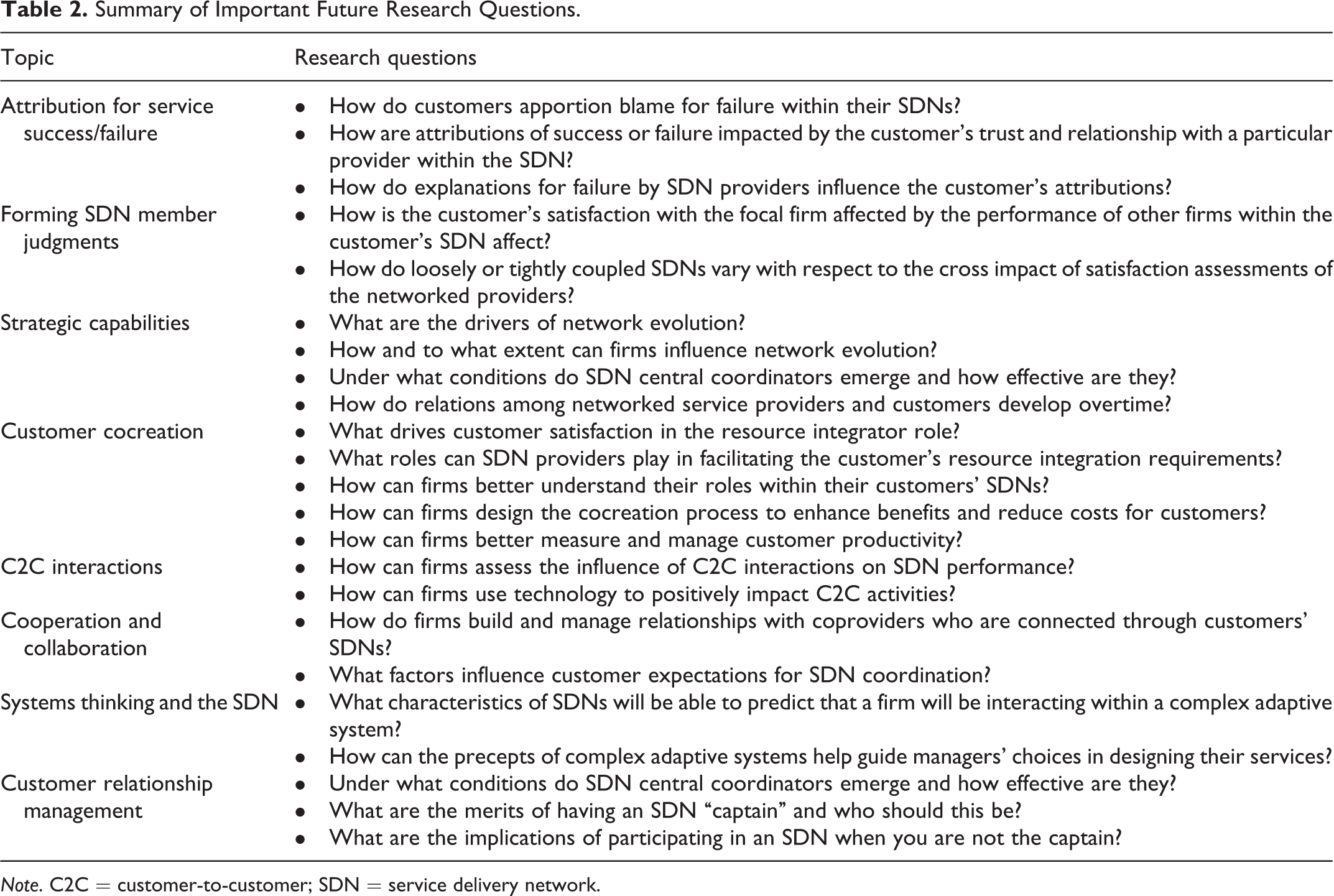
Note. C2C = customer-to-customer; SDN = service delivery network.
Attributions for Success and Failure
Understanding how customers make decisions about the cause of success and failure in the SDN is an important issue in both attribution research and network research (e.g., Folkes 1984). SDNs create a more complicated system of explanations when failures occur (i.e., the scope of each participant’s potential finger-pointing and rationalization of events) for customers to sort through and reach a conclusion (Cowley 2005). This presents a challenge for researchers and managers. Given the potential for conflicting accounts, an important issue to explore is the effect of different types of relations among SDN participants, including trust and relationship strength as well as other relevant attribution predictors in networked service delivery.
Forming SDN Member Judgments
SDN members may contribute to customer assessments of each other’s performance. Understanding how consumers form judgments about the member firms will shed light on the nature of satisfaction with SDNs as well as about the drivers of service quality. One of the main thrusts in this line of inquiry is how satisfaction evaluations of one member are impacted by other SDN members’ performance, particularly the nature and extent of the impact. Examining this reciprocal influence would be particularly insightful in situations where members are expected to collaborate in delivering the service.
Strategic Capabilities
Network members need to be concerned about developing, maintaining, and defending their positions (Gadde and Mattsson 1987; Wilkinson 2008). When a member takes on the role of coordinator, it may need to build new capabilities to broaden its service offerings and compete with traditional partners. Competition to play a more central role in client problem solving has become increasingly important as the services of less strategic members become commoditized. Research examining how the network “captain” is identified is needed to understand this critical issue.
There has been increasing interest in the issue of the dynamics and evolution of business relations and networks (Easton et al. 2008), and new methodologies, such as complexity theory and agent-based models offer powerful ways of advancing our understanding in this domain (Wilkinson, Marks, and Young 2010). Research exploring the use of these methods would be valuable in growing the theory in this area.
Customer Cocreation
Cocreation can have both significant costs and benefits for the customer and the firm. Traditional network research has focused on situations where firms form the network associations and usually take a strategic perspective about how these associations are created (Ritter and Gemünden 2003). The SDN approach highlights that network development and management may be more complex. Research is needed to understand the cocreation role customers play in designing and taking on responsibilities within their SDNs. In the IT literature, some have posited that the customer will become increasingly responsible for putting together their service packages with network-based customer service systems (e.g., Brohman et al. 2009). Research on how firms can better understand managing in an environment where the customer is the central node in the network is critical.
Customer-to-Customer (C2C) Interactions
The service literature notes that customers influence each others’ experience in a variety of ways, both positive and negative (Baron and Harris 2009). Other customers in the service setting influence wait times as well as offer assistance and provide social benefits (Baron and Harris 2009). Since customers can partially replace service providers in the SDN, they may play an important function in service delivery. Research on how firms can monitor and assess the quality of C2C interactions is important, given the impact on customer outcomes.
Cooperation and Collaboration
Network theory observes the central role of coordination and collaboration among members in contributing to service outcomes (Ritter and Gemünden 2003; Wilkinson 2008). Much research has been conducted in settings where the governance among members has been formal, contractual, and with an underlying strategic relationship. These conditions stand in contrast with situations where the customer is the central node and the relationships among firms within the customer’s SDN may range from very weak to stronger ties (Borgatti and Halgin 2011). The study of power, conflict, trust development, cooperation, and communication within more fluid sets of SDNs would be very helpful in understanding network performance.
Research on collaboration and cooperation has largely been conducted from the point of view of the organizations involved. The SDN approach requires a better understanding of this issue from the customers’ perspectives. Further research on how network firms shape customer expectations about the level and nature of coordination and cooperation among SDN firms would be valuable.
Systems Thinking and the SDN
The diversity or commonality of customers’ SDNs is challenging and creates important conditions that firms face. In systems terms, the ability for contributing service providers to offer different outcomes for each customer leads to increased dimensionality or range of possible results at any stage, which leads to unpredictability in the system’s behavior. When a firm has wide diversity in its customers’ SDN membership and where contributing services provide customization, the combination can quickly lead to high complexity and difficult-to-predict system behavior. Networked service delivery in such situations as hospital care (Tan, Wen, and Awad 2005) and ecotourism (Schianetz and Kavanagh 2008) has been described in terms of complex adaptive systems (Holland 1992). Research bringing the complex adaptive system view into the SDN literature could prove beneficial in understanding the conditions and management challenges in particular SDN contexts.
Customer Relationship Management
Another valuable research contribution would be to understand how relationships form over time in SDN contexts, with a view to rethinking current CRM models. While we speculate that an SDN member might emerge as the “captain,” research to test that assumption and explain how that process unfolds is essential to informing firms on how to participate in an SDN. Research also points to the need for firms to maintain ownership of their relationships with customers, especially in situations where competition is prevalent among SDN members (Wilkinson 2008). In addition, it is critical to understand CRM from the position of firms not playing the coordinating role, as they are in a weaker position to grow their relationships with valuable customers and are more susceptible to being replaced in the network.
Conclusion
Recent articles have made the case that customer experiences need to account for forces outside the firm that influence the traditional dyadic encounter perspective that has driven service theory development. The SDN perspective provides a conceptual basis for integrating network theory into the service encounter and the customer experience and journey literature. Taking the customer’s view and seeing networked service delivery from this vantage point provides a more realistic way of portraying the service encounter in a world of fragmented, interconnected service delivery. Doing so affords service providers insights into critical design and strategy decisions. One key decision is how to build relationships with complementary firms to deliver a more efficient and enjoyable customer journey. In doing so, gaining customers’ trust and confidence likely depends upon the firm’s concern for relational coordination and a harmonized approach to how its network operates. This may require firms to develop new capabilities to capitalize on the opportunities while at the same time considering that network partners represent a new form of competition.
The SDN also provides a different perspective on many core service management activities. Our understanding of service quality, CRM, process design, service recovery, and service orientation are all impacted by taking a network perspective of customer-firm interactions. In addition, the areas of future research that we highlight point to how many of the foundational principles of service management emanating from the dyadic view may benefit from a more realistic network viewpoint.
Footnotes
Acknowledgments
We thank the editor and three anonymous reviewers for their valuable comments throughout the review process.
Declaration of Conflicting Interests
The author(s) declared no potential conflicts of interest with respect to the research, authorship, and/or publication of this article.
Funding
The author(s) received no financial support for the research, authorship, and/or publication of this article.
References
Supplementary Material
Please find the following supplemental material available below.
For Open Access articles published under a Creative Commons License, all supplemental material carries the same license as the article it is associated with.
For non-Open Access articles published, all supplemental material carries a non-exclusive license, and permission requests for re-use of supplemental material or any part of supplemental material shall be sent directly to the copyright owner as specified in the copyright notice associated with the article.
