



Abstract
While retention of highly qualified employees is vital for professional services firms, prior research has largely neglected the role of customers as a driver of employee satisfaction and retention. Drawing on an experimental study and a dyadic field study, this article shows that client satisfaction is an important determinant of employee satisfaction, which in turn increases employee retention. Thus, for professional services firms, the common logic in relationship marketing that employee satisfaction affects client satisfaction can also be reversed. First, in line with balance theory, an attitudinal transfer occurs from the client to the employee which is stronger when both share the same opinion about their collaboration. Second, in line with Herzberg’s motivational theory, client satisfaction indirectly affects employee satisfaction by affecting the perceived appreciation the employee receives from the customer. These findings have three major managerial implications: First, investments into client satisfaction might pay off double by enhancing revenues and profit on one hand, and enhancing employee satisfaction and retention, on the other hand. Second, positive client feedback has positive effects on employee satisfaction and recognition. Third, these results suggest that marketing and human resource issues are intertwined in professional services firms. Thus, service firms should encourage ample communication and collaboration between these functions.
Keywords
Introduction
Professional services firms account for a substantial part of modern economies (Nikolova 2007; Scott 1998). Typically delivering knowledge-intensive services such as consultancy, engineering, and legal services, professional services are highly customized and high in credence properties (Patterson 2000). Furthermore, professional services are characterized by intense client-employee interactions and thus by a high level of personal rapport between client firm representatives and employees of professional services firms (see also Gremler and Gwinner 2000). As a result, the performance of professional services firms strongly depends on a solid base of human capital (Rust et al. 1996). Employee turnover and the resulting outflow of knowledge and resources spent on recruiting and adaptation training are therefore detrimental to professional services firms. However, these firms often face high turnover rates (Batt 2002; Nikolova 2007), which endanger their ability to provide quality services and which raise costs considerably (Luo and Homburg 2007). Replacement costs for a highly qualified professional services employee can rise to double the annual salary (Capelli 2000), and costs are increasing in economies where aging and sinking birthrates mean fewer qualified personnel will be available in the next decades.
Causes for the high employee turnover in professional services firms can lie in the nature of the job (Nikolova 2007). Professional services work is mostly organized into serial projects or assignments, during which employees work closely with their clients and often remotely from their employer on a sequence of assignments lasting from several weeks to several months—or even years. The de facto superior on a project is often a member of the client company. Collaborating employees of the client company become an employee’s temporary colleagues during the project and client companies tend to become the employee’s focal company of interest, rather than the employer itself. In such a context, true loyalty to the employer may be difficult to build up.
Due to the nature of professional services work, clients’ views are usually crucial for the employees’ remuneration and performance feedback. The client’s feedback is widely used to evaluate employee performance, making clients even more critical for professional services employees. Thus, client behavior and satisfaction might have a substantial influence on professional services employees’ work motivation and satisfaction. Although the integration of an external factor is fundamental for service providers (Vargo and Lusch 2004; Zeithaml, Parasuraman, and Berry 1990), human resource management and services marketing studies have not yet systematically analyzed how and why client satisfaction might affect employee satisfaction and retention. Prior work focuses on personal or firm-related and thus internal determinants of employee satisfaction and retention, such as employees’ motivations, role perceptions, or economic rewards (e.g., Boyt, Lusch, and Naylor 2001; Brown and Peterson 1993; Hartline and Ferrell 1996).
Most literature on managing customer relationships focuses on market-related outcomes of customer satisfaction, such as the customer’s word of mouth, repurchase intentions, and cross-buying behavior (e.g., Homburg and Stock 2004; Sheth and Parvatiyar 1995; von Wangenheim and Bayón 2007). Remarkably, firm- or employee-related internal consequences of customer satisfaction have rarely been studied (Luo and Homburg 2007). While several authors have found correlations between client and employee satisfaction (e.g., Ryan, Schmit, and Johnson 1996; Schneider and Bowen 1985; Tornow and Wiley 1991), these studies have mostly disregarded causal relationships. Additionally, investigators have not studied individually matched dyads of clients and employees who work together directly, and have so far completely overlooked professional services. Interestingly, most of the studies on effects between client and employee satisfaction have proposed that employee satisfaction should affect client satisfaction (e.g., Brown and Lam 2008; Evanschitzky et al. 2011; Grandey, Goldberg, and Pugh 2011). Barely any study has indicated a potential influence of client satisfaction on employees, even though this effect is at least as likely as the reverse effect, as we argue below. Consequently, this article contributes to the literature as follows:
As the first study of its kind, we investigate how and why clients contribute to or hinder employee retention in the professional services setting. Thus, we examine how client satisfaction contributes to human resource management performance, thus strengthening marketing’s relevance for overall service firm performance.
With a two-study design, we aim at providing robust results with strong external validity and managerial implications helping practitioners to reduce employee turnover by investigating the underlying mechanisms in the client-employee relationship. By relying not only on experimental evidence but also on a dyadic data set of professional service clients and employees who were working together on an assignment, we respond to the call for using multiple data sets and methods to establish causal relationships and valid results (Davis, Golicic, and Boerstler 2011).
Including moderating variables, we test the conditions under which the link between client satisfaction and employee satisfaction might be stronger or weaker. In addition, we include an indirect effect of client satisfaction on employee satisfaction in order to explain why an attitudinal transfer from clients to employees might occur. We thus further illuminate the underlying mechanisms of the client-employee relationship.
This article is organized as follows: After developing our conceptual framework and the corresponding hypotheses, we describe the methodology and results of the two empirical studies. We then explain the results and discuss research-related and managerial implications.
Conceptual Framework
Overview
The unit of analysis of our study is the dyad of a client firm representative and an employee of the professional services firm directly collaborating on a shared project. In this client-employee dyad, we consider individual constructs and a construct at the dyad level. With respect to the individual constructs, we measure client satisfaction on the client’s side of the dyad and we measure perceived appreciation, employee satisfaction, and employee retention on the employee’s side. At the dyad level, we consider the attitudinal congruence of client and employee. Figure 1 shows our conceptual framework.
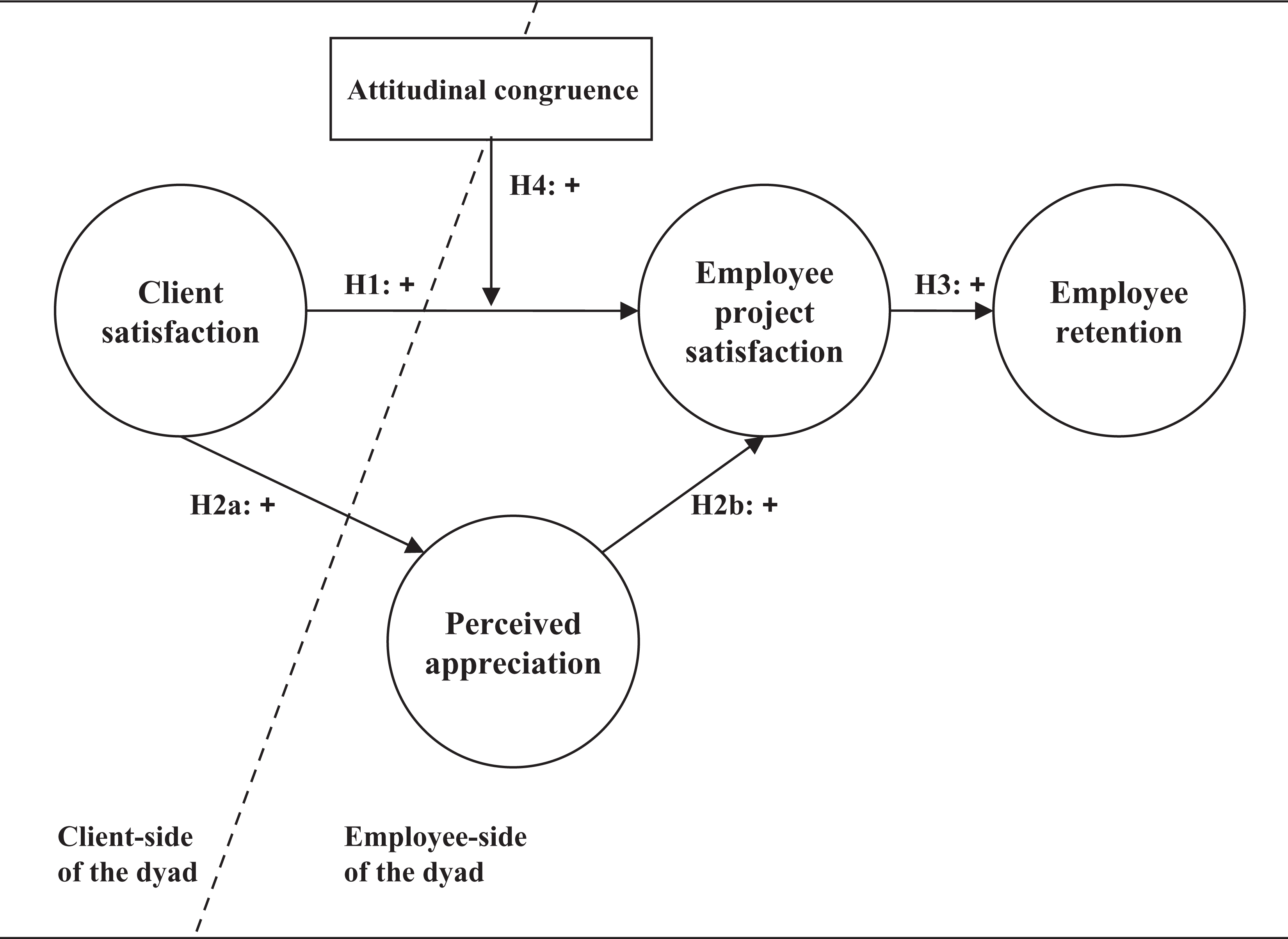
Research framework.
Since clients are of central importance for professional services employees, we propose a direct effect of client satisfaction on employee satisfaction. A direct effect of client satisfaction on employee satisfaction can be reasoned by drawing on Heider’s (1958) balance theory. Balance theory argues that people generally tend toward assimilating their attitudes toward an object, even if they initially disagree. Balance theory and its implications for the model are further explained in the Hypothesis Development section. As a direct test of the underlying rationale, we also consider a moderating effect on the direct effect of client satisfaction on employee satisfaction. If balance theory applies, a construct reflecting the attitudinal congruence of the client and the employee should moderate the effect of client satisfaction on employee satisfaction positively.
We further propose an indirect effect from client satisfaction positively influencing employees’ perceived appreciation and thus enhancing employee satisfaction. If clients are satisfied with their interaction with the professional services employee and with the project’s advancement, they will exhibit appreciative behaviors and expressions which, in turn, lead to employees’ perception of appreciation. According to Herzberg’s motivational theory (Herzberg, Mausner, and Snyderman 2008), appreciation for one’s work and performance is one of the most powerful motivators leading to employee satisfaction.
We extend these effects to a causal chain, as employee satisfaction should positively affect employee retention. In this respect, several studies demonstrate that satisfied employees have a strong intent to stay with the company and that turnover is lower (e.g., Carsten and Spector 1987; Cotton and Tuttle 1986; Griffeth, Hom, and Gaertner 2000; Lee and Maurer 1997; Lee and Mitchell 1994; Lee et al. 2008; Mobley et al. 1979; Tett and Meyer 1993).
Construct Definitions
In general, client satisfaction can be defined as the client’s postconsumption or postusage evaluation of the professional service, containing both cognitive and affective elements. Whereas transaction-specific satisfaction captures the client’s evaluation of a particular service encounter during the project, we consider the client’s cumulative satisfaction with the service provider, namely, the client’s overall evaluation of the service or the service encounters to date (e.g., Homburg, Koschate, and Hoyer 2005).
With respect to employee satisfaction, the traditional job satisfaction definitions from the human resource management literature mostly conceptualize formative satisfaction constructs including aspects such as work conditions, remuneration, or relationships with superiors (Brown and Peterson 1993; Locke 1976; Mobley 1977). In this study, we focus on the narrower construct of “employee project satisfaction.” We aim at analyzing the effect of client satisfaction on employees and therefore focus on the portion of employee satisfaction that can be affected by interactions with clients on a particular project. It is unreasonable to expect that client satisfaction would influence employees’ general perceptions of their remuneration or career opportunities as other major aspects of job satisfaction.
We define employee project satisfaction as the portion of satisfaction that refers to the client and to interactions with the client resulting from an evaluation of both cognitive and affective elements during the shared project. It is thus a rather global assessment of satisfaction referring to all interactions with the client in the project to date. Since professional services assignments can last weeks to several months and employees work together with clients very closely, the employee project satisfaction is of high relevance for professional services employees and their intent to stay. It is worth emphasizing that while we focus on an employee’s project-related satisfaction, we include other aspects of job satisfaction (satisfaction with the work environment and with colleagues) as control variables in our dyadic study (see Figure 2).
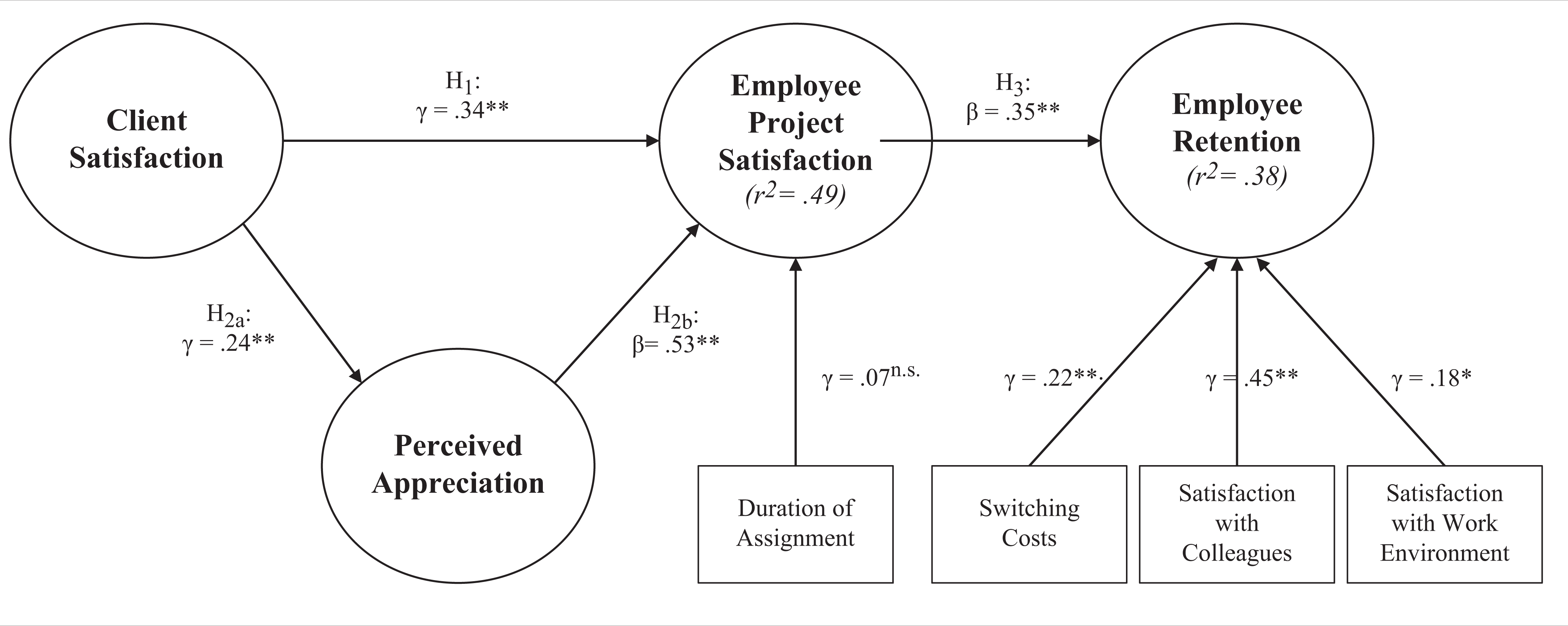
Dyadic field study—results of model estimation. Note. n.s = not significant. Completely standardized coefficients are shown. *p < .05. **p < .01.
Employee retention can be conceptualized either as a result of employee behavior or as a goal of management. Since a longitudinal design measuring de facto retention is hardly accomplishable for dyadic research designs, we define employee retention as the intent to stay with a company for the mid or long term.
Since we did not find a suitable definition for the employee’s perceived appreciation by the client in a service context, we define it as an employee’s feeling of being valued as a person and for his or her professional performance. According to Heider (1958), attitudinal congruence is the degree to which clients and employees share the same attitudes and opinions on the shared project assignment.
Establishing Causality Between Client Satisfaction and Employee Satisfaction
Prior research has largely focused on the extent to which employee satisfaction affects client satisfaction (e.g., Brown and Lam 2008; Evanschitzky et al. 2011; Grandey, Goldberg, and Pugh 2011; Homburg and Stock 2004; Johnson 1996; Koys 2001; Schlesinger and Zornitsky 1991; Schmit and Allscheid 1995; Tornow and Wiley 1991). It is not the goal of this study to claim that this well-established effect of employee satisfaction on client satisfaction does not hold. Rather, we aim at analyzing whether, in a professional services context, there also exist an effect of client satisfaction on employee project satisfaction and ultimately employee retention.
In order to establish the causal direction of the effect between clients and employees, we first aim at understanding the reasons for the attitudinal transfer in this direction. Therefore, we consider two constructs moderating and mediating the effect of client satisfaction on employee project satisfaction. Moderation and mediation are important ways to specify the nature of a causal relationship between two constructs (e.g., Zhao, Lynch, and Chen 2010).
“Another potential remedy [to rule out reverse causality] is to separate the measurement of the predictor and criterion variables. This might be particularly important in the study of attitude–attitude relationships” (Podsakoff et al. 2003, p. 887). Separation of measurement can be accomplished in several ways. One is to create a temporal separation by introducing a time lag between the measurement of the predictor and criterion variables. The idea is to establish a temporal order between cause and effect “since after cannot cause before” (Rindfleisch et al. 2008, p. 263). A further approach in this respect is to dyadically survey study participants by gathering the independent variables from one partner of the dyad and the dependent variables from the other partner. The dyad is considered the “fundamental unit of interpersonal interaction and interpersonal relations” (Kenny, Kashy, and Cook 2006, p. 1), and is adequate for studying interpersonal phenomena. However, since dyadic data are hard to collect, only a few studies employ this advanced sampling method in the context of client-employee interactions (e.g., Homburg and Stock 2004; Simpson, Rholes, and Nelligan 1992; Strauss, Barrick, and Connerley 2001; Williams and Hazer 1986).
Despite contemporary analysis methods such as structural equation modeling, finding evidence for causal effects while simultaneously ruling out the reversed effect is a thorny undertaking. In strict terms, causality cannot be established with cross-sectional data. Ideally, we would be able to access longitudinal and dyadic data (Echambadi, Campbell, and Agarwal 2006; Rindfleisch et al. 2008). In such a setting, client satisfaction and employee project satisfaction as well as the moderating and mediating constructs should be assessed at two or more distinct points of time. However, longitudinal and dyadic data are very difficult to obtain.
As an alternative to these forms of survey and panel designs, experimental research is an adequate method for isolating causality, manipulating independent variables, and measuring or observing the result subsequently. This notably holds as the “identification of cause and effect relationships is the raison d’être of experimentation” (Perdue and Summers 1986, p. 317).
To establish a causal link between client satisfaction and employee project satisfaction and to strengthen the validity of our findings, we thus address these methodological requirements using a multimethod approach (Davis, Golicic, and Boerstler 2011). More specifically, we apply a two-study design that includes an experimental study on one hand and a dyadic field study with temporally lagged survey data on the other. The experimental study is intended to predominantly establish causality and to focus on internal validity. It additionally includes a temporal feature, intending to separate the manipulated independent variable from measuring the dependent variable. The dyadic field study aims at providing external validity, accounting at the same time for causality issues. We aim at implementing this by (1) temporally separating the measurement of cause and effect, (2) separating the measurement source, in particular for client satisfaction and employee project satisfaction, (3) including a mediating effect explaining the reason for the attitudinal transfer, and (4) including a moderating variable explaining under which circumstances the attitudinal transfer is weaker or stronger.
Hypothesis Development
Drawing on balance theory (Heider 1958), we first suggest a direct effect of client satisfaction on employee project satisfaction. Balance theory posits that a system of triadic relationships between two persons and an object can be either balanced or unbalanced. The triad is defined by one person’s relationship to the other person and the object as well as the other person’s relationship toward the object, resulting in a relationship triangle. A relationship system is balanced if the two people have the same attitude toward the object and unbalanced if the two people differ in their attitudes toward the object. Differing attitudes result in cognitive tension. Since people tend to avoid cognitive tension, they attempt to balance the system, which requires one person to change his or her attitude toward the object. According to Heider (1958), the change occurs when the person with more social power convinces the other to amend his or her attitude. The prevalent notion in services science that “clients are king” leads us to suggest that clients are the more powerful part in the professional services triadic relationship, making employees adjust their attitude and eventually also their satisfaction to match our definition of the client’s satisfaction. Evidence from balance theory thus leads to the following hypothesis:
An indirect effect of client satisfaction on employee project satisfaction, mediated by client appraisal, is suggested by Herzberg’s motivational theory (Herzberg, Mausner, and Snyderman 2008). Herzberg found drivers of employee dissatisfaction (hygiene factors) to differ from drivers of employee satisfaction (motivators). The major motivators are a feeling of success in one’s job, a sense of responsibility, and the perception of appreciation for accomplishments. Several studies have supported these motivators (e.g., Hellman 1997; Tett and Meyer 1993). Satisfied clients will probably express their feeling of contentment with a professional services employee’s performance through appreciative remarks or positive feedback, thus providing more rapid performance feedback than professional services employees’ superiors. We therefore derive the following hypotheses pertaining to the indirect effect, mediated by the construct of “perceived appreciation”:
Finally, a direct effect of employee project satisfaction on employee retention can be proposed from the theory of social identity and the theory of reasoned action. The theory of social identity pertains to an individual’s pursuit of a positive identity or improving the present identity by identifying with certain social groups (Tajfel 2010; Tajfel and Turner 2004). The identification process is based on three levels: social categorization, social identification, and social comparison and psychological group distinction. Undergoing such an identification process with a group (e.g., the employing firm) increases solidarity within that group and degrades other groups. The marketing and management literature has widely used the theory of social identity (e.g., Madrigal 2001; Sen and Bhattacharya 2001; Sirgy 1982).
For professional services employees, the first step in social identification with their employing firm is social categorization. That is, employees categorize the firm as socially desirable. The second step is employees’ identification with the firm, which is followed by the third step, social comparison. Employees compare their firm with others and rank it as superior while simultaneously degrading alternative employers, leading to a stronger intent to stay with the current employer and, hence, to employee retention.
The theory of reasoned action indicates that attitudes lead to intentions, which in turn manifest in actions (Ajzen and Fishbein 1975, 1980). Applying the theory to the proposed relationship between employee project satisfaction and retention, we propose that high satisfaction and the intent to stay result in behavior to continue the relationship with the current employer. On the basis of these two theories, we propose that:
As outlined above, we consider a moderating variable in our research framework: We operationalize balance theory as a moderating variable in order to test the theoretical contribution to the effect of client satisfaction on employee project satisfaction. Balance theory is the theoretical basis for Hypothesis 1, as well as the basis for defining client and employee interactions (e.g., Hennig-Thurau et al. 2006; Homburg and Stock 2004, 2005). However, investigators have rarely assessed the empirical validity of this theoretical rationale. If balance theory applies in this context, the convergence or divergence of the client’s and the employee’s perception of the service relationship would have to moderate the effect of client satisfaction on employee project satisfaction. In other words, the more the client and employee agree, the more strongly client satisfaction will affect employee project satisfaction. Hence, the “attitudinal congruence” between client and employee is likely to moderate the client-employee satisfaction relationship:
Experimental Evidence
Study Design
The main goals of the experimental study were to isolate the causality of the fundamental link between client satisfaction and employee project satisfaction and to focus on internal validity. To address Hypotheses 1 and 3, we manipulated client satisfaction in a scenario-based experimental setting while subsequently measuring employee project satisfaction and retention.
We conducted our experiment at two Western European Business Schools where students in business administration (mostly at the MBA level) were encouraged to participate. The experiment was conducted online. From a population of 561 students, 206 participated for a response rate of 36.7%. Participants’ average age was 31.8 and their average professional experience was 9.1 years, also indicating a fairly high external validity owing to a sample that reflects practical reality better than conventional (undergraduate) student samples. We excluded cases where respondents failed the manipulation check and had unreasonably short answering times. More specifically, we first excluded cases with many missing values. Second, we excluded responses with unreasonably short answering times since we wanted to ensure that participants were really involved in the scenario. Third, we rigorously analyzed the client satisfaction manipulation check in order to make sure that the participants really understood the scenario. The final sample consisted of 172 complete responses.
The overall scenario required participants to imagine themselves as a consultant at a fictional strategy and management consultancy (Consulting Associates, Inc.), where they worked with an automobile firm to develop a new strategy for bringing hybrid cars on the market. The scenario introduced a contact person (head of research and development) at the client company. We then manipulated client satisfaction as communicated by the client contact person on five different levels, ranging from a very dissatisfied to a very satisfied client. Drawing on prior research (Homburg, Koschate, and Hoyer 2005), we manipulated client satisfaction as a cognitive and affective evaluation of employee performance by the contact person. For example, in the case of a quite satisfied client (Level 4 of the 5 satisfaction levels), we indicated that “All in all, your client seems to be quite pleased. He is satisfied with your performance and especially your last presentation. He tells you that he is satisfied with your work so far” (Table 1). To encourage participants to focus on client behavior and the current project, we kept the information about other general employee satisfaction constituents (e.g., working hours, stress, and relationships with colleagues and superiors) to a minimum. In the interest of instrumental control, extraneous factors were held constant, and the only framing information given at the beginning of the study was “All in all, your work environment and remuneration are okay for you.”
Experimental Study—The Effect of Client Satisfaction on the Dependent Measures.

Note. SD = standard deviation.
Underlying items anchored by 1 = do not agree at all and 7 = strongly agree.
Participants were randomly presented with one of the five client satisfaction scenarios. In order to separate cause and effect in a temporal direction, we included an additional screen in the online experiment before measuring employee project satisfaction. On this screen, participants received the following information: “Since your last personal contact with Mr. M, some time has passed by. It is one of these Fridays where you visit your consultancy’s office in order to sort out bills and do some documentation. When you were just getting yourself a cup of coffee, you meet one of your colleague consultants. She asks you how satisfied you are currently with your job.” When clicking on the “next” button after reading this information participants were presented with the employee project satisfaction items. With this extension of the scenario, we (1) created a temporal distance between the scenario presentation and the measurement of the dependent variables, (2) strengthened the experiment’s true-to-life character, and (3) introduced some intended cognitive space by instructing participants that “some time had passed since the last contact” with the contact person at the client company.
Items for employee project satisfaction were adapted from Homburg and Stock (2004). Cronbach’s α indicates good reliability for the scale (α = .95). After assessing employee project satisfaction, we confronted participants with an intervening task separating the measurement of satisfaction and retention. In particular, participants were asked to read a blog article on a related topic. We then measured employee retention as the employee’s intent to stay using a semantic differential with a 7-point Likert-type scale from 1 (I will definitely leave the consulting firm) to 7 (I will definitely stay with the consulting firm). Table 1 shows the means across the experimental conditions as well as the manipulation of client satisfaction.
Manipulation Check
We checked whether the manipulation of client satisfaction was successful. At the end of the study, we assessed participants’ recall of the scenario with a single 7-point item, which asked participants to indicate whether the client was dissatisfied (1) or satisfied (7). Results show that the manipulation of client satisfaction significantly affected the corresponding check, F(4, 167) = 36.86, p < .01. As intended, the ratings on the manipulation check increased with the client satisfaction manipulation (M satisfaction high = 5.59, M satisfaction moderately high = 4.86, M satisfaction medium = 4.43, M satisfaction moderately low = 2.81, M satisfaction low = 2.56).
Results
We tested Hypothesis 1 by analyzing between-group variation. More specifically, we performed a multivariate analysis of variance (MANOVA) with two dependent variables, employee project satisfaction and employee retention. The independent variable was client satisfaction. The use of a MANOVA instead of two separate analyses of variance (ANOVAs) is advocated when the two dependent variables are correlated to some extent (Hair et al. 2010, p. 452). In our case, this is implied by Hypothesis 3. In addition, a MANOVA has a higher statistical power than separate ANOVAs for each of the dependent variables (Hair et al. 2010, p. 451).
Results of the MANOVA show a significant main effect of client satisfaction on employee project satisfaction, F(4, 167) = 38.30, p < .01, η2 = .48. Employee project satisfaction increases when client satisfaction increases along the five levels (Table 1). We thus find support for Hypothesis 1. Furthermore, results show that employee retention increases when client satisfaction increases, F(4, 167) = 10.77, p < .01, η2 = .20; Table 1.
We tested whether client satisfaction has an indirect effect on employee retention through employee project satisfaction (Zhao, Lynch, and Chen 2010). We used the Statistical Package for the Social Sciences macro and the recommended procedure of Preacher and Hayes (2008), with n = 5,000 for the bootstrapping test. We included the client satisfaction manipulation as an index ranging from 1 (the lowest level of client satisfaction) to 5 (the highest level of client satisfaction). In addition, we included the participants’ number of employers throughout their working life up until now as control variable. We included this variable to control for potential effects of the participants’ proneness to retention or turnover. Results confirm the significant effect of client satisfaction on employee project satisfaction (β = .66, p < .01) and show a significant effect of employee project satisfaction on employee retention (β = .20, p < .05). The number of prior employers as control variable has no effect on employee retention (β = .01, p > .10). More importantly, the mean indirect effect of client satisfaction on employee retention is positive (β = .13) with a 95% confidence interval ranging from .03 to .26. Therefore, as suggested in our framework, client satisfaction has an indirect effect on employee retention via employee project satisfaction.
Dyadic Field Study
Overview
The goal of the dyadic field study was to test the entire framework by drawing on a cross-sectional sample of individual dyads of professional services clients and employees. As we outlined when developing our framework, the idea was to provide external validity to our findings, to gather data from different sources, and to consider a temporal order between the client’s and the employee’s assessment. Accordingly, we first surveyed clients (cause) and subsequently employees (effect).
In this study, we employ a dyadic design at the individual level. We surveyed clients and employees actually working together on a shared project and tracked individual attitudinal transfer effects as considered in our framework. Owing to the difficulty of finding such dyads, tracking them, and obtaining responses, this kind of dyadic research design is rather scarce in management and marketing literature (e.g., Homburg and Stock 2004). Instead, researchers have pooled dyad members, such as clients and employees of a branch bank, and examined responses at an aggregated level (e.g., Reynierse and Harker 1992; Tornow and Wiley 1991).
Data for the study were obtained from professional services employees and clients for whom they are responsible. We collaborated with a European association of professional services firms for marketing-related business-to-business services, whose newsletter informed the 175 associated firms and agencies about the study. Three weeks after the newsletter’s publication, the surveys for both clients and employees were sent to the service firms. For data privacy protection, the employees were asked to forward the client surveys to the client they were working with most intensively at the moment. Employees were asked to wait about 2 weeks after forwarding the client survey before filling out and returning their employee survey in order to ensure temporal order of cause and effect. A time lag of 2 weeks was advised by expert interviews prior to the study in order to ensure that employees and clients were still engaged in the shared project which typically lasts between 2 and 24 months.
Employee and client surveys were number coded to allow tracking of the one-to-one dyads. The procedure led to a total of 112 dyadic data sets, each consisting of a professional services firm’s employee data set and a related client set. These data sets were gathered from advertising agencies, media agencies, information brokers, marketing consultancies, and other marketing-related service firms, which varied in size from 20 to 1,000 employees. The procedure of forwarding client surveys through their collaborating services employees can be rated as successful since we received only 23 incomplete dyads. In addition, temporal order was followed effectively. The average time between the reception of clients’ and employees’ surveys was 15 days (standard deviation [SD] = 7.50).
The average duration of the assignment of the client to the professional services firm employee was 22 months (median: 10 months). Furthermore, in 96 of the cases (85.7%), it was not the first assignment of the client to the particular firm, and in 68 cases (60.7%) the client representative and the professional service employee already worked together on past assignments. On average, the client representative and the professional services firm employee had 46.6 interactions per month (median: 28.5), mostly by e-mail and telephone. On average, the client and the employee had 1.8 meetings per month (median: 1.0). Finally, the professional services firms’ employees indicated that the client was very important for them (mean: 6.01; scale with (1) = not important at all and (7) = highly important). Thus, our sample contains important and repeated long-term assignments with frequent interactions between the client and the professional services firm employee (see also Patterson 2000, p. 149).
Measure Development and Assessment
With respect to the main effects, the different constructs in the theoretical framework were measured from opposing sides of the dyad. While client satisfaction was measured at the client side of the dyad; employee project satisfaction as well as the mediator variable perceived appreciation, and employee retention were assessed on the basis of data collected from the employee. This approach minimizes the threat of a common method bias when observing a significant correlation between client satisfaction and employee project satisfaction (Podsakoff et al. 2003). We measured the moderating variable of attitudinal congruence using ratings of both sides of the dyad.
Multiple items measure the constructs used in the study. Items were generated from preliminary interviews with professional services employees and a review of the extant literature. Client satisfaction was assessed as a reflective measure with 5 items adapted from Homburg and Stock (2004). As in related studies in service research (Rust et al. 1996; Singh, Verbeke, and Rhoads 1996), these items reflect an overall satisfaction measure rather than a transaction-specific measure of client satisfaction. For the employee project satisfaction construct, we adapted items from the reflective measure of Homburg and Stock (2004). These items reflect the measurement of satisfaction with the employee’s own effort in the assignment, the degree to which the employee likes working with the client, and the extensiveness of positive experiences with the client.
Additional scale development was needed for the mediator variable perceived appreciation. We could not find a suitable measurement scale in the literature, which led to the construction of a self-developed measurement scale, for which we drew on the management literature of superior appreciation (Barge and Oliver 2003; Herzberg, Mausner, and Snyderman 2008). Expert interviews were valuable for scale development. The reflective appreciation measure, which was successfully pretested, consists of 4 items covering such issues as having previously received positive feedback from the client, having the feeling that the client is satisfied with one’s performance, and perceived appreciation for one’s accomplishments by the client.
For employee retention, very few validated scales are available in the literature (e.g., Lee and Mitchell 1994; Sheridan 1992) since most of the retention literature either approaches the turnover problem from a more conceptual point of view or uses manifest numbers such as absences per year and employees in total (e.g., Butler and Waldroop 1999; Hom and Kinicki 2001; Logan 2000). We therefore partly adapted items from Lee and Mitchell (1994), Sheridan (1992), and Rust et al. (1996). The reflective scale includes 5 items and refers to such issues as employer preference, psychological bond with the company, sense of belonging to the company, work enthusiasm, and positive word of mouth for the firm. All items were successfully pretested and were measured using 7-point Likert-type scales with 1 = do not agree at all and 7 = strongly agree.
For the construct of attitudinal congruence, the degree to which service employees’ and clients’ attitudes toward the shared project agreed, no suitable measurement scale was available. Therefore, we developed a reflective measure scale referring to the ease of finding a consensus, the similarity of the client’s and employee’s opinions, and the congruence of their attitudes toward the project. The construct was assessed with the same items at both sides of the dyad.
We checked whether the client’s and the employee’s assessment of attitudinal congruence were consistent, that is, showed a high degree of convergence. In particular, we relied on four common criteria to establish interrater agreement and reliability (LeBreton and Senter 2008, p.836). First, the correlation between the employee’s and the client’s evaluation of attitudinal congruence is .52 (p < .01). Second, we computed the mean r WG(J) agreement index (James, Demaree, and Wolf 1984) between the client’s and the employee’s evaluation and obtained a strong agreement (r WG(J) = .96; LeBreton and Senter 2008, p. 836). Third, the ADM(J) index is .46, thus below the suggested maximum value 1.20 for a 7-point rating scale (LeBreton and Senter 2008, p. 836). Fourth, the intraclass correlation (ICC) between both evaluations, ICC (1, 2) = .68, is above the suggested minimum value of .60 (Glick 1985). In summary, the four criteria all provide evidence for a high convergence of the employee’s and the client’s assessment of attitudinal congruence. Based on this result, we computed the mean across the client’s and the employee’s rating on each scale item (van Bruggen, Lilien, and Kacker 2002). In the subsequent analyses, we used these mean ratings as indicators of attitudinal congruence.
We also assessed several control variables. We asked the employees to indicate the duration of their current assignment to this particular client (in months). The reasoning for assessing this control variable was that the employee project satisfaction needs a certain time of collaboration and a certain number of interactions between the client and the employee to evolve (Ellingson, Gruys, and Sackett 1998; see also Patterson 2000, p. 149). We also assessed additional determinants of employee retention. In this respect, prior work has identified a long list of determinants of employee retention or turnover (Cotton and Tuttle 1986; Griffeth, Hom, and Gaertner 2000; Mobley et al. 1979). In particular, we assessed the employee’s satisfaction with their work environment and with their colleagues. Furthermore, we considered the employee’s costs of switching the job as a major determinant of employee retention (Clugston 2000). In particular, we asked employees to give an overall evaluation of the three following domains of their job which should determine the likelihood of being able to switch to another company: (1) the employee’s personal situation (“Due to my personal situation, it would be very difficult to leave the company,” with (1) do not agree at all—(7) do totally agree). (2) Pay level (“Overall, I am well paid in my current job,” with (1) do not agree at all—(7) do totally agree). (3) The expectancy of finding an alternative job on the market (“My prospects to find an alternative job on the job market are … ” with (1) very high—(7) very low). We aggregated the ratings on these 3 items to form an overall index for the employee’s switching costs.
To assess measurement validity, confirmatory factor analyses were run for each reflective measure individually using the software Mplus 6 (Muthén and Muthén 1998-2010). Table 2 shows the confirmatory factor analysis results together with additional measurement information. Composite reliability represents the shared variance among a set of observed variables measuring an underlying construct (Fornell and Larcker 1981). In general, a composite reliability score of at least .60 is considered desirable (Bagozzi and Yi 2012). All factors meet this requirement. The values of average variance extracted are also satisfactory. Further, as Table 2 shows, Cronbach’s α values clearly exceed the commonly used threshold value of .70. A complete list of the items appears in the Appendix.
Dyadic Field Study—Correlations and Constructs.
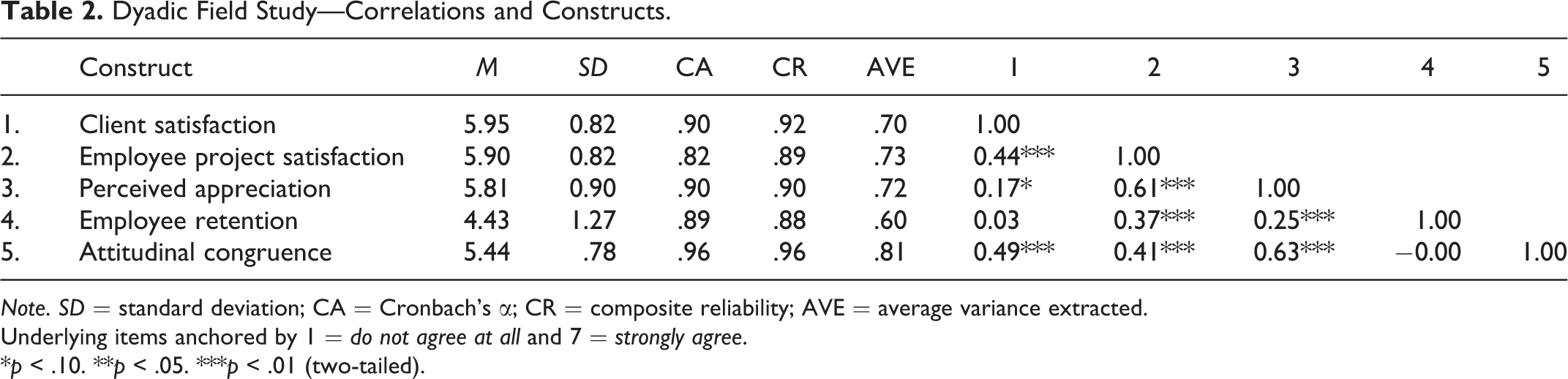
Note. SD = standard deviation; CA = Cronbach’s α; CR = composite reliability; AVE = average variance extracted.
Underlying items anchored by 1 = do not agree at all and 7 = strongly agree.
*p < .10. **p < .05. ***p < .01 (two-tailed).
Results
We estimated the main effects of the structural equation model using the software Mplus 6. The evaluation of the model yielded satisfying results, with the overall fit measures suggesting that the data provide an acceptable fit for the hypothesized model. The chi-square/df statistic (χ2/df = 1.79), the comparative fit index = .95, and the nonnormed fit index = .92 generally meet or exceed the recommended threshold values (e.g., Bagozzi and Yi 2012). The standardized root mean square residual as an absolute measure of fit is .07 and thus below the threshold of .10 (Hu and Bentler 1999). Figure 2 shows the results of model estimation.
Hypothesis 1, which proposes a positive effect of client satisfaction on employee project satisfaction, is also supported by the field data (γ = .34; p < .01). This finding is particularly important, because this strong effect is obtained from data collected from both sides of the dyad. Additionally, support for Hypothesis 2a (γ = .24; p < .01) and Hypothesis 2b (β = .53; p < .01) indicates the existence of an indirect effect of client satisfaction leading to perceived appreciation, which in turn positively affects employee project satisfaction. Client satisfaction and perceived appreciation are also measured from both sides of the dyad indicating a strong and significant effect. Similarly, results show support for Hypothesis 3 (β = .35; p < .01) with a positive effect of employee project satisfaction on employee retention.
Sobel tests indicate that both indirect paths of client satisfaction on employee retention are significant (client satisfaction → employee project satisfaction → employee retention: β = .12, p < .01; client satisfaction → perceived appreciation → employee project satisfaction → employee retention: β = .04, p < .05; Figure 2). In addition, the 95% confidence intervals of these indirect effects (using bootstrapping with n = 5,000) indicate that all coefficients are positive. To further test whether the effect of client satisfaction on employee retention is fully mediated by employee project satisfaction, we estimated an alternative structural equation model that also includes the direct effect of client satisfaction on employee retention. However, the direct effect is not significant (p > .10) and model fit is not significantly better, Δχ2 (df = 1) = .04, p > .10. Thus, employee project satisfaction mediates the effect of client satisfaction on employee retention (Zhao, Lynch, and Chen 2010).
In addition, as already outlined, we considered the effects of control variables on both employee project satisfaction and employee retention. First, the duration of the assignment has a positive but insignificant effect on employee project satisfaction (γ = .07; p > .10). Second, the employee’s satisfaction with the work environment (γ = .18; p < .05) and with colleagues (γ = .45; p < .01) have significant positive effects on retention. The same holds for the switching costs (γ = .22; p < .01). Thus, we observe a significant effect of employee project satisfaction on retention while controlling for other major determinants of employee retention.
To test the moderating effect of attitudinal congruence on the effect of client satisfaction on employee project satisfaction we used moderated regression analysis for three reasons: First, moderated regression analysis is the most frequently used method to analyze moderation or interaction effects (Cohen et al. 2003). Second, we considered our sample size too low to use approaches based on structural equation modeling (e.g., Marsh, Wen, and Hau 2004). Third, simulation studies imply that moderated regression analysis is a conservative way of detecting interactions (Chin, Marcolin, and Newsted 2003). In the regression model, we mean centered the independent variables to assure the interpretability of the results (Echambadi and Hess 2007). In line with Cohen et al. (2003), we created the interaction term by multiplying the corresponding mean-centered first-order variables (perceived appreciation and client satisfaction).
We included three types of control variables as additional determinants of employee project satisfaction in our model: First, we included the perceived appreciation as our main effects model has shown that perceived appreciation affects employee project satisfaction (Hypothesis 2b). Second, we also considered the duration of the assignment for this reason. Third, we included four industry dummies. Table 3 shows the results of the moderated regression analysis.
Dyadic Field Study—Results of Moderated Regression Analysis.

Note. r 2 = .63.
Table 3 shows that multicollinearity of the independent variables is moderate (Cohen et al. 2003; Hair et al. 2010; Wooldridge 2002). The highest variance inflation factor is 3.2 for perceived appreciation, thus below an absolute value of 4.0 indicating no substantial degree of multicollinearity (Wooldridge 2002). In line with the main effects model, results show a significant and positive effect of client satisfaction on employee project satisfaction (β = .32; p < .01). In line with Hypothesis 3, the moderated regression analysis also shows a significant β estimate for attitudinal congruence (β = .24; p < .01) and, in line with Hypothesis 4, a positive interaction term of attitudinal congruence with client satisfaction (β = .14; p < .05). Plotting the effect of client satisfaction on employee project satisfaction at a low and a high level of attitudinal congruence (using 1 SD below and above the mean) indicates that attitudinal congruence strengthens the link between client and employee project satisfaction (Figure 3).
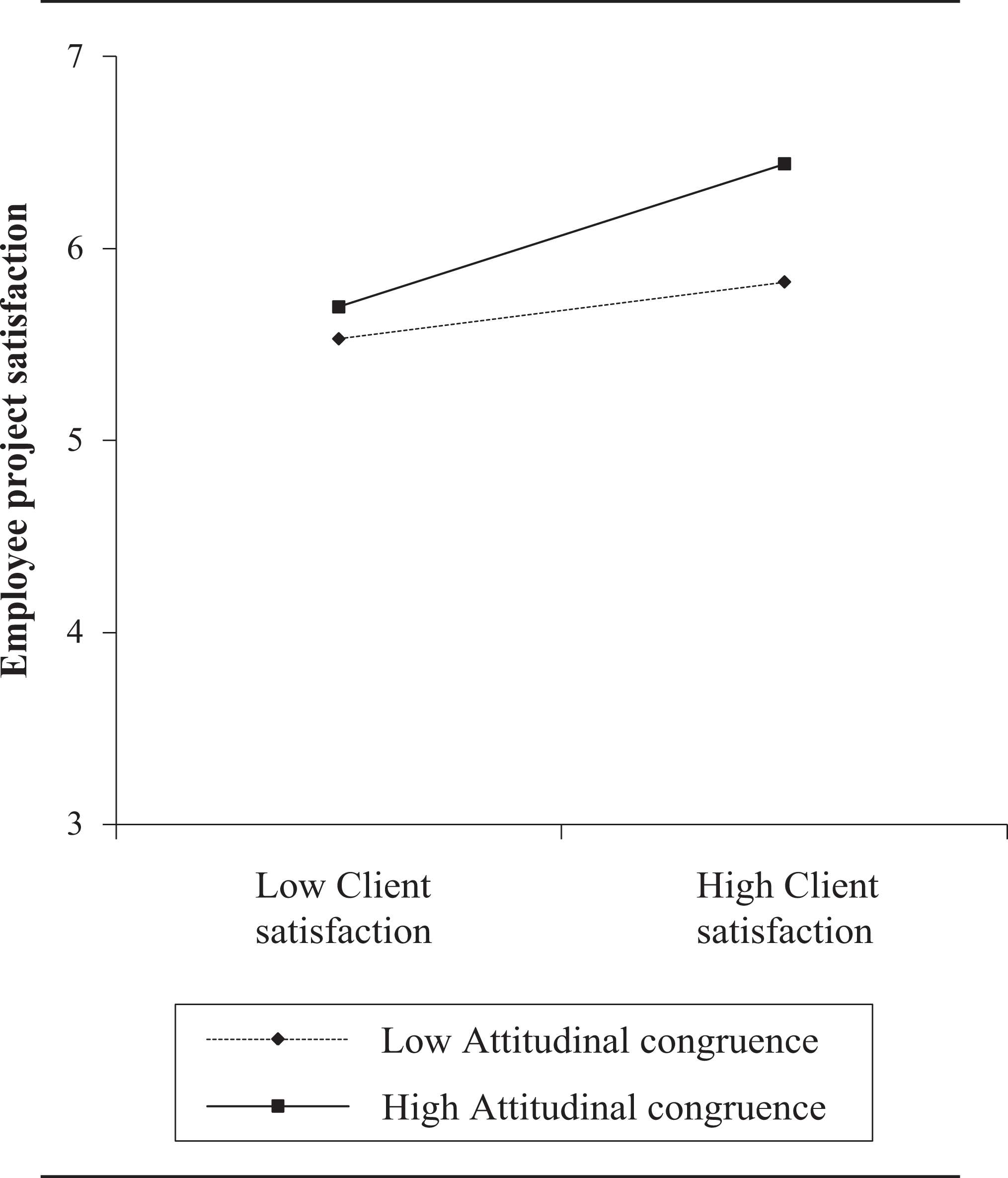
Dyadic field study—the moderating role of attitudinal congruence.
With respect to the controls, both the perceived appreciation (β = .41; p < .01) and the duration of the assignment (β = .23; p < .01) positively affect employee project satisfaction. In addition, results show that the industry “publishing” has a significantly lower retention (at p < .01) than the industry baseline. To a lower extent (at p < .10), the same holds for the industry “advertising.”
It is worth pointing out that we also tested whether switching costs moderate the effect of employee project satisfaction on employee retention. The rationale is that employee project satisfaction should notably affect employee retention when switching costs are low, for example, when an alternative job is available (see also Lee et al. 2008). However, results of a moderated regression analysis including the determinants of employee retention as well as the interaction between switching costs and employee project satisfaction show that the interaction is not significant. Thus, we do not find empirical evidence that switching costs moderate the effect of employee project satisfaction on retention.
Discussion
Although numerous prior investigations have demonstrated the link between employees’ work satisfaction and clients’ satisfaction, studies so far have neglected the existence of a potential reverse effect of client satisfaction on employee project satisfaction. This article extends previous service research by indicating that the client has a major influence on the satisfaction of employees in professional services firms and thus is an important factor to improve employee retention. Several studies have emphasized the difficulty of retaining (professional) services employees (e.g., Batt 2000; Patterson, Johnson, and Spreng 1997; Price and Arnould 1999; Rust et al. 1996; Schneider and Bowen 1985), accentuating the importance of this research. Drawing on multimethod evidence from an experimental study and a cross-sectional dyadic field study, we demonstrate that client satisfaction does not only contribute to market-related outcomes such as increased revenues and loyalty but also leads to enhanced employee retention, which should in turn positively affect performance. Our research thus has implications for both service research and human resource management.
Specifically, we demonstrate that client satisfaction has an impact on professional services employees’ job satisfaction and retention. Additionally, aside from directly affecting employee project satisfaction, client satisfaction also indirectly affects employee project satisfaction through the mediating construct of the employee’s perception of appreciation by the client. Moreover, this study makes a contribution toward an explanation as to why client satisfaction affects services employee satisfaction and retention as well as suggesting how retention can be improved. Finally, this study shows the close relationship of services marketing and human resource management issues for professional services firms. Consequences of client satisfaction have typically been studied by marketing scholars, while employee satisfaction and retention are typically issues of human resource management.
It is important to note that the goal of this study is not to claim that the well-established effect of employee satisfaction on client satisfaction does not hold. Prior work has highlighted the reciprocal nature of the attitudinal transfer between clients and employees (de Jong, de Ruyter, and Wetzels 2006; Heskett and Sasser 2010). The goal of this study is to show that, in a professional services context, the effect of client satisfaction on employee satisfaction is of high relevance and underresearched so far. In this respect, our study aimed at understanding the reasons for this attitudinal transfer.
By integrating the mediating variable of perceived appreciation, we were able to find a rationale for why client satisfaction affects employee satisfaction, and we are thus able to validate perceived appreciation as a major motivator in the sense of Herzberg’s motivational theory (Herzberg, Mausner, and Snyderman 2008). To further explain the causal effect of client satisfaction and employee satisfaction, we also tested the underlying theoretical rationale of balance theory. Conceptualizing the theory into a variable measured at both sides of the dyad, we integrated attitudinal congruence as moderating variable of the direct effect of client satisfaction on employee satisfaction. We show that attitudinal congruence positively moderates the effect of client satisfaction on employee satisfaction. The dyadic study shows that the more the employees feel they share an opinion with their clients, the more strongly the client satisfaction affects employee satisfaction. Thus, to establish “balanced” work teams sharing the same attitudes toward their project, professional services management should consider client and employee personalities. A possible implementation might include profiling clients and employees according to their personalities and arranging teams on the basis of these data.
From a managerial perspective, these findings imply that investments into client satisfaction also pay off for professional services firms in terms of enhanced employee satisfaction and retention. While exactly defining the extent to which additional investments in client satisfaction enhance employee satisfaction is difficult, a strong and significant effect is nevertheless observable and should be considered by professional services managers. Thus, positive client feedback should be amply distributed among services employees, while negative feedback should not be dramatized. Interestingly, the significant effect of satisfaction with colleagues and superiors in the professional services firm demonstrates that professional services employees are anything but footloose freelancers. Rather, the employing service firm, especially coworkers, strongly influences employee retention.
This study represents an initial exploration of direct and indirect effects between client and employee satisfaction and retention. Future research should look further into conditions under which the attitudinal transfer is stronger or weaker and integrate additional moderator variables. As examples, the duration of the business relationship, the frequency of communication, and differences between genders could all be of interest. Moreover, an interesting approach would be to apply the conceptual model to a business-to-consumer services context, where interactions are typically shorter but often occur several times in sequence (e.g., in restaurants or hair salons). Extending the scope to manufacturing contexts and business-to-business sales interactions might also offer insights into client-employee interactions and reveal reasons for employee retention and performance. Extending the investigation in these directions would provide additional insights into the relationship of clients and employees in a services context and help effectively manage turnover and retention, as this study has done for professional services.
Finally, in order to make a causality claim with respect to the effect of client satisfaction on employee satisfaction, we relied on an experimental study and hypothesized and established both a moderating and a mediating effect using cross-sectional dyadic data. Both moderation and mediation specify the nature of a causal relationship between two variables (e.g., Zhao, Lynch, and Chen 2010). However, causality cannot be ultimately established with cross-sectional data. Ideally, we would have observed these effects in a longitudinal dyadic design measuring client satisfaction, employee project satisfaction as well as the perceived appreciation and the attitudinal congruence between the client and the employee at least at two distinct points of time. Under such circumstances, a direct test of the reciprocity of client satisfaction and employee satisfaction (such as feedback loops or halo effects) would have been possible (e.g., de Jong, de Ruyter, and Wetzels 2006; van Doorn 2008).
Footnotes
Appendix
Declaration of Conflicting Interests
The author(s) declared no potential conflicts of interest with respect to the research, authorship, and/or publication of this article.
Funding
The author(s) received no financial support for the research, authorship, and/or publication of this article.
References
Supplementary Material
Please find the following supplemental material available below.
For Open Access articles published under a Creative Commons License, all supplemental material carries the same license as the article it is associated with.
For non-Open Access articles published, all supplemental material carries a non-exclusive license, and permission requests for re-use of supplemental material or any part of supplemental material shall be sent directly to the copyright owner as specified in the copyright notice associated with the article.
