



Abstract
Frontline employee behaviors can elicit gratitude, allowing service providers to reap benefits including positive word of mouth. However, research has begun to suggest some behaviors might instead elicit indebtedness, a different emotion not always associated with positive outcomes. Using a qualitative study, we construct a model grounded in the threat to self-esteem theory that delineates differences in employee behaviors that generate these two emotions and the consequences of their elicitation. The model is empirically tested in two studies. Consistent with the threat to self-esteem theory, the findings indicate that customer gratitude arises in supportive employee-customer encounters and drives positive relational behaviors. Conversely, customer indebtedness occurs in threatening employee-customer encounters and possesses the potential to deter positive relational behaviors. As a result, we encourage scholars to appreciate the differences between these two emotions and managers to promote employee behavior designed to generate gratitude and not indebtedness.
Within the service encounter, frontline employee behavior is critical, as it influences customer emotions, evaluations, and long-term relationships (Hennig-Thurau et al. 2006; Sirdeshmukh, Singh, and Sabol 2002). One positive emotion elicited by behaviors of others (e.g., effort, favors, and motives) that is relevant to service encounters and gaining recent attention in buyer-seller relationship literature is gratitude. Findings demonstrate that gratitude encourages reciprocal behaviors important to relationships (Palmatier et al. 2009; Raggio and Folse 2009; Wetzel, Hammerschmidt, and Zablah 2014), including purchase intentions (Palmatier et al. 2009; Xia and Kukar-Kinney 2013) and positive word of mouth (Soscia 2007; Xia and Kukar-Kinney 2013). In fact, many of these scholars studying gratitude contend that it is a fundamental component of buyer-seller relationships, and firms need to identify and encourage frontline employee behaviors that promote it (Raggio et al. 2013). But, what happens if frontline employee behavior intended to elicit gratitude instead produces the feeling of indebtedness—defined as an arousing and discomforting state where one feels obligated to repay another (Greenberg 1980)? The answer to this important question remains largely unclear, and our research examines this issue.
At this point, we know little about the employee behaviors that elicit these two emotions and the unique consequences stemming from their elicitation. Instead, what we know is that psychology scholars distinguish gratitude from indebtedness (Tsang 2006; Watkins et al. 2006) and offer compelling evidence for other disciplines to do the same. For instance, their findings indicate that indebtedness (often measured with “payback” or “obligation”) is viewed negatively, whereas gratitude (often measured with “thankful” or “grateful”) is viewed positively (Goei and Boster 2005; Tsang 2006; Watkins et al. 2006). Certainly, gratitude and indebtedness overlap conceptually. They both are emotions resulting from an agency appraisal where an individual (e.g., customer) attributes an outcome to another agent’s (e.g., employee’s) actions and not the self (Tsang 2006). Yet, by examining gratitude and indebtedness as distinct emotions occurring within the service encounter, researchers can identify the specific employee behaviors generating these emotions as well as the managerially relevant outcomes stemming from their elicitation.
Therefore, the purpose of this research is to extend our understanding of customer gratitude and indebtedness experienced within the service encounter by identifying frontline service employee behaviors eliciting these emotions and the relational outcomes impacted by these emotions. In pursuing these objectives, the current research offers three key contributions to the services literature. First, to our knowledge, we are the first to empirically demonstrate that gratitude and indebtedness operate differently within the service encounter. Therefore, our findings support the recent discoveries in psychology that stress measuring these emotions as separate constructs. Second, this research extends the threat to self-esteem theory to the service encounter context to identify frontline service employee behaviors that uniquely elicit each emotion. Despite psychology research that advocates their distinctions (Algoe, Gable, and Maisel 2010; Goei and Boster 2005; Tsang 2006; Watkins et al. 2006), only one study has examined gratitude and indebtedness as separate emotions within the service encounter and that study positions the emotions as having the same antecedent and consequence (i.e., employee effort and agent ratings, respectively; Morales 2005). Thus, examining differences in employee behavior eliciting these emotions contributes to service theory by revealing the types of employee behaviors that generate each emotion and ultimately impact more favorable relational outcomes of importance to service providers. Third, we contribute to the literature by evaluating each emotion’s ability or inability to build customer relationships, thus revealing the significance of eliciting such emotions within the service encounter.
We structure the remainder of this article as follows: First, we review gratitude and indebtedness research published in both marketing and psychology. We follow that discussion with details of a depth interview study where we considered these emotions in consumers’ lived consumption experiences. Drawing on the threat to self-esteem theory (Fisher, Nadler, and Whitcher-Alagna 1982), we then describe the conceptual model delineating frontline employee behaviors driving these emotions and the consequences of their elicitation. Next, we discuss two quantitative studies that empirically test the distinctions between these two emotions. We conclude by reviewing our findings, outlining the theoretical and managerial contributions of this research, and offering suggestions for future research.
Background
Conceptualization
Gratitude
Marketing scholars study gratitude as an emotional state that is elicited after the appraisal of help (Palmatier et al. 2009; Raggio and Folse 2009; Xia and Kukar-Kinney 2013). It is positive in valence, as it is positively correlated with other positive emotions and inversely correlated with negative emotions (Watkins et al. 2006). Gratitude is suggested to occur after an individual receives something from another entity, which prompts a desire to reciprocate (Palmatier et al. 2009; Watkins et al. 2006). Thus, it has motivational properties.
Indebtedness
Indebtedness was originally defined by Greenberg (1980, p. 4) “as the state of obligation to repay another” and has been termed the “emotional state of arousal and discomfort.” The feeling of indebtedness arises from the norm of reciprocity—that individuals should help and not harm those who have helped them (Gouldner 1960). Again, individuals appraise the help from others and, thus, experience this emotion. Unlike gratitude, indebtedness appears more negative, as it is positively correlated with the negative emotion of guilt (Watkins et al. 2006). Similar to gratitude, indebtedness has motivational properties. Yet, here, the motivation is to reduce its feeling, which may occur through reciprocation (Greenberg 1980).
Other-Agency Behaviors
Appraisal theorists (Weiner 1985) agree that gratitude is generated by other-agency appraisals, whereby an individual appraises a situation (i.e., help) as due to another agent’s actions and not the self. Gratitude has been linked to a series of appraisals, interpreting (a) the value of the help, (b) the cost to the benefactor (i.e., the individual who provided the help), and (c) the sincerity of the benefactor (Wood et al. 2008). Gratitude is augmented to the extent that help is appraised as being valuable, costly to the benefactor, and genuinely motivated.
Findings from marketing studies assessing gratitude (and not indebtedness) reveal specific other-agency actions that elicit gratitude. For instance, in employee-customer contexts, customer gratitude increases (a) when employees are perceived as putting forth extra effort (Morales 2005), (b) when employees lift fees imposed on customers (Xia and Kukar-Kinney 2013), and, more broadly, (c) when employee-produced outcomes are consistent with customer goals (Soscia 2007). Altogether, these employee behaviors coincide with the notion of other-agency appraisals and interpreting the employee’s help as valuable, costly, or sincerely motivated, all of which have been linked to feelings of gratitude.
However, as pointed out by psychology researchers (Wood et al. 2008), such findings should be “treated with caution” if the reported studies have not disentangled gratitude from indebtedness and, in fact, assess gratitude with items that are arguably measuring indebtedness. These authors contend that although these emotions can both arise from other-agency appraisals—when an individual perceives a benefit as bestowed by another, direct investigations demonstrate these emotions differ. Given the differences in the motivational properties to help the other (gratitude) versus the self (indebtedness), not surprisingly, antecedents that give rise to these emotions might differ, as well.
Interestingly, two separate studies published in psychology have initiated this conversation of differences, revealing that specific situations can promote either gratitude or indebtedness. Through using vignettes, Watkins et al. (2006) find that benefactor intent is one of those situational variables. That is, when an individual perceives that a behavior was performed with expectations of return, an individual feels indebted and not grateful. Similarly, Tsang (2006) assessed benefactor intent by considering how selfish versus benevolent benefactor intentions impact beneficiary gratitude and indebtedness. Tsang (2006) found gratitude was enhanced when the benefactor was believed to have benevolent intentions. In contrast, indebtedness was unaffected by benefactor intent. This initial evidence suggests that perhaps additional other-agency actions intended to elicit gratitude might instead elicit indebtedness.
Relational Outcomes
While marketing research notes gratitude’s significant effects on key outcomes (see our opening discussion), even when including indebtedness items in its measurement (Palmatier et al. 2009; Wetzel, Hammerschmidt, and Zablah 2014), a review of the limited number of psychology studies comparing gratitude and indebtedness suggests these two emotions prompt different consequences. One finding is that gratitude promotes strong, positive relationships unlike indebtedness. For instance, in romantic relationships, gratitude rather than indebtedness is the primary mechanism associated with a partner’s increased feelings of relationship connection and relationship satisfaction (Algoe, Gable, and Maisel 2010). Likewise, indebtedness, but not gratitude, is associated with self-focused attention, which is consequently linked to feeling less close and committed to one’s benefactor (Mathews and Green 2010). Given these findings, it is not surprising that research supports gratitude rather than indebtedness, as the key explanatory mechanism of postfavor beneficiary compliance (Goei and Boster 2005).
In sum, this literature review suggests that service research could be advanced by studying these emotions as distinct and that concepts such as “owe,” “payback,” and/or “indebted” that have been included with thankful, grateful, and “appreciative” to measure customer gratitude are more reflective of indebtedness. We do not suggest the previous findings that employ a mixture of these items are incorrect. In fact, we contend that the relationships with gratitude might actually be more pronounced than originally reported, strengthening the arguments that gratitude is a powerful emotion in customer relationships. The following three studies offer a comprehensive examination of gratitude and indebtedness in service encounters.
Study 1
We utilized depth interviews to verify that the conceptual differences between these emotions, as indicated in the psychology literature (Watkins et al. 2006), were consistent with customer experiences and to identify frontline employee behaviors eliciting these emotions as well as the relational outcomes impacted from their elicitation.
Research Design, Sample, and Analysis
Using judgment sampling, one of the authors trained in interview methods recruited and interviewed 10 individuals. The participants maintained diverse socioeconomic statuses, their ages ranged from 29 to 69, and half were male. Participants were asked to describe two different experiences with a frontline employee—one that made them feel grateful and one that made them feel indebted. For each of the two described experiences, the interviewer probed and asked follow-up questions to ensure rich descriptions were offered. These interviews were approximately 45 to 60 minutes in length and were conducted over the course of several weeks.
After the interviews were transcribed, two of the authors analyzed the data using the commonly accepted analyses of open and axial coding (Strauss and Corbin 1998). The researchers searched for similarities and patterns both within each interview and across all interview text concerning the descriptions, employee behaviors, and relational outcomes of each emotion. The researchers also used dialectical tacking and compared these patterns with the conceptualizations offered in the existing literature (Belk, Fischer, and Kozinets 2013). As shown in Figure 1, the emergent themes offer strong distinctions between the employee behavior giving rise to these emotions as well as the diverse consequences stemming from their elicitation.
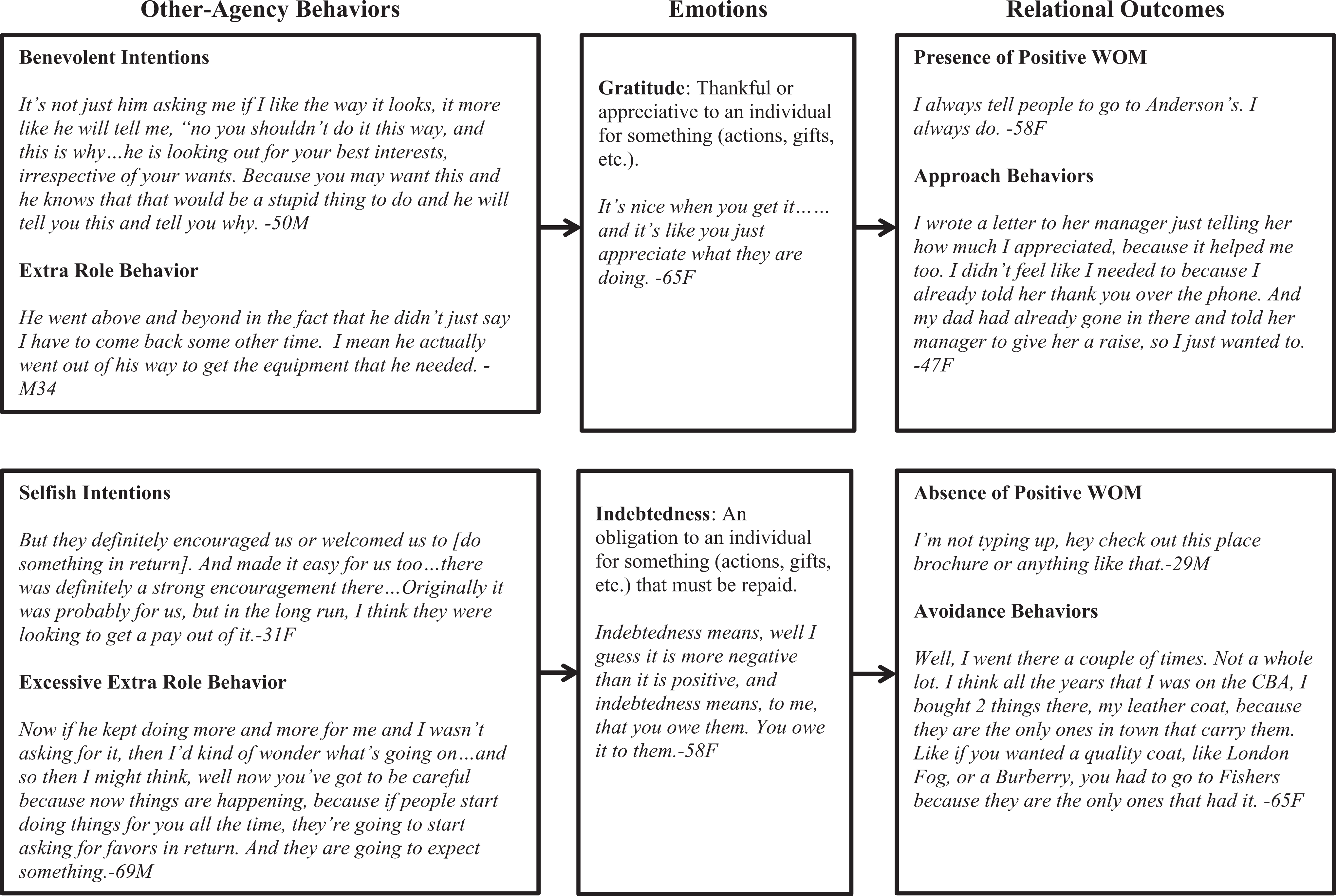
Conceptual model developed from qualitative findings.
Results
Theoretical Foundation
Comparisons between the interview data and existing literature suggest that the threat to self-esteem theory (Fisher, Nadler, and Whitcher-Alagna 1982) might suitably account for the types of service encounters that give rise to gratitude versus indebtedness. The threat to self-esteem theory (Fisher, Nadler, and Whitcher-Alagna 1982) posits that situational conditions and recipient characteristics influence the magnitude to which a recipient (e.g., a customer) perceives help as self-supportive or self-threatening. Help is supportive when it (a) conveys a positive self-relevant message, such as emphasizing the helper’s (e.g., employee’s) caring or appreciation of the help recipient; (b) follows socialized values (e.g., rewarding excellence); or (c) includes instrumental benefits. On the other hand, help is threatening when it (a) conveys a negative self-relevant message, (b) opposes socialized values (e.g., independence, self-reliance, or fairness), (c) causes the recipient to feel inferior or overly dependent upon the helper, (d) provides evidence of failure, or (e) omits instrumental benefits (Fisher, Nadler, and Whitcher-Alagna 1982; Kassin, Fein, and Markus 2010; Nadler and Fisher 1986). The theory recognizes that both self-supportive and self-threatening elements can be present in a single helping encounter; therefore, the degree to which support is experienced instead of threat or vice versa in the appraisal process determines recipient reactions to receiving help. When self-supportive elements dominate over threat, favorable recipient reactions occur (e.g., positive emotions, positive evaluations, and a continuance of receiving help). Conversely, negative recipient reactions (e.g., negative emotions, negative evaluations, and withdrawal from receiving help) result when self-threatening elements dominate. The following section describes the study’s key findings, revealing how each emotion’s nomological network adheres to the threat to self-esteem theory.
Conceptualizations
Both emotions were described as resulting from someone (beneficiary) receiving something (benefit) from another (benefactor); however, participants’ rich descriptions revealed gratitude’s positive nature and indebtedness’s unique negative element. The common concepts of thankful, appreciative, and grateful emerged in these data. Likewise, the key components concerning motivational tendencies of “owing,” “obligation,” and “repayment” also arose in descriptions of indebtedness but not in those for gratitude. Thus, based upon the data, we define gratitude as a feeling of thanks or appreciation to an individual for something (actions, gifts, etc.) and indebtedness as a feeling of obligation to an individual for something that must be repaid.
Frontline Employee Behavior
The employee behaviors described in participants’ experiences of these emotions prominently also differed. Evaluating the correspondence between the theory and our qualitative findings revealed that participants’ grateful experiences are consistent with supportive help, whereas participants’ indebtedness experiences overlap with threatening help (see Figure 1).
In gratitude experiences, participants explained that employees were “looking out” for the participants’ best interests with “no expectation of return,” which is consistent with Tsang’s (2006) findings that gratitude is augmented by another’s benevolent intentions. They also described employees as performing extra-role behaviors, including noncontractual volitional behaviors that were reasonable to the employee’s role. Participants stated that employees went “above and beyond,” “the extra-mile,” and “exceeded expectations.”
In contrast, in indebtedness experiences, participants stated that employee behaviors were motivated by selfish intentions, by describing employees as “trying to get customers to be repeat customers,” “looking to get a pay out of it,” or “using certain tactics to bring people in.” They offered that employees performed excessive extra-role behaviors by violating job-role norms. Compared to gratitude experiences in which employee extra-role behavior was perceived favorably, in indebtedness experiences, extra-role behavior was perceived as extreme or unnecessary, as articulated in the comment “it seemed like they kind of broke a rule.”
Relational Outcomes
Gratitude appeared to stimulate a plethora of prosocial approach actions by the respondents, whereas indebtedness failed to do so. In discussing grateful experiences, participants mentioned spreading positive word of mouth about the employee and the organization, in addition to various other prosocial approach behaviors they performed aimed to benefit the employee, such as gift giving and recognizing the employee’s greatness through contacting a manager. Furthermore, gratitude experiences were consistently linked to an other orientation, whereby participants focused on their benefactor (i.e., employee) and indicated a desire to help their benefactor. Altogether, the expanded prosocial approach actions described by respondents offer further support that gratitude is in fact a positive experience with motivations to benefit another.
Unlike grateful experiences, indebtedness experiences lacked evidence of prosocial behaviors. Instead, there was a clear absence of positive word of mouth, and participants often articulated avoidance behaviors. Another distinguishing factor is the link between an indebtedness and a self-orientation, such that participants focused on the self and ridding themselves of the way they felt. Failure to find expansive action tendencies in participant’s indebtedness experiences further supports the negative element associated with indebtedness, as negative emotions tend to restrict the specific behavioral actions that one considers (Fredrickson 2001).Thus, the data offer evidence that indebtedness does contain a negative element with motivations to either avoid a situation or reciprocate to benefit the self.
Study 2
In Study 2, we develop and test a conceptual model that is largely guided by both the emergent themes identified in Study 1 and the threat to self-esteem theory. Specifically, we examine the influence of perceived frontline employee intentions on gratitude and indebtedness and, in turn, the effects of these emotions on positive word of mouth and avoidance. We conceptualize gratitude and indebtedness in accordance with our depth interview findings offered previously. We define perceived benevolent intentions as the degree to which the customer perceives the employee behavior is motivated by a genuine concern for the customer’s welfare (Lee et al. 2004) and perceived selfish intentions as the degree to which the customer perceives the employee behavior is motivated by personal gain. We define positive word of mouth as customers’ intentions to speak favorably about the employee and the experience (Arnett, German, and Hunt 2003) and avoidance as a customer’s desire to withdraw oneself from interacting with the firm (Grégoire, Tripp, and Legoux 2009). Based upon theory and existing literature, we offer our specific hypotheses below.
Hypotheses
Effects on gratitude
We expect perceived benevolent intentions to positively impact customer gratitude. Positive effects of benevolent intentions occur because benevolent behaviors signal “pro-customer motivations, restraint on self-serving opportunism, and a willingness to assume fiduciary responsibility” (Sirdeshmukh, Singh, and Sabol 2002, p. 18). This explanation is consistent with a key element of the threat to self-esteem theory—displaying concern for the customer (help recipient). The theory posits that help is appraised as supportive when it demonstrates the helper’s concern for the recipient, conforms to socialized values, and contains instrumental qualities (Nadler and Fisher 1986), which all give rise to positive affective reactions (Fisher, Nadler, and Whitcher-Alagna 1982). Benevolence is a means by which an employee can show concern and care for a customer (help recipient); consequently, perceived benevolent intentions should align with supportive help and produce customers’ positive affective reaction of gratitude. Thus, we predict the following:
If gratitude arises in supportive employee encounters, then gratitude should be adversely affected in threatening employee encounters. An employee perceived as having selfish intentions presents a negative self-relevant message to the customer by imposing a constraint on the customer’s behavioral freedom, therefore, conflicting with the socialized norm of independence. This infringement is a defining characteristic of threatening help, which suggests that selfish intentions should arise in employee encounters perceived as threatening and decrease customers’ positive affective response of gratitude. Thus, we hypothesize:
Effects on indebtedness
Since indebtedness maintains positive properties through receiving a benefit and negative properties through feeling obligated to repay, we expect that benevolent intentions will have a positive effect on indebtedness. More specifically, we contend that when an employee is perceived as providing a benefit benevolently, customer indebtedness, although it contains a negative valence, can still occur. Given our qualitative findings, it seems plausible that even when an employee is perceived as acting benevolently, engaging in excessive helping behaviors can still prompt customer indebtedness. Thus, although it is considered a supportive element in a helping encounter, perceived benevolent intentions is expected to elicit indebtedness and is proposed below.
Drawing from the threat to self-esteem theory, we expect perceived selfish intentions will exemplify threatening help and trigger customer indebtedness. Threatening help occurs when it conflicts with socialized values, such as independence, by restricting a recipients’ future behavior or causing recipients to feel as though they must act accordingly (Fisher, Nadler, and Whitcher-Alagna 1982). With regard to selfish intentions, the recipient is expected to act in a manner that is beneficial to the giver (Watkins et al. 2006). Thus, when employees are perceived as having selfish intentions, customers may feel restricted and inclined to reciprocate, although they may not necessarily desire to do so. Perceived selfish intentions may therefore be considered a threatening element to receiving help, and since threatening help motivates negative recipient reactions, we anticipate that customer indebtedness will arise as hypothesized below.
Effects on positive word of mouth
Prior work indicates that gratitude drives positive word of mouth (Soscia 2007; Xia and Kukar-Kinney 2013). Broaden-and-build theory of positive emotions proposes that gratitude, as a positive emotion, may influence a grateful individual’s mind-set by broadening his prosocial behaviors or displays of appreciation (Fredrickson 2004). Spreading positive word of mouth is one method by which grateful customers can engage in prosocial actions to show their appreciation to an employee. Moreover, within the threat to self-esteem theory, supportive help occurs when a recipient (customer) feels appreciated and cared for (Kassin, Fein, and Markus 2010), which is accompanied by favorable recipient reactions, such as spreading word of mouth. Given these theories and the existing literature, we predict:
Since indebtedness is expected to arise in threatening encounters, we anticipate that indebtedness will have a negative association with positive word of mouth. The threat to self-esteem theory posits that threatening help encounters promote negative recipient reactions such as negative reciprocity, negative evaluations, and avoidance behaviors (Fisher, Nadler, and Whitcher-Alagna 1982). Since indebtedness is expected to arise in threatening help encounters, and given its characteristic as a negative emotional motivator (Greenberg 1980), we anticipate that customer indebtedness will reduce intentions to spread positive word of mouth. Formally, we predict:
Effects on avoidance
Avoidance is considered a passive coping strategy, whereby consumers prevent further damage by relinquishing patronage, often increasing over time, as consumers find replacements for prior providers (Grégoire, Tripp, and Legoux 2009). Building from the threat to self-esteem theory, gratitude is expected to arise in supportive contexts—contexts associated with subsequent help seeking and approach behavior (Fisher, Nadler, and Whitcher-Alagna 1982). Consequently, gratitude should draw the employee and customer closer together rather than apart. Extant research supports this proposition, as the find, remind, and bind theory (Algoe 2012) posits that gratitude strengthens relationships by first helping identify or remind oneself of quality relationship partners and then by binding the parties together. Taken together, gratitude should foster relationships rather than diminish them; thus, we predict:
Unsupportive social contexts can motivate avoidance-oriented coping (Manne et al. 2005), and within the threat to self-esteem theory, self-threatening help provokes recipient withdrawal from subsequent help (i.e., avoidance; Fisher, Nadler, and Whitcher-Alagna 1982). Avoidance is also triggered by threat-induced emotions because of the inclination to “flight” when feeling threatened (Duhachek 2005). Drawing from extant theory, if indebtedness arises in threatening encounters, such as when an employee maintains selfish intentions (Hypothesis 4), indebtedness, by being a threat-induced emotion, should prompt customer avoidance behavior. Formally, we hypothesize:
Research Design and Sample
Students from a major state university subject pool recruited 270 nonstudent adults to participate in the study. The sample was 60.7% female, and the average age was 44.46. Of the participants, 84.4% were Caucasian, 7.8% were African American, 2.6% were Hispanic American, less than 1% were Asian American or indicated other, and 3.7% preferred not to share their ethnicity. We adopted a critical incident design (Voorhees, Brady, and Horowitz 2006), whereby participants were randomly assigned to recall an interaction with a frontline employee that made them feel either grateful or indebted. After writing about the experience in detail, participants completed all measures (see the Appendix for the list of items).
Results
Manipulation Checks
Mean scores of participants’ feelings (utilizing a 7-point scale) were compared across the two conditions to ensure a successful recall task. As expected, analysis of variance results revealed feelings of gratitude were significantly (p < .05) higher in the gratitude condition (M = 6.60) compared to the indebtedness condition (M = 5.29). Likewise, feelings of indebtedness were significantly (p < .05) higher in the indebtedness condition (M = 4.12) than in the gratitude condition (M = 3.48). These scores, which are consistent with extant research comparing gratitude and indebtedness (Mathews and Green 2010; Shen, Fan, and Wyer 2011; Tsang 2006; Watkins et al. 2006), suggest that gratitude was the primary emotion experienced. This finding is not unexpected, as recall biases may have led participants to reconstruct their experiences more positively (Tsang 2006).
Measurement Model Analysis
Confirmatory factor analysis (CFA) was used to assess the factor structure and validity of the model constructs, plus the effects of age and self-esteem as control variables. Age and self-esteem were selected as controls, since prior research suggests a possible association between age and gratitude (Froh et al. 2011) and indicates the influence of self-esteem on behavioral tendencies (Baumeister, Tice, and Hutton 1989). The CFA model demonstrated good fit, χ2 (248) = 440.33, p < .01, comparative fit index [CFI] = .96, root mean square error of approximation [RMSEA] = .05. 1 Items loaded significantly to their proposed construct, and with the exception of 3 items (2 of which were reverse-coded items), standardized loadings were greater than .70 (see Appendix A for complete details). Evidence of convergent validity was found, with composite reliabilities ranging from .75 to .96, and the average variance extracted (AVE) exceeding .50 for all constructs. Moreover, AVE estimates for each construct pair were larger than the squared interconstruct correlations, thus supporting discriminant validity (Fornell and Larcker 1981; see Table 1 for descriptive statistics and construct correlations).
Study 2 Descriptive Statistics and Construct Correlations.
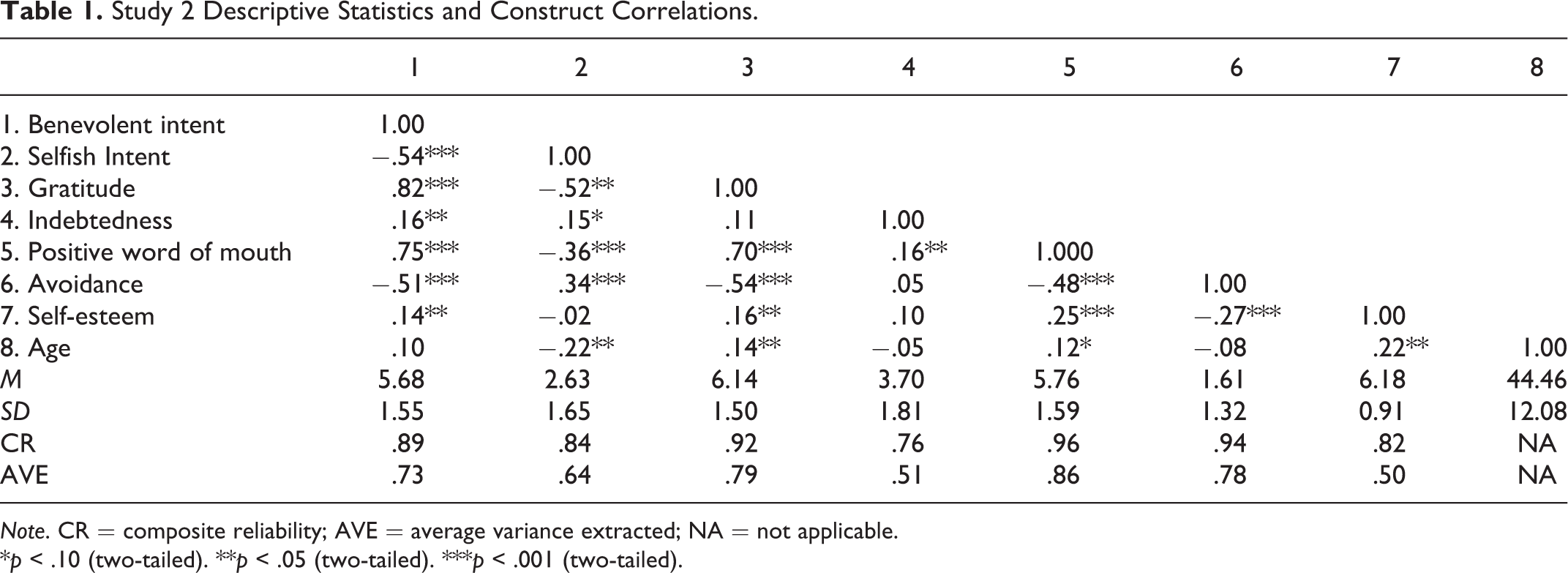
Note. CR = composite reliability; AVE = average variance extracted; NA = not applicable.
*p < .10 (two-tailed). **p < .05 (two-tailed). ***p < .001 (two-tailed).
Common Method Bias
To assess the potential for common method bias, an unmeasured latent method factor was added to the measurement model, with all measures as indicators of the method factor (Podsakoff et al. 2003). The measures failed to load significantly on the method factor (unstandardized estimate = −.021, p > .05), indicating that method bias does not significantly influence the interpretation of the data.
Hypothesis Testing
Hypotheses 1–8 were evaluated using structural equation modeling, with age and self-esteem as controls. The structural model demonstrated good fit, χ2 (170) = 272.18, p < .01, CFI = .98, RMSEA = .05, although assessing the modification indices signified the addition of direct paths from perceived benevolent intentions to positive word of mouth and avoidance. Thus, the model was reestimated with the inclusion of these paths. Model fit was significantly improved, χ2 (168) = 235.65, p < .01, CFI = .99, RMSEA = .04; Δχ2(2) = 36.53, and tests of the direct effects demonstrated support for all hypothesized effects except Hypothesis 6 (Figure 2). Among the drivers of gratitude, perceived benevolent intentions positively affected gratitude (Hypothesis 1: β = .75, t = 10.33, p < .001), while perceived selfish intentions negatively affected gratitude (Hypothesis 2: β = −.11, t = −1.96, p = .05). As expected, perceived benevolent intentions and perceived selfish intentions also positively affected indebtedness (Hypothesis 3: β = .33, t = 3.47, p < .001; Hypothesis 4: β = .32, t = 3.24, p < .01). Finally, among the outcomes, gratitude positively influenced positive word of mouth (Hypothesis 5: β = .26, t = 2.92, p < .01) and negatively influenced avoidance (Hypothesis 7: β = −.31, t = −3.00, p < .01). Indebtedness, however, had no effect on positive word of mouth (Hypothesis 6: β = .05, t = 1.02, p > .05) but had a positive effect on avoidance (Hypothesis 8: β = .14, t = 2.40, p < .05; see Figure 2). Collectively, these results enhance the robustness of the qualitative findings and reveal that gratitude and indebtedness offer different implications for customer relationships.

Standardized estimation results. *p < .10. **p ≤ .05. ***p < .01. Study 2 and Study 3 results appear before and after the forward slash, respectively. Control variables in Study 2 include age and self-esteem. Control variables in Study 3 include age, self-esteem, self-interest, other-interest, and trait gratitude. All p values reflect two-tailed tests.
Study 3
In Study 3, we examine the robustness of the hypotheses through experimental testing. We specifically focus on perceived benevolent intentions and examine the effects of an additional theme present in the qualitative study—excessive extra-role behavior. We anticipate that excessive extra-role behavior, defined as employee behavior that violates job-role norms and is perceived as extreme or unnecessary, will exemplify threatening help. This reasoning is in accordance with the threat to self-esteem theory which describes threatening encounters as conveying negative self-messages, opposing socialized values, causing the recipient to feel inferior or overly dependent upon the helper, or omitting instrumental benefits. Therefore, according to theory suggesting that indebtedness occurs within threatening employee-customer encounters, we expect excessive extra-role behavior will positively influence indebtedness. However, since gratitude arises in supportive employee-customer contexts that adhere to socialized values, gratitude should be adversely affected by excessive extra-role behavior. We formally predict these relationships below.
Design and Data Collection
We used a scenario-based experiment with a 2 (benevolent intentions: high vs. low) × 2 (excessive extra-role behavior: high vs. low) between-subjects design. The scenario described a service encounter between a hotel employee and a customer, in which participants were asked to imagine themselves as the customer. This context was chosen for three reasons. First, in Study 2, several participants mentioned service encounters with hotel employees; second, it was assumed that a hotel context would be familiar to a large number of participants; and third, service research has experimentally examined employee-customer encounters within a hotel check-in context (Victorino et al. 2012).
The scenarios were based upon examples provided by participants in the prior studies and were pretested (n = 98) to ensure successful manipulations. In the scenario, participants were told that they needed a larger hotel room due to last minute changes, but upon arrival, the front desk employee informed them that the hotel was nearly fully occupied. Next, participants were exposed to the manipulations. Excessive extra-role behavior (high vs. low) was manipulated by the amount of time, effort, and behavior the employee exhibited to accommodate the customer. Benevolent intentions (high vs. low) was manipulated by the content of online reviews and by whether or not the hotel displayed customer service awards, both considered cues used to judge the genuineness of employee concerns for customers (see Appendix B for complete details). 2 In all conditions, the scenario concluded by the participant obtaining a larger hotel room. After being exposed to the scenario, participants responded to all items. Measures utilized in the prior study were adapted to the hotel context (e.g., I want to avoid frequenting this hotel), and in addition to these items, participants completed measures of excessive extra-role behavior and individual-level variables including self-esteem, trait gratitude, self- and other-interest, and involvement. Finally, demographic data were gathered (see Appendix A for a list of measures).
Data were collected from Amazon Mechanical Turk. Participants failing instructional and attention checks embedded within the items were removed from the data, producing a sample of 549. Of the participants, 49.4% were male and the average age was 36 years. In terms of ethnicity, 81.6% were Caucasian, 6.4% were Asian American, 5.5% were African American, and 3.8% were Hispanic American. Other ethnicities reported composed of less than 2% of the sample. Forty-three percent of participants held a 4-year college degree.
Measurement Validation and Common Method Bias
CFA was used to assess the item properties. The CFA model demonstrated good fit, χ2 (575) = 1,386.45, p < .01, CFI = .96, RMSEA = .05, and the constructs demonstrated internal consistency, with acceptable composite reliability and AVE estimates (see Table 2). The results also supported discriminant validity, such that AVE estimates were larger than squared construct correlations (Fornell and Larcker 1981). To assess common method variance, we followed the marker variable technique by adding involvement to the model. Following Williams, Hartman, and Cavazotte (2010), who recommend selecting a marker variable that is not anticipated to be theoretically associated with model variables but can capture sources of bias occurring in the measurement context, involvement was used due to potential method biases stemming from a participant’s mood state, acquiescence, consistency motifs, and common scale format (Podsakoff et al. 2003). The results indicated that less than 1% of the model’s variance was shared between the marker and other constructs, which is well below the average shared variance found in common method variance research (Williams, Cote, and Buckley 1989). Thus, the results support that method bias does not influence the data.
Study 3 Descriptive Statistics and Construct Correlations.
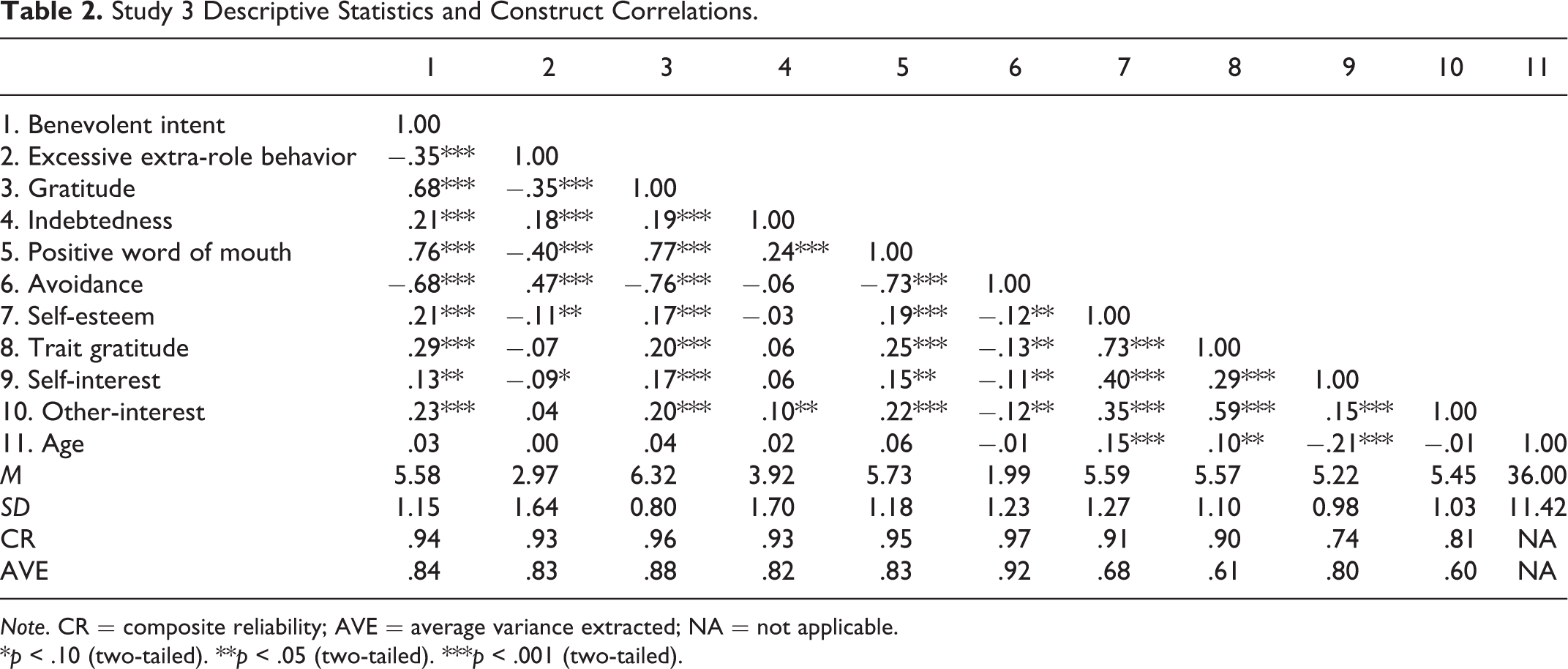
Note. CR = composite reliability; AVE = average variance extracted; NA = not applicable.
*p < .10 (two-tailed). **p < .05 (two-tailed). ***p < .001 (two-tailed).
Manipulation Checks
Multivariate analysis of covariance with age, self-esteem, trait gratitude, self-interest, and other-interest as covariates offered support for the manipulations. As expected, employee benevolence was higher in the high benevolent condition compared to the low benevolent condition, Ms 6.04 vs. 5.09; F(1, 549) = 127.54, p < .01, and excessive extra-role behavior was higher in the high excessive condition compared to the low excessive condition, Ms 3.77 vs. 2.09; F(1, 549) = 215.96, p < .01. 3
Hypothesis Testing
The hypotheses were tested using structural equation modeling, with age, self-esteem, trait gratitude, self-interest, and other-interest as control variables. The results revealed acceptable model fit, χ2 (208) = 616.08, p < .01, CFI = .97, RMSEA = .06. In support of Hypothesis 1, perceived benevolent intentions positively influenced gratitude (β = .65, t = 16.43, p < .01; see Figure 2), and as predicted in Hypothesis 3, perceived benevolent intentions positively influenced indebtedness (β = .31, t = 6.52, p < .01). In support of Hypothesis 9, excessive extra-role behavior positively influenced indebtedness (β = .28, t = 6.00, p < .01), yet excessive extra-role behavior had a negative effect on gratitude, β = −.15, t = −4.39, p < .01), therefore supporting Hypothesis 10. Analyzing the outcome variables revealed support for Hypothesis 5, such that gratitude positively influenced positive word of mouth (β = .77, t = 22.08, p < .01), and contrary to Hypothesis 6, indebtedness also positively influenced positive word of mouth (β = .09, t = 3.19, p < .01); nevertheless, as expected, gratitude was a much stronger driver of positive word of mouth than indebtedness (critical ratio = 19.23, p < .05). In support of Hypothesis 7, gratitude negatively affected avoidance (β = −.80, t = −24.67, p < .01), but indebtedness positively influenced avoidance (β = .08, t = 2.78, p < .01), supporting Hypothesis 8.
General Discussion
We identify specific frontline employee behaviors that elicit gratitude and/or indebtedness, demonstrating that these emotions are different and impact relational consequences of importance to service providers. These findings extend the single service encounter study that considered gratitude and indebtedness as separate emotions with the same antecedent and outcome (i.e., employee effort and agent ratings, respectively; Morales 2005). More importantly, our findings suggest a “latitude of acceptance” for employee extra effort. Extra effort, exemplified in employee extra-role behavior, can elicit the positive reaction of customer gratitude when the employee behavior is perceived as appropriate and upholding norms. Nonetheless, when employee behavior becomes excessive, such as engaging in too much effort by going outside of the norm, the behavior fosters a threatening encounter by eliciting indebtedness. We discuss the theoretical and managerial implications of these findings next.
Theoretical Contributions
This research offers significant implications for service research. First, since prior work has often, but perhaps unintentionally, treated customer gratitude and indebtedness as substitutes (Palmatier et al. 2009; Wetzel, Hammerschmidt, and Zablah 2014), our findings present a strong theoretical contribution by empirically demonstrating the importance of treating them as separate constructs occurring within the service encounter. Treating these emotions as distinct will avoid “deficient and contaminated measures,” “measurement model misspecification,” and “weak theoretical rationale for hypotheses,” as noted by MacKenzie (2003). In this vein, researchers need to evaluate item wording cautiously to ensure that the elements of gratitude or indebtedness are not intertwined to promote construct validity, statistical conclusion validity, and internal validity. We are pleased to point out that previous findings capturing gratitude with both gratitude and indebtedness items illustrate important relationships with gratitude that are perhaps more powerful than originally reported.
Second, considerable research documents the value of frontline service employees, as their behavior influences customer emotions and service evaluations (Hennig-Thurau et al. 2006), and this research contributes to this body of work by revealing the significance of customer construals of employee behavior. Consistent with the threat to self-esteem theory and appraisal theories, customers’ appraisals of employee behavior give rise to emotions. When employee behavior violates norms, it is appraised as threatening, and a negative reaction of indebtedness is elicited. In contrast, employee behavior appraised as supportive produces gratitude. This contribution uncovers several areas for continued research, such as identifying specific employee behaviors, gestures, or language that might give rise to one of these emotions.
Third, by extending the threat to self-esteem theory to the service encounter, we empirically demonstrate the influence of these emotions on relational outcomes. Consistent with theory, threatening help eliciting indebtedness promotes the negative behavioral reaction of avoidance, whereas supportive help eliciting gratitude reduces avoidance. Yet, contrary to our prediction guided by the threat to self-esteem theory, indebtedness also positively influenced positive word of mouth in Study 3, although the effect was significantly weaker than gratitude’s effect on positive word of mouth. We contend that consumers may spread word of mouth as a means to relieve themselves of feeling indebted, and we encourage future research to investigate this issue. Importantly, by examining the impact of these emotions on relational outcomes, this research advances the literature by noting that gratitude and indebtedness are not equally effective at fostering customer relationships. Some researchers have questioned the ability of gratitude and indebtedness to elicit similar outcomes (Algoe, Gable, and Maisel 2010; Goei and Boster 2005), and our work further supports such contentions. Whereas one study in marketing finds these emotions as generating the same customer response (Morales 2005), the findings herein reveal that this is not always the case.
Managerial Implications
Frontline employee behavior
Our findings offer relevant implications for service managers, particularly in regard to frontline employee training. Through identifying employee behaviors that elicit gratitude and indebtedness, our findings indicate that managers may want to implement employee training programs, perhaps using modeling or role-playing techniques, aimed toward demonstrating employee benevolent intentions and attenuating displays of selfish intentions and excessive extra-role behavior. Although continued research is needed to explore the differences in employee behavior driving these customer emotions, the helping literature does indicate that negative recipient reactions stem from imposed, unexpected, or counternormative help (Deelstra et al. 2003). Bridging the existing literature with our consumer comments clearly reveals the need for managers to evaluate employee behavior and the offerings provided to customers to ensure employee practices are eliciting favorable customer reactions. While the current study demonstrates how two customer emotions impact positive word of mouth and customer avoidance, plentiful studies exhibit the influence of customer emotions on their perceptions, attitudes, and behaviors (e.g., Hennig-Thurau et al. 2006). In order to reap these benefits tied to emotions, managers and frontline employees need to manage these customer emotions effectively.
Service scripts
In a similar vein, this research also highlights the importance of service scripting, defined as “the sequence of behaviors that employees … are expected to follow during the service encounter” (Lovelock and Wirtz 2007, p. 54). Scripting can be one means to ensure adequate customer treatment, and within the current studies, scripting may be an appropriate method to ensure that employees are demonstrating benevolent intentions and extra-role behavior relevant to the employee’s role. Therefore, scripting can be used to mitigate threatening encounters that foster indebtedness and, instead, promote supportive encounters fostering customer gratitude.
Customer engagement
By specifically examining how customers disseminate recommendations, our work is also related to customer engagement—customer behaviors beyond transactions or purchases that influence the firm (Van Doorn et al. 2010). Firms desire engaged customers, as these customers are more loyal and profitable than nonengaged customers (Sorenson and Adkins 2014). Extant research suggests that customer engagement can be prompted by attitudinal factors, including satisfaction, trust, commitment, and even customer emotions (Van Doorn et al. 2010). While prior research recognizes the effect of negative states on customer engagement (Grégoire, Tripp, and Legoux 2009), our findings, as well as prior research revealing that gratitude prompts positive word of mouth (Xia and Kukar-Kinney 2013), suggest that future research ought to consider the role of gratitude in customer engagement. Particularly, gratitude may be a catalyst for creating meaningful connections with customers to turn a customer into an engaged customer.
Customer retention
Certainly, customer retention is critical across industries, and our results indicate that eliciting customer indebtedness is especially problematic in services where customer retention is required for success (e.g., weight loss services). Fitness professionals are cautioned about rushing the display of relationship building behaviors to clients (Bratcher 2008), and based upon our findings, exhibiting relationship building behaviors too soon may elicit customer perceptions of excessive employee behavior. Thus, in industries where customer retention is critical to the success of the service, the findings herein reveal the importance of employee behavior that is perceived as supportive and not threatening.
Limitations and Future Research
One limitation of this research is that data were collected solely from North American consumers, and cultural differences may impact feelings of gratitude and indebtedness. Research suggests that Asian consumers, unlike North American consumers, frequently invoke a reciprocity norm and that this awareness drives Asian consumers to refuse nonreciprocal gifts in order to avoid feeling indebted (Shen, Fan, and Wyer 2011). Moreover, attributions often vary across cultures. It is common for individualistic cultures to attribute a benefactor’s behavior to internal motives or dispositions, whereas collective cultures commonly attribute a benefactor’s behavior to external motives or situational factors (Morris and Peng 1994). Consequently, future work exploring cultural differences pertaining to gratitude and indebtedness is warranted.
Another limitation is that this research was cross-sectional in nature, and therefore the construct associations may not fully account for the dynamic character of relationships. As relationships develop, employee behaviors may transition into norms, and employee behaviors that initially elicited customer felt gratitude or indebtedness may not continue to do so. Thus, gratitude may play a more pivotal role in developing new relationships, or indebtedness may have a greater hindrance on early relationships. These interferences are consistent with Frijda’s (1988, p. 353) emotional law of habituation, highlighting that individuals are inclined to become habituated to their place and that “continued pleasures wear off.” As a benefit is routinely received, individuals will adapt emotionally, not acknowledge the benefit, and cease being appreciative (Watkins 2014). Therefore, benefits frequently provided by long-term relationship partners have a high potential to go unrecognized. Considering extant theory, future research might engage in longitudinal studies to examine how relationship progression relates to the generation and consequences of customer gratitude and indebtedness.
Footnotes
Appendix A
Construct Measures and Standardized Factor Loadings.
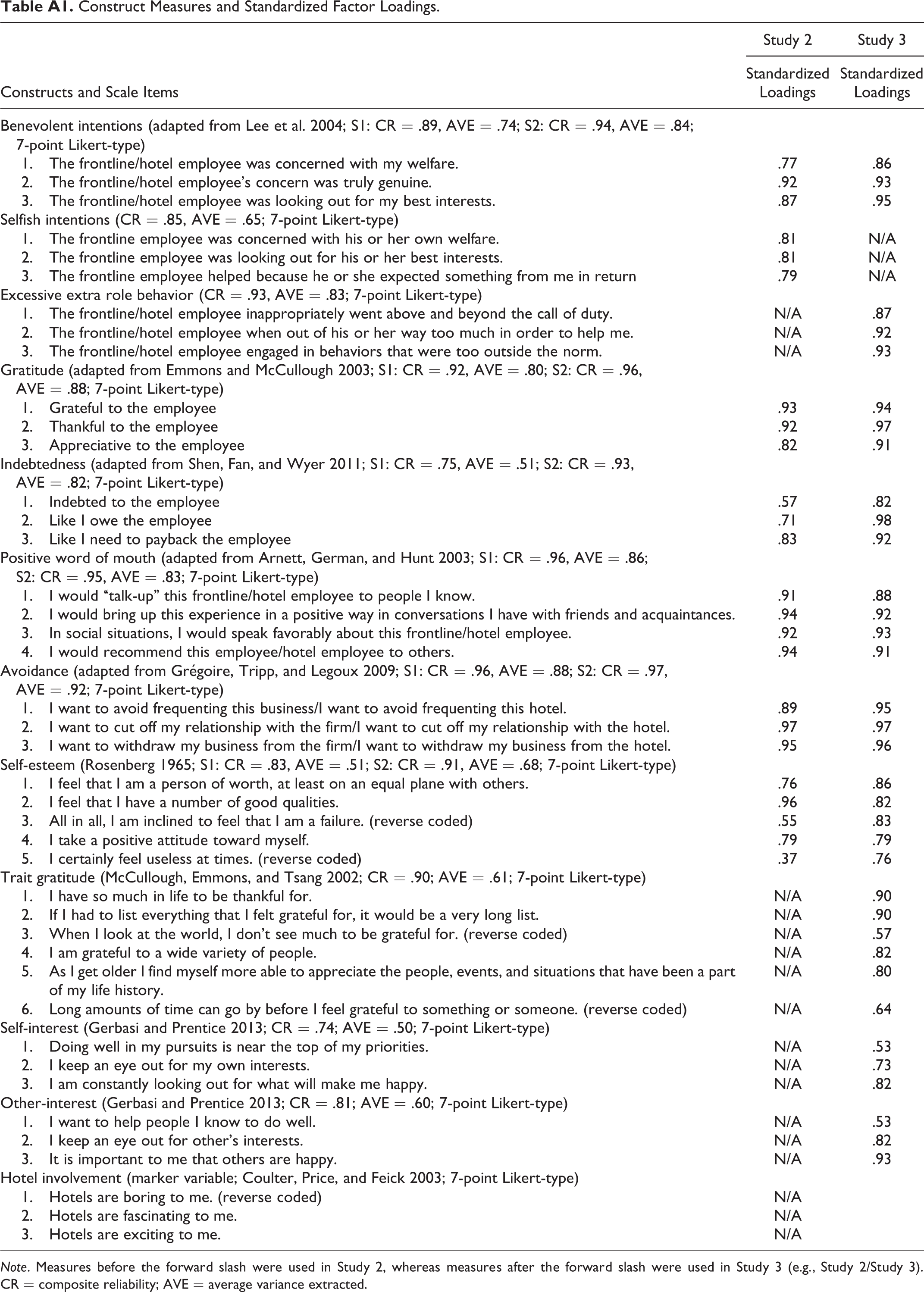
| Constructs and Scale Items | Study 2 | Study 3 |
|---|---|---|
| Standardized Loadings | Standardized Loadings | |
| Benevolent intentions (adapted from Lee et al. 2004; S1: CR = .89, AVE = .74; S2: CR = .94, AVE = .84; 7-point Likert-type) | ||
| 1. The frontline/hotel employee was concerned with my welfare. | .77 | .86 |
| 2. The frontline/hotel employee’s concern was truly genuine. | .92 | .93 |
| 3. The frontline/hotel employee was looking out for my best interests. | .87 | .95 |
| Selfish intentions (CR = .85, AVE = .65; 7-point Likert-type) | ||
| 1. The frontline employee was concerned with his or her own welfare. | .81 | N/A |
| 2. The frontline employee was looking out for his or her best interests. | .81 | N/A |
| 3. The frontline employee helped because he or she expected something from me in return | .79 | N/A |
| Excessive extra role behavior (CR = .93, AVE = .83; 7-point Likert-type) | ||
| 1. The frontline/hotel employee inappropriately went above and beyond the call of duty. | N/A | .87 |
| 2. The frontline/hotel employee when out of his or her way too much in order to help me. | N/A | .92 |
| 3. The frontline/hotel employee engaged in behaviors that were too outside the norm. | N/A | .93 |
| Gratitude (adapted from Emmons and McCullough 2003; S1: CR = .92, AVE = .80; S2: CR = .96, AVE = .88; 7-point Likert-type) | ||
| 1. Grateful to the employee | .93 | .94 |
| 2. Thankful to the employee | .92 | .97 |
| 3. Appreciative to the employee | .82 | .91 |
| Indebtedness (adapted from Shen, Fan, and Wyer 2011; S1: CR = .75, AVE = .51; S2: CR = .93, AVE = .82; 7-point Likert-type) | ||
| 1. Indebted to the employee | .57 | .82 |
| 2. Like I owe the employee | .71 | .98 |
| 3. Like I need to payback the employee | .83 | .92 |
| Positive word of mouth (adapted from Arnett, German, and Hunt 2003; S1: CR = .96, AVE = .86; S2: CR = .95, AVE = .83; 7-point Likert-type) | ||
| 1. I would “talk-up” this frontline/hotel employee to people I know. | .91 | .88 |
| 2. I would bring up this experience in a positive way in conversations I have with friends and acquaintances. | .94 | .92 |
| 3. In social situations, I would speak favorably about this frontline/hotel employee. | .92 | .93 |
| 4. I would recommend this employee/hotel employee to others. | .94 | .91 |
| Avoidance (adapted from Grégoire, Tripp, and Legoux 2009; S1: CR = .96, AVE = .88; S2: CR = .97, AVE = .92; 7-point Likert-type) | ||
| 1. I want to avoid frequenting this business/I want to avoid frequenting this hotel. | .89 | .95 |
| 2. I want to cut off my relationship with the firm/I want to cut off my relationship with the hotel. | .97 | .97 |
| 3. I want to withdraw my business from the firm/I want to withdraw my business from the hotel. | .95 | .96 |
| Self-esteem (Rosenberg 1965; S1: CR = .83, AVE = .51; S2: CR = .91, AVE = .68; 7-point Likert-type) | ||
| 1. I feel that I am a person of worth, at least on an equal plane with others. | .76 | .86 |
| 2. I feel that I have a number of good qualities. | .96 | .82 |
| 3. All in all, I am inclined to feel that I am a failure. (reverse coded) | .55 | .83 |
| 4. I take a positive attitude toward myself. | .79 | .79 |
| 5. I certainly feel useless at times. (reverse coded) | .37 | .76 |
| Trait gratitude (McCullough, Emmons, and Tsang 2002; CR = .90; AVE = .61; 7-point Likert-type) | ||
| 1. I have so much in life to be thankful for. | N/A | .90 |
| 2. If I had to list everything that I felt grateful for, it would be a very long list. | N/A | .90 |
| 3. When I look at the world, I don’t see much to be grateful for. (reverse coded) | N/A | .57 |
| 4. I am grateful to a wide variety of people. | N/A | .82 |
| 5. As I get older I find myself more able to appreciate the people, events, and situations that have been a part of my life history. | N/A | .80 |
| 6. Long amounts of time can go by before I feel grateful to something or someone. (reverse coded) | N/A | .64 |
| Self-interest (Gerbasi and Prentice 2013; CR = .74; AVE = .50; 7-point Likert-type) | ||
| 1. Doing well in my pursuits is near the top of my priorities. | N/A | .53 |
| 2. I keep an eye out for my own interests. | N/A | .73 |
| 3. I am constantly looking out for what will make me happy. | N/A | .82 |
| Other-interest (Gerbasi and Prentice 2013; CR = .81; AVE = .60; 7-point Likert-type) | ||
| 1. I want to help people I know to do well. | N/A | .53 |
| 2. I keep an eye out for other’s interests. | N/A | .82 |
| 3. It is important to me that others are happy. | N/A | .93 |
| Hotel involvement (marker variable; Coulter, Price, and Feick 2003; 7-point Likert-type) | ||
| 1. Hotels are boring to me. (reverse coded) | N/A | |
| 2. Hotels are fascinating to me. | N/A | |
| 3. Hotels are exciting to me. | N/A | |
Note. Measures before the forward slash were used in Study 2, whereas measures after the forward slash were used in Study 3 (e.g., Study 2/Study 3). CR = composite reliability; AVE = average variance extracted.
Appendix B
Acknowledgments
The authors would like to thank Robert Palmatier for his insightful comments on this article.
Declaration of Conflicting Interests
The author(s) declared no potential conflicts of interest with respect to the research, authorship, and/or publication of this article.
Funding
The author(s) disclosed receipt of the following financial support for the research, authorship, and/or publication of this article: This research was partially funded by Auburn University’s Center for Marketing Research.
Notes
References
Supplementary Material
Please find the following supplemental material available below.
For Open Access articles published under a Creative Commons License, all supplemental material carries the same license as the article it is associated with.
For non-Open Access articles published, all supplemental material carries a non-exclusive license, and permission requests for re-use of supplemental material or any part of supplemental material shall be sent directly to the copyright owner as specified in the copyright notice associated with the article.
