




Abstract
The service literature highlights the importance of organizational leaders in creating an organization-wide customer orientation (CO). Yet, some open questions remain regarding this relationship: Are organizational leaders from different hierarchical levels equally effective in creating a CO? Does the functional role of employees affect the importance of certain leaders? More generally, when does customer-oriented leadership really pay off? To address these questions, we investigate how senior managers’ and direct supervisors’ CO affects the CO climate and effectiveness of both frontstage and backstage service teams. Analyzing multisource data from 575 employees and their supervisors from 110 teams in a retail bank, we find that the effect of perceived senior manager CO on team CO climate and team effectiveness is stronger in backstage teams while perceived direct supervisor CO has a greater influence on frontstage teams. Moreover, team CO climate consensus moderates the effect of team CO climate on team effectiveness. These results suggest that, contrary to past theorizing, customer-oriented leadership does not per se increase team CO climate and team effectiveness; rather, the correct coupling of leadership source and degree of customer contact needs to be achieved. Service managers should use these findings and appoint the correct leader to implement CO to make the organization-wide CO diffusion more efficient and effective.
Keywords
Customer orientation (CO) is a strategic priority for firms aiming to deliver a superior service experience (Brown et al. 2002). Service firms have traditionally relied on their employees to bring a customer-oriented strategy to life, as employees are the “first and only” service representatives (Hartline, Maxham, and McKee 2000, p. 35). In recent years, however, service research has begun to reflect the tendency among firms to organize the delivery of customer service around teams (Ahearne et al. 2010; Menguc et al. 2016). Therefore, we capture the team-level manifestation of CO with the construct of team CO climate.
Service research has also examined the role of organizational leaders in driving the creation of a CO (Kennedy, Goolsby, and Arnould 2002). We focus on two main sources of team leadership: direct supervisors, or formal leaders internal to teams; and senior managers, or formal leaders external to teams (Morgeson, DeRue, and Karam 2010). Direct supervisors share the daily reality of teams and can directly reward or sanction team member behaviors, while senior managers are in charge of setting higher order goals and priorities. Some scholars have proposed a “cascading” model in which senior managers rely on direct supervisors to disseminate CO (Lam, Kraus, and Ahearne 2010). Others have argued in favor of a “bypass” model, implying the direct impact of senior managers on lower level employees (Hammond, Webster, and Harmon 2006).
Furthermore, CO should permeate in contexts with both high and low customer contact (Liao and Subramony 2008), defined as the extent to which a team’s functional role involves regular direct interactions with external customers. Service teams with frontstage roles, such as sales and customer care, are more proximal to customers and interact directly with them. Customer contact decreases for teams in backstage roles such as information technology (IT), accounting, and finance. While both frontstage and backstage teams are valuable in providing customer-oriented services, their stance toward customers differs. For frontstage teams, CO is part of the “job description,” with team members being more exposed to customers’ needs and demands, while backstage teams are not.
The characteristics of frontstage and backstage teams create differential challenges for leaders. Therefore, understanding which organizational leader can effectively align teams with different levels of customer contact is critical for ensuring a high and consistent CO in service firms (Ostrom et al. 2015). The notion of construal fit suggests that a team’s proximity to customers should be mirrored by the different hierarchical levels of customer-oriented leadership (Berson and Halevy 2014). Therefore, the influence of different leaders as CO role models is contingent on the degree of customer contact of their teams. Against this background, our study is the first to examine the interplay of leadership source and customer contact on team CO climate and team effectiveness as well as the moderating effect of team CO climate consensus.
We advance the understanding of the role and value of leaders’ CO in two important ways. First, informed by construal-level theory (CLT; Trope and Liberman 2010) and construal fit, we propose and find support for a novel contingency hypothesis, involving two main leadership sources (senior managers and direct supervisors) and two levels of customer contact (frontstage and backstage), to pinpoint leaders’ CO as a driver of team CO climate. Our work integrates prior research that has mainly focused on a unitary leadership source and privileged frontstage settings (see Figure 1). Second, whereas the moderating role of team CO climate consensus emerges from prior research (Ahearne et al. 2010), we are the first to demonstrate that team CO climate consensus also affects the conditional indirect effects of perceived leaders’ CO on team performance and team job satisfaction. This finding represents an essential addition to the literature on CO in service firms, as so far, no study has offered a comprehensive explanatory model of the moderated-mediation process connecting perceived CO of direct supervisors and senior managers to the effectiveness of their teams.
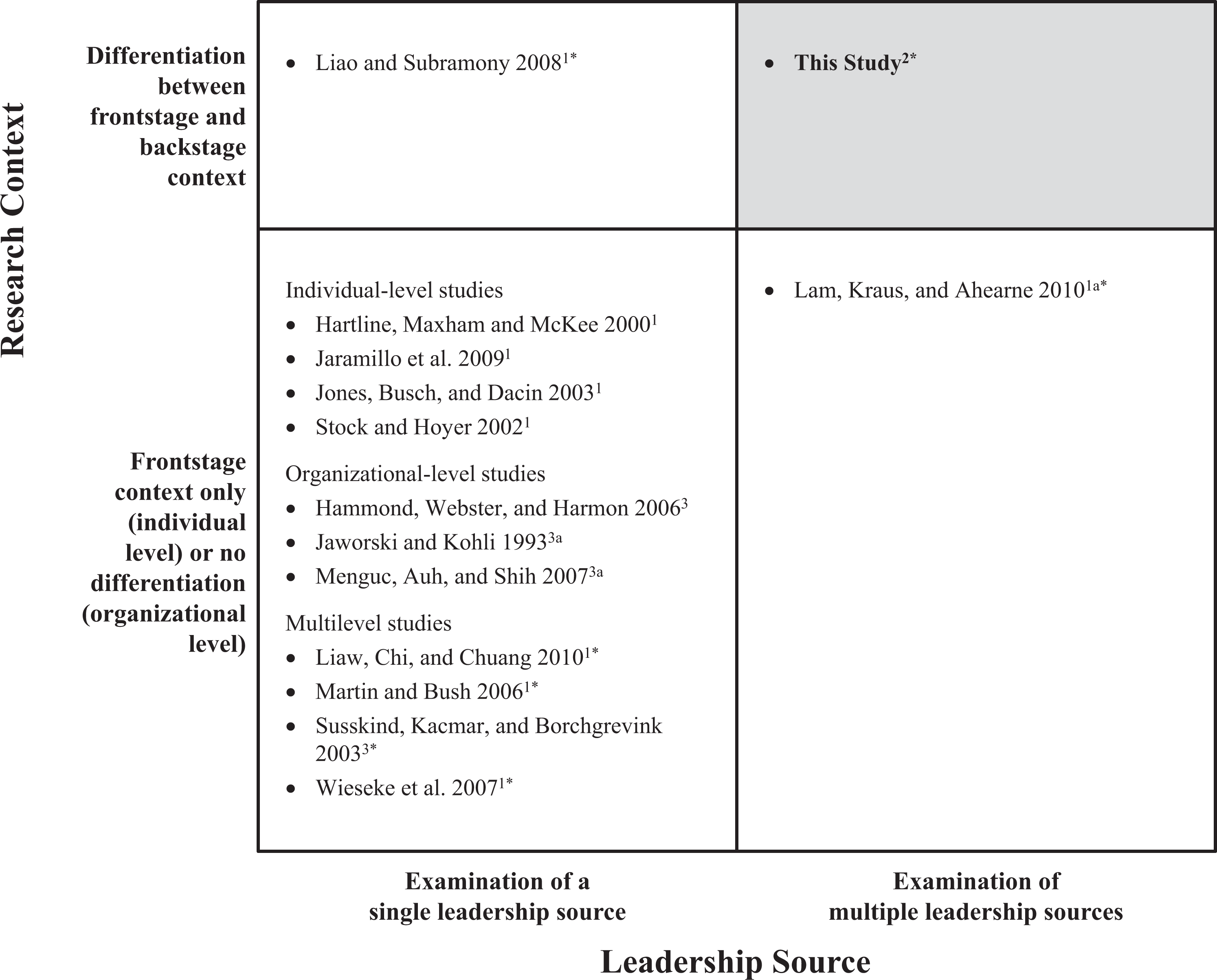
Categorization of previous research on leadership antecedents of customer orientation. 1Customer orientation (CO) on the individual level. 2CO on the team level. 3CO on the organizational level. aThese studies subsume CO under the larger concept of market orientation. *Multilevel studies. We only report selected studies on organizational-level market orientation.
Our findings present important managerial implications for service firms. We describe how senior managers (i.e., direct supervisors’ managers) and direct supervisors can direct their perceptions as CO role models in frontstage and backstage contexts to make the process of CO diffusion more efficient and their teams more effective. We test our conceptual model (Figure 2) using multisource and time-lagged data from 575 employees and their supervisors from 110 teams in a retail bank.
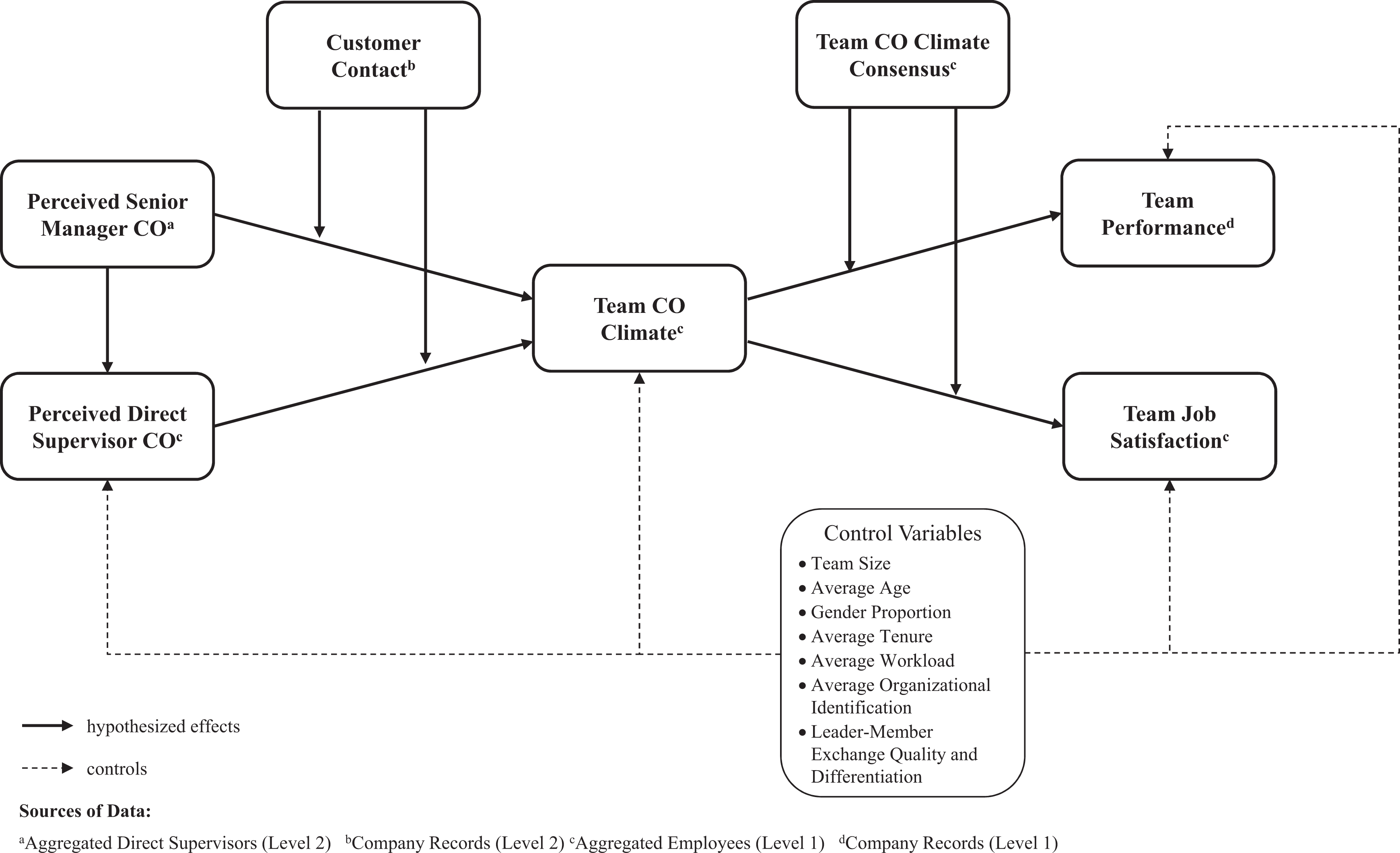
Hypothesized model.
Conceptual Development
Team CO Climate: Construct Definition and Functional Relationships
CO is manifest at both the individual and aggregated levels (i.e., team or firm level). In such cases, it is important to distinguish the level of theoretical origin from the focal level at which the construct is studied (Kozlowski and Klein 2000). This distinction needs to articulate the theoretical processes that lead to the emergence of the construct at the higher level and how this differs from its manifestation at the level of theoretical origin. In this study, we employ the widely accepted psychological view of employee CO, which places CO’s theoretical origin at the individual level. We define employee CO as “the work value that captures the extent to which employees’ job perceptions, attitudes, and behaviors are guided by an enduring belief in the importance of customer satisfaction” (Zablah et al. 2012, p. 24). Conceptualizing employee CO as a work value emphasizes the importance of the attraction, selection, and socialization processes that underpin the emergence of CO at the team level (Hartline, Maxham, and McKee 2000). From this standpoint, we delineate the functional relationship among individual CO, team CO climate, and team CO climate consensus.
Schneider, Salvaggio, and Subirats (2002) conceptualize climate as a shared perception of the properties of a team or unit. Consistent with this view, we define team CO climate as team members’ shared perception of the behaviors and attitudes within the team that are guided by an enduring belief in the importance of customer satisfaction. 1 Shared unit properties originating from individual unit members “converge among group members as a function of attraction, selection, attrition, socialization, social interaction, leadership and other psychological processes” (Kozlowski and Klein 2000, p. 30). Thus, leadership and other socialization processes influence the coalescence of individual-level CO into team CO climate.
The attraction–selection–attrition (ASA) model provides the theoretical foundation to explain the emergence of team CO climate from the individual level (Bliese 2000). The ASA model predicts within-group homogeneity (i.e., a shared perception) of team CO. This homogeneity is explained by the interrelated processes of attraction (customer-oriented employees gravitate to customer-oriented teams), selection (customer-oriented teams select customer-oriented employees), and attrition (employees who do not fit with the CO work–value leave or are removed). However, as the ASA model can never ensure perfect homogeneity in a real organizational context (Bliese 2000), we assume partial isomorphism in the functional relationship between employee CO and team CO climate. Partial isomorphism describes a situation in which employee CO and team CO climate maintain conceptual links but differ in subtle and important ways (Morgeson and Hofmann 1999). The key implication is that team members form a shared perception of team CO climate, though their individual contributions to the aggregated score may vary.
Thus, we theoretically model the emergence of team CO climate from the individual level as a fuzzy composition process (Bliese 2000, p. 369). In this process, we capture team CO climate as a shared unit property by a reference-shift consensus model, using intraclass correlation (ICC[1]) and reliability of group mean (ICC[2]) to justify data aggregation to the higher level. If these criteria are met, we operationalize team CO climate as the mean value of team members’ evaluations of team CO (Chan 1998). We capture team CO climate consensus by a dispersion model and measure it as the opposite of the standard deviation of team members’ evaluations of team CO (Chan 1998).
Our study focuses on team-level antecedents and consequences of team CO climate as well as moderators of these relationships. First, we consider leadership perceptions as the most salient “input” for team climate (Kozlowski and Doherty 1989). As teams are simultaneously exposed to multiple sources of leadership (Morgeson, DeRue, and Karam 2010), we distinguish between the influence of internal and external leaders. Second, we link team CO climate to team effectiveness, in terms of team performance and team job satisfaction (Mathieu et al. 2008). This mirrors the main external and internal benefits of CO for service firms (Donavan, Brown, and Mowen 2004). Third, we argue that customer contact moderates the impact of perceived leader CO on team CO climate, while team CO climate consensus moderates the impact of team CO climate on team effectiveness.
Leaders as Role Models for Team CO Climate
Figure 1 presents our contribution vis-à-vis existing studies examining the leadership effects of senior managers or direct supervisors on CO. 2 Given that CO diffuses from leaders to subordinates through a social learning process (Lam, Kraus, and Ahearne 2010), we expect that leaders affect team CO climate by acting as role models for CO. Consistent with role modeling research in the service context (Schneider et al. 2005), we focus on perceived leader CO, defined as subordinates’ perception that their leader’s behaviors are consistent with CO values and norms. The leadership literature distinguishes between two types of formal leaders: direct supervisors and senior managers (Morgeson, DeRue, and Karam 2010). Direct supervisors influence team climate through concrete leadership behaviors such as work instructions and direct feedback, as documented in studies on transformational leadership (Hur, van den Berg, and Wilderom 2011) and service climate (Hui et al. 2007). These activities represent “behavioral role modeling” (Morgenroth, Ryan, and Peters 2015) and are prevalent because direct supervisors work from within their teams.
Because senior managers do not work directly with subordinates, they interact less frequently with team members and influence team climate through abstract leadership behaviors such as setting a vision and creating a desired organizational culture. These activities represent instances of “inspirational role modeling” (Morgenroth, Ryan, and Peters 2015). The leadership literature further distinguishes between the direct influence of senior managers on subordinates (“bypass effect”) and their indirect influence through direct supervisors (“cascading effect”). First, senior managers may directly affect subordinates in service teams who are two or more hierarchical levels below them through role model behavior, thereby bypassing direct supervisors (Dvir et al. 2002). Second, senior managers’ role model behavior may shape the role model behavior of direct supervisors, which in turn affects service team members, thereby cascading role model perceptions down to subordinates two or more hierarchical levels below. Thus, we expect role model perceptions of both senior managers and direct supervisors to influence team CO climate, with senior managers’ influence being both direct and indirect through direct supervisors. As the literature affirms the plausibility of these main effects, we use this nomological network as the basis for our hypotheses on the conditional effects of perceived leaders’ CO on team CO climate and team effectiveness.
Hypotheses
The Moderating Effect of Customer Contact
Research indicates that the hierarchical distance between leaders and followers moderates the effectiveness of leaders’ behaviors (Berson and Halevy 2014). This hypothesis builds on the concept of construal fit, which emerges when the abstractness of a stimulus matches the level of psychological distance from the source of the stimulus (Berson and Halevy 2014). For example, the notion of construal fit would suggest that CO role modeling is situationally appropriate when the abstractness with which teams represent CO matches the psychological distance from the leaders who promote and communicate CO. Drawing from this concept, we propose that the coupling of leadership source (a leader’s distance from the team) and customer contact (a team’s distance from the customer) determines the effectiveness of leaders’ role model behavior. The concept of construal fit comes from CLT (Trope and Liberman 2010) and its recent applications to leader–team dynamics (Wilson, Crisp, and Mortensen 2013). The central argument of CLT is that psychologically distant targets are represented in a more abstract and schematic way, while representations of psychologically close targets are more concrete and detailed.
Research indicates that team members construe senior managers more abstractly because of the higher psychological distance and direct supervisors more concretely because of the lower psychological distance (Berson et al. 2015). Indeed, team members may perceive the same leadership activities from different leaders in different ways, depending on the hierarchical distance from the leader (i.e., more abstract for senior managers and more concrete for direct supervisors; Shamir 1995). Similarly, the degree of customer contact (i.e., direct or indirect) affects the level of perceived psychological distance of team members to customers (i.e., proximal vs. distal), which in turn affects their mental construal process. Thus, members of teams with low customer contact represent customers and CO in a more abstract and schematic way, while members of teams with high customer contact represent customers and CO in a more concrete and detailed way. Table 1 summarizes the associations among construal level, leadership source, and customer contact.
Associations Among Construal Level, Leadership Source, and Customer Contact.
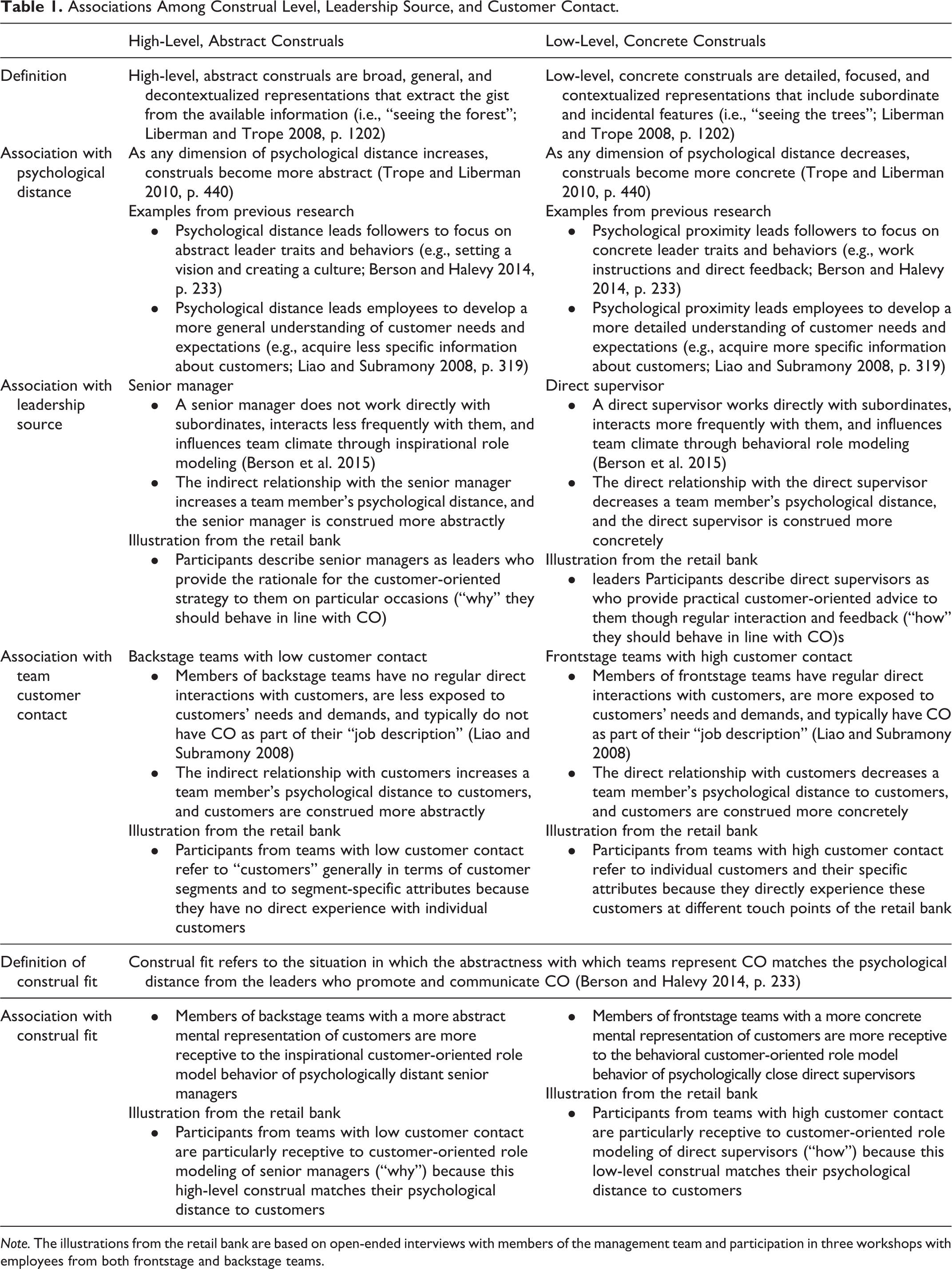
Note. The illustrations from the retail bank are based on open-ended interviews with members of the management team and participation in three workshops with employees from both frontstage and backstage teams.
Building on the construal fit argument, we contend that members of backstage teams without direct customer contact have a more abstract mental representation of customers and therefore are more receptive to the abstract, high-level, customer-oriented role model behavior of senior managers. Conversely, members of frontstage teams with direct customer contact have a more detailed mental representation of customers and thus are more receptive to the concrete, low-level, customer-oriented role model behavior of direct supervisors. The reason is that construal fit increases psychological engagement (Berson and Halevy 2014), enhances perceived credibility of information (Hansen and Wanke 2010), and intensifies emotional reactions to messages (Lee, Keller, and Sternthal 2010). The combined action of these mechanisms consolidates the ASA process through which team CO climate emerges. While the ASA process operates in both frontstage and backstage teams, we advance that different leaders are better placed for enacting the process in the two contexts. With these arguments, we propose the following
3
:
While we consider a potential bypass effect of senior manager CO on team CO climate in Hypothesis 1, senior manager CO may also indirectly affect team CO climate in a cascading effect through direct supervisor CO. Indeed, senior managers’ role model behavior can shape the role model behavior of direct supervisors, thereby cascading role model perceptions down to subordinates of these direct supervisors (Lam, Kraus, and Ahearne 2010). However, following our Hypothesis 2, we expect that the second stage of this mediation model (i.e., the direct supervisor–team relationship) is contingent on team customer contact, while we do not expect such a contingency in the first stage of this mediation model (i.e., the senior manager–direct supervisor relationship). Thus, considering construal fit, we propose a second-stage moderated mediation as described in the following:
The Moderating Effect of Team CO Climate Consensus
In line with team effectiveness research, our model includes the two most important direct outcomes of team climate: team performance and team job satisfaction (LePine et al. 2008). These pertain to service contexts in which leaders are challenged to simultaneously achieve team performance targets and keep team members satisfied. Members of teams with a high level of CO climate are more likely to match their activities to customer demands, identify the services that will best meet customer needs, and deal proactively with customer requests. In turn, these actions increase team performance because such customer-oriented attitudes and behaviors enable teams to create superior value for customers (Kennedy, Lassk, and Goolsby 2002). Moreover, when team CO climate is high, the team tends to work collaboratively and minimize conflict with other teams and with the customers they serve, thereby enhancing team job satisfaction.
Although the ASA model suggests that a shared perception of CO climate emerges in teams, it is unrealistic to expect all team members to have exactly the same understanding of their team’s CO climate (Bliese 2000). The resulting variance is captured by the construct of team CO climate consensus, defined as the extent to which team members share the same perception of their team’s CO climate (Ahearne et al. 2010). When CO climate consensus is strong, team members exhibit more consistent customer-related attitudes and behaviors, presenting a “united front” when dealing with customer-related issues (Schneider, Salvaggio, and Subirats 2002). Thus, compared with teams that do not share a common perception of their team’s CO climate, teams with high consensus should be more effective and efficient in all customer-related activities. As a result, the performance-enhancing effect for the same level of team CO climate will increase with high CO climate consensus and decrease with low CO climate consensus. Furthermore, strong CO climate consensus enables intra- and interteam collaborations through an aligned perception of the team’s properties, as team members are less likely to diverge in the way they represent their team to colleagues or customers. In contrast, low CO climate consensus indicates a less harmonious representation of the team, which may undermine collaboration and increase conflict. Thus, the link between team CO climate and team job satisfaction is stronger under high team CO climate consensus.
Leader CO and Team Effectiveness
A key suggestion within our reasoning is the need to understand the circumstances under which the perceived CO of a certain leader is more (or less) conducive to team effectiveness. Thus, conditional indirect effects are implicit in the reasoning behind our hypotheses, as displayed in Figure 2. First, following team research, we expect team climate to mediate the relationship between perceived leaders’ CO and team effectiveness. Specifically, team effectiveness is a function of the customer-oriented climate that leaders create, and therefore perceived leader CO is a distal rather than proximal antecedent of team performance and job satisfaction. Second, we anticipate that the indirect effect of perceived senior manager (direct supervisor) CO on team effectiveness is stronger when customer contact is low (high). Third, we postulate that the indirect effect of perceived leader CO on team effectiveness through team CO climate is stronger when CO climate consensus is high. As the magnitude and potentially the significance of the indirect effects of perceived leader CO on team performance and job satisfaction are contingent on customer contact and team CO climate consensus, we propose the following moderated-mediation hypotheses:
Method
Research Context and Data Sources
To test our hypotheses, we collected data from a team-based, medium-sized Swiss retail bank. This context suits our study well for several reasons. First, due to the firm’s team-based structure, team membership is explicit and identifiable. Second, every team has an assigned internal leader; these supervisors have formal authority in directing, managing, and rewarding their teams. Third, senior managers are line managers to direct supervisors and interact somewhat with the teams. Fourth, team members are jointly responsible for team goals, and their annual performance is evaluated and rewarded as a team, rather than individually. Fifth, teams share the same organizational structures, systems, and processes and are led by the same executives; this minimizes potential confounds due to contextual factors.
The retail bank is structured in frontstage teams with high customer contact (e.g., consumer lending, customer service) and backstage teams with low customer contact (e.g., internal auditing, credit analysis). All team members receive fixed compensation from the bank irrespective of their customer contact level. Each direct supervisor is assigned to a team of employees who perform either frontstage or backstage roles. Similarly, each senior manager leads a department of either frontstage or backstage teams. Thus, direct supervisors or senior managers do not distribute their time/attention between team members or teams across frontstage and backstage roles. In addition, leadership policies for senior managers and direct supervisors are the same regardless of customer contact.
We obtained multiple-source data from the retail bank: We collected survey data from team members and direct supervisors, while the human resources (HR) department provided data on team performance, customer contact, and demographics. We distributed our questionnaires through the company’s intranet, assuring confidentiality to all participants. We contacted 818 employees (129 direct supervisors, 689 team members) and received 728 responses: 125 direct supervisors (97% response rate) and 603 team members (88% response rate). We did not find significant differences between respondents and nonrespondents in terms of age, gender, workload, or tenure. Together with the high response rate, this evidence suggests that nonresponse bias is not an issue. We excluded responses from team members whose direct supervisors did not reply (n = 13) and from teams with a single respondent (n = 15). Accordingly, we retained valid responses from 110 direct supervisors and 575 team members of 110 teams (average team size = 5.63). These teams are from 39 different departments, each led by a senior manager.
Measures
We used established scales whenever possible. We collected departmental-level data on perceived senior manager CO from direct supervisors. Team-level data on perceived direct supervisor CO, team CO climate, CO climate consensus, and team job satisfaction came from team members. Last, we used the firm’s archival data on customer contact and team performance. Online Appendix B provides the measurement items for the main constructs.
Team CO climate and CO climate consensus
As our study is the first to investigate team CO climate, a scale for this construct was not available. We could not adapt the available scale of unit CO climate (Grizzle et al. 2009) because it uses managers’ behaviors as rated by employees to gauge unit climate. Thus, we first specified the construct’s domain based on our definition and on the review of relevant literature. Following suggestions from Zablah et al. (2012), we focused on CO-expressive behaviors and CO-expressive attitudes to operationalize CO climate. Second, we developed an initial pool of items from established scales, which we adapted to the team context. A group of managers and employees’ representatives judged the scale on their content validity and redundancy. In line with their feedback, we refined the wording of the items. Third, we pretested the scale with a sample of employees from the bank. None of the participants indicated any difficulties understanding or answering the survey questions. Fourth, we assessed the scale’s convergent and discriminant validity with the survey data (n = 575 employees) and then confirmed the retest validity with a second survey of 297 employees (we provide more details subsequently). In the main study, measures of team CO climate were acceptable (Cronbach’s α = .87; average variance extracted [AVE] = .46; ICC[1] = .23; ICC[2] = .61). Although the ICC[2] is lower than the conventional .70 threshold, its value is aligned with other aggregated constructs in multilevel research (De Jong, de Ruyter, and Lemmink 2004; Liao and Subramony 2008). The team CO climate scale displayed similar properties in the second survey (α = .91; AVE = .57; ICC[1] = .35; ICC[2] = .66). Following a dispersion model, we computed team CO climate consensus as the standard deviation of the team members’ climate scores multiplied by −1, such that more negative values indicate lower consensus.
Perceived leader CO
We used the leader CO scale from Wieseke et al. (2009) and assigned the referent to “my direct supervisor” or “my senior manager” to capture the perceived CO of different leaders. We used a reference-shift consensus model and team members as informants to rate direct supervisor CO (α = .83; AVE = .57). Because ICC[1] = .24 and ICC[2] = .62, aggregation to the team level was justified. To avoid same-source bias of leadership impressions, we used direct supervisors as informants to rate perceived senior manager CO (α = .75; AVE = .46). By doing so, we also prevented team members from providing their perceptions of firm-level CO rather than referring to a specific senior manager (Grizzle et al. 2009). We adopted an additive composition model (Chan 1998) and averaged perceived senior manager CO within departments because divergent perspectives of senior manager CO are likely to exist among direct reports. 4 This kind of aggregation is justified, given our direct supervisor sampling ratio of 97%. Thus, we construed perceived senior manager CO as a formative multilevel construct, using the departmental mean of direct supervisor perceptions as an indicator of the senior manager’s CO.
Customer contact
The value of this variable is 1 if the team has a frontstage role (48% of teams) or 0 if the team provides backstage services (52% of teams). The HR department indicated whether a team has direct customer contact or not.
Team performance
As part of the annual appraisal process, the HR department assesses each team on a 10-point scale. We used these evaluations, carried out 5 months after our data collection, to measure team performance.
Team job satisfaction
We used Donavan, Brown, and Mowen’s (2004) global measure of job satisfaction, asking team members to rate the level of satisfaction with their “overall job.” Following an additive composition model, we averaged satisfaction within teams.
Control variables
We controlled for several factors that may potentially influence perceived leader CO, team CO climate, and team effectiveness. Social exchange theory suggests that the quality of the team–supervisor relationship can influence leadership perceptions, team performance, and job satisfaction (Dulebohn et al. 2012). Thus, we controlled for team leader–member exchange (LMX) quality (Graen, Liden, and Hoel 1982; α = .87; AVE = .57; ICC[1] = .27; ICC[2] = .66), defined as the reciprocal exchanges between an employee and his or her direct supervisor based on trust, respect, and obligations. Similarly, we controlled for team LMX differentiation (Menguc et al. 2016) because variability in how followers feel their team leaders treat them may correlate with team climate, performance, and satisfaction. As it may influence CO (Wieseke et al. 2007), we also controlled for average organizational identity. Furthermore, we obtained coded archival data on sociodemographics and job-related variables that served as control variables in prior CO and team studies: team size, average age, gender proportion, average workload, and average tenure. Table 2 reports descriptive statistics and correlations.
Descriptive Statistics and Correlations.

Note. CO = customer orientation; LMX = leader–member exchange; SD = standard deviation.
**p < .01. *p < .05 (two-tailed tests).
Measurement Model
We conducted confirmatory factor analyses (CFAs) to validate our multi-item measures. First, we specified a CFA on measures of perceived direct supervisor CO, team CO climate, and LMX quality at the employee level using the robust Satorra–Bentler maximum-likelihood estimator. The model fits well with our data, χ2(116) = 302.28, p < .01; comparative fit index (CFI) = .98; root mean square error of approximation (RMSEA) = .05. All items loaded significantly on the hypothesized latent variables, and squared correlations were lower than the AVEs for any pair of constructs. Second, we applied a CFA on perceived senior manager CO items collected from direct supervisors, χ2(2) = .18, p > .91; CFI = 1.00; RMSEA = .00. Estimations of CFAs with clustered standard errors and multilevel CFAs led to similar results.
Results
Main Effects
We applied multilevel structural equation modeling with CFA scores because teams were nested in 39 different departments and because perceived senior manager CO and customer contact are departmental-level constructs. Moreover, the ICC[1] indicated that 13% of team CO climate variance rested between departments. Although the presence of one cross-level interaction would call for group-mean centering, we used grand-mean centering for two reasons. First, group-mean centering would make Level 1 and Level 2 variables uncorrelated with each other, thus preventing us from testing some relevant effects in our model. Second, we followed Bliese’s (2000, p. 433) suggestion to use grand-mean centering because “spurious cross-level interaction are rare.”
Table 3 reports the results of the main effects model (including random intercepts) and the full model (including random intercepts and a random slope for perceived direct supervisor CO, which has a cross-level interaction). In the main effects model, perceived senior manager CO is positively related to perceived direct supervisor CO (γ = .20, p < .05), both perceived senior manager CO (γ = .15, p < .10) and direct supervisor CO (γ = .32, p < .01) are positively related to team CO climate, and team CO climate is positively related to team performance (γ = .71, p < .01) but is not significantly related to team job satisfaction (γ = .07, ns).
Results of Multi-Level Structural Equation Models.
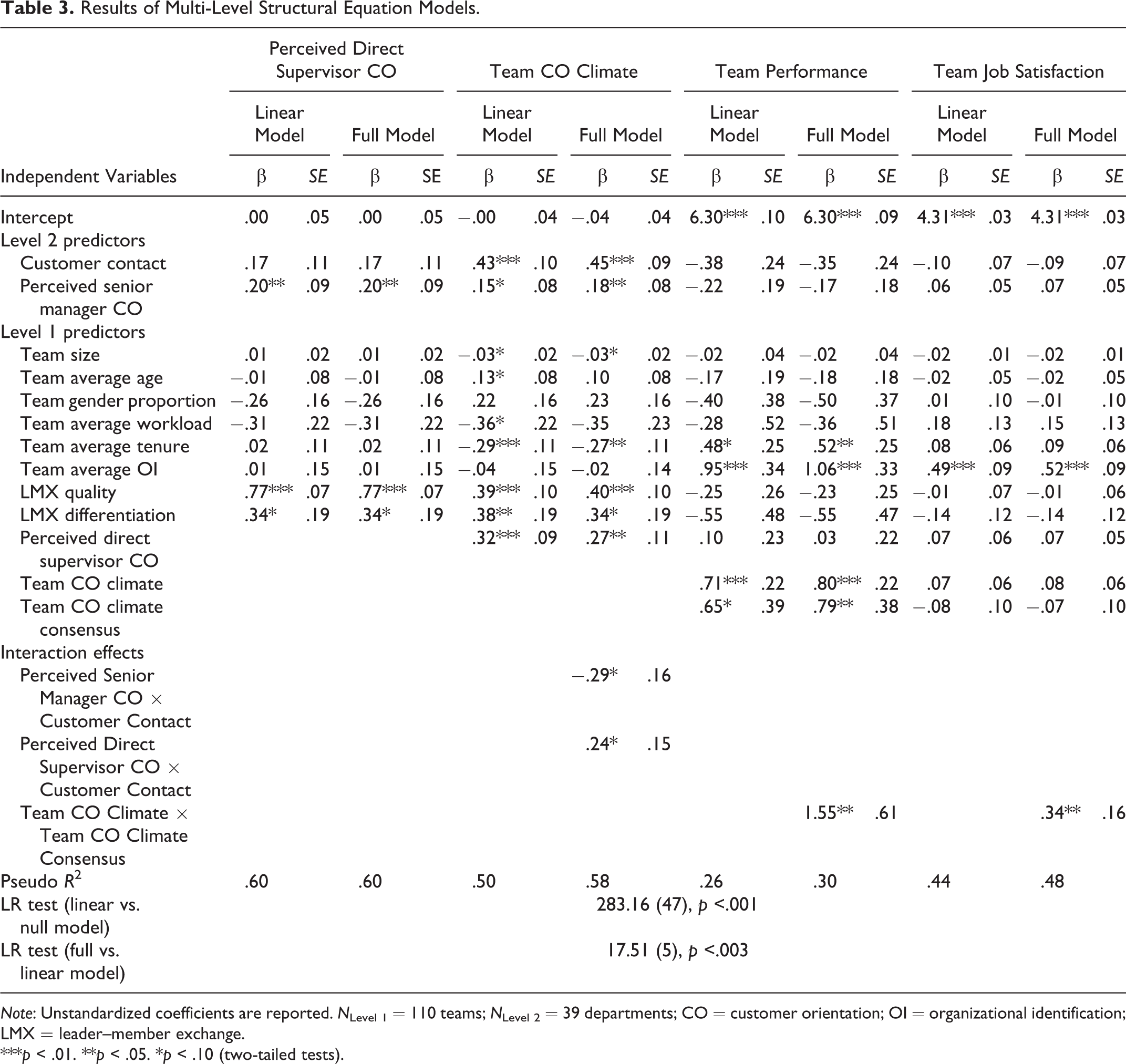
Note: Unstandardized coefficients are reported. N Level 1 = 110 teams; N Level 2 = 39 departments; CO = customer orientation; OI = organizational identification; LMX = leader–member exchange.
***p < .01. **p < .05. *p < .10 (two-tailed tests).
Moderating Effects
Table 4 summarizes the results for all hypotheses. Adding the proposed interaction effects significantly improved the model fit (−2LL (log-likelihood) change = 17.51, Δdf = 5, p < .01). In support of Hypothesis 1, we find a negative interaction effect of perceived senior manager CO and customer contact on team CO climate (γ = −.29, p < .10). The effect of perceived senior manager CO on team CO climate is positive and significant for low (γ = .31, p < .05) but not for high (γ = .03, ns) customer contact (Figure 3, Panel A). We find a positive interaction effect of perceived direct supervisor CO and customer contact on team CO climate (γ = .24, p < .10). Consistent with Hypothesis 2, the effect of perceived direct supervisor CO on team CO climate is stronger when customer contact is high (γ = .39, p < .01) rather than low (γ = .15, ns; Figure 3, Panel B). As predicted in Hypotheses 4a and 4b, we find positive interaction effects of team CO climate and team CO climate consensus on team performance (γ = 1.54 p < .05) and team job satisfaction (γ = .34, p < .05). The simple slopes for the effects of team CO climate on team performance (γhigh = 1.26, p < .01; γlow = .34, ns) and team job satisfaction (γhigh = .19, p < .05; γlow = −.02, ns) are positive and significant only when team CO climate consensus is high (Figure 4, Panels A and B).
Overview of Hypotheses Testing.
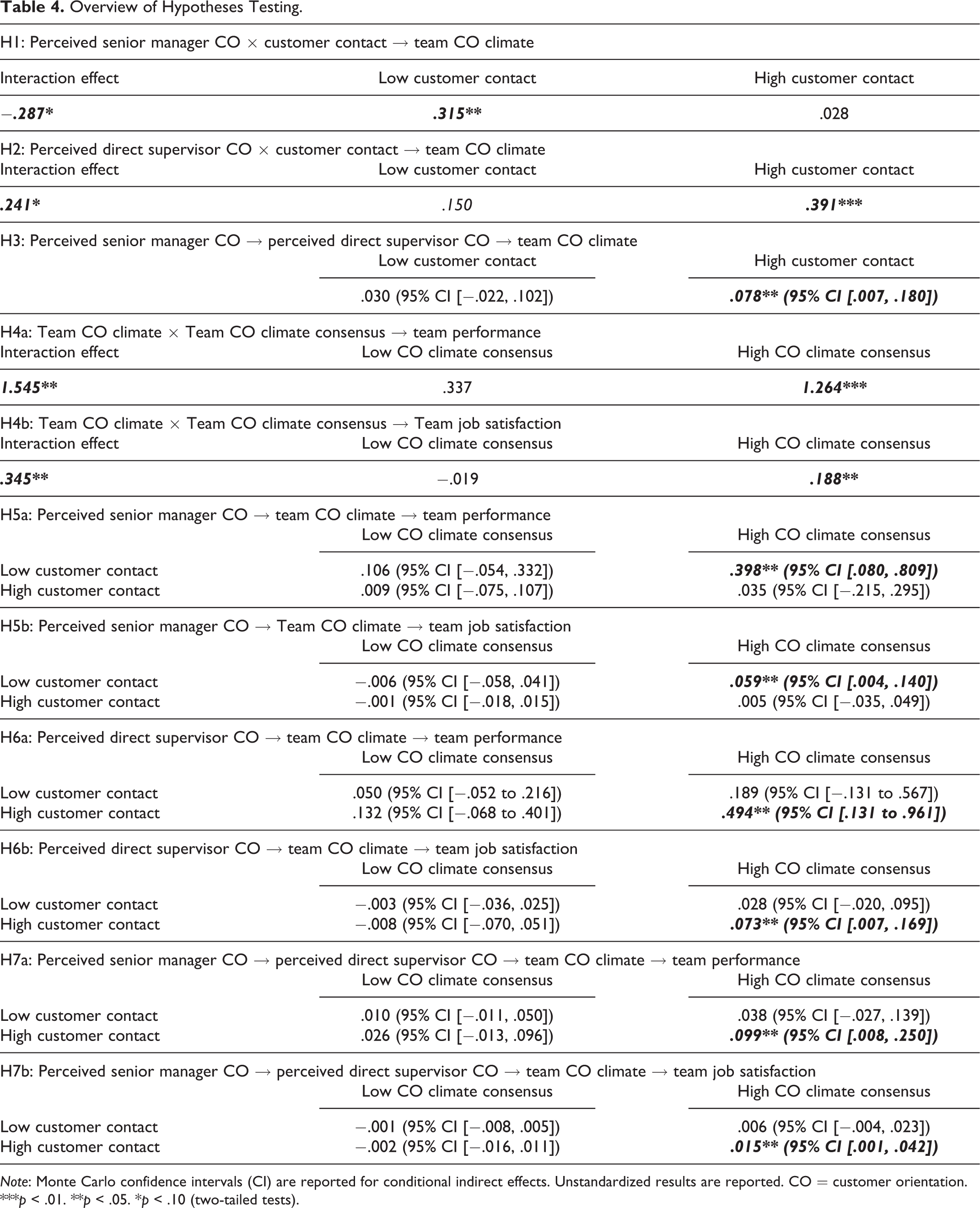
Note: Monte Carlo confidence intervals (CI) are reported for conditional indirect effects. Unstandardized results are reported. CO = customer orientation.
***p < .01. **p < .05. *p < .10 (two-tailed tests).
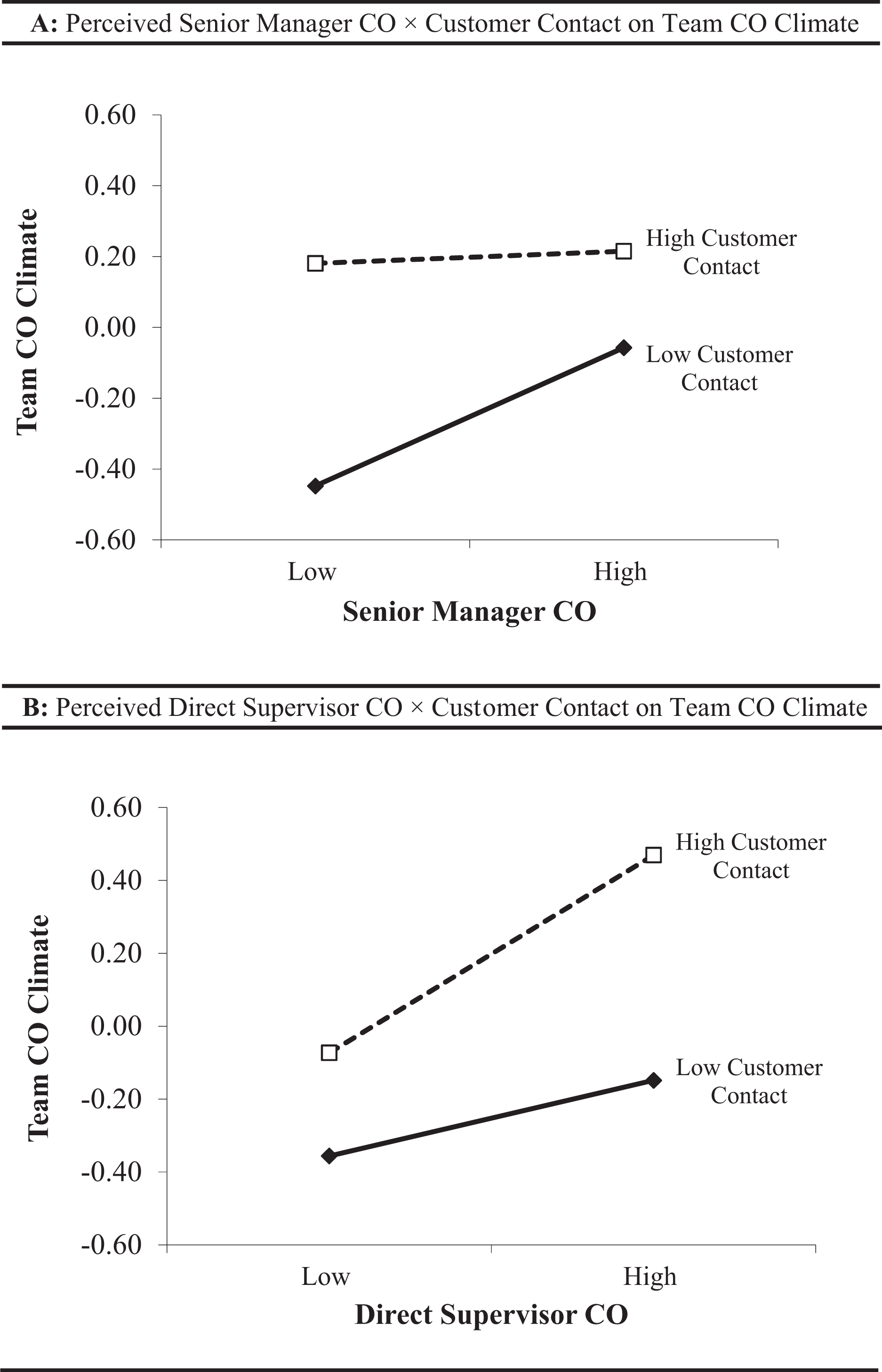
Moderating effects of customer contact. We used the exact specific values of customer contact for the simple slopes.
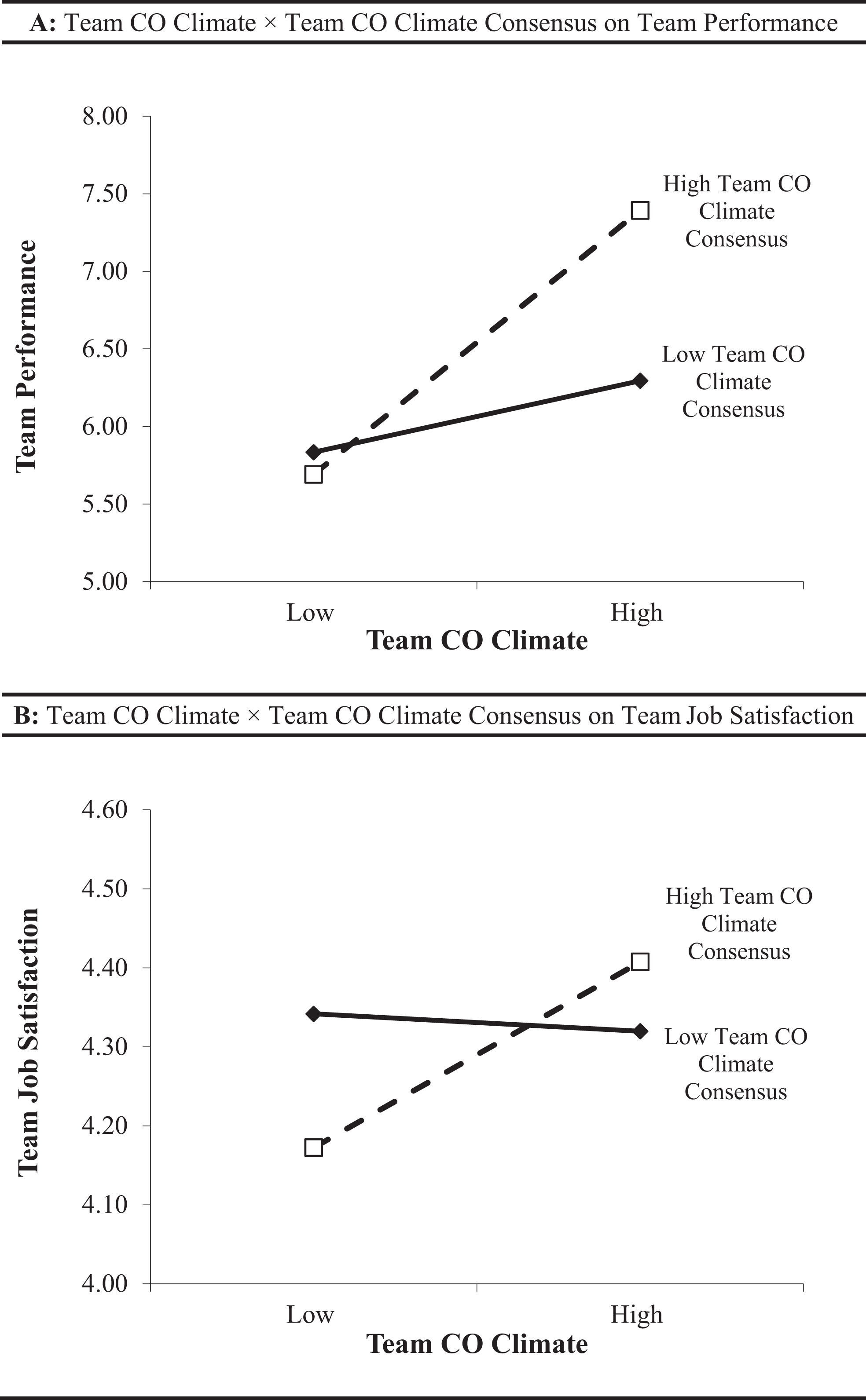
Moderating effects of team customer orientation (CO) climate consensus. We used mean ± one standard deviation of team CO climate consensus for the simple slopes.
Conditional Indirect Effects
To explore the proposed conditional indirect effects, we ran mediation tests and computed Monte Carlo confidence intervals for the indirect effects based on 50,000 sampling distributions of point estimates and correlations. First, we assessed the conditional indirect effects of perceived senior manager CO. The indirect effect on team CO climate through direct supervisor CO is significant only when customer contact is high in support of Hypothesis 3. However, the total effect of perceived senior manager CO on team CO climate is significant only when customer contact is low. The indirect effects on team performance and team job satisfaction through team CO climate are significant only when customer contact is low and team CO climate consensus is high, confirming Hypotheses 5a and 5b. Second, we assessed the conditional indirect effects of perceived direct supervisor CO. The indirect effects on team performance and team job satisfaction through team CO climate are significant only when both customer contact and team CO climate consensus are high in support of Hypotheses 6a and 6b. Third, we assessed the “perceived senior manager CO → perceived direct supervisor CO → team CO climate → team effectiveness” path. These indirect effects are significant only when both customer contact and team CO climate consensus are high in support of Hypotheses 7a and 7b. Importantly, the total effects of perceived senior manager CO on team performance and team job satisfaction are significant only when customer contact is low and team CO climate consensus is high; they are always nonsignificant under different conditions.
Robustness Tests
Customer contact, team CO climate, and team effectiveness
We tested whether the relationship between team CO climate and team effectiveness varies between frontstage and backstage service teams and found nonsignificant results.
Common method bias
We applied ex ante procedures and ex post computations to control for common method bias. First, we collected data from different sources, ensured anonymity, pretested the clarity of items, and gathered time-lagged performance data. Second, we anticipated that moderating effects would increase the model’s complexity and reduce the potential bias from respondents’ implicit theories. Third, we estimated a CFA that included a latent method factor with paths to each item. Substantive factor loadings remained significant, and the method factor accounted for only 9.5% of variance. Accordingly, we consider common method bias negligible.
Reverse causality
To rule out reverse causality, we approached the bank 18 months after the initial survey and gathered additional matched data from 78 supervisors and 297 team members from 78 teams. We only considered respondents who held the same positions and belonged to the same team as in the first survey. We collected data from direct supervisors on their own CO (α = .82; AVE = .54; Thomas, Soutar, and Ryan 2001) and their team’s CO climate (α = .93; AVE = .63) and from team members on their team’s CO climate (α = .91; AVE = .57; ICC[1] = .35; ICC[2] = .66), their supervisor’s CO (α = .91; AVE = .73; ICC[1] = .47; ICC[2] = .76), and the related construct of service climate (α = .85; AVE = .44; ICC[1] = .35; ICC[2] = .66; Bowen and Schneider 2014). Using these additional data, we tested the direction of causality in the direct supervisor CO–team CO climate relationship through a longitudinal analysis. In controlling for covariates, the results of multilevel models with random intercepts (Level 1: team and Level 2: department) suggest that perceived direct supervisor COtime1 is significantly related to team CO climatetime2 (γ = .62, p < .01). However, team CO climatetime1 is not related to perceived direct supervisor COtime2 (γ = .22, ns). These results confirm the direction of causality we hypothesized.
Consistency of perceived, self-rated, and supervisory-rated measures
Using the additional data collected, we compared perceived and self-rated measures of direct supervisor CO and self-rated and supervisory-rated measures of team CO climate. We found positive and significant correlations between self-rated direct supervisor CO and direct supervisor CO as perceived by the teams (r = .52, p < .01) and between teams’ self-assessments and their supervisor’s assessment of team CO climate (r = .66, p < .01). These findings provide additional evidence of measure validity.
Discriminant validity with service climate
A CFA on the additional data at the employee level showed good fit to the data, χ2(224) = 535.63, p < .01; CFI = .97; RMSEA = .07. All items loaded significantly on the hypothesized latent variables, and squared correlations were lower than the AVEs for any pair of constructs. Moreover, combining the items of team CO climate and service climate into one construct, χ2(227) = 1,137.27, p < .01; CFI = .90; RMSEA = .12, resulted in a significantly worse fit, Δχ 2 (3) = 601.64, p < .01, indicating discriminant validity.
Discussion
This study aimed to investigate how leaders’ CO affects the CO climate and effectiveness of both frontstage and backstage service teams. We complement prior research by examining the interplay of senior manager CO and direct supervisor CO with customer contact, their conditional effects on team CO climate and team effectiveness, and the moderating effect of team CO climate consensus. More specifically, we (1) simultaneously include the effects of both senior manager CO and direct supervisor CO on team CO climate and both frontstage and backstage contexts in one study, (2) differentiate between the bypass and cascading effects of senior managers’ influence on service teams, (3) treat CO as a team-level phenomenon, and (4) specify the conditional indirect effects of leader CO on team performance and team job satisfaction. We find that the effect of perceived senior manager CO on team CO climate is stronger in backstage teams than in frontstage teams while perceived direct supervisor CO has a stronger impact on team CO climate in frontstage teams than in backstage teams. Our results also indicate that team CO climate consensus is a boundary condition for the indirect effects of leader CO on team effectiveness. These findings have important implications for service research and practice.
Theoretical Implications
While some scholars have stressed that direct supervisors are the predominant source of effective customer-oriented leadership (Stock and Hoyer 2005), others have emphasized the crucial role of senior management (Hammond, Webster, and Harmon 2006). However, no research to date has considered different leadership sources and different levels of customer contact simultaneously (see Figure 1). Thus, our research is the first to consider both leadership sources and both levels of customer contact in a single study, with noteworthy results.
Building on the theoretical mechanism of construal fit, we find that the extent to which teams are proximal to customers determines the extent to which “distant” or “proximal” leaders are effective in enhancing CO. Therefore, customer contact can explain the effectiveness of senior managers or direct supervisors in the organizational diffusion of CO. The impact of hierarchically distant senior managers, who typically use more abstract leadership behaviors, is only significant for backstage teams. Conversely, the impact of hierarchically close direct supervisors, who embody more concrete leadership behaviors, is only significant for frontstage teams. Thus, it is not customer-oriented leadership per se that increases team CO climate, but rather the correct combination between the source of leadership and the degree of customer contact, a key characteristic of the team’s context.
Related to this point, we contribute to the debate on whether senior managers affect subordinates directly or through direct supervisors. While we find that senior manager CO always affects direct supervisor CO (post hoc analysis revealed that the interaction between perceived senior manager CO and customer contact has no effect on perceived direct supervisor CO), the cascading effect only takes place in frontstage teams. Instead, senior managers influence backstage teams directly through the bypass effect. These findings explain more comprehensively how to design pathways between leaders and teams and to implement CO successfully throughout the whole firm.
Our empirical analysis of a balanced sample of frontstage and backstage teams is a significant addition to the literature that serves to broaden “the service concept to include both outward-looking phenomenon and inward-looking phenomenon” (Ostrom et al. 2015, p. 135). Indeed, the marketing literature suggests that internal marketing and internal service orientation are important in these contexts. Our study adds to this internal perspective by demonstrating that customer-oriented backstage teams that look beyond their internal logic and develop an external CO perform better and are more satisfied than those that do not. As a rejoinder, post hoc analyses revealed that the team CO climate–team effectiveness link is positive and significant in both frontstage and backstage groups.
While many firms have begun organizing the delivery of customer service around teams, extant CO research has maintained an individual-level focus. This is a shortcoming, given that employee CO and team CO differ in subtle and important ways. Therefore, we extend prior CO research by considering the partial isomorphism of team CO climate (Bliese 2000). Although team CO climate may increase both team performance and team job satisfaction, its ability to do so is contingent on team CO climate consensus—an inherently team-level variable (Ahearne et al. 2010). If team CO climate consensus is low, customer-oriented behaviors will not pay off. Figure 4 indicates that when consensus on CO climate within a team is high, team CO climate has positive effects on team performance and team job satisfaction. However, when consensus is low, the impact of team CO climate is no longer evident. A noteworthy aspect of this pattern of findings is that the teams with the lowest satisfaction are those that show low team CO climate with high consensus. Teams with low team CO climate whose members do not uniformly share these attitudes and beliefs have higher satisfaction. These findings reveal important contingencies in the team CO–job outcomes link.
Our results further advance team effectiveness research that captures the factors that make some teams more productive than others and the mediating mechanisms that explain how certain inputs affect team effectiveness (Mathieu et al. 2008). Our study addresses both areas by identifying leader CO as a driver of team performance and team job satisfaction through its effect on team CO climate. However, to realize its intended effects, the right leadership source needs to be applied, and a sufficiently strong climate among team members must exist. Thus, our research builds on and extends extant literature on unconditional relationships among leaders, team climate, and job outcomes by highlighting crucial contingencies.
Our results also have wider implications for research on leadership antecedents of related climate constructs (i.e., service climate; Bowen and Schneider 2014). To date, climate studies have relied on single leadership sources as role models of work climate from either direct supervisors or senior managers (Kuenzi and Schminke 2009). This is a shortcoming because our results suggest that these leadership sources are not interchangeable. Rather, the correct source of leadership needs to be used to create a certain team climate. Following the notion of construal fit, the effect of proximal leaders as role models is only significant for a climate directly related to unit members’ day-to-day activities, while the effect of more distant leaders as role models is only significant for a climate indirectly related to unit members’ day-to-day activities.
Managerial Implications
Appointing the correct leader
We advise senior leaders to become CO envoys in different ways for different teams. Their role in backstage teams with low customer contact is central because of their bypass effect on team members; for this reason, senior leaders should play a more prominent role in customer-oriented initiatives for these teams. Conversely, senior leaders can take a less prominent role for frontstage teams, and instead support direct supervisors, given the prevalence of a cascading effect. Direct supervisors, therefore, are essential CO envoys in frontstage teams. However, many service industries are moving toward a low customer contact model (Ostrom et al. 2015). For example, retail banks and insurance companies increasingly encourage customers to use online and mobile channels, thereby reducing or even eliminating customer contact for their employees. Our results suggest that because of the declining customer contact, the importance of senior managers as role models of CO for employees will further grow. Taken together, these insights help firms appoint the correct leader to make CO diffusion more efficient and effective for both leaders and teams.
Substitution between customer contact and senior managers
Particularly noteworthy is the substitution effect between customer contact and senior manager CO. From a managerial perspective, this suggests that firms can enhance team CO climate by allocating resources to increase either senior manager CO or team customer contact. However, considering how firms are normally organized, managers would find the former more realistic to implement than the latter. Every company, including the retail bank in our study, needs teams with both high and low customer contact. Nevertheless, we advise managers to use softer mechanisms, such as perspective taking, to increase the “perceived customer contact” of teams by improving their acuity toward customers without altering their job context.
Fostering consensus
While managerial practice reveals that aligning teams rather than individuals with a CO strategy is a necessary condition to transfer CO to employees, current knowledge is mostly applicable at the individual level. This is problematic because focusing on individual CO neglects the importance of team consensus. Our results, instead, indicate that the link between team CO and desired outcomes critically depends on consensus among team members. Indeed, our findings suggest that high team CO climate is only valuable when combined with sufficiently high consensus.
CO of backstage teams
Most existing studies focus only on the frontstage service context despite the importance of CO for the whole firm, thereby excluding the backstage service context. However, transferring implications from frontstage findings to the backstage context is problematic. Our study answers the question whether it pays off for backstage teams to be customer oriented. We find that highly customer-oriented backstage teams perform better and are more satisfied. Still, this effect depends on a sufficient level of consensus among team members.
Limitations and Directions for Further Research
Our study has some limitations that offer avenues for further research. We focus on one particular service firm, thereby limiting empirical generalizability to other settings. However, this approach provides rich insights and methodological safeguards against endogeneity and other potential determinants of CO (i.e., organizational structures, systems, and processes). Further research might assess our model in other service settings.
Although our measurement of subordinates’ evaluations of their leaders’ CO provides several advantages over self-assessments (i.e., self-awareness, leniency, and social desirability), it is also worth highlighting that a potential halo effect of unit-level CO might bias leader ratings (Grizzle et al. 2009). While our supplementary data analysis could rule out this concern for direct supervisors’ CO, future studies might assess the proposed relationships to self-reported measures of senior manager CO. Furthermore, research should investigate whether our results generalize to other outcomes of team CO climate such as financial performance or quality perceptions.
Our findings also point to more areas for future research. Given the moderating effect of team CO climate consensus, we estimated an additional model with all predictors of team CO climate as predictors of team CO climate consensus and found significant effects only for team LMX differentiation (γ = −.38, p < .01) and team size (γ = −.02, p < .05). This result complements our main study by showing that antecedents other than climate drive consensus. Future research should examine potential antecedents of team CO climate consensus, such as social interactions among team members. Last, as increasingly more companies externalize their activities, from IT to sales, it would be timely to explore CO dissemination in an outsourcing context and identify how leaders can increase the CO climate of external teams.
Footnotes
Acknowledgment
The authors thank the Swiss retail bank for data access and Petra Kipfelsberger, Costas Andriopoulos, Kwaku Atuahene-Gima, Rebecca Hamilton, Son Lam, Ko de Ruyter, Christian Schmitz, Rebecca Slootegraf, Gabriele Troilo, Jan Wieseke, and the JSR Review Team for helpful comments and suggestions on previous versions of this article.
Declaration of Conflicting Interests
The author(s) declared no potential conflicts of interest with respect to the research, authorship, and/or publication of this article.
Funding
The author(s) received no financial support for the research, authorship, and/or publication of this article.
Supplemental Material
Supplementary material for this article is available online.
Notes
References
Supplementary Material
Please find the following supplemental material available below.
For Open Access articles published under a Creative Commons License, all supplemental material carries the same license as the article it is associated with.
For non-Open Access articles published, all supplemental material carries a non-exclusive license, and permission requests for re-use of supplemental material or any part of supplemental material shall be sent directly to the copyright owner as specified in the copyright notice associated with the article.
