




Abstract
Managers are faced with complex decisions when considering automating the front end of a service, where the firm interacts with its customers (e.g., check-in at airports). We develop an analytical model for the optimal decisions as to whether to automate the service and which price to charge. The model accounts for automation-induced customer inconvenience in the short run and differences in service quality and production costs in the long run. We show that it may be optimal not to automate, even if automated service reduces production costs for the firm and is ultimately desired by customers. In other situations, automated service is optimal, even though customer inconvenience may trigger financial losses in the short run. Automated service may also become optimal, as customers become more sensitive to service quality, but only if the quality of the automation technology is sufficiently high. We show that the firm should compensate customers for automation-induced inconvenience, but this price compensation can be reduced as customers become more comfortable with the service. Although automated service is cheaper to produce than labor-produced service, the firm should charge a price premium if the quality of the automated service is sufficiently superior.
Keywords
Productivity is a key factor in the long-run development of income per capita (Romer 2007), but the general picture in most developed countries is that productivity growth is leveling out (Bureau of Labor Statistics 2016). Automation—or the replacement of people with machines and technology—can be an effective way to improve productivity and is taking place in many areas (Levitt 1976; Parasuraman 2000; Ostrom et al. 2015). However, by replacing employees with machines and making customers part-time employees in the cocreation of value, automation puts jobs at risk (Acemoglu and Restrepo 2017; Morgenstern 2016); indeed, 47% of total U.S. employment is potentially automatable (Frey and Osborne 2013). Furthermore, automation directly affects consumer well-being via the (often inferior) quality of the automation technology (Rust and Huang 2012). When interacting with service providers, consumers are frequently exposed to automated processes in the front end of the service. Examples include ATMs, automated menus used by call centers, self-checkout at grocery stores and hotels, and self-check-in at airports. As another example, the Japanese hotel Henn-na checks its guests in using robots, which also deliver the guests’ luggage to their rooms (The Guardian 2015). Similarly, the Canadian Shouldice hospital, which specializes in hernia operations, engages patients in an online medical prequalifier questionnaire, surgery scheduling, and postoperative care (Heskett 2003).
From the firm’s perspective, automated services often result in substantial cost efficiencies. For instance, unit-operating costs in the banking industry in 12 European countries were reduced by approximately 30% from 1987 to 1999 through electronification of payments and the introduction of ATMs. This reduction amounted to US$32 billion in cost savings or 0.38% of gross domestic product (Humphrey et al. 2003). However, automated services are often not desired by customers, thus potentially hurting demand for the firm’s services. Improving the firm’s productivity by cutting the number of frontline employees increases the amount of time, effort, and emotional energy customers must put into completing the transaction (Parasuraman 2002, 2010). Thus, firms face trade-offs between cost efficiencies and service quality (Anderson, Fornell, and Rust 1997; Marinova, Ye, and Singh 2008). Revealingly, Royal Dutch Airlines now redirects most of its customers to self-service baggage check-in but preserves check-in via a frontline employee for its most profitable customers. Implicit in the airline’s approach is the assumption that customers dislike self-service.
Despite the importance of automation for both firms and society, few studies have considered the firm’s optimal labor-automation decisions. An exception is the seminal study on service productivity by Rust and Huang (2012). Their findings revealed that labor-produced services are recommended if service quality is important (i.e., if selling prices and profit margins are high), whereas automated services are optimal if cost-efficiency aspects dominate (i.e., if the industry is highly concentrated or employee wages are high). The present study develops an analytical model that extends the work by Rust and Huang in three important directions.
First, we relax their assumption that automated services reduce service quality; instead, we allow automation to ultimately increase customers’ satisfaction with the service. Standardization of the front-end elements of services and advances in information technologies have paved the way for superior technological solutions that improve the market offering and reduce variance in quality (Teboul 2006); in addition, improved technology (e.g., interactive humanoid robots) may engage customers socially (Van Doorn et al. 2017). Managers seem very interested in whether (and how) automated customer services may result in a competitive advantage (Hallowell and Hampton 2000). We identify conditions in which it is optimal for the firm not to automate, even if automated services reduce production costs for the firm and are ultimately desired by customers. Furthermore, we show that the relationship between customers’ sensitivity to service quality and the optimal labor-automation decision is moderated by the quality of the automation technology: Increased sensitivity to service quality makes labor more attractive if the quality of technology is low, whereas it favors automated service if the quality of technology is sufficiently high.
Second, we incorporate the idea that customers may experience inconvenience when adopting automated service. In the long run, customer preferences for full-labor service versus automated service depend on the quality of the automation technology (Rust and Huang 2012). However, in the short run, customer preferences for automated service may also be driven by perceived inconvenience, depending on the complexity of the automation technology and customers’ technology readiness. For example, Alaska Airlines was the first U.S. airline to install self-service baggage check-in; though customers initially experienced inconvenience, many of them became comfortable with the self-service (Hallowell and Hampton 2000). We allow customer inconvenience to decay over time and incorporate both the amount of inconvenience and its speed (i.e., slowness) of decay. In so doing, we extend the static Rust-Huang (2012) model and take a multiperiod approach. We find that automated service may trigger losses in the short run, due to customer inconvenience, but may still be profitable in the long run, ultimately making the firm better off.
Third, we include the selling price of the service as a decision variable. In contrast, Rust and Huang (2012) treat price as exogenous (i.e., fixed). 1 Since the labor-automation decision and the pricing decision are interrelated, we optimize these two decisions jointly. Automation affects both the cost price of a service and service quality; the price instrument gives firms the opportunity to either compensate customers or charge a premium. Some airlines, such as Alaska Airlines and Lufthansa, reward customers for self-service by offering frequent-flier miles, a form of price compensation (Hallowell and Hampton 2000). While the optimal selling price is usually higher for full-labor service than for automated service, we find that it is optimal to charge a price premium for the automated service if the automation technology is sufficiently superior to labor. The situation of a price premium is most likely to occur if the cost efficiencies of providing automated services are limited and if customers do not experience much automation-induced inconvenience and are sensitive to service quality but not to price. Furthermore, it is optimal to compensate customers for the amount of inconvenience they experience due to automated service. This makes the optimal pricing scheme for automated service time-varying: A low selling price is optimal in the beginning (when customers need to get acquainted with the new technology and experience relatively high inconvenience), and this selling price should increase over time (as customers become more comfortable).
The remainder of this article is structured as follows. In the next section, we present our analytical model and then derive the comparative statics to show how the optimal pricing and labor-automation decisions depend on underlying factors. We conclude with the implications of our study.
Analytical Model
We build the model and derive our results from a set of assumptions.

where i is the discount rate per period,

Since a higher service quality should increase demand, whereas a higher selling price and greater customer inconvenience should decrease demand, we assume that β
S
> 0, β
P
> 0, and β
I
> 0 in Equation 2. These parameters capture customers’ sensitivity to service quality, price, and automation-induced inconvenience, respectively. For example, in the airline economy-class market, β
S
is relatively low and β
P
is high, whereas β
S
is high and β
P
is low in the industry’s business-class market. The impact of automation-induced inconvenience on unit sales, β
I
, may depend on customers’ technology readiness—that is, their propensity to embrace and use new technologies (Parasuraman 2000)—and the related perceived ease of use of the new technology (Davis 1989; Davis, Bagozzi and Warshaw 1989). In particular, in the early stages of introducing a new technology (e.g., self-service check-in at airports), customers may perceive the technology as hard to use and therefore experience inconvenience. In our analysis, we will assume that unit sales

where α > 0 is the quality of the technology, and the labor dummy θt equals 1 for the full-labor service and 0 for the automated service. For ease of exposition, and following Rust and Huang (2012), we assume that the intrinsic quality of the service translates directly into perceived service quality. Thus, automation increases service quality if α > 1, whereas it decreases service quality if α < 1 (Rust and Huang 2012).

where
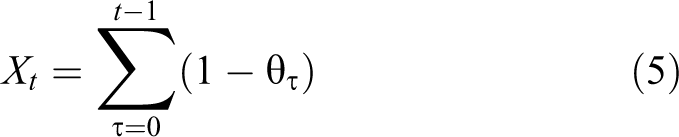
is the number of past periods in which the service was automated, so customers were exposed to the new technology; Xt
reflects the firm’s labor-automation history for the service. A high decay parameter ω implies that customers learn slowly and will experience inconvenience for a long time. On the other hand, customers will accept the new technology quickly if ω is close to 0. Customer inconvenience is transient (i.e., nonpermanent) if ω < 1, whereas it becomes permanent if ω = 1. The slowness of decay ω may depend on customers’ technology readiness and the related perceived ease of use of the new technology.

where CL is the cost price of the full-labor service (with
Analytical Results
In this section, we derive the firm’s optimal decision as to whether to automate the service and the optimal selling price of the service; we use comparative statics to relate these decisions to underlying factors. We note that both the optimal labor-automation decision and the optimal price in period t may depend on the firm’s labor-automation decisions up to period t − 1 via Xt, which is the number of past periods with automated service.
While the optimal price of the automated service turns out to vary over time (via Xt), we argue that the optimal labor-automation decision in period 0 must also be optimal for all subsequent periods. Thus, instead of 2 t possible paths for labor-automation in t periods, we only need to consider two paths (full-labor in all periods vs. automation in all periods); this greatly simplifies the optimization problem. It is easy to see that none of the alternative labor-automation paths can be optimal: (1) If it was optimal not to automate the service in period 0, it is also optimal not to automate in period 1, as the firm would face exactly the same situation in period 1 as in period 0 (i.e., Xt remains 0 and customers would still have to go through the full process of automation-induced inconvenience); this argument can be repeated for period 2 and so on; (2) if it was optimal to automate in period 0, it is also optimal to automate in period 1, as automated service is at least as attractive for the firm in period 1 as in period 0 (i.e., Xt has increased and customers experience less [or the same] inconvenience because they have been exposed to the automation technology); thus, it is optimal not to reverse past decisions to automate, which extends to period 2 and so on.
The structure of the optimization problem is as follows. The firm should first decide on its price policy, that is, the optimal price in each period t for both the full-labor service and the automated service for each feasible labor-automation history Xt. Then it should decide on the optimal labor-automation decision, which (as discussed) is constant over time, and incorporate the optimal price policy into this decision.
Optimal Selling Price
Using Equations 2 to 6, we can write the firm’s objective function, total discounted profit in Equation 1, as

where

is unit sales for the automated service (excluding the price term, which we keep explicit), and

is the difference in unit sales between the full-labor service and the automated service when they are sold at the same price;

Appendix A shows that solving the first-order condition for the optimal selling price

Appendix A also shows that Equation 11 satisfies the second-order condition for maximum profit. It immediately follows that the optimal price premium for the full-labor service (with

where we substitute Equation 9. The comparative statics below follow from Equation 12:
Thus, a lower price should be charged for the automated service, as customers become more sensitive to automation-induced inconvenience and as customer inconvenience decays more slowly. In other words, the firm can use the selling price as a tool to compensate customers for inconvenience. Furthermore, the firm should reduce the amount of compensation over time if customer inconvenience is transient; customers will eventually become more comfortable with the automated service and will therefore require less compensation. This makes the optimal pricing scheme time-varying. Relatedly, Alaska Airlines compensates customers for automated service by offering frequent-flier miles (Hallowell and Hampton 2000). Based on our results, this was likely a very good choice in the early stages of the self-service technology, but the amount of compensation could have been reduced later.
Importantly, the optimal selling price of the automated service exceeds the optimal selling price of the full-labor service (i.e.,
Thus, whether the relationship between customers’ sensitivity to service quality and the optimal price premium for labor is positive or negative depends on the quality of the automation technology, α. The firm should increase its price premium for labor, as customers become more sensitive to service quality if the automation technology is inferior to labor (i.e., if α < 1). Consistent with this, an airline could charge its quality-sensitive business-class segment more for full-labor service, as these customers want to avoid the inferior automated service. On the other hand, the firm should decrease its price premium for labor as customers become more quality sensitive if the automation technology is superior (i.e., if α > 1).
Optimal Level of Labor
As discussed, the model implies that the optimal labor-automation decision,

whereas the total discounted profit for the full-labor service (L) is:

It follows from Equations 13 and 14 that the firm should automate its service if and only if:

Thus, the firm should automate its service if total discounted squared demand for the full-labor service does not exceed total discounted squared demand for the automated service, if the two services are sold at their respective cost prices, CL and CA. An important special case of Equation 15 is a myopic firm that only considers immediate profit and ignores future profits. Only incorporating period 0 (instead of infinitely many future periods), Equation 15 can be written as:

where we use the idea that taking the square of positive demand amounts to a monotonic transformation. Equation 16 states that automation is optimal if cost-price demand for the full-labor service does not exceed cost-price demand for the automated service. Since Equation 8 implies that

The solid line illustrates Result 4 (short-term losses but long-term cumulative gains), and the dashed line illustrates Result 5 (superior automation technology but cumulative losses in both short run and long run). The solid line is obtained by taking i = 0.01, β0 = 10, β
S
= 2,
Appendix B proves that superior automation technology, with α > 1, is not a sufficient condition for the automated service to be more profitable than the full-labor service, even when taking a long-term perspective.
This is another important result (again depicted in Figure 1, dashed line). Even if automation is ultimately desired by customers (since α > 1) and automation is more cost-efficient than labor (since
Appendix B also derives the following comparative results:
These results show that (nonpermanent) customer inconvenience may drive the firm’s optimal decision as to whether to automate the service, which has long-term consequences. The firm may try to reduce the impact of customer inconvenience by assigning extra staff to help out customers; this was done by Alaska Airlines and many other airlines.
As long as customers are sensitive to service quality (an assumption in our model), better automation technology will reduce the supply of full-labor services.
Whether a more quality-sensitive market (e.g., moving from the economy-class segment to the business-class segment in the airline industry) moves a rational firm to more labor or more automation depends on the quality of the automation technology, α. If customers are insensitive to price and automation-induced inconvenience (i.e.,
Implications
In this article, we extend the literature on optimal labor-automation trade-offs in services in three important ways. First, we go beyond the typical setting in which automation reduces service quality and explore the situation in which automation increases service quality. Second, we incorporate automation-induced customer inconvenience and how slowly it decays over time. In so doing, we make customer preferences time-varying: Customer inconvenience may decrease preferences for automated service in the short run, whereas the quality of the automation technology may either decrease or increase preferences in the long run. Thus, we take a multiperiod approach. Third, we treat the selling price of the service as an endogenous decision variable. We connect the firm’s optimal labor-automation and pricing decisions and show that these decisions are interrelated. Thus, the present study provides guidelines for when automated services are optimal and how the optimal selling price depends on this decision (as well as other factors). Our implications include the following:
Firms taking a short-term perspective may not automate their services when they should. Automated service may result in short-term losses, but with long-term (discounted) profits exceeding these losses; thus, it would still be optimal to automate. Although automation triggers customer inconvenience and may reduce demand in the short run, it reduces production costs and possibly increases demand in the long run (depending on the quality of the automation technology). However, a myopic firm would only focus on the short-term losses and miss this intertemporal trade-off. As a result, it may decide not to automate when it should. Thus, it is important to take a long-term perspective when it comes to automation decisions.
A lower selling price can be used to compensate customers for automation-induced inconvenience. Although automated service may decrease demand in the short run due to customer inconvenience, this drop in demand can be reduced by offering price compensation to customers. Charging a lower price reduces profit margins, but our results suggest that this is worthwhile. Furthermore, the price can be increased as customers become more familiar with the automated service and experience less inconvenience. Thus, when automating a service, it is more profitable to use time-varying prices (based on time elapsed, since the service was automated) than to charge a price that remains constant over time. Only a multiperiod model with endogenous pricing decisions can reveal such patterns.
Using a superior automation technology does not guarantee higher profits compared to using labor, even if automation is more cost-efficient than labor. Interestingly, we would expect the opposite result: Something that is cheaper for the firm and is ultimately preferred by customers should be the optimal option. Again, the effect can be explained by automation-induced customer inconvenience in the short run that may be so significant that later profits due to cost savings and increased demand cannot compensate for it. The paradox is most likely to occur if the automated service provides only small cost efficiencies compared to the full-labor service, and customers are relatively insensitive to service quality.
Full-labor service is not always optimal, as the market becomes more sensitive to service quality. While both extant research and intuition suggest that labor-produced services should be offered to customers if service quality is important (Rust and Huang 2012), the opposite may sometimes hold. Automated service may become optimal as customers become more sensitive to service quality, but only if the quality of the automation technology exceeds a threshold. The threshold is α = 1 (i.e., automation is as good as labor) if customers are insensitive to price and inconvenience, but the threshold is unequal to α = 1 otherwise. Thus, knowing whether the automation technology is superior (or inferior) to labor is not sufficient to decide whether more automated services should be offered as customers become more sensitive to service quality. Instead, this decision depends on the popularity of automated service relative to full-labor service (in terms of total discounted demand when the services are offered at their cost prices).
Automated service should not always be cheaper for customers than full-labor service, even if automated service is cheaper to produce. The optimal pricing decision depends on the quality of the automation technology. It may be optimal to charge a higher price for superior automated service than for full-labor service, particularly if automation-induced customer inconvenience is low, customers are sensitive to service quality but not to price, and the cost efficiencies of the automated service are small. Thus, scenarios exist in which cost-based pricing should be reversed.
Extensions and Further Research
Our article presents several avenues for future research. Although these extensions represent valuable additions, they would make the analytical model less tractable or imply other challenges.
First, we held competitors’ decisions fixed. An important extension would be to develop a game-theoretic model with multiple firms whose optimal pricing and labor-automation decisions depend on the decisions made by the other firms. Nevertheless, our model implicitly allows for competition-related factors via its parameters. For example, more intense competition likely increases customers’ sensitivity to service quality (e.g., Rust and Huang 2012). Result 8 implies that it is optimal to continue offering the full-labor service if the quality of the automation technology is low, whereas it is optimal to automate the service if the quality of technology is sufficiently high. Similarly, competition may make customers more sensitive to automation-induced inconvenience, particularly if competitors still offer full-labor services. In such a situation, the focal firm may be forced to continue with the labor-intensive service.
Second, we held the quality of the automation technology, α, constant, whereas it may increase over time due to technological advances. Although we expect the comparative statics to be very similar to the present results, an important difference is that the firm may want to wait to offer the automated service until the quality of the technology is sufficient. Furthermore, the optimal pricing scheme for the automated service would become more time-varying: The selling price should increase over time not only because of decreasing customer inconvenience but also because of improvements in the technology itself.
Third, embedded in our thinking is a type of service in which substituting frontline employees with technology is relatively easy. In contrast, automation is often difficult for competence-based services such as professional services to companies (e.g., consultancy) and health-care services (e.g., surgery). Nevertheless, even competence-based services might be eligible for substitution of labor with technology. For example, IBM’s new Watson computer provided recommendations for the treatment of cancer patients that coincided with expert recommendations in 99% of the cases and was even able to provide valuable overlooked treatment options (Vena 2017). We encourage future research to address the challenges for competence-based services. Furthermore, we note that customer inconvenience may be an important factor when the firm considers automating the front end of a service but will not play a role when the focus is on automating the back-end component.
Finally, it would be valuable to augment the analytical model with an empirical study. Obviously, this would require the collection of extensive longitudinal data for many firms. We hope that our study will spark further interest in optimal labor-automation decisions.
Footnotes
Appendix A
In this appendix, we derive the optimality conditions of the firm’s profit maximization problem. The labor dummy
Appendix B
We use the difference between the left-hand side of Equation A11 and the right-hand side of Equation A11 for comparative statics. This expression indicates whether the optimality condition for automated service is satisfied, and how far it is from being binding.
First, we consider Result 5 that states that scenarios exist in which the automation technology is superior to labor, with α > 1, but it is optimal not to automate the service; that is, condition A11 is not satisfied. Hence, we need to show that α > 1, but
Now, let CL approach CA (i.e., ΔCL approaches 0) and let β
S
approach 0; then, using
or equivalently,
Since
To prove Results 6a and 6b, we note that QL does not depend on the inconvenience term,
where we imply that cost-price demand for the automated service,
To prove Result 7, we note that QL does not depend on the quality of the automation technology, α, whereas
To prove Result 8, we note that
Thus:
if and only if,
In words, the full-labor service becomes more preferable as customers become more sensitive to service quality if and only if the quality of the automation technology, α, is less than the ratio of total discounted cost-price demand of the full-labor service and total discounted cost-price demand of the automated service. If
which becomes binding as α → 1. Furthermore, it follows from Equation B8 that the threshold for α increases as automation-induced customer inconvenience
Acknowledgments
An early draft of the article was inspired by an MSc thesis by Jan Henrik Fosse. The authors thank three anonymous reviewers for their valuable comments. Furthermore, they thank conference attendees at EMAC and the Frontiers in Service Conference.
Declaration of Conflicting Interests
The author(s) declared no potential conflicts of interest with respect to the research, authorship, and/or publication of this article.
Funding
The author(s) received no financial support for the research, authorship, and/or publication of this article.
Note
References
Supplementary Material
Please find the following supplemental material available below.
For Open Access articles published under a Creative Commons License, all supplemental material carries the same license as the article it is associated with.
For non-Open Access articles published, all supplemental material carries a non-exclusive license, and permission requests for re-use of supplemental material or any part of supplemental material shall be sent directly to the copyright owner as specified in the copyright notice associated with the article.
