



Abstract
This study integrates Kaplan and Kaplan’s framework on informational variables (mystery, complexity, legibility, and coherence) with construal level theory to examine how managers can use the visual design of virtual servicescapes to achieve a sense of telepresence (the subjective experience of being in a computer-mediated environment, even when one is physically elsewhere). Three studies using mixed methods and diverse samples show that informational variables vary in their capacity to evoke telepresence and thus in their impact on consumer behavioral intention. Study 1, a content analysis, uses expert judges and a global pool of virtual servicescapes to provide initial evidence that informational variables impact telepresence. Study 2, a commercial survey, shows that telepresence mediates effects of mystery and complexity (sensorially richer variables) on consumer intentions to approach. Study 3 uses a consumer sample to replicate the mediating role of telepresence and to show that a person’s visual processing style moderates effects of mystery and complexity. The effects are robust in the presence of an alternative process path through aesthetics and occur regardless of consumers’ familiarity with the servicescape, category knowledge, and involvement. Managerial implications focus on how to increase mystery and complexity for higher telepresence.
When looking at online content (e.g., taking a virtual tour of a servicescape), have you ever forgotten where you actually were or experienced the feeling that your body was in the room but your mind was in that other place? When you closed the online content, did you feel like you had come back to the real world after a journey? If the answer to those questions is yes, then you may have experienced a sense of telepresence, “the subjective experience of being in one place or environment, even when one is physically situated in another” (Witmer and Singer 1992, p. 225). Telepresence is considered crucial for conceptualizing consumer experiences in both off-line (e.g., Weibel, Wissmath, and Mast 2011) and online environments (e.g., Hopkins, Raymond, and Mitra 2004; Nadkarni and Gupta 2004; Nelson, Yaros, and Keum 2006). Through its ability to reduce perceived spatial and psychological distance (Marlow and Dabbish 2014), telepresence in computer-mediated and virtual environments can facilitate a variety of desirable marketing outcomes, such as enhanced product evaluation (Klein 2003), trust (Darke et al. 2016), and willingness to patronize (Fiore, Kim, and Lee 2005). Telepresence thus offers substantial opportunities for both exclusively online servicescapes (e.g., purely virtual environments) and those with both virtual and brick-and-mortar locations (e.g., hybrid environments; Mollen and Wilson 2010). However, the lack of knowledge on how to evoke telepresence, specifically through visual design, represents a serious obstacle to the effective use of virtual servicescapes.
Past research suggests that telepresence can be evoked through cues such as interactivity (Spielmann and Mantonakis 2018) and vividness (Marlow and Dabbish 2014; Wirth et al. 2007). Notwithstanding the importance of such factors, both variables capture technical parameters (i.e., user input and control possibilities [interactivity] and media tools, such as video, audio, and animation [vividness]; Steuer 1992) rather than visual design characteristics. Practitioners have few theory-based, actionable insights on how to modify visual characteristics of an environment to evoke telepresence. Our research adds to current understanding by integrating construal level theory (CLT; Trope and Liberman 2010) as a conceptual framework with Kaplan and Kaplan’s (1989) informational variables, to examine how the visual appearance of online virtual servicescapes can be modified to evoke telepresence, thus stimulating purchases and encouraging visits. In particular, we propose and test a mediation process model of effects (see Figure 1), in which four informational variables (mystery, complexity, legibility, and coherence) differentially influence telepresence and consequently behavioral intention. We add a parallel path through aesthetics as a control because this is the route commonly validated in research on informational variables (e.g., Kumar, Puntani, and Sahadev 2017) and in studies on the visual design of servicescapes (e.g., Deng and Poole 2010; Kumar, Puntani, and Sahadev 2017; Mummalaneni 2005; Tractinsky and Lowengart 2007, for a review). We further expect that telepresence channels effects whatever a person’s familiarity with the servicescape, category knowledge, and involvement but likely depending on their visual processing style.
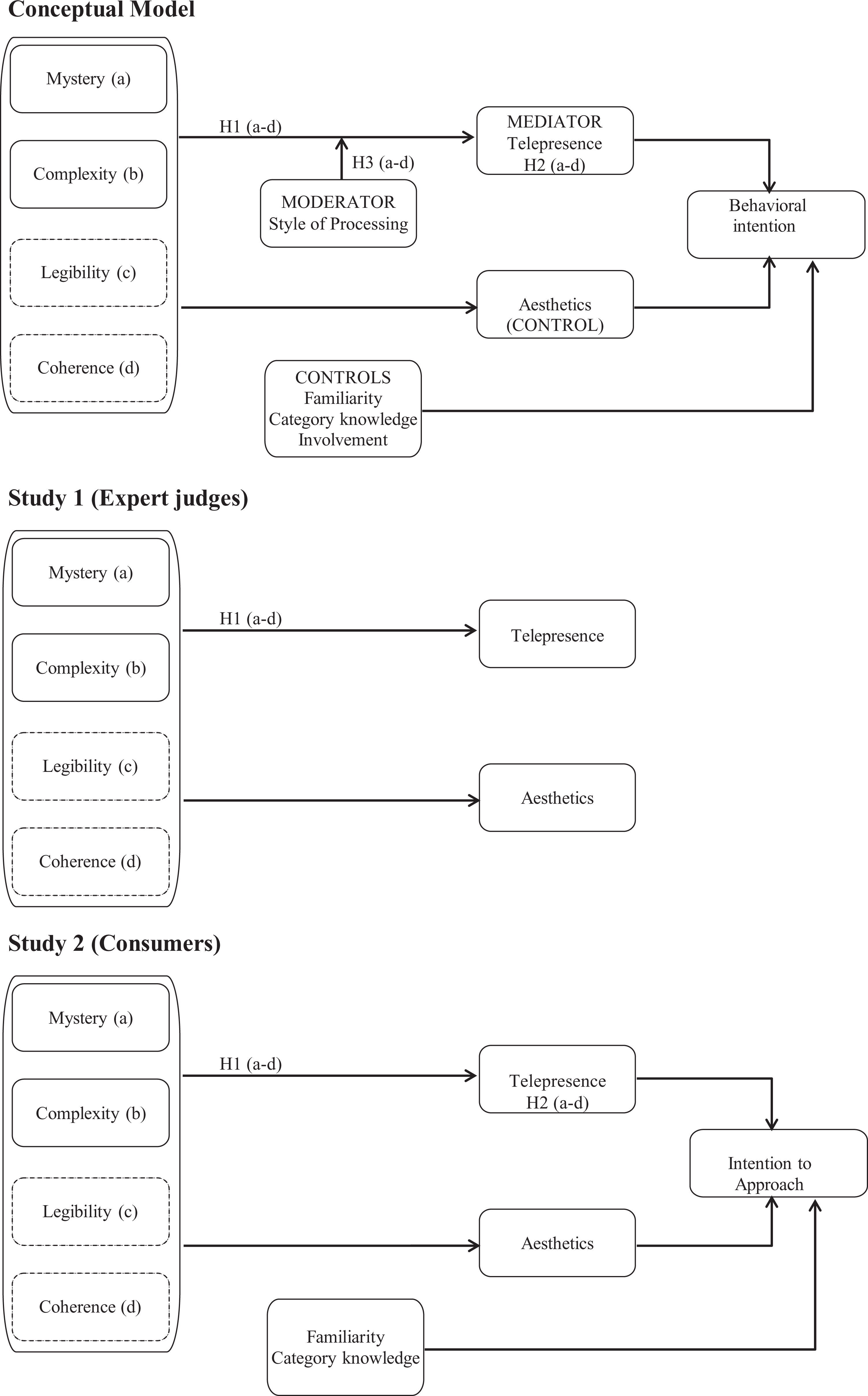
Conceptual model and its operationalization in our empirical studies. Dotted lines around a construct indicate a nonsignificant effect is expected.
As such, our study contributes to service marketing theory and practice in several ways. Theoretically, our work expands the scope of construal level research (e.g., Darke et al. 2016; Ding and Keh 2017) by linking the visual design characteristics of a virtual servicescape with telepresence for the first time, using mixed methods, and testing mediation and moderation. We also expand research on the interior design of servicescapes (e.g., Kumar, Puntani, and Sahadev 2017; Orth and Wirtz 2014; Vilnai-Yavetz and Rafaeli 2006; Wang, Minor, and Wei 2011) by adding a more holistic perspective to the prevailing elemental views. We extend research on informational variables by adding a cognitive process explanation to the traditional affective one through aesthetics (e.g., Kumar, Puntani, and Sahadev 2017). Managerially, our research offers a framework for visual design strategies that managers can use to modify a virtual servicescape’s mystery, complexity, legibility, and coherence (e.g., Kumar, Puntani, and Sahadev 2017; Orth, Heinrich, and Malkewitz 2012; Rosen and Purinton 2004) and thus to evoke higher levels of telepresence in visitors and thereby stimulate visits and encourage purchases.
The remainder of this article is organized as follows. First, we discuss mystery, complexity, legibility, and coherence as variables capturing the visual information present in an environment. Next, we adopt the CLT view of varying levels of concreteness (facilitated by sensory depth) and derive its implications for how informational variables influence telepresence and behavioral intentions. We then expand this framework and the corresponding hypotheses by adding a control path through aesthetics, as well as other controls and boundary conditions. We then test our hypotheses in three studies, using a mixed-methods approach and diverse samples of experts and consumers. Study 1 uses expert judges and content analysis to evaluate a global set of virtual servicescapes and to provide initial evidence that informational variables can relate to telepresence. Study 2, a quasi-experiment with customers of a large wine e-tailer, tests the effects of informational variables on telepresence and intention to approach the brick-and-mortar environment, including a parallel path through aesthetics. This study includes servicescape familiarity, category knowledge, and involvement as controls. Study 3 uses a consumer sample and the same virtual servicescapes as Study 1 to replicate the mediating role of telepresence, again controlling for a parallel path through aesthetics and including processing style as a moderator. In addition, this study controls for familiarity and category involvement. This article concludes with a discussion of theoretical and practical implications, as well as future research opportunities.
Conceptual Framework and Hypotheses
Mystery, Complexity, Legibility, and Coherence as Informational Variables
As one of the most widely applied theories in environmental psychology (Stamps 2004), Kaplan’s four informational variables can explain people’s evaluation of natural scenes (Stamps 2004) and constructed environments (e.g., Akalin et al. 2009; Joye 2007; Kumar, Puntani, and Sahadev 2017; Nasar, Stamps, and Hanyu 2005). The model may also be applicable to virtual servicescapes, as the four variables impact aesthetics and thus consumer preferences (Kumar, Puntani, and Sahadev 2017). Importantly from a managerial perspective, each of the variables can easily be associated with visual elements in virtual servicescapes (Rosen and Purinton 2004).
The basic assumption underlying Kaplan and Kaplan’s (1989) mystery-complexity-legibility-coherence model is that, in any environment, people have two fundamental needs: to understand and to explore. Combining these two needs with two levels of immediacy (what is immediately perceptible and what might be perceptible if one moved to another location) yields the following four variables: mystery (inferred exploration), complexity (immediate exploration), legibility (inferred understanding), and coherence (immediate understanding). Importantly, the variables vary in sensory depth, which refers to greater resolution within the perceptual channel of vision, a predictor of telepresence (Steuer 1992).
Mystery reflects the degree to which an environment promises more if one could move deeper into it (Herzog and Bryce 2007). Mystery in a servicescape increases one’s desire to explore the space by conveying the feeling that additional discoveries lie ahead (Rosen and Purinton 2004). In a virtual servicescape, mystery corresponds to low light levels, lower layout clarity, confined spaces offering surprising viewpoints, and indistinct walkways, aisles, and passages (Kumar, Puntani, and Sahadev 2017). Mystery is thus strongly associated with sensory depth.
Complexity reflects the visual richness of elements in a setting (Ode, Hagerhall, and Sang 2010). Complexity increases with the quantity (Wolfe, Horowitz, and Kenner 2005) and range (Pieters, Wedel, and Zhang 2007) of objects and with the variety of colors, materials, and surface styles (Heaps and Handel 1999), including artwork (Motoyama and Hanyu 2014). Complexity further depends on the degree of perceptual grouping (Palmer 1999), such that regularity, symmetry, uniform orientation, and similarity simplify an environment (Heaps and Handel 1999; Palmer 1999). A virtual servicescape is more complex when there is a lot to be observed and a wide variety of design elements and factors, especially colors and other noticeable features (Kumar, Puntani, and Sahadev 2017). Sensory depth is thus a key feature of complexity.
Legibility refers to how easy it is for visitors to find their way around the environment, to understand where they are at any given moment, and to find their way back to any given point in the environment (Stamps 2004). By possessing memorable components, a high legible scene facilitates navigating and wayfinding (Rosen and Purinton 2004). Memorable components include layout clarity (Cubukcu and Nasar 2005), presence of signage (Finlay et al. 2006), and highly visible landmarks (Kumar, Puntani, and Sahadev 2017). Little or no sensory depth is a hallmark of legibility.
Finally, coherence captures “the degree to which the environmental landscape hangs together” (Rosen and Purinton 2004, p. 789). As such, coherence relies on the organization of environmental elements and factors relating to the environment’s shell and content, such as textures, walls, ceilings, floors, furniture, decoration, and signage (Orth, Heinrich, and Malkewitz 2012). Coherence also refers to how easy visitors find it to organize and structure a virtual servicescape (Demangeot and Broderick 2010) and how visually balanced and harmonious the arrangement is (Kumar, Puntani, and Sahadev 2017). As such, coherence is associated with little or no sensory depth.
Taken together, past research points to substantial differences in sensory depth between the four variables. Some scholars (e.g., Evans and McCoy 1998; Tveit, Ode, and Fry 2006) even suggest that informational variables can be arranged along a continuum ranging from mystery (high sensory depth) to complexity (high to moderate sensory depth) to legibility (moderate to low sensory depth) to coherence (low sensory depth). Adopting this perspective, we present the informational variables in that order.
CLT as a Conceptual Framework
We use CLT (Trope and Liberman 2010) to link informational variables with telepresence and behavioral intention. A central proposal of CLT is that construal level, the abstractness of the mental representation of a referent, increases with psychological distance (which has temporal, spatial, social, and sensory facets; Liberman, Trope, and Waslak 2007). Higher level construals correlate with abstract, general mental representations that lack detail, whereas lower level construals correlate with concrete, vivid, specific mental representations that include rich detail.
Construal levels and psychological distance have been connected to a sense of presence, the experience of one’s physical environment (Steuer 1992). Perceptual factors generating this sense include input from sensory channels, along with attentional and mental processes that assimilate incoming sensory data with current concerns and past experiences (Gibson 1978). When perception is mediated by a communication technology (e.g., the Internet), people perceive two separate environments simultaneously: the physical environment in which they are present and the environment presented via the medium. Telepresence describes the extent to which one feels present in the mediated environment rather than in the immediate physical environment (Steuer 1992). The mediated environment can be either a temporally or spatially distant “real” environment (e.g., a distant servicescape experienced by taking a virtual tour) or an animated but nonexistent virtual world synthesized by a computer (e.g., a purely virtual servicescape).
By reducing perceived spatial distance, telepresence decreases psychological distance (Marlow and Dabbish 2014). While physical presence correlates with abstract, higher level knowledge about distal rather than proximal targets, telepresence correlates with concrete construals (Vonkeman, Verhagen, and van Dolen 2017). When such low-level construals are activated, attention focuses on the local, subordinate, and secondary features of a referent, making the “here and now” more salient, which facilitates intention to approach. In contrast, when high-level construals are activated, the global, superordinate, and primary features of an object become more relevant, inhibiting approach intention (e.g., Vonkeman, Verhagen, and van Dolen 2017).
CLT may help to explain how informational variables affect behavioral intention through telepresence. Remote brick-and-mortar servicescapes are not just physically distant from the consumer’s location, they are also distant in terms of time, as the consumer cannot immediately enter them. This relatively large psychological distance between the consumer and the servicescape is likely to activate high-level construals of the environments, and thus, it should inhibit approach behavior. Online virtual servicescapes may reduce psychological distance by increasing telepresence; the greater the telepresence in a virtual environment, the smaller the psychological distance between the consumer and that servicescape and vice versa (see also Darke et al. 2016). Taken together, we expect that increased telepresence should relate to low-level construals, which should stimulate behavioral intention.
Hypotheses
We expect that informational variables vary in their capacity to evoke a sense of telepresence, due to differences in sensory depth (Steuer 1992). Mystery can provide visitors with a sense of presence through its key property of inferred exploration (De Kort et al. 2006). When suitably staged by the service provider, the servicescape will have a mysterious dimension for the consumer to investigate (Pine and Gilmore 1999). Similarly, interactivity and vividness, which are close associates of the inferred exploration inherent to mystery, lead to increased feelings of telepresence (Coyle and Thorson 2001). Exploring the many different perspectives offered by a 360° panorama in an online virtual tour enhances telepresence (Marlow and Dabbish 2014; Wirth et al. 2007) by helping consumers to immerse themselves, explore and discover, and thereby uncover the mystery of the servicescape. As such, mystery should be strongly and positively associated with telepresence.
Similar to mystery, complexity’s key properties of immediate exploration and richness should provide the sensory depth required for telepresence. Nadkarni and Gupta (2004) suggest that website complexity increases telepresence by providing sensory depth. Klein (2003) proposes that media richness, operationalized similarly to complexity, contributes to telepresence. Furthermore, the complex 360° panoramas of online virtual tours increase spatial presence, resulting in greater telepresence (Marlow and Dabbish 2014; Wirth et al. 2007). As such, the more complex the virtual servicescape, the more senses it engages. The visual senses are engaged via colors, hues, and saturation that vary across scenes and through movement. Haptics are engaged via clicks, touch pads, and mouse movements. Taken together, complexity, through many types of sensory engagement required in virtual servicescapes, increases the likelihood of telepresence.
Legibility helps consumers make sense of an environment and find their way around within it (Lynch 1960). While sensory cues related to legibility (such as signage) make a servicescape easier to navigate and more ergonomic, they make the environment less cognitively demanding. However, telepresence, as a higher order form of flow, requires a significant amount of cognitive stimulation (Mollen and Wilson 2010). Legibility may thus have little or no impact on telepresence, as it does not satisfy the need for cognitive stimulation (Ng 2003).
Through its key property of facilitating immediate understanding, coherence in a servicescape facilitates processing (Orth and Wirtz 2014). Given the abstract nature of services, coherence may support consumer decision-making by making the experience more tangible (Pine and Gilmore 1998). However, immediate understanding of a virtual servicescape should obstruct telepresence, by limiting sensory depth.
Telepresence and Behavioral Intention
Telepresence, evoked by exposure to informational variables in a virtual servicescape, should encourage approach behaviors such as intention to visit and to purchase. The rationale supporting this effect draws on the CLT framework and on studies of how direct experience influences persuasion (e.g., Fazio and Zanna 1978).
Telepresence is persuasive because in a state of telepresence, virtual experiences can be intense enough for consumers to perceive them as equivalent to real experiences (e.g., Daugherty, Li, and Biocca 2008; Klein 2003; Mollen and Wilson 2010). Firsthand experience enables a person to better form intentions. Because the information is self-generated, people are more confident in their inferred judgments and intentions (Hoch and Ha 1986). Because online experiences are self-generated, they are more persuasive (Coulter 2016). Once users experience telepresence, suggested by T. Kim and Biocca (1997), they are more likely to consider their experience in the mediated environment as firsthand or direct. Therefore, as with direct experience, telepresence has a positive effect on behavioral intention (Daugherty, Li, and Biocca 2008). When they have (vs. perceive) experiences, consumers perceive more truth and consider the offer as more authentic (Steiner and Reisinger 2006). Taken together, telepresence can simulate direct experience (Hopkins, Raymond, and Mitra 2004). Integrating Hypotheses 1a to d with the positive effect of telepresence on behavioral intention, we expect:
Individual Differences in Visual Processing
People acquire and process information in different ways, and they may use visual cues more or less than verbal ones (Richardson 1994). Two extreme styles of processing (SOP) constitute the ends of a continuum: Visualizers prefer and use images, whereas verbalizers prefer to read and use text. Consumer reactions to online environments can vary depending on their SOP (Yoo and Kim 2014). Given the visual nature of informational factors, a person’s SOP should impact responses, in line with research on online product presentation (Yoo and Kim 2014) and websites (Sicilia, Ruiz, and Munuera 2005). Specifically, the effects of sensory-rich informational variables on telepresence should be stronger in consumers with a visually oriented processing style, as they should be more aware of and susceptible to greater visual sensory depth:
Controls
A number of factors may influence how informational variables impact behavioral intention through telepresence. Important among those factors are an alternative process explanation through aesthetics and the effects of a person’s familiarity with the servicescape, category knowledge, and involvement. We discuss these variables as possible influencers to test the robustness of our framework.
The literature on effects of mystery, complexity, legibility, and coherence has largely suggested that the variables affect visitors through aesthetics (e.g., Kumar, Puntani, and Sahadev 2017; Tractinsky and Lowengart 2007, for a review). The aesthetics path has also been substantiated for virtual servicescapes (e.g., Vilnai-Yavetz and Rafaeli 2006; Wang, Minor, and Wei 2011). Given that servicescape aesthetics can significantly influence intentions to visit (Vilnai-Yavetz and Rafaeli 2006) and to buy (Tractinsky and Lowengart 2007), a parallel path through aesthetics should be included in studies testing a route through telepresence.
The effects of informational variables may also depend on a person’s involvement, that is, their motivational state directed toward a goal object (e.g., wine) to accomplish a specific goal (e.g., purchase; Mittal and Lee 1989). When involvement levels are high, consumers process informational cues more extensively (e.g., Petty and Cacioppo 1986). Under such conditions, they allocate substantial cognitive resources to process visual information (Meyers-Levy and Peracchio 1995), with intentions following on from an extensive, systematic examination of informational cues (Petty and Cacioppo 1986). By allowing consumers to focus on important informational variables, an information-rich environment may provide consumers with an enhanced sense of presence (Nadkarni and Gupta 2004). Given that category involvement moderates the telepresence effect in online advertising contexts (Hopkins, Raymond, and Mitra 2004), our study must account for possible effects of involvement.
Categorization theory (Sujan 1985) suggests that a consumer’s prior category knowledge affects their information processing, as they compare new information with existing schemata. In service contexts, knowledgeable consumers process an environment more easily, resulting in more favorable behavioral responses (Morales et al. 2005). Similarly, a person’s familiarity with a service environment facilitates processing (Mattila 2000), as those who are familiar with an environment are more likely to extract meaning from information present by activating their prior knowledge structures. As familiarity with an environment increases, people find their way more quickly and easily, thereby making the visit more pleasurable and facilitating approach behaviors (Prestopnik and Roskos-Ewoldsen 2000). Our study will thus account for possible effects of knowledge and familiarity.
Study 1
The purpose of Study 1 was to identify informational variables present in virtual servicescapes and to provide initial evidence for their impact on telepresence. As a secondary objective, the study assembled a pool of stimuli varying in informational variables for use in Study 3.
Method
Study 1 used a panel of expert judges to evaluate the visual features of virtual servicescapes. We selected virtual tours of wineries as an appropriate context because winery servicescapes (1) are information-rich environments with substantially varying visual elements (Orth, Heinrich, and Malkewitz 2012), (2) favor interaction and impact consumer behavior (Orth, Wirtz, and McKinney 2016), (3) especially through informational factors such as complexity (Orth and Crouch 2014). We selected stimuli for the study using a stepwise approach, closely following Orth and Malkewitz (2008).
In the first step, two of the authors used the key words “winery” and “virtual tour” in an Internet meta-search engine to compile an initial list of 149 wineries in major wine regions around the globe (Australia, France, Germany, Italy, New Zealand, South Africa, Spain, and the United States). We included wineries in the list if (1) the instructions for navigating the servicescape were in English, (2) the virtual tour covered the same indoor areas as visits to the brick-and-mortar environment, and (3) the tour met basic technical requirements (Aladwani and Palvia 2002).
The second step involved assembling and training a panel of expert judges to evaluate the virtual servicescapes. We recruited six judges with expertise in environmental atmospherics from graduate service marketing classes at two major universities, one in Australia and the other in Germany. All the judges received thorough, intensive training in evaluating Kaplan’s informational variables in servicescapes. The training involved learning definitions of the key constructs (i.e., mystery, complexity, legibility, coherence, telepresence, and aesthetics), studying existing scales with demonstrated measurement properties for the constructs (see Study 2), and taking three example virtual tours (Danang Cave, Vietnam; Children’s Museum, London; Hotel de Glace, Quebec).
In the third step, the judges completed each of the virtual tours over a period of 2 weeks, spending sufficient time there to familiarize themselves with the servicescape. Using the definitions and scales provided in training, they evaluated each virtual servicescape by scoring key constructs. In addition, they scored technical parameters (e.g., loading speed, ease of navigation, interactivity, and vividness) and commented on their overall impressions. Given at least satisfactory inter-rater agreement (α > .06), we formed indices for each variable by computing mean expert scores for mystery (α = .78, M = 3.69, SD = .69), complexity (α = .62, M = 3.96, SD = .78), legibility (α = .74, M = 4.47, SD = .66), coherence (α = .67, M = 4.45, SD = .73), telepresence (α = .64, M = 3.67, SD = .79), and aesthetics (α = .70, M = 4.40, SD = .76). After reviewing the comments and scores for technical variables, we dropped 21 servicescapes due to recurring technical problems or insufficient content, leaving a sample of N = 128. In line with a Gestalt approach to visual design (Orth and Malkewitz 2008) and servicescapes (Kumar, Puntani, and Sahadev 2017), our unit of analysis is the individual servicescape.
Analysis and Results
Following Orth and Malkewitz (2008), regression analyses used average scores computed for each informational variable, making the unit of analysis the servicescape and the sample size 123 wineries. We used stepwise hierarchical regression analysis to test Hypothesis 1, linking informational variables with telepresence. Our results indicate that telepresence, F(4, 118) = 56.16, p ≥ .01,
Discussion of Study 1 Findings
Study 1 provides initial evidence that informational variables influence telepresence, which may be enhanced by increasing the mystery, complexity, legibility, and coherence of virtual servicescapes. The finding that both legibility and coherence significantly contribute to telepresence is unexpected. One possible explanation is that expert judges could have a different perspective from consumers, due to individual and situational differences in perception (we carefully trained the judges to detect and pay attention to informational variables). In addition, we did not assess the effects of telepresence on behavioral intention or test alternative predictors (e.g., aesthetics, familiarity, and knowledge), which might represent a limitation. These considerations motivated Study 2.
Study 2
Study 2 used a consumer sample to test the proposition that informational variables influence telepresence (Hypothesis 1), which influences intention (Hypothesis 2). We included a parallel path through aesthetics as well as familiarity and knowledge, as controls.
Method
We collected data in a quasi-experimental field study (N = 12 virtual servicescapes), to enhance the robustness of our findings (by randomizing out other differences between servicescapes) and to extend the external validity and wider applicability of visual servicescape effects (Orth and Wirtz 2014). To minimize potentially confounding effects within each environment, we randomized out factors such as floor space, artifacts, lighting, and other externalities by using a randomized roster for data collection. We controlled for key variables across environments by selecting comparable wineries. In addition, we entered “winery” as a control variable (all dummies were nonsignificant) in our analysis, to control for any potential winery-specific variance that might explain our dependent variables. For Study 2, we selected as servicescapes 12 virtual tours of wineries from the portfolio of a large European wine e-tailer that had not been included in Study 1. Other criteria guiding our selection included the technical parameters used in Study 1 and e-tailer preferences (to include small boutique wineries as well as large corporate brands).
We e-mailed invitations to 700 randomly selected customers in the e-tailer’s database in Germany, informing them that they had been selected to assess a new winery for possible inclusion in the e-tailer’s portfolio, offering a 25% discount on future purchases as an incentive, and specifying a 10-day cutoff date. A total of 237 customers agreed and accessed an online survey site where they received instructions to take the virtual tour of one randomly selected winery, to study the environment carefully, and then to provide feedback. To minimize common method bias, we used procedural remedies recommended by Podsakoff, MacKenzie, and Podsakoff (2012). Only 202 participants, however, completed the survey, and we dropped another 13 data sets because initial checks indicated that participants had not followed the instructions or had used a mobile (rather than a stationary) device to view the servicescape, leaving a total of N = 189 (Mage = 35.6, SD = 12.2; 54% females) for further analyses.
Measures
We assessed constructs using established, previously validated item batteries with Likert-type scales (ranging from 1 = strongly disagree to 7 = strongly agree), following Douglas and Craig’s (2007) collaborative iterative approach in translating scales into German. Respondents rated their intention to approach (Mattila and Wirtz 2001) and telepresence, using T. Kim and Biocca’s (1997) frequently used measure (e.g., Coyle and Thorson 2001; Klein 2003; Nelson, Yaros, and Keum 2006), but modified for virtual servicescapes. Other measures included aesthetic appeal (Vilnai-Yavetz and Rafaeli 2006) and the four informational variables (Herzog and Bryce 2007; Kumar, Puntani, and Sahadev 2017). The final questions focused on respondent age, gender, familiarity with the winery, and category knowledge.
Analyses and Results
To test the conceptual model, our initial analysis used the partial least squares approach to structural equation modeling (Chin 2010; Ringle, Sven, and Jan-Michael 2015). This approach assesses the correlations, average variances extracted, and shared variances of the constructs, as well as the parameter estimates of the structural model depicted in Figure 1. Table 1 reports scales and key statistics for the constructs involved. Our results show that convergent validity was satisfactory, average variance extracted for each construct exceeding 0.50. Convergent validity guidelines were also met at item level (Chin 2010); the block of items has a high loading and a narrow range for mystery (0.91 to 0.93), complexity (0.90 to 0.93), legibility (0.95 to 0.97), coherence (0.82 to 0.90), telepresence (0.80 to 0.89), aesthetics (0.87 to 0.91), and intention to approach (0.61 to 0.84). Discriminant validity guidelines were also met, since average variance extracted for each construct exceeded the squared correlation (i.e., shared variance) with any other construct. Furthermore, the item of each construct loaded more highly to its intended construct than to any other construct, supporting discriminant validity at item level (Chin 2010).
Scale Items and Summary Statistics for Construct Measures.
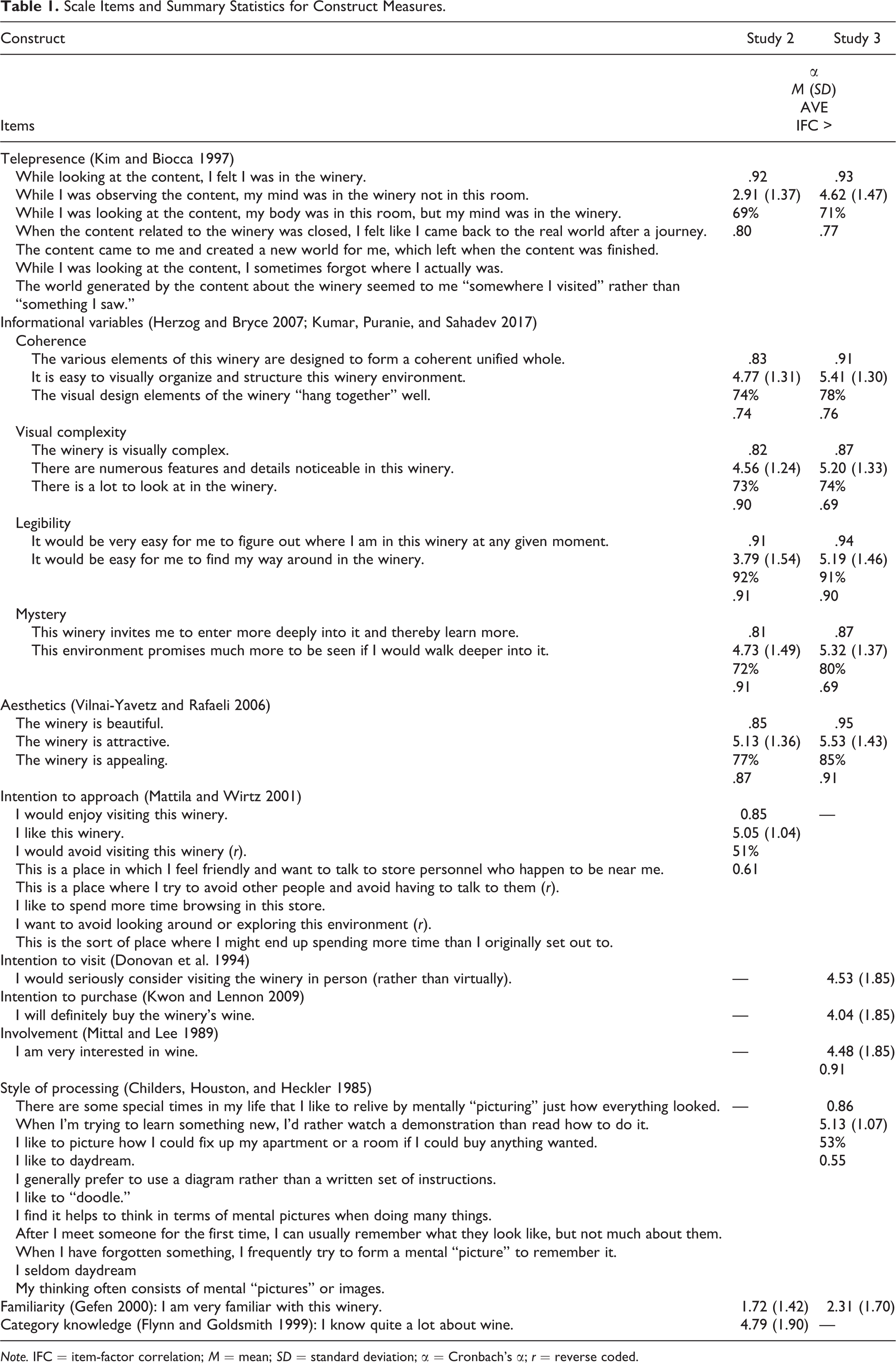
Note. IFC = item-factor correlation; M = mean; SD = standard deviation; α = Cronbach’s α; r = reverse coded.
We estimated Hypothesis 1 through a multiple mediator model (Figure 1) following Hayes (2017). First, the analysis estimated the direct paths from informational variables to intention to approach, without including the mediator variables. The results show significant direct positive paths to intention to approach from mystery (β = .58, t = 10.88, p = .001), complexity (β = .13, t = 1.99, p = .046), and familiarity (β = .11, t = 2.16, p = .032) but not from legibility (β = .09, t = 1.46, p = .145), coherence (β = .03, t = .41, p = .681), and knowledge (β = −.09, t = 1.89, p = .059). Then, we introduced telepresence and aesthetics to the model to estimate their direct and mediating effects. Now, the direct path from complexity to intention to approach became nonsignificant (β = .05, t = 1.04, p = .341), whereas the direct path from mystery remained significant (β = .55, t = 8.23, p = .001), suggesting full and partial mediation, respectively.
Table 2 summarizes the estimation results of the final model, which shows that mystery had a significant positive effect on telepresence (β = .37, t = 5.28, p = .001), in support of Hypothesis 1a. Similarly, complexity had a significant positive effect on telepresence (β = .20, t = 2.83, p = .005), in support of Hypothesis 1b. Neither legibility nor coherence had a significant effect on telepresence (p > .10), in support of Hypotheses 1c and d.
Path Coefficients for Study 2.
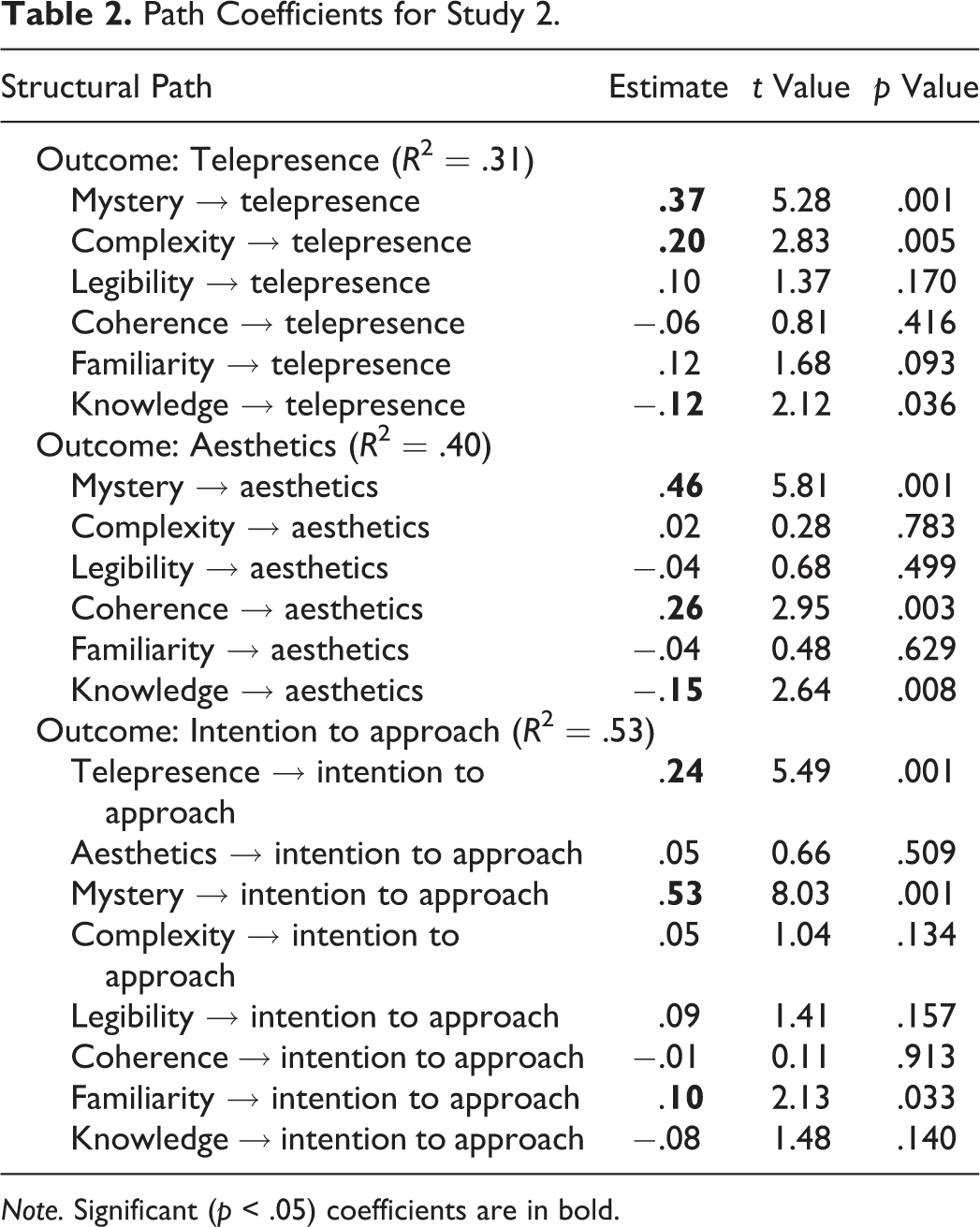
Note. Significant (p < .05) coefficients are in bold.
We estimated the significance of the specific indirect effects of informational variables (Hypothesis 2) using a bootstrapping procedure with 5,000 samples (Hayes 2017; PROCESS Model 4). Our results indicated that telepresence mediated the relationship between mystery and intention to approach (Bindirect = .08, SE = .02, 95% CI [.04, .14]), in support of Hypothesis 2a. Similarly, telepresence mediated the relationship between complexity and intention to approach (Bindirect = .05, SE = .02, 95% CI [.01, .09]), in support of Hypothesis 2b. However, telepresence did not mediate the relationships between legibility and intention (Bindirect = .01, SE = .01, 95% CI [−.02, .04]) or between coherence and intention (Bindirect = −.01, SE = .02, 95% CI [−.05, .03]), in support of Hypotheses 2c and d.
Discussion of Study 2 Findings
The findings from Study 2 illustrate how sensorially rich informational variables (mystery and complexity but not legibility and coherence) can stimulate consumer approach behaviors by evoking telepresence. These effects proved robust when we tested a parallel path through aesthetics, including familiarity and knowledge as individual controls. The lack of significant effects for legibility and coherence contradicts the findings obtained from experts (Study 1) but aligns with our theorizing. However, we cannot exclude the possibility that our sample characteristics may have biased the results. Specifically, wine e-tailer customers are more involved with the category, 1 which may have led to them overestimating telepresence effects. In addition, we did not include processing style, a variable thought to moderate effects. These considerations motivated Study 3.
Study 3
The purpose of Study 3 was to replicate the effects of informational variables (Hypothesis 1) and the mediating role of telepresence (Hypothesis 2) using a more general sample of consumers and to test the moderating role of a person’s visual processing style (Hypothesis 3). In addition, the study controls for familiarity and category involvement.
Method
Study 3 was quasi-experimental, reusing the 128 virtual servicescapes from Study 1. We recruited U.S. citizens through MTurk (Amazon Mechanical Turk) (N = 308, Mage = 38.2, SD = 11.9 years, 51% females), who visited one randomly selected virtual servicescape where they familiarized themselves with the environment and then assessed the winery for a possible purchase and personal visit. Given the discussion of the validity of MTurk samples, we followed Goodman and Paolacci (2017) and Wessling, Huber, and Netzer (2017) to ascertain appropriateness (prescreening, screening for duplicate Worker IDs and IP addresses, and using small monetary incentives).
An electronic survey site contained a link to one randomly selected virtual tour (each tour was assessed by 3.1 consumers on average), a timer, and measures for all constructs. We dropped data supplied by six participants because they had not followed instructions, had used a small-screen device to view the virtual servicescape, or viewed the servicescape for less than 2 minutes.
Measures
Measures included previously validated items for intention to visit, aesthetic appeal, telepresence, and the four informational variables. In addition, we included Mittal and Lee’s (1989) involvement scale, the previously used single-item measure for familiarity with the winery, and the 11-item visual SOP Scale adapted from Burns, Biswas, and Babin (1993). Unlike in Study 2, we included a measure of intention to purchase (Kwon and Lennon 2009) as an additional indicator of behavioral intention to approach. We assessed the psychometric properties of the measures using confirmatory factor analysis, testing all scales simultaneously, with each item allowed to load only on its respective factor. The results suggested that the measurement model fits the data reasonably well (χ2 = 1,601, df = 812, CFI = 934, TLI = .927, SRMR = .050). Construct reliability (.83 to .92) and the convergent and discriminate validity of the scales were again adequate. We list the scales, references, and key statistics in Table 1.
Testing the Mediating Role of Telepresence
Replicating the analytical approach used in Study 2, we directly tested the mediating role of telepresence following Hayes (2017; PROCESS Model 4, number of bootstrap samples = 5,000). Mystery, complexity, legibility, and coherence were the independent variables; telepresence and aesthetics parallel the mediators; intention to visit the dependent variable; and familiarity and involvement the covariates.
Our results (Table 3) indicated that telepresence (R2 = .53) was significantly influenced by mystery (B = .37, t = 4.66, p = .001) and complexity (B = .28, t = 4.14, p = .001), in support of Hypotheses 1a and b. The effect of legibility on telepresence was also significant but weak (B = .11, t = 2.23, p = .027), in support of Hypothesis 1c. Coherence did not affect telepresence, supporting Hypothesis 1d. Other predictors of telepresence included familiarity (B = .09, t = 2.64, p = .009) and involvement (B = .08, t = 2.26, p = .025).
Testing the Mediating Role of Telepresence on Intention to Visit (Study 3).
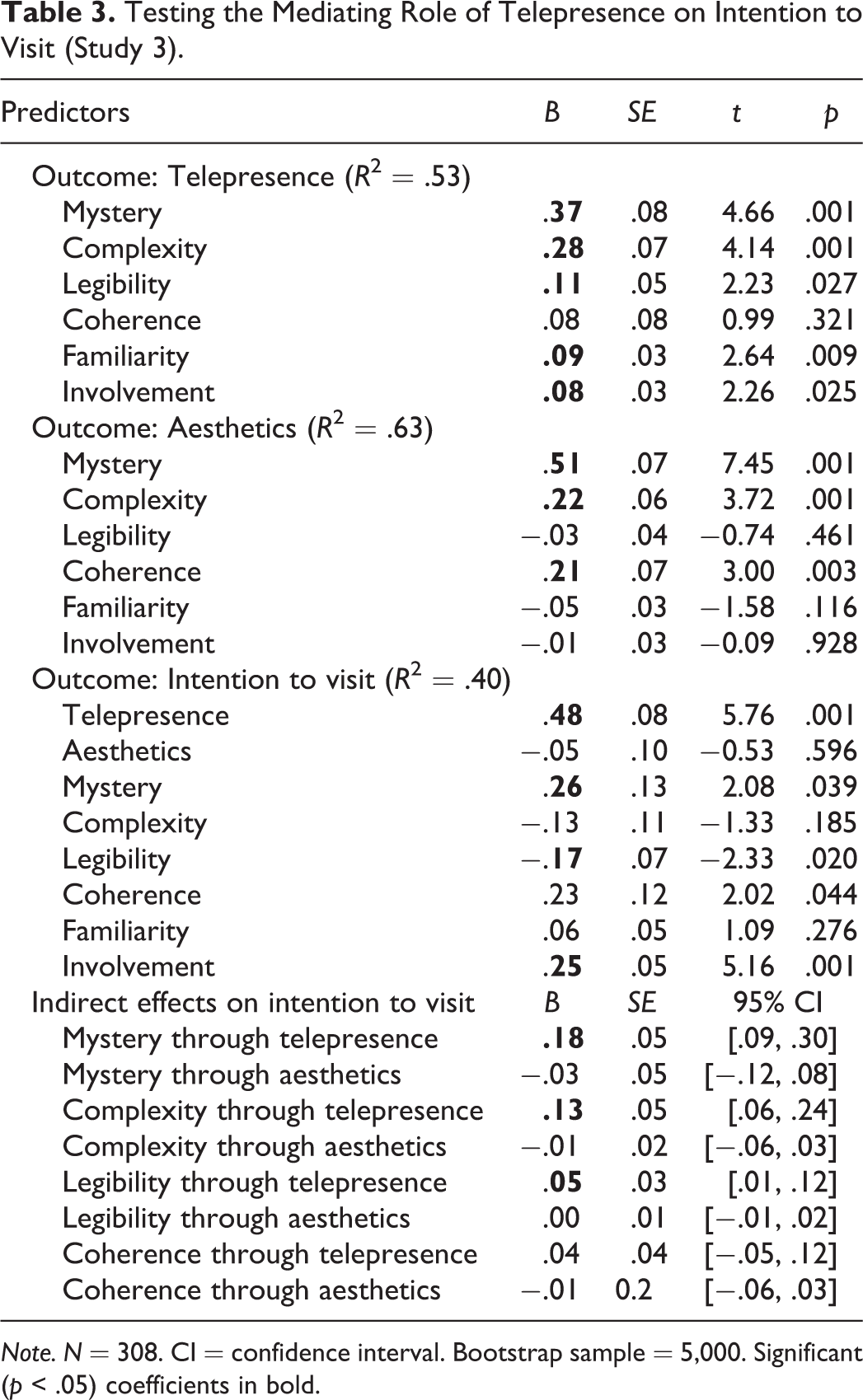
Note. N = 308. CI = confidence interval. Bootstrap sample = 5,000. Significant (p < .05) coefficients in bold.
Telepresence mediated the relationship between mystery and intention to visit (Bootstrap [5,000]; Bindirect = .18, SE = .05, 95% CI [.09, .30]), between complexity and intention to visit (Bootstrap [5,000]; Bindirect = .13, SE = .05, 95% CI [.06, .24]), and—to a lesser extent—between legibility and intention to visit (Bootstrap [5,000]; Bindirect = .05, SE = .03, 95% CI [.01, .12]). However, it did not mediate the relationship between coherence and intention to visit. Repeating the analysis with intention to purchase as the main dependent variable yielded very similar results (see Appendix Table A1): Telepresence mediated the effects of mystery, complexity, and legibility but not coherence. Together, these results support Hypotheses 2a, b, and d but not Hypothesis 2c.
Testing Moderated Mediation With Processing Style as a Boundary Condition
Next, we conducted moderated mediation analyses (Hayes 2017; PROCESS Model 5, 5,000 bootstrap samples) to test Hypothesis 3 and the claim that a person’s visual processing style functions as a moderator. Mystery, complexity, legibility, and coherence were the independent variables; telepresence the mediator; processing style the moderator; intention to visit the dependent variable; and familiarity and involvement the controls. Significant interaction terms indicated that the influence of mystery (B = .09, t = 2.80, p = .006) and complexity (B = .10, t = 2.86, p = .005) on telepresence depended on the visual SOP. More specifically, the conditional indirect effect of mystery on intention to visit was significant and small for participants scoring low on visual SOP (M − SD; Bootstrap [5,000]; Bindirect = .11, SE = .05, 95% CI [.03, .23]), was greater at mean levels of visual processing style (Bindirect = .16, SE = .05, 95% CI [.08, .28]), and was yet greater and significant at high levels of visual SOP (M + SD; Bindirect = .23, SE = .08, 95% CI [.08, .43]), in support of Hypothesis 3a. Similarly, the conditional indirect effect of complexity on intention to visit was nonsignificant for participants scoring low on visual SOP (M − SD; Bootstrap [5,000]; Bindirect = .06, SE = .04, 95% CI [−.01, .15]), was significant at mean levels of visual SOP (Bindirect = .10, SE = .04, 95% CI [.03, .20]), and was greater and significant at high levels of visual SOP (M + SD; Bindirect = .14, SE = .06, 95% CI [.04, .28]), in support of Hypothesis 3b. The nonsignificant interactions between SOP and legibility and coherence support Hypotheses 3c and d.
General Discussion and Implications
Theoretical Implications
This study has two main findings that extend our understanding of virtual servicescapes (see Table 4 for an overview of our research program). First, the study is the first to explore visual design antecedents of telepresence in the context of virtual service environments. By showing how the visual information in a servicescape influences telepresence and consumer intentions, we expand the scope of CLT as a conceptual framework by linking it to one of the most widely applied theories in environmental psychology. The finding that mystery, complexity, legibility, and coherence vary in their capacity to evoke telepresence substantiates presumed differences in their sensory depth (Steuer 1992), and specifically, the superior depth of mystery and complexity over legibility and coherence (Evans and McCoy 1998; Tveit, Ode, and Fry 2006). We thus demonstrate that the visual design of online representations of service environments can evoke telepresence, attract customers, and sell offers. This provides a novel perspective, contributing to a fuller account of consumer responses to virtual servicescapes than that provided by previous research, which has focused (in a variety of related contexts) on consequences of telepresence (e.g., Mollen and Wilson 2010), psychological distance (Darke et al. 2016), and technical variables (Spielmann and Mantonakis 2018).
Research Program Overview and Summary Findings.

Note. √ = hypothesis was supported; — = relationship was not tested in that study; × = hypothesis was not supported.
Second, this study extends research on Kaplan’s informational variables by offering a novel explanation for how they influence consumer behavior. We show that telepresence, a cognitive variable, channels effects on behavioral intentions, providing a new process explanation paralleling the affective explanation investigated in previous applications to servicescapes (Tractinsky and Lowengart 2007), virtual servicescapes (e.g., Vilnai-Yavetz and Rafaeli 2006; Wang, Minor, and Wei 2011), natural landscapes (Stamps 2004), and built-up environments (e.g., Akalin et al. 2009; Joye 2007; Nasar, Stamps, and Hanyu 2005), which have typically focused on the mediating role of aesthetics. By showing that mystery, complexity, and—to a lesser extent—legibility bring about telepresence, our study broadens understanding of how informational variables function.
In addition to these two key findings, this study makes several secondary contributions. First, we extend research on environmental atmospherics, specifically in online virtual environments (Eroglu, Machleit, and Davis 2003; Mummalaneni 2005; Vilnai-Yavetz and Rafaeli 2006), by adding a holistic perspective. Our focus on the mystery-complexity-legibility-coherence model extends previous work that focused more narrowly on specific elements (e.g., Mandel and Johnson 2002), selected factors (e.g., Deng and Poole 2010; Orth and Wirtz 2014), and types of interior design (e.g., Orth, Heinrich, and Malkewitz 2012). Because the model used here represents a more comprehensive set of environmental descriptors (Stamps 2004), the resulting holistic approach to consumer perception and processing should allow for more inclusive predictions of behavior than studies of less aggregate, more specific visual elements.
Second, we address the question of when telepresence is more or less likely to occur, examining the possible boundary conditions of processing styles, familiarity with the environment, category knowledge, and involvement. We show that the effects of mystery and complexity on telepresence are stronger in those with a more visual processing style, confirming not only that such people are more aware of and susceptible to the greater sensory depth inherent in these factors but also that this individual variable moderates the effects of visual factors in other online contexts (e.g., Sicilia, Ruiz, and Munuera 2005; Yoo and Kim 2014). By demonstrating that the effects of mystery and complexity are robust in the presence of a competing path through aesthetics, and regardless of a person’s familiarity with the virtual servicescape, category knowledge, and involvement, our CLT interpretation of Kaplan’s model represents a substantive contribution.
Practical Implications
Given that telepresence in virtual environments can facilitate desirable marketing outcomes (Darke et al. 2016; Fiore, Kim, and Lee 2005; Klein 2003; Novak, Hoffman, and Yung 2000), our findings offer several opportunities for managing purely virtual as well as hybrid servicescapes. Broadly, our research offers a framework for visual design strategies on which managers of virtual servicescapes can draw to modify an environment’s mystery, complexity, and legibility (e.g., Kumar, Puntani, and Sahadev 2017; Orth, Heinrich, and Malkewitz 2012; Rosen and Purinton 2004) and thus evoke higher levels of telepresence in visitors, stimulate future visits, and encourage purchases.
A servicescape’s visual characteristics can be modified in many ways. For example, the sense of mystery can be increased, conveying the feeling that additional discoveries lie ahead, and increasing visitors’ desire to explore (Rosen and Purinton 2004). Such measures include lowering light levels, diffusing the clarity of the layout, confining spaces, offering surprising views, and making it more difficult to identify walkways, aisles, passages, and throughways (Kumar, Puntani, and Sahadev 2017). Again, two-dimensional, simplistic environments can be improved by adding mystery. Too often, websites present realistic photos of servicescapes taken in bright conditions, instead of building mystery in the ways suggested above. Although we did not test audio enhancement, we speculate that this would also increase complexity and, if the sounds are properly chosen, could increase the level of mystery.
Complexity can be enhanced by increasing the number of images with varied design elements, especially colors and other noticeable features (Kumar, Puntani, and Sahadev 2017). Managers can enhance the visual richness of elements in a servicescape (Ode, Hagerhall, and Sang 2010), by augmenting the variety of objects and surfaces (Oliva, Wolfe, and Arsenio 2004), by decluttering the spatial layout (Rayner 1998), and by reducing the groupings of furniture, merchandise, and displays (Palmer 1999) and including pieces of art (Motoyama and Hanyu 2014). Many online servicescapes are two-dimensional and simplistic. Adding complexity and richness will encourage visitors to engage more deeply (thus experiencing telepresence) and improve the likelihood of purchases. Together, all measures should aim at enriching sensory input.
Finally, our findings suggest that while managers may not need to pay particular attention to their customers’ category involvement, knowledge, and familiarity, they should account for processing style. In this study, visual processing styles enhanced the processing of mystery and complexity through telepresence. Our research suggests that in virtual servicescape design, one size does not fit all. In other words, those with different visual processing levels may experience different levels of telepresence and should therefore behave differently. Given the established links between processing style and other individual variables (M. Kim and Lennon 2008; Sojka and Giese 2006), marketers can identify customer groups and tailor their servicescapes accordingly. In line with this thinking, the German wine retailer Hawesko uses a highly mysterious design for their website catering for more knowledgeable and involved visitors (hawesko.de) and a less mysterious design for their sites targeting less knowledgeable and involved buyers (wein.de, vinos.de, thewinecompany.de), thus aiming for designs that facilitate telepresence.
Limitations and Future Research
As with any research, this study has limitations in terms of methods and contexts that offer opportunities for further research. Methodologically, despite the three empirical studies and the procedural remedies taken, we cannot fully discount common method bias resulting from the fact that predictor and criterion variables were obtained from the same rater and were produced by the measurement items themselves or by the context (Podsakoff, MacKenzie, and Podsakoff 2012). While the debate on statistical remedies for common method bias continues (Fuller et al. 2016), future studies could clarify this issue by replicating our study along the dimensions of method and context (Berthon et al. 2002).
Contextually, this study is set in wineries, and our findings may not directly transfer to environments in which the visual design is an important component of the customer value proposition (e.g., art galleries) or in which ambient conditions are of greater relevance to overall service delivery (e.g., cruise ships, hotels, or fine dining restaurants). Furthermore, we conducted our research using samples based in Germany (Study 2) and the United States (Study 3). Many cross-cultural factors vary between individuals, possibly influencing telepresence and behavioral intentions. For example, cultural influences can lead people to process visuals dependently or independently of the field (Masuda and Nisbett 2001) or, more specifically, to view elements detached from or embedded within a context. Given that field dependence captures the relative influence of “whole” visual fields over “parts” (Goodenough 1987), this should affect perception and processing of the sensory depth provided by informational variables, as—in servicescapes—field dependent people find it more difficult to discriminate between relevant and irrelevant information (Orth and Crouch 2014). We hope that the contributions of this study will stimulate further research in the field.
Supplemental Material
Supplemental Material, JSR_TLP_XSum_final - Design Antecedents of Telepresence in Virtual Service Environments
Supplemental Material, JSR_TLP_XSum_final for Design Antecedents of Telepresence in Virtual Service Environments by Ulrich R. Orth, Larry Lockshin, Nathalie Spielmann and Mirjam Holm in Journal of Service Research
Footnotes
Appendix
Testing the Mediating Role of Telepresence on Intention to Purchase (Study 3). Note: N = 308. CI = confidence interval. Bootstrap sample = 5,000. Significant (p < .05) coefficients are in bold.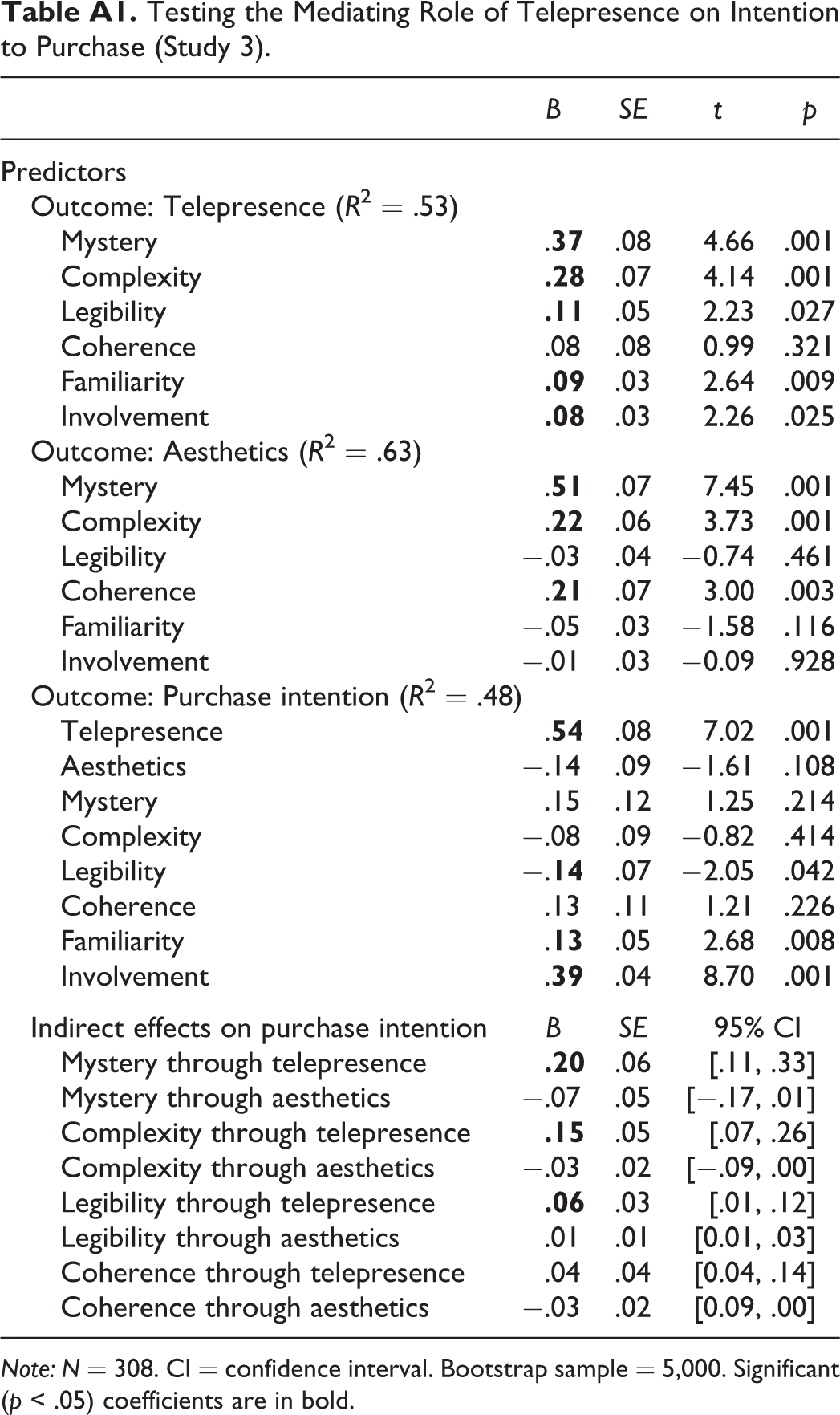
B
SE
t
p
Predictors
Outcome: Telepresence (R2 = .53)
Mystery
.
.08
4.66
.001
Complexity
.07
4.14
.001
Legibility
.05
2.23
.027
Coherence
.08
.08
0.99
.321
Familiarity
.03
2.64
.009
Involvement
.03
2.26
.025
Outcome: Aesthetics (R2 = .63)
Mystery
.
.07
7.45
.001
Complexity
.
.06
3.73
.001
Legibility
−.03
.04
−0.74
.461
Coherence
.
.07
3.00
.003
Familiarity
−.05
.03
−1.58
.116
Involvement
−.01
.03
−0.09
.928
Outcome: Purchase intention (R2 = .48)
Telepresence
.
.08
7.02
.001
Aesthetics
−.14
.09
−1.61
.108
Mystery
.15
.12
1.25
.214
Complexity
−.08
.09
−0.82
.414
Legibility
−.
.07
−2.05
.042
Coherence
.13
.11
1.21
.226
Familiarity
.
.05
2.68
.008
Involvement
.
.04
8.70
.001
Indirect effects on purchase intention
B
SE
95% CI
Mystery through telepresence
.06
[.11, .33]
Mystery through aesthetics
−.07
.05
[−.17, .01]
Complexity through telepresence
.05
[.07, .26]
Complexity through aesthetics
−.03
.02
[−.09, .00]
Legibility through telepresence
.03
[.01, .12]
Legibility through aesthetics
.01
.01
[0.01, .03]
Coherence through telepresence
.04
.04
[0.04, .14]
Coherence through aesthetics
−.03
.02
[0.09, .00]
Authors' Note
Ulrich R. Orth is also affiliated with Ehrenberg-Bass-Institute of Marketing Science, University of South Australia, Adelaide, Australia.
Acknowledgments
We gratefully acknowledge the excellent research assistance provided by Anna-Maria Kabacinska, Franziska von Unruh, and Elisabeth Franke.
Declaration of Conflicting Interests
The author(s) declared no potential conflicts of interest with respect to the research, authorship, and/or publication of this article.
Funding
The author(s) received no financial support for the research, authorship, and/or publication of this article.
Note
References
Supplementary Material
Please find the following supplemental material available below.
For Open Access articles published under a Creative Commons License, all supplemental material carries the same license as the article it is associated with.
For non-Open Access articles published, all supplemental material carries a non-exclusive license, and permission requests for re-use of supplemental material or any part of supplemental material shall be sent directly to the copyright owner as specified in the copyright notice associated with the article.
