



Abstract
This study focuses on ambient temperature in online service environments (ATOS), a sensation which is not directly accessible in the current state of technology, but may be inferred from other cues such as visuals. Consider a virtual tour of a café: Within the online service environment, visitors may encounter cues, especially visual ones, that impact their perception of ambient temperature. For example, whisps of steam rising from the coffee machine may lead to inferences of a cool environment, whereas lava cakes oozing chocolate may be associated with a warm environment. Similarly, harsh lighting and bright illumination, shiny blank surfaces, and light blue colors may be associated with lower ambient temperature, whereas dim illumination, matte surfaces, tropical plants, and muted orange colors may evoke associations with warmer temperatures. Will such temperature inferences elicited online influence important first judgments of the service provider? Extending to managerially important behavioral outcomes? The specific question examined in this study is how (by enhancing judgment of service provider warmth) and when (in object-care service contexts) ATOS influences important service outcomes such as purchase intention, customer-company identification, word-of-mouth, and willingness-to-pay.
The notion that ambient factors play important roles in service provision is widely accepted (Bitner, 1992; Huang et al., 2014). Background factors that stimulate any of the five senses can substantially impact consumer decision-making and behavior (Biswas, 2019). Among those factors, ambient temperature has a proven ability to influence a number of behavioral outcomes (Krishna, 2012), including consumers’ risk-taking propensity (Huang et al., 2014), product valuation (e.g., Park and Hadi, 2020; Zwebner, Lee, and Goldenberg, 2014), decision-making (e.g., Cheema & Patrick 2012), advertising response (e.g., Bruno, Melnyk, and Völckner, 2017), and choice (Tong et al., 2018). However, only a small number of studies focus on service environments, for example establishing temperatures at which customers feel comfortable (D’Astous 2000) and identifying effects on waiting time (Baker and Cameron 1996).
Important to the present study is a critical difference between brick-and-mortar and online service environments: Because the latter are more limited in what sensory modalities practitioners can employ to appeal to customers (i.e., visual, auditory, and occasional haptic feedback: Petit, Velasco, and Spence, 2019), they are more likely to stimulate cross-modal inferences (Imschloss and Kuehnl 2019). Lacking the ability to directly sense temperature input online, consumers may infer it from secondary cues. Online representations of service environments typically represent a vision-related stimulus (Krishna 2012), whereas temperature relates to haptics (Lederman and Klatzky 2009). Referring to interactions among the senses (Spence 2011), cross-modal correspondence captures a common phenomenon where people map features in one sensory modality onto features in other modalities (e.g., Motoki et al. 2020). Previous research has documented correspondence between temperature and other sensory modalities (see Spence 2020, for a review). However, this body of research offers only limited guidance with respect to the role of ambient temperature within the context of online service environments.
State of Research and Contributions of This Study.

At the heart of our conceptual model lies the position that the inference of ambient warmth can transfer to relational concepts of warmth. Indeed, social warmth can be induced by the experience of physical warmth (Bargh and Shalev 2012; Bargh and Melnikoff 2019), for example by holding a cup of hot coffee (Williams and Bargh 2008). As well, experiencing a warm store environment enhances perceptions of the retail brand personality as warm, indicating that bodily experiences transfer relational meaning (Möller and Herm 2013). Furthermore, consumers’ haptic sensations (weight and softness conveyed through business cards and flyers) influence their perceptions of retailer warmth and competence (Jha et al. 2020). Building on these findings, we propose that inference of an online environment’s ambient temperature (ATOS) differentially affects judgment of service provider warmth, in turn influencing consumer behavior. Given large variance in service contexts, we examine the type of service context (i.e., people versus object care; Lovelock, 1983) as a moderator of the ATOS—warmth relationship.
Our study contributes to several streams of research. First, we uniquely extend the literature on servicescape atmospherics by showing how an online ambient characteristic that is not directly accessible, but must be inferred from secondary cues, impacts consumer behavior. This is also important for service management, as it identifies an option for influencing customer judgment and behavior prior to actual visits, and with a modest input of resources (Biswas 2019). Recent advances in technology make ATOS more feasible, emulating actual ambience (see Farah et al. 2019 and Hollebeek et al. 2020 for reviews). Second, we contribute to the literature on cross-modal inferences by extending the focus from products to environments, specifically, online representations of servicescapes. This focus extends the nascent stream of research which has typically focused on offline environments (e.g., Tsushima et al. 2020) and sensory correlates of ambient temperature (e.g., Krishna, Elder, and Caldara 2010; Lefebvre and Biswas 2019; Wang and Spence 2017; Wnuk et al. 2017). Third, research has started applying the warmth-competence model of social cognition to service contexts (e.g., Li, Chan and Kim 2019; Jha et al. 2020; Güntürkün, Haumann, and Mikolon 2020). Answering calls for more sensory research in services ambience (Helmefalk and Hultén 2017), the present study combines the two theoretical lenses on social and situated cognition to identify an atmospheric driver of relational warmth, going beyond previously studied visual, verbal and haptic assessments of objects and individuals. We test our conceptual model (see Figure 1) over the course of three empirical studies. Study 1 tests the fundamental mechanism of situated cognitions; Studies 2 and 3 investigate the application of this mechanism in different service contexts, where cognitions situated online spill over to judgment of service provider warmth to influence purchase intention and other service outcomes. Conceptual model and its operationalization in the empirical studies. Note: Hypothesis in brackets indicates a mediated effect. Dashed lines indicate non-hypothesized effects.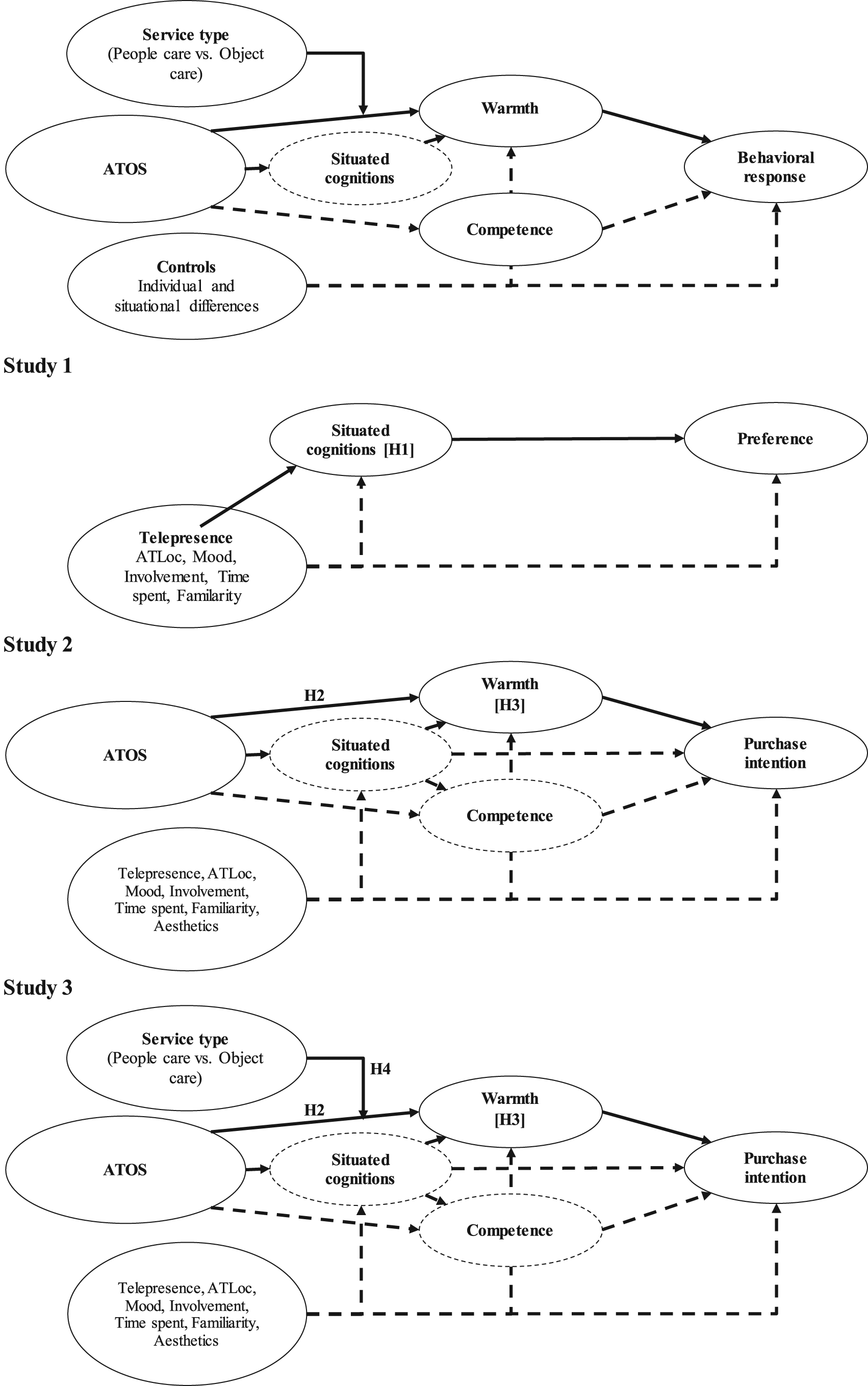
Theoretical Background and Hypotheses
Cross-Modal Inference of Temperature
Classified a haptic/tactile cue (Lederman and Klatzky 2009), feelings of warm/cold can be elicited both thermally (i.e., by ambient temperature and contact with objects) and chemaesthetically (e.g., through dermal contact with chemical substances) (Spence 2020). In service contexts, ambient temperature has received attention as a characteristic of the servicescape (Bitner 1992; Wakefield and Blodgett 1999). In online environments, ambient temperature represents a sensation that is not directly accessible, but must be inferred from secondary cues.
Referring to sensory interactions among the senses (Spence 2011), cross-modal correspondence captures a common occurrence where people consistently map features in one sensory modality onto features in other modalities (e.g., Motoki et al. 2020). Sensory research has established a solid link between sensations received through different sensory modalities, specifically, cross-modal influences on haptic perceptions (Krishna, Elder, and Caldara 2010). The psychological dimensions of temperature perceptions related to visual cues are formed through experience and evolution (Zarzo and Stanton, 2009). Temperature correspondences have been reported with other sensory modalities involving visual, acoustic, and olfactory cues (see Spence 2020, for a review). One of the most frequently established visual associations involves the color-temperature inference, namely, red-hot and blue-cold (Ho et al. 2014; Ketron and Spears 2020). Known as the hue-heat effect (Mogensen and English 1926), lights and colors affect perceived temperature, and product judgments (Ketron and Spears 2020).
The perception of a service environment as warm or cool depends on the amount and location of color (Baker and Cameron 1996). Warmth can be visually projected by color and material of a store’s interior design (Baek, Choo, and Lee 2018). Psychophysical experiments point at two dimensions of a room’s illumination (i.e., illuminance [in Lux], and color temperature [in Kelvin]) as drivers of perceived temperature (Tsushima et al. 2020). Brighter illumination and lower color temperatures (white, light blue) relate to cooler temperatures, whereas dimmer illumination and warmer colors (orange) lead to perceptions of higher ambient temperature (Tsushima et al. 2020).
In addition, temperature has been associated with sound properties, such as music pitch and tempo (Wang and Spence 2017). Scholars have also identified olfactory associates of temperature (Krishna, Elder, and Caldara 2010) such as certain odors (cinnamon) being perceived as warm, and others (peppermint) being perceived as cool (Wnuk et al. 2017). Adding an environmental perspective, exposure to a warm (vs. cool) ambient odor can influence perceived ambient temperature, in turn affecting consumer behavior (Lefebvre and Biswas 2019). Generally, sensory correlates of temperature have strong managerial relevance since they can influence behaviors in non-obvious ways and are relatively easy to change (Biswas 2019). For example, it requires minimal effort to change the illumination in an online service environment, or adjust the dominant colors of floors, ceilings, and walls. While a detailed examination of possible influencers of ATOS is beyond the scope of this study, the discussion above speaks to the capacity of online service environments to evoke ATOS.
Telepresence and Situated Cognition
A key feature in consumers’ interaction with online environments is the experience of telepresence (Orth et al. 2019; Spielmann and Orth 2021). Telepresence represents a psychological state where people, by interacting with a medium, experience a rewarding and real sense of being present in a remote environment, similar to direct physical experiences (Coyle and Thorson 2001; Grigorovici and Constantin 2004; Steuer 1992). Important to this study is the immersive capacity of online service environments to make users believe that they are physically “present” there (see Wirth et al. 2007, for a systematic conceptualization of presence). Telepresence and its effects have been established in a variety of online service contexts, including retail (e.g., Orth et al. 2019), tourism and hospitality (e.g., Spielmann and Orth 2021), and fashion and apparel (e.g., Vonkeman, Verhagen, and Van Dolen 2017), to name a few.
Conceptually, telepresence is a form of situated cognition (Riva 2007), with consumers forming thoughts (Barsalou 2008), reacting physiologically (Macedonio et al. 2007), and taking action (Clancey 2009) in accordance with a place that is presented online rather than experienced offline (Lombard and Ditton 1997). For an individual, the sense of “being there” affects their thinking of “doing there” (Schultze 2010), especially when experiences are intense enough to be perceived as equivalent to real experiences (Grigorovici and Constantin 2004). Cognition is grounded in multiple ways, including simulations, situated action, and bodily states (Barsalou 2008). Individuals develop an understanding of highly abstract concepts (i.e., warmth) through bodily experiences that are metaphorically linked to those concepts (Landau, Meier, and Keefer 2010). Driven by warmth-related cognition is self-regulatory behavior (Lee, Rotman, and Perkins 2014), for example, substituting physical through relational warmth (Hong and Sun 2012). Researchers have traditionally focused more on the social context of cognition, but physical contexts, especially online environments (Carrozzi et al. 2019) impact cognitions as well (Riva 2007).
Integrating a situated cognition perspective with cross-modal inference research suggests that people may experience cognitions and bodily sensations through interaction with an online service environment they perceive as “cool” or “warm.” Inferring the environment’s ambient temperature from visual cues, well-established metaphors can thus be tied to the source domain of physical experience (Huang et al. 2014), thereby influencing the target domain of psychological judgment upon activation (Ackerman, Nocera, and Bargh 2010). Consumers may thus respond to ATOS with cognitions seated in the online context, extending to cognitively driven physiological reactions. Formally, we expect:
Consumers will experience situated cognitions and bodily sensations consistent with ATOS when feeling present in an online environment.
Ambient Temperature and Judgment of Warmth
Social psychology research views warmth and competence as two fundamental dimensions of people judging others (Fiske, Cuddy, and Glick 2007). Warmth captures attributes that help maintain relationships, such as perception of a person being friendly, kind, likeable and nice (Halkias and Diamantopoulos 2020). Competence refers to attributes that relate to other people’s perceived ability to perform a task and deliver, such as being capable, competent, efficient, and skillful (Halkias and Diamantopoulos 2020). In interpersonal contexts, warmth is found to be the primary dimension as people judge warmth before competence (Wojciszke, Bazinska, and Jaworski 1998). At a basic level, warmth involves more affectively driven evaluations, whereas competence is driven more by cognitive evaluations (Dubois, Rucker, and Galinsky 2016).
Marketing researchers have adopted the framework and extended it from judgment of people to judgment of brands (Aaker, Garbinsky, and Vohs 2012), firms (Jha et al. 2020; Möller and Herm 2013), service providers (e.g., Güntürkün, Haumann, and Mikolon 2020) and service environments (e.g., Gao and Mattila 2014). In a service context, a number of drivers of warmth (and competence) has emerged, but, except for a study on shape cues (Liu, Bogicevic, and Mattila 2018), ambient factors have been neglected, including temperature.
Outside the service ambience domain, extant research shows that the abstract concept of relational warmth is grounded in bodily experiences of physical warmth: feelings of social warmth or coldness can be induced by experiences of physical warmth or coldness (Bargh and Shalev 2012; Bargh and Melnikoff 2019). For example, when holding a cup of hot coffee rather than a cup of iced coffee, people evaluate others as more generous and friendly (Williams and Bargh 2008). Conversely, physical coldness increases perception of social distance and exclusion, close correlates of relational coldness (Zhong and Leonardelli 2008). Important to our study, consumers’ haptic interactions with retail environmental cues (i.e., sensations of softness conveyed through business cards and flyers) influence judgment of retailer warmth (Jha et al., 2020). Similarly, feelings of hardness and temperature transfer to brand personality on the warmth dimension, indicating that bodily experiences transfer metaphoric meaning to customers (Möller and Herm 2013). Together, these findings suggest that the experience of ambient temperature can trigger judgment of relational warmth. In the online service environmental context, we expect that the inference of higher ATOS should spill over to judgment of relational warmth transferred to the service provider. Formally:
Ambient temperature of an online service environment will have a positive effect on consumer judgment of service provider warmth.
Mediating Effects of Warmth on Outcome Variables
To more fully capture the impact of ATOS, and to better isolate its effect through warmth (versus competence), we account for the classification of warmth/competence driven marketing outcomes along the relational-transactional continuum (Garbarino and Johnson 1999). This distinction appears important as the dominance of warmth over competence shifts contingent upon the primacy of a consumer’s relational versus capability concerns (Güntürkün, Haumann, and Mikolon 2020). Because ATOS should affect warmth, but not competence, its impact on important service outcomes may vary.
Regarding transactional outcomes in the context of service provision, warmth is positively associated with a customer’s intention to purchase (e.g., Güntürkün, Haumann, and Mikolon 2020; Liu, Bogicevic, and Mattila 2018), willingness-to-pay (e.g., Bolton and Mattila 2015), and word-of-mouth (e.g., Li, Chan, and Kim 2019; Jha et al. 2020). Regarding a relational outcome, warmth has an established positive effect on customer-company identification (e.g., Güntürkün, Haumann, and Mikolon 2020). Given these positive consequences of warmth, we expect judgments of warmth to mediate the effect of ATOS on important service outcomes. Formally:
Judgment of service provider warmth will mediate the positive effect of ambient temperature on behavioral intention (purchase intention, word-of-mouth, customer-company identification, and willingness-to-pay).
The Moderating Role of Type of Service Context
While we expect ATOS to influence warmth judgment across many contexts, the type of service, specifically, whether service delivery is directed at people versus object care (Lovelock 1983), may change the capacity of ATOS to evoke situated cognitions and judgment of warmth. Important, Lovelock’s (1983) conceptualization leads to a classification of service contexts along a continuum ranging from purely people-directed to purely object-directed services, but additionally including blended types. Services directed at people (e.g., restaurants, hair styling, health care, etc.) center on customers being the subject of the service delivery, assigning them a more active role in the process, and enabling them to directly monitor progress (Dong and Sivakumar 2017). In contrast, services directed at objects (e.g., automotive, cleaning, and financial services) typically allow customers to be absent during actual service delivery, with less opportunity to monitor progress (Lovelock 1983). These differences between people care and object-care services may impact the relationship between ATOS and judgment of warmth as consumers expect to be more (vs less) present during the service delivery, and thus being more (vs less) exposed to ambient factors such as temperature. Furthermore, people care is more social and therefore more relational warmth would be expected (versus objects which as inanimate). In line with these thoughts, warmth-related cues such as ATOS should exert a stronger influence in contexts where service provision is directed more at object care, as customers will expect to be less physically present and less exposed to ambient and social factors. Conversely, when service provision is directed at people, the influence of ATOS on warmth should be smaller, because customers tend to be more present during much of the service delivery process, involving greater exposure to ambient temperature and others. Formally:
Type of service context (people care vs object care) will moderate the effect of ATOS on warmth judgment such that the positive effect will be stronger with more object-care services and will be weaker with more people-care services.
Accounting for Individual and Situational Differences: Control Variables
Several individual and situational differences may impact the effects of ATOS on situated cognitions, warmth/competence and service outcomes, including ambient temperature at the consumer’s location, their mood state, process/outcome orientation, category involvement, and familiarity with the service provider as well as levels of telepresence evoked by the online environment, and its aesthetics.
First, different than ambient temperature inferred from the online environment, ambient temperature at the consumer’s actual location (ATLoc) may impact situated cognitions and judgment of warmth. In line with sensory studies reporting ambient temperature effects on consumer judgment (e.g. Park and Hadi 2020; Zwebner, Lee, and Goldenberg 2014) and behavior (e.g., Cheema and Patrick 2012; Huang et al. 2014; Tong et al. 2018), possible temperature effects at the consumer’s location should be accounted for.
Second, online ambient features can influence consumer mood state and subsequent behavioral response (Björk 2010). Warmth involves more affectively driven evaluations (Dubois, Rucker, and Galinsky 2016) and prior research on influencers of warmth has typically accounted for the possibility of a general mood or “halo” effect (Li, Chan, and Kim 2019; Williams and Bargh 2008), especially when studying the impact of physical temperature (Bruno, Melnyk, and Völckner 2017).
Referring to the degree of personal relevance, consumer’s category involvement impacts how consumers respond to ambient factors in an online environment (Eroglu, Machleit, and Davis, 2001). As consumers devote divergent levels of attention to specific service categories, their information processing changes. Specifically, more involved consumers process service environments more easily, resulting in more favorable behavioral responses (Varki and Wong, 2003). Favorable responses include emotional response to atmospheric web cues (Ha and Lennon, 2010), and specifically evaluative responses such as warmth (Zawisza and Pittard, 2015).
Similarly, a person’s familiarity with a service provider is an established influencer of warmth (Halkias & Diamantopoulos, 2020), as those who are familiar are more likely to form positive judgments by activating existing knowledge structures. With online service environments, people are more likely to experience telepresence as familiarity increases, in turn developing more favorable intentions (Orth et al., 2019).
While the primary importance of telepresence lies with its capacity to facilitate situated cognitions related to ATOS, it may as well directly impact judgment and behavior. By shortening psychological and spatial distance perceptions (Maglio, Trope, and Liberman, 2013), telepresence can alter consumer response to online service environments (Orth et al., 2019). Because judgment of relational warmth is closely tied to physical closeness and proximity (Hertenstein et al., 2006), the mere experience of being present in an online service environment may evoke warmth.
Aesthetics (physical attractiveness) refers to the external appearance of an online service environment and the emotional experience induced consequently (Vilnai-Yavetz and Rafaeli, 2006). Across many contexts, the “beautiful-is-good” stereotype suggests that more (rather than less) esthetic stimuli will elicit more positive responses (Eagly et al., 1991). With online service environments, the stereotype may manifest itself by visual characteristics of an interior’s design influencing aesthetics, in turn stimulating favorable intentions (Orth et al. 2019).
Pilot Study—Exploring Online Offline Experience Linkages
Current research has yet to provide a robust understanding of how online service environments contribute to omnichannel experiences across the customer journey (Hollebeek et al., 2020). To provide initial evidence for (and against) the relevance of ATOS, a pilot study employed twelve in-depth interviews exploring linkages between online and offline environments across a number of service contexts. Gender was largely balanced (five males and seven females), with ages ranging from 25 to 69 years (see Web Appendix A1). Recruited via judgmental sampling, interviews were conducted online in accordance to a consistent guide.
The process started with the interviewer asking people to recall a recent experience with a service environment they visited online as well as in person. Following from that, participants were asked to describe their impressions formed from visiting the online environment (coded in terms of both ambient and business characteristics). Moving on from the online to the offline environment, they were also asked to describe impressions obtained during their visit to the brick-and-mortar environment. Questions about possible differences between online and offline environments including intentions and behavior concluded the interviews.
The experiences recalled by study participants referred to a variety of service contexts including a bar, a gym, a hotel, various medical offices, an optometrist, two restaurants, and a toy store. Content analysis of the recorded and transcribed data revealed that all respondents could easily recall a business they had visited online as well as in person. Moreover, visiting an online representation of a business first and the offline environment later emerged as a strategy commonly employed by the interviewees: “In my experience, virtual tours help a lot in forming first impressions and making a decision on whether or not to do business with them.” (Jürgen—medical office)
For the online service environments, participants identified a number of ambient characteristics (e.g., acoustics, layout, lighting, people, and temperature) and the business impressions they would infer from them (including qualities relating to warmth). For example: “The colors, specifically, walls painted in orange, evoke the impression of warm room temperatures.” (Eike—fitness studio) “Numerous windows, with lots of natural lighting made it very welcoming and inviting.” (Bettina—indoor pool). When prompted for temperature cues, 10 participants named colors, nine lighting, five furniture (materials), and one mentioned greenery. Coding of business impressions revealed that 10 participants indicated one or more descriptors of service provider warmth, whereas all 12 indicated one or more descriptors of service provider competence.
Regarding discrepancies between the online and the offline environments, all participants identified at least one difference relating to a sensory mode. For example, “Sitting inside, next to the doorway, it was actually more confined and cooler, not in line with the virtual tour which appeared warmer and more welcoming. […] I did not like that.” (Josephine—restaurant) And: “The most striking difference was the presence of people in the actual room and the odors that come with them […] but that’s to be expected.” (Tabea—gym) “The initial impression of friendliness was really confirmed during the visit: staff was very likable, waiting times were kept very short, […] kindhearted and amiable personal service, […] fully in line with the online experience.” (Rolf—medical office) “I hadn’t expected it to be so cool […], in reality it turned out to be reasonably warm, but definitely not as warm as anticipated.” (Torben—medical office)
Last, eight respondents based their intention to visit the offline environment and do business there on the impressions obtained during their visit to the online environment: “With the online tour, there was nothing sugarcoated or idealized, everything was just realistic, and to me that’s a good thing.” (Jonna—optometry office) “I even feel that they downplay the experience through the online environment, they avoid raising too high expectations, and the visit to the actual environment then is much better, with all the people there, the dim lights[…].” (Felix—bar) Important, three stated they would not do repeat business or that they would spread negative word-of-mouth given substantial discrepancies between online and offline experiences.
Taken together, findings from the in-depth interviews corroborate the notion that online ambient factors such as ATOS are instrumental in shaping initial consumer judgments of a business, hereby impacting intentions and future behavior. In addition, the interviews show evidence that discrepancies between online and offline ambient factors (i.e., ATOS) can impact managerially relevant service outcomes, both positively and negatively.
Study 1: Testing the Base Mechanism With a Hot Environment
Study 1 was designed to test the fundamental mechanism, specifically, the experience of situated cognitions and bodily sensations consistent with ATOS when consumers feel present in an online environment. The study employs an online representation of an environment with presumably high ambient temperature and high humidity: a holiday resort on the Caribbean island Curaçao. It additionally manipulates ATLoc (ambient temperature at the consumer’s actual location) to explore the robustness of ATOS effects. To further enhance generalizability (and to generate variance in the variables of interest), the study employed three different online representations of that environment, yielding a 2 (temperature at consumer’s location: low versus high) x 3 (media format: static images vs. curated video vs. a 360° panoramic virtual tour [360VT]) design. While the virtual tour (https://www.curacao-travelguide.com/360-Virtual-Tour/) was self-directed, a curated video was produced by following the most likely path through the environment. Still images were shot from vantage points along this route. Consistent with our basic premise that ATOS evokes situated cognitions, Study 1 focused on how people’s experience of being present in an online servicescape (telepresence) impacts situated cognitions and preference for products compatible with that environment on the temperature dimension. In addition to ATLoc, the study controlled for mood state, involvement, viewing time, and familiarity with the remote location.
Method
A two-step Pilot Study identified products compatible and not with the online environment on the temperature dimension. The first step involved a free-elicitation task with a convenience sample of 18 consumers who were prompted, after viewing the online environment, to write down products they associated (or not) with it. Eliminating brand names, products mentioned only once or unlikely to be familiar to our main study participants, six pairs (i.e., six compatible and six non-compatible) of products nominated most frequently were compiled. Next, a fresh sample of consumers (N = 27) rated each of the 12 products, presented in random order, on a scale from 7 (fully compatible with the Curaçao resort) to 1 (not at all compatible with the Curaçao resort). Based on the highest and lowest scores, respectively, eight products were retained for the main study: lobster, pineapple, rhum, and silk clothes (compatible); venison, carrots, vodka, and wool clothes (non-compatible).
In the main study, physically located in a consumer laboratory, a total of 240 participants (Mage = 22.35, SD = 5.53 years; 47.1% males) viewed one randomly selected stimulus. Eleven data sets were excluded from further analyses because respondents had been previously to the island of Curaçao. Alternating between days of the week and hours of the day, the ambient temperature in the room was set to either a “low” (18°C; N = 98) or “high” (22°C; N = 142) condition.
Prior to viewing one randomly selected stimulus (360VT: N = 77, video: N = 76, images: N = 76), participants indicated their mood (Peterson and Sauber, 1983) and initial preferences for each of the eight products using the same scale as in the pretest. After viewing the Curaçao resort, participants completed previously validated measures of telepresence (Coyle and Thorson, 2001), involvement (Josiam, Smeaton, and Clements, 1999), intention to visit the island resort and familiarity (Biswas, 1992). Situated cognitions were assessed using six semantic differential items tailored to correspond with ambient temperature. Finally, preferences for compatible and non-compatible products were re-assessed, before collecting personal information. Web Appendix A2 holds scale items and key statistics for all measures. 1 As an additional variable, time a participant spent on viewing the stimulus was obtained from the survey software (M = 256 seconds, SD = 291 seconds).
Analyses and Results
As a check to our manipulation, a two-factorial analysis of variance on the telepresence measure indicated nonsignificant effects of the media format (F(2,240) = 0.04, p = 0.958, MPicture = 4.06 vs. MVideo = 4.06 vs. MVT = 3.97), the temperature at the lab (F(1,240) = 1.01, p = 0.316, Mlow = 3.93 vs. Mhigh = 4.10), and the Media format × Lab temperature interaction term (F(2,240) = 0.75, p = 0.473). We take this finding to mean that a range of online media formats has the capacity to evoke feelings of telepresence, in line with reports for substantial levels of telepresence evoked by reading a book, watching a movie, or using a mobile phone (Riva, 2007). In line with the continuous nature of telepresence, subsequent analyses involved using the interval-scaled telepresence variable rather than the media format categories.
To prepare analyses, within-subject difference scores were computed for each of the eight products as indicators of changes in preferences with items subsequently collapsed into single indices for compatible (Dcompatible = post-exposure preferencecompatible—pre-exposure preferencecompatible; α = 0.78, M = 0.34, SD = 0.87) and non-compatible products (Dnon-compatible = post-exposure preferencenon-compatible—pre-exposure preferencenon-compatible; α = 0.67, M = −0.04, SD = 0.89). Accordingly, positive values indicate increases in preferences.
To test our key proposition, the pivotal role of situated cognitions, we employed mediation analysis (Hayes 2013, model 4). Telepresence was the independent variable; situated cognitions the mediator, and change in preference for compatible products was the dependent variable. ATLoc, mood, involvement, familiarity, and time spent were included as covariates. All continuous variables were mean-centered (Hayes 2013). Web Appendix A2 holds full results.4
The results indicate that situated cognitions were significantly influenced by telepresence (B = 0.19, SE = 0.07, p = 0.012) and ATLoc (B = −1.15, SE = 0.18, p = 0.001). Change in preference for compatible products, in turn, was significantly influenced by situated cognitions (B = 0.18, SE = 0.05, p = 0.001), and ATLoc (B = 0.33, SE = 0.14, p = 0.015). No other effects were significant. Importantly, situated cognitions mediated the effect of telepresence on preference (Bootstrap [5000]; B indirect = 0.03, SE = 0.02, 95% CI [0.01, 0.07]).
Discussion of Study 1 Findings
Study 1 provides initial support for the claim that the experience of telepresence while visiting an online service environment evokes situated cognitions consistent with the ambience, hereby impacting consumer preferences for products compatible with the environment on the temperature dimension. This effect holds in the presence of a significant effect of ATLoc, thus corroborating the robustness of our fundamental mechanism beyond actual room temperature.
Study 2: Testing Effects in an Café Experiment
Study 2 was designed to extend the initial study by directly testing the influence of ATOS on warmth (H1) and on behavioral responses (H2). Judgment of competence was included as a parallel mediator to account for an alternative process. Given the variable’s significant effects in Study 1, we control for ATLoc, and additionally for mood, involvement, the time spent in the virtual environment, familiarity with the service provider, aesthetics and telepresence.
Method
Study 2 employed a one-factorial (ATOS: high vs. low) between-subjects experimental design with 360VTs of two cafés. Accounting for established cross-modal correspondences of ambient temperature (Spence 2020), especially illumination (Tsushima et al. 2020), the tours were selected from a set of six 360VTs pretested with members of a consumer panel (N = 31). Two coffee shops, Café Bella Vita (low ATOS: https://mpembed.com/show/?m = Dvw3veksqdb) and Rainforest Café Woodfield (high ATOS: https://rebranding360.com/portfolio/rainforest-cafe-woodfield-virtual-tour/) were selected according to divergent scores on inferred ambient temperature ((F(1,2) = 24.61, p = 0.002, MBella Vita = 3.50 vs MWoodfield = 5.00), similar scores on familiarity (F(1,2) = 5.02, p = 0.060, MBella Vita = 4.33 vs. MWoodfield = 2.00) and aesthetics (F(1,2) = 4.55, p = 0.070, MBella Vita = 4.00 vs. MWoodfield = 5.75), and only minimal differences in size and navigation technology.
Using a university-based consumer panel, 155 participants were recruited in return for a coupon valid at a large retailer. Nine data sets were dropped due to failed attention checks or because participants had spent less than 30 seconds or more than 30 minutes with the stimulus, leaving a final sample of 146 (74% females, Mage = 36.64, SD = 13.34): 72 in the Woodfield and 74 in the Bella Vita café.
In the main study, prior to viewing one randomly selected stimulus, participants indicated their mood (Peterson and Sauber 1983) and ATLoc (Barbosa Escobar et al. 2021), both measures embedded in a series of questions designed to help participants ease into the study. After taking the virtual tour, participants completed measures of telepresence (as in Study 1), perceived illumination (Tsushima et al. 2020), ATOS (Krause et al. 2020), warmth and competence (Halkias and Diamantopoulos, 2020), customer-company identification (Bagozzi and Dholakia, 2006), and a comprehensive set of outcome variables (purchase intentions, word-of-mouth communications, and willingness-to-pay; Zeithaml and Parasuraman, 1996). The control variables were involvement (Josiam, Smeaton, and Clements, 1999), familiarity with the café (Biswas, 1992), and aesthetics (Fisher, 1974). Situated cognitions were assessed using the validated six-item semantic differentials from Study 1. Finally, time (in seconds) spent on viewing the stimulus was obtained from the survey software (M = 673, SD = 510). Web Appendix A2 includes scale items and key statistics.
Analyses and Results
Analysis of variance indicated a significant effect of the treatments on the ATOS measure (F(1,144) = 61.65, p = 0.001, MBella Vita = 3.70 vs. MWoodfield = 5.00). In addition, there were significant correlations between ATOS and the environment’s color temperature (r = 0.68, p = 0.001) as well as illumination (r = −0.28, p = 0.001). Together, these findings indicate that the manipulation of our key independent variable was successful.
Testing for Serial Parallel Mediation (Study 2).

Note: N = 146. CI = confidence interval. HAYES PROCESS model Custom (Hayes, 2013): Bootstrap sample = 5000. Significant (p<0.05) coefficients in bold.
The results indicate that ATOS had a significant positive effect on situated cognitions (B = 0.34, SE = 0.16, p = 0.032), which were additionally influenced by ATLoc (B = 0.52, SE = 0.08, p = 0.001) and, marginally, involvement (B = −0.09, SE = 0.05, p = 0.079). Warmth was influenced significantly and positively by ATOS (B = 0.43, SE = 0.16, p = 0.008), in support of H2. Additional influencers included situated cognitions (B = 0.25, SE = 0.09, p = 0.004), ATLoc (B = −0.18, SE = 0.09, p = 0.046), involvement (B = 0.10, SE = 0.05, p = 0.047) and aesthetics (B = 0.64, SE = 0.05, p = 0.001), and, marginally, telepresence (B = 0.11, SE = 0.06, p = 0.069), familiarity (B = −0.09, SE = 0.05, p = 0.072), and time spent (B = −0.12, SE = 0.07, p = 0.099). Purchase intention, in turn, was influenced by warmth (B = 0.73, SE = 0.11, p = 0.001), telepresence (B = 0.18, SE = 0.08, p = 0.027), and familiarity (B = 0.14, SE = 0.06, p = 0.027). Importantly, the indirect effect of ATOS on purchase intention 3 was significant through warmth (B = 0.31, SE = 0.12, 95%CI(0.09, 0.57)) as well as through situated cognitions and warmth (B = 0.06, SE = 0.04, 95%CI(0.01, 0.16)), supporting H3. While ATOS had an additional significant effect on competence (B = −1.08, SE = 0.18, p = 0.001), this variable did not affect purchase intention, hereby ruling out an alternative process explanation.
Discussion of Study 2 Findings
Taken together, Study 2 findings support the claim that the ambient temperature viewers infer from online environments impacts judgments of relational warmth, in line with a situated cognitions perspective. Specifically, ATOS evokes cognitions congruent with the online environment on the temperature dimension. In addition, ATOS positively affects judgment of service provider warmth, and ultimately purchase intention, word-of-mouth, customer-company identification and willingness-to-pay. Significant effects of ATLoc on situated cognitions and warmth judgment corroborate its capacity to induce these responses even with viewers who are physically located in an environment where the ambient temperature is different from the one inferred from the online environment. Furthermore, while ATOS does have a significant (negative) effect on competence, a judgment paralleling warmth, none of the outcome variables tested were significantly affected by competence. In addition, this study shows that ATOS effects are robust when controlling for several important individual and situational difference variables, including ATLoc, mood, involvement, time spent, familiarity, aesthetics and telepresence.
Despite the robustness of findings and their general support for the hypotheses, Study 2 has a number of limitations, most prominent among them the focus on a single service context (cafés). To address possible limitations, Study 3 was designed to replicate Study 2, to examine effects across a number of diverse service contexts, and to test the moderating role of service type.
Study 3: Replication and Extension With Twelve Service Contexts
Study 3 was designed to replicate and extend Study 2 by testing the influence of ATOS on warmth (H1), the mediated effects on service outcomes (H2), and the moderating role of service type (H3). Again, the study accounted for an alternative process through competence. Control variables were identical to the ones used in Study 2, with a new variable added to assess the type of service context (object care versus people care; Lovelock, 1983).
Method
Study 3 employed a quasi-experimental design with two factors: 2 (ATOS: high vs. low) x 12 (service category: art gallery, coffee shop, dental office, fitness studio, hair salon, hotel, law firm, optometrist, real estate, restaurant, vet/pet service, winery). This design increased variance in key variables, thereby enhancing generalizability. Two pretests aided in ascertaining sufficient variance in the independent (ATOS) and moderator variables (service type).
To manipulate ATOS, 360VTs of service environments were selected in a pretest. A group of six researchers initially assembled a large pool of 69 possible environments from various Internet sites. In the second step, each researcher evaluated all stimuli (in random order) on ATOS using the previously validated scale. The final step involved a consensual selection (ICC = 0.84) of 12 stimuli scoring low on ATOS and another 12 scoring high; simultaneously minimizing differences in familiarity, aesthetics, size and navigation technology (see Web Appendix A4).
To ascertain sufficient variance in the moderator variable, a second pretest (N = 59) involved undergraduate students rating all 24 stimuli on a 5-point scale ranging from 5 = people-care service type to 1 = object-care service type. The results indicate substantial variance in the variable ranging from high values (indicating people-care services such as cafés (M = 4.17), restaurants (M = 3.98) and hair salons (M = 4.18)) to low values (indicating object-care services such as real estate offices (M = 1.92), museums (M = 2.12), and art galleries (M = 1.65)). Web Appendix A5 holds illustrative screen shots.
In the main study, 644 American participants were recruited through Prolific. Due to failed attention checks or because participants had spent less than 30 s or more than 30 min with the stimulus, 51 data sets were dropped, resulting in a final sample of 593 (51% females, Mage = 44.19, SD = 16.00, between 46 and 53 participants/service category, minimum 21 participants per stimulus). Replicating previously employed procedures and reemploying Study 2 measures (see Web Appendix A2), participants first indicated their mood and ATLoc before they proceeded to view one randomly selected 360VT. After taking the tour, participants completed measures of telepresence, situated cognitions, perceived illumination, ATOS, service provider warmth and competence, purchase intention, customer-company identification, word-of-mouth, and willingness-to-pay. Control variables included involvement, familiarity with the service environment, aesthetics, and time (in seconds) spent viewing the stimulus (M = 922, SD = 500). The moderator, service type, was assessed using Lovelock’s (1983) semantic differential.
Analyses and Results
Results of a general linear model indicated a significant effect of ATOS manipulations on the ATOS measure (F(1,23) = 25.70, p = 0.001, Mlow = 3.61 vs. Mhigh = 4.16), in the presence of a significant effect of service category (F(1,23) = 4.22, p = 0.001, MCafés = 4.38 vs. MRestaurants = 4.37 vs. MReal estate = 4.20 vs. MLaw offices = 4.09 vs. MFitness studios = 4.08 vs. MHair salons = 4.00 vs. MWineries = 3.90 vs. MOptometrists = 3.88 vs. MVet/Pet service = 3.75 vs. MArt galleries = 3.47 vs. MDentist = 3.53 vs. MHotels = 2.89) and a significant ATOSmanipulated x Category interaction effect (F(1,23) = 4.65, p = 0.001). Further analyses indicated a significant correlation between the ATOS measure and color temperature (r = 0.48, p = 0.001); the correlation with illumination was nonsignificant (p = 0.215). While these findings suggest that the manipulation of our key independent variable ATOS was successful, possible confounding effects of the service category cannot be ruled out. As evidenced by the pretest, service categories vary in the perceived care for people versus objects. To address this, subsequent analyses involved using interval-scaled variables (measured) rather than categorical ones (manipulated), in line with the continuous nature of concepts (temperature, service type).
Testing for Moderated Serial and Parallel Mediation (Study 3).

Note: N = 593. CI = confidence interval. HAYES PROCESS model Custom (Hayes, 2013): Bootstrap sample = 5000. Significant (p<0.05) coefficients in bold.
The results indicate that ATOS had a significant positive effect on situated cognitions (B = 0.22, SE = 0.09, p = 0.012), which were additionally influenced by ATLoc (B = 0.21, SE = 0.04, p = 0.001), familiarity (B = 0.07, SE = 0.02, p = 0.004), aesthetics (B = −0.08, SE = 0.04, p = 0.033), and telepresence (B = 0.10, SE = 0.04, p = 0.017). Warmth was positively influenced by ATOS (B = 0.17, SE = 0.06, p = 0.010), situated cognitions (B = 0.09, SE = 0.03, p = 0.003), type of service (B = 0.29, SE = 0.03, p = 0.001), mood (B = 0.09, SE = 0.03, p = 0.002), involvement (B = 0.06, SE = 0.02, p = 0.021), familiarity (B = 0.07, SE = 0.02, p = 0.001), aesthetics (B = 0.20, SE = 0.03, p = 0.001), and telepresence (B = 0.12, SE = 0.03,p = 0.001), in support of H2. Important, the ATOS x Service type interaction effect was significant and negative (B = −0.09, SE = 0.04, p = 0.035). Specifically, the conditional effect 5 of ATOS on warmth was significant and strong at low levels of the service type variable (indicating more object-care–directed services such as real estate offices, museums and art galleries: B = 0.26, SE = 0.08, 95% CI[0.11, 0.42]), was significant but weaker at intermediate levels (indicating services directed at both people and objects such as optometric and medical services: B = 0.17 SE = 0.06, 95% CI[0.04, 0.29]), and was nonsignificant at high levels (indicating contexts where service provision is directed more at people care such as cafés, restaurants and hair salons: B = −0.01, SE = 0.11, 95% CI[−0.22, 0.19]). These findings support hypothesis H4.
Purchase intention, the dependent variable, was influenced by warmth (B = 0.18, SE = 0.06, p = 0.003), competence (B = 0.23, SE = 0.06, p = 0.001), telepresence (B = 0.24, SE = 0.04, p = 0.001), involvement (B = 0.27, SE = 0.03, p = 0.001), aesthetics (B = 0.15, SE = 0.04, p = 0.001), familiarity (B = 0.12, SE = 0.03, p = 0.001), and ATLoc (B = 0.08, SE = 0.04, p = 0.046). The indirect effect of ATOS (through warmth) on purchase intention 6 was significant in service contexts involving more object care (B = 0.05, SE = 0.02, 95% CI[0.01, 0.10]), was significant, but weaker at intermediate levels (B = 0.03, SE = 0.02, 95%CI[0.01, 0.07]), and was nonsignificant when service provision was directed more at people care (B = −0.01, SE = 0.02, 95% CI[−0.04, 0.03]; index of moderated mediation: −0.02, SE = 0.01, 95% CI[−0.04, −0.01]). The effects through situated cognitions and warmth were significant for high (B = 0.01, SE = 0.01, 95%CI[0.01, 0.02]) and intermediate levels of object-care services (B = 0.01, SE = 0.01, 95% CI[0.01, 0.01]) but not for people-care service contexts (B = −0.01, SE = 0.01, 95% CI[−0.01, 0.01]). The indirect effects of ATOS through competence were nonsignificant, irrespective of service type (index of moderated mediation: −0.01, SE = 0.01, 95% CI[−0.03,.02]).
General Discussion and Conclusions
This study examines how ATOS, a sensory cue inferred from visual representations of online service environments, influences consumer behavioral intention through service provider warmth. It integrates research on cross-modal inferences with situated cognition theory and the warmth-competence model to hypothesize that ATOS facilitates judgment of service provider warmth, and ultimately impacts important service outcomes, in line with a situated cognitions perspective.
From a mixed methods approach, the findings highlight the capacity of online service environments (especially virtual tours) to evoke inferences of ambient temperature, which impact consumer judgments and behavioral intention. These effects are more pronounced with services directed at objects, and are less pronounced with services directed at people. Examining a presumably hot and humid environment, Study 1 provides evidence for the fundamental mechanism by showing that the experience of telepresence evoked by viewing online representations of an environment evokes situated cognitions, in turn impacting consumer preferences for products compatible with that environment on the temperature dimension. Study 2 (virtual tours of cafés) provides direct support for the ATOS—warmth judgment—service outcomes chain of effects. Specifically, ATOS evokes cognitions congruent with the online environment on the temperature dimension, and positively affects judgment of service provider warmth, ultimately stimulating purchase intention, word-of-mouth, customer-company identification and willingness-to-pay. Study 3 replicates these effects with a diverse set of 12 service contexts, and additionally shows that the effect of ATOS on warmth is stronger with object-care services, and is weaker with people-care services. Including a parallel path through competence, and controlling for possible effects of ATLoc, mood, involvement, time spent, familiarity, aesthetics and telepresence enhances confidence in the robustness of the findings.
This study makes three significant contributions. First, we contribute to the growing body of research on ambient temperature as a characteristic of the servicescape (Bitner 1992; Wakefield and Blodgett 1999) by providing more insight on temperature as an ambient factor in online environments where it is not directly accessible but inferred. Research on temperature in service environments (Baker and Cameron 1996; D'Astous 2000; Lefebvre and Biswas 2019) is extended by examining the influence of inferred ambient temperature in an online context. This presents an important contribution, as previous research on online environments tended to focus on technical parameters (e.g., Coyle and Thorson 2001) and primary (visual) sensations rather than inferences (e.g., Orth et al. 2019). In addition, our findings extend the literature on ambient temperature effects in the domains of advertising (e.g., Bruno, Melnyk, and Völcker 2017), decision-making (e.g., Cheema and Patrick 2012; Tong et al. 2018), and product valuation (e.g., Huang et al. 2014; Park and Hadi 2020) to a service context. The novelty of our contribution is demonstrating that ambient temperature can be inferred from online environmental cues instead of as a thermal cue in brick-and-mortar environments.
Second, by demonstrating consumer behavioral effects of ATOS we contribute to the literature on cross-modal inferences (e.g., Krishna et al. 2010; Spence 2011), specifically, those involving temperature (e.g., Motoki et al. 2020; Spence 2020). Our finding that consumers use visual cues to deduce the online servicescape’s temperature ties in with reports that temperature perceptions are formed through experience and evolution (Hertenstein et al., 2006), specifically, the hue-heat effect established in many previous studies (e.g., Ho et al., 2014; Ketron and Spears, 2020). The correlations found in two studies between illumination and temperature extend research on consumer perception of a service environment as warm or cool (Baek, Choo, and Lee, 2018; Baker and Cameron, 1996) and corroborate psychophysical experiments on environmental illuminance and color temperature as drivers of perceived temperature (Tsushima et al., 2020). While previous research has focused more on cross-modal inferences in physical settings (i.e., Hong and Sun, 2012), and has examined sensory correlates of temperature such as sound properties (e.g., Wang and Spence, 2017) and olfactory cues (e.g., Krishna, Elder, and Caldara, 2010; Lefebvre and Biswas, 2019; Wnuk et al. 2017), we provide insight on the capacities of online servicescapes to shape temperature perception and impact consumer behavior.
Third, we contribute to the large body of research on the warmth-competence model (Fiske, Cuddy, and Glick, 2007), by demonstrating the impact of inferred ambient temperature in online servicescapes. Applying the warmth-competence model to judgment of brands (Aaker, Garbinsky, and Vohs, 2012), firms (Jha et al., 2020; Möller and Herm, 2013), service providers (e.g., Güntürkün, Haumann, and Mikolon, 2020) and service environments (e.g., Gao and Mattila, 2014), past research has demonstrated how perceptions of relational warmth lead to positive consumer outcomes. We extend previous studies on visual (e.g., Li, Chan, and Kim, 2019), haptic (Jha et al. 2020; Möller and Herm, 2013) and social (Liu, Bogicevic, and Mattila, 2018) drivers of warmth by identifying an atmospheric driver: ambient temperature. Research outside the service domain is extended through our finding that the abstract concept of service provider warmth is grounded in online experiences of physical warmth. As such our finding that ATOS facilitates judgment of service provider warmth confirms that feelings of relational warmth can be induced by experiences of physical warmth (Bargh and Shalev, 2012; Bargh and Melnikoff, 2019; Williams and Bargh, 2008).
Our study does not claim to offer an omnipotent model with ATOS presenting a single driver of effects. Previous research (see Table 1) points at a number of possible influencers of warmth judgment, with a few included as controls. Our finding that ATOS influences warmth judgment in the presence of established influencers makes a contribution to current research as it attests to our model’s capacity to explain effects beyond those of other drivers.
Practical Implications
Our research has a prominent managerial aim: to help service managers and marketers better utilize their online environments. Online service environments have the capacity to contribute to omnichannel experiences across the customer journey (Hollebeek et al., 2020), and many service businesses are now offering online tours of their environments (Rogers 2020). Our findings are consistent with the idea that online service environments can be designed more effectively to appeal to human senses (Krishna 2012), to reinforce the nature of the business, and to attract and retain customers (Bitner 1992). While it is common practice to visually (and sometimes acoustically) design online servicescapes to signal provider image and influence visitor behavior, our results suggest an additional option that goes beyond employing visual cues. The findings of our study can help to guide service managers to use ambient temperature inferences in a manner that is consistent with their intended levels of warmth. Web Appendix A6 provides a summary overview on specific managerial implications of our findings.
Prominent among managerial implications are the ones highlighting ATOS’ capacity to influence positioning and behavior, and the contingency of this effect on service type. Establishing that consumers form important judgments of a service provider (i.e., warmth) based on ATOS is a critical insight for service management, as it identifies an option that reliably affects customer behavior (Baker and Cameron 1996), prior to actual visits, and with a modest input of resources (Biswas 2019). For example, changing the illumination in an online service environment, or adjusting the dominant colors of floors, ceilings, and walls requires minimal effort. Details of a scene that have previously deemed irrelevant (such as dim illumination and muted colors) can be purposefully designed to generate associations with a warm environment. Similarly, to convey warmth, businesses should avoid harsh lighting and bright illumination. Other cues to warmth may include leaving an ice-cold beverage with visible condensation droplets on the glass on a counter, showing windows through which the sun shines, or presenting individuals in short-sleeved tops.
Furthermore, the ability of online servicescapes to shape consumer ‘experience’ of the business prior to actual visits is critically important. As our research demonstrates, designing the servicescape as warm generates desirable consequences in terms of purchase intention, word-of-mouth and customer-company identification. Managers should thus pay close attention to the ambient temperature consumers may infer from their online representation, even when they seem to be incidental, because these inferences can facilitate (or hinder) positive outcomes.
Finally, managers need to be aware that ATOS will not affect intentions and behaviors uniformly across all service types. Our research demonstrates that for object-care services, ATOS is more efficient and relevant than it is in people-care service settings. Consequently, service retailers should consider first the type of service they offer and then adapt their online servicescape: the more people-driven, the more desirable it is for them to include cues to warmth. They can be confident, however, that carefully tailoring ATOS to their business goals and objectives will pay off, irrespective of the customer’s familiarity with their business, their involvement with the service category, esthetic appreciation of the online environment, mood, and ATLoc.
Limitations and Research Agenda
There are some limitations to our research. First, our research did not consider all types of online servicescape media formats. We focused primarily on self-guided 360-degree virtual tours. Different and more advanced technology (i.e., Augmented Reality, goggles and body suits) may alter results, especially the experience of situated cognitions (Petit, Velasco, and Spence 2019). Nevertheless, we selected 360VTs as a less expensive technology and currently available to a wider range of businesses and consumers, in order to provide more relevant results for a wider audience. Given the previously reported superior performance of VR (or video) versus static pictures (e.g. Coyle and Thorson 2001; Spielmann and Orth 2021), researchers may find it beneficial to further explore how ATOS effects may change depending on the technology employed by consumers for experiencing online service environments.
A second limitation traces back to the negative influence of ATOS on competence found in Study 2, but not in Study 3. This inconsistency advocates that future research should further examine the role of competence judgment in online servicescapes, considering ambient cues that accentuate (or not) potentially negative judgments of competence relative to warmth.
Third is the employment of an explicit measure of ATLoc in Studies 2 and 3, which suggests the possibility of unintended priming effects. However, because the ATLoc measure was embedded in a series of questions designed to make participants feel comfortable and ease into the study, and considering that alerting study participants to ambient temperature effects should suppress effects as much as it strengthens them, we are confident that findings can be interpreted as conservative rather than exaggerated.
An Agenda for Future Theory Building and Research on ATOS.

Supplemental Material
Supplemental Material—Ambient Temperature in Online Service Environments
Supplemental Material for Ambient Temperature in Online Service Environments by Ulrich R. Orth, Nathalie Spielmann and Caroline Meyer in Journal of Service Research
Footnotes
Declaration of Conflicting Interests
The author(s) declared no potential conflicts of interest with respect to the research, authorship, and/or publication of this article.
Funding
The author(s) disclosed receipt of the following financial support for the research, authorship, and/or publication of this article: The authors would like to thank the city of Reims for its Grant (RM-2018-2020) which helped make this research possible.

Supplemental Material
Supplemental material for this article is available online.
Notes
Author Biographies
References
Supplementary Material
Please find the following supplemental material available below.
For Open Access articles published under a Creative Commons License, all supplemental material carries the same license as the article it is associated with.
For non-Open Access articles published, all supplemental material carries a non-exclusive license, and permission requests for re-use of supplemental material or any part of supplemental material shall be sent directly to the copyright owner as specified in the copyright notice associated with the article.
