




Abstract
While many firms are increasing salespeople’s service expectations alongside selling responsibilities, evidence suggests this strategy is difficult to implement. Yet research addressing this challenge for dual-role sales forces is limited. Utilizing matched, dyadic (salesperson-customer) data from business-to-business (B2B) selling firms across industries, we investigate the drivers and value-creation impact of salespeople tasked with performing sales and service activities—termed sales-service ambidextrous (SSA) behaviors. Given the importance of job fit in professional selling, we build from trait activation theory to identify salespeople’s preference for switching between multiple tasks within the same time period (i.e., polychronicity) as a key driver critical for enacting SSA behavior. Further, we illustrate contexts (i.e., task, social, and organizational) impacting the extent polychronic salespeople perform SSA behaviors. We also provide evidence that ambidextrous salespeople create increased value to customers through customers’ willingness to pay a price premium. Together, these findings help illustrate the practical considerations sales leaders should consider before initiating a dual-role sales force approach.
Keywords
Intense growth expectations coupled with rising customer demands leave firms with tough decisions on how they sell and service customers (Singh et al. 2019). In response, firms often try to coordinate between sales and service departments or pair a sales representative with a service specialist. However, firms are also embracing a different approach by combining roles. That is, firms now are calling upon salespeople to both sell and service customer accounts (e.g., Agnihotri et al. 2017). Exemplifying this trend, companies such as Salesforce.com are blurring the lines of service and sales (Schwartz 2017). Similarly, T-Mobile recently overhauled its sales and customer service departments with the key purpose of delivering high levels of customer value (Dixon 2018). By combining sales and service roles, salespeople are now responsible for an array of activities such as sales, solution fulfillment, resolving technical issues, and account maintenance. This behavioral pattern, where frontline employees perform sales and service roles—termed sales-service ambidextrous behaviors (hereafter, SSA behaviors)—can potentially offer more customer benefits along with a competitive advantage.
However, many organizations struggle to integrate the diverse responsibilities of a dual role for two primary reasons. First, it is unclear what salesperson traits and external contexts drive SSA behavior. Regarding traits, current empirical research on sales-service ambidexterity fails to acknowledge that employees’ work and personal preferences (e.g., time, flexibility, culture) may not align with dual-role settings. Relating to sales-service ambidexterity, dual-role salespeople face uncertain demands on their time for executing service and sales tasks—fulfilling a service request may surprisingly become a cross-selling opportunity or vice versa. This uncertainty inherent in sales-service task switching can misalign a salesperson’s work skills and preferences and, as a result, constrain the salesperson’s ability to fulfill both activities (Arndt, Arnold, and Landry 2006; Weeks and Fouriner 2010). Regarding external contexts, empirical research on the boundary conditions for salesperson ambidexterity has focused largely on influencing SSA orientations or performance. We have yet to scratch the surface in understanding how external contexts (i.e., customer, manager, organization) influence the predictors of SSA behaviors (see Table 1).
Review of the Related Research on Service and Sales Ambidexterity.
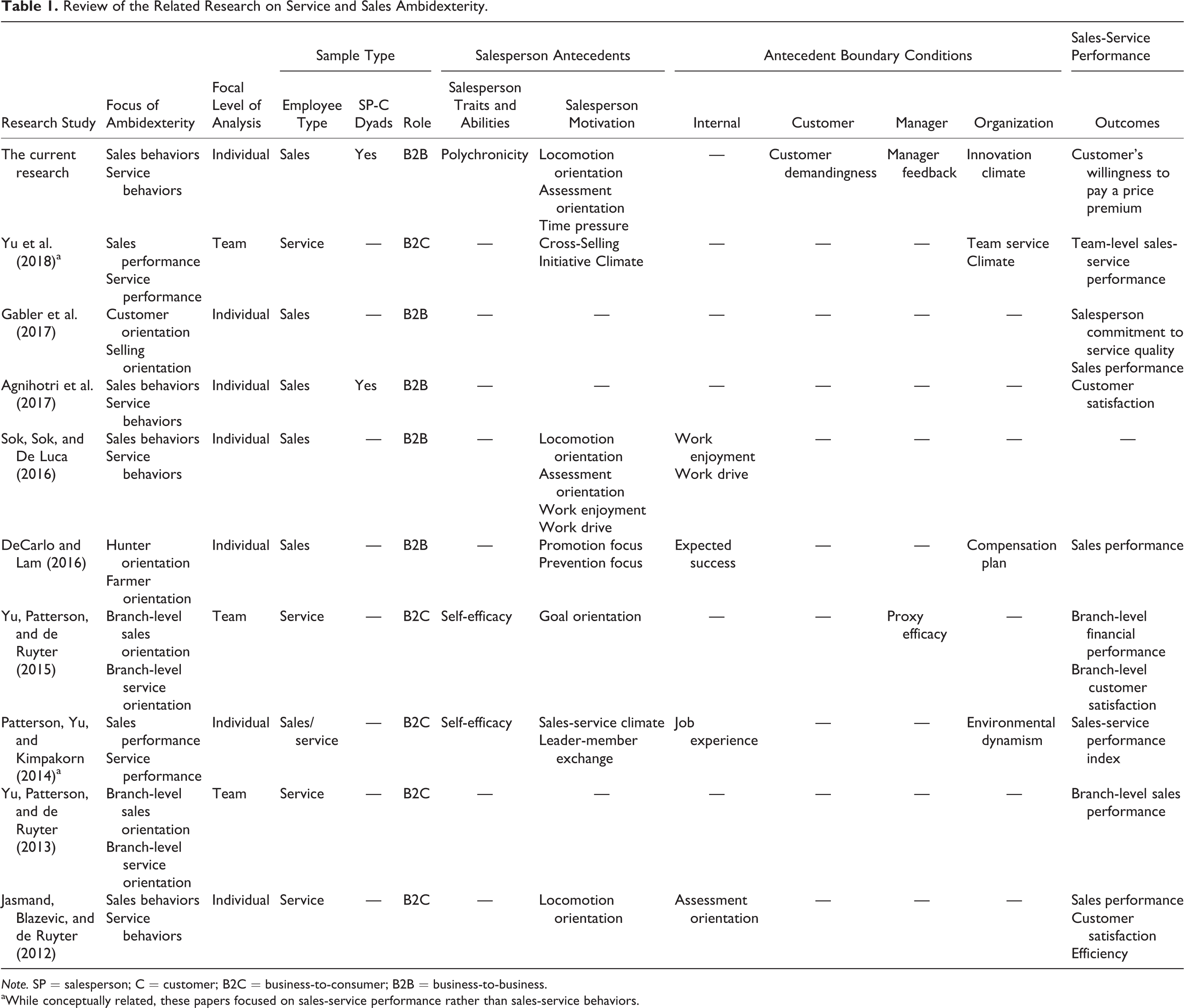
Note. SP = salesperson; C = customer; B2C = business-to-consumer; B2B = business-to-business.
aWhile conceptually related, these papers focused on sales-service performance rather than sales-service behaviors.
Second, many organizational leaders prefer to keep the sales and service functions separate to ensure each group delivers on sales and service outcomes (Schiff 2014; Zoltners, Sinha, and Lorimer 2016). This perspective suggests that combining service and sales roles at the individual level (vs. team or business unit level) comes at too great a cost to employees in the form of lower efficiency (Jasmand, Blazevic, and de Ruyter 2012) or greater role conflict (Gabler et al. 2017). However, research has yet to investigate whether combining these roles could provide customers greater value, which could potentially justify these costs. For example, the outcomes measured in most sales-service ambidexterity research focus on retrospective sales and service outcomes (i.e., sales performance and customer satisfaction), which can typically be achieved via separate sales and service divisions. Without value-added metrics to indicate loyalty or future profitability (Palmatier, Scheer, and Steenkamp 2007), it is difficult for sales leaders to justify the cost-benefit trade-off from blending the sales-service role.
To address these gaps (illustrated in Table 1), we test an integrative framework that examines antecedents and outcomes of salespeople’s SSA behaviors (see Figure 1) using 161 business-to-business (B2B) salesperson-customer dyads and performance data, representing firms across six industries. B2B selling is a perfect environment for studying SSA behaviors because B2B sales roles often entail a critical set of service behaviors that must be executed to create value when executing sales activities (Ahearne, Jelinek, and Jones 2007). Thus, we specifically posit that SSA behaviors can be reflected through B2B salespeople’s ability to execute both sales and service behaviors (A. A. Rapp et al. 2017). Given the impact of time in these dual roles and the importance of employee job fit, we focus our investigation on salespeople’s preference for structuring their own time—one task versus multiple tasks—as a key enabler of SSA behaviors. The preference for structuring time, termed polychronicity, is defined as the “preference for switching between multiple tasks within the same time block” (Arndt et al. 2006, p. 320). We draw from trait activation theory to examine environmental cues that enable or hinder salespeople’s enactment of SSA behaviors. Furthermore, SSA behaviors provide firms value-based outcomes as we posit and find that SSA behaviors increase a customers’ willingness to pay a price premium.
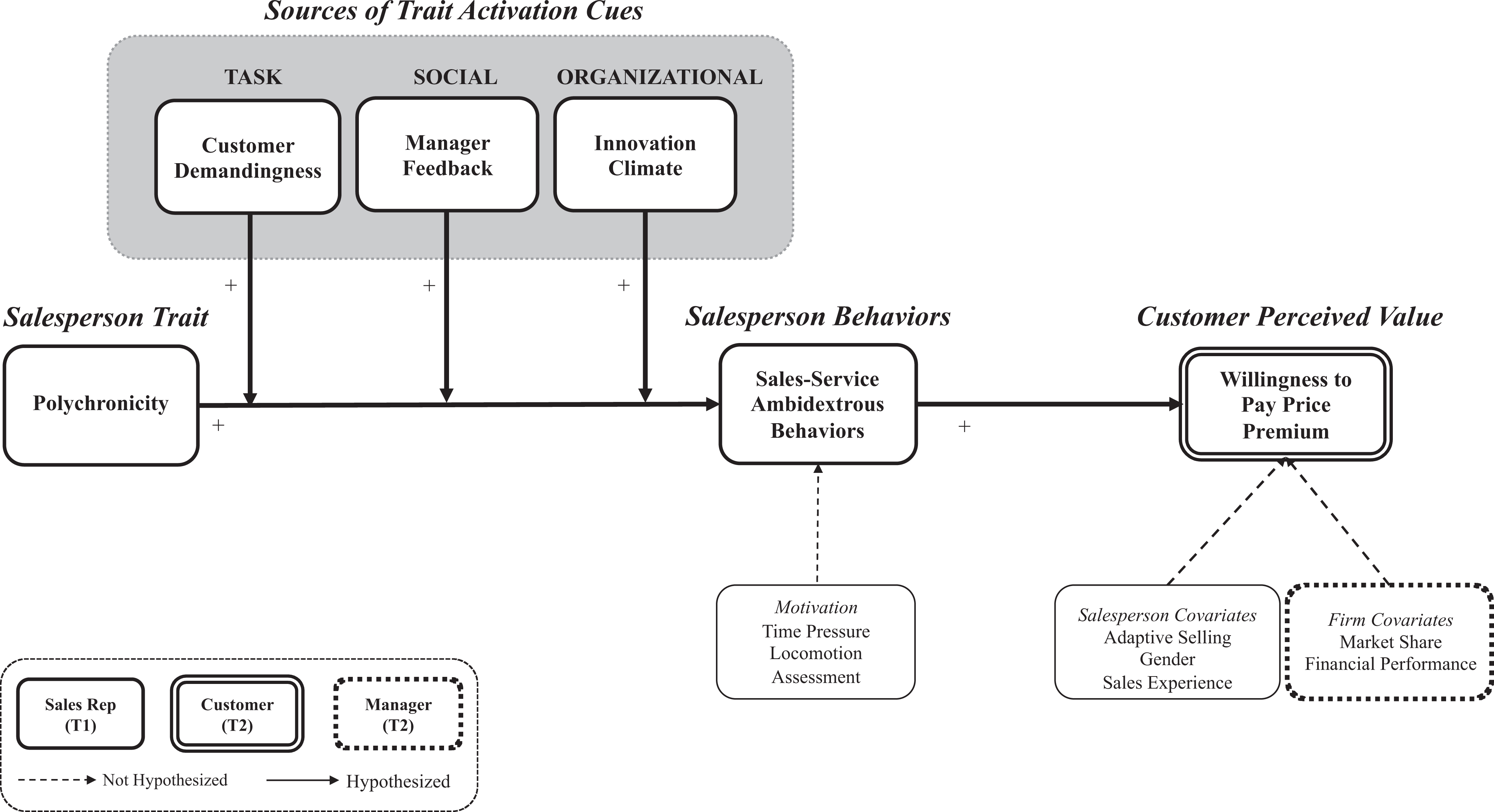
Hypothesized model.
This research makes several unique contributions. First, prior literature on ambidexterity focuses on motivations as a key determinant of sales-service ambidexterity (DeCarlo and Lam 2016; Sok, Sok, and De Luca 2016; Yu, Patterson, and de Ruyter 2013). However, previous research acknowledges that salesperson preferences for time use are critical when the management of multiple tasks (e.g., selling additional products, problem resolution) is the norm (Fournier et al. 2013). We address this knowledge gap by proposing that ambidextrous behaviors are not only driven by state motivations but also by the salesperson’s preferred time structure for work tasks (i.e., polychronicity). Our findings uncover that salespeople’s preference for switching among multiple tasks in the same time block (i.e., more polychronic vs. monochronic) leads to salespeople performing more SSA behaviors.
Second, in complex work settings such as ambidextrous roles, an individual’s behavior is often influenced by external cues that are out of the individual’s control. Trait activation theory guides us in identifying task, social, and organizational relevant cues that influence SSA behaviors. Our focus on three distinct external cues is noteworthy because previous studies on ambidextrous behaviors have not uncovered any boundary conditions outside the individual (see Table 1). Our results improve our understanding here, showing that the effect of salespeople’s polychronicity on SSA behaviors is enhanced when they serve highly demanding customers, receive feedback from managers, and work within a climate for innovation.
Third, we find that customers see greater value in salespeople who perform SSA behaviors, resulting in a higher willingness to pay a price premium. Establishing the link between SSA behaviors and customers’ perceived value clearly suggests a distinct advantage of adopting the dual-role sales force approach relative to structurally independent sales and service functions (i.e., structural ambidexterity). This value-added approach also aligns with the increasingly competitive B2B marketplace where customers seek efficiency in both the resolution of service problems and the execution of the sales process.
Conceptual Background and Model Development
The concept of ambidexterity traditionally refers to an organization’s ability to perform differing, and often competing, strategic actions at the same time (Gibson and Birkinshaw 2004). Research in this area emphasizes that ambidextrous strategies encourage employees to pursue apparently conflicting goals, suggesting that a firm’s ambidexterity is rooted in the employee’s ability to manage disparate task demands and integrate them for greater performance (Raisch et al. 2009). As a result, the conceptualtization of ambidexterity has evolved into a multilevel phenomenon with more recent focus emerging on individual ambidexterity (Junni et al. 2013).
In marketing, a stream of research with an individual-level focus on ambidexterity has developed with researchers examining various factors such as customer and selling orientations (Gabler et al. 2017) and hunting and farming orientations (DeCarlo and Lam 2016). As can been seen in Table 1, research on individual ambidexterity often focuses on service and sales ambidexterity. For example, Jasmand, Blazevic, and de Ruyter (2012) examine sales and service behavior in the context of customer service representatives. Similarly, Sok, Sok, and De Luca (2016) examine sales and service behaviors in B2B salesperson roles. Given the variation between the contexts studied (service vs. sales employees), it becomes important to clearly conceptualize how to view SSA within various role combinations.
We offer a sales and service ambidexterity continuum to distinguish the various role contexts inherent to these dual-role positions (see Figure 2). The continuum varies from focusing solely on sales behavior (i.e., addressing unmet needs by expanding or replacing the customer’s current offering) as the emphasis of the employee’s role, to focusing solely on service behaviors (i.e., helping customers fulfill needs via their current offering), with combinations of these responsibilities in between. Positions that fall under sales-specific roles are solely responsible for sales performance outcomes. These roles typically do not actively manage customer relationships, or have a very short-term orientation, and thus have no responsibility for service fulfillment. As a result, selling behaviors are highly emphasized. Positions that fall under sales-service ambidexterity are primarily focused on addressing unmet needs by expanding or replacing the customer’s current offering (e.g., selling new offerings, cross-selling additional offerings), while fulfilling service requests. Employees who fill these roles are expected to handle a variety of tasks such as conducting a needs assessment while handling service issues. Even though service fulfillment can be inherent to some of these roles, what remains clear is that the degree of service behavior varies greatly from employee to employee because of the emphasis on sales outcomes (Ahearne, Jelinek, and Jones 2007; Sok, Sok, and De Luca 2016).
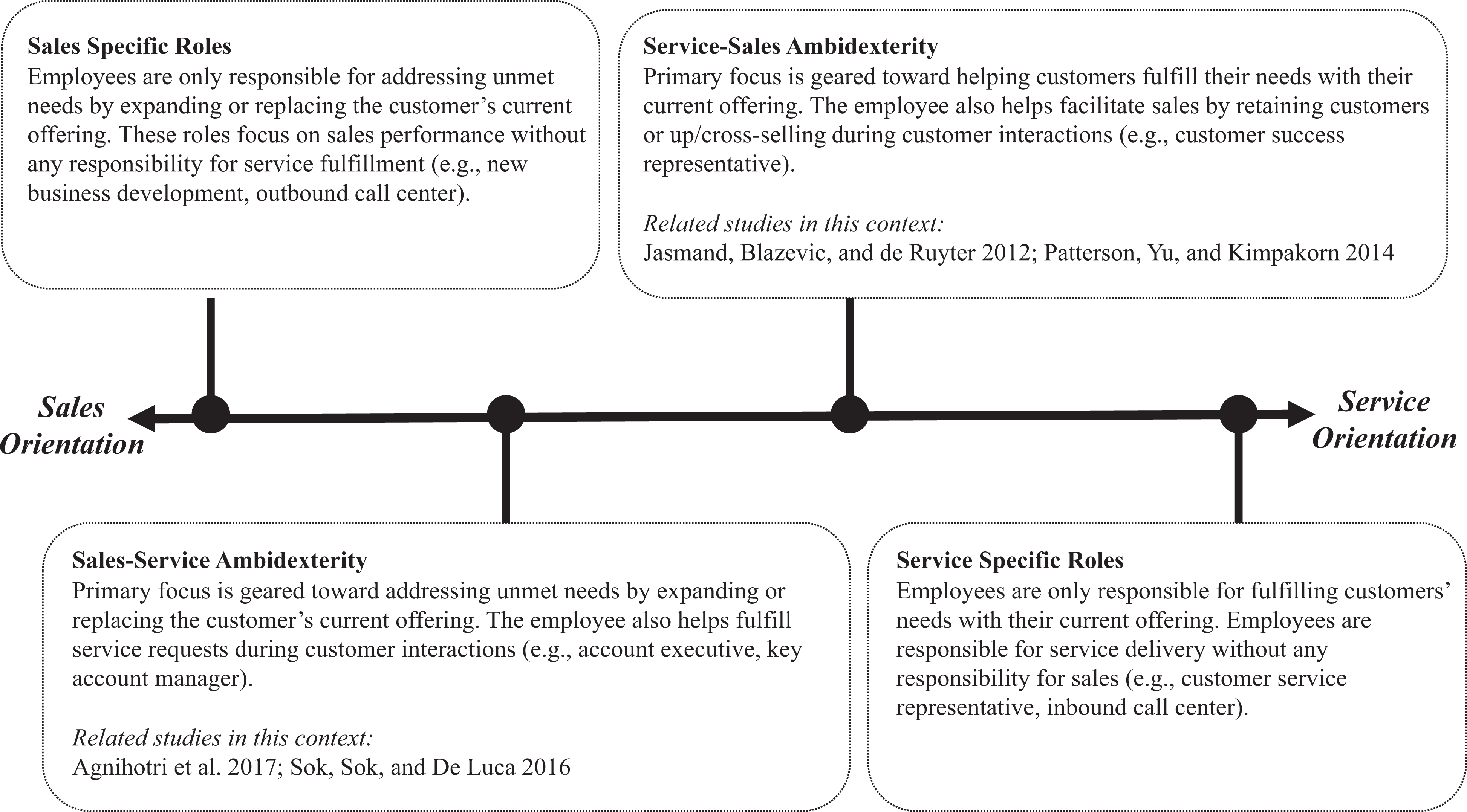
Sales and service ambidexterity continuum.
Sales-service positions are primarily more sales-oriented, with service delivery acting as a complementary component to help improve sales outcomes. This is in contrast to positions falling under service-sales ambidexterity where the primary focus is on helping customers fulfill their needs with their current offering. These roles are unique from other service-specific roles though, in that while they embody a service orientation, they also attempt to leverage their relationship to close sales by retaining customers or up/cross-selling during customer interactions. Service-specific roles are responsible for service delivery alone without any sales performance requirements.
In our study, we examine B2B salespeople whose primary role consists of growing the share of business within customer accounts while also maintaining satisfied relationships with their customers. This context fits well within the sales-service ambidexterity role, and related study contexts (e.g., Agnihotri et al. 2017; Sok, Sok, and De Luca 2016), and offers a suitable focus for studying sales-service ambidextrous behaviors. We posit that ambidextrous behaviors can be categorized as proactive behaviors that are, nonpatterned, nonrepetitious, and hard to imitate (Agnihotril et al. 2017). Our conceptual model focuses on salesperson trait-based antecedents to SSA behaviors. Further, given research in this area predominantly posits retrospective outcomes of ambidextrous behaviors such as sales performance and customer satisfaction (e.g., Jasmand, Blazevic, and de Ruyter 2012; Yu, Patterson, and De Ruyter 2015), scholars urge a deeper dive into the outcomes of ambidexterity (A. A. Rapp et al. 2017). In particular, SSA salespeople should offer greater value for customers—key to gaining competitive advantage—by delivering multiple functions within a single relationship. Yet the overwhelming focus of SSA outcomes on sales performance and satisfaction provides little evidence that SSA yields additional value to customers relative to separate sales and service organizations. Value justification is needed here because SSA behaviors impose significant resource limitations (i.e., less time for each activity) on dual-role employees. Without evidence of any added benefits for adopting this resource-taxing approach, sales leaders can justify separating the sales and service functions to achieve sales and service goals. In light of this, we seek to establish a link between SSA behaviors and customers’ perceived value (i.e., willingness to pay a higher price).
Trait Activation Theory
In examining the drivers of SSA behaviors, we follow trait activation theory that utilizes personality traits and environmental characteristics to explain an individual
For the ambidextrous salesperson, pursuing selling and service goals presents conflicting behavioral demands that can limit the time allocated to achieving each goal. For example, the variability and uncertainty associated with selling may seem incompatible with the efficiency and reliability associated with service activities (Jasmand, Blazevic, and de Ruyter 2012), such that the service may limit time devoted to selling. This constant juggling of activities requires salespeople to judge how to divide their time between demands for sales and service. As a result, the preference for how an individual allocates time represents an important situational aspect within the roles of ambidextrous salespeople. We therefore posit that a salesperson’s innate time preferences (i.e., polychronicity) should play an influential role in the enactment of ambidextrous behaviors.
Salesperson Polychronicity
Hall (1983) introduced the notion of polychronicity (vs. monochronicity) to describe the temporal personality of individuals. Individuals who are polychronic in nature prefer to do several things at a time (e.g., having two or three projects in hand); they are more strongly oriented toward the present and feel themselves less bound to a timetable or a procedure than monochronic individuals (Benabou 1999). It is important to underscore that the contrast between polychronicity and monochronicity is based on patterns of time allocation. That is, the emphasis is not on the speed with which tasks are completed but rather on how time is distributed (Hecht and Allen 2005). We follow previous literature to define polychronicity as the extent to which people prefer to switch among multiple tasks in the same time block (Bluedorn et al. 1999). However, Bluedorn et al. (1999) also suggests that polychronicity can take the form of task switching—the preference for moving between tasks in a given time block or simultaneous tasking (multitasking)—engaging in two tasks at the same time. Because sales and service behaviors often entail competing sets of tasks, we do not expect that sales and service behaviors occur simultaneously. Thus, in line with research in retailing (Arndt et al. 2006) and sales (Weeks and Fourneir 2010), we emphasize that polychronicity in the sales-service context relates to preferences for task switching, and not simultaneous tasking. This conceptualization of moving between tasks in a time block is appropriate for B2B sales roles in existing customer accounts where, for example, a salesperson resolves a customer issue and then switches tasks to offer additional products or upsell current offerings.
A crucial aspect of polychronicity relates to the individual’s ability to manage different and competing priorities, both mentally and socially (Bluedorn 2002). Research in sales finds that polychronicity helps improve salesperson performance in the face of ambiguous job demands (Fournier et al. 2013). Thus, for B2B sales roles defined by both service and sales tasks, polychronic salespeople can more easily engage in several activities during a given time period and thus should be better able to switch back and forth among different tasks such as selling and servicing customers than monochronic salespeople. For example, a salesperson who is visiting a customer’s facility to explore an opportunity to cross-sell may unexpectedly be faced with a post-sales service-related issue upon arrival. This unforeseen service obligation changes the nature of how the salesperson must manage their time and the relationship interactions in order to resolve the service issue effectively and uphold the cross-selling objective during the customer visit. Under such circumstances, a polychronic salesperson should be better able to handle an unforeseen customer service request and, while also on the visit, explore the cross-selling opportunity; conversely, a monochronic salesperson who prefers “closure on one task before moving on to the next task” (Fournier et al. 2013, p. 199) is less equipped to practice this sort of mental and social management. Thus, we believe polychronic salespeople will exhibit more SSA behaviors than monochronic salespeople.
Moderating Impact of Activation Cues
Trait activation theory further elaborates that both the characteristics of an employee and that of the environment influence and thus predict employee behaviors. In fact, the interaction of such characteristics can explain more variance than either characteristic alone (Caldwell and O’Reilly 1990). To conceptualize these environmental interactions, trait activation theory highlights three different sources of trait-relevant cues—task, social, and organizational—that help explain the activation of trait-based behavior in employment contexts (Tett and Burnett 2003). Task-level cues represent trait activation paths emerging from the nature of the work itself that helps define the expectations for employees’ job performance. In a selling context, for example, salespeople’s core tasks offer many cues centered on meeting customer expectations and responding to customers’ demands (Jaramillo and Mulki 2008; Wang and Netemeyer 2002). Social-level cues arise in working with others such as peers, supervisors, and subordinates’ and capture expectations of and explanations from socially significant others. For salespeople, sales managers are often considered a role model (Rich 1997), and manager feedback is one of the key social functions that affect salespeople’s approaches and behaviors (DeCarlo and Leigh 1996). Finally, organizational-level cues often represent the character of the organization such as organizational climate and culture.
Exploring the interplay between personality trait and situational cues within our sales-service ambidexterity framework, we investigate the role of customer demandingness (task-level cue), manager feedback (social-level cue), and innovation climate (organization-level cue). The objective is to understand how environmental “cues” emerging from these sources may impact the link between polychronicity and SSA behavior. All three variables represent situational factors that relate to the trait activation mechanism in a work behavior context. As a measure of task difficulty, customer demandingness provides sellers with “a summary of evolving market conditions such as competitive offerings, technological advances, and customization” (Wang and Netemeyer 2002, p. 219), while manager feedback is the information provided to the employee that indicates if and how an individual is meeting goals (Boshoff and Mels 1995). Firm innovation climate captures the salesperson’s perception of the organization-level support and encouragement of innovation in behaviors and processes (Scott and Bruce 1994).
Customer demandingness
Following trait activation theory, customers provide external cues to salespeople on the appropriate behaviors required for the task (e.g., performing sales and service). We focus on the task-relevant cues that resonate from customers based on the demands that they place on salespeople, termed customer demandingness. We define customer demandingness as the salesperson’s perception of customers’ product- and service-related requirements and expectations involving quality, reliability, delivery, and product-needs fit (Wang and Netemeyer 2002). More demanding customers have higher and more unique requirements for products and services than less demanding customers.
At the core, demanding customers want salespeople to shift along with their changing needs. Previous sales literature underscores the role of customer demandingness as one of the boundary conditions impacting relationships among key salesperson variables. Demandingness has been shown to strengthen the effect of supportive leadership on intrinsic motivation because it creates difficult customer tasks that challenge the salesperson’s capacity to achieve job goals (Jaramillo and Mulki 2008). Customer demandingness also enables salespeople to exhibit improvisational behaviors that are “not ‘pre-scripted’ but rather conceived and implemented extemporaneously” (Banin et al. 2016, p. 122). Therefore, highly demanding customers should encourage salespeople to proactively adopt task-switching behavior. Together, highly demanding customers provide task-level cues signifying the need for salespeople to be flexible, improvise, and change with the customers shifting needs. These cues will activate salespeople to enact polychronic behavior—strengthening the link between polychronicity and SSA behaviors.
Manager feedback
The richness and quality of exchanges between sales managers and salespeople can significantly shape the behavior and outcomes of the sales force. In organizational settings, manager feedback can be defined as a supervisor’s communication to a subordinate about the execution of work behaviors and the quality of job performance (Boshoff and Mels 1995). Providing proper feedback to salespeople regarding behaviors, productivity, or other important assessment criteria should provide a social-level cue that activates salesperson traits when executing work behaviors.
Based on trait activation theory, we posit that polychronicity is activated and leads to more SSA behavior when salespeople are provided more feedback from their manager. Manager feedback should play a role in reinforcing the activation of polychronic trait behavior as past research provides empirical evidence supporting the idea that manager feedback enables employees to handle unexpected (König and Waller 2010) and ambiguous (Fournier et al. 2013) situations. For example, sales literature has examined the moderating role of manager feedback in the relationships between emotional intelligence and creative behaviors (Agnihotri et al. 2014), as well as relational orientation and effort behaviors (Gabler et al. 2017). In line with this, we posit that manager feedback is a critical moderating factor in the polychronicity–SSA behavior relationship because it is more likely to reduce salesperson uncertainty about their own time management preferences and align their efforts toward task preferences (i.e., task switching); thus, feedback may further strengthen polychronic salespeople’s ability to perform SSA behaviors. In our context, because sales manager feedback should help salespeople confirm the desired dual behaviors for performance, greater feedback should help lead polychronic salespeople to proactively perform both service and sales behaviors.
Innovation climate
We also examine firm innovation climate as an organization-level cue for activating salesperson polychronicity. The psychological climate for innovation is defined as “the degree to which organization members perceived an organizational climate as supportive of innovation” (Scott and Bruce 1994, p. 583). For salespeople, a climate for innovation provides cues influencing salespeople’s perceived openness, flexibility, and encouragement toward novel methods of problem solving (Evans et al. 2007). The more supportive the organization to innovation, the more freedom the salesperson has to implement strategies appropriate for the needs and wants of their customers (Wang and Ma 2013). Thus, salespeople under an innovation climate should perceive more freedom to switch between selling and service tasks—taking an adaptive approach to execute both tasks—rather than prioritizing certain activities over the others. Substantiating this, salespeople are more cautious (less proactive) when trying new approaches for fear of how innovative behaviors will be received by their respective organizations (Agnihotri et al. 2014). Therefore, salespeople’s perceived efficacy of a polychronic trait—preference for task switching—is contingent upon a climate where the environment is open and responsive to dynamic approaches in employee processes and behaviors (Jang and George 2012). An innovation climate (i.e., rewarding creative behaviors, encouraging change) should provide cues that polychronicity is valued (e.g., activating the trait) and strengthen the link between polychronicity and SSA behavior.
Creating Value From Salesperson Ambidextrous Behaviors
We posit that salespeople who pursue both sales and service goals via SSA behaviors add value into the buyer-seller exchange process. Following previous research (Palmatier, Scheer, and Steenkamp 2007), we measure customers’ perceived value based on their willingness to pay a price premium. We define price premium as customers’ intentions to “continue to do business with the company even if its prices increase” (Zeithaml, Berry, and Parasuraman 1996, p. 38). Price premium reflects the customers’ willingness to spend more on acquiring the product or service in question, and it is considered as an important financial outcome (Homburg, Hoyer, and Koschate 2005).
Unlike specialized roles (e.g., new account development), ambidextrous roles require salespeople to develop expertise for revenue enhancement and service provision. This dual expertise enables salespeople performing SSA behaviors to devote attention to both selling and problem-solving tasks, making these salespeople poised to proactively address customers’ unique relationship needs. As a result, customers experience the value-added benefits of fewer relationship handoffs (i.e., single point of contact) while securing mutual goals via the SSA salesperson. Taking an example from our sample, a hospital’s purchasing manager often works closely with a supplier salesperson to ensure medical supplies and equipment are functioning properly for medical staff and patients. Service satisfaction during these interactions creates relationship-value and a preference for the relationship with the salesperson. As a result, purchasing managers are more willing to pay a higher price for additional offerings from the salesperson and avoid competitor salesperson relationships. Thus, if a salesperson can resolve customers’ service problems alongside promoting additional value-added offerings, the customer should attribute greater value to the salesperson and, in our case, be willing to pay a price premium. Supporting this, customers who perceive greater value from a salesperson relationship, both sales and service quality, are more loyal and willing to pay more (Palmatier, Scheer, and Steenkamp 2007).
Method
Data and Sample Description
To test our conceptual framework, dyadic survey data were collected in collaboration with a marketing research company that utilizes a broad network of B2B sales organizations across different industries. A B2B context serves as a relevant setting for examining ambidextrous behaviors (O’Cass, Heirati, and Ngo 2014; Sok, Sok, and De Luca 2016) because organizations within the B2B environment place an emphasis on developing a trusting relationship with clients (via service) and achieving repeat business along with additional growth (via sales). Therefore, criteria for the selection of companies for this study included the following: (i) the company operates in a B2B market and (ii) the salesforce maintains ongoing and long-term relationships with customers. Next, participants were randomly chosen from a selection of target companies.
Before data collection, we pretested each questionnaire to check the clarity and relevance of each item in the selling context. Based on feedback from respondents, questions were refined with appropriate guidance for better fit within B2B settings. Lastly, a panel of three academics reviewed the survey items providing support for face validity in B2B sales contexts.
The data collected comprise three sources of survey input: salespeople, customers, and managers. For the salesperson data, web-based surveys were administered over a 2-week period. We obtained a total of 220 responses from the salesperson surveys. For each salesperson invited to participate in this study, the independent research firm solicited a response from one of their respective customers (i.e., ongoing accounts) and the salesperson’s manager 3 months (a sales quarter) following the salesperson survey. Customer selection was done randomly from a census list of existing customers provided by each salesperson and reviewed by managers to control for self-reported bias. By design, the firm selected only existing customers to ensure salespeople had the potential to cross-sell and upsell, as well as service the customer. Thus, the basis of their activities focus on customer service provision and cross-/upselling opportunities. Code numbers were assigned to each salesperson, which were used to match salesperson, manager, and customer responses. Complete anonymity and confidentially were maintained for all who participated. We also emphasized the point that salespeople will not be evaluated based on the data collected in order to attenuate any social desirability bias of customers.
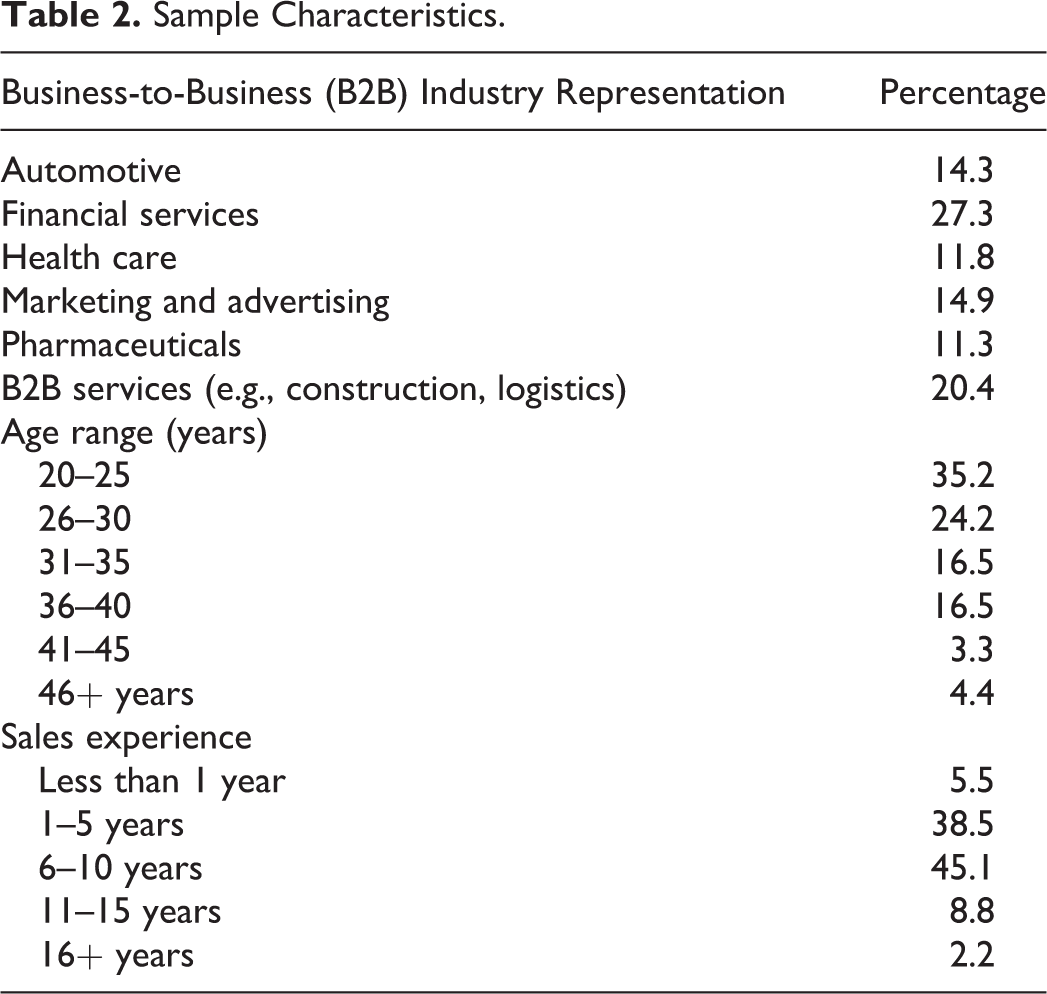
After collecting the customer survey responses, we removed dyads with missing values and unmatched data leaving 161 unique salesperson-customer dyads for analysis. Because only one name was randomly selected from the list of customers for each salesperson, each dyad was unique and no salesperson was entered twice in the final matched data. We compared matched and unmatched groups and found no significant differences among the focal variables in our study. The sample was 18% female, with an average sales experience of 6.4 years, average age of 30.7 years, and average tenure with the manager of 4.7 years. A description of our sample characteristics regarding industry, age, and sales experience can be found in Table 2.
Sample Characteristics.
Measures and Measurement Analysis
All latent measures are adapted from previously developed multi-item scales. For all scales, participants responded on a 7-point Likert-type scale with responses ranging from 1 (strongly disagree) to 7 (strongly agree) to indicate agreement with statements reflected in the items. Descriptive statistics and measurement validation can be found in Table 3 and Table A1 in Appendix.
Construct Correlation Matrix, Descriptive Statistics, and Measurement Assessment.
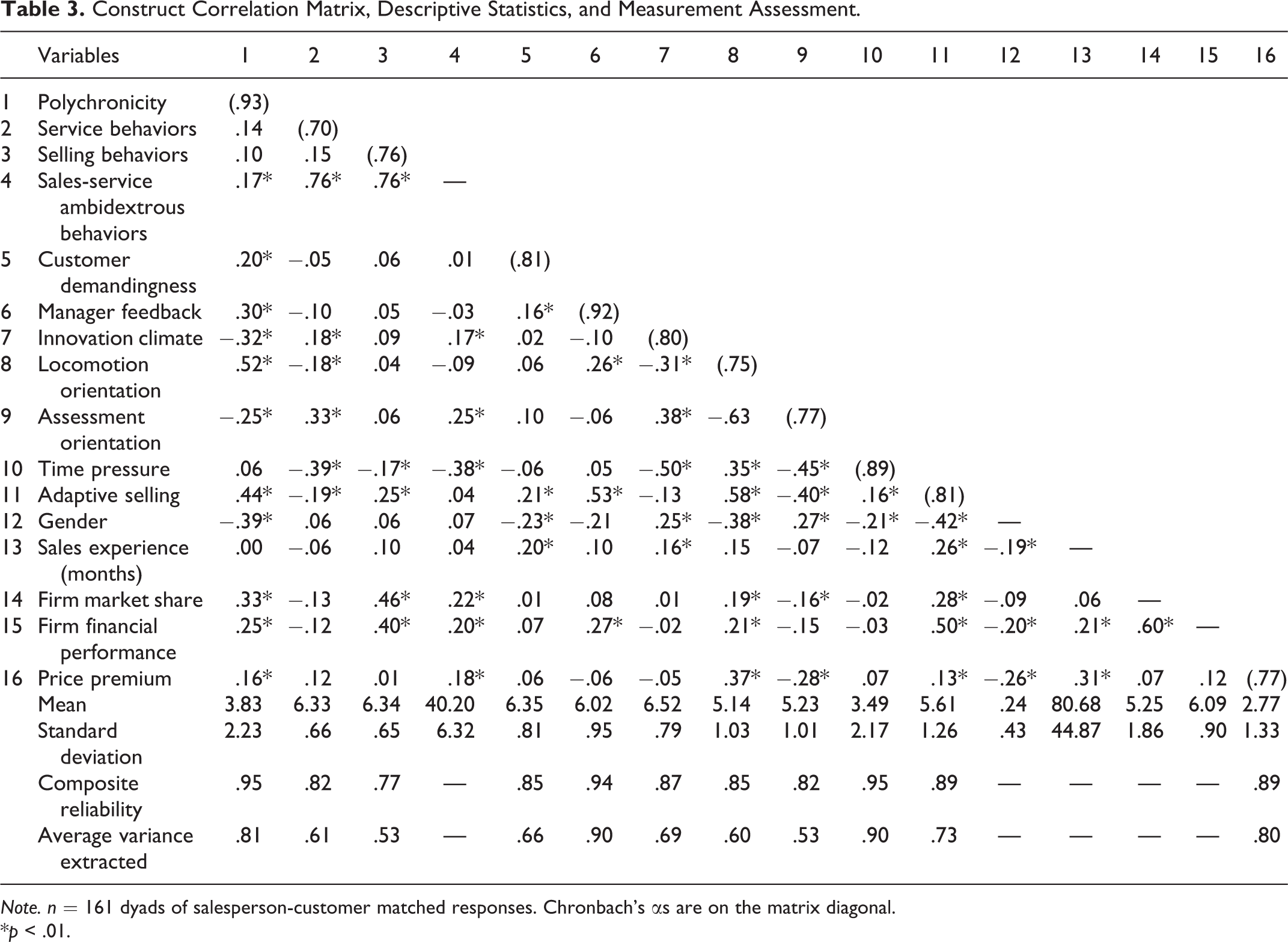
Note. n = 161 dyads of salesperson-customer matched responses. Chronbach’s αs are on the matrix diagonal.
*p < .01.
Salesperson-provided measures
We measured polychronicity using 4 items adapted from Fournier et al. (2013). One example item is “I believe people do their best work when they have many tasks to complete.” We measured customer service behavior using 3 items adapted from Jasmand, Blazevic, and de Ruyter’s (2012) Customer Service Provision Scale to measure the degree to which the salesperson provides service behaviors to their customers. For example, we include “During conversations with customers, I identify the customers’ problem with their products, and solve it in a reliable way.” We measure selling behavior using 3 items adapted from Jasmand, Blazevic, and de Ruyter’s (2012) Cross-/Upselling Scale to measure the degree to which the salesperson performs sales-focused behaviors to their customers (e.g., “During conversations with customers, I ask questions to assess whether the customers would be willing to buy an additional product”). Consistent with our conceptualization and previous studies on ambidexterity (e.g., Jasmand, Blazevic, and de Ruyter 2012), we multiplied the customer service behavior and selling behavior measures to operationalize our sales-service ambidexterity construct.
For the interactions in the model, customer demandingness was measured using 3 items adapted from Wang and Netemeyer’s (2002) scale with items such as “My customers have high expectations for service and support.” Manager feedback was captured using 2 items from Agnihotri et al.’s (2014) scale. For example, we include “My supervisor makes it a point of telling me when he or she thinks I manage my time well.” Lastly, we capture innovation climate from the salesperson’s perception, using 3 items from Scott and Bruce (1994) with items such as “In my company, creativity and innovation are always encouraged” and “The rewards system here encourages innovation.”
Customer-provided measures
With relationship marketing as a focal point of scholarly attention, researchers are increasingly studying customer-focused outcomes such as customer problem-solving (Agnihotri et al. 2014) and customer satisfaction (A. Rapp et al. 2006). In line with this stream, we examine customers’ willingness to pay a price premium—defined as a customer’s intention to “continue to do business with the company if its prices increase” (Zeithaml, Berry, and Parasuraman 1996, p. 38)—as a key value-added sales outcome that is also a behavioral consequence of service quality (Berry and Parasuraman 2004). We measured customers’ willingness to pay a price premium using 2 items adapted from previous work (Homburg et al. 2005; Palmatier, Scheer, and Steenkamp 2007; e.g., “My company will continue to do business with this sales representative even if prices increase”).
Model covariates
Because we perceive time as an important part of our SSA conceptualization, we covary time pressure with SSA behavior in our model using 2 items adapted from Andrews and Smith (1996) such as “I need more hours in the day to get my work done.” We also build from previous ambidexterity studies (e.g., Jasmand, Blazevic, and de Ruyter. 2012) and covary locomotion and assessment orientation measures using 4 items each adapted from Kruglanski et al. (2000). For example, the locomotion orientation measure includes the item “When I get started on something, I usually persevere until I finish,” and the assessment orientation measure includes “I am very self-critical and self-conscious about what I am saying.”
Previous studies also show that the customers’ relationship with the salesperson and the importance of the product to the customer can impact the price they are willing to pay (Palmatier, Scheer, and Steenkamp 2007). In light of this, we also covaried salesperson and firm factors to help rule out alternative explanations and provide more robust model estimates for our price premium–dependent variable. For salesperson factors, we covaried the sales experience, gender, and adaptive selling to help rule out alternative explanations stemming from individual factors. For firm factors, we covaried the market share and financial performance (relative to competitors) to account for the customer’s potential market dependence on the particular firm’s offering. These data were reported by managers. We also control for differences between industries by including industry dummy variables within our explanation of our price premium–dependent variable.
Analytical Approach
To test the hypothesized relationships, we used a partial least squares (PLS) structural equation modeling approach using SmartPLS Version 3.2.6 software. This modeling approach was chosen over a covariance-based structural equation modeling approach based on model estimation selection criteria from Hair et al. (2017). First, the nature of the polychronic orientation measure can lead to a bimodal distribution, making the assumption of normality less certain, a primary assumption in covariance-based structural equation modeling (SEM) packages. Because PLS-SEM is a nonparametric estimation procedure, it is better suited to address the unlikely assumption of normally distributed data. Second, a primary focus of our research was to investigate the strongest predictors of ambidexterity, which leads us to focus on exploring variables (e.g., polychronicity) that can explain greater variance. Lastly, PLS is superior to covariance-based SEM approaches when a product-indicator approach for modeling interactions is performed (Chin, Marcolin, and Newsted 2003; Hair, Ringle, and Sarstedt 2011). Product-indicator interactions can create errors and estimation difficulty due to nonlinear constraints, especially in larger SEM models (Ping 1996). Furthermore, interaction effects in covariance-based SEM, and the resulting complex constraints, require large samples to provide accurate parameter and standard error estimates. Given the complexity of our model and sample size, PLS provides the better estimation option.
Following the recommendations of Hair, Ringle, and Sarstedt (2011) and previous research (Ahearne et al. 2010), we multiplied standardized indicators of independent and moderating variables to create the latent construct interactions in PLS. Table 4 provides the standardized path coefficients, t values, and 95% bias-corrected confidence intervals [CIs] resulting from a 1,000 sample bootstrap analysis. We also include the R2 (percentage variance explained) for each endogenous construct to provide evidence of the explanatory ability of our model variables and interactions.
Partial Least Square (PLS)-SEM Results for Hypothesized Model.

Note. n = 161 dyads of salesperson-customer matched responses. Parameter estimates are standardized.
*p < .05. **p < .01.
Results
Construct Validity
Following Hulland’s (1999) recommendations for variance-based SEM models, we examine the results of several statistical analyses to ensure our measures are valid. As shown in Table 3, Cronbach’s α, composite reliability, and average variance extracted all indicate satisfactory reliability at the construct level. Additionally, item and construct discriminant validity analysis suggests satisfactory validity levels for all constructs following Fornell and Larcker’s (1981) criterion. Construct correlations can also be found in Table 3. As an additional check for discriminant validity, we follow Henseler, Ringle, and Sarstedt (2015) who recommend the heterotrait-monotrait (HTMT) approach to support measurement validity in PLS models. All construct correlations yield HTMT values well below the conservative HTMT.85 threshold, suggesting discriminant validity has been established. Lastly, the highest variance inflation factor (VIF) statistic was 2.90 indicating low levels of multicollinearity.
Model Results
Table 4 provides the parameter estimates for our main effects model and the full interaction model. To support overall model adequacy, we assessed the coefficient of determination R2 for our endogenous variables and the standardized root mean square residual (SRMR). Results show R2 values of .47 for sales-service ambidexterity and .22 for customers’ willingness to pay a price premium. We also find strong evidence of model fit with SRMR = .08 (Henseler et al. 2014).
In H1, we posit that higher salesperson polychronicity is associated with higher SSA behaviors. Our main effects model reveals a positive significant effect (β = .23, p < .01), supporting H1. We also note that time pressure shows a significant negative effect on SSA behavior (β = −.33, p < .01). Interestingly, while research has also found locomotion and assessment orientations to be predictors of ambidextrous behaviors for service representatives (Jasmand, Blazevic, and de Ruyter. 2012), we did not find a significant relationship for the B2B sales representatives in our study (β = −.04, p > .10, β = .14, p > .10, respectively).
Next, we uncovered the contextual nature of the polychronicity-ambidexterity relationship by examining the situational moderators within our model. Comparison of the variance explained for SSA behaviors between models shows ▵R2 = .26, providing strong support for the inclusion of our proposed moderators. Results from the full interaction model revealed that customer demandingness had a positive interaction effect (β = .32, p < .01), thus strengthening the relationship between polychronicity and SSA behaviors, supporting H2. In support of H3, manager feedback also strengthens the relationship between polychronicity and SSA behaviors (β = .25, p < .05). Innovation climate was also found to bolster the relationship between polychronicity and SSA behavior (β = .36, p < .01), providing support for H4.
To illustrate these interaction effects, we followed Cohen et al.’s (2013) simple slopes analysis approach (Figure 3A–C). Results reveal that when customer demandingness is high (i.e., +1 SD above the mean), the association between polychronicity and SSA behaviors is significant and positive (b = .58, p < .01). However, when customer demandingness is low (i.e., −1 SD below the mean), the effect is mitigated such that the association between polychronicity and SSA behaviors is not significant (b = −.06, p > .05). In a similar fashion, when manager feedback is high, the positive association between polychronicity and SSA behaviors is strengthened (b = .51, p < .01). When manager feedback is low, the association between polychronicity and SSA behaviors is nullified (b = .01, p > .10). Lastly, the impact of polychronicity on SSA behaviors is positive under highly innovative climates (b = .62, p < .01), but negative under low innovation climates (b = −.10, p < .05). These patterns of results indicate that polychronicity’s positive effect on SSA behaviors is stronger in contexts that cue polychronic behavior.
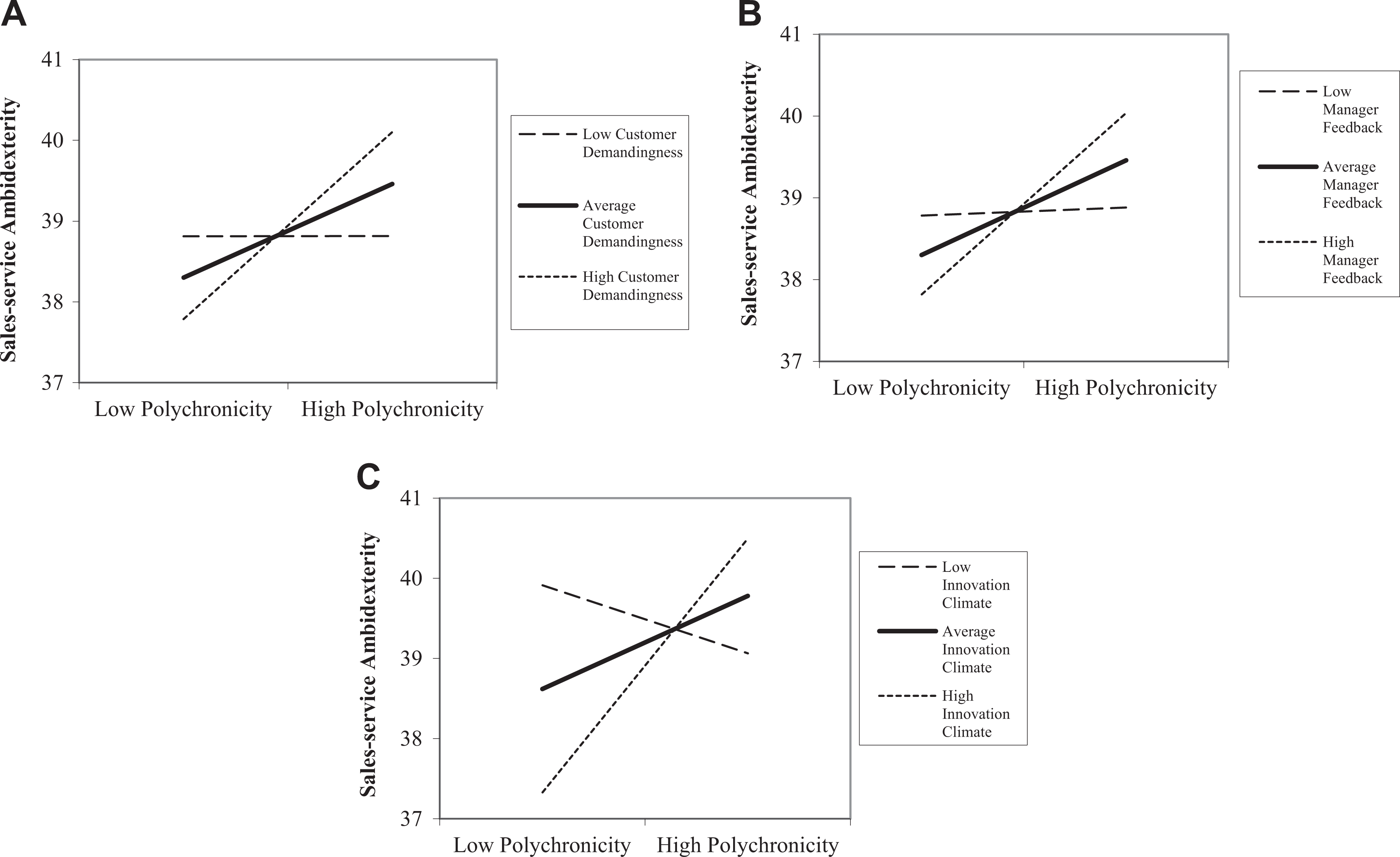
Interaction effects of selling context and polychronicity on sales-service ambidextrous behaviors. (A) Task cues (customer demandingness), (B) social cues (manager feedback), and (C) organizational cues (innovation climate).
In our remaining hypothesis, we examined the performance consequences of SSA behaviors, focusing on price premium as an indicator of greater value created for the customer. Results show that as expected, SSA behaviors have a positive association with price premium (β = .21, p < .01), supporting H5.
Additional Analysis: Conditional Indirect Effects
Following Preacher, Rucker, and Hayes (2007), we use a bootstrap sampling approach to test the conditional indirect effects of polychronicity on price premium as mediated through SSA behaviors. First, results indicate that the indirect effect from polychronicity to price premium through SSA behaviors is .06 with a 95% bias-corrected CI of [.02, .14], providing support for a partial mediation effect. We conducted additional tests for the conditional indirect effects through SSA behaviors as moderated by customer demandingness, manager feedback, and innovative climate. Following advice from Hayes (2015) to examine the index of moderated mediation, results show that the conditional indirect effect of innovative climate is .10 with a 95% bias-corrected CI of [.04, .16]. Using simple slopes analysis to probe this effect reveals that the indirect path through SSA behaviors is positive and significant for salespeople with a strong (+1 SD) innovative climate (b = .18, p < .05), but the indirect path falls away under a weak (−1 SD) innovative climate (b = .03, p > .10). Additional results show that the conditional indirect effect from manager feedback is .05 with a 95% bias-corrected CI of [−.03, .11], thus we do not find support for this relationship. Lastly, results focused on customer demandingness as the moderator demonstrate a conditional indirect effect of .07 with a 95% bias-corrected CI of [.04, .13]. Probing this effect reveals that the indirect path through SSA behaviors is positive and significant for salespeople under high (+1 SD) customer demandingness (b = .17, p < .05), but the indirect path is mitigated under low (−1 SD) customer demandingness (b = .04, p > .10). These results suggest that polychronic salespeople with demanding customers and innovative climates are more likely to accrue higher prices via their SSA behaviors.
To provide additional support for our multiplicative measure of SSA behaviors, we also conducted a hierarchical modeling approach by estimating a first-order model with cross-selling and service provision as predictors of price premium followed by a second-order model that included the multiplicative SSA construct. For PLS models, a Q2 > 0 provides support that the model has predictive relevance for an endogenous construct (Chin 1998), and the comparison of Q2 values between models provides evidence of the effect of a specific exogenous construct, called the q2 effect size
Common Method Bias
When independent and dependent variables are obtained from the same source, it is important to consider the potential of common method variance (CMV). To help minimize this potential, we relied on recommendations from Podsakoff et al. (2003). For ex ante considerations, we used separate sources (salespeople and customers) for a portion of the predictor and criterion variables. Additionally, we worked to ensure the survey measures were concise and randomly ordered and that all participants understood their anonymous status. Regarding ex post considerations, the model results indicated significant interaction effects. This undermines the plausibility of respondents’ implicit theories or CMV as alternative accounts of the data (Siemsen, Roth, and Oliveira 2010). We also completed an additional robustness check using a measured latent marker variable (MLMV) approach that has been shown to detect and correct for CMV in PLS analyses (Chin et al. 2013). For our marker variable, we selected a 7-item measure of environmental orientation (e.g., T. L. Gabler, Rapp, and Richey 2014) because it is theoretically unrelated to the model variables, yet is associated with positive salesperson behaviors, and thus is more likely to partial out effects of CMV due to sources such as social desirability. Our choice of marker also exhibited low correlations with the other constructs in our study (−.05 to .09). Importantly, results were equivalent between the original research model and the MLMV model. Together, we conclude that the possibility of our results being impacted by CMV is remote.
Discussion and Implications
In an effort to provide more value to customers, many organizations are assigning multiple, yet often conflicting, responsibilities to their frontline employees (e.g., selling activities alongside customer service) to achieve short-term and long-term firm objectives. Yet, evidence from practice (Zoltners, Sinha, and Lorimer 2016) and academia (Agnihotri et al. 2017) would suggest that this approach is not only difficult for salespeople to perform but provides limited benefits relative to a separate sales and service role approach. With that in mind, our research focuses on how to capitalize on this growing trend of integrating service within B2B sales roles.
Our research begins by providing guidance on factors that impact salespeople’s enactment of SSA behaviors. We find that salespeople’s polychronicity—preference for switching between multiple tasks within the same perceived time period—is a key driver of SSA behaviors. Further, results show that selling contexts with more demanding customers, greater manager feedback, and a stronger climate for innovation strengthen the link between polychronicity and salesperson SSA behaviors. Important to SSA strategy in practice, we find that SSA behaviors improve salespeople’s value-selling ability as shown by customers’ willingness to pay a price premium. We believe our findings contribute to the literature on ambidextrous behavior and sales-service performance in several ways and offer implications for managers aiming to guide their sales force to take on both selling and customer service.
Theoretical Contributions
Drivers of salesperson ambidextrous behavior
In an increasingly competitive environment that has motivated an expansion of salesperson activities (Singh et al. 2019), sales targets (Glynn 2015), and heightened time efficiency (Fournier et al. 2013), little attention has been paid to salesperson characteristics, traits, and abilities that align with these broader and more time-pressured contexts such as in ambidextrous salesperson roles. Indeed, prior research on the drivers of ambidexterity has provided important insights on motivational states such as promotional focus (e.g., DeCarlo and Lam 2016) and locomotion orientation (e.g., Jasmand, Blazevic, and de Ruyter 2012) with very few findings on trait- or ability-based drivers that could explain salesperson behavior beyond self-efficacious beliefs (Patterson, Yu, and Kimpakorn 2014; Yu, Patterson, and de Ruyter 2015). Our focus on polychronicity extends this literature stream by illustrating a trait-based driver of ambidextrous behavior. This finding is particularly notable given research on selling roles shows a strong impact from individual differences in driving positive behaviors and performance (Wang and Netemeyer 2002).
Our findings also highlight the importance of broader research that incorporates salesperson characteristics as well as motivation (e.g., goal states) to understand ambidextrous behaviors. Specifically, previous ambidexterity research on goal states has shown mixed results. Locomotion was a significant predictor of ambidextrous behaviors for service representatives (Jasmand, Blazevic, and de Ruyter 2012), while in sales-defined roles, locomotion and assessment were both positively linked to ambidextrous behavior in pharmaceutical salespeople (Sok, Sok, and De Luca 2016). Interestingly, by accounting for the salesperson trait, polychronicity, we failed to find a significant relationship for either of these goal states for the cross-industry B2B sales representatives in our study (see Results section). This suggests that the link between contexts, traits, goal states, and ambidextrous behaviors might be less straightforward than previously thought. Our research offers insight into the nuances of this link by distinguishing between the subtle differences in time perceptions and self-regulation mechanisms. In brief, locomotion orientation represents a preference to work on a different activity rather than standing still, and assessment orientation captures a preference to compare alternative states for judging their relative worth (Kruglanski et al. 2000). Because locomotion and assessment orientations maintain the separation of tasks, either in starting a new one or judging worth, respectively, these states may not fully motivate ambidextrous behavior when certain tasks are preferred over others. In contrast, a polychronic perspective integrates multiple task activities within the same time block. Thus, a polychromic salesperson is more likely to perform multiple tasks regardless of preference; hence, explaining why the effects of both goal states are no longer significant when polychronicity is included in our model.
We also offer additional insight to help illustrate the challenges of asking sales and services reps to take on more responsibilities. In our study, we find that salespeople’s perception of time pressure has a negative impact on SSA behaviors (β = −.26), highlighting an additional motivation or contextual factor that impacts enactment of ambidextrous behavior. We believe this finding should not only alarm firms that are asking more of their employees but opens the door for future research focusing on individual differences in perceptions of time and other time-centered personality traits as these may offer new insights in explaining dual-role behavior.
Trait activation cues
Our model and analysis also help identify environmental factors—customer demandingness, manager feedback, and organizational climate of innovation—that influence the impact of salesperson polychronicity on SSA behavior. Previous literature on the antecedent boundary conditions of SSA primarily focus on salesperson factors such as proxy efficacy (Yu, Patterson, and de Ruyter 2015) and work enjoyment (Sok, Sok, and De Luca 2016) as well as other boundary conditions from compensation plans (DeCarlo and Lam 2016), environmental dynamism (Patterson, Yu, and Kimpakorn 2014), to service climate (Yu et al. 2018). Yet, all of these studies examine these contextual moderators’ influence on SSA orientations or SSA performance, which we distinguish from SSA behavior. Thus, with the exception of assessment orientation (Jasmand, Blazevic, and de Ruyter 2012), we have a limited understanding of how situational contexts promote SSA behavior. Contributing to this literature, our research identifies three situation-relevant cues in the salesperson’s environment that help strengthen the link between polychronicity and SSA behavior.
Using these cues within the trait-activation framework (Tett and Burnett 2003) provides a clear and flexible guide for future research to examine situation-relevant cues that activate polychronic trait behavior, as well as other salesperson characteristics that drive sales-service ambidexterity. Situational cues such as relationship control (R. R. Mullins et al. 2015), goal monitoring (T. L. Rapp et al. 2014), and climate (Ogilvie et al. 2017) could offer important cues that influence salesperson SSA orientations, behavior, and performance. In particular, Ogilvie et al. (2017) highlight that the integration of sales and service climates can create challenges for organizations seeking both sales and service outcomes.
Managerial Implications
Building a sales-service ambidextrous sales force
Our findings offer valuable insight for managers hiring and overseeing ambidextrous roles by underscoring the importance of polychronic activation in SSA contexts. Specifically, our evidence supports the proposition that salespeople’s SSA behaviors are linked with innate, time-related, traits such as polychronicity. Drawing from this, managers have several options during hiring to identify salespeople who prefer to handle multiple tasks at a time (Arndt et al. 2006). If framed appropriately, managers could design a workplace-relevant measurement scale drawing from Bluedorn et al.’s (1999) Inventory of Polychronic Values that could be used for recruiting (Tett, Jackson, and Rothstein 1991). Alternatively, hiring managers can offer an experimental test to determine preferred work styles or conduct depth interviews for recruits to reflect on task preferences in previous roles. Salespeople who feel uncomfortable engaging in multiple activities in a given time period, or avoid task switching, are less suited for roles which encompass both sales and service demands.
Moreover, managers play a key role in enabling the right contexts when setting dual-role expectations for their sales force. Our findings related to trait activation cue—emerging due to the presence of customer demandingness, manager feedback, and climate of innovation—offer critical implications for managers. Specifically, sales leaders should ensure alignment between salespeople’s polychronic behavior preferences and the contextual forces that reside within the external (customer demandingness) and internal (innovation climate) contexts where the sales force operates. For example, utilizing customer relationship management (CRM) system applications, managers could align their polychronic salespeople with demanding customers. By doing so, managers increase the opportunity for SSA behaviors and, therefore, enhance the potential for value-added selling with their salesforce. Along the same line, the link between salesperson polychronicity and SSA behaviors is enhanced by the organization’s climate for innovation. Given previous research emphasizes the critical role of leaders in shaping innovative culture (e.g., Hunt and Morgan 1995) and customer orientation (R. Mullins and Syam 2014), this finding emphasizes that frontline managers must play an active role to create an environment for SSA behavior. Leadership factors such as leader-member exchange (Scott and Bruce 1994) as well as participative decision-making (Hurley and Hult 1998) provide a clear set of starting points for developing an innovative climate. Managers should cultivate these values and norms in order to enhance SSA behaviors from their polychronic salesforce.
Building on the importance of leadership, our findings also show that manager feedback influences the relationship between polychronicity and SSA behaviors, cementing the notion that manager-salesperson communication is a key factor for the ambidextrous sales force. This is a critical insight as salespeople are particularly susceptible to conflicting role perceptions when performing SSA behaviors (Gabler et al. 2017). Therefore, managers need a constructive feedback process so salespeople continually receive social cues that clarify expectations.
Value-added outcomes of SSA behaviors
This research also offers insights for leaders that oversee selling and service activities with their customers. Traditionally, leaders create structures and systems to reconcile the seemingly conflicting goals between these two responsibilities. This structural ambidexterity is most commonly exemplified by task partitioning systems, whereby firms designate certain groups to be responsible for selling goals while another group offers customer service provision to meet different goals. Another solution leaders often implement is a temporal separation, where employees focus on one set of activities for a specified period of time, then switch to a different set of activities during a different specified time (see Gibson and Birkenshaw 2004). Both approaches allow firms to fulfill competing demands, but the reliance on structurally separate activities (either by group or time) prevents employees from delivering benefits on the customers’ time line. Customers must communicate with multiple frontline employees in these structurally ambidextrous organizations, which can raise coordination problems. For example, salespeople often “block” or fail to include the service department or representative when dealing with customers, which destroys customer value (Murtha, Challagalla, and Kohli 2011). Despite this shortcoming, firms that manage to retrospective sales and service goals (i.e., sales performance and customer satisfaction) see little alternative to this approach because of the additional costs from lower efficiency (Jasmand, Blazevic, and de Ruyter 2012) and role conflict (Gabler et al. 2017) that exist when combining the roles.
We offer leaders a different perspective. To truly understand the benefits of ambidextrous roles, it is important to consider forward-looking metrics that indicate value received, loyalty, and future profitability (Palmatier, Scheer, and Steenkamp 2007). Our findings provide initial support for this premise in that SSA salespeople offer greater value within the customer experience by delivering multiple functions via a single relationship. Specifically, we validate the benefits of the ambidextrous sales force by uncovering the positive link with customers’ willingness to pay a price premium. Price premium has been considered as a reflection of a customer’s loyalty toward the company (Evanschitzky et al. 2012), and studies have aligned price premium with financial outcomes (e.g., profitability) resulting from salesperson-customer relationships (Foster and Cadogan 2000) and from overall customer satisfaction (Homburg et al. 2005). As a result, we help justify the cost-benefit trade-off from blending the sales-service role by providing evidence of the additional value from an SSA model that could not be achieved within structurally separate functions.
Limitations and Future Directions
No study is without limitations that open avenues to explore for new research. In our study, we explored SSA behaviors across many firms, which enabled us to strengthen the generalizability of our findings. However, we were unable to delve deeply within a single firm to identify aspects across salespeople that sell in the same situations. This type of research would provide insight on more salesperson characteristics, beyond the motivations that impact SSA behaviors. What other characteristics impact salespeople’s ability to practice SSA behaviors or influence salespeople’s SSA behaviors on performance duality? This research would provide important insight on how sales organizations set expectations for their salespeople.
While we studied three contexts that influenced salespeople’s enactment of SSA behaviors, other selling situations and organizational factors should also be explored. Based on the literature (Agnihotri et al. 2017; Jasmand, Blazevic, and de Ruyter 2012), we utilized the measures for cross-selling and service provision to capture sales-service ambidexterity. Because our focal construct is sales-service ambidextrous behaviors, by design, the firm collected data from current accounts to ensure salespeople had the potential to cross-/upsell as well as provide post-sales service. However, it would be very interesting to explore other actual behaviors classified as ambidextrous. 1 For example, salespeople are commonly responsible for meeting with customers and developing relationships. Yet, in some organizations, they are responsible for entering trouble tickets and addressing service issues. More broadly, in the near future, salespersons may be asked to make regular use of analytics, artificial intelligence, machine learning–based tools, and other technologies to make recommendations to customers. Thus, exploring ambidexterity in a variety of specific contexts could be useful. It may also be fruitful to examine the trajectories of organizations that are shifting emphasis toward ambidexterity—shifting salespeople into account management/service responsibilities versus shifting service/technical personnel into sales roles.
Further, our study focuses on salesperson ambidexterity rather than service representative ambidexterity. While similarities in these roles exist (see Figure 2), future research should examine the specific nature of sales and service with ambidextrous responsibilities. There may be contextual factors that differentiate adding service to a salesperson’s responsibilities and vice versa. Illustratively, a locomotion orientation is influential for driving ambidextrous behavior in service delivery roles (e.g., Jasmand, Blazevic, and de Ruyter 2012) but is not in selling roles as found here. Salespeople and service representatives may operate under a different mind-set when their roles are broadened. Also, traditional sales and service roles have differences in required skills, training, compensation, and goals. A fruitful area for research would aim to not only understand how to recruit, train, and retain ambidextrous employees but understand how these processes may differ between roles that are primarly sales and those that are primarily service.
Lastly, we focused on one sales-service performance outcome—price premium. Building off previous literature, we believe that customers’ willingness to pay a price premium signifies these customers perceive additional value. However, we do not directly measure perceived value or benefits or other sales-service performance measures. Fruitful research could focus on not only how SSA behaviors impact value perceptions and other various performance measures but how they do so in various settings (e.g., B2B vs. B2C, salespeople vs. service reps).
Supplemental Material
Supplemental Material, JSR_Summary - The Ambidextrous Sales Force: Aligning Salesperson Polychronicity and Selling Contexts for Sales-Service Behaviors and Customer Value
Supplemental Material, JSR_Summary for The Ambidextrous Sales Force: Aligning Salesperson Polychronicity and Selling Contexts for Sales-Service Behaviors and Customer Value by Ryan Mullins, Raj Agnihotri and Zachary Hall in Journal of Service Research
Footnotes
Appendix

| Measurement Items | Loadings |
|---|---|
| Salesperson Reported | |
| Polychronicity | |
| I like to juggle several activities at the same time. | .79 |
| I believe people do their best work when they have many tasks to complete. | .95 |
| I believe it is best for people to be given several tasks and assignments to perform. | .94 |
| I would rather complete several projects every day than complete an entire project. | .92 |
| Customer service provision | |
| During conversations with customers, I.… | |
| …identify the customers’ problem with their products and solve it in a reliable way. | .82 |
| …listen attentively to customers to handle their concerns regarding their products. | .81 |
| …pay attention to the customers’ questions regarding products to answer them correctly. | .71 |
| Cross-selling behaviors | |
| During conversations with customers, I… | |
| …ask questions to assess whether the customers would be willing to buy an additional product. | .75 |
| …utilize a good opportunity to advise customers of a product which they could benefit from. | .72 |
| …usually offer an additional product which meets the customers’ needs best. | .72 |
| Customer demandingness | |
| My customers have high expectations for service and support. | .88 |
| My customers require a perfect fit between their needs and our product/service offering. | .62 |
| My customers expect me to deliver the highest levels of product and service quality. | .90 |
| Manager feedback | |
| My supervisor makes it a point of telling me when he or she thinks I manage my time well. | .98 |
| When I fail to meet expectations, my supervisor indicates his/her dissatisfaction. | .90 |
| Innovation climate | |
| In my company, creativity and innovation are always encouraged. | .65 |
| This organization is open and responsive to changes. | .92 |
| The rewards system here encourages innovation. | .89 |
| Locomotion orientation | |
| I feel excited just before I am about to reach a goal. | .79 |
| When I get started on something, I usually persevere until I finish it. | .83 |
| Most of the time, my thoughts are occupied with the task I wish to accomplish. | .90 |
| I don’t mind doing things even if they involve extra effort. | .53 |
| Assessment orientation | |
| I am very self-critical and self-conscious about what I am saying. | .60 |
| I spend a great deal of time taking inventory of my positive and negative characteristics. | .91 |
| I like evaluating other people’s plans | .70 |
| I often compare myself with other people. | .67 |
| Time pressure | |
| I never have enough time to think ahead. | .97 |
| I need more hours in the day to get my work done. | .93 |
| Adaptive selling | |
| Each customer requires a unique approach. | .81 |
| When I feel that my sales approach is not working, I can easily change to another. | .86 |
| I like to experiment with different sales approaches. | .89 |
| Customer reported | |
| Price premium | |
| My company will continue to do business with this sales representative even if prices increase. | .97 |
| If this salesperson were to raise prices, I would continue to be a customer of the supplier. | .81 |
| Manager reported | |
| Firm market share | |
| Our market share is much better than our main competitor. | — |
| Firm financial performance | |
| Our anticipated ROI is much better than our competitor. | — |
Acknowledgments
We would like to acknowledge the financial support given from the Sales Education Foundation (SEF)/Neil Rackham Annual Research Grant Award as well as the Ralph and Luci Schey Sales Centre Research Investment Program at Ohio University.
Declaration of Conflicting Interests
The author(s) declared no potential conflicts of interest with respect to the research, authorship, and/or publication of this article.
Funding
The author(s) disclosed receipt of the following financial support for the research, authorship, and/or publication of this article: Sales Education Foundation (112714).

Note
References
Supplementary Material
Please find the following supplemental material available below.
For Open Access articles published under a Creative Commons License, all supplemental material carries the same license as the article it is associated with.
For non-Open Access articles published, all supplemental material carries a non-exclusive license, and permission requests for re-use of supplemental material or any part of supplemental material shall be sent directly to the copyright owner as specified in the copyright notice associated with the article.
