




Abstract
Building on new theoretical foundations in the professional selling domain, growing bodies of research on frontline ambidexterity, and an increasingly demanding and dynamic frontline role, this article advances frontline ambidexterity through three focal goals. We first provide an in-depth discussion of the evolution of the professional selling role. This foundation allows us to identify and explore the implications of a market-driven model of ambidexterity that can manifest organically within certain professional selling contexts. In so doing, we espouse a new model of individual-level ambidexterity—organic frontline ambidexterity. Next, we discern existing models of frontline ambidexterity (characterized as inorganic) and compare these to the organic model proposed. Finally, we provide an organizational framework of frontline ambidexterity enablement to provide context for organizations to best align and enable ambidexterity as a dynamic capability. We provide corresponding research questions in an effort to aid in the systematic expansion of frontline ambidexterity research.
In a marketplace increasingly characterized by rapid change, rising complexity, and surges in technological advancement (Day 2011; Hunter and Perreault 2007; Sheth and Sharma 2008), organizations are exploring new efficiencies in frontline management (Lam, DeCarlo, and Sharma 2019). One option being considered by many organizations to increase frontline productivity is the adoption of an ambidextrous frontline management strategy (Yu, Patterson, and de Ruyter 2013). With market forces changing the frontline role (Hartmann, Wieland, and Vargo 2018), ambidexterity aims to combine service and sales efforts and increase frontline efficiency (Jasmand, Blazevic, and de Ruyter 2012). Indeed, both research and practice view this ambidextrous strategy of servicing existing clients, while generating new business as a prerequisite to both survival and success in today’s marketplace (Raisch and Birkinshaw 2008).
Duncan (1976) first introduced the concept of “ambidexterity” at an organizational level to examine the trade-offs between securing current certainties in a marketplace and pursuing new opportunities. While originally conceptualized at the organizational level, ambidexterity has also been leveraged as a theoretical lens for management and marketing research at the managerial level (Mom, Fourné, and Jansen 2015), within teams (e.g., Lubatkin et al. 2006), and at the individual level with customer service representatives (e.g., Jasmand, Blazevic, and de Ruyter 2012). As a metaphor for the pursuit of seemingly conflicting strategic goals (Lubatkin et al. 2006), becoming truly ambidextrous requires harmonizing the management of contradictory demands when exploiting current resource positions and simultaneously exploring future market opportunities (Raisch and Birkinshaw 2008). Yet literature from the organizational level down to recent work at the individual level has consistently treated exploitation and exploration activities as inherently opposing; resulting in a view of diminished, but inescapable trade-offs.
Blending sales and service activity has the potential to generate increased value for both buyers and sellers by reducing or even mitigating the disconnect between supplier and buyer objectives. Despite a growing interest in ambidextrous frontline units, reports of failed implementation and negative implications abound. For example, Wells Fargo confronted challenges related to the implementation of an ambidextrous strategy created to enhance revenue generation of their financial advisors. Following aggressive sales goals set for this traditionally service-oriented role, financial advisors reportedly encouraged customers to move and increase investments in such a way as to maximize revenue for the firm, often at the expense of the customer (Glazer 2018). This example demonstrates the pervasive challenges that plague frontline ambidexterity in absence of strategic approaches to enable and manage this capability. Yet, despite ongoing research (e.g., DeCarlo and Lam 2016; van der Borgh, Jong, and Nijssen 2017) and the introduction of new classification schema (Lam, DeCarlo, and Sharma 2019), the challenges associated with frontline ambidexterity prevail.
This research provides insight on this organizational priority by considering frontline ambidexterity in light of a new theoretical foundation for selling—service ecosystems (Hartmann, Wieland, and Vargo 2018). Through a service ecosystems lens, ambidexterity manifests within the frontline role as a result of market-driven factors (e.g., increasing customer demands, heightened service expectations, buyer access to offerings and information). Service ecosystems perspective allows “a robust theoretical framework” (p. 2) to examine frontline phenomena like ambidexterity without the restrictions of traditional, firm-centric, and unidirectional assumptions (Hartmann, Wieland, and Vargo 2018). Ultimately, this provides a foundation for understanding a unique model of frontline ambidexterity that occurs in response to market dynamics—organic frontline ambidexterity.
Considering the implications of service ecosystems, ambidexterity can manifest organically within ecosystems characterized by customer-oriented, complex markets with heightened expectations (Lam, DeCarlo, and Sharma 2019; Hartmann, Wieland, and Vargo 2018). Existing models of frontline ambidexterity often consider firm-driven, inorganic ambidexterity that results from top-down strategic frontline role expansion and the formal addition of role responsibilities (e.g., Jasmand, Blazevic, and de Ruyter 2012; Yu, Patterson, and de Ruyter 2013). Organic ambidexterity however is market driven and involves adaptation of the frontline role at the individual level and an informal alignment of employee behaviors with ecosystem demands. Leveraging service-dominant logic, organic ambidexterity embraces the broader transitions in the way markets create, perceive, and measure value (Vargo and Lusch 2004).
In the following sections, we discuss the evolution of the professional selling role and the emergence of a market-driven, organic frontline model of ambidexterity. We contrast this unique manifestation of ambidexterity with existing conceptualizations and extant research of firm-driven or inorganic ambidexterity. By examining instances of organic versus inorganic ambidexterity, we propose new considerations in the study of frontline ambidexterity that shed light on the implications of alignment between market expectations and frontline ambidexterity. Considering the variation in actors, expectations, or complexity that can exist within a frontline exchange (Rackham and DeVincentis 1998), customer expectations and market alignment are crucial pieces in the puzzle of effective frontline ambidexterity. Finally, we outline opportunities for organizations to enable frontline ambidexterity and propose an organizational framework for frontline ambidexterity enablement. We provide corresponding research questions in an effort to aid in systematic expansion of frontline ambidexterity research.
The Evolution of the Professional Selling Role
The role of a salesperson in the emerging era will be more than that of a general manager. Salespersons will be responsible for marshalling internal and external resources to satisfy customer needs and wants. (Sheth and Sharma 2008, p. 260)
Considering the evolution of new theoretical foundations in selling and an increasingly demanding and dynamic frontline role, this research first provides a discussion of the evolution of the professional selling role within an increasingly service-dominant marketplace. As customers are increasingly expecting organizations to offer a “single face” when it comes to both selling and customer service activities (Rapp et al. 2017), we acknowledge that broader changes in the market have been shifting the roles of salespeople for some time. Following transitions in the way value is defined in markets, the professional selling role has evolved to encompass greater integration of (traditionally) service activities (Davies, Ryals, and Holt 2010; Sheth and Sharma 2008). Most recently, marketing research has begun to highlight the implications of all exchange activities existing within a larger service ecosystem (Hartmann, Wieland, and Vargo 2018). While the importance of the salesperson role continues to increase (Cron et al. 2014), shifts in value perceptions have actually resulted in the masking of many selling tasks and processes. In today’s market, many of these activities and processes are not seen in the traditional light of “generating revenue” (Vargo and Lusch 2004) but instead facilitate relationship or exchange value that is less tangible (Hartmann, Wieland, and Vargo 2018). In this way, many industries likely have salespeople engaging in ambidextrous behavior within a majority of customer exchanges as the sales process becomes increasingly multidirectional. In approaching the question of frontline ambidexterity from a professional selling perspective, this research demonstrates the implications of an increasingly service-dominant market on the evolution of the frontline sales role and the ultimate manifestation of organic ambidexterity.
Market dynamics have been shifting perceptions of value within frontline exchange and the professional selling role for some time (Marshall and Michaels 2001). As marketing has shifted from a transactional to relational view (Anderson 1996), the role of the frontline salesperson has become increasingly crucial to value creation and customer satisfaction (Weitz and Bradford 1999). In fact, evolution in sales processes and selling schemes has mirrored the service shift, changes in customer goals, new buyer and seller capabilities, and an emphasis on customer relationship management practices for decades (Sheth and Sharma 2008). In previous decades, sales effort has been characterized by one-way communication within the customer exchange with an emphasis on tactical goals and objectives tied to stimulating customer needs rather than satisfying them (Cespedes 1994). Historically, these transactional mind-sets were reinforced with a product-centric focus within the organization and control systems that rewarded short-term revenue generation (Wotruba 1996). Yet, with the introduction of service-centered approaches to customer value creation (Vargo and Lusch 2004), organizations began to recognize that value flows naturally in both directions during the customer exchange. With the broadening view of value creation processes, the range of service-focused sales activities on the frontline continues to expand (Hartmann, Wieland, and Vargo 2018).
As organizations began blurring the lines between the products they were selling and the during- and post-exchange service provided to customers (Sharma et al. 1999), fundamental shifts in sales processes, an emphasis on bundled solutions, and an increase in customer-centric sales approaches resulted. In particular, the relationship marketing paradigm shift led to a rise in customer-focused salespeople and consultative selling agents (Arnett and Badrinarayanan 2005). This, alongside automation practices that are shifting transactional purchasing processes to technology outlets (Sheth and Sharma 2008), resulted in a decrease in the demand for salespeople that only fulfill transactional needs. Ultimately, as the emphasis on activities that focus solely on unilateral revenue generation has diminished, a new consultative selling era has emerged and rewarded those sales forces that have evolved to adhere to the new terms of selling (Hartmann, Wieland, and Vargo 2018). Through this new lens of selling, value creation unfolds between actors within the exchange in complex and dynamic systems of value creation (Hartmann, Wieland, and Vargo 2018). Ultimately, this ongoing frontline shift in value has led to a consultative sales role that is embedded within the buying firm (Liu and Leach 2001), offering insights and seeking solutions for the customer (Sheth and Sharma 2008), and providing a constant and consistently intertwined service and sales interface at the point of the customer exchange (Rapp et al. 2017). In this way, in many firms, the frontline sales role has evolved organically toward a natural state of service-sales integration without the imposition of formal organizational interventions and additional role requirements typical of existing models of service-sales ambidexterity.
Inorganic and Organic Models of Ambidexterity
To uncover the implications of frontline ambidexterity relative to firm value creation and individual switching costs, we first consider the two existing approaches to structuring frontline ambidexterity relative to the organic model proposed in this work. In extant research, individual-level ambidexterity has largely been considered in terms of systematic approaches that involve (1) the expansion of formal role responsibilities for customer service representatives through the addition of sales responsibilities mandated by the organization or (2) an emphasis on secondary customer service responsibilities in the salesperson role. Notably, each of these approaches relies on employees undertaking additional tasks and balancing multiple expectations that are treated as unique organizational imperatives. Ultimately, this requires frontline employees to engage in activities that “aim to change” (p. 22), with the uncertain returns and heightened risk of failure tied to new tasks (Jasmand, Blazevic, and de Ruyter 2012). In this way, existing models consider frontline ambidexterity that is largely driven by the organization. We consider such firm-driven approaches and formal role expansions as inorganic models of frontline ambidexterity.
Conversely, when joint sales and service expectations are driven by underlying shifts in market dynamics (as opposed to firm strategy), an organic manifestation of frontline ambidexterity likely results for sales activities within service-dominant markets. Thus, an organic model of frontline ambidexterity derives from informal role expansions and the evolution of professional selling to encompass customer relationship management strategies and value cocreation techniques. While these distinctions may seem nuanced, organic manifestations of frontline ambidexterity within the sales role as opposed to inorganic frontline ambidexterity have unique implications for value creation, resource and effort duplication, switching costs, short- and long-term performance, and the alignment of frontline employee activities with customer expectations. In order to maximize value and minimize waste, ambidexterity requires coordination and integration of activities (Teece 2007), just as the salesperson’s role increasingly calls for value to be delivered to the customer and the organization concurrently (Davies, Ryals, and Holt 2010).
Advancing sales theory increasingly acknowledges that the selling role no longer refers to a unilateral approach to persuading a buyer and exchanging a product or service (Hartmann, Wieland, and Vargo 2018). Instead, the selling paradigm has shifted to encompass dynamic and multidirectional interactions between the buying and selling firm to optimize relationships through concurrent value creation (Sheth and Sharma 2008; Vargo and Lusch 2004). With simultaneous goal pursuit as the crux of ambidexterity (Raisch and Birkinshaw 2008), concurrent value creation opportunities represent ideal conditions for frontline ambidexterity to create value for both the organization (sales revenue) and the customer (service value) within the exchange. By embracing the service ecosystem perspective (Hartmann, Wieland, and Vargo 2018), selling actors, processes, and activities can be redefined in terms of the broader system of value creation in which the exchange occurs. Hartmann, Wieland, and Vargo (2018) advocate for a systems perspective that identifies crossing points or locations at which ongoing alignment creates the opportunity for exchange efficiencies. As a result, the selling role incorporates value cocreation and codelivery processes into each interaction in an effort to accommodate both sales performance and buyer-seller relations in the broader service exchange, generating value for all stakeholders (Lusch and Webster 2010). In this way, the sales-service interface acts as a natural crossing point for selling and customer service efficiencies (Rapp et al. 2017), making advanced frontline sales processes inherently ambidextrous. In Figure 1, we illustrate the implications of inorganic versus organic ambidexterity. As shown, inorganic models of ambidexterity involve expanding the frontline role and the high mental barriers that can result from multiple tasks that are perceived to have discrete goals (Jasmand, Blazevic, and de Ruyter 2012). Alternatively, we illustrate organic ambidexterity as the manifestation of frontline sales activities being carried out within a larger service ecosystem. The resultant blurring of sales and service-oriented tasks (Rapp et al. 2017) creates market-driven, organic manifestations of frontline ambidexterity.
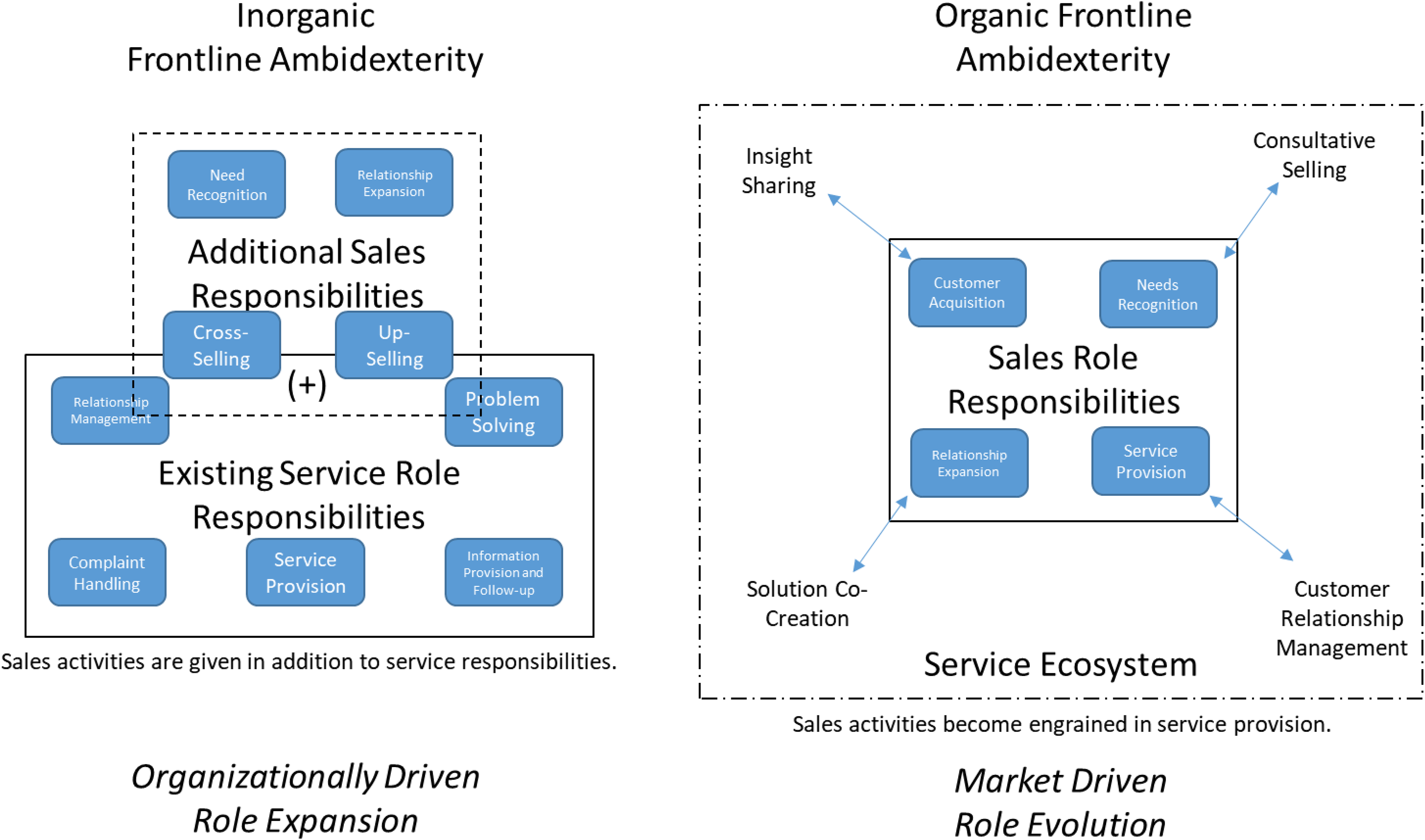
Inorganic and organic models of ambidexterity.
Interestingly, this lens allows us to consider the nuances of frontline ambidexterity in markets that are increasingly dynamic, complex, or relationship driven. In these contexts, market dynamics drive organic expectations that service and sales value be intertwined (Rapp et al. 2017). This creates an opportunity for natural adaptation on the frontline to meet changing market demands. At the individual level, natural selection (i.e., job retention) favors those employees capable of continuously adapting to meet evolving customer expectations. This has initiated an ongoing, natural evolution of the frontline sales role and the organic emergence of an ambidextrous frontline that—when enabled with the proper resources—can lead to emergent states of simultaneous sales and service value creation.
Microfoundations of Ambidexterity: Dynamic Capabilities and Ambidexterity Enablement
Apparently, firms struggle to create conditions that are conducive to a successful alignment between customer service and sales. (Jasmand, Blazevic, and de Ruyter 2012, p. 20)
In order to identify those behaviors that would represent value alignment and simultaneous pursuit of both sales and service goals, we extend organizational ambidexterity frameworks (e.g., Duncan 1976; Lubatkin et al. 2006; Tushman and O’Reilly 1996) and leverage those frontline activities identified in previous service-sales integration research (e.g., Rapp et al. 2017). Building on the sales-service interface, we outline the microfoundations of ambidexterity that generate concurrent sales and service value within the exchange. We include account management, customer information management, communication, and provision activities (Rapp et al. 2017), as well as solution creation, relationship expansion, coordination, information gathering, planning, and market analysis activities (Anderson 1996; Marshall and Michaels 2001; Piercy 2006; Weitz and Bradford 1999); activities tied to service contract increases (Bolton, Lemon, and Verhoef 2008, 2004; Jap 1999); and other hybrid activities that reside within the sales-service exchange. While we gather these activities from a number of recent research streams surrounding the duality of frontline value creation, we do not maintain that this is an exhaustive list but merely a starting point from which to build future work surrounding scale development, ambidexterity enablement research, and theoretical advances surrounding strategic management of frontline service sales ambidexterity.
Notably, successful execution of frontline ambidexterity hinges on alignment of frontline employee actions with customer preferences, needs, and expectations. Value derived from sales or service activities is highest when exchange activities align with desired and expected behaviors. Traditional sales activities, service activities, or sales activities embedded in service exchanges generate the most value when delivered under circumstances in which the customer exchange expectations are consistent with the sales and service levels provided. For example, with one-time transactions, simple order procurement, or straight rebuy situations, a customer’s highest “service” value may come from the selling firm’s ability to provide transaction speed, low prices, and ease of ordering (Rackham and DeVincentis 1998). Consultative clients, however, emphasize and place value on insight, customized offerings, and high-touch relationships; ultimately, valuing an ambidextrous approach that uses service to bolster value creation within the sales exchange. For this reason, driving value creation and realization within the customer exchange starts with alignment of employee response with the expectations that exist for different types of customer accounts and customer exchange goals (e.g., short- or long-term customer goals). In Figure 2, we consider the interaction of account complexity with customer orientations to begin highlighting conditions for optimal value creation through alignment of frontline ambidexterity strategies with customer expectations.
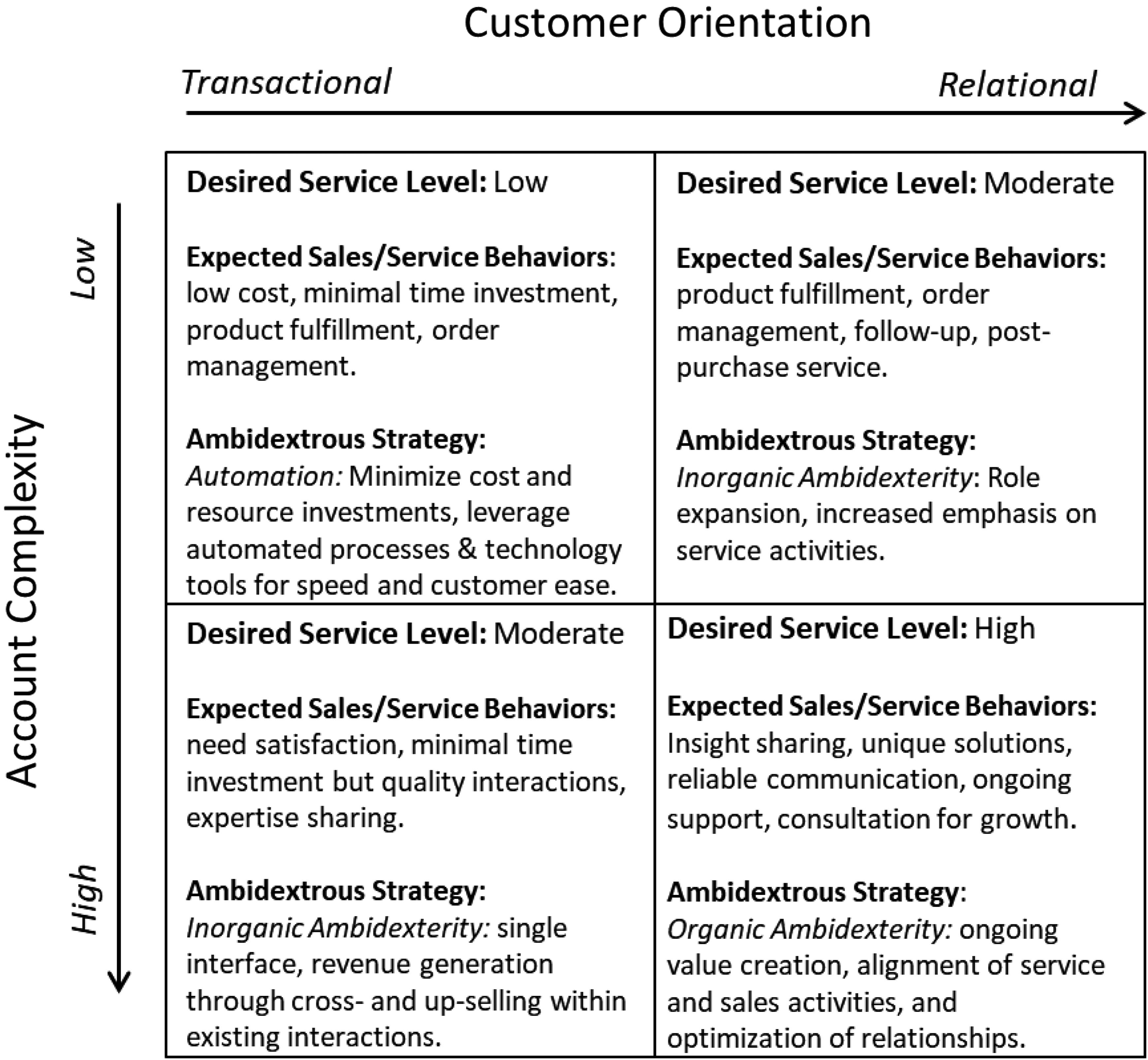
Aligning frontline ambidexterity strategies with customer expectations.
While ambidexterity arises from the organizational context within which units operate (Gibson and Birkinshaw 2004), many firms fall short when attempting to create the conditions necessary for successful service and sales alignment (Jasmand, Blazevic, and de Ruyter 2012). When driven by the market, and demanded by customers, the activities outlined in previous sections represent beneficial pursuits of simultaneous sales and service provision. However, it would be foolish to believe that, even when organically derived, the performance of these activities at high levels for extended periods of time is easily sustainable by even the most qualified frontline employees. Instead, if an organization hopes to cultivate an ongoing competitive advantage around frontline ambidexterity, strategic ambidexterity enablement activities will be necessary at every level of the organization.
Recently, researchers have begun conceptualizing the microfoundations of ambidexterity as a dynamic capability that exists at the individual level (Rapp et al. 2017). However, emerging work in dynamic capabilities suggests that the ability to learn quickly and build new assets involves processes to reconfigure competencies and transform existing assets to generate sustained competitive value (Arndt and Pierce 2017). Thus, contextual drivers within the organization will be necessary to facilitate the emergence of ambidexterity as a dynamic capability. By considering the complex and dynamic environment in which employees operate, as well as the nuances of value creation within a buyer-seller exchange, we underscore the implications of contextual levers on the generation of a competitive advantage around frontline ambidexterity. Specifically, we believe that cultivating a competitive advantage from frontline ambidexterity requires enablement processes at multiple levels of the organization.
In order to create and sustain a competitive advantage surrounding frontline ambidexterity, organizations must identify and manage different structural mechanisms to cope with the competing demands facing the organization and frontline employees (Adler, Goldoftas, and Levine 1999; Tushman and O’Reilly 1996). Indeed, in their seminal work on salesperson performance drivers, Walker, Churchill, and Ford (1977) emphasize that it is not simply individual factors that drive performance, but a culmination of organizational, environmental, motivational, and numerous other role factors that play a significant role in frontline success. Thus, a cohesive and pervasive enablement strategy must exist to provide resources that aid in meeting the additional demands placed on all levels of a market-driven ambidextrous organization. Employee characteristics alone will not provide an adequate lever for ultimate, ongoing performance improvements (Sheth and Sharma 2008).
Macro-Level Ambidexterity Enablement
Much like organizational approaches to leveraging information systems (Palanisamy 2003), adopting customer relationship management software (Ahearne, Hughes, and Schillewaert 2007), managing customer care (LeBon and Hughes 2009), or even utilizing social media technologies (Ogilvie et al. 2018), when organizations attempt to integrate resource intensive initiatives to combat environmental demands without the proper mechanisms, strategies, or support structures to supplement new processes, the positive effects of these initiatives will likely be subpar or even detrimental compared to expectations. While intended to increase adaptability and capture performance gains, all of the initiatives mentioned above stand testament to the fact that without a proper strategy and supporting processes, even the most effective techniques may miss the mark. Such instances are further showcased in our initial example detailing the implications of a Wells Fargo approach to frontline ambidexterity that was implemented without proper control systems, training, or organizational support and ultimately resulted in failure. Extant marketing research underscores the challenges of unsupported ambidexterity in frontline roles and the implications for subpar performance outcomes in both sales and service metrics as well as the potential for role conflict and ambiguity (e.g., Gabler et al. 2017; Ogilvie et al. 2017).
Organizational level
At the organizational level, ambidexterity enablement requires setting a strategy for change in organizational structures with planned processes and predictable outcomes (Winklhofer 2002). It is through the integration and coordination of adaptive activities that firms create a system for seizing sales opportunities and satisfying ongoing customer demands (Green, Whitten, and Anthony Inman 2012). At the organizational level, this strategy will likely require a number of cooperating processes and functions. These include systems for classifying customer expectations and account complexity to first align customer value seeking with appropriate frontline responses (see Figure 2). As alluded to earlier, market-driven organizations must understand that customers seek different service levels and derive value based on the congruence between service desired and service-level provision during the exchange. For example, transactional accounts with short-term exchange goals would gain little additional value from extensive contact with a frontline employee and would instead derive value from ease of ordering, unbundled offerings, fast delivery, and an ultimately lower price than would a consultative customer. Indeed, as customer expectations evolve following a greater variety of engagement options through dynamic technologies, digital tools, expanding communication channels, and reliance on automated processes, organizations are presented with opportunities to streamline and automate customer interactions using things like artificial intelligence. In some cases, customers may ultimately be best serviced through the use of automated sales process and (increasingly) through artificial intelligence and machine learning systems. Ultimately, serving well and selling well will mean different things to different customers and organizations must first and foremost be equipped to identify and classify exchange opportunities through processes that support efficient frontline resource deployment.
With processes in place to best manage resource allocation, the organization must then consider optimal approaches to cultivating a climate that supports and rewards concurrent value creation. Cultivating a climate that enables ambidexterity requires leadership that is dedicated to both short- and long-term performance goals (Turner, Swart, and Maylor 2013) and encourages pursuit of both objective sales revenue goals as well as more subjective relationship satisfaction goals. However, in designing creative compensation models to incentivize both sales and service performance outcomes, organizations can examine frontline performance beyond sales quotes to consider and reward relationship expansion goals, account renewal percentages, quotas tied to referrals, and ultimately by keeping a pulse on customer satisfaction and its link to ongoing and increased business performance (Grewal and Sharma 1991; Sharma 2000). The biggest challenge tied to reward systems in the case of ambidexterity is the dynamic nature of this capability. A dynamic capability requires a dynamic measure of performance. Thus, organizations will need to consider both current performance while simultaneously leveraging performance tracking tools that provide a true pulse of employee performance with respect to both exploitations of current accounts and exploration of new opportunities. Ultimately, if we expect a frontline that practices ambidexterity in customer exchanges, traditional compensation structures based on sales alone will not be adequate (Sheth and Sharma 1997). Structure will ultimately be reinforced not only through routines and processes, but incentives that enable ambidexterity through formal and informal mechanisms (Turner, Swart, and Maylor 2013). Forward-looking metrics tied to growth in profit, customer satisfaction, account retention, and consistent relationship expansion will paint a clearer picture of concurrent sales and service value creation.
Managerial level
When enabling ambidexterity, the frontline manager plays a crucial role in equipping employees with the necessary knowledge, training, and supporting tools to be most effective in their role. Managers maintain the responsibility of ensuring that organizational strategy is executed at the microlevel (Turner, Swart, and Maylor 2013) by providing direction and support to orchestrate the knowledge assets and appropriate resources necessary to achieve desired results. Enabling ambidexterity begins with managers identifying, recruiting, and selecting optimal candidates for an ambidextrous role. Leveraging performance metrics that demonstrate both service and sales excellence, managers can identify current top performers as a selection model. Additionally, predictive indices may provide clearer recruiting profiles that allow managers to identify those employees more suited to an ambidextrous frontline role. Based on previous work and expected frontline activities, we discuss some potential predictors in the microlevel discussion below. Notably, ambidexterity represents a shift that will require managers to hire and train personnel that are problem solvers and relationship managers (Sharma 2000) and that have the skill to navigate the internal organization and marshal needed resources to create value with customers (Bolander et al. 2015). Ultimately, the ability to understand dynamic customer needs and adapt quickly should be treated as a core focus in the hiring, as well as development, of frontline employees (Sheth and Sharma 2008).
Ambidexterity confounds the frontline role with competing identities and objectives which can result in complicated and conflicting demands being placed on employees (Hekman et al. 2009). Such dynamic environments require leadership activities that motivate and support heightened demands and supplement employee resources. This includes activities that (1) focus on improving employee knowledge and skill bases, (2) equip employees with tools that facilitate efficient exchanges, and (3) connect employees to the internal resources necessary to meet the demands of a more dynamic frontline. Training and coaching initiatives allow managers to focus effort on employee knowledge expansion and skill development. While coaching remains under researched in the academic realm (Badrinarayanan et al. 2015), industry reports from organizations such as the Corporate Executive Board document increased goal achievement and employee performance that results from as little as 3 hours of coaching a month (Nguyen 2017). Such developmental activities are crucial to enabling and sustaining ambidexterity.
Considering the second avenue of managerial support, equipping employees with tools that can aid in efficiency of resource deployment in light of increasing demands will allow employees to more effectively allocate their limited resources toward those activities with the highest current and future returns. Through implementation of automated processes, the shifting of transactional activities to digital or mechanized channels, and leveraging new technologies (e.g., artificial intelligence, predictive customer analytics) for efficient customer relationship management, employees can be freed of many tactical selling actions (Sheth and Sharma 2008) and better allocate time and resources toward those activities that optimize relationship value creation. Finally, ambidexterity enablement requires managers to facilitate organizational synergy and functional connectivity to link employees to the internal resources necessary to sustain ambidexterity execution. Employees can generate additional customer value and minimize waste when ties exist linking them to pertinent internal resources (Bolander et al. 2015) and channels of access to cross-functional talent exchange are available (Dewsnap and Jobber 2000). Enabling ambidexterity requires functional synergy and cooperation across organizational levels and multiple functional interfaces (Hughes, Malshe, and Le Bon 2012). Managers are uniquely positioned to cultivate and support these internal connections and influence employee actions that facilitate access to functional and social resources housed within the organization. Indeed, the role of the frontline manager centers on a collection of tasks and responsibilities intended to improve frontline execution, supplement employee resources, and enable frontline ambidexterity.
Microlevel Ambidexterity Enablement
Finally, enabling ambidexterity requires the microlevel capabilities of those individuals pursuing the value alignment and optimization of relationships. Effectively executing complex, dynamic, and resource intensive activities demanded by increasingly sophisticated markets and buying processes (Hartmann, Wieland, and Vargo 2018) requires stronger skill sets within individual salespeople (Sheth and Sharma 2008). Salespeople must be agile and adaptable, with the ability to rapidly respond to short-term changes in demand and restructure resources for long-term market changes. Those salespeople equipped with the ability to navigate ambiguity (Ahearne, Jelinek, and Jones 2007), leverage adaptability, and maintain awareness of value alignment opportunities (Rackham and DeVincentis 1998) are most strategically poised to productively engage in ongoing frontline ambidexterity. Such tendencies will enable these individuals to optimize relationships and maintain the ongoing value alignment that creates “thicker” crossing points of sales and service value creation (Hartmann, Wieland, and Vargo 2018).
In their review of ambidexterity, Gibson and Birkinshaw (2004) outline four key ambidextrous behaviors held within individuals. They include taking initiative to engage outside of specific job roles, demonstrating cooperative behavior, brokering and building internal linkages, and being comfortable with multitasking (p. 49). In the context of frontline ambidexterity, these behaviors maintain their relevance. Frontline ambidexterity will require salespeople to go above and beyond their designated job role. Specifically, in the case of organic ambidexterity, these individuals must be self-motivated and often autonomous in this pursuit as ambidextrous activities arise in response to market demands and conditions. In the case of traditional service-sales ambidexterity research, the organization may mandate the employee take on additional responsibilities outside of their job role, but success will still stem from the extent to which the employee chooses to engage in these additional initiatives and extra-role behaviors (MacKenzie, Podsakoff, and Ahearne 1998). Both cooperative behaviors and the ability to broker and build internal linkages to connect to and marshal resources will also be increasingly relevant to enabling individual ambidexterity as the increasing demands of an ambidextrous approach will burden the limited resources of salespeople (Agnihotri et al. 2017). Further, these behaviors will facilitate effective communication and the ability to gather the market and competitive intelligence necessary for value creation in dynamic exchanges (Hughes, Le Bon, and Rapp 2013). Finally, given the unique aspects of sales and service functions, despite the best attempts to engage in activities that create concurrent value, salespeople will still be required to engage in activities that lean more toward uniquely selling or uniquely servicing behaviors at times. That being the case, ambidextrous enablement requires individual attitudes that embrace multitasking and the ambiguity it entails (Tushman and O’Reilly 1996).
Ultimately, ambidexterity enablement requires synergy across all organizational levels and dedicated processes for rapid and dynamic resource deployment in response to market needs. This dynamic capability is cultivated through (1) macro-level strategies surrounding identification and alignment of dynamic market needs with flexible and efficient organizational offerings, and systems of motivating, rewarding, and monitoring ambidexterity; (2) managers that equip and support ongoing ambidexterity efforts through training, development, coaching, and support; and ultimately (3) by identifying, recruiting, and hiring individuals with the knowledge, skills, and abilities to facilitate concurrent value creation and optimize customer relationships.
Summary and Research Questions
Recognizing that ambidexterity is not a silver bullet for frontline management (Agnihotri et al. 2017; Gabler et al. 2017) but in fact exists and emerges in a variety of forms is the first step toward strategically managing this approach to optimizing frontline resource deployment. By considering the evolution of the professional selling role in an increasingly service-dominant ecosystem, we espouse a new model of ambidexterity distinct from existing frontline ambidexterity approaches. We ultimately distinguish two unique models of individual-level ambidexterity: inorganic and organic frontline ambidexterity. This research contributes an alternative, organic model of ambidexterity that emerges from market-driven forces within dynamic markets. Inorganic and organic ambidexterity and the unique implications of each for value creation, resource and effort duplication, and switching costs were discussed. In conjunction with this, we propose the following research questions:
This research approaches the question of frontline ambidexterity from a professional selling perspective. As a foundation for considering an organic form of frontline ambidexterity, we detail the evolution of the selling role given systematic changes in the marketplace and expanding, dynamic customer expectations. We highlight the implications of sales activities existing within a larger service ecosystem and the emergent, organic model of frontline ambidexterity that has resulted. When ambidexterity is encompassed within the selling paradigm, it accounts for, and responds to, the dynamic and multidirectional interactions that exist between the buying and selling firm in today’s market. We specifically highlight the implications for ambidextrous behaviors that truly capture the nature of simultaneous goal pursuit through alignment of functional activities and concurrent value creation. Following this, we propose the following research questions:
Finally, we examine ambidexterity as a dynamic capability and highlight the need for strategic enablement initiatives at all levels of the organization. Recognizing that those organizations hoping to cultivate an ongoing competitive advantage surrounding frontline ambidexterity will be required to create strategic processes for resource provision and support. We therefore outline a multilevel ambidexterity enablement strategy for dynamic capability creation. A culmination of strategic initiatives at the organizational level, facilitation and support at the managerial level, and individual enablement capabilities at the microlevel play a significant role in the ongoing success of ambidexterity. Thus, we propose that organizations must invest in and monitor the existence of cohesive and pervasive enablement strategies to support additional demands placed on all levels of a market-driven ambidextrous organization. Along these lines we propose the following research questions:
Footnotes
Authors' Note
Douglas E. Hughes is now affiliated with Muma College of Business, University of South Florida, Tampa, FL, USA.
Declaration of Conflicting Interests
The author(s) declared no potential conflicts of interest with respect to the research, authorship, and/or publication of this article.
Funding
The author(s) received no financial support for the research, authorship, and/or publication of this article.
