



Abstract
The Service-dominant (S-D) logic of marketing is currently comprised of ten foundational premises (FPs). The original statements of eight FPs have since been reworded and two additional FPs have been added. The proposers of S-D logic, Steven Vargo and Robert Lusch, have stated that S-D logic is neither complete nor owned by them: it is ‘Open Source’.
However, despite the many articles that have been published on S-D logic, it seems that many scholars do not fully understand the fundamental ideas that underpin the logic. In particular, perusal of the FPs leaves many scholars confused. This is probably for two reasons: (1) the ideas are unfamiliar; (2) there are so many of them. Hence the purposes of this paper are to explain briefly the unfamiliar ideas, and, more importantly, to reduce the complexity of S-D logic by explicitly analysing the ontological content of the FPs and the logical structure of relationships between the FPs, as premises (or axioms) and conclusions or corollaries. The outcome of this analysis is that the core, essential, FPs are identified, as well as some gaps.
In particular it seems clear that only two of the FPs are fundamental, or axiomatic: that service is the fundamental basis of exchange, and that value is co-created (by beneficiary and service-provider)
Introduction
The Service-dominant (S-D) logic of marketing, since its first appearance in 2004, has been the subject of numerous scholarly articles, conference sessions, entire conferences worldwide and one book (Lusch and Vargo, 2006b). The key features of S-D logic are the assertion that in all economic exchange service is exchanged for service, and an emphasis on the concept of the co-creation of value. The originators of S-D logic, Stephen Vargo and Robert Lusch, hope that it will become the foundation for a general theory of markets and marketing (Lusch and Vargo, 2006a).
However, after several years of scholarly development of S-D logic in the form of academic articles, books and conferences, there still seems to be some confusion regarding what S-D logic actually is, and more importantly, its status as an intellectual device: a theory, a model, a paradigm or a ‘pre-paradigmatic lens’ (Vargo, 2007b: 105). This may not be surprising, since there has been so much written on the topic, and the conception of S-D logic has changed somewhat since the publication of the original article (Vargo and Lusch, 2004). To examine that article and then evaluate the worth of S-D logic would be misguided at best. For an example of this type of confusion, see O’Shaughnessy and O’Shaughnessy (2009) and the subsequent rejoinder (Lusch and Vargo, 2011). In that rejoinder Lusch and Vargo caution against judging S-D logic by the original article alone and helpfully include a list of some of their relevant writing on the topic to date – 15 articles – as an appendix.
From the amount of misunderstanding about S-D logic, as evidenced by published articles as well as articles that I have reviewed and that did not get published, it seems as though it might be too much to ask some busy scholars to read in any great depth such a large volume of material. Therefore it is one purpose of this paper to explain as simply as possible the core ideas of S-D logic. As part of this endeavour, the ontological status of the core ideas, and the logical structure of the interrelationships between the 10 foundational premises (FPs) of S-D logic will be explained. This leads to the major purpose of the paper: as a result of this analysis, S-D logic can be made even more clear: by seeing what is fundamental versus what is of lesser importance and is possibly even distracting.
This paper is organized as follows. The next section provides a summary of what S-D logic actually is, if such a large body of literature by theory creators and their commentators can be said to ‘actually’ be anything. The following sections provide a deconstruction of S-D logic with the aim of making it more simple and hence clear and more convenient, especially for pedagogical purposes. The final section contains a discussion of further directions for refinement of S-D logic.
What is S-D Logic?
The concept of the S-D logic of marketing made its public debut in an award-winning article in the Journal of Marketing (Vargo and Lusch, 2004). That article is essentially an integrative literature review. The authors are not proposing any new theory, rather they are describing trends in marketing thought that have been influential and well accepted in certain circles, but have not yet reached total mainstream acceptance. These ideas are then integrated into a coherent framework, summarized in a set of eight ‘FPs’).
It is important to realize that some of the premises contained in that paper are not hypotheses or propositions in the sense that they are empirical (and hence disprovable) statements about the world. Rather, they are concisely expressed statements of a coherent philosophical lens (i.e. not a world view or paradigm, according to Vargo and Lusch) for examining markets and marketing. They provide a framework for understanding and analysing markets and marketing phenomena, but some of them cannot be said to be true or false; they are simply ways of looking at things. The following example may make these ideas more clear.
At the business briefing that followed the Otago Forum on the Service-Dominant Logic (Aitken et al., 2006), Robert Lusch told the audience about how he teaches undergraduate marketing (‘Marketing 101’). He tells students a story about a small village where some people are farmers and some are fishers. The farmers and the fishers trade vegetables for fish, so that everyone can have a balanced diet. But what is really going on? What is being exchanged?
Lusch says that it’s not fish that is being exchanged for vegetables, but rather that the farmer is combining his or her farming knowledge and expertise as competencies with the competencies derived from the fishing knowledge and expertise of the fisher to create value (i.e. a more balanced diet and hence greater health) for both parties. Further, the application of these competencies in a process of value creation and in an environment of freedom will generally result in market structures that are ‘pro-consumer and pro-society’, and that freedom to develop and apply competencies is ‘at the heart of social and economic development’. (See Lusch (2006: 242) for this claim and Lusch and Vargo (2006a: 415–6) for the pro-society argument.)
One is free to take the view that ‘fish is being exchanged for vegetables’, or that ‘fishing knowledge is being traded against farming knowledge’, or that ‘fishing knowledge is being combined with farming knowledge to create value’. None of these statements can be said to be true or false: they are just ways of looking at things. They are not statements that can be argued about or proved, only agreed with or not as a starting point for analysis. In formal logical terms, they are axioms, not propositions. They are premises, not conclusions.
From this starting point Vargo and Lusch (Vargo and Lusch, 2004, 2006, 2008a) list a set of FPs that encapsulate S-D logic. These are listed below for convenience, but for a more detailed explanation the reader is urged to consult the original material.
In order to fully understand the FPs we need to define some terms. Perhaps the most important is ‘service’. In later writing (Vargo and Lusch, 2008b) the importance of, and rationale for, using the term service was explained in detail. In S-D logic service is defined as the application of specialized competencies (operant resources) for the benefit of others. ‘Operant resources’ are resources that act on other resources: operand resources (Constantin and Lusch, 1994). In S-D logic operant resources include skills and knowledge. These are perhaps the most important operant resources. So, referring to the farmers and fishers above, farmers are applying their operant resources for the benefit of fishers, and fishers are applying their operant resources for the benefit of farmers: hence service is being exchanged for service.
There were originally eight FPs. In later writing Vargo and Lusch added two more and reworded most of the original eight. Here is the list of FPs current at the time of writing: Service is the fundamental basis of exchange. Indirect exchange masks the fundamental basis of exchange. Goods are distribution mechanisms for service provision. Operant resources are the fundamental source of competitive advantage. All economies are service economies. The customer is always a co-creator of value. The enterprise cannot deliver value, but only offer value propositions. A service-centred view is inherently customer oriented and relational. All social and economic actors are resource integrators. Value is always uniquely and phenomenologically determined by the beneficiary.
But are the FPs the sum total of S-D logic? In their first article on the topic (Vargo and Lusch, 2004: 10) they state that ‘Six differences between the goods-centred and the service-centred dominant logic are presented in Table 1.2. The six attributes and our eight foundational premises help present the patchwork of the emerging dominant logic’. Their Table 1.2 is reproduced here as Table 1.
Operand and operant resources help distinguish the logic of the goods- and service-centred views
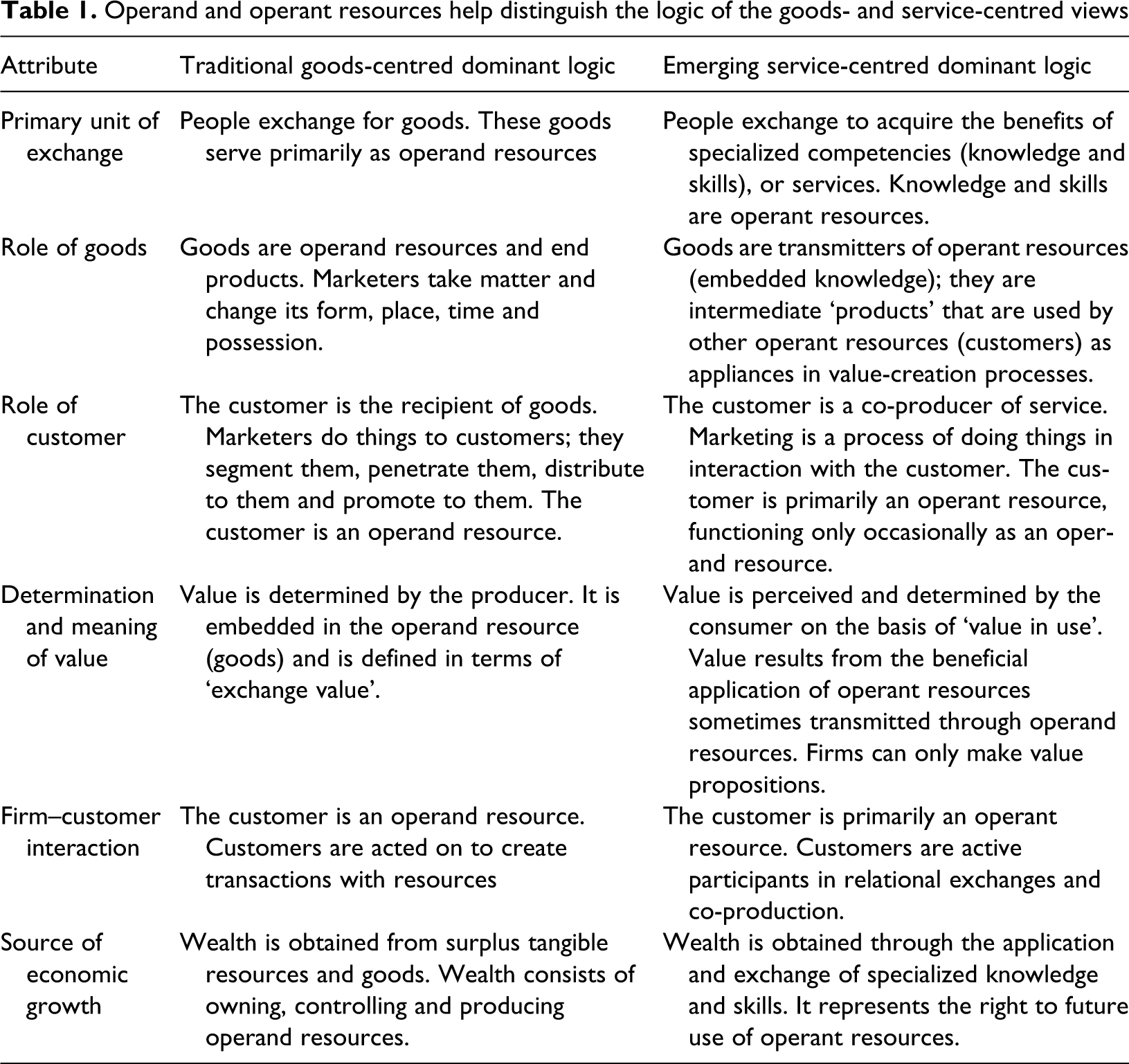
It can be seen from the right-hand column that the six attributes actually add very little to the FPs; the contents of that column merely explain the FPs in more detail. The sole addition to the FPs seems to be a recognition of the customer as an operant resource. But wait: as noted above, Vargo and Lusch have written many articles and book chapters on S-D logic. Maybe there’s something we’re missing that we can’t find in the articles that deal solely with stating and modifying the FPs (Vargo and Lusch, 2004, 2006; Lusch and Vargo, 2006c; Vargo and Lusch, 2008a)?
In one paper (Lusch et al., 2007) a table is given that lists not only the FPs, but the rationale behind each one. Also relevant is a paper (Vargo et al., 2008) that includes the table reproduced here as Table 2.
G-D logic vs S-D logic on value creation
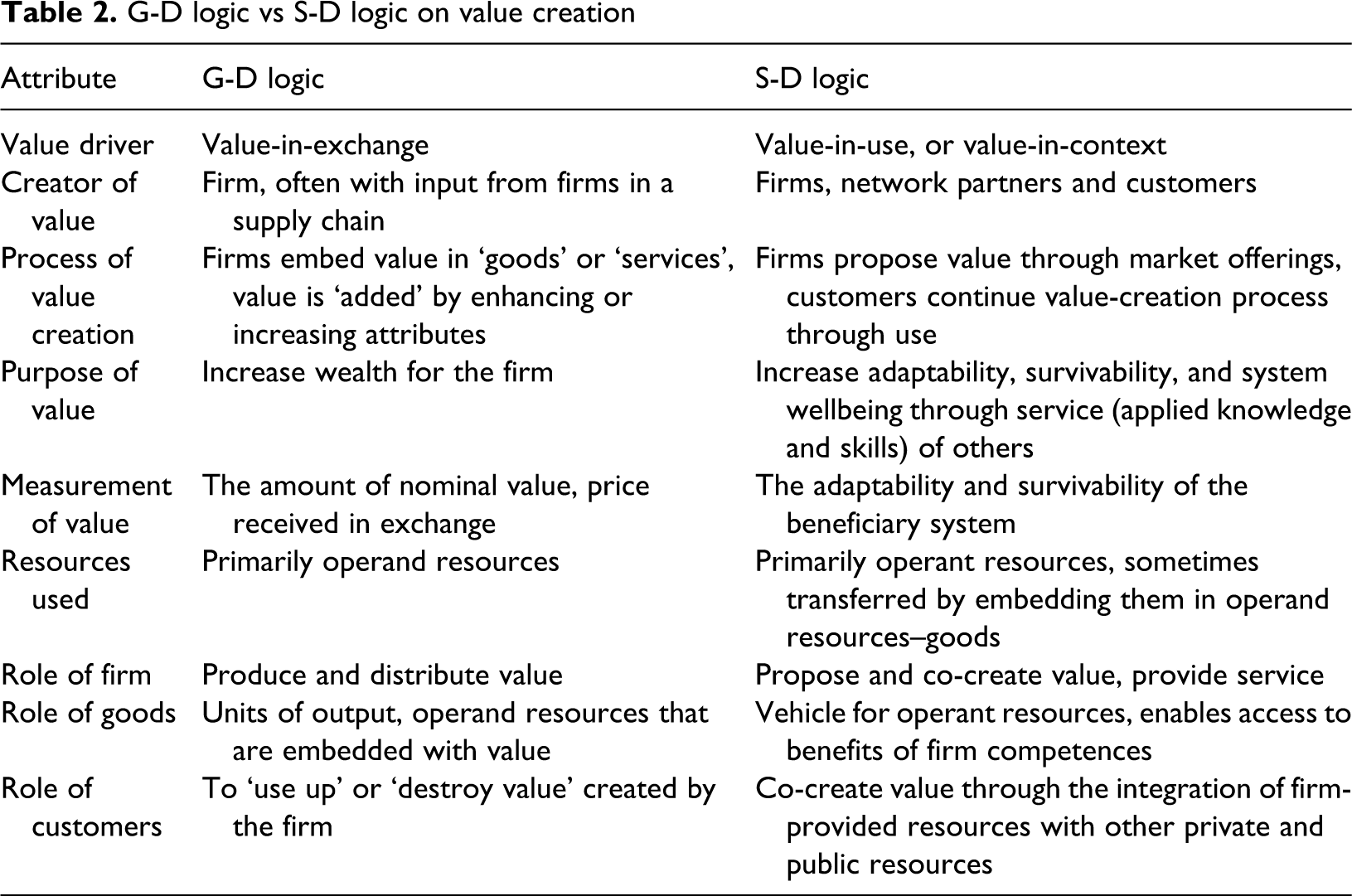
Note that the authors explicitly acknowledge externalities, in particular the use of public resources in the value-creation process. Second, the measure of value is the adaptability and survivability of the beneficiary system (presumably they mean the beneficiary’s system?).
These three points (customer as operant resource, externalities and a normative goal for business) seem to be very important components of S-D logic. However these items do not appear in the FPs. One is tempted to ask ‘why not?’ Could they be implicit somehow in the FPs? This question will be examined below. However, before asking whether such-and-such can be derived from a set of propositions, or are antecedents to determining the truth-value of a proposition (in other words to ask epistemological questions), we should examine the ontological status of the FPs.
The nature of the FPs
Vargo and Lusch are adamant that S-D logic is neither a model, nor a theory nor a paradigm (Lusch and Vargo, 2006a; Vargo, 2007b, 2008, 2011), but they hope it will be the foundation for future theory making. As such it is helpful to consider the ontological status of the FPs.
It appears clear that some of the FPs are statements of empirical fact, inasmuch as this can be said of any socially constructed concept such as ‘value’ and ‘service’. Such FPs as can reasonably be construed as positive statements (i.e. statements about how things actually are) as opposed to normative statements (i.e. statements about how things should be) are FPs 3, 7, 9 and 10. Each of these will be discussed below. Vargo (2007a) has pointed out the futility of trying to develop positive theory on normative foundations, so it is especially relevant to apply this dictum to the FPs.
FP3 (goods are mechanisms for service provision) seems to be very close to the more-or-less standard marketing view that objects have attributes that (potentially) convey benefits (Lancaster, 1966). Is the choice of words ‘convey benefits’ vs ‘renders service’ meaningful? As Vargo and Lusch define service in exchange as the application of operant resources for the benefit of another party, FP3 seems entirely consistent with mainstream marketing thought, and furthermore seems to be simply common sense. As such, it is safe to say that this is an inter-subjectively verifiable ‘truth’.
FP7 (the enterprise cannot deliver value, but only offer value propositions) also seems entirely consistent with not only mainstream marketing thought but also non-specialist ideas about business. It could be expressed as ‘nothing is worth more than what someone is prepared to pay’ or some variation on that sentiment.
FP9 (all social and economic actors are resource integrators) also seems to be a statement with which anyone would agree once the term ‘resource integrator’ was explained. If this simply means someone who combines resources to produce some outcome of value, then this statement seems entirely uncontroversial. The slightly more technical definition as applying operant resources does not alter the main sense of the statement, or its ontological status as a matter of fact.
FP10 (value is always uniquely and phenomenologically determined by the beneficiary) is the last FP that seems to be a simple fact. No-one can tell you what anything is worth to you. Only you can make that determination. Furthermore, the same offering may have a different value for different people (it is this fact that makes exchange possible in the first place); and the value of an offering can vary within people over time. In other words, value is not fixed, in the sense of being objective and immutable. This is not deep philosophy, but a simple fact of life.
The ontological status of the remaining FPs is mixed. Some are, in a sense, content free because they are simply logical consequents of the other FPs, i.e. they are tautologies. Others seem not to be deducible directly from the other FPs without the use of auxiliary hypotheses. These issues will be discussed in the next section.
Relationships between the FPs
To what degree are the foundational premises fundamental? In particular, are some of them conclusions, rather than premises? At the outset it seems fairly easy to see that, for example, if service is the fundamental basis of exchange (i.e. that all exchange is service for service) then a direct, trivial consequence is that all economies are service economies. What does FP5 add, if one already accepts all the other FPs? FP5 is clearly a corollary of FP1.
Taking this approach to analysis further results in the structure of relationships between the FPs as shown in Figure 1, which summarizes the subsequent analysis. There are eight relationships in the figure, labelled a to h. Each of these will be explained below.
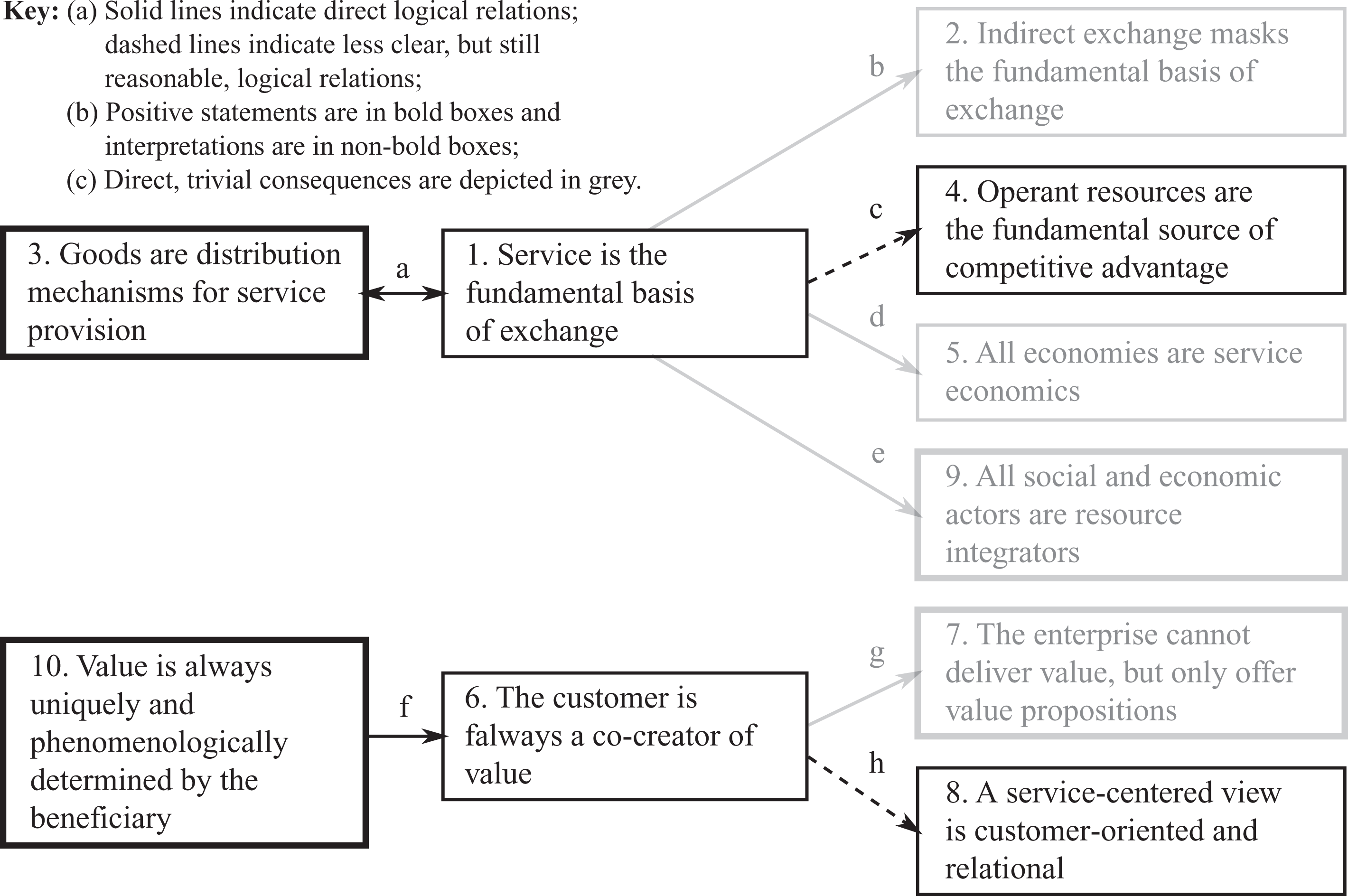
The logical structure of the Service-Dominant logic of Marketing
Most of the relationships are easy to see once they are pointed out, but others may need some further explanation. For a start, three key ideas are essential to understanding the relationships between the FPs: the definition of service as the integration and application of operant resources for the benefit of another party the observation that providing service may or may not involve physical objects and if it does, that physical objects are a means to provide the service (a ‘transmission mechanism’) that objects have no value in themselves, they only have (potential) value inasmuch as they can render service. Value is not stored or exchanged; it is created. Value is not a property of objects or acts; it is a human cognitive process. Given that objects are transmission mechanisms for service (FP3) then it follows that service is the fundamental basis of exchange (FP1). Note that not only does FP3 imply FP1, but also FP1 implies FP3. The only reason that FP3 is on the left in the figure is that it seems prudent to have positive and non-controversial statements as logical antecedents to the more normative premises. If service is the fundamental basis for exchange (FP1), then goods can’t be fundamental, and if they appear to be so, that appearance is false (FP2). The relationship between FP1 and FP4 is less clear. At the outset it would seem that if to create value both operant and operand resources are needed then neither could be said to be more important than the other. If we are considering a competitive situation then competition must be based on providing superior service (the basis of exchange), and because service is the application of operant resources (by definition) then application of superior operant resources is (by definition) superior service. However, one is tempted to say that having superior operand resources could also provide a competitive advantage. Probably the key to resolving this question is to realize that by ‘operant resources’ Vargo and Lusch are thinking particularly of knowledge and skills. With current mainstream acceptance of the concept of the ‘knowledge economy’, this seems to be a fairly uncontroversial claim. Hence application of operant resources is the basis of competition, and therefore possession of superior quantity or quality of those resources is a competitive advantage (FP4). Perhaps most obviously of all the relationships between the FPs, if service is the fundamental basis of exchange, then all economies are by definition service economies (FP5). If all exchange is about service, and service is the application of operant resources (which often include physical objects), then all actors must be ‘resource integrators’ (FP9). A resource integrator is simply an economic actor that combines resources to create value. Hence FP9 is an inescapable consequence of the definitions of ‘service’ and ‘resource integrator’. Because value is determined by beneficiary (FP10), and the beneficiary must have something to value (i.e. the offering), value is in this sense co-created (FP6). In other words, it takes the involvement of both parties for value to be realized for each. However, from a purely logical point of view FP6 does not imply FP10: the (putative) fact that value is co-created by two actors does not imply that one of them is the sole arbiter of value. If value is always co-created by the customer (FP6), then of course the enterprise cannot deliver value unilaterally (FP7). How could it be otherwise? Now we turn to FP8. At first glance FP8 seems to be independent of the whole farmers and fishers story, and is more about how S-D logic fits with the relationship marketing and customer-centricity literatures. These are normative theories of marketing (they say what marketers should do, not how things are).
Now let us examine each of the relationships shown in the figure; first, those that involve service.
Now we turn to the nature of value:
However (Vargo and Lusch, 2008a) assert that FP8 is a positive statement because value is co-created by (at least) two actors; the value creation process is inherently relational. This appears supportable within one meaning of the word ‘relationship’ (in that value is created by the interaction between the actors). The validity of this argument rests, of course, on the acceptance of FP6 (value is always co-created). However, considered in isolation, I contend that FP8 is normative.
However, they also argue that because co-creation of value involves the customer, this makes S-D logic ‘inherently’ customer-centric. It is difficult to follow this line of reasoning. One could, with equal validity, say that because co-creation involves the firm, S-D logic is firm-centric!
Perhaps it is more appropriate or illuminating to say that FP8 shows the consequences that accepting or adopting this view of economics (S-D logic) has for marketing theory, or marketing practice. It forces us to regard the customer not just as a source of cash for the firm, but rather as a source of value in a wider sense. Moreover, it forces firms to recognize the customer as central to value creation. Finally, by taking value-creation processes as the fundamental unit of analysis for marketing thought, it forces us to think in terms of relationships rather than exchanges.
You will note that there are no relationships linking FP1 or FP3 with FP10 or FP6. No simple chain of reasoning is apparent that will show one of these to be direct consequences or antecedents of each other. So we can conclude that: FP3 does not seem to imply FP10; nor does FP10 seem to imply FP3. Hence FP3 and FP10 are axioms (premises) and the other FPs are conclusions.
Note that the way the logical relationships between the FPs as depicted in the figure is not the only way to configure them. In particular, FP1 could be made the left-most (and hence the more fundamental) without loss of meaning.
Reconfiguring the FPs
As discussed above, it appears that only two of the foundational premises of Vargo and Lusch are truly foundational, in the sense of being logically prior to the other premises. So it seems as though one way we could usefully reconfigure the FPs is as follows:
Axioms:
A1 Goods are distribution mechanisms for service provision.
A2 Value is determined by the beneficiary.
Direct consequences (or corollaries):
DC1 Service is the fundamental basis of exchange.
DC2 The customer is always a co-creator of value.
Indirect consequences (or corollaries):
IC1 All social and economic actors are resource integrators.
IC2 A service-centred view is customer oriented and relational.
IC3 Indirect exchange masks the fundamental basis of exchange.
IC4 All economies are service economies.
IC5 Operant resources are the fundamental source of competitive advantage.
IC6 The enterprise can only make value propositions.
This goes some way from transforming the FPs from a flat list that gives no indication of the relative importance of the items into something more structured and hence understandable and memorable. Now, can we do more? From the analysis depicted in Figure 1, we can see that four of the FPs are positive and relatively uncontroversial statements (FPs 3, 7, 9 and 10). They do not give S-D logic its defining character in that they are not unique to S-D logic. Furthermore, three of the FPs (FPs 2, 5 and 7) are trivial consequents of one or more other FPs. So, in a sense more than half (6 out of 10) of the FPs do not describe the essence of S-D logic. The four FPs that do are: FP1 (service is the fundamental basis of exchange) and its consequence, FP4 (operant resources are the fundamental source of competitive advantage). FP6 (the customer is always a co-creator of value) and its consequence, FP8 (a service-centred view is customer-oriented and relational).
These premises, I contend, are the essence of S-D logic. They are essential because they are non-trivial and normative statements that are predicated on positive statements. But given that they are normative, are they also contentious?
More than any other element of S-D logic, the FP that most people have trouble with is that labelled DC2 above. Countless times the objection is raised that can be exemplified as ‘If I buy a can of beans, how have I co-created that?’ The immediate response of the student of co-creation is that it is the value that is co-created, not the physical product; in other words, S-D logic emphasizes value-in-use, rather than value-in-exchange. (Vargo and Lusch are now using the term value-in-context; see Chandler and Vargo (2011), for example). This is important because traditionally marketing management theory has emphasized the exchange aspect (i.e. transactions) as opposed to the use (specifically: the needs that prompt the consumer to engage in exchange, and how the market offering satisfies those needs). The consumer behaviour (and, more specifically, consumer culture) literature has of course long engaged with these questions as being central (Arnould, 2006; Arnould et al., 2006). In my experience, once this point is explained, the objection to S-D logic disappears.
What, then, is to be gained from reconfiguring the FPs? First, and most importantly, it makes S-D logic easier to understand and communicate, to scholars, students and practitioners. Second, it makes further development of S-D logic more clear, if by ‘development’ we mean adding to, deleting or rewording the FPs. The more important premises have been separated from those of lesser importance. Perhaps even more importantly, now that the fundamental FPs have been identified, it can be made clear that S-D logic is not an empirical theory or model. The essential FPs cannot be proved or disproved by recourse to the empirical world. They are simply ways of looking at empirical phenomena, in much the same way as looking at a glass of water and saying that it is half full (as opposed to half empty).
Now that we’ve examined the FPs and their relationships to one another, let us now consider whether the FPs can reasonably be considered to encapsulate the essence of S-D logic. In particular, recall the additional features of S-D logic that resulted from our analysis of Tables 1 and 2, namely: explicit recognition of the role of externalities in value creation that the customer should be viewed as a ‘primarily’ operant resource of the enterprise the normative goal of business as survivability (rather than profit maximization).
Can any of these features be deduced directly from the FPs? Or do some auxiliary hypotheses have to be brought into play? It seems to me that none of these three aspects of S-D logic can be deduced from the FPs as they are stated in their short forms (as displayed in Figure 1). Are they then logically distinct from the FPs?
The clue to resolving this problem lies in FP8. It seems to be an outlier among the FPs in that it is the most overtly normative, and without a clear derivation from its antecedent. What do Vargo and Lusch mean by ‘relational’ and ‘customer-oriented’? These terms mean simply that S-D logic recognizes that (a) the customer is the source of value for the enterprise (Levitt, 1960); (b) long-term exchange relationships provide superior value (Grönroos, 1994). But students of S-D logic will only come to this realization after reading (and rereading) the core S-D logic literature, spread over several papers and book chapters.
The three features of S-D logic listed above seem to be consistent with both customer-centricity and relationship marketing, and reading the articles that deal with developing the FPs does give one an insight into the spirit of S-D logic – or should that be the spirit of its authors? While it seems clear from their works, taken together, that these ideas are coherent, it does not seem clear (to me) that the pro-consumer, pro-society features listed above are a function of the logic per se, if one can take ‘the logic’ to be the FPs taken in isolation and at face value.
Discussion
We have seen that the truly essential, fundamental, FPs are those that relate to the concepts of (1) value and (2) service. Similarly we have seen that some fairly important and (to many) attractive features of S-D logic do not appear to be directly derivable from the FPs.
What is the function of the FPs? If it can be reasonably assumed that they constitute the S-D logic manifesto, in other words their function is to communicate the core ideas as succinctly and coherently as possible, then we have seen that there is some room for improvement.
The originators of S-D logic, Stephen Vargo and Robert Lusch, have stated that they don’t own it and that it is not complete (Lusch and Vargo, 2006a: 287). Also, it is ‘Open Source’ (Vargo and Lusch, 2006: 51). In Open Source software development the source code to any software must be made available to everyone at no charge. Anyone can take and modify the source code, and even sell their modified version, as long as they redistribute their modified version to others with the same rights as they enjoyed when they acquired the original code: in particular, the source code must be provided, and the modified version must be clearly differentiated from the original version (i.e. not just the same name of the software but with a later version number). Alternatively, they can help improve the original code by modifying it and submitting their changes (a ‘patch’) back to the maintainers of the project for review. The latter route is what usually happens. However, if sometimes the maintainers are unhelpful or have different views from the majority of patch contributors, the contributors may ‘fork’ the project. This happened recently with the LibreOffice fork of OpenOffice: see Clarke (2011), for example.
The concept of source code does not apply to theoretical academic research (because there is no corresponding compiled, non human-readable machine code). Presumably what Vargo and Lusch mean by this is that anyone can take their ideas and modify them, as long as they give their modifications back to ‘the community’. But this is exactly how academia works anyway: scholars critique and modify each other’s work (especially models and theories) all the time. So one is led to the conclusion that what they really mean is that they want to encourage others to help develop S-D logic. It is the purpose of this article to respond to that call. This article is, in effect, a patch to S-D logic that will be submitted to the maintainers of the project. This patch will be reviewed and then maybe applied, or maybe rejected. To my knowledge, a direct modification of the FPs has only been proposed once before (Williams and Aitken, 2011), and to date there has been no public comment from Vargo and Lusch on that proposal.
Continuing the software development analogy, when a project has been in existence for a long time there is the urge to add extra features, to enhance the utility of the software. But this comes at a cost: the code base becomes larger and hence harder to understand and maintain. This makes bugs more likely to occur, and makes finding and fixing them harder. This phenomenon is known as ‘creeping featurism’. The ‘creeping’ part denotes that it happens slowly, and the cost of adding just one more feature does not seem that great. However, in time the code accumulates ‘cruft’, i.e. bits of code that were added hastily and are now seen to be not ideal; or code that was once needed is needed no more. But it is still there, serving no purpose. Hence, periodically the maintainers announce an effort to ‘refactor’ the code base in order to make it more easily maintainable, and to ‘clean out the cruft’.
It seems evident from the above analysis that S-D logic has bugs, in the sense that some important claims about S-D logic are not directly derivable from the FPs; and that it has accumulated cruft, in the sense that some of the FPs are redundant. Hence it will benefit from refactoring. The suggestions that I’ve made above can be considered as patches that will be submitted to the maintainers, but are also open to the scrutiny of the community.
Specifically, the preceding analysis has shown that the FPs contain some logically redundant statements; in particular it seems that FPs 2, 5 and 7 are such trivial consequences of the other FPs that they could be dropped without loss of information, if the FPs are intended to be the minimal set of axioms from which the rest of S-D logic can be derived. This would be a useful first step in developing an axiomatic and logically consistent theory of markets and marketing, and perhaps even micro-economics.
More importantly, we have seen that some of the oft-claimed attributes of S-D logic (recognition of externalities, customer as operant resource, non-profit-maximization) are not directly derivable from the FPs as they currently stand. It seems that there is an urgent need to modify the FPs (adding, changing or deleting some of them) so that this situation is remedied.
Stephen Vargo has recently stated that the time has come to try to ‘nudge S-D logic from framework to theory’ (Vargo, 2011: 218), and that is the stated goal of a series of conferences, the Forum on Markets and Marketing. It is my hope that the analysis described above can serve to further those efforts by enabling theorists to concentrate on (a) what is essential, and (b) constructing theory as a small set of propositions that are mutually consistent and comprehensive.