



Abstract
Extant literature has studied how customer–salesperson price negotiations evolve in “normal” circumstances. However, recent economic recessions illustrate the need to advance theory on the question of how price negotiations evolve in “abnormal” times when customer demand significantly contracts beyond expected variation. In response to this gap in the literature, this study uses a multi-method design to investigate price negotiations during exceptional demand contractions. Our results from a theories-in-use study reveal that during such circumstances, salespeople’s perceived dependency on customers increases while customers’ perceived dependency on salespeople decreases. The inherent “power shift” should benefit customers in subsequent price negotiations. However, customers are less likely to capitalize on their power if they have a close relationship with a salesperson, implying that salespeople do not have to concede on price negotiations. This effect is likely due to increased sympathy during periods of exceptional demand contractions. The authors further validate key propositions from this qualitative study in a field study and a scenario-based experiment. Altogether, this study suggests that managers should not be too hasty in approving and encouraging salespeople to offer unnecessary price discounts during exceptional demand contractions as buyers may become more sympathetic and lenient during price negotiations.

At the heart of many business-to-business (B2B), customer–salesperson interactions are price negotiations. In fact, there is an abundance of practitioner articles and books that offer salespeople advice and guidance on how to best negotiate pricing (e.g. Mohammed 2020). Despite these practical recommendations, sales managers remain concerned with the “B2B discount conundrum” (Wong 2016), and avoidance of discounting is an important metric against which they are measured and evaluated (CSO Insights 2014).
Given the high importance of price negotiations to managerial practice, the marketing academy has put a strong focus on explaining price negotiation outcomes. For example, prior research has shown that negotiated prices depend on negotiation tactics (Lawrence et al. 2021; Wieseke, Alavi, and Habel 2014) as well as buyer and seller firm characteristics (e.g. Alavi et al. 2018, 2020; Kassemeier et al. 2022; Wieseke, Alavi, and Habel 2014). Notwithstanding these important contributions, the sales literature remains silent about the impact of the economic context on customer–salesperson price negotiations.
Toward that end, the economic context examined in this study is that of exceptional demand contractions, which we define as periods during which markets experience significant decreases in customer demand beyond expected variation. To illustrate, in May 2020, attributed to the COVID-19 pandemic, B2B spending in the United States had fallen by 13.6% year-over-year (Solomon 2021). As another example, consider how during the financial crisis of 2008–2009 the economy in the United Kingdom declined by 6% in just over a year, which resulted in high unemployment rates and pay freezes (ONS 2018). For the purposes of this study, we focus solely on sales negotiations during demand “contractions” (and not “expansions”), as these instances have been overlooked in the extant literature.
How do such exceptional demand contractions affect a firm’s price negotiations? On one hand, as demand decreases, excess supply may lead customers to request lower prices (Dekimpe and Deleersnyder 2018), putting immense pressure on salespeople’s price negotiations. 1 On the other hand, firms may defend their price levels more aggressively because during exceptional demand contractions it becomes even more “critical that companies figure out how to protect and increase revenues—not just containing or cutting costs” (Andersen et al. 2020, p. 1). This may impose a further challenge for salespeople because limiting price reductions during an exceptional demand contraction might create unintended damage to their customer relationships (e.g. defection). The complexity of this issue and the countervailing perspectives render the broad question “How do exceptional demand contractions affect customer–salesperson price negotiations?” managerially relevant and theoretically intriguing.
To address this question, we conduct three empirical studies (see Figure 1 for an overview of our multi-method approach). Due to a lack of existing guidance in the literature and to gain rich first-hand insights, we begin with Study 1 by conducting in-depth interviews with sales professionals to gather personal experiences and reflections from a recent exceptional demand contraction and uncover practitioners’ mental models (Zeithaml et al. 2020). To expand on Study 1 and to offer an initial quantitative test of the qualitative findings, we next examine secondary data of sales opportunities gathered from an industrial manufacturer’s CRM system (Study 2). Finally, we used a scenario-based experiment (Study 3) to test the role of perceptual constructs revealed in Study 1 that we could not test in Study 2. Overview of multi-method approach.
Our results indicate that exceptional demand contractions lead to a “power shift” that favors customers over salespeople due to changes in perceived relative dependency (Emerson 1962). Power swings even more so towards customers as a salesperson’s perceived importance of the sale increases and a customer’s importance of the purchase decreases. This power shift encourages customers to exploit their increased power position during price negotiations with salespeople (e.g. Jap et al. 2013). However, the salesperson–customer relationship emerges as a key boundary condition. Specifically, in close relationships, customers desist capitalizing on their increased power during exceptional demand contractions, possibly, due to the moral and social implications of doing so (Harmeling et al. 2015). In other words, the customer becomes less focused on the price negotiation, and more focused on “doing the right thing” which manifests as helping the salesperson through challenging economic times. This finding is surprising because it challenges and qualifies past literature that suggests customers with close relationships feel entitled to receive better prices and negotiate harder to obtain them (Wetzel, Hammerschmidt, and Zablah 2014; Wieseke, Alavi, and Habel 2014). Thus, during exceptional demand contractions, customer motivations during price negotiations seem to shift, depending on the pre-existing relationship closeness with a salesperson.
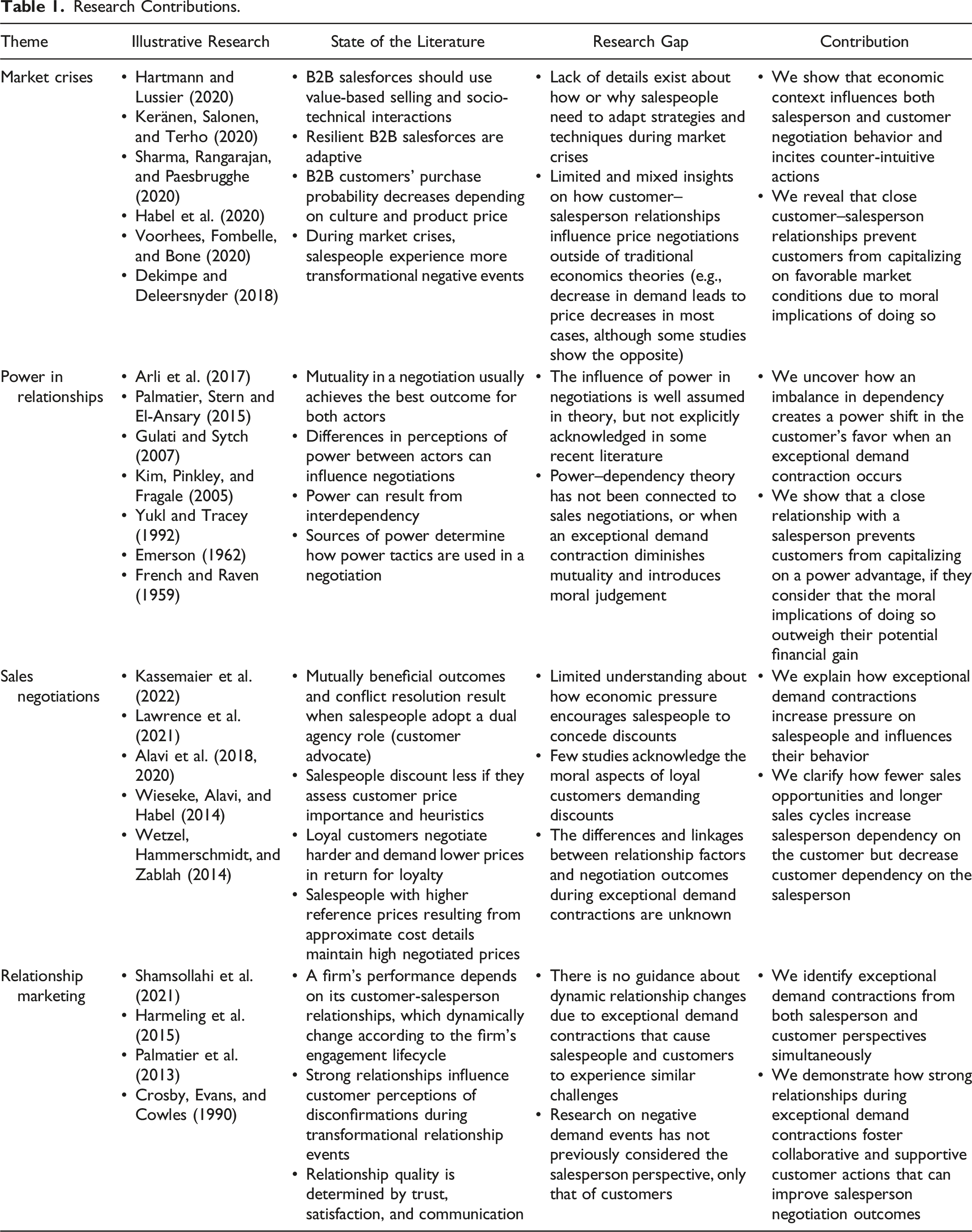
Research Contributions.
Exceptional Demand Contractions
The focus of our study is on exceptional demand contractions, which we define as periods during which markets experience significant decreases in customer demand beyond expected variation. Integral to this definition, we use the label “exceptional” to pronounce the abnormal and high impact nature of these market reductions. As such, an important characteristic of an exceptional demand contraction is that it creates a heightened sense of uncertainty for individuals and businesses alike. During these difficult and surprising economic times, demand tends to drop much faster than supply (depending on the industry) and there is a need for quick individual and organizational action in order to ensure a successful response (Steenkamp and Fang 2011).
Exceptional demand contractions can disrupt economic activities in marketplaces (albeit not always to the same scope and level of intensity), create economic turmoil, and result in “sudden and dramatic socioeconomic surprises” (Grossman 2015, p. 57). In this study, we are not interested in differentiating between the nature or cause of a shock event, but rather the unforeseen economic consequences (i.e. exceptional demand contractions) that arise because of such events. That is, we focus on the adverse economic conditions that are intrinsic to exceptional demand contractions regardless of the detectible source or root of the problem itself.
The broad notion of economic contractions has been examined in the marketing literature (e.g. Steenkamp and Fang 2011). Although the literature does not specifically consider “exceptional” demand contractions, it does suggest that economic contractions in general can have negative (e.g. consumer responses, limited budgets, firms cutting advertising) or positive (e.g. increased R&D investments and product innovations) outcomes. However, this research has strictly considered consumer-level and organization-level consequences. At the same time, recent research has acknowledged that crises have a profound impact on personal selling and interfirm relationships (Das et al. 2021; Grewal et al. 2021; Pedersen, Ritter, and Di Bendetto 2020). It remains to be known how such crises affect customer–salesperson price negotiations.
Toward that end, our research begins to explore the effect of exceptional demand contractions on customer–salesperson interactions, particularly negotiations, where we use exceptional demand contractions associated with the COVID-19 pandemic as our empirical context to offer insights into the price negotiations that occur between customers and salespeople during abnormal economic times. In so doing, we respond to calls in the literature for further research that investigates the effectiveness of marketing strategies during “down economic times” (Bradlow 2009), the impact of crises on interfirm (e.g. customer–salesperson) relationships (Grewal et al. 2021), and the implications of abnormal times on “people” involved in marketing practice (Das et al. 2021).
Study 1: Qualitative Investigation
To develop a deeper understanding of customer–salesperson price negotiations during an exceptional demand contraction, we use a theories-in-use and grounded theory approach (Corbin and Strauss 2014; Zeithaml et al. 2020). Grounded theory is a pragmatic qualitative approach to building theoretical models that are “grounded” in the mindsets of both the researcher and participants (Zeithaml et al. 2020).
Data Collection
Our primary data source was a series of semi-structured interviews, which remained flexible as participants’ recollections unveiled intriguing insights that warranted further exploration and a more unstructured approach. We undertook a multi-step inquiry (McCracken 1988) to gather the experiences of salespeople and customers in the European B2B industrial technology sector. Participants were selected and recruited through personal contacts of the authors from a network of individuals, sufficiently qualified and experienced to provide a meaningful perspective for this study. As participants predominantly worked in Small-Medium Enterprises (SMEs) with global supply chains 2 , they all noticed reductions in customer demand across their firm, and not solely in relation to their own business unit. By focusing on the European context, we minimized any cultural- or country-specific differences that were not central to our investigation. Participant experiences were consistent irrespective of their organization, and no further confounding factors were identified in their responses.
We conducted the interviews over a 2-week period in early September 2020, approximately 6 months into the COVID-19 pandemic. As a result, participants’ responses largely focused on their experiences during this extreme period. Within this timeframe, participants had experienced the most rapid period of adjustment to an exceptional demand contraction and had started to reflect on how customer–salesperson price negotiations had been affected. The interviews focused on changes in supply and demand of products and services (Habel et al. 2020), buying and selling processes and methods (Zoltners, Sinha, and Lorimer 2008), and customer–supplier relationships (Obal and Gao 2020). Using common ethnographic techniques, we asked questions that broadly introduced the topic of the discussion, served as planned prompts, and enabled open, discovery-oriented discussions that captured individual perspectives (McCracken 1988). A semi-structured interview guide which included, as an example, questions about, “How have relationships between salespeople and customers evolved over recent months?” helped to set the tone of the interview. The interview guide converged into a more unstructured interview approach in which probing questions such as “Why is it easier/harder to sell to these customers now?” led to open discussions about price and contractual negotiations including specific experiences and explicit examples. The interviews ranged from 30 to 60 min and were audio-recorded and transcribed verbatim.
Through purposeful sampling (Patton 2015), the selection of interviewees sought diversity in tenure, position, and seniority. We conducted the interviews until we reached theoretical saturation (Zeithaml et al. 2020). In the end, we conducted in-depth interviews with 22 professional B2B industrial technology salespeople and customers, which is an adequate sample size given the recommended range of 15–25 participants (Zeithaml et al. 2020). Our sample included 7 salespeople, 2 customers, and 13 managers who perform dual agency roles and hence could provide both buyer and seller perspectives. By including participants with experiences from both of these perspectives, we were able to capture a more balanced set of responses and identify differences as well as similarities in perceptions between salespeople and customers. As experiences and insights shared from those with a dual agency role corroborated with those performing either solely a sales or customer role, there are no concerns about biasing or misrepresentation in the selection sample. The age of the participants ranged from 25 to 63 years, and their company/industry tenures ranged from 1 to 45 years (for more details on participants, see Web Appendix W1.2).
Data Analyses
We analyzed the data simultaneous to conducting the interviews because each interview led to new routes of discovery within each subsequent discussion (Zeithaml et al. 2020). Initially, we read the transcripts without coding them to form a general impression of the data; this approach ensured consistency throughout our analyses and guided the initial coding process. Then, to ensure integrity in our analyses, we followed the well-established and rigorous steps of the Corbin and Strauss (2014) grounded theory approach (see Web Appendix W1.3 for sample coding process). NVivo 12 software was used for the formal coding process. Web Appendix W1.4 describes the trustworthiness checks employed (Zeithaml et al. 2020). During the first stage of analysis (open coding), we conducted a detailed, line-by-line evaluation of recorded words and phrases, to generate descriptive, in vivo, process, and structural codes (Saldaña 2013). We clustered the open codes into related concepts and then grouped them again into broader and similar categories. We constantly compared codes, concepts, and categories, following an iterative process to ensure that we remained “grounded” in the data. In the second stage, we conducted axial coding by assembling the categories from the first stage into conditions, interactions, and consequences in order to determine the properties and dimensions of each category (Corbin and Strauss 2014). As part of this stage, we reorganized categories and subcategories and aggregated them into higher-level “meta” categories (Saldaña 2013), before carrying out a selective coding process (third stage), in which we harmonized the categories to streamline them into primary themes and weave a pervasive narrative. This resulted in a theoretical model that encapsulates themes, linkages, and narratives.
Overview of Findings
Figure 2 depicts the model revealed by our analyses. It suggests that exceptional demand contractions increase market uncertainty, which initially manifests as fewer sales opportunities and longer sales cycles. In such circumstances, as customers generally have a reduced need to purchase, this results in changes in perceived dependency which shifts power toward customers. This power shift then affects price negotiation outcomes for sales opportunities that do persist; the effects of which are contingent on the relative importance of that sale to each party. Notably, customers’ decision to exert power depends on the closeness of their relationships. Our model suggests that, during periods of exceptional demand contraction, despite the power advantage for customers, close relationships can prevent customers from capitalizing on the situation, thus reducing the pressure on salespeople to negotiate on price. In the following sections, we elaborate on each of these findings. Study 1 theories-in-use model. Notes: Our model highlights how the effects of an exceptional demand contraction manifest into changes in dependency between customers and salespeople that create a power shift which is the starting point within a price negotiation. For example, both “Fewer Sales Opportunities” and “Longer Sales Cycles” can influence both salesperson and customer perceived dependencies according to the context through cross-over effects. To illustrate, a reduction in sales opportunities means salespeople have to increase their conversion rate for opportunities that remain, rendering them more dependent on customers to be more forthcoming with the information that the salesperson needs to secure the sale. Simultaneously, as there is less pressure on customers to make a procurement decision, they can independently research their options, rendering them less dependent on salespeople. The power shift subsequently sets the tone of the negotiation process, which is influenced by the relationship closeness, to determine the negotiated price outcome.
Exceptional Demand Contractions
All participants in our investigation indicated that they had experienced at least one exceptional demand contraction for products and services in their careers, the most recent being associated with the COVID-19 pandemic. During such periods, market uncertainty increases, and companies become more risk averse (Habel et al. 2020). Consequently, salespeople experienced (1) a reduced number of opportunities in their sales funnel due to spending cuts as customers became “extremely cash conservative” (Ben), but also (2) lengthened sales cycles (i.e. sales process durations) for each sales opportunity as delays or cancelations of non-essential purchases were implemented until market uncertainty and the financial risk reduced. As expected, these insights from salespeople align with those of prior literature, including a decreasing likelihood of purchase—especially for high-priced items (Habel et al. 2020)—and purchase delays (Obal and Gao 2020) in response to crises.
The Increase in Perceived Salesperson Dependency on Customers
Of greater interest is that fewer sales opportunities and longer sales cycles change the perceived dependency between salespeople and customers. Dependency arises when “actor A aspires to goals or gratifications whose achievement is facilitated by appropriate actions on actor B’s part” (Emerson 1962, p. 32). We refer to perceived dependency due to the subjective nature of each actor’s assessment of the situation. These perceived changes in mutual dependency constitute a power shift from salespeople to customers, with vital implications for selling practices. As the number of sales opportunities decreases and sales cycles extend, salespeople perceive greater dependency on customers, due to both (1) increased pressure to source and secure new sales opportunities, and (2) reduced communications with customers disrupting the flow of information salespeople need to achieve their sales targets.
Increase in pressure
For salespeople, an increase in perceived dependency on customers results from an increase in pressure because sales targets become harder to achieve when sales opportunities decline and sales cycles lengthen. Our participants described such pressure as a combination of applied managerial pressure and self-inflicted pressure: There is a lot more pressure now to make the numbers, because of … the lack of opportunities effectively. I get a lot more phone calls from my boss going, “how is that sale going ... and where are the numbers for this and where are the numbers for that?” (Graham, Sales Manager)
Increased pressure stemming from the lack of sales opportunities and delayed sales cycles increased salespeople’s focus on chasing new opportunities to refill their shrinking pipelines, such as pursuing projects that usually would have been outside their scope, with dubious success. There are other things that we have tendered for that we perhaps would have said no to previously. We haven’t been successful in any of them, which perhaps shows why we stopped tendering in the first place. (Francis, Group Manager, Salesperson)
Our findings complement research by Voorhees, Fombell, and Bone (2020), who identify negative effects of pressure on salespeople’s resilience and morale, which influence sales approaches and attitudes. Furthermore, Rostami, Gabler, and Agnihotri (2019) demonstrate that pressured salespeople expend greater effort and find more creative ways to solve sales-related challenges particularly in periods of high uncertainty. This is akin to findings by Epler and Leach (2021) who refer to similar actions as salesperson bricolage—when salespeople make do with limited resources and reconfigure them according to the challenge or opportunity they encounter. We add to this literature by identifying how increased pressure on sales performance increases salespeople’s perceived dependency on supportive customer interactions which influences their approach to customer engagement.
Communication challenges
Participants underscored how communication challenges disrupted the flow of sales information between customers and salespeople and reduced the number of high-quality interactions. As a result, salespeople felt they had to increase their communications efforts to minimize their dependency on customers and exert influence. For example, Matthew, a Sales and Business Development Manager, observed that “you don’t necessarily know who you need to talk to at a company.” Such communication challenges reported by participants result from a lack of availability of their normal contact person due to retrenchment. As opportunities for good communication decrease, salespeople are less able to influence customers, thereby rendering the salesperson dependent on the customer to initiate and engage in sales interactions.
The Decrease in Perceived Customer Dependency on Salespeople
While exceptional demand contractions increase salespeople’s perceived dependency on customers, customers in turn perceive less dependency on salespeople. This is because for sales opportunities that continue to proceed, customers (1) have more time to research alternatives independently, and (2) gain more favorable purchase terms, as salespeople compete for fewer opportunities in the marketplace.
Researching alternatives
Longer sales cycles create more time for customers to research alternative solutions and source quotes from multiple suppliers. This extended time enables them to improve their knowledge and awareness without the need for salespeople’s input. Some customers adapted their purchasing policies too, which lengthened the procurement cycle as they had to obtain quotes from several suppliers to secure the best deal. At times, this was merely an exercise, as Steve, a purchaser, noticed that “even though we know what we want … we have to go out to tender … to show we’ve done our due diligence.”
These findings complement previous studies that explain the pros and cons of dealing with better informed customers (e.g. Graham 2005). We expand on this research by recognizing these effects in the context of exceptional demand contractions. According to our participants, when customers have more time available to research their options, salespeople’s input becomes less important, thereby reducing customers’ perceived dependency on salespeople.
Favorable purchase terms
Fewer sales opportunities and longer sales cycles increase market competition for salespeople who are pursuing the same sales opportunities. Participants admitted to being offered discounts more readily than usual. For example, Francis, a Group Manager, observed that “a couple of [suppliers] have offered us discounts on things that they wouldn’t normally offer discounts on to try and secure more work.” Similarly, Ivan, a Project Manager, noted “you’d get a better deal now than you would do last year for most companies.”
Here, we begin to see how a power imbalance encourages salespeople to preemptively offer discounts signaling their dependency on the customer. Thus, the lack of mutuality in dependency between customers and salespeople shifts power substantially, as predicted and explained by power–dependency theory. According to Emerson (1962, p. 32), power is “the amount of resistance on the part of actor B which can be potentially overcome by actor A.” Existing conceptualizations of power largely reflect three main perspectives (Kim, Pinkley, and Fragale 2005). 3 The first perspective, developed by French and Raven (1959), suggests that there are power bases that determine an actor’s ability to manipulate the behavior of others using specific sources of power. The second perspective, developed by Yukl and Tracey (1992), asserts that power comprises various influence tactics. Finally, Emerson’s (1962) view, now known as power–dependency theory, asserts that power is a function of dependency among actors.
Considering the nature of the dependency between salespeople and customers as found in our interviews, the third perspective fits our findings best. 4 Specifically, Emerson’s (1962, p. 32–33) model of power–dependency states that “The power of A over B is equal to and based upon the dependence of B upon A.” As both previous research and our findings show, mutual dependency is key to customer–salesperson relationships (e.g. Anderson, Lodish, and Weitz 1987). We show that mutuality becomes less pronounced during exceptional demand contractions as dependency shifts away from customers and toward salespeople. This shift occurs because on the one hand, the customer’s obligation to contribute to reducing their firm’s exposure to financial risk causes them to reduce their purchase demands (Shen et al. 2020), yet simultaneously, salespeople’s obligation to help mitigate the financial risks for their firm and themselves in terms of job losses, increases their need to secure sales opportunities. Hence, the economic context determines the power–dependency relation which is the foundation for the ensuing sales negotiation.
Importance of Sale and Purchase Moderate Power–Dependency Shifts
Our analyses reveal that the extent to which exceptional demand contractions alter perceptions of dependency (and thus power) between salespeople and customers is dependent on the relative importance of the sale and the purchase.
Importance of the sale
The effect of fewer sales opportunities and longer sales cycles on salespeople’s perceived dependency is contingent on the importance of the sale to salespeople, as determined by (1) sales control systems that specify how salespeople’s performance is assessed and (2) the strategic advantage a sale offers the firm.
Sales control systems are either outcome-based or behavior-based (Anderson and Oliver 1987). Outcome-based systems remunerate salespeople for achieving targets at the end of the sales process, whereas behavior-based systems adopt a staged activities approach, assessing various performance metrics throughout the sales process. Our interviewees reported mostly outcome-based systems, with mixed approaches to adjusting targets to reduce pressure on salespeople given the economic circumstances. Because we’re selling low volumes of high value items, one sale one way or the other can make a big difference. If you think you’re going to get one sale and suddenly you don’t, that’s a very big hole to fill. (Graham, Sales Manager) Yes, there has been pressure on us as a sales team to perform, but our targets have also been reviewed and amended in light of the circumstances. It was clear by that they were no longer realistic. (Kevin, Sales Manager)
Recent studies show salespeople perceive considerable pressure if they are uncertain about achieving their sales targets which can impair their performance (Habel, Alavi, and Linsenmayer 2021a). We support these studies and find that salespeople, whose performance is measured against outcome-based measures, feel even more dependent on customers unless their firms relax or adapt sales targets.
Some sales opportunities can be strategically important to a salesperson’s firm, such as if they promise to enhance its reputation or improve its market position, and salespeople may feel greater pressure to secure these opportunities over others. In such cases, strategic importance manifests as the associated benefits to the salesperson’s firm, for example, by pursuing diversification or growth strategies: We can get more out of our supply chain because they are willing to work with us. They recognize that they are getting revenue from selling us equipment, but also the kudos of working with a renowned business. (Alex, Business Development Manager, on his experiences with his suppliers)
Importance of the purchase
The extent to which longer sales cycles decrease perceived customer dependency is contingent on the importance of the purchases to firms’ customers, which is determined by both competitive intensity and necessity. Participants identified that niche products indicate low competitive intensity within the market, because customers have limited alternatives. This renders them dependent on suppliers and salespeople. With our kit, there are competitors, but they’re not direct competitors. You know, somebody that needed [Company A] for a project wouldn’t buy [Company B], for example. (Carl, Managing Director, on his sales experiences with his customers)
Such limitations also apply to necessary purchases in B2B industrial manufacturing and technology industries, such that customers remain dependent on salespeople to facilitate the purchase. Our findings in this regard also align with Emerson’s (1962) power–dependency theory. Emerson explains that dependency is directly proportional to the outcome at stake (i.e. importance of the sale to the salesperson) and inversely proportional to the availability of this outcome through alternative sources (i.e. importance of the purchase to the customer).
The Power Shift Affects Customer–Salesperson Negotiations
Customers in our sample not only perceived their own reduced dependency but also were aware of salespeople’s increased dependency (e.g. “our suppliers are keen to sell again” [Alex]). Salespeople’s conscious and unconscious actions, such as issuing ultimatums and pushing customers too hard, can reinforce such perceptions. As a result, many customers decided to capitalize on their power by asserting price discounts from salespeople. For example, Elizabeth, a Sales Manager, recalled that “a couple of blanket emails [from customers] were sent out, quite firm emails actually, [saying] that [they] expected discounts in these trying times, and [suppliers] need to be very supportive and reactive.” Representing the purchasing side, Alex admitted that “we’re able to delay the procurement of other things and then use that to leverage better pricing.”
The extent to which customers succeed in capitalizing on their power depends on salespeople’s reactions to the power shift. As customers attempt to exert power over salespeople to secure a better deal for themselves, a salesperson either concedes to customer demands and their exertion of power, or attempts to regain power and exert control over negotiations. In our sample, salespeople used both strategies (see Web Appendix W1.5 for a deeper discussion). Yet, their increased perceived dependency commonly led them to succumb to customer power by reducing prices. We’ve always said we are not the cheapest to do business with. I don’t know if that’s true anymore. (Ben, Regional Manager, on his sales experiences) We’ve introduced some lower rates for some of our work, where we would previously put a higher margin on but haven’t just to ensure that we are competitive. We’re not in the situation to really pick and choose what we want to do. (Francis, Group Manager, on her sales experiences)
The Pivotal Element: Relationship Closeness
According to prior literature, close relationships are particularly prone to negotiations for better prices. In close customer–salesperson relationships, customers’ awareness of their pronounced importance to a salesperson leads them to perceive increased power and expect improved negotiation outcomes, such that they negotiate prices down over time (Anderson and Jap 2005; Wetzel, Hammerschmidt, and Zablah 2014; Wieseke, Alavi, and Habel 2014). If we apply this reasoning to our findings, we might infer that the closer the customer relationship, the more the power shift affects customer–salesperson negotiations, leading prices to decrease even more.
However, our results indicate the opposite. That is, as demand contracts, customers in close relationships with salespeople are more lenient in price negotiations. This is because a close relationship, defined by mutual trust and long-term commitment (e.g. Arli et al. 2017; Gulati and Sytch 2007), leads customers to show unforeseen understanding and sympathy for the pronounced challenges that salespeople are experiencing. Understanding and sympathy are cultivated in close relationships, particularly when there is a high degree of relatedness or commonality (Small 2011). Participants indicated an increase in sharing personal experiences with close customers during the exceptional demand contraction which increases the likelihood of identifying relatedness and commonality and reinforces feelings of sympathy. Thus, customers were more able to recognize and understand the specific challenges that were beyond the control of the salesperson and, subsequently, worked more cooperatively to solve issues. For example, consider the following quotes that illustrate the idea of such sympathy from customers toward salespeople. You have potentially awkward discussions [with customers], but it’s wrapped up much more nicely with “How are you?” That’s a genuine question now. They’re honest and they say, “This is really tough, really hard”. That wouldn’t have happened before. (Elizabeth, Sales Manager) Customers have been really good. They understand that it is out of everyone’s hands. (Harry, Applications Manager)
Importantly, in our context, the salesperson’s personal challenges were akin to the customer’s personal challenges making them more relatable. For example, Kevin observed that his close customers were “fairly understanding—they’re all experiencing the same problems as well,” which Oliver elaborates on: During the crisis, humans change—they are more amenable to each other. They’re more willing to do favors… We’re all helping each other out. (Oliver, Managing Director, on his sales experiences)
Transaction cost theories which underpin new institutional economics suggest that self-serving actions arise when the realized benefits of an interaction exceed its costs. However, our findings indicate that while customers could gain more by capitalizing on their power, doing so exacerbates the salesperson’s struggle, leading customers to reduce their self-serving tendencies. This suggests that the customer’s cost–benefit analysis goes beyond financial and instead comprises socioemotional considerations. This is consistent with research suggesting that in close business relationships, relational expectations increase, rendering opportunistic behavior increasingly unacceptable (Gulati and Sytch 2007; Harmeling et al. 2015).
This finding also has important implications for the negotiator’s dilemma (Kaufmann 1987), in which negotiators must balance the need to improve their economic outcomes while still securing ongoing relationships with negotiation partners. In normal times, salespeople are reluctant to force high prices on customers; they want to avoid threatening close relationships (Wieseke, Alavi, and Habel 2014). But in times of exceptional demand contractions, customers who show understanding for salespeople do not strive for larger discounts and lower prices, despite their own personal challenges and firm’s financial constraints. In essence, the human factor, which evokes feelings of sympathy and kindness, dominates the business mindset when economic circumstances become challenging.
Study 2: A First Quantitative Test of Our Qualitative Insights
Propositions and Future Research Considerations.


Conceptual framework.
Research Context
The supplier that we partnered with produces and markets machinery that shapes sheet metal. The firm’s customers are primarily SMEs that come from various industries that use sheet metal in production, such as automotive and electronics—industries which experienced exceptional demand contractions during the COVID-19 pandemic (e.g. Wayland 2020). The supplier has more than 10,000 employees and 70 subsidiaries across various countries; it serves customers through a field-based salesforce, with every customer being served by a dedicated account manager. The sales process starts with salespeople identifying an opportunity in their territories, that is, specific customer demands they could fulfill. Salespeople log these opportunities into a CRM system, including products and proposed prices, and update the entries regularly.
For our analyses, we use 3664 sales opportunities won between January 1 and 31 December 2020, across 32 countries. In that year, due to the COVID-19 pandemic, the supplier faced significant month-on-month contraction and expansion of demand, illustrated by a fluctuation in newly generated sales opportunities as well as sales cycles (see Web Appendix W2.1 and W2.2). We capitalize on these fluctuations and examine how the price realized for each opportunity depends on the current market conditions.
Measures
Dependent variable
We measure the negotiated price as the final price charged for the product which an opportunity pertains to (NegotiatedPrice). To account for different currencies, we z-standardize the variable within countries.
Independent variables
We extract each salesperson’s newly generated sales opportunities (Opportunities) in the month before winning the focal opportunity as a count variable from the CRM data. Such opportunities reflect a salesperson’s new sales potential. Furthermore, we measure the sales cycle (SalesCycle) for won opportunities as the number of days an opportunity had been open until it was won.
Moderator
We approximate the closeness of the relationship between a customer and the firm as the sales revenue generated with a customer in the prior 3 years (PriorRevenue). Again, to account for different currencies, we z-standardize the variable within countries. Prior research has frequently used sales revenue with a customer as an indicator of the relationship closeness. For example, Schmitz et al. (2020) show that a disruption of a close relationship between a customer and a salesperson decreases sales revenue.
Control variables
We include several controls to reduce omitted variable bias. First, we control for the intensity of the COVID-19 pandemic in terms of a country’s regulatory response. We operationalize the pandemic intensity using the publicly available Oxford COVID-19 Government Response Tracker (OxCGRT 2020). This index (OxCGRT) is calculated from 14 indicators related to countries’ containment and closure policies, economic responses, and health systems. 6 It is scaled from 0 to 100, with higher values indicating a more intense government response and thus a higher likelihood of contracting demand. It provides an index for more than 180 countries on a daily level starting 1 January 2020. We aggregated the index on a country–month level by calculating the mean.
Study 2 Descriptives and Correlations.

*p < 0.05, **p < 0.01 (two-tailed).
aStandardized within countries.
bLog-transformed.
cWe z-standardized these variables within countries to account for different currencies. Web Appendix W2.3 reports country-specific means and standard deviations before the z-standardizations.
Model Specification
Our data comprises 3664 won sales opportunities, which are nested in 2408 customers, who are nested in 377 salespeople, who are nested in 32 countries. Furthermore, the 3664 won sales opportunities are nested in 430 products and in 12 months. We specify the following model
Results
Study 2 Results.

Note. FE = fixed effects. SE = standard errors. SE in parentheses.
*p < 0.05, **p < 0.01, ***p < 0.001 (two-tailed).
If our qualitative investigation and theorizing holds, we should observe b3 to be negative and b4 to be positive. That is, as demand contracts (indicated by a decreasing number of opportunities and lengthening sales cycles), prices should be less likely to decrease if relationships are close (indicated by the level of prior sales revenue with a customer). As to the first, the interaction effect between opportunities and prior sales revenue is negative and significant across all models (b3 = −0.045, p < 0.05). This suggests that as demand contracts and the number of open opportunities decreases, prices are less likely to decrease if the prior sales revenue is high. In fact, at a high level of relationship closeness (M + 1 × SD), the main effect of opportunities on negotiated price becomes negative (b1 = −0.041, p < 0.05). This finding aligns with our proposition from Study 1 that close relationships shield against eroding prices when demand contracts; and with the findings from prior literature that close relationships can erode price levels otherwise (e.g. Wieseke, Alavi, and Habel 2014).
Second, the interaction effect between the sales cycle and prior sales revenue is non-significant (b4 = −0.005, p > 0.05). Thus, we find no support for the proposition from Study 1 that the increasing sales cycle contributes to the power shift toward customers. Instead, in the company that we examine here, the power shift seems to be driven solely by the decrease in the number of opportunities.
Robustness Checks
Because our dataset comprises 2408 customers, we observe approximately 1.5 opportunities per customer on average (min = 1, max = 35). This number may be too low to draw meaningful inferences when including customer fixed effects. Hence, we specified an alternative model in which we replace customer fixed effects by fixed effects for the 377 salespeople in our dataset. Repeating our prior approach, we cluster the errors at the level of salespeople (Model 4), salespeople and months (Model 5), or salespeople, months, and products (Model 6). The interaction effect between opportunities and prior sales revenue is negative and significant across all models (b3 = −0.010, p < 0.05), while the interaction effect between sales cycle and prior sales revenue is non-significant (b4 = −0.014, p > 0.05). This substantiates the robustness of our results.
Supplemental Analyses
We reran our model for the years of 2018 and 2019, when the supplier operated under normal circumstances and thus fluctuations in opportunities and sales cycles are likely due to expected cyclicality of business rather than exceptional demand contractions. In both years, our results do not replicate, as our two focal interaction effects (Opportunities × Prior sales revenue, Sales cycle × Prior sales revenue) are non-significant. This further supports the special influence of relationship closeness on price negotiation outcomes during exceptional demand contractions.
Study 3: Experimental Replication and Extension
The previous studies have two limitations that Study 3 aims to address using an experimental approach. First, both of our preceding studies utilized experiences of an exceptional demand contraction triggered by the recent COVID-19 pandemic. This instance of an exceptional demand contraction is unique in that it presents a rapid and global humanitarian risk, which may challenge the generalizability of the results found in Studies 1 and 2. As such, in Study 3, we further test our theoretical model for an unspecified trigger of an exceptional demand contraction. Second, the data used in Study 2 did not afford us the opportunity to quantitatively test the perceptual constructs (e.g. increase in customer negotiation power relative to the salesperson) revealed in our qualitative study. With an experimental study, however, we can test the key finding from Study 1 that that a power shift interacts with relationship closeness in shaping price negotiations (see Figure 3). Table 2 lists the propositions tested in this study.
Method
Stimuli and procedure
We developed an online scenario-based experiment in Qualtrics which was disseminated via Prolific. We screened participants according to their country of residence (limited to the United States and United Kingdom), their employment status (employed only), negotiation experience, and decision-making responsibilities in either operations/production or supply chain/logistics. Each participant who met the selection criteria was randomly assigned a scenario describing one of four treatment conditions in a 2 (power shift: low vs. high) × 2 (relationship closeness: not close vs. close) between-subjects design. Specifically, we instructed participants to imagine that they intended to purchase a piece of industrial equipment from a salesperson from one of their suppliers and that they had a choice to negotiate on the price offered (the full experimental stimuli are provided in Web Appendix W3.1).
The online experiment generated a total of 200 responses, which consisted of 109 (54.5%) males and 91 (45.5%) females with an average age of 41 years (SD = 11.3), an average industry tenure of 7 years (SD = 6.7), and an average buying experience of 6.6 years (SD = 8.2).
Measures
Based on the circumstances described in their assigned scenario, participants submitted a price that they would offer the salesperson. From this negotiated price measure, we calculated each participant’s discount claim as the difference between the salesperson’s requested price (fixed to $50,000 for the same equipment purchase across all scenarios) and the customer’s price offer. Thus, the effect on discount request is the outcome variable in our model. Since this study is a scenario-based experiment, our ultimate dependent variable is the participants’ initial price offer rather than the ultimate negotiated price identified in Studies 1 and 2. Given that initial price offers correlate with ultimate price outcomes due to setting an anchor point for the price negotiation (e.g. Galinsky and Mussweiler 2001), we purport that the use of our measure is justified. It is also consistent with other price negotiation studies which adopt a similar approach to utilizing this type of outcome measure (e.g. Alavi et al. 2020).
To test the mechanism linking the power shift in combination with a customers’ price offer, we also include a measure of sympathy with the salesperson (named Bill in the scenario). Specifically, based on the scale by Darden et al. (1991), “I would feel…” (1) “… sympathy for Bill,” “… compassion for Bill,” “… concern for Bill.” This measure was found to be reliable (M = 4.3, SD = 1.4, α = 0.92, AVE = 0.80; 7-point scale).
Results
We initially ensured that the manipulations worked as intended. To that end, we evaluated relationship closeness using four 7-point Likert scales adapted from Guenzi and Pelloni (2004) (“Bill and I know each other very well,” “Bill and I experience a close relationship,” “Bill and I are likely to have good rapport,” “Bill and I are considered to be friends,” α = 0.971, AVE = 0.896). This measure is significantly higher in the high-closeness than in the low-closeness conditions (Mlow = 2.175, Mhigh = 5.635, t = −27.137, p < 0.001). We evaluated a buyer’s negotiation power using three 7-point items adapted from Ford and Johnson (1998) (“In a potential price negotiation, I think that …” “… I can exert power over Bill,” “… I have a power advantage over Bill,” “… I can easily influence Bill,” α = 0.924, AVE = 0.811). This measure is significantly higher in the high-power shift than in the low-power shift conditions (Mlow = 4.210, Mhigh = 5.160, t = −5.991, p < 0.001). Furthermore, we asked participants to indicate their agreement with the statement that negotiation power had shifted to their advantage, yielding similar results (Mlow = 4.265, Mhigh = 5.902, t = −10.521, p < 0.001). Thus, all manipulations worked as intended. In addition, the participants perceived the scenario to be realistic (M = 5.5, SD = 0.93), thought that it could happen in the real world (M = 5.8, SD = 1.04), and could easily picture themselves in it (M = 5.58, SD = 1.04).
Moving to the results of the experiment, Figure 4 presents the mean values for our measured variables across the experimental cells (Panel A: discount claim; Panel B: sympathy with the salesperson). A two-way ANOVA reveals that a customer’s discount claim is significantly driven by our manipulation of the power shift (F(1, 196) = 19.110, p < 0.001), relationship closeness (F(1, 196) = 21.861, p < 0.001), and the interaction of the two (F(1, 196) = 6.514, p = 0.012). Furthermore, three contrasts are significant: (1) When the relationship closeness is low, the discount claim is significantly higher for high compared to low power shift (t = −4.896, p < 0.001); (2) when power shift is high, the discount claim is significantly higher for a low relationship closeness compared to high relationship closeness (t = 5.126, p < 0.001); (3) when power shift is high and relationship closeness is low, the discount claim is significantly higher than when power shift is low and relationship closeness is high (t = 6.361, p < 0.001). Study 3 results. Note. 0 = low, 1 = high.
Similarly, a two-way ANOVA reveals that sympathy with the salesperson is significantly driven by our manipulation of the power shift (F(1, 196) = 12.804, p < 0.001), relationship closeness (F(1, 196) = 37.647, p < 0.001), and the interaction of the two (F(1, 196) = 5.888, p = 0.016). Furthermore, four contrasts are significant: (1) When power shift is low, sympathy is significantly higher for a high compared to a low relationship closeness (t = −0.2.562, p = 0.011); (2) when power shift is high, sympathy is significantly higher for a high compared to a low relationship closeness (t = −6.080, p < 0.001); (3) when relationship closeness is high, sympathy is significantly higher for a high compared to low power shift (t = −4.246, p < 0.001); (4) when power shift and relationship closeness are high, sympathy is significantly higher than when power shift and relationship closeness are low (t = −6.834, p < 0.001).
Lastly, we test whether sympathy with the salesperson mediates the effect of the power shift × relationship closeness interaction while bootstrapping the standard errors with 5000 iterations. The indirect effect of the power shift × relationship closeness interaction on the discount claim via sympathy with the salesperson is significantly negative (bindirect = −902.710, p = 0.045). Thus, in line with our findings in Study 1, sympathy with the salesperson provides a potential explanation as to why customers in close relationships do not negotiate as hard when power shifts to them.
General Discussion
Summary of Results
Taken together, the findings of our three studies indicate that during an exceptional demand contraction, changes in external factors prompt customer firms to implement risk-averse actions that reduce the number of sales opportunities in a market and lengthen sales cycles. The former change affects customer–salesperson perceived dependency, which creates a power shift in the customer’s favor that is moderated by the relative importance of the sale. Negotiation ensues, in which the negotiated price hinges on prior relationship closeness. That is, in contrast to “normal” economic circumstances, customers with close relationships reduce their self-concern and desist capitalizing on their improved power positions. As such, salespeople can possibly avoid having to concede on price negotiations during periods of exceptional demand contraction.
Research Implications
This study makes several contributions to the extant marketing and sales literature (see Table 1). First, it provides new academic insights into how exceptional demand contractions affect customer–salesperson interactions in light of market crises (Das et al. 2021; Hartmann and Lussier 2020; Keränen, Salonen, and Terho 2020; Sharma, Rangarajan, and Paesbrugghe 2020). Particularly, as salespeople are essential for business continuity (Gregg, Kim, and Perrey 2020) and have the potential to turn crises into opportunities (Andersen et al. 2020), we build on several recent works examining the effect of market crises on salesforces. Shen et al. (2020) and Dekimpe and Deleersnyder (2018) also find that increased market uncertainty prompts customer firms to implement risk-averse actions leading to fewer sales opportunities and longer sales cycles. While extant literature advises salespeople to adapt and become more resilient to exogenous shocks (Sharma, Rangarajan, and Paesbrugghe 2020), we go on to describe the specific changes sales managers should accommodate, such as reducing pressure on salespeople (Voorhees, Fombell, and Bone 2020) by changing sales control systems, and how such changes will shape sales negotiations.
Second, we demonstrate that the real-world phenomenon of selling during exceptional demand contractions can be explained by power–dependency theory (Emerson 1962). Sales funnel changes diminish mutuality (Anderson, Lodish, and Weitz 1987; Palmatier, Stern, and El-Ansary 2015), which affects customer–salesperson perceived dependency. On one hand, salespeople experience fewer opportunities to influence customers and thus become more dependent on customers to provide sales opportunities that help them achieve sales targets. On the other hand, customers become less dependent on salespeople, because they have more time available to research and source alternative solutions in a market that favors them. These changes create a power shift toward customers, which they can exploit in ensuing negotiations (Emerson 1962). To the best of our knowledge, researchers have not applied power–dependency theory to customer–salesperson negotiations specifically during exceptional demand contractions. Our research provides new insights into the application of power–dependency theory. In particular, we complement studies on embeddedness (e.g. Gulati and Sytch 2007), which identify how joint (or mutual) dependency influences relational interactions and can lead to better performance outcomes when actors desist exploiting power advantages. While we identify some synergies with the embeddedness literature—namely, improved negotiation outcomes and similar moral actions that are mediated by relationship quality (Gulati and Sytch 2007)—our contextual settings differ. We find that similar outcomes can be achieved when dependencies are not mutual and have shifted as a result of an exceptional demand contraction.
Third, we advance theoretical understanding of customer–salesperson negotiations, elucidating that the outcome depends on prior customer relationship closeness. When demand exceptionally contracts, customers experiencing close relationships with salespeople demonstrate less self-serving behaviors, and deem capitalizing on their improved power positioning a moral violation under the circumstances (Gulati and Sytch 2007; Harmeling et al. 2015). Thus, despite the advantageous economic context for customers, salespeople have an opportunity to avoid unnecessary discounting, while simultaneously maintaining and even strengthening close relationships with these customers. This finding qualifies prior literature that indicates loyal customers negotiate harder and get better prices (Wieseke, Alavi, and Habel 2014). We add a new facet to this dynamic by finding that during exceptional demand contractions, if customer–salesperson relationships are strong, customers are more lenient in their price negotiations, due to the negative moral implications of exploiting a salesperson who is already struggling, and the shift in focus towards moral instead of financial benefits of the transaction. Therefore, without the need to offer high discounts, it is salespeople who can experience a better financial outcome overall, while simultaneously strengthening their close customer relationships. Our findings align with laboratory studies that show close relationships facilitate more collaborative negotiations (e.g. Greenhalgh and Chapman 1998), whereas previous research reveals some inconsistencies in laboratory and field studies regarding the role of customer relationships in price negotiations (Wieseke, Alavi, and Habel 2014). Is it possible that simulated environments in laboratory studies foster behaviors that extend to the field during exceptional demand contractions? This question offers an intriguing avenue for further research.
Fourth, transaction cost theory explains that self-serving actions arise when the realized benefits of an interaction exceed its costs (Gulati and Sytch 2007). Our results indicate that while customers in close supplier relationships could gain more financially by capitalizing on their power, they avoid doing so during exceptional demand contractions. It could be argued that such actions indicate an issue of incompetence. However, similar to the notion of forbearance, a more detailed explanation may be a change in customers’ cost–benefit assessments as identified by Jap et al. (2013). They find that financial benefits are negated by emotional benefits due to “morally malleable reasoning.” In our context of exceptional demand contractions, customers may perceive that the human emotional benefits achieved through helping struggling salespeople outweigh the financial benefits they could realize for their company through exploiting a power advantage.
All in all, the findings should be interpreted considering the institutional context of our empirical studies. In both Studies 1 and 2, the buying organizations were mostly small-and medium-sized family businesses. Such family businesses do not make decisions purely based on economic reasons, but, rather, based on their motivation to preserve “socioemotional wealth” (SEW; e.g. Berrone, Cruz, and Gomez-Mejia 2012; Cennamo et al. 2012; Kupp, Habel, and Schmitz 2019). One aspect of SEW is the family firms’ social relationships, which include “time-honored vendors and suppliers, who may be viewed as, or might actually be, members of the family” (Berrone, Cruz, and Gomez-Mejia 2012, p. 263). Perhaps, our studies observe SEW theory in action. That is, when relationships with suppliers are close and thus SEW is high, the buyers in our sample capitalized less on their elevated power position in order to preserve their SEW—even if it puts them at a potential disadvantage economically. This line of thinking opens interesting avenues for future research: Do our results generalize across different ownership types (e.g. publicly traded, private equity) and sizes (e.g. large enterprises) of buying firms? Even more broadly, against the backdrop of SEW theory, sales research could more frequently examine the influence of SEW dimensions on phenomena such as price negotiations (e.g. Alavi et al. 2018, 2020), digital selling (Chaker et al. 2022), value and relational selling (e.g. Delpechitre et al. 2018; Habel, Alavi, and Linsenmayer 2021b), and sales leadership (Badrinarayanan et al. 2020; Guenzi et al. 2019).
Managerial Implications
The insights from this study might help sales managers make more informed choices about their sales priorities and activities during exceptional demand contractions. First, to improve a firm’s “resilience to economic adversity” (Dekimpe and Deleersnyder 2018) salespeople in B2B industrial technology firms should be encouraged to foster close relationships with their customers during “normal” times. Building trust and long-term commitment (Arli et al. 2017) upfront could protect firms during an economic downturn by alleviating tough price negotiations.
Second, when customer relationships are close, salespeople who are open and show their vulnerability to customers with whom they have good relationships, can evoke sympathy and understanding. In doing so, salespeople inherently encourage customers to replace self-serving behavior with sympathetic behavior meaning customers are less likely to capitalize on their improved power position during a negotiation. Moreover, when interacting with these customers, salespeople may avoid offering high discounts during price negotiations, because customers are likely to become more lenient as they understand salespeople’s precarious situations.
Third, for customers with whom salespeople have distant relationships, managers should help to reduce their salespeople’s perceived dependency on the customer. For example, we recommend firms and sales managers reduce pressure on salespeople by lowering sales control and performance assessment expectations (Habel, Alavi, and Linsenmayer 2021a). This minimizes the need to secure sales opportunities at all costs (e.g. giving high discounts) and the risk of exposing a customer’s advantage. By reducing salespeople’s dependency on customers, managers can decrease the power shift toward customers and improve negotiation outcomes.
To minimize power shifts, salespeople and customers should avoid disclosing the relative importance of the sale to the other party. In practice, salespeople often proclaim the importance of their customers, for example through loyalty schemes or discounts, and customers often proclaim the importance of particular goods or services, for instance through user case studies. However, our findings suggest that both parties should reconsider this approach as it highlights dependencies that could be exploited. Similarly, salespeople may have an opportunity to ask close customers for help or “call in favors” occasionally as their willingness to comply might reinforce relationship closeness. Nevertheless, this approach should only be adopted when the salesperson has a genuine need for help, otherwise it might be perceived as manipulative and risks dissolving trust within the relationship.
Limitations and Future Research
Several limitations of our study present opportunities for further research. First, the generalizability of our findings requires further testing. Our data sources include B2B industrial manufacturing firms only, so ongoing research needs to test the applicability of our theory to other industries, such as retail, travel, and hospitality. Some industries, such as online communication platforms and home delivery services, may experience positive demand surges instead of a contraction (e.g. Braithwaite 2020). Because our model is unlikely to explain how crisis scenarios stimulate this boom in demand, further studies might develop corresponding theories for these economic conditions and industries. Also, since our insights are largely based on data collected in a SME context, future research should consider whether and how our model holds up and evolves in larger firms.
Furthermore, our emphasis in this study was exclusively on price negotiations, and, while we shed light into how this transpires during exceptional demand contractions, it must be acknowledged that salespeople across industries may negotiate other aspects of a deal (e.g. better payment terms, delivery, add-ons) that create value for customers. In Web Appendix W1.4, we provide a brief discussion and share examples around how such “additional incentives” were requested by customers and offered by salespeople during exceptional demand contractions, but future research should expand on these preliminary findings and explore how other aspects of a negotiation beyond price play a key role during exceptional demand contractions. Along these lines, although our research identifies the importance of customer–salesperson relationship closeness in price negotiations, it would be fruitful for scholars to investigate other potential factors (e.g. availability of alternatives) that create a shift in power dependence. In addition, given that our research focused on and offered insights into exceptional demand contractions, we urge future researchers to consider the other side of such economic contexts and examine more of the supply related impacts.
Finally, Table 2 demonstrates that while some of the propositions highlighted in our theoretical model developed in Study 1 could be quantitatively tested through our second and third studies, we indicate two propositions that remain to be tested and lend themselves to future research opportunities. Specifically, P5 and P6 indicate that we did not specifically explore the importance of the sale and purchase respectively on the power–dependency shift between salespeople and customers. Future quantitative testing of these propositions could unveil further insights on how the context surrounding a negotiation process can influence negotiation outcomes during exceptional demand contractions.
Supplemental Material
Supplemental Material - Customer–Salesperson Price Negotiations During Exceptional Demand Contractions
Supplemental Material for Customer–Salesperson Price Negotiations During Exceptional Demand Contractions by Claire Cardy, Nawar N. Chaker, Johannes Habel, Martin Klarmann, and Olaf Plötner in Journal of Service Research
Supplemental Material
Supplemental Material - Customer–Salesperson Price Negotiations During Exceptional Demand Contractions
Supplemental Material for Customer–Salesperson Price Negotiations During Exceptional Demand Contractions by Claire Cardy, Nawar N. Chaker, Johannes Habel, Martin Klarmann, and Olaf Plötner in Journal of Service Research
Footnotes
Declaration of Conflicting Interests
The author(s) declared no potential conflicts of interest with respect to the research, authorship, and/or publication of this article.
Funding
The author(s) received no financial support for the research, authorship, and/or publication of this article.

Supplemental Material
Supplemental material for this article is available online.
Notes
Author Biographies
References
Supplementary Material
Please find the following supplemental material available below.
For Open Access articles published under a Creative Commons License, all supplemental material carries the same license as the article it is associated with.
For non-Open Access articles published, all supplemental material carries a non-exclusive license, and permission requests for re-use of supplemental material or any part of supplemental material shall be sent directly to the copyright owner as specified in the copyright notice associated with the article.
